



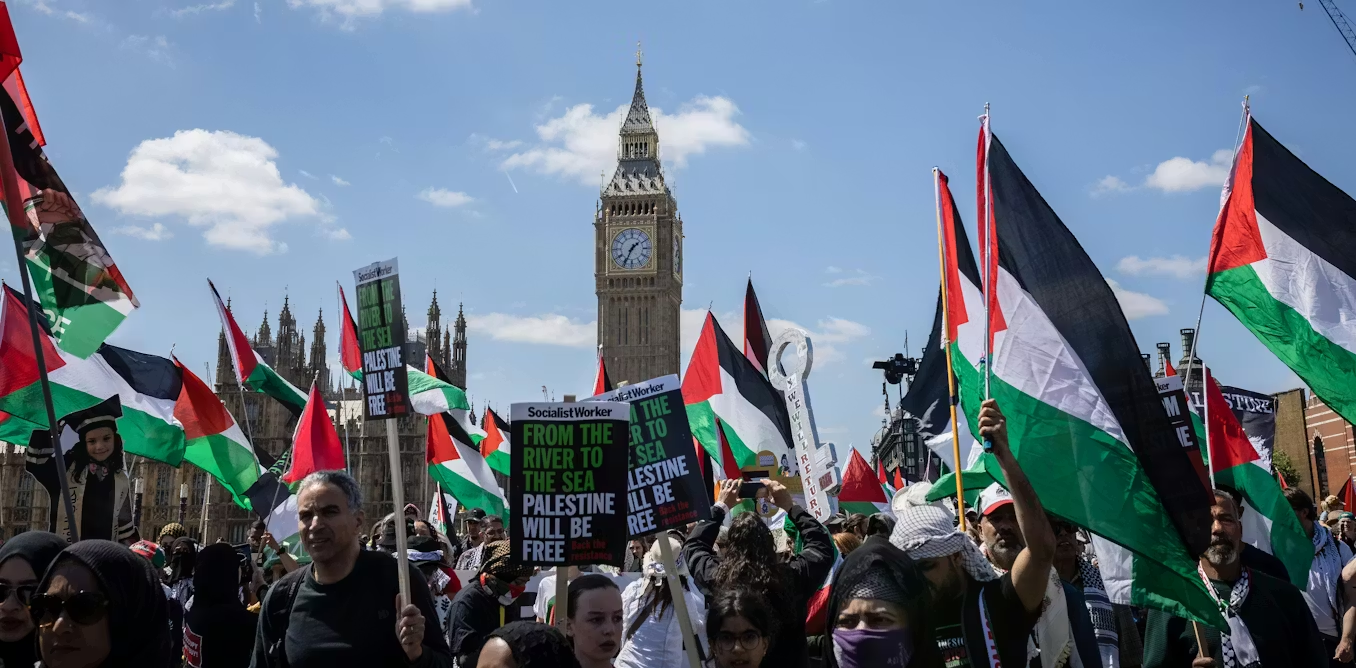
Following recent antisemitic violence and aggression, calls from some quarters for a temporary ban on pro-Palestine marches have gained traction. Conservative party leader Kemi Badenoch has firmly supported a ban, while
Keir Starmer, the prime minister, has suggested that some protests may need to be stopped. The government’s independent reviewer of terrorism legislation has called for a moratorium on such marches.
Those who have made such calls do so on the grounds that pro-Palestine marches, whatever their intent, are contributing to a “tone of Jew hatred within our country”, in the words of Chief Rabbi Sir Ephraim Mirvis. Starmer has also expressed concern about the “cumulative” effect of the marches on Jewish communities.
This is an understandable position in some ways. There can be little denying that some participants in pro-Palestine events have articulated antisemitic positions. And in a period where more clearly needs to be done to address antisemitic violence and aggression, a ban appears to provide a way for authorities to send a clear message that there is no place for antisemitism in Britain today.
Yet there are also problems with such proposals. As policymakers consider their options, it is important that these problems are taken seriously.
Evidence on the relationship between protest activity and targeted violence outside of the protest arena is limited. The available evidence points to a complex and context-dependent relationship.
Some studies have found that when protests increase, extremism and extremist violence can also rise, especially when society is more divided. Such a pattern has been observed, for example, in the US, where the bipartisan thinktank the Center for Strategic and International Studies identified heightened protest activity and rising domestic terrorism during the early 2020s.
However, many studies of nonviolent protest show that it reduces political violence, by providing nonviolent means of pursuing social and political objectives.
Where heightened protest activity coincides with increased extremist violence, it is often unclear whether protests or marches themselves are the cause. Today, people participating in social movements are likely to access and share information through a range of (often unregulated) spaces both offline and online. It is difficult to assess how important protests themselves might be in influencing people to go on to engage in targeted violence.
This is not simply academic nitpicking. It means that it is possible that a ban on marches would have little to no effect on the use of targeted violence against Jewish communities.
In fact, there is a distinct possibility that banning pro-Palestine marches, even if only temporarily, might actually increase violence.
Studies show that violence is less likely to escalate when moderate groups within protest movements are present and have influence. This has been observed, for example, in research into the escalation or inhibition of violence during waves of far-right protest.
Expanded state repression – such as bans on certain forms of previously legal protest – can weaken the position of moderate factions. When this happens, calls for restraint and advocacy of non- or less-violent strategies can lose credibility within the movement, weakening the “internal brakes” on violence.
Practicalities of enforcement
A moratorium on pro-Palestine marches would also raise many questions about the practicalities of any restrictions. For one, calls on the police to ban other contentious demonstrations that risk hostility towards different groups would increase.
What particular types of action would be banned? Marches? Demonstrations? Would size be a factor? Would it cover a protest against the ban on the protest? What about other forms of action such as sit-ins, information stands or coordinated online action? And what sanctions would be imposed on those who did not comply?
Attempting to enforce such bans could become a significant drain on already stretched public resources, not least because activists would probably seek to increase pressure on authorities because of those costs. This is one of the most obvious lessons to draw from responses to the government’s attempts to ban the group Palestine Action.
À lire aussi :
Labour wants to restrict repeat protests – but that’s what makes campaigns successful
In addition to this, police have also recently been authorised to consider the “cumulative impact” of protests on local areas when policing. They have had to grapple with how and when to incorporate this in addition to their usual powers.
Before introducing a ban, it’s important to think about the example it would set and how it could influence future decisions about the right to protest. The UK would be less able to criticise authoritarian countries and illiberal democracies that misuse counterextremism and counter-terrorism powers that limit people’s freedom.
None of this is to deny the urgency of confronting antisemitic violence and aggression in the UK. This requires sustained political commitment, effective policing and community protection. But restricting the right to protest is a blunt and risky instrument.
The available evidence suggests it may do little to reduce harm and could, in some circumstances, make matters worse. Politicians should therefore be cautious before treating bans on marches as a solution to complex and deeply rooted problems.












































You must be logged in to post a comment Login