
Crypto World
HYPE eyes breakout toward $50 as Open Interest and TVL surge

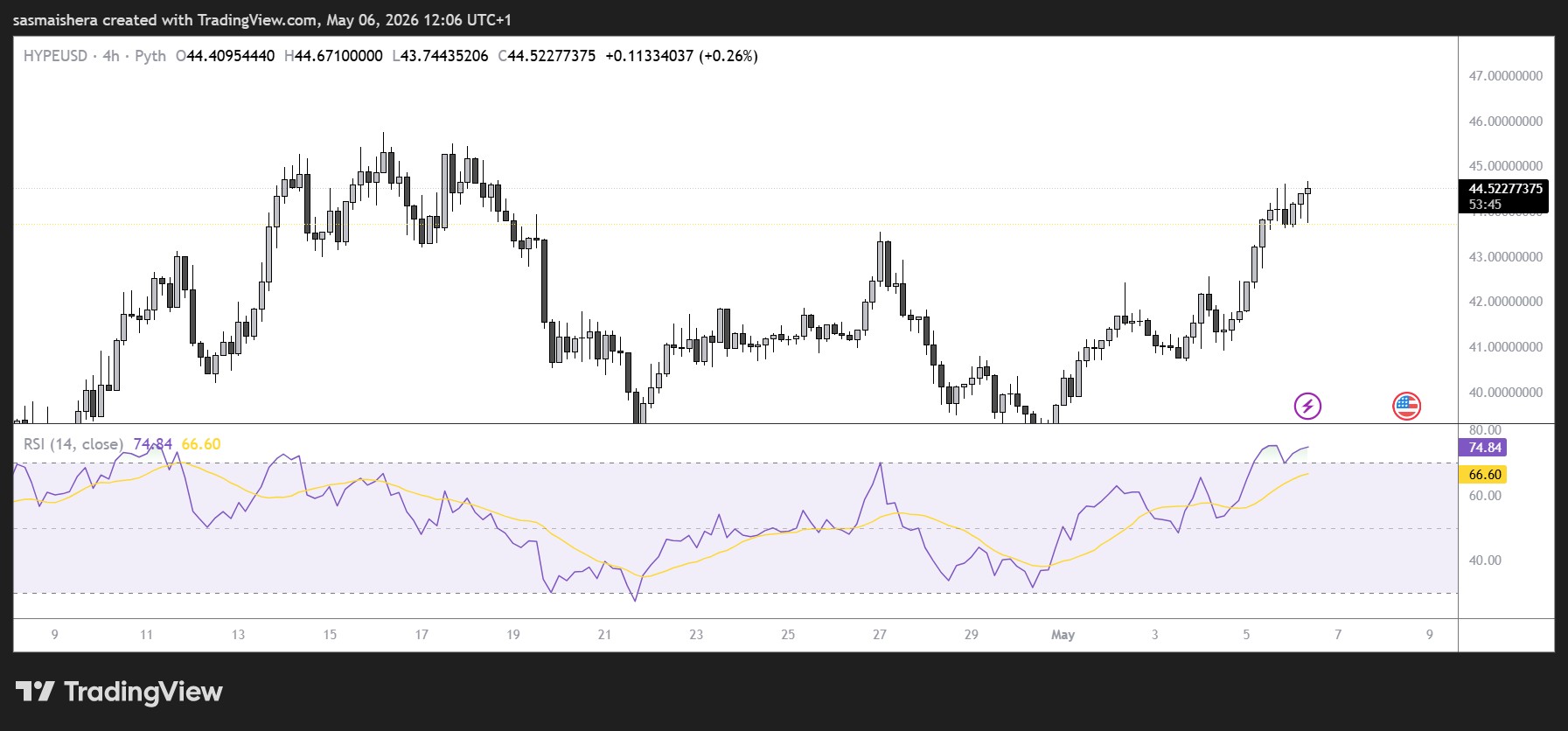
Hyperliquid (HYPE) traded above $44.00 on Wednesday, extending its rally for a sixth consecutive session as rising derivatives activity and growing platform usage strengthened bullish sentiment around the exchange token.
The latest rally comes as investor confidence gradually returns to the broader crypto market, boosting both leverage exposure and user participation across the Hyperliquid ecosystem.
Hyperliquid sees rising retail demand and platform activity
CoinGlass data show HYPE futures Open Interest (OI) climbed to $1.75 billion on Wednesday from $1.62 billion the previous day, signaling an increase in leveraged positions and fresh capital entering the market.
The sharp rise in Open Interest suggests traders are increasingly positioning for additional upside as bullish momentum accelerates.
At the same time, DeFiLlama data indicate Total Value Locked (TVL) on Hyperliquid increased more than 2% over the last 24 hours to reach $1.556 billion, reflecting stronger inflows into the protocol.
Growing TVL is typically associated with rising user engagement and improving platform fundamentals, as more capital flows into decentralized finance applications built on the ecosystem.
Hyperliquid also continues to rank among the strongest-performing DeFi protocols by revenue generation.
Excluding stablecoin protocols, Hyperliquid currently leads the sector in seven-day revenue with $11.58 million, underscoring sustained trading activity and demand for the platform.
Technical outlook: HYPE targets a breakout above $50
Technically, Hyperliquid maintains a strong bullish structure as price action continues to trade comfortably above the 50-day, 100-day, and 200-day Exponential Moving Averages (EMAs), all of which continue to slope upward and reinforce the broader uptrend.
Momentum indicators also support the bullish outlook. The Moving Average Convergence Divergence (MACD) remains firmly in positive territory on the 4-hour chart, signaling sustained upward momentum, while the Relative Strength Index (RSI) hovers near 74, reflecting an overbought condition.
On the upside, the next key resistance level is the R1 Pivot Point near $45.52. A decisive breakout above this barrier would bring the broader descending trendline resistance near the psychological $50.00 level into focus.

A sustained close above the $50 region could trigger a stronger bullish continuation phase and potentially open the door for a broader medium-term rally.
On the downside, immediate support sits near the rising trendline around $40.00, followed by the 50-day EMA near $39.76.
Additional downside protection is seen at the 100-day EMA around $37.45 and the 200-day EMA near $36.45 if broader market conditions weaken and trigger a deeper correction.

Crypto World
Uber and Disney are seeing the same remarkable dynamic in this economy. Both stocks are surging


Higher gasoline prices and mounting geopolitical tensions are doing little to slow the American consumer — at least judging by the latest results and commentary from Uber Technologies and The Walt Disney Company.
The two companies pointed to a remarkably resilient spending backdrop, with consumers continuing to shell out for rides, food delivery, vacations and theme park trips even as oil prices climb and broader concerns about the economy linger.
Shares of Uber surged nearly 10% in premarket trading, while Disney shares popped 5%.
“We watched consumer patterns really closely. Are people taking shorter trips? Are people trading down in terms of the size of their grocery basket, so to speak? With the kinds of restaurants that they’re eating at, are consumers tipping as much as they were? All of those indicators continue to be really strong,” Uber CEO Dara Khosrowshahi said on CNBC’s “Squawk Box” Wednesday. “The consumers are spending, they’re spending locally, and we don’t see any signs of that weakening at this point.”
At Uber, delivery remained the company’s fastest-growing business in the latest quarter, with revenue jumping 34% to $5.07 billion from $3.78 billion a year earlier. Revenue in the ride-hailing division rose 5% to $6.8 billion as commuting activity and local spending stayed strong.
Khosrowshahi said Uber is seeing consumers continue to leave their homes more frequently, helped in part by a return-to-office trend that has boosted commuting demand. The company now has more than 10 million earners on its platform globally, including drivers and delivery workers.
The same resilience showed up at Disney, where the entertainment giant topped Wall Street expectations on the strength of its streaming and parks businesses.
Disney’s experiences division, which includes theme parks and cruises, posted nearly $9.5 billion in quarterly revenue, up 7% from a year earlier. Global attendance rose 2%, even as domestic park visitation slipped 1%.
“Current demand at our domestic parks and resorts is healthy,” Disney said in its earnings materials. “While we acknowledge the potential impact of heightened global macro uncertainty on consumers, we are encouraged by current demand and expect year-over-year attendance at our domestic parks in Q3 to show improvement compared to Q2 results.”
The results from Uber and Disney defied expectations for a slowdown in consumer spending as gasoline prices surge and investors worry that rising energy costs could eventually squeeze household budgets.
The national average price for regular gasoline has climbed to $4.54 a gallon, up 52% since the war began, according to AAA data. Diesel prices have similarly surged to $5.67 a gallon, a roughly 51% increase since late February.
But so far, companies tied to travel, entertainment and local commerce are seeing little evidence of a pullback.
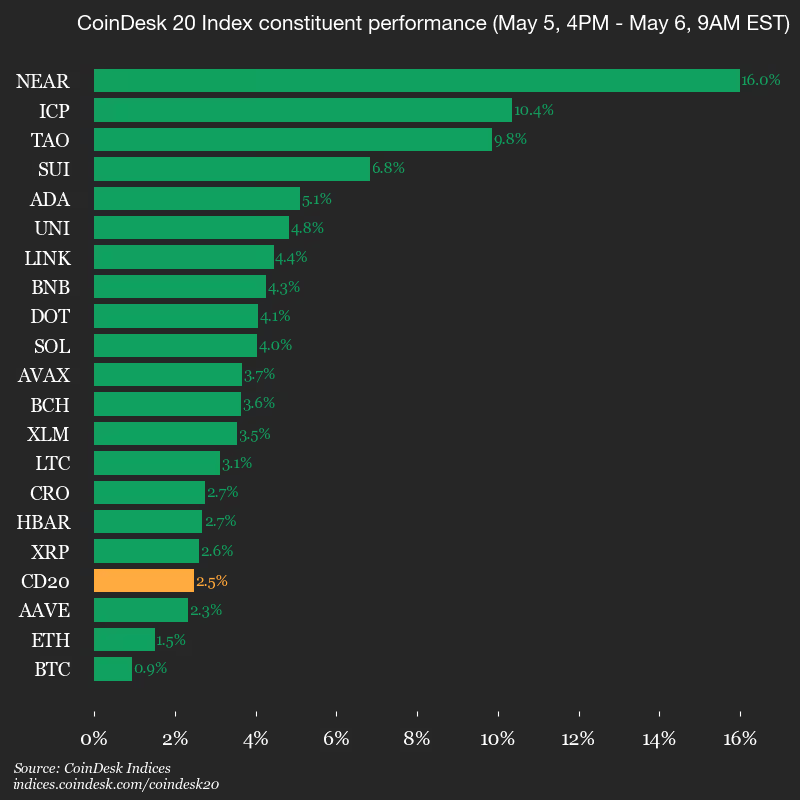
CoinDesk Indices presents its daily market update, highlighting the performance of leaders and laggards in the CoinDesk 20 Index.
The CoinDesk 20 is currently trading at 2210.86, up 2.5% (+53.36) since 4 p.m. ET on Tuesday.
All 20 assets are trading higher.

Leaders: NEAR (+16.0%) and ICP (+10.4%).
Laggards: BTC (+0.9%) and ETH (+1.5%).
The CoinDesk 20 is a broad-based index traded on multiple platforms in several regions globally.

A California federal court is weighing a civil claim that challenges Coinbase Global’s handling of frozen digital assets tied to a $55 million DAI phishing theft in August 2024. The Puerto Rico–based plaintiff requests recognition of ownership over the frozen funds and demands their return, arguing the assets are identifiable and traceable property. The complaint also names an unknown John Doe as a defendant, alleged to have carried out the theft.
The suit, filed in the U.S. District Court for the Northern District of California in San Francisco, raises questions about the duties of cryptocurrency exchanges when funds linked to a crime are traced to exchanges after an exploit. The plaintiff contends Coinbase has acknowledged holding the traced funds and has indicated that a court order adjudicating ownership is required before the assets can be released.
Key takeaways
- The Puerto Rico–based plaintiff seeks court-ordered ownership recognition and return of DAI funds frozen in a Coinbase retail account, tying the assets to the August 2024 DeFi phishing incident.
- The complaint asserts that Coinbase holds identifiable, traceable property and has previously demanded the return of the assets, while indicating that a court ruling is needed to release them.
- The 2024 incident was carried out via a phishing attack that leveraged a compromised DeFi Saver login and a scam-as-a-service tool called Inferno Drainer, enabling asset theft without protocol-level exploits.
- Forensic tracing linked the laundering path to a Ukrainian national, Okelsiy Oleksandrovych Gorelikhin, with Coinbase receiving notifications in late 2024 of funds deposited into a Coinbase address and later implementing measures to prevent dissipation.
- The case illustrates ongoing tensions in asset-recovery workflows: exchanges may freeze stolen funds but often face friction in releasing them absent judicial decrees, a dynamic with regulatory and policy implications for AML/KYC frameworks and cross-border enforcement.
Legal contours of asset recovery on exchanges
According to court filings, the plaintiff argues that the funds in question are “traceable property” linked to the plaintiff’s stolen assets and located within a Coinbase account. The complaint contends Coinbase previously acknowledged the existence of the traced funds and stated that ownership determinations require court intervention before any release. This framing places exchanges at a pivotal point in the chain of custody: they must align operational controls with judicial processes when faced with a theft that can be traced across public ledgers and on-chain flows.
The legal question at the heart of the suit concerns the scope of an exchange’s fiduciary responsibility when it receives stolen assets that are demonstrably linked to a crime. If successful, the claim would set a precedent on whether custodians can or must return or transfer such assets before litigation concludes, or must defer to a court order to resolve ownership disputes. The presence of an unnamed John Doe defendant suggests the plaintiffs anticipate additional actors might be implicated in the theft or its laundering trail.
Forensic timeline: tracing the path from theft to a frozen Coinbase account
The August 2024 breach involved a sophisticated phishing operation that duped the victim into authorizing access to a DeFi Saver account, subsequently enabling the attacker to siphon a substantial amount of DAI. A notable feature of this case is the involvement of a “scam-as-a-service” toolset known as Inferno Drainer, which provided a malware-based framework for facilitating asset theft without exploiting protocol-level vulnerabilities. The broader phenomenon of scam-as-a-service tools surged in 2024, with security researchers noting a marked increase in such capabilities across the ecosystem.
Following the breach, multiple blockchain-analytic entities tracked the stolen funds as they moved through the on-chain ecosystem and into various laundering channels. Zero Shadow and Five Stones, two forensic firms, traced the funds and identified a laundering connection to a Ukrainian national, Okelsiy Oleksandrovych Gorelikhin. The timeline includes two key regulatory- and law-enforcement–adjacent events: on November 30, 2024, Zero Shadow notified Coinbase that funds tied to the theft had been deposited into a Coinbase address, prompting requests for due diligence and asset freezing; and on December 2, 2024, Coinbase confirmed that the address belonged to a Coinbase retail user and said it had implemented friction measures intended to prevent dissipation of the assets pending investigation.
The complaint frames the assets held in the Coinbase account as “identifiable property traceable to Plaintiff’s stolen assets,” and notes that Coinbase had previously requested the return of those assets. This sequence underscores how forensic findings and exchange actions feed into civil litigation over recovery rights, and how such proceedings can influence ongoing enforcement actions tied to cyber-enabled thefts.
Regulatory and policy implications for exchanges and policymakers
What unfolds in this case has broader significance for the crypto industry’s regulatory and compliance landscape. First, it highlights the tension between custodial risk management and judicial control over the disposition of recovered funds. Exchanges frequently face balancing acts between freezing suspected stolen funds to prevent dissipation and awaiting court orders to release assets to rightful claimants. This dynamic intersects with AML/KYC frameworks, as well as with cross-border enforcement considerations when actors and funds cross jurisdictional boundaries.
From a policy perspective, the case invites scrutiny of how existing regulatory regimes—whether adjudicated in the United States or overseas—address the custody and disposition of stolen crypto assets. It also touches on the practical implications for stablecoins and their on- and off-ramps, especially as regulators and financial institutions consider how to integrate such assets into compliant banking and settlement ecosystems. While the immediate dispute centers on a U.S. court’s interpretation of ownership and recovery, the outcome could inform parallel disputes elsewhere and influence how exchanges design procedures for asset freeze, disclosure, and release under varying legal regimes.
As the industry navigates these questions, observers will watch for how courts weigh the evidentiary standard of traceability, the adequacy of on-chain linkage, and the sufficiency of interagency cooperation in recovery efforts. In regulations already evolving around anti-money-laundering and know-your-customer obligations, cases like this may help anchor operational expectations for exchanges and forensic firms, while clarifying the thresholds for blocking access to, or reclaiming, stolen assets. The broader policy context remains fluid, with ongoing discussions in multiple jurisdictions about harmonizing standards for asset recovery, cross-border cooperation, and the role of mixers and obfuscation services in illicit activity.
Closing perspective
As civil litigation over crypto-asset recovery unfolds, the case will test the practical boundaries between exchange custody, judicial authority, and forensic tracing. The outcome could shape institutional expectations for asset freezes, owner identification, and the conditions under which exchanges may release funds to claimants, with wide-ranging implications for compliance programs and cross-border enforcement.


The odds on a seven-leg parlay and the odds on a fresh memecoin trade are roughly the same, BONK core contributor Nom told audience at the ongoing Consensus Miami on Tuesday.
Most memecoin teams lack the staying power to push their projects through real regulatory steps, Nom said, citing exchange listings, ETF filings and public-company structures as the markers that separate tokens that last from those that rinse retail.
Crypto has built systems “really, really good at incentivizing inorganic traffic,” he added, pointing to points programs and airdrop farms that pull in mercenary capital and then watch network activity collapse the following week.
BONK has worked through several of those rails. Nasdaq-listed Bonk Holdings (BNKK), which rebranded from beverage company Safety Shot in October 2025, holds roughly 2.7% of BONK’s circulating supply and is targeting $115 million in token holdings by the end of 2026.
Tuttle Capital has filed a 2x leveraged BONK ETF with the SEC, and TenX Protocols, listed on the TSX Venture Exchange, made a public treasury allocation in January.
The token launched Christmas Day 2022, days after the FTX collapse, with Solana trading below $10 and most builders questioning whether the chain would survive. BONK went out as an airdrop to NFT holders, developers and active wallets with no presale, no venture funding and no whitepaper.
The pitch was distribution rather than a token, Nom said, built to give Solana developers something to rally around in a dead market.
The surrounding stack now includes LetsBonk.fun, the Solana memecoin launchpad that flipped rival Pump.fun on monthly volume earlier this year, plus BonkBot, a Telegram trading interface, and around a million wallets, per figures cited on the panel.
Pressed on where the next breakout community comes from, Nom said it would form around something most people currently dismiss, naming the TON network and Telegram-built projects as candidates worth watching.
Whether BNKK hits its $115 million treasury target by year-end and whether Tuttle’s leveraged ETF clears the SEC are the two cleanest signals for whether Nom’s TradFi-bridge thesis actually plays out.
The fireside was moderated by Lionel Williams, vice president of business development at Light Node Ventures.

Key Highlights
- BMW shares gained more than 6% following first-quarter performance that exceeded analyst projections for margins and cash generation
- Pre-tax earnings of €2.3B surpassed the €2.2B analyst estimate, even with a 25% year-over-year decline
- Automotive EBIT margin reached 5%, exceeding the projected 4.7%
- Automotive free cash flow surged to €777M, nearly doubling from the prior year as capital expenditures declined significantly
- The company reaffirmed its full-year automotive EBIT margin guidance of 4–6%
BMW delivered first-quarter 2026 pre-tax earnings of €2.3 billion, surpassing the analyst consensus estimate of €2.2 billion. Shares reacted positively, gaining over 6% during Wednesday’s trading session to reach approximately €82.
Consolidated revenue declined 8.1% to €31 billion, while EBIT tumbled 36% compared to the same period last year, settling at €2 billion. Despite these challenging headline figures, market participants focused on more encouraging underlying metrics.
The automotive division emerged as the performance driver. Its EBIT margin reached 5.0%, exceeding analyst expectations of 4.7% and remaining well within BMW’s annual guidance range of 4–6%.
Bayerische Motoren Werke AG, BMW.DE
The motorcycle division also delivered strong results, achieving an 11.4% margin.
Cash generation proved to be another positive catalyst. Automotive free cash flow climbed to €777 million—nearly twice the previous year’s level—supported by significantly reduced capital expenditure, which fell from €2.83 billion to €1.73 billion as electric vehicle platform investments began to plateau.
BMW projects full-year automotive free cash flow will surpass €4.5 billion.
The financial services segment represented the weakest area of the report. Pre-tax profit in this division declined 41% to €381 million, impacted by provisions related to a motor finance compensation program in the UK. Most analysts viewed this charge as non-recurring.
Delivery Volumes Face Headwinds
Worldwide deliveries decreased 3.5% to approximately 566,000 vehicles during the first quarter. China continues to present the most significant challenges—sales in that market fell 12.5% throughout 2025, and BMW anticipates volumes will remain essentially flat in 2026.
Battery electric vehicle deliveries contracted 20% during the quarter, reflecting changing consumer preferences and subsidy modifications across major markets.
US deliveries of BMW and MINI brands declined 4.3% to 90,492 units. The 25% US import tariffs on European vehicles present ongoing challenges, though BMW’s Spartanburg manufacturing facility in South Carolina offers partial mitigation.
Its Chinese-manufactured Mini vehicles continue to face EU anti-subsidy tariffs, adding costs in the low hundreds of millions of euros.
Stock Valuation and Expert Perspectives
At present price levels, BMW trades at approximately 6.4 times trailing twelve-month earnings. The stock’s 52-week trading range spans from €70.94 to €97.92, positioning it considerably below its recent peak.
An anticipated dividend of €4.40 per share is scheduled, with the ex-dividend date set for May 14—translating to approximately a 5.7% yield at current valuation.
Morgan Stanley confirmed its overweight recommendation, highlighting enhanced cash generation capabilities and favorable margin trajectory.
JP Morgan maintains an overweight stance with a €100 price objective. RBC Capital Markets holds a neutral rating with an €84 target, citing concerns around raw material pricing and foreign exchange volatility.
Bernstein reaffirmed its buy recommendation on May 4. The consensus analyst price target stands at €91.59, with 10 buy ratings and four sell recommendations among covering analysts.
BMW confirmed its annual guidance, projecting group pre-tax profit will decline an additional 5–9.9% from the €10.2 billion recorded in 2025.
Mercedes-Benz is scheduled to release its Q1 2026 results soon, providing a benchmark for evaluating how German luxury automakers are navigating comparable tariff pressures and China market challenges.


Today, bitcoin (BTC) neared $83,000, a level it hasn’t seen since late January.
And according to on-chain analytics firm Santiment, the uptick has positively affected market sentiment, helping push up the prices of several tokens and stirring whispers that altcoin season may be coming.
Altcoins Are Stirring After Bitcoin Clears Key Level
Data shared by Santiment on May 6 showed tokens such as Toncoin (TON), Internet Computer (ICP), Cardano (ADA), SUI, ONDO, and Hyperliquid (HYPE) opening the week in positive territory.
“Some mild whispers of altseason are beginning to emerge,” wrote Santiment. “Bitcoin’s own emergence above $81.7K has allowed profits to begin trickling into long-dormant projects.”
Its internal screener showed daily gains of up to 17% for ICP and 16% for TON, while ONDO and ADA posted more modest moves near 5%. On a seven-day view, ONDO climbed roughly 23%, ICP added 16%, and Dogecoin (DOGE) gained around 15%.
One of the biggest performers was Zcash (ZEC), which went up by nearly 40% in the last 24 hours and 76% over the past week, per CoinGecko data.
Analyst Darkfost also shared some information regarding the altcoin setup, pointing out that their market cap, excluding Bitcoin and Ethereum, tracked as TOTAL3 had risen by approximately 15% from its low in February.
In addition, he said that 11.7% of alternative cryptocurrencies listed on Binance have now reclaimed their 200-day moving average, up from just 2.3% in early February, and called it “an initial signal of recovery.”
Their trading volumes on Binance have also improved, with their share relative to combined BTC and ETH volumes rising from 31% to 49% over the past two months.
Still a Long way From Full Rotation
The broader picture is still firmly in bitcoin’s favor, considering that BTC dominance is currently sitting at around 58.6% per CoinGecko, while CoinGlass’s Altcoin Season Index, which measures how many of the top 100 tokens have outperformed BTC over a rolling 90-day window, sits at 40 out of 100.
A confirmed altseason requires a reading above 75. Put simply, the majority of altcoins are still losing ground to bitcoin when you zoom out.
Additionally, the alternative coins currently garnering the most interest are also selective, clustering around only a handful of themes like AI, DeFi projects, and some old layer-1 networks, which have been overlooked for many months now.
According to Darkfost, the recovery in altcoins is “moderate.” He further said, “This type of shift can precede a more pronounced rotation phase within the market,” even though he didn’t outrightly claim that such a change was already underway.
The post Bitcoin Shoots Past $82K, Fuels Altseason Speculation appeared first on CryptoPotato.


Ripple CEO Brad Garlinghouse is in the news after he used his XRP Consensus 2026 stage to do something unusual. He explicitly says, “I’ve never been an XRP maxi,” adding directly, “I want Bitcoin to succeed.” The remarks land as BTC reclaims $81,000.
Ripple executive publicly backing Bitcoin’s upside while Bitcoin is actively reclaiming a pivotal level is a strategic signal on where the industry’s center of gravity is heading.
Discover: The latest institutional XRP developments and what they mean for price
Decoding Garlinghouse Signal
Garlinghouse’s argument is straightforward and structural. He noted that the crypto industry does not consolidate around one chain; it expands into a multi-chain ecosystem where distinct networks serve distinct purposes.
Glassnode reports a +199.1% surge in spot CVD over the past week, indicating that aggressive spot buying is driving BTC’s recovery above $78K. Market correlation between spot demand and price structure is what precedes altcoin rotation. When spot CVD spikes on Bitcoin, history shows risk appetite expands across the asset class.
Garlinghouse confirmed he holds Bitcoin and Ethereum alongside XRP, and has actively lobbied against a Bitcoin-only U.S. crypto reserve framework. When the Trump administration initially floated a BTC-exclusive reserve, Garlinghouse pushed policymakers toward a multi-asset model.
That lobbying effort was validated when the U.S. Treasury formally endorsed a multi-asset reserve approach. And it’s not just the U.S government, but more than 200 entities across the world.
Discover: The best pre-launch token sales
Beyond XRP News: Ecosystem Unity Matters More Than Maxi Loyalty
Bitcoin’s dominance effect on altcoins is a recurring market pattern. BTC ETF inflows historically precede altcoin rallies by two to four weeks as institutional capital uses Bitcoin as the on-ramp before rotating into higher-beta assets.
Garlinghouse’s Ripple $1.2 billion in On-Demand Liquidity volume using XRP in Q1 2026, up 45% year-over-year, driven by new corridors in Brazil and Japan. Ripple also announced, as reported in the news, a $500 million investment in AI-driven custody solutions, integrating both XRP and BTC for institutional clients, making the ecosystem-unity thesis operational.
Messari analyst Ryan Selkis framed it cleanly: “BTC at $78K lifts all boats; XRP’s utility shines in a rising tide, not isolation.” Tribalism is a retail-era relic. Institutional capital does not pick sides; it allocates across correlated assets based on risk-adjusted return.
Discover: The best crypto to diversify your portfolio with
The post XRP News: Garlinghouse “I’ve never been an XRP maxi” Comment Could Supress XRP Price appeared first on Cryptonews.
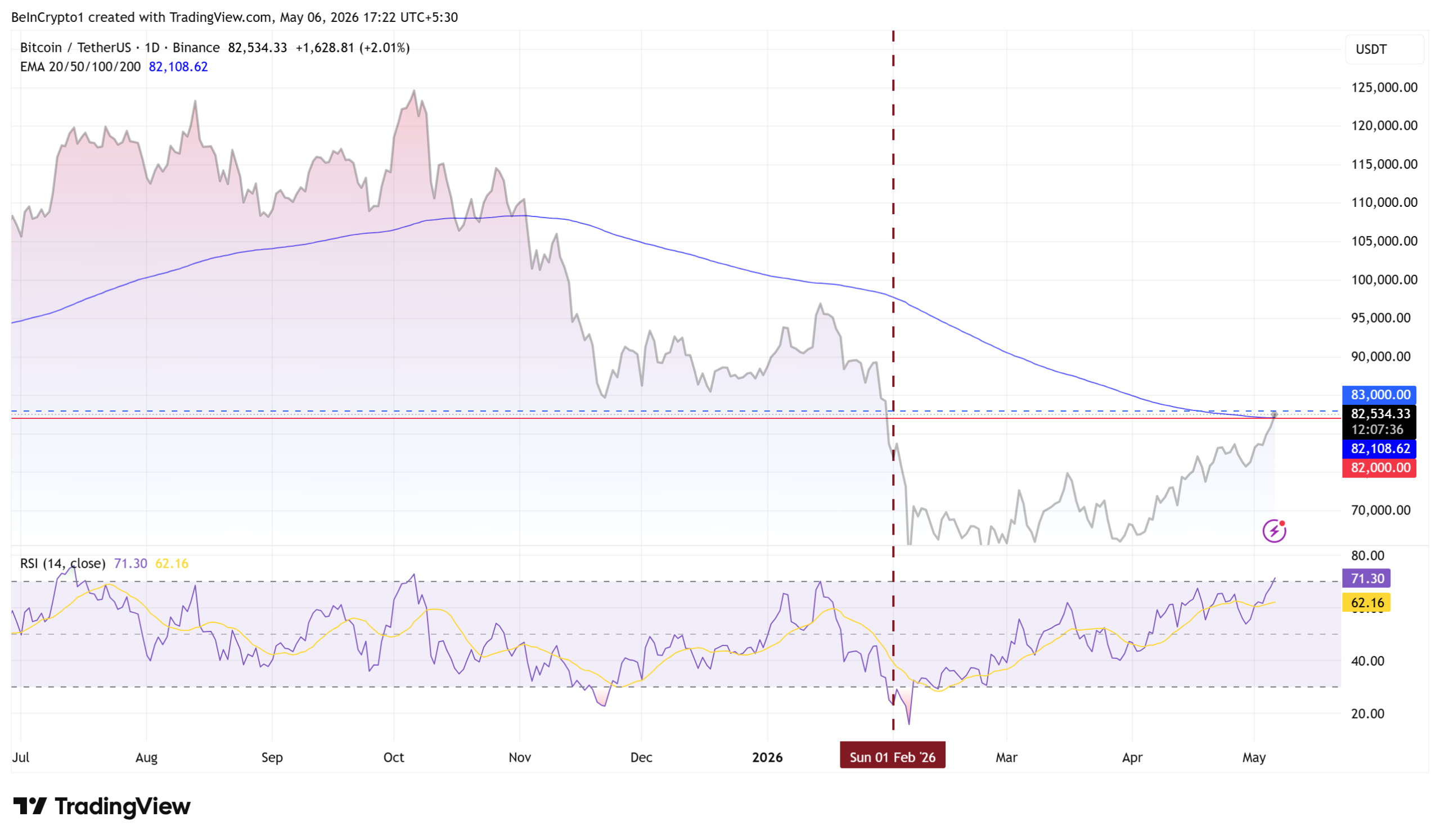
Bitcoin (BTC) climbed back above $82,000 on Tuesday, recovering ground last held in late January, as CNBC’s Jim Cramer told viewers US equities had cooled enough to support another leg higher.
BTC traded near $82,450 on Binance, up roughly 1.9% on the day. Cramer flagged compute-AI, financials, travel and leisure, and Middle East rebuild manufacturing as likely sector leaders if the rally extends.
Cramer’s Reset Call Lands as Bitcoin Tests its Recovery Line
Cramer’s mid-April warning that US markets had become extremely overbought has shifted. The CNBC host now says equities are no longer stretched and could push higher.
His sector list led with compute and AI infrastructure plays. Financials, travel and leisure, and US manufacturers tied to Middle East reconstruction rounded out the picks.
The framing matches earlier Cramer commentary that the AI buildout is reshaping equity leadership.
“The computer-driven economy doesn’t care much about oil or interest rates,” said Cramer.
For Bitcoin holders, his macro reset matters because BTC has tracked US risk assets closely through this cycle.
Spot Bitcoin ETFs pulled in $2.44 billion in April, the strongest monthly figure since October 2025.
BTC Reclaims its Bull Market Support After months below
The move above $80,000 on May 4 was the first since January 31. Bitcoin had tested that level twice in 2026 and been rejected both times.

The reclaim also pushed price back above the bull market support band that had capped every recovery attempt since November 2025. Analysts treat that band as a regime line between bear and bull conditions.
The 200-day EMA near $82,108 sits just below current price. Holding it on a daily close would mark the first such reclaim since the post-record-high decline began in late 2025.
Daily RSI(14) sits at 71.30, just inside overbought territory. The signal cuts both ways, showing fresh momentum but also raising the odds of a near-term cooldown.
Inverse Cramer Chatter and Macro Skeptics
Replies to Cramer’s reset have leaned heavily on the inverse-Cramer trade. Traders cited recent Nasdaq and S&P 500 volatility as evidence that the technical reset may not hold.
The skepticism is not new. Cramer’s flips between bullish and bearish on Bitcoin have made his calls a contrarian indicator for parts of the trading community.
The Middle East thread carries its own complications. The Trump administration has pitched Kuwait, Bahrain, and the UAE on using American firms for reconstruction, with energy rebuild costs alone estimated at roughly $25 billion by Rystad Energy.
Total Gulf reconstruction tied to the Hormuz crisis fallout could run between $100 billion and $250 billion over a decade, according to industry estimates.
That spending pipeline is what Cramer says US manufacturers are positioned to capture.
The next test for BTC is whether it can hold the 200-day EMA into the weekend.
A daily close above it would confirm Cramer’s risk-on framing for the bulls. A rejection would hand the inverse-Cramer crowd another data point.
The post Jim Cramer’s Reset Call Could Impede Bitcoin Move Reclaiming Its Bull Market Support appeared first on BeInCrypto.
The cryptocurrency market continued its upward move, and Zcash (ZEC) is the best-performing top-100 digital asset today (May 6).
The massive resurgence has reignited bullish sentiment among analysts, with some eyeing an explosion to a potential all-time high in the short term.
The Start of a New Bull Run?
Earlier today, ZEC climbed to almost $600 after posting a 40% daily increase. This represents the token’s highest level since November last year, while its market capitalization exceeded the $10 billion milestone. In other words, ZEC has reclaimed a spot among the 15 biggest cryptocurrencies after flipping Cardano (ADA), Monero (XMR), Bitcoin Cash (BCH), and other popular altcoins.

The sudden move north was likely triggered by Tushar Jain’s (Co-founder and Managing Partner of Multicoin Capital) recent announcement. He revealed that his entity has built a significant position in ZEC since February and highlighted the project’s privacy focus.
“We believe that truly private, censorship and seizure-resistant assets have a clear product-market fit and demand is accelerating. We believe ZEC is the cleanest way to express this thesis in public markets,” his post reads.
Of course, another possible catalyst could be the green wave passing through the broader cryptocurrency market. Bitcoin (BTC) has surged past $82,500, while numerous altcoins such as Dash (DASH), Toncoin (TON), Filecoin (FIL), and Internet Computer (ICP) have jumped by double digits over the past 24 hours.
Many analysts expect ZEC’s rally to continue in the coming weeks and months. X user WIZZ, for instance, predicted that the asset’s price could reach a four-digit range later this year, marking a new all-time high.
For his part, Ardi paid attention to the $550 level, describing it as “the macro lower-high resistance area” that stopped the prior breakout attempt in December 2025. As mentioned above, the valuation climbed above that zone, and it will be interesting to see whether it now heads into uncharted territory.
Meanwhile, on-chain activity also points to growing confidence among traders. According to Lookonchain, a newly created wallet opened a 10x long position on 5,000 ZEC (worth $2.64 million). Such aggressive leveraged positions signal that some market participants expect further upside, adding another layer of bullish momentum to the breakout.
The Risks Remain
The crypto sector might have been on an evident uptrend lately, but that doesn’t guarantee that the bear market is over. This means that ZEC, alongside many other digital assets, could head south just as sharply should the bulls lose momentum.
The asset’s Relative Strength Index (RSI) should serve as another warning. The ratio has skyrocketed to 96 (out of 100), indicating the price has increased too much in a short period and could be on the verge of a pullback. Conversely, readings below 30 are typically interpreted as buying opportunities.

The post Zcash (ZEC) Explodes 40% Daily: What Drives the Pump and What’s Next? appeared first on CryptoPotato.
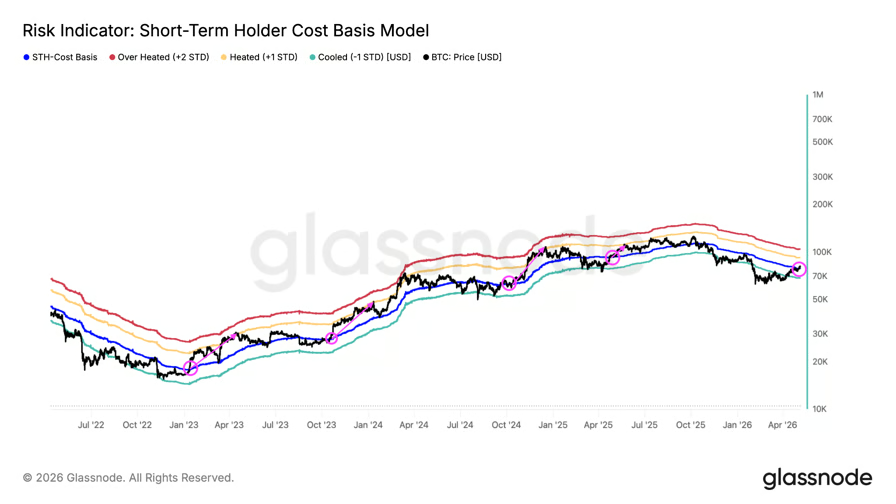
Bitcoin (BTC) buyers resumed their activity during the early Asian trading hours on Wednesday, pushing the price to a new multi-month high of $82,240.
Onchain indicators, including the short-term holder (STH) cost basis, suggest that the BTC price can go higher, with the next big target at $92,000.
Key takeaways:
- Bitcoin holders are back in profit, increasing the chances of reaching $92,000.
- BTC bulls must overcome resistance at $84,000 to continue the uptrend.
Bitcoin price eyes $92,000 next
Data from TradingView shows that BTC/USD had risen 37% to trade above $82,000 from its multi-month low of $60,000 reached on Feb. 6.
This rally has seen Bitcoin rise above the cost basis of its short-term holders, currently at $79,000, according to data from Glassnode.
STH cost basis refers to the average purchase price of investors who have held Bitcoin for less than 155 days.
Historically, reclaiming this level has coincided with extended recovery phases, as investors returning to profit are often less inclined to sell and more willing to add exposure. The shift can also attract fresh buyers and trigger short squeezes as bearish positioning unwinds.
Related: Bitcoin in ‘disbelief rally’ as traders spot $84K BTC price target
The chart below shows that when the price reclaimed its realized price in April 2025, it rallied 30% toward the upper band of this metric at $112,000 four weeks later.
Similar occurrences in October 2024, October 2023 and January 2023 also saw the BTC price rally toward the same onchain level, as shown in the chart below.
If BTC breaks above the line, there is a good chance of seeing $92,423 in the short term, about 13% above the current price.
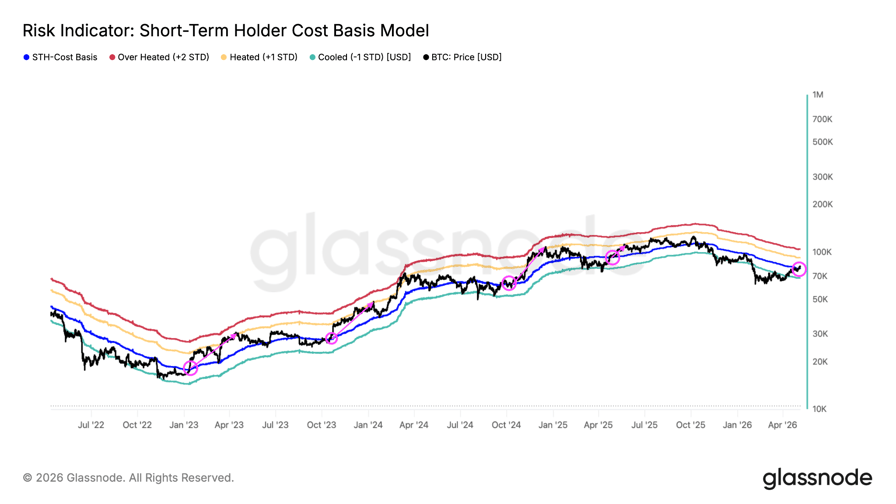
Bitcoin STH cost basis. Source: Glassnode
“Bitcoin has crossed the coveted ‘short-term holder breakout,’” analyst Mitchell Askew said in a Wednesday post on X, adding:
“This typically signals the end of bear markets and consolidation periods.”
Bitcoin analyst Plan C said if the price “can find sustained support above this level,” it would confirm that the 50% drawdown from the $126,000 all-time high was just a “mid-cycle correction.”
Meanwhile, Bitcoin’s STH spent output profit ratio (SOPR) has flipped positive, showing early signs of a shift in market behavior.
The metric is “back above 1, which usually means recent buyers are back in profit and selling pressure is easing,” analyst BitBull said in a Wednesday post on X, adding:
“This is where markets often move from accumulation into early bullish phases.”
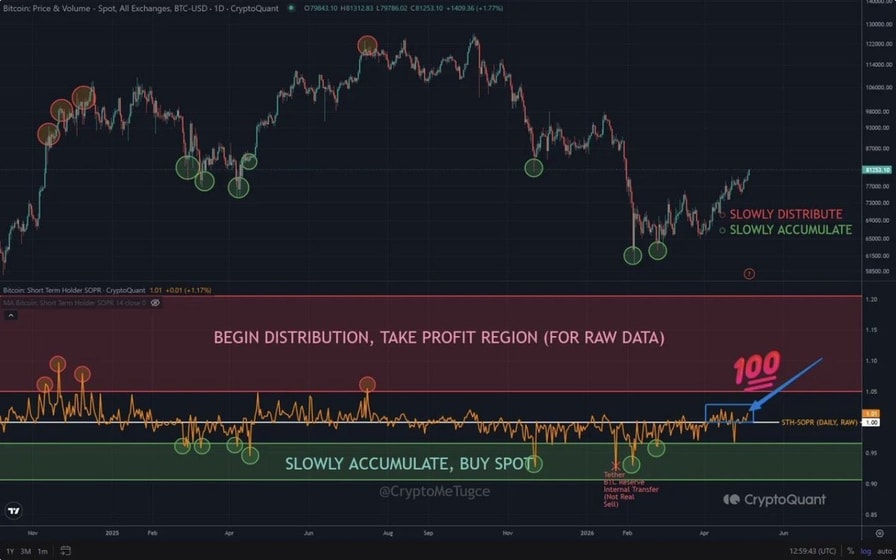
Bitcoin STH SOPR. Source: BitBull
As Cointelegraph reported, several technical indicators suggest that Bitcoin’s bottom is in, with analysts setting targets as high as $250,000 within a year.
Bitcoin’s price needs to flip $84,000 into support
Bitcoin’s bullish weekly close above the 20-week exponential moving average and true market mean at $78,300 has convinced traders it can move higher from current levels.
Analysts say the continuation of Bitcoin’s rally now hinges on breaking above the $82,000-$84,000 supply zone.
Bitcoin is retesting the low $80,000s region, which “corresponds with the November lows and the Daily 200MA/EMA coming in a bit higher,” trader and analyst Daan Crypto Trades said in his latest Bitcoin analysis on X.
Note that the 200-day EMA and the 200-day simple moving average are at $82,600 and $83,402, respectively.
This is a “big level” for Bitcoin bulls, the analyst said, adding:
“Acceptance higher can lead to a further bounce back into the $90Ks, but a rejection will likely keep this rangebound with $80K as the ceiling for a while.”
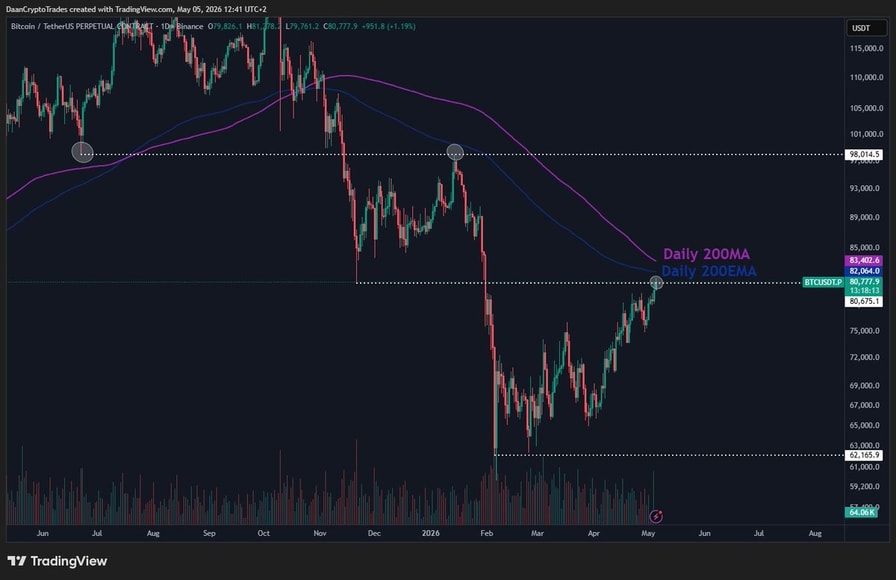
BTC/USD daily chart. Source: X/Daan Crypto Trades
MN Capital founder Michael van de Poppe shared a chart showing $84,000-$86,000 as the “next resistance zone,” which, if broken, could potentially see Bitcoin “continue to the 50-Week MA around $90K.”
Meanwhile, Bitcoin’s whale order book showed “big ask orders concentrated” between $82,000-$84,000, making it a crucial level for the bulls to overcome.
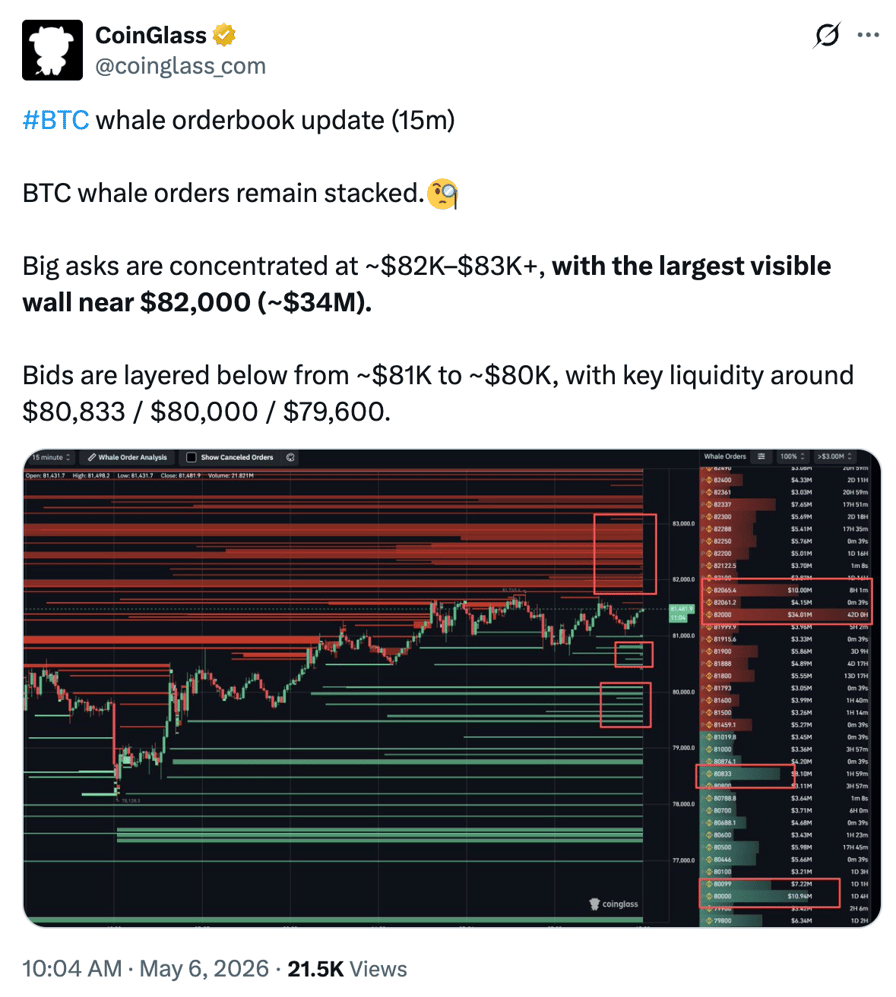
Bitcoin whale order book. Source: CoinGlass
As Cointelegraph reported, the BTC/USD pair may rise as high as $92,000 if resistance at $84,000 is broken.

What Battlestar Galactica Did Better Than Star Trek Ever Did

Bitcoiners Predict MASSIVE Bull Market

Why banning pro-Palestine marches is a risky response to antisemitic violence

Manchester United reach agreement with Casemiro over contract clause amid transfer speculation

US brings back mandatory military draft registration

Steven Gerrard disagrees with Gary Neville over ‘shock’ Chelsea and Arsenal claim | Football


-
 Business7 days ago
Tesla Officially Registers Elon Musk’s Stock: What Investors Need to Know
-

 NewsBeat3 days ago
Channel 5 – All Creatures Great and Small series 7 new post
-

 Entertainment6 days ago
Insider Claims Reason Behind Key & Peele Split
-
 Tech5 days ago
Trump’s 25% EU auto tariff breaches Turnberry Agreement that also covers semiconductors and digital trade
-
 Sports5 days ago
Paul Scholes issues Marcus Rashford reality check as agreement emerges over Man United star
-

 Entertainment5 days ago
Met Gala 2026 Rumored Guest List Is Turning Heads
-

 Entertainment6 days ago
Celebrities Who Are Attending the 2026 Met Gala Event
-

 Business5 days ago
Strait of Hormuz Blockade Persists Amid US-Iran Standoff, Sending Oil Prices Soaring
-
Business7 days ago
Strait of Hormuz Remains Heavily Restricted on April 29 Amid Iran Conflict
-
Entertainment5 days ago
New on Prime Video in May 2026 — Full List of Movies and Shows
-
 Sports5 days ago
David Benavidez responds to team Canelo saying the fight will never happen
-

 Crypto World7 days ago
Meta (META) starts stablecoin payout to creators in Circle’s USDC on Polygon, Solana via Stripe
-

 Sports5 days ago
Cavaliers vs. Raptors Game 6 live score, updates, highlights from 2026 NBA playoffs first-round series
-

 Tech7 days ago
Texas Instruments made a new flagship graphing calculator: the TI-84 Evo
-

 Sports6 days ago
Saudi Arabia set to withdraw LIV Golf funding after 2026 season, per reports
-

 Tech6 days ago
Mark Zuckerberg Says Meta Is Working On AI Agents For Personal And Business Use
-

 Entertainment5 days ago
Kylie Jenner Hit With Second Lawsuit From Ex-Housekeeper
-

 Sports5 days ago
Plane crash in Wimberley, Texas kills 5 pickleball players at tournament
-
 Sports5 days ago
IPL 2026: ‘Love you darling’- Hardik Pandya’s reaction to MS Dhoni steals the show |Watch | Cricket News
-

 Sports7 days ago
Arsenal, Atletico Madrid share draw after penalty drama in Champions League semi-final
You must be logged in to post a comment Login