Connect with us
DAPA Banner

NewsBeat

Location, Location, Location star details episode ‘that will never come to air’

Published

on

Wales Online

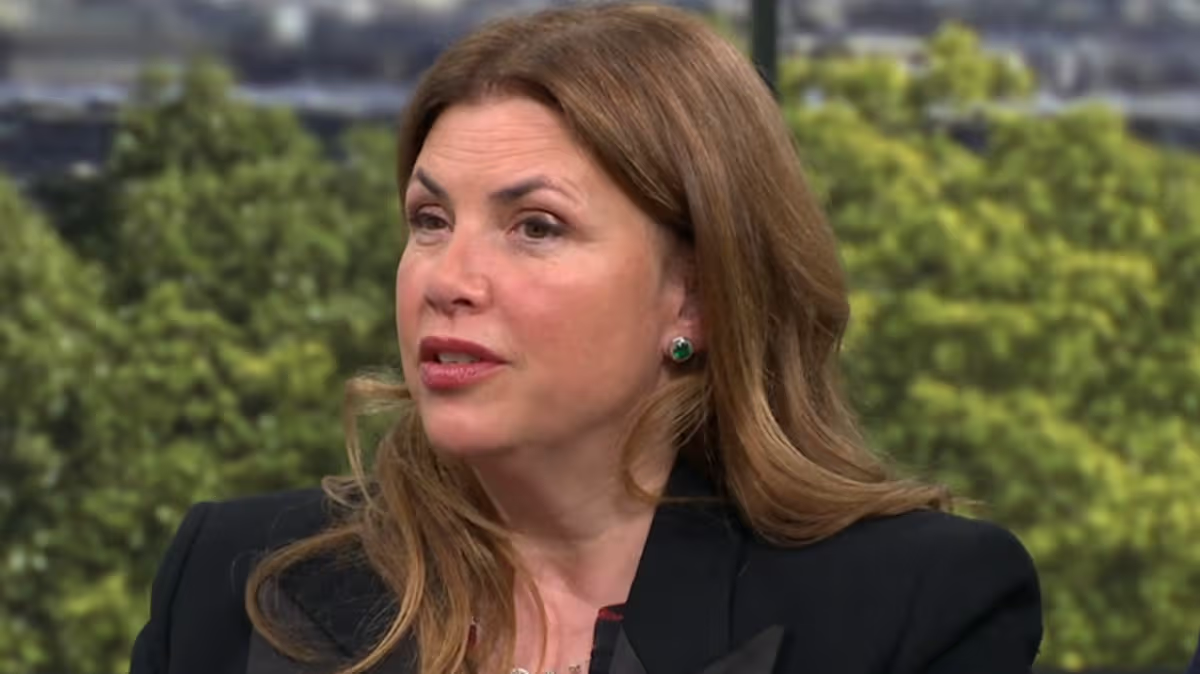
Kirstie Allsopp made an admission ahead of the new series of Location, Location, Location

Kirstie Allsopp made a surprising revelation on ITV’s This Morning.

The 54-year-old host is due to return to television tonight (Wednesday, May 6) for a fresh series of Channel 4’s Location, Location, Location, alongside Phil Spencer.

Advertisement

Kirstie and Phil are marking 26 years presenting the programme together, so audiences may be astonished to discover that they weren’t initially intended to be matched as a hosting partnership.

While appearing on This Morning, Kirstie disclosed to presenters Ben Shephard and Cat Deeley that she was required to audition alongside other prospective female candidates before securing the presenting role back in 2000.

“I look at the two of you now and you can’t imagine one without the other… I didn’t realise, Kirstie, that Phil made you fight for your place alongside him. You had a screen test with other women,” Ben said, reports the Mirror.

Kirstie revealed: “There was an Italian girl with legs up to here [makes tall gesture]. Legs like Cat’s. Phil really, really wanted her, but the problem was the accent was so strong.”

Phil replied: “That’s not quite true!” before Kirstie continued: “And there was a really sweet girl who was an estate agent, but I think that she was probably intimidated by the whole thing.

“So, he sort of ended up with me by default. We did a non-transmissible pilot. Thank god that will never come to air.”

She added: “We both thought, ‘Oh, that was fun, but we’ve got real jobs.’ And then they commissioned the show, and they asked us to present it.”

Advertisement

The pair went on to confirm that the first three series of Location, Location, Location were filmed while they both held down their regular jobs.

“It was a busy time,” Phil remarked, with Kirstie quipping: “We had no belief in this telly rubbish!”

The latest series of Location, Location, Location returns to Channel 4 at 8pm tonight, with Kirstie and Phil once again steering prospective buyers through an ever-shifting property market.

Advertisement

The series kicks off in Surrey, a popular commuter belt for London workers and a county steeped in quintessential English character. Emily and Jack have postponed their wedding until they secure a home, having so far been disappointed by properties that fail to live up to their brochure images.

Elsewhere, Jane, who has spent her career working across the globe, is eager to settle down in Farnham. Despite Phil residing nearby, it quickly becomes apparent that his local knowledge is no guarantee of a straightforward house hunt.

Location, Location, Location is available to stream on Channel 4

Source link

Advertisement
Continue Reading
Click to comment

You must be logged in to post a comment Login

Leave a Reply

NewsBeat

Why Arsenal may not wear their home kit in the Champions League final

Published

on

Why Arsenal may not wear their home kit in the Champions League final

Arsenal have qualified for the Champions League for the first time in two decades, but their red shirts still may not grace Europe’s greatest stage.

Source link

Advertisement
Continue Reading

NewsBeat

Michael Vaughan says wait to appoint new England selector is ‘ridiculous’

Published

on

A Good Girl's Guide To Murder

Former captain Michael Vaughan says it is “ridiculous” England are yet to appoint their new national selector.

The process to name the successor to Luke Wright, who announced he was stepping down on 22 January and left after the T20 World Cup concluded in March, has reached the final stages, with interviews for the position held this week.

There have already been four rounds of action in the County Championship and England are set to name their squad for the first Test against New Zealand in two weeks’ time.

“It’s ridiculous how they’re announcing a selector so late,” Vaughan said on the Stick to Cricket podcast.

Advertisement

“I wanted the selector there on 1 April, going out, having a look, gathering information.

“Luke Wright quit at the back end of Australia. We knew didn’t we?

“It’s a long time, four months, to find someone.”

Source link

Advertisement
Continue Reading

NewsBeat

Victorian railway station moves nine miles down road and rebuilt brick by brick

Published

on

Cambridgeshire Live

The restored station, which now has a different name, is hoped to provide an attractive gateway to a railway site

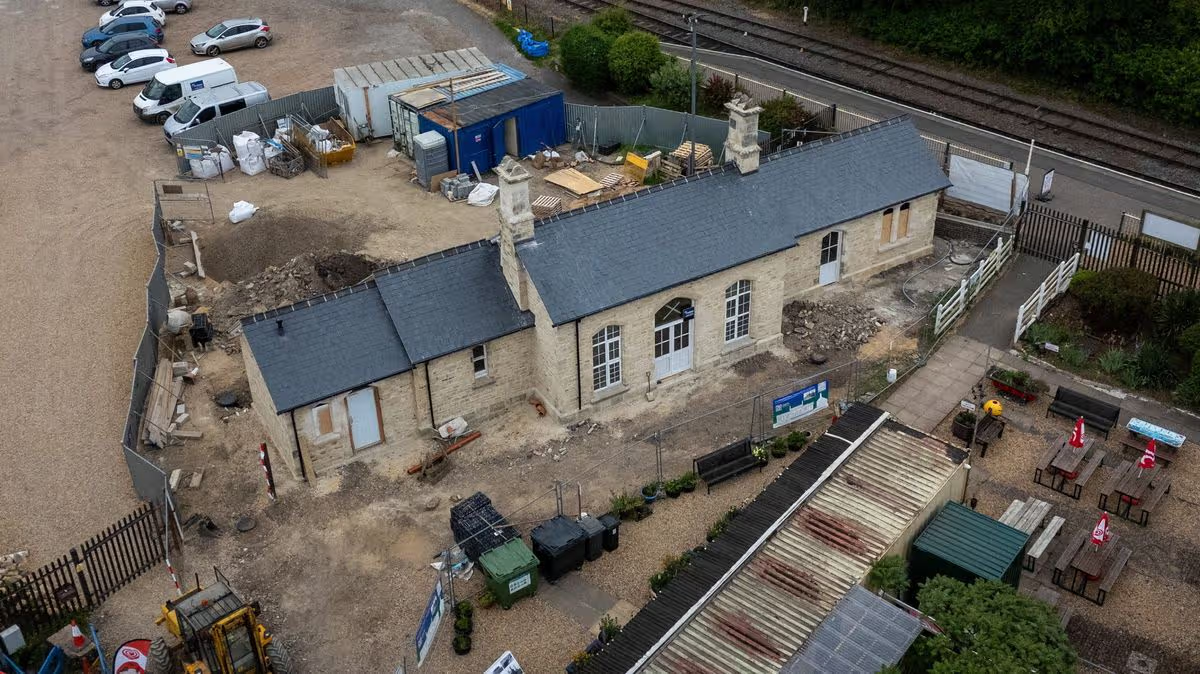
A disused Victorian railway station that was facing demolition to make way for a major road scheme has almost completed its brick-by-brick relocation nine miles away.

Wansford Road station in Sutton, near Peterborough, was threatened with destruction to accommodate what is now the abandoned construction of a new dual carriageway on the A47. The proposed £100 million upgrade near Wansford was scrapped last summer due to costs.

However the station, which dates back to 1867, was dismantled in April 2024 and has nearly been reconstructed in the city under its new identity, known as Woodstone Wharf Station.

Advertisement

The original Wansford Road station, constructed in brick with a limestone façade and featuring a booking office, waiting room and administration office, was built to serve Wansford residents. Following its closure in 1929, it was converted into a private home before eventually falling into disuse.

Stan Bell, who has been helping to spearhead the project at The Wansford Road CIO, said: “It’s clear that the building will have a huge rejuvenating impact on this often-forgotten part of Peterborough. We’ve been incredibly lucky to have the support of National Highways.

“We’ve moved it from the original site to its new site in Peterborough, carefully moving the stones. The station will look almost exactly as it did in the Victorian times.

Advertisement

“It’s such a good example of the architecture and it’s too good an opportunity to miss. It’s very important that we save it for future generations.”

It’s anticipated that the structure will be reconstructed and sited to create an appealing entrance to the Railworld site and the Nene Valley trains.

Its primary purpose will be ticket sales and it will be styled as a Victorian ticket office, featuring period artefacts on display. The new railway station is scheduled to open in summer 2026.

Advertisement

Source link

Continue Reading

NewsBeat

Why banning pro-Palestine marches is a risky response to antisemitic violence

Published

on

Why banning pro-Palestine marches is a risky response to antisemitic violence

Following recent antisemitic violence and aggression, calls from some quarters for a temporary ban on pro-Palestine marches have gained traction. Conservative party leader Kemi Badenoch has firmly supported a ban, while
Keir Starmer, the prime minister, has suggested that some protests may need to be stopped. The government’s independent reviewer of terrorism legislation has called for a moratorium on such marches.

Those who have made such calls do so on the grounds that pro-Palestine marches, whatever their intent, are contributing to a “tone of Jew hatred within our country”, in the words of Chief Rabbi Sir Ephraim Mirvis. Starmer has also expressed concern about the “cumulative” effect of the marches on Jewish communities.

This is an understandable position in some ways. There can be little denying that some participants in pro-Palestine events have articulated antisemitic positions. And in a period where more clearly needs to be done to address antisemitic violence and aggression, a ban appears to provide a way for authorities to send a clear message that there is no place for antisemitism in Britain today.

Yet there are also problems with such proposals. As policymakers consider their options, it is important that these problems are taken seriously.

Advertisement

Evidence on the relationship between protest activity and targeted violence outside of the protest arena is limited. The available evidence points to a complex and context-dependent relationship.

Some studies have found that when protests increase, extremism and extremist violence can also rise, especially when society is more divided. Such a pattern has been observed, for example, in the US, where the bipartisan thinktank the Center for Strategic and International Studies identified heightened protest activity and rising domestic terrorism during the early 2020s.

However, many studies of nonviolent protest show that it reduces political violence, by providing nonviolent means of pursuing social and political objectives.

Where heightened protest activity coincides with increased extremist violence, it is often unclear whether protests or marches themselves are the cause. Today, people participating in social movements are likely to access and share information through a range of (often unregulated) spaces both offline and online. It is difficult to assess how important protests themselves might be in influencing people to go on to engage in targeted violence.

Advertisement

This is not simply academic nitpicking. It means that it is possible that a ban on marches would have little to no effect on the use of targeted violence against Jewish communities.

In fact, there is a distinct possibility that banning pro-Palestine marches, even if only temporarily, might actually increase violence.

Studies show that violence is less likely to escalate when moderate groups within protest movements are present and have influence. This has been observed, for example, in research into the escalation or inhibition of violence during waves of far-right protest.

Advertisement

Expanded state repression – such as bans on certain forms of previously legal protest – can weaken the position of moderate factions. When this happens, calls for restraint and advocacy of non- or less-violent strategies can lose credibility within the movement, weakening the “internal brakes” on violence.

Practicalities of enforcement

A moratorium on pro-Palestine marches would also raise many questions about the practicalities of any restrictions. For one, calls on the police to ban other contentious demonstrations that risk hostility towards different groups would increase.

What particular types of action would be banned? Marches? Demonstrations? Would size be a factor? Would it cover a protest against the ban on the protest? What about other forms of action such as sit-ins, information stands or coordinated online action? And what sanctions would be imposed on those who did not comply?

Attempting to enforce such bans could become a significant drain on already stretched public resources, not least because activists would probably seek to increase pressure on authorities because of those costs. This is one of the most obvious lessons to draw from responses to the government’s attempts to ban the group Palestine Action.

Advertisement


À lire aussi :
Labour wants to restrict repeat protests – but that’s what makes campaigns successful


In addition to this, police have also recently been authorised to consider the “cumulative impact” of protests on local areas when policing. They have had to grapple with how and when to incorporate this in addition to their usual powers.

Before introducing a ban, it’s important to think about the example it would set and how it could influence future decisions about the right to protest. The UK would be less able to criticise authoritarian countries and illiberal democracies that misuse counterextremism and counter-terrorism powers that limit people’s freedom.

None of this is to deny the urgency of confronting antisemitic violence and aggression in the UK. This requires sustained political commitment, effective policing and community protection. But restricting the right to protest is a blunt and risky instrument.

Advertisement

The available evidence suggests it may do little to reduce harm and could, in some circumstances, make matters worse. Politicians should therefore be cautious before treating bans on marches as a solution to complex and deeply rooted problems.

Source link

Advertisement
Continue Reading

NewsBeat

Up to 150 former WH Smith high street stores risk closure under big shake-up

Published

on

Daily Mirror

Mass job losses are feared after the owner of high street chain TG Jones announced proposals to revive the loss-making retailer

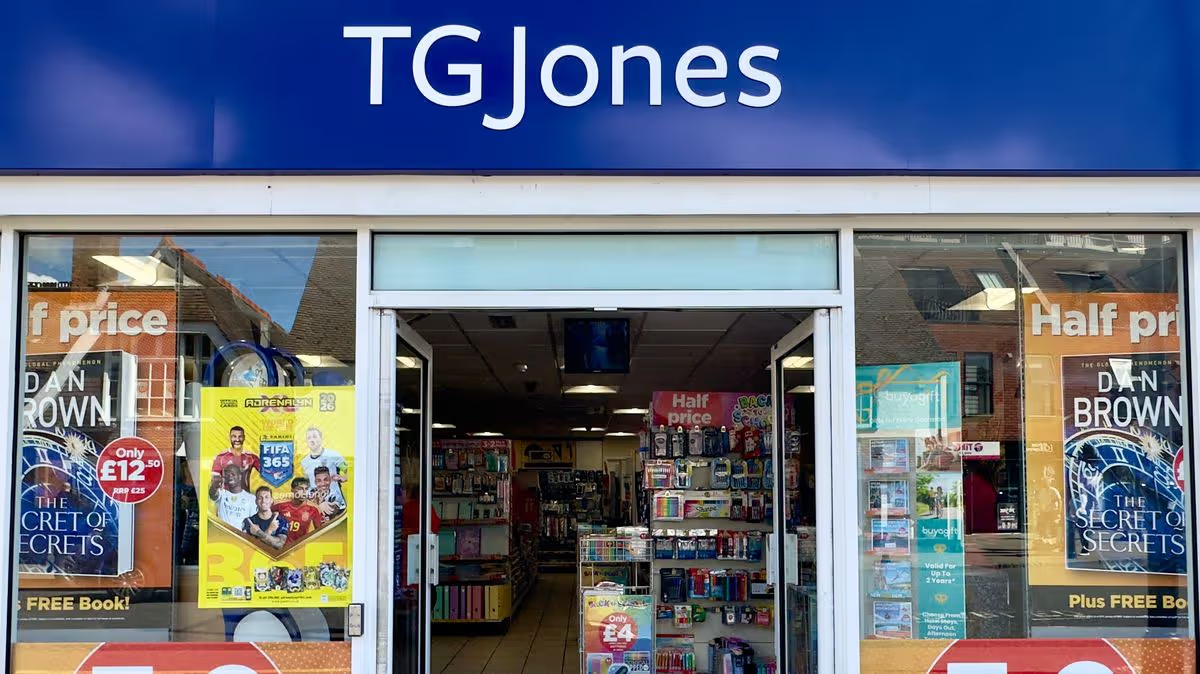
More than one in four former WH Smith high street stores risk closure under sweeping plans.

The cull of up to 150 stores – which have been rebranded TG Jones – threaten large scale job losses among its 5,000 strong workforce.

A radical restructuring has been put forward by Modella Capital, which acquired WH Smith’s high street business for £40million last year.

Advertisement

Despite ambitions to grow the business, it has instead suffered tough trading and mounting costs. Bosses have also blamed the loss of the WH Smith name for putting off shoppers. The remaining WH Smith business is now concentrated on its travel stores situated in airports and railway stations, as well as hospitals.

Insiders have also blamed the cost of refurbishing the stores, claiming many had been barely touched this century.

Modella is set to begin negotiations with store landlords that will ultimately determine the number of stores that will shut. It could result in up to 150 of the 480 TG Jones closing. The outcome will determined through two High Court hearings scheduled for next month.

Advertisement

The move also threatens the future of a large number of Post Office branches that are situated in TG Jones stores.

Modella has been prolific in snapping-up struggling retailers over the past 18 months, including Hobbycraft, the Original Factory Shop and Claire’s Accessories. However, Hobbycraft has been put up for sales and the Original Factory Shop and Claire’s Accessories have collapsed into administration.

A TG Jones spokesperson said: “TGJones has launched a formal process known as a restructuring plan to make the business fit for the future. The plan is an essential part of the company’s turnaround and will support further investment in stores over the long term.

“Modella Capital has committed to financial contributions totalling more than £35million as part of the process.

Advertisement

“This decision has not been taken lightly. While we continue to believe in the strength of the core business, TG Jones has experienced highly challenging trading conditions over the past year, along with many other brick-and-mortar retailers.

“Weak consumer spending and cost-of-living pressures, combined with rising operating costs as a direct result of government policy and recent geopolitical events, have meant that the company as a whole has remained loss-making.

“The forced name change from WH Smith has also negatively impacted consumer awareness, despite the fact that the proposition has improved.”

It went on: “The survival of this iconic 234-year-old business is our imperative. No decisions have yet been taken on how this will impact roles, but we will aim to preserve as many jobs as possible. Any potential store closures or role reductions will be subject to appropriate consultation, and we are committed to engaging openly and constructively with colleagues and their representatives.

Advertisement

“We want to be clear, however, that the plan may result in the closure of some stores and the loss of some roles. We recognise the impact this uncertainty will have on colleagues, their families and the communities we serve.”

Source link

Continue Reading

NewsBeat

Neighbours finds new home on UKTV in ‘landmark deal’

Published

on

Neighbours finds new home on UKTV in 'landmark deal'

It first aired on BBC One in the UK in 1986, before transferring to Channel 5 in 2008.

Described as a “landmark deal” between UKTV and Fremantle, the series will air weekly on U&Drama, as well as being available to watch on streaming service U.

This is the first time that the episodes have aired chronologically on British screens in decades.

Advertisement


Emma Tibbetts, UKTV’s Director of Programming for scripted content, said: “Neighbours is one of television’s most iconic and enduring dramas, and we’re thrilled to bring the back-catalogue to U.

“This acquisition further expands the breadth of scripted entertainment available on our free streaming service, strengthening our growing slate of global IP.

“We can’t wait for both long‑time fans and new audiences to rediscover the series in its entirety.”

Louise Toner, VP Distribution UK and Ireland, International, for Fremantle, added: “Neighbours is a truly iconic series, loved across generations.

Advertisement

“We’re thrilled to partner with UKTV to bring its classic episodes and unforgettable characters back to audiences old and new.”


Of the second cancellation, executive producer Jason Herbison told the Radio Times in March 2025: “We were considered a very big success on Amazon Freevee, and we’re so grateful to them for this chapter and this two and a half years.

“While we seem to be very successful on Prime, we’re just simply not part of their content strategy going forward.

Advertisement

“And there’s really no hard feelings with that. Things change, and as I say, we’re just very grateful to them to have had this chapter.”


What is Neighbours?

The soap, which made household names of the likes of Kylie Minogue, Guy Pearce and Margot Robbie, aired between 1985 and December last year.

During that time, it was axed by two networks in its home country and enjoyed a final run in a partnership with Amazon Prime Video.

What’s your favourite soap? Let us know in the comments

Advertisement

Source link

Continue Reading

NewsBeat

Additional learning needs present a key challenge for the incoming Senedd

Published

on

Additional learning needs present a key challenge for the incoming Senedd

The upcoming Senedd elections may shift the balance of power in Wales. Any new government must immediately grapple with the significant ongoing challenges of embedding educational reforms across the additional learning needs system.

Recent policy proposals to change the system of support for children with special educational needs in England have brought a heightened focus on how education systems might best support all learners. In Wales, special educational needs and disabilities are referred to as additional learning needs (ALN).

Wales reached a major milestone in August 2025 when the ALN code came fully into effect, four years after its publication.

Despite the devolution of education and increasing divergence in education policy between Wales and England, the ALN code in Wales shares some similar ambitions to England’s recent policy plans.

Advertisement

These reforms in Wales sought to increase the rights and autonomy of children and young people. They provide statutory individual development plans for those needing anything additional to universal learning provision. They also extend support for learners aged up to 25. The intention is to improve consistency and strengthen multi-agency collaboration across education, health and social care.

The progress of reform

The additional learning needs reforms in Wales reflect a commendable shift towards rights-based, person-centred planning and autonomy for children and young people and their families.

This is also a key tenet of the Curriculum for Wales. This has been implemented since 2022 in primary schools, and gradually over subsequent years in secondary schools. The curriculum framework has a focus on learner voice and providing a broad, purpose-led and flexible curriculum. It is designed to ensure that even those from disadvantaged backgrounds or with complex needs are supported to access a meaningful education.

However, a number of challenges remain with embedding the ALN reforms across Wales.

Advertisement

A key issue relates to the identification of learners with ALN. Under the new system, there has been a 53% decrease in the number of learners being identified as having ALN. This is despite a reported increase in children presenting with more complex needs, indicating that learning needs may in fact be increasing. Data also suggests that it is those with low to moderate needs who are much less likely to be formally identified.

It has been suggested that this reduction could be due to children who might previously have been identified with ALN being catered for through an improved universal offering.

Some students may be missing out on support.
New Africa/Shutterstock

However, teachers have reported that the proportion of learners in their classes with ALN has increased over the past five years. A majority – 65% – of teachers in Wales reported that there were learners in their classes who still needed additional support, but were no longer identified as having ALN following changes in identification criteria.

Lacking resources

This has caused hugely increased workloads in attempts to provide adequate learner support. At the same time, the number of in-house specialist staff to advise and support delivery has dramatically reduced. Without the resources to support more learners with additional needs, many teachers have reported that children are often not receiving the education they are entitled to.

Advertisement

There have been significant strides towards developing inclusive schools across Wales. Even in the best cases, though, there is a long way to go. In reality, the overall picture behind the reduction in identification of ALN indicates issues with identification criteria and resources, and whether the current policy encompasses all children in need, rather than a sudden shift to high quality inclusive education.

Schools report an increase in local authorities refusing requests for assessments or access to support for struggling learners. They have suggested the bar is being raised for access to support, without clarity or transparency. There’s also a clear indication from specialist staff in Wales that they have insufficient time to fulfil their ALN duties.

This suggests that processes and resources for identifying learners with ALN are playing a significant part in the reduced identification. Many learners could be slipping through the net, rather than experiencing effective inclusive provision.

This tension between policy intent and practice is familiar territory when it comes to inclusion. There are ongoing concerns that legislative reform has outpaced operational readiness and available resources, leading to a crisis point.

Advertisement

This crisis is exacerbated for Welsh-medium learners. The policy intention is for a fully bilingual system. But finding Welsh-medium specialists and honouring language preference is proving challenging. This has lead to families struggling to find support in their preferred language. Such battles are at odds with both Welsh Language policy and the principles of Person-Centred Planning and autonomy that are central to the reforms.

Whatever the outcome of the Senedd elections, educators and families across Wales will be hoping for an increased sense of momentum and urgency. They’ll also be looking for a commitment to sustained and appropriate levels of funding to ensure learners in Wales can be supported to access their education.

Source link

Advertisement
Continue Reading

NewsBeat

Ryanair flogs budget flights to Spain that are ‘cheaper than buying dinner’

Published

on

Manchester Evening News

Ryanair is selling cheap flights to Spain and, if you’re looking for a bargain deal, there are some crucial things you need to know. Some say they’re so reasonable, they’re “cheaper than buying dinner”

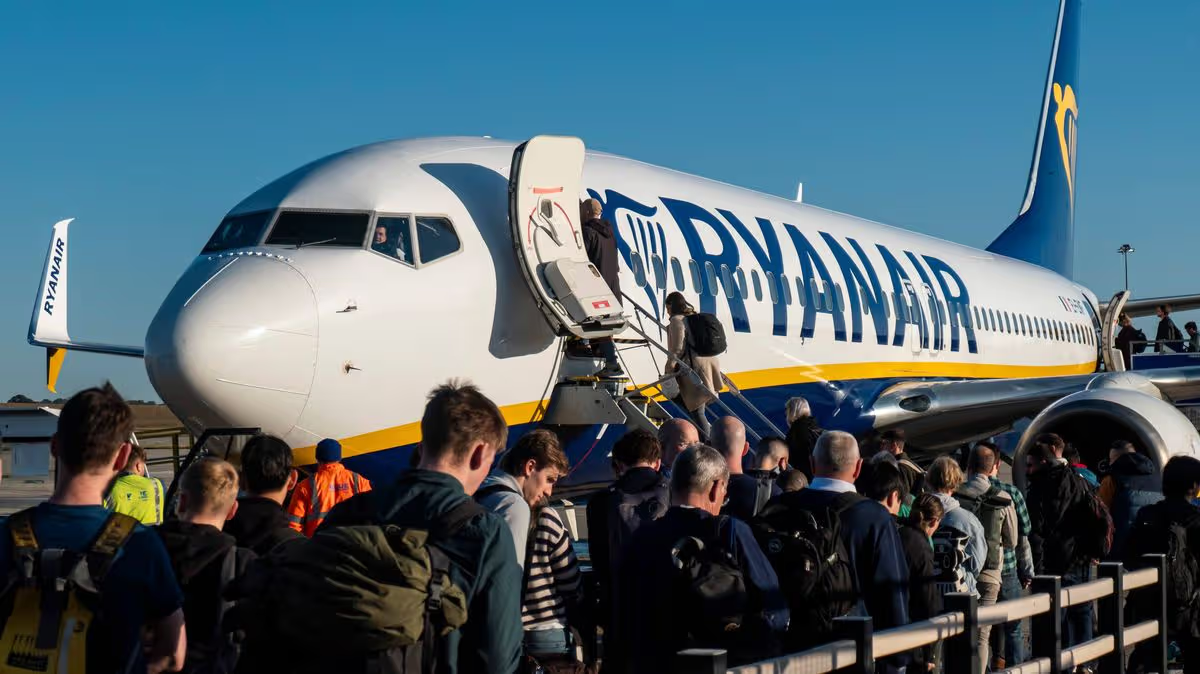
Millions of passengers fly with Ryanair each year but, if you’re planning a trip to Spain, there’s some vital information you should be aware of. Travellers have been informed that Ryanair is selling seats that are “cheaper than buying dinner”, which is fantastic news for those on the hunt for a budget-friendly getaway.

Advertisement

The travel deals were recently highlighted by Spain Explore on Instagram, with the page eager to bring the bargains to people’s attention. The account claimed the airline has announced routes to Barcelona that are “cheaper than dinner” and, after a quick search, it’s clear that some flights from the UK are remarkably good value.

It’s not the only noteworthy update passengers have received about the airline of late either. Just days ago, travellers were cautioned that a straightforward error could end up pushing up the cost of their flights.

Alongside the post, the caption read: “Greece to Barcelona for just $48 (£35.26) on Ryanair. May 26, 2026 departure. This price won’t last long so grab yours NOW before it’s gone.”

However, for those travelling from the UK and Ireland, there are a few key details worth knowing to help secure the best possible deals. Ryanair typically offers very competitively priced flights to Barcelona, with fares frequently starting from around £15 to £25 for one-way tickets from various UK departure points, including London Stansted and Manchester.

Advertisement

They predominantly operate into Barcelona El Prat Airport (BCN), typically arriving at Terminal 2B, with fares that are often highly competitive and usually include just a small personal item. The London Stansted to Barcelona route is considered a popular budget option, with one-way tickets occasionally available for as little as £19.

Content cannot be displayed without consent

However, there are several important factors to bear in mind. Generally, you’ll need to book approximately 45 to 60 days ahead to secure the most affordable fares.

Additionally, the lowest prices typically cover only one small personal item. Additional fees may be incurred for cabin baggage or hold luggage.

How to secure the best offers

While a handful of bargain fares remain available this month, June presents flights from as little as £16.99 for one-way trips from airports including Birmingham, Bristol and Liverpool on selected dates.

Advertisement

For departures from Dublin, the website presently displays fares as low as €31 (£26.75) on certain days for a one-way trip, though return prices can vary. The cost is dependent on your chosen travel dates.

For those looking to depart shortly, some return flights are also on offer from just €58 (£50.06) in May. However, you’ll need to move quickly to secure these seats, as availability is restricted.

Meanwhile, departures from Glasgow Prestwick tend to be more economical mid-week in June for those planning to visit Barcelona. Some can be secured for as little as €51 (£44.02) for a return journey in May and June.

Bear in mind that flight prices vary considerably throughout the month, so acting swiftly is essential if you’re hoping to secure a bargain fare. It’s also worth noting that prices fluctuate constantly and may mean you’re restricted to travelling on certain dates.

Advertisement

In fact, costs can change several times a day, driven by real-time demand, seat availability and competitor pricing. Airlines are known to employ dynamic algorithms to adjust fares, with prices climbing as flights fill up or dropping to attract bookings, typically mid-week.

Additional factors such as travel dates, route popularity and public holidays can also influence these shifts. It’s well worth keeping this in mind when shopping around for the best deal.

Source link

Advertisement
Continue Reading

NewsBeat

BBC star makes sweet admission on filming in Belfast for popular crime-drama

Published

on

Belfast Live

The popular BBC series first kicked off in 2023 and has grown in popularity over the years.

Earlier this year, it was confirmed that another series of Blue Lights is on the way.

Sharing a post on social media, the BBC crime drama announced the programme was filming in Belfast.

Advertisement

The series follows police recruits Grace, Annie, and Tommy as they learn the ropes of the police force while working in a high-pressure environment.

As filming gets underway, some of the cast members revealed their favourite things about filming in the city. In a clip shared on BBC’s Instagram, actress Siân Brooke comments: “Belfast is made of the best people, end of.”

Sharing their thoughts on the city, Martin McCann added: “Belfast is made of heart, soul. It’s Northern Ireland you know, it’s beautiful. It really punches above its weight.”

Meanwhile, other members of the cast, including actors Katherine Devlin and Nathan Braniff, said it was also full of love and good craic as Nathan remarked: “For me, it feels like home.”

Katherine added: “I think it’s because it’s so vibrant as a city, and also, there are so many different textures to it. You have Holywood direction and it’s beside the sea and then you also have inner-city Belfast too.”

Following the announcement that another series was on the way, the BBC shared that Richard Dormer was returning to the role of Gerry Cliff.

Although his character was killed off in series one, fans suspect it’s likely his reprisal will be down to a flashback scene or a storyline surrounding Gerry’s murder investigation.

Fans will also see Hannah McClean as solicitor Jen Robinson and Jonathan Harden as disgraced former Inspector Jonty, in an episode that will answer important questions from the past.

Declan Lawn and Adam Patterson, co- creators and co-writers say: “We’re very excited to bring this series of Blue Lights to audiences.

“It reveals a lot of dark secrets, examines what justice looks like in Belfast today, and ties together the past, present, and futures of Grace, Annie and Tommy in an action-packed story. We can’t wait to start filming it!”

Advertisement

A synopsis for the series reads: “Three years into their jobs as response officers, Constables Grace Ellis, Tommy Foster, and Annie Conlon are operating at their limit, facing a new threat on the streets that the police can barely control.

“Meanwhile, the murder trial of Gerry Cliff exposes a dangerous and long-buried secret that leads to chaos both inside the police and across the criminal underworld. As they grapple with big decisions about their future, Grace, Tommy and Annie must find the courage to face the greatest threat they have ever encountered: the truth.”

Blue Lights is available to watch on BBC iPlayer.

Advertisement

Source link

Continue Reading

NewsBeat

Death of girl, 12 killed by falling tree branch was accidental, coroner rules

Published

on

Manchester Evening News

Brooke Wiggins died after falling from a rope swing

The death of a 12-year-old girl who was killed after being hit by a falling branch while playing on a rope swing has been ruled an accident in court.

Advertisement

Brooke Wiggins died days before she turned 13 on November 9, 2024, after she fell from a rope swing in Banstead, Surrey. South London Coroner’s Court heard how a large branch suddenly snapped before landing on the youngster.

Assistant coroner Ivor Collett said Surrey County Council, which was responsible for maintaining the tree, had been criticised over how it inspected the safety of trees, but concluded it could not have reasonably been expected to do more to prevent it from happening. Mr Collett said: “I see what happened on the awful day of Brooke’s death as an accident which was not readily foreseeable by either of the local authorities involved.

Click here to get the biggest stories straight to your inbox in our Daily Newsletter

“I find that they, and Surrey County Council in particular, had reasonable systems in place. Bearing in mind their duties and the risks and the public resources they have to manage, they could not reasonably be expected to have done more in a way which would have prevented this terrible accident.”

Advertisement

The inquest previously heard the tree had been reviewed by Surrey County Council in May 2022. Following the inspection, there was a recommendation to remove ivy covering it to “aid future inspection” of the tree, which, after Brooke’s death, was revealed to have had a “crack” not visible from ground level.

A re-inspection was scheduled for May 2024, but this did not take place because of prioritising other inspections, the inquest heard. The coroner told the inquest on Wednesday, May 6, that there was “no sound evidence that a re-inspection by May 2024 would have revealed either a dangerous crack or a rope swing”.

Mr Collett said: “A criticism made in this case of Surrey County Council has been that its inspection regime was deficient. However, I do not make that finding.

Advertisement

“I accept the need to prioritise tree inspection works. This is not the same statutory territory as highway inspection regimes, it is far more nuanced and must be far more reactive and flexible, especially given the resources available and the huge number of trees involved in the Surrey CC estate.”

The inquest previously heard that a “pathway for avoiding Brooke’s death” was for the erection of advisory notices between May 2022 and May 2024 warning against rope swings.

Mr Collett rejected this in his conclusions because there was a lack of evidence that a rope swing would have been discovered in that period and “it is doubtful that vigorous children and teenagers would take much notice of warning signs”.

Advertisement

Get MEN Premium now for just £1 HERE – or get involved in our WhatsApp group by clicking HERE

The assistant coroner told the inquest that a Prevention of Future Deaths (PFD) report was “not warranted” as “there is a sufficient system already in place”. Mr Collett ended the inquest by paying tribute to Brooke’s family.

He said: “They have provided a voice for her when she has been unable to speak for herself.

“Brooke was plainly a light that shone in their lives, and while that light shone far less than half as long as was its due, it clearly shone more than twice as brightly.”

Advertisement

Source link

Continue Reading

Trending

Copyright © 2025