
Crypto World
Gnosis Treasury Redemption Vote Swings as Whale Counters Cofounder



Votes in favor of a redemption proposal that would let GNO holders claim roughly $170 per token from a $223M treasury have retaken the lead on Snapshot.


TLDR
- Nigel Farage said he had no obligation to declare the $6.7 million personal gift from Christopher Harborne.
- He stated that the £5 million payment was unconditional and not linked to political activity.
- Conservative officials referred the matter to Parliamentary Standards Commissioner Daniel Greenberg for review.
- Christopher Harborne holds a 12% stake in Tether and has donated £12 million to Reform UK.
- Prime Minister Keir Starmer announced a moratorium on cryptocurrency donations to UK political parties.
Reform UK leader Nigel Farage rejected calls to declare a $6.7 million personal gift from crypto investor Christopher Harborne. He said the £5 million payment carried no political conditions and required no disclosure. Meanwhile, opposition parties asked the Parliamentary Standards Commissioner to review the matter.
Nigel Farage Defends $6.7M Gift From Tether Stakeholder
Nigel Farage said he had “no obligation” to declare the $6.7 million gift from Christopher Harborne. He told broadcasters that the payment was “an unconditional, non-political, personal gift.” He added, “Believe you me, we’ve looked at this from every legal angle.” He said the law did not require disclosure of such gifts.
Farage linked the payment to past threats against him, including a firebomb attack on his home. He said the funds would help “ensure I can be safe for the rest of my life.” He confirmed he would not refer himself to Parliamentary Standards Commissioner Daniel Greenberg. He argued there was “no case to answer” under current rules.
Conservative officials referred the issue to Daniel Greenberg for independent review. They asked him to examine whether any part of the £5 million supported political activity. Labour chair Anna Turley said Farage “appears to have broken the rules again.” Reform UK stated the gift arrived before Farage planned to stand for Parliament.
Reports revealed the payment occurred in June 2024, months before Farage announced his Clacton candidacy. The transaction did not appear in disclosures under UK campaign finance laws. Reform UK maintained that timing placed the gift outside reporting requirements. The party denied any breach of election law.
Crypto Donations Face Scrutiny After Rycroft Review
Christopher Harborne resides in Thailand and holds a 12% stake in stablecoin issuer Tether. He has donated £12 million to Reform UK through separate contributions. His £9 million donation last year became the largest single political gift from a living individual. He confirmed the $6.7 million payment to Farage was “unconditional and irrevocable.”
Harborne told the Telegraph he expected nothing in return except Farage’s safety. He said he believed he influenced the government’s decision to cap overseas donations. He stated he did not believe the government had “a right to stop me.” He did not rule out returning to the UK to bypass donation limits.
Prime Minister Keir Starmer announced an immediate moratorium on cryptocurrency donations to political parties. The government triggered the move after an independent review led by Philip Rycroft. The ban applies to all crypto donations received from today. Parties must return any crypto within 30 days.
Philip Rycroft warned that hostile actors could exploit crypto assets to channel foreign funds. He said the risk was “unacceptable” and required urgent action. He described the moratorium as an “interlude” rather than a permanent ban. He clarified that donors could still convert crypto into fiat and donate through banks.

TLDR
- Morgan Stanley has launched a spot cryptocurrency trading pilot on its E*Trade retail brokerage platform.
- The bank is charging clients 50 basis points on the dollar value of each crypto transaction.
- The pilot is currently live and Morgan Stanley plans to extend access to all 8.6 million E*Trade clients later this year.
- Jed Finn said the initiative is part of a broader strategy and described it as disintermediating the disintermediators.
- Bloomberg reported that the new fee is lower than Charles Schwab’s 75-basis-point fee for similar services.
Morgan Stanley has launched spot cryptocurrency trading on its ETrade retail brokerage platform, according to Bloomberg. The bank charges 50 basis points per transaction and has started a live pilot. It plans to extend access to all 8.6 million ETrade clients later this year.
Morgan Stanley Expands Crypto Access Through E*Trade Pilot
Morgan Stanley rolled out spot cryptocurrency trading for select E*Trade clients as part of a pilot program. The bank charges a 50-basis-point fee on each crypto transaction. Bloomberg reported that the pilot is active and broader access will follow this year.
The bank manages the sixth-largest U.S. assets by assets under management. Jed Finn, head of wealth management, outlined the broader strategy behind the move.
He said, “This is much bigger than trading crypto at a cheaper rate,” and called it “disintermediating the disintermediators.”
Bloomberg senior ETF analyst Eric Balchunas compared the new fee with competitors. He said Charles Schwab charges 75 basis points for similar services. He added that Schwab “likely won’t let this stand,” in a post on X.
Balchunas also pointed to lower-cost alternatives in the market. He said Bitcoin ETFs can trade at around 2 basis points.
He also wrote, “I still think ETFs are the way bigger cash magnet at least for now.”
Bitcoin Initiatives and Stablecoin Fund Broaden Digital Asset Push
Morgan Stanley had largely stayed away from crypto until October. At that time, it said it would cap crypto allocations at up to 4% in aggressive portfolios. That move aligned the bank with asset managers such as BlackRock and Fidelity.
Weeks before the E*Trade pilot, the bank launched a spot bitcoin exchange-traded fund called MSBT. The fund gathered $103 million in net inflows within its first six trading days. It has since accumulated more than $205 million in assets under management, according to The Block.
Bloomberg also reported further digital asset plans. Morgan Stanley plans to let clients convert cryptocurrency into shares of exchange-traded products without selling holdings. The bank also intends to enable tokenized equities trading for institutional clients in the second half of the year.
Meanwhile, the investment unit launched a stablecoin reserves fund last month. The fund follows GENIUS Act requirements and maintains a stable $1 net asset value. It invests in cash and U.S. Treasury instruments with maturities of 93 days or less.


An announcement about the long-anticipated U.S. Strategic Bitcoin Reserve (SBR) is coming “in the next few weeks,” Patrick Witt, executive director of the President’s Council of Advisors for Digital Assets, told CoinDesk’s Consensus Miami conference on Wednesday.
The federal effort to inventory, centralize and secure U.S.-held bitcoin and other digital assets has been running in the background for months, Witt said. Following President Donald Trump’s executive order calling for bitcoin and other crypto assets to be set aside in long-term holdings, the White House halted what Witt characterized as “fire sale” liquidations under the previous administration and started auditing what crypto each agency was holding.
“We’ve heard stories and confirmed some of them of cold wallets that were being stored in drawers of desks in various agencies,” he said.
Witt cited a recent exploit involving assets held by the U.S. Marshals Service as a motivating proof point for centralization. Bloomberg reported in January that the Marshals Service was investigating a possible hack of U.S. government digital-asset accounts, after on-chain investigator ZachXBT claimed a hacker stole more than $60 million in late 2025, including funds from government seizure wallets.
“It’s a case in point for why it was so necessary that the president established the SBR, and that he instructed the agencies to take these assets very seriously and properly safeguard them,” Witt said. “Custody is unique for digital assets.”
Witt declined to disclose how much bitcoin or other crypto the federal government currently holds.
“Number one is we want to get our own house in order. We want to properly safeguard, custody these assets before we discuss any details around it,” he said. He suggested the upcoming announcement would address some of the open questions on size and structure, but said he did not want to “front run any of the other principals involved.”
He also clarified that the reserve will not absorb every newly seized asset automatically. Crypto seized in active legal proceedings sits in pending status until forfeiture is finalized, he said, with assets potentially returned to victims through restitution before being moved to the bitcoin reserve or the separate stockpile anticipated for other crypto assets.
On the legal underpinnings, Witt said much of the staff work has gone into general-counsel-level questions about which authorities allow agencies to hold the assets, for how long and whether they are subject to congressional clawback.
“This really hadn’t been explored until the president signed the executive order,” he said.
Codification will need to follow through Congress, Witt said, citing Sen. Cynthia Lummis’s BITCOIN Act in the Senate and Rep. Nick Begich’s American Reserves Modernization Act, a rebranded update of the same bill in the U.S. House of Representatives.
“It always needs to be followed up with proper legislation,” Witt said.
The likely need for a legislative underpinning to the formation of the bitcoin reserve has been a major constraint in this process. It’s unclear when Congress will find the bandwidth and drive to push through a reserve bill.


The Trump administration has held internal discussions about allowing wealthy donors to contribute company shares to Trump Accounts. The federal child investment program would give those donors significant tax breaks in return, Forbes reported on May 6.
The proposal would expand the program beyond cash contributions. Donors could give appreciated stock, avoid capital gains tax, and claim full charitable deductions at market value.
A New Pathway for Wealthy Donors
Trump Accounts went live this year under the One Big Beautiful Bill Act. Each US child born between 2025 and 2028 receives a $1,000 Treasury seed deposit. Parents can add up to $5,000 a year in post-tax dollars.
Funds are invested in diversified US equity index funds and are unlocked partially at age 18. Cash contributions open officially on July 4, 2026. The discussion names Brad Gerstner of Altimeter Capital as the lead advocate.
Why the Tax Math Matters
The proposed structure mirrors existing tax rules for charitable stock gifts. A wealthy donor would avoid capital gains tax on accumulated appreciation. The same donor would also claim a deduction worth the share’s current market price.
That double benefit could attract billions from founders sitting on highly appreciated equity. Cash donations carry no comparable advantage.
Billions Already Pledged, Critics Push Back
Private capital is already flowing in. Michael and Susan Dell pledged $6.25 billion in December. Their gift will seed $250 deposits for roughly 25 million children in lower-income ZIP codes.
Ray Dalio, BlackRock, Uber, Robinhood, and Charles Schwab have committed state-level or employer-matched contributions.
Allowing stock donations could route appreciated founder wealth into the program.
The NYU Tax Law Center calls the plan an expansion of philanthropy deductions already used by ultra-wealthy donors.
Any expansion would require new legislation. Neither the Treasury nor the White House has publicly confirmed the talks.
Congress now stands as the gatekeeper. Lawmakers will decide whether founder stock can flow into the accounts of millions of American children.
The post Billionaires May Get Tax Break for Donating Stock to Trump Accounts appeared first on BeInCrypto.
TLDR
- 21Shares listed the Strategy Yield ETN on the London Stock Exchange to expand access for U.K. investors.
- The ETN provides exposure to Strategy’s Series A perpetual preferred stock known as STRC shares.
- The product offers an 11.50% annual yield and pays distributions monthly in cash.
- 21Shares applies no management fee to the Strategy Yield ETN.
- Strategy holds 818,334 BTC valued at nearly $67 billion based on recent figures.
21Shares has listed the Strategy Yield ETN on the London Stock Exchange, offering U.K. investors exposure to Strategy’s preferred stock. The exchange-traded note tracks Strategy’s Series A perpetual preferred shares and delivers an 11.50% annual yield paid monthly in cash. The product marks 21Shares’ first U.K. vehicle tied directly to Strategy’s Bitcoin-backed securities.
STRC Shares Offer Yield Linked to Bitcoin Holdings
21Shares structured the ETN to provide exchange-traded access to Stretch, Strategy’s variable rate Series A perpetual preferred stock. The underlying STRC shares provide yield exposure supported by Strategy’s large Bitcoin holdings. The ETN currently offers an 11.50% annual yield, and it pays distributions monthly in cash.
The company reviews the distribution rate each month to support price stability and align with market conditions. The structure includes a floor tied to short-term interest rates to protect yield levels. 21Shares charges no management fee on the ETN, which creates a fee-free structure for U.K. investors.
21Shares President Duncan Moir described the launch as a milestone for the domestic market.
He said, “We are introducing an easy-to-access investment product that combines high income potential with a familiar exchange-traded structure.” He added that the product gives U.K. investors access to a strategy that was not previously available in an ETN format.
Strategy President and CEO Phong Le also addressed the launch in a statement. He said, “STRC is an innovation in the capital markets that provides the upside of a Bitcoin-backed security, with the stability of a traditional credit product.” He added that the partnership expands access for U.K. investors to Strategy’s capital model.
Strategy Expands Bitcoin Treasury and Adjusts Policy
Strategy, based in Tysons, Virginia, holds 818,334 BTC valued at nearly $67 billion. The company represents about 3.9% of Bitcoin’s total supply based on current figures. Strategy previously relied on issuing common MSTR shares to finance its Bitcoin purchases.
However, the company has raised $5.58 billion in 2026 through its STRC shares to buy more Bitcoin. This shift reflects growing investor interest in the preferred stock structure. The new ETN enables U.K. traders to access similar yield exposure through a listed instrument.
On Tuesday, Strategy revised its long-standing Bitcoin policy and adjusted its “never sell” stance. The company told investors it would sell Bitcoin when doing so is “advantageous to the company.” Strategy reported a $12.54 billion net loss for the first quarter of 2026.
The loss included $14.5 billion tied to the decline in Bitcoin’s value during the period. In comparison, the company recorded a $14.4 billion loss in the fourth quarter of 2025. Despite losses, Strategy has continued accumulating Bitcoin and expanding its treasury position.
MSTR recently traded at $183.45, according to Yahoo Finance data. The stock has gained nearly 44% over the past month. Bitcoin traded near $81,750 after rising about 18% in the same period.
Hut 8 Mining Corp. is navigating a pivotal transition as its first-quarter 2026 results highlight both the volatility of Bitcoin prices and a bold strategic pivot toward AI infrastructure. The Canadian-listed miner reported a quarterly net loss of more than $253 million, driven largely by a write-down tied to the market value of its Bitcoin holdings, which tumbled from a high of roughly $126,000 in October to about $60,000 in February.
Revenue for the quarter came in at just over $71 million, down about 22% from the prior period’s $88.4 million. Analysts had expected around $78.5 million, according to FactSet. Hut 8 noted that $66.0 million of its Q1 revenue came from ASIC compute, AI cloud and traditional cloud solutions, underscoring the company’s ongoing diversification beyond pure crypto mining.
More notably, Hut 8 unveiled a landmark development: a $9.8 billion deal to lease 352 megawatts of capacity to a third-party AI company over 15 years. The arrangement positions Hut 8 to monetize large-scale compute capacity beyond Bitcoin mining and into AI hosting and related data-center operations. The company had earlier signaled progress in this direction with the commercialization of the first phase of its Beacon Point AI data-center campus, a 1 gigawatt project that includes the 352 MW lease footprint referenced in the agreement.
Key takeaways
- Hut 8’s Q1 2026 net loss exceeds $253 million, driven by a write-down reflecting the drop in Bitcoin’s market value from October highs to February lows.
- Quarterly revenue stands at $71 million, down roughly 22% from the prior quarter’s $88.4 million; analysts’ consensus stood at about $78.5 million.
- The company disclosed a $9.8 billion, 15-year lease to supply 352 MW to an AI-focused data-center operator, signaling a major strategic pivot toward AI hosting and energy infrastructure.
- Hut 8’s shift mirrors a broader industry trend as crypto miners diversify into AI workloads, energy projects, and scalable data-center ventures to offset traditional mining headwinds.
- Industry dynamics surrounding electricity pricing and energy supply are intensifying competition between AI infrastructure and Bitcoin mining, with implications for network security and grid demand.
Hut 8’s quarterly numbers: the price of BTC and the pull of AI
Hut 8 attributes its sizeable quarterly loss to the revaluation of its Bitcoin holdings. The company noted that BTC prices have swung dramatically since last fall, trading above $126,000 at their peak and sliding toward the $60,000 region by February. In crypto markets, such mark-to-market adjustments can dwarf operating cash flows, especially for miners with significant BTC inventories and holdings. Hut 8’s management described the loss as a market-value write-down tied to the company’s Bitcoin exposure, a reminder of how sensitive mining operators remain to the coin’s price trajectory.
Despite the headwinds from Bitcoin’s price moves, Hut 8 reported that its revenue mix in Q1 still reflected a meaningful contribution from non-mining activities. The company said it generated $66.0 million in revenue from ASIC compute, AI cloud and traditional cloud solutions, contributing to a total quarterly revenue of just over $71 million. The juxtaposition of a high-profile impairment with a growing AI and cloud services footprint illustrates the company’s attempt to diversify a business model exposed to crypto cycles.
Market expectations, meanwhile, framed Hut 8’s results in a context of caution. FactSet consensus pointed to roughly $78.5 million in Q1 revenue, suggesting investors were looking for resilience despite BTC volatility. Hut 8’s management acknowledged the miss against consensus while emphasizing the strategic importance of the AI and data-center initiatives as the company navigates a shifting industry landscape.
Strategic pivot: a $9.8 billion lease and a new future
The centerpiece of Hut 8’s 2026 strategic pivot is the long-term lease arrangement for 352 MW of capacity, part of a broader plan to monetize substantial, scalable compute capacity beyond traditional mining operations. The $9.8 billion deal spans 15 years and is designed to anchor a third-party AI company’s data-center needs, effectively transforming a portion of Hut 8’s asset base into an AI-hosting platform. This move aligns with Hut 8’s earlier disclosures about advancing the Beacon Point AI data-center campus—an ambitious, multi-phase project designed to support hyperscale AI workloads while leveraging Hut 8’s existing infrastructure and energy relationships.
Analysts and industry observers have noted that AI infrastructure commands higher value per megawatt than traditional crypto mining, a dynamic that can reshape the economics of large-scale data centers. As Hut 8 reorients its business model toward AI hosting, the company will face new operating considerations, including long-term power purchase commitments, reliability of energy supply, and the ability to scale AI-friendly data-center services while managing legacy mining operations.
The broader market backdrop for this pivot is not unique to Hut 8. The crypto-mining sector has faced sustained pressure from rising energy costs, market volatility, and regulatory scrutiny, prompting several operators to diversify into AI and other high-performance computing (HPC) ventures. Cointelegraph has repeatedly highlighted this trend, noting that several miners are refocusing on AI-hardware deployments and energy infrastructure to sustain growth in a landscape where pure mining margins have eroded. The industry’s shift toward AI-hosting and related data-center partnerships reflects a pragmatic response to a structurally changing energy and compute market.
In parallel, observers point to the intensifying competition for electricity between AI hyperscalers and Bitcoin miners. Crypto trader and market analyst Ran Neuner has framed the dynamic as a race for a scarce resource: power. “Both industries compete for the same thing: electricity,” Neuner said, noting that AI workloads are currently willing to pay higher prices for capacity. Estimates floated by Neuner put mining margins at lower per-MW rates compared with AI hosting, underscoring why some miners are pursuing AI-centric business lines to sustain profitability.
These energy-market dynamics are not happening in a vacuum. Since 2024, major AI and cloud players—Google, Microsoft, Amazon, and Meta—have signaled a growing appetite for nuclear-energy-backed power to sustain their AI infrastructure. The trend points to a broader energy strategy among hyperscalers and a potential reshaping of power-market demand as AI workloads scale. Cointelegraph has traced related developments, including coverage of AI-focused data-center expansions and energy procurement strategies that intersect with crypto-mining footprints.
What this means for investors, users, and the sector
Hut 8’s earnings trajectory underscores a key tension facing publicly traded miners: a need to balance capital-intensive mining operations with enduring value from diversified compute workloads. The $9.8 billion, 15-year lease represents not just a new revenue line, but a strategic bet on AI hosting as a durable driver of cash flow in an environment where mining economics can be cyclical and highly sensitive to BTC price movements. For investors, the question is how quickly and efficiently Hut 8 can translate this strategic pivot into meaningful, recurring profits while managing the transition from a pure mining model to a hybrid AI-and-mining platform.
From a market perspective, the shift raises several watch points. First, how will Hut 8 balance debt, capital expenditure, and lease obligations with ongoing mining operations? Second, does the AI-hosting business model deliver reliable, long-term returns in the face of potential regulatory, grid, or energy-price shocks? And third, how will the broader energy market respond as more data centers compete for power, particularly if AI demand accelerates beyond initial projections? These questions will shape Hut 8’s next earnings cycles and could influence investor sentiment across the broader mining sector, where several peers are weighing similar moves into AI and energy infrastructure.
For users and builders, the development signals a growing convergence between crypto infrastructure and mainstream compute ecosystems. If Hut 8’s AI data-center strategy proves resilient, it could catalyze more partnerships that blend mining facilities with AI hosting capabilities, potentially creating new pathways for energy efficiency, grid resilience, and technology deployment at scale. And as the energy landscape evolves—with nuclear-backed power and large-scale HPC demands rising—the industry’s appetite for stable, long-horizon power agreements could reshape how crypto miners approach site selection, energy contracts, and environmental considerations.
Readers should keep an eye on Hut 8’s upcoming disclosures for updates on the lease execution, cash flow implications, and the progression of Beacon Point’s phased development. The balance between a recovering BTC price, the economics of AI hosting, and evolving energy-supply arrangements will likely determine whether the company can turn this strategic pivot into durable profitability in a market that remains highly dynamic.

Eric Trump mocked JPMorgan at Consensus Miami 2026 for reversing its bitcoin stance within 18 months, saying banks have accepted they can no longer hold back the tide.
Summary
- Eric Trump told Consensus Miami that JPMorgan dismissed bitcoin as a “joke asset” 18 months ago and is now allowing clients to take out mortgages against it.
- Trump said traditional financial institutions have “lost” the fight against crypto and are now joining the current rather than fighting it.
- JPMorgan CEO Jamie Dimon was a longtime critic of bitcoin before his bank built out its Kinexys blockchain platform and sponsored Consensus Miami 2026.
Eric Trump took the stage at Consensus Miami 2026 on Wednesday and attacked JPMorgan over its reversal on bitcoin, framing a timeline that moved from public hostility to mortgage products in under two years. Trump, co-founder and chief strategy officer of American Bitcoin, cast the shift as a concession by the banking establishment.
“JPMorgan, who was crapping all over bitcoin 18 months ago, saying it was a joke asset,” Trump told the Consensus crowd. “It’s really interesting — now they’re allowing people to take down home mortgages against their bitcoin holdings at JPMorgan, this happened in a period of 18 months, my friends.”
Trump argued the broader financial industry has been forced to capitulate. “The financial institutions all realize that they’ve lost and they can no longer push back,” he said. “And so instead of actually fighting against the tide, you know what they’re doing, they’re swimming with it for the first time.”
JPMorgan CEO Jamie Dimon described bitcoin as a fraud and a speculative asset at multiple points over the past decade. The bank has since pivoted, building out its Kinexys blockchain platform, which has processed more than $1 trillion in transactions, and sponsoring Consensus Miami 2026 for the first time. As crypto.news documented, JPMorgan is now embedded across crypto infrastructure, including as a key institutional partner for Chainlink.
Trump also referenced his family’s history of being debanked, calling it the experience that pushed him toward advocating for bitcoin’s censorship-resistant rails. American Bitcoin holds all mined coins without selling. For Trump, JPMorgan’s shift from critic to mortgage provider in 18 months is the clearest evidence yet that institutional resistance to bitcoin is over.


Summary
- The US and Iran are close to agreeing a one-page memorandum of understanding to end the current war and set up detailed nuclear talks, according to Axios.
- The 14-clause draft would pause Iran’s uranium enrichment, ease sanctions, unlock billions in frozen funds, and gradually reopen the Strait of Hormuz to shipping.
- De-escalation around Iran has repeatedly moved Bitcoin, gold, and oil this year, with prior ceasefire headlines helping push BTC back toward the $78,000–$79,000 range.
The White House believes it is “getting close to an agreement with Iran on a one-page memorandum of understanding to end the war and set a framework for more detailed nuclear negotiations,” Axios reported on Wednesday, citing two US officials and two additional sources briefed on the talks. The US expects Tehran’s response on several key points within the next 48 hours, making this “the closest the parties have been to an agreement since the war began,” according to the report.
Memo could end war and reopen Strait of Hormuz
Under the draft, Iran would commit to a moratorium on uranium enrichment, while Washington would agree to lift some sanctions and release billions of dollars in frozen Iranian assets, Reuters summarized in its own write‑up of the Axios story. Both sides would also lift restrictions on transit through the Strait of Hormuz, the chokepoint that handles roughly 20% of global oil trade and has been partially shut by Iranian measures and a US naval blockade during the conflict.
The memorandum, described as a 14‑point, single‑page document, is being negotiated by Trump envoys Steve Witkoff and Jared Kushner with several Iranian officials, using a mix of direct and mediated channels. In its current form, the memo would formally declare an end to regional hostilities and trigger a 30‑day period of intensive talks on a fuller agreement covering strait access, nuclear limits, and sanctions relief, with venues under discussion including Islamabad and Geneva. During that 30‑day window, restrictions on shipping and the US blockade would be phased out; if the talks collapse, US forces would retain authority to restore the blockade or resume military action.
What a deal would mean for Bitcoin, gold, and risk assets
Markets have already shown how sensitive they are to each turn in the Iran story. When the war first escalated in late February, Bitcoin fell from about $66,000 toward $63,000 within hours, erasing over $120 billion in crypto market cap, while gold spiked toward fresh highs and oil briefly jumped more than 10%, as detailed in a Blockhead post‑mortem and a broader Economic Times review of safe‑haven flows.
As the conflict shifted from escalation to uneasy ceasefire, Bitcoin’s behavior flipped. When President Donald Trump signaled an initial pause in escalation and a conditional ceasefire tied to reopening the Strait of Hormuz, BTC jumped roughly 5% in a single session to above $72,700, according to Bitcoin Magazine. A later extension of the truce helped push Bitcoin toward $78,000, its highest level in more than ten weeks, Yahoo Finance reported.
Analysts quoted by MEXC and other outlets have framed this pattern as a classic “de‑risking, then re‑risking” sequence: in the initial shock, traders dump Bitcoin alongside equities and rotate into cash, gold, and oil; once a ceasefire or de‑escalation looks durable, capital rotates back into higher‑beta assets, with BTC often outperforming in the relief phase. A recent MEXC scenario analysis on the Iran‑Israel war laid out this exact path—oil easing back, inflation expectations softening, the Fed resuming cuts, and “Bitcoin breaking higher” under a ceasefire case.
If Washington and Tehran now ink even a preliminary memorandum that ends the war and reopens the Strait, traders will likely replay a similar macro script: crude prices and gold could cool from crisis highs, rate‑cut expectations might firm, and Bitcoin could benefit from both a weaker dollar and renewed risk appetite. Crypto’s response will not be linear—macro, ETF flows, and idiosyncratic factors all matter—but the market has already shown that for this conflict, peace headlines have tended to coincide with BTC reclaiming the high‑$70,000 to $79,000 zone, as noted by CryptoBriefing.
Over the medium term, a durable US‑Iran understanding that normalizes the Strait of Hormuz would remove one of the biggest geopolitical tail‑risks hanging over both traditional markets and crypto. That could shift the narrative away from “war hedge” trades in gold and oil back toward structural stories like Bitcoin ETF adoption, Ethereum’s roadmap, and the broader on‑chain capital rotation that crypto.news has been tracking in recent coverage, including this ETF inflow analysis, a safe‑haven comparison, and a macro‑driven market outlook.
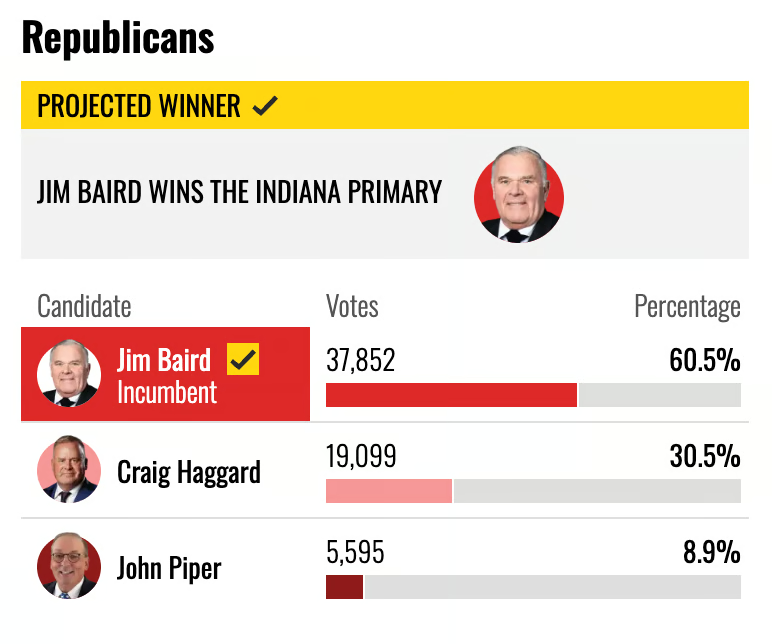
A Republican US House of Representatives member running for reelection has won his party’s primary after crypto-affiliated groups contributed more than $500,000 in supportive media buys.
Representative James Baird won Tuesday’s Republican primary for Indiana House District 4 with more than 60% of the vote, beating challenger Craig Haggard and others.
Beginning with his first term, in January 2019, Baird consistently supported legislation considered favorable to the crypto industry, including the GENIUS stablecoin act and the market structure bill, the CLARITY Act.
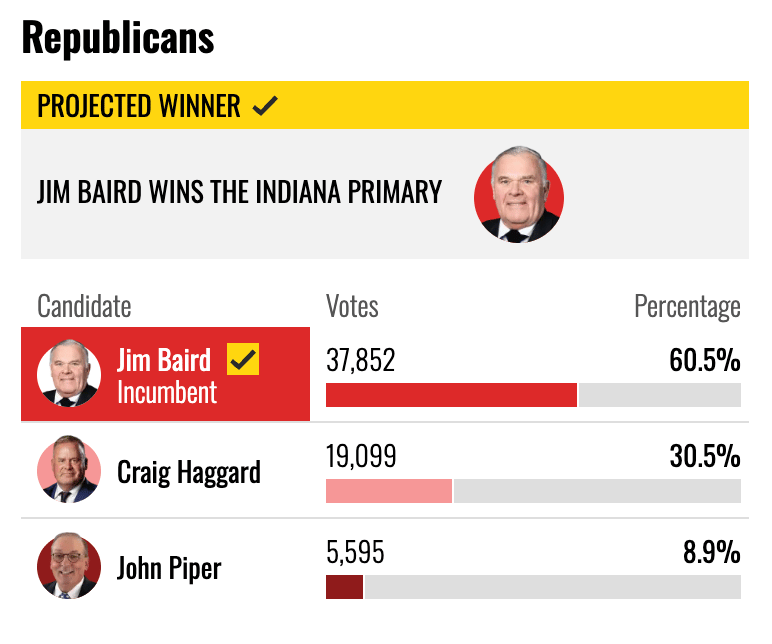
Source: NBC News
According to filings with the US Federal Election Commission (FEC), the Defend American Jobs political action committee (PAC) spent about $514,000 on media to support Baird. The PAC is affiliated with Fairshake, a committee backed by crypto companies including Coinbase and Ripple Labs that spent more than $130 million to influence the 2024 US elections.
“Representative Baird has been a proven leader for pro-job, pro-consumer, and pro-innovation policies in Congress,“ a Fairshake spokesperson told Cointelegraph before the primary. “We’re proud to support leaders committed to responsible regulation that ensures the US remains the global leader in innovation.”
Baird, who also received an endorsement from Donald Trump, reportedly thanked the US President following his primary win. Trump’s ties to the crypto industry have come under increased scrutiny as lawmakers in the Senate consider the CLARITY Act, with many calling for ethics provisions on digital assets before a potential vote.
Related: Americans distrust crypto, AI as industry super PACs flood midterms, poll finds
Fairshake, which reported holding $193 million as of January, is expected to spend millions of dollars in support of candidates it considers “pro-crypto” in the 2026 US midterm elections, as well as “oppose anti-crypto politicians” through media and ads. As of Wednesday, the PAC and its affiliates have spent about $10 million for races in Illinois and Texas in 2026.
Stablecoin yield compromise could advance market structure bill
Last week, US Senators Thom Tillis and Angela Alsobrooks announced that they had finalized the text of the CLARITY Act to include a compromise on stablecoin yield, one of the provisions at issue for the banking and crypto industries.
Although the Senate Banking Committee had not scheduled a markup on the bill as of Wednesday, many expect the stablecoin deal to advance the market structure legislation, which had been stalled in the chamber for months.
Magazine: Guide to the top and emerging global crypto hubs: Mid-2026
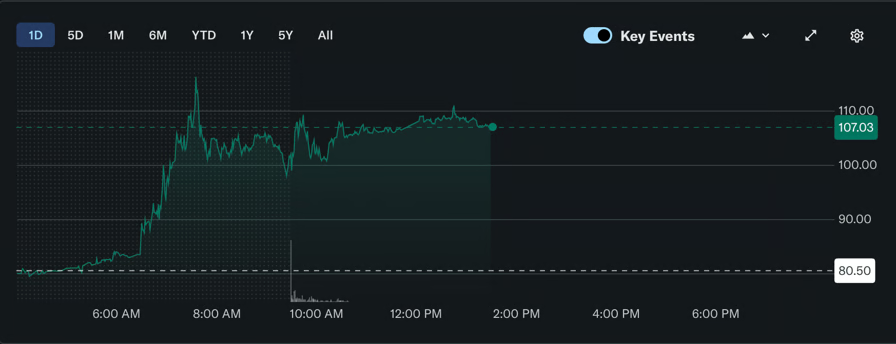
Investors appeared to disregard Hut 8’s reported first quarter 2026 net loss of more than $253 million on Wednesday, lifting the shares of the Bitcoin mining company by more than 33%.
Hut 8 attributed the loss to a reduction in the market value of its Bitcoin (BTC) holdings, which fell from a high of over $126,000 apiece in October to a low of $60,000 in February.
Revenue for quarter totaled more than $71 million, down by about 22% from the previous period’s $88.4 million, according to Hut 8’s earnings statements. Analysts had forecast $78.5 million, according to FactSet.
The company also announced a $9.8 billion deal that will see Hut 8 lease 352 megawatts to a third-party AI company over a 15-year period. Wednesday’s results showed the company generated $66.0 million in first quarter revenue from ASIC compute, AI cloud and traditional cloud solutions.
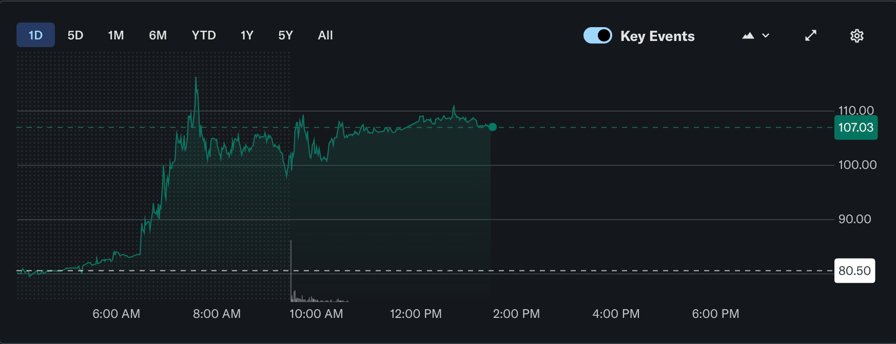
Hut 8’s stock surged following news of a $9.8 billion deal. Source: Yahoo Finance
The company’s diversification into AI and energy infrastructure comes amid an industry-wide pivot away from crypto mining, as public crypto mining companies struggle with high costs and declining revenues.
Related: Bitcoin miner Core Scientific shifts to AI with 1.5GW data center push
AI and Bitcoin mining increasingly compete for power
The shift to AI threatens the Bitcoin mining industry, according to crypto trader and market analyst Ran Neuner.
“Both industries compete for the same thing: electricity,” Neuner said, adding, “right now, AI is willing to pay much more for it.”
Mining companies can make anywhere between $57 and $129 per MW securing the blockchain, compared to between $200 and $500 per MW for AI infrastructure, he said.
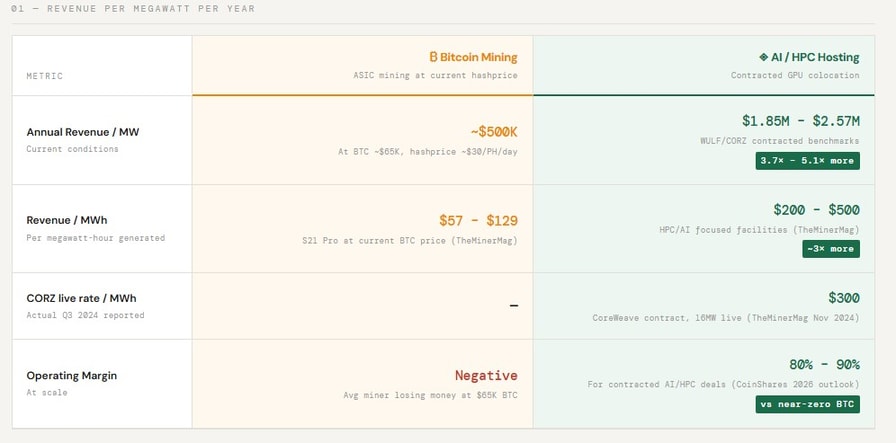
Revenue comparison for Bitcoin mining and AI hosting. Source: Ran Neuner
As miners shift their focus to more-profitable AI ventures, the total amount of computing power dedicated to securing the Bitcoin blockchain declines, making the network easier to attack, Neuner said.
The need for massive amounts of energy to power high-performance computing applications, including Bitcoin mining and AI workloads, has driven demand for nuclear energy generation.
Since 2024, several AI hyperscaling companies like Google, Microsoft, Amazon and Meta have announced nuclear energy deals to power their AI infrastructure.
Magazine: How AI just dramatically sped up the quantum risk for Bitcoin

Jane Fonda leads tributes to ex-husband and CNN founder Ted Turner

Warner Bros. Discovery books $2.9B net loss tied to Paramount deal
Nigel Farage Rejects Calls to Disclose $6.7M Gift

Manchester United reach agreement with Casemiro over contract clause amid transfer speculation

US brings back mandatory military draft registration

Steven Gerrard disagrees with Gary Neville over ‘shock’ Chelsea and Arsenal claim | Football


-

 NewsBeat3 days ago
Channel 5 – All Creatures Great and Small series 7 new post
-

 Entertainment7 days ago
Insider Claims Reason Behind Key & Peele Split
-
 Tech5 days ago
Trump’s 25% EU auto tariff breaches Turnberry Agreement that also covers semiconductors and digital trade
-
 Sports5 days ago
Paul Scholes issues Marcus Rashford reality check as agreement emerges over Man United star
-

 Entertainment5 days ago
Met Gala 2026 Rumored Guest List Is Turning Heads
-

 Business6 days ago
Strait of Hormuz Blockade Persists Amid US-Iran Standoff, Sending Oil Prices Soaring
-

 Entertainment7 days ago
Celebrities Who Are Attending the 2026 Met Gala Event
-
Entertainment5 days ago
New on Prime Video in May 2026 — Full List of Movies and Shows
-

 Sports5 days ago
Cavaliers vs. Raptors Game 6 live score, updates, highlights from 2026 NBA playoffs first-round series
-
 Sports5 days ago
David Benavidez responds to team Canelo saying the fight will never happen
-
Business7 days ago
Strait of Hormuz Remains Heavily Restricted on April 29 Amid Iran Conflict
-

 Entertainment5 days ago
Kylie Jenner Hit With Second Lawsuit From Ex-Housekeeper
-
 Sports5 days ago
IPL 2026: ‘Love you darling’- Hardik Pandya’s reaction to MS Dhoni steals the show |Watch | Cricket News
-

 Entertainment5 days ago
Young and the Restless Next Week: Cane Arrested & Matt’s Deadly New Scheme!
-

 Sports7 days ago
Saudi Arabia set to withdraw LIV Golf funding after 2026 season, per reports
-

 Tech7 days ago
Mark Zuckerberg Says Meta Is Working On AI Agents For Personal And Business Use
-

 Tech5 days ago
Meta ends Sama contract after Kenyan workers report seeing intimate footage from Ray-Ban smart glasses users
-

 Sports5 days ago
Plane crash in Wimberley, Texas kills 5 pickleball players at tournament
-

 Sports7 days ago
Stalemate in Madrid as resilient Arsenal Blunt Atletico Madrid in semi-final clash – Sports
-

 Sports7 days ago
Arsenal, Atletico Madrid share draw after penalty drama in Champions League semi-final
You must be logged in to post a comment Login