
Crypto World
BeInCrypto 100 Institutional Awards Nomination: Wintermute for Best Liquidity Provider



Liquidity provision in digital assets is no longer measured only by quoted spreads on exchanges. Institutional clients need firms that can price size, support bilateral execution, manage settlement across venues, and stay active when traditional markets are closed.
Wintermute has built its business around that demand. The firm is nominated for Best Liquidity Provider at the BeInCrypto Institutional 100 Awards 2026.
Average Daily Volume
$15B+ across CeFi and DeFi
Trading Pairs
3,000+ asset pairs supported
Connectivity
60+ centralized and decentralized venues
OTC Desk
Institutional digital asset execution across crypto and tokenized assets
Regulatory Standing
UK FCA registered
Asset Coverage
Native crypto, stablecoins, tokenized gold, oil exposure, tokenized money market funds
Execution Access
Chat, API, CeFi venues, DeFi protocols
Wintermute Liquidity Provider Snapshot
The nomination reflects Wintermute’s role as a global algorithmic trading firm and OTC desk serving institutional digital asset markets. Its business spans centralized exchanges, decentralized protocols, bilateral OTC execution, and tokenized real-world assets.
For the Best Liquidity Provider category, size alone is not enough. The award assesses whether a firm can support institutional execution across market conditions, asset classes, and settlement environments. Wintermute’s nomination is anchored in that broader role.
The OTC Desk Behind Institutional Flow
Wintermute’s OTC desk sits at the center of its nomination.
For institutional clients, liquidity is often judged away from the visible order book. Asset managers, allocators, tokenization issuers, and trading firms need block execution, same-day settlement, weekend coverage, and access to long-tail pairs without creating unnecessary market impact.
Wintermute supports more than 3,000 asset pairs across 60+ centralized and decentralized venues. The firm transacts more than $15 billion in average daily volume across CeFi and DeFi, with access through chat, API, exchange venues, and DeFi protocols.
That breadth matters because institutional flow is becoming more complex. A client may need a stablecoin settlement leg for a cross-border transaction, a rebalance involving a tokenized money market fund, or weekend exposure to a tokenized commodity while traditional markets are shut.
Wintermute’s OTC desk is designed for that environment. It gives clients access to institutional-sized execution across native crypto assets, stablecoins, and tokenized real-world assets from a single liquidity provider.
A Market-Neutral Liquidity Model
In an interview with BeInCrypto, David Micley, Managing Director of Americas at Wintermute, described the firm’s approach as market neutral.
“Wintermute is a market-neutral liquidity provider. Regardless of whether the market goes up or down, we want to make sure we are in a position to generate positive P&L, assume worst-case scenarios, and not just survive but thrive through all economic environments,” Micley said.
That model is important in a category built around resilience. Liquidity providers must remain active through volatility, exchange stress, geopolitical shocks, and changing regulations.
Institutions rely on desks that can continue quoting and settling when market conditions are not clean.
Pricing the Tokenized Market
Wintermute’s nomination also reflects its role in tokenized assets.
The firm is already active in tokenized gold, stablecoins, tokenized money market fund flows, and weekend commodity exposure. Micley noted that tokenized commodities are solving a real market problem by allowing exposure outside legacy trading hours.
Weekend oil exposure is one example. When geopolitical events move during closed market hours, tokenized markets can give participants a way to hedge or adjust exposure before traditional venues reopen.
Tokenized gold is another important area. Wintermute has highlighted growing activity in digital gold products, with tokenized gold volumes across supported segments surpassing the combined volume of several major gold ETFs.
For institutional liquidity providers, this shows how tokenized commodities are becoming a live execution market rather than a future concept.
Why the Nomination Stands
Wintermute’s nomination for Best Liquidity Provider rests on three factors.
The firm has a regulatory posture that institutions can underwrite, including UK FCA registration. Second, its $15 billion+ average daily volume and 3,000+ supported pairs show the scale of its institutional execution footprint.
Also, its expansion into tokenized commodities, stablecoin settlement, and RWA liquidity places it in the part of the market where institutional crypto is moving next.
The BeInCrypto Institutional 100 Awards recognize firms building the systems that could define the next phase of digital finance. Wintermute’s nomination reflects its role in providing the liquidity layer behind a 24/7 market spanning crypto-native assets and tokenized real-world assets.
The post BeInCrypto 100 Institutional Awards Nomination: Wintermute for Best Liquidity Provider appeared first on BeInCrypto.

Crypto World
Zcash Eyes Another 40% Price Jump as US Hedge Fund Reveals ‘Significant Position’ in ZEC
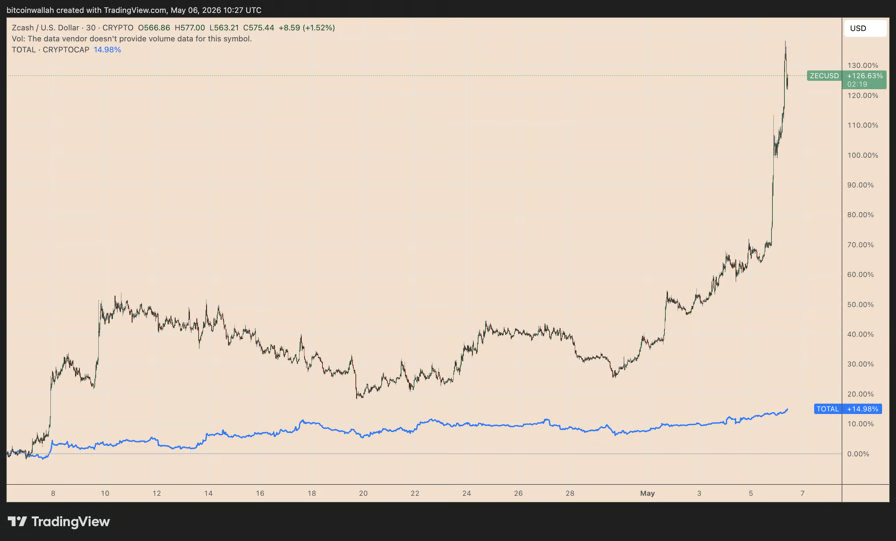
Zcash (ZEC) has outperformed the broader crypto market over the past month, rising by over 125% compared to an average 15% gain for most coins.
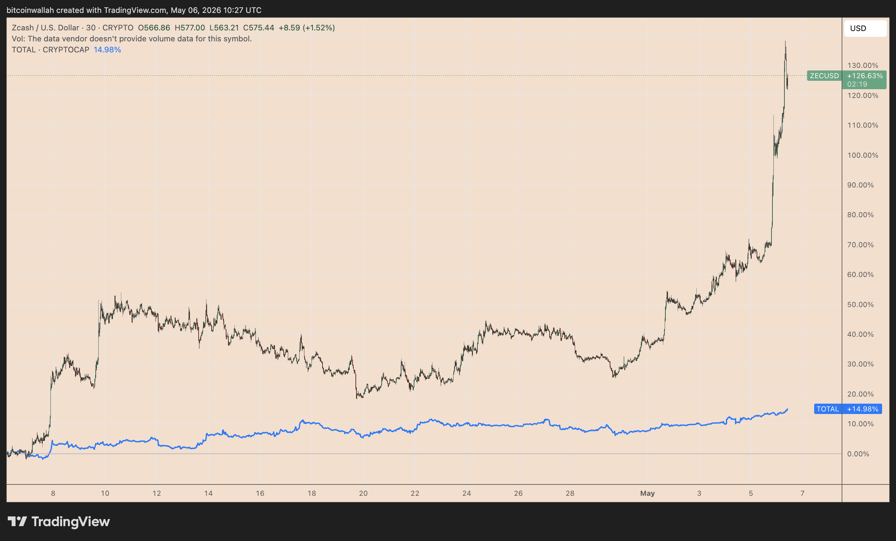
ZEC/USD versus TOTAL crypto market cap 3o-day performance chart. Source: TradingView
The privacy-focused cryptocurrency may rally further in the coming weeks as a mix of bullish technical and fundamental catalysts converges.
Key takeaways:
- US crypto hedge fund Multicoin Capital revealed it has been buying ZEC since February.
- Robinhood will list ZEC as Zcash’s network activity has been booming in the past weeks.
- ZEC technicals are painting a 40% rally setup.
Multicoin disclosure boosts ZEC momentum
On Tuesday, Multicoin Capital, a US-based crypto hedge fund managing $2.687 billion in assets, revealed a “significant position” in ZEC, fueling speculation that institutional investors are warming up to privacy-focused digital assets again.
Its co-founder, Tushar Jain, revealed that the firm had been accumulating ZEC since February.
Jain described Zcash as “the most direct public market vehicle” for exposure to private, censorship-resistant and seizure-resistant money, framing the investment as a bet on rising demand for financial sovereignty and cypherpunk-style privacy tools.
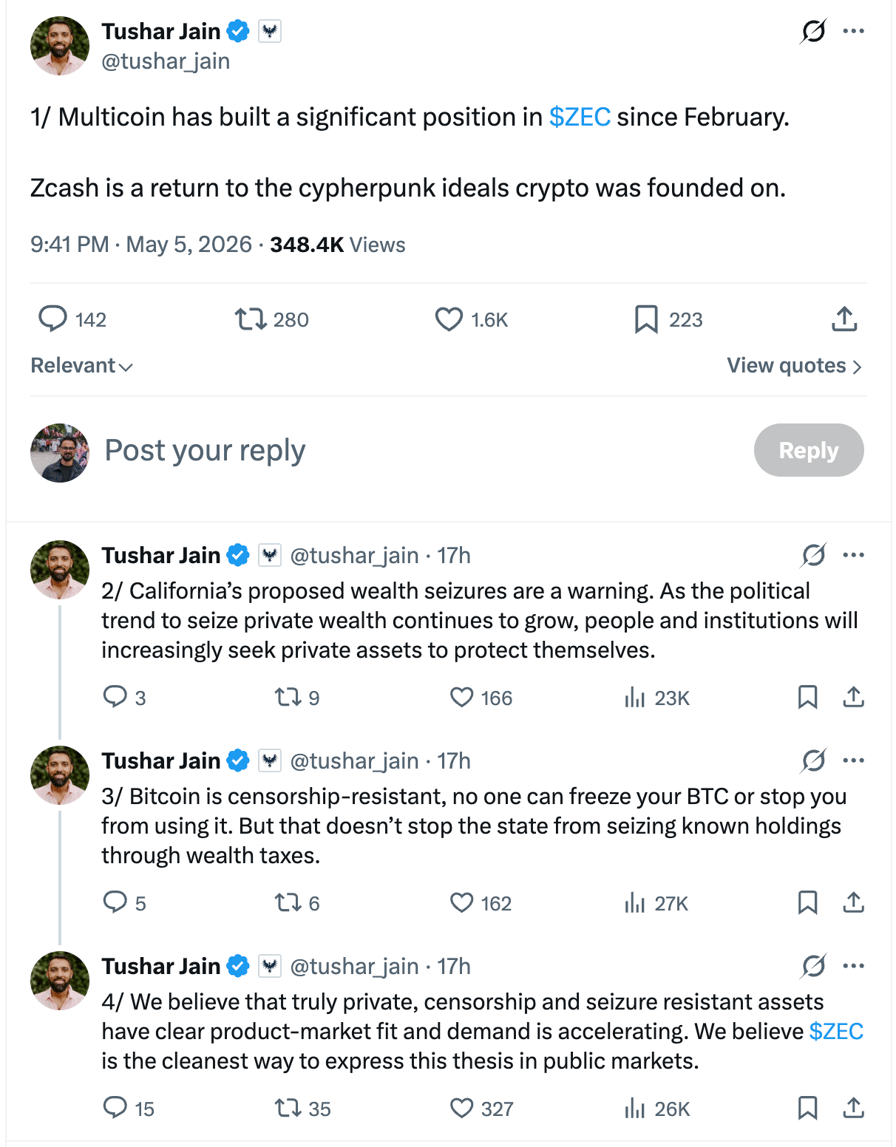
Source: X
ZEC has rallied by over 43% in the past 24 hours, showing that traders have interpreted the Multicoin announcement as institutional validation of the privacy coin narrative.
ZEC’s flag breakout hints at further gains
From a technical perspective, Zcash has entered the breakout phase of a prevailing bull flag pattern on the weekly chart.
A bull flag forms when the price consolidates lower within a descending parallel channel after a strong uptrend. It resolves when the price breaks above the channel’s upper trendline and rises by as much as the previous uptrend’s height.
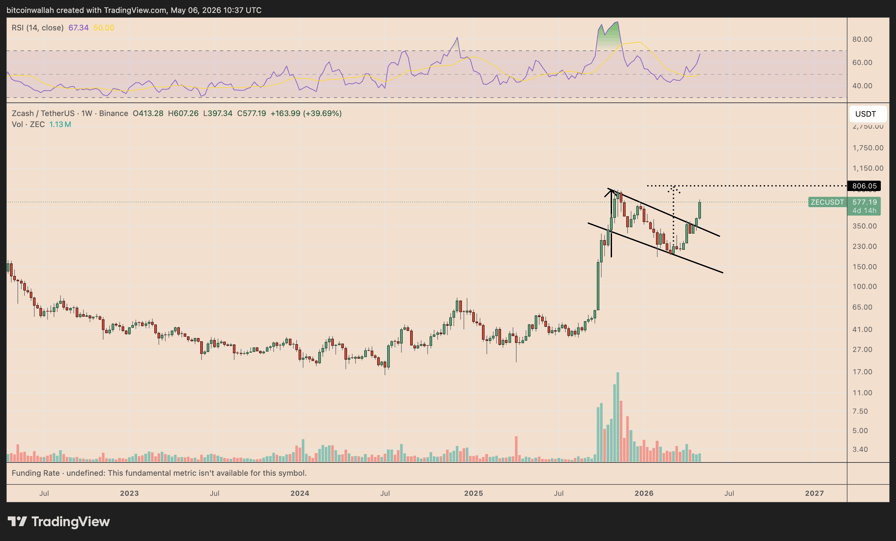
ZEC/USDT weekly chart. Source: TradingView
Applying that rule to ZEC’s chart puts its breakout target near $800. As of Wednesday, Zcash traded as high as $607, leaving the token on track to test the bull flag’s measured upside target located roughly 40% above.
Zcash’s weekly relative strength index (RSI), a momentum indicator that measures whether an asset is overbought or oversold, also suggests the rally may continue.
The RSI currently remains just below 70, a level traders typically associate with overheated market conditions, indicating ZEC may still have room to climb before buyers show signs of exhaustion.
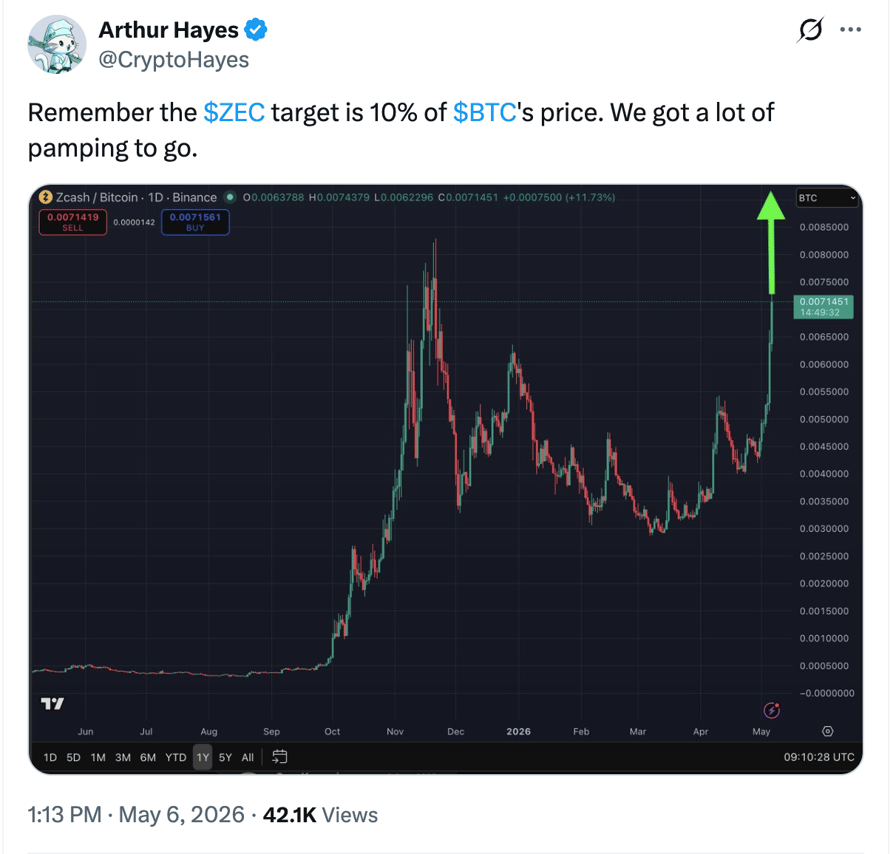
BitMEX Co-Founder Arthur Hayes said ZEC’s target is 10% of Bitcoin’s market capitalization, a scenario that would imply a multi-trillion-dollar valuation for ZEC and prices potentially ranging between $8,000 and $10,000 per coin based on current supply levels.
Source: X
Robinhood listing, tightening ZEC supply adds tailwinds
Zcash’s breakout also has fundamental support.
ZEC has rallied alongside the broader crypto market as US–Iran peace-deal hopes improve risk appetite, mirroring patterns in early April.
Its Robinhood listing on April 23 added another tailwind by opening spot access to 25.9 million funded users, including those in stricter jurisdictions like New York.
Meanwhile, more than 30% of circulating ZEC now sits in shielded addresses, according to data resource ZecHub.WIKI. This tightening supply shows a big jump in demand for private on-chain transactions over the past year.
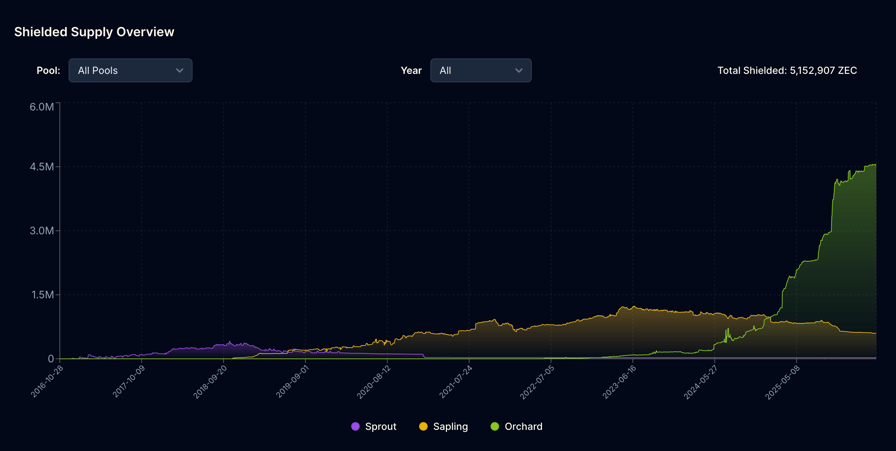
Zcash shielded supply weekly chart. Source: ZecHub.WIKI
Key takeaways:
- A sharp fifty percent drop in exchange activity and decentralized application revenue is stalling Ether price growth.
- Institutional investor interest in Ether remains under pressure as major holders like Bitmine face billions in unrealized losses.
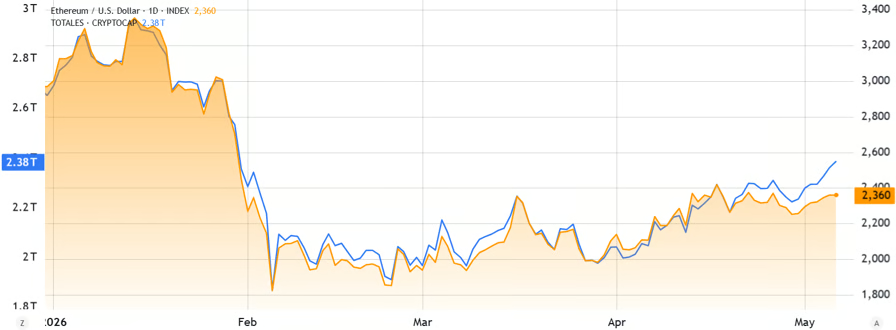
Ether (ETH) has failed to sustain levels above $2,400 for the past three months, consistently lagging behind most of its peers. Ether’s down 21% in 2026, and investors have expressed uncertainty about the altcoin’s inability to mirror the broader market recovery.
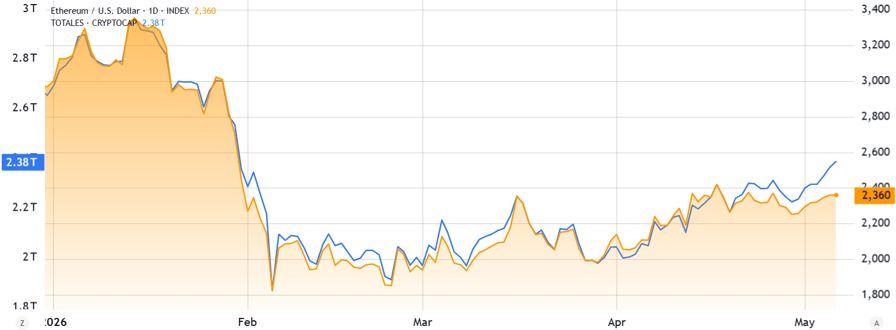
Total crypto market capitalization vs. ETH, USD. Source: TradingView
The total cryptocurrency market capitalization is down 11% year-to-date, suggesting specific headwinds for Ether remain in play. A decline in decentralized applications (DApps) activity partially explains this fading interest. Regardless of whether this trend has affected the industry as a whole, the shift negatively affects ETH price formation.
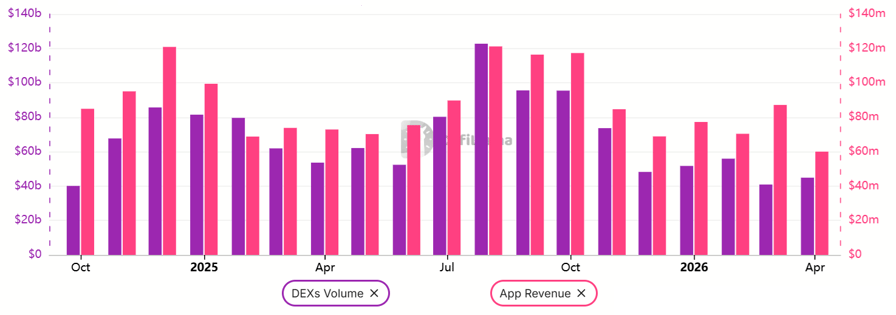
Ethereum DEX monthly volumes vs. DApps revenue, USD. Source: DefiLlama
Decentralized exchanges (DEX) volumes fell by 53% in six months, a sector largely responsible for Ethereum’s DApps activity. Consequently, these DApps experienced a 49% decline in revenue over the same period. While the sharp drop in memecoin prices and token launches contributed to reduced DEX appeal, other factors, including protocol hacks, also played a significant role.
Multiple hacks had a negative impact on DApp activity
The cryptocurrency industry suffered $630 million in hacks in April, with KelpDAO and Drift Protocol accounting for 82% of the losses. Blockchain security company Hacken attributed the attacks to actors linked to the Democratic People’s Republic of Korea (DPRK). Aggregate crypto industry DEX activity dropped by 47% in three months.
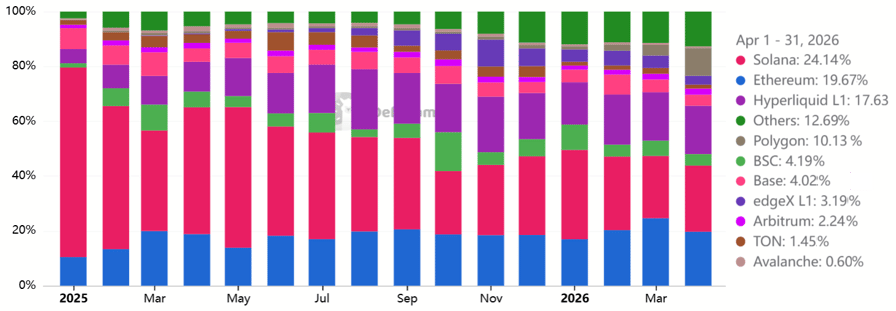
Blockchain DApps revenue market share. Source: DefiLlama
Some Ethereum competitors have opted for base layer scalability, providing less friction for regular users. While Ethereum remains the absolute leader in the aggregate ecosystem, including its layer-2 solutions, Solana and Hyperliquid account for a combined 42% market share in DApp revenue. Such data is even more impressive given that Ethereum’s total value locked is six times larger.
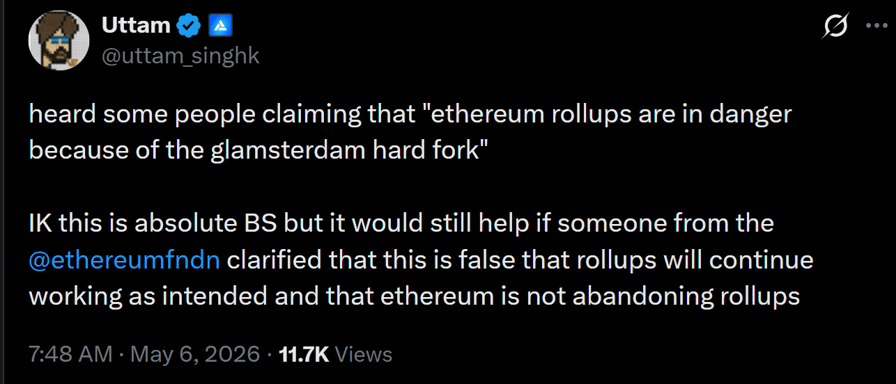
Source: X/uttam_singhk
Uttam Singh, engineer at Alchemy, noted that part of the market incorrectly judged that Ethereum’s upcoming glamstedam hard fork would put rollups “in danger.” The upcoming network upgrade should result in a threefold increase in base-layer capacity and allow clients to pre-fetch block data, thereby enabling parallel transaction execution.
Fierce blockchain competition, ETH whales underwater
Regardless of how straightforward Ethereum’s scaling plans are, most users and investors struggle to understand the need for layer-2 rollups once base-layer scalability reaches a certain threshold. There is also limited visibility on whether these changes will actually generate higher network fees, which ultimately act as a catalyst for higher staking yields.
Related: Ethereum backers pledge up to 30,000 ETH to rsETH recovery after bridge incident
Institutional investors’ perception of Ether has also been negatively impacted as Bitmine (BMNR US), the largest publicly listed holder of ETH, remains underwater in its corporate reserves. The company, led by chairman Tom Lee, spent $12.2 billion to acquire ETH, but its position is currently valued at $10.8 billion. While this does not pose an immediate sell-off risk, it reduces the asset’s institutional appeal.
None of these factors is an absolute impediment for Ether price to reach $2,800. However, declining onchain activity, fierce competition in the DApps industry, and reduced institutional appeal continue to contribute to its underperformance relative to the broader crypto market.


Samourai Wallet co-founder Keonne Rodriguez published a public appeal from FPC Morgantown federal prison, asking Bitcoin (BTC) holders to donate to a wallet address tied to his family’s mounting legal debt.
Rodriguez wrote on X (Twitter) that he and his wife Lauren owe more than $2 million in legal fees. They also face a $250,000 court-imposed fine after his guilty plea to operating an unlicensed money-transmitting business.
Pardon Prospects Have Faded
In his May 6 post, Rodriguez said he is five months into a 60-month sentence at the West Virginia camp. He surrendered to federal custody in December 2025.
He had previously been released on a $1 million bond before sentencing.
Hope for a presidential pardon stirred briefly during the Bitcoin 2026 conference but has since dimmed. President Trump had said in late 2025 he would consider a pardon.
Rodriguez now calls those prospects “very low.”
“I am simply a federal prisoner without money, power, or influence, and I will serve my full sentence,” he lamented.
Follow us on X to get the latest news as it happens
$2 Million in Debt and a Direct Bitcoin Address
The appeal directs donations to the address bc1qtjjcvn98wh7dfd55m8kxhjcfexanttwt8gtan8, with private alternatives available through his wife’s X (Twitter) account.
Rodriguez said lawyers and the U.S. Department of Justice are pressing for payment.
Federal prosecutors had alleged Samourai processed over $237 million in criminal proceeds, according to the original arrest announcement.
“A seizure warrant for Samourai’s mobile application was served on the Google Play Store. As a result, the application will no longer be available to be downloaded from the Google Play Store in the United States,” the officials wrote in their statement.
The wallet handled more than $2 billion across over 100,000 users since 2015. Rodriguez and co-founder William Lonergan Hill pleaded guilty in 2025 to conspiracy to operate an unlicensed money-transmitting business. Hill received a four-year sentence.
The two also forfeited approximately $6.37 million in earned fees as part of a larger money judgment.
The case continues to anchor debate over whether developers of non-custodial privacy software can face criminal liability for user activity.
The original code still circulates through the Ashigaru fork.
Subscribe to our YouTube channel to watch leaders and journalists provide expert insights
The post Samourai Wallet’s Co-Founder Appeals for Bitcoin Donations From Federal Prison appeared first on BeInCrypto.
Crypto World
BeInCrypto Institutional Research: 15 Onramp and Offramp Solutions Powering Crypto Access


Best Onramp and Offramp Solution is an award category within the BeInCrypto Institutional 100, an annual research-driven program recognizing institutional digital asset excellence across 26 categories and six pillars.
This category tracks the firms building payment rails, wallet integrations, banking APIs, and regulated settlement infrastructure that move money between fiat systems and crypto markets.
A shortlist will be named in May 2026, with the winner announced at Proof of Talk in Paris on June 2–3, 2026.
Key Facts
- Long list: 15 firms across consumer onramps, B2B infrastructure, aggregators, banking APIs, non-custodial systems, and TradFi payment processors with crypto rails
- Initial pool: More than 30 onramp and offramp providers screened; 15 advanced to the long list
- Scoring: 30% quantitative data · 50% Expert Council · 20% disclosed company data
- Criteria assessed: Country coverage, payment methods, regulatory compliance, UX integration, settlement speed, ecosystem integration, innovation
- Data sources: NYDFS, OCC, FCA, MiCA-CASP, FINMA, MAS, AUSTRAC, FINTRAC, audited filings, company disclosures, PitchBook, Tracxn, and Crunchbase
| # | Firm | Onramp/Offramp Sub-Segment | HQ | Reach | Top Licensure | Representative Work |
|---|---|---|---|---|---|---|
| 1 | MoonPay | Consumer onramp/offramp | Miami, USA | 30M+ accounts 180 countries |
NYDFS BitLicense + Trust Charter | Acquired Helio, Iron, and Meso in 2025 Reportedly explored ~$5B ICE-linked deal talks |
| 2 | Stripe Crypto Onramp | Enterprise onramp stack | South San Francisco, USA | 75M+ Privy accounts 1,000+ developer teams |
Bridge OCC charter conditionally approved | Bridge trust charter approved Feb 2026 Expanded crypto stack through Bridge and Privy |
| 3 | Coinbase Onramp | Exchange-backed B2B onramp | Wilmington / SF, USA | 110M+ users 60+ fiat currencies |
NYDFS BitLicense + US MTLs | Headless Apple Pay API launched Zero-fee USDC onramp on Base |
| 4 | Transak | Consumer onramp + wire rails | Miami, USA | 10M+ users 150+ countries |
Expanding US MTL coverage | Enabled wire-transfer onramps in the US Integrated MiCA-compliant USDG stablecoin |
| 5 | Ramp Network | EU-regulated onramp/offramp | London / Dublin | 150+ countries | MiCAR-CASP via Central Bank of Ireland | Became fully operational under MiCA in Jan 2026 EU passporting structure now active |
| 6 | Alchemy Pay | APAC + global onramp | Singapore | 173 countries 300+ payment methods |
HK SFC, UK API, FINTRAC, US MTLs | Hong Kong licence expanded to virtual assets Alchemy Chain testnet launched in 2026 |
| 7 | Zerohash | US-regulated B2B infrastructure | Chicago / Amsterdam | 5M+ users 190 countries |
NYDFS BitLicense + MiCA access | Filed for OCC national trust bank charter Rejected reported $2B Mastercard offer |
| 8 | Nuvei (Simplex) | Card onramp stack | Tel Aviv / Montreal | 200+ markets 680+ payment methods |
MiCA CASP | Completed take-private transaction in 2025 Integrated Wero wallet and Azure partnership |
| 9 | Mercuryo | Card onramp/offramp | Tallinn / London | 4M+ users 200+ assets |
Estonian VASP | Added BitMEX onramp integration Expanded Mastercard crypto card partnership |
| 10 | Onramper | Onramp aggregator | Amsterdam | 30+ integrated onramps 190+ countries |
Partner-license model | Expanded crypto trading in Brazil, Mexico, and Chile Launched MUSD stablecoin in Brazil |
| 11 | OSL Group (Banxa) | APAC regulated access | Hong Kong | 40+ licences globally | HK SFC + AUSTRAC + FINTRAC | Completed Banxa take-private in Jan 2026 Launched USDGO stablecoin and StableHub |
| 12 | Wert | NFT/ERC20 onramp specialist | Tallinn / Oakland | 200+ countries | Estonian VASP | Embedded NFT checkout with gas included ERC20 onramp without exchange listing |
| 13 | Striga | Banking-grade API stack | Tallinn, Estonia | 30+ countries | Estonian VASP | Combined vIBAN, custody, and cards in one API Integrated Lightning settlement support |
| 14 | Mt Pelerin | Swiss non-custodial onramp | Geneva / Neuchâtel | 150K+ users $1B+ volume |
FINMA regulated + SO-FIT | Built non-custodial DeFi bridge infrastructure MPS asset token registered in Switzerland |
| 15 | Mercado Pago | LatAm super-app access | Buenos Aires | 50M+ Mercado Pago users | Paxos + Ripio partnerships | Filed for OCC national trust bank charter Rejected the reported $2B Mastercard offer |
About This List
The BeInCrypto Institutional 100: Fiat-to-Crypto Access (2026 Long List) identifies the firms building regulated infrastructure for moving money between traditional payment systems and digital assets.
The category includes consumer-facing onramps, B2B settlement infrastructure, regional payment specialists, aggregators, and banking-grade APIs integrated into wallets, exchanges, fintech apps, and dApps.
Stablecoin orchestration platforms without a direct fiat onramp or offramp surface are evaluated separately under stablecoin infrastructure categories.
Methodology
This category is evaluated under Track B of the BeInCrypto Institutional 100 methodology: 30% quantitative metrics, 50% Expert Council scoring, and 20% disclosed data.
Assessment spans seven criteria: country coverage, payment method diversity, regulatory compliance, UX integration, settlement speed, wallet and dApp ecosystem integration, and innovation.
Data was verified using regulatory registers, audited filings, company disclosures, partnership announcements, and private-market sources, including PitchBook, Tracxn, and Crunchbase.
To submit a nomination or share feedback, contact awards@beincrypto.com
The post BeInCrypto Institutional Research: 15 Onramp and Offramp Solutions Powering Crypto Access appeared first on BeInCrypto.

One of the world’s largest wealth management firms, Morgan Stanley, is all set to introduce cryptocurrency trading on its E*Trade platform, which it acquired for $13 billion six years ago.
It aims to compete on lower costs.
Morgan Stanley Joins Crypto Trading Space
The bank plans to charge 50 basis points per transaction based on dollar value, as it positions itself below rivals such as Coinbase and Robinhood. The rate is also below the 75 basis points charged by Charles Schwab, which rolled out spot Bitcoin and Ethereum trading earlier in April.
Morgan Stanley’s latest service is currently in a pilot phase and is expected to be rolled out to all 8.6 million E*Trade clients later this year, according to the latest report by Bloomberg. At launch, clients will be able to trade Bitcoin, Ether, and Solana. The banking giant had previously tapped Zerohash, an infrastructure provider for digital assets, for the initiative back in September 2025.
The latest development comes almost a month after Morgan Stanley’s much-anticipated spot Bitcoin ETF, under the ticker MSBT, went live on NYSE Arca. The fund debuted with a 0.14% fee, lower than competing products. Data compiled by SoSoValue revealed that MSBT’s cumulative net inflow stood at over $181 million as of May 5th.
Stablecoin Reserve Fund
More recently, Morgan Stanley launched the Stablecoin Reserves Portfolio (MSNXX) in New York to target stablecoin issuers seeking compliant reserve solutions. The fund is part of its Institutional Liquidity Funds Trust and is structured as a government money market fund in line with reserve standards set by the GENIUS Act.
It is designed to help issuers manage assets backing their tokens while maintaining liquidity and capital stability. The main objective of the portfolio is to keep a $1 net asset value and generate income by investing only in cash, US Treasury bills, notes, and overnight repurchase agreements.
Co-Head of Global Liquidity Fred McMullen had said that the offering responds to growing demand as stablecoin issuance expands. Meanwhile, Amy Oldenburg had added that the initiative supports efforts to modernize financial infrastructure and improve institutional access to digital asset markets.
The post Wall Street Giant Morgan Stanley Enters Crypto Race With Pricing Edge: Report appeared first on CryptoPotato.
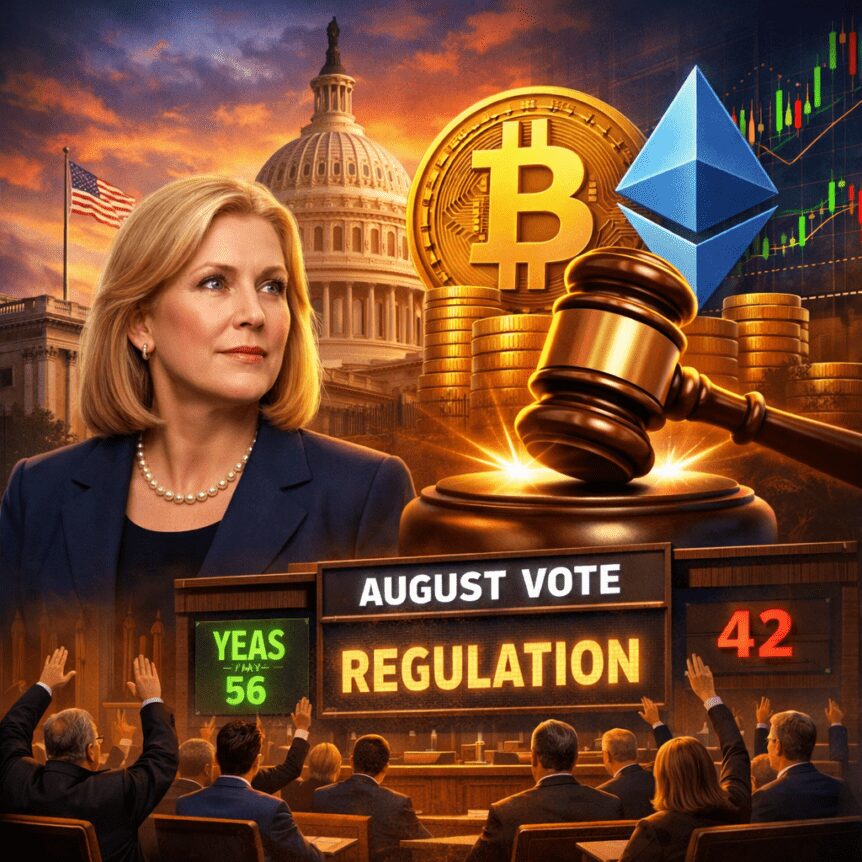
US Senator Kirsten Gillibrand indicated at the Consensus conference in Miami that the fate of the digital asset market structure bill hinges on lawmakers meeting three practical conditions before the Senate can consider a vote. Speaking on the record, she identified consumer protection, illicit finance controls, and ethics provisions as essential elements that must be addressed prior to any action on the CLARITY Act. She suggested that if Congress can merge the market structure framework with the version already advanced by the Senate Agriculture Committee and attach robust ethics language, a vote could occur before the August recess that begins on August 10.
“There will be no one voting for this bill if we don’t have an ethics provision,” Gillibrand said, underscoring that integrity standards are non-negotiable in a landscape where public officials’ involvement in the industry could raise conflicts of interest. “Because the truth is, we cannot allow members of Congress, senior administration officials, presidents or vice presidents, to get rich off of these industries because of their insider status. It is the worst form of pay for play.”
While Gillibrand did not name specific individuals, the remarks come amid renewed scrutiny of ties between public figures and crypto ventures. The broader political debate surrounds the CLARITY Act as lawmakers weigh how to regulate a fast-evolving sector, including stablecoins, DeFi platforms, and tokenized equities, within a cohesive federal framework.
Beyond the ethics question, the evolving policy conversation has touched the linkage between regulatory risk and industry structure. Last week, senators on the Senate Banking Committee announced a deal on stablecoin yield issues that could help move the market structure legislation forward, although the agreement did not address language on potential conflicts of interest among public officials. The development signals that it is possible to find bipartisan consensus on certain technical elements while leaving other concerns to future negotiations.
In the broader policy discourse, industry voices have pressed for timely progress. Ripple CEO Brad Garlinghouse pointed to a narrow window for legislators to address the bill before it becomes entangled in electoral-year dynamics, a sentiment echoed by other executives who argue that delay raises uncertainty for infrastructure planning, product launches, and institutional compliance programs.
From the regulatory side, former Commodity Futures Trading Commission commissioner and Blockchain Association chief executive Summer Mersinger described the current moment as a critical juncture—the window to act could open briefly, and if missed, there is no guarantee it will reappear in the same form. Her remarks highlighted the practical implication for compliance teams and legal professionals who must map to evolving standards and potential licensing regimes.
Key takeaways
- The CLARITY Act’s path to a Senate vote depends on three conditions: consumer protection, illicit finance safeguards, and ethics provisions.
- Lawmakers aim to merge the market structure bill with the Agriculture Committee version and attach ethics language, with possible action before the August recess.
- Ethics provisions are framed as essential to prevent conflicts of interest and pay-for-play risks in crypto policymaking.
- Recent discussions on stablecoin yield could facilitate movement on the bill, though work remains on public official conflicts language.
- Industry voices view the timing as delicate: act now to avoid entrenchment during the midterm cycle and potential political headwinds.
Legislative status and the regulatory backdrop
The market structure bill, which seeks to establish a comprehensive federal framework for digital assets, has become a focal point of regulatory policy debates in Washington. As of the week described, the Senate Banking Committee had not yet rescheduled a markup after postponing it earlier in the year. The postponement followed public criticism from some industry participants who argued that the bill, in its current form, may unduly constrain innovation in areas such as decentralized finance, stablecoins, and tokenized equities.
Coinciding with legislative momentum, industry leaders have stressed the need for precise and enforceable rules that align with existing financial oversight while safeguarding innovation. The stance from Coinbase’s leadership earlier this year, which signaled reservations about certain provisions, illustrates the sensitivity around DeFi and crypto token classifications. In this context, the ethics language Gillibrand emphasized would address concerns about potential corruption risks in the legislative process and strengthen the bill’s legitimacy from a governance perspective.
On the regulatory horizon, the interplay with cross-border and domestic regimes remains a strategic consideration. In the European Union, MiCA represents a parallel trend toward centralized regulatory clarity for crypto assets and stablecoins, influencing how U.S. policymakers think about licensing, supervision, and market integrity. Although the CLARITY Act is a U.S.-centric initiative, its design and potential impact will be evaluated against international practice, especially in areas related to consumer protection, AML/KYC requirements, and orderly markets.
In public commentary, industry participants have flagged specific policy areas requiring careful calibration. Regulatory and enforcement considerations—ranging from disclosures and fiduciary duties to anti-money laundering controls and executive ethics requirements—shape what compliance teams must prepare for. The need for robust governance language is underscored by discussions about conflicts of interest and the integrity of public decision-making when it touches crypto markets.
Timing, signals, and practical implications for institutions
Timely action on the market structure bill matters for exchanges, banks, and institutional investors that seek clear, predictable rules for custody, settlement, and product structuring. A stable policy framework can reduce the risk of ad hoc enforcement actions and provide a stable basis for licensing, risk management, and operational compliance. The recent stablecoin yield discussions—though not sealing language on conflicts of interest—underscore efforts to resolve key technical issues that affect product design, liquidity management, and capital treatment for regulated entities interacting with crypto assets.
From a market perspective, traders and risk managers have tracked predictions about the bill’s prospects. Prediction-market platforms reflect divergent expectations: one platform assigns a higher probability to passage by year-end, while another assigns a more immediate likelihood of action within the August window. These signals influence how institutions calibrate internal roadmaps for product launches, governance reviews, and regulatory reporting.
Industry advocates argue that progress on the CLARITY Act could harmonize U.S. oversight with evolving international standards, reducing fragmentation across markets and jurisdictions. The emphasis on consumer protection, illicit finance controls, and ethics aligns with a growing consensus that credible crypto regulation must balance innovation with oversight, a balance that institutions require to manage risk, ensure compliance, and preserve customer trust.
Enforcement, compliance, and policy implications
Legal and compliance teams should monitor the potential alignment between the CLARITY Act and broader enforcement priorities. The proposed ethics provisions would likely shape internal governance policies, whistleblower channels, and disclosures related to political contributions, corporate sponsorships, and senior leadership ties to the industry. For banks and regulated intermediaries, the framework could inform licensing expectations, disclosure regimes, and risk-based AML/KYC programs tailored to crypto assets.
lawmakers are also weighing how to articulate standards for consumer protection—ranging from product disclosures to protections against misrepresentation and fraudulent schemes. The delicate balance between enabling new financial products and safeguarding consumers will influence how firms structure disclosures, marketing materials, and relationship-based risk controls. The discussion also intersects with anti-money laundering and countering the financing of terrorism regimes, where clarity in definitions, reporting obligations, and enforcement mechanisms matters for integration with existing financial compliance ecosystems.
On the enforcement front, the CLARITY Act would potentially interact with actions by the SEC, the CFTC, and the DOJ as agencies delineate jurisdictional boundaries and supervisory expectations. Institutions would need to map regulatory requirements across agencies, ensuring that liquidity management, custody, and trading activities align with the evolving standard for crypto assets and digital securities. The outcome could also influence cross-border operations, especially for firms with global exposures and interconnected stablecoin initiatives.
Closing perspective
As policymakers continue to refine the bill, the central questions revolve around how to reconcile innovation, investor protection, and governance integrity within a coherent legal framework. The window for consensus appears to be narrowing as the August recess approaches and midterm dynamics intensify. Observers should watch for developments on the ethical governance provisions, the final alignment of the House and Senate market structure texts, and any forthcoming language on conflicts of interest that could determine whether the CLARITY Act advances in its current form. In practice, the outcome will influence not only regulatory clarity for crypto markets but also the risk and compliance posture of a broad set of financial institutions engaging with digital assets.

The Solana Foundation has partnered with Google Cloud to launch Pay.sh, a platform that allows AI agents to use and pay for API services using stablecoins on Solana.
The two built the payment gateway service to solve a common problem in software development, where even advanced AI systems still need human intervention to create accounts, manage credentials, and handle billing processes.
Solana’s AI Agent-Driven Payment Layer
The firm shared in a May 5 announcement that Pay.sh introduces a system where AI agents can independently discover, access, and pay for APIs on a per-request basis without needing accounts, keys, or subscriptions.
Vibhu Norby, chief product officer at the Solana Foundation, said the product was partly developed to address the growing issue of unregulated machine payments, with the collaboration aiming to legitimize the growing agent-driven economy through a compliant solution.
“Most agentic payments are being done through gray or black market facilitation, which means they can be disabled or banned without notice by the underlying provider,” he wrote.
The Solana Foundation explained that the platform functions as an API proxy built on Google Cloud infrastructure, handling payments while still applying proper security controls like rate limits and access permissions.
Pay.sh works by linking a Solana wallet to popular AI tools like Gemini, Claude Code, and Codex, allowing users to fund them in about 60 seconds with stablecoins or a credit card, after which the agent can immediately begin accessing several paid Google Cloud API services like BigQuery, Vertex AI and Cloud Run.
Transactions on the gateway service are processed quickly using stablecoins on Solana and then converted into fiat currency for the service providers. This also means that developers only pay for what they use, while providers receive funds reliably without managing subscriptions or billing systems.
The product also offers a one-stop marketplace where agents can get over 50 community-based services across several areas like e-commerce, data intelligence, communications, and blockchain infrastructure on platforms such as Rye, Dune Analytics, Nansen, StableEmail, Helius and The Graph.
Pay.sh Introduces Open-Source Payment Solution
Pay.sh is built on open standards like x402 and MPP for machine-to-machine transactions and is fully open source, allowing developers to explore the code, contribute, and build their own integrations. The platform also brings together services from different agent providers into a single searchable catalog on the Solana ecosystem.
Launch partners supporting the platform’s community include PayAI, Crossmint, Merit Systems, Corbits, Moonpay, Sponge Wallet, ATXP, and Tektonic.
The development comes as major crypto and tech companies race to build payment infrastructures for autonomous AI systems, with Coinbase also revealing its x402 app store for agents, a marketplace made to standardize micropayments between bots.
Elsewhere, Google has been expanding its own crypto payments work, with the firm launching an Agent Payments Protocol (AP2) backed by Coinbase and the Ethereum Foundation.
The post Solana and Google Cloud Team Up for Stablecoin-Powered AI Agent Payments appeared first on CryptoPotato.
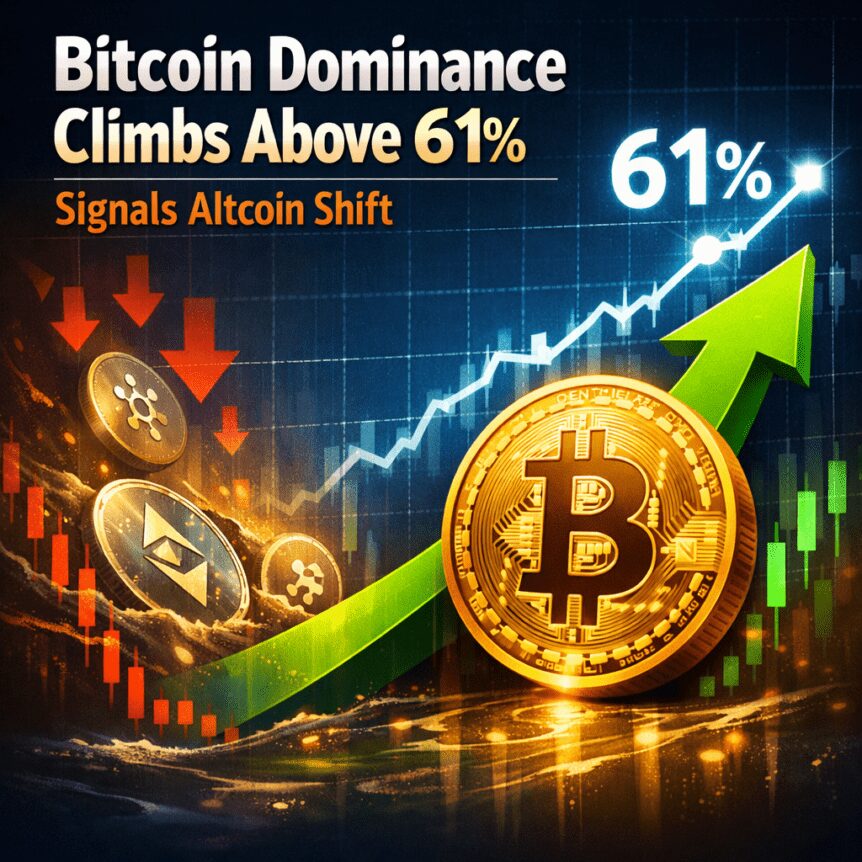
Bitcoin dominance jumped to 61% on Wednesday, the highest reading since November 2025, signaling that BTC remains the market’s main driver even as altcoins attempt a gradual revival. The move follows a slower start to April, when dominance sat at 58.44%, underscoring a renewed tilt toward Bitcoin amid improving but uneven participation across the wider crypto space.
In tandem with the BTC-led momentum, activity within the altcoin space showed encouraging signs of life. Binance data over the past two months illustrate a substantial uptick in altcoin liquidity, with altcoin trading volumes rising 49% and 12.6% of altcoins reclaiming their 200-day moving average. While these are notable shifts, analysts caution that the pace remains selective and does not yet resemble the vigorous rotations seen in past altcoin cycles.
Key takeaways
- Bitcoin dominance reached about 61% this week, its highest level since November 2025, up from 58.44% at the start of April.
- Binance altcoin volumes surged roughly 49% over the last two months, while 12.6% of altcoins reclaimed their 200-day simple moving average.
- TOTAL3, the market cap excluding Bitcoin and Ether, rose 17% to a two-month high of about $765 billion, signaling a broad but uneven recovery in non-BTC assets.
- CryptoQuant data show rising altcoin activity on centralized exchanges, with the altcoin share of volume on Binance increasing to 49% from about 31% in March, indicating growing participation beyond BTC and ETH.
Bitcoin leadership amid a cautious altcoin revival
Analysts note that Bitcoin’s outperformance is translating into a higher dominance metric, reflecting a movement of capital back into the benchmark asset while other crypto assets attempt to catch up. Crypto analyst Darkfost attributed BTC’s strength to a roughly 36% rally from its February 6 low near $60,000, a move that helped push the dominance measure above the 61% mark. That perspective aligns with the sense that BTC remains the anchor of sentiment even as market participants monitor signs of a broader altcoin bounce.
On the broader market, TOTAL3’s 17% ascent to $765 billion over two months signals that traders are rotating capital away from BTC and ETH into a wider mix of non‑ETH/NBC coins, even if the pace lags the earlier altseason highs. The mid-April improvement in altcoin performance is being watched closely for indications of a sustainable shift, rather than a temporary liquidity-driven rebound.
Alternative momentum and what it could imply for markets
Market data providers have pointed to shifting exchange dynamics as a potential indicator of a broadening cycle beyond the top two assets. CryptoQuant’s analysis shows a measurable uptick in altcoin activity, driven in part by higher volumes on centralized exchanges. The firm’s metrics show that altcoin trading volume, excluding the five largest cryptocurrencies, has increased steadily in recent weeks, with their share of Binance’s combined BTC and ETH futures volumes rising to 49% on Wednesday from 31% in March. The shift suggests growing participation outside of Bitcoin and Ether, although it remains moderate compared with prior altcoin cycles.
“The AltSeason Index is moving higher, but there hasn’t been a full-blown AltSeason yet. The peak of the last cycle was earlier in 2024, and even then, the value was relatively modest by historical standards,”
CryptoQuant’s 90-day AltSeason Index reached 28.6, its fastest upturn in months. While this demonstrates improving altcoin performance relative to Bitcoin, analysts caution that it does not yet signal a traditional AltSeason. The data imply that while more traders are exchanging altcoins for BTC and ETH, the market remains in a transitional phase rather than entering a sustained multi-month equity-like cycle.
Another key signal comes from CryptoQuant’s observation that, on average, altcoins are trading about 23.47% below their 200-day moving average, an improvement from roughly 44.4% earlier in the cycle. Historical readings of this nature have appeared near the end of bear markets in 2022, suggesting residual reversion tendencies as confidence gradually returns to risk assets beyond Bitcoin.
For investors, these indicators point to a few important takeaways. First, BTC remains the dominant driver in the near term, which can support risk-off sentiment in broader market downturns but may also provide a stabilizing anchor during periods of volatility. Second, the early signs of altcoin engagement on major exchanges hint at increased liquidity and curiosity among traders, though sustained momentum will depend on continued demand and favorable macro and regulatory conditions. Finally, the mixed pace of the altcoin recovery underscores the ongoing challenge of achieving broad, durable rotation rather than selective, stock-like rebounds within a handful of tokens.
As the market watches for confirmation of a durable shift beyond Bitcoin, traders will be looking for continued improvement in altcoin price action, more sustained cross-exchange activity, and a clear move above relevant moving averages across a broader basket of altcoins. The next few weeks will be telling: will the altcoin revival gain steadier traction, or will BTC’s leadership reassert itself in a market still seeking a clear directional signal?
Investors should monitor evolving on-chain signals and exchange volumes to gauge whether the current rotation can translate into a meaningful, lasting shift or simply reflect a temporary liquidity reallocation. While the data point to growing interest in non-BTC assets, the path to a robust altseason remains uncertain, requiring cautious positioning and ongoing scrutiny of market structure developments.
Box Elder County commissioners approved Kevin O’Leary’s 9GW Stratos AI campus in Utah on May 4, amid loud public protests from hundreds of local residents.
Summary
- Kevin O’Leary’s Stratos project, a 40,000-acre AI campus in Utah, received county approval on May 4 despite strong community opposition over water, energy, and environmental concerns.
- The campus will generate up to 9 gigawatts at full buildout, more than twice Utah’s current total electricity consumption, powered by an on-site natural gas pipeline.
- O’Leary framed the project as a direct response to China building 400 gigawatts of AI-capable power over the past two years, calling it a national security priority.
Box Elder County commissioners in Utah voted unanimously on May 4 to approve the Stratos AI campus backed by Kevin O’Leary Digital, the infrastructure arm of O’Leary Ventures.
The approval came over the objections of hundreds of residents who chanted “Shame!” as the vote was announced and who said they had been given too little time to raise concerns before the decision.
The campus, designated through Utah’s Military Installation Development Authority, spans more than 40,000 acres and will reach 9 gigawatts of generation capacity at full buildout.
Phase one calls for approximately 3 gigawatts. Kevin O’Leary told Fox Business the site will be powered entirely by an on-site connection to the Ruby Pipeline, a 680-mile natural gas line crossing northern Utah, rather than drawing from the state grid.
China as the stated rationale
O’Leary made the competition framing explicit. “China built 400 gigawatts of new power over the last 24 months, and much of it is powering AI data centers,” he said, according to the Salt Lake Tribune. “We’re in a race with them.” He described the project as providing compute power for US AI companies and national defense.
Utah’s MIDA cut Stratos’s energy use tax from 6% to 0.5% and agreed to rebate 80% of property tax revenue to attract the project. Environmental critics raised concerns about water use near the already-depleted Great Salt Lake and potential weather pattern changes.
O’Leary said the facility would use closed-loop water recycling and air-liquid cooling. No hyperscale tenant has been publicly named. Initial delivery is expected in Q4 2026, with full buildout spanning approximately ten years across multiple phases.


NFTs are due for a “rebirth” as AI agents force the internet to solve new identity and trust problems, Reid Hoffman told CoinDesk’s Consensus Miami conference on Wednesday.
The Greylock partner and LinkedIn co-founder said agents transacting with other agents will require trustworthy digital identity systems that resemble what NFTs originally tried to solve. Hoffman said he began revisiting NFTs as he considered a future in which AI agents outnumber humans online.”When you begin to think we’re going to have more agents than people, what does the identity layer look like? What is the notion of, hey, when your agent’s talking to my agent, and we book this talk here, is it a trustable transaction?” Hoffman said. “And that got me back into thinking about NFTs.”
Hoffman said identity systems will exist inside companies, but the harder problem will be identity for agents operating across the open internet.
“It’s going to be kind of free range on the internet, and how does that work? And crypto is the obvious answer,” he said.
This argument carries a throughline from Hoffman’s earlier work at LinkedIn, where real-world professional identity was central to the network’s design. Hoffman said actual identity can create “more responsibility, more reliability,” while also acknowledging that pseudonyms have legitimate uses in some contexts.
Hoffman, who said he bought his first Bitcoin over a decade ago and has never sold any, framed crypto as the natural answer to the deepfake-era trust problem. He cited his own AI clone, Reid AI, which he has sent to speak at conferences, as an example of why provenance will matter more as generative media improves.
“When I bought my first Bitcoin in 2014, it was like, actually, in fact, this is part of a design feature, that this is how DNS should work. This is how identity should be working, generally when you get to the internet,” he said.
That identity problem, Hoffman explained, extends beyond agent-to-agent commerce. He pointed to AI-generated content, bot farms, manipulated polls and paid political influence campaigns as examples of why proof-of-humanity is becoming harder to ignore online.
In a politically calibrated stretch, Hoffman urged the crypto industry not to overcommit to Republicans on policy.
“If the industry goes, oh, we’re overly reacting against Gensler, et cetera, and then being kind of, as it were, anti-Democratic Party on this, the problem is that the pendulum swings,” he said. “It’s good to be bipartisan from a viewpoint of what we care about is the ecosystem. We care about how it plays a good role in society.”
Hoffman also disputed the prevailing narrative that AI is driving Big Tech layoffs.
“What I’ve seen so far in every company that says, ‘I’m doing layoffs because of AI,’ maybe other than Meta, is not out of productivity, but is just out of reshifting,” he said. “We’ve overhired because of the pandemic. We need to change. We’re going to call it AI for a position of strength.”
As an investor, Hoffman said he is looking for crypto ideas that may have been tried too early during prior market cycles but could return as AI changes the internet. NFTs are one such area, he said, while “DAOs and other areas” could also see renewed relevance.
Asked at the close what his Bitcoin exit price was, Hoffman didn’t name a number. “Is there such a thing as an exit price?” he asked.

Asake – Wa (Official Visualizer)

Letter from the editor – People have died for the right to vote

OECD sees fragile New Zealand recovery; warns on energy, ageing and capital-market gaps

Manchester United reach agreement with Casemiro over contract clause amid transfer speculation

US brings back mandatory military draft registration

Steven Gerrard disagrees with Gary Neville over ‘shock’ Chelsea and Arsenal claim | Football


-

 NewsBeat3 days ago
Channel 5 – All Creatures Great and Small series 7 new post
-

 Entertainment7 days ago
Insider Claims Reason Behind Key & Peele Split
-
 Tech5 days ago
Trump’s 25% EU auto tariff breaches Turnberry Agreement that also covers semiconductors and digital trade
-
 Sports5 days ago
Paul Scholes issues Marcus Rashford reality check as agreement emerges over Man United star
-

 Entertainment5 days ago
Met Gala 2026 Rumored Guest List Is Turning Heads
-

 Business6 days ago
Strait of Hormuz Blockade Persists Amid US-Iran Standoff, Sending Oil Prices Soaring
-

 Entertainment7 days ago
Celebrities Who Are Attending the 2026 Met Gala Event
-
Entertainment5 days ago
New on Prime Video in May 2026 — Full List of Movies and Shows
-

 Sports5 days ago
Cavaliers vs. Raptors Game 6 live score, updates, highlights from 2026 NBA playoffs first-round series
-
 Sports5 days ago
David Benavidez responds to team Canelo saying the fight will never happen
-

 Entertainment5 days ago
Kylie Jenner Hit With Second Lawsuit From Ex-Housekeeper
-
 Sports5 days ago
IPL 2026: ‘Love you darling’- Hardik Pandya’s reaction to MS Dhoni steals the show |Watch | Cricket News
-

 Entertainment5 days ago
Young and the Restless Next Week: Cane Arrested & Matt’s Deadly New Scheme!
-

 Sports7 days ago
Saudi Arabia set to withdraw LIV Golf funding after 2026 season, per reports
-

 Tech7 days ago
Mark Zuckerberg Says Meta Is Working On AI Agents For Personal And Business Use
-

 Tech6 days ago
Meta ends Sama contract after Kenyan workers report seeing intimate footage from Ray-Ban smart glasses users
-

 Sports7 days ago
Stalemate in Madrid as resilient Arsenal Blunt Atletico Madrid in semi-final clash – Sports
-

 Sports5 days ago
Plane crash in Wimberley, Texas kills 5 pickleball players at tournament
-
Entertainment4 days ago
New Netflix Movies in May 2026 — My Top 3 Picks to Stream
-
 Sports7 days ago
Manchester United 2025/26 squad review – keep, sell, loan, release
You must be logged in to post a comment Login