

Crypto World
BeInCrypto 100 Institutional Awards Nomination: Wintermute for Best Liquidity Provider



Liquidity provision in digital assets is no longer measured only by quoted spreads on exchanges. Institutional clients need firms that can price size, support bilateral execution, manage settlement across venues, and stay active when traditional markets are closed.
Wintermute has built its business around that demand. The firm is nominated for Best Liquidity Provider at the BeInCrypto Institutional 100 Awards 2026.
Average Daily Volume
$15B+ across CeFi and DeFi
Trading Pairs
3,000+ asset pairs supported
Connectivity
60+ centralized and decentralized venues
OTC Desk
Institutional digital asset execution across crypto and tokenized assets
Regulatory Standing
UK FCA registered
Asset Coverage
Native crypto, stablecoins, tokenized gold, oil exposure, tokenized money market funds
Execution Access
Chat, API, CeFi venues, DeFi protocols
Wintermute Liquidity Provider Snapshot
The nomination reflects Wintermute’s role as a global algorithmic trading firm and OTC desk serving institutional digital asset markets. Its business spans centralized exchanges, decentralized protocols, bilateral OTC execution, and tokenized real-world assets.
For the Best Liquidity Provider category, size alone is not enough. The award assesses whether a firm can support institutional execution across market conditions, asset classes, and settlement environments. Wintermute’s nomination is anchored in that broader role.
The OTC Desk Behind Institutional Flow
Wintermute’s OTC desk sits at the center of its nomination.
For institutional clients, liquidity is often judged away from the visible order book. Asset managers, allocators, tokenization issuers, and trading firms need block execution, same-day settlement, weekend coverage, and access to long-tail pairs without creating unnecessary market impact.
Wintermute supports more than 3,000 asset pairs across 60+ centralized and decentralized venues. The firm transacts more than $15 billion in average daily volume across CeFi and DeFi, with access through chat, API, exchange venues, and DeFi protocols.
That breadth matters because institutional flow is becoming more complex. A client may need a stablecoin settlement leg for a cross-border transaction, a rebalance involving a tokenized money market fund, or weekend exposure to a tokenized commodity while traditional markets are shut.
Wintermute’s OTC desk is designed for that environment. It gives clients access to institutional-sized execution across native crypto assets, stablecoins, and tokenized real-world assets from a single liquidity provider.
A Market-Neutral Liquidity Model
In an interview with BeInCrypto, David Micley, Managing Director of Americas at Wintermute, described the firm’s approach as market neutral.
“Wintermute is a market-neutral liquidity provider. Regardless of whether the market goes up or down, we want to make sure we are in a position to generate positive P&L, assume worst-case scenarios, and not just survive but thrive through all economic environments,” Micley said.
That model is important in a category built around resilience. Liquidity providers must remain active through volatility, exchange stress, geopolitical shocks, and changing regulations.
Institutions rely on desks that can continue quoting and settling when market conditions are not clean.
Pricing the Tokenized Market
Wintermute’s nomination also reflects its role in tokenized assets.
The firm is already active in tokenized gold, stablecoins, tokenized money market fund flows, and weekend commodity exposure. Micley noted that tokenized commodities are solving a real market problem by allowing exposure outside legacy trading hours.
Weekend oil exposure is one example. When geopolitical events move during closed market hours, tokenized markets can give participants a way to hedge or adjust exposure before traditional venues reopen.
Tokenized gold is another important area. Wintermute has highlighted growing activity in digital gold products, with tokenized gold volumes across supported segments surpassing the combined volume of several major gold ETFs.
For institutional liquidity providers, this shows how tokenized commodities are becoming a live execution market rather than a future concept.
Why the Nomination Stands
Wintermute’s nomination for Best Liquidity Provider rests on three factors.
The firm has a regulatory posture that institutions can underwrite, including UK FCA registration. Second, its $15 billion+ average daily volume and 3,000+ supported pairs show the scale of its institutional execution footprint.
Also, its expansion into tokenized commodities, stablecoin settlement, and RWA liquidity places it in the part of the market where institutional crypto is moving next.
The BeInCrypto Institutional 100 Awards recognize firms building the systems that could define the next phase of digital finance. Wintermute’s nomination reflects its role in providing the liquidity layer behind a 24/7 market spanning crypto-native assets and tokenized real-world assets.
The post BeInCrypto 100 Institutional Awards Nomination: Wintermute for Best Liquidity Provider appeared first on BeInCrypto.


TLDR
- SpaceX set its IPO price at $135 per share.
- The IPO values SpaceX at about $1.77 trillion.
- Jim Cramer warned demand could push shares too high.
- Retail market orders may increase first-day volatility.
- Cramer said controlled trading would support a healthier debut.
SpaceX has entered public trading with demand far exceeding available shares, raising concerns about sharp early price swings. The company set its IPO price at $135 per share, giving it a valuation of $1.77 trillion. Heavy institutional interest and strong retail participation have placed the offering among the most anticipated market debuts this year.
Report Highlights Concerns Over Opening Day Demand
According to a report by CNBC, television host Jim Cramer said SpaceX could experience an unusually volatile first trading session. He said the stock may attract a combination of institutional buyers, retail traders, and future index-related demand.
As a result, he argued that share prices could move far beyond levels usually seen after major IPO launches. Cramer said extreme demand could temporarily push the company toward valuations rarely seen in public markets.
He explained that the strongest public offerings usually trade in a controlled manner after listing. Instead, SpaceX faces conditions that could create large price moves shortly after trading begins. Cramer said he worries about inexperienced traders placing market orders rather than limit orders. He described those buyers as “new, unguided missiles who can’t be controlled.”
Retail Participation And Index Demand Draw Attention
Cramer said retail enthusiasm may combine with institutional demand to create additional buying pressure. He stated that many traders could enter positions immediately after the opening bell. If enough orders arrive simultaneously, he said the stock could briefly challenge the valuations of the world’s largest companies. However, he stressed that such moves often prove difficult to maintain.
Speaking on his “Mad Money” program, Cramer raised the possibility of a temporary valuation between $4 trillion and $5 trillion. “Can a $4 to $5 trillion stock really be at hand?” he asked. He then answered, “For a few minutes perhaps, just as long as it takes to gaffe a marlin.” Cramer added that rapid gains can disappear quickly if buyers fail to support elevated prices.
The IPO has already attracted strong interest before trading began. Reports cited by CNBC said demand exceeded available shares by roughly four times. While oversubscription often signals confidence, Cramer argued that excessive demand can also contribute to unstable trading conditions. He said a measured opening would provide a healthier path for long-term performance.
Previous IPO Examples Remain Part Of The Discussion
To support his view, Cramer referred to recent public offerings that delivered strong early gains before retreating. He cited Figma, which went public in July 2025, as one example. He also mentioned Cerebras, which entered public markets in May. According to Cramer, both companies initially climbed higher before entering extended declines.
Cramer said the objective should not be an explosive first-day rally. Instead, he argued that newly listed companies benefit when prices rise gradually over time. He said orderly trading allows markets to establish sustainable valuations. “We want the deals to be under control because otherwise it can be disastrous,” Cramer said.
SpaceX begins trading with a fixed IPO price of $135 per share. That price values the company at approximately $1.77 trillion. Market participants will now watch how demand develops during its first session as a publicly traded company.

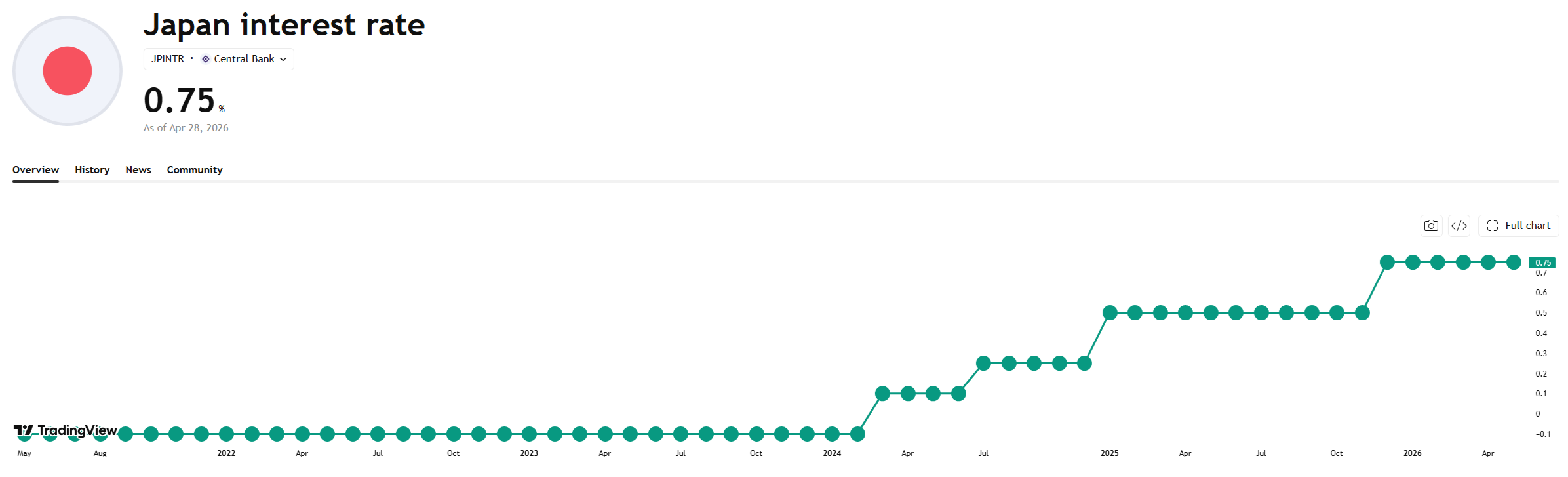
The Bank of Japan is almost certain to raise its benchmark interest rate to 1% at its June 15-16 policy meeting, a level the country has not seen since 1995. But with Governor Kazuo Ueda hospitalized and unable to chair the meeting, the real question is what comes next.
A Reuters survey of 70 economists found 94% expect the rate to move by month’s end. The case is clear: wholesale prices rose 4.9% year-over-year in April, the yen has weakened past 160 per dollar, and Japan has spent 11.7 trillion yen ($73 billion) in currency intervention since late April to slow the decline.
A BOJ Rate Hike Without Its Architect
Ueda, 74, entered the hospital on June 10 for treatment of an infected liver cyst, according to CNBC. It marks the first time since 1998 that a BOJ governor has missed a policy-setting meeting. Nikkei Asia reported that Deputy Governor Ryozo Himino will chair in his place, while Deputy Governor Shinichi Uchida, recently diagnosed with leukemia, will conduct the post-meeting press conference.

The BOJ rate hike itself is not in doubt, but concerns and questions linger about what comes next. Past BOJ meetings have shown that markets can move as sharply on post-meeting language as on the rate decision itself.
Mari Iwashita, executive rates strategist at Nomura Securities, told Reuters the BOJ may avoid clear signals on the future rate path:
“It’s also becoming more unclear on whether the BOJ would hike again this year.” Shigeto Nagai, head of Japan economics at Oxford Economics, framed the hike as defensive: “I interpret the coming rate hike as a defensive measure intended to prevent further yen depreciation.”
Beyond 1%: Who Drives the Next Phase
More than 75% of economists in a recent Reuters survey expect a follow-up hike to 1.25% in Q4 2026, with two-thirds forecasting 1.5% by mid-2027.
But the political calendar could slow that path. Prime Minister Sanae Takaichi, a proponent of loose fiscal and monetary policy, gains the power to reshape the BOJ board when two hawkish members’ terms expire in July 2027.
“Next year’s personnel shift could overhaul the balance within the board,” said Tsuyoshi Ueno, senior economist at NLI Research Institute. “The BOJ may find it difficult to do anything that could draw the government’s ire.”
The June hike is essentially decided. Whether Japan’s tightening cycle continues beyond it depends on economic conditions, the governor’s recovery, and the prime minister’s patience.
The post Japan Set For 30-Year Rate High: Leadership Turmoil Raises Uncertainty appeared first on BeInCrypto.
TLDR
- XRP forms a head-and-shoulders pattern targeting a move near $0.99 if support breaks.
- Bear flag structure signals continuation risk toward $0.94 on lower timeframes.
- On-chain MVRV bands indicate a potential downside zone near $0.96 based on historical cycles.
- RSI remains below neutral levels, showing weak short-term momentum across charts.
- Key resistance levels sit near $1.12 to $1.15, where breakdown invalidation may occur.
XRP price moved under pressure as multiple bearish chart patterns emerged across short-term trading sessions in June market action. Traders observed head-and-shoulders formation and bear flag signals, while on-chain metrics indicated weakening demand and rising sell pressure across exchanges’ data flows. Weak momentum and technical breakdown risks suggested potential downside continuation as price action approached key support zones during current market conditions across multiple timeframes analysis.
XRP bearish chart signals pressure below $1
XRP chart structure shows repeated lower highs forming a bearish pressure pattern signal. Market participants watch support levels near the neckline after a recent decline, with continuation risk.
Head-and-shoulders formation continues to develop on lower timeframes across charts. Sellers increase activity as price fails to reclaim prior resistance zones tested.
Bear flag structure indicates consolidation after sharp downward movement in trading sessions. Momentum indicators remain weak with readings below the neutral threshold on chart analysis.
Four-hour chart highlights rejection near short-term moving average levels observed. Traders monitor potential breakdown below flag support for confirmation signal formation phase.
XRP price action continues hovering near key intraday support area levels tested. Sustained weakness increases the probability of further downside pressure in the sessions ahead.
Short-term momentum remains negative across intraday trading charts, signaling weakening. Market structure shows failure to sustain upward breakout attempts in the recent sessions’ analysis.
Support levels near the psychological zone attract repeated price testing behavior patterns. Breakdown confirmation depends on sustained close below critical support market reaction now.
XRP price faces breakdown risks from technical patterns
Bearish continuation patterns align with recent price rejection zones across observed timeframes. Market watchers identify potential downside targets near lower support band levels forming.
Four-hour chart breakdown signals increased selling pressure continuation near resistance zones. Technical indicators confirm weak momentum and limited upward strength on charts today.
Price structure forms repeated rejection near short-term moving averages, recent data. Volume patterns show declining participation during recovery attempts across trading sessions analysis.
Bear flag continuation signals remain active on intraday charts and market structure today. Support breakdown risk increases with sustained selling pressure during the sessions now phase.
On-chain metrics show weakening demand signals across trading activity data. Historical comparisons suggest similar patterns during prior correction phases of market cycles observed.
Liquidity zones around support levels attract repeated market attention to levels tested. Price action remains constrained within tight consolidation ranges across intraday charts.
Lower band projections indicate potential movement toward historical support zone levels. Trading activity continues near critical levels, with cautious positioning and market conditions stable.


Anthropic raised money at a $965 billion valuation last month and is heading toward a public stock listing. But to build the data centers, it needs to stay competitive. The AI company is reportedly asking Google, its most direct rival, to guarantee the bills.
Anthropic has signed more than a dozen preliminary agreements to lease US data centers with a combined capacity above 1 gigawatt. Executives at the company have also reportedly discussed an arrangement where Google would financially backstop those lease payments, with Apollo Global Management and Blackstone providing private credit as part of the wider financing structure.
Google Competes With Anthropic, and Also Funds It
Google’s Gemini competes directly with Anthropic’s Claude across AI assistants, coding tools, and enterprise software. Yet Google has committed up to $40 billion to Anthropic and co-designs some of the server chips the company plans to use in its new facilities.
The reported lease guarantee would deepen that entanglement: Google would stand behind Anthropic’s payments if the company cannot meet them.
Neither company addressed the specifics publicly. Google told Reuters it does not comment on rumors or speculation. Also, Anthropic did not respond to requests for comment.
Anthropic Data Centers and the IPO Push
Anthropic has historically relied on cloud providers, including Google Cloud, for compute capacity. Leasing and running its own facilities gives the company more control over costs and performance as it scales, and cuts its dependence on the same providers it competes with directly.
Anthropic confidentially filed for a US IPO earlier this month without disclosing the size or terms of the offering. Its most recent funding round, closed in late May, raised $65 billion at a post-money valuation of $965 billion, placing it ahead of OpenAI by implied market value.
The AI Race Runs on Mutual Dependence
Google’s interest in Anthropic’s success extends well beyond equity returns. A strong Anthropic keeps OpenAI from monopolizing the enterprise AI market and validates Google’s own AI infrastructure bets.
Meanwhile, Anthropic pays SpaceX, another competitor through xAI, $1.25 billion a month for AI compute, and these companies are both heading for IPOs. It is evidence of two more AI companies racing each other for the same institutional capital while being in business with each other.
The post Anthropic Is Worth $965 Billion and Still Needs Google to Pay Its Rent appeared first on BeInCrypto.

Bitcoin miners are facing growing financial strain as falling prices and shrinking revenue push several key industry indicators into what analyst Axel Adler Jr. has described as a “stress zone.”
But while the pressure is building, the data suggests that the market has not yet reached the collapse-level extremes seen in 2018 or 2022.
What the Metrics Are Saying
According to Adler, the Puell Multiple 30-day moving average, which compares the current daily revenue of BTC miners to a 365-day average, fell 11% in ten days, moving from 0.83 at the end of May to 0.74 as of June 10.
The raw Puell Multiple is even lower, at 0.58. Values below 1.0, per the analyst, mean that current revenue is running below the annual norm, and the deeper that reading goes, the harder things become for mining operators.
For context, the Puell 30DMA hit a peak of 1.33 in July 2025 when BTC was trading above $120,000. The current 0.74 puts miners roughly where they were in mid-2024, right around the halving period when the flagship cryptocurrency was changing hands between $55,000 and $68,000.
At the 2022 cycle low, Adler says the same indicator fell to 0.45, while in December 2018 it reached 0.33. So judging by those, 0.74 is not exactly a crisis number.
But the issue, as the market observer pointed out, is that the 30DMA has been dropping for two straight weeks, and at that pace it could very well reach 0.50 by late June, a level that led to mass equipment shutdowns in 2022.
The second metric is the Price-to-Miner-Revenue Multiple, which measures how far above the annual revenue per BTC of miners the cryptocurrency’s price is trading.
According to Adler, a falling reading means the speculative premium over miner production costs is shrinking. The ratio is currently at 80, having tumbled from a high of 160 that it registered in 2025.
However, the analyst says that’s a “normalization zone,” and it has not yet hit undervaluation territory. For comparison, the 2022 bottom saw it hit 33, while it compressed as far as 15 in February 2019.
Lastly, Adler touched on the Miner Capitulation metric, which tracks the percentage change in Bitcoin’s price since the most recent Difficulty Bottom. Per his report, that drawdown was at -21% as of June 9, while it had been at -8 on June 1 and near zero toward the end of May.
Historically, deeper miner distress emerged when contractions pushed beyond -30%, with the worst reading on record coming in 2022 when it hit -39 and contributed to the forced selling and large-scale ASIC shutdowns seen in that year.
How Far From a True Bottom
Despite the pressure, Adler confirmed that miners have not yet fully capitulated, and for that to happen, the Puell Multiple would likely need to fall below 0.50, the Price-to-Miner-Revenue Multiple would need to compress toward the 30-40 range, and the dip from the Difficulty Bottom would need to be more than -30%.
Right now, all three metrics are running at about half the severity of those historical extremes. But the analyst said that they could deteriorate some more if BTC were to fall below $55,000 without a new downward difficulty adjustment.
The asset was trading a couple of hundred bucks below $63,000 at the time of writing, having bounced back from a brief drop toward $59,000 last Friday, which was its worst showing in nearly two years.
The post 3 Key Metrics Show Bitcoin Miners Are Under Mounting Pressure appeared first on CryptoPotato.

The 2026 FIFA World Cup is shaping up to be a pivotal moment for prediction markets, according to new analysis from Bernstein. The research argues that the expanded tournament schedule could unlock a surge in both sports betting and consumer prediction markets, turning what is traditionally a slow window for online wagering into a substantial revenue engine.
Bernstein’s forecasts center on a roughly month-long event spanning 104 matches, during which the industry could see more than $3 billion in incremental sports betting handle and between $5 billion and $10 billion in additional consumer prediction market volume. FIFA’s own outlook for the worldwide audience—about 6 billion viewers, up from an estimated 5 billion in 2022—only underscores the potential scale of engagement during the tournament. The analysts frame the World Cup as a test case for how large-scale, real-world events can accelerate participation in prediction markets beyond the traditional sports betting crowd.
Key takeaways
- The World Cup could convert a typically slow betting period into a major driver of both traditional betting and prediction-market activity, with potential incremental handles in the billions of dollars.
- Coinbase is highlighted as a standout player in the prediction-market space, having surpassed $100 million in annualized revenue by March after launching nationwide in partnership with Kalshi.
- Robinhood is anticipated to benefit as it rolls out Rothera, its CFTC-licensed prediction-market exchange and clearinghouse, positioning the firm for sizable incremental revenue in 2026.
- Broader market data point to robust growth in prediction markets, driven by retail participation and sports categories, supported by regulatory developments signaling cautious openness to built-out contract markets.
- Industry volumes are expanding rapidly, with retail traders comprising a large share of activity and sports accounting for a growing share of prediction-market volumes.
Prediction markets scale with a global sports event
Bernstein’s analysis emphasizes the World Cup as a catalyst for a broader shift in the prediction-market space. While sports and politics have traditionally driven spikes in activity, the report suggests that the 2026 tournament could unlock a sustained step-up in engagement across real-world outcomes. The forecasted incremental sports-betting handle of more than $3 billion, paired with an extra $5–$10 billion in consumer prediction-market volume, signals a potential re-rating of the market’s growth trajectory for the rest of the year and into 2027.
The market implication is twofold. First, operators with established pipelines into broad U.S. and global audiences stand to capture a larger share of recreational and casual bettors who are drawn to the predict-and-win format of markets tied to real events. Second, the event provides a proving ground for non-traditional prediction offerings—ranging from entertainment and culture to politics and sports—where a large, engaged audience can be monetized through event-driven contracts.
FIFA’s global viewership projection, which Bernstein cites as a driver of engagement, also highlights a key adoption tailwind: the more people tune in, the more people seek ways to participate beyond traditional watching or betting. That dynamic could help prediction-market products gain traction beyond crypto-native users and bring in more mainstream participants who are comfortable with contract-based outcomes.
Platform momentum and revenue signals
The analysis credits Coinbase with establishing a notable presence in the prediction-market landscape. Bernstein notes that Coinbase’s prediction-market offering exceeded $100 million in annualized revenue as of March—remarkable growth for a product launched just months earlier. The rollout, pursued through a nationwide arrangement with Kalshi, enables users in all 50 states to trade outcome-based contracts across sports, politics, culture, and other real-world events. This nationwide reach marks a significant expansion from earlier, more constrained access models and positions Coinbase as a benchmark for monetization in this space.
Coinbase’s move is complemented by Roger-friendly expansion from Robinhood. Bernstein flags that the brokerage is leveraging the World Cup period to introduce Rothera, its US Commodity Futures Trading Commission (CFTC)-licensed exchange and clearinghouse for prediction markets. The forecast: the World Cup could be a major revenue driver for 2026, with Bernstein projecting roughly $586 million in prediction-market revenue for the year. If realized, this would underscore a broader trend of mainstream fintech platforms embracing prediction markets as a core product category rather than a niche experiment.
These platform dynamics echo a broader industry trend: established exchanges are increasingly partnering with payment rails and regulatory-compliant structures to unlock mass participation. The momentum also raises questions about how quickly other incumbents—both crypto-native and traditional fintechs—will pursue similar paths, and what the competitive landscape might look like as more players enter the space.
Market growth, retail dominance, and regulatory signals
Beyond individual platform moves, market research from Bitget Wallet and Polymarket provides a contemporaneous snapshot of growth, noting that monthly prediction-market trading volume reached about $26 billion in April, with retail traders comprising more than 80% of users. The report also highlighted a structural shift in user behavior: rather than rallying around single events like elections, prediction markets are increasingly retaining users across recurring categories, with sports emerging as the largest segment. In March, sports betting accounted for more than 39% of prediction-market volumes, according to Bitget Wallet and Polygon data.
Regulatory signals are also shaping the trajectory. The CFTC issued draft rules around prediction markets, signaling that sports-event contracts are generally not contrary to the public interest, even though federal law classifies them as “gaming.” The evolving policy framework is crucial for how quickly larger-scale, payment-enabled prediction markets can scale while maintaining compliance and consumer protections. For investors and builders, the regulatory environment remains a critical variable: clarity and workable licensing pathways could reinforce growth, while tightening rules could constrain new product formats or market access.
In parallel, industry chatter around valuations and fundraising remains active. Earlier coverage noted Kalshi and Polymarket eyeing substantial valuations as venture funds seek exposure to prediction-market platforms, illustrating how the space has evolved from niche experimentation to potential mainstream adoption through scalable, regulated products.
What readers should watch next
The World Cup’s impact on prediction markets will hinge on several moving parts. Actual revenue realization from Coinbase’s Kalshi partnership and Robinhood’s Rothera offering will be telling, as will user retention beyond the tournament window. Regulatory developments will continue to shape product designs, risk controls, and cross-border access for prediction-market platforms. Finally, sustained volume gains—particularly in sports- or entertainment-focused markets—will determine whether the World Cup represents a one-off surge or the start of a longer growth cycle for consumer prediction markets.
As the tournament unfolds, observers should monitor how incremental volumes compare with Bernstein’s projections and whether the retail-led momentum observed in early 2024 persists into late 2026. If the industry secures a stable regulatory footing and broadens access without compromising protections, the World Cup could become a defining milestone for prediction markets, catalyzing deeper participation from traders, investors, and builders alike.


Retail traders have scrambled for SpaceX shares ahead of the aerospace giant’s IPO, with some reportedly seeking loans as demand climbs far above available supply.
Summary
- Some investors are seeking personal loans and additional financing to buy SpaceX shares as demand for the IPO surges.
- Retail interest could reach $70 billion despite only $22.5 billion of shares being allocated to individual investors.
- SpaceX faces legal and regulatory scrutiny ahead of its debut, but Oppenheimer maintains a $190 price target versus the expected $135 IPO price.
According to Bloomberg, some investors have gone beyond setting aside cash and have attempted to borrow additional funds in an effort to secure shares in Elon Musk’s rocket and satellite company.
The rush comes as SpaceX prepares for one of the most closely watched public offerings in recent years, carrying a valuation of around $1.75 trillion.
Among those seeking exposure is Anna Watts, a 33-year-old public relations manager from New York. Bloomberg reported that Watts has accumulated $6,500 for the offering and unsuccessfully sought an additional $5,000 from both a friend and a bank. Despite the rejected loan requests, she told Bloomberg she remains committed to participating in the IPO.
Investor demand has continued to build even as concerns surrounding the company have drawn attention in recent weeks.
According to previous reporting by crypto.news, Senator Elizabeth Warren urged the U.S. Securities and Exchange Commission to delay the offering, citing questions related to investor protections, corporate governance, and valuation.
Retail demand has outpaced available shares
Bloomberg reported that investor interest exceeds the number of shares available for sale by more than four times. SpaceX has allocated approximately 30% of the offering to retail participants, a portion valued at about $22.5 billion.
Market observers cited by Bloomberg estimate that retail demand could approach $70 billion once trading begins, highlighting the gap between available shares and investor appetite.
Many buyers appear to be driven by Musk’s long track record of building high-profile companies. Tesla’s transformation from a niche electric vehicle maker into one of the world’s most valuable corporations has encouraged some investors to view SpaceX as a similar long-term opportunity.
Others have already sought indirect exposure through investment funds holding private SpaceX shares while waiting for broader public access through the IPO. Bloomberg reported that some investors describe the offering as a rare opportunity they intend to hold for many years.
Legal and regulatory concerns remain in focus
Away from the enthusiasm surrounding the listing, SpaceX and xAI are facing a legal challenge tied to Musk’s artificial intelligence business.
According to a complaint filed in California’s Santa Clara County Superior Court, former xAI engineer Devin Kim alleges he was dismissed after raising concerns about Grok’s safety systems and pushing for additional testing procedures.
The lawsuit claims the chatbot lacked sufficient safeguards against misinformation, bias, and other harmful outputs.
Kim is seeking compensatory damages, punitive damages, attorneys’ fees, forfeited equity compensation, and other remedies. SpaceX was included in the lawsuit following the recent merger between the two companies, placing the dispute under additional scrutiny just before the IPO.
Despite those developments, Wall Street sentiment has remained largely constructive. As previously reported by crypto.news, brokerage firm Oppenheimer initiated coverage of SpaceX with an outperform rating and assigned a $190 price target, above the company’s expected IPO price of $135.
SpaceX enters the public market after years of growth in commercial launch services, astronaut transportation, and Starlink satellite internet operations.
While regulators, lawmakers, and legal challenges continue to attract attention, Bloomberg reported that strong demand from Musk supporters remains the dominant force shaping interest in the offering.


The US Securities and Exchange Commission (SEC) has proposed rescinding Rules 611 and 610(e) of Regulation NMS, the trade-through rule that has shaped US equity market structure since 2005.
Galaxy Digital’s Head of Firmwide Research, Alex Thorn, called the rule “one of the biggest structural barriers” to tokenized US equities trading in decentralized finance (DeFi).
SEC Plans to Drop Rule 611
Rule 611, commonly known as the Order Protection Rule, is part of the US Securities and Exchange Commission’s (SEC) Regulation NMS framework.
The rule requires trading venues, such as stock exchanges and broker-dealers, to prevent “trade-throughs,” instances in which an order is executed at a worse price when a better price is available on another exchange.
Thorn explained that in practice, every trade in a national market system (NMS) stock must respect the national best bid and offer (NBBO).
The SEC also proposed scrapping Rule 610(e). It concerns locking and crossing quotations in US equity markets. A 60-day public comment period follows publication in the Federal Register.
“This proposal is intended to simplify market structure and reduce costs for market participants while allowing competition, innovation, and other market forces to shape the continuing evolution of our equity markets. I look forward to reviewing public comments as we take a careful, deliberative approach to avoid repeating the same mistakes that brought us here,” SEC Chairman Paul Atkins said.
Follow us on X to get the latest news as it happens
Galaxy’s Alex Thorn Calls SEC Rule Repeal A Breakthrough For Tokenized Stocks
Thorn argued that this is “one of the biggest unlocks yet for tokenized stocks.” He noted that automated market makers (AMMs) cannot comply with these rules by design. Pools execute against bonding curves at whatever price liquidity dictates, with slippage, at block-time granularity.
“An AMM can’t route intermarket sweep orders. can’t ingest SIP data with latency guarantees. can’t halt a swap because a better quote exists on Nasdaq. any pool in a tokenized NMS stock would commit trade-throughs constantly and arguably be an illegal trading center,” he stated. 610(e) is the same story. AMM prices drift continuously with flow and would routinely lock or cross the displayed NBBO, which venues are currently required to prevent.”
Without Rule 611, the broker-level best execution duty under FINRA Rule 5310 would govern order handling. That standard is principles-based rather than enforced trade-by-trade. He argued that this framework can accommodate automated market makers (AMMs), whereas the previous system could not.
However, he noted that tokenized NMS stocks still face open questions on exchange and ATS registration, clearance, and settlement. Thorn hopes the SEC’s forthcoming “innovation exemption” will address many of these issues.
Thorn described the sequencing as the SEC executing its Project Crypto playbook. The agency clears the hardest market structure obstacle first, then handles venue registration through exemptive relief. The comment period will reveal whether market participants oppose dismantling a 20-year-old pillar of US trading.
Subscribe to our YouTube channel to watch leaders and journalists provide expert insights
The post SEC Moves to Scrap Rule 611: Here’s What It Means for Tokenized Stocks appeared first on BeInCrypto.


BlackRock placed an order for at least $5 billion in SpaceX IPO shares ahead of the historic Nasdaq debut, according to Bloomberg. The move adds heavyweight institutional backing to what could be the largest IPO ever recorded.
The reported bid from the world’s largest asset manager intensifies the spotlight on the listing.
What BlackRock’s Bet on the SpaceX IPO Reveals
An IPO marks the moment a private firm begins trading on an exchange, opening its capital to a broader base of shareholders. SpaceX combines a high-impact technology narrative with a growth track record that has drawn strong demand from both institutional funds and retail investors, making this listing one of the most anticipated of the decade.
The scale of the deal is unprecedented, with SpaceX aiming to raise roughly $75 billion at a valuation near $1.8 trillion, a figure that would not only set a global IPO record but also place the company among the most valuable in the world.
BlackRock, the world’s largest asset manager, is reportedly seeking at least $5 billion in shares, a level of conviction that, according to Bloomberg, reflects either deep confidence in SpaceX’s long-term growth potential or the strategic value of securing exposure to a company of this caliber from day one of trading.
Read More: How to Buy the SpaceX IPO Stock? Crypto Users Have an Inside Lane
The order book reportedly closed on Wednesday, and lead banks are now finalizing the allocations ahead of the Nasdaq listing, a delicate process given that large funds, institutional clients, and a sizable retail segment are all competing for a limited number of shares.
A $5 billion order, however, does not necessarily translate into the final allocation, as oversubscribed IPOs typically see large investors request far more shares than they ultimately receive, particularly when demand outpaces supply by a wide margin.
Why Elon Musk’s IPO Style Is Different
Elon Musk has rewritten the traditional IPO rules for SpaceX, designing a process that gives retail investors a stronger role, pushes for early index inclusion, and embeds a governance structure built to preserve firm founder control in the years ahead.
BeInCrypto previously reported that SpaceX is considering allocating up to 30% of the offering to individual investors, a share that clearly breaks with traditional practice, where the most attractive tranches usually concentrate in the hands of institutions with close ties to the placement banks.
That detail matters far beyond the equity market, since a larger retail allocation could intensify FOMO buying around the debut and pull liquidity away from other risk assets, including Bitcoin and Ethereum, during the trading days surrounding the Friday listing.
The expectations extend beyond traditional finance, since traders on the prediction market platform Polymarket see a strong likelihood that SpaceX will rise on its public market debut, with high odds of closing with a market capitalization above $2 trillion.
Follow us on X to get the latest news as it happens
For BlackRock, the strategic logic looks straightforward, as SpaceX brings together Starship, Starlink, and a growing set of AI projects, including the recent xAI acquisition, a bundle that fits perfectly into a market that keeps rewarding growth stories tied to technology, defense, connectivity, and strong founder leadership.
The reported $1.8 trillion valuation also places SpaceX inside a tier reserved for the most dominant global companies, reflecting the confidence parts of the market assign to its competitive position and long-term business vision.
For now, all eyes are on the official Friday debut, where BlackRock’s reported $5 billion interest already signals the financial weight surrounding this listing, and the final allocations will reveal just how much each investor group ultimately receives.
The post BlackRock Places $5 Billion Order for SpaceX IPO Ahead of Historic Nasdaq Debut appeared first on BeInCrypto.
US stocks surged after comments from President Donald Trump reduced concerns about a potential military escalation with Iran.
Summary
- US equities added about $1.2T in value within 20 minutes.
- The S&P 500 rose 1.33%, while the Nasdaq gained 1.75%.
- Trump’s Iran remarks eased escalation fears and lifted market sentiment.
Major equity indexes recorded strong gains after reports said Trump cancelled planned airstrikes and pointed to possible progress in talks with Tehran. Market figures shared online showed more than $1.2 trillion in combined market value returned to US equities within minutes.
Markets rally after reports of eased Iran tensions
According to market commentator Bull Theory, US stocks added roughly $1.2 trillion in value within 20 minutes. The move followed reports that Trump canceled planned military action against Iran. Investors responded quickly as expectations around geopolitical developments changed during the session.
The S&P 500 led gains among major benchmarks. The index climbed 1.33% and added approximately $890 billion in market capitalization. At the same time, the Nasdaq advanced 1.75% and contributed around $670 billion.
Meanwhile, the Dow Jones Industrial Average gained 1.22%. The index added roughly $150 billion in market value during the rally. The Russell 2000 also rose 1.70%, increasing its capitalization by about $56 billion.
The gains appeared across several market segments. Large technology companies, industrial firms, and smaller businesses all participated in the advance. The move showed buying activity across multiple areas of the market.
Index gains spread across large and small cap stocks
Bull Theory highlighted the scale of the market reaction in a post on X. The account linked the rally to reports surrounding US-Iran developments. It also pointed to improving sentiment across major stock indexes.
Market participants often react rapidly to developments involving international relations. Changes in expectations can influence trading activity within minutes. In this case, investors moved into equities following reports of reduced military risk.
Technology shares participated alongside traditional blue-chip companies. Small-cap stocks also recorded gains as the rally expanded. The advance did not remain concentrated within a single industry group.
Trading activity increased as market sentiment improved during the session. The gains followed several periods of uncertainty tied to geopolitical developments. Investors adjusted positions as new information entered the market.
SpaceX IPO discussion joins market conversation
Attention has also turned toward the anticipated SpaceX initial public offering. Bull Theory noted that the IPO was less than 24 hours away when the comments appeared. The upcoming listing added another point of focus during an active trading session.
Large public offerings often attract interest from both institutional and retail investors. Market participants frequently evaluate such events alongside broader economic and political developments. The expected SpaceX debut remained part of discussions throughout the session.
Even so, trading activity centered largely on developments related to US-Iran relations. Reports concerning diplomacy and military action remained the primary catalyst behind the market move. Investors continued monitoring official statements from Washington and Tehran for further updates.
The session ended with major indexes holding strong gains. Market participants remained focused on geopolitical developments and upcoming corporate events. The rally underscored how rapidly stock prices can respond to changes in international developments.

Bangkok and Tokyo Launch Joint Tourism Campaign
Jim Cramer Warns Spacex IPO Debut Could Trigger Extreme Valuation Surge

2026 FIFA World Cup standings: Group stage table, results



-

 Fashion6 days ago
Weekend Open Thread: Evereve – Corporette.com
-
 Crypto World7 days ago
Jensen Huang Approves Samsung, SK Hynix, and Micron for NVIDIA (NVDA) HBM4 Memory Supply
-

 Crypto World4 days ago
Anatomy of the June crypto crash: Fed, Iran, Saylor
-
 Entertainment5 days ago
The Best Mystery Series of All Time Is Surging on Streaming 30 Years After It Ended
-

 NewsBeat4 days ago
Alexander Zverev wins the French Open to finally earn a 1st Grand Slam title
-

 Tech6 days ago
Suspicious Polyfill login prompts pop up on Toshiba, Muji websites
-
Crypto World5 days ago
Senator Cynthia Lummis Calls CLARITY Act the Most Consequential Financial Legislation of This Generation
-

 Tech7 days ago
Microsoft launches MXC, an OS-level sandbox for AI agents, with OpenAI and Nvidia already on board
-

 Tech5 days ago
Microsoft unveils seven homegrown AI models in new bid for ‘long term self-sufficiency’
-

 Business7 days ago
(VIDEO) Justin Bieber Delivers Surprise Happy Birthday Serenade to Diners at Los Angeles Mexican Restaurant
-
 NewsBeat4 days ago
Alexander Zverev conquers demons and outlasts Flavio Cobolli to win French Open for first major title
-
 Business5 days ago
The Pain Points Taking a Fragile Tech Rally Down a Notch
-

 Business4 days ago
High Stakes for Wembanyama as New York Pushes for 3-0 Lead
-
 Crypto World4 days ago
Eli Lilly (LLY) Stock Surges 4% Following Breakthrough Sleep Apnea Trial Results
-

 Tech6 days ago
Von der Leyen’s AI envoy pick draws conflict-of-interest fire
-

 Tech7 days ago
Meta steals a tactic from Tesla and builds data centers in tents
-

 Tech6 days ago
Hackers now exploit SolarWinds Serv-U flaw to crash servers
-
Crypto World7 days ago
LBank Surpasses 25 Million Users Worldwide as AFA Partnership Continues to Drive Global Growth
-

 Crypto World5 days ago
Trump’s AI Ownership Plan Could Benefit Anthropic at OpenAI’s Expense
-
 Sports3 days ago
Bangladesh beat Australia after 20 years in ODIs, register only their second win over six-time world champions | Cricket News
You must be logged in to post a comment Login