
Crypto World
US Senator Gillibrand says crypto market structure vote could happen by August

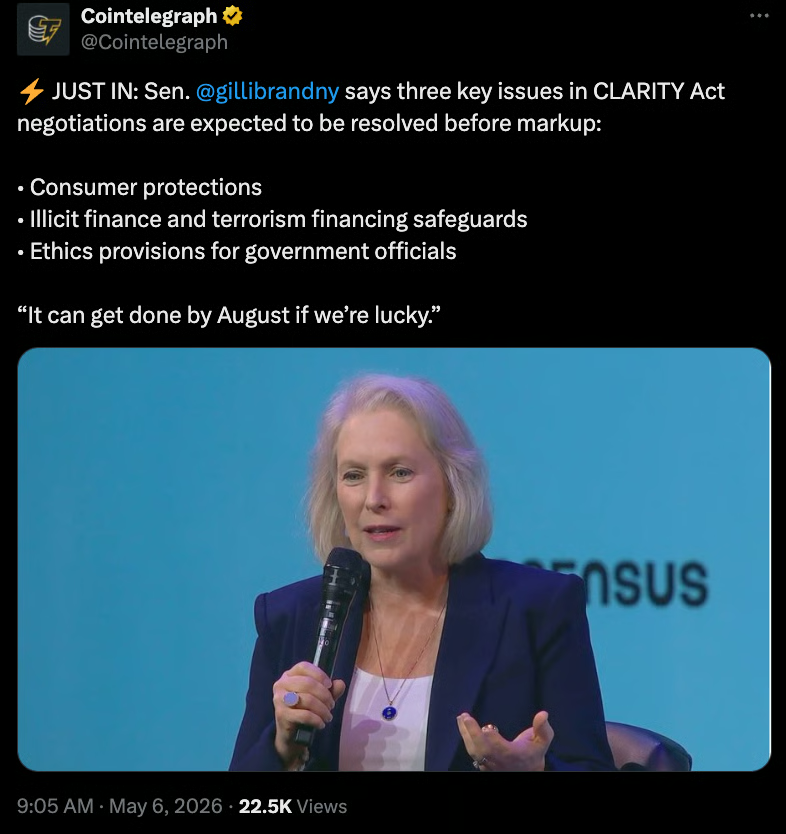
US Senator Kirsten Gillibrand said lawmakers working towards passage of a digital asset market structure bill likely need to meet three conditions before the chamber could vote on the legislation.
Speaking at the Consensus conference in Miami on Wednesday, Gillibrand said she considered addressing consumer protection, illicit finance, and ethics provisions essential before any potential vote on the CLARITY Act. She said that if Congress were to consider those issues, as well as combine the draft of the market structure bill with the version already passed in the Senate Agriculture Committee and ensure ethics language, lawmakers could have a vote “before the August recess,” which begins Aug. 10.
“There will be no one voting for this bill if we don’t have an ethics provision,” said Gillibrand. “Because the truth is, is that we cannot allow members of Congress, senior administration officials, presidents or vice presidents, to get rich off of these industries because of their insider status. It is the worst form of pay for play.”
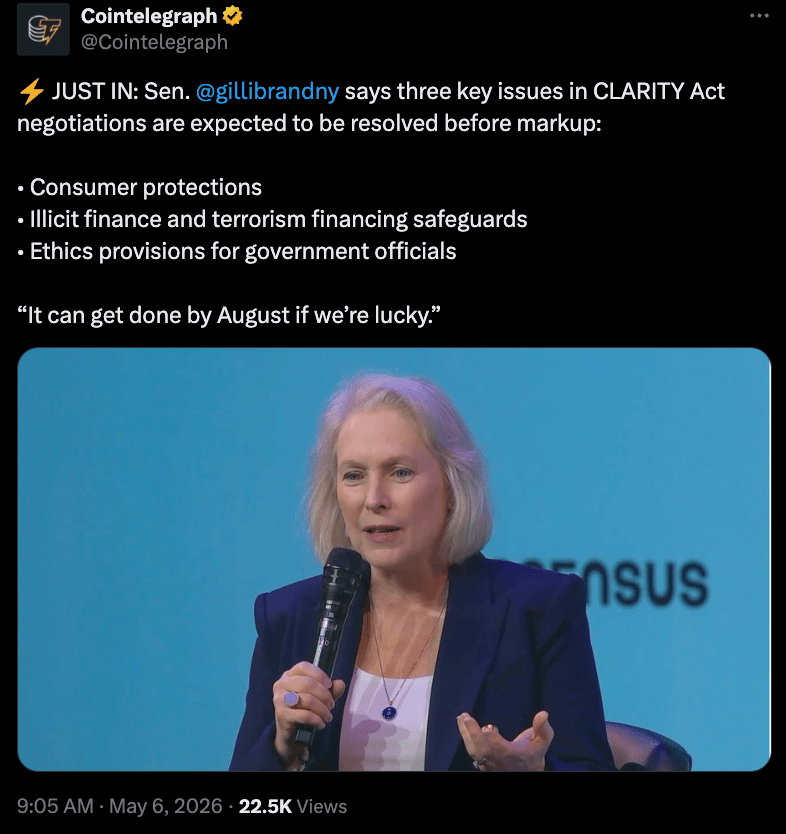
Senator Kirsten Gillibrand speaking on Wednesday. Source: Cointelegraph
Although Gillibrand did not explicitly mention US President Donald Trump by name, his ties to the crypto industry, through the launch of his memecoin, his family’s crypto business World Liberty Financial, and other dealings with the industry have come under scrutiny as lawmakers consider the CLARITY Act.
Last week, senators on the banking committee announced a deal on stablecoin yield which could allow the market structure bill to advance, but did not address language on public officials’ potential conflicts of interest.
Related: Americans distrust crypto, AI as industry super PACs flood midterms, poll finds
Crypto industry leaders and advocates have been weighing in on the market structure bill since the stablecoin yield compromise was announced. Ripple CEO Brad Garlinghouse said on Tuesday that lawmakers likely needed to address the bill in the next two weeks before it became muddied by issues amid the US midterm elections.
“There’s a window of opportunity, and that’s always important that you act when you find that window of opportunity,” said Summer Mersinger, a former commissioner at the Commodity Futures Trading Commission and CEO of the Blockchain Association, in a separate panel on the market structure bill at Consensus on Wednesday.
“That doesn’t mean the window’s not going to open again. You just never know what’s going to happen in the intervening events that maybe will bring people back to this issue after August recess,” she said.
Bill awaits markup in Senate Banking Committee
As of Wednesday, the Senate Banking Committee had not rescheduled a markup on the market structure bill after postponing the event in January. At the time, Coinbase CEO Brian Armstrong said that the exchange could not support the legislation as written, leading to other crypto companies and advocates speaking out against certain provisions in the bill on decentralized finance, stablecoins and tokenized equities.
Traders on prediction markets platform Polymarket see a 65% chance of the CLARITY Act being signed into law by the end of 2026. On Kalshi, traders currently put the probabilty that the bill will become law before August at 49%.
Magazine: Guide to the top and emerging global crypto hubs: Mid-2026

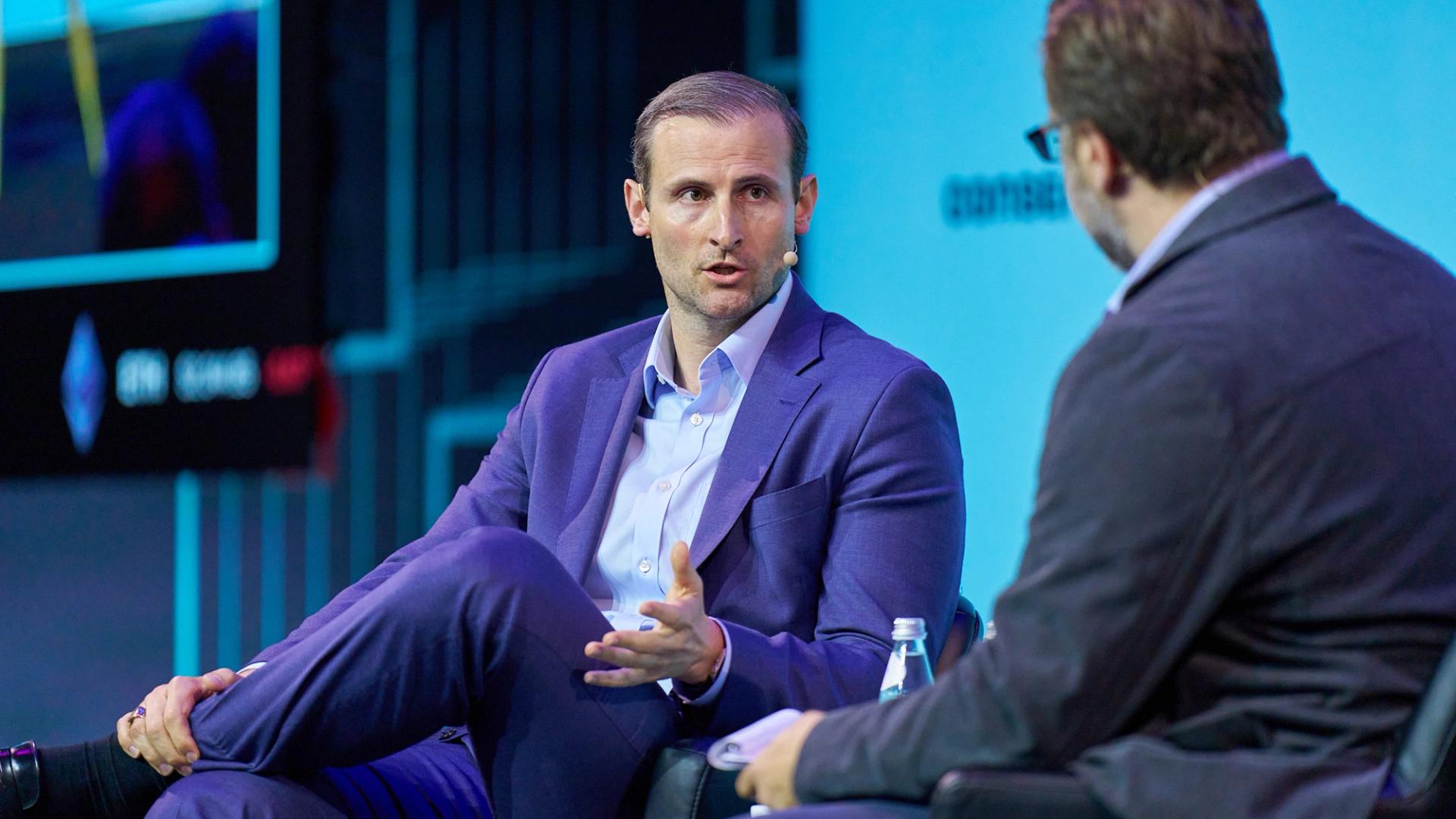
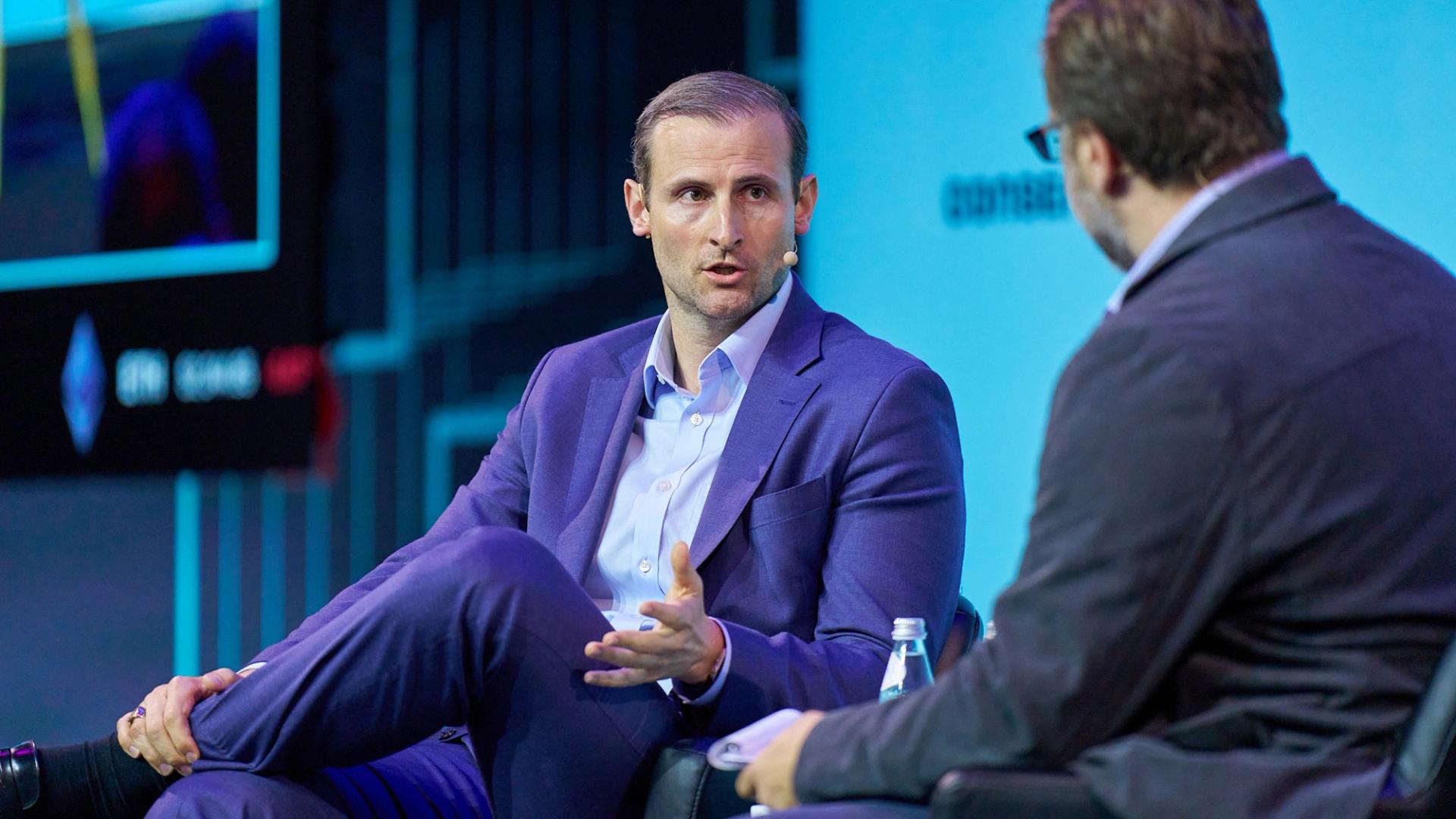
The White House is aiming for July 4 for Congress to pass the Digital Asset Market Clarity Act, Patrick Witt, executive director of the President’s Council of Advisors for Digital Assets, told CoinDesk’s Consensus Miami conference on Wednesday.
“We’re targeting July 4th. I think that would be a tremendous birthday present for America, celebrating our 250th,” Witt said. The mechanics, according to Witt, are: Senate Banking Committee markup this month, four working Senate weeks in June for floor passage and enough runway for a U.S. House of Representatives vote before the Independence Day deadline.
That timeline runs ahead of the prediction Sen. Kirsten Gillibrand shared on the same stage earlier in the day, when the New York Democrat predicted Clarity would reach the president’s desk by the first week of August.
“There’s not a lot of slack left in the rope right now,” Witt said. “But it is an achievable timeline.”
The path to markup opened when Sen. Thom Tillis (R-NC) and Sen. Angela Alsobrooks (D-MD) released a compromise on the bill’s stablecoin-yield provisions in early May, banning bank-deposit-equivalent yield on stablecoins while leaving room for rewards tied to spending. Witt said the White House convened banks and crypto firms to fashion the language, then handed it to the senators, who ran their own process and arrived at a text both sides found equally unsatisfying.
“Crypto is unhappy, banks are unhappy, but they’re both about equally unhappy,” Witt said. “And so we know that we got the right compromise.” Witt considered that the stablecoin-yield issue “is closed.”
The White House is also closing in on a deal on the conflict-of-interest provision that has divided Democrats and the administration. Witt said the negotiating posture is to accept rules that apply “across the board, from the president all the way down to the brand new intern on Capitol Hill,” but reject anything that singles out a particular office or officeholder. “We’re not going to allow targeting of anyone’s family, any one particular politician,” he said. “I’m optimistic that we’re going to be able to close that out.”
Speaking on what happens if Clarity slips past 2026, Witt said “If we’re not setting the standard, if we’re not writing the rules, then we are going to be a rule follower, and we’re going to be following somebody else’s rulebook on this. And God forbid it’s China that’s ultimately writing those rules.”
U.S. leadership in global capital markets, he added, is one of the things that “underwrite American hegemony.”
Witt also discussed the Guiding and Establishing National Innovation for U.S. Stablecoins (GENIUS) Act, the stablecoin-issuer law passed last year, where rulemaking by the Treasury Department, the Office of the Comptroller of the Currency, the Federal Deposit Insurance Corp. and other agencies is closing in on a one-year July deadline.
“These are complicated issues. They require following the Administrative Procedures Act, soliciting comments. And we received a flood of comments,” Witt said. The law, he added, exemplifies “the efficient frontier of regulation: just enough to allow an industry to flourish… but not so much that you overly burden an innovation into irrelevance.”


Pfizer, Anthropic, and prominent longevity researchers see AI (artificial intelligence) as the most consequential input shaping healthcare, from molecule design to drug trials and aging research.
Biopharma, frontier model labs, and academic medicine each report meaningful AI-driven progress, although researchers caution that regulation, compute, and biological complexity still set the pace.
Pfizer Reviews an AI-Designed Molecule
Pfizer CEO Albert Bourla said in a Bloomberg TV appearance that the company is reviewing a new molecule its scientists generated using AI.
The remark sits squarely inside Pfizer’s stated strategy. The company has paid up to $350 million to PostEra since 2020 for AI-designed small molecules and antibody-drug conjugate payloads.
In January, they announced a strategic collaboration with the Boltz biomolecular foundation model team to refine open-source models on Pfizer’s internal data.
Pfizer Ventures has previously backed longevity vehicle VitaDAO, reflecting the company’s appetite for AI-adjacent biology bets.
“Once we know the target where we need to hit, we need a medicine to do that. And AI can design medicines and molecules that they can fit that target much faster and better than our own thing,” Bourla stated in a Yahoo Finance interview last November.
Anthropic Claims a Frontier Lead
Speaking at Anthropic’s invite-only financial services event in New York, CEO Dario Amodei said Chinese AI labs are likely 6 to 12 months behind frontier US capabilities, while other US labs trail Anthropic by 1 to 3 months.
The event coincided with the release of Claude Opus 4.7 and a wave of new agents pitched at banks, including a financial-crime tool built with FIS.
Amodei also flagged a closing patching window. He said Anthropic’s Mythos model has surfaced tens of thousands of previously unknown software vulnerabilities.
Based on this, he warns that governments and large enterprises have a six to 12-month window to patch before Chinese models close the gap.
The company’s pre-IPO valuation crossed $1 trillion in April, and Amodei told the audience that first-quarter revenue grew roughly 80 times on an annualized basis.
Longevity Researchers See an Inflection Point
Biomedical gerontologist Aubrey de Grey and immunology professor Derya Unutmaz argued in a new BeInCrypto podcast appearance that AI is now the credible path to reversing aging.
Unutmaz predicted most diseases could be addressed within 10 to 15 years, while de Grey put the odds of reaching longevity escape velocity by the late 2030s at roughly 50 percent.
Subscribe to our YouTube channel to watch leaders and journalists provide expert insights
Unutmaz pushed a sharper line on physician practice in the same conversation.
“Very soon it’s going to be malpractice not to use AI in medicine,” Derya Unutmaz told BeInCrypto.
The week’s three signals point in one direction. Drugmakers, frontier labs, and academic researchers are converging on AI as healthcare’s primary accelerator, while regulators, compute supply, and biological data gaps remain the binding constraints.
Whether Bourla’s molecule advances to trials, Amodei’s lab-gap claim survives independent benchmarking, and the longevity field produces de Grey’s mouse breakthrough will define how fast the field moves through the rest of the decade.
Follow us on X to get the latest news as it happens
The post AI in Healthcare? Pfizer, Anthropic, and Longevity Scientists Think It’s Critical appeared first on BeInCrypto.
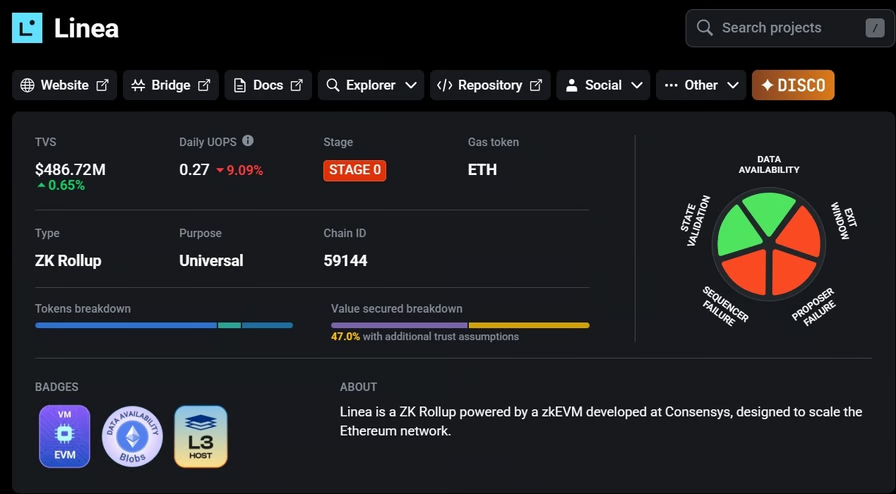
Linea Consortium has joined Linux Foundation Decentralized Trust (LFDT) as a premier member and contributed the open-source zero-knowledge (ZK) rollup stack powering Linea as a new code project called Lineth.
The contribution places Linea’s core layer-2 technology under LFDT’s open-source governance framework, rather than the control of any single company, Linea Consortium said in a release on Tuesday, positioning the move as a step toward decentralization. However, the contribution concerns governance of Linea’s open-source technology stack, not necessarily the decentralization of the Linea network itself.
Linea Consortium board director Declan Fox will join the LFDT governing board alongside representatives from companies like Consensys, Hedera, Kaleido, OpenAssets and Shielded Technologies.
Linea Consortium is a nonprofit that guides Linea’s ecosystem growth, protocol strategy and decentralization, while LFDT is the Linux Foundation’s open-source organization for blockchain, ledger, identity and related decentralized technologies.
Lineth includes Linea’s core ZK rollup components, including its execution, consensus and proof systems, as well as L1 and L2 smart contracts. Linea said the project aims to expand its maintainer base, attract enterprise and institutional users, and support long-term sustainability beyond any single company.
Cointelegraph reached out to Linea Consortium for additional information, but did not receive a response by publication.
Open-source move does not decentralize Linea network
The move gives Linea’s ZK rollup stack a foundation-governed home for maintainers, contributors and potential enterprise adopters. However, key parts of the network remain centralized, including its sequencer, prover, upgrade controls and validator participation.
In the announcement, Fox highlighted one of Ethereum’s core value propositions: credible neutrality. He said that joining LFDT and contributing Lineth are “deliberate steps in Linea’s progressive decentralization.” He added that the move gives the technology powering the L2 ecosystem a “neutral home that no single company controls.”
Related: DeFi can freeze stolen funds, but not everyone agrees it should
According to Linea’s risk disclosures, its Mainnet Beta still includes centralized components such as the sequencer, prover and Security Council, which are maintained by the team. The sequencer can also postpone transaction inclusion and reorder transactions.
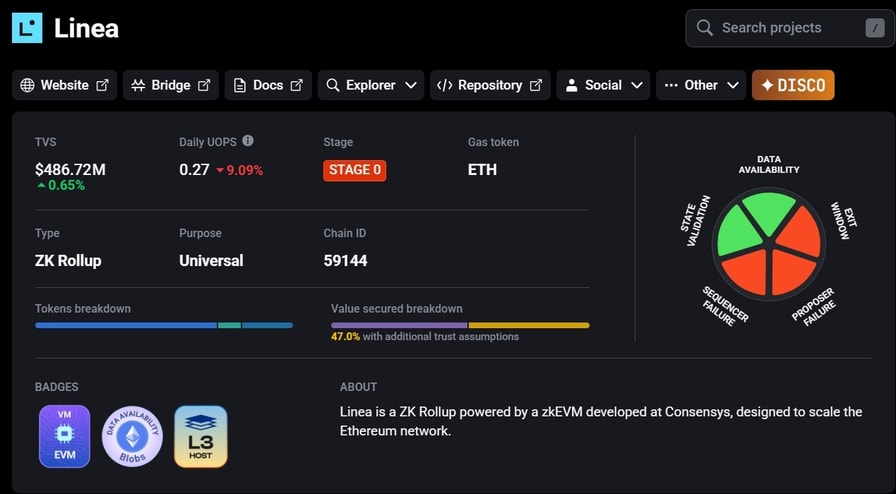
Linea’s information page at L2Beat. Source: L2Beat
L2 analytics tracker L2Beat classifies Linea as a Stage 0 rollup, a category used for networks that still rely heavily on operators or other trusted actors.
The distinction comes amid a broader Ethereum debate over the role of L2 networks. Ethereum co-founder Vitalik Buterin said in February that L2 progress toward Stage 2, where networks are mostly controlled by smart contracts and permissionless mechanisms rather than by the core team, had been slower and harder than expected.
Magazine: AI-driven hacks could kill DeFi — unless projects act now
Crypto World
Spot Bitcoin ETFs solved access, but custody, advisors and plumbing still lag, panelists say
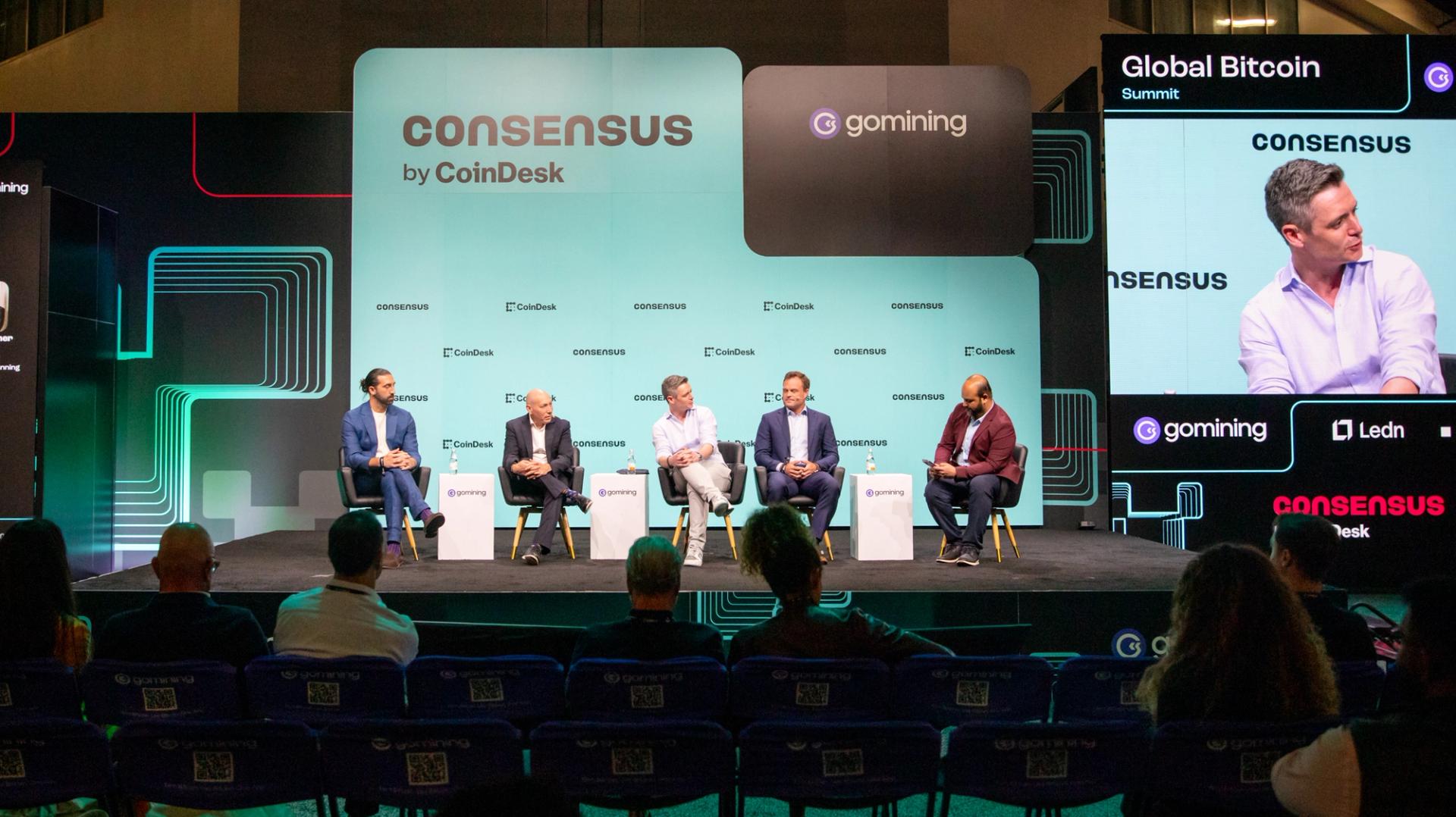
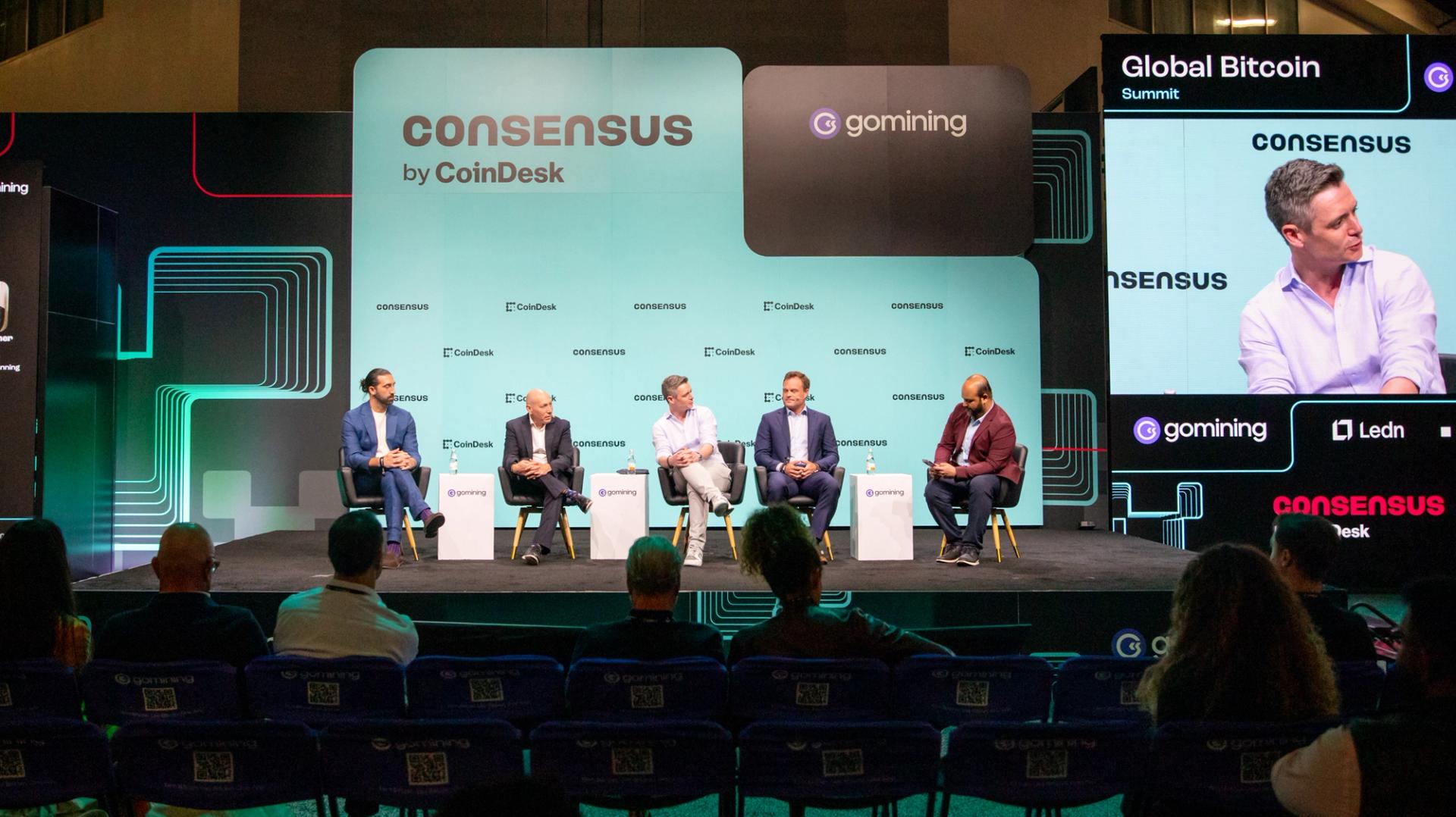
Spot bitcoin ETFs cleared crypto’s long-standing access hurdle by placing bitcoin inside brokerage and advisor accounts already used for stocks and bonds. Two and a half years in, panelists at CoinDesk’s Consensus Miami conference agreed that part had worked. However, they said custody concentration, modest advisor uptake and back-office plumbing all remain unresolved.
Christopher Russell, head of strategic planning and analysis at Calamos Investments, framed the access win in numbers. “The ETF solved one big problem, which was access,” he said. The roughly dozen US spot bitcoin ETFs now hold around $107 billion in combined assets, with about $20 billion in institutional hedge funds, $12.5 billion allocated by registered investment advisors, and 60% sitting in direct retail accounts.
Out of $146 trillion in advisor-managed AUM, that $12.5 billion advisor allocation “seems like a big number, but it’s a really small number,” Russell said. He pointed to what he called the 1% problem: “They can take a 1% position in a 50-60 vol asset, but they don’t want to spend 50% of their client meetings explaining why a 1% position went down 50%.”
Jean-Marie Mognetti, CEO and co-founder of CoinShares, pressed on the structural side. “Right now they are all using one custodian, which is Coinbase, creating a massive concentration risk in the market,” he said. “From a protection and diversification point of view, it’s a zero. If you were in any hedge fund, you would want to get a number of prime brokers to diversify your risk.”
Mognetti’s warning lands in a market that is no longer uniformly single-custodian, but where Coinbase remains a central piece of ETF infrastructure. Fidelity’s FBTC uses Fidelity Digital Assets, VanEck’s HODL launched with Gemini and later added Coinbase, BlackRock’s IBIT added Anchorage Digital Bank alongside Coinbase, and Morgan Stanley’s proposed bitcoin ETF names Coinbase Custody and BNY as bitcoin custodians.
Aaron Dimitri, general counsel for digital assets at Flow Traders, said ETFs have shifted bitcoin from pure buy-and-hold exposure into broader portfolio construction. “You’re not just buying and holding an asset, hoping it appreciates over time,” he said. “You’re able to build in yield products, different structured vehicles.” For institutions, Dimitri said, ETFs do not remove bitcoin’s volatility, but they make the exposure easier to package and manage. “If you’re going to go on a roller coaster, you might as well make sure that the lap belt locks down before the ride takes off,” he said.
Simeon Hyman, global investment strategist at ProShares, pushed back on treating volatility as a problem to be engineered away. “Volatility is a feature, not a bug,” he said, citing bitcoin and ether both up 20% since the start of the war in Iran. If an asset is volatile but not closely correlated with stocks and bonds, “you sprinkle a little in and you’re going to improve Sharpe ratio efficiency,” Hyman said. “But you got to be ready to tell the story.” He also argued that futures-based products retain a role: ProShares’ BITO, launched in October 2021, holds about $2 billion in assets but still trades at 35% of the daily volume of BlackRock’s IBIT, the dominant spot product.
The discussion lands against an unsettled demand backdrop. Strategy, the largest corporate Bitcoin holder with 818,334 BTC, reported a roughly $12.5 billion Q1 net loss this week. CoinDesk reported that the company signaled it could sell some bitcoin to help meet dividend obligations. Strategy’s accumulation has been widely viewed as one of the structural demand pillars of the post-ETF era.
Asked for a five-year price target, Russell predicted Bitcoin reaches $1 million within five years, “but it’s not going to be a straight line.”
Crypto World
Zcash Eyes Another 40% Price Jump as US Hedge Fund Reveals ‘Significant Position’ in ZEC
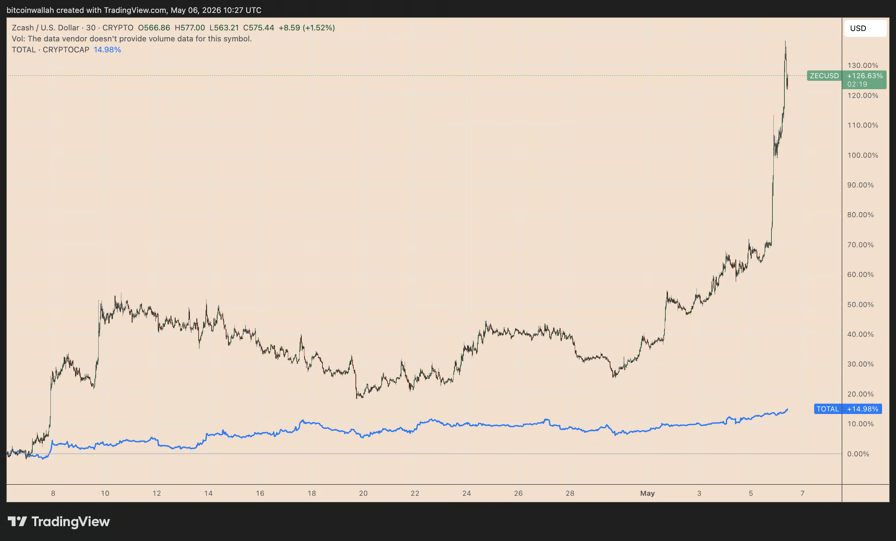
Zcash (ZEC) has outperformed the broader crypto market over the past month, rising by over 125% compared to an average 15% gain for most coins.
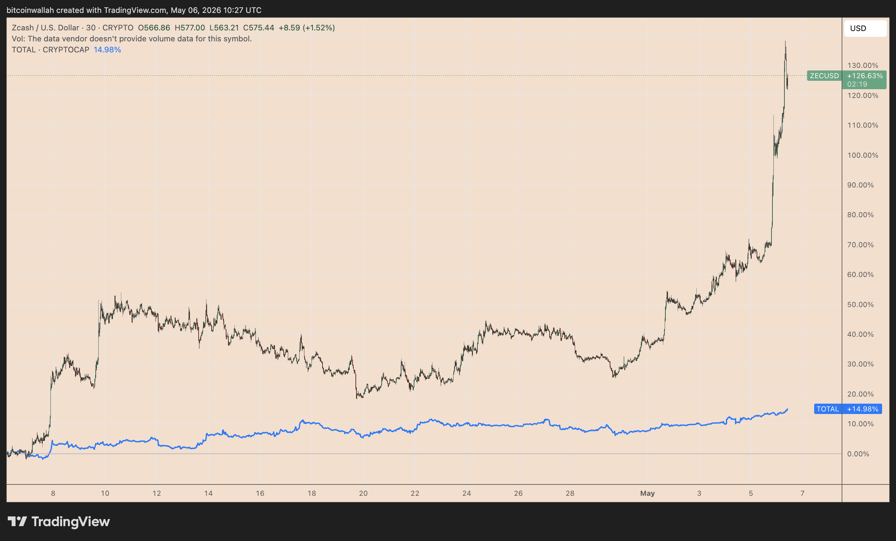
ZEC/USD versus TOTAL crypto market cap 3o-day performance chart. Source: TradingView
The privacy-focused cryptocurrency may rally further in the coming weeks as a mix of bullish technical and fundamental catalysts converges.
Key takeaways:
- US crypto hedge fund Multicoin Capital revealed it has been buying ZEC since February.
- Robinhood will list ZEC as Zcash’s network activity has been booming in the past weeks.
- ZEC technicals are painting a 40% rally setup.
Multicoin disclosure boosts ZEC momentum
On Tuesday, Multicoin Capital, a US-based crypto hedge fund managing $2.687 billion in assets, revealed a “significant position” in ZEC, fueling speculation that institutional investors are warming up to privacy-focused digital assets again.
Its co-founder, Tushar Jain, revealed that the firm had been accumulating ZEC since February.
Jain described Zcash as “the most direct public market vehicle” for exposure to private, censorship-resistant and seizure-resistant money, framing the investment as a bet on rising demand for financial sovereignty and cypherpunk-style privacy tools.

Source: X
ZEC has rallied by over 43% in the past 24 hours, showing that traders have interpreted the Multicoin announcement as institutional validation of the privacy coin narrative.
ZEC’s flag breakout hints at further gains
From a technical perspective, Zcash has entered the breakout phase of a prevailing bull flag pattern on the weekly chart.
A bull flag forms when the price consolidates lower within a descending parallel channel after a strong uptrend. It resolves when the price breaks above the channel’s upper trendline and rises by as much as the previous uptrend’s height.
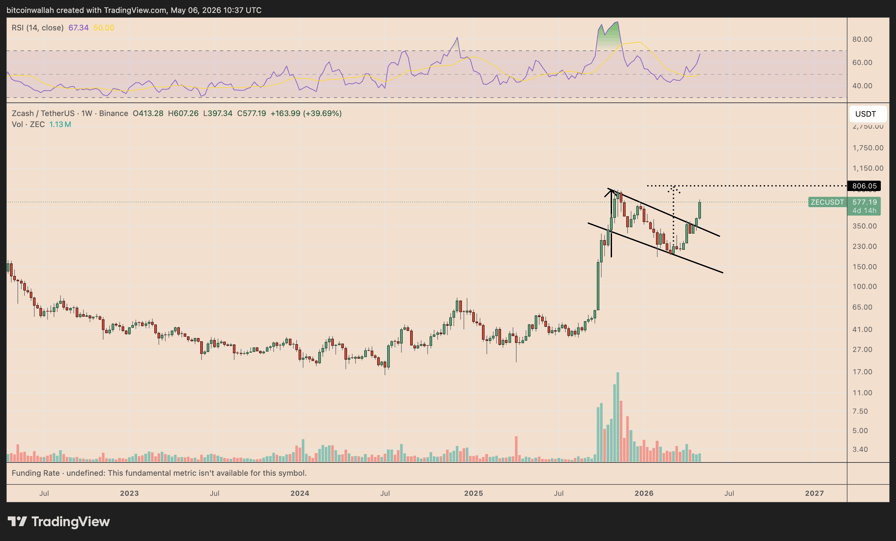
ZEC/USDT weekly chart. Source: TradingView
Applying that rule to ZEC’s chart puts its breakout target near $800. As of Wednesday, Zcash traded as high as $607, leaving the token on track to test the bull flag’s measured upside target located roughly 40% above.
Zcash’s weekly relative strength index (RSI), a momentum indicator that measures whether an asset is overbought or oversold, also suggests the rally may continue.
The RSI currently remains just below 70, a level traders typically associate with overheated market conditions, indicating ZEC may still have room to climb before buyers show signs of exhaustion.
BitMEX Co-Founder Arthur Hayes said ZEC’s target is 10% of Bitcoin’s market capitalization, a scenario that would imply a multi-trillion-dollar valuation for ZEC and prices potentially ranging between $8,000 and $10,000 per coin based on current supply levels.
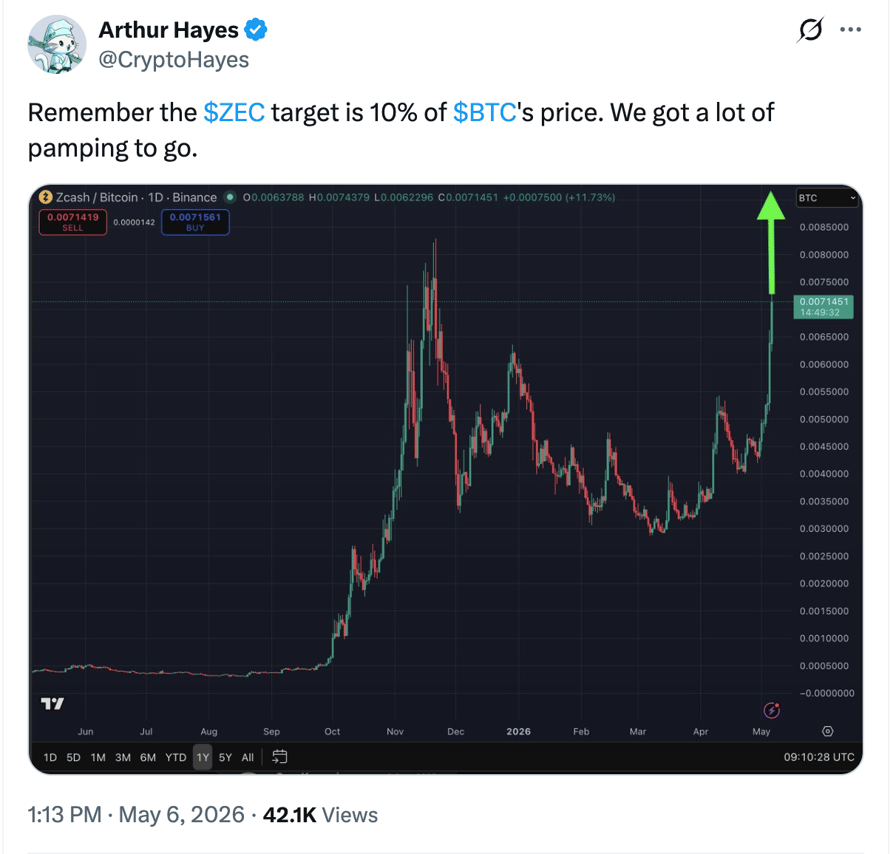
Source: X
Robinhood listing, tightening ZEC supply adds tailwinds
Zcash’s breakout also has fundamental support.
ZEC has rallied alongside the broader crypto market as US–Iran peace-deal hopes improve risk appetite, mirroring patterns in early April.
Its Robinhood listing on April 23 added another tailwind by opening spot access to 25.9 million funded users, including those in stricter jurisdictions like New York.
Meanwhile, more than 30% of circulating ZEC now sits in shielded addresses, according to data resource ZecHub.WIKI. This tightening supply shows a big jump in demand for private on-chain transactions over the past year.
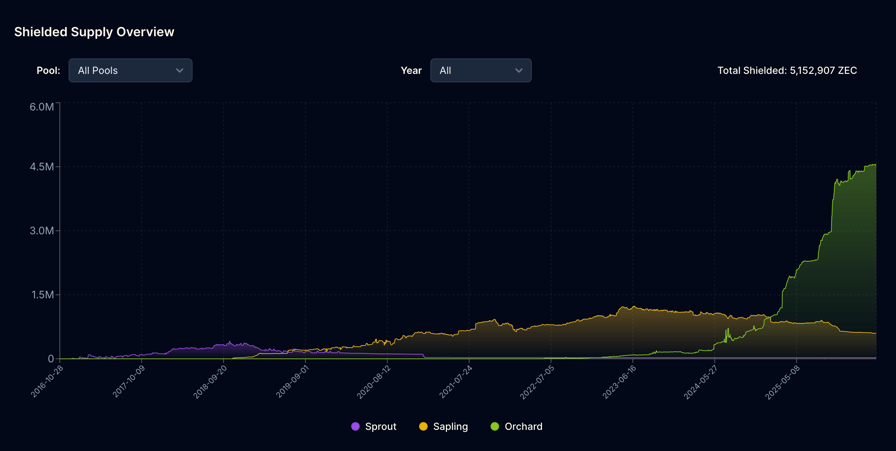
Zcash shielded supply weekly chart. Source: ZecHub.WIKI
Key takeaways:
- A sharp fifty percent drop in exchange activity and decentralized application revenue is stalling Ether price growth.
- Institutional investor interest in Ether remains under pressure as major holders like Bitmine face billions in unrealized losses.
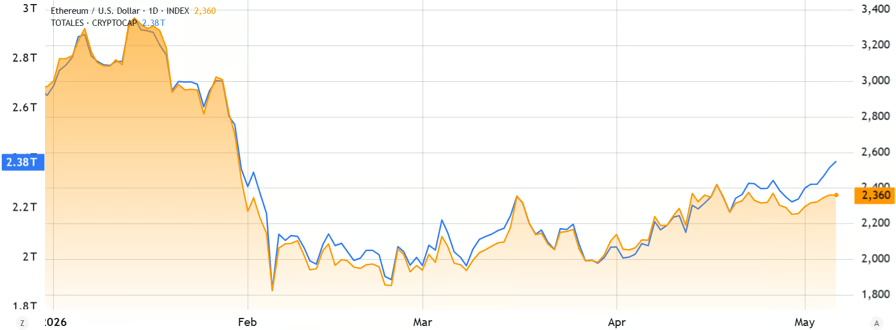
Ether (ETH) has failed to sustain levels above $2,400 for the past three months, consistently lagging behind most of its peers. Ether’s down 21% in 2026, and investors have expressed uncertainty about the altcoin’s inability to mirror the broader market recovery.
Total crypto market capitalization vs. ETH, USD. Source: TradingView
The total cryptocurrency market capitalization is down 11% year-to-date, suggesting specific headwinds for Ether remain in play. A decline in decentralized applications (DApps) activity partially explains this fading interest. Regardless of whether this trend has affected the industry as a whole, the shift negatively affects ETH price formation.
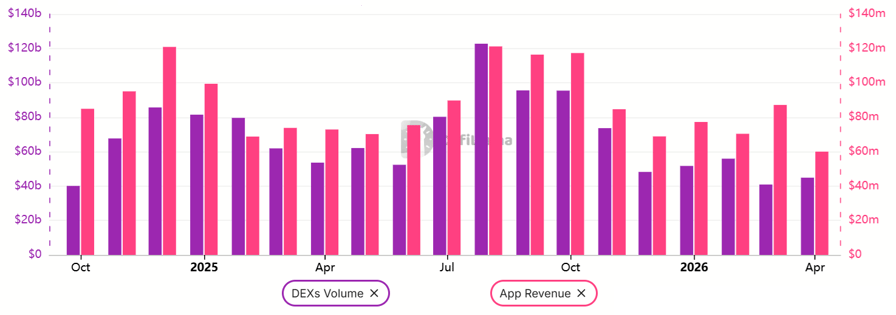
Ethereum DEX monthly volumes vs. DApps revenue, USD. Source: DefiLlama
Decentralized exchanges (DEX) volumes fell by 53% in six months, a sector largely responsible for Ethereum’s DApps activity. Consequently, these DApps experienced a 49% decline in revenue over the same period. While the sharp drop in memecoin prices and token launches contributed to reduced DEX appeal, other factors, including protocol hacks, also played a significant role.
Multiple hacks had a negative impact on DApp activity
The cryptocurrency industry suffered $630 million in hacks in April, with KelpDAO and Drift Protocol accounting for 82% of the losses. Blockchain security company Hacken attributed the attacks to actors linked to the Democratic People’s Republic of Korea (DPRK). Aggregate crypto industry DEX activity dropped by 47% in three months.
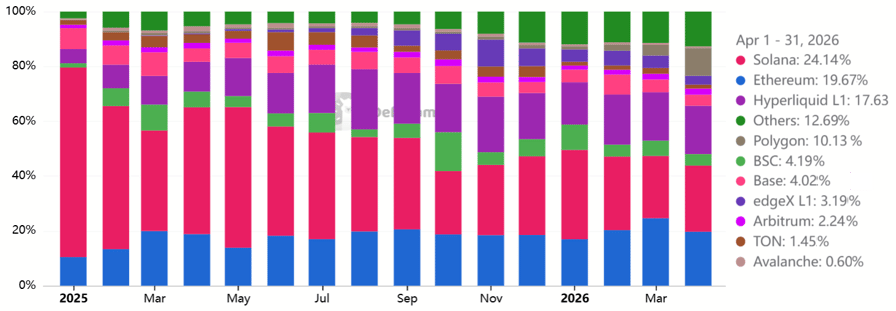
Blockchain DApps revenue market share. Source: DefiLlama
Some Ethereum competitors have opted for base layer scalability, providing less friction for regular users. While Ethereum remains the absolute leader in the aggregate ecosystem, including its layer-2 solutions, Solana and Hyperliquid account for a combined 42% market share in DApp revenue. Such data is even more impressive given that Ethereum’s total value locked is six times larger.
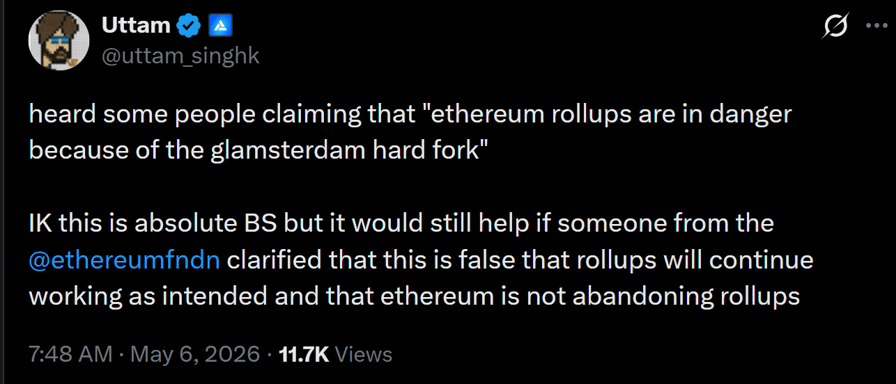
Source: X/uttam_singhk
Uttam Singh, engineer at Alchemy, noted that part of the market incorrectly judged that Ethereum’s upcoming glamstedam hard fork would put rollups “in danger.” The upcoming network upgrade should result in a threefold increase in base-layer capacity and allow clients to pre-fetch block data, thereby enabling parallel transaction execution.
Fierce blockchain competition, ETH whales underwater
Regardless of how straightforward Ethereum’s scaling plans are, most users and investors struggle to understand the need for layer-2 rollups once base-layer scalability reaches a certain threshold. There is also limited visibility on whether these changes will actually generate higher network fees, which ultimately act as a catalyst for higher staking yields.
Related: Ethereum backers pledge up to 30,000 ETH to rsETH recovery after bridge incident
Institutional investors’ perception of Ether has also been negatively impacted as Bitmine (BMNR US), the largest publicly listed holder of ETH, remains underwater in its corporate reserves. The company, led by chairman Tom Lee, spent $12.2 billion to acquire ETH, but its position is currently valued at $10.8 billion. While this does not pose an immediate sell-off risk, it reduces the asset’s institutional appeal.
None of these factors is an absolute impediment for Ether price to reach $2,800. However, declining onchain activity, fierce competition in the DApps industry, and reduced institutional appeal continue to contribute to its underperformance relative to the broader crypto market.


Samourai Wallet co-founder Keonne Rodriguez published a public appeal from FPC Morgantown federal prison, asking Bitcoin (BTC) holders to donate to a wallet address tied to his family’s mounting legal debt.
Rodriguez wrote on X (Twitter) that he and his wife Lauren owe more than $2 million in legal fees. They also face a $250,000 court-imposed fine after his guilty plea to operating an unlicensed money-transmitting business.
Pardon Prospects Have Faded
In his May 6 post, Rodriguez said he is five months into a 60-month sentence at the West Virginia camp. He surrendered to federal custody in December 2025.
He had previously been released on a $1 million bond before sentencing.
Hope for a presidential pardon stirred briefly during the Bitcoin 2026 conference but has since dimmed. President Trump had said in late 2025 he would consider a pardon.
Rodriguez now calls those prospects “very low.”
“I am simply a federal prisoner without money, power, or influence, and I will serve my full sentence,” he lamented.
Follow us on X to get the latest news as it happens
$2 Million in Debt and a Direct Bitcoin Address
The appeal directs donations to the address bc1qtjjcvn98wh7dfd55m8kxhjcfexanttwt8gtan8, with private alternatives available through his wife’s X (Twitter) account.
Rodriguez said lawyers and the U.S. Department of Justice are pressing for payment.
Federal prosecutors had alleged Samourai processed over $237 million in criminal proceeds, according to the original arrest announcement.
“A seizure warrant for Samourai’s mobile application was served on the Google Play Store. As a result, the application will no longer be available to be downloaded from the Google Play Store in the United States,” the officials wrote in their statement.
The wallet handled more than $2 billion across over 100,000 users since 2015. Rodriguez and co-founder William Lonergan Hill pleaded guilty in 2025 to conspiracy to operate an unlicensed money-transmitting business. Hill received a four-year sentence.
The two also forfeited approximately $6.37 million in earned fees as part of a larger money judgment.
The case continues to anchor debate over whether developers of non-custodial privacy software can face criminal liability for user activity.
The original code still circulates through the Ashigaru fork.
Subscribe to our YouTube channel to watch leaders and journalists provide expert insights
The post Samourai Wallet’s Co-Founder Appeals for Bitcoin Donations From Federal Prison appeared first on BeInCrypto.
Crypto World
BeInCrypto Institutional Research: 15 Onramp and Offramp Solutions Powering Crypto Access


Best Onramp and Offramp Solution is an award category within the BeInCrypto Institutional 100, an annual research-driven program recognizing institutional digital asset excellence across 26 categories and six pillars.
This category tracks the firms building payment rails, wallet integrations, banking APIs, and regulated settlement infrastructure that move money between fiat systems and crypto markets.
A shortlist will be named in May 2026, with the winner announced at Proof of Talk in Paris on June 2–3, 2026.
Key Facts
- Long list: 15 firms across consumer onramps, B2B infrastructure, aggregators, banking APIs, non-custodial systems, and TradFi payment processors with crypto rails
- Initial pool: More than 30 onramp and offramp providers screened; 15 advanced to the long list
- Scoring: 30% quantitative data · 50% Expert Council · 20% disclosed company data
- Criteria assessed: Country coverage, payment methods, regulatory compliance, UX integration, settlement speed, ecosystem integration, innovation
- Data sources: NYDFS, OCC, FCA, MiCA-CASP, FINMA, MAS, AUSTRAC, FINTRAC, audited filings, company disclosures, PitchBook, Tracxn, and Crunchbase
| # | Firm | Onramp/Offramp Sub-Segment | HQ | Reach | Top Licensure | Representative Work |
|---|---|---|---|---|---|---|
| 1 | MoonPay | Consumer onramp/offramp | Miami, USA | 30M+ accounts 180 countries |
NYDFS BitLicense + Trust Charter | Acquired Helio, Iron, and Meso in 2025 Reportedly explored ~$5B ICE-linked deal talks |
| 2 | Stripe Crypto Onramp | Enterprise onramp stack | South San Francisco, USA | 75M+ Privy accounts 1,000+ developer teams |
Bridge OCC charter conditionally approved | Bridge trust charter approved Feb 2026 Expanded crypto stack through Bridge and Privy |
| 3 | Coinbase Onramp | Exchange-backed B2B onramp | Wilmington / SF, USA | 110M+ users 60+ fiat currencies |
NYDFS BitLicense + US MTLs | Headless Apple Pay API launched Zero-fee USDC onramp on Base |
| 4 | Transak | Consumer onramp + wire rails | Miami, USA | 10M+ users 150+ countries |
Expanding US MTL coverage | Enabled wire-transfer onramps in the US Integrated MiCA-compliant USDG stablecoin |
| 5 | Ramp Network | EU-regulated onramp/offramp | London / Dublin | 150+ countries | MiCAR-CASP via Central Bank of Ireland | Became fully operational under MiCA in Jan 2026 EU passporting structure now active |
| 6 | Alchemy Pay | APAC + global onramp | Singapore | 173 countries 300+ payment methods |
HK SFC, UK API, FINTRAC, US MTLs | Hong Kong licence expanded to virtual assets Alchemy Chain testnet launched in 2026 |
| 7 | Zerohash | US-regulated B2B infrastructure | Chicago / Amsterdam | 5M+ users 190 countries |
NYDFS BitLicense + MiCA access | Filed for OCC national trust bank charter Rejected reported $2B Mastercard offer |
| 8 | Nuvei (Simplex) | Card onramp stack | Tel Aviv / Montreal | 200+ markets 680+ payment methods |
MiCA CASP | Completed take-private transaction in 2025 Integrated Wero wallet and Azure partnership |
| 9 | Mercuryo | Card onramp/offramp | Tallinn / London | 4M+ users 200+ assets |
Estonian VASP | Added BitMEX onramp integration Expanded Mastercard crypto card partnership |
| 10 | Onramper | Onramp aggregator | Amsterdam | 30+ integrated onramps 190+ countries |
Partner-license model | Expanded crypto trading in Brazil, Mexico, and Chile Launched MUSD stablecoin in Brazil |
| 11 | OSL Group (Banxa) | APAC regulated access | Hong Kong | 40+ licences globally | HK SFC + AUSTRAC + FINTRAC | Completed Banxa take-private in Jan 2026 Launched USDGO stablecoin and StableHub |
| 12 | Wert | NFT/ERC20 onramp specialist | Tallinn / Oakland | 200+ countries | Estonian VASP | Embedded NFT checkout with gas included ERC20 onramp without exchange listing |
| 13 | Striga | Banking-grade API stack | Tallinn, Estonia | 30+ countries | Estonian VASP | Combined vIBAN, custody, and cards in one API Integrated Lightning settlement support |
| 14 | Mt Pelerin | Swiss non-custodial onramp | Geneva / Neuchâtel | 150K+ users $1B+ volume |
FINMA regulated + SO-FIT | Built non-custodial DeFi bridge infrastructure MPS asset token registered in Switzerland |
| 15 | Mercado Pago | LatAm super-app access | Buenos Aires | 50M+ Mercado Pago users | Paxos + Ripio partnerships | Filed for OCC national trust bank charter Rejected the reported $2B Mastercard offer |
About This List
The BeInCrypto Institutional 100: Fiat-to-Crypto Access (2026 Long List) identifies the firms building regulated infrastructure for moving money between traditional payment systems and digital assets.
The category includes consumer-facing onramps, B2B settlement infrastructure, regional payment specialists, aggregators, and banking-grade APIs integrated into wallets, exchanges, fintech apps, and dApps.
Stablecoin orchestration platforms without a direct fiat onramp or offramp surface are evaluated separately under stablecoin infrastructure categories.
Methodology
This category is evaluated under Track B of the BeInCrypto Institutional 100 methodology: 30% quantitative metrics, 50% Expert Council scoring, and 20% disclosed data.
Assessment spans seven criteria: country coverage, payment method diversity, regulatory compliance, UX integration, settlement speed, wallet and dApp ecosystem integration, and innovation.
Data was verified using regulatory registers, audited filings, company disclosures, partnership announcements, and private-market sources, including PitchBook, Tracxn, and Crunchbase.
To submit a nomination or share feedback, contact awards@beincrypto.com
The post BeInCrypto Institutional Research: 15 Onramp and Offramp Solutions Powering Crypto Access appeared first on BeInCrypto.

One of the world’s largest wealth management firms, Morgan Stanley, is all set to introduce cryptocurrency trading on its E*Trade platform, which it acquired for $13 billion six years ago.
It aims to compete on lower costs.
Morgan Stanley Joins Crypto Trading Space
The bank plans to charge 50 basis points per transaction based on dollar value, as it positions itself below rivals such as Coinbase and Robinhood. The rate is also below the 75 basis points charged by Charles Schwab, which rolled out spot Bitcoin and Ethereum trading earlier in April.
Morgan Stanley’s latest service is currently in a pilot phase and is expected to be rolled out to all 8.6 million E*Trade clients later this year, according to the latest report by Bloomberg. At launch, clients will be able to trade Bitcoin, Ether, and Solana. The banking giant had previously tapped Zerohash, an infrastructure provider for digital assets, for the initiative back in September 2025.
The latest development comes almost a month after Morgan Stanley’s much-anticipated spot Bitcoin ETF, under the ticker MSBT, went live on NYSE Arca. The fund debuted with a 0.14% fee, lower than competing products. Data compiled by SoSoValue revealed that MSBT’s cumulative net inflow stood at over $181 million as of May 5th.
Stablecoin Reserve Fund
More recently, Morgan Stanley launched the Stablecoin Reserves Portfolio (MSNXX) in New York to target stablecoin issuers seeking compliant reserve solutions. The fund is part of its Institutional Liquidity Funds Trust and is structured as a government money market fund in line with reserve standards set by the GENIUS Act.
It is designed to help issuers manage assets backing their tokens while maintaining liquidity and capital stability. The main objective of the portfolio is to keep a $1 net asset value and generate income by investing only in cash, US Treasury bills, notes, and overnight repurchase agreements.
Co-Head of Global Liquidity Fred McMullen had said that the offering responds to growing demand as stablecoin issuance expands. Meanwhile, Amy Oldenburg had added that the initiative supports efforts to modernize financial infrastructure and improve institutional access to digital asset markets.
The post Wall Street Giant Morgan Stanley Enters Crypto Race With Pricing Edge: Report appeared first on CryptoPotato.
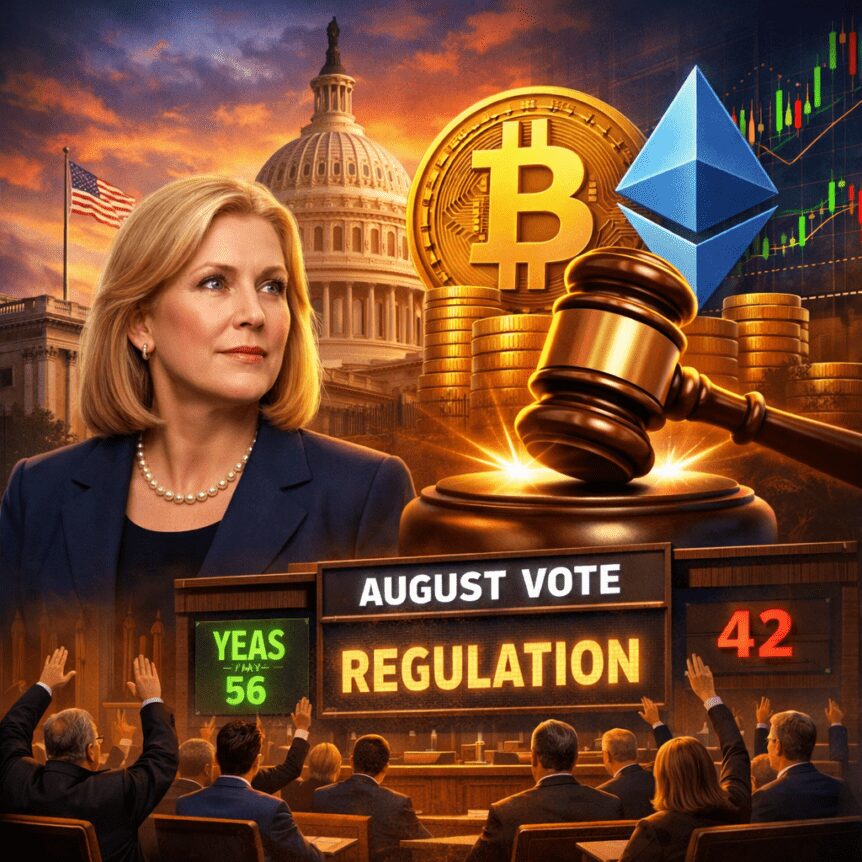
US Senator Kirsten Gillibrand indicated at the Consensus conference in Miami that the fate of the digital asset market structure bill hinges on lawmakers meeting three practical conditions before the Senate can consider a vote. Speaking on the record, she identified consumer protection, illicit finance controls, and ethics provisions as essential elements that must be addressed prior to any action on the CLARITY Act. She suggested that if Congress can merge the market structure framework with the version already advanced by the Senate Agriculture Committee and attach robust ethics language, a vote could occur before the August recess that begins on August 10.
“There will be no one voting for this bill if we don’t have an ethics provision,” Gillibrand said, underscoring that integrity standards are non-negotiable in a landscape where public officials’ involvement in the industry could raise conflicts of interest. “Because the truth is, we cannot allow members of Congress, senior administration officials, presidents or vice presidents, to get rich off of these industries because of their insider status. It is the worst form of pay for play.”
While Gillibrand did not name specific individuals, the remarks come amid renewed scrutiny of ties between public figures and crypto ventures. The broader political debate surrounds the CLARITY Act as lawmakers weigh how to regulate a fast-evolving sector, including stablecoins, DeFi platforms, and tokenized equities, within a cohesive federal framework.
Beyond the ethics question, the evolving policy conversation has touched the linkage between regulatory risk and industry structure. Last week, senators on the Senate Banking Committee announced a deal on stablecoin yield issues that could help move the market structure legislation forward, although the agreement did not address language on potential conflicts of interest among public officials. The development signals that it is possible to find bipartisan consensus on certain technical elements while leaving other concerns to future negotiations.
In the broader policy discourse, industry voices have pressed for timely progress. Ripple CEO Brad Garlinghouse pointed to a narrow window for legislators to address the bill before it becomes entangled in electoral-year dynamics, a sentiment echoed by other executives who argue that delay raises uncertainty for infrastructure planning, product launches, and institutional compliance programs.
From the regulatory side, former Commodity Futures Trading Commission commissioner and Blockchain Association chief executive Summer Mersinger described the current moment as a critical juncture—the window to act could open briefly, and if missed, there is no guarantee it will reappear in the same form. Her remarks highlighted the practical implication for compliance teams and legal professionals who must map to evolving standards and potential licensing regimes.
Key takeaways
- The CLARITY Act’s path to a Senate vote depends on three conditions: consumer protection, illicit finance safeguards, and ethics provisions.
- Lawmakers aim to merge the market structure bill with the Agriculture Committee version and attach ethics language, with possible action before the August recess.
- Ethics provisions are framed as essential to prevent conflicts of interest and pay-for-play risks in crypto policymaking.
- Recent discussions on stablecoin yield could facilitate movement on the bill, though work remains on public official conflicts language.
- Industry voices view the timing as delicate: act now to avoid entrenchment during the midterm cycle and potential political headwinds.
Legislative status and the regulatory backdrop
The market structure bill, which seeks to establish a comprehensive federal framework for digital assets, has become a focal point of regulatory policy debates in Washington. As of the week described, the Senate Banking Committee had not yet rescheduled a markup after postponing it earlier in the year. The postponement followed public criticism from some industry participants who argued that the bill, in its current form, may unduly constrain innovation in areas such as decentralized finance, stablecoins, and tokenized equities.
Coinciding with legislative momentum, industry leaders have stressed the need for precise and enforceable rules that align with existing financial oversight while safeguarding innovation. The stance from Coinbase’s leadership earlier this year, which signaled reservations about certain provisions, illustrates the sensitivity around DeFi and crypto token classifications. In this context, the ethics language Gillibrand emphasized would address concerns about potential corruption risks in the legislative process and strengthen the bill’s legitimacy from a governance perspective.
On the regulatory horizon, the interplay with cross-border and domestic regimes remains a strategic consideration. In the European Union, MiCA represents a parallel trend toward centralized regulatory clarity for crypto assets and stablecoins, influencing how U.S. policymakers think about licensing, supervision, and market integrity. Although the CLARITY Act is a U.S.-centric initiative, its design and potential impact will be evaluated against international practice, especially in areas related to consumer protection, AML/KYC requirements, and orderly markets.
In public commentary, industry participants have flagged specific policy areas requiring careful calibration. Regulatory and enforcement considerations—ranging from disclosures and fiduciary duties to anti-money laundering controls and executive ethics requirements—shape what compliance teams must prepare for. The need for robust governance language is underscored by discussions about conflicts of interest and the integrity of public decision-making when it touches crypto markets.
Timing, signals, and practical implications for institutions
Timely action on the market structure bill matters for exchanges, banks, and institutional investors that seek clear, predictable rules for custody, settlement, and product structuring. A stable policy framework can reduce the risk of ad hoc enforcement actions and provide a stable basis for licensing, risk management, and operational compliance. The recent stablecoin yield discussions—though not sealing language on conflicts of interest—underscore efforts to resolve key technical issues that affect product design, liquidity management, and capital treatment for regulated entities interacting with crypto assets.
From a market perspective, traders and risk managers have tracked predictions about the bill’s prospects. Prediction-market platforms reflect divergent expectations: one platform assigns a higher probability to passage by year-end, while another assigns a more immediate likelihood of action within the August window. These signals influence how institutions calibrate internal roadmaps for product launches, governance reviews, and regulatory reporting.
Industry advocates argue that progress on the CLARITY Act could harmonize U.S. oversight with evolving international standards, reducing fragmentation across markets and jurisdictions. The emphasis on consumer protection, illicit finance controls, and ethics aligns with a growing consensus that credible crypto regulation must balance innovation with oversight, a balance that institutions require to manage risk, ensure compliance, and preserve customer trust.
Enforcement, compliance, and policy implications
Legal and compliance teams should monitor the potential alignment between the CLARITY Act and broader enforcement priorities. The proposed ethics provisions would likely shape internal governance policies, whistleblower channels, and disclosures related to political contributions, corporate sponsorships, and senior leadership ties to the industry. For banks and regulated intermediaries, the framework could inform licensing expectations, disclosure regimes, and risk-based AML/KYC programs tailored to crypto assets.
lawmakers are also weighing how to articulate standards for consumer protection—ranging from product disclosures to protections against misrepresentation and fraudulent schemes. The delicate balance between enabling new financial products and safeguarding consumers will influence how firms structure disclosures, marketing materials, and relationship-based risk controls. The discussion also intersects with anti-money laundering and countering the financing of terrorism regimes, where clarity in definitions, reporting obligations, and enforcement mechanisms matters for integration with existing financial compliance ecosystems.
On the enforcement front, the CLARITY Act would potentially interact with actions by the SEC, the CFTC, and the DOJ as agencies delineate jurisdictional boundaries and supervisory expectations. Institutions would need to map regulatory requirements across agencies, ensuring that liquidity management, custody, and trading activities align with the evolving standard for crypto assets and digital securities. The outcome could also influence cross-border operations, especially for firms with global exposures and interconnected stablecoin initiatives.
Closing perspective
As policymakers continue to refine the bill, the central questions revolve around how to reconcile innovation, investor protection, and governance integrity within a coherent legal framework. The window for consensus appears to be narrowing as the August recess approaches and midterm dynamics intensify. Observers should watch for developments on the ethical governance provisions, the final alignment of the House and Senate market structure texts, and any forthcoming language on conflicts of interest that could determine whether the CLARITY Act advances in its current form. In practice, the outcome will influence not only regulatory clarity for crypto markets but also the risk and compliance posture of a broad set of financial institutions engaging with digital assets.

Understanding This Will Change Your Financial Future

BBC Dr Punam says ‘tiredness’ could be sign of ‘something sinister’

Wells Fargo Advisors Adds to String of New Recruits With $1.6 Billion UBS Team

Manchester United reach agreement with Casemiro over contract clause amid transfer speculation

US brings back mandatory military draft registration

Steven Gerrard disagrees with Gary Neville over ‘shock’ Chelsea and Arsenal claim | Football


-

 NewsBeat3 days ago
Channel 5 – All Creatures Great and Small series 7 new post
-

 Entertainment7 days ago
Insider Claims Reason Behind Key & Peele Split
-
 Tech5 days ago
Trump’s 25% EU auto tariff breaches Turnberry Agreement that also covers semiconductors and digital trade
-
 Sports5 days ago
Paul Scholes issues Marcus Rashford reality check as agreement emerges over Man United star
-

 Entertainment5 days ago
Met Gala 2026 Rumored Guest List Is Turning Heads
-

 Business6 days ago
Strait of Hormuz Blockade Persists Amid US-Iran Standoff, Sending Oil Prices Soaring
-
Entertainment5 days ago
New on Prime Video in May 2026 — Full List of Movies and Shows
-

 Entertainment7 days ago
Celebrities Who Are Attending the 2026 Met Gala Event
-

 Sports5 days ago
Cavaliers vs. Raptors Game 6 live score, updates, highlights from 2026 NBA playoffs first-round series
-
 Sports5 days ago
David Benavidez responds to team Canelo saying the fight will never happen
-

 Entertainment5 days ago
Kylie Jenner Hit With Second Lawsuit From Ex-Housekeeper
-
 Sports5 days ago
IPL 2026: ‘Love you darling’- Hardik Pandya’s reaction to MS Dhoni steals the show |Watch | Cricket News
-

 Entertainment5 days ago
Young and the Restless Next Week: Cane Arrested & Matt’s Deadly New Scheme!
-

 Tech7 days ago
Mark Zuckerberg Says Meta Is Working On AI Agents For Personal And Business Use
-

 Sports7 days ago
Saudi Arabia set to withdraw LIV Golf funding after 2026 season, per reports
-

 Tech6 days ago
Meta ends Sama contract after Kenyan workers report seeing intimate footage from Ray-Ban smart glasses users
-

 Sports7 days ago
Stalemate in Madrid as resilient Arsenal Blunt Atletico Madrid in semi-final clash – Sports
-

 Sports5 days ago
Plane crash in Wimberley, Texas kills 5 pickleball players at tournament
-
Entertainment4 days ago
New Netflix Movies in May 2026 — My Top 3 Picks to Stream
-
 Sports7 days ago
Manchester United 2025/26 squad review – keep, sell, loan, release
You must be logged in to post a comment Login