

Crypto World
Spot Bitcoin ETFs solved access, but custody, advisors and plumbing still lag, panelists say

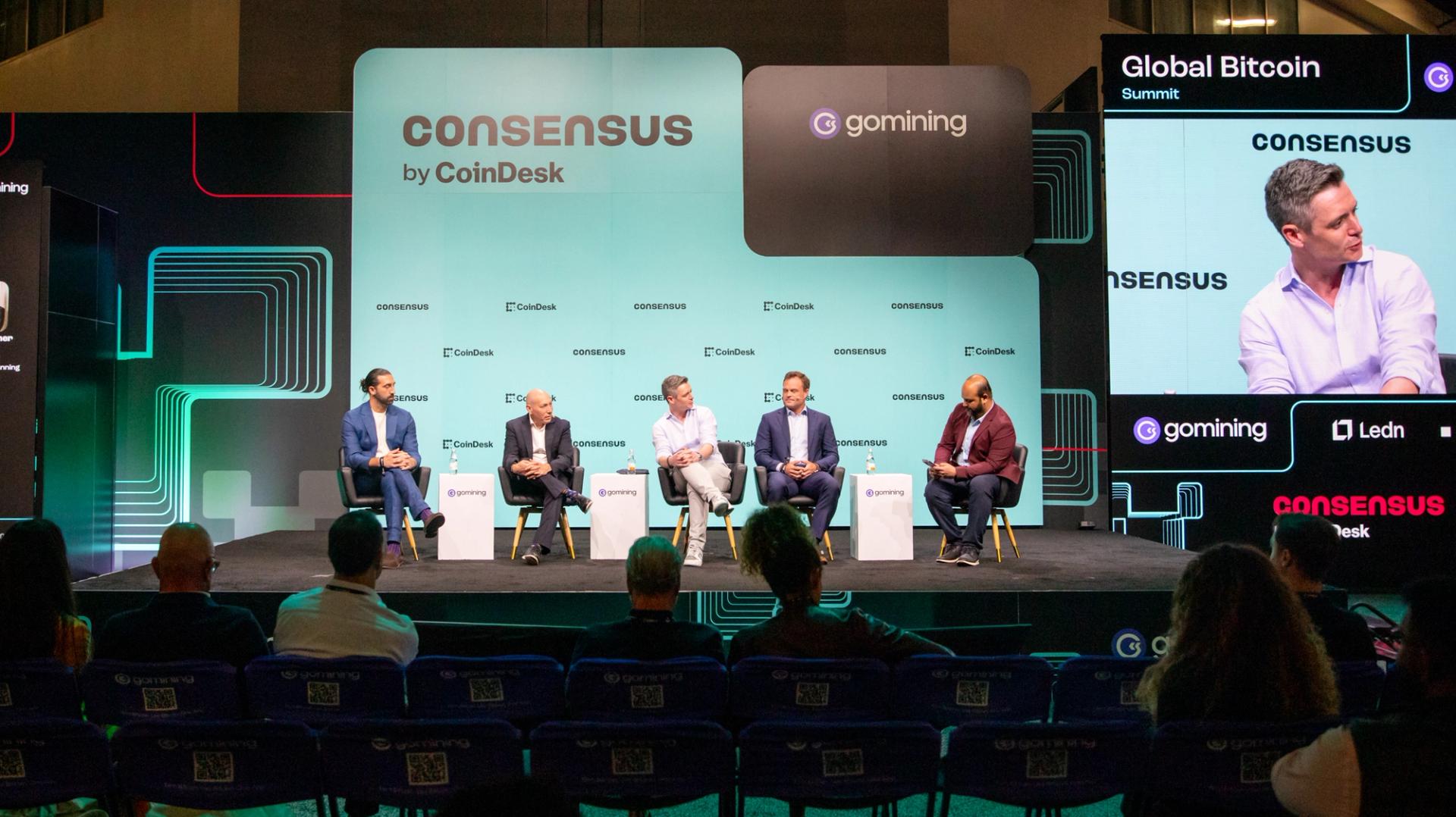
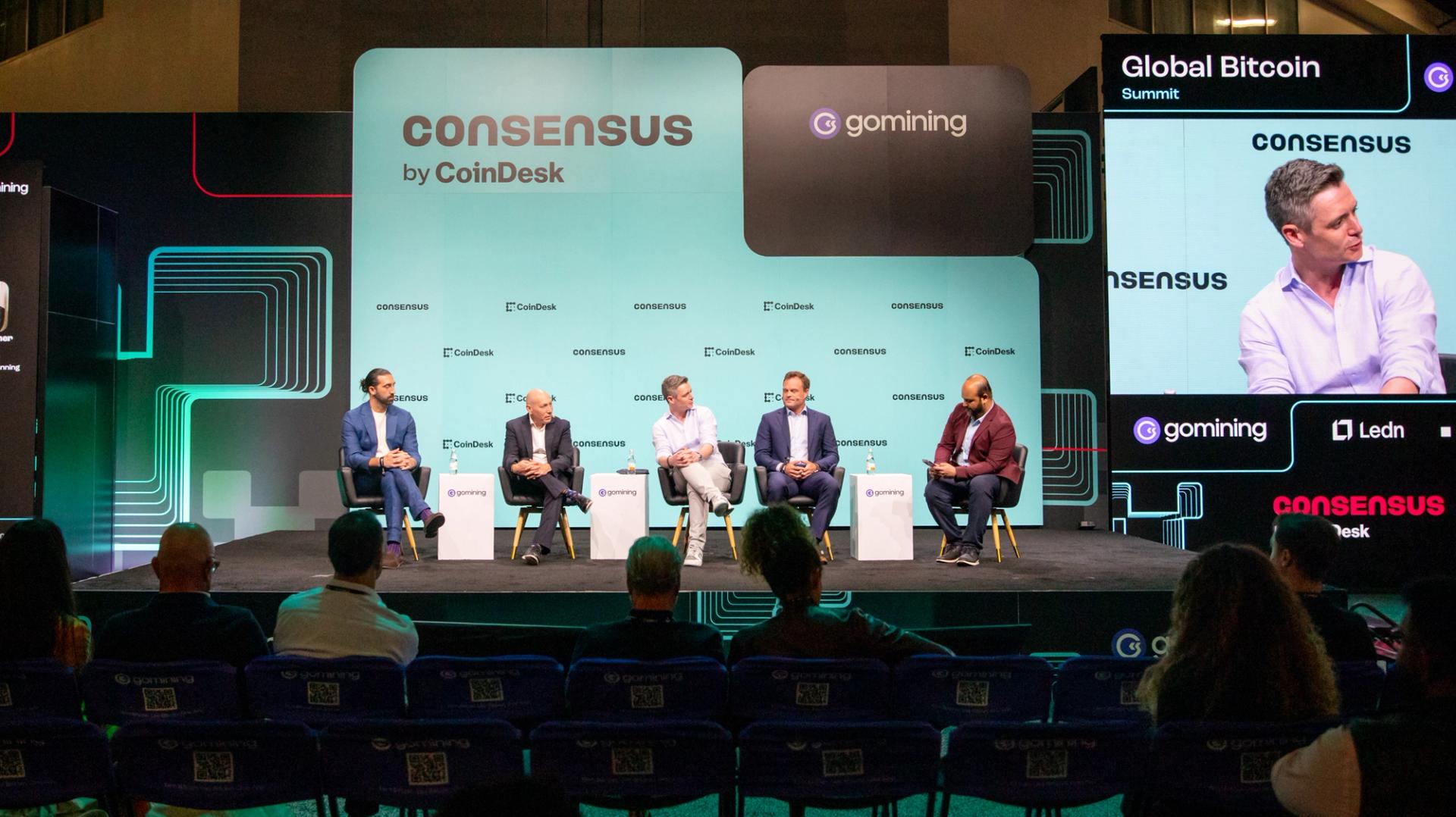
Spot bitcoin ETFs cleared crypto’s long-standing access hurdle by placing bitcoin inside brokerage and advisor accounts already used for stocks and bonds. Two and a half years in, panelists at CoinDesk’s Consensus Miami conference agreed that part had worked. However, they said custody concentration, modest advisor uptake and back-office plumbing all remain unresolved.
Christopher Russell, head of strategic planning and analysis at Calamos Investments, framed the access win in numbers. “The ETF solved one big problem, which was access,” he said. The roughly dozen US spot bitcoin ETFs now hold around $107 billion in combined assets, with about $20 billion in institutional hedge funds, $12.5 billion allocated by registered investment advisors, and 60% sitting in direct retail accounts.
Out of $146 trillion in advisor-managed AUM, that $12.5 billion advisor allocation “seems like a big number, but it’s a really small number,” Russell said. He pointed to what he called the 1% problem: “They can take a 1% position in a 50-60 vol asset, but they don’t want to spend 50% of their client meetings explaining why a 1% position went down 50%.”
Jean-Marie Mognetti, CEO and co-founder of CoinShares, pressed on the structural side. “Right now they are all using one custodian, which is Coinbase, creating a massive concentration risk in the market,” he said. “From a protection and diversification point of view, it’s a zero. If you were in any hedge fund, you would want to get a number of prime brokers to diversify your risk.”
Mognetti’s warning lands in a market that is no longer uniformly single-custodian, but where Coinbase remains a central piece of ETF infrastructure. Fidelity’s FBTC uses Fidelity Digital Assets, VanEck’s HODL launched with Gemini and later added Coinbase, BlackRock’s IBIT added Anchorage Digital Bank alongside Coinbase, and Morgan Stanley’s proposed bitcoin ETF names Coinbase Custody and BNY as bitcoin custodians.
Aaron Dimitri, general counsel for digital assets at Flow Traders, said ETFs have shifted bitcoin from pure buy-and-hold exposure into broader portfolio construction. “You’re not just buying and holding an asset, hoping it appreciates over time,” he said. “You’re able to build in yield products, different structured vehicles.” For institutions, Dimitri said, ETFs do not remove bitcoin’s volatility, but they make the exposure easier to package and manage. “If you’re going to go on a roller coaster, you might as well make sure that the lap belt locks down before the ride takes off,” he said.
Simeon Hyman, global investment strategist at ProShares, pushed back on treating volatility as a problem to be engineered away. “Volatility is a feature, not a bug,” he said, citing bitcoin and ether both up 20% since the start of the war in Iran. If an asset is volatile but not closely correlated with stocks and bonds, “you sprinkle a little in and you’re going to improve Sharpe ratio efficiency,” Hyman said. “But you got to be ready to tell the story.” He also argued that futures-based products retain a role: ProShares’ BITO, launched in October 2021, holds about $2 billion in assets but still trades at 35% of the daily volume of BlackRock’s IBIT, the dominant spot product.
The discussion lands against an unsettled demand backdrop. Strategy, the largest corporate Bitcoin holder with 818,334 BTC, reported a roughly $12.5 billion Q1 net loss this week. CoinDesk reported that the company signaled it could sell some bitcoin to help meet dividend obligations. Strategy’s accumulation has been widely viewed as one of the structural demand pillars of the post-ETF era.
Asked for a five-year price target, Russell predicted Bitcoin reaches $1 million within five years, “but it’s not going to be a straight line.”


A Canadian teenager has admitted to a conspiracy to launder money tied to a multimillion-dollar cryptocurrency theft carried out through social-engineering ploys that purported to be trusted firms. Prosecutors say Trenton Richard Johnston, who turned 20 this year, and his co-conspirators impersonated Google, Trezor and other crypto industry figures to access victims’ digital wallets, culminating in a more than $13 million drain. The scheme funded a high-end lifestyle in Miami and Los Angeles, including luxury cars, jewelry, and private-jet travel. Johnston had been charged in May 2024 and, this week, pleaded guilty to money-laundering conspiracy as part of a plea agreement that prosecutors say could yield a prison term in the mid‑range of four to five years.
According to the U.S. Attorney’s Office for the Southern District of Florida, the operation began in January 2024. In February, Johnston allegedly convinced a victim that his Google email and Coinbase accounts had been compromised, enabling the theft of roughly $41,000 in Ether. Less than a month later, the group posed as Google and Trezor representatives to trick a California resident into believing someone was attempting to access their cryptocurrency wallet, resulting in the loss of about $13 million in Bitcoin.
About $1.2 million of the stolen funds were used to finance a lavish lifestyle in Miami and Los Angeles over a two‑month span, prosecutors say. The group leveraged an exotic-car rental business, with Johnston and accomplice Brandon Tardibone—a car‑rental company owner—acquiring and leasing luxury vehicles, including two BMWs and a Lamborghini Aventador SVJ. The spending also extended to private jet arrangements, a North Miami rental home, and plane tickets for “two girls from New York.”
Johnston’s run of alleged fraud ended in March when a traffic stop for speeding in a Rolls‑Royce led to the discovery of 21 suspected amphetamine tablets in his possession. Investigators seized his computer, cellphone, and handwritten notes, linking him to the broader scheme. Since then, Johnston has turned over approximately 53.16 Bitcoin and 275.23 Ether, valued at about $3.7 million at current prices. In exchange for a full cooperation, prosecutors have recommended a sentence of 51 to 63 months in prison and dismissal of wire‑fraud charges. Tardibone, the car‑rental partner, faces a recommended sentence of 27 to 33 months.
Key takeaways
- Social engineering remains a dominant vector for crypto theft, with attackers targeting trust and human error rather than relying solely on software exploits.
- The case emphasizes how quickly crypto transfers can be executed and how difficult it can be to reverse a loss once funds leave a compromised account.
- Prosecutors highlight a pattern where a portion of stolen funds are spent on conspicuous consumption, underscoring the “lifestyle” incentives behind many frauds.
- The defendants face prison time under a plea deal, illustrating U.S. law enforcement’s ongoing pivot from post‑crime investigation to prevention and pre‑transaction security measures.
- The broader crackdown on crypto scams continues, with recent high‑profile sentences signaling a tighter torque on perpetrators, including cases in California and other jurisdictions.
How the scheme unfolded and what changed for victims
The Florida case traces a sequence of social‑engineering moves designed to lull victims into a false sense of security. In the February incident, a victim was persuaded that his Google email and Coinbase accounts had been compromised, enabling the attackers to siphon Ether worth about $41,000. Within weeks, the operation escalated, with Johnston and collaborators posing as Google and Trezor representatives in an attempt to dupe a California resident into believing someone was trying to access their cryptocurrency wallet. The result was a theft of roughly $13 million in Bitcoin, illustrating how the combination of misrepresentation and rapid, irreversible blockchain transfers can produce outsized losses in moments.
The financial footprint extended far beyond the wallet drain. Prosecutors say about $1.2 million of the stolen crypto was diverted to fund a glamorous two‑month Miami‑Los Angeles lifestyle, including rental of luxury cars and other upscale expenditures. The involvement of an exotic‑car rental operator—Brandon Tardibone—helped sustain the shopping spree, with Johnston described as the principal beneficiary of the proceeds. The case highlights how proceeds from fraud can be laundered through real‑world assets and services that are quick to monetize and difficult to reclaim once spent.
Law enforcement efforts culminated in Johnston’s March arrest after a traffic stop in a Rolls‑Royce revealed further incriminating materials, including handwritten notes and electronic devices. Investigators recovered a record of the scheme and the links between the illicit cryptocurrency movements and the lifestyle purchases, reinforcing prosecutors’ assertions that the case was less about complex code exploits and more about human manipulation in a fast, high‑stakes environment.
From a restitution and asset‑recovery standpoint, the defendant has already turned over a substantial portion of the stolen assets: 53.16 BTC and 275.23 ETH, collectively valued at about $3.7 million at today’s prices. The plea agreement contemplates a sentence that would dismiss wire‑fraud charges, conditional on continued cooperation, and would place Johnston in a prison range of roughly five years.
A broader pattern: enforcement momentum in crypto crime
The Johnston case sits within a wider pattern of aggressive enforcement against crypto‑related fraud. In April, a California resident received a 70‑month sentence for involvement in a criminal enterprise that purportedly stole $263 million in cryptocurrency through social engineering and burglary, with another defendant—Evan Tangeman, 22—pleading guilty to laundering at least $3.5 million of illicit funds. In February, a Chinese national was sentenced to 20 years in a federal prison for a global crypto scam that allegedly defrauded investors of more than $73 million.
Analysts emphasize that technology alone cannot shield users from this category of crime. Deddy Lavid, CEO and co‑founder of Cyvers, told Cointelegraph that the most significant thefts today often hinge on genuine human interaction rather than pure software flaws. “Crypto makes this especially dangerous because transactions are fast and largely irreversible,” Lavid said. “The attacker only needs to win the victim’s trust once, for a few minutes, and the loss can be permanent.”
Experts argue that the industry must evolve beyond awareness and education. They advocate real‑time, pre‑transaction security controls across wallets, exchanges, custodians, and banking partners to detect suspicious behavior, risky destination wallets, and laundering patterns before funds leave an account. The shift, they say, should move toward preventing fraud before execution rather than solely responding after a theft has occurred.
Related reading: authorities crack down on crypto fraud networks and enforcement actions continue to expand beyond U.S. borders.
As the legal process unfolds for Johnston and his co‑conspirators, readers should monitor the formal sentencing schedule and any additional charges or asset‑recovery actions that may emerge. The emphasis from regulators and prosecutors on prevention—alongside punishment—signals a broader trend that could shape how projects, exchanges, and wallets approach security in the coming months.

Consensys CEO Joseph Lubin dropped a structural catalyst that could reframe Ethereum entire valuation and price thesis for the next several years.
In a recent interview, Lubin believes that Ethereum could become a fully zero-knowledge proof-based protocol within 3 to 5 years. It is big for ETH holders with a full cryptographic overhaul of the base layer. Lubin specifically backed initiatives such as “Lean Ethereum,” an EF researcher’s long-term proposal targeting 10,000 TPS, 100% uptime, and EVM 2.0 via ZK cryptography.
The shift, Lubin says, would hugely improve composability between the Ethereum mainnet and its Layer 2 ecosystem. This comes as ETH sentiment indicators have been flashing potential bottom signals, adding weight to the bull case.
The backdrop is unambiguously constructive as ETF inflows accelerate, staking yields rise, and multiple analysts now openly target $7,500 ETH by year-end, with cycle peaks potentially at $20,000.
Discover: The Best Crypto to Diversify Your Portfolio
Can Ethereum Price Hit $10,000 This Cycle?
ETH’s technical structure is quietly compelling. BTCC analyst Emma describes a four-year accumulation base, with price currently holding above the critical $1,500 support level and no clear topping pattern in sight.
The MACD has printed a bullish crossover with a positive histogram, building upward momentum, not decelerating. Bollinger Band compression with price near the lower band at $1,550 signals that a volatility expansion is coming.
Near-term resistance sits at $1,800, with the broader band top and next meaningful clearing zone at $2,000. A decisive close above the $1,800 range is widely cited as the trigger for a larger trend move.

If ETH clears $2,000, Lubin’s narrative could attract institutional re-rating, and the price could then re-target $3,000 by year-end. For now, we would likely see consolidation under the $2,000 before a breakout attempt in Q3.
Analyst Sykodelic projects a minimum target of $10,000, citing a five-year high-timeframe base and “large breakout potential.” Bitwise’s Matt Hougan sees ETH potentially doubling from $4,000 to above $10,000 by 2030 if the scaling and stablecoin theses play out.
Arthur Hayes and analyst Alejandro₿TC both reiterate $10,000 as a realistic destination after corrective dips. The price targets are converging, but Ethereum at $1,650 still needs to clear a lot of technical real estate to get there.
Discover: The Best Token Presales
Bitcoin Hyper Targets Early-Mover Upside as Ethereum Tests Key Levels
ETH at its current level offers real upside, but that path to $10,000 is measured in years, not weeks.
Traders watching the ZK infrastructure narrative and thinking about asymmetric exposure are increasingly looking at earlier-stage plays where the runway is steeper, and the entry price hasn’t already been discovered by institutions. That’s precisely the gap Bitcoin Hyper ($HYPER) occupies right now.
Bitcoin Hyper is positioning itself as the first-ever Bitcoin Layer 2 with Solana Virtual Machine (SVM) integration, bringing fast, scalable smart contracts to the Bitcoin ecosystem while preserving Bitcoin’s core security model.
It’s the same infrastructure narrative powering Lubin’s ZK thesis that applies here: breaking through slow transactions, high fees, and limited programmability at the base layer.
The presale has already raised more than $32 million at a current price of $0.0136 per $HYPER, with staking live and delivering high APY for early participants. Key features include sub-second Layer 2 finality, a Decentralized Canonical Bridge for native BTC transfers, and SVM-based smart contract execution at speeds that rival, and reportedly exceed Solana.
Research Bitcoin Hyper at the official presale page before the next price tier moves.
The post Ethereum Price Could Finally Fly to $10,000: Lubin Says ETH Going ZK-Proof in 3 Years appeared first on Cryptonews.


Digital Asset Holdings has raised $355 million in a new round led by Andreessen Horowitz’s crypto arm, highlighting Wall Street’s accelerating push into permissioned blockchain infrastructure.
A16z crypto contributed $100 million, alongside 7RIDGE, the Abu Dhabi Investment Authority, Citadel Securities and Optiver, in a deal that values Digital Asset at around $2 billion, according to a Thursday Bloomberg Law report citing people familiar with the matter.
The capital will be used to scale the Canton Network, developed and maintained by Digital Asset, designed for financial institutions to tokenize and settle traditional securities while keeping commercially sensitive data private.
Canton has already been piloted by institutions such as Goldman Sachs, BNY Mellon, BNP Paribas, Standard Chartered, Société Générale and Deutsche Börse.
Last month, Bloomberg reported that Digital Asset had initially been seeking roughly $300 million at that valuation and expected to close the financing within weeks.
“We knew institutional adoption was the path,” cofounder and chief executive of Digital Asset, Yuval Rooz, wrote on X after the raise was announced, reflecting on Digital Asset’s nearly 12‑year journey from DRW spin‑out to Canton Network. “We failed. We made bad decisions… But we never let go of our North Star.”
Raise builds on a multiyear funding stack for Digital Asset
The latest raise extends a run of Wall Street-backed funding for Digital Asset. In June 2025, the company secured $135 million from DRW Venture Capital, Tradeweb, Citadel Securities, IMC, Optiver, Goldman Sachs, Virtu and others, followed by a $50 million strategic round that December from BNY Mellon, Nasdaq, S&P Global and iCapital.
Those rounds added to more than $120 million raised in 2021 from investors including 7RIDGE and Eldridge, following earlier investments from JPMorgan, Citi, Deutsche Börse, Goldman Sachs, IBM, Samsung and Salesforce.
Cointelegraph reached out to Digital Asset for comment, but had not received a response by publication.
Magazine: Bitcoin will not hit $1M by 2030, says veteran trader Peter Brandt
Fortune unveiled its inaugural Fortune Crypto 100 this week, naming Hyperliquid the leading decentralized finance (DeFi) platform. Coinbase topped the centralized finance (CeFi) category, ahead of second-placed Binance.
The ranking, built with intelligence firm Inca Digital, sorted more than 3,000 companies into 10 categories of 10 entries each. A survey of over 200 crypto experts informed trust and reputation scores.
How the Fortune Crypto 100 Was Built
Fortune modeled the project on its Fortune 500 franchise. Each entity could appear in only one category.
Companies that qualified for several were placed where they ranked highest, according to the published methodology.
Scores combined on-chain activity and corporate financials with security infrastructure, regulatory track records, and global media footprint. However, Fortune and Inca Digital declined to reveal the metric weights, citing competitive reasons.
The announcement confirmed eight other category winners. Franklin Templeton led TradFi, Robinhood took fintech, and Andreessen Horowitz headed venture capital. Meanwhile, Tether won stablecoins, Chainalysis topped crypto services, Mara led mining, and Bitcoin (BTC) ranked first among blockchains and protocols.
BlackRock claimed the digital asset treasuries (DATs) and ETFs category. The result reflects how a few Wall Street asset managers now hold most institutional crypto exposure.
“Evaluating digital assets means looking past the trends and analyzing the data that isolates real signals. Inca brought financial and technical analysis across markets, sentiment, and on-chain activity to the Fortune Crypto 100 list. This is what a higher benchmark for tracking the industry looks like,” Adam Zarazinski, CEO of Inca Digital, said in the release.
Follow us on X to get the latest news as it happens
Why Hyperliquid Topped the DeFi Category
Hyperliquid (HYPE) earned the DeFi crown after a year of measurable growth. The perpetuals exchange recently cracked the top 10 by market capitalization, flipping Dogecoin (DOGE) in the process.
Its Assistance Fund has also directed $1.16 billion in buybacks toward HYPE since launch. In addition, growing institutional ETF demand has supported the token through 2026.
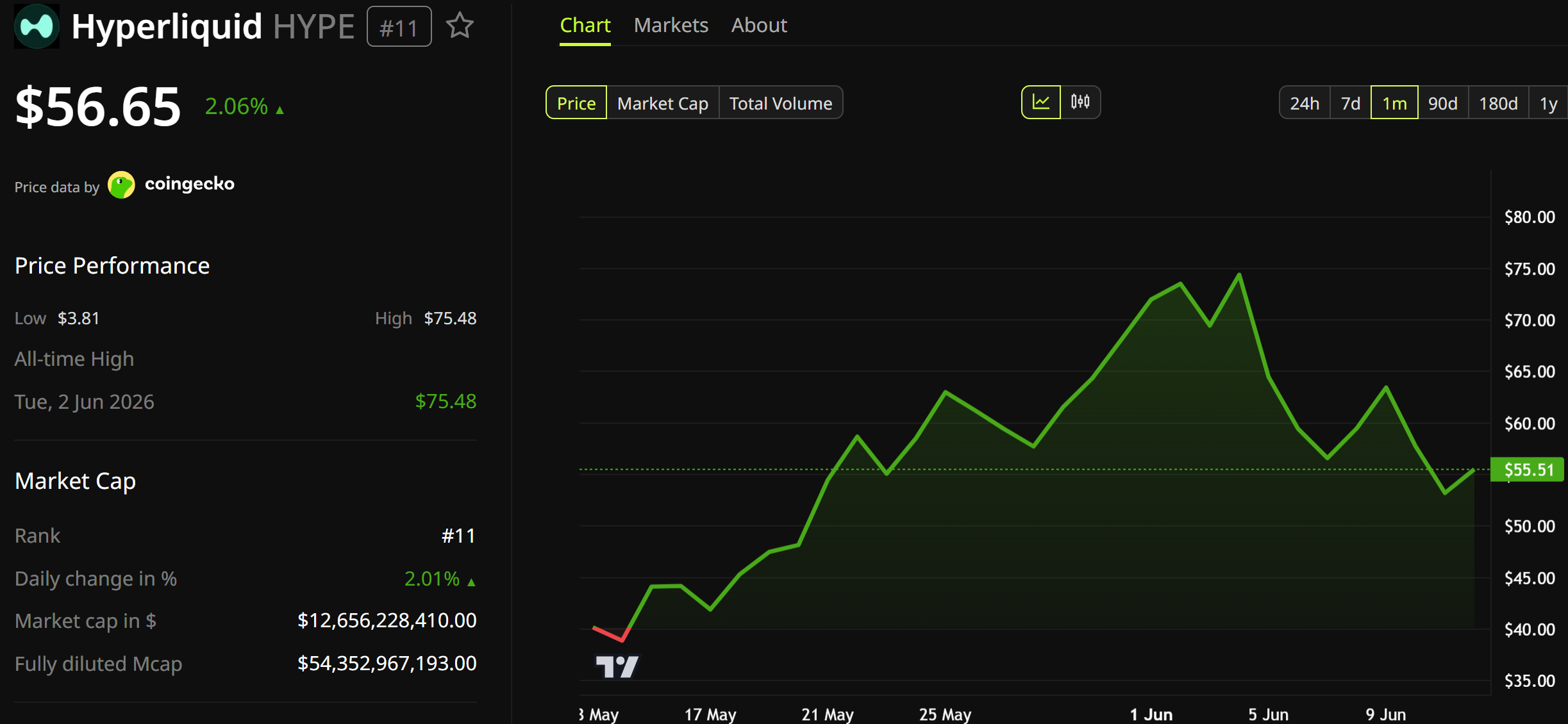
HYPE traded at $56.65 at press time, up 2% in 24 hours, per BeInCrypto Markets data. That gives the token a $12.66 billion market cap, ranking 11th overall.

The price remains below its June 2 all-time high of $75.48 after a 12.6% weekly pullback.
Fortune acknowledged one gap in the first edition. Crypto market makers were left out, and the publisher pledged to include them next time.
A companion Crypto Innovators list also recognized 30 emerging firms across Asia-Pacific, Europe, Latin America, and Africa.
Whether the Fortune Crypto 100 becomes an annual industry benchmark may depend on how its winners perform before the 2027 edition.
The post Fortune Crypto 100 Crowns Hyperliquid as Top DeFi Platform in Debut Ranking appeared first on BeInCrypto.


Ondo Finance has hired former Invesco ETF executive and Grayscale managing director John Hoffman to expand its tokenized investment products beyond stocks and Treasury notes.
Hoffman joins the firm as managing director and head of product portfolios after serving as head of distribution and partnerships at Grayscale Investments, best known for its digital asset funds. Before that, he spent nearly two decades at $2.5 trillion asset manager Invesco, where he most recently led the firm’s ETF and index strategies business in the Americas.
His focus will be building and distributing tokenized portfolios, including investment baskets developed with asset managers and strategies built around Ondo’s existing products.
The hire points to Ondo’s plans to move beyond tokenized versions of individual assets toward managed investment products on blockchain rails.
“Our next step is building the world’s most trusted platform for intelligently managed, onchain investment portfolios,” Hoffman told CoinDesk in an interview.
“It took 30 years for ETFs to go from niche product to the default vehicle,” he said. “Onchain finance will compress that timeline dramatically. The infrastructure is here and the next generation of portfolio products will be built onchain.”
The move comes as tokenization gains traction across Wall Street and crypto markets. The technology creates blockchain-based versions of traditional assets such as stocks, bonds and funds. Supporters say it can reduce settlement times, keep markets open around the clock and make assets easier to move between trading venues. BlackRock, Franklin Templeton, Fidelity and JPMorgan are among the financial firms that have launched or tested tokenized products.
The market for tokenized assets has nearly tripled in a year, surpassing $30 billion, RWA.xyz data shows. Citi has projected tokenized assets could reach $5.5 trillion by 2030, while a joint report from Boston Consulting Group and Ripple estimated the market could grow to $18.9 trillion by 2033.
Ondo has been one of the biggest crypto-native players in the sector. The company first gained traction with tokenized Treasury products OUSG and USDY, which provide investors with blockchain-based exposure to U.S. government debt and other yield-bearing assets.
More recently, the company expanded into tokenized equities through Ondo Global Markets, which the company says has surpassed $1 billion in total value locked across more than 250 stocks and ETFs.
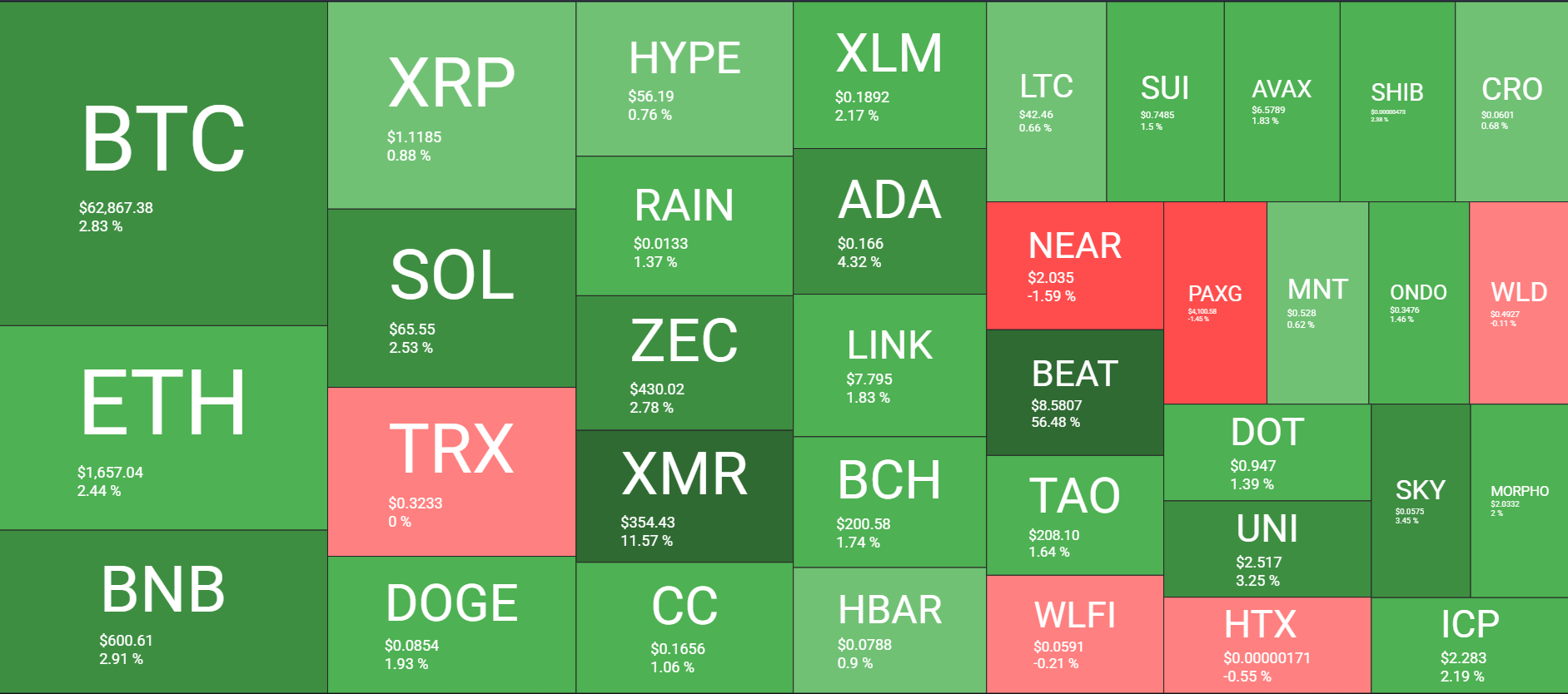
Bitcoin’s price dipped once again in the past 24 hours after the tension in the Middle East skyrocketed with new attacks, but it has managed to offset the losses and is back toward $63,000 now.
Most altcoins have followed suit, with ETH going past $1,650, BNB returning to $600, and SOL reclaiming the $65 level.
BTC Aims at $63K
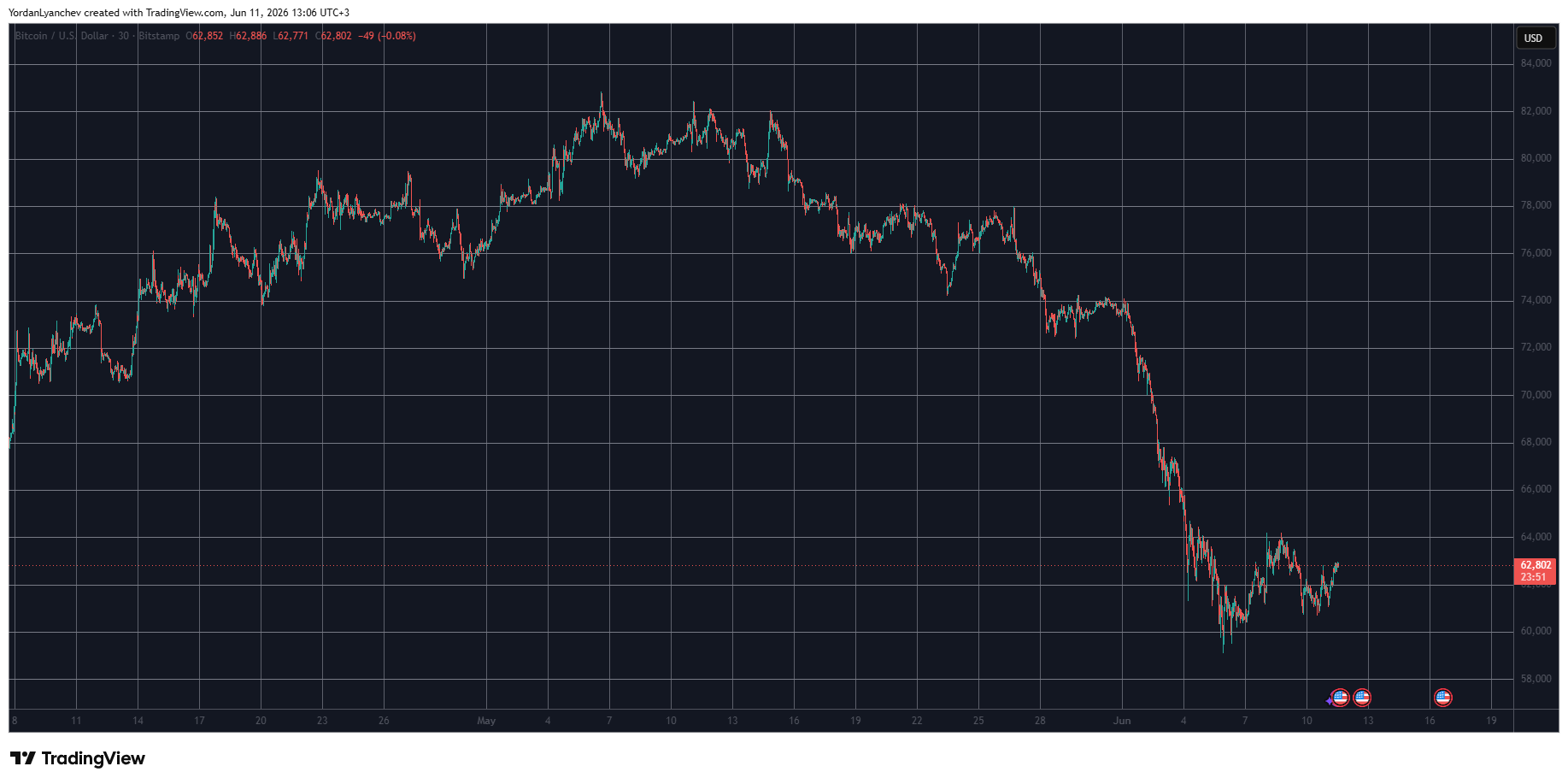
The primary cryptocurrency’s price troubles intensified at the beginning of the month when it was rejected at $73,000. It quickly dumped below the psychological $70,000 level, and the situation worsened rapidly after that. $65,000 gave in in days, and the bears started to challenge the $60,000 support.
Unlike February, when this coveted line managed to hold the price declines, the bears were more persistent this time and managed to break through. The drop below $60,000 wasn’t as profound as many feared, as BTC dipped to $59,100 and bounced off. Nevertheless, this still became its lowest price in almost two years.
That all took place on Friday, but bitcoin managed to recover to $63,000 by Sunday. It even spiked to $64,000 on Monday morning but was quickly halted there as reports emerged that Iran had taken down a US helicopter. President Trump said his country has to retaliate, which resulted in another price dip for BTC to $61,000.
Nevertheless, the asset has remained above that level and now sits close to $63,000. Its market capitalization has climbed to $1.260 trillion on CG, while its dominance over the alts is well above 56%.
BEAT, XMR Pump
Most larger-cap alts have erased yesterday’s losses. Ethereum is above $1,650 once again, BNB has tapped $600, while XRP has defended the $1.10 support. SOL is up to $65, while XMR has stolen the show from this cohort of assets. The privacy token has soared by over 11% to $354 as of now.
Audiera (BEAT) remains the top performer from the mid-caps, soaring by 56% in the past 24 hours alone. The asset has skyrocketed by a mind-blowing 500% in the past week. In contrast, LAB has plunged again, as another 15% drop has driven it to well below $8.
The total crypto market cap has recovered more than $40 billion daily and is up to $2.230 trillion on CG.
The post Bitcoin (BTC) Eyes $63K Again, Monero (XMR) Jumps by Double Digits (Market Watch) appeared first on CryptoPotato.
Ripple’s cross-border token has tracked the broader crypto downturn, sliding roughly 24% over the past month to its current level of $1.12.
Despite unfavorable conditions and fears of a deeper decline, several key factors suggest that a much-needed recovery could be on the horizon.
The Potential Catalysts
The first bullish sign was disclosed by the renowned analyst Ali Martinez. He revealed on X that the Tom DeMark Sequential indicator has flashed a buy signal on XRP, suggesting a possible rebound is imminent.
It is important to note that his post was met with mixed feelings, as some users claimed that the technical analysis tool has not been quite accurate in the past.
Earlier this month, Martinez touched on XRP again, saying he has been closely monitoring $0.90 and arguing that a plunge to that level could present “a compelling long-term buying opportunity.”
The second factor on the list is the asset’s Relative Strength Index (RSI). The ratio recently slipped well below 30 and now hovers around that mark, suggesting the token remains oversold and may be on the verge of a short-term rally. The index ranges from 0 to 100, and conversely, anything above 70 is interpreted as a bearish signal.

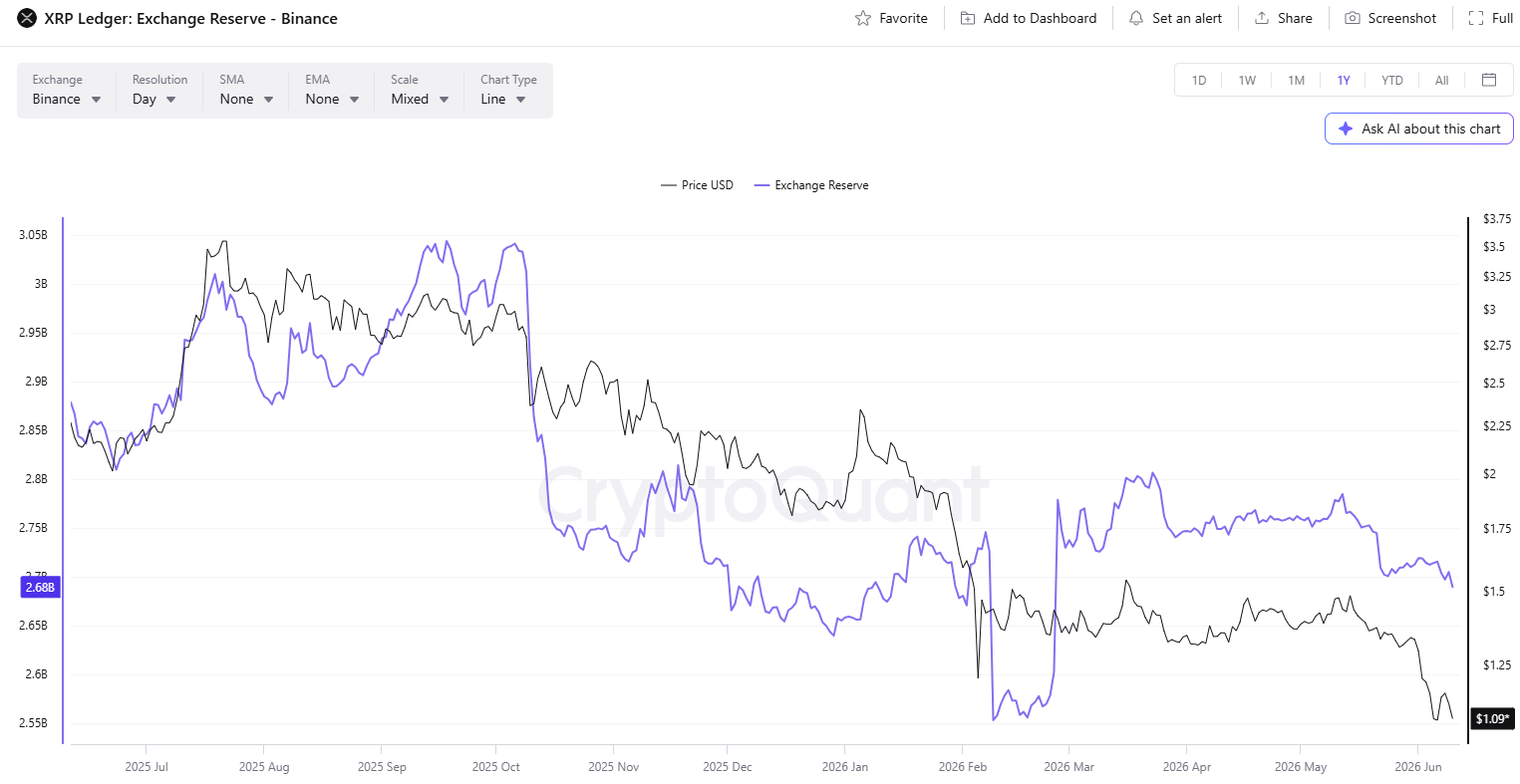
Third comes the declining amount of XRP tokens stored on Binance. CryptoQuant’s data shows that the figure has dropped to a four-month low of around 2.68 billion. The development indicates that some investors have moved their holdings from the world’s largest crypto exchange to self-custody solutions, thereby reducing immediate selling pressure.
Bonus: The ETFs
The solid institutional interest in Ripple’s native cryptocurrency should also be mentioned. Over the past several weeks, inflows into spot XRP exchange-traded funds (ETFs) have exceeded outflows, suggesting that more conservative players, including pension funds and hedge funds, have increased their exposure to the coin.

As a result, financial giants such as Bitwise, Canary Capital, Franklin Templeton, 21Shares, and Grayscale were required to purchase real XRP to properly back the acquired shares. The first such products popped up towards the end of 2025, and since their launch, they have generated a cumulative total net inflow of almost $1.45 billion.
Meanwhile, spot BTC and ETH ETFs have been bleeding lately, suggesting that institutional investors have reduced their exposure to the two biggest cryptocurrencies.
The post 3 Reasons Why Ripple (XRP) Could Be Ready to Pump appeared first on CryptoPotato.
Crypto World
Trump “Loves the Inflation,” as Crypto Keeps Getting Butchered: Geopolitical Tensions vs. Crypto

Bitcoin is holding above $62,000, but barely. The crypto market shed by 20% in a month, with Ethereum breaching the psychologically huge $2,000 level and XRP going down fast. Meanwhile, a new political narrative is hardening on Crypto Twitter. The crypto president, Donald Trump, openly welcomes inflation if it torches incumbent credibility and pumps hard assets.
The macro backdrop has turned genuinely hostile. Hotter-than-expected inflation prints have markets reluctantly pricing in a “higher for longer” rate environment. This has acted as a direct headwind for Bitcoin and risk assets, regardless of what political soundbites suggest.
Pro-Trump influencers on X are circulating the line that he “loves the inflation,” framing persistent CPI as a weapon against the current administration. Macro analysts push back hard: real yields drive crypto flows, not campaign rhetoric.
ETF inflows into US spot Bitcoin products have become the clearest short-term directional signal, and those flows have been wavering amid escalating geopolitical flashpoints across the Middle East and Eastern Europe.
Discover: The Best Crypto to Diversify Your Portfolio
Can Crypto President Donald Trump Reverse Bitcoin to $70,000?
Bitcoin is trading in a weekly range of $59,000–$64,000, with that band acting as both short-term support and resistance. The current $62,800 print sits uncomfortably in the middle of that channel, a no man’s land for directional traders.

The technical structure is mixed at best. Analyst video breakdowns identify ascending trendline support clustering around $60,000 on higher timeframes, while the critical resistance zone sits between $67,500 and $70,000. A clean breakout above $71,500–$73,000 would flip the short-term bias decisively bullish.
Ethereum at $1,600 is tracking BTC’s indecision rather than generating its own momentum. XRP remains range-bound at low with no breakout catalyst in sight. The collapse in corporate buying pressure adds another layer of bearish overhang.
Discover: The Best Token Presales
Bitcoin Hyper Targets Early-Mover Upside as BTC Tests Critical Support
Here’s the uncomfortable truth for spot BTC holders: even in the extreme bull case, a move from here to an all-time high will just give traders $1k for $1k initial. For traders who missed the cycle lows, that’s a thin margin against macro risk. That calculus is exactly why early-stage infrastructure plays are drawing attention from allocation-aware investors rotating out of range-bound majors.
Bitcoin Hyper ($HYPER) is positioning itself as the first-ever Bitcoin Layer 2 with Solana Virtual Machine (SVM) integration, a technical combination that, if it delivers, addresses Bitcoin’s three core limitations simultaneously: slow transactions, high fees, and the near-total absence of programmability.
The project has raised a verified $32 million in presale at a current token price of $0.0136814, with high-APY staking already live for early participants. The SVM integration theoretically enables smart contract execution faster than Solana’s mainnet, while the Decentralized Canonical Bridge handles BTC transfers without custodial risk.
The post Trump “Loves the Inflation,” as Crypto Keeps Getting Butchered: Geopolitical Tensions vs. Crypto appeared first on Cryptonews.

Cardano News: ADA price is sitting at $0.1665, down 42% over the past month and trading at its lowest level since December 2020, a level that has effectively unwound the entire speculative premium from Cardano’s Alonzo-era rally.
A whale sell-off is pressing the asset deeper into a zone most traders hoped they would never revisit, while a speculative cross-chain catalyst from Flare Network is generating just enough noise to complicate the bearish read.

The question is whether that noise becomes signal, or whether the selling simply overwhelms it.
Discover: The Best Crypto to Diversify Your Portfolio
Cardano News: What the Whale Data and On-Chain Pressure Actually Show
On-chain analytics firm Santiment flagged a sharp spike in Cardano’s Age Consumed metric and a simultaneous flattening of Mean Dollar Invested Age as ADA printed a low near $0.1485, signals interpreted as long-dormant holders suddenly moving coins, consistent with capitulation or major redistribution rather than routine churn.
Separately, large-holder cohorts have been repeatedly offloading: wallets holding 10–100 million ADA sold roughly 180 million tokens over just a few days, while wallets in the 1–10 million ADA range shed over 560 million tokens in a prior four-day window.
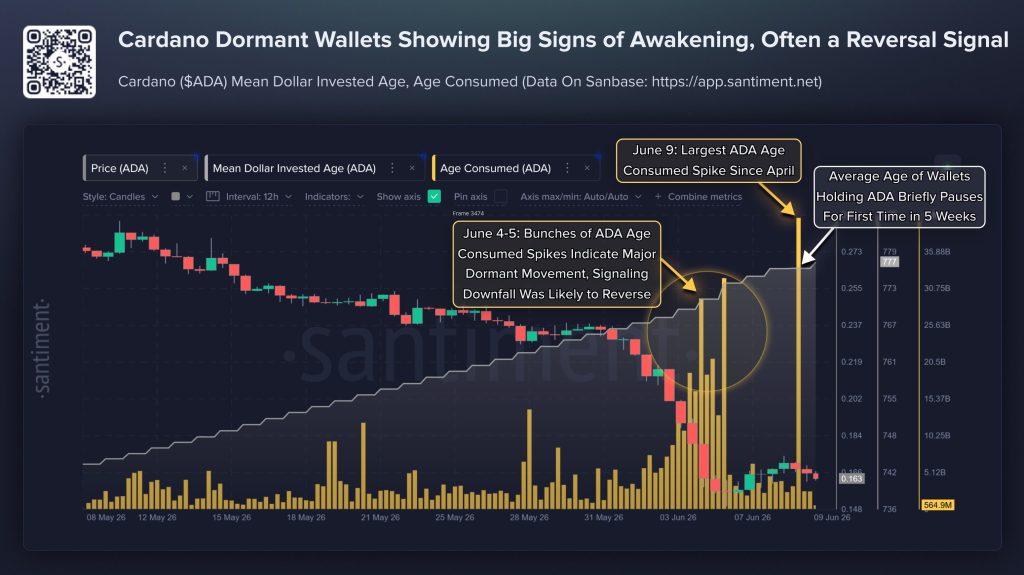
That selling pressure is compounded by a broader crypto bear market environment, ETF outflows, treasury-level de-risking, and geopolitical risk-off have hit the entire altcoin complex, meaning ADA’s breakdown is not purely project-specific.
Technically, the 50-, 100-, and 200-day EMAs are clustered between $0.23 and $0.33, all sitting well above current price, the kind of stacked moving average compression that confirms a structurally broken trend rather than a temporary dip.
Cardano Price Prediction: Where Can ADA go From Here?
Cardano (ADA/USD) has experienced a dramatic boom-and-bust cycle over the past two years on the weekly timeframe.After trading in a relatively subdued range around $0.35–$0.50 through mid-2024, ADA exploded higher in late 2024, surging to a major peak near $1.35–$1.40 in early 2025.
This parabolic move was followed by intense volatility and a series of lower highs throughout 2025. Since the second half of 2025, the token has been in a sustained and steep downtrend, shedding the majority of its gains and recently breaking to fresh lows around $0.1666.As of June 11, 2026, ADA is trading at approximately $0.1666 (up ~0.85% on the week), sitting near the bottom of a multi-month descending channel.
The RSI (14) is deeply oversold at 27.83, suggesting the asset is technically exhausted to the downside and potentially due for a relief bounce or consolidation, though the broader trend remains firmly bearish. The price is now trading at levels last seen in the 2024 bear market lows, indicating significant long-term value erosion for holders who bought near the 2025 highs.
Discover: The Best Token Presales
The post Cardano News: ADA Hits Multi-Year Low as Whales Sell, Can this be The End of Cardano? appeared first on Cryptonews.

TLDR
- Philippines central bank said Binance and BlockShoals do not hold required VASP licenses.
- Authorities clarified that BSP licensing is separate from SEC sandbox approval rules.
- Binance previously faced restrictions in 2023 for operating without proper authorization.
- SEC allowed BlockShoals entry under the StratBox sandbox for controlled fintech testing.
- Regulators require integration with a licensed domestic VASP before user onboarding begins.
The Philippines’ central bank confirmed Binance and its partner lack the required VASP licenses today. Securities and Exchange Commission records show prior warnings against Binance operations in the country. Officials said licensing rules under BSP remain separate from SEC sandbox approval process requirements.
Binance Faces Licensing Gap in Philippine Market
Bangko Sentral ng Pilipinas said neither entity holds a valid VASP license authorization. The regulator stressed that crypto payment operations require separate approval frameworks under BSP.
Binance previously faced restrictions after the SEC flagged unlicensed activity in a 2023 public notice. Authorities ordered internet providers and app stores to block the exchange nationwide.
BlockShoals Technologies entered a partnership with Binance under a regulatory sandbox framework program. The sandbox allows firms to test financial services under supervision rules in a controlled environment.
SEC granted initial clearance to BlockShoals under its StratBox program framework pilot phase. Clearance does not replace central bank licensing requirements for operations in Philippines market.
BlockShoals Partnership Under Regulatory Scrutiny
Reports say the SEC revised language describing the Binance crypto-asset service provider classification change. This description differs from earlier references that labeled Binance as a VASP designation status.
New terms require BlockShoals to integrate systems with a licensed domestic VASP by the deadline. Integration must occur before any Binance-powered user onboarding begins according to regulatory terms.
The requirement sets a 90-day timeline for compliance action from the approval stage. Authorities say the rule ensures separation between sandbox and licensing framework requirements.
BlockShoals must meet conditions before onboarding users via the Binance infrastructure system integration stage. The central bank confirmed licensing remains mandatory for all VASP operations nationwide.
BitPinas reported that the central bank clarified sandbox participation limits for crypto firms locally. The clarification highlights regulatory separation between test environments and licensing compliance structure rules.
Binance continues discussions with local partners to enter the Philippine market on the regulatory approval path. Officials maintain that all exchanges must follow dual licensing rules under BSP SEC.
StratBox sandbox continues to evaluate fintech and crypto applications under the supervision of the review process. Participation requires integration testing with regulated financial service providers before the production use stage.
The SEC adjusted sandbox terms describing the Binance crypto service entity classification update. Updated terms also require integration with licensed domestic operators within the regulatory window period.
BlockShoals must complete integration within the 90-day compliance requirement set by the regulators’ framework. No Binance user onboarding can proceed without full licensing approval from authorities process.


Polanski calls Elon Musk a ‘threat to democracy’

Teen crypto scammer’s $13M heist funds private jets and Lambo

Somali ref Artan picked for UEFA game after being barred by U.S. from World Cup



-

 Fashion6 days ago
Weekend Open Thread: Evereve – Corporette.com
-
 Crypto World6 days ago
Jensen Huang Approves Samsung, SK Hynix, and Micron for NVIDIA (NVDA) HBM4 Memory Supply
-
 Entertainment4 days ago
The Best Mystery Series of All Time Is Surging on Streaming 30 Years After It Ended
-

 Crypto World3 days ago
Anatomy of the June crypto crash: Fed, Iran, Saylor
-

 NewsBeat4 days ago
Alexander Zverev wins the French Open to finally earn a 1st Grand Slam title
-

 Tech5 days ago
Suspicious Polyfill login prompts pop up on Toshiba, Muji websites
-
Crypto World5 days ago
Senator Cynthia Lummis Calls CLARITY Act the Most Consequential Financial Legislation of This Generation
-
 Tech4 days ago
Microsoft unveils seven homegrown AI models in new bid for ‘long term self-sufficiency’
-

 Tech6 days ago
Microsoft launches MXC, an OS-level sandbox for AI agents, with OpenAI and Nvidia already on board
-

 Business6 days ago
(VIDEO) Justin Bieber Delivers Surprise Happy Birthday Serenade to Diners at Los Angeles Mexican Restaurant
-
 Business4 days ago
The Pain Points Taking a Fragile Tech Rally Down a Notch
-

 Business3 days ago
High Stakes for Wembanyama as New York Pushes for 3-0 Lead
-
 Crypto World3 days ago
Eli Lilly (LLY) Stock Surges 4% Following Breakthrough Sleep Apnea Trial Results
-

 Tech5 days ago
Von der Leyen’s AI envoy pick draws conflict-of-interest fire
-

 Tech6 days ago
Meta steals a tactic from Tesla and builds data centers in tents
-
Crypto World6 days ago
LBank Surpasses 25 Million Users Worldwide as AFA Partnership Continues to Drive Global Growth
-

 Tech5 days ago
Hackers now exploit SolarWinds Serv-U flaw to crash servers
-

 Crypto World4 days ago
Trump’s AI Ownership Plan Could Benefit Anthropic at OpenAI’s Expense
-
 NewsBeat4 days ago
Alexander Zverev conquers demons and outlasts Flavio Cobolli to win French Open for first major title
-
 Sports2 days ago
Bangladesh beat Australia after 20 years in ODIs, register only their second win over six-time world champions | Cricket News
You must be logged in to post a comment Login