

Crypto World
Crypto Polo Cup returns for its fourth edition in Palm Beach during Consensus Miami week


Palm Beach, Florida, May 7, 2026 – Hosted by Luna PR, the fourth edition of the Crypto Polo Cup (CPC) will take place on May 9, 2026, at the Santa Clara Polo Club, alongside Consensus Miami. The invite-only event will bring together institutional leaders, founders, and investors across the digital asset and financial sectors.
Since its debut in Palm Beach in 2022, Crypto Polo Cup has established itself as a premier gathering the intersections of digital assets, finance, and culture. Now in its fourth year, the 2026 edition will welcome more than 500 guests for a day blending sport, entertainment, and high-caliber networking.

“The Crypto Polo Cup has grown into a global meeting point for leaders across industries, creating a space where meaningful relationships are formed, strategic conversations happen, and real collaboration takes shape,” said Nikita Sachdev, Founder and CEO of Luna PR. “We are proud to bring CPC back to Florida, where it first began, and to welcome our global community during Consensus Miami week.”
The event will feature two professional polo matches, offering a distinctive setting for meaningful conversations and high-value connections. Alongside the match, guests will have the opportunity to connect with senior leaders across the financial sectors in a more intimate environment.
This year’s edition is supported by a select group of partners whose involvement reflects the continued industry backing behind CPC including TEXITcoin, Binance, Naoris, AMINA, Solana Company, CakeWallet, Unicoin, Quantum, CoinRoutes, and Sailo Tech.
This year’s ambassador lineup spans across government, global exchange leadership, venture capital, media and digital asset innovation, reflecting the breadth of industries that CPC brings. Ambassadors include:
- Michael Carbonara, Congressional Candidate FL-22
- Rachel Conlan, Global CMO of Binance
- Yana Prikhodchenko, CEO of Cointelegraph Global
- Tess Hau, Founder of Tess Ventures
- Silvina Moschini, Founder of Unicorn Hunters
- Michael Terpin, Founder and CEO of Transform Ventures
- Matthew Jason Nordgren, Founder and Managing Partner of Arcadian Capital
- Ran Neuner, Founder of Crypto Banter
- Gary Hopkinson, Managing Director of Clear Street
- Analys Falchuk, Investor Relations Manager, OG Advisory Group.
Their participation reinforces the CPC’s position as a meeting point for leaders shaping the future of technology, finance, media, and global markets.
CPC continues to serve as a platform to major industry gatherings, offering a more informal environment for connection and collaboration. Attendance is invitation only. Limited media access is available upon request.
About Crypto Polo Cup
The Crypto Polo Cup is where the world of investment, innovation, and influence converges. Since its inception in Palm Beach, Florida, in 2022, it has become a premier invitation-only event that attracts the biggest players in venture capital, blockchain, and emerging technology. With billions in investment capital represented on and off the field, this is where deals are made, partnerships are formed, and the future of Web3 takes shape.
Powered by Luna Media Corp, a global powerhouse that houses eight companies, including Luna PR – the leading PR agency in Web3, the Crypto Polo Cup is a gathering of visionaries who are shaping the future of technology and finance.
Media contact

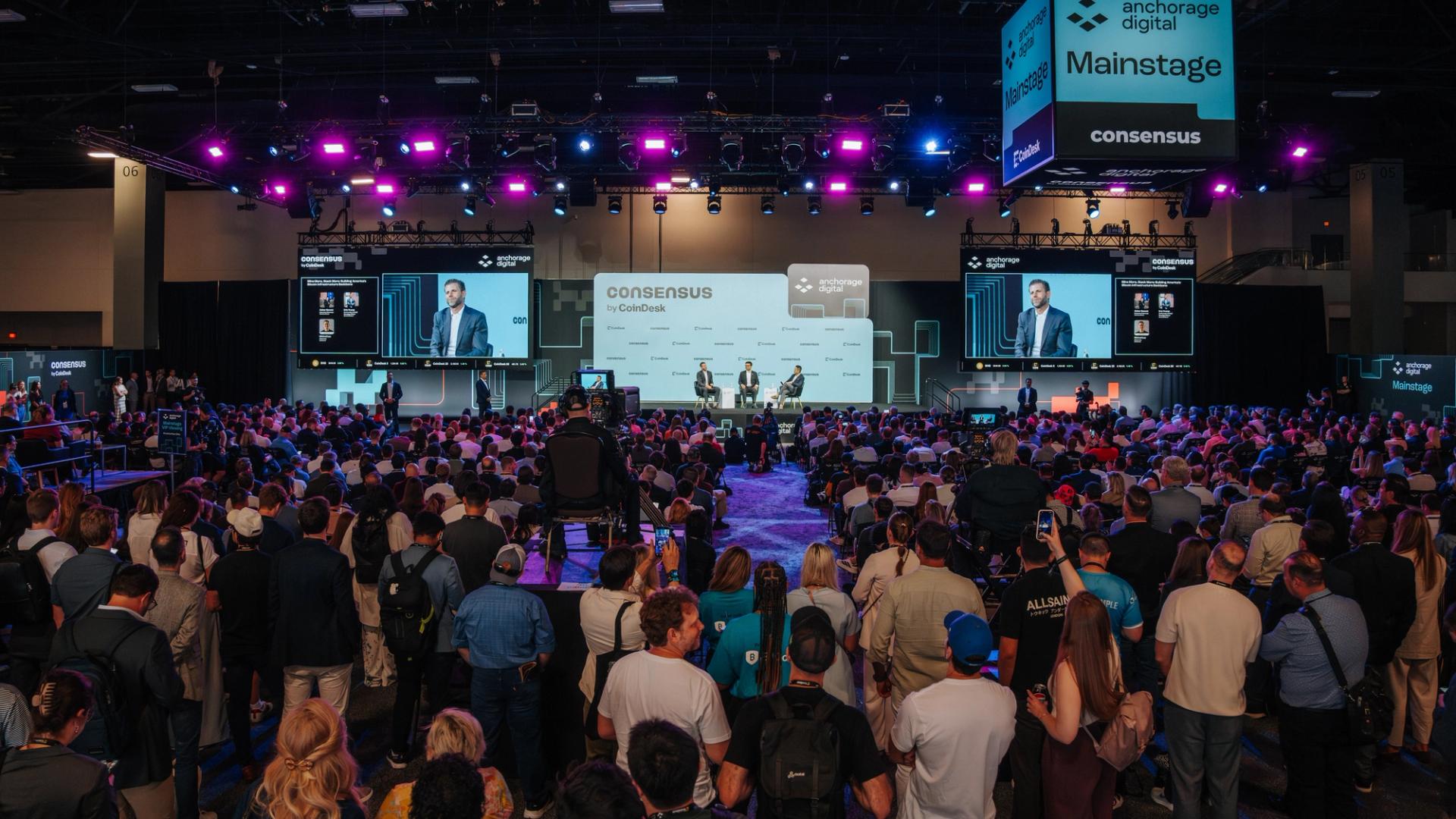
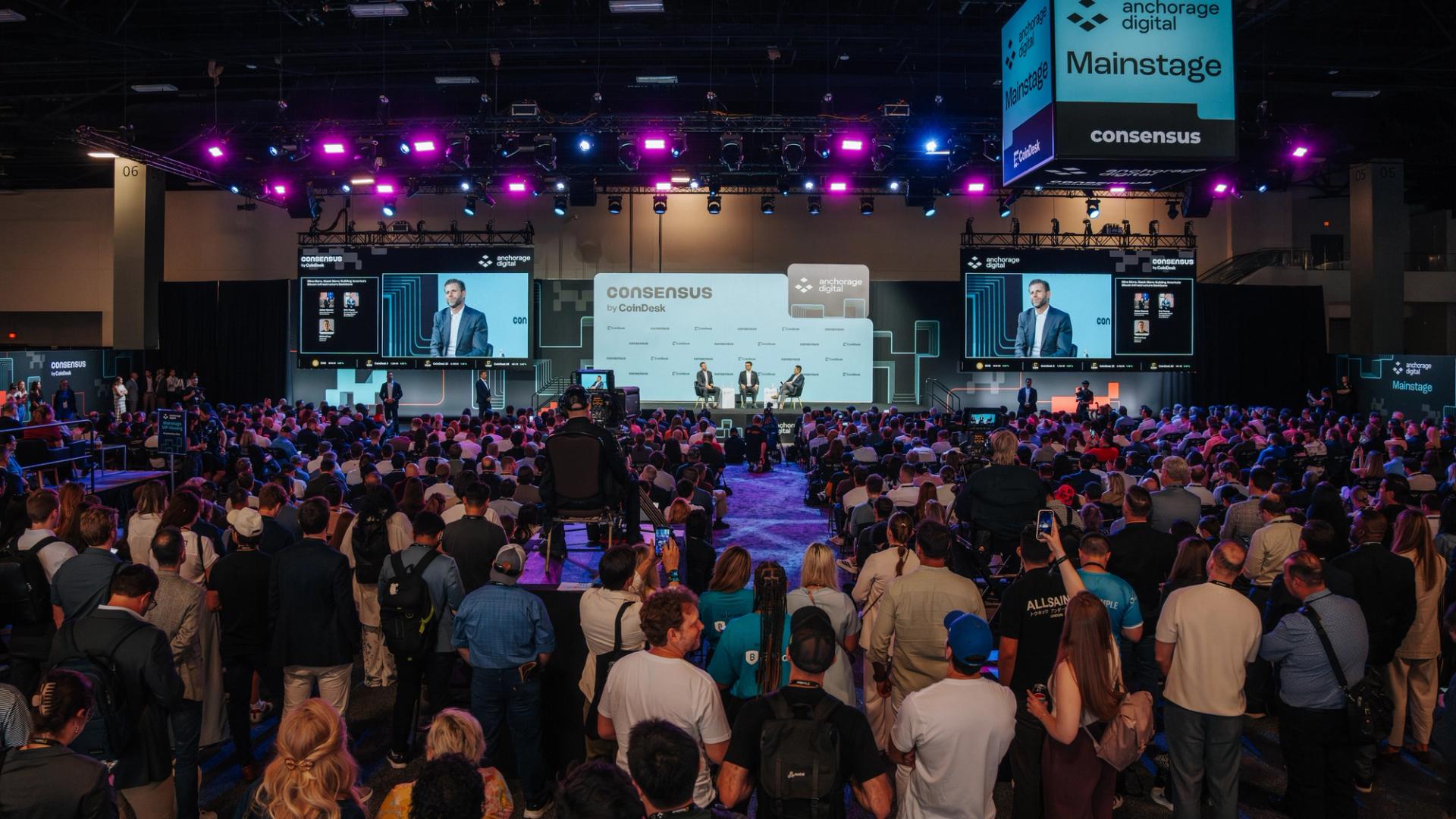
It’s the third and final day of Consensus Miami.
To recap yesterday, ICYMI, Patrick Witt, the Executive Director of the President’s Council on Digital Assets, told the audience at day 2 of Consensus Miami that if the Senate Banking Committee holds a markup this month, it would give the Senate four weeks to merge the bill with the Senate Agriculture Committee version and June to work out issues with the House of Representatives. It’s an aggressive timeline, “but it is an achievable timeline,” he said.
Michael Saylor followed up to lay out his case for yieldcoins, laying out a vision for the potential future of the digital assets sector.
And the time is now to start working on post-quantum security, Project Eleven CEO Alex Pruden said.
Catch up on all of the coverage here.
Today will see panels addressing prediction markets and sports betting, stablecoins, banking and more. Privacy and agentic payments will again take the stage.
Tom Lee will present a keynote, while stablecoin executives will weigh in on recent regulatory advancements. World Liberty Financial’s Donald Trump, Jr. and Zach Witkoff will take the main stage right after lunch, while payments executives will lay out how crypto cards and other tools will work.
CoinDesk will host its Policy & Regulation Summit, diving deep into the key regulatory issues you should be paying attention to: DeFi regulation, the 2026 election and more. The day will end with a debate on prediction markets. Are they just gambling products dressed up in a fancy costume? Or are these contracts actually a novel financial product? And what does that all mean for you? Come through and find out.


Animoca Brands chairman Yat Siu told Consensus Miami 2026 that the metaverse is over as a consumer destination, and that 100 billion AI agents will become blockchain’s primary users.
Summary
- Yat Siu said the pandemic-era vision of humans living in virtual worlds was wrong, and that the metaverse was a proof of concept for AI agent infrastructure rather than a consumer product.
- He predicted 50 to 100 billion AI agents will eventually operate on the internet, outnumbering humans and transacting autonomously on blockchain networks.
- Animoca announced a $10 million investment initiative for developers building AI agent applications through its Animoca Minds platform.
Animoca Brands chairman Yat Siu told Consensus Miami 2026 on Thursday that the metaverse, as the crypto industry imagined it during the pandemic, was never really built for humans.
“Where we’re landing is that the metaverse, the blockchain-based one, was really the proof of concept for agents,” he said. “In other words, it was never really destined for humans as a prime consumer.”
The remarks mark a clean break from Animoca’s earlier positioning. The firm was among the most prominent advocates of the pandemic-era metaverse vision, which assumed users would spend growing amounts of their social and economic lives in immersive virtual environments.
Siu attributed that misconception to the distorting conditions of COVID lockdowns, when it seemed remote digital life would become permanent. “Everyone thought, ‘Oh, we’re going to be at home, and we’re never going to travel as much anymore,’” he said. “Which, of course, turned out to be quite the opposite.”
What comes next: the agent economy
Siu’s new thesis is that blockchain’s most scalable user base will not be humans but autonomous AI agents. “I think the point is that it’s going to be more agents than humans,” he said, estimating 50 to 100 billion agents could eventually operate on the internet.
On current population math, 10 to 20 agents per human produces between 70 and 140 billion agents globally. “Blockchain technology is the ideal financial system for machines,” Siu said. “We, the humans, were basically the guinea pigs.”
The argument centres on a practical problem that has limited crypto’s reach. Approximately 700 to 800 million people globally own some form of cryptocurrency, but as crypto.news reported, fewer than 70 million actively use blockchain applications, largely because the technology remains too complex for mainstream consumers. AI agents do not face that barrier.
They interact directly through code, require no traditional banking infrastructure, and can transact autonomously on-chain. As part of the pivot, Animoca announced a $10 million initiative for developers building AI agent applications through its Animoca Minds platform, framing agents as its next major investment category after the metaverse era closes.
The MEV gods do not discriminate.
Vitalik Buterin, Ethereum’s co-founder and a vocal advocate for fixing toxic maximal extractable value, got hit by the very kind of attack he has been campaigning against, blockchain data from earlier this week shows.
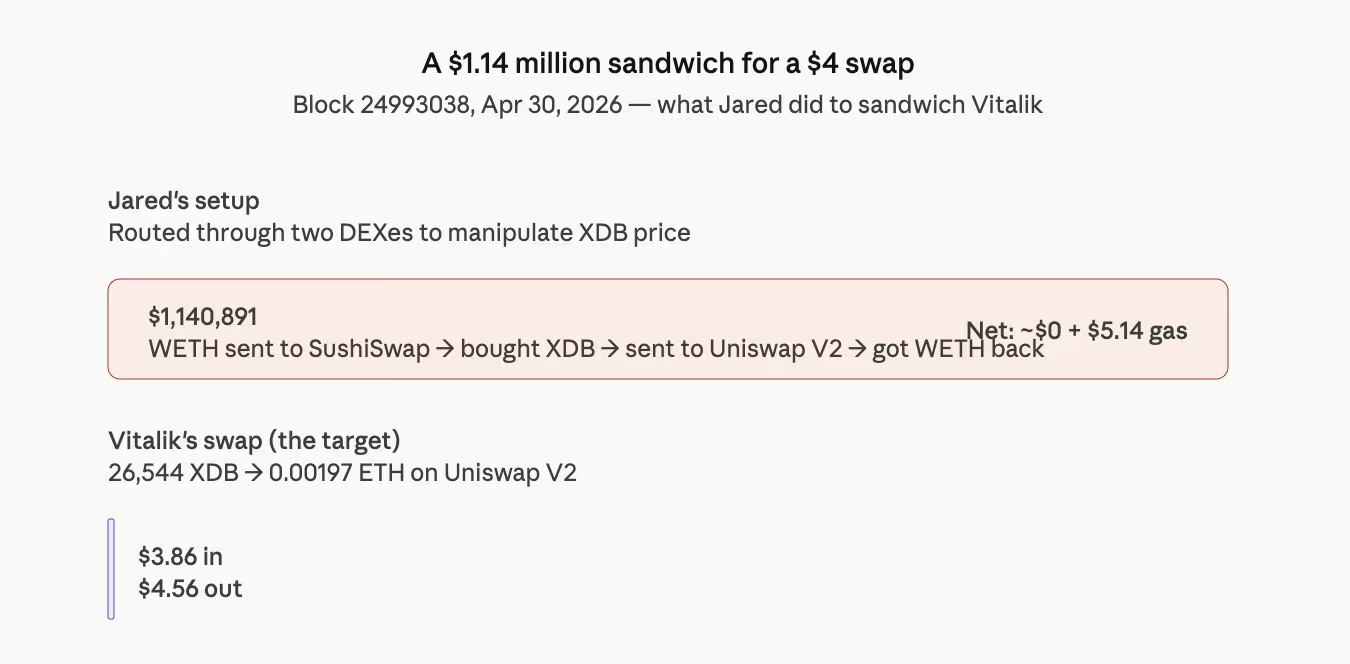
Data shows a transaction by Buterin on April 30 was sandwiched by the bot in block 24993038, per Etherscan data, resulting in a worse execution price for the Ethereum co-founder.
A sandwich attack is when a bot spots a trader’s pending transaction, places its own buy order in front to push the price up, lets the victim execute at the inflated price, then dumps the tokens immediately after to pocket the difference. The victim usually does not even notice, as they just get a slightly worse fill than they should have.
Analysis by CoinDesk shows Buterin swapped 26,544 digitalbits (XDB) tokens worth roughly $3.86 for 0.00197 ETH worth $4.56. The bot ran $1.14 million worth of WETH through SushiSwap and Uniswap V2 to manipulate the XDB price between the two pools right before Buterin’s swap landed.
After gas fees of $5.14, Jared appears to have lost money on this particular sandwich, and Buterin’s slippage was likely in a few cents.

This shows the bot is so industrialized that it scans every pending transaction in the mempool for any opportunity to insert itself, profitable or not.

Buterin has spent the past several months pitching encrypted mempools as a fix for toxic MEV in Ethereum’s 2026 roadmap.
MEV is the profit that whoever orders transactions on a blockchain can pocket by reshuffling them. Anyone running a bot that watches the public mempool, the holding pen where pending transactions sit before being added to a block, can spot opportunities to insert their own trades around someone else’s.
Sandwich attacks are the most aggressive form, with cumulative MEV extracted on Ethereum is now over $1.2 billion and these type of attacks accounting for roughly 51% of the total volume.
Buterin, among other developers, argue that MEV creates a hidden tax on regular users that can favour large, specialized operators over everyone else.
Jaredfromsubway.eth rose to prominence in 2023 as it sandwiched traders of meme coins like pepe and wojak during the then meme frenzy.
It briefly accounted for 7% of all gas fees on the network in April that year, and has reportedly extracted more than $7 million from victims across hundreds of thousands of transactions since.
The bot adapts faster than the protocols trying to stop it. It has survived contract upgrades, mempool filtering, and several attempts by builders to design exploits that drain its funds.
Key takeaways:
- Half of the $6 billion in Bitcoin options open interest is tied to long-shot strategies used for hedging and neutral price strategies.
- The 9% put (sell) options premium hints that professional traders are worried about a potential Bitcoin price drop.
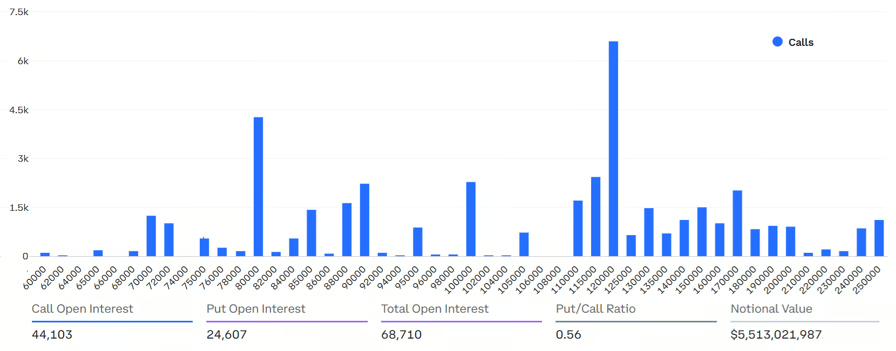
Bitcoin (BTC) bulls have high hopes for the year-end options expiry on Dec. 25, which features $6 billion at stake. The 33% price gain since the $60,130 yearly low on Feb. 6 have played a major role in bringing back bullish expectations. However, the huge amount of call (buy) options targeting $115,000 and higher for Dec. 25 raises questions about whether bulls are overconfident.
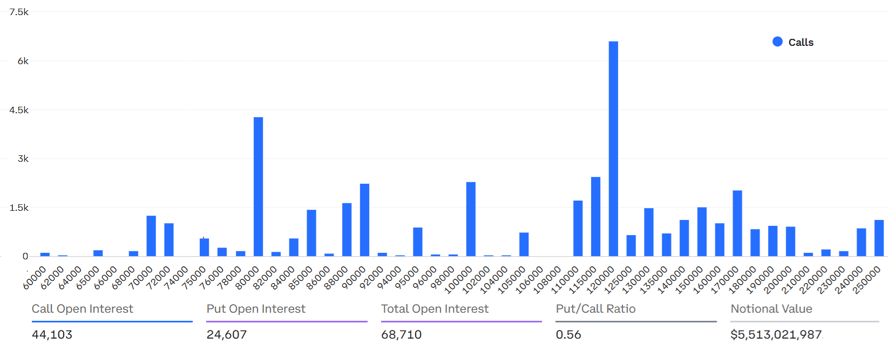
December Bitcoin call (buy) options open interest at Deribit, BTC. Source: Deribit
Deribit exchange holds a 92% market share in December’s Bitcoin options open interest at $5.5 billion. However, the actual value at expiry will be much lower. Many of these instruments were placed on unlikely outcomes as a hedge or for neutral strategies that do not require large price moves to remain profitable.
Bitcoin call options dominate, but both sides have unrealistic bets
Put (sell) options are underrepresented by 56% on Deribit compared to call options. Crypto traders are known for being bullish, so the put-to-call ratio is usually skewed. Still, the $1.85 billion in open interest in call options targeting $115,000 and higher is significant. This setup makes it worth comparing how optimistic call options are versus the puts.
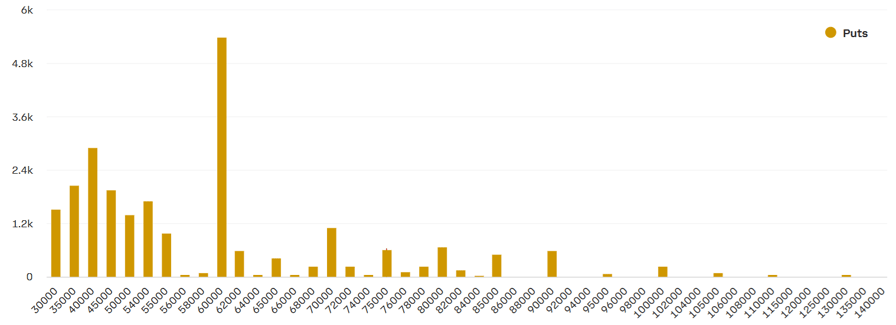
December Bitcoin put (sell) options open interest at Deribit, BTC. Source: Deribit
The high volume of put options targeting $55,000 and lower is also notable, totaling $1 billion in open interest. This means the percentage of bets considered improbable is similar for both sides, sitting at roughly 50% of the open interest in each segment. If bulls are seen as overly optimistic, then the bears appear equally extreme in their pessimism.
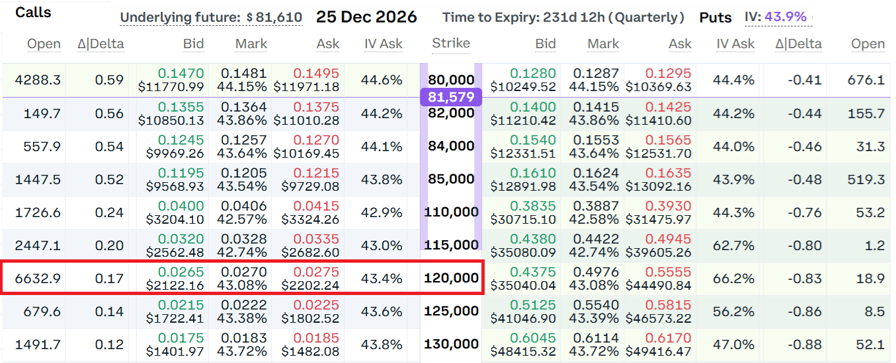
December Bitcoin options pricing at Deribit on May 7. Source: Deribit
Beyond serving as a counterbalance in strategies with different expiry dates, a call option at $120,000 offers cheap exposure to extreme upside events. Based on Deribit prices on May 7, a buyer pays $2,202 to secure unlimited upside exposure to the equivalent of one full Bitcoin at a price of $120,000 or higher on Dec. 25.
The options skew metric provides a clearer view of professional traders’ comfort levels regarding both upside and downside price risks.
Related: Bitcoin holds $81K amid flat derivatives markets–Is rally sustainable?
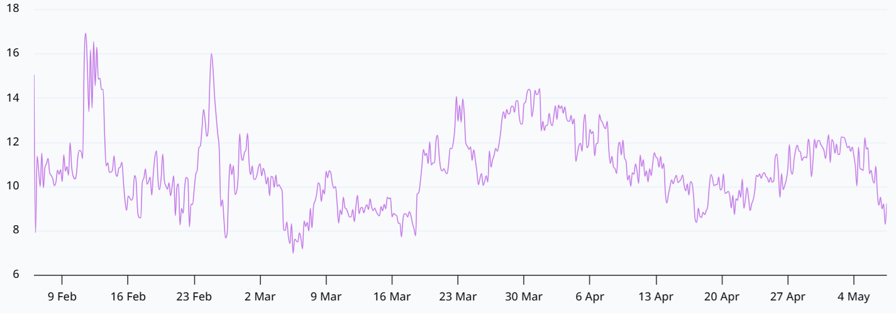
Bitcoin 6-month options delta skew (put-call) at Deribit: Source: Laevitas
Put options are trading at a 9% premium relative to equivalent calls, signaling moderate fear of downside price movements in Bitcoin. Under neutral conditions, the skew indicator should range between -6% and +6%. According to derivatives metrics, investor optimism was not substantially impacted by the rally to $80,000.
Ultimately, the $1.85 billion in December call options should not be interpreted as a sign of excessive bullish confidence.

TLDR
- BitMine may slow its Ethereum purchases as it approaches its 5% supply target.
- Chairman Tom Lee said the company could reach the 5% goal within six weeks at its current pace.
- BitMine held 5.18 million ETH as of May 3, equal to 4.29% of total supply.
- The company bought 101,745 ETH in the previous week to advance its target.
- BitMine staked 4.36 million ETH, worth about $10.2 billion at recent prices.
BitMine Chairman Tom Lee said the company may reduce its Ethereum buying pace as it nears a 5% supply target. He made the remarks at Consensus 2026 in Miami on Thursday. He said the company could reach its goal within six weeks if it maintains its current purchase rate.
BitMine Reassesses ETH Buying Strategy
Lee said BitMine may slow purchases as it approaches its internal threshold. He stated, “I do think we’re going to slow down our pace of buying.” He added, “I’m not sure we want to get to 5% too quickly.”
He explained that the company continues to review its capital allocation plans. He said other priorities now compete for funding within the crypto sector. He pointed to the company’s recent New York Stock Exchange listing and a $4 billion share repurchase authorization.
BitMine reported that it held 5.18 million ETH as of May 3. The company said this amount equals 4.29% of Ethereum’s 120.7 million total supply. It added that it reached 86% of its “Alchemy of 5%” objective after buying 101,745 ETH last week.
Lee said the company could reach the 5% level within six weeks at the same pace. However, he stressed that management may adjust the accumulation rate. He said the firm wants to balance growth with other operational goals.
Ethereum Holdings and Staking Operations Expand
BitMine disclosed that it staked 4.36 million ETH as of May 3. The company valued those holdings at about $10.2 billion based on a $2,336 ETH price. Tom Lee said annualized staking revenue reached $297 million.
He said the firm’s own staking operations generated a 2.91% annualized seven-day yield. He highlighted staking as a core part of the treasury strategy. He said ETH remains the company’s primary reserve asset.
The company reported total crypto, cash, and moonshot holdings of $13.1 billion. These holdings include 200 BTC and $700 million in cash. It also holds equity stakes in Beast Industries and Eightco Holdings.
Lee reiterated his broader Ethereum outlook during the event. He said Wall Street tokenization supports Ethereum adoption. He also said agentic AI systems require public and neutral blockchains.
ETH traded near $2,300 at press time, down about 2% on the day. Meanwhile, BMNR traded near $21.97. The company’s market capitalization stood at about $11.8 billion at that time.

Crypto World
Kalshi confirms $1 billion raise that values the firm at $22 billion amid prediction market boom
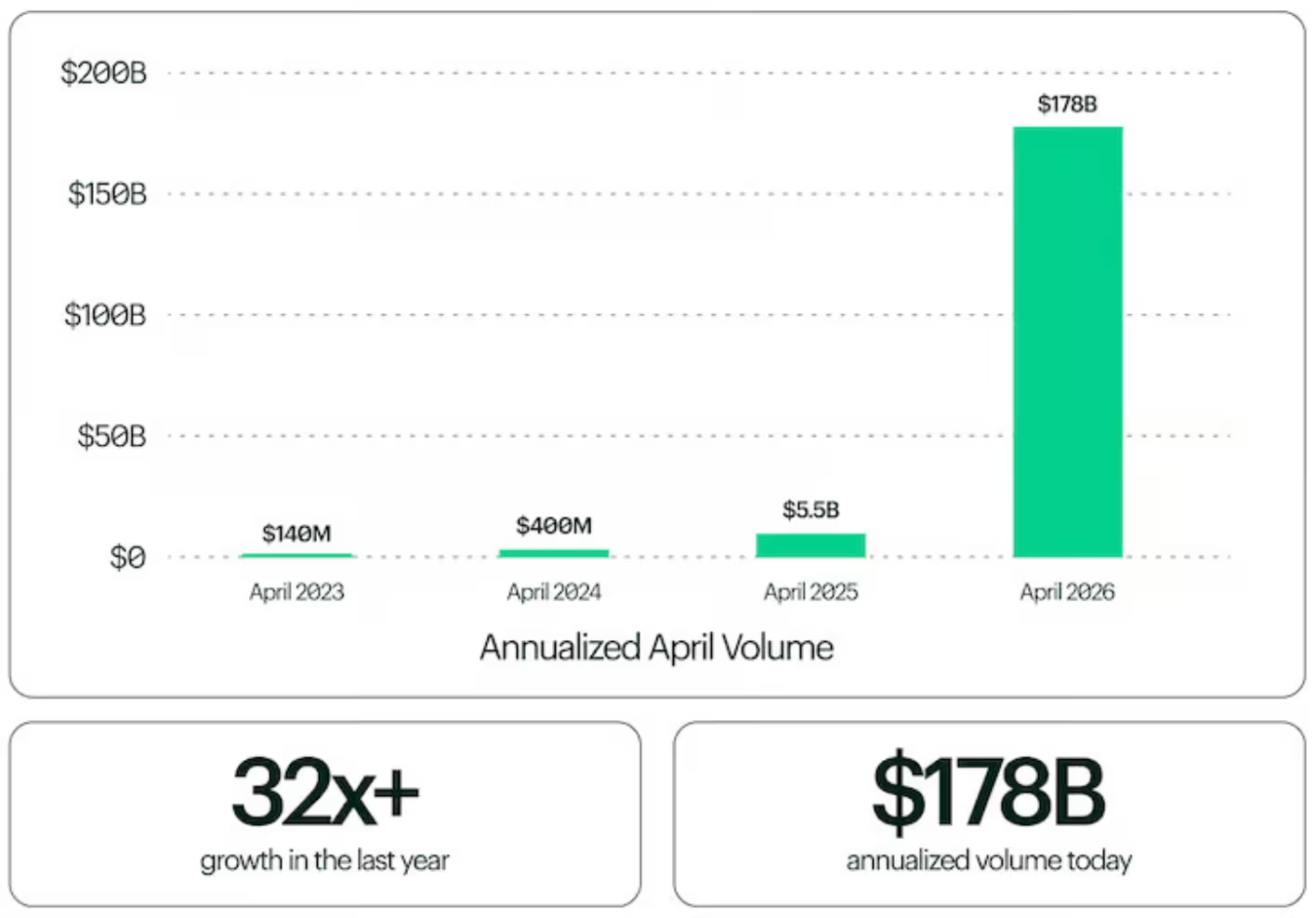
Prediction market platform Kalshi said it raised $1 billion in fresh funding at a $22 billion valuation, as institutional investors increasingly turn to event contracts for trading and hedging.
The Series F round was led by Coatue and included Sequoia Capital, Andreessen Horowitz (a16z), Paradigm, IVP, Morgan Stanley and ARK Invest, according to a Thursday press release. The news confirmed a Bloomberg report in March about the investment round and valuation.
The firm said it plans to use the capital to expand institutional services, including block trading tools, broker integrations and new risk products aimed at asset managers and insurance firms.
The fundraising comes as prediction markets have gained momentum in crypto and traditional finance alike as firms look for alternative ways to gauge probabilities and manage risk. Hedge funds and proprietary trading firms increasingly use event contracts alongside conventional derivatives to hedge exposure or express macroeconomic views.
The company operates a regulated marketplace where users trade contracts tied to real-world outcomes, from elections and economic data to sports and weather events. Traders buy contracts that pay out if a specific event occurs, turning forecasts into tradable markets.
Kalshi said institutional trading volume on the platform jumped 800% over the past six months, while annualized trading volume more than tripled to $178 billion during the same period.

Amid staggering growth, prediction markets have also drawn growing scrutiny from U.S. regulators and state authorities. Nevada, New Jersey, Illinois and several other states have issued cease-and-desist orders or launched legal challenges against Kalshi, arguing that some event contracts resemble unlicensed sports betting products. Kalshi has pushed back, saying its federally regulated exchange falls under the oversight of the Commodity Futures Trading Commission (CFTC) rather than state gambling regulators.


Solv Protocol has said it’s moving more than $700 million of tokenized bitcoin assets to Chainlink’s Cross-Chain Interoperability Protocol (CCIP) and deprecating LayerZero bridge support across Corn, Berachain, Rootstock and TAC.
The migration covers SolvBTC and xSolvBTC, Solv’s wrapped bitcoin assets used across DeFi and BTCfi markets. Solv said it made the decision after an updated security review and recent cross-chain hacks, pointing to CCIP as its standard bridge infrastructure.
Chainlink’s CCIP is a bridge that connect blockchains, enabling transfers of tokens, messgages and data between different decentralized networks.
Solv’s move follows Kelp DAO’s shift from LayerZero to Chainlink after an April exploit drained 116,500 rsETH, worth roughly $292 million, from its LayerZero-powered bridge.
Kelp and LayerZero have since traded blame over the setup behind the exploit. LayerZero said Kelp used a single-verifier configuration despite recommendations to adopt a multi-DVN model, while Kelp says LayerZero personnel reviewed and approved the configuration it later blamed for the attack.
The dispute has turned verifier design into a live security issue for high-value cross-chain assets as Kelp says the 1-of-1 setup was not an edge case. LayerZero says it was an application-level configuration choice and has since said it will no longer sign messages for applications using that model.
Solv’s migration gives Chainlink a second post-hack win in cross-chain infrastructure. Kelp is moving liquid restaked ETH to it, while Solv is moving tokenized bitcoin.
Together, Kelp and Solv represent more than $2 billion in protocol asset value moving toward Chainlink’s cross-chain infrastructure.
“We are speaking to many teams across the industry and there is a clear and accelerating trend where protocols like Solv are migrating to Chainlink in a flight to quality reminiscent of the rapid shifts during DeFi summer,” Johann Eid, chief business officer at Chainlink, told CoinDesk.
“The industry’s largest protocols are realizing they can no longer rely on cross-chain and oracle infrastructure that push liability onto users and blame them for systemic failures,” Eid added. “By choosing CCIP, Solv gets cross-chain infrastructure that is “secure and decentralized by default.”
Solv already had already worked with Chainlink to offer real-time collateral verification for SolvBTC pricing.


Bedrock AgentCore Payments turns Amazon’s agent platform into a transactional layer, with Coinbase supplying x402 stablecoin rails and Stripe contributing wallet infrastructure via Privy.
Bitcoin’s December 25 options expiry brings roughly $6 billion in open interest into focus, according to Deribit data. The picture that emerges is less about a single megabull thesis and more about hedging and neutral positioning that could shape price action as expiry nears. Traders appear to be leaning on sophisticated strategies that cushion against downside risk or lock in gains without requiring a dramatic daily move in BTC.
The backdrop includes a 33% rally off a February low near $60,130, which has revived bullish sentiment to some degree. Yet a substantial chunk of the options book is structured to function as protection or neutral bets, rather than as outright bets on a fresh, multi-month rally. Deribit dominates this market, accounting for about 92% of December’s BTC options open interest, with the caveat that the eventual payout at expiry will depend on the actual price path BTC traces on Dec. 25.
In this environment, the distribution of bets across strikes reveals a nuanced mix of optimism and caution. The market shows a heavy concentration of upside exposure at very high strikes, while sizeable protection at lower levels reflects ongoing nerve about downside risk. With that context, investors should watch how these positions translate into real-world liquidity and potential spillovers if BTC traverses key thresholds in the final days of the year.
Key takeaways
- About half of the $6 billion December BTC options open interest is tied to hedging or neutral strategies rather than directional bets on a decisive rally.
- Calls targeting extreme upside—specifically $115,000 and above—compose roughly $1.85 billion of open interest, highlighting a notable tilt toward upside scenarios, even if many of these are hedges rather than pure speculation.
- Puts at lower levels—around $55,000 and below—total near $1 billion, indicating substantial downside protection alongside the bullish tilt.
- Put options trade at a roughly 9% premium to equivalent calls, signaling modest fear of downside despite the rally’s progress; a single Dec. 25, $120k call costs about $2,202 to buy, offering leveraged upside exposure without requiring a large move from current levels.
Hedging-centric positioning dominates the December expiry
Deribit’s data shows that the December expiry is skewed toward strategies that do not depend on a dramatic price breakout. The lion’s share of open interest sits in hedges and neutral plays, as traders seek to protect gains or secure profits in a range-bound scenario. While a rally to new highs is not out of the question, the structure of the book implies that many participants are prepared for a more modest move and want to manage risk in a volatile environment.
Industry observers note that large derivatives books often grow in hedges and neutral hedges ahead of major option expiries, as participants use gamma, vega, and other Greeks to balance risk across a spectrum of potential outcomes. In this case, the sheer size of the hedged leg indicates a market that is mindful of downside risk even as price recovery has resumed in recent months.
Extreme-strike bets reveal a split in sentiment between fear and optimism
Across strike layers, the options distribution is telling. The $115,000-and-above calls account for about $1.85 billion of open interest, underscoring demand for upside leverage even as they are often part of hedging or complex price-mivoting schemes rather than straightforward long bets. In parallel, about $1 billion of open interest sits in puts at $55,000 and lower, reflecting risk controls and tail-risk hedging that persist despite BTC’s higher ground.
Crucially, the market appears to exhibit roughly equal weight of bets on “unlikely” downside and upside events, with both sides comprising around half of the overall open interest in their respective extreme segments. That balance suggests a market that remains mindful of outsized moves in either direction, rather than committing wholesale to a single directional narrative. For context, commenters have argued that even when the price advances appear compelling, the options market can stay skeptical about the permanence of such moves; see ongoing analyses of how far the rally can run alongside entrenched hedges.
Pricing signals and what traders are paying for exposure
The options market’s pricing signals reinforce a cautious but not pessimistic outlook. The 9% premium on put options relative to equivalent calls indicates a modest appetite for protection against a potential pullback, rather than a fear-driven rush to sell. In neutral conditions, the put-call skew typically sits within a narrow band; current metrics suggest investors are comfortable with upside but remain wary of a swift reversal that could catch bullish participants off guard.
One concrete data point: a Dec. 25, $120,000 call is priced to cost around $2,202, granting “unlimited” upside exposure relative to that strike at expiry. These structures exemplify how traders use high-strike calls to participate in outsized upside without committing to heavy upfront bets on BTC crossing multiple substantial resistance levels. The combination of high-strike calls and downside protection paints a picture of a market cautiously positioning for both tail-risk and potential upside, rather than a one-way bet on a sustained rally.
Observers also note that derivatives data from Laevitas and other analytics providers show the same general dynamic: a relatively flat six-month delta skew in certain regimes, punctuated by pockets of time-sensitive optimism around the $80,000 region, even as the market remains wary of a sustained breakout. For readers following the broader narrative, this nuance aligns with prior commentary that even as price recovers, the market’s appetite for risk remains tempered by a desire to maintain optionality without overcommitting capital. See related market analyses that discuss whether a final move to or beyond five-figure levels is sustainable in the near term.
As traders gaze toward Dec. 25, many will be watching not just BTC’s price, but how these hedges behave as expiry nears. The balance between protective positions and upside-capitalizing bets will influence liquidity, implied volatility, and potential gamma-driven moves on the last trading days of the year. The recent rally has rekindled bullish chatter, but the options book tells a parallel story of caution and risk management shaping the near-term outlook. For ongoing context, readers can refer to prior analyses on whether the rally can sustain under current derivatives dynamics.
This analysis draws upon Deribit’s December open interest breakdown and related derivatives metrics, with additional context from market analytics providers tracking skew and delta. It is intended to illuminate how a large, hedged options book can coexist with a bullish price trajectory, and what that means for traders, investors, and builders navigating a volatile end to the year.
Readers should monitor how BTC behaves as the expiry approaches. If price action remains within a mid- to high-range band, many hedges could simply yield minimal P&L changes, while a breakout in either direction could trigger rapid adjustments in the remaining open positions. The unfolding dynamics will help determine whether this expiry marks a pause in volatility or a prelude to a more decisive move in 2022–2023-like cycles.

Digital asset funds posted $117.8 million in inflows, continuing a five-week streak, though this was the smallest weekly gain in that period. The overall number indicated a late recovery.
Earlier in the week, from Monday through Thursday, the market saw $619 million in outflows over four consecutive days. A sharp reversal came on Friday, as $737 million entered in a single day, which managed to turn the weekly balance positive.
Friday Saves the Week
CoinShares stated that this is one of the largest daily inflows recorded in 2026, “likely reflecting a sharp improvement in risk appetite.” Meanwhile, total assets under management held steady at $155 billion.
Investment products tied to Bitcoin attracted over $192 million in the past week, bringing its total for the year to $4.2 billion. The figure is still below recent weekly averages of close to $1 billion.
A small group of investors still expect BTC to decline as Short Bitcoin products raked in $6 million in inflows. Multi-asset products brought in $3.6 million, while XRP recorded $3 million during the same period. Ethereum, on the other hand, saw $81.6 million exit, as it snapped a three-week streak of gains above $190 million. Solana also followed suit with over $11 million in outflows.
In its latest Digital Asset Fund Flows Weekly Report, CoinShares said,
“The narrowing in participation from nine assets to four this week is the clearest signal that sentiment softened through the working week before recovering on Friday.”
The US brought in $47.5 million, far lower than the $1.1 billion seen a week earlier amid a slowdown in the week. In contrast, Germany amassed $43.8 million, while Canada added $16 million, indicating steadier demand. Elsewhere, Switzerland and Australia recorded smaller inflows of $5.2 million and $4 million.
Choppy Trading Sessions Ahead?
Bitcoin has entered May on a strong note, after breaking above $80,000 for the first time since January 31. In a recent note to investors, Singapore-based QCP Capital observed that Bitcoin’s correlation with US stocks is rising back toward 2023 levels, in what appears to be a renewed link with broader risk assets.
Interestingly, BTC’s rally came even as Strategy paused its purchases, which can indicate “the market may be drawing strength from a wider base of support beyond that single narrative.” Institutional demand also remains steady. However, QCP noted that holding above the $82,000 to $83,000 range is important for continuation.
Implied volatility is near yearly lows, while the VIX is around 17, which essentially means that markets are largely looking past geopolitical risks. Despite this, the situation remains “fluid.” Upcoming labor data and earnings from Strategy, Coinbase, and Block could lead to choppiness over the coming sessions.
The post How $619M Midweek Bleed Was Erased by Massive One-Day Crypto Inflow appeared first on CryptoPotato.

Crypto Gold Live Trading 6 MAY – stock_learners

Salford’s Labour deputy mayor loses council seat to Reform UK after 2025 misconduct complaint

Canadian Natural Resources Limited (CNQ:CA) Q1 2026 Earnings Call Transcript

Manchester United reach agreement with Casemiro over contract clause amid transfer speculation

US brings back mandatory military draft registration

Steven Gerrard disagrees with Gary Neville over ‘shock’ Chelsea and Arsenal claim | Football


-

 NewsBeat4 days ago
Channel 5 – All Creatures Great and Small series 7 new post
-

 Crypto World17 hours ago
Upbit adds B3 Korean won pair as Base token gains Korea access
-
 Tech6 days ago
Trump’s 25% EU auto tariff breaches Turnberry Agreement that also covers semiconductors and digital trade
-
 NewsBeat18 hours ago
NCP car park operator enters administration putting 340 UK sites at risk of closure
-
 Sports6 days ago
Paul Scholes issues Marcus Rashford reality check as agreement emerges over Man United star
-

 Entertainment6 days ago
Met Gala 2026 Rumored Guest List Is Turning Heads
-

 Business7 days ago
Strait of Hormuz Blockade Persists Amid US-Iran Standoff, Sending Oil Prices Soaring
-
Entertainment6 days ago
New on Prime Video in May 2026 — Full List of Movies and Shows
-

 Entertainment6 days ago
Kylie Jenner Hit With Second Lawsuit From Ex-Housekeeper
-

 Sports6 days ago
Cavaliers vs. Raptors Game 6 live score, updates, highlights from 2026 NBA playoffs first-round series
-
 Sports6 days ago
David Benavidez responds to team Canelo saying the fight will never happen
-

 Tech7 days ago
Meta ends Sama contract after Kenyan workers report seeing intimate footage from Ray-Ban smart glasses users
-
Entertainment5 days ago
New Netflix Movies in May 2026 — My Top 3 Picks to Stream
-
 Sports6 days ago
IPL 2026: ‘Love you darling’- Hardik Pandya’s reaction to MS Dhoni steals the show |Watch | Cricket News
-

 Entertainment6 days ago
Young and the Restless Next Week: Cane Arrested & Matt’s Deadly New Scheme!
-

 Entertainment5 days ago
Melissa Joan Hart and More Stars Attend 2026 Kentucky Derby
-

 Business5 days ago
Luka Doncic Injury Update: Doncic’s Hamstring Recovery Slows Lakers’ Hopes Against Thunder: Can He Run Yet?
-
Crypto World5 days ago
Pi Network Mandates Protocol 23 Upgrade for All Mainnet Nodes Before May 15 Deadline
-

 Sports7 days ago
What Preity Zinta Said After Punjab Kings’ First Defeat Of IPL 2026
-

 Crypto World5 days ago
Bitcoin mining equities rise in 2026 as BTC lags behind
You must be logged in to post a comment Login