

Business
10 Things You Must Know About Canvas Hack Impacting Thousands of Schools Nationwide


SALT LAKE CITY — A major cyberattack on the Canvas learning management system has disrupted education for millions of students and teachers across thousands of schools and universities, exposing sensitive data and forcing emergency contingency plans during critical end-of-semester periods. Instructure, the company behind Canvas, confirmed the breach on Thursday and is working with law enforcement. Here are 10 essential things everyone needs to know about the incident.

1. The attack was claimed by the hacking group ShinyHunters. The notorious group posted a ransom demand and claimed to have accessed data from more than 8,800 institutions and 275 million records. They defaced login pages with ransom notes and threatened to leak student information if payment is not made by May 12.
2. The breach involved unauthorized access to personal and academic data. Exposed information reportedly includes names, email addresses, student ID numbers, course records, private messages and possibly grades. While Instructure says highly sensitive financial data appears unaffected, the volume of personal information at risk is enormous.
3. Canvas serves millions of users daily across K-12 and higher education. The platform powers course management for over 8,000 institutions worldwide. During the outage, students could not submit assignments, access materials or communicate with instructors, particularly affecting those in final exam periods.
4. The attack caused widespread but not total system failure. While the main website showed partial functionality, the mobile app and certain backend services were heavily impacted. Many districts activated backup systems such as Google Classroom or email-based alternatives to minimize disruption.
5. Timing could not have been worse for academic calendars. The incident hit during peak finals and grading season for many schools. Universities and high schools scrambled to extend deadlines, shift to paper submissions or use alternative platforms, adding stress to already pressured students and faculty.
6. Instructure responded by taking systems offline proactively. The company said it detected suspicious activity and isolated affected portions of the platform. It is cooperating with cybersecurity experts and federal authorities, including the FBI, to investigate the full scope of the breach.
7. This is not the first major incident for education technology platforms. Canvas and other LMS providers have faced previous ransomware attempts and data leaks. The sector’s rapid shift to digital learning during the pandemic expanded the attack surface without proportional security investment at many institutions.
8. Students and parents should monitor for identity theft risks. Experts advise affected individuals to watch credit reports, enable two-factor authentication everywhere and be wary of phishing emails pretending to be from schools or Canvas support. Free credit monitoring may be offered to impacted users.
9. The financial and reputational cost to Instructure could be significant. Beyond any ransom payment (which the company has not confirmed pursuing), the breach may trigger lawsuits, regulatory fines and loss of institutional trust. Shares of Instructure’s parent entity faced selling pressure following the news.
10. The incident highlights urgent need for better ed-tech security standards. Education leaders are calling for stronger federal guidelines on data protection for learning platforms. Many schools are now reviewing vendor contracts and developing more robust backup systems to reduce reliance on single providers.
Background and Technical Details
The attack appears to have begun with exploitation of a vulnerability that allowed initial access, followed by privilege escalation. ShinyHunters posted screenshots of internal dashboards and sample data as proof. Instructure emphasized that core student safety systems and emergency communications were not compromised.
Impact on Different Education Levels
Higher education institutions faced the heaviest disruption, with final papers, exams and grade submissions affected. K-12 districts reported similar issues but were often quicker to pivot to alternative tools due to existing hybrid learning infrastructure. Some states activated statewide emergency learning continuity plans.
Long-Term Implications
The breach could accelerate a shift toward decentralized or open-source learning platforms and greater investment in cybersecurity training for school IT staff. Privacy advocates are pushing for stricter data minimization policies so that not every piece of student information is stored in one central system.
For now, students and educators are advised to remain patient as systems are gradually restored with enhanced security measures. Instructure has promised transparent updates and support for affected institutions. The education community is watching closely to see how quickly trust can be rebuilt after this significant incident.


Spyre Therapeutics director Michael Henderson sells $5.95 million in shares


US concerned by Taiwan defence delay ’concession’ to China

Equal Employment Opportunity Commission Chair Andrew Lucas says a lawsuit alleges ‘race discrimination’ against the entire corporate workforce at Nike on ‘The Bottom Line.’
Nike is facing a new class action lawsuit accusing the company of failing to refund tariff-related costs it passed on to consumers through higher prices.
In the proposed lawsuit, consumers argue Nike should not be allowed to keep “significant” refunds it may receive after the U.S. Supreme Court ruled in February that the president lacked authority under the International Emergency Economic Powers Act (IEEPA) to impose certain tariffs.
Nike has said it paid roughly $1 billion in tariffs on imported goods as a result of those actions. Plaintiffs allege the company raised prices on some footwear by $5 to $10 and on some apparel by $2 to $10 to offset those costs.
“Nike has made no legally binding commitment to return tariff-related overcharges to the consumers who actually paid them,” the complaint, filed in federal court in Portland, Oregon, states.
TRUMP RAMPS UP TARIFFS ON EUROPEAN CARS IMPORTED INTO US

Nike is facing a class action lawsuit alleging the company failed to refund tariff-related costs passed on to consumers through higher prices. (istock / iStock)
“Unless restrained by this court, Nike stands to recover the same tariff payments twice — once from consumers through higher prices and again from the federal government through tariff refunds,” the complaint continues.
The lawsuit is one of several filed against major companies, including Costco, alleging they failed to pass tariff-related refunds on to consumers.
| Ticker | Security | Last | Change | Change % |
|---|---|---|---|---|
| NKE | NIKE INC. | 44.14 | -0.27 | -0.61% |
More than 2,000 companies have filed suits in the U.S. Court of International Trade seeking to recover tariffs paid on imported goods.
TRUMP SAYS KING CHARLES ‘GOT ME TO’ DROP WHISKY TARIFFS AFTER ROYAL VISIT
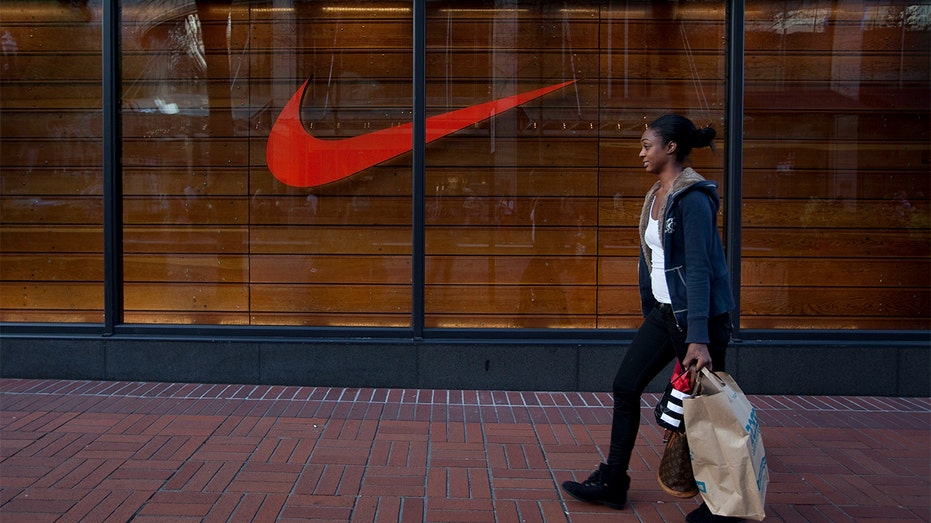
A woman carries a shopping bag while passing in front of a Nike Inc. store in Portland, Oregon, on Wednesday, April 24, 2013. (Natalie Behring/Bloomberg via Getty Images / Getty Images)
During a March conference call, Nike said its fiscal quarter ending in August 2026 would likely be the final period in which tariffs materially impact gross margins.
The lawsuit comes weeks after Nike announced plans to lay off roughly 1,400 employees across its Global Operations team.
In a memo to staff, Chief Operating Officer Venkatesh Alagirisamy said the cuts would primarily affect the company’s technology division across North America, Asia and Europe, representing just under 2% of its global workforce.
CLICK HERE TO GET FOX BUSINESS ON THE GO

The logo of Nike is pictured in a store in Manhattan on March 30, 2026, in New York City. (Zamek/VIEWpress / Getty Images)
Nike declined to comment to FOX Business.
FOX Business’ Eric Revell and Reuters contributed to this report.

Markets Weekly Outlook: Is The 'Risk-On' Rally Sustainable With Rates And Energy Elevated?
US military says it killed 2 in strike on alleged drug-trafficking boat

iSpecimen prices $2.5M private placement at $5.12 per share

These 3 Big AI IPOs Could Test Demand Before SpaceX Debuts
AppLovin Beats Quarterly Revenue Expectations. The Stock Is Rising.

Flex director Charles K. Stevens III sells $2.07m in shares

Surf Air Mobility CEO Deanna White sells $74,779 in shares

Oxford study finds warmer AI chatbots tell more lies

Netflix’s 4-Part Dark Drama Is the Perfect Addictive Weekend Binge

#finance #emergency #learning #life #money

Manchester United reach agreement with Casemiro over contract clause amid transfer speculation

US brings back mandatory military draft registration

Steven Gerrard disagrees with Gary Neville over ‘shock’ Chelsea and Arsenal claim | Football


-
 Crypto World16 hours ago
HarrisX Poll Found 52% of Registered Voters Support the CLARITY Act
-

 NewsBeat5 days ago
Channel 5 – All Creatures Great and Small series 7 new post
-

 Crypto World2 days ago
Upbit adds B3 Korean won pair as Base token gains Korea access
-

 Tech4 days ago
Image AI models now drive app growth, beating chatbot upgrades
-
 NewsBeat2 days ago
NCP car park operator enters administration putting 340 UK sites at risk of closure
-

 News Videos6 days ago
AP Dhillon – Old Money (Official Audio)
-

 Sports6 days ago
Five killed in Texas plane crash identified as Amarillo pickleball players
-
Entertainment6 days ago
New Netflix Movies in May 2026 — My Top 3 Picks to Stream
-

 Entertainment6 days ago
Melissa Joan Hart and More Stars Attend 2026 Kentucky Derby
-

 Fashion8 hours ago
Weekend Open Thread: Marianne Dress
-

 Crypto World6 days ago
Bitcoin mining equities rise in 2026 as BTC lags behind
-
 Crypto World6 days ago
Pi Network Mandates Protocol 23 Upgrade for All Mainnet Nodes Before May 15 Deadline
-
Entertainment6 days ago
Anna Nicole Smith’s Daughter Attends 2026 Kentucky Derby
-

 Business6 days ago
Luka Doncic Injury Update: Doncic’s Hamstring Recovery Slows Lakers’ Hopes Against Thunder: Can He Run Yet?
-
Entertainment6 days ago
Venus Williams’ Best Met Gala Looks Over the Years
-
 Entertainment6 days ago
After 2 Years, This Taylor Sheridan Neo-Western Doesn’t Have a Single Bad Episode
-
 Entertainment6 days ago
Netflix’s 10-Part Miniseries Based on a True Story Is a Perfect Weekend Binge
-

 Sports6 days ago
Is Man United v Liverpool on TV? Channel, streaming and how to watch Premier League fixture
-

 Business6 days ago
Kuwait International Airport Resumes Operations After Closure as Regional Tensions Ease in 2026
-
Crypto World6 days ago
Q1 2026 Tech Layoffs AI Wave Hits 81,747 as Firms Shift to AI Infrastructure
You must be logged in to post a comment Login