

Crypto World
Crypto and Equity Markdowns Drive Trump Media’s $406 Million Q1 Loss



Trump Media & Technology Group (TMTG) posted a $405.9 million net loss for the first quarter of 2026, dominated by non-cash losses.
Unrealized losses on digital assets and equity securities reached $368.7 million, almost the entire shortfall. Stock-based compensation added $11.8 million, alongside $11.5 million of accreted interest.
Bitcoin Treasury Drives Paper Losses as Prices Drop
TMTG’s crypto treasury is valued at $821.9 million against a $1.24 billion cost basis, per CoinGecko data. The position is roughly $423.06 million underwater overall.
The treasury contains 9,542 Bitcoin (BTC) worth $767 million, acquired at an average cost of $118,529 per coin. TMTG’s Bitcoin balance dropped by 2,000 BTC in late February, down from 11,542 BTC.
Bitcoin fell roughly 22% during Q1 2026, marking its worst quarter since 2018. The company also holds 756 million Cronos (CRO), worth $54 million.
Follow us on X to get the latest news as it happens
Trump Media’s Financial Assets Climb to $2.1 Billion as Revenue Stays Thin
Meanwhile, the operator of Truth Social produced just $0.9 million in revenue. Operating cash flows totaled $17.9 million, marking the company’s fourth straight positive quarter.
The firm’s total assets reached $2.2 billion. The figure nearly tripled from $759 million a year earlier.
“Trump Media is using its strong balance sheet and positive operating cash flow to continue growing all our businesses and platform infrastructure. Even as we work toward advancing our proposed merger with TAE Technologies as quickly as possible, we’re identifying new growth opportunities and new ways to increase shareholder value,” Interim CEO Kevin McGurn said.
Trump Media also said it is developing new Truth Social features, including prediction-market tools, a sports section, expanded use of artificial intelligence across the platform, and more.
Subscribe to our YouTube channel to watch leaders and journalists provide expert insights
The post Crypto and Equity Markdowns Drive Trump Media’s $406 Million Q1 Loss appeared first on BeInCrypto.


Bitcoin’s ongoing institutional embrace is drawing attention from across the market, but Strike CEO Jack Mallers argues that Wall Street’s deeper involvement does not undermine the asset’s core principles. In a wide-ranging conversation with Danny Knowles on the What Bitcoin Did podcast, Mallers defended Bitcoin’s ethos while acknowledging the a new era of capital flow.
“My one-word answer to that is no,” Mallers said, responding to whether institutional participation threatens Bitcoin’s foundational ideas. “If Wall Street getting into Bitcoin kills it, it was never going to be successful in the first place.” He framed the development as a natural part of Bitcoin’s evolution as it competes for global wealth, arguing that the asset’s mission to be “money for all” should include even those who might oppose it or come from different communities.
“Bitcoin is predicated on this idea that it is money for all. And the all part should be explored,” Mallers added. “That means your enemies, too.”
Key takeaways
- Strike’s Jack Mallers argues that Wall Street’s increasing involvement in Bitcoin does not threaten the asset’s core principles and may be essential to its broader adoption.
- 11 US spot Bitcoin ETFs have drawn a combined net inflow of about $59.38 billion as of the most recent reporting period, underscoring rising institutional interest in Bitcoin exposure, according to data from Farside.
- The influx of traditional capital is framed as a competitive force for Bitcoin to become a global store of value, with wealth migrating toward digital assets as part of a broader monetization of Bitcoin’s network effects.
- Wall Street’s push into crypto access pathways is multiplying, with Morgan Stanley reported to have rolled out a cryptocurrency trading pilot on its E*Trade platform, offering retail clients a lower fee structure than many peers—50 basis points per transaction.
- Within the Bitcoin community, there are tensions about governance and development pace, with some critics warning that large institutions could seek to influence or replace development decisions if core concerns, such as quantum computing risk, are not addressed swiftly.
Bitcoin’s broadening narrative: Wall Street’s footprint deepens
Mallers’ comments speak to a broader debate inside crypto circles about whether Wall Street’s growing ownership, custody, and trading presence will shift Bitcoin’s social contract. Proponents say institutional participation brings legitimacy, risk management, and liquidity to a market that has long been driven by retail and tech-savvy participants. Critics warn that large holders could gain outsized influence over key decisions, potentially diluting Bitcoin’s original decentralization ethos. The tension is not merely theoretical: it is playing out in instruments and platforms that shape how non-technical investors access and perceive Bitcoin.
On one hand, the trend reflects a maturing market. Since the US introduced spot Bitcoin ETFs in January 2024, a cohort of products has begun to attract institutional inflows. As of the latest reports, the 11 spot ETF funds have collectively accumulated about $59.38 billion in net inflows, illustrating that traditional asset managers see Bitcoin as a credible, scalable exposure for clients’ portfolios. This momentum aligns with a broader arc of traditional financial firms integrating crypto into their advisory and execution capabilities, signaling that Bitcoin is increasingly being analyzed and priced like a global macro asset rather than a niche tech product.
For investors, the implication is twofold: greater access to Bitcoin via familiar channels and the potential for deeper price discovery as large, diversified capital allocators participate. Yet the dynamic also raises questions about market structure, custody, and governance—areas where institutions historically exert influence. The debate remains whether Bitcoin can maintain its trustless, permissionless ideals while absorbing the efficiency and governance expectations of mainstream finance.
From on-ramp to on-chain: Wall Street’s retail access play
The period of institutional interest is accompanied by concrete moves that blur the line between traditional finance and crypto native services. Wall Street banks aren’t just offering exposure; they are building the plumbing for everyday investors to transact in digital assets. A notable development reported this week was Morgan Stanley’s reported rollout of a cryptocurrency trading pilot on its E*Trade platform. The pilot is described as offering lower basic retail fees than some of the largest crypto and brokerage platforms, pricing at around 50 basis points on the dollar value of trades. By pricing crypto access competitively, Morgan Stanley appears to be aiming to win a broader share of the retail crypto trading audience, potentially drawing customers away from pure-play crypto exchanges and traditional brokers alike.
The move signals a shift from mere custody or custody-adjacent services toward full execution capability and market access, a trend that could accelerate user adoption and reshape marketplace liquidity. While industry participants weigh fee levels and execution quality, observers are watching how such pilots will integrate with existing risk controls, compliance frameworks, and customer protection standards that are central to mainstream finance.
For traders and institutions, the evolving retail-on-ramp dynamic matters because it influences liquidity, price discovery, and the cost of capital in Bitcoin markets. A broader, more diverse base of participants can smooth price movements and reduce the risk of outsized moves tied to niche trader cohorts. However, it also elevates the importance of robust risk controls and transparent governance to maintain market integrity as new players enter the space.
Community perspectives: balancing ascent with core principles
Not all voices in the Bitcoin ecosystem are unreservedly celebratory about Wall Street’s growing presence. Some critics argue that large institutions could gain enough influence to shape Bitcoin’s development trajectory or question the pace at which developers address emerging concerns. In particular, discourse around resilience and future-proofing has included warnings that governance could shift if institutions push for faster timelines or more centralized decision-making. One prominent Bitcoin thinker cautioned that as institutions accumulate Bitcoin, they may seek to substitute governance or push for changes that align with their risk tolerances and timelines. The underlying tension is a reminder that Bitcoin’s architectural and policy choices—such as how updates are implemented and how disputes are resolved—remain critical to its long-term integrity. This debate has been echoed in coverage discussing technology risk, including concerns around quantum computing and the implications for security and development governance, as noted in broader industry conversations.
As these discussions unfold, observers will be watching how institutions engage with Bitcoin’s open-source development community, and whether traditional governance expectations are reconciled with the decentralized, permissionless ethos that helped Bitcoin reach its current status. The nuanced point, underscored by Mallers’ interview, is that Bitcoin’s universal appeal—its promise to be money for all—should be inclusive of diverse actors, even those with competing interests. Yet the challenge remains balancing rapid adoption and scale with the safeguards that maintain the network’s core trust framework.
For readers seeking context, these perspectives sit alongside ongoing reporting that institutional actors are actively shaping how crypto markets are accessed and regulated, and how new products and platforms can align with both investor protection and the network’s decentralization philosophy. As markets continue to evolve, watchers should monitor policy developments, custody standards, and the governance conversations that ultimately determine how Bitcoin navigates the intersection of innovation and institutional participation.
In sum, Mallers’ stance frames Wall Street’s ascent not as a threat but as a catalyst for Bitcoin’s global monetization and adoption. The coming quarters will reveal how this dynamic plays out across product design, market structure, and the delicate balance between openness and safeguards that define the asset’s path forward.
What’s next? Investors and users should watch for further institutional-thick liquidity in spot markets, the trajectory of ETF inflows, and how major banks balance consumer access with robust risk controls. Regulatory signals and governance debates will also be key to understanding whether the current momentum can translate into lasting, widely accessible on-chain usage and sustained price formation.

Ethereum’s native coin finally managed to break its all-time high during the 2025 rally, but only mildly compared to other assets, such as BTC. Its subsequent behavior has been quite painful, as it now trades over 53% away from its peak at $4,950 from August 2025, even after the market-wide rebound seen in the past few weeks.
Moreover, on-chain data shows that whales have been disposing of their assets, which begs the question: what does ETH need to recover to $3,000 and beyond?
Whales Moving Off ETH?
Recall that ETH whales went on a massive accumulation spree in the middle of last year, which peaked shortly after the asset’s all-time high and before the massive market-wide crash in early October. More precisely, those holding between 1,000 and 10,000 tokens had increased their portfolios from 12.95 million to 15.95 million in just several months, according to data shared by Ali Martinez.
Since then, though, their behavior has changed completely aside from a few brief exceptions. Their total holdings have declined by 21.5%, Martinez continued, bringing them below the starting point of 12.95 million to 12.52 million ETH.
Given this significant whale exodus, Martinez questioned whether they will be able to sustain a more profound rally to $3,000 and beyond. In fact, he suggested that the asset might require “a fresh wave of institutional or retail demand” to offset the whales’ distribution.
Ethereum whales are doing something they haven’t done in a year.
Since October 6, 2025, Ethereum whales holding 1,000 to 10,000 $ETH have undergone a significant regime change in their market behavior.
Before this shift, this cohort was in a steady accumulation regime. Their… https://t.co/5WAJSKsnl9 pic.twitter.com/qezrxfq6Re
— Ali Charts (@alicharts) May 7, 2026
ETF Inflows Incoming?
After five consecutive months of outflows dominating inflows, the spot Ethereum ETFs finally broke this adverse streak in April, attracting over $355 million in fresh capital. Although May began on a high note as well, with roughly $170 million entering the funds in just several days, the year-to-date numbers remain deep in the red.
Moreover, the ETH ETF cumulative total net inflows are far from their peak marked in early October of approximately $15 billion. As last week’s closing bell, they stood at just over $12 billion.
Consequently, it’s safe to assume that ETF investors have not stepped up to offset the whales’ distribution so far. Perhaps that’s why ETH remained over 53% below its August 2025 ATH, and every breakout attempt has been halted at $2,400.
The post What Does ETH Need to Surge Past $3,000 Again as Whales Are Abandoning Ship? appeared first on CryptoPotato.

Bitcoin payments application Strike CEO Jack Mallers said that Wall Street’s growing involvement in Bitcoin poses no threat or conflict to the asset itself.
“My one-word answer to that is no,” Mallers told Danny Knowles on the What Bitcoin Did podcast published to YouTube on Thursday, in response to whether institutional involvement threatens Bitcoin’s core principles.
“If Wall Street getting into Bitcoin kills it, it was never going to be successful in the first place,” Mallers said.

Jack Mallers spoke to Danny Knowles on the What Bitcoin Did podcast. Source: What Bitcoin Did
“Bitcoin is predicated on this idea that it is money for all. And the all part should be explored. That means your enemies, too,” he said. “That means the ex-wife that cheated on you, that means your neighbor that’s a fan of the opposing football club, that’s everybody,” he added.
Bitcoin is competing for global capital, says Mallers
Some Bitcoiners argue that Wall Street’s presence threatens Bitcoin’s original ethos by concentrating ownership, influence and custody of the asset in the hands of large financial institutions. Since spot Bitcoin ETFs launched in the US in January 2024, the 11 funds have collectively recorded $59.38 billion in net inflows as of Friday, according to Farside data.
However, Mallers said the “obvious implication” is that Wall Street and other major traditional investors would get involved in Bitcoin as the asset competes for global capital.
“Where wealth exists today, those things will be demonetized like real estate will be demonetized, fine art will be demonetized, government debt will be demonetized, and Bitcoin will be monetized,” he said.
Some Bitcoiners have argued that growing institutional involvement could eventually give large firms too much influence over Bitcoin itself. Bitcoiner and venture capitalist Nic Carter said that major Bitcoin-holding institutions may eventually lose patience with Bitcoin developers for not addressing quantum computing concerns quickly enough. “I think the big institutions that now exist in Bitcoin, they will get fed up, and they will fire the devs and put in new devs,” Carter said in February.
Wall Street moves in on crypto platforms’ customers
There have been several developments in Wall Street’s adoption of Bitcoin and, more broadly, crypto over the past couple of years.
Related: CLARITY Act support carries electoral boost, HarrisX poll finds
Most recently, on Tuesday, it was reported that Morgan Stanley rolled out a cryptocurrency trading pilot on its E*Trade platform, charging lower basic retail fees than some of the largest US crypto and brokerage platforms.
The Wall Street bank is charging clients 50 basis points on the dollar value of each crypto transaction, undercutting Coinbase, Robinhood and Charles Schwab on standard retail pricing.
Magazine: Guide to the top and emerging global crypto hubs: Mid-2026
Crypto World
Best Crypto to Invest in Right Now as BITCOIN Breaks Past $81,000 and One Presale Could Deliver the Returns That Altcoins Cannot
BITCOIN just broke past $81,000 for the first time since January, and the best crypto to invest in landed back at the center of every portfolio decision. April ETF inflows hit $2.44 billion, the strongest monthly figure since October 2025, and that kind of institutional buying confirms the recovery is built on real demand rather than a short-lived bounce.
Meanwhile, Pepeto keeps banking capital at presale pricing, with $9.84 million raised and an expected Binance listing that could reprice the token before most buyers even notice.
While institutions stack BITCOIN through ETFs and retail watches from the sidelines, Pepeto’s PepetoSwap exchange and risk scoring tool bring direct trading paths and contract verification to every wallet. The presale window is narrowing by the day.
BITCOIN Rallies Past $81,000 on ETF Demand and Geopolitical Relief
BITCOIN hit $81,000 on May 5 as multiple catalysts came together at once. April spot ETF inflows reached $2.44 billion, with BlackRock and Fidelity leading the buying, according to CoinDesk.
The move also followed eased Middle East tensions after an announcement around the Strait of Hormuz, which lifted risk assets broadly. This rally confirms that capital is returning to crypto at a pace that makes the best crypto to invest in conversation relevant for anyone sitting on the sidelines.
Projects and Coins Defining the Best Crypto to Invest in for This Market Cycle
Pepeto
The BITCOIN rally is a reminder of how the capital flow works in crypto. Institutions and large wallets move first during fear, and by the time the recovery shows up on the chart, the cheapest entries are already gone. Whether it is ETF demand during a dip or whale buying before a breakout, the wallets that act during doubt collect what the late arrivals cannot reach.
Pepeto, considered the best crypto to invest in, was designed to close that distance. Created by the mind behind the original PEPE coin who proved what happens when 420 trillion tokens meet a community that refuses to stop buying, Pepeto’s PepetoSwap marketplace processes token trades and the risk scoring tool audits smart contracts before capital touches anything dangerous.
This functioning product is precisely why the presale banked more than $9.84 million during a market that crushed most new launches. At $0.0000001868, the project is backed by a functioning marketplace that traders already use, and the projected upside ranges from 100x to 300x because the entry window opened at the same stage where every past winner started before anyone cared.
Compare this to waiting for established coins to double from prices that already carry billions in market cap. Pepeto does not need years to play out because the expected Binance listing marks the moment when presale holders see their entry repriced against the full market for the first time.
Independent verification from SolidProof covers every contract, staking at 175 percent APY grows positions daily for wallets that moved early, and the distance between $0.0000001868 and a listing price set by millions of traders is the kind of gap that created every crypto fortune worth talking about.
DOGECOIN
DOGECOIN (DOGE) is trading near $0.10 after whales loaded 160 million tokens in 96 hours and the first DOGE ETF attracted fresh inflows. The price cleared the 50-day and 100-day moving averages for the first time in months, and technical targets now sit at $0.126 where the 200-day moving average waits as resistance.
While DOGE carries strong whale backing and growing ETF attention, the token still trades 84 percent below its all-time high of $0.7376 and needs multiple catalysts to reclaim higher ground, which is why many searching for the best crypto to invest in look at earlier-stage projects with a clear listing catalyst still ahead.
ETHEREUM
ETHEREUM (ETH) is trading near $2,285 according to CoinMarketCap after the Glamsterdam upgrade went live and tripled the gas limit to 200 million per block, according to Reuters. ETF inflows reached nine consecutive days, and whale buying topped 230,000 ETH in one week, which means large buyers are treating this zone as a long-term entry.
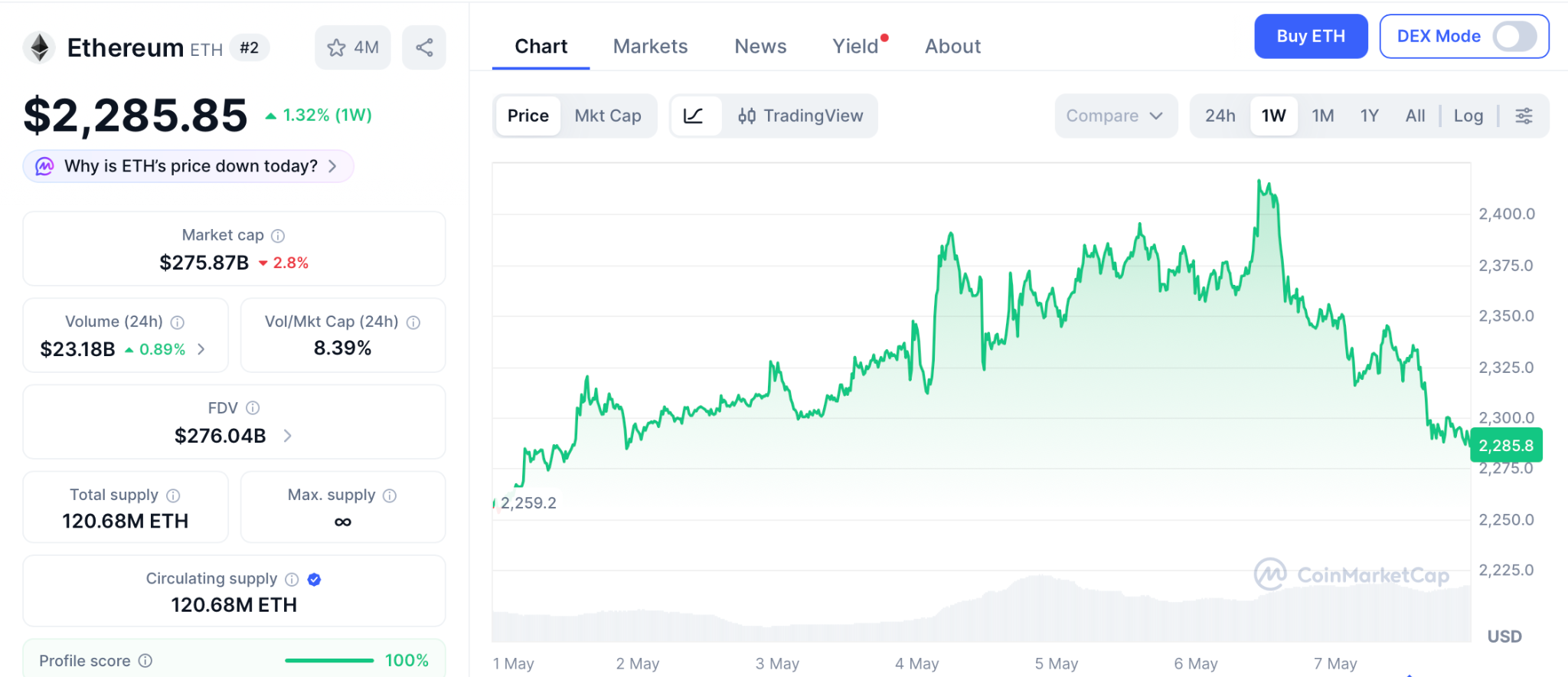
While ETH holds the strongest technical infrastructure in crypto, the price still sits 53 percent below its all-time high of $4,953 and needs sustained demand above $2,500 to confirm the next leg higher.
Conclusion
The market always pays the most to the earliest believers, and the window to be early does not stay open once the listing arrives. PEPE turned small wallets into millions with zero products, and those entries can never come back. More than $9.84 million flowing into this presale during market fear means those wallets see the same setup that rewarded the earliest holders in every previous cycle, and that is exactly what the best crypto to invest in conversation comes down to right now.
Pepeto carries the backing of the PEPE cofounder, a live marketplace, a risk scoring tool, and an expected Binance listing that could go live any day. One simple decision, entering now instead of waiting, is the difference between being the wallet that collected 100x to 300x and being the one that watched from the sidelines and spent the rest of the cycle wishing they had moved when it cost almost nothing.
The listing is not months away, it is close, and every day of hesitation shrinks the window that separates life-changing returns from regret that lasts the entire bull run.
Click To Visit Pepeto Website To Enter The Presale

FAQs
What makes Pepeto the best crypto to invest in during the 2026 bull market?
Pepeto is the best crypto to invest in during the 2026 bull market because it combines a working marketplace, a contract risk scorer, and an expected Binance listing into one presale entry at $0.0000001868. The project has raised more than $9.84 million with 175 percent APY staking that grows positions for holders who entered before listing.
How does the BITCOIN rally affect the best crypto to invest in right now?
The BITCOIN rally past $81,000 confirms institutional money is back in the market, and that capital historically rotates into smaller tokens within days of BTC breaking key levels. Presale entries with listing catalysts ahead capture the largest returns during this rotation phase.
Is DOGECOIN or ETHEREUM a stronger investment than Pepeto in 2026?
DOGECOIN and ETHEREUM carry solid technical backing but sit 84 percent and 53 percent below their all-time highs respectively, which limits their short-term upside. Pepeto offers a presale entry at $0.0000001868 with an expected Binance listing that sets a clear repricing event no established coin can match.
Disclaimer: This is a Press Release provided by a third party who is responsible for the content. Please conduct your own research before taking any action based on the content.

Crypto World
Ondo Finance Builds Bullish Setup Near 0.44 as Institutional RWA and Capital Inflows Surge

TLDR:
- Ondo Finance holds near $0.44 as accumulation signals strengthen across trading sessions
- Ondo Finance benefits from RWA expansion as institutional inflows support the market recovery trend
- Market structure improves as ONDO shows higher lows and reduced downside pressure overall
- Cross-border settlement with major institutions strengthens ONDO’s relevance in tokenized finance
Ondo Finance is on a revival journey as its price structure strengthens alongside its real-world asset adoption and institutional settlement progress. This move is showing a reflection of renewed confidence across digital asset markets.
Accumulation Structure and RWA-Driven Price Action
Ondo Finance is trading within a strengthening accumulation range after months of broad market correction pressure.
Price behavior around the $0.20 zone has repeatedly attracted buyers, establishing a notable demand foundation across sessions.
Following this reaction, ONDO recorded a sharp rebound of nearly 88 percent from recent lows with sustained volume expansion.
This movement suggests that selling pressure is gradually being absorbed as market structure shifts toward recovery formation stages.
RWA sector momentum continues to support Ondo Finance as tokenized treasuries and yield products attract renewed attention.
Market participants are increasingly rotating liquidity into real-world asset protocols as institutional demand expands across digital markets.
This rotation has strengthened ONDO positioning within narrative-driven altcoins, especially as volatility compresses near support regions.
Ondo Finance, therefore, remains positioned within a structurally improving range supported by gradual capital inflows and renewed participation.
The technical structure shows higher lows forming consistently, indicating absorption of supply during consolidation phases across trading intervals.
This pattern often precedes expansion phases when liquidity returns, and market sentiment stabilizes after extended uncertainty periods.
Ondo Finance, therefore, remains positioned within a structurally improving range supported by gradual capital inflows and renewed participation.
Cross-Border Settlement and Institutional Integration
Ondo Finance has advanced its institutional relevance through a near real-time cross-border redemption of a tokenized U.S. Treasury fund.
The transaction involved collaboration with Kinexys by JPMorgan, Mastercard, and Ripple across a hybrid settlement infrastructure.
Execution occurred using both public blockchain systems and traditional interbank rails, enabling seamless financial interoperability.
Settlement completion outside standard banking windows demonstrates continuous operational capability within tokenized financial systems. This framework supports the concept of 24/7 global settlement for digital assets across integrated financial networks.
Ondo Finance remains positioned within this evolving structure as institutional testing of blockchain settlement expands globally.
Market response reflects growing attention toward tokenized treasury products and real-time settlement efficiency across institutional channels.
Financial institutions continue exploring blockchain integration to improve settlement speed and reduce operational constraints.
Ondo Finance benefits from this environment as the adoption of real-world asset tokenization increases steadily across markets.
The collaboration between major financial entities signals increased alignment between traditional finance systems and blockchain networks.
This alignment supports broader experimentation with hybrid settlement models across global financial infrastructure frameworks.
Continued progress in tokenized settlement may shape future cross-border transaction standards across regulated markets.
Ondo Finance remains a reference point in this evolving financial infrastructure transformation phase. Liquidity flows indicate sustained interest from participants evaluating blockchain-based settlement systems. globally
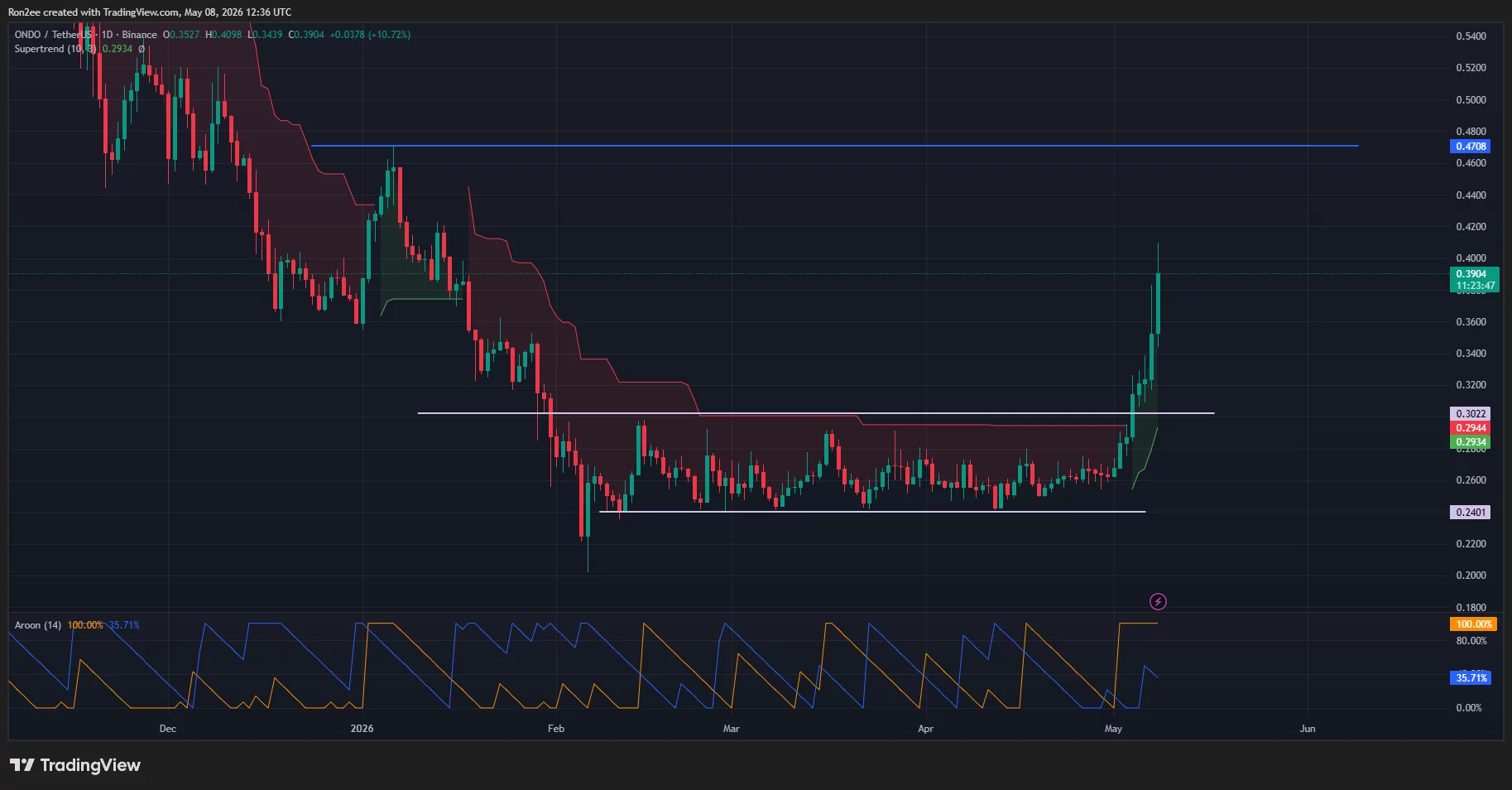
Ondo price surged above $0.30 after a JPMorgan-Mastercard tokenized Treasury pilot and strong Q1 growth pushed TVL to $3.53 billion.
Summary
- Ondo price surged above the key $0.30 resistance after completing a cross-border tokenized Treasury settlement pilot with JPMorgan, Mastercard, and Ripple.
- ONDO rallied more than 50% over the past week as the project reported $13.26 million in Q1 revenue and $3.53 billion in total value locked.
- Technical indicators turned bullish after the breakout, with analysts now watching the January resistance zone near $0.47 as the next major upside target.
According to data from crypto.news, Ondo (ONDO) climbed to an intraday high near $0.40 on May 8 before slightly easing to around $0.39 at press time. The token has now gained more than 50% over the past week, making it one of the strongest-performing major RWA-focused assets during the period.
The latest rally comes amid a series of major institutional developments tied to Ondo’s tokenized treasury products.
One of the biggest catalysts was the successful completion of a cross-border institutional settlement pilot involving Ondo, JPMorgan’s Kinexys, Mastercard, and Ripple. The pilot demonstrated the redemption and settlement of tokenized U.S. Treasuries using blockchain infrastructure, with the asset leg reportedly finalized in under five seconds on the XRP Ledger.
The development strengthened investor confidence that tokenized financial products are gradually moving closer to real-world institutional adoption.
ONDO also benefited earlier this week after being selected for the Depository Trust & Clearing Corporation’s Industry Working Group, an initiative focused on exploring how tokenization could modernize capital markets infrastructure. The DTCC currently processes transactions worth quadrillions of dollars annually across global financial markets.
Strong fundamentals also helped sustain the rally. Ondo recently reported $13.26 million in Q1 revenue, while total value locked climbed to roughly $3.53 billion, reflecting continued growth across its tokenized asset ecosystem.
At the same time, anticipation surrounding Ondo’s planned expansion to the Solana ecosystem, including the launch of more than 200 tokenized stocks and ETFs, has further supported bullish momentum.
Ondo price analysis
On the daily chart, ONDO has now broken above the major horizontal resistance zone near $0.30, a level that capped multiple recovery attempts since February. The breakout followed several months of sideways consolidation between roughly $0.24 and $0.30, suggesting that buyers gradually absorbed selling pressure before the latest move higher.
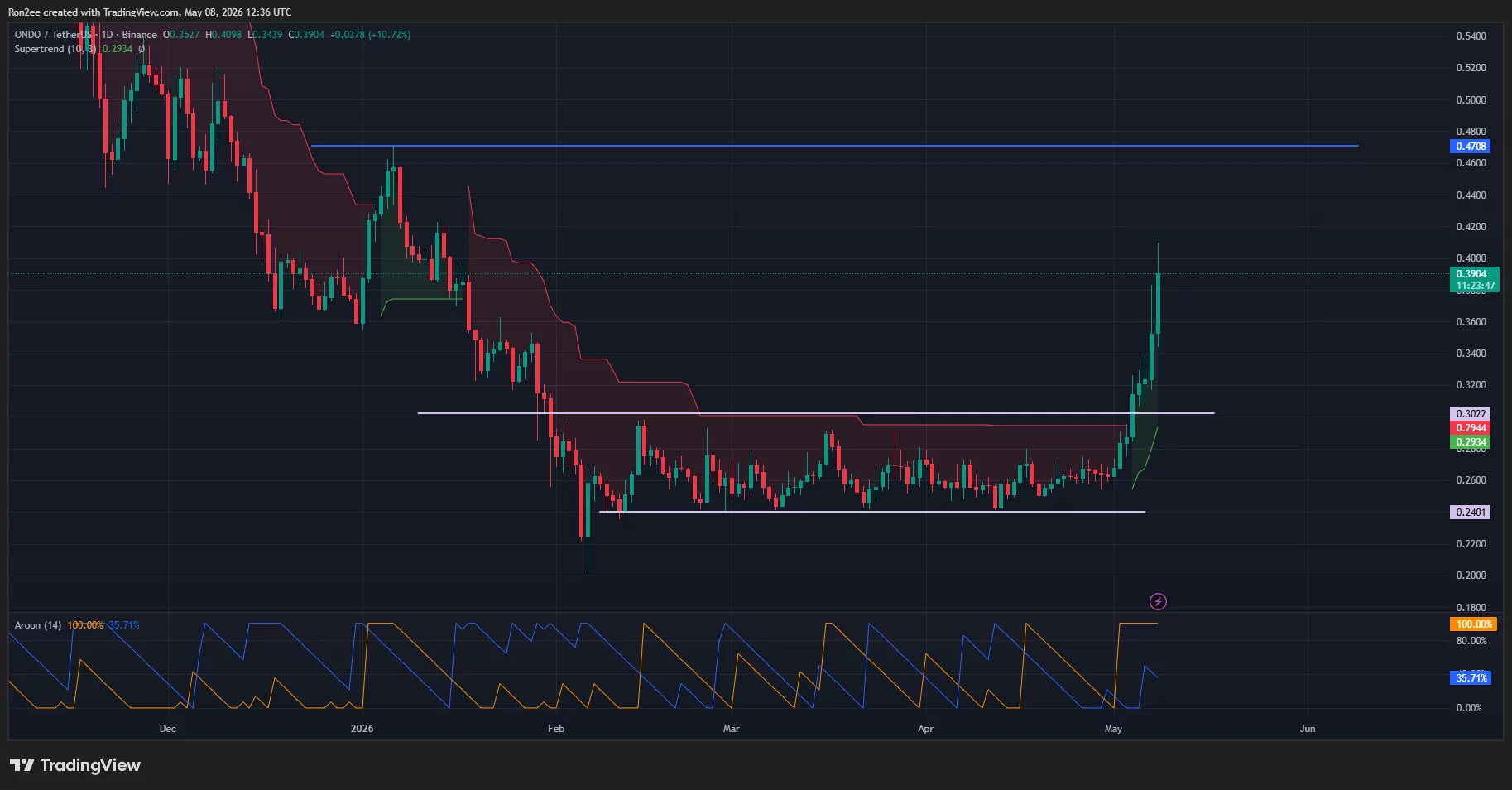
The rally also pushed price well above the Supertrend resistance level, with the indicator now beginning to flip bullish after remaining in a bearish structure for months.
Meanwhile, the Aroon Up indicator has surged to 100%, while the Aroon Down has dropped toward 35%, signaling strengthening bullish momentum and a possible shift in broader trend direction.
However, momentum indicators also suggest the rally may be overheating in the short term. ONDO’s Relative Strength Index recently climbed above 81, indicating heavily overbought conditions that could trigger temporary profit-taking or volatility after the sharp move higher.
If bulls maintain control above the $0.30 breakout zone, the next major upside target could emerge near $0.47, which marks the January local high and a key resistance region from the broader downtrend structure.
On the downside, losing the newly reclaimed $0.30 support level could weaken the breakout structure and potentially trigger a pullback toward the $0.24 consolidation range.
Disclosure: This article does not represent investment advice. The content and materials featured on this page are for educational purposes only.
TLDR:
- Ethereum’s DeFi TVL share dropped from 63.5% to 54% in 2026, yet it still leads with $45.4 billion locked.
- Hyperliquid recorded $9.37 billion in 24-hour perpetuals volume, confirming its role as DeFi’s top perps venue.
- Tron holds $89.6 billion in stablecoins with USDT at 97.86%, making it crypto’s largest dollar-settlement rail.
- Ethereum’s DeFi TVL share could recover to 55–58% or compress to 46–50% by end-2026, data projects.
Ethereum DeFi TVL declined from 63.5% at the start of 2025 to approximately 54% as of May 7, 2026. Even so, Ethereum retains the top position with $45.4 billion locked across protocols, per DeFiLlama.
Rival chains have narrowed the gap by targeting distinct roles in decentralized finance. BSC dominates DEX flow, Tron leads stablecoin settlement, and Hyperliquid controls perpetuals. Each of these competing chains currently holds under 7% of DeFi TVL individually.
How Rival Chains Are Claiming Specialized DeFi Roles
BSC built its position through Binance distribution and PancakeSwap integration. In Q2 2025, PancakeSwap volume surged 539.2% quarter-over-quarter to $392.6 billion.
Binance deepened this through Alpha Earn and Alpha 2.0, embedding DEX trading inside its exchange interface. DeFiLlama shows BSC at $5.55 billion in TVL and $739.6 million in 24-hour DEX volume.
Tron operates as a stablecoin settlement rail rather than a broad trading platform. DeFiLlama records $89.6 billion in stablecoins on the network, with USDT at 97.86% of that total.
Its 24-hour DEX volume of only $55.5 million confirms thin application diversity. At $5.19 billion in TVL, Tron stands as crypto’s leading stablecoin settlement network.
Bitcoin’s DeFi TVL reached $5.34 billion with 6.35% dominance, growing 13.4% over 30 days. Its 24-hour DEX volume of $338,516 confirms that capital flows to Bitcoin for yield, not active trading. The BTCFi model centers on collateral use and lending protocols rather than exchange activity.
Hyperliquid has grown into a purpose-built on-chain perpetuals venue. DeFiLlama shows $9.37 billion in 24-hour perpetuals volume and $8.94 billion in open interest.
Its TVL of $1.52 billion understates its true market weight. These metrics confirm that perpetuals now form a self-contained DeFi liquidity center.
Ethereum’s Remaining Strengths and the Path Forward
Ethereum’s absolute position remains strong across key DeFi metrics. DeFiLlama records $45.4 billion in TVL and $165.5 billion in stablecoins.
The chain hosts blue-chip lending protocols and the deepest stablecoin pools in the market. Institutional integrations continue to place Ethereum as the core balance sheet for DeFi.
Base adds nuance here, operating within the Ethereum technology stack. Coinbase built Base as an L2 on the OP Stack, available in over 140 countries.
Activity on Base still settles within Ethereum’s security model. DeFiLlama puts Base at $4.58 billion in TVL and $854.97 million in 24-hour DEX volume.
Two scenarios project Ethereum’s DeFi TVL share by end-2026. In the recovery path, share climbs to 55%–58% as stablecoin and lending growth outpaces specialist chains.
Ethereum’s $165.5 billion stablecoin base and lending depth support this outcome. Institutional tokenization further reinforces capital concentration on Ethereum.
In the compression scenario, Ethereum’s DeFi TVL share falls toward 46%–50% by end-2026. This occurs if Binance deepens integration, BTCFi grows further, and Hyperliquid maintains its perpetuals lead.
Ethereum would then serve as DeFi’s settlement layer while user activity shifts to specialized venues. Its stablecoin depth and institutional role keep it central regardless.
Acting Labor Secretary Sandlin’s push for earlier Fed cuts clashes with a cautious central bank, leaving crypto trading a “higher for longer” regime even as the political drumbeat for easing grows louder.
Summary
- Acting US Labor Secretary Sandlin has said the Federal Reserve “should consider lowering interest rates,” putting a senior Biden administration official on the side of earlier easing even as Fed leadership signals patience.
- The comments land against a backdrop of strong jobs and growth data that have already pushed market expectations for the first Fed cut into late 2026, weighing on bitcoin and other risk assets.
- For crypto, a credible political drumbeat for cuts could support medium‑term bullish narratives, but in the short term traders are still trading off Fed guidance and data that argue for rates staying at 3.5–3.75% longer.
Political pressure builds for easier Fed policy
Acting Labor Secretary Sandlin’s remark, reported by Jinshi, that the Federal Reserve should “consider lowering interest rates” adds an explicit voice from the administration’s economic team to a growing chorus arguing that current policy is too tight for the labor market. While the exact wording of Sandlin’s statement has not been widely syndicated yet, it echoes recent comments from Fed officials like Governor Christopher Waller and Vice Chair for Supervision Michelle Bowman, who have both said they are prepared to back cuts if job losses mount or labor data deteriorate.
Waller told CNBC in March that he supported holding rates at the April meeting but was “willing to advocate for rate cuts later this year” if the labor market “remains weak,” while Bowman warned in January that, absent “a clear and sustained improvement in labor market conditions,” the Fed should be ready to bring policy “closer to neutral.” In parallel, former Treasury Secretary Steven Mnuchin has criticized the central bank for being “too slow” to lower rates after being late to hike during the pandemic, telling The National that he expects the terminal rate to settle between 3% and 3.5%, below where the Fed has been for much of the past year.
Despite this, the center of gravity inside the Fed is still firmly on the side of caution. A late‑April Reuters poll of economists found that most now expect the first cut no earlier than Q4 2026, with war‑related energy shocks and sticky inflation leading markets to scale back bets on 2026 easing. Minneapolis Fed President Neel Kashkari has gone further, telling Reuters that the oil shock from the Strait of Hormuz and Gaza could even justify hiking again if inflation re‑accelerates, and Boston Fed President Susan Collins recently said she was “strongly supportive” of holding rates at 3.5–3.75% rather than signaling imminent cuts.
What a cut — or delay — means for crypto
For crypto markets, what matters is less Sandlin’s individual statement and more how it interacts with the evolving Fed path. Crypto.news has already documented how falling odds of 2026 rate cuts have pressured bitcoin, with one story noting that BTC retreated after strong GDP data pushed back expectations for easing and left traders re‑pricing key support around $80,000. Another crypto.news story showed a similar pattern after disappointing jobs revisions in February: as markets inferred “higher for longer,” the total crypto market cap dropped and bitcoin slid below $67,000.
When cuts do arrive, the reaction is not always straightforward. As BitMarkets pointed out in an analysis, a recent 25‑basis‑point Fed cut to the 3.5–3.75% range, though fully priced in, did not produce the expected follow‑through in BTC and ETH, with both coins stalling as traders sold the news. In another episode tracked by TradingView’s news desk, bitcoin briefly spiked above $93,000 on the announcement of a Fed cut before fading as markets digested guidance that further easing would be gradual.
The through‑line is that crypto trades the whole policy regime, not just the direction of the next move. Goldman Sachs Research still forecasts two more Fed cuts over the next year, which would leave rates around 3–3.25%, but warns that a higher‑for‑longer scenario remains plausible if inflation stays sticky. For now, Sandlin’s call for cuts might help bolster the medium‑term narrative that political and labor‑market pressure will eventually force the Fed to ease — a backdrop that historically has favored bitcoin and ethereum as “duration” assets — but until the data flip or Fed communication softens, the balance of risk for crypto remains tied to a policy rate that is, in the Fed’s own words, “significantly in restrictive territory.”


Hong Kong’s SFC flags HabitTrade in a warning on unlicensed virtual asset platforms, but the broker insists it hasn’t done regulated business or marketed services to Hong Kong investors and blames unauthorized third‑party promoters.
Summary
- Hong Kong’s Securities and Futures Commission (SFC) has warned investors about unlicensed platforms and recent promotional activity referencing HabitTrade.
- In response, HabitTrade says it is a licensed Australian brokerage and “has not conducted any regulated business in Hong Kong,” nor marketed such services to the Hong Kong public.
- The firm blames third-party promoters for unauthorized content using its brand and says it may pursue legal action, underscoring how tight Hong Kong’s virtual asset rules have become.
HabitTrade has pushed back against an investor alert from Hong Kong’s Securities and Futures Commission, saying it does not carry out regulated activities in the city and has not marketed its services to Hong Kong residents. In a statement posted on X, the brokerage said it “is a licensed Australian brokerage and compliant financial services platform” and that it “has not conducted any regulated business in Hong Kong, nor promoted or provided related services to the public in Hong Kong,” directly disputing any suggestion that it is operating there without authorization.
The clarification comes after the SFC published a notice reminding the public to be wary of “unlicensed platforms and related market promotional activities,” explicitly flagging HabitTrade in the context of suspicious marketing around virtual asset trading. While the regulator’s latest web alert does not yet list HabitTrade by name on its public “suspicious virtual asset trading platforms” page, the SFC has regularly used such notices to call out firms it believes may be targeting Hong Kong investors without a license. In an earlier circular on crypto products, the SFC warned that dealing in virtual asset futures or routing related orders for Hong Kong clients is a “Type 2” regulated activity and “requires a license from the SFC regardless of whether the business is located in Hong Kong.”
HabitTrade argues that any recent marketing push is not coming from the company itself. The broker said that “some third-party promotional content, video materials, and platform traffic diversion activities that have recently appeared in the market do not represent the official position of HabitTrade,” adding that it “reserves the right to trace and take legal action against any misleading promotions and violations using its brand, technological channels, or partnerships without authorization.” The firm also pledged to “adhere to a compliance-first approach and cooperate with the regulatory requirements of relevant jurisdictions to conduct necessary investigations,” signaling that it is prepared to work with authorities to identify promoters it says are misusing its name.
The dispute highlights how aggressive Hong Kong’s enforcement stance around virtual assets has become. In 2023, the SFC warned unlicensed virtual asset trading platforms that making false claims about license applications or offering prohibited services such as staking could constitute a criminal offence under the Anti‑Money Laundering and Counter‑Terrorist Financing Ordinance. In February 2024, the regulator and local police jointly warned about an alleged scam using the name of MEXC, putting the platform on its alert list and reiterating that overseas exchanges cannot market or serve Hong Kong retail users without a license, as crypto.news reported in a detailed story.
Those rules have only tightened. A recent crypto.news story on Hong Kong’s upcoming stablecoin and virtual asset regime noted that the city is building out parallel licensing systems for exchanges, custodians, dealers and advisers, and making it explicit that any foreign platform “targeting” Hong Kong investors via marketing or website localization is within scope. Against that backdrop, HabitTrade’s insistence that it has done no regulated business in Hong Kong is as much about legal risk as it is about reputation: under current SFC guidance, even the perception of soliciting Hong Kong users without a license can be enough to land a platform on the regulator’s alert list, with all the banking and counterparties problems that follow.


MegaETH has activated a MEGA token buyback program funded entirely by net revenue from its USDm stablecoin, turning Treasury‑backed yield into a standing bid for its “real‑time Ethereum” L2 token after a sharp post‑launch selloff.
Summary
- The MegaETH Foundation has kicked off a MEGA token buyback program, completing its first purchase using all net earnings generated by USDm through the end of April.
- USDm’s current supply is about $480 million, and future MEGA buybacks will run programmatically, with size determined by USDm supply and yield on its reserve assets.
- The foundation stresses that USDm is not issued or operated by MegaETH or MegaLabs, even as its revenue stream becomes a core economic engine for MEGA demand.
The MegaETH Foundation says its MEGA token buyback plan is now live, with the first repurchase funded entirely by net earnings from USDm accumulated through the end of April. In an announcement on X, the foundation said it had “completed the first MEGA buyback using all net income generated by USDm’s issuer as of April 30,” framing the move as the start of an ongoing demand loop where the ecosystem’s stablecoin revenue is recycled into the native token.
MEGA buyback goes live, tied directly to USDm revenues
Importantly, the foundation reiterated that “USDm is not issued or operated by the MegaETH Foundation or MegaLabs,” clarifying that the stablecoin’s issuer is a separate entity even though its economics are tightly coupled to MEGA. USDm is a yield-bearing stablecoin built on Ethena’s USDtb rails, with reserves primarily invested in BlackRock’s tokenized U.S. Treasury fund BUIDL via Securitize, alongside liquid stables for redemptions. Those reserves generate a predictable yield, which flows to the USDm issuer and, under the new scheme, is then used as the funding source for MEGA buybacks.
CoinMarketCap’s overview of MegaETH notes that the MEGA token has a fixed supply of 10 billion and is used for gas, staking and governance within the “real-time Ethereum” L2, which targets sub-millisecond latency and over 100,000 transactions per second. By tying MEGA buybacks to USDm’s revenues, the foundation is effectively turning stablecoin growth and on-chain economic activity into a direct support mechanism for MEGA’s price and scarcity.
Programmatic buybacks, variable size, and market impact
According to the foundation, future MEGA buybacks will be executed “as programmatically as possible,” running automatically according to preset rules instead of being manually timed by the team. The size of each operation “will not be fixed,” it said, but will depend on “changes in USDm supply and the yield of the underlying reserve assets,” meaning that as USDm circulates more widely and its Treasury-backed yield rises or falls, the buyback firepower will adjust in tandem.
Earlier this year, the MegaETH Foundation outlined a broader economic model in which USDm functions as an “economic engine” for the L2: yield from its reserves is used to subsidize sequencer costs and network fees and, now, to fund ongoing MEGA purchases from the market. MEXC’s summary of the plan notes that USDM (often stylized as USDm) “is backed by Ethena and BlackRock’s BUIDL fund,” and that the project will “trigger MEGA token generation based on KPIs” such as reaching $500 million in USDm circulation, launching 10 apps on MegaETH, or having at least three apps generate $50,000 in fees for 30 consecutive days. DefiLlama data show USDm’s broader MegaETH stablecoin stack now has a market cap of about $810.6 million, with USDm itself accounting for roughly 58% dominance, implying a USDm supply in the neighborhood of $470–$480 million.
The timing of the first buyback is notable. AInvest reported that MEGA fell about 38% from its April 30 launch price to $0.138 amid heavy post‑TGE selling pressure from early participants. CoinMarketCap’s explainer on MegaETH says the ecosystem was designed from the outset to “use its native stablecoin’s reserve yield to fund MEGA buybacks,” positioning this week’s announcement as the moment when that theoretical flywheel actually starts to spin. If USDm continues to grow and on-chain yields remain robust, the programmatic buyback mechanism could become a persistent marginal buyer of MEGA in secondary markets, linking the token’s long-term value more tightly to real usage and stablecoin demand rather than one-off hype cycles.

Freeman, Ohtani lead Dodgers past Sale, Braves in National League showdown

Microsoft is adding a feature that briefly maxes out your CPU to make Windows feel snappier

BITCOIN WARNING: DUMP & PUMP COMING (This is Why)!!! – Bitcoin News Today, Ethereum & Altcoins

Manchester United reach agreement with Casemiro over contract clause amid transfer speculation

US brings back mandatory military draft registration

Steven Gerrard disagrees with Gary Neville over ‘shock’ Chelsea and Arsenal claim | Football
BITCOIN WARNING: DUMP & PUMP COMING (This is Why)!!! – Bitcoin News Today, Ethereum & Altcoins

7 May | Live Market Analysis for Gold and Crypto | US Session

“Why Indians Are Obsessed With Money” #podcast #growth #motivation #rajshamani
-
 Crypto World24 hours ago
HarrisX Poll Found 52% of Registered Voters Support the CLARITY Act
-

 NewsBeat6 days ago
Channel 5 – All Creatures Great and Small series 7 new post
-

 Crypto World2 days ago
Upbit adds B3 Korean won pair as Base token gains Korea access
-

 Tech5 days ago
Image AI models now drive app growth, beating chatbot upgrades
-
 NewsBeat2 days ago
NCP car park operator enters administration putting 340 UK sites at risk of closure
-

 News Videos6 days ago
AP Dhillon – Old Money (Official Audio)
-

 Fashion15 hours ago
Weekend Open Thread: Marianne Dress
-

 Sports6 days ago
Five killed in Texas plane crash identified as Amarillo pickleball players
-
Entertainment6 days ago
New Netflix Movies in May 2026 — My Top 3 Picks to Stream
-
Crypto World7 days ago
Pi Network Mandates Protocol 23 Upgrade for All Mainnet Nodes Before May 15 Deadline
-

 Entertainment6 days ago
Melissa Joan Hart and More Stars Attend 2026 Kentucky Derby
-
Entertainment6 days ago
Anna Nicole Smith’s Daughter Attends 2026 Kentucky Derby
-

 Crypto World6 days ago
Bitcoin mining equities rise in 2026 as BTC lags behind
-

 Business6 days ago
Luka Doncic Injury Update: Doncic’s Hamstring Recovery Slows Lakers’ Hopes Against Thunder: Can He Run Yet?
-
Entertainment6 days ago
Venus Williams’ Best Met Gala Looks Over the Years
-

 Business7 days ago
Kuwait International Airport Resumes Operations After Closure as Regional Tensions Ease in 2026
-
Entertainment6 days ago
“Storage Wars” star Darrell Sheets' ex-wife breaks silence on his death
-

 Sports6 days ago
Is Man United v Liverpool on TV? Channel, streaming and how to watch Premier League fixture
-
 Entertainment7 days ago
After 2 Years, This Taylor Sheridan Neo-Western Doesn’t Have a Single Bad Episode
-
Crypto World6 days ago
Q1 2026 Tech Layoffs AI Wave Hits 81,747 as Firms Shift to AI Infrastructure
You must be logged in to post a comment Login