









“What is evident is that the apparent collapse of the Placenames Project was a slow-motion administrative failure, compounded by poor planning, departmental buck-passing and a worrying absence of long-term strategic thinking.”
Once again, this week a controversy erupted at Stormont, with Sinn Féin and the DUP retreating to opposite trenches, and accusations flying across the Assembly chamber and social media. But somewhere beneath the noise lies a far more mundane but arguably more troubling reality, which appears to be precisely what has happened with the collapse of funding for the Northern Ireland Placenames Project.
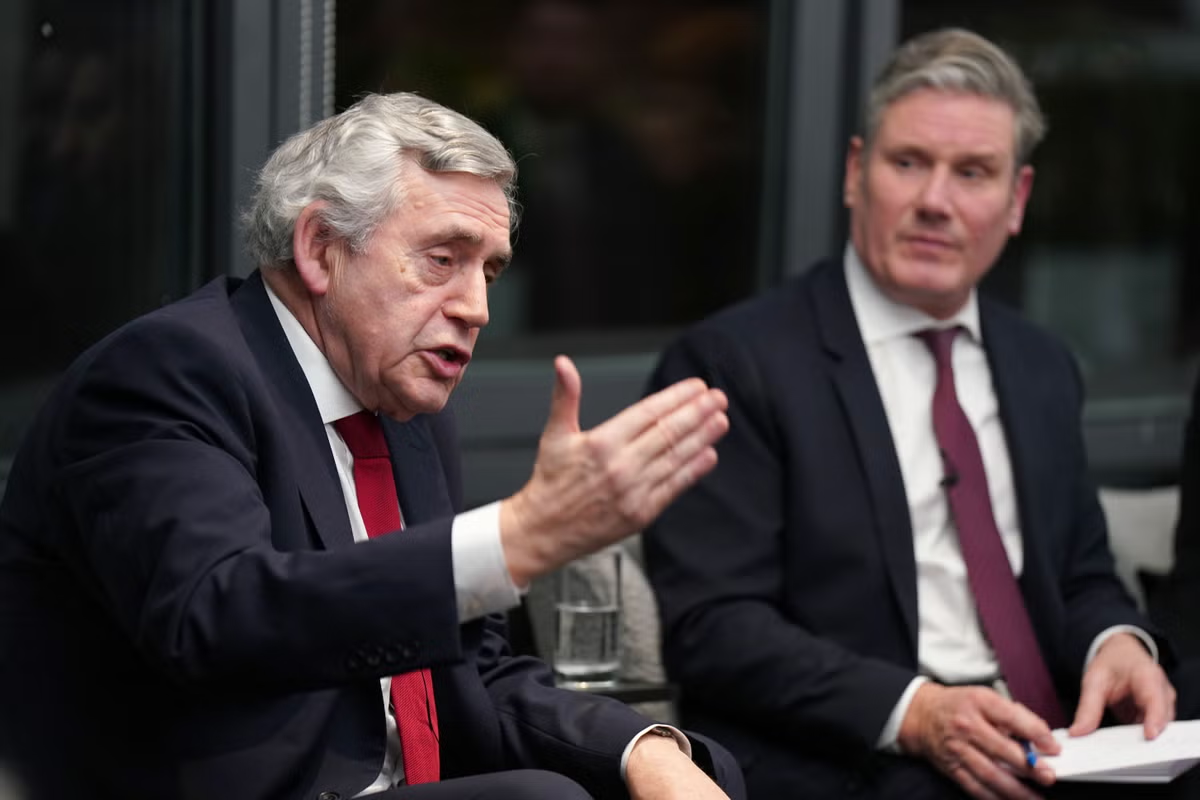
Over the past week, Sinn Féin accused Communities Minister Gordon Lyons and his department of allowing the project to die through neglect. The DUP, meanwhile, has sought to push responsibility back towards Sinn Féin ministers who oversaw the original transfer of the project from the Department of Finance to the Department for Communities in 2022.
Both sides can point to evidence which partially supports their case. But the documents and correspondence now in the public domain suggest this was not a story of one dramatic ministerial decision or ideological attack. Instead, what is evident is that the apparent collapse of the Placenames Project was a slow-motion administrative failure, compounded by poor planning, departmental buck-passing and a worrying absence of long-term strategic thinking.
READ MORE: Department for Communities officials warned £6m would be ‘wasted’ if additional funding wasn’t allocated for Placenames ProjectREAD MORE: ‘I never heard misogynistic language in PSNI’, says UUP leader Jon Burrows
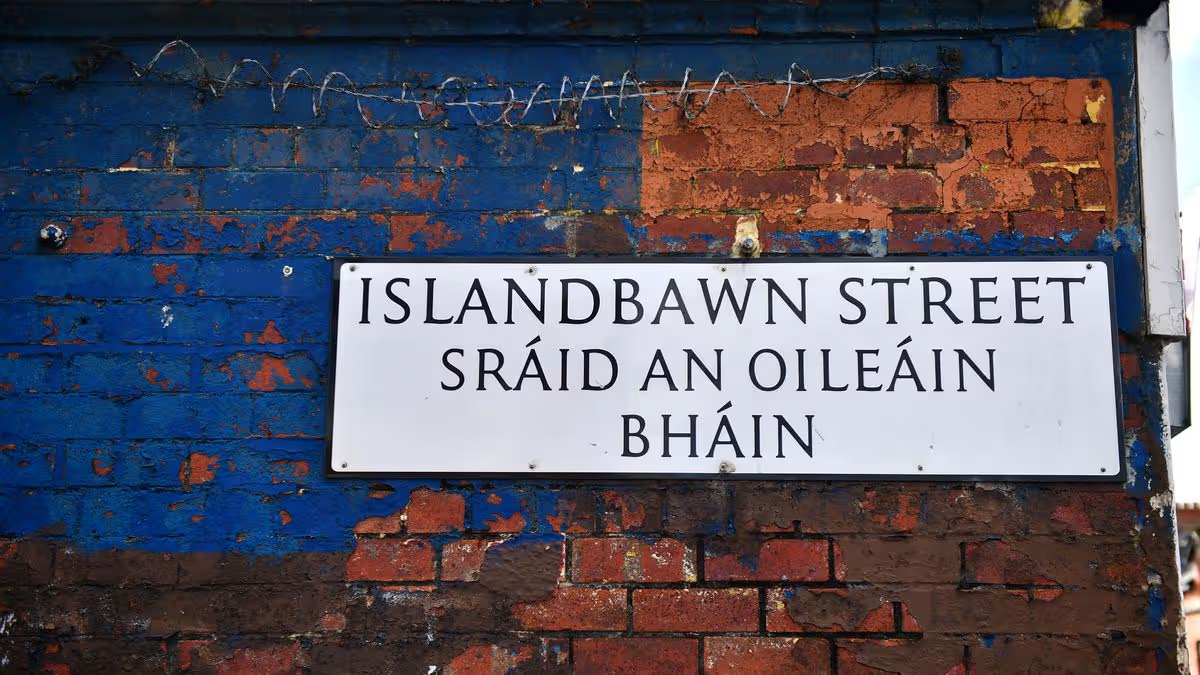
Since 1987, the project has researched and catalogued the history and Irish-language versions of place names across Northern Ireland. Councils and public bodies relied upon it as the authoritative source for bilingual signage and translation services, and officials themselves acknowledged it was the sole authoritative database for Irish versions of street names in Northern Ireland.
Yet, despite that acknowledged importance, a remarkable paper trail shows departments drifting towards a cliff edge while seemingly hoping that someone else would intervene before the funding finally ran out.
The Department of Finance are of the view that when the project was transferred to Communities in 2022, Finance agreed to continue funding it for three years as part of a transition arrangement. Officials repeatedly stressed in emails that the expectation was for Communities to absorb future funding requirements into their own budget planning exercises.
The Department for Communities, however, appears not to have done so.
Instead, officials spent months warning internally that the project was politically sensitive, that its collapse would waste public money already invested, and that the database itself risked being lost if funding ceased. At various points, they requested emergency funding from the Department of Finance while reviews and business cases were still being developed.
The correspondence paints a picture not of a department confidently managing a transition, but of one scrambling belatedly for stopgap solutions after the clock had almost expired.
None of this absolves Sinn Féin ministers entirely, either. The ministerial meeting note from January 2022 revealed that then Communities Minister, Deirdre Hargey, explicitly stated that no budget was available within her department to fund the project at that time and that any transfer would require accompanying resources.
That should have been the moment when the project’s long-term sustainability was nailed down in black and white. Instead, what emerged was a three-year holding arrangement, which appears to have postponed rather than resolved the fundamental issue.
It is no secret that Stormont has become increasingly vulnerable to this kind of governance failure. Departments operate within rigid silos, responsibilities are shuffled around without clear accountability, and politically sensitive projects can survive for years on temporary arrangements rather than a secure strategic footing. When financial pressure tightens, those unresolved problems eventually surface.
The danger is that this may not be an isolated case. If a project with acknowledged political sensitivity, cross-departmental relevance and repeated official warnings could drift towards collapse because future funding was never properly embedded into departmental planning, it inevitably raises wider questions.
How many other programmes currently exist on similar transitional arrangements? How many other projects are quietly dependent on temporary funding assumptions or unresolved departmental responsibilities?
Northern Ireland’s institutions already struggle with public confidence. Voters frequently hear ministers announcing strategies, commitments and long-term ambitions. But the machinery underneath often appears remarkably fragile, dependent upon short-term fixes and bureaucratic improvisation rather than coherent planning.
That fragility becomes particularly dangerous when political crises already consume enormous amounts of ministerial attention and civil service capacity.
What makes the Placenames Project saga especially frustrating is that nobody involved appears unaware of the risks. Officials explicitly warned about the consequences. They warned about the political implications. They warned about the loss of information. They warned about wasted public investment. Yet the system still drifted towards failure.
The row that unfolded inevitably descended into another orange-and-green blame game because that is the gravitational pull of our politics. But the more important story is the one sitting underneath the theatrics.
This was a test of whether Stormont’s institutions are capable of basic long-term governance. On the evidence now available, the answer is not especially reassuring.
For all the latest news, visit the Belfast Live homepage here and sign up to our daily newsletter here.




































You must be logged in to post a comment Login