

Crypto World
Ethereum Launches Clear Signing Standard to Combat Blind Signing Risks


TLDR:
- Ethereum’s Clear Signing standard now displays transactions in plain language instead of unreadable hex data.
- Blind signing has contributed to billions in ecosystem losses, prompting this open standard’s coordinated launch.
- ERC-7730 and ERC-8176 are the two core frameworks introduced to support human-readable transaction signing.
- Contributors include Ledger, Trezor, MetaMask, Fireblocks, and WalletConnect, coordinated by the Ethereum Foundation.
Ethereum has officially launched the Clear Signing open standard, marking a major step forward in transaction security.
The initiative converts unreadable hexadecimal data into plain, human-readable text during transaction approvals. The Ethereum Foundation coordinated the effort alongside key industry contributors.
Together, they aim to address one of the most persistent security vulnerabilities in the Ethereum ecosystem. Blind signing has cost the industry billions of dollars over the years.
What the Clear Signing Standard Brings to Ethereum
The Ethereum Foundation announced the launch via its official X account on May 12, 2026. The post stated that clear signing is now live as an open standard to end blind signing.
It described the development as a major upgrade to both user experience and transaction security on Ethereum.
Until now, signing a transaction often meant approving a string of unreadable hex data. This practice, known as blind signing, has contributed to billions in losses across the ecosystem. Users had no way to verify what they were actually approving before confirming transactions.
The new standard changes that by displaying transaction details in plain language. Instead of raw technical data, users now see clear descriptions of what each transaction does. This gives people better control and awareness before they confirm any on-chain action.
The Ethereum Foundation noted the effort builds on existing clear signing work already present in the ecosystem. In particular, it acknowledged the approach pioneered by Ledger as a foundation for this broader, unified standard.
Key Components and Contributors Behind the Initiative
Several prominent names in the crypto industry contributed to the Clear Signing initiative. Wallet and hardware contributors include Ledger, Trezor, MetaMask, WalletConnect, and ZKnox. On the security side, Cyfrin participated, while Fireblocks and Zama represented infrastructure. Sourcify and Argot contributed tooling support.
The standard introduces ERC-7730, which provides an open framework for human-readable transaction descriptions.
Alongside it comes a neutral, mirrorable descriptor registry for broader accessibility. An attestation framework under ERC-8176 allows auditors to verify the integrity of transaction descriptors.
Open developer tooling has also been released for wallets, protocols, and auditors to use. These tools make it easier for developers to integrate the standard across different platforms. The goal is to drive adoption and expand coverage across the Ethereum ecosystem consistently.
The Ethereum Foundation confirmed the work is ongoing and not a one-time release. Contributors will continue expanding coverage, refining tooling, and pushing for wider adoption.
As more wallets and protocols integrate the standard, blind signing risks are expected to decrease steadily across the network.


TLDR:
- Dalio warns Bitcoin’s publicly visible transactions make it an unsuitable reserve for central banks.
- Bitcoin’s high correlation with tech stocks weakens its role as a hedge during market downturns.
- Investors tend to sell Bitcoin first when under portfolio pressure, reducing its safe-haven appeal.
- Gold’s centuries-old track record and broad institutional ownership keep it ahead of Bitcoin globally.
Bitcoin has yet to establish itself as a genuine safe-haven asset, according to Bridgewater founder Ray Dalio. The veteran investor pointed to the cryptocurrency’s lack of privacy and the potential for transaction monitoring.
He also cited its high correlation with technology stocks during periods of market stress. Dalio argued that gold holds a more central and trusted role in the global financial system. His remarks come as debate over Bitcoin’s place in global portfolios continues among institutional investors.
Bitcoin’s Privacy Gap and Tech Stock Correlation Draw Scrutiny
One of Dalio’s primary concerns about Bitcoin centers on its transparency across the blockchain. Unlike gold or cash, every Bitcoin transaction is publicly recorded and traceable by outside parties.
Dalio noted that this visibility makes the cryptocurrency unattractive as a reserve holding for central banks. Governments and financial institutions tend to prefer assets that do not expose all transaction activity.
In a post on X, Dalio stated that Bitcoin lacks privacy and that transactions can be monitored. He added that this is why central banks are not looking to hold it as a reserve.
That reasoning aligns with longstanding hesitancy among major financial institutions toward cryptocurrency adoption.
Beyond privacy, Dalio noted that the cryptocurrency carries a relatively high correlation with technology stocks. When investors face pressure elsewhere in their portfolios, they often sell it first to raise liquidity. This behavior reduces its effectiveness as a buffer during broader market downturns.
This pattern of liquidating the digital asset under pressure has repeated across multiple market cycles. At the moments a safe-haven is needed most, it often declines alongside other risk assets. That dynamic makes it a less reliable hedge compared to instruments traditionally used to protect wealth.
Gold Holds Its Ground as the Preferred Safe-Haven Asset
Dalio also raised concerns about Bitcoin’s relatively small market size compared to gold. He described it as a market more susceptible to influence by large participants.
That susceptibility weakens its case as an independent and stable store of value. In contrast, gold’s market is far deeper and more resistant to such concentrated influence.
Gold has been held by governments, central banks, and individuals across centuries of financial history. That long track record gives it a level of institutional trust that Bitcoin has not yet earned.
Dalio pointed out that gold’s broad ownership sets it apart from any competing asset. No other asset class has replicated gold’s deeply established place in the global financial system.
Dalio’s position reflects a broader view that the digital currency still needs time to mature. Gold’s centuries-old history as a monetary metal gives it a structural advantage over newer alternatives. Central banks continue to accumulate gold as part of their official reserves worldwide.
As uncertainty continues to shape financial markets, the comparison between Bitcoin and gold remains active. Dalio’s stance represents a cautious view shared by many in traditional finance and institutional circles. Gold, for now, retains its standing as the benchmark safe-haven asset globally.
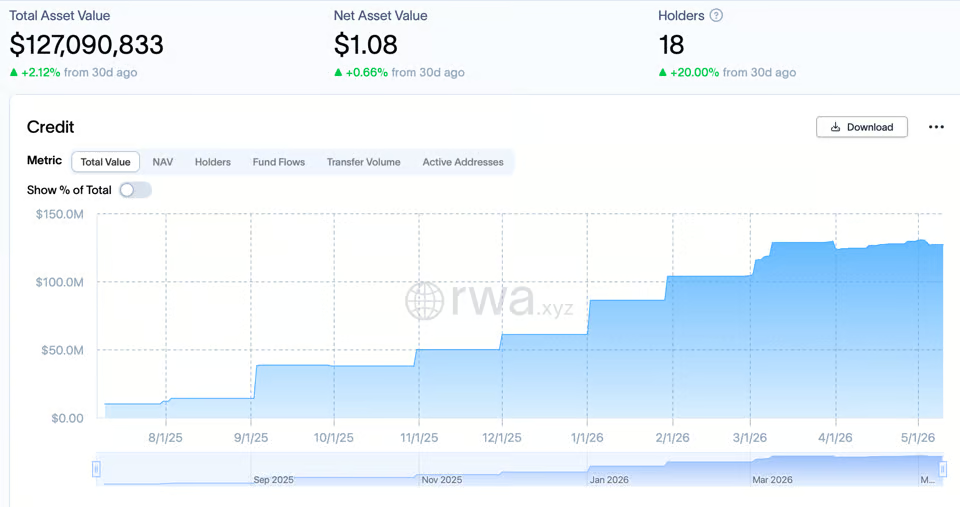
FalconX has expanded its tokenized structured credit facility to the Monad network, allowing institutional credit vault deposits to be used as collateral in decentralized finance protocols such as Morpho.
Tokenization takes traditional credit facilities and represents them as digital tokens on a blockchain. In this case, the facility packages loans originated through FalconX’s lending business into tokenized credit products accessible through Pareto vaults curated by M11 Credit.
RWA.xyz data shows real-world assets issued onchain have grown to more than $31 billion, including Treasurys, credit products and other financial assets. Credit-related assets alone account for more than $5 billion in distributed value across blockchain networks.
The FalconX deployment adds support for using AA_FalconXUSDC vault tokens in onchain lending markets, enabling investors to borrow against institutional credit exposure while maintaining yield-bearing positions. Data from RWA.xyz shows FalconX Credit Vault currently holds about $127 million in distributed value.

FalconX Credit Vault. Source: RWA.xyz
According to an announcement shared with Cointelegraph, the system also includes automated margin controls, real-time collateral monitoring and onchain settlement features.
Monad Foundation director of marketing Nathan Cha told Cointelegraph that the broader opportunity for tokenized credit products lies in their composability across DeFi markets, allowing institutional assets to be reused across lending, trading and other onchain financial activity.
FalconX is a crypto prime brokerage and institutional lending company, while Monad is an EVM-compatible Layer 1 blockchain designed for high-performance financial applications.
Related: OKX lets institutions use BlackRock’s BUIDL fund as trading collateral
Institutional credit moves onchain
Today’s announcement is representative of a broader push to bring traditional financial products onto blockchain networks.
Maple Protocol ranks as the largest manager in the tokenized credit sector with around $1.7 billion in distributed value, followed by SICOS Securities with about $902 million and Anemoy with roughly $476 million.

Tokenized credit snapshot. Source: RWA.xyz
Earlier this year, Maple Finance expanded its yield-bearing syrupUSDC token to Coinbase’s Base network and pursued a proposal to allow the asset to be used as collateral on Aave. Like FalconX’s credit vault product, syrupUSDC is backed by institutional lending activity and designed for use across decentralized finance markets.
The push to bring financial assets onchain has also gone beyond credit markets into tokenized securities and exchange infrastructure.
In March, the New York Stock Exchange signed an agreement with Securitize to support a securities platform for blockchain-based share issuance, trading and settlement.
That same month, Nasdaq partnered with Kraken and tokenization company Backed to develop infrastructure for blockchain-based equities designed to move between traditional and onchain markets.
Magazine: XRP ‘probably going to $12,’ Bitcoin ETFs add $1B: Market Moves


President Donald Trump said stopping Iran from getting a nuclear weapon is the “only thing that matters” to him. He dismissed Americans’ financial strain as inflation hit a three-year high in April.
The comments came before Trump departed for a high-stakes trip to Beijing to meet Chinese President Xi Jinping.
“I don’t think about Americans’ financial situation. I don’t think about anybody. I think about one thing: we cannot let Iran have a nuclear weapon. That’s all,” he said.
Follow us on X to get the latest news as it happens
Trump Shrugs Off Americans’ Pain as Inflation Hits 3.8%
The president brushed off the notion that the economic toll on Americans was shaping his approach to Iran, telling a reporter, “Not even a little bit” when asked how much the issue motivated him to make a deal.
BeInCrypto reported that in April, the headline Consumer Price Index (CPI) rose to 3.8% year-over-year, above Wall Street estimates of 3.7%. Meanwhile, core CPI jumped to 2.8% year-over-year, beating expectations of 2.7%.
Energy was a key driver. The energy index jumped 3.8%, accounting for over 40% of the headline gain. Gasoline alone rose 28.4% over the past year.
Notably, Americans have separately spent an extra $37.6 billion on fuel since February. The Strait of Hormuz closure has rippled through global supply chains, lifting transportation and food costs alongside gasoline.
Moreover, the data showed that the food index has risen 3.2% annually, with fertilizer costs threatening further pressure on grocery bills.
The president held firm despite the price pressure. He pushed back sharply after a reporter pressed him on why inflation had climbed to a three-year high despite his pledge to lower prices.
“If you go back to just before the war, for the last three months, inflation was at 1.7%. Now, we had a choice. Let these lunatics have a nuclear weapon. If you want to do that, then you’re a stupid person,” he said.
He added that an end to the war, which he suggested would come soon, would pull oil prices lower and send the stock market, already at record highs, “through the roof.”
Subscribe to our YouTube channel to watch leaders and journalists provide expert insights
The post Trump Says Stopping Iran’s Nukes Is “Only Thing That Matters” as Inflation Hits 3.8% appeared first on BeInCrypto.

Grayscale Investments revised its Hyperliquid ETF filing and added staking yield features for HYPE exposure. The filing updates aim to enhance returns while keeping the trust structure compliant with U.S. regulations. The ETF will list on Nasdaq under HYPG after registration approval becomes effective.
Grayscale integrated staking consideration into the fund to capture HYPE network rewards. This structure mirrors Ethereum ETF models that distribute staking yield through regulated products. The proposal states compliance checks must confirm grantor trust status before activation.
Hyperliquid operates as a decentralized perpetual trading blockchain, gaining rapid market traction. HYPE token supports ecosystem activity and serves as the primary network asset. Grayscale appointed Anchorage Digital as custodian and Bank of New York Mellon as administrator.
Ethereum ETF Staking Models Expand Across Issuers
Ethereum staking ETF structures expand as issuers integrate yield generation into regulated funds. Grayscale and peers use ETH staking to create additional income streams for fund holdings. These products aim to reflect blockchain rewards while maintaining traditional exchange-traded fund rules.
Ethereum staking integration follows regulatory discussions around yield classification in crypto assets. Asset managers design staking systems to distribute rewards proportionally to ETF unit holders. Custodial frameworks ensure staking operations remain separated from trading and liquidity functions.
Ethereum ETF staking models influence broader crypto fund innovation across multiple networks. Yield distribution mechanisms vary depending on validator participation and network performance metrics. Regulatory compliance remains central as issuers align staking rewards with financial rules.
Solana ETFs Integrate Staking Rewards Into Fund Design
Solana staking ETFs gain attention as issuers explore high-throughput network rewards. Funds tracking SOL aim to capture staking yield from validator participation across the network. Solana network design supports rapid transaction processing and consistent reward distribution models.
ETF issuers evaluate staking risks and operational requirements before launching SOL-based products. Custody providers manage validator delegation to ensure secure staking participation for funds. Market structures adapt as Solana staking becomes integrated into regulated financial vehicles.
Reward calculations depend on validator uptime and network consensus performance metrics. Institutions explore SOL exposure through ETF frameworks to simplify digital asset access. Regulatory alignment shapes how Solana staking income flows into fund structures.
Custody Framework and Regulatory Structure Shape ETF Growth
Grayscale trust design relies on regulated custodians to manage digital asset security. Anchorage Digital provides custody services that support institutional-grade blockchain asset handling. Bank of New York Mellon handles administrative and transfer agent responsibilities for the ETF.
The structure aims to maintain compliance with grantor trust tax classification requirements. Regulatory approval depends on alignment between staking rewards and securities law frameworks. Issuers expand crypto ETF offerings as staking features become integrated across assets.
Fund administrators monitor reward flows to ensure accurate distribution to share units. Crypto ETF evolution reflects the growing integration of blockchain yield mechanisms into finance. Grayscale adjusts filings to match evolving regulatory standards for digital asset products.


Ethereum whale Garrett Jin moved 577,896 ETH worth $1.35 billion to Binance over four days, per Lookonchain.
Summary
- Garrett Jin transferred his entire 577,896 ETH position to Binance over four days, accumulating an estimated $1.3 billion in unrealized losses.
- Jin originally swapped Bitcoin for ETH eight months ago at around $4,591, well above the current trading price of approximately $2,300.
- Total Ethereum exchange reserves climbed from 14.36 million to 14.95 million ETH since May 5, per CryptoQuant data, adding supply pressure.
An Ethereum whale identified as Garrett Jin deposited all 577,896 ETH worth roughly $1.35 billion into Binance over four consecutive days, raising concerns about potential selling pressure. Lookonchain flagged the transfers on May 10 and 11.
Jin originally converted Bitcoin to Ethereum eight months ago when ETH was trading at approximately $4,591. With ETH now holding near $2,300, Lookonchain noted he is sitting on roughly $1.3 billion in unrealized losses. His position represents one of the largest single-wallet inflows to a centralised exchange in Ethereum’s recent trading history.
Why this move is triggering concern
A transfer to an exchange does not guarantee an immediate sale. Whales sometimes move funds for collateral posting, liquidity management, or OTC desk activity. The scale and the fact that Jin moved his entire position, however, has concentrated market attention.
CryptoQuant data shows total Ethereum exchange reserves climbed from 14.36 million ETH on May 5 to 14.95 million ETH in the days that followed, a sustained increase that signals broader accumulation on exchanges. Binance now holds approximately 3.62 million ETH, equivalent to 24.6% of all ETH held on centralised exchanges.
The broader supply picture has also been compounded by institutional activity. BlackRock and Fidelity deposited more than 35,000 ETH into Coinbase Prime in the same week, adding further short-term supply. US spot Ethereum ETFs saw $103.6 million in net outflows on May 7, ending a four-day positive flow streak.
What analysts are watching
Market analyst Ted Pillows said ETH must reclaim the $2,400 level to sustain recovery momentum, warning that failure to do so could push the asset back toward $2,100. He also noted a pattern of hourly Binance inflow surges throughout May that are adding supply pressure beyond Garrett Jin’s single position.
Ethereum whale activity has been a recurring market signal throughout 2026, with concentrated exchange inflows consistently drawing scrutiny from on-chain analysts monitoring whether large holders are positioning for exits or simply rotating collateral. ETH held near $2,300 as of May 12 despite the elevated exchange supply, suggesting the market has not yet absorbed the move as a confirmed sell signal.


SKYAI jumps 44% to top the day’s top‑100 gainers as ONDO sinks 10%, highlighting a rotation from RWA and yield infra into AI‑adjacent tokens riding the agentic AI narrative.
Summary
- SKYAI is the top performer among the top 100 cryptocurrencies by market cap on Tuesday, surging 44.45% to $0.5792, while BUILDon and Humanity posted double-digit gains of 15.32% and 13.06% respectively.
- Ondo Finance’s ONDO token is the day’s biggest loser in the same cohort, dropping 10.28% to $0.3908, with Aerodrome Finance close behind at minus 10.16%, as RWA and DeFi infrastructure tokens give back recent gains.
- The divergence between AI-adjacent tokens like SKYAI and RWA platforms like ONDO captures a broader rotation dynamic playing out across the mid-cap crypto market on May 12.
According to CoinMarketCap data, SKYAI is Tuesday’s standout performer among the top 100 cryptocurrencies by market capitalization, jumping 44.45% to a current price of $0.5792 as AI-themed tokens continue to attract disproportionate speculative interest in a market where the agentic AI narrative is building momentum. BUILDon followed with a 15.32% gain to $0.6454, and Humanity added 13.06% to reach $0.2646, rounding out a top three that is heavily skewed toward newer, narrative-driven tokens rather than established large-caps.
SKYAI’s 44% surge leads an AI-driven top-100 sweep
Injective posted a more measured 7.06% gain to $4.66, while JUST rounded out the top five with a 2.95% rise to $0.08974. The breadth of the gainers list — spanning AI infrastructure, DeFi tooling and cross-chain protocols — is consistent with the early-altseason rotation pattern that analysts have been flagging this week, as capital moves down the risk curve from Bitcoin and Ethereum into mid and small-cap tokens with higher beta and more compressed float. A previous crypto.news story on SUI’s 31% single-session surge noted how open interest across derivatives venues jumped from $450 million to over $620 million in a single day as short squeezes and supply shocks amplified directional moves, a dynamic that appears to be repeating in Tuesday’s AI-token winners.
SKYAI’s move in particular reflects the broader agentic AI rally that has drawn institutional attention this week. As covered in a recent crypto.news story on Gemini, Bitget and Neyro’s push into AI-driven trading, the global agentic AI market is projected to grow from $7.29 billion in 2025 to $139.19 billion by 2034 at a 40.5% CAGR, and tokens with credible exposure to that thesis are attracting flows that look less like speculation and more like early infrastructure positioning.
ONDO’s 10% drop as RWA tokens face profit-taking
The losses side of Tuesday’s ledger tells an equally revealing story. ONDO is down 10.28% to $0.3908, making it the top loser among the top 100 despite — or perhaps because of — a string of positive fundamental announcements this week. Ondo Finance bridged 35 tokenized assets including SPY, QQQ, NVDA, TSLA and BABA to Hyperliquid’s HyperEVM via a LayerZero bridge, as detailed in a crypto.news story, and participated in Ripple’s tokenized Treasury settlement test with JPMorgan and Mastercard. The sell-off on a day of positive news is a textbook “buy the rumor, sell the news” dynamic, with traders who accumulated ONDO ahead of the Hyperliquid and XRP Ledger announcements now rotating proceeds into higher-momentum plays like SKYAI.
Aerodrome Finance shed 10.16% to $0.4725, Ethena lost 7.57% to $0.1204, Sei fell 7.03% to $0.0695 and Virtuals Protocol dropped 6.99% to $0.8131, painting a picture of broad profit-taking across Base ecosystem tokens, yield infrastructure and AI-agent platforms that had run hard in recent weeks. The Virtuals Protocol decline is particularly notable given that AI-agent tokens are simultaneously among Tuesday’s biggest winners and losers, suggesting the market is differentiating sharply between projects it views as having durable infrastructure narratives and those it treats as pure momentum plays. For ONDO specifically, the 10% pullback after a week of landmark partnership announcements — Franklin Templeton’s Kraken integration, Ripple’s Treasury settlement test, and the broader RWA tokenization push covered across multiple recent crypto.news stories — may ultimately read as a healthy consolidation in a token whose fundamental case is arguably stronger today than it was when it was trading 25% higher.
Crypto World
Cardano Looks at $0.53 as ADA Hovers Over Key Support Area With Van Rossem Hard Fork Making Progress
Key Insights
- The Cardano cryptocurrency made another rebound from the key $0.25 support level, with analysts focusing on the possibility of reaching $0.53.
- The previous recoveries of the Cardano coin from the current support area resulted in gains of 88 percent and 243 percent.
- The Van Rossem hard fork is progressing successfully on the Preview testnet.
Bullish Momentum Returns for Cardano After Breaking Out of the Support Level
The Cardano price returned to a bullish trend after buyers defended the important support level of $0.25, which continues to draw a lot of attention in the crypto market. As per Ali Martinez, a cryptocurrency market expert, Cardano has previously been able to generate major uptrends after breaking out of the support region at different points in time.
According to him, Cardano rallied by more than 88% in January 2023 following a breakout above the mentioned support level. The cryptocurrency also witnessed a similar strong rally in September 2023 after defending itself against heavy sell-off pressure from the $0.25 level.
Cardano Recovery Gathers Pace Amid ADA’s Move Towards $0.53
The Cardano cryptocurrency ADA saw more buying interest due to its continued performance, particularly after seeing a resurgence in the entire crypto market sector. Based on cryptocurrency analyst Ali Martinez, the ADA price might go up towards the $0.53 mark if it manages to sustain its momentum at the $0.36 resistance zone.
Analysts have observed that prior recoveries from support levels led to massive gains in the prices of the cryptocurrencies. ADA managed a 5.02% gain during the last 24 hours, with a weekly increase of nearly 11%. The rise in the value of crypto is due to increased investor confidence amid high appetite for risky asset classes.
The Bitcoin price went higher amid other altcoins with a surge in the general market sentiment after seeing better-than-expected economic data in the United States. Encouraging April employment numbers indicated a stable economic outlook in the country amid inflationary pressures.
Key Support Levels Continue to Be Important
While the positive outlook was provided by analysts, they added that ADA is still vulnerable to a downside correction if the market loses its momentum. Ali stressed that the $0.25 region continues to be an important level of support for Cardano. Any breakdown below this level will make ADA more vulnerable to bearish pressure, thus preventing a potential breakout above key resistance zones.
Investors will continue to keep their eye on the overall state of the cryptocurrency markets, since the future direction of Cardano might be dependent on how Bitcoin performs. In the event of continued bullish momentum, ADA will have a chance to try and reclaim higher resistance zones during the upcoming trading days.
Van Rossem Hard Fork Upgrade Progresses on Preview Testnet
Another noteworthy development related to Cardano was the progression of the network with regards to the Van Rossem hard fork upgrade on the Preview testnet.
According to Samuel Leathers, the Daedalus wallet transitioned smoothly through the upgrade phase with no problems reported during the process. The developers are now ready to push an upgraded version of the wallet to the Cardano mainnet next week.
Ripple’s cross-border token has posted a 3% increase over the past week, while the rising institutional interest suggests that a more substantial pump could be on the horizon.
Some analysts are optimistic that XRP could indeed head north, assuming it overcomes important resistance levels.
Best Day in Months
It was in November last year that Canary Capital became the first company to launch a spot XRP ETF in the US with 100% exposure to the asset. Shortly after, well-known entities like Bitwise, Franklin Templeton, 21Shares, and Grayscale followed suit.
At first, these financial vehicles entered the market with a storm, generating consecutive months of strong inflows. However, the momentum faded toward the end of January, and both February and March proved noticeably weaker. April and May saw significant improvement, signaling that the interest from more conservative investors, including pension funds and hedge funds, has returned. In fact, the inflows into spot XRP ETFs in the past 24 hours surpassed $25 million, the highest since the start of the year.

When fresh money flows into these products, the issuers are required to buy real tokens from the market to back the purchased shares. This process automatically generates consistent buying pressure, and when demand rises faster than the available supply, it can naturally push the price upward.
Since their launch, the spot XRP ETFs have accumulated a cumulative total net inflow of roughly $1.35 billion. In comparison, ETFs with Solana (SOL) as the underlying token have attracted approximately $1.08 billion, while those centered on Dogecoin (DOGE) have pulled in a mere $10.65 million.
Meanwhile, Standard Chartered recently projected that inflows into XRP ETFs could explode to the $4-$8 billion range by the end of the year, should regulatory clarity in the United States continue to improve. Growing political momentum behind initiatives like the CLARITY Act could make it easier for big investors to allocate capital, further strengthening the ETF narrative.
When Real Pump?
XRP is well in green territory in both the weekly and monthly timeframes, yet analysts believe a more aggressive surge may come only when it crosses key levels.
The renowned crypto commentator Ali Martinez suggested that it must close above the top of a certain channel at $1.49 to trigger a breakout toward $1.80. Prior to that, he noted that the TD Sequential metric had flashed a major buy signal on the 4-hour chart, expecting a jump to $1.82 if the valuation decisively breaks through the $1.45 resistance.
XRP CAPTAIN 589 also chipped in. In their view, Ripple’s native token is on the verge of a “straight line breakout” to $8, with the catalyst potentially being the approval of the CLARITY Act.
The post XRP Inflows at 5-Month High: Why Institutional Giants Are Flocking Back to Ripple appeared first on CryptoPotato.

The cryptocurrency markets continue to prove their robustness as the price of Bitcoin remains well above the level of $80,000 and the price of Ethereum stays well above $2,300. Such strong market activity has led many traders to ask themselves whether cryptocurrencies are decoupling from traditional financial markets.
Increasingly more market analysts are convinced that Bitcoin and Ethereum will decouple from US stocks. Usually, the markets of cryptocurrencies correlated well with stock indices during times of economic turmoil, yet now there is a clear indication of a new trend.
A well-known trader says that the change is becoming more evident as investors reevaluate the valuations in the markets. Although stocks in the United States remain at historically high prices, cryptocurrencies are considered undervalued investments with higher growth prospects in the long run.
The expert attributed the positive sentiment on crypto news, such as the introduction of the CLARITY Act, the growing popularity of cryptocurrencies among institutions, and an improving regulatory environment in the country. The anticipation of the Bitcoin-friendly stance from the Fed also supports the positive sentiment.
Bitcoin Clings Above $80k Amidst Market Uncertainties
The strong performance by Bitcoin above the $80,000 mark has gained considerable traction amongst market players. Previously, over the past weeks, Bitcoin was finding it difficult to regain and hold its position above $76,000. Following this breakout from resistance, the cryptocurrency is now holding firm in higher zones of support.
A bullish camp claims that if Bitcoin manages to remain above the $80,000 mark, it will provide momentum to make a move towards higher levels of resistance. According to many, a breakout above the $84,000 level will cause explosive momentum, resulting in a new bullish leg.
Bitcoin Could See a Bearish Breakout After Rising Wedge Pattern Formation
Several bearish traders have issued a warning stating that Bitcoin’s present chart setup might be exhibiting a rising wedge formation, a bearish setup in technical analysis. One bearish trader said that Bitcoin has formed such a setup since February, creating an illusion of a bullish trend.
The bearish trader said that each higher high creates the impression of momentum, but each higher low suggests strength in the market. In his opinion, however, the rising wedge pattern indicates weak buying power and compression in price action before a breakout lower.
He cited $84,000 as the top of the wedge and suggested that the resistance level would reject further gains in Bitcoin. In the event that the cryptocurrency is unable to rise past the resistance zone and breaks down from the $80,000 support level, a measured downside target would be around $56,000.
Rotation of Capital From Stocks to Crypto Might Be Already Happening
Even with all the negative sentiment being put out, there are plenty of optimistic views regarding crypto’s future. At the moment, the bullish case being made for crypto is mostly about the undervaluation compared to stocks.
As several market analysts note, the stock markets in the United States are currently experiencing overvaluation because of the past few years’ rapid growth driven by AI promises and successful performances within the technology sector.
However, when it comes to Bitcoin and Ethereum, the price of both currencies is way lower than what many experts predicted back then. All this leads many to believe that some capital might already start to leave stocks and enter crypto. If so, Bitcoin and Ethereum are likely to see more flows heading their way.
THE MOST DECEPTIVE PATTERN IN CRYPTO. BITCOIN IS IN IT.
Rising wedge. Since February.
Every higher high looks like momentum.
Every higher low looks like strength.It’s neither. It’s compression before a breakdown.
$84K is the top of the wedge. Rejection zone.
Break below… pic.twitter.com/4pP2ndg3E4— Merlijn The Trader (@MerlijnTrader) May 11, 2026
Crypto World
Exodus Shifts from Wallet to Full Crypto Payments Company After Selling $87M in Bitcoin
TLDR:
- Exodus launched Exodus Pay, a platform letting users spend crypto directly from wallets across the U.S. and Europe.
- The firm acquired Monavate and Baanx to build out its full-stack crypto payments infrastructure in Q1 2026.
- Exodus cut Bitcoin holdings from 1,704 BTC to 628 BTC, using proceeds to become fully debt-free this quarter.
- XO Cash, Exodus’s new dollar-backed stablecoin, is positioned as the first stablecoin designed for AI agents.
Exodus (EXOD), the publicly traded Bitcoin wallet firm, is broadening its scope beyond wallets into a full crypto payments company.
The firm announced this shift alongside its Q1 earnings report, backed by two strategic acquisitions and a new stablecoin launch.
Its balance sheet also changed sharply, with Bitcoin holdings cut significantly to fund debt repayment and acquisition costs. Shares closed Tuesday at $6.97, down 9.6% on the day.
Exodus Pay and XO Cash Drive the Payments Expansion
Exodus is now positioning itself as a full-stack payments business through its Exodus Pay platform. The platform lets users spend crypto directly from their wallets without surrendering private keys. It is currently live across the United States and Europe.
The company closed two acquisitions to support this move — financial services firms Monavate and Baanx. These deals gave Exodus the infrastructure needed to support crypto spending at scale. CEO JP Richardson described the expansion as a natural extension of the firm’s founding vision.
“Exodus has always been about simplicity and control; that vision hasn’t changed since 2015,” Richardson told Decrypt. “We are expanding what we’re offering, we are not pivoting.”
He added that enabling customers to send and spend digital dollars without handing over their keys is what the firm has been building toward from day one.
Alongside Exodus Pay, the firm launched XO Cash, a dollar-backed stablecoin. Exodus claims it is the first stablecoin built specifically for AI agents, adding another layer to its growing payments ecosystem.
Bitcoin Holdings Drop as Exodus Clears Its Debt
Exodus ended Q1 2026 with $48 million in digital assets, down sharply from $156 million at the close of 2025. Cash and cash equivalents rose to nearly $73 million, compared to under $5 million at year-end. The shift reflects a deliberate treasury reallocation.
Bitcoin holdings fell from 1,704 BTC to 628 BTC during the quarter. The firm also shed 37 ETH, worth roughly $87,000.
These moves helped Exodus pay down a Bitcoin-backed loan from Galaxy and cover acquisition-related costs, leaving the company debt-free.
Richardson addressed the treasury changes directly: “Most of the treasury adjustments you saw in Q1 reflect paying down a Bitcoin-backed loan to Galaxy and other acquisition-related costs. We’re debt-free as a result.” He also reaffirmed that the firm’s long-term conviction in Bitcoin has not changed.
Meanwhile, Exodus added to its Solana position, growing holdings from 12,473 SOL to 17,541 SOL. At Tuesday’s price of around $93.91 per SOL, that stake is worth approximately $1.65 million.
Richardson also noted that Exodus will track transaction volume and the quarterly split between payments and trading revenues going forward. “Spending is a different behavior and a different business,” he said, pointing to the shift away from wallet-only revenue.

Rigel Pharmaceuticals, Inc. (RIGL) M&A Call Transcript
Ray Dalio: Why Bitcoin Has Not Lived Up to Its Safe-Haven Reputation

Ian McKellen Reveals The Worst Advice He’s Ever Received

Manchester United reach agreement with Casemiro over contract clause amid transfer speculation

US brings back mandatory military draft registration

Steven Gerrard disagrees with Gary Neville over ‘shock’ Chelsea and Arsenal claim | Football


-
 Crypto World5 days ago
HarrisX Poll Found 52% of Registered Voters Support the CLARITY Act
-

 Fashion4 days ago
Weekend Open Thread: Marianne Dress
-

 Crypto World6 days ago
Upbit adds B3 Korean won pair as Base token gains Korea access
-
 NewsBeat6 days ago
NCP car park operator enters administration putting 340 UK sites at risk of closure
-

 Fashion1 day ago
Coffee Break: Travel Steam Iron
-

 Fashion2 days ago
What to Know Before Buying a Curling Wand or Curling Iron
-

 Tech3 days ago
Auto Enthusiast Carves Functional Two-Stroke Engine from Solid Metal
-

 Politics1 day ago
What to expect when you’re expecting a budget
-

 Politics4 days ago
Politics Home Article | Starmer Enters The Danger Zone
-
 Business4 days ago
Ignore market noise, India’s long-term story intact, say D-Street bulls Ramesh Damani and Sunil Singhania
-

 Tech2 days ago
GM Agrees To Pay $12.75 Million To Settle California Lawsuit Over Misuse Of Customers’ Driving Data
-

 Crypto World7 days ago
BlackRock CEO Larry Fink Discusses a New Asset Class
-
 Sports7 days ago
NBA playoff winners and losers: Austin Reaves is not loving Lakers vs. Thunder matchup, but Chet Holmgren is
-

 Entertainment6 days ago
Sarah Paulson Called Out For Met Gala ‘Hypocrisy’
-

 Politics5 days ago
Simon Cowell Says He Was ‘Horrible’ To Susan Boyle During BGT Audition
-

 Entertainment5 days ago
General Hospital: Ric & Ava Bombshell – Ric’s Massive Secret Exposed!
-

 Crypto World6 days ago
Robinhood says Wall Street is building onchain
-

 Entertainment6 days ago
Bold and Beautiful Early Spoilers May 11-15: Steffy Revolted & Liam Overjoyed!
-

 Sports6 days ago
UEFA Champions League final schedule, teams, venue, live time and streaming | Football News
-

 Entertainment6 days ago
Why David Letterman Called CBS ‘Lying Weasels’
You must be logged in to post a comment Login