

Crypto World
Crypto Decouples from U.S. Stocks as Experts Claim that Crypto Is Undervalued


The cryptocurrency markets continue to prove their robustness as the price of Bitcoin remains well above the level of $80,000 and the price of Ethereum stays well above $2,300. Such strong market activity has led many traders to ask themselves whether cryptocurrencies are decoupling from traditional financial markets.
Increasingly more market analysts are convinced that Bitcoin and Ethereum will decouple from US stocks. Usually, the markets of cryptocurrencies correlated well with stock indices during times of economic turmoil, yet now there is a clear indication of a new trend.
A well-known trader says that the change is becoming more evident as investors reevaluate the valuations in the markets. Although stocks in the United States remain at historically high prices, cryptocurrencies are considered undervalued investments with higher growth prospects in the long run.
The expert attributed the positive sentiment on crypto news, such as the introduction of the CLARITY Act, the growing popularity of cryptocurrencies among institutions, and an improving regulatory environment in the country. The anticipation of the Bitcoin-friendly stance from the Fed also supports the positive sentiment.
Bitcoin Clings Above $80k Amidst Market Uncertainties
The strong performance by Bitcoin above the $80,000 mark has gained considerable traction amongst market players. Previously, over the past weeks, Bitcoin was finding it difficult to regain and hold its position above $76,000. Following this breakout from resistance, the cryptocurrency is now holding firm in higher zones of support.
A bullish camp claims that if Bitcoin manages to remain above the $80,000 mark, it will provide momentum to make a move towards higher levels of resistance. According to many, a breakout above the $84,000 level will cause explosive momentum, resulting in a new bullish leg.
Bitcoin Could See a Bearish Breakout After Rising Wedge Pattern Formation
Several bearish traders have issued a warning stating that Bitcoin’s present chart setup might be exhibiting a rising wedge formation, a bearish setup in technical analysis. One bearish trader said that Bitcoin has formed such a setup since February, creating an illusion of a bullish trend.
The bearish trader said that each higher high creates the impression of momentum, but each higher low suggests strength in the market. In his opinion, however, the rising wedge pattern indicates weak buying power and compression in price action before a breakout lower.
He cited $84,000 as the top of the wedge and suggested that the resistance level would reject further gains in Bitcoin. In the event that the cryptocurrency is unable to rise past the resistance zone and breaks down from the $80,000 support level, a measured downside target would be around $56,000.
Rotation of Capital From Stocks to Crypto Might Be Already Happening
Even with all the negative sentiment being put out, there are plenty of optimistic views regarding crypto’s future. At the moment, the bullish case being made for crypto is mostly about the undervaluation compared to stocks.
As several market analysts note, the stock markets in the United States are currently experiencing overvaluation because of the past few years’ rapid growth driven by AI promises and successful performances within the technology sector.
However, when it comes to Bitcoin and Ethereum, the price of both currencies is way lower than what many experts predicted back then. All this leads many to believe that some capital might already start to leave stocks and enter crypto. If so, Bitcoin and Ethereum are likely to see more flows heading their way.
THE MOST DECEPTIVE PATTERN IN CRYPTO. BITCOIN IS IN IT.
Rising wedge. Since February.
Every higher high looks like momentum.
Every higher low looks like strength.It’s neither. It’s compression before a breakdown.
$84K is the top of the wedge. Rejection zone.
Break below… pic.twitter.com/4pP2ndg3E4— Merlijn The Trader (@MerlijnTrader) May 11, 2026



Dogecoin sits near $0.195, 70% below its 2025 peak, as altseason signals from SUI and ETH collide with Musk‑driven sentiment and a fragile path toward the $0.50 level.
Summary
- Dogecoin is trading around $0.195, down roughly 70% from its 2025 peak, even as altseason momentum and rising open interest across the top-10 begin to suggest a broader rotation out of Bitcoin dominance.
- SUI’s 31% single-day surge to $1.40 and Ethereum’s push toward a “parabolic” breakout on some timeframes are being cited on Crypto Twitter as early altseason signals that historically precede DOGE’s most explosive moves.
- Elon Musk’s continued dominance of X — now a tradeable data point on Polymarket’s tweet-count markets — keeps Dogecoin tied to one of crypto’s most unpredictable sentiment catalysts, even as its on-chain fundamentals slowly mature.
Dogecoin (DOGE) is currently trading around $0.195, a level that places it roughly 70% below the $0.65 peak it reached during the 2025 rally and well below the $0.50 psychological threshold that permabulls have flagged as the first real target in any sustained recovery. The drawdown is steep even by crypto standards, but it is also consistent with DOGE’s historical pattern: the token tends to underperform Bitcoin and large-cap altcoins for extended periods before compressing years of gains into weeks of vertical price action when sentiment flips.
That sentiment flip may be starting to take shape elsewhere in the market. A previous crypto.news story on SUI’s 31% single-session surge to $1.40 noted how open interest across derivatives venues jumped from roughly $450 million to over $620 million in a single day as traders rotated into high-beta altcoins following a supply shock from Nasdaq-listed SUI Group Holdings. That kind of move — a top-10 token exploding on a combination of fundamental catalyst and short squeeze — is exactly the precursor pattern that has historically preceded broader DOGE runs, as capital flows down the risk curve from large-caps to mid-caps and eventually into meme coins once speculative appetite is fully engaged.
Ethereum is adding another data point. Analysis circulating on X describes ETH as forming a “parabolic” breakout structure on the weekly chart, with Ethereum’s recent upgrade roadmap — detailed in a crypto.news story on the Glamsterdam devnet going live and the Hegotá scalability roadmap advancing — giving the second-largest asset a fundamental narrative to match its technical setup. When ETH leads, DOGE has historically followed with a lag of days to weeks, as retail traders who miss the Ethereum move look for the next high-leverage, high-beta play with name recognition and exchange liquidity.
The Musk variable and the road back to $0.50
No DOGE forecast is complete without addressing Elon Musk, and in May 2026 that variable is stranger than ever. As covered in a recent crypto.news story on Polymarket’s Elon Musk tweet-count contracts, Musk’s posting behavior is now literally a tradeable market, with millions of dollars wagered on whether he will post between 100 and 139 times in a given week. That financialization of Musk’s X activity is a two-edged sword for DOGE: it keeps him in the daily conversation of crypto traders, maintaining the ambient association between Musk and Dogecoin that has driven some of the token’s most violent pumps, but it also means any single pro-DOGE tweet now lands in a market that is already pricing his behavior probabilistically rather than reacting to it as a pure surprise.
On the fundamental side, DOGE’s case for a recovery is thin but not nonexistent. Daily transaction counts on the Dogecoin network have held above 50,000 in recent months even during the price drawdown, and the token continues to be accepted as payment by a small but growing list of merchants enabled through integrations that X’s payments infrastructure could eventually formalize. None of that is a near-term price catalyst on its own, but it does mean DOGE is not quietly dying during the bear phase — it is maintaining a baseline of utility that gives it a platform to rally from when conditions improve.
The price prediction range most consistent with the current setup runs something like this: in a base case where altseason continues to build off SUI and ETH momentum but does not fully ignite, DOGE could push toward $0.25 to $0.30 in the next four to six weeks as Bitcoin consolidates above $80,000 and capital continues rotating. In a bull case where the CLARITY Act passes committee this week, the stablecoin bill clears the House on May 14, and Bitcoin makes a clean break above $90,000, DOGE has historically traded at roughly 0.25% to 0.30% of Bitcoin’s price at peak altseason euphoria — a ratio that would put it between $0.225 and $0.27 at current BTC levels, and closer to $0.45 to $0.54 if Bitcoin reaches $150,000 to $180,000 by end of year in the most optimistic scenario. The bear case — a Wyckoff retest pulling Bitcoin back toward $60,000 and open interest liquidations cascading through altcoins — could drag DOGE back toward $0.12 to $0.14, erasing most of the recovery from last year’s lows and resetting the base for a later, larger move.


Coinbase now lets users borrow up to $100K against SOL via Morpho on Base, turning Solana into its third major collateral pillar as the token eyes a retest of $200.
Summary
- Coinbase has added Solana as a supported collateral asset in its on-chain lending product, letting users borrow up to $100,000 against SOL holdings via the Morpho protocol on Base, expanding a service that has already issued over $2.3 billion in cumulative loans.
- Bitcoin dominates Coinbase’s lending book with $2.17 billion in cumulative collateralized loans, followed by ETH at $110 million and XRP at $31.6 million, with SOL now joining that roster as Coinbase pursues its “Everything Exchange” strategy.
- The SOL addition lands despite Coinbase reporting a $394.1 million net loss in Q1 and cutting roughly 14% of its workforce, with CEO Brian Armstrong maintaining that “all finance will migrate on-chain” and multiple Wall Street desks keeping buy ratings on COIN stock.
Coinbase has expanded its on-chain crypto lending product to include Solana as collateral, allowing users to borrow up to $100,000 against SOL holdings through an integration with the Morpho lending protocol on the Base network, according to reporting by The Block.
Coinbase bets on SOL as its third major collateral pillar
The product previously supported Bitcoin and Ethereum as collateral assets, and the SOL (SOL) addition marks the first time a major non-BTC, non-ETH Layer 1 has been added to Coinbase’s lending stack, reflecting the exchange’s assessment that Solana has reached the liquidity depth and institutional acceptance needed to function as reliable loan collateral.
Ben Shen, Coinbase’s Head of Financial Services and Loyalty Products, framed the move explicitly around platform strategy, saying the addition of SOL collateral is “an important step for Coinbase to become the best platform for trading and holding Solana” and that it reflects the company’s broader push to build an “Everything Exchange” — a single venue where users can trade, hold, earn, borrow and settle across any major asset without leaving the Coinbase ecosystem. Since launching its crypto lending product last year, Coinbase has issued more than $2.3 billion in cumulative loans, with Bitcoin accounting for $2.17 billion of that total, ETH at roughly $110 million and XRP at $31.6 million, followed by smaller positions in cbETH, DOGE, ADA and LTC.
SOL is currently trading around $171, having pulled back from highs above $260 earlier in the cycle, and sits in a market where the addition of a major exchange’s collateral lending service has historically acted as a mild but persistent price support: users who might otherwise sell SOL to raise dollar liquidity can instead borrow against their position, reducing spot sell pressure while keeping exposure intact. That dynamic has been well-documented in Bitcoin’s lending market, where the growth of BTC-collateralized loans is cited as one structural reason why long-term holders have been able to extract liquidity without triggering the kind of forced selling that characterized earlier cycles.
“Everything Exchange” strategy survives a $394M quarterly loss
The SOL lending launch arrives in the same news cycle as Coinbase’s Q1 earnings disclosure, which showed a net loss of $394.1 million and a workforce reduction of approximately 14%. Those numbers reflect a broader revenue compression from lower trading volumes and the cost of Coinbase’s aggressive product expansion, but CEO Brian Armstrong has been consistent in framing near-term losses as the price of building infrastructure for what he calls the inevitable migration of “all finance on-chain.” Institutional analysts appear to agree with that framing: Bernstein, Benchmark and Rosenblatt have all maintained buy ratings on COIN stock, with Bernstein specifically noting that Coinbase is “gradually validating the feasibility of its Everything Exchange strategy” through cumulative data points like $2.3 billion in loans issued and the UK market expansion completed last month.
For Solana’s price trajectory, the Coinbase lending integration is one of several institutional signals converging this week. Huma Finance’s V2 PayFi platform, detailed in a recent crypto.news story, is built on Solana and recently survived a legacy Polygon exploit that underlined the architectural superiority of its Solana-native rebuild. Meanwhile, a crypto.news story on SUI’s 31% single-session surge showed how supply shocks and new institutional products can compress months of sideways price action into days of vertical movement for high-liquidity Layer 1 tokens.
At roughly $171, SOL would need a 17% move to retest $200 — a level it held briefly in early 2026 before the broader market correction — and a 52% recovery to challenge its cycle high above $260. The Coinbase collateral addition does not by itself generate that kind of move, but it does remove one structural friction point by giving large SOL holders a dollar-liquidity option that does not require selling, and it extends Coinbase’s institutional credibility to Solana in the same way that BTC and ETH lending helped normalize those assets as balance-sheet instruments. Combined with the altseason rotation signals flagged in a separate crypto.news story on Tuesday’s top-100 movers, a clear break above $180 to $185 in the near term looks more achievable than it did before Coinbase put SOL on the same collateral shelf as Bitcoin.


Coinbase CEO Brian Armstrong said the CLARITY Act gave banks their must-haves as the Senate released its 309-page bill text.
Summary
- Senate Banking Committee Chairman Tim Scott released the 309-page CLARITY Act substitute text on May 12, scheduling a markup for May 14.
- Brian Armstrong said in an X livestream that not everyone got everything they wanted, but the core priorities were preserved in the bill.
- Five major US banking groups jointly rejected the stablecoin yield compromise on the eve of the markup, calling the deal insufficient.
The Senate Banking Committee released the 309-page substitute text of the CLARITY Act on May 12, setting a committee markup for May 14 at 10:30 am. The bill defines which digital assets fall under the SEC and which belong to the CFTC, a question the US crypto industry has been pushing Congress to answer for years.
Coinbase CEO Brian Armstrong said in an X livestream on May 12 that the compromise preserved the industry’s core asks. “Not everyone got everything they wanted, but they got the must-haves,” he said, adding that Coinbase is working with at least five of the largest global banks on crypto integration.
Why banks are still pushing back
Five major banking groups, including the American Bankers Association and the Bank Policy Institute, issued a joint statement rejecting the stablecoin yield compromise brokered by Senators Thom Tillis and Angela Alsobrooks. The groups argued that Section 404 of the bill still permits yield-like rewards that compete with bank deposits.
“Research demonstrates that yield-earning stablecoins could reduce all consumer, small-business, and farm loans by one-fifth or more,” the coalition said. The compromise bans passive yield paid solely for holding stablecoins while permitting activity-based rewards tied to payments and platform use.
Senator Cynthia Lummis responded on X that the finalized text is “the culmination of months of hard work.” Senator Tillis went sharper, warning that certain factions in traditional finance may simply oppose any version of the CLARITY Act and are using the yield debate to stall it entirely.
The stakes around the May 14 markup
The CLARITY Act cleared the House 294 to 134 in July 2025 and passed the Senate Agriculture Committee in January 2026. The Banking Committee markup is the next required step before a full Senate floor vote, which needs 60 votes to advance.
Senators Lummis and Bernie Moreno have both warned that missing the May 21 Memorial Day recess window risks pushing comprehensive crypto legislation off the calendar entirely. Prediction markets currently price the bill’s odds of becoming law in 2026 at over 60%. The White House has set a July 4 target for a presidential signature.
The U.S. Senate is turning its attention to the Digital Asset Market Clarity Act (CLARITY) as an anticipated Thursday markup approaches, with lawmakers weighing a text that broadens the framework for crypto market structure while surfacing questions about unrelated policy provisions. The version released by three Republican senators—marking what they say is a product of ongoing negotiations with Democratic colleagues—follows earlier drafts from mid-2025 and represents a step in recent intensive discussions over stablecoin yield and market structure governance.
According to the U.S. Senate Banking Committee release, the text will guide committee deliberations on how digital assets are supervised and regulated in the broader financial system. The bill’s release came after negotiations that extended into fall 2025, with lawmakers signaling bipartisan momentum for a markup on the measure. In parallel, some Democrats have pressed for accompanying ethics provisions to address conflicts of interest, linking the crypto policy debate to wider concerns about governance and integrity in financial legislation. As reported, the dynamics remain delicate, with discussions framed by a balance between industry structure, investor protections, and legislative oversight.
Notably, the final pages of the draft contain a housing policy element—the Build Now Act—that would create a pilot program intended to incentivize housing development within select Community Development Block Grant participating jurisdictions. This inclusion has surprised some observers, given that the core text centers on market structure for digital assets rather than housing, and has sparked questions about Senate Democrats’ appetite for attaching broader policy measures to crypto legislation. The section-by-section summary indicates the housing provisions are designed to pilot development initiatives, which could influence the overall legislative package and its political reception.
Senators Tim Scott, Cynthia Lummis, and Thom Tillis have portrayed the text as a product of ongoing bipartisan talks with their Democratic colleagues, signaling a readiness to move toward a markup on Thursday. Yet, in public comment, some Senate Democrats, including Kirsten Gillibrand, have urged that the bill not reach the floor without explicit ethics language addressing potential conflicts of interest. The tension was summarized by party-line perspectives and positioned to shape the upcoming procedural path for CLARITY.
“We have worked too hard on this bill to give up now,” said Senator Angela Alsobrooks, who sits on the banking committee and helped broker a stablecoin yield compromise with Tillis. “My hope is to get to a bipartisan markup on Thursday with a compromise on ethics.”
In the broader policy conversation, the CLARITY Act is frequently described as a vehicle to clarify and potentially expand the Commodity Futures Trading Commission’s (CFTC) oversight role in the digital-asset space, a shift often discussed in relation to where the Securities and Exchange Commission (SEC) would or would not have jurisdiction. The legislative journey has included prior committee activity—most notably, the Senate Agriculture Committee’s January markup advancing its version of the bill—but full passage remains contingent on Banking Committee action, Senate floor votes, and eventual reconciliation with the House of Representatives. The cross-chamber process mirrors the complexity of other crypto-related legislation, including past bipartisan outcomes on related measures such as stablecoin infrastructure and cross-border policy alignment.
Key takeaways
- The CLARITY Act text has been released ahead of a scheduled Senate Banking Committee markup, signaling renewed bipartisan engagement on digital-asset market structure and regulatory oversight.
- A housing-related provision—the Build Now Act—appears in the later pages of the draft, introducing a pilot program to incentivize housing development in certain Community Development Block Grant jurisdictions. The policy’s inclusion in a crypto bill raises questions about legislative scope and sequencing.
- The bill explicitly prohibits paying interest or yield on payment-stablecoins, with narrow exceptions for bona fide activities or transactions that are not economically or functionally equivalent to interest-bearing deposits. This provision directly shapes how stablecoin models may be structured or marketed in the United States.
- Provisions drawn from the Blockchain Regulatory Certainty Act aim to shield software developers from traditional money-transmitter requirements, a topic closely watched by DeFi and open-source development advocates.
- Advocacy and enforcement dynamics center on the balance between empowering the CFTC and maintaining appropriate guardrails. Ethic provisions remain a point of contention among lawmakers, with some Democrats insisting on clear ethics language before advancing.
- The overall legislative path remains complex: Agriculture Committee approval has occurred, but the Banking Committee, Senate floor, and House reconciliation are still prerequisites for any final enactment. Previous crypto measures have demonstrated that bipartisan support can be achievable but not guaranteed on procedural or policy grounds.
CLARITY Act: structure, scope, and regulatory intent
At its core, the CLARITY Act seeks to redefine regulatory posture for digital assets by clarifying which agency takes primary supervisory responsibility and by spelling out market-structure rules that would govern issuance, trading, and settlement of crypto instruments. A central element, as outlined in the text, is a prohibition on paying interest or yield on payment stablecoins. The prohibition is not absolute, however; the text allows incentives or rewards that are based on bona fide activities or bona fide transactions and that are not economically or functionally equivalent to paying interest on an interest-bearing bank deposit. The structure of this prohibition will influence how stablecoins are designed and marketed, potentially shaping issuer strategies and user expectations for on-chain payments and settlements.
In addition, the bill incorporates language from the Blockchain Regulatory Certainty Act, a provision designed to shield developers of blockchain software from being treated as money transmitters under existing statutes. This element is of particular interest to DeFi ecosystems and other open-source projects, which have long argued that broad money-transmitter designations could chill innovation. Proponents argue that such protection helps maintain near-term operational viability for developers while still enabling appropriate regulatory oversight over the broader ecosystem.
Regulatory and enforcement implications extend beyond the CFTC’s jurisdictional purview. The measure is framed in a way that could influence how responsible actors—exchanges, issuers, and liquidity providers—structure products, comply with AML/KYC requirements, and interact with banking partners. The plan to tilt certain supervisory responsibilities toward the CFTC reflects ongoing debates about investor protection versus innovation, a dynamic that has repeatedly surfaced in discussions around MiCA-equivalent regimes and U.S. market architecture.
As part of the broader policy conversation, a number of lawmakers and advocacy groups have highlighted the need for practical guardrails. The DeFi Education Fund, for example, pointed to the software-developer protections as a meaningful step toward reducing friction for compliant developers. In public commentary, the organization noted that the protections align with a pragmatic approach to innovation while maintaining a clear regulatory boundary. The latest bill text and public discussion suggest a cautious but constructive path toward balancing innovation with supervisory clarity.
Ethics, governance, and the partisan friction
The ethics dimension remains a live issue in the currency of policy negotiations. Democrats have pressed for explicit ethics provisions to address potential conflicts of interest, a concern intensified by high-profile political discussions around cryptocurrency ventures connected to public figures and their families. The absence of ethics language in the released draft has drawn criticism from some quarters. Massachusetts Senator Elizabeth Warren publicly criticized the bill, arguing that it could undermine investor protection and national financial security by not addressing ethics standards. The exchange highlighted how the crypto policy debate intersects with broader governance concerns and national policy priorities.
On the other hand, proponents emphasize a pragmatic, bipartisan approach to market structure. Senator Scott, Senator Lummis, and Senator Tillis have framed the text as a product of ongoing negotiations with Democratic colleagues, signaling a potential path to bipartisan markup. As one takeaway, the willingness to consider a stablecoin-yield compromise with Senate Democratic leadership suggests a broader readiness to reconcile technical governance with concerns about conflicts of interest. The ongoing discussion underscores the delicate balance between advancing a cohesive regulatory framework and accommodating divergent views on ethics and governance.
In the political dynamics of the process, the Agriculture Committee’s January approval and the potential for a 60-vote threshold in a full Senate passage scenario are key procedural realities. The experience of earlier crypto legislation—such as the GENIUS Act, which passed the Senate with broad bipartisan support—demonstrates that consensus is possible but not guaranteed, especially when ethics and governance topics are front and center. Observers will be watching how Thursday’s markup addresses these policy tensions and whether a bipartisan compromise can survive to final passage.
For institutions and market participants, the evolving regulatory posture around CLARITY has practical implications. Compliance teams must monitor potential shifts in supervisory expectations—particularly any transition of primary oversight responsibilities to the CFTC—and assess how these changes could affect licensing, registration, and ongoing reporting requirements. Banks and payment networks, in turn, will need to align risk management and customer due diligence with a regime that may differentiate between stablecoin models and other digital assets, while also contemplating cross-border regulatory differences that may arise in analogous regimes abroad, such as MiCA in the European Union.
As observed, the text also implies ongoing considerations about stablecoin design, product rhetoric, and the permissible nature of yield-like features. The prohibition on paying yield on stablecoins, coupled with permitted bona fide activity-based rewards, may influence issuer business models, token utility, and marketing practices. These design constraints have direct consequences for liquidity providers, custodians, and wallet providers, all of whom must maintain alignment with evolving regulatory interpretations and enforcement expectations.
Regulatory context and what comes next
The CLARITY Act sits at the intersection of U.S. regulatory modernization efforts and evolving global frameworks for digital assets. Its progression touches on issues central to MiCA-like regimes, potential SEC/CFTC jurisdiction delineations, and the broader policy objective of preventing illicit finance while enabling legitimate financial innovation. Regulators and market participants alike are watching closely for how the bill’s structure could influence cross-border activity, licensing regimes, and the calculus of risk for institutions seeking to participate in regulated digital-asset markets.
To move from proposal to law, the bill must pass through the Banking Committee, clear the full Senate, and be reconciled with a version from the House of Representatives before any presidential sign-off. The legislative timeline remains uncertain, with procedural hurdles and political considerations continuing to shape the pace and substance of crypto regulation.
For now, the latest draft represents a meaningful consolidation of several policy threads: a clearer regulatory boundary for stablecoins, enhanced protections for developers, and a continued emphasis on market structure oversight. As coverage and commentary continue, observers should monitor not only the substantive provisions but also the ethics framework that many policymakers view as essential to a credible, sustainable regulatory regime. This frame is critical for institutions seeking to align operations with evolving rules and for analysts assessing the potential long-term impact on innovation, risk management, and financial stability.
As Cointelegraph observed in coverage surrounding the markup discussions, the ethics dimension and bipartisan dynamics will likely shape Thursday’s proceedings and the ultimate trajectory of CLARITY. The ongoing debate reflects a broader inquiry into how best to harmonize investor protection, regulatory clarity, and innovation in the United States’ rapidly evolving digital-asset landscape. See the committee’s posted text and related materials for the latest details and official documentation.
Related reporting and commentary continue to illustrate the evolving stance of lawmakers toward crypto market structure, ethics governance, and the role of regulators in a shifting financial ecosystem. For context, coverage of reactions, amendments, and subsequent developments remains essential for compliance and policy teams tracking regulatory risk and strategic planning in this space. Additionally, institutional readers may find it useful to benchmark these developments against existing or proposed international standards and cross-border policy initiatives.
Source notes and further reading: the text and summary materials linked by the Senate Banking Committee; press commentary on bipartisan negotiations and ethics considerations; coverage of related legislation and committee actions; and industry commentary on software developer protections and market structure considerations. For broader context, analyses and updates from specialized outlets continue to shape the interpretation of CLARITY’s regulatory implications.
Crypto World
Polygon CDK Unveils Institutional-Grade Privacy Chains With Full Access to Global Liquidity

TLDR:
- Polygon CDK’s validium config keeps raw transaction data sealed within institution-owned infrastructure.
- Settlement on Ethereum uses only a cryptographic commitment and a ZK proof, never exposing transactions.
- Five composable privacy levels let institutions scale confidentiality without migrating between configurations.
- Private CDK chains connect to Agglayer, preserving access to Ethereum, multi-chain liquidity, and fiat ramps.
Polygon CDK has announced a new privacy configuration for institutions building custom blockchains on its technology stack.
The upgrade keeps raw transaction data inside institution-owned infrastructure. At the same time, chains built on the configuration retain open access to global liquidity networks.
Powered by Succinct Labs’ SP1 Hypercube proving system, only a cryptographic commitment and a zero-knowledge proof settle to Ethereum.
The configuration primarily targets banks, payments companies, and asset managers that are moving onchain.
How the Privacy Configuration Works
Polygon CDK now offers a validium configuration developed in partnership with Succinct Labs. Transaction data stays within an institution-operated data availability environment.
Raw transaction data never reaches a public network. Ethereum receives only a cryptographic fingerprint and a validity proof for settlement.
The SP1 Hypercube proving system is already live in production on Katana Network. Settlement relies on validity proofs rather than a trusted operator with data access.
This approach means no single party holds visibility into the institution’s transaction data. The chain is verified publicly, but its transaction contents remain confidential.
@0xPolygon stated: “Ethereum confirms the chain is operating correctly. It never sees the transactions.” Role-based controls gate RPC endpoints and block explorers through enterprise systems like Okta and Azure AD. Policies apply at the contract and function level. Counterparties view only their own transactions.
Auditors receive scoped read access, while regulators get selective disclosure capabilities. Chain operators, by contrast, retain full visibility over all chain activity.
Even operational metadata — block contents, transaction counts, gas usage — can stay private. Institutions ultimately control what information is shared and with whom.
Five Privacy Levels and Cross-Chain Liquidity
Polygon CDK gives institutions five composable privacy levels with no migration required. The base level covers permissioned access through role-based RPC and private block explorers.
The newest tier is the confidential chain, keeping data within institution-owned infrastructure. A third level adds trusted execution environments for sealed workloads like dark-pool matching and sealed-bid auctions.
The fourth level applies fully homomorphic encryption to permissioned token rails. Balances and transfer amounts stay encrypted onchain throughout.
Apex Group’s T-REX Ledger with Zama on ERC-3643 already demonstrates this in production. The fifth level uses client-side zero-knowledge proofs through Hinkal to shield wallet-layer transactions from onchain visibility.
Despite the privacy architecture, Polygon CDK chains stay connected to Agglayer. Through this layer, private chains can access Ethereum, other L1s and L2s, and non-EVM networks like Miden.
A regional bank can settle with counterparties on other chains. Fiat ramps and stablecoin liquidity remain accessible through the Open Money Stack.
Target institutions include banks launching tokenized deposits and payments companies building stablecoin corridors. Asset managers issuing tokenized funds and crypto-native teams requiring enterprise SLAs also qualify.
Each deployment remains subject to applicable laws and regulations. Institutions can start at one privacy level and expand from there.

Crypto World
Jensen Huang is joining Trump’s China trip after the U.S. president called the Nvidia CEO

Jensen Huang, CEO of Nvidia speaks with CNBC on May 5, 2026.
CNBC
BEIJING — Nvidia CEO Jensen Huang is joining U.S. President Donald Trump‘s trip to China this week, the chipmaker confirmed to CNBC, after initial indications the executive had not been invited.
After seeing the media coverage of Huang’s absence from the delegation, Trump called the Nvidia executive and asked him to join, a source familiar with the situation told CNBC.
Huang flew to Alaska to board Air Force One, the source said.
Trump is bringing more than a dozen U.S. executives to Beijing this week where he is scheduled to meet with Chinese President Xi Jinping Thursday and Friday.
“Jensen is attending the summit at the invitation of President Trump to support America and the administration’s goals,” a spokesperson for the chip giant said in a statement. Nvidia referred to the same comment when asked about Huang joining mid-journey in Alaska, but did not provide a reason.
The White House did not immediately respond to a request for comment.
Nvidia’s most advanced chips, widely used for training AI models, have faced tighter U.S. restrictions on China sales over the last four years. The company said in February that U.S.-government-approved versions of the chips had yet to be allowed into China.
“I still believe that we are far away from a deal on export controls … it’s positive that he’s there and he’s part of the President’s delegation, and that that that’s important for him and it’s important for the President,” Carlos Gutierrez, former U.S. secretary of commerce, told “Squawk Box Asia.”
TLDR:
- Dalio warns Bitcoin’s publicly visible transactions make it an unsuitable reserve for central banks.
- Bitcoin’s high correlation with tech stocks weakens its role as a hedge during market downturns.
- Investors tend to sell Bitcoin first when under portfolio pressure, reducing its safe-haven appeal.
- Gold’s centuries-old track record and broad institutional ownership keep it ahead of Bitcoin globally.
Bitcoin has yet to establish itself as a genuine safe-haven asset, according to Bridgewater founder Ray Dalio. The veteran investor pointed to the cryptocurrency’s lack of privacy and the potential for transaction monitoring.
He also cited its high correlation with technology stocks during periods of market stress. Dalio argued that gold holds a more central and trusted role in the global financial system. His remarks come as debate over Bitcoin’s place in global portfolios continues among institutional investors.
Bitcoin’s Privacy Gap and Tech Stock Correlation Draw Scrutiny
One of Dalio’s primary concerns about Bitcoin centers on its transparency across the blockchain. Unlike gold or cash, every Bitcoin transaction is publicly recorded and traceable by outside parties.
Dalio noted that this visibility makes the cryptocurrency unattractive as a reserve holding for central banks. Governments and financial institutions tend to prefer assets that do not expose all transaction activity.
In a post on X, Dalio stated that Bitcoin lacks privacy and that transactions can be monitored. He added that this is why central banks are not looking to hold it as a reserve.
That reasoning aligns with longstanding hesitancy among major financial institutions toward cryptocurrency adoption.
Beyond privacy, Dalio noted that the cryptocurrency carries a relatively high correlation with technology stocks. When investors face pressure elsewhere in their portfolios, they often sell it first to raise liquidity. This behavior reduces its effectiveness as a buffer during broader market downturns.
This pattern of liquidating the digital asset under pressure has repeated across multiple market cycles. At the moments a safe-haven is needed most, it often declines alongside other risk assets. That dynamic makes it a less reliable hedge compared to instruments traditionally used to protect wealth.
Gold Holds Its Ground as the Preferred Safe-Haven Asset
Dalio also raised concerns about Bitcoin’s relatively small market size compared to gold. He described it as a market more susceptible to influence by large participants.
That susceptibility weakens its case as an independent and stable store of value. In contrast, gold’s market is far deeper and more resistant to such concentrated influence.
Gold has been held by governments, central banks, and individuals across centuries of financial history. That long track record gives it a level of institutional trust that Bitcoin has not yet earned.
Dalio pointed out that gold’s broad ownership sets it apart from any competing asset. No other asset class has replicated gold’s deeply established place in the global financial system.
Dalio’s position reflects a broader view that the digital currency still needs time to mature. Gold’s centuries-old history as a monetary metal gives it a structural advantage over newer alternatives. Central banks continue to accumulate gold as part of their official reserves worldwide.
As uncertainty continues to shape financial markets, the comparison between Bitcoin and gold remains active. Dalio’s stance represents a cautious view shared by many in traditional finance and institutional circles. Gold, for now, retains its standing as the benchmark safe-haven asset globally.
FalconX has expanded its tokenized structured credit facility to the Monad network, allowing institutional credit vault deposits to be used as collateral in decentralized finance protocols such as Morpho.
Tokenization takes traditional credit facilities and represents them as digital tokens on a blockchain. In this case, the facility packages loans originated through FalconX’s lending business into tokenized credit products accessible through Pareto vaults curated by M11 Credit.
RWA.xyz data shows real-world assets issued onchain have grown to more than $31 billion, including Treasurys, credit products and other financial assets. Credit-related assets alone account for more than $5 billion in distributed value across blockchain networks.
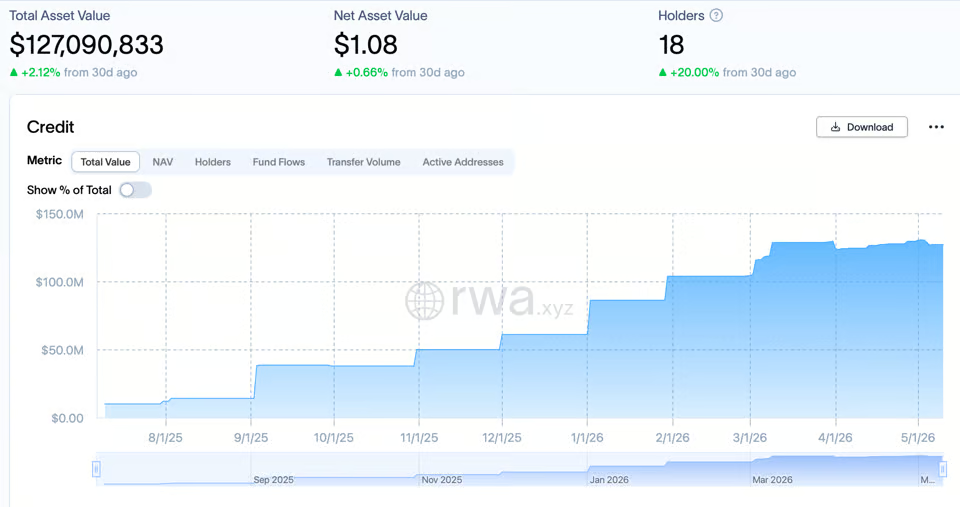
The FalconX deployment adds support for using AA_FalconXUSDC vault tokens in onchain lending markets, enabling investors to borrow against institutional credit exposure while maintaining yield-bearing positions. Data from RWA.xyz shows FalconX Credit Vault currently holds about $127 million in distributed value.

FalconX Credit Vault. Source: RWA.xyz
According to an announcement shared with Cointelegraph, the system also includes automated margin controls, real-time collateral monitoring and onchain settlement features.
Monad Foundation director of marketing Nathan Cha told Cointelegraph that the broader opportunity for tokenized credit products lies in their composability across DeFi markets, allowing institutional assets to be reused across lending, trading and other onchain financial activity.
FalconX is a crypto prime brokerage and institutional lending company, while Monad is an EVM-compatible Layer 1 blockchain designed for high-performance financial applications.
Related: OKX lets institutions use BlackRock’s BUIDL fund as trading collateral
Institutional credit moves onchain
Today’s announcement is representative of a broader push to bring traditional financial products onto blockchain networks.
Maple Protocol ranks as the largest manager in the tokenized credit sector with around $1.7 billion in distributed value, followed by SICOS Securities with about $902 million and Anemoy with roughly $476 million.

Tokenized credit snapshot. Source: RWA.xyz
Earlier this year, Maple Finance expanded its yield-bearing syrupUSDC token to Coinbase’s Base network and pursued a proposal to allow the asset to be used as collateral on Aave. Like FalconX’s credit vault product, syrupUSDC is backed by institutional lending activity and designed for use across decentralized finance markets.
The push to bring financial assets onchain has also gone beyond credit markets into tokenized securities and exchange infrastructure.
In March, the New York Stock Exchange signed an agreement with Securitize to support a securities platform for blockchain-based share issuance, trading and settlement.
That same month, Nasdaq partnered with Kraken and tokenization company Backed to develop infrastructure for blockchain-based equities designed to move between traditional and onchain markets.
Magazine: XRP ‘probably going to $12,’ Bitcoin ETFs add $1B: Market Moves


President Donald Trump said stopping Iran from getting a nuclear weapon is the “only thing that matters” to him. He dismissed Americans’ financial strain as inflation hit a three-year high in April.
The comments came before Trump departed for a high-stakes trip to Beijing to meet Chinese President Xi Jinping.
“I don’t think about Americans’ financial situation. I don’t think about anybody. I think about one thing: we cannot let Iran have a nuclear weapon. That’s all,” he said.
Follow us on X to get the latest news as it happens
Trump Shrugs Off Americans’ Pain as Inflation Hits 3.8%
The president brushed off the notion that the economic toll on Americans was shaping his approach to Iran, telling a reporter, “Not even a little bit” when asked how much the issue motivated him to make a deal.
BeInCrypto reported that in April, the headline Consumer Price Index (CPI) rose to 3.8% year-over-year, above Wall Street estimates of 3.7%. Meanwhile, core CPI jumped to 2.8% year-over-year, beating expectations of 2.7%.
Energy was a key driver. The energy index jumped 3.8%, accounting for over 40% of the headline gain. Gasoline alone rose 28.4% over the past year.
Notably, Americans have separately spent an extra $37.6 billion on fuel since February. The Strait of Hormuz closure has rippled through global supply chains, lifting transportation and food costs alongside gasoline.
Moreover, the data showed that the food index has risen 3.2% annually, with fertilizer costs threatening further pressure on grocery bills.
The president held firm despite the price pressure. He pushed back sharply after a reporter pressed him on why inflation had climbed to a three-year high despite his pledge to lower prices.
“If you go back to just before the war, for the last three months, inflation was at 1.7%. Now, we had a choice. Let these lunatics have a nuclear weapon. If you want to do that, then you’re a stupid person,” he said.
He added that an end to the war, which he suggested would come soon, would pull oil prices lower and send the stock market, already at record highs, “through the roof.”
Subscribe to our YouTube channel to watch leaders and journalists provide expert insights
The post Trump Says Stopping Iran’s Nukes Is “Only Thing That Matters” as Inflation Hits 3.8% appeared first on BeInCrypto.

Grayscale Investments revised its Hyperliquid ETF filing and added staking yield features for HYPE exposure. The filing updates aim to enhance returns while keeping the trust structure compliant with U.S. regulations. The ETF will list on Nasdaq under HYPG after registration approval becomes effective.
Grayscale integrated staking consideration into the fund to capture HYPE network rewards. This structure mirrors Ethereum ETF models that distribute staking yield through regulated products. The proposal states compliance checks must confirm grantor trust status before activation.
Hyperliquid operates as a decentralized perpetual trading blockchain, gaining rapid market traction. HYPE token supports ecosystem activity and serves as the primary network asset. Grayscale appointed Anchorage Digital as custodian and Bank of New York Mellon as administrator.
Ethereum ETF Staking Models Expand Across Issuers
Ethereum staking ETF structures expand as issuers integrate yield generation into regulated funds. Grayscale and peers use ETH staking to create additional income streams for fund holdings. These products aim to reflect blockchain rewards while maintaining traditional exchange-traded fund rules.
Ethereum staking integration follows regulatory discussions around yield classification in crypto assets. Asset managers design staking systems to distribute rewards proportionally to ETF unit holders. Custodial frameworks ensure staking operations remain separated from trading and liquidity functions.
Ethereum ETF staking models influence broader crypto fund innovation across multiple networks. Yield distribution mechanisms vary depending on validator participation and network performance metrics. Regulatory compliance remains central as issuers align staking rewards with financial rules.
Solana ETFs Integrate Staking Rewards Into Fund Design
Solana staking ETFs gain attention as issuers explore high-throughput network rewards. Funds tracking SOL aim to capture staking yield from validator participation across the network. Solana network design supports rapid transaction processing and consistent reward distribution models.
ETF issuers evaluate staking risks and operational requirements before launching SOL-based products. Custody providers manage validator delegation to ensure secure staking participation for funds. Market structures adapt as Solana staking becomes integrated into regulated financial vehicles.
Reward calculations depend on validator uptime and network consensus performance metrics. Institutions explore SOL exposure through ETF frameworks to simplify digital asset access. Regulatory alignment shapes how Solana staking income flows into fund structures.
Custody Framework and Regulatory Structure Shape ETF Growth
Grayscale trust design relies on regulated custodians to manage digital asset security. Anchorage Digital provides custody services that support institutional-grade blockchain asset handling. Bank of New York Mellon handles administrative and transfer agent responsibilities for the ETF.
The structure aims to maintain compliance with grantor trust tax classification requirements. Regulatory approval depends on alignment between staking rewards and securities law frameworks. Issuers expand crypto ETF offerings as staking features become integrated across assets.
Fund administrators monitor reward flows to ensure accurate distribution to share units. Crypto ETF evolution reflects the growing integration of blockchain yield mechanisms into finance. Grayscale adjusts filings to match evolving regulatory standards for digital asset products.

How to Make Money as a Teenager

Israel booed as five countries are eliminated in Eurovision semi-final

Barminco secures $850m Bellevue contract

Manchester United reach agreement with Casemiro over contract clause amid transfer speculation

US brings back mandatory military draft registration

Steven Gerrard disagrees with Gary Neville over ‘shock’ Chelsea and Arsenal claim | Football


-
 Crypto World5 days ago
HarrisX Poll Found 52% of Registered Voters Support the CLARITY Act
-

 Fashion4 days ago
Weekend Open Thread: Marianne Dress
-

 Crypto World6 days ago
Upbit adds B3 Korean won pair as Base token gains Korea access
-
 NewsBeat6 days ago
NCP car park operator enters administration putting 340 UK sites at risk of closure
-

 Fashion1 day ago
Coffee Break: Travel Steam Iron
-

 Fashion2 days ago
What to Know Before Buying a Curling Wand or Curling Iron
-

 Tech3 days ago
Auto Enthusiast Carves Functional Two-Stroke Engine from Solid Metal
-

 Politics1 day ago
What to expect when you’re expecting a budget
-

 Politics4 days ago
Politics Home Article | Starmer Enters The Danger Zone
-
 Business4 days ago
Ignore market noise, India’s long-term story intact, say D-Street bulls Ramesh Damani and Sunil Singhania
-

 Crypto World7 days ago
BlackRock CEO Larry Fink Discusses a New Asset Class
-

 Tech2 days ago
GM Agrees To Pay $12.75 Million To Settle California Lawsuit Over Misuse Of Customers’ Driving Data
-
 Sports7 days ago
NBA playoff winners and losers: Austin Reaves is not loving Lakers vs. Thunder matchup, but Chet Holmgren is
-

 Entertainment6 days ago
Sarah Paulson Called Out For Met Gala ‘Hypocrisy’
-

 Entertainment5 days ago
General Hospital: Ric & Ava Bombshell – Ric’s Massive Secret Exposed!
-

 Politics5 days ago
Simon Cowell Says He Was ‘Horrible’ To Susan Boyle During BGT Audition
-

 Crypto World6 days ago
Robinhood says Wall Street is building onchain
-

 Entertainment6 days ago
Bold and Beautiful Early Spoilers May 11-15: Steffy Revolted & Liam Overjoyed!
-

 Sports6 days ago
UEFA Champions League final schedule, teams, venue, live time and streaming | Football News
-

 Entertainment6 days ago
Why David Letterman Called CBS ‘Lying Weasels’
You must be logged in to post a comment Login