



Connect with us
DAPA Banner
DAPA Coin
DAPA
COIN PAYMENT ASSET
PRIVACY · BLOCKDAG · HOMOMORPHIC ENCRYPTION · RUST
ElGamal Encrypted MINE DAPA
🚫 GENESIS SOLD OUT
DAPAPAY COMING

Tech

Everyone at the Musk v. Altman Trial Is Using Fancy Butt Cushions

Published

on

The final stragglers testified on Wednesday in the Musk v. Altman trial. The witnesses generated few waves, aside from the revelation that Microsoft has so far spent over $100 billion on its partnership with OpenAI. Rather than focus on that, I wanted to bring you a candid observation that my colleague Maxwell Zeff and I can’t stop talking about after spending nearly three weeks watching the trial.

The courtroom is littered with butt cushions.

Several of the hard, wooden benches on the right side of US district Judge Yvonne Gonzalez Rogers’ courtroom are reserved for OpenAI and Microsoft’s attorneys, executives, and other members of the defense. About 10 people, including OpenAI CEO Sam Altman and general counsel Che Chang, have benefitted from thick black cushions—the plushest of them from the brand Purple; $120 from Target—that spare their butts from hours of sitting. Some cushions have rounded corners, while others are square. On Wednesday, Chang even put one behind his back, a less common but not unprecedented move in the courtroom.

OpenAI President Greg Brockman and his wife, Anna, have watched a considerable portion of the trial—and have both been prolific users of pristine white pillows. Judging from the tags bursting from the seams, the pillows seem to be from the sleeping goods brand Coop, which sells a two pack of alternative down-filled throw pillows for $35.

Advertisement

On Wednesday, an OpenAI bodyguard carried a purple handbag into the courtroom, with a pillow for each of the Brockmans. Anna gave her husband just a minute to suffer in pillow-less oblivion before she discreetly passed one to him and then situated her own. I felt bad for OpenAI chief futurist Joshua Achiam, who later took Brockman’s seat but wasn’t left with either of the pillows. (Achiam eventually did obtain one of the more standard black cushions.)

OpenAI did not immediately respond to WIRED’s request for comment.

One longtime technology lawyer told WIRED that using cushions or pillows isn’t exactly “customary,” but noted, “it’s not totally out of left field.” Personally, he said, he has never seen lawyers use pillows or cushions during his trials, but then again, he’s “never been involved in a trial that has lasted as many days as that one.”

The core litigators in this case sit in comparatively luxurious leather chairs, though a couple do show signs of fraying, so maybe the padding isn’t as robust as it appears.

Advertisement

My last time in this courtroom for an hours-long stretch was in 2021, covering portions of the Epic Games v. Apple trial. But capacity was limited back then because of Covid concerns, so I had plenty of room to stretch out. This time around, the courtroom has been filled nearly to its maximum capacity—about 150 people—including bench seats for up to 90.

I thought about bringing my own cushion roughly an hour into my first day of the trial at the end of April, because, well, these benches are deeply uncomfortable. But I didn’t want to come off as weak. None of the other two dozen or so reporters regularly in attendance—including one who is pregnant—seemed to bring cushions, at least, initially. So I went through a run of six days with my bottom and back getting sorer by the minute.

Last week, after a particularly brutal morning, I finally decided to bring in some help. I couldn’t find the well-padded seat cushion meant for stadium bleachers, so I settled for a “cooling” cushion passed out at the steaming-hot outdoor venues at the Tokyo Olympics. About two seconds into using it on Wednesday morning for the first time, I ruled it counterproductive. It was too small and too thin to offer any relief. My back got particularly stressed when furiously typing notes about the Musk-inspired jackass trophy, which reportedly once had its own pillow.

Four hours in, I gave up on the pillow entirely. But I noticed one New York Times reporter who eventually caved, as well as the courtroom artist—who has a particularly colorful cushion—remained seated on their pillows. Maybe I’ll find a better remedy for next week, when Gonzalez Rogers will hear arguments about potential penalties.

Advertisement

Maxwell Zeff contributed to this report.


This is an edition of Maxwell Zeff’s Model Behavior newsletter. Read previous newsletters here.

Source link

Advertisement
Continue Reading
Click to comment

You must be logged in to post a comment Login

Leave a Reply

Tech

Netflix’s Ad Tier Now Has A Whopping 250 Million Monthly Users

Published

on


Netflix has more than 250 million monthly active users on its ad-supported tier. The figure, which was revealed during the company’s Upfront presentation, marks a huge spike for this subscription option. In 2024 the plan with ads had 70 million users and in 2025 it reached 94 million.

Starting next year, Netflix will also launch the ad-supported plan in 15 more countries: Austria, Belgium, Colombia, Denmark, Indonesia, Ireland, the Netherlands, New Zealand, Norway, Peru, Philippines, Poland, Sweden, Switzerland and Thailand.

The Basic with Ads tier of access started rolling out in 2022. It appears to be an increasingly popular option as Netflix, like most streaming services, has continued to get ever-more expensive. The company just upped all monthly subscription costs by a dollar earlier this year.

Advertisement

And of course, because this is 2026, the Upfront included plenty of talk about AI. Netflix started using the tech in its ads last year, and one of the new potential applications the company is testing will serve “personalized ad loads and frequency caps that dynamically adjust the ads our members see, based on their viewing behaviors.” Netflix is currently facing a lawsuit from Texas on claims that it illegally sells user data to ad tech companies, although the streaming service said the suit was “based on inaccurate and distorted information.”


Advertisement

Source link

Continue Reading

Tech

Tiny Ukrainian startup claims its low-cost laser weapon can destroy drones and helicopters from several kilometers away

Published

on


  • Trident reportedly destroys reconnaissance drones from distances reaching 1.5 kilometers away
  • Ukrainian developers claim the laser weapon costs far less than Western systems
  • The Trident laser reportedly damages aircraft optics, electronics, and structural components effectively

Ukrainian company Celebra Tech is putting the final touches on a Trident laser weapon which it claims can destroy drones, helicopters, and even missiles at significant distances.

The Trident burns through enemy optics and structural components from up to three miles away.

Source link

Advertisement
Continue Reading

Tech

KitchenAid Launches Its First Smart Thermometer

Published

on


KitchenAid has released a smart thermometer, the first from the popular cooking brand. The single probe model will retail for $100 while the dual option will cost $200. Although a maximum temperature isn’t listed in the specs, the company says that the Smart Thermometer can be used for a range of processes, including grilling, roasting, smoking, air frying and stovetop cooking.

The probes are waterproof and dishwasher safe, and when fully charged, the battery life can top out at 24 hours, so you can keep tabs even on long projects like smoking a hefty brisket. The quick-charge option can boost the probe to an extra five hours of cooking from five minutes of charging.

The KitchenAid Smart Thermometer connects to the company’s app, which offers a graph view for visualizing the cooking process, a collection of up to 20 saved cooks, and timers or alerts. Notifications can let the cook know when it’s time to take different steps in a recipe based on temperature. The probes use Bluetooth, and the Range Extender Mode can stretch the device’s 285-foot range with a second internet-connected device if needed.

Advertisement

KitchenAid’s offering joins several other products on the market, some from grilling-focused specialists such as Meater and ThermoWorks, and others from similarly major kitchen brands like Whirlpool, which just so happens to own KitchenAid.


Advertisement

Source link

Continue Reading

Tech

Daily Deal: 5-in-1 MagSafe Wireless & Wired Charging Station

Published

on

from the good-deals-on-cool-stuff dept

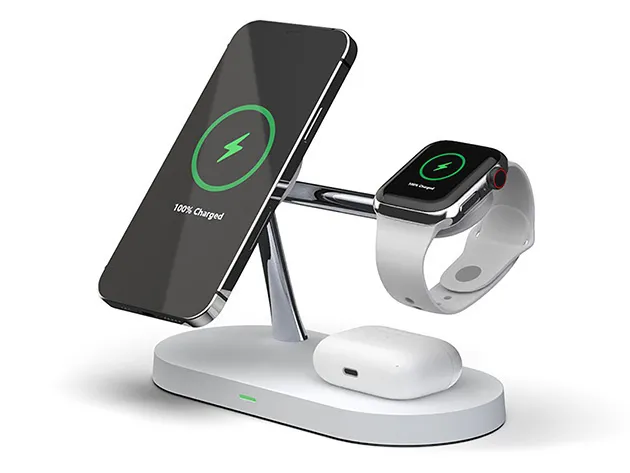
Simplify your daily charging experience and replace most of the chargers and cables on your desktop. The 5-in-1 Wireless & Wired Charging Station is a compact and powerful charging station to charge all your favorite gadgets at the same time, and can also double as a bedside lamp with 3 brightness levels. Having 3 wireless charging spots, and one USB-A port, it enables charging for up to 4 devices simultaneously, including iPhone, Apple Watch, AirPods Pro, AirPods with Wireless Charging Case, other Qi-compatible Android Phones, and Bluetooth earbuds. The Apple Watch Stand is for charging any Apple Watch from Series 1 to 9. Save your workspace and charge all your favorite techs in one elegant solution. It’s on sale for $40.

Note: The Techdirt Deals Store is powered and curated by StackSocial. A portion of all sales from Techdirt Deals helps support Techdirt. The products featured do not reflect endorsements by our editorial team.

Filed Under: daily deal

Source link

Advertisement
Continue Reading

Tech

Instagram’s New Instants App Is a Snapchat Clone for Thirst Traps

Published

on

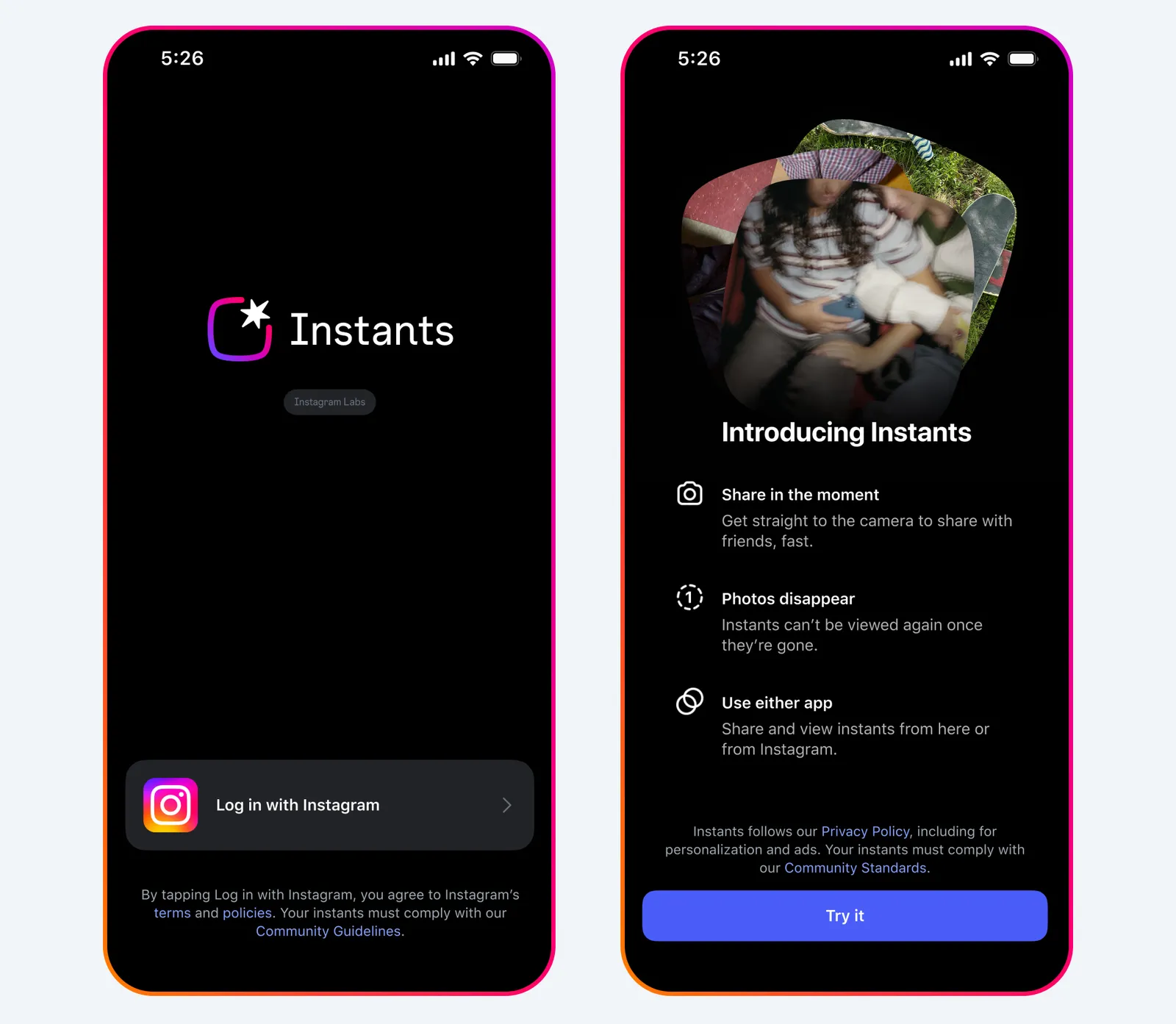
Meta launched a new app on Wednesday, called Instants, that integrates with existing Instagram accounts and allows users to send unedited, disappearing photos. Instants leans into the popularity of Instagram’s Stories feature and Close Friends lists, where users can selectively share images with a smaller audience.

Instants is available as a stand-alone app on iOS and Android in select countries, and it’s accessible through Instagram’s direct messaging tab.

The core of Instants, from its name to the bare-bones layout, is designed to evoke a sense of ephemerality. Yes, it’s a conceptual clone of Snapchat, with images that disappear after viewing, which can also be unsent before the person on the other end views them. (Instagram’s Stories feature, launched a decade ago, was also influenced by Snapchat.)

Unlike Snapchat, Instants is much more focused on capturing raw moments, like the once-viral BeReal app, and doesn’t allow any filters or retouching. That’s striking for a company that helped make sepia-toned filters like Valencia household names, and is hell-bent on adding generative AI to every other corner of its apps.

Advertisement
Image may contain Electronics Phone Mobile Phone Person Text Face and Head

Courtesy of Meta

There’s one specific kind of raw image I fully believe adult users will be sharing with their Close Friends list through Instants: dick pics.

Instagram’s Close Friends feature, which arrived in 2018, earned a reputation as a way to share thirst traps. As a gay man living in San Francisco, I’m fully aware of what I’m going to see when someone adds me to their list and posts to Close Friends. No one’s posting full hog on main—that would be blocked by Meta—but there’s plenty of skin on display in those green bubbles.

Similar to Instagram, Instants is available to teenage users. Even so, content posted on either app may feel adult in nature. While Instagram’s community guidelines ban posting most kinds of nudity, with exceptions for sculptures and breastfeeding, in practice, the main feed on my Instagram is full of ass shots—nothing frontal. Images posted on Stories just to Close Friends lists, rather than being more publicly shared, often seem to avoid the stricter moderation rules. The Instants app is governed by the same guidelines as the main Instagram app.

Image may contain Text

ScreenshotCourtesy of Meta

Advertisement

Source link

Continue Reading

Tech

Notion just turned its workspace into a hub for AI agents

Published

on

Productivity software maker Notion is stepping into the agentic era.

In a live-streamed product announcement on Wednesday, the company, known best for its collaborative note-taking app, introduced a new developer platform that extends the capabilities of its custom AI agents, connects with external agents, and allows teams to build automated multi-step workflows that can pull in data from any database.

By building an orchestration layer — a system that coordinates AI work across multiple tools and data sources — Notion is positioning itself as more than a note-taker with AI features and instead as a hub where people and agents can collaborate across tools and databases.

In February, Notion first launched its Custom Agents — AI teammates that handle repetitive tasks, like answering frequently asked questions, compiling status updates, and automating workflows. Since then, Notion customers have built over one million agents, the company says.

Advertisement

However, these agents had limitations. They couldn’t connect with external data or use custom logic. External agents that companies used also didn’t have a way to connect with the Notion workspace. Teams had to work around these problems by using third-party automation platforms or writing their own scripts that run on their own infrastructure.

“It’s true that, historically, Notion hasn’t been the most developer-focused platform,” said Ivan Zhao, Notion co-founder and CEO, during the livestream. “But things are changing.”

Image Credits:Notion

Now, Notion will allow teams to deploy their own custom code. With its new Workers, Notion’s cloud-based environment for running custom code, customers can write their logic and deploy it to a secure sandbox (an isolated environment that keeps the code from interfering with other systems). This allows teams to do things like sync their data into Notion, build custom tools, and trigger work with webhooks — which are automated signals that kick off actions when something happens in another app — without needing to rely on external infrastructure.

You don’t even have to write the code. The company points out that your preferred AI coding agent can do it for you.

The Workers will use the same credit system as Custom Agents, but Notion is making this free through August, so developers can experiment.

Advertisement

Syncing external data sources is also a part of the Notion Developer Platform. Powered by Workers, the database sync feature can pull in data from any database with an API. That means you could access data from places like Salesforce, Zendesk, Postgres, and others within your own Notion databases — and keep the data current.

Zhao noted that this means that Notion’s users can now “use your Notion database as a sheer canvas to power both your workflows and your agents.”

Image Credits:Notion

Workers can also build agent tools with custom logic, for those times when connecting with a third-party via MCP — short for Model Context Protocol, an emerging standard that lets AI tools connect to external data and services — isn’t enough.

Another addition allows Notion’s users to chat directly with external AI agents they use, assign them work, and track their progress, as if they were one of Notion’s own custom agents. At launch, Notion says that Claude Code, Cursor, Codex, and Decagon are supported partner agents, but it plans to add more.

There’s an External Agent API, too, if teams want to connect their own internal agents with Notion, like those they’ve built specifically for their company’s needs.

Advertisement
Image Credits:Notion

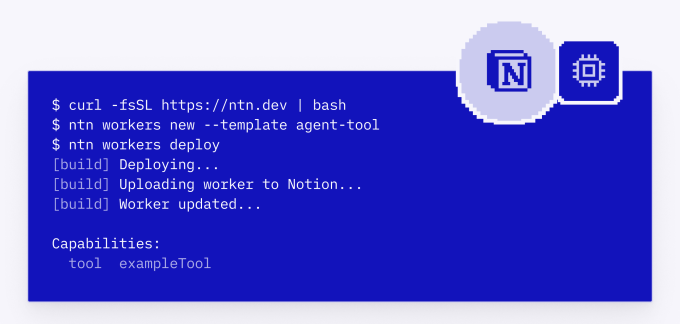
Developers and agents interact with Notion’s new Developer Platform via the Notion CLI, a command-line tool for developers, available on the company’s Business and Enterprise Plans.

The Developer Platform represents a shift in strategy for Notion as it becomes more of a programmable platform than just an application, setting it up to compete with other workflow automation platforms. As businesses increasingly look to automate knowledge work and build internal AI systems, a platform that ties together agents, custom code, and live data in one place starts to look less like a productivity app and more like core infrastructure.

It also follows the broader trend among AI companies, which have been moving beyond the AI chatbot to offer agentic tools that can take actions across different software platforms.

“Any data, any tool, any agent — that’s the big picture for the Notion Developer Platform,” Zhao said.

When you purchase through links in our articles, we may earn a small commission. This doesn’t affect our editorial independence.

Advertisement

Source link

Continue Reading

Tech

South Africa Used AI To Write Its Now Withdrawn AI Policy. The Citations Were Fake.

Published

on

from the doesn’t-anyone-check-anything? dept

Given how often we’ve seen AI-generated fake citations show up in legal filings and even legal decisions, you’d think the lesson would have sunk in by now: if you’re going to use AI to help draft something, you have to actually check what it produces. Apparently that lesson has not reached every government ministry.

Researcher Damien Charlotin was hunting for hallucinated citations using software he’d built for exactly that purpose, when he flagged something worth pausing on: South Africa’s proposed national AI policy contained at least four citations that don’t appear to exist.

The policy that contained hallucinated citations was, in part, a policy about the dangers of AI-generated misinformation.

And, days later, South Africa withdrew the proposal entirely.

Advertisement

South Africa has withdrawn its first draft national AI policy after revelations that it ​contained fictitious sources in its reference list ‌which appeared to have been AI-generated.

“The most plausible explanation is that AI-generated citations were included without proper verification. ​This should not have happened,” Minister of ​Communications and Digital Technologies Solly Malatsi said.

“This ⁠failure is not a mere technical issue but ​has compromised the integrity and credibility of the ​draft policy,” he wrote in a post on X on Sunday.

Compromised the integrity and credibility of the policy? Bit of an understatement, I’d say.

And, look, it’s perhaps no surprise that those looking to put in place an AI policy would be using the tech themselves, but it’s difficult to think that they can regulate it well when they don’t even appear to understand how to use it well (and when not to use it at all).

Advertisement

Naturally, the minister’s takeaway is that the tech needs more regulation:

“This unacceptable lapse proves why vigilant human ​oversight over the use of ​artificial intelligence is critical. It’s a lesson we take with humility,” ​he wrote.

That really feels a lot like blaming the tech for humans making dumb decisions with the tech. He’s not wrong that we need human oversight of the tool. The power of AI tools is only recognized when they are there to assist humans, not replace them, but it’s not clear how a policy position fixes that.

To me, this is more evidence that we need to do a much better job educating people about what these tools can and can’t do. And that’s harder than it sounds, because the companies selling these products have spent years aggressively overselling what AI can do while burying the caveats about how it should actually be used. The gap between what vendors promise and what the tools actually deliver is a big part of why people keep reaching for them in exactly the wrong contexts.

Malatsi’s instinct — regulate harder — is understandable, but it addresses the wrong problem. The behavior you’re trying to regulate here isn’t malicious; it’s lazy and uninformed. Regulation is reasonably good at deterring bad intent. It has a much worse track record against ignorance. People are going to keep trying to force these tools to do things they’re not good at, regardless of what the rules say, because convenience and overconfidence are powerful forces. The better outcome comes when people learn, through repeated direct experience, that the tool fails in these situations — and when the companies selling these tools are honest about where they fail.

Advertisement

There are still genuinely useful ways to deploy AI, even if stories like this make people think that the tech is never good at anything. But using it to generate citations for official government policy documents, without verifying a single one, is not among them.

Of course, rather than actually dealing with any of this, expect a new crop of startups offering tools that claim to review your AI-generated content for hallucinated citations — and are just as unreliable.

Filed Under: ai policy, generative ai, hallucinations, south africa

Advertisement

Source link

Continue Reading

Tech

More AI expected in the App Store, if Apple can minimize risks

Published

on

The App Store includes a lot of AI-coded apps, but Apple is still wary of loosening the leash.

Apple is facing the problem of allowing apps that use AI agents in the App Store, and is having internal discussions about how to incorporate them without breaking long-standing App Store guidelines.

Artificial intelligence has led to a swathe of apps hitting the App Store, as developers embrace agentic coding. While Apple is fine with using AI to produce apps, it continues to have trouble bringing apps using AI to the App Store itself, due to the potential of breaking its rules.

Apple is now trying to work out how to include apps that use AI agents in the App Store so that it can profit from them, reports sources of The Information.

Advertisement

So far, Apple has been blocking apps that have the capability of being used for vibe coding, namely using AI to write code and to create programs. However, the App Store Review Guidelines forbid apps from coding and producing other apps on the iPhone and iPad itself.

The sticking point is that the App Store Review process is meant to check and safeguard users from potential harm, such as malware. If allowed to pass the review process, coding apps could be used to make malware, which wouldn’t have been inspectable by Apple beforehand.

There is also the matter of those agentic coding apps creating other apps for the user. While it wouldn’t be checkable by Apple, it’s also something that can save users from buying other apps from the App Store, endangering its revenue.

Working with the rules

Apple is trying to come up with ways to reconcile this problem. So far, this has apparently consisted of designing a system for apps to adhere to privacy and security standards.

Advertisement

Such a system would prevent some of the more elaborate agentic AI systems from being on iPhone. That means no OpenClaw-style software with massive reach across the user’s system.

Apple has an obvious monetary reason for enabling the apps, especially when they are growing in popularity. But at the same time, those apps have the potential to harm the ecosystem too.

WWDC in June is expected to include a lot of AI-related content, but it is unclear if this AI thrust will involve the App Store.

Third-party AI party

Some of this work to firm up its AI proposition runs alongside another effort giving users a lot more options when it comes to task processing. It is rumored that Apple will be giving users the ability to choose which third-party models can run on their iPhone, as an alternative to Apple Intelligence.

Advertisement

While Apple already has ChatGPT integrated in a way that allows various Apple Intelligence features to run through it instead, including Siri queries, more AI models will apparently be supported in the 27-generation Apple operating systems.

The selected agents will be able to handle things like user queries directed to Siri, Writing Tools, and even the generation of files through Image Playground.

This is something that Apple has been thinking about for some time, especially concerning the App Store. There have been rumors going back to 2024 about an AI App Store, but more recent speculation has been about a section within the store itself.

By contrast to Apple’s current App Store quandry, the models Apple will allow to work with Siri and have deeper access into iOS and macOS will be those approved by Apple. Those models will obviously face more stringent inspection from Apple, and won’t have the capability to code at all.

Advertisement

Source link

Continue Reading

Tech

Anker Nano Travel Adapter Turns Outlets Into Hubs Anywhere with Five Ports in One Slim Unit

Published

on

Anker Nano Travel Adapter 2026
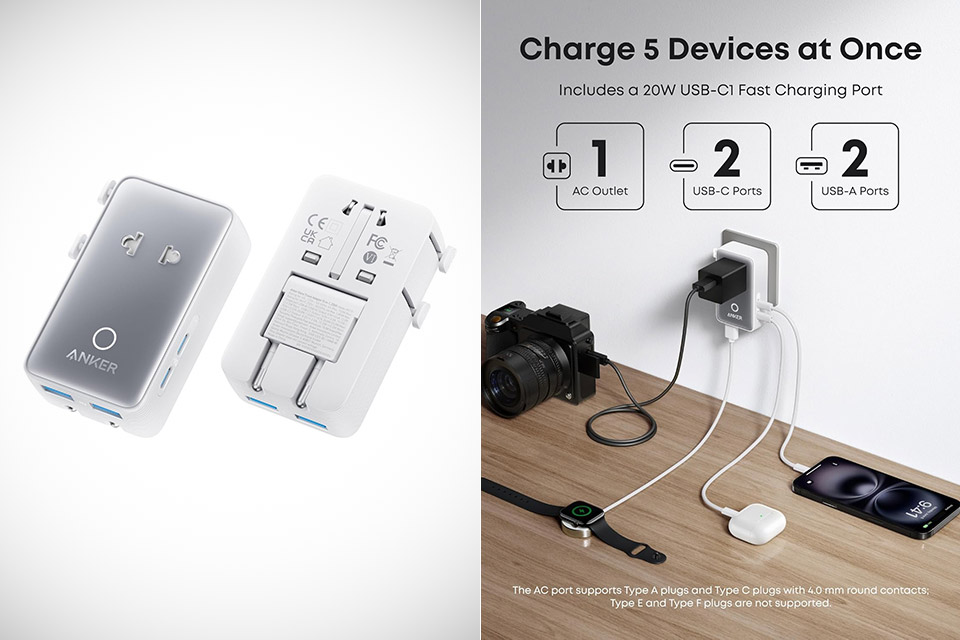
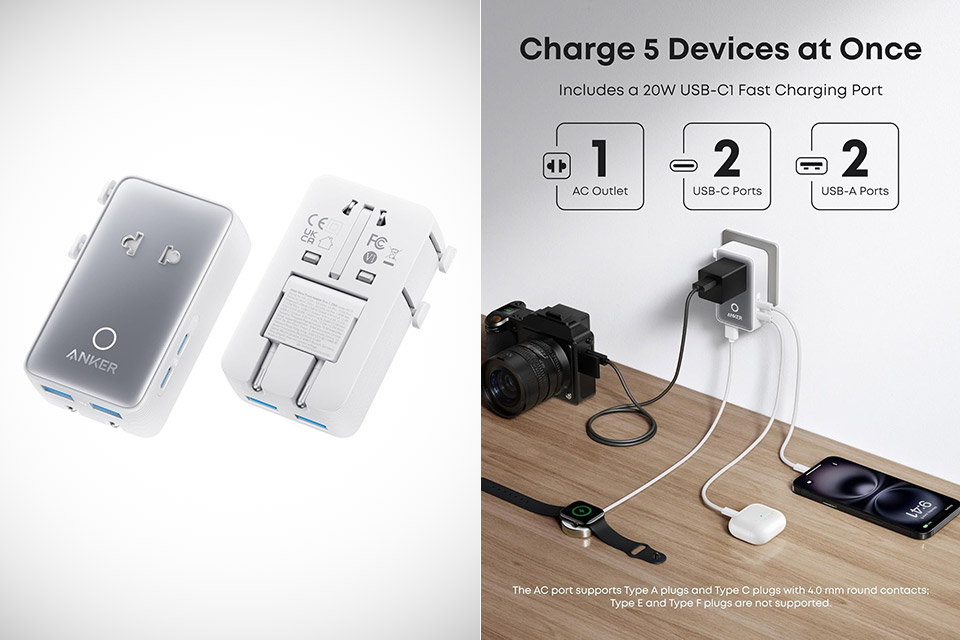
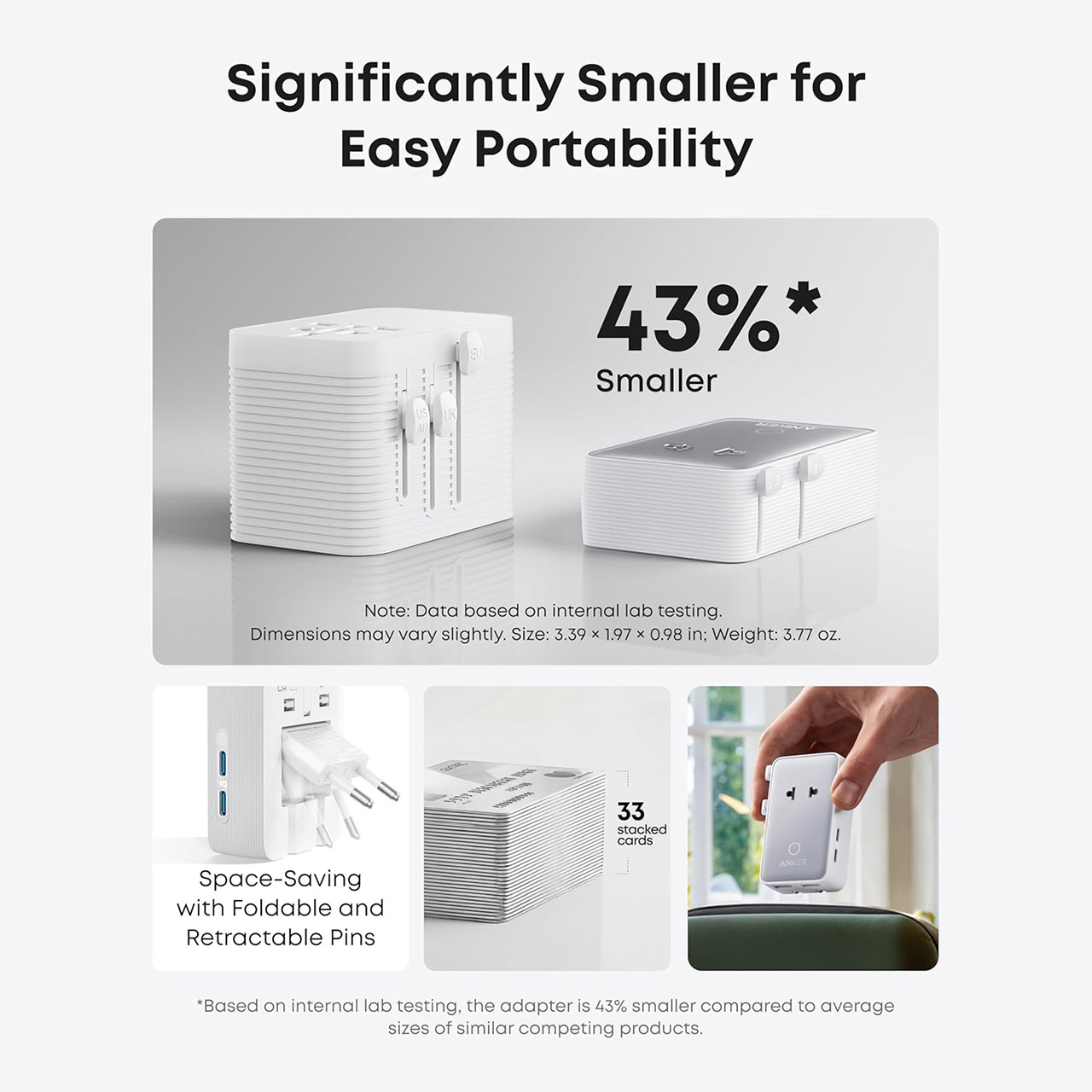
Any regular traveler understands how aggravating it can be to spend hours looking for the correct plug adapter, only to struggle to find enough outlets to charge all of your devices at once. Fortunately for us, Anker has devised a clever little solution that checks off both boxes in one slim package. The Nano Travel Adapter priced at $19.99 (was $26), is just under an inch thick and weighs less than four ounces, thanks to its four USB ports on the sides and bottom, as well as a conventional AC outlet on the front.


Changing the plug to suit different countries is a simple on the rear; simply slide it to the one you need. You will find selections for the United States, Europe, the United Kingdom, and Australia. From there, you can access more than 200 countries and regions, though you may need to do some research to identify the specific ones that are covered. Once you’ve connected it in, a blue LED light on the front indicates that everything is working properly.

Sale


Anker Nano Travel Adapter, 5-Port Power Adapter with 1× 2-Pin AC, 2 USB A, 2 USB C for 20W, Smart…
  • Universal Plug Compatibility: Type A (US / Canada / Japan / China), Type C (EU), Type G (UK / Singapore), and Type I (Australia).
  • Power 5 Devices at Once: Includes 1 AC outlet, 2 USB-A ports, and 2 USB-C ports. The USB ports support up to 20W total output or 15W max when shared…
  • Exceptionally Compact: Measuring just 3.39 × 1.97 × 0.98 in (86 × 50 × 25 mm), it has a credit card-sized footprint and is 43% smaller than…

The AC outlet accepts two-prong US plugs and can handle up to 750 watts (far greater in other countries; verify local voltage limits). Hair dryers and shavers are safe to use, but only if they match the local voltage. When it comes to electronics, they all run on 100-240 volts, which is what this converter is truly built for.

Advertisement


There are four USB ports in all, two of which are USB-C, with one reaching 20 watts (enough to charge a smartphone quickly) and the other topping out at 15 watts. The two USB-A ports can each supply 12 watts, and when all USB ports are active, they can deliver a total of 15 watts between them. This means that all of your stuff will be charged, but it may take longer than if you used a dedicated charger for each gadget.

Anker Nano Travel Adapter 2026
Real-world tests show a phone, earbuds, tablet, and power bank all topping off overnight from one outlet. Laptops stay off the list since they demand more juice than this adapter provides. Instead, bring the laptop’s own charger and plug it straight into the AC outlet.

Anker Nano Travel Adapter 2026
Build quality holds up well after weeks of daily use in different locations. The sliding prongs lock securely with an audible click and resist accidental retraction. The entire unit sits flush against the wall for added stability in crowded sockets. No major scratches or loose parts appeared even after repeated packing and unpacking.

Source link

Advertisement
Continue Reading

Tech

Fractile’s $220m round arrives as Anthropic eyes its UK silicon

Published

on

Accel led the London chip startup’s round, with Pat Gelsinger joining as an angel investor, weeks after Anthropic was reported to be in early discussions to become a customer.


Fractile, the London-based startup designing inference chips that put compute and memory on the same die, has raised $220 million to take its hardware to production, the company said on Tuesday.

The round closes above the $200 million reported target the company was understood to be sounding out in late March, as Electronics Weekly first noted, and lifts Fractile into the cohort of European chip companies pitching themselves as alternatives to Nvidia at the inference layer.

The investor profile is what gives the round its weight. Accel is understood to have led, with former Intel chief executive Pat Gelsinger participating as an angel and operating adviser.

Advertisement

The 💜 of EU tech

The latest rumblings from the EU tech scene, a story from our wise ol’ founder Boris, and some questionable AI art. It’s free, every week, in your inbox. Sign up now!

Existing backers Kindred Capital, the NATO Innovation Fund, and Oxford Science Enterprises, which co-led Fractile’s $15 million seed in July 2024, are part of the round. 

The technology argument runs against the prevailing architecture. Conventional AI accelerators, including Nvidia’s H- and B-series GPUs, separate the compute die from high-bandwidth memory and pay an energy and latency tax shuttling data between them.

Advertisement

Fractile’s design instead performs the matrix multiplications that dominate transformer inference inside SRAM cells located alongside the compute logic, an in-memory-compute approach the company says removes most of the DRAM dependence that is currently the binding constraint on inference cost.

Fractile claims the resulting chip can run frontier models up to 100 times faster and 10 times cheaper than current GPU setups; more recent investor materials, frame the comparison as 25 times faster at one-tenth the cost.

Whether those numbers hold under production loads is the central technical question. The company has so far disclosed simulation and small-silicon results rather than at-scale benchmarks against deployed GPU clusters. F

ractile’s first commercial chip is not expected to be available until 2027, a timeline the company has reiterated publicly, and the $220 million is sized to take the design through tape-out, software-stack build, and early customer integration rather than full production ramp.

Advertisement

The customer side is where the round arrives at the right moment. Anthropic is in early discussions to buy Fractile chips when they are available, multiple outlets reported earlier this month.

If the relationship formalises, Fractile would become Anthropic’s fourth named compute supplier alongside Nvidia, Google’s TPUs, and Amazon’s Trainium and Inferentia parts.

Anthropic has separately been exploring building its own custom AI chips, but the Fractile track suggests it is still pursuing a multi-supplier hedge.

Fractile is also part of a small group of European chip startups whose pitch is that the inference market is structurally distinct from training and therefore winnable.

Advertisement

TNW has tracked three such companies across the past year. The argument is that training will continue to require the largest, most exotic systems and that Nvidia’s CUDA moat is strongest there, while inference, the workload that actually consumes most of the dollars once a model is deployed, rewards specialised architectures tuned for throughput and energy per token rather than peak FLOPs.

The competitive set on that thesis is becoming crowded. Groq has shipped its language-processing units to multiple model providers and recently raised at a $6.9 billion valuation; Etched is building transformer-specific silicon; Cerebras and SambaNova have raised against the same workload from different angles.

Google itself is assembling a four-partner inference-chip supply chain with Broadcom, MediaTek, and Marvell to challenge Nvidia at the inference layer. Fractile’s claim is that its in-memory architecture wins on the metric that matters most for cost-sensitive inference, watts per useful token.

The round follows Fractile’s February announcement of a £100 million ($132 million) three-year expansion of its London and Bristol operations, including a new hardware-engineering site in Bristol, and fits the wider UK sovereign-AI push that also produced the BT, Nscale, and Nvidia data-centre partnership in April.

Advertisement

Founder and chief executive Walter Goodwin, an Oxford Robotics Institute PhD now in his late twenties, has been the public face of the pitch.

The team has drawn engineers from Graphcore, Nvidia, and Imagination Technologies, and is building its software stack alongside the silicon. Tape-out and customer integration are the next visible milestones.

Source link

Advertisement
Continue Reading

Trending

Copyright © 2025