

Crypto World
OKX oil futures deal with ICE brings 24/7 crude to crypto

Intercontinental Exchange and OKX are teaming up to list perpetual oil futures that track ICE Brent and WTI benchmarks on the crypto exchanges derivatives platform.
Summary
- ICE will license its Brent and WTI futures prices to support new perpetual oil contracts on OKX in selected markets
- The move follows ICE’s investment that valued OKX at 25 billion dollars and gave the NYSE owner a board seat
- Oil perps mirror a fast growing niche pioneered by platforms like Hyperliquid, where WTI linked perpetuals have seen volumes jump to 7.3 billion dollars
- The initiative blurs lines between traditional commodities and crypto derivatives as CME and ICE push regulators to rein in offshore oil perps while testing their own 24/7 models
The owner of the New York Stock Exchange will provide its regulated futures prices for ICE Brent crude and West Texas Intermediate as the reference curve behind the new contracts, while OKX handles the perpetual structure, crypto margin and user distribution.
The contracts will reference the same benchmarks that underlie multi trillion dollar cleared futures on ICE, according to Bloomberg, but will be listed as non expiring swaps on OKX’s venue with funding payments to keep prices aligned with the underlying oil curves.
For now the trading will be limited to jurisdictions where OKX already has permission to offer perpetual futures, which means the products are likely to launch outside the United States even as ICE markets them to institutions used to regulated commodity exposure.
That split structure allows ICE to monetise its benchmark data and deepen a 25 billion dollar strategic tie up with OKX without immediately seeking US approval for 24 hour oil perps on its own exchanges.
The deal sits on top of a broader partnership under which ICE took a minority stake in OKX, secured a board seat and agreed to license its US futures and tokenised equities markets back into the crypto exchange, which serves more than 120 million accounts.
Under that March agreement ICE plans to launch US regulated crypto futures based on OKX spot prices while OKX in turn expects to offer access to ICE’s US futures suite and New York Stock Exchange linked tokenised stocks once regulators sign off.
Will OKX and ICE’s 24/7 oil perps redraw the line between Wall Street and crypto?
Market observers see the oil perpetuals as a logical extension of that blueprint, inserting real world commodities into a crypto native leverage and funding model that retail traders already use for Bitcoin (BTC) and Ethereum (ETH) exposure on OKX’s derivatives books.
For readers tracking large cap assets, Bitcoin and Ethereum prices, liquidity conditions and derivative flows are already covered in depth on dedicated pages at crypto news, which provide context for how new products like oil perps can bleed into broader digital asset volatility and funding markets.
What does this mean for crypto and commodity regulation
The move lands in the middle of a political and regulatory fight over whether perpetual futures on US linked commodities should be allowed for American users at all, and if they are, who should host them.
CME and ICE have pushed US officials to crack down on platforms like Hyperliquid that list WTI linked perps for global users with little classical oversight, framing the issue as a question of market integrity and surveillance rather than a pure turf war.
At the same time both exchanges are nudging regulators toward a world of 24 hour trading, with ICE’s NYSE working on a tokenised securities platform funded by stablecoins and designed for round the clock access that looks very similar in structure to the crypto venues they are publicly criticising.
In that context the OKX deal reads less like a sideline experiment and more like a live test case for hybrid market structure.
ICE supplies regulated benchmarks and governance while OKX contributes the perpetual engine, user interface and experience running high leverage derivatives with up to 125 times leverage in some markets.
If regulators tolerate oil perps tied to regulated benchmarks offshore, it strengthens the case for bringing similar products onshore in a controlled way; if they clamp down, the episode will underline how far commodity regulators are willing to go to keep price discovery anchored in listed futures rather than in offshore crypto contracts.
One person familiar with the thinking told Bloomberg that a large energy trading firm put it bluntly, saying that traders “want the same benchmarks and margin offsets they already use at ICE, but with the flexibility of crypto style funding and around the clock risk management,” a view that captures the logic behind the tie up even as the regulatory path remains uncertain.
For readers looking to understand how this clash between traditional derivatives and digital assets is evolving beyond oil, detailed coverage of Bitcoin markets, Ethereum staking and the rise of perpetual futures across major coins is available on crypto news, including explainers on how funding rates, open interest and cross margining can transmit stress between commodity perps and large cap crypto contracts.
Those dynamics matter because an oil shock expressed through leveraged perps can now move through balance sheets that also hold Bitcoin or Ethereum collateral, tightening the coupling between energy and crypto in ways that macro traders and regulators will have to model rather than ignore.
“We are seeing the convergence of two infrastructures that used to live in separate universes,” said a derivatives strategist at a European prop firm who asked not to be named because they are not authorised to speak publicly. “If you clear oil futures at ICE during the day and trade perpetuals on OKX at night, that is one risk system, not two.”

South Korea’s planned cryptocurrency tax has come under renewed political scrutiny after a public petition seeking its repeal cleared the signature threshold required for legislative review.
Summary
- South Korea’s proposed crypto tax repeal petition has crossed 50,000 signatures and moved to a National Assembly committee for review.
- The petition argues that taxing crypto gains while exempting stock and bond investment income creates unfair treatment for digital asset investors.
- South Korea is set to launch the 22% crypto tax in January 2027, with the National Tax Service already coordinating compliance rules with local exchanges.
According to South Korea’s National Assembly petition system, the motion surpassed 50,000 signatures at around 11:23 a.m. local time on Thursday, eight days after submission, automatically sending the proposal to a parliamentary committee for examination.
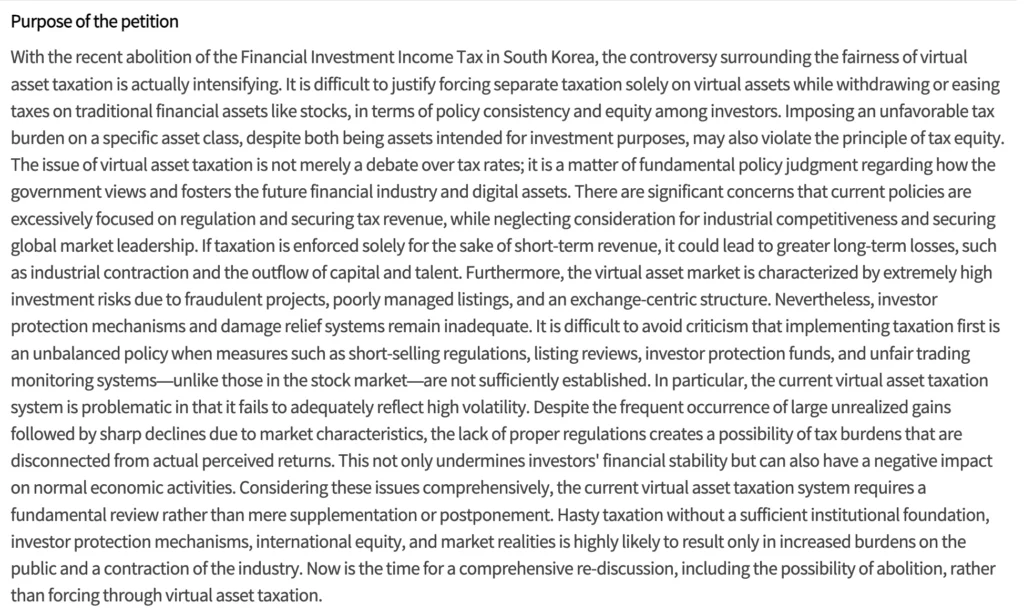
In the petition, an anonymous author argued that taxing crypto investors while exempting traditional financial investment income creates an unfair imbalance.
The motion pointed to South Korea’s decision to abolish taxes on gains from stocks and bonds, while virtual asset investors still face a planned 22% levy on annual gains above 2.5 million won, or roughly $1,650.
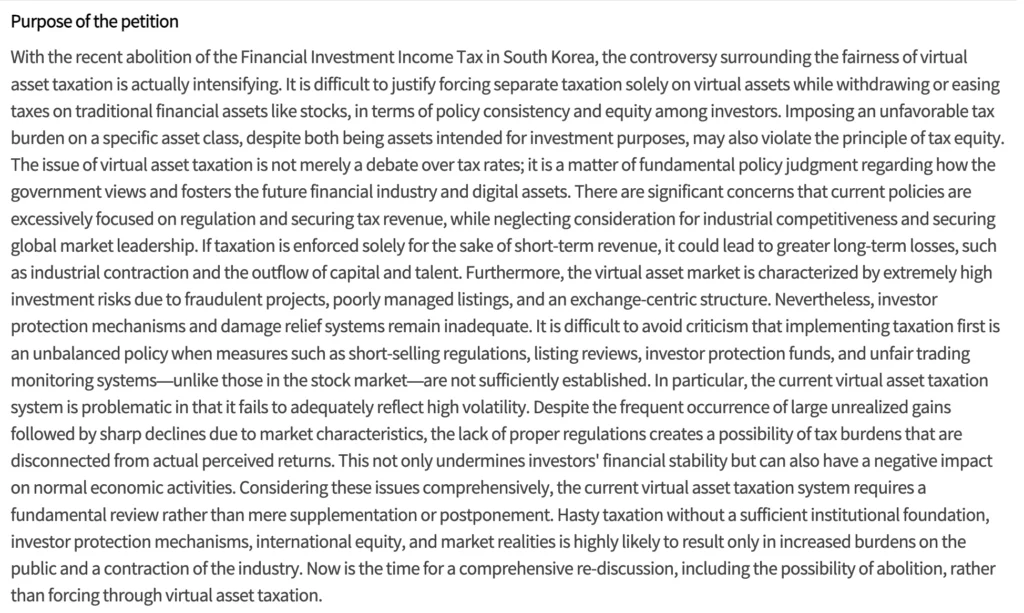
A translated excerpt of the petition. Source: South Korean National Assembly
Set to take effect from Jan. 1, 2027, the tax includes a 20% income tax and a 2% local income tax under South Korea’s Income Tax Act.
Earlier this month, Moon Kyung-ho, director of the Ministry of Economy and Finance’s income tax division, said during a National Assembly forum that the government intended to proceed with the tax as scheduled.
At the same time, South Korea’s National Tax Service has continued preparing implementation guidance with domestic exchanges including Upbit, Bithumb, Coinone, Korbit, and Gopax. Local reports previously said the agency plans to release detailed compliance guidelines later in 2026 before the first full filing period opens in May 2028 for income earned during 2027.
Petition raises investor protection concerns
Alongside criticism over tax fairness, the petition argued that South Korea’s crypto market still lacks sufficient investor safeguards. The motion cited fraudulent activity and poor-quality token listings as ongoing risks that authorities have not fully addressed before introducing taxation.
Translated text from the petition stated that the issue extends beyond tax rates and concerns how the government intends to treat digital assets and the future of the financial industry.
Additional criticism focused on market volatility. According to the motion, the current framework fails to properly account for large price swings that can rapidly alter investor positions.
Political disagreement over the crypto tax has delayed the measure three times already. Per earlier crypto.news reporting, lawmakers postponed implementation from 2025 to 2027 after debates over exchange infrastructure, reporting systems, and whether the 2.5 million won threshold was too low compared with other investment products.
More recently, South Korea’s People Power Party proposed legislation to abolish the tax before its scheduled rollout. However, the Finance Ministry’s latest public comments suggested authorities are still preparing for implementation unless lawmakers amend the law beforehand.
Elsewhere in South Korea’s digital asset sector, regulators have continued advancing new crypto oversight rules ahead of 2027. Earlier this month, the National Assembly passed amendments to the Foreign Exchange Transactions Act requiring firms involved in overseas crypto transfers to register with the finance minister.
Separately, the Financial Services Commission said on May 15 that it plans to release detailed tokenized securities rules in July ahead of amendments to the Capital Markets Act and Electronic Securities Act scheduled to take effect in February 2027. Samsung SDS is also building infrastructure for the Korea Securities Depository’s token securities platform as authorities prepare blockchain-based issuance and settlement systems.


THORChain node operators are voting on ADR028, a recovery plan that would restart the network after a $10.7 million exploit without minting new RUNE.
Summary
- THORChain’s ADR028 plan would use protocol-owned liquidity first before sharing remaining losses with synth holders.
- The proposal avoids new RUNE minting, token sales, or holder dilution while node operators vote on recovery.
- Recent DeFi exploits add pressure on THORChain to restart safely after patching its GG20 vulnerability.
THORChain said node operators are now voting on ADR028 after the May 15 incident. The proposal sets the direction for recovery, while exact figures remain open to later changes through Mimir governance.
The official exploit report said the attacker drained about $10.7 million from one of five vaults. THORChain said the attacker was a newly churned node operator who exploited a GG20 Threshold Signature Scheme vulnerability. The other four vaults were not affected.
Recovery plan avoids new RUNE
Under ADR028, protocol-owned liquidity would absorb the loss first. Any remaining shortfall would then be shared across synth holders. THORChain said the split is still being reviewed and will be adjusted later.
The proposal says no new RUNE will be minted, no RUNE will be sold, and holders will not be diluted. Protocol-owned liquidity would be reduced to zero, with part of future system income redirected to rebuild it over time.
Moreover, THORChain said GG20 will stay in place for now, but it must be patched and upgraded before trading resumes. The network will also need a successful churn before normal activity returns.
The exploit report said automatic solvency checks detected the vault imbalance within minutes. Node operators then used manual pauses and Mimir votes to halt trading, signing, chain observation, and churning within about two hours of the community alert.
Recent DeFi exploits add pressure
The THORChain vote comes after earlier reports said the protocol halted trading when ZachXBT warned that losses could top $10 million across Bitcoin, Ethereum, BSC, and Base. Related coverage noted that RUNE fell after the alert as users waited for clearer details from protocol operators.
The incident also follows a busy period for crypto exploits. Recent reports said the Verus Ethereum bridge lost more than $11.5 million after attackers used a forged cross-chain transfer message. Security firms linked that exploit to missing validation checks in the bridge process.
April also showed how heavy the pressure on DeFi security has become. Crypto protocols lost more than $606 million in the first 18 days of April, led by the $292 million KelpDAO breach and the $285 million Drift Protocol exploit.
TRM Labs also reported that North Korea-linked actors drove about 76% of global crypto hack losses in the first four months of 2026. The firm put those losses at about $577 million through April.
Attacker faces slashing and bounty offer
ADR028 proposes full slashing for the attacker’s node. THORChain said innocent nodes assigned to the same vault would be protected. Recovered RUNE would be paired with any assets recovered from the affected vault, while surplus RUNE would be burned.
The proposal also offers the attacker a bounty to return the funds. If funds are returned in part, the recovery plan would roll back by the same share. THORChain also said the protocol will remain neutral and permissionless, meaning the attacker’s swaps will not be censored once trading resumes.
The vote now gives node operators a path to approve the recovery direction. It does not finalize every number. The main test is whether THORChain can restart safely, absorb losses without new RUNE, and restore confidence after another high-profile DeFi exploit.
Pi Network is trying to link token design with real product use as PI continues to trade near the lower end of its recent range.
Summary
- Pi Network price holds near $0.153 after losing about 10% over the last seven days.
- Chengdiao Fan said token design should support user growth, engagement, feedback, and long-term utility.
- Pi’s utility push follows Protocol 23, but PI still faces weak momentum near key support.
Pi Network said founder Chengdiao Fan’s Consensus 2026 talk focused on a common problem in crypto: the gap between token design and real product innovation. The project said her session, “Aligning Web3, AI, and Blockchain for Utility,” framed tokens as tools for user growth, engagement, and long-term use.
Fan’s presentation also discussed Pi Launchpad, a proposed model for ecosystem tokens and launch mechanisms. The goal is to help products reach real users who can test, give feedback, and use tokens inside actual product experiences, rather than only trading them.
Pi Network’s own blog said Fan argued that AI has made it easier to create applications. That changes the main challenge for builders. In Pi’s view, distribution, verified users, and real usage now matter more than the ability to launch another app.
The Consensus event page used similar language. It said the session would show how Pi combines blockchain infrastructure, verified identity, and a large engaged network to support utility-driven products and AI-era business models.
PI price remains under pressure
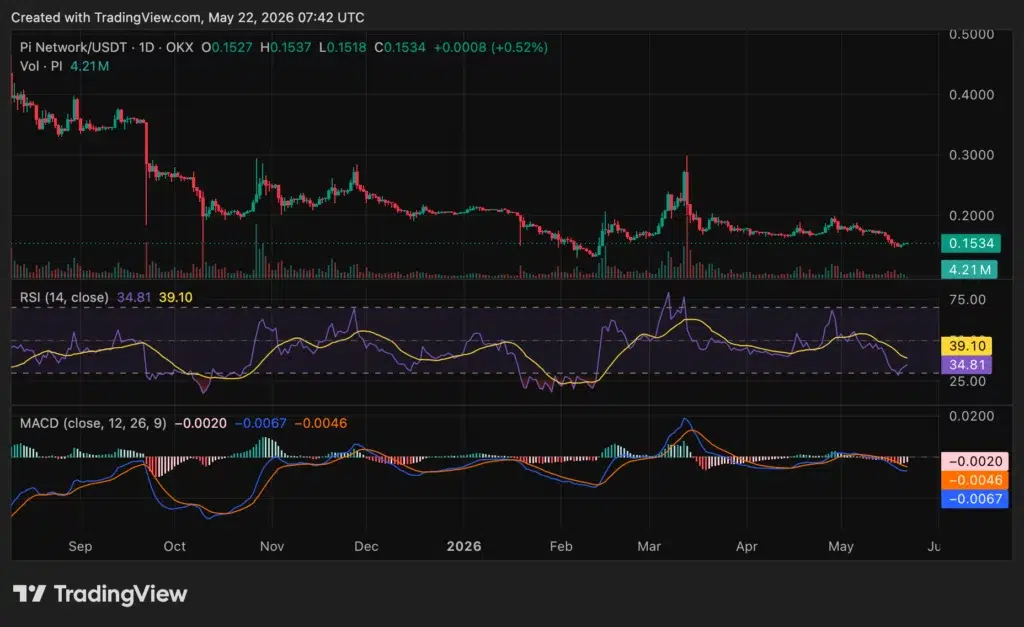
Pi Network’s market data still shows a weak price setup. PI traded near $0.152949 on May 22, with a 24-hour range between $0.150275 and $0.153973. The token was down 10.02% over seven days and 10.14% over 30 days, according to crypto.news price data.
The same data showed Pi Network with a market cap of about $1.62 billion and a fully diluted valuation of about $2.49 billion. PI ranked #54 by market cap, with 24-hour trading volume near $11.5 million.
Pi’s longer-term price picture remains weak. The token is down more than 81% over the past year and remains far below its all-time high of $2.99, reached on Feb. 26, 2025. It is still above its all-time low of $0.131244 from Feb. 11, 2026.
Chart signals also point to limited demand. PI/USDT is trading with muted volume, while the price is struggling to reclaim the $0.17 to $0.20 zone. RSI near 35 shows weak momentum, and the MACD remains negative, keeping sellers in control for now.
Protocol 23 keeps ecosystem hopes alive
Pi Network’s utility message follows a major technical phase for the project. Recent coverage said Protocol 23 activated on May 11, shortly after the project’s Consensus 2026 appearance. The upgrade introduced full smart contract functionality to the Pi blockchain for the first time.
Earlier reports also said Pi’s co-founders used Consensus 2026 to discuss AI, online identity, and Web3 use cases. Fan spoke about utility and token design, while Nicolas Kokkalis joined a panel on proving human identity online without exposing personal data.
That timing matters because Pi is trying to move beyond its long-running mobile mining identity. Protocol 23 gives the network a path toward more programmable applications, while Pi Launchpad would support ecosystem tokens and product launches.
Still, the market has not yet priced in a clear recovery. PI needs a stronger move above $0.17 to $0.18 to weaken the bearish setup. A break below $0.15 could expose another move toward lower support.
Token design becomes Pi’s main test
Fan’s message puts Pi Network inside a wider debate about what tokens should do. Many crypto projects have used tokens mainly for fundraising, speculation, or short-term incentives. Pi is arguing that tokens should help products find users and keep them active.
That pitch fits the project’s existing focus on identity. Pi says its verified user network can help businesses reach real people at a time when AI tools can create fake users, bots, and content at scale. The project says this creates value for apps that need trusted human participation.
The challenge is execution. Utility claims only matter if developers build products that users want and if PI becomes useful inside those products. Price action shows traders remain cautious while they wait for stronger signs of demand.
Polymarket has reportedly appointed a Japanese representative as the prediction market platform moves toward securing approval to operate legally in the country by 2030.
Summary
- Bloomberg reported that Polymarket has appointed a Japan representative as it works toward regulatory approval in the country by 2030.
- Japan remains on Polymarket’s restricted access list while local gambling laws continue imposing strict penalties on unauthorized betting activity.
- Expansion efforts in Japan have surfaced as regulators in India, Argentina, and parts of the U.S. continue tightening oversight on prediction markets.
According to a Friday Bloomberg report citing people familiar with the matter, Polymarket sees Japan as a long-term expansion market even as the platform remains blocked or restricted across several jurisdictions over gambling and financial compliance concerns.
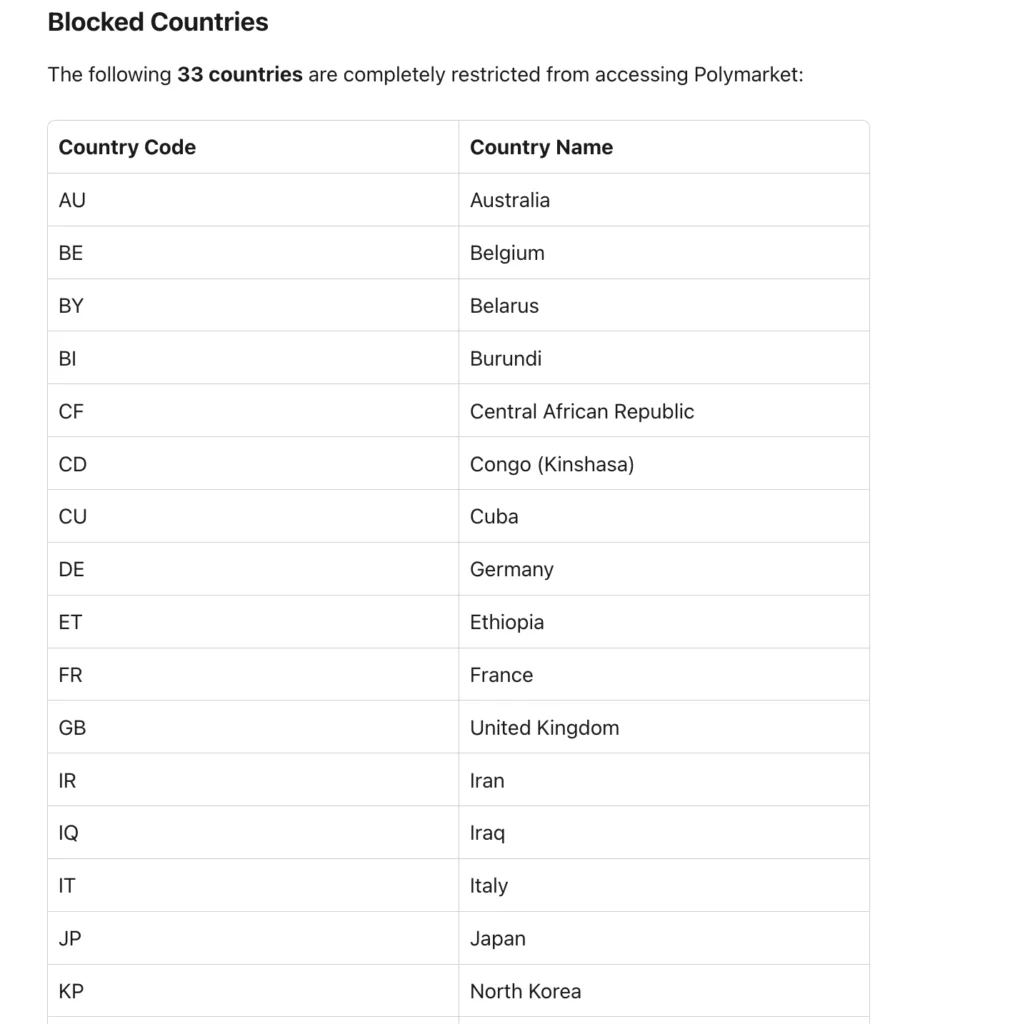
Polymarket’s list of restricted countries. Source: Polymarket website.
Leading the effort is Mike Eidlin, who Bloomberg identified as the current head of Japan at Jupiter. According to the report, Eidlin has been appointed to oversee Polymarket’s local strategy as the company begins discussions around regulatory access in the country.
At present, Japan remains on Polymarket’s restricted jurisdiction list. The platform’s website states that users from the country are blocked due to “regulatory requirements and compliance with international sanctions.”
Japanese law maintains strict restrictions on gambling activity. Under the country’s Penal Code, habitual gambling can carry prison terms of up to three years, while operating gambling businesses can result in imprisonment ranging from three months to five years.
Government-approved horse racing and public lotteries remain exempt under existing rules, while pachinko parlors continue operating through a long-standing legal gray area tied to token exchange systems.
Polymarket pushes expansion amid rising regulatory pressure
Outside Japan, regulators have continued increasing scrutiny of prediction market platforms, particularly those tied to crypto-based payments and speculative contracts.
Earlier on Friday, Indian authorities blocked access to Polymarket after the Ministry of Electronics and Information Technology instructed internet providers and VPN operators to restrict access to what officials classified as illegal online betting and prediction market services. Local outlet ThePrint reported that authorities are also preparing similar action against Kalshi, a U.S.-regulated prediction platform overseen by the Commodity Futures Trading Commission.
Regulatory documents tied to India’s Promotion and Regulation of Online Gaming Act 2025 have categorized platforms that allow users to place money on uncertain outcomes as prohibited betting services, regardless of whether operators describe them as forecasting tools or researching markets.
Pressure has surfaced in other regions as well. Earlier this year, authorities in Argentina ordered internet providers to block Polymarket after a Buenos Aires court found the platform operated outside the country’s gambling framework. Colombia and Romania imposed similar restrictions last year after classifying the service as unauthorized gambling activity.
At the same time, parts of the U.S. have also moved against prediction markets tied to sports contracts. Minnesota recently became the first U.S. state to ban prediction markets, while the CFTC and the Department of Justice filed a lawsuit earlier this week challenging the state’s legislation.
Even with growing regulatory pushback, Polymarket has continued expanding its institutional presence.
Earlier this month, the company partnered with Nasdaq Private Market to launch prediction markets linked to private-company valuations, IPO timelines, and secondary-market pricing. Under the agreement, Nasdaq Private Market serves as the resolution data provider for those contracts using verified transaction data tied to private companies.
Reuters previously reported that Polymarket has also been exploring a fresh funding round that could value the company at roughly $15 billion.
Back in the U.S., Polymarket has also returned through its acquisition of federally regulated derivatives exchange QCEX. Bloomberg and other outlets have reported that the company remains in talks with the CFTC as it seeks to restore broader access to its main exchange operations in the country.
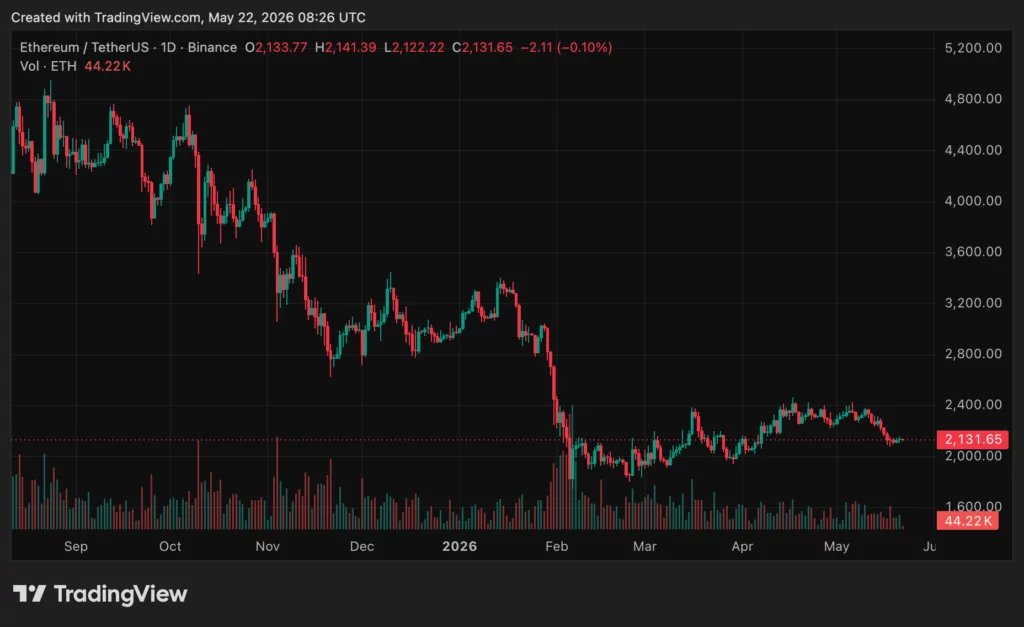
Ethereum sentiment has weakened sharply in May as traders react to price pressure, ETF outflows, Foundation exits, and slower network growth.
Summary
- Santiment says Ethereum’s market cap fell 11.6% in 15 days as trader sentiment weakened.
- ETF outflows, Foundation exits, and slower network growth have fueled fresh Ethereum doubts in May.
- JPMorgan says ETH needs stronger network activity and real-world use to close Bitcoin’s widening lead.
Santiment said Ethereum has seen a sharp shift in market mood, with its market cap down 11.6% over 15 days. The data platform said ETH is now at risk of falling below $2,000 for the first time since late March if selling pressure continues.
The report said Ethereum’s social dominance rose while price kept falling. That pattern can point to higher attention, but Santiment said the tone of discussion moved toward fear and frustration instead of optimism.
Santiment also said bullish and bearish comments about ETH moved closer to balance in May. In late April, bullish comments were still well above bearish ones. By May, the ratio had moved closer to 1.0, showing that traders had become far less confident.
ETF outflows weigh on ETH demand
ETF flows are one of the main pressure points. Santiment said several Ethereum ETF products saw outflows through May, including large exits from BlackRock-related funds. It also said no total Ethereum ETF inflow day above $50 million had been recorded in three weeks.
📉 Ethereum sentiment has flipped hard, and retail has jumped from crypto’s #2 market cap quickly. ETF outflows, Foundation exits, slowing network growth, and nonstop bearish narratives have traders questioning $ETH like never before. Here’s our take. 👇https://t.co/RDpVPbdIZs pic.twitter.com/y7JPlcZEPK
— Santiment Intelligence (@SantimentData) May 22, 2026
Related reports also show why traders are watching the $2,000 area. Earlier market coverage said Ethereum ETFs recorded more than $340 million in net outflows over six trading sessions, while ETH struggled to reclaim $2,150.
JPMorgan has also flagged weaker Ethereum demand compared with Bitcoin. The bank said Bitcoin ETFs recovered about two-thirds of recent outflows, while Ether ETFs recovered only about one-third. It also said ETH and altcoins may keep lagging without stronger DeFi activity and real-world use cases.
Foundation exits add to trader doubts
Ethereum Foundation changes have also fed the weaker mood. Recent coverage noted that Carl Beek and Julian Ma announced exits from the Ethereum Foundation, adding to broader Protocol Cluster changes.
Santiment said traders often react quickly to these narratives. It added that reports about Foundation exits and public claims about ETH supporters reducing exposure helped build the current bearish mood. Some of those claims lacked full context, but they still shaped trader behavior.
The report also noted that Ethereum remains strong in development activity. Santiment said Ethereum still leads in raw developer work, even as retail traders focus more on faster price moves from rival ecosystems.
Network growth remains the market test
Santiment said daily active addresses and network growth have cooled from stronger periods in 2024 and 2025. Fewer new wallets are interacting with Ethereum, which traders may read as a sign of weaker demand for ETH.
Ethereum was trading near $2,125 to $2,135 on May 22, based on market data crypto.news. That keeps ETH close to the support zone watched by traders after recent outflows and technical weakness.
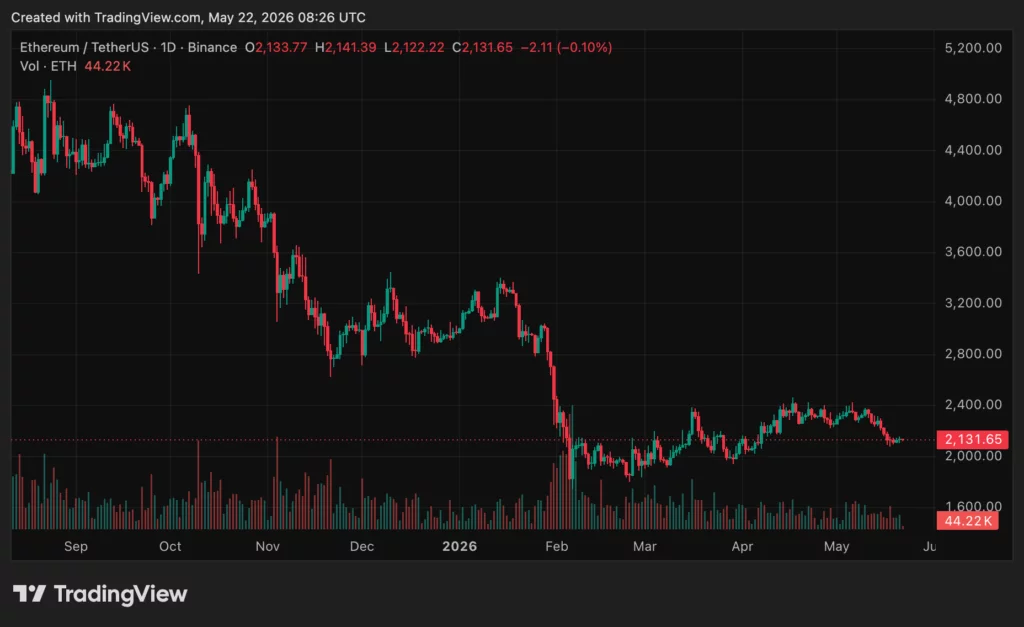
Santiment said “Whether ETH is actually approaching one of those moments remains uncertain,” referring to whether extreme bearish sentiment could turn into a contrarian setup. For now, the market is focused on whether Ethereum can restore demand, defend the $2,000 area, and prove that network use can recover faster than trader confidence is falling.
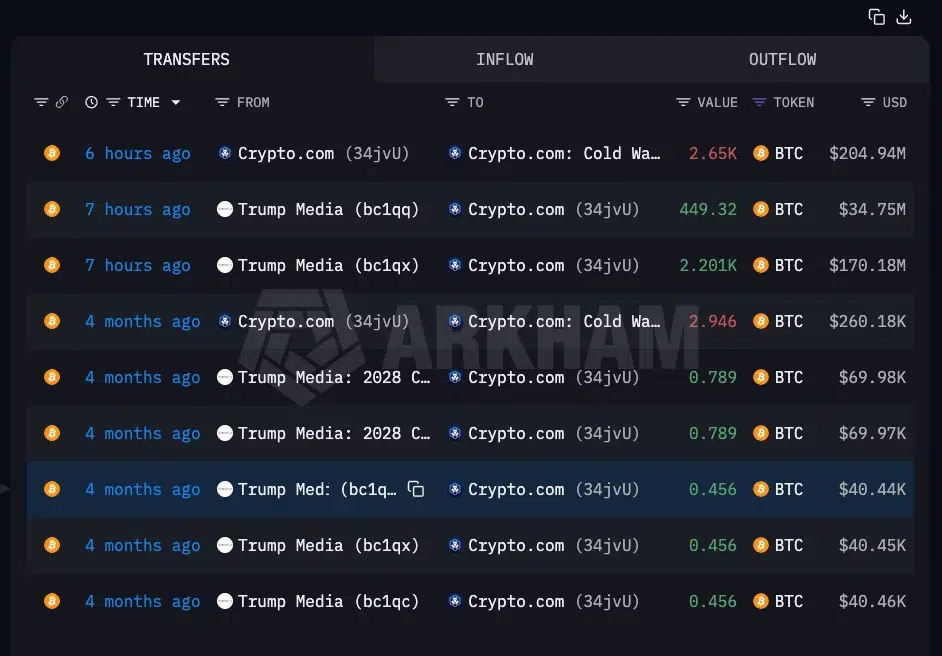
Trump Media & Technology Group has transferred another 2,650 Bitcoin worth about $205 million to Crypto.com, adding fresh scrutiny to the company’s crypto treasury strategy as its holdings remain deeply underwater.
Summary
- Trump Media moved 2,650 Bitcoin worth about $205 million to Crypto.com, according to Lookonchain data.
- The company’s Bitcoin treasury has fallen sharply below its reported average purchase price of about $118,522 per coin.
- Trump Media previously disclosed a $405.9 million quarterly loss, with most of the hit tied to unrealized crypto asset markdowns.
According to blockchain analytics platform Lookonchain, the transfer was detected from wallets linked to Trump Media, the company behind Truth Social and majority owned by the Donald J. Trump Revocable Trust.
Although deposits to exchanges do not automatically confirm a sale, traders often treat large inflows as a possible signal that liquidation could follow.
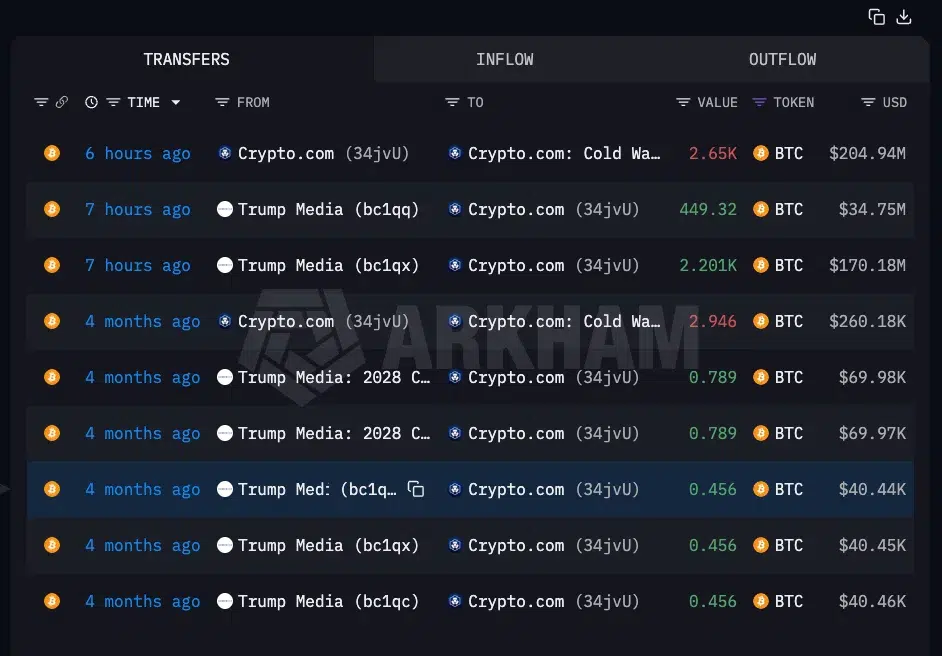
Transferred funds remain in the Crypto.com wallet. Source: Arkham.
Earlier this year, Trump Media moved 2,000 Bitcoin valued at roughly $175 million when Bitcoin (BTC) traded around $87,378. Since then, the market has weakened further, with Bitcoin hovering near $77,700 at the time of the latest transfer.
Corporate treasury losses deepen
Based on Trump Media’s previous disclosures, the company originally accumulated 11,542 BTC at an average purchase price of about $118,522 per coin, spending close to $1.37 billion on the position. At current market prices, the remaining treasury has fallen well below its entry level.
Quarterly filings released by the company showed that its Bitcoin holdings had already declined to 9,542 BTC after the first transfer. Following the latest 2,650 BTC movement flagged by Lookonchain, the stash now appears to stand near 6,889 BTC.
Recent financial results have already shown the impact of the downturn. Trump Media reported a $405.9 million net loss for Q1 2026, with $368.7 million tied to unrealized markdowns on digital assets, pledged crypto assets, and equity securities.
Within the filing, the company disclosed that its Bitcoin holdings carried a cost basis of roughly $1.13 billion while their fair value had dropped to about $647 million by the end of March. Trump Media also disclosed ownership of around 756 million Cronos tokens linked to its partnership with Crypto.com.
What does this mean for Bitcoin?
Large exchange inflows such as these can create temporary fear among traders because visible supply on an exchange order book may act as a potential resistance zone.
However, it must also be noted that the $205 million transfer remains relatively small compared with Bitcoin’s multi-billion dollar daily spot and derivatives trading volume. For now, the market impact would depend on whether the coins are sold directly on the exchange or moved through over-the-counter channels.
Separately, on-chain supply data has continued to show strong long-term holder activity despite weakness among some corporate treasury buyers.
Market analytics cited in recent reports estimated that more than 70% of Bitcoin’s circulating supply has remained unmoved for over a year, suggesting long-term investors have continued holding through the current downturn.
🚨 $BTC Long Term Holders Just Flashed The Signal That Preceded Every Major Expansion Phase Since 2012.#Bitcoin The 1Y+ Long Term Holder metric has now dropped back into the historical “oversold” accumulation zone, a region that previously appeared before explosive upside… pic.twitter.com/9ZHwKFJRm9
— CryptoZeno (@CrypZeno) May 20, 2026
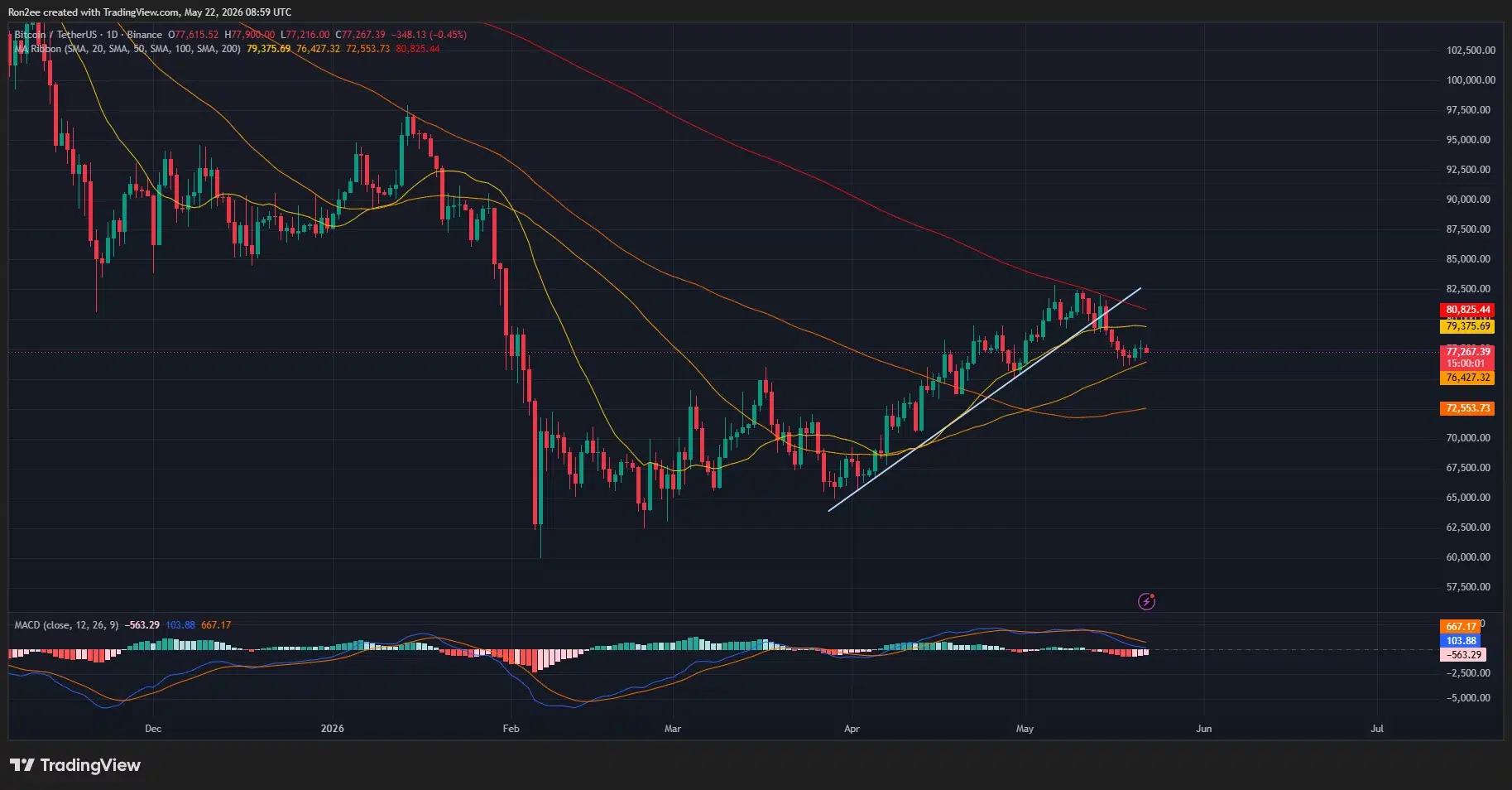
Bitcoin has fallen back toward the $77,000 region after losing a key ascending trendline support that had guided its recovery from April lows.
Summary
- Bitcoin fell back toward $77,000 after breaking below a key ascending trendline support and failing to reclaim the 200-day moving average near $80,800.
- U.S. spot Bitcoin ETFs recorded roughly $1.4 billion in weekly outflows, while over $744 million worth of BTC moved to exchanges over the past five days.
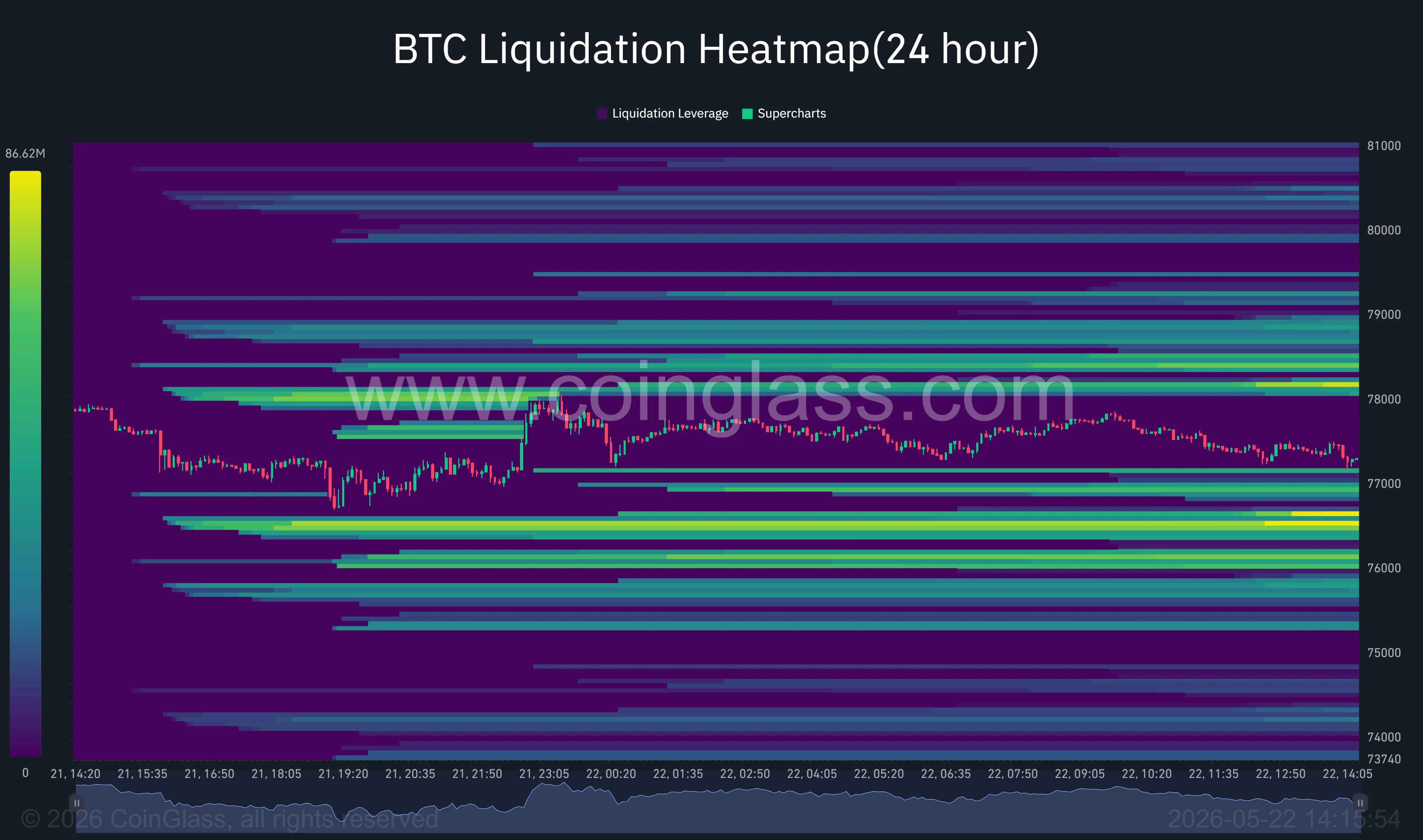
- CoinGlass liquidation data showed dense long liquidation clusters near $76,000 as traders monitored rising oil prices, Fed uncertainty, and U.S.–Iran tensions.
According to data from crypto.news, Bitcoin (BTC) price traded near $77,200 during Friday’s session after briefly losing the rising support structure that had guided its recovery from April lows. Selling pressure accelerated after Bitcoin once again failed to reclaim the $82,000 resistance area, a level that coincides with a descending local trendline and the 200-day moving average near $80,825 on the daily chart.
Over the past week, leveraged bullish positions have absorbed the bulk of the damage. According to derivatives data, nearly $661 million to $850 million in long liquidations were wiped out across exchanges as Bitcoin reversed lower from its May highs. The liquidation cascade amplified downside momentum as forced selling pushed spot prices into lower liquidity zones.
At the same time, U.S. spot Bitcoin ETFs recorded roughly $1.4 billion in cumulative net outflows over the past week. It signals a sharp slowdown in institutional demand following months of post-halving accumulation. BlackRock’s IBIT reportedly registered one of its largest daily outflow sessions during the move, while other major issuers also posted consistent redemptions as traders reduced risk exposure.
On-chain flows added another bearish signal. Analysts noted that 9,664 BTC worth more than $744 million had been transferred to exchanges over the last five days, often interpreted as a sign of rising sell-side intent. Separately, on-chain tracker Lookonchain reported that Trump Media & Technology Group moved another 2,650 BTC valued at roughly $205 million to Crypto.com, further increasing market focus on potential large-holder distribution.
Adding to market sensitivity, Friday’s decline unfolded during Bitcoin Pizza Day week, a period that historically draws elevated trading activity and renewed attention to Bitcoin’s long-term gains. Instead of celebratory momentum, traders encountered rising volatility and deteriorating macro conditions.
Outside crypto markets, oil prices reintroduced another layer of pressure. WTI crude futures climbed back above $98 per barrel after reports suggested Iran’s Supreme Leader ordered enriched uranium reserves to remain inside the country, complicating ongoing negotiations with Washington.
The geopolitical dispute intensified after reports emerged that Iran and Oman were working on a framework for permanent toll systems through the Strait of Hormuz, though President Donald Trump reportedly rejected the proposal and insisted the shipping route remain unrestricted.
Even with crude oil price still down more than 3% for the week, energy traders remained cautious as U.S.–Iran negotiations showed mixed signals.
U.S. Secretary of State Marco Rubio said there were “some encouraging signs” surrounding a possible deal, while Pakistani mediators were expected to travel to Tehran during the latest review phase of Washington’s proposal.
Higher oil prices have compounded inflation concerns that were already building after recent U.S. CPI and PPI readings came in above expectations. Treasury yields climbed toward yearly highs as markets reduced expectations for aggressive Federal Reserve rate cuts. Investors are also preparing for a potential leadership transition from Jerome Powell to Kevin Warsh at the Fed, a scenario many traders associate with a more hawkish policy outlook.
Under those conditions, capital rotation away from speculative assets accelerated across global markets. Bitcoin, which had benefited from strong institutional inflows earlier this quarter, now faces a more difficult liquidity environment as investors prioritize yield-bearing instruments and reduce leveraged exposure.
Can Bitcoin hold the $76K region after losing ascending support?
Technically, Bitcoin’s daily structure has weakened after the price broke below a rising white trendline that had connected higher lows since early April. The breakdown occurred shortly after repeated rejection beneath the descending red resistance trendline near $82,000, reinforcing the formation of a lower high on the daily timeframe.
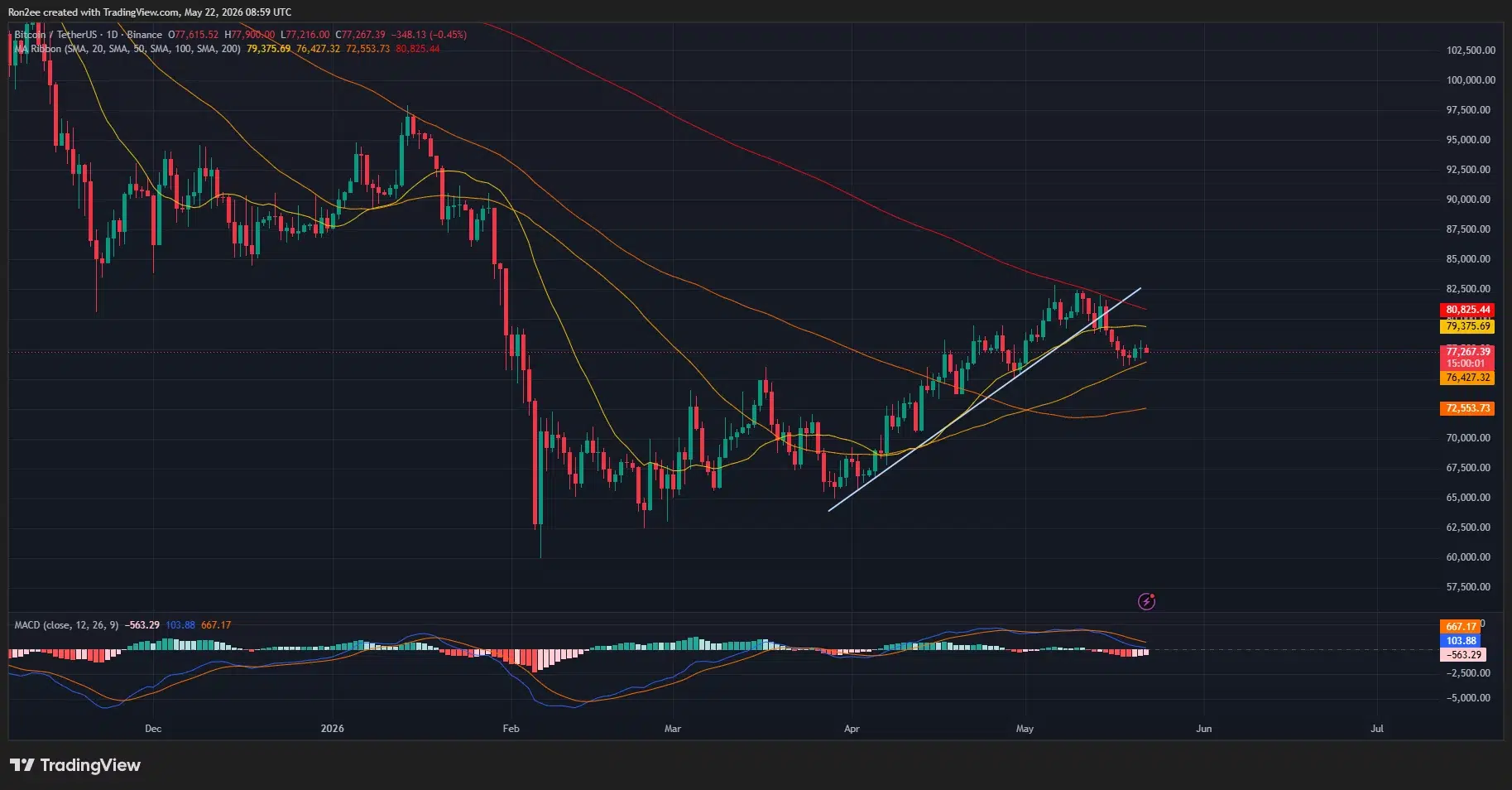
The breakdown also pushed Bitcoin beneath its 20-day moving average around $79,375 while keeping the price trapped below the 200-day moving average near $80,825.
Meanwhile, the 50-day moving average around $76,427 has emerged as the next major technical support. Daily candles are now compressing between declining short-term resistance and the rising 100-day moving average near $72,553.
The MACD histogram on the daily chart has turned negative, while the MACD line itself is beginning to cross lower beneath the signal line. Earlier bullish momentum from April’s recovery phase has faded steadily throughout May as buyers failed to produce a convincing breakout above resistance.
Liquidation data from CoinGlass suggests Bitcoin may still be vulnerable to another sweep lower before stabilization occurs. The 24-hour liquidation heatmap shows dense long liquidation clusters sitting between $76,000 and $76,500, with another concentration near $74,000. Large liquidity pockets above the current price remain concentrated near $78,000 to $79,000, potentially acting as short-term magnets during relief bounces.
Crypto trader Lennaert Snyder said Bitcoin’s daily candle had closed “pretty weak” after failing to reclaim the $78,200 highs. According to Snyder, the market remains trapped in a choppy mid-range structure, with a likely sweep of “sell-side liquidity at the $76.4K range lows” before any meaningful recovery attempt develops.
Meanwhile, Daniel Reis-Faria, CEO of ZeroStack, told crypto.news that Bitcoin’s rejection near its 200-day moving average signaled weak buying pressure.
“Bitcoin turning lower after struggling to move above its 200-day moving average suggests there still may not be enough buying to push prices higher…If buying starts to pick up again, Bitcoin can move higher pretty quickly. But until that happens, Bitcoin is likely to stay under pressure.”
Daniel Reis-Faria, CEO of ZeroStack.
Derivatives positioning also points to lingering caution rather than aggressive dip buying. Funding rates across several perpetual futures platforms have cooled significantly compared to earlier May levels, while open interest has fallen alongside price, signaling ongoing deleveraging instead of fresh speculative participation.
What could invalidate the bearish Bitcoin outlook?
Bitcoin’s recovery back above $79,000 would be the first sign that sellers are losing short-term control. Beyond that, Bitcoin would still need to reclaim the 200-day moving average near $80,800 and invalidate the descending resistance trendline before traders begin discussing a sustainable reversal structure.
Any breakthrough in U.S.–Iran negotiations capable of pulling oil prices lower could ease inflation concerns and reduce pressure on Treasury yields. Softer economic data or renewed expectations for Federal Reserve easing would likely improve sentiment across crypto and equity markets simultaneously.
ETF demand also remains a critical variable. Persistent outflows have weighed heavily on spot liquidity during the latest correction. A reversal back into net positive inflow territory could stabilize price action quickly, especially given how aggressively leverage has already been flushed from the system over the past week.
Failure to hold the $76,000 region, however, could expose Bitcoin to a deeper move toward the $74,000 liquidity zone highlighted on derivatives heatmaps. Below that level, traders may begin targeting the 100-day moving average near $72,500 as the next major structural support during a prolonged risk-off phase.
Disclosure: This article does not represent investment advice. The content and materials featured on this page are for educational purposes only.
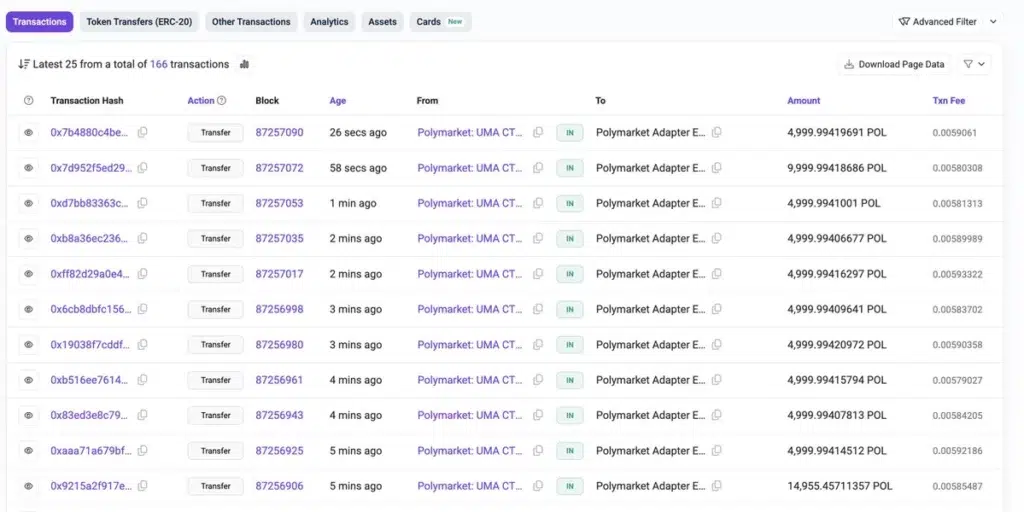
Polymarket’s UMA CTF Adapter contract on Polygon has reportedly been targeted in a suspected exploit, with onchain analysts warning users to pause activity.
Summary
- ZachXBT flagged a suspected UMA CTF Adapter exploit on Polygon with losses above $520K reported.
- PeckShield said two addresses were drained and some stolen funds were deposited into ChangeNOW already.
- Bubblemaps warned attackers were removing 5,000 POL every 30 seconds as losses kept rising quickly.
A ZachXBT community alert said Polymarket’s UMA CTF Adapter contract on Polygon was suspected of being attacked. The alert listed losses above $520,000 and named the attacker address as 0x8F98075db5d6C620e8D420A8c516E2F2059d9B91.
PeckShield later said ZachXBT had reported that the contract had “potentially been exploited.” The security firm said two addresses, 0x871D…9082 and 0xf61e…4805, were drained of about $520,000. It also said part of the stolen funds had already moved to ChangeNOW.
Polymarket protocol contributor Shantikiran Chanal said the security reports were linked to rewards payout activity. He said user funds and market resolution are safe, adding that early findings point to “a private key compromise of a wallet used for internal operations, not contracts or core infrastructure.”
Bubblemaps warns users to pause activity
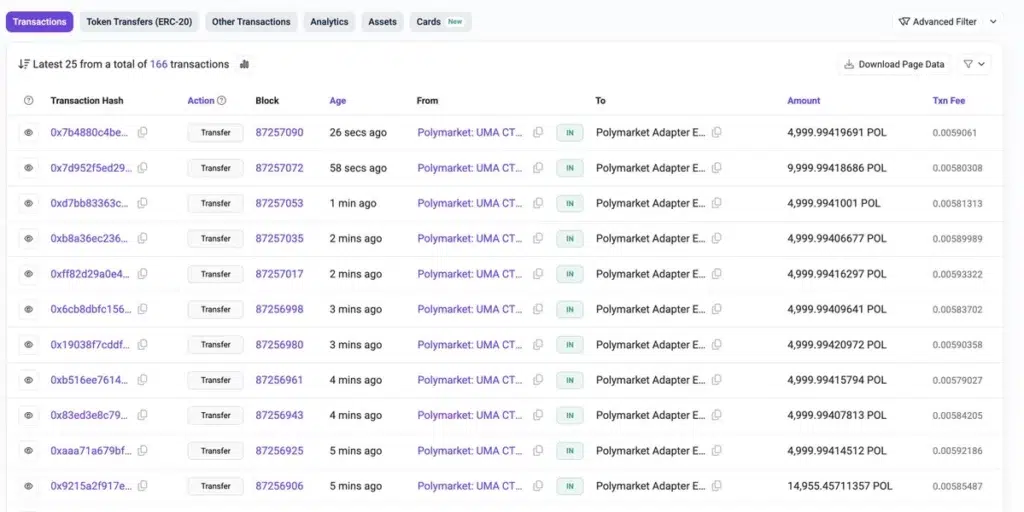
Bubblemaps also warned that a Polymarket contract had been exploited. The firm said attackers were removing 5,000 POL every 30 seconds and estimated losses at about $600,000 at the time of its alert.
PolygonScan data for 0x871D…9082 shows repeated outgoing transfers of 5,000 POL to an address tagged as Polymarket’s UMA CTF Adapter Admin. Several transfers occurred about 30 seconds apart, matching the pattern flagged by Bubblemaps.
Meanwhile, Polymarket’s documentation says the UMA CTF Adapter connects markets to UMA’s Optimistic Oracle. The adapter is used to request and retrieve resolution data for prediction markets built on the Conditional Tokens Framework.
Polymarket’s newer documentation says all outcomes on the platform are tokenized through CTF, with outcome tokens backed by locked pUSD. That makes the affected contract area relevant to how markets are created, resolved, and redeemed onchain.
This is not Polymarket’s first UMA-related controversy. Earlier coverage noted that a UMA whale allegedly influenced a Polymarket market outcome tied to a Trump-Ukraine mineral deal, raising questions over oracle voting power and market resolution trust.
Attack comes as Polymarket expands
The incident comes as Polymarket has been moving from a crypto-native prediction platform into a larger market structure debate. Recent crypto.news coverage said prediction markets led by Polymarket and Kalshi have grown into one of finance’s fastest-moving sectors.
The platform has also faced regulatory and market-design pressure. Earlier coverage noted Wisconsin’s lawsuit against Polymarket, Kalshi, Coinbase, Robinhood, and Crypto.com-linked entities, arguing some prediction markets function as unlicensed gambling products.
The suspected exploit adds a new technical risk layer to that debate. Polymarket is already watched for questions around regulation, resolution rules, and market integrity. A contract-level incident now puts user safety and smart contract controls back in focus.
The latest alert also follows a wider run of DeFi security incidents. Recent reports covered Echo Protocol’s paused bridge after unauthorized eBTC minting, while the Verus Ethereum bridge case took a different turn after the exploiter returned 4,052 ETH, following an $11.5 million forged-transfer attack.
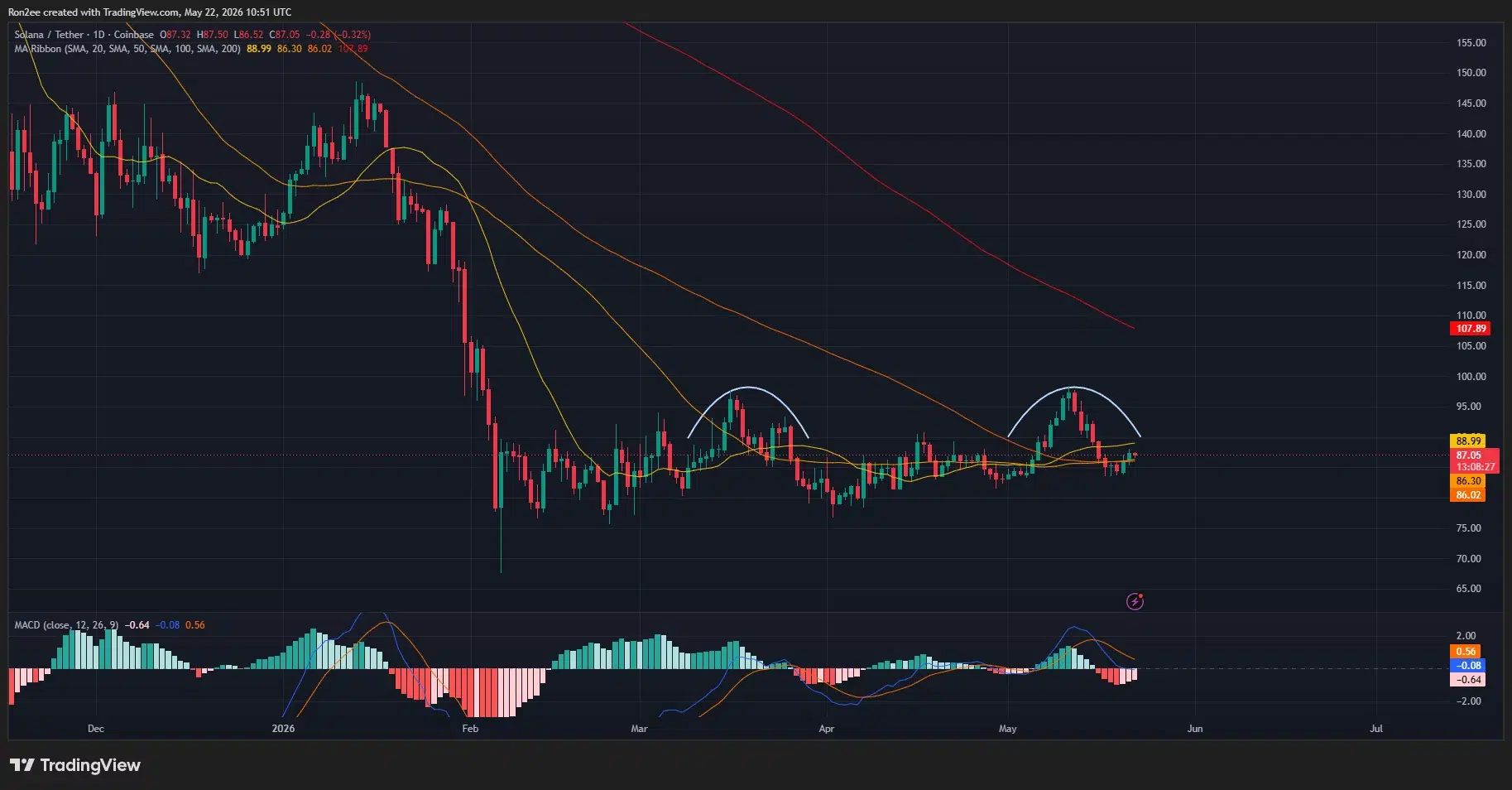
Solana price has recovered from recent market weakness, with bulls now attempting to overcome double-top resistance near the $100 level.
Summary
- Solana price traded near $87 as traders monitored whether mounting short liquidations and improving ETF sentiment could drive a breakout above $100.
- Morgan Stanley reportedly refiled a Solana ETF with staking support under the “MSOLsec” ticker, adding to institutional momentum around SOL products.
- Analysts identified heavy liquidation clusters between $90 and $95, while repeated double-top resistance continued capping Solana’s upside attempts.
Across the crypto market, risk appetite improved modestly after Bitcoin reclaimed ground above $77,000 following several sessions of macro-driven weakness tied to geopolitical tensions and volatility in oil markets.
The rebound helped major altcoins recover intraday losses, although traders remain cautious ahead of further U.S. inflation data and Federal Reserve commentary that could influence liquidity conditions across risk assets.
At the same time, institutional activity surrounding Solana has continued to strengthen despite the recent correction. A fresh catalyst emerged after Morgan Stanley reportedly refiled a Solana ETF product with staking support under the “MSOLsec” ticker, adding to growing expectations that regulated SOL investment vehicles could eventually mirror the success of spot Bitcoin and Ethereum products.
The filing arrived as asset managers continue expanding their exposure to staking-enabled crypto funds in search of yield-bearing digital assets.
Meanwhile, capital inflows into Solana-linked investment products have remained comparatively resilient during May’s choppy trading conditions. Products managed by firms such as Bitwise continued attracting attention from institutional allocators even as several other altcoins experienced declining flows.
Analysts say the ability of Solana products to maintain steady demand during a corrective phase suggests longer-term positioning rather than speculative short-term trading.
On-chain fundamentals have also remained constructive. In April 2026, Solana-based DePIN ecosystems generated a record combined revenue of roughly $2.9 million, according to ecosystem tracking data.
Projects including Helium, Render, and Hivemapper contributed heavily to the surge as decentralized infrastructure demand continued expanding across AI compute, mapping, and wireless connectivity markets.
Enterprise adoption narratives have continued building underneath the market. Payment giant Visa has already integrated Solana infrastructure into parts of its stablecoin settlement operations, while Meta has reportedly explored USDC-based creator payouts utilizing Solana rails. Traders increasingly view these commercial integrations as a long-term valuation support layer that differentiates Solana from purely speculative Layer-1 ecosystems.
Can Solana break through its double-top resistance structure?
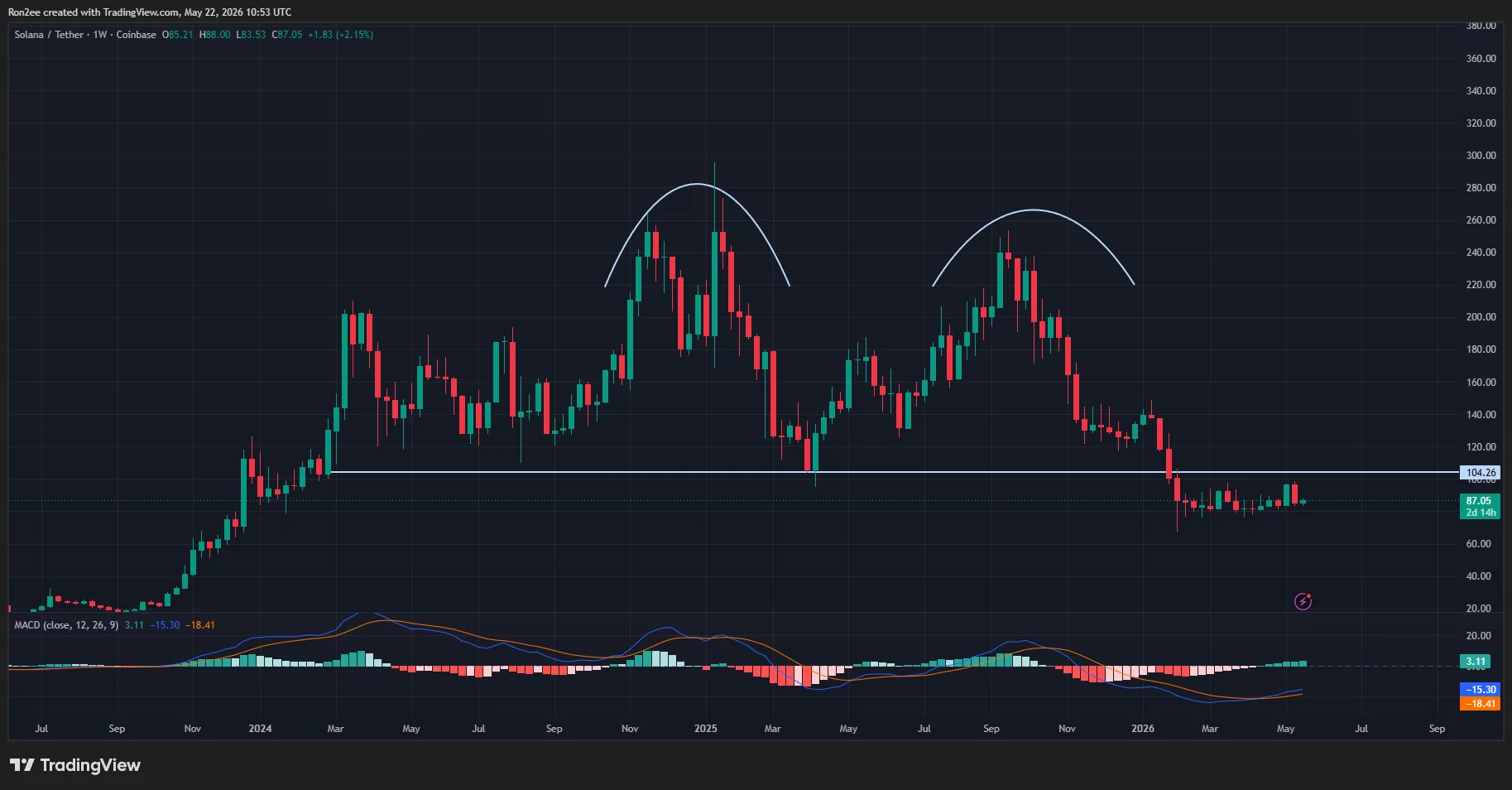
Solana remains trapped beneath a significant resistance zone after forming another local double-top pattern on both the daily and weekly timeframes. The charts show repeated rejection near the $95 to $100 region, an area that has capped upside attempts multiple times since late 2025.
On the daily chart, Solana (SOL) continues trading below the 200-day moving average near $107.89, while short-term moving averages around $86–$89 are beginning to flatten. Price action has compressed into a tight consolidation range after rejecting near $98 earlier this month, suggesting bulls and bears remain locked in a directional battle.
Momentum indicators have weakened but have not fully rolled over into bearish territory. The MACD histogram on the daily timeframe remains negative, although selling momentum has gradually faded over the past several sessions. Weekly MACD readings have also started stabilizing after months of persistent downside pressure, raising the possibility of a medium-term trend reversal if buyers reclaim higher resistance levels.
From a structural perspective, traders are closely monitoring the 0.382 Fibonacci retracement region between $87 and $90. Analysts view sustained closes above that area as an early confirmation that Solana may be transitioning out of its post-double-top consolidation phase. A breakout above $90 could expose liquidity near $95 before opening the path toward the key psychological barrier at $100.
According to analyst Javon Marks, Solana is once again holding a long-term support area that previously triggered explosive rallies. In a recent market update, Marks said one historical rebound from the level generated an 80% rally while another produced gains exceeding 270%.
“With prices showing strength off of this support level again, we are watching for an over 165% climb to test a key technical level at $233.8 again,” Marks wrote in a May 22 X post.
Beyond directional price action, derivatives positioning suggests a sharp volatility move could emerge if resistance levels begin failing. CoinGlass liquidation heatmaps show dense liquidation clusters concentrated between $90 and $95, with another large band sitting just above current price levels.
A decisive move into that region could trigger forced short liquidations and accelerate upside momentum through a classic squeeze setup. Market data cited by traders indicates short sellers recently absorbed nearly five times more liquidation pressure than longs.
Open interest has also started rising gradually after several weeks of deleveraging, suggesting traders are rebuilding directional positions ahead of a potential breakout attempt. Funding rates, while not excessively bullish, have stabilized near neutral territory, a setup many derivatives traders consider healthier than heavily crowded long positioning.
Meanwhile, Solana’s total value locked has shown signs of stabilizing after months of contraction. Analysts tracking on-chain liquidity argue that a sustained TVL recovery would likely strengthen spot demand for SOL tokens while reinforcing confidence in Solana’s decentralized finance ecosystem. Historically, periods of expanding TVL have coincided with stronger medium-term price performance for SOL.
What could invalidate Solana’s bullish breakout thesis?
Despite improving sentiment, several downside risks continue threatening the bullish setup. The most immediate concern remains Bitcoin’s fragile position near major support levels as global macro uncertainty continues pressuring risk assets.
Oil markets remain highly sensitive to developments surrounding U.S.-Iran negotiations and shipping disruptions near the Strait of Hormuz. Any renewed spike in crude prices could reignite inflation concerns and reduce expectations for Federal Reserve rate cuts, creating another wave of risk-off pressure across crypto markets.
At the same time, Solana’s technical structure still carries meaningful bearish risk unless buyers reclaim the $95–$100 resistance band decisively. Repeated rejections beneath double-top resistance often weaken bullish momentum over time, particularly if accompanied by declining spot demand.
Failure to hold the $84–$85 support region could expose lower liquidity zones near $80 and potentially reopen the path toward the March lows. CoinGlass heatmap data already shows notable downside liquidation pockets sitting below current prices, meaning volatility could accelerate rapidly if sellers regain control.
The longer-term weekly chart also shows SOL continuing to trade well below its 2025 highs despite recent stabilization. Until the asset reclaims the major breakdown region near $104, some traders may continue treating rallies as temporary relief bounces within a larger bearish market structure.
Still, improving institutional narratives, expanding enterprise adoption, growing DePIN revenues, and mounting short-side leverage continue giving bulls a credible case for another breakout attempt.
If Bitcoin stabilizes and macro conditions avoid further deterioration, Solana may soon test whether the market still has enough momentum to finally clear the stubborn double-top ceiling and reclaim triple-digit territory.
Disclosure: This article does not represent investment advice. The content and materials featured on this page are for educational purposes only.


Disclosure: This article does not represent investment advice. The content and materials featured on this page are for educational purposes only.
Bitcoin DeFi platforms on Rootstock simplify staking, rBTC rewards, and DeFi access for mainstream users.
Summary
- Rootstock is expanding Bitcoin DeFi access with staking, rBTC rewards, and EVM-compatible infrastructure.
- The sidechain has operated since 2018, offering lower fees, faster confirmations, and Bitcoin-backed security.
- RootstockCollective lets users stake RIF tokens while helping fund Bitcoin-focused builders through its DAO model.
Bitcoin DeFi is no longer reserved for technical experts. Platforms built on Rootstock make it simple to stake RIF, earn rBTC rewards, and participate in decentralized finance backed by Bitcoin’s consensus security, no specialized knowledge required.
Why Bitcoin DeFi has been so hard
Less than 1% of all BTC is deployed in decentralized finance, despite Bitcoin being the most widely held cryptocurrency. The reason is friction: specialized wallets, multi-chain bridging, unfamiliar gas tokens, and confusing interfaces. A BTCFi survey reported that 36% of respondents avoid BTCFi entirely due to lack of trust.
That’s changing fast. BTCFi total value locked grew roughly 20x from about $307 million in January 2024 to approximately $6.5 billion by mid-2025 (figures vary by methodology), driven by EVM-compatible Bitcoin sidechains like Rootstock that bring familiar tools to Bitcoin’s security.
How Rootstock and RootstockCollective remove the barriers
Rootstock is Bitcoin’s longest-running sidechain, operating since 2018 with 100% uptime. It inherits consensus security from Bitcoin via merged mining (participation reported in the 60–80%+ range of Bitcoin’s hashpower) while offering full EVM compatibility. The native token rBTC is pegged 1:1 to Bitcoin via the PowPeg bridge, a federated peg design. Transactions confirm within one to two blocks, fees are far lower than Ethereum’s (reduced ~60% after network upgrades), and the ecosystem includes 150+ partner applications with familiar names like Uniswap (via Oku), SushiSwap, and LayerBank.
RootstockCollective is the first DAO built for Bitcoin builders on this foundation. It’s where users can stake RIF tokens AND directly fund builders, combining rewards with real ecosystem impact. Key features that simplify onboarding:
Feature
Traditional Bitcoin DeFi
RootstockCollective on Rootstock
Wallet setup
Specialized, unfamiliar wallets
MetaMask and popular EVM wallets via Reown AppKit
Gas costs
High and unpredictable
Far lower than Ethereum; reduced ~60% after upgrades
Custody model
Often custodial or wrapped
Non-custodial; the user controls tokens
Reward transparency
Variable, often unclear
Bi-weekly distributions in rBTC, RIF, and USDRIF
Staking flexibility
Lock-up periods common
No lock-up; unstake anytime
With an approximately 20% average Annual Backer Incentive (varies by period), over 3.7 BTC,1.4 million RIF and $20k USDRIF paid out in Collective Rewards, and 35 million+ RIF staked, the reward mechanics are transparent and proven. Governance happens on-chain via the RootstockCollective dApp, so that funds can be seen exactly where they go.
Start earning in six steps
Step 1: Set Up a Wallet. Install MetaMask (or Rabby, SafePal, etc.) and add the Rootstock network by visiting the Get RIF page and clicking “Add RIF to wallet.” It configures everything automatically. Coming soon: social login via MagicLink for users new to web3 wallets.
Step 2: Get RIF Tokens. Purchase RIF on Binance, Gate.io, Bitget, or MEXC, then withdraw to a wallet. When withdrawing, select the RSK/Rootstock network, not ERC-20 or BEP-20. Alternatively, use Symbiosis or Router Protocol to bridge assets directly to Rootstock.
Step 3: Get rBTC for Gas. Swap a small amount of RIF for rBTC on SushiSwap (select RIF → rBTC and confirm), even 0.001 rBTC covers many transactions. Users can also bridge BTC via the PowPeg app at 2wp.rootstock.io (Fast Mode completes in ~20 minutes) or use Boltz.
Step 4: Stake RIF. Visit the official website, click “Connect Wallet” (top right), and select a wallet. Navigate to “Stake,” enter an amount, click “Stake,” and approve in MetaMask. RIF converts to stRIF at 1:1. After approving, the user has voting power in the DAO.
Step 5: Back Builders. Go to the Builders screen to see active builders. Review each builder’s “Backer Share %”, the percentage of earnings they share with backers. Hover over a chosen builder, press “Back builder,” then type an allocation or drag the allocation bar on the Backing page. Confirm on-chain. Example: if a builder earns 20% of total cycle rewards and sets a 25% Backer-Reward Percentage, backers collectively receive 5%, distributed proportionally by allocated stRIF.
Step 6: Claim Rewards. Go to the Holdings screen, view “My Balances,” and click “Claim Rewards.” rBTC, RIF, and USDRIF arrive in a wallet after approval. There’s no deadline; rewards remain available until they are collected.
Two roles, one virtuous cycle
RootstockCollective runs on two complementary roles.
- Backers stake RIF, vote on proposals, and allocate stRIF to support builders, earning a share of their rewards proportional to their backing.
- Builders, teams creating dApps, protocols, and infrastructure on Rootstock, submit proposals, receive community votes, and access grants plus ongoing Collective Rewards. The more backing a builder attracts, the larger their share of the reward pool, and a portion flows back to their backers.
Current ecosystem projects include OpenOcean, Boltz, WoodSwap, Money On Chain, Tropykus, WakeUp Labs, LayerBank, Steer Protocol, Symbiosis, Hunters of Web3 and Top Tier Alliance, and more. All smart contracts are built on audited OpenZeppelin libraries, treasury is managed through multisig controls with Foundation oversight, and all actions are recorded on-chain.
The next step: visit the RootstockCollective website, connect a wallet, and stake the first RIF.
Disclosure: This content is provided by a third party. Neither crypto.news nor the author of this article endorses any product mentioned on this page. Users should conduct their own research before taking any action related to the company.

Former AEW champion saves Damian Priest from dangerous situation

Man United latest: Manager’s private conversation as Michael Carrick nears first summer signing

Patient capital trusts India as hot money exits; FDI inflow rises 17% YoY


-

 Crypto World1 day ago
Blockchain.com files with SEC for U.S. IPO
-

 Fashion10 hours ago
Holiday Weekend Open Thread – Corporette.com
-

 Fashion6 days ago
On the Scene at Gucci’s Cruise Show in New York City: Mariah Carey, Kim Kardashian, Lindsay Lohan, Iman, and More!
-

 Politics7 days ago
Watch: far-right flag-fanatics run over victim, attack locals – Setup By the Left wing for your entertainment
-

 Fashion7 days ago
Trending Western Style Vests Perfect for Summer
-
 Crypto World6 days ago
Intesa Sanpaolo’s crypto holdings jump to $235M as XRP enters
-

 Crypto World14 hours ago
Space X IPO Is ‘Bad News’ for Tech Stocks: But What About Bitcoin?
-

 Fashion6 days ago
Amazon Sundays: Memorial Day Hosting
-

 Entertainment6 days ago
Off Campus Easter Eggs Explained: Characters, Stories, More
-

 Business14 hours ago
Dell Technologies DELL Stock Surges 15% on AI Server Momentum and Analyst Upgrades in 2026
-
 Crypto World4 days ago
Revolut Launches Dogecoin Debit Card Across UK and EU
-
 Tech16 hours ago
A 0.12% parameter add-on gives AI agents the working memory RAG can’t
-
Business6 days ago
Australia defends property tax changes designed to fix ‘broken’ housing
-
 NewsBeat2 days ago
Charity run by Reform leader Malcolm Offord accused of ‘law breaking’ over Scottish registration
-

 Politics7 days ago
Anti-Zionists attacked in Jerusalem as ethnofascists chant race-hate
-

 Tech1 day ago
WhatsApp ads could make Irish debut after discussions with DPC
-

 Sports1 day ago
2026 CJ Cup Byron Nelson leaderboard: Brooks Koepka finds putting stroke in Round 1
-
Politics6 days ago
Wings Over Scotland | The Land Of No Laws
-

 Crypto World22 hours ago
Trump Media’s Bitcoin Stash Shrinks Again as 2,650 BTC Lands on Crypto.com
-

 Politics7 days ago
Cassidy defiant as Trump's revenge campaign closes in
You must be logged in to post a comment Login