

Crypto World
What next for BTC prices as Bitcoin slides to $70,000 on Strategy’s sale



Bitcoin extended its slide below $71,000 in early Asian hours Tuesday, down 3.4% in the past 24 hours and 7.5% on the week, as the aftermath of Strategy’s first disclosed bitcoin sale weighed on the market while stocks paused at record highs and oil pushed further on the stalled U.S.-Iran ceasefire negotiations.
BTC traded near $70,830 by Tuesday morning, with the 24-hour range stretching from a low of $70,120 to a high of $73,458, per CoinDesk data. Ether (ETH) hovered just below $2,000 at $1,996, sat flat at $0.10, XRP fell 3% to $1.28 and Solana’s SOL slipped 1.7% to $80.47.
Monday’s 8-K filing from Strategy (MSTR), the largest corporate holder of bitcoin, disclosed the company’s first publicized sale of bitcoin in the five years since it began accumulating, with 32 coins sold for $2.5 million at an average price of $77,135 and proceeds earmarked to fund preferred stock distributions.
CoinDesk covered the sale extensively on Monday, including the broader funding-stack context behind it and the resulting Polymarket resolution around a $14 million market that debates whether the sale occured in May or June.
Stocks eased from all-time highs as investors locked in gains on the AI rally that has dominated markets this year, Bloomberg reported.
MSCI’s Asia-Pacific equity index fell 0.5%, with South Korea’s Kospi sliding 1.8% after its 105% year-to-date run. Nasdaq 100 futures slipped 0.7%, while Chinese tech bucked the trend with Tencent (0700) jumping 7.5%.
Brent crude pared some of Monday’s advance but held around $94.40 a barrel as the U.S.-Iran impasse persisted, with Treasuries holding their losses from the prior session on concerns that higher energy costs would force the Federal Reserve to keep interest rates higher for longer. Iran said it would halt message exchanges with Washington, Tasnim news agency reported.
Hyperliquid’s HYPE remained the outlier in the top 10 by market value, gaining 24.3% over the past seven days to $73.76 even as bitcoin and ether bled.
BTC is now at its lowest level in weeks. With ETF demand still flowing the wrong way and Strategy disclosed as a seller, there is no obvious near-term catalyst for a reversal.


The EDGE token collapsed to an all-time low of around $0.40 on June 1, less than two weeks after it hit an all-time high of $1.54.
The crash wiped off about 51% of the token’s value in a single day, triggering more than $6.2 million in liquidations across major exchanges and drawing immediate accusations of insider manipulation from on-chain researcher ZachXBT.
edgeX Points the Finger Outward
edgeX, the decentralized perpetual futures DEX that issues the EDGE token, posted on X several hours after the crash began, acknowledging what it called “a sudden and irregular price movement.” The team also said they were working to understand what happened. Two hours later, the project followed with a firmer statement, saying the following:
“The edgeX protocol were not compromised in any way. This is not a hack, exploit, or security breach. What we have identified so far suggests deliberate attempts by certain external party to manipulate the market price of EDGE.”
The company added that it was working with relevant exchanges and platforms to identify the cause and pursue accountability. It also promised to provide a more detailed update once the said investigations were over.
However, their explanation was not well received everywhere, with ZachXBT, an on-chain investigator known for calling out bad actors in crypto, pushing back directly and stating that the EDGE supply appeared to be controlled by a small group with low circulating float. He also challenged the edgeX team to disclose the platform’s counterparties and market maker agreements if they really cared about transparency, mocking the project’s self-investigation with a pointed paraphrase:
“We investigated ourselves and did not find ourselves guilty even though we control nearly the entire supply.”
On the price side, the damage was significant, with CoinGecko data showing that EDGE dropped from about $1.26 to near $0.40, which was a new all-time low, before it stabilized around $0.62 at the time of writing.
Additional data from CoinGlass showed the price fall caused liquidations of about $6.2 million in 24 hours, with long positions accounting for $4.84 million. That activity was mostly concentrated on Binance, Bybit, and OKX, which together handled the majority of the forced closures that affected at least 3,840 traders, with price volatility hitting 74.77% on the day.
A Rough Season for Crypto Security
There is a valid reason why many people, upon seeing EDGE’s behavior in the market, immediately thought its parent platform had been hacked and why edgeX came out to categorically deny that there had been such an incident.
This year, the crypto space has been rattled by a string of exploits, including a recent attack on DxSale, where more than 1,400 liquidity pools tied to its old contracts on the BNB Chain were drained of about $7.3 million worth of tokens. A hacker also stole about $11 million from the Verus bridge, while TrustedVolumes, a liquidity provider, lost just under $6 million.
The post ‘We Investigated Ourselves’: ZachXBT Slams EdgeX After Sudden Token Collapse appeared first on CryptoPotato.
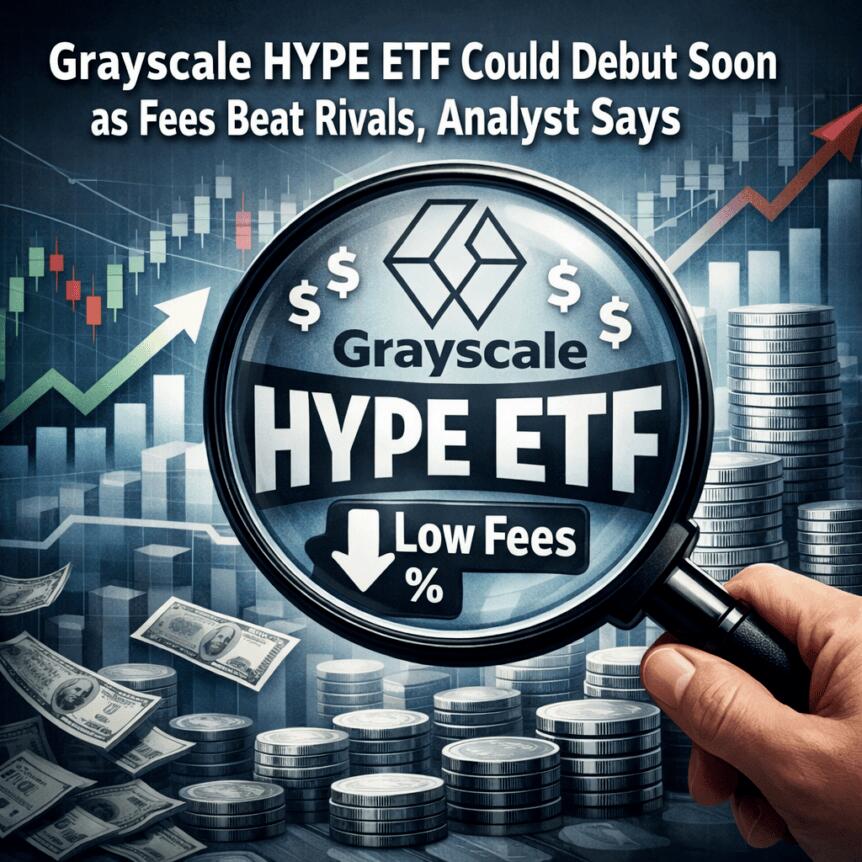
Grayscale could bring its Hyperliquid-backed exchange-traded fund (ETF) to the U.S. market as soon as this week, after amending the regulatory filing to include a ticker and management fee. The amended S-1 shows the proposed fund would trade under HYPG and carry a 0.29% expense ratio, a pricing point that analysts say could sharpen competition with existing Hyperliquid-linked ETFs.
Bloomberg ETF analyst James Seyffart noted on X that the sixth amendment to Grayscale’s filing added the HYPG ticker and the fee, suggesting a launch may be imminent. The amended filing is publicly accessible through the SEC, marking another step toward a potential listing in the near term.
Grayscale’s move positions the firm alongside 21Shares and Bitwise, which already offer Hyperliquid exposure through their own HYPE ETFs. Those rivals currently charge 0.3% and 0.34% respectively, underscoring Grayscale’s attempt to attract cost-conscious investors while offering yield opportunities tied to the Hyperliquid ecosystem.
Source: James Seyffart via X
Key takeaways
- Grayscale’s HYPG ETF would list with a 0.29% management fee, according to the amended S-1, potentially undercutting competing HYPE ETFs from 21Shares and Bitwise.
- The amended filing marks what Bloomberg’s Seyffart described as a likely imminent launch, signaling rapid progress toward US listing.”
- Combined inflows into the existing HYPE ETFs are approaching $140 million since launch, reflecting steady investor appetite for Hyperliquid exposure.
- Hyperliquid’s ecosystem remains highly liquid, with data showing the platform handling about $170 billion in monthly trading volume across multiple asset classes.
- The broader ETF backdrop includes ongoing outflows from U.S.-listed Bitcoin and Ether ETFs, a sobering reminder that retail and institutional appetite can shift quickly amid macro and regulatory factors.
Grayscale’s HYPG filing: what changed
The core change in Grayscale’s S-1 amendment is the addition of a ticker—the HYPG symbol—and a stated management fee of 0.29%. The filing, which was amended for the sixth time, explicitly positions HYPG to be traded on ordinary U.S. exchanges if approved by regulators. The market reaction to the increased clarity around the product is underscored by market observers who see the fee posture as a strategic move to compete with established Hyperliquid-linked ETFs.
For readers tracking primary sources, the amended filing can be reviewed at the U.S. Securities and Exchange Commission’s archive: hype_s-1_amendment_6.htm.
Analyst commentary surrounding the development has focused on whether the HYPG price point and yield-sharing features will translate into sustained demand. Grayscale’s approach echoes a broader industry trend of layering staking rewards or yield enhancements onto crypto ETF structures, a tactic employed by the existing HYPE ETF lineup.
Competition dynamics: how HYPG would fit with HYPE ETFs
Existing Hyperliquid ETFs—launched by 21Shares and Bitwise—carry expense ratios of 0.30% and 0.34%, respectively. The new 0.29% fee from Grayscale would place HYPG at a slightly more favorable price tier for cost-conscious investors. In aggregate, the two established ETFs have attracted nearly $140 million in net inflows since their debut, reflecting a growing demand for direct exposure to Hyperliquid’s tokenized strategy and its perpetual futures framework.
Hyperliquid’s ecosystem has gained notable traction beyond the ETF wrappers. Data from Dune Analytics shows the platform now facilitates substantial liquidity across a broad range of assets, with monthly trading volumes surpassing $170 billion. This level of activity points to a mature, liquid environment that can support ETF-style access and on-chain derivatives exposure for traditional investors wary of over-the-counter or direct-token allocations.
Hyperliquid’s native token, HYPE, has also surged in tandem with the ETF rollout narrative. After rallying to an all-time high of about $75.30, HYPE’s market presence has expanded, helping to drive a market capitalization that has climbed to roughly $16.7 billion, placing it among the larger crypto assets in terms of capitalization. Such momentum underscores why asset managers are eager to offer U.S.-listed products tied to HYPE, even as the sector contends with broader volatility and regulatory scrutiny.
For context, readers can observe the market movement around HYPE via CoinGecko and related coverage tracking inflows tied to the ETF ecosystem. The combined ETF inflows have been a strong signal of investor appetite for access to Hyperliquid’s unique staking-and-yield dynamic within a regulated wrapper.
Market backdrop: ETF outflows complicate the narrative
How HYPG lands in a crowded market will also hinge on the broader ETF landscape in the United States. Recent data show net outflows from Bitcoin-focused ETFs over ten consecutive trading days, totaling nearly $3 billion, signaling a cautious mood among investors amid macro headwinds and regulatory uncertainty. Ether ETFs have similarly faced a two-week rhythm of outflows, as investors reassess risk versus potential upside. These trends suggest a balancing act for new wrappers like HYPG: while product design and yield features can attract capital, the prevailing climate has favored risk-off behavior in core crypto assets.
Industry observers note that such outflows don’t necessarily preclude long-term adoption but do underscore the importance of clarity around product design, governance, and yield strategies. The next wave of developments—regulatory clarity, actual ETF listing dates, and real-world performance data—will be critical in determining whether HYPG and its peers can sustain momentum once trading commences.
What to watch next
Readers should keep an eye on regulatory milestones and potential listing dates for HYPG. If Grayscale proceeds as expected, HYPG could debut in the U.S. in the near term, joining the existing HYPE ETFs and adding another option for investors seeking direct exposure to Hyperliquid’s token ecosystem via a regulated vehicle. Beyond listing, investors will want to monitor how HYPG’s yield features are implemented and whether the ETF structure can deliver sustained inflows in a market characterized by episodic risk sentiment shifts.
As always, market participants should stay attuned to broader macro developments, regulatory updates, and the evolving usage of Hyperliquid’s platform, which continues to push the narrative around institutional-friendly access to crypto-native instruments.
Related coverage notes that Hyperliquid has also expanded into prediction markets for real-world events, illustrating the growing breadth of use cases that underpin the HYPE ecosystem and its potential to attract diversified investor interest.
Readers should watch for any official updates on HYPG’s listing timeline, as well as fresh data on ETF inflows and trading activity once the market tests Grayscale’s new offering in a live environment.
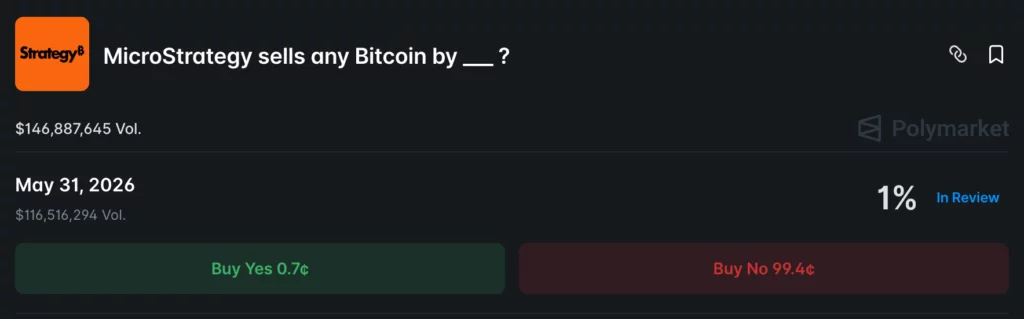
More than $80 million has been wagered on a Polymarket market tied to Strategy’s Bitcoin sales, with the outcome now heading to a final dispute process after the company disclosed that it sold 32 BTC before the market’s May 31 deadline.
Summary
- A Polymarket market with more than $80 million in volume entered a dispute after Strategy disclosed a 32 Bitcoin sale that occurred before the May 31 deadline.
- Polymarket proposed a “No” resolution, arguing that confirmation of the sale was not publicly available within the market’s timeframe.
- The final outcome now rests with UMA tokenholders after users challenged the proposed resolution and questioned how the market’s rules should be applied.
Polymarket users have challenged the platform’s proposed resolution of a market that asked whether Strategy would sell Bitcoin by May 31, after the company revealed in a regulatory filing that it sold 32 BTC worth roughly $2.5 million between May 26 and May 31.
Although the transaction took place within the period specified by the market, Strategy disclosed the sale on June 1. Based on that timing, Polymarket moved to resolve the market as “No,” arguing that confirmation of the sale did not emerge before the market’s deadline.
By Tuesday, trading activity on the market had exceeded $80 million as users continued to debate whether the result should depend on when the sale occurred or when it became publicly known.
In an update posted to the market page, Polymarket said confirmation achieved outside the market’s timeframe does not qualify for resolution purposes. The platform added that no information from Strategy, on-chain data, or a consensus of credible reporting confirmed a Bitcoin sale before the deadline expired.
Users push back against proposed outcome
Across the market’s comment section, several participants criticized the proposed resolution and argued that the underlying event occurred before May 31 regardless of when the company disclosed it.
One user wrote that Polymarket should “trade truth, not technicalities,” while another said the outcome had caused them to lose confidence in the platform. A separate commenter described the decision as “unbelievable.”
As the dispute continued, the market remained heavily priced in favor of a “No” outcome, with approximately 99.9% odds attached to that result despite objections from holders of “Yes” shares.
Because two proposed resolutions have already been disputed, the final decision now falls to holders of the UMA token, which powers the oracle system used by Polymarket to settle markets. According to the market’s rules, the review process can take up to two days.
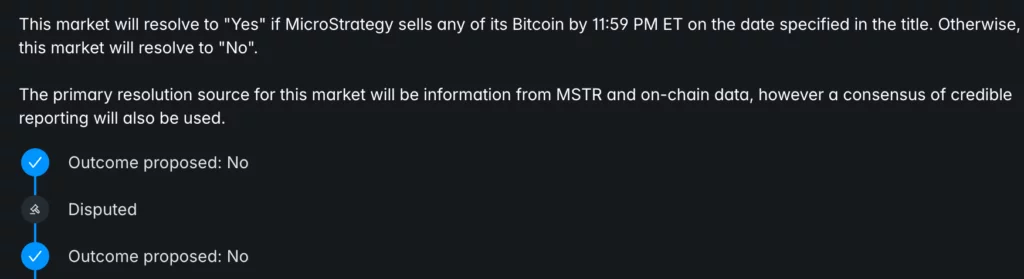
Polymarket noted that if no statement is issued by 12:00 a.m. UTC on Wednesday, the order book will be cleared.
The controversy emerged shortly after Strategy reported its first Bitcoin sale since 2022. The company, formerly known as MicroStrategy, disclosed Monday that it had sold 32 BTC while continuing to hold more than $60 billion worth of Bitcoin.
Strategy’s decision drew attention because the firm had long maintained that it would never sell its Bitcoin holdings. Following the disclosure on June 1, Bitcoin fell 2.5% to $70,815 within five hours, according to market data.
Other Strategy-related prediction markets asking whether the company would sell Bitcoin by June 30 and Dec. 31 have already resolved to “Yes” without disputes.
For participants in the May 31 market, however, the final outcome now depends on how UMA voters interpret the timing of confirmation versus the timing of the sale itself.
As previously reported on crypto.news, last year a separate Polymarket dispute emerged over a market asking whether Ukrainian President Volodymyr Zelenskyy would wear a suit during a specified period.
The market generated roughly $237 million in volume and eventually went to UMA tokenholders after participants disagreed over whether Zelenskyy’s military-style attire met the definition of a suit.
The case drew criticism from some users, who argued that subjective interpretations could influence market outcomes.
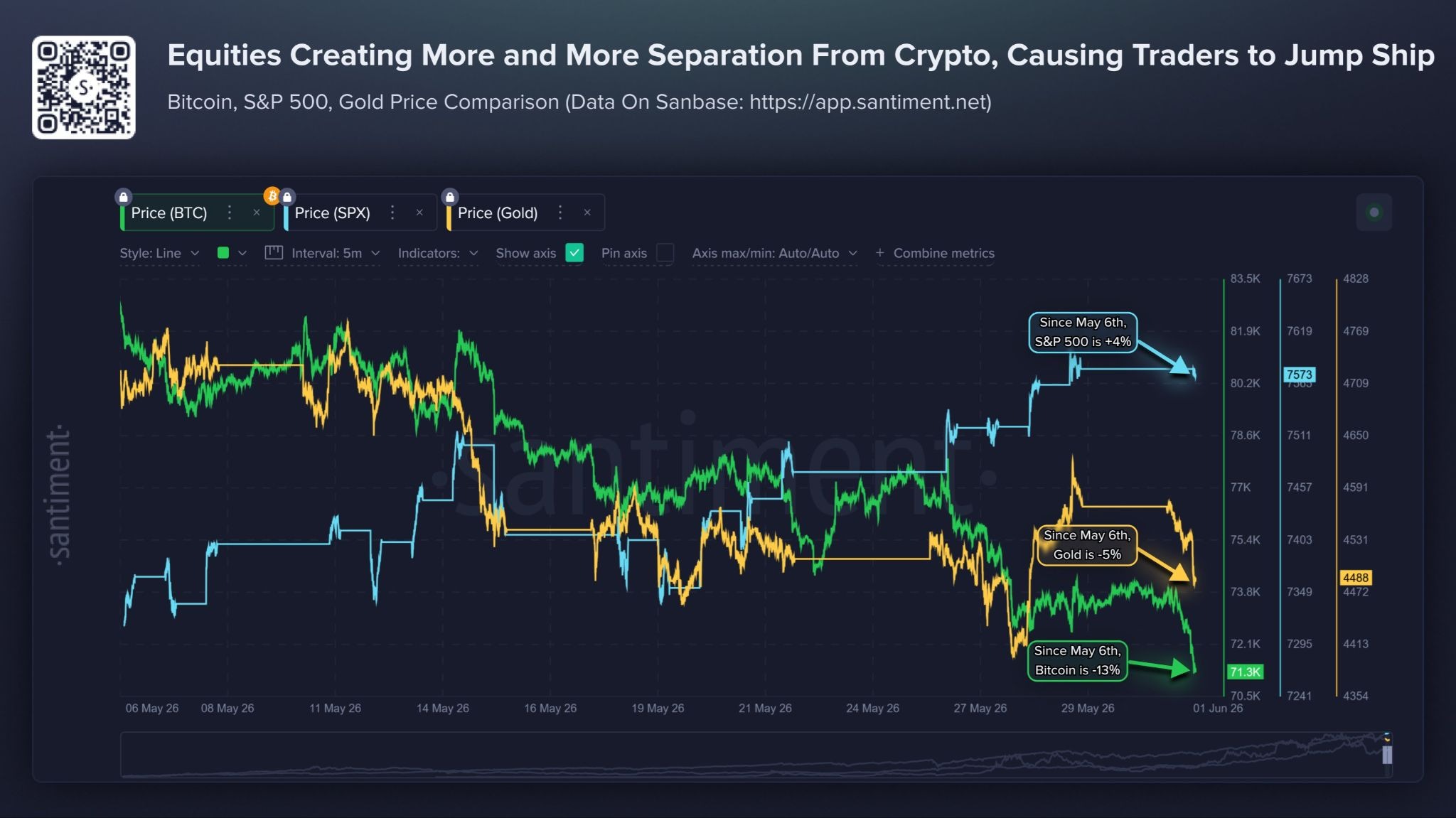
Bitcoin fell to its lowest level in almost two months on Tuesday as cryptocurrencies continue to diverge from traditional equity markets.
Bitcoin (BTC) fell to a low of $70,023 on Coinbase early on Tuesday, its lowest level since April 7, marking a daily decline of more than 4% and a weekly loss of 8%, according to TradingView. Bitcoin is down 44% from its October peak of $126,000.
US stock markets such as the S&P 500 have meanwhile hit a record high of just over 7,600 points on Monday, while the tech-heavy Nasdaq peaked at over 27,000 points.
Andri Fauzan Adziima, research lead at Bitrue Research Institute, told Cointelegraph that some analysts have noted that Bitcoin is the only major asset in contraction right now, and the divergence is notable.
“It shows Bitcoin is trading more like a high-beta risk asset tied to macro sentiment rather than an independent hedge,” he added.
“This gap highlights current weakness, but it also sets up potential for stronger relative performance once macro conditions improve. I view it as a temporary phase in the cycle, not a permanent shift.”
Analytics platform Santiment said on Monday that “the gap between traditional equities and crypto has become increasingly difficult for traders to ignore.”
“This divergence has led to a growing preference among investors for stocks over alternative assets like Bitcoin and altcoins,” it added.
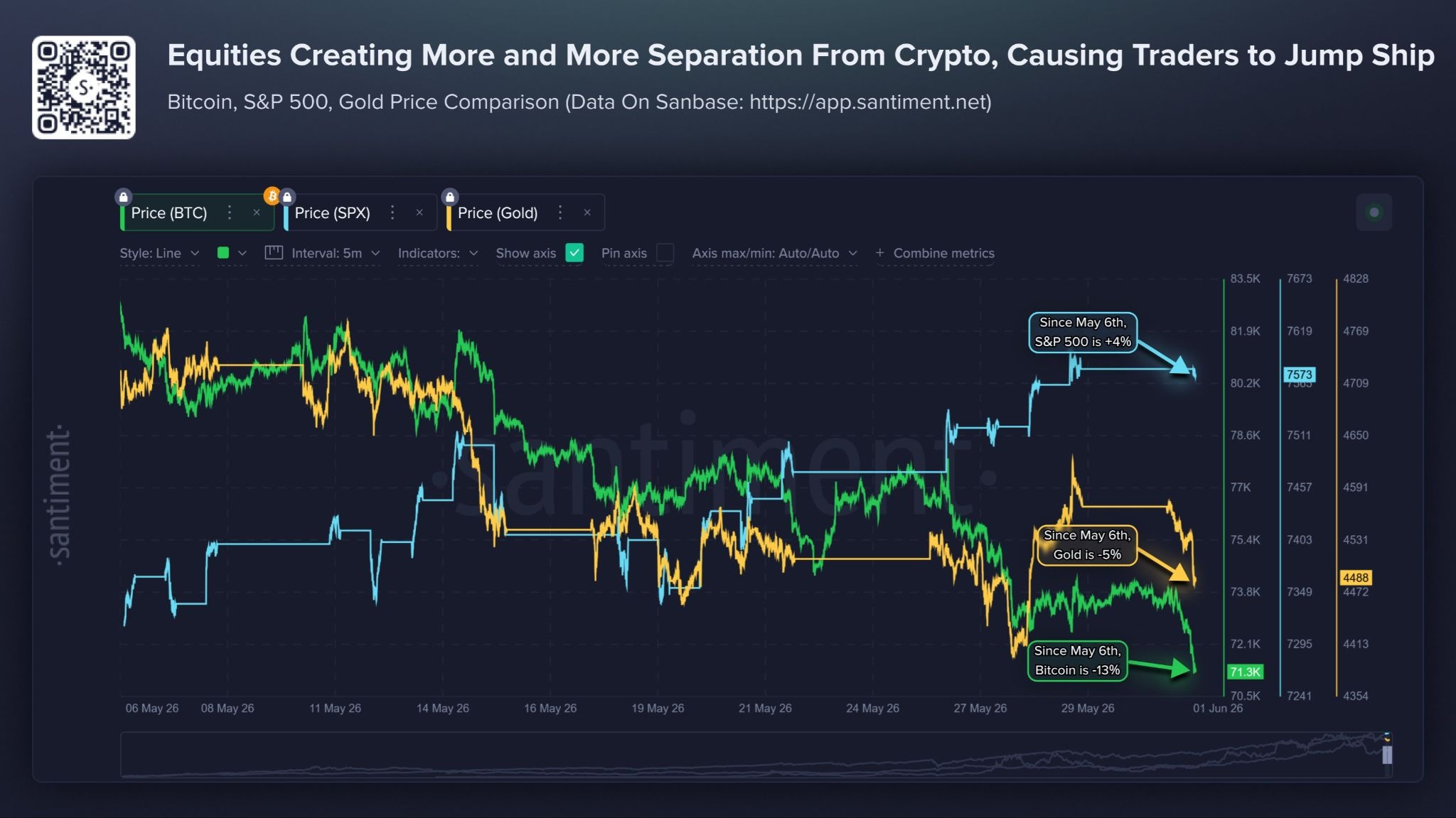
Crypto and equity divergence widens. Source: Santiment
Related: Bitcoin bulls eye fresh positions after BTC price drops under $71K
Santiment said the performance gap between sectors can create a “self-reinforcing cycle,” and when traders see equities consistently generating better returns with lower volatility, “capital often rotates away from crypto and into stock markets.”
However, Santiment said that this pattern won’t last forever, and “mainstream influencers” discussing stock dominance over crypto is often a good sign that the crowd is leaning too far into the “equity FOMO and crypto FUD.” Markets generally move opposite to the majority of traders’ expectations, it added.
Bitcoin is approaching a major long-term resistance level at the 200-week exponential moving average (EMA), which is currently around the $69,000 price zone.
Magazine: Big Questions: Do we really only need 2–5 cryptocurrencies?

Stock and crypto trading platform Robinhood has entered the Canadian market after closing a $180 million stock acquisition of local crypto technology company WonderFi, gaining the company’s licenses and regulatory approvals in the country.
Robinhood said on Monday that the acquisition marks the platform’s entry into Canada and will see crypto exchanges Bitbuy and Coinsquare come under the company’s banner.
Bitbuy and Coinsquare are among Canada’s largest crypto exchanges. WonderFi disclosed in March that the platforms generated combined revenue of $49.8 million in 2025.
Johann Kerbrat, the general manager of Robinhood Crypto and International, said in a statement that WonderFi has “extensive experience operating regulated crypto platforms that serve beginner and advanced crypto users alike, making it an ideal partner to accelerate Robinhood’s mission in Canada.”

Source: Vlad Tenev
Crypto payments company Triple A estimated that roughly 4.1% of Canadians own crypto, while the analytics and consulting firm Grand View Research estimated that the Canadian crypto market generated around $263 million in revenue in 2025, driven by hardware. The firm also said Canada is the fastest-growing regional market in North America and projects total revenue will surpass $1 billion by 2033.
Robinhood said WonderFi’s employees, including the leadership team, will stay on as part of the deal. It also expects to gain about 300,000 funded customers from WonderFi.
Related: Robinhood announces $1.5B share buyback as stock struggles in 2026
WonderFi and Robinhood first entered into an agreement last May at 36 Canadian cents per common share ($0.26). WonderFi’s stock has been drifting between 34 and 36 Canadian cents for the last month, according to Google Finance.
Robinhood entered the US crypto trading market in February 2018. In April, the company was tapped to serve as brokerage and initial trustee for Trump Accounts, a new tax-advantaged investment account program for children.
The company also launched an Ethereum layer-2 network on a testnet in February with plans for a mainnet launch later this year. Robinhood CEO Vlad Tenev said the network processed 4 million transactions in its first week of public testnet activity.
Magazine: HYPE chases $100 target, ETH could dump below $1800: Market Moves

Key Highlights
- Robinhood finalized the purchase of Toronto-headquartered WonderFi for approximately C$250 million ($180 million USD)
- The acquisition includes two regulated Canadian cryptocurrency exchanges: Bitbuy and Coinsquare
- This transaction elevates Robinhood’s international funded customer count beyond 1 million
- Following deal closure, WonderFi was removed from Toronto Stock Exchange listings
- HOOD shares decreased 3.8% on Monday, settling at $90.73
Shares of Robinhood (HOOD) concluded Monday’s trading session at $90.73, marking a 3.8% decline as the company officially completed its WonderFi acquisition.
First unveiled in May 2025, the transaction integrates WonderFi’s Canadian cryptocurrency infrastructure into Robinhood’s expanding ecosystem. The acquisition encompasses Bitbuy, Coinsquare, and Bitcoin.ca — all licensed platforms catering to Canadian retail investors and institutional participants in the digital asset space.
The all-cash transaction valued WonderFi at C$0.36 per outstanding share, reaching a total of approximately C$250 million on a fully diluted basis. Converting to US currency, the purchase price equals roughly $180 million.
Initially scheduled for completion during 2025’s second half, the deal timeline was extended by mutual agreement. The extension allowed Robinhood additional time to implement its proprietary trading infrastructure across Canadian markets while satisfying regulatory requirements.
Final approval came from British Columbia’s Supreme Court on July 21, 2025. WonderFi shareholders had cast their approval votes during a special meeting convened four days prior.
WonderFi shares ceased trading on the Toronto Stock Exchange as markets closed Monday. The company is also anticipated to terminate its status as a reporting issuer under Canada’s securities regulations.
To facilitate the deal structure, Robinhood established Wrangler Holdings Inc. as an acquisition vehicle. WonderFi now functions as a fully-owned Robinhood subsidiary.
Establishing a Canadian Base
Johann Kerbrat, who serves as SVP and General Manager for Robinhood Crypto & International, described WonderFi as “an ideal partner to accelerate Robinhood’s mission in Canada.” He highlighted the company’s proven track record operating compliant platforms serving both novice and sophisticated cryptocurrency traders.
WonderFi’s existing base of roughly 300,000 funded accounts will receive invitations to transition to Robinhood’s platform. This migration propels Robinhood’s international funded customer total above the 1 million milestone.
The company confirmed it will maintain WonderFi’s established institutional partnerships, viewing them as complementary to the institutional cryptocurrency services acquired through its 2024 Bitstamp purchase.
Wall Street Perspectives
KeyBanc continues holding an Overweight recommendation on HOOD stock. Meanwhile, Mizuho elevated its price objective to $115 while reaffirming an Outperform stance, following Robinhood’s introduction of Agentic Trading, its artificial intelligence-powered trading feature.
Robinhood presently commands an $81.9 billion market capitalization and has delivered 42.6% returns to shareholders over the trailing twelve months.
The brokerage firm has also attracted attention for serving as the initial trustee for the Trump Accounts app launched by the US Treasury, which establishes investment accounts for minors.
On the legal front: Robinhood confronts possible US Supreme Court examination regarding IPO-related litigation. The lawsuit claims the company provided misleading information about its financial performance and expansion trajectory to investors.
All broker warrants associated with the WonderFi transaction reached expiration on March 10, 2026, with previous warrant holders receiving no compensation.

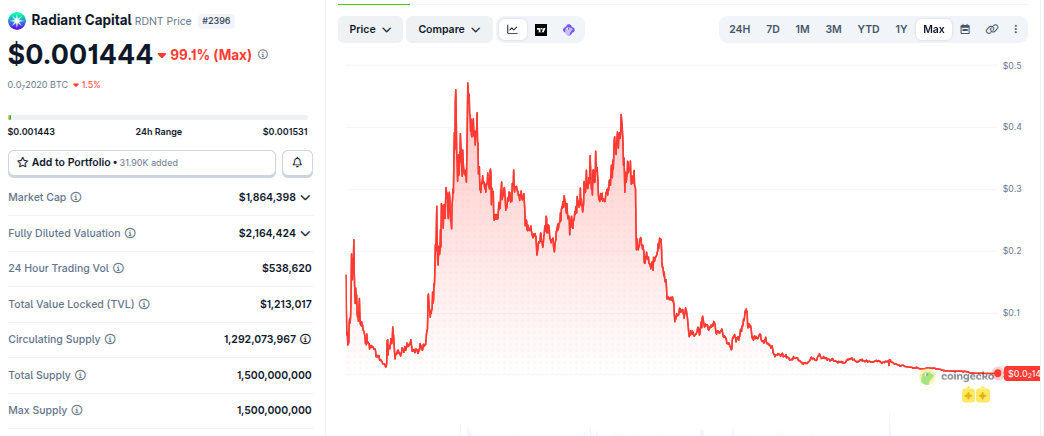
Radiant Capital announced an orderly wind-down of its DAO operations after 18 months of failed efforts to recover the more than $50 million lost in the devastating October 2024 exploit.
We break down the reasons behind the closure, what happens to users, and the key lessons it leaves for DeFi.
What the Radiant Capital Wind-Down Really Means
A DeFi wind-down is the orderly closure of a protocol while keeping smart contracts accessible so users can still withdraw funds and manage positions. Radiant Capital began exactly that process on June 1, 2026.
The final trigger was clear. After 18 months of work alongside zeroShadow, the DAO failed to recover any of the funds stolen in the critical October 2024 exploit that drained more than $50 million from the protocol.
The hack followed an earlier blow. In January 2024, a flash loan attack worth around 1,900 ETH had already forced the DAO to use treasury funds to cover communal bad debt and reduce its operating reserves significantly.
New capital never arrived either. No strategic investors, allocators, or ecosystem grants stepped in to extend the runway, while user trust, retention, and overall protocol revenue continued declining month after month.
Under those conditions, continuing operations would have meant maintaining limited functionality without a clear path forward. The DAO decided to halt active development and focus exclusively on user safety and ongoing recovery work.
The deployed smart contracts remain fully immutable and accessible on-chain. Users keep complete control to withdraw funds, repay loans, close lending positions, claim rewards, and unlock their DLP tokens directly.
Key Changes for Users and Lessons for DeFi 3.0
Several changes take effect immediately. Borrowing is disabled across all Core and RIZv1 markets, RDNT token emissions are discontinued, and treasury usage will be restricted to essential operations only.
The website and front-end will stay live through the end of the year. Discord, Telegram, and X will remain active for support, although with reduced response times and limited operational intervention from contributors.
Following the announcement, the RDNT token plummeted 4.4% to trade at $0.001444, according to CoinGecko data. This brings the altcoin’s total decline to 99.1% from its all-time high of $0.5853, recorded in September 2022.

Recovery work has not ended. The remediation portal will remain online indefinitely, zeroShadow stays engaged within available resources, and any recovered funds will be distributed directly to the users affected by the October 2024 exploit.
Radiant’s team also framed the closure as a broader lesson for the industry. They argue that DeFi is shifting toward what they call DeFi 3.0, where security is no longer a feature but the actual product institutions evaluate.
In this new phase, allocators care more about structural properties than nominal yields. Risk isolation, deterministic behavior under stress, operational security, and credible recovery pathways now define which protocols deserve serious capital allocation today.
Their final message is direct. Future protocols will likely be judged by how they fail, not just by how they perform under ideal conditions, making containment design and pre-built recovery plans essential.
The post Radiant Capital Ends DAO Operations 18 Months After $50 Million Exploit appeared first on BeInCrypto.


Charles Schwab is preparing to extend direct crypto access from retail investors to financial advisors, with a 2027 target for spot trading, transfers and custody on its advisor platform.
Summary
- Charles Schwab targets mid-2027 for advisor crypto spot trading, transfers and custody, though timing may change.
- The advisor plan follows Schwab Crypto, which brought Bitcoin and Ethereum trading to retail clients.
- Advisors use crypto ETPs, but direct spot demand is rising among clients holding assets elsewhere.
The plan would move Schwab’s crypto work deeper into wealth management, where advisors manage client accounts, asset transfers and custody needs through one platform.
Charles Schwab targets advisor crypto access
Charles Schwab is aiming to launch crypto spot trading services for advisors on its custody platform in 2027. The planned rollout would give advisor clients access to direct trading, asset transfers and custody through Schwab’s existing wealth management infrastructure.
Jalina Kerr, managing director at Schwab Advisor Services, said during a virtual media roundtable that the launch is “on track” for around mid-2027. She also said the timeline is “subject to change,” which means Schwab has not set a final launch date. Schwab oversees more than $10 trillion in client assets.
Meanwhile, the advisor plan follows Schwab Crypto, the firm’s spot Bitcoin and Ethereum trading product for retail clients. Schwab began rolling out that service to select U.S. clients this year, after earlier confirming a phased launch for direct access to Bitcoin and Ethereum.
Schwab said the retail crypto account is offered through Charles Schwab Premier Bank, SSB. Paxos provides trade execution and sub-custody services, while Schwab clients can view crypto beside traditional investments on Schwab.com, Schwab Mobile and thinkorswim.
Advisors weigh direct custody demand
Kerr said advisors still prefer exchange-traded products for most crypto exposure. Those products let clients track crypto markets inside familiar brokerage structures without directly handling coins or wallets.
Direct spot trading interest has still increased among advisors whose clients already hold crypto elsewhere. Schwab’s planned service would target that group by adding custody and transfer tools, not just trading access.
Competitors push into crypto trading
The move comes as major financial firms add direct crypto services. As previously reported by crypto.news, Morgan Stanley launched an ETrade crypto pilot with Bitcoin, Ether and Solana trading at a 0.5% fee, below Schwab’s 75-basis-point retail crypto fee.
Schwab has not released advisor pricing, supported assets or transfer limits for the 2027 service. Its retail platform started with Bitcoin and Ethereum, while Schwab said it plans to add more cryptocurrencies and transfer features over time.
The advisor rollout would expand Schwab’s digital asset strategy beyond self-directed retail users. It would also bring direct crypto tools closer to independent advisors who already use Schwab for custody, trading and client account support.
For now, the plan remains tied to a flexible timeline. Schwab is targeting mid-2027, but Kerr’s comments show the firm is still working through product design, cash movement rules and custody controls before launch.

A Polymarket trader has accused the prediction market platform of unfairly resolving a disputed market tied to Strategy’s first Bitcoin sale in years.
The trader claims he lost around $500,000 after betting that the firm had sold BTC before a May 31 deadline – something that was officially confirmed by an SEC filing on June 1.
Strategy’s Bitcoin Sale Sparks Serious Controversy
The whole thing centers on a Polymarket event asking whether MicroStrategy (later rebranded to Strategy) would sell any of its Bitcoin by a specific date. The rules stated that the market would resolve to “Yes” if the company sold any BTC by 11:59 ET on May 31. Resolution sources included on-chain data, disclosures, and credible reporting.
On June 1, Strategy filed an 8-K with the Securities and Exchange Commission. As CryptoPotato reported, the firm sold 32 BTC worth approximately $2.5 million between May 26 and May 31 – clearly within Polymarket’s resolution period.
However, the filing came one day after the May 31 market deadline, creating the central dispute: should the event be judged by when the sale occurred, or by when it was publicly confirmed?
Trader Says Polymarket Added a Rule After the Fact
According to the trader, he started buying “Yes” shares after noticing that Strategy had deposited around $30 million of BTC into Coinbase Prime a week ago – a move that escalated speculations that the firm would sell.
He said he had reviewed on-chain data, checked past wallet activity, and concluded that Strategy had likely sold BTC before the deadline.
After the firm confirmed the sale on June 1st through the SEC filing, the trader increased his position. He said that the market was still open, arguing that the rules only required a sale within the timeframe – not confirmation within the timeframe. Here’s where it gets interesting.
The trader claims that Polymarket added a clarification stating that confirmation achieved outside the market’s timeframe would not qualify. And they did that after the fact.
Later, Polymarket added clarification.
“No information from MSTR, on-chain data, or consensus of credible reporting confirmed that MicroStrategy sold Bitcoin within the market’s timeframe.
Confirmation achieved outside of the market’s time frame does not qualify.” pic.twitter.com/60O3S1q4LV
— willo2 (@willo2_Poly) June 2, 2026
The user said that the move constituted a new rule and alleged that the market should either have resolved to “Yes” or closed on May 31 if post-deadline confirmation was not allowed.
At the time of this writing, the market has been resolved to “No.”
The main problem here, according to other traders on Polymarket, is that anyone can dispute a market’s resolution by posting a bond, which triggers a debate period. During that debate period, a set of people who hold UMA tokens vote on the correct resolution according to the predefined rules. Many argue that this creates a situation in which UMA whales can manipulate markets during dispute windows, and that Polymarket is doing nothing about it.
The post Trader Claims Polymarket Scammed Him for $500K on MicroStrategy’s Bitcoin Sale Market appeared first on CryptoPotato.
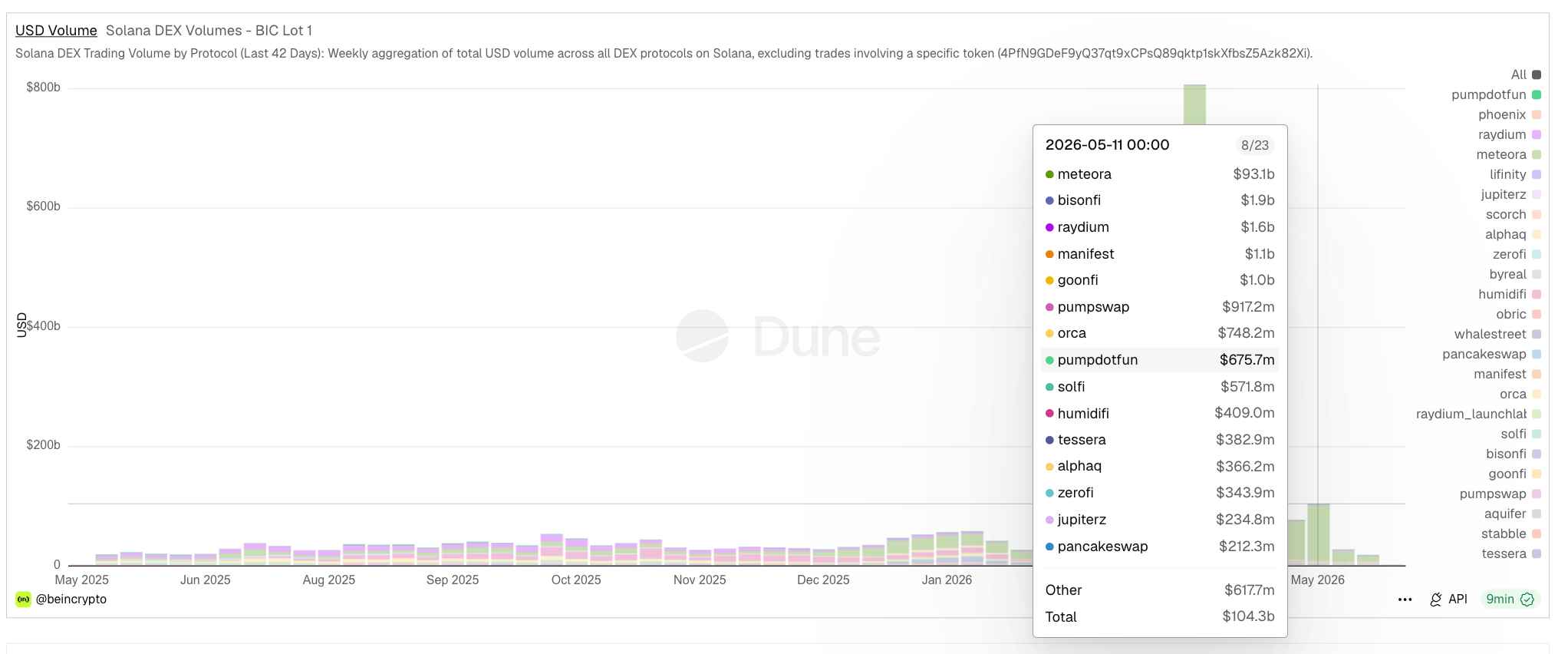
Solana (SOL) is flashing two on-chain cracks in the same two-week window: weekly DEX trading volume collapsed about 82%, and a key holder cohort began trimming its stake just as that drop unfolded. Dune and Glassnode data line the two events up almost to the week, with meme coin launchpads at the center.
The timing is the story. Here is how the pieces connect.
Solana DEX Volume Collapsed in Two Weeks
The drop is steep and recent. Per Dune data, total weekly DEX volume across Solana protocols stood near $104.3 billion in the week of May 11, with the DEX Meteora alone accounting for about $93.1 billion. Two weeks later, in the week of May 25, total weekly volume had fallen to roughly $18.8 billion, with Meteora down to $9.2 billion.

That is a decline of about 82% in two weeks, and it hit the largest venue hardest.
Want more token insights like this? Sign up for Editor Harsh Notariya’s Daily Crypto Newsletter here.
Meteora shed more than $80 billion in weekly volume on its own. The fall is broad rather than isolated, pointing to a drying up of the speculative flow that once defined Solana trading.
It also extends a longer slide, with weekly DEX volume on the network down more than 50% since January. The question is what drained the flow, and who reacted to it.
Meme Coin Launchpads Went Quiet
The answer sits with meme coins. Solana’s DEX volume has long run on a flywheel where launchpads mint new meme coins, traders chase them, and DEXes process the churn. That engine, where components even rivalled Ethereum, has stalled.
On-chain data shows new meme coin launches roughly halved in early 2026. The cooling launchpad activity and cutting the supply of fresh tokens to trade are visible. With fewer new narratives to chase, the speculative volume that inflated weekly DEX totals had nothing to feed on. Trading bot revenue likely fell alongside it.

The Meteora figures make the link concrete. A venue built around meme coin and launch churn does not shed more than $80 billion in weekly volume on a broad market dip alone.
It falls when the launches that generate the trades dry up. The collapse in DEX volume is, at its core, a collapse in meme coin speculation, and the timing of that collapse matters for what came next.
The Overlap: A Key Cohort Started Selling in the Same Window
Here is where the two datasets meet. Per Glassnode’s HODL Waves, a metric that groups supply by how long coins have stayed unmoved, the 1-year-to-2-year cohort held 16.049% of SOL supply on May 21. By June 1, that share had slipped to around 15%.
That sell-down began on May 21, squarely inside the May 11 to May 25 window in which DEX volume collapsed. The two on-chain signals turned at almost the same time. This cohort holds coins bought into Solana’s 2024-to-2025 activity boom.
It is the same boom that ran on the meme coin volume now draining away.

The data does not prove the volume crash forced the cohort out, and the piece does not claim it did. What the data shows is a clean timeline overlap. As the activity that underpinned Solana’s trading economy fell off, a group of holders who had sat tight through that economy started letting go in the same window.
Whether the Solana DEX volume collapse is the trigger or simply a parallel symptom, the two are now bleeding together. And that is the question Solana’s next few weeks will answer.
The post Solana DEX Volume Collapsed 82% as the Meme Coin Engine Stalled appeared first on BeInCrypto.

Peter Murrell bought motorhome, £1k telescope and book of Sturgeon speeches with embezzled SNP funds

Tasmea in $254m east coast acquisition
‘We Investigated Ourselves’: ZachXBT Slams EdgeX After Sudden Token Collapse

Steven Gerrard disagrees with Gary Neville over ‘shock’ Chelsea and Arsenal claim | Football

US brings back mandatory military draft registration

Register Renaming | Hackaday

XRP BREAKING NEWS: US Opens Door for Regulated Crypto Futures | XRP Ready for Institutional Boom?

BEFORE & AFTER GAMBLING WITH THE BOYS! #funny #gambling #money #skit #shorts #foryou

What is Cryptocurrency? | Cryptocurrency Explained in Hindi | Beginner’s Guide
-

 NewsBeat6 days ago
Israel says it has killed new Hamas military leader in Gaza City airstrikes
-

 Tech6 days ago
NASA taps Blue Origin to deliver lunar rovers for Moon Base initiative
-

 News Videos4 days ago
This is BROKEN! INSANE 5x MONEY CAR WASH WEEK! The NEW GTA Online UPDATE Today! (GTA5 New Update)
-

 News Videos6 days ago
XRP *JUST* SUCCEEDED!!!! CLARITY ACT EXPOSED!!! (SHE EXPOSED IT)
-
 Crypto World6 days ago
Micron Crosses $1 Trillion Market Cap as AI Demand Reshapes Memory Sector
-
 Tech3 days ago
SpaceX just won a second Golden Dome contract. This one is $4.16 billion.
-

 Business6 days ago
Selena Gomez Reportedly Upset Over Benny Blanco’s Comments on Her ‘Terrible’ Diet
-

 Tech4 days ago
Waymo dominates autonomous vehicle registrations as Tesla trails behind
-

 News Videos4 days ago
SHE IS KILLING XRP!!! WATCH URGENT AND ACT FAST
-

 Entertainment7 days ago
Days of our Lives 2-Week Spoilers May 25-June 5: Gwen Rages, Abe Confesses & 2 Tragic Anniversaries!
-
 NewsBeat3 days ago
FIRST NIGHT REVIEW: Take That bring the Circus back to life in spectacular sun-soaked style
-

 Tech6 days ago
The Samsung pay deal is the moment Korean unions changed register
-

 Tech6 days ago
Millions of AI agents imperiled by critical vulnerability in open source package
-

 Business12 hours ago
Jade Biosciences, Inc. (JBIO) Discusses Positive Interim Results From JADE101 Phase I Healthy Volunteer Study and Development Plans Transcript
-
Crypto World4 days ago
CFTC Has Approved the First Regulated Bitcoin Perpetual Contract in the U.S.
-
Crypto World6 days ago
SpaceX’s $2 Trillion IPO: Why Tech Giants Nvidia (NVDA), Apple (AAPL), and Microsoft (MSFT) May Face Pressure
-

 NewsBeat7 days ago
Family pay tribute to Eston ‘murder’ victim Peter Phillips
-
 Crypto World7 days ago
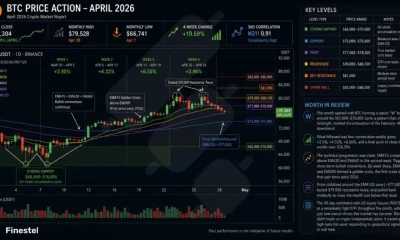
Bitcoin’s April recovery showed signs of structural accumulation
-

 Crypto World7 days ago
Spain blocks prediction markets Polymarket Kalshi
-
 Entertainment6 days ago
The Most Misunderstood Sci-Fi Horror Movie of the Last 10 Years Just Took Over Netflix
You must be logged in to post a comment Login