

Crypto World
Micron Crosses $1 Trillion Market Cap as AI Demand Reshapes Memory Sector


TLDR:
- Micron’s market cap surged from $70 billion to $1 trillion in twelve months, driven by AI memory demand.
- Q3 fiscal 2026 guidance projects $33.5 billion in revenue with gross margins expected to exceed 81%.
- Micron can only fulfill 50% to two-thirds of demand from its largest AI customers in the near term.
- The HBM total addressable market is forecast to grow from $35 billion in 2025 to $100 billion by 2028.
Micron Technology has officially crossed the $1 trillion market capitalization milestone for the first time in its history.
The company’s stock climbed from a $70 billion valuation just twelve months ago. That represents a 14x move in a single year.
AI-driven demand for high-bandwidth memory is widely credited for the dramatic shift in Micron’s financial position.
AI Infrastructure Drives Unprecedented Memory Shortage
Traditional memory markets operated on a predictable boom-and-bust cycle for decades. Oversupply would crush prices, margins would collapse, and weaker players would exit.
That pattern depended on memory being cheap and interchangeable over time. However, the AI buildout has fundamentally changed that dynamic.
Every AI inference call requires DRAM to process. An AI server consumes roughly eight times more DRAM than a traditional server.
High-bandwidth memory, or HBM, required by Nvidia’s H100s and B200s, uses over three times more wafer capacity per bit than DDR5. This creates a supply gap the industry was never built to fill.
As Milk Road AI noted, Micron’s CEO confirmed on camera that the company can only fulfill 50% to two-thirds of demand from its largest AI customers. Samsung raised DRAM list prices approximately 60% since September.
Spot DRAM prices are up roughly 3x year over year, while supplier stockpiles fell from 17 weeks in late 2024 to just two to four weeks by October 2025.
Contract pricing and allocation constraints are now structural features of the market. They are not temporary disruptions that will self-correct within a quarter or two.
The shortage is expected to persist until at least 2028, based on current production timelines from major manufacturers.
Financial Results Reflect Scarcity-Driven Pricing Power
Micron reported Q2 fiscal 2026 revenue of $23.86 billion, up 196% year over year. That result beat estimates by 24%. Gross margins reached 74.4%, more than doubling within a single year.
The company’s gross margin sat below 20% in 2023, making the turnaround notable by any financial measure.
Q3 guidance calls for $33.5 billion in revenue, up over 200% year over year. Gross margins are expected to exceed 81%, with EPS projected at $19.15 against a consensus estimate of $12.05. Management described the current cash generation as levels “not seen in its history.”
UBS raised its price target for Micron to $1,625, pointing to the structural nature of the shortage and locked-in HBM contracts.
Despite those figures, the stock still trades at roughly 8x forward P/E on fiscal 2026 consensus earnings. That multiple is typically associated with slower-growing, lower-margin businesses.
New manufacturing capacity in Boise will not reach full production until mid-2027. The second phase runs to late 2028, and the New York fab does not contribute meaningfully until 2030.
The HBM total addressable market alone is forecast to grow from $35 billion in 2025 to $100 billion by 2028.


Sonic Labs has announced a leadership overhaul after the S token extended its long-running decline, with former chief technology officer Andre Cronje joining two other senior figures in stepping down from the organization’s board.
Summary
- Andre Cronje, Michael Kong, and David Richardson have stepped down from Sonic Labs’ board.
- Sonic Labs appointed new executives and launched governance reforms amid community concerns.
- S token remains under pressure, with technical indicators pointing to continued bearish momentum.
According to Sonic Labs, Andre Cronje, former Fantom Foundation chief executive Michael Kong, and executive chairman David Richardson have resigned from the board as the company restructures its governance and executive leadership.
The announcement coincided with another day of losses for the Sonic (S), which traded near $0.029 after falling about 5% over the past 24 hours.
In a separate statement, Cronje addressed criticism from community members and argued that responsibility should rest with the individuals who directly oversaw specific decisions.
While accepting accountability for the technology and technical decisions he led, he said he was not responsible for decisions involving the network migration, airdrop structure, tokenomics, or management of the legacy network.
“I stand behind the technology and technical decisions I led. I was not the author or decision owner of the migration, airdrop, tokenomics, or legacy-network decisions described above.”
Sonic Labs described the resignations as part of an orderly transition.
“These are the people who built what Sonic is today. They remain invested in Sonic’s success and are handing off their responsibilities the right way, in full. From here, they will no longer make business decisions for the organization.”
Sonic Labs has appointed Matt Visser as its new CEO and Kosta Kourkoumelis as chief operating officer as part of the transition.
Sonic Labs acknowledged that both the token’s performance and community sentiment have deteriorated. In a statement, the company said it was not attempting to downplay those challenges, stating that “the token is down” and that community sentiment has weakened.
As per data from crypto.news, the S token has fallen roughly 97% since launching in January 2025 as part of the network’s migration from Fantom to Sonic.
Why is Sonic changing its leadership structure?
Facing criticism from community members and investors, Sonic Labs said the management changes are tied to a new governance framework designed to improve accountability and communication.
Alongside the executive reshuffle, the company said it will introduce more transparent governance processes, provide clearer updates on development progress, and establish a dedicated risk and compliance committee. Sonic Labs stated that the departing board members helped build the network into its current form but will no longer participate in business decisions going forward.
Originally founded as the Fantom Foundation in 2018, the organization rebranded to Sonic Labs following a major network upgrade that replaced the Fantom Opera blockchain with the Sonic layer-1 network. The company says the blockchain can process up to 10,000 transactions per second while delivering sub-second transaction finality.
Earlier this year, Sonic Labs also expanded its ecosystem with the launch of USSD, a dollar-pegged stablecoin backed by tokenized U.S. Treasury assets. Announced in March, the stablecoin was introduced to support trading, lending, payments, and settlement activity across decentralized finance applications operating on the Sonic network.
What does the market signal about the S token?
Recent price action suggests traders remain cautious despite Sonic Labs’ efforts to restore confidence through governance and leadership changes.
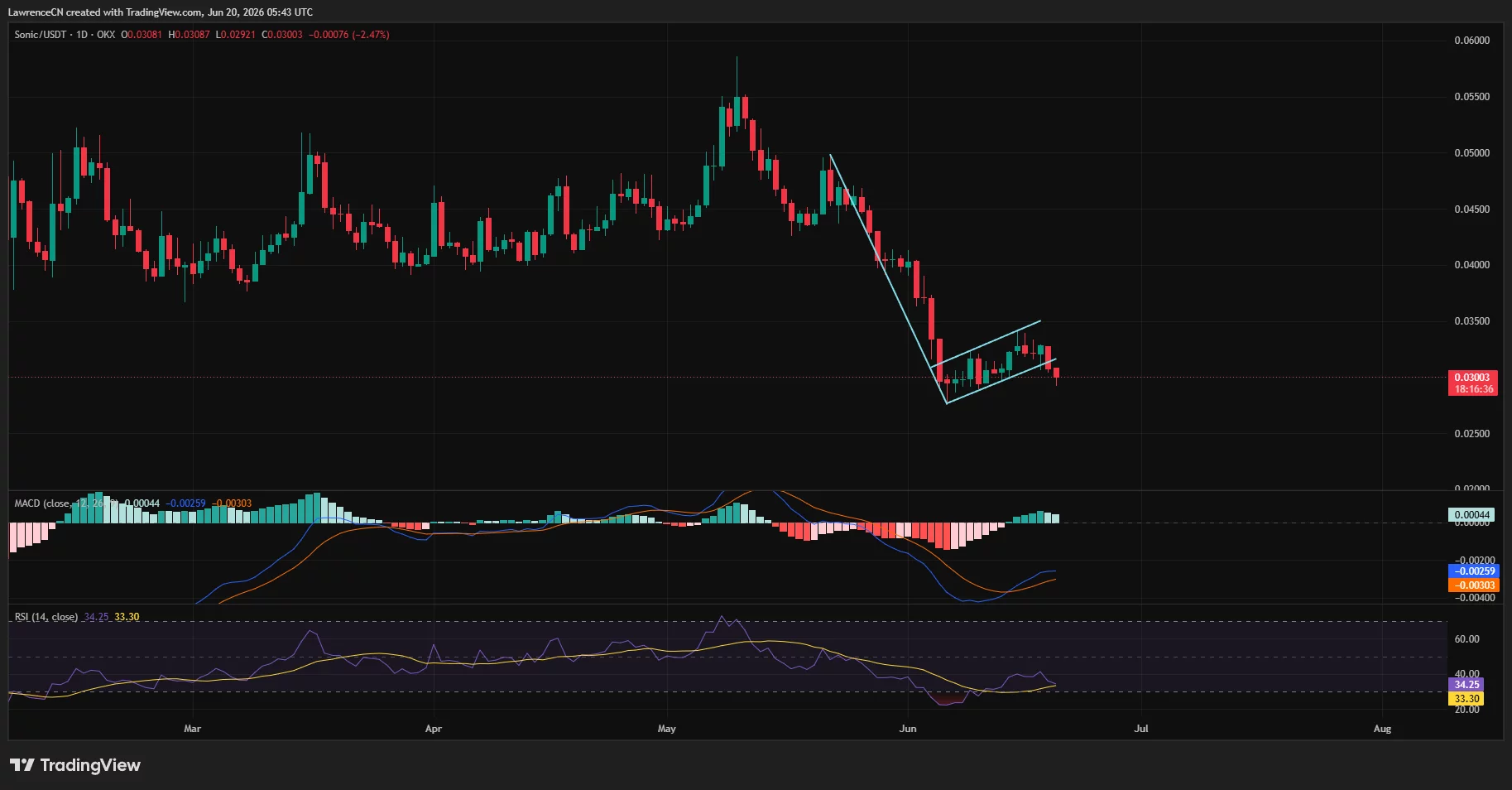
Daily chart data shows the S token trading near $0.03 after breaking below the lower boundary of a bearish flag pattern that formed following a sharp June selloff. The formation emerged after the token dropped from roughly $0.049 to below $0.03, with a brief upward consolidation creating the flag before sellers regained control.
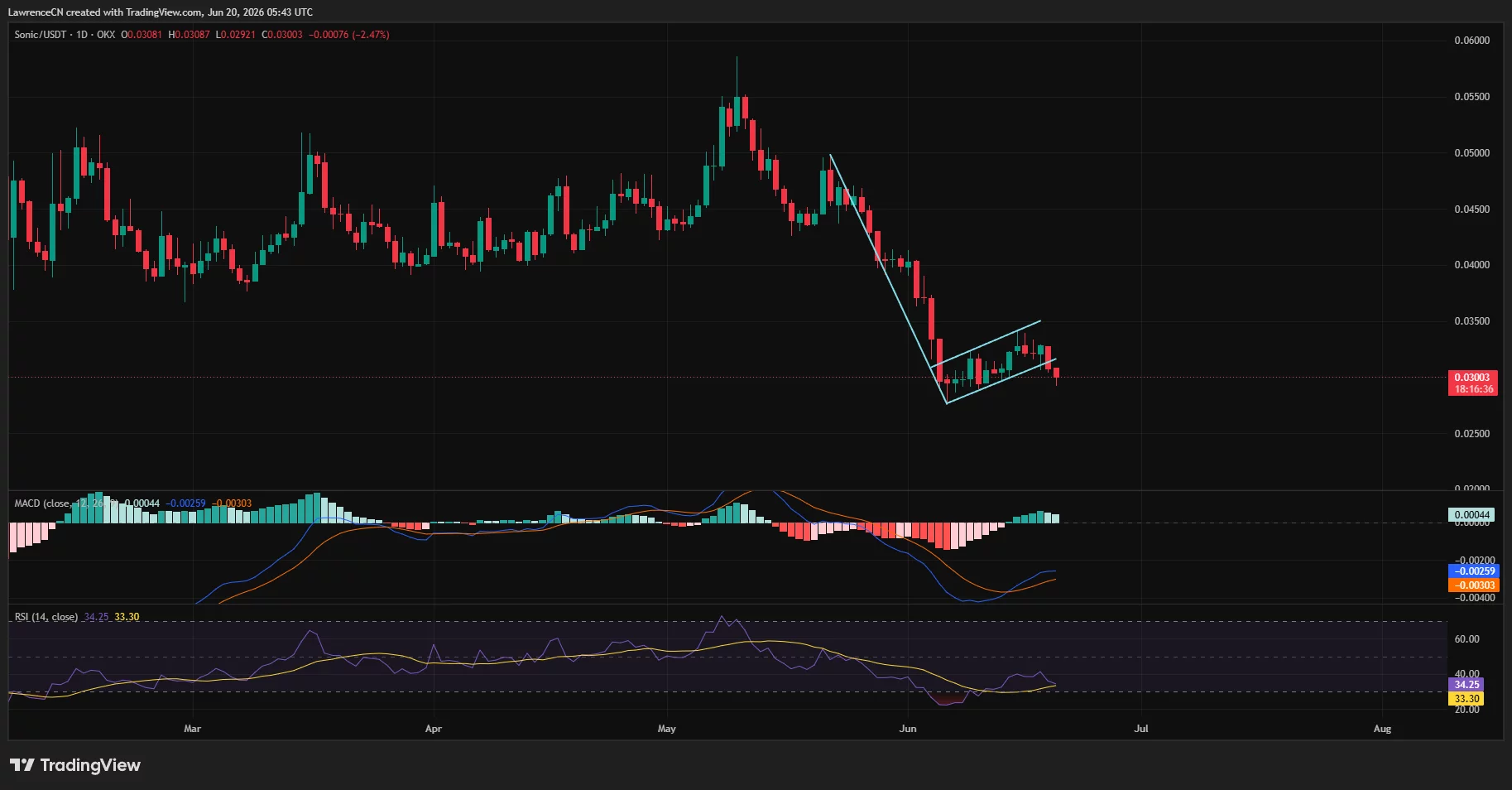
Momentum indicators continue to favor bears. The Relative Strength Index has slipped to around 34, remaining below the neutral 50 level and pointing to weak buying demand. Meanwhile, the MACD remains below the zero line despite a recent bullish crossover attempt, indicating that the broader trend remains tilted to the downside.
Following the breakdown, the recent swing low near $0.028 has become the nearest support level. A move below that area could open the door to lower levels seen during the token’s post-launch decline. On the upside, former flag support near $0.032 has turned into resistance, while a recovery toward the $0.034-$0.035 range would be needed to challenge the current bearish structure.
While Sonic Labs works through its leadership transition, executive turnover has also affected other parts of the crypto industry. As reported by crypto.news, on Thursday, Ethereum Foundation co-executive director Hsiao-Wei Wang announced her departure, adding to a reported 19 layoffs and departures from the organization this year.

Two brothers accused of kidnapping a Minnesota family at gunpoint to steal cryptocurrency have pleaded guilty in federal court, according to the US Attorney’s Office for the District of Minnesota. The case centers on an alleged $8 million theft from the victim’s online accounts and hardware wallets.
The guilty pleas, entered on Thursday by Isiah Angelo Garcia and Raymond Christian Garcia, underline how “wrench attacks” — violent robberies targeting crypto holders — are increasingly prompting coordinated law-enforcement action. The development also comes as analysts report a sharp rise in crypto-related assaults and kidnappings in recent years.
Key takeaways
- Garcia brothers pleaded guilty to Interference with Commerce by Robbery, a federal charge carrying a maximum penalty of 20 years in prison.
- Prosecutors say the kidnapping was used to force a victim to transfer $8 million in cryptocurrency from online accounts and hardware wallets.
- Both defendants admitted using firearms to threaten victims and agreed to pay more than $8 million in restitution.
- Sentencing has not yet been scheduled, leaving the timeline for final penalties still open.
- The case adds to a growing US and international crackdown on violent robberies aimed at crypto owners.
Guilty pleas in Minnesota kidnapping-for-crypto case
According to the US Attorney’s Office of the District of Minnesota, Isiah Angelo Garcia and Raymond Christian Garcia entered guilty pleas on Thursday in connection with an armed robbery in Minnesota. The charge is Interference with Commerce by Robbery, with prosecutors noting a maximum possible federal prison term of 20 years.
US Attorney Daniel Rosen said the pleas reflect the government’s effort to hold defendants accountable for the choices they made.
The criminal conduct prosecutors describe began when the two men allegedly traveled from Texas to Minnesota in September 2025. Prosecutors said their aim was to seize cryptocurrency by holding a victim and his family at gunpoint.
How prosecutors say the $8 million theft unfolded
In an earlier filing, the US Attorney’s Office stated that on Sept. 19, 2025, the brothers allegedly held the victim’s family at gunpoint and forced the victim to transfer cryptocurrency. Prosecutors said the robbery involved both online accounts and hardware wallets.
The alleged kidnapping lasted for hours. Prosecutors said the victim’s wife and son were held in their family home for about nine hours, while the victim was taken to a cabin roughly three hours away.
Police involvement began after the victim’s son was able to make an emergency call. Washington County sheriff’s deputies responded, and investigators later found a rifle and a shotgun. Prosecutors also pointed to surveillance footage and other evidence connecting the brothers to the burglary.
What the pleas mean legally and financially
In their guilty pleas, both defendants admitted to using firearms to threaten the victims as part of the robbery, according to the US Attorney’s Office. The plea agreement also includes restitution obligations exceeding $8 million.
Although the guilty pleas mark a major procedural step, the case is not yet at sentencing. The US Attorney’s Office said sentencing hearings have not been scheduled, meaning the final duration of prison terms remains uncertain.
For crypto owners and the broader market, cases like this are not only about criminal punishment. They also signal that investigators are willing and able to pursue federal charges in violent schemes tied to crypto custody and transfers, rather than treating them solely as isolated robberies.
Part of a wider pattern of crypto wrench attacks
The Minnesota case lands amid growing concerns about violent crimes specifically targeting cryptocurrency. In February, CertiK reported that the number of crypto-related assaults and kidnappings increased 75% in 2025 compared with the prior year. CertiK also estimated that losses from such attacks in the first four months of 2026 had already reached $101 million, according to a Cointelegraph report referencing CertiK’s findings.
This broader context helps explain why authorities appear to be pursuing multiple cases in parallel. Earlier in the year, US authorities unsealed an indictment involving three men accused of stealing at least $6.5 million in what prosecutors described as a violent robbery spree targeting cryptocurrency owners. In that case, prosecutors alleged the defendants posed as delivery drivers to enter residences and use violence to extract cryptocurrency.
Outside the US, the issue has also drawn official attention. During Paris Blockchain Week in April, Jean-Didier Berger, a minister delegate to the interior minister of France, said his office has taken “preventive measures” against crypto wrench attacks, including launching a prevention platform that generated thousands of sign-ups, according to a Cointelegraph report.
What to watch next
With the brothers now pleading guilty and restitution agreed, the next key development will be sentencing scheduling and the terms the court imposes. More broadly, investors and users should watch whether prosecutors continue to expand federal cases in wrench-attack schemes and how prevention efforts evolve as reported losses rise.

Two brothers accused of holding a Minnesota family at gunpoint to steal approximately $8 million worth of cryptocurrency have entered guilty pleas in connection with the armed robbery, according to the U.S. Attorney’s Office for the District of Minnesota. The case underscores how crypto-related thefts increasingly intersect with traditional violent crime—raising distinct enforcement and compliance challenges for financial institutions and regulated crypto businesses.
On Thursday, Isiah Angelo Garcia and Raymond Christian Garcia pleaded guilty to Interference with Commerce by Robbery. Prosecutors said the brothers traveled to Minnesota from Texas and used firearms to coerce a victim and his family into facilitating transfers from online accounts and hardware wallets.
Key takeaways
- Garcia brothers pleaded guilty in federal court to robbery-related interference with commerce, facing a maximum of 20 years in prison.
- Prosecutors allege the attack relied on threats with firearms to force cryptocurrency transfers, including from hardware wallets.
- The defendants agreed to pay more than $8 million in restitution; sentencing dates were not yet scheduled at the time of the announcement.
- The case reflects broader efforts by U.S. authorities to prosecute violent crypto thefts under federal criminal statutes.
- European policymakers have also moved toward targeted prevention measures amid rising reported “wrench attacks.”
Minnesota kidnapping case ends in guilty pleas
Federal prosecutors said that on Sept. 19, 2025, the brothers traveled to Minnesota with the intent to kidnap and threaten a victim and his family. According to the U.S. Attorney’s Office of the District of Minnesota, the confrontation involved firearms and was aimed at compelling the victim to move cryptocurrency held in digital accounts.
The indictment and related filings described a sustained period of coercion at the family’s home, followed by transportation of the victim to a separate location. Prosecutors said the victim was ultimately forced to transfer $8 million in cryptocurrency, while the victim’s wife and son were held for approximately nine hours inside their residence.
Authorities reported that the kidnapping was identified after the victim’s son managed to make an emergency call. Deputies responded and later located firearms—reported as a rifle and a shotgun—along with surveillance footage and other evidence that prosecutors said linked the brothers to the burglary and robbery.
What the guilty pleas cover—and the compliance angle
In their pleas, both defendants admitted to using firearms to threaten the victims as part of a robbery. The U.S. Attorney’s Office stated that the brothers agreed to pay more than $8 million in restitution. Prosecutors also noted that sentencing hearings had not yet been scheduled.
From a regulatory and compliance perspective, the case highlights a recurring pattern: violent actors frequently attempt to obtain crypto through coercion of individuals’ credentials and access pathways, rather than purely exploiting market or technical weaknesses. This distinction matters for firms implementing risk controls around customer protection, incident response, and red-flag monitoring, as well as for banks and other regulated intermediaries that may be asked to support law enforcement requests or freeze assets tied to criminal activity.
For institutional stakeholders, it also reinforces the importance of clearly documented processes to distinguish between:
- voluntary customer transfers that occurred under threat or duress, and
- criminally directed movements involving stolen or coerced assets.
While a guilty plea does not automatically answer restitution allocation mechanics or any downstream asset recovery questions, it does strengthen the evidentiary record used by prosecutors and may affect how regulated entities handle subpoenas, restraining orders, and asset-freezing requests tied to the same conduct.
Broader enforcement and policy context for “wrench attacks”
The Minnesota case comes amid growing attention to incidents in which perpetrators use weapons to obtain cryptocurrency. In a separate context, Cointelegraph reported on findings from blockchain security and intelligence firm CertiK. The reporting referenced an increase in crypto-related assaults and kidnappings and cited estimated losses associated with such attacks.
U.S. authorities have continued to use federal criminal tools to address violent theft of digital assets. For example, prosecutors have previously unsealed indictments involving alleged “violent robbery sprees” targeting cryptocurrency owners and described tactics such as coercing victims through home entry and physical threats.
Internationally, French officials have also signaled that governments are treating these crimes as a public safety issue requiring targeted prevention. During Paris Blockchain Week, a French interior ministry delegate described “preventive measures” against crypto wrench attacks, including a prevention platform that attracted sign-ups.
For compliance programs, these cross-border developments have practical implications: legal thresholds for information sharing, consumer protection obligations, and licensing regimes can vary substantially between jurisdictions, but the underlying risk mechanism—coercion of access to wallets and accounts—tends to be consistent. As a result, firms may need harmonized training and controls across jurisdictions, even where regulatory frameworks differ.
What happens next
Sentencing is the next key step in the Garcia brothers’ case, and it will likely clarify the final penalties and restitution terms. More broadly, as enforcement actions accumulate and governments pursue prevention initiatives, regulated crypto firms and their banking counterparts will want to review whether their customer safeguarding, incident response, and law-enforcement workflow policies adequately address the realities of coercion-driven theft, including duress-related transfer scenarios.

Two brothers accused of kidnapping a Minnesota family at gunpoint last year to steal $8 million in cryptocurrency pleaded guilty in connection with the armed robbery.
Isiah Angelo Garcia and Raymond Christian Garcia, on Thursday, entered guilty pleas for Interference with Commerce by Robbery, facing a maximum of 20 years in federal prison, according to the US Attorney’s Office of the District of Minnesota.
“The guilty pleas entered today reflect our commitment to holding the defendants accountable for the choices they made,” US Attorney Daniel Rosen said.
Global crypto wrench attacks have skyrocketed in recent years. In February, CertiK found that the number of crypto-related assaults and kidnappings increased 75% in 2025 from the previous year. Estimated losses in the first four months of 2026 from such attacks have already reached $101 million.
Garcia brothers steal $8 million in crypto
Prosecutors said on Sept. 19, 2025, the two brothers traveled to Minnesota from Texas to hold a victim and his family at gunpoint, forcing him to transfer cryptocurrency from his online accounts and hardware wallets.
The ordeal left the victim’s wife and son held for nine hours in their family home, while the victim was taken to a family cabin about three hours away and was ultimately forced to transfer $8 million in cryptocurrency.

Isiah Angelo Garcia (left) and Raymond Christian Garcia (right). Source: Waller County, Texas, Sheriff’s Office
Police were alerted to the kidnapping after the victim’s son was able to make an emergency call, which was answered by Washington County sheriff’s deputies. Deputies later found a rifle and a shotgun, which, along with surveillance footage and other evidence, connected the brothers to the burglary.
Crypto attackers plead guilty
In their guilty pleas, both defendants admitted to using firearms to threaten the victims in order to rob them. They have agreed to pay more than $8 million in restitution. Sentencing hearings have not yet been scheduled.
The latest development adds a win for US prosecutors in a global fight against criminals who target crypto owners.
Related: Accused attackers of Sandbox exec’s wife tried to flee via Uber
In May, US authorities unsealed an indictment against three men accused of stealing at least $6.5 million in a “violent robbery spree targeting cryptocurrency owners.”
The robberies involved the three defendants allegedly posing as delivery drivers to force their way into residences and use violence to extract cryptocurrency from their victims.
The increase in global attacks has drawn the attention of the French government.
During Paris Blockchain Week in April, Jean-Didier Berger, minister delegate to the interior minister of France, said his office has taken “preventive measures” against crypto wrench attacks, including launching a prevention platform that has drawn thousands of sign-ups.
Magazine: The end of anon? AI could unmask crypto’s hidden identities

Sonic Labs’ board shake-up has spilled over into the market, with the network’s native token, S, sliding after the company announced that three former executives are stepping down from its board. The move comes as Sonic continues an overhaul of leadership and governance amid ongoing criticism from sections of its community.
On Friday, S fell to around 0.031, down 5% over 24 hours. The resignations include Michael Kong, previously CEO of the Fantom Foundation and a director at Sonic Labs; David Richardson, who served as executive chairman of Sonic Labs; and Andre Cronje, the project’s former chief technology officer, who had earlier posted a statement about his board resignation at andrecronje.info.
Key takeaways
- Sonic Labs announced the resignations of three board members, prompting a 5% drop in the S token over 24 hours.
- The departures include Michael Kong, David Richardson, and Andre Cronje; Sonic is naming new top roles including Matt Visser as CEO.
- Sonic said outgoing leaders will remain invested but will no longer make organizational business decisions.
- The changes are positioned alongside promises of more transparent governance, clearer updates, and new risk/compliance oversight.
- The leadership transition targets dissatisfaction linked to S’s long-running decline since Sonic’s January 2025 network upgrade.
Token drop follows board changes
The immediate market reaction to Sonic Labs’ announcement reflects how quickly governance headlines can influence token sentiment. S moved lower after the company said three former executives resigned from its board, while also detailing a broader leadership restructuring.
In its announcement, Sonic Labs emphasized continuity in a way that tries to address trust concerns. Outgoing board members “built what Sonic is today,” the company said, adding that they will “remain invested in Sonic’s success” and are transferring responsibilities “the right way.” Sonic’s statement also stressed that, after the transition, they “will no longer make business decisions for the organization.”
Sonic simultaneously named Matt Visser as its new CEO and Kosta Kourkoumelis as chief operating officer, framing the board exit as part of an attempt to reset how the organization is run and communicated.
Why the resignations matter for investors and users
For S holders, governance isn’t just corporate housekeeping—it can shape development priorities, treasury decisions, and the pace of execution. Sonic Labs’ own messaging suggests it is responding to mounting dissatisfaction in the community, while also acknowledging that the token’s performance has deteriorated since launch.
According to the article, Sonic Labs tied its governance overhaul to the “growing community dissatisfaction” and to what it called the prolonged decline in S. The token, launched in January 2025 as part of the Sonic network upgrade, is reported to have fallen 97% since that launch.
Rather than contesting the narrative, Sonic Labs said it would not present the situation as a success story. “We are not going to open with a victory lap. The token is down. Community sentiment is down. We see both clearly, we are not spinning it, and we are not asking anyone to pretend otherwise,” Sonic Labs stated.
This kind of direct acknowledgement matters because it can affect how quickly stakeholders believe management actions are aligned with delivered outcomes. It also sets a clear expectation: any subsequent improvements—whether in protocol development, ecosystem growth, or risk controls—will be judged against the backdrop of a steep drawdown.
Governance commitments and new oversight structures
Sonic Labs said the leadership change will be paired with governance and communications reforms. The company pointed to:
- More transparent governance processes.
- Clear communication around project updates.
- The creation of a dedicated risk and compliance committee.
Those promises reflect a broader trend in crypto over the past year: when markets doubt project stewardship, teams often respond by formalizing accountability mechanisms and improving how information is shared with token holders.
However, governance changes also leave open a key question for investors: what will actually change operationally? Sonic’s restructuring indicates an intention to change decision-making and oversight, but readers will likely want to watch for concrete deliverables—particularly around how the new committee will function and how update cadence and transparency will be measured.
From Fantom to Sonic—and the leadership reorientation
Sonic Labs is the research and development organization behind the Sonic layer-1 blockchain. The network positions itself as an EVM-compatible chain designed for high performance, claiming 10,000 transactions per second and subsecond finality.
Sonic’s identity shift is also part of the context. As described in the article, the project rebranded from Fantom to Sonic and introduced a major structural and technical upgrade, replacing the legacy Fantom Opera network.
Against that backdrop, the board reshuffle signals a second-phase transition: an evolution from building and migration into managing ongoing expectations. Sonic’s approach appears to be attempting to restore credibility by tightening governance and aligning leadership roles with a new operating structure.
The timing is also notable in relation to wider industry developments. The article notes that this comes just days after Ethereum Foundation co-executive director Hsiao-Wei Wang announced she had stepped down, adding to a series of departures and layoffs reported earlier in the year. While that is a separate organization, it underscores that governance and leadership volatility is not unique to Sonic.
For now, the most important question is whether Sonic’s promised governance and oversight reforms translate into measurable progress that can stabilize community confidence and improve the token’s outlook. Investors should watch for how the new leadership structure operates in practice—especially update transparency, risk/compliance committee actions, and the project milestones that follow the board transition.
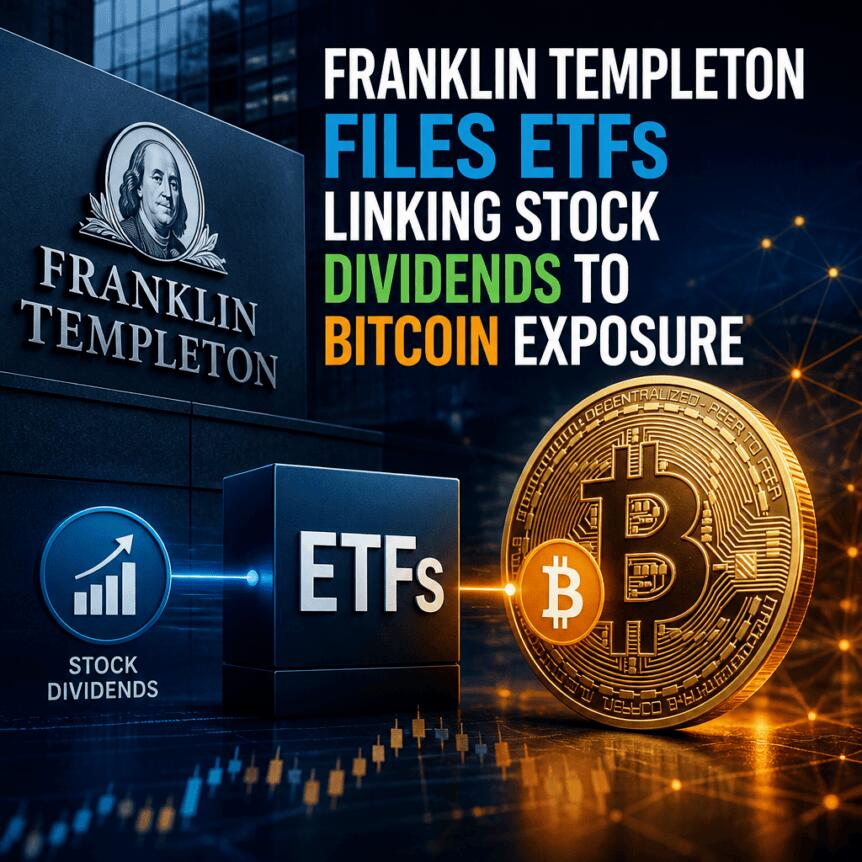
Franklin Templeton has filed with the US Securities and Exchange Commission (SEC) to launch two exchange-traded funds designed to turn dividend income from US stocks into Bitcoin exposure. The proposal, disclosed in a June 18 SEC filing, targets investors who want a rules-based path to add Bitcoin exposure without abandoning an equity allocation.
The funds—titled the Franklin US Equity Bitcoin DRIP Index ETF and Franklin US Innovation Bitcoin DRIP Index ETF—would follow indexes that reinvest dividends from selected US stocks into a predetermined Bitcoin allocation. According to the filing, the initial allocation framework would place 5% into Bitcoin exposure and 95% into equities, with the index methodology governing how that balance is maintained over time.
Key takeaways
- Franklin Templeton filed for two dividend-reinvestment ETFs that convert stock dividends into Bitcoin exposure through proprietary index rules.
- The proposed funds would start with a 5% Bitcoin exposure and 95% US equities allocation, then keep that target within limits through periodic rebalancing.
- Bitcoin exposure could be gained through multiple instruments, including Bitcoin exchange-traded products, futures, options, and Bitcoin-backed depositary receipts, as described in the SEC filing.
- The “Equity” fund would track a broad US large-cap benchmark, while the “Innovation” version would focus on the 100 largest non-financial companies listed on Nasdaq.
- The filing arrives as at least several issuers continue experimenting with Bitcoin strategies beyond traditional spot ETF wrappers, amid reported softness in US spot ETF flows.
How Franklin Templeton’s “DRIP into Bitcoin” approach would work
In its SEC filing, Franklin Templeton describes two ETFs that use a Dividend Reinvestment Plan (DRIP) concept—but with the reinvestment redirected toward Bitcoin exposure. The indexes underlying each fund would systematically direct regular and special dividends from the equity holdings into Bitcoin within the index’s allocation framework.
Per the filing, the funds would launch with the same starting mix: 5% Bitcoin exposure and 95% US equities. The mechanism is intended to create a structured way to accumulate Bitcoin exposure over time as dividends are generated by the equity portfolio.
The SEC filing also outlines how the funds would maintain the allocation. It states that the indexes would be rebalanced quarterly to keep the Bitcoin allocation inside predefined boundaries, and that the indexes would be reconstituted semiannually.
Where the Bitcoin exposure could come from
One of the more practical details in the filing is how the funds plan to access Bitcoin exposure. Rather than relying on a single instrument, Franklin Templeton indicates that the proposed ETFs could gain Bitcoin exposure using a range of options. These include:
- Bitcoin exchange-traded products
- Bitcoin futures contracts
- Bitcoin options
- Bitcoin-backed depositary receipts
In addition, the filing states that the funds may hold certain Bitcoin-related investments through a wholly owned Cayman Islands subsidiary. The inclusion of a subsidiary structure signals that the issuer is planning for operational flexibility in how it sources or holds the relevant Bitcoin-linked instruments.
Two equity universes, one Bitcoin reinvestment rule
The two proposed ETFs differ in the equity set used to generate dividend income, even though both would follow the same dividend-to-Bitcoin investment concept.
According to the filing, the Franklin US Equity Bitcoin DRIP Index ETF would track an index built around a US large-cap equity benchmark. The Franklin US Innovation Bitcoin DRIP Index ETF, meanwhile, would track an index composed of the 100 largest non-financial companies listed on Nasdaq.
Both funds would be passive index ETFs tracking proprietary VettaFi indexes. Franklin Templeton’s filing also indicates that those indexes would be managed with quarterly rebalancing and semiannual reconstitution, meaning the reinvestment-to-Bitcoin process would remain rule-bound even as the underlying equity constituents potentially change.
Why this filing matters as issuers test income-focused Bitcoin products
Franklin Templeton’s proposal adds to a growing trend among asset managers: developing Bitcoin strategies designed to generate or enhance returns through structured rules, including income-focused methods. The filing comes after other major players explored Bitcoin-related products aimed at harvesting yield characteristics rather than relying solely on spot price appreciation.
Earlier this year, BlackRock filed for the iShares Bitcoin Premium Income ETF, which would use an options strategy tied to Bitcoin and its spot ETF to pursue additional returns. In April, Goldman Sachs outlined plans for a Bitcoin income ETF that would invest in spot Bitcoin exchange-traded products and sell call options against those holdings—aimed at generating yield while reducing sensitivity to price swings. Hamilton ETFs also moved toward a covered-call-style approach in Canada with a proposed leveraged Bitcoin income fund, as described in earlier reporting.
At the same time, the filing appears amid concerns about the near-term demand picture for US spot Bitcoin ETFs. CoinShares data cited that spot products have seen persistent outflows—though the source provided in the text points to SoSoValue, noting six consecutive weeks of net outflows between May 15 and June 18.
That backdrop helps explain why dividend-reinvestment mechanics could be appealing. By funneling cash generated from equity holdings into Bitcoin exposure on an ongoing basis, the strategy may offer a different “behavioral” path into Bitcoin—one anchored to equity dividends and disciplined index rules, rather than investor timing decisions alone.
What to watch next
Investors should watch how the SEC evaluates the proposed index methodology, particularly the practical implementation of Bitcoin exposure via futures, options, or Bitcoin-linked instruments, and whether the issuer specifies any additional constraints as part of the review. If approved, the funds would represent another step in Bitcoin ETF design—shifting the conversation from “spot access” to “systematic, income-linked allocation.”


Hsiao-Wei Wang has stepped down as co-executive director and board member of the Ethereum Foundation, effective immediately.
Summary
- Wang said her sabbatical helped her decide to leave Ethereum Foundation leadership effective immediately.
- Her exit follows Tomasz Stańczak’s February departure and Bastian Aue’s interim leadership appointment this year.
- Ethereum Foundation still funds protocol research as Glamsterdam and wider roadmap work continue this year.
She announced the decision on X after returning from a sabbatical. Wang said the break gave her time to review her priorities and the next phase of her life. She said she came to feel it was the “right moment” to step back from her formal role.
She thanked Bastian Aue for guiding the transition while she was away. Wang did not announce a new job or project, but said she expects to spend more time closer to home. She also said she remains a member of the Ethereum community.
Buterin credits Wang’s research and community work
Ethereum co-founder Vitalik Buterin also responded to Wang’s exit, saying she had been a “steadfast contributor” to the Ethereum ecosystem for a decade. He recalled her early role in the Ethereum research community and said she helped make research and consensus work more organized.
Buterin also pointed to Wang’s work outside protocol research. He said she helped build a strong Ethereum community in Taipei through people and events. He added that Wang handled her foundation leadership role “skillfully and gracefully” during a difficult period for Ethereum and the wider industry.
His comments add context to Wang’s departure by placing her work across both technical coordination and community building. Wang has not announced her next role, but Buterin said he looks forward to her next steps.
Exit follows earlier leadership change
Wang’s exit comes months after another change at the top of the Ethereum Foundation. In February, Tomasz Stańczak stepped down as co-executive director, and the board appointed Aue as interim co-executive director.
The Ethereum Foundation said at the time that Aue had deep knowledge of its structure and values. It also said he had worked with Wang and Stańczak on decisions across grants, enterprise work, and operations.
Wang and Stańczak had been named co-executive directors in March 2025. The foundation said then that Wang brought seven years of research experience, including work tied to the Beacon Chain and Ethereum’s wider research process. The appointment created a dual-leadership model after Aya Miyaguchi moved into the president role.
Ethereum work continues across teams
Wang used her message to point to the Ethereum community beyond the foundation. She said Ethereum has always been “bigger than any one role” and credited builders, researchers, educators, node operators, validators, and users.
As previously reported by crypto.news, the Ethereum Foundation has continued to fund protocol and infrastructure work. Its Q1 2026 grants supported Geth, Erigon, Lighthouse, validator security tools, zero-knowledge research, and public infrastructure.
Crypto.news also reported that the foundation has faced other staff changes in 2026. The Protocol Cluster transition included exits or sabbaticals involving Barnabé Monnot, Tim Beiko, and Alex Stokes, while new leads took over key areas. That transition came as core teams kept work moving across scaling, security, and client development.
Roadmap remains under watch
The leadership change lands as Ethereum developers prepare for major roadmap work. Crypto.news earlier reported that the Glamsterdam upgrade focuses on Enshrined Proposer-Builder Separation and Block-Level Access Lists.
Those changes aim to make block building more transparent and help clients process data more efficiently. Ethereum teams are also tracking gas repricing, Layer 1 scaling, privacy, and future security work.
The change also comes as the foundation narrows its role. Crypto.news recently reported Vitalik Buterin’s view that the Ethereum Foundation should act as one node in the wider Ethereum system, not as Ethereum’s parent or permanent steward.


Custodia Bank and Vantage Bank have unveiled a tokenized payments model that has combined bank deposits and stablecoins into a single asset, with plans to make the network available to banks and customers in the fourth quarter of 2026.
Summary
- Custodia and Vantage Bank have proposed a token that functions as a bank deposit inside the Hazel network and as a stablecoin when transferred outside it.
- The Ethereum based system has been running since March and is being tested by participating banks ahead of a planned launch in late 2026.
- The proposal comes as banks seek blockchain payment solutions that keep customer deposits within the banking system amid rising stablecoin adoption.
According to a white paper published on June 18, the proposed token changes its legal and operational form depending on where it is held. Inside the Hazel banking network, it functions as a bank deposit issued by a participating institution. Once transferred to external users or platforms outside the consortium, it becomes a stablecoin backed by cash and short-term U.S. Treasury securities.
Custodia and Vantage said the system has been operating on Ethereum since March and is currently undergoing testing with participating banks ahead of a planned launch later this year. The companies said Hazel is designed to support tokenized deposits, stablecoins and other blockchain-based financial assets through shared banking infrastructure.
Rather than requiring banks to overhaul existing systems, the white paper stated that Hazel operates alongside current core banking software, payment rails and ledger infrastructure. Participating institutions can continue using their existing systems while offering blockchain-based payment services.
The proposal arrives as banks search for ways to enter tokenized payments while retaining customer deposits within the regulated banking sector. Custodia and Vantage said the platform is intended for institutions of all sizes, including community banks and credit unions, allowing them to participate in digital asset payments without moving deposits to third-party stablecoin issuers.
Banks advance tokenized deposit plans
Across the banking sector, financial institutions have increasingly explored tokenized deposits as an alternative to traditional stablecoin models.
Earlier this month, The Wall Street Journal reported that The Clearing House, whose owners include JPMorgan Chase, Bank of America and Citigroup, is preparing a tokenized deposit network that could launch in the first half of 2027. According to the report, the system would allow banks to settle payments using blockchain-based representations of customer deposits.
At the same time, banking groups have opposed proposals that would permit stablecoin issuers to offer yield-bearing products. JPMorgan CEO Jamie Dimon recently said banks would continue challenging provisions in the CLARITY Act, a U.S. crypto market structure bill that he argued could allow crypto firms to compete for deposits without obtaining bank charters.
DefiLlama data shows the stablecoin sector has grown to roughly $315 billion from about $251 billion a year earlier, underscoring the increasing role of blockchain-based dollar assets in payments and settlement activity.
For Custodia, the Hazel initiative also arrives after years of regulatory disputes over access to the traditional banking system. In March, the U.S. Court of Appeals for the Tenth Circuit declined to revive the bank’s challenge against the Federal Reserve after regulators denied its application for a master account.
Custodia had argued that direct access to Federal Reserve payment infrastructure would allow it to provide settlement services without relying on intermediary banks, while regulators cited concerns related to its crypto-focused business model.


Ethereum trades near $1,696 as ETF outflows, Fed caution, weak whale activity and rare RSI signals shape the next ETH price move.


Yuma, one of Bittensor’s largest contributors and the network’s third-largest validator, has published a detailed critique of the proposed “Root Reborn” upgrade, arguing that the design introduces governance, regulatory, and market structure risks that outweigh its potential benefits.
Summary
- Yuma has opposed Bittensor’s proposed Root Reborn upgrade, warning that it could introduce conflicts of interest, regulatory concerns, and new risks for stakers.
- The proposal would allow validators to allocate root staking rewards across subnet tokens instead of automatically converting rewards into TAO.
- Yuma said subnets backed by validator allocations could benefit from additional demand, but called for more testing, risk analysis, and a formal upgrade roadmap before deployment.
The proposal, currently under review and not yet active on mainnet, would overhaul how root staking rewards are handled. Under the existing system, root dividends are effectively paid by automatically converting subnet alpha emissions back into TAO. The new design would stop those automatic sales.
Instead, validators would set allocation weights across subnets. Root emissions would then be deployed into validator-selected baskets of subnet tokens, with stakers receiving redeemable claims on those positions rather than direct TAO rewards.
The proposal states that the change would reduce automatic sell pressure on subnet assets and make validator allocation decisions a more important part of the network economy. It would also introduce new tools to track validator basket net asset value, subnet allocations, staker liabilities, and network-wide basket performance.
Yuma said the proposal changes the role of validators from infrastructure operators into active allocators of capital.
“In its current form, the Root Reborn proposal carries substantial unmitigated risk that outweighs its benefits,” the validator group wrote.
Yuma warns of conflicts and regulatory exposure
Yuma argued that validators would gain significant influence over capital flows inside the Bittensor ecosystem, creating incentives that may not always align with the interests of delegators.
The group said validators could direct allocations toward subnets in which they already hold positions or accept external incentives from subnet operators seeking additional capital. Yuma compared the structure to the lessons of the LIBOR scandal, where a small group of participants held influence over key financial benchmarks.
“Moral hazard is acute,” Yuma wrote, adding that validators should be expected to maximize their own financial returns.
The organization also questioned whether validator performance could be measured effectively under the proposed system. It said validators would not control redemption timing, making it difficult to maintain target portfolio allocations as users enter and exit positions.
Over time, Yuma argued, new emissions would represent an increasingly small portion of large validator baskets, limiting a validator’s ability to materially influence performance through future allocation decisions.
The report also raised concerns about regulatory treatment. Yuma said validators currently direct blockchain emissions, but Root Reborn would place them in a position where they actively determine subnet token exposure for delegators.
“Validators are no longer simply providing a neutral technological service due to the requirement to also set weights for subnet token rewards,” the group wrote.
Proposal seeks to reduce sell pressure on subnet assets
Supporters of the proposal have presented the upgrade as a mechanism to keep more value inside the subnet economy.
A summary accompanying the Subtensor pull request stated that root yield would move away from automatic subnet token sales and toward reinvestment across validator-selected subnets. The proposal described the change as a way to make validator selection depend on capital allocation decisions rather than primarily on fees or staking yields.
The proposal also said delegators would gain additional transparency through dashboard tools that display basket composition, net asset value, and outstanding liabilities owed to stakers.
Yuma acknowledged that subnets receiving validator allocations could benefit from increased demand and stronger token prices. The group wrote that subnets awarded meaningful weights would likely experience net-positive price effects, while subnets receiving little or no allocation could see neutral outcomes.
At the same time, Yuma warned that the structure could encourage lobbying efforts by subnet operators seeking validator support. The report said new projects may face greater barriers to entry if relationships with validators become an important factor in attracting capital.
The validator group also identified operational risks. Its report cited escrow concentration in a single coldkey, redemption dynamics that could create losses for late redeemers during periods of heavy withdrawals, repeated slippage costs from basket rebalancing, and execution challenges if network activity scales significantly.
Yuma urged the OpenTensor Foundation and network stakeholders to consider alternative approaches that allow stakers to express subnet preferences directly through opt-in mechanisms rather than concentrating allocation decisions among validators.
The group also called for a published upgrade roadmap, a defined release process, additional testing, and formal risk evaluation before any implementation proceeds.
The debate arrives days after Bittensor attracted renewed market attention following comments from Grayscale Head of Research Zach Pandl, who argued that recent U.S. restrictions on Anthropic’s advanced AI models could strengthen demand for decentralized AI networks. Pandl wrote that investors may increasingly look toward alternatives such as Bittensor as access to frontier AI systems becomes subject to centralized controls.
TAO (TAO) climbed roughly 30% within 12 hours after those developments, as per previous coverage on crypto.news. However, as of press time, TAO is down over 6% as traders weigh the recent concerns around the Root Rebor proposal.

Madonna Wore a $10 Drugstore Blush on the Met Gala Red Carpet

The Pitt’s Katherine LaNasa Claims She Was Haunted By Famous Ex-Husband’s Ghost

Neeraj Chopra’s return delivers hope and a Commonwealth Games ticket | Other Sports News


-

 Business6 days ago
No Jackpot Winner as $257 Million Prize Rolls Over to $269 Million Monday Draw
-
Crypto World5 days ago
Zimbabwe Requires Crypto Businesses to Register Annually Under New FIU Regulations
-

 Fashion13 hours ago
Weekend Open Thread: Miami – Corporette.com
-
 Entertainment5 days ago
Matt Damon’s Viral Sci-Fi Thriller Has Taken Over HBO Max
-

 Business5 days ago
Anthropic staff to meet White House officials next week, Axios reports
-

 Tech6 days ago
As AI companies race to go public, who else is along for the ride?
-
 Crypto World5 days ago
Bitcoin could crash to $48,000, if this historical pattern is triggered
-
 NewsBeat5 days ago
Warning of disruption as Cardiff Crossrail works to start
-
 NewsBeat5 days ago
what doctors are seeing in ebike crashes
-
 NewsBeat5 days ago
Tributes to former deputy head teacher at Cambridge school among death and funeral notices
-

 Politics5 days ago
“Israel’s” ban on ICRC visits ruled illegal, but Knesset moves to stop them permanently
-

 Entertainment6 days ago
Deion Sanders Shares Powerful Post After Viral Advice To Deiondra
-

 News Videos5 days ago
Financial Accounting | Last Day Revision Strategy and Booster | CMA Inter – June 2026
-
 Entertainment5 days ago
Kate Middleton Glare Goes Viral After Kids Booed At Royal Event
-

 Crypto World5 days ago
XRP ETFs Outperform As Bitcoin And Ethereum Funds Extend Outflow Trend
-

 Tech5 days ago
Over 400 Arch Linux packages compromised to push rootkit, infostealer
-
 Crypto World6 days ago
Market Preview: SpaceX (SPCX) IPO Record, Federal Reserve Meeting, and Iran Nuclear Agreement
-

 Business5 days ago
Invesco Quality Income Fund Q1 2026 Commentary
-

 NewsBeat5 days ago
Singer Oliver Tree dies aged 32 in helicopter crash in Brazil
-

 Sports5 days ago
Dick Advocaat’s Curacao scores first-ever World Cup goal against Germany
You must be logged in to post a comment Login