

Crypto World
BTC appears set for re-test of February’s lows



Crypto markets continue to bleed lower, with bitcoin (BTC) leading the way following Strategy’s (MSTR) disclosure of a small BTC sale on Monday.
“The funny thing is that the forced selling in crypto hasn’t even started yet,” wrote Wazz on X Tuesday morning. Whether right or wrong, Wazz, in the space of a few words, put to rest the many “hot takes” dismissing Strategy’s 32 BTC sale as a nothingburger.
Yes, Strategy suffered through the 2022 bear market and survived, but the digital asset treasury industry was far different and far smaller then. Whether the current iteration — in many cases (but not all), with questionable capital structures — can withstand the opposite of “number go up” remains to be seen.
One hour ahead of the opening for U.S. stocks Tuesday morning, bitcoin was trading at $69,000, down 4.5% over the past 24 hours. The February 6 low was $60,000, but that was a very momentary wick to the downside. The $63,000 area is probably closer to where markets can start thinking “re-test” of the bottom.
Strategy’s sales, for the moment, have placed bitcoin in the position of a laggard in the crypto market. Ether (ETH) is lower by just 0.5% and solana (SOL) by 2.5%.

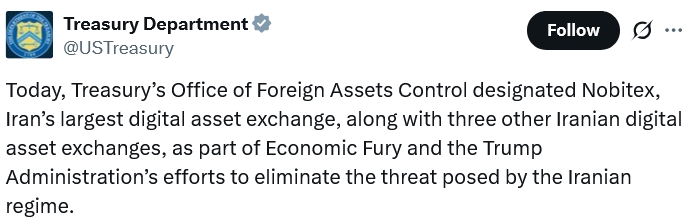
The US Treasury has sanctioned four Iranian crypto exchanges, including the country’s largest, Nobitex, marking the latest effort in its campaign called “Economic Fury” that aims to cut Iran off from the financial system.
The Treasury said on Tuesday that it added crypto exchanges Wallex, Bitpin and Ramzinex to the Office of Foreign Assets Control’s sanction list, prohibiting US businesses and persons from providing services to those platforms.
“While Iran’s economy is in free fall, the regime has chosen to co-opt digital asset technologies for its own corrupt agenda, including evading sanctions and transferring wealth out of the country,” said Treasury Secretary Scott Bessent.
The Treasury’s efforts to cut financial networks from Iran are at the center of its “Economic Fury” campaign, which commenced on April 14, months into the Iran war that kicked off with joint US-Israeli strikes on the country in February.
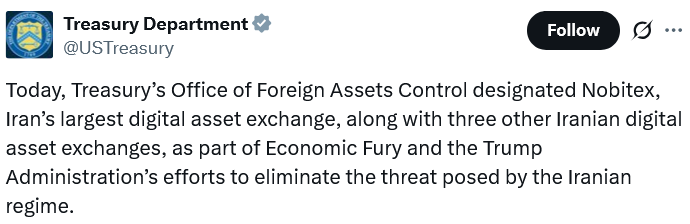
Source: Treasury Department
The US has repeatedly struck Iran amid efforts to reach a ceasefire agreement and resolve a dispute over the Strait of Hormuz, a vital shipping lane that transits about one-fifth of the world’s oil.
One of the top priorities for Treasury is to end Iran’s nuclear programme, Bessent said.
“As promised, Treasury will continue to follow the money in support of Economic Fury, whether it is through the banking system or through digital assets, to prevent the regime from developing a nuclear weapon.”
The latest sanctions come four days after Bessent revealed that the Treasury had seized nearly $1 billion in crypto from Iranian crypto exchanges and wallets since the Iran war began.
Nobitex the centerpiece of Iran’s “digital dollar pipeline”
The Treasury said Nobitex, Iran’s largest crypto exchange, has continued to facilitate payments for the Islamic Revolutionary Guard Corps and other sanctioned entities.
On Tuesday, blockchain forensics platform Chainalysis said that Nobitex is at the center of Iran’s “digital dollar pipeline,” and that it handles about 50% of the country’s crypto trading volume.
Related: US Senate advances resolution to curb Trump’s Iran war powers
The Treasury claimed that Nobitex has contributed to the repression of the Iranian people by facilitating state-linked surveillance of civilians.
Nobitex’s CEO, Seyed Ali Khoee, and chairman Amir Hossein Rad were also added to OFAC’s sanction list.
The Treasury said it has cut off “tens of billions of dollars” worth of funding channels from otherwise being accessible to the Iranian regime and its proxies.
That includes action taken against alleged shadow bank networks, as well as foreign officials and companies seeking to support Iran’s oil trade and military activities.
Magazine: Should users be allowed to bet on war and death in prediction markets?
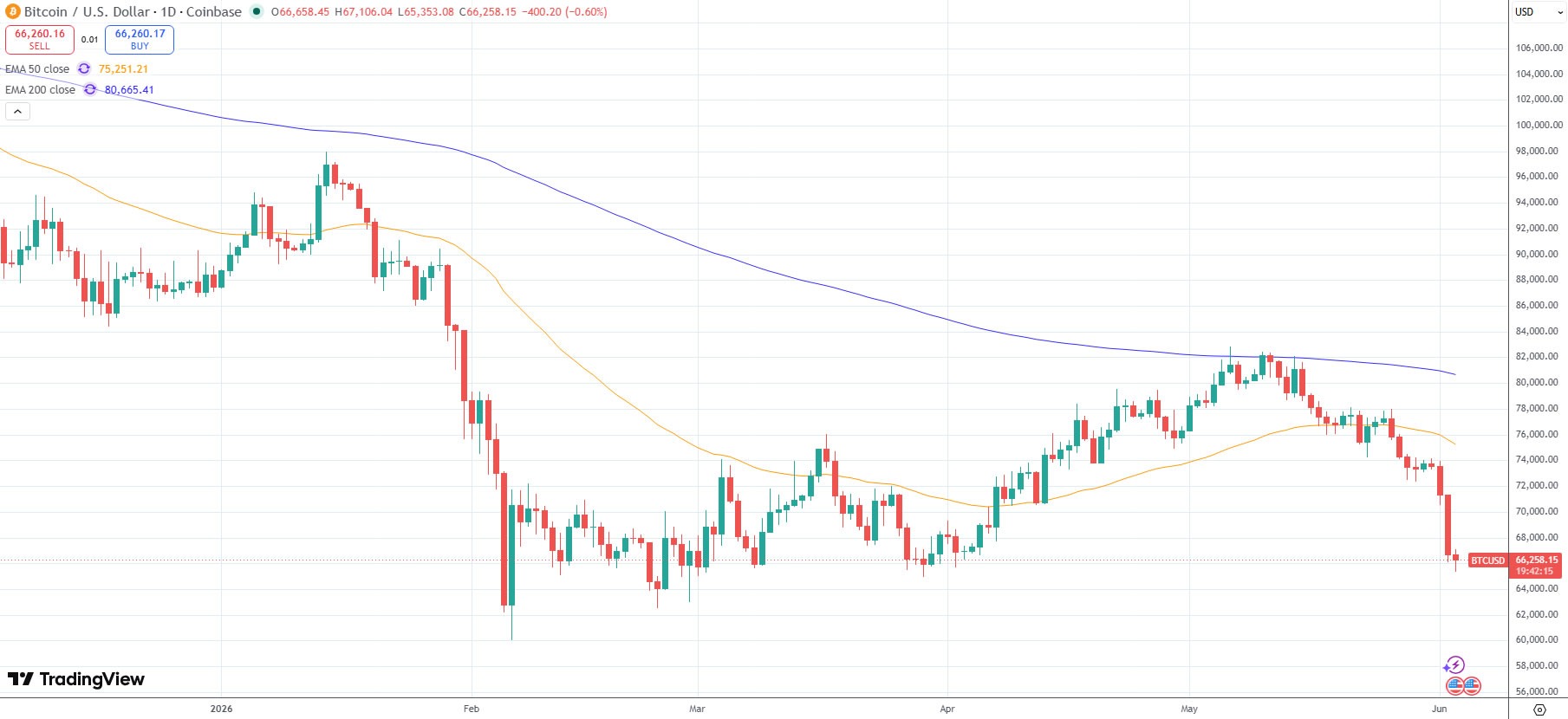
Bitcoin prices have dropped 7% on the day, breaking key support to a nine-week low after the US and Iran launched fresh strikes as talks over a possible ceasefire have stalled.
Bitcoin (BTC) fell to $65,385 on Coinbase in early trading on Wednesday, its lowest level since late March, according to TradingView.
The slump follows the largest daily fall since Feb. 5 as BTC shed more than $4,500 on Tuesday.
According to CoinGlass data, around 277,000 traders have been liquidated over the past 24 hours, with total liquidations of around $1.83 billion. More than 90% of them were long positions, primarily in Bitcoin and Ether (ETH).
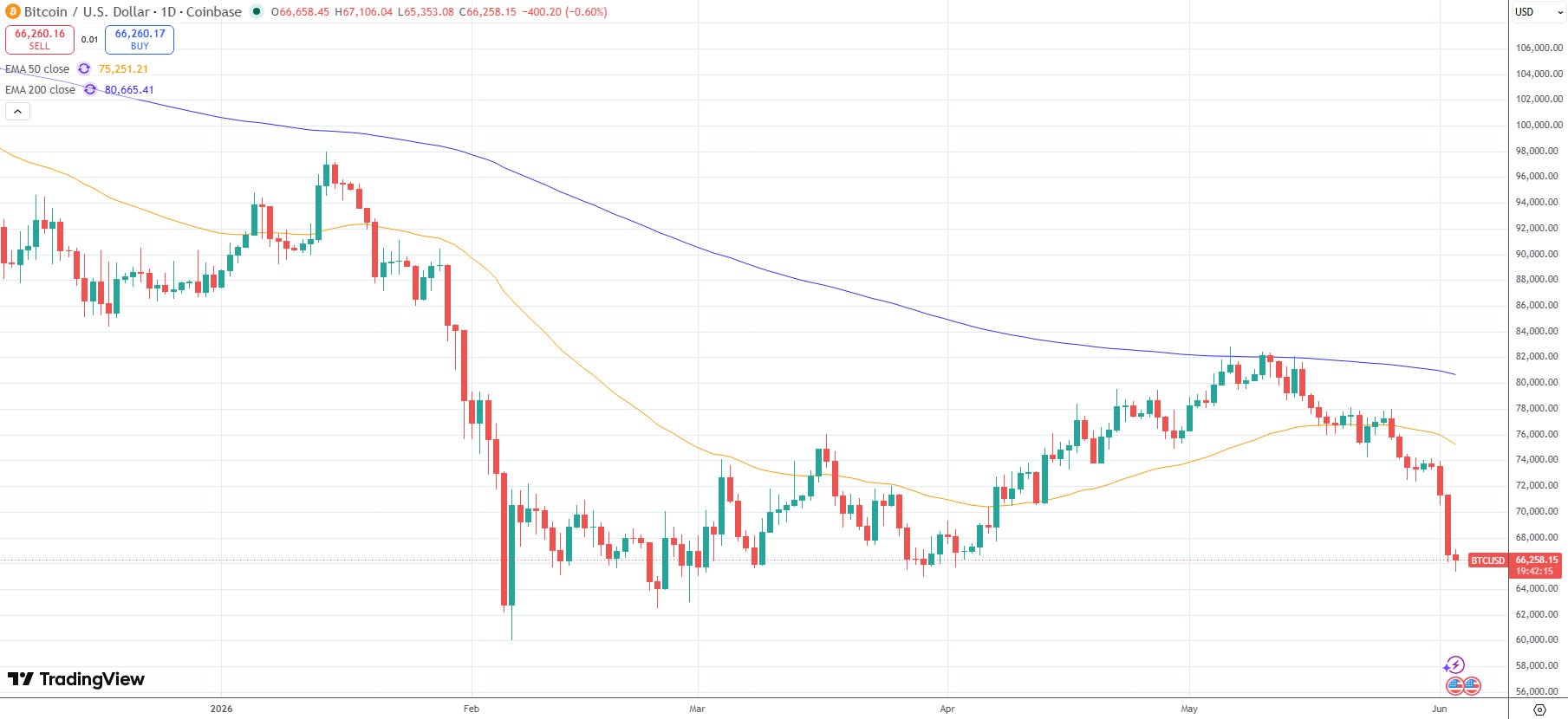
Bitcoin has fallen below $66,000 in the most significant single-day drop since February. Source: TradingView
Andri Fauzan Adziima, the research lead at Bitrue Research Institute, told Cointelegraph that Bitcoin’s current drop is more about “leveraged liquidations, heavy ETF outflows, and technical breakdowns than pure Iran news, but it amplifies the fear.”
Adziima said he expected “choppy consolidation,” as real support sits lower around $64,000 to $65,000, “with any de-escalation or strong macro rebound potentially sparking a sharp relief rally.”
The $150 billion crypto market capitalization exodus came as the US continued its military strikes against what it called “aggressive Iranian behavior.”
US Central Command stated on Tuesday that it had successfully defeated multiple Iranian ballistic missiles and drones, and “conducted self-defense strikes” on Qeshm Island in response to attempted attacks by Iran across the Middle East.
“Iran launched several ballistic missiles toward regional neighbors; however, all failed to hit their intended targets,” CENTCOM said. Two Iranian missiles were fired at Kuwait, and three missiles were launched at Bahrain, it added.
Related: Crypto turns ‘contrarian bet’ as AI stocks draw investor attention: Bitwise
The latest skirmish comes amid a two-month ceasefire between the US and Iran, which has included indirect talks on extending the ceasefire and lifting a blockade of the Strait of Hormuz. However, negotiations have yet to yield an agreement.
President Donald Trump claimed on Truth Social on Tuesday that “reports that the Islamic Republic of Iran, and the USA, stopped speaking a few days ago are false and erroneous.”
“The conversations between us have been going on continuously, including four days ago, three days ago, two days ago, one day ago, and today,” he said.
The comments came after Iran’s Tasnim news agency reported on Tuesday that the country would halt all conversations with the US until Israel ceased attacking Lebanon.
Magazine: Big Questions: Do we really only need 2–5 cryptocurrencies?

[PRESS RELEASE – Cayman Islands, British Overseas Territories, June 3rd, 2026]
Gate has announced a strategic partnership with Alpaca to expand access to real stock trading for eligible users. The collaboration marks another milestone in Gate’s ongoing effort to bridge digital assets and traditional financial markets through a unified multi-asset trading experience.
Through this upcoming launch, Gate users will gain access to more than 10,000 stocks and ETFs across major U.S. securities markets, including the New York Stock Exchange (NYSE) and Nasdaq. It will support fractional share trading with a minimum purchase of $1. Leveraging Gate’s unified account system, users will be able to use USDT to trade stocks and ETFs, creating a more seamless connection between digital assets and traditional financial markets.
Expanding Access to Traditional Financial Markets
Founded in 2013, Gate has grown into one of the world’s leading cryptocurrency and integrated financial services platforms, serving more than 54 million users globally. The upcoming launch of stock trading reflects Gate’s long-term strategy to build a unified, multi-asset platform that connects digital assets and traditional financial markets.
Traditionally, accessing global equity markets often requires investors to open separate brokerage accounts, complete lengthy onboarding procedures, and manage capital across multiple platforms.
To address these challenges, Gate has expanded beyond its core digital asset offering to build a more comprehensive financial ecosystem. The upcoming launch of its stock trading services represents a significant step toward creating a unified environment where users can access multiple asset classes through a single platform and account structure.
Gate’s stock offering will provide access to real stock and ETF trading via regulated market infrastructure, enabling users to participate in traditional financial markets within a familiar crypto-native experience.
Powered by Alpaca’s Brokerage Infrastructure
Gate selected Alpaca as its infrastructure partner for its regulated, self-clearing brokerage framework, API-first architecture, and extensive experience supporting financial platforms globally. As the clearing broker partner, Alpaca will handle the execution, clearing, settlement and custody for orders, as well as handling dividend payments and corporate actions.
The integration enables Gate to efficiently expand its stock trading capabilities while maintaining a seamless user experience. By leveraging Alpaca’s brokerage infrastructure, Gate can provide eligible users with access to a broad range of U.S.-listed stocks and ETFs while continuing to strengthen its position as a multi-asset trading platform.
A Shared Vision for Financial Accessibility
“The future of finance is becoming increasingly interconnected. As the boundaries between digital assets and traditional financial markets continue to evolve, users are looking for more efficient ways to access a broader range of investment opportunities. Our partnership with Alpaca will help advance that vision by providing seamless access to real stock market investing while maintaining the simplicity and efficiency that users expect from a modern digital asset platform. We believe multi-asset access will play an increasingly important role in the next generation of global financial services,” said Dr. Han, Founder and CEO of Gate.
Yoshi Yokokawa, Co-Founder and CEO of Alpaca, commented: “At Alpaca, our mission is to open financial services to everyone on the planet through modern infrastructure. We are pleased to partner with Gate as it expands access to the U.S. stock market and continues building a more comprehensive financial ecosystem for users around the world. Together, we are helping create a more connected and efficient global investment experience.”
Advancing Gate’s Multi-Asset Strategy
The partnership with Alpaca aligns with Gate’s broader strategy to build a unified platform that connects digital assets with traditional financial markets. In addition to its upcoming support for trading across more than 10,000 stock assets, Gate continues to expand its TradFi offering across equities, indices, commodities, metals, and foreign exchange markets, providing users with broader opportunities for cross-market participation and portfolio diversification.
As the convergence between crypto and traditional finance accelerates, Gate remains focused on expanding market access, improving capital efficiency, and delivering a more seamless multi-asset investing experience for users worldwide.
About Gate
Gate, founded in 2013 by Dr. Han, is one of the world’s leading cryptocurrency and integrated financial services platforms. Serving over 54 million users globally, it supports trading across 4,700+ digital assets and 10,000+ stock assets, while fully covering TradFi trading services spanning metals, stocks, indices, forex, and commodities, providing users with a one-stop, multi-asset trading experience. As an industry benchmark, Gate was among the first platforms to implement 100% Proof of Reserves. Its ecosystem includes Gate Wallet, Gate Ventures, Gate for AI Agent, and a wide range of products and services.
For more information, users can visit: Website | X | Telegram | LinkedIn| Instagram | YouTube
About Alpaca
Alpaca is a US-headquartered, self-clearing broker-dealer and global leader in brokerage infrastructure APIs, powering access to traditional and on-chain asset classes. Today, Alpaca supports over 10 million brokerage accounts across hundreds of fintechs and institutions in more than 40 countries, backed by over $320 million in funding. For more information, users can visit alpaca.markets.
The post Gate Partners with Alpaca for Upcoming Real Stock Trading Access for Global Users appeared first on CryptoPotato.

The European Banking Authority and the New York State Department of Financial Services (NYDFS) have signed a memorandum of understanding to police cross-border stablecoin activities.
The EBA said on Tuesday that the deal is part of its duties under the Markets in Crypto-Assets (MiCA) Regulation and sets out principles and procedures for exchanging information and coordinating stablecoin supervisory activities, market trends, and risks between New York and the European Union.
NYDFS said the deal would “enhance the supervision of entities engaged in stablecoin activities, identify market trends and risks, and promote the integrity of the stablecoin market.”
Banks and major financial institutions in the US and Europe have tested using stablecoins for payments, spurred on by laws regulating the tokens in the US and EU. The global stablecoin market has grown to more than $319 billion as of Wednesday, according to DefiLlama.

Source: European Banking Authority
Some of the information the two watchdogs will share includes the issued stablecoin, total volume in circulation, the number of holders, results of external and internal audits and the regulatory standing of specific products and services.
The MOU also provides a framework for the two regulators to assist each other and coordinate efforts during crises or emergencies. However, only supervised entities’ stablecoin-related activities will be monitored, not all activities a company might conduct.
Related: ‘Stablecoins’ are an outdated term from crypto’s early years: A16z
US President Donald Trump signed stablecoin regulations into law in July, while the European Union’s Markets in Crypto-Assets framework came into effect toward the end of 2024. US dollar-denominated stablecoins currently make up the lion’s share of activity in the sector, with Tether’s USDT and Circle’s USDC the two largest by market capitalization.
Jimmy Xue, co-founder of quantitative yield protocol Axis, told Cointelegraph in January that the global stablecoin market has largely plateaued after rapid expansion, entering a consolidation phase as new regulation, liquidity constraints, and higher real-world yields weigh on new issuance.
Xue added that a cautious macroeconomic environment, combined with competitive Treasury yields, further reduced appetite for rapid stablecoin expansion.
Magazine: Big Questions: Do we really only need 2–5 cryptocurrencies?


The future of asset management is shifting on-chain, but the transition is exposing a major structural conflict over traditional corporate revenue.
Speaking on a panel at the Proof of Talk summit in Paris, Jenny Johnson, CEO of Franklin Templeton, a $1.74 trillion asset manager, openly addressed the industry hesitation to deploy decentralized networks. According to Johnson, major financial firms are dragging their feet because public blockchain architecture directly challenges their existing profitability.
“This technology threatens a huge number of business models that exist today in traditional finance,” Johnson stated bluntly. “If you see any kind of hesitation, it’s because there is a threat to the business model. Think about the toll-takers in a transaction.”
She explained that if a blockchain can handle settlement instantly via a smart contract, large banks can no longer collect transaction fees as third-party intermediaries.
While crypto-native networks favor open architecture, traditional financial systems are beginning to migrate to public networks due to the significant transaction efficiencies. To demonstrate the cost savings, Johnson cited Franklin Templeton’s history running its tokenized money market fund, Benji, on public networks.
“It was so dramatically cheaper,” Johnson explained, breaking down the internal data. “It cost us about $1.30 a transaction for 50,000 transactions on the old system. And it cost us about $1.13 to run on the Stellar blockchain.”
Johnson’s mention of Benji comes just hours after the Wall Street giant announced it is expanding its digital asset strategy through a new partnership with MoonPay that will allow institutional investors to move between stablecoins and the asset manager’s tokenized money market fund through an onchain workflow.
“In everyday life, anybody—individual, medium, or large enterprise—we want to have a trusted party,” Johnson noted. “We don’t want to keep our assets in our private wallets, in our safes at home. We want to delegate this peace of mind to a third party. And that’s why custodians or banks still have a future.”
The shift of institutional wealth into digital assets will depend entirely on building standard, low-cost compliance rails for legacy investment funds. While Blockstream CEO Adam Back pointed out that bitcoin allows users to maintain true fiscal privacy without an institutional partner, Johnson concluded that standard investors will continue to demand a heavily regulated custody layer.
Blockchain Association has rallied support from 160 former national security and law enforcement officials for the CLARITY Act as the crypto market structure bill awaits consideration by the full U.S. Senate.
Summary
- A Blockchain Association letter backed by 160 former national security and law enforcement officials has urged the Senate to pass the CLARITY Act.
- Supporters said the bill would expand anti-money laundering, sanctions compliance, and information sharing tools across the digital asset sector.
- The CLARITY Act is currently awaiting a full Senate vote after advancing through the Senate Banking Committee.
According to a letter sent Tuesday by the Blockchain Association to Senate Majority Leader John Thune and Senate Democratic Leader Charles Schumer, former officials from national security and law enforcement backgrounds urged lawmakers to approve the legislation, arguing that it would strengthen oversight of digital asset markets rather than weaken it.
“The United States has long led the world by pairing innovation with the rule of law. The Clarity Act advances that tradition. It strengthens American competitiveness, protects American consumers, supports American law enforcement, and reinforces America’s role as the global standard-setter for financial integrity and technological leadership.
We urge the Senate to advance the Clarity Act and to support a framework that strengthens both law enforcement capabilities and our national security.”
– Excerpt from the Blockchain Association letter.
The group said the CLARITY Act contains provisions that expand law enforcement tools and financial crime prevention measures across the crypto sector. In the letter, signatories argued that the legislation would improve investigators’ ability to track illicit activity while bringing more digital asset activity under U.S. regulatory supervision.
Support for the bill comes as lawmakers continue debating the measure’s final form. Discussions in Congress have included whether ethics restrictions should be added to limit elected officials’ participation in crypto-related business ventures, an issue that has drawn attention because of President Donald Trump’s digital asset interests.
Former officials back enforcement provisions
Within the letter, the officials highlighted several sections they believe would strengthen compliance and enforcement efforts, including expanded obligations tied to the Bank Secrecy Act and U.S. sanctions rules, along with Treasury Department-led information sharing between government agencies and private sector participants.
The proposal would also establish a permanent interagency working group dedicated to crypto-related illicit finance investigations, according to the letter.
Describing the bill as an enforcement measure rather than a rollback of oversight, the signatories wrote that the provisions are intended to improve compliance, accountability, coordination, and visibility throughout digital asset markets.
Separately, the Blockchain Association said it plans to increase its advocacy efforts in Washington. The organization is preparing meetings across 18 Senate offices and will host a virtual town hall on Thursday focused on the bill’s law enforcement and national security implications.
Scheduled participants include Senator Cynthia Lummis, Representative Tom Emmer, and Patrick Witt, executive director of the White House President’s Council of Advisors for Digital Assets.
The Blockchain Association has remained active on several policy issues in Washington this year. In April, the group’s executive vice president of legal and government relations, Ashok Pinto, urged the Federal Reserve to formally remove “reputation risk” from bank supervision rules, arguing that the standard had contributed to debanking concerns affecting crypto firms and created uncertainty for regulated businesses.
CLARITY Act advances toward Senate debate
Momentum around the legislation has increased since the Senate Banking Committee approved the CLARITY Act in a 15-9 bipartisan vote in May. As previously reported by crypto.news, the bill has since been placed on the Senate Legislative Calendar, making it eligible for floor consideration once Senate leadership schedules debate.
Senator Lummis has previously said the legislation could help settle the long-running jurisdictional dispute between the SEC and CFTC over digital asset oversight. Coinbase has also described the bill as nearing completion, while institutional investors have already begun trading on its prospects through prediction market contracts facilitated by Galaxy Digital.
Key Takeaways
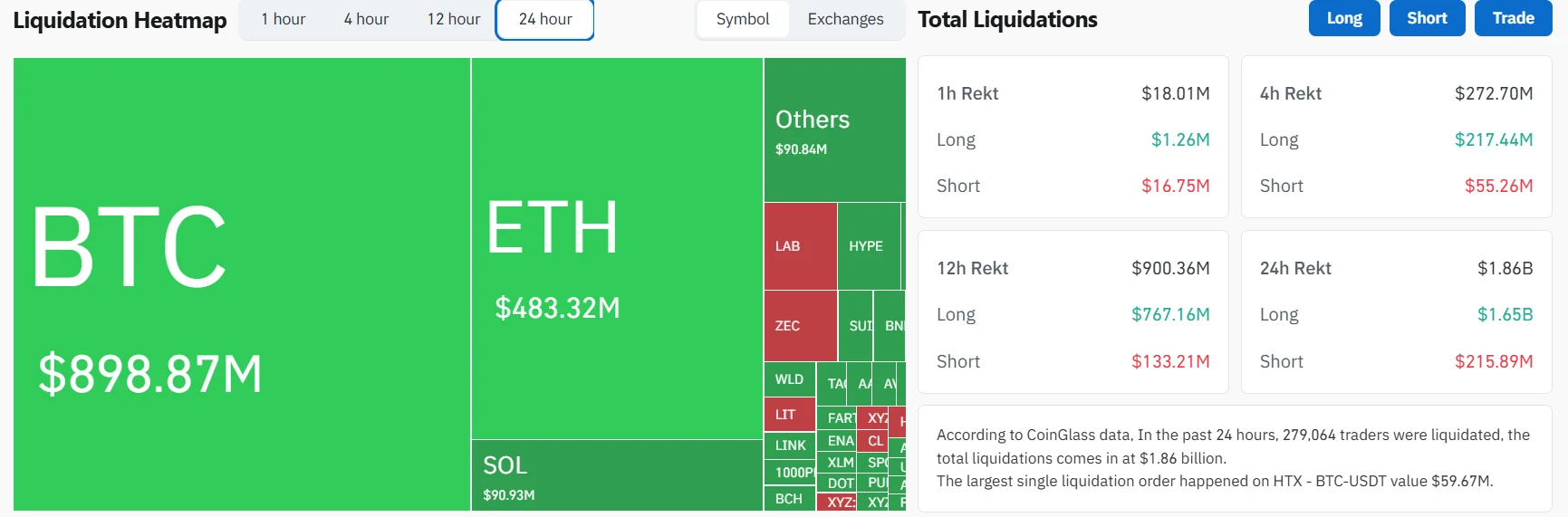
- Approximately $1.84 billion worth of leveraged cryptocurrency positions were liquidated within a 24-hour period — marking the most severe liquidation event since February 5
- Bullish bets suffered catastrophic losses, with $1.66 billion in long positions eliminated compared to only $180 million in short positions
- Bitcoin long traders faced $883 million in liquidations, including one massive $59.67 million BTC-USDT position closed on HTX exchange
- Escalating U.S.-Iran geopolitical tensions and surging crude oil prices triggered the mass exodus from risk assets
- Institutional Bitcoin ETF products witnessed $3.5 billion in capital flight across the past 10 trading sessions, compounding market pressure
Digital asset markets experienced their most devastating liquidation cascade since early February, erasing nearly $1.84 billion in leveraged trading positions within a single 24-hour window. Bitcoin crashed through the $66,000 support level while Ethereum collapsed beneath $1,900 as panic selling intensified.
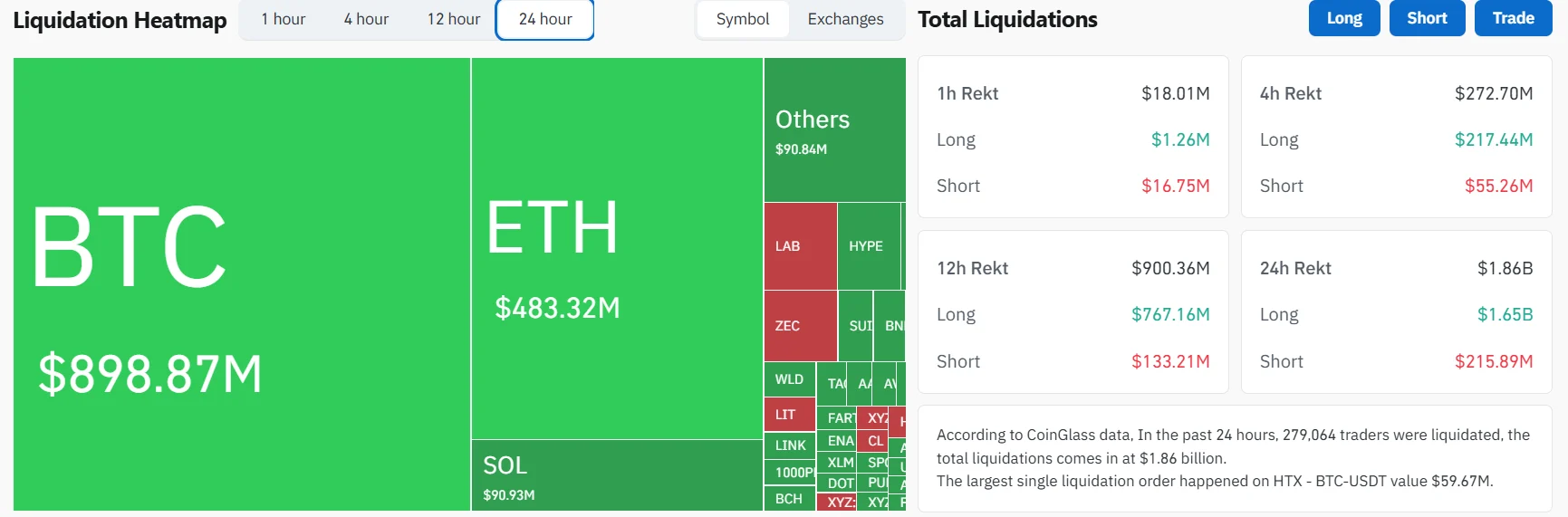
Bullish traders absorbed virtually the entire impact of the liquidation event. Out of total liquidations, long positions accounted for $1.66 billion, whereas short positions represented a mere $180 million, based on analytics from CoinGlass.
Bitcoin bulls experienced the heaviest casualties with $883.66 million in liquidated longs. Ethereum long positions contributed $475.73 million to the carnage, while Solana longs added $91.18 million. Additional losses were distributed across numerous altcoins including Dogecoin, BNB, and various other tokens.
The most substantial individual liquidation involved a $59.67 million Bitcoin-USDT long trade on the HTX platform.
Exchange Breakdown of Liquidation Activity
Binance dominated liquidation volume, processing $748 million — representing approximately 41% of total liquidations — with 89% consisting of long positions. Hyperliquid facilitated $314 million in liquidations, with longs comprising 94% of the total. Bybit recorded $247 million with 93% attributed to long positions.
Over 224,500 individual market participants faced liquidation during this turbulent period.
Paradoxically, Bitcoin open interest expanded during the downturn. It increased from approximately 759,000 BTC to 788,600 BTC even as valuations declined. When open interest rises while prices fall, it typically indicates fresh short positions entering the market, signaling growing bearish sentiment.
Retail sentiment across major trading platforms remains predominantly bullish. Binance displays a long-to-short ratio of 2.22. OKX shows 2.01, while Bybit registers 1.58. However, whale-sized accounts on OKX have reversed course with a 0.54 ratio, which CoinGlass characterizes as “extremely bearish.”
Geopolitical Instability and Capital Flight from ETFs
The market downturn has been attributed to intensifying friction between the United States and Iran. Iran halted diplomatic discussions with the U.S. and issued threats to block the Strait of Hormuz, a critical chokepoint for global petroleum shipments. Brent crude prices climbed to $93.89 per barrel, representing a 1.88% increase.
Elevated oil prices combined with geopolitical uncertainty drove capital toward traditional safe-haven assets such as cash reserves and gold, draining liquidity from cryptocurrency markets.
Bitcoin ETF products intensified the downward pressure. These investment vehicles experienced $3.5 billion in net outflows throughout the previous 10 trading days. A $14 million Bitcoin transfer executed by Tether further amplified market anxiety and accelerated selling momentum.
Based on current market prices, Bitcoin has declined approximately 12% over the weekly timeframe. Ethereum has fallen roughly 5.38% to trade at $1,894. XRP decreased 6.43% to $1.21, Solana tumbled 7.54% to $74.92, and Dogecoin slipped 7.05% to $0.093.
Market participants are closely monitoring the critical $65,000 support zone. A decisive breakdown below this threshold could trigger additional selling toward the $60,000 level.

Fundamental backdrop
In April, US inflation stood at 3.8% year-on-year — the highest level since May 2023. A significant contribution came from rising fuel prices amid escalating tensions in the Middle East. Market reaction was somewhat paradoxical: instead of inflows into safe-haven assets, the strong CPI print triggered a reassessment of Federal Reserve monetary policy. Expectations of a possible rate hike by the end of the year appear to have strengthened the US dollar and weighed on gold.
By the end of May, the precious metal had lost more than 4% and is currently trading roughly 20% below its January record high. Markets are now awaiting labour market data and comments from Federal Reserve officials as key guidance for the next reassessment of monetary expectations.
Technical picture
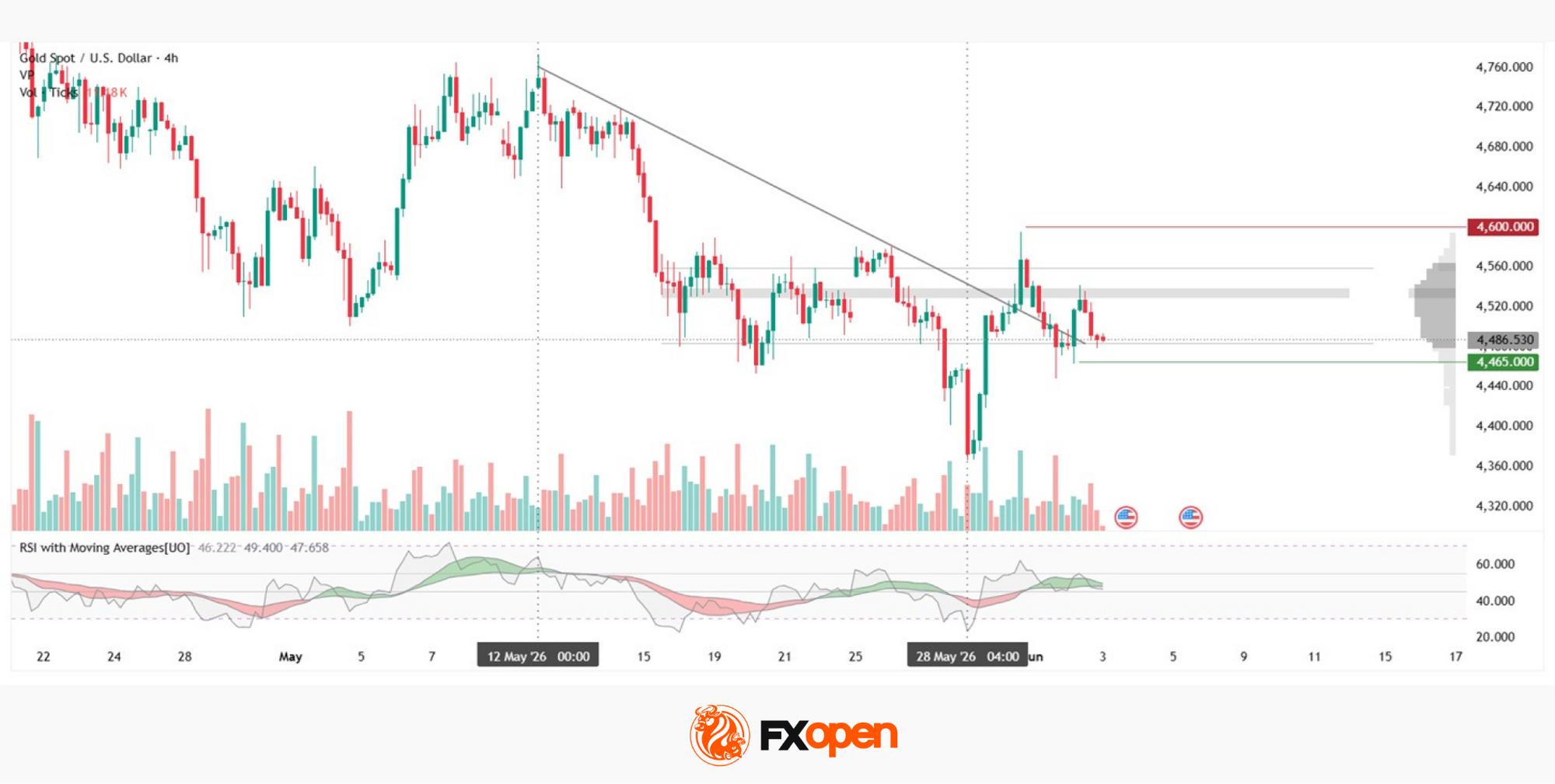
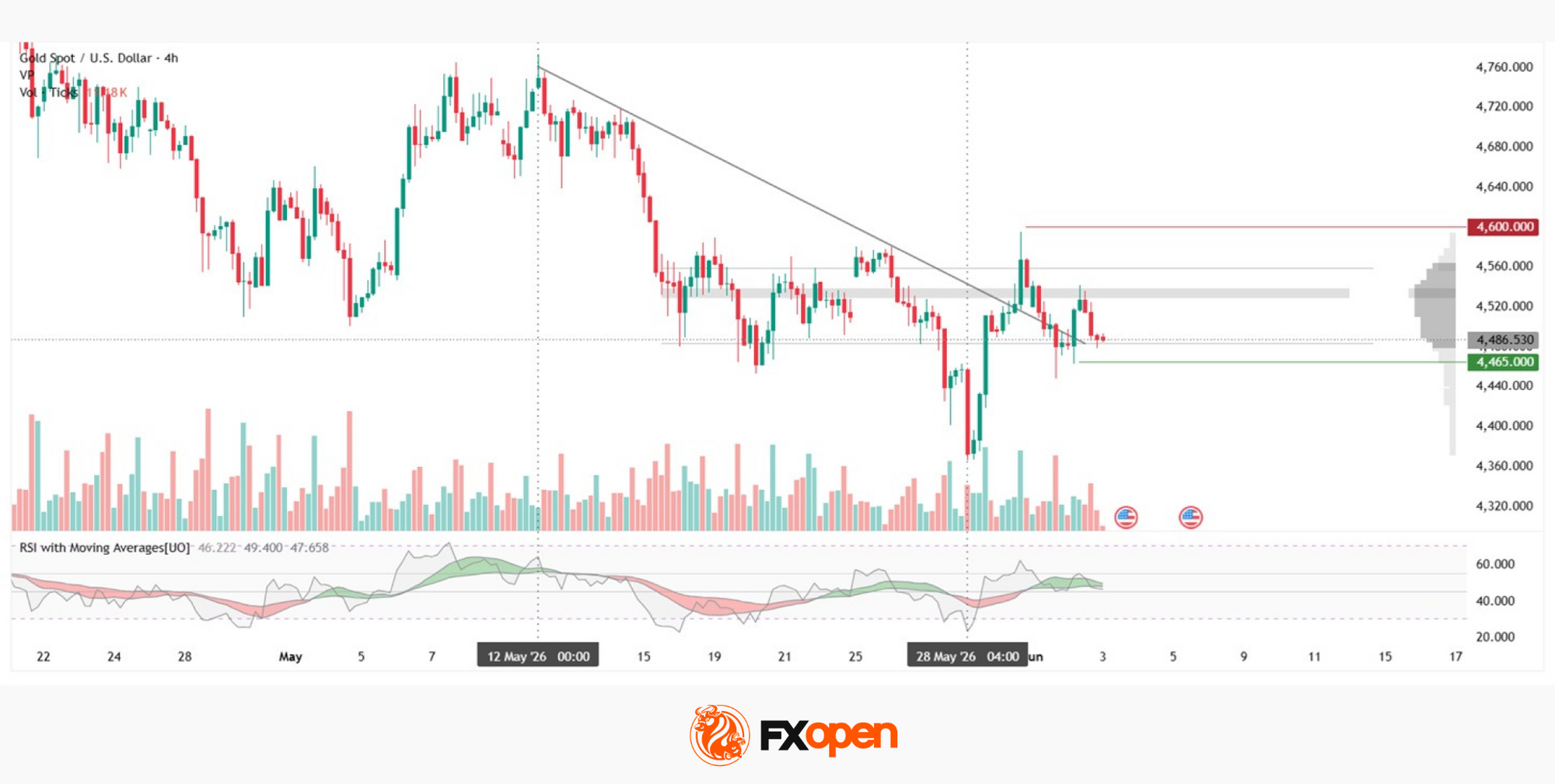
On the four-hour chart of Gold (XAUUSD on FXOpen), a short-term bearish trend can be identified: starting on 12 May and ending in a phase of acceleration on 28 May. The trendline is drawn across consecutively lower highs and is clearly defined. Following the 28 May impulse, price reversed sharply and attempted to break above the trendline. However, it has not yet managed to hold above it — the move may be viewed as an incomplete retest of trend strength, with the final outcome still undecided.
The horizontal volume profile defines the current working range, with the upper boundary located around 4,560 and the lower boundary at 4,485. The point of control (POC) is concentrated between 4,533 and 4,535. At present, price is testing the lower boundary of the profile — if this support is lost, attention could shift towards the 4,465 area, where a key support level is located. The 4,600 area could also attract interest if the upward move continues.
RSI + MAs shows readings of 46, 49 and 47 — the oscillator remains in neutral territory but is poised for a potential new impulse.
Key takeaways
Further gold price dynamics will largely depend on US labour market data and Federal Reserve rhetoric: confirmation of expectations for higher rates could increase pressure on the asset. The technical picture remains mixed — the attempted breakout above the descending trendline has not been confirmed, while RSI does not provide a clear directional advantage for either side.
Start trading commodity CFDs with tight spreads (additional fees may apply). Open your trading account now or learn more about trading commodity CFDs with FXOpen.
This article represents the opinion of the Companies operating under the FXOpen brand only. It is not to be construed as an offer, solicitation, or recommendation with respect to products and services provided by the Companies operating under the FXOpen brand, nor is it to be considered financial advice.
Crypto traders hoping the market would catch up to the global stock rally were left nursing tears on Wednesday as a sharp price drop triggered the largest liquidation event since early February.
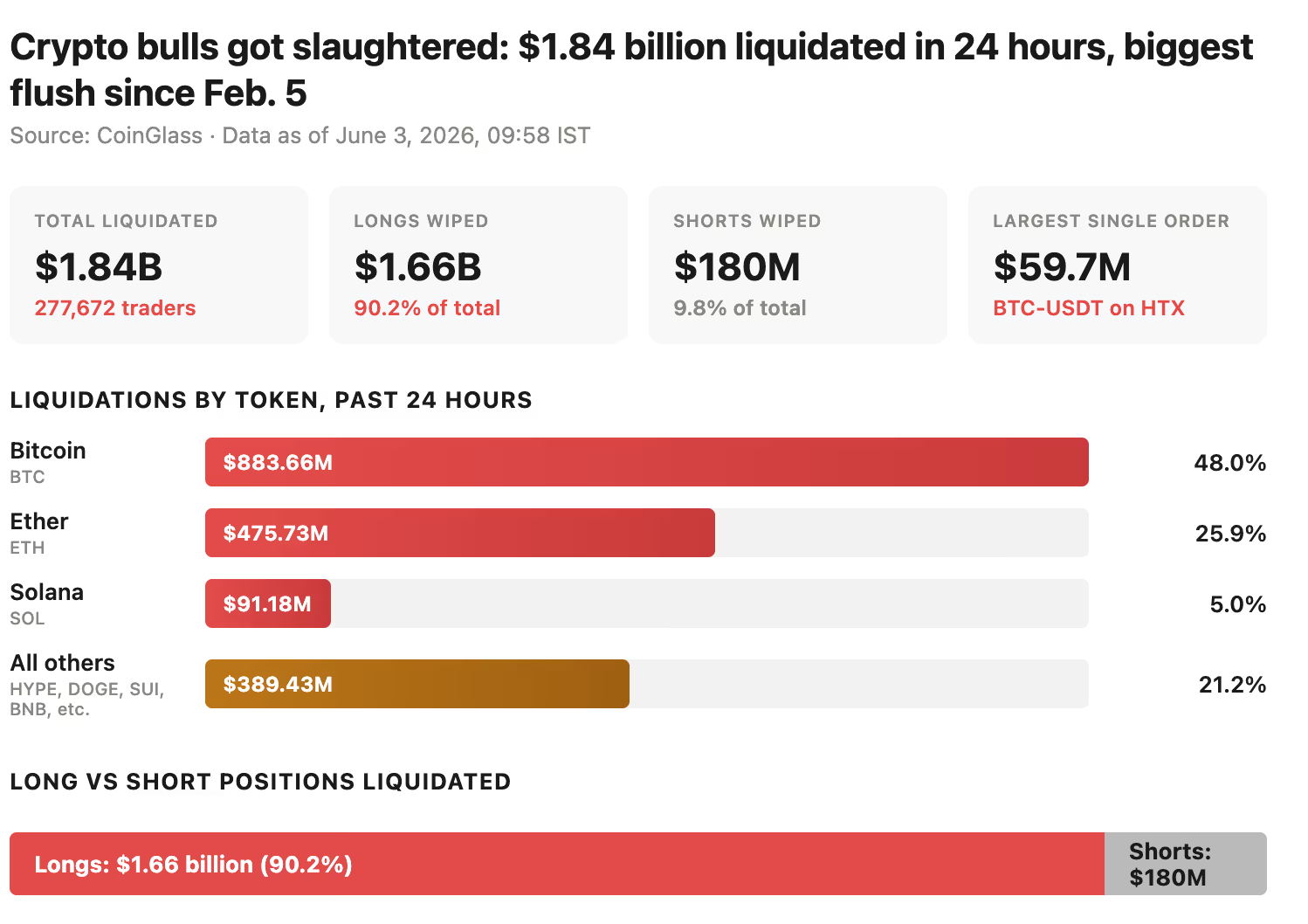
Roughly $1.84 billion in crypto leveraged positions were liquidated across the past 24 hours as bitcoin plunged below $66,000 and ether (ETH) broke under $1,900, the largest single-day wipeout since February 5 and a near-pure flush of long bets, with longs taking $1.66 billion of the total and shorts only $180 million, per CoinGlass data.
A liquidation is when an exchange automatically closes a leveraged trade because the trader’s losses have exceeded the collateral they posted to open it. Long positions bet that the price will rise, while short positions are bets on prices falling.
Bitcoin longs absorbed $883.66 million of the damage, ether longs another $475.73 million and solana (SOL) longs $91.18 million, with the remaining roughly $390 million spread across HYPE, DOGE, SUI, BNB, NEAR, AAVE, LINK and the broader top-30 long book.
The single largest order was a $59.67 million BTC-USDT long unwinding on HTX.

Binance accounted for $748 million of the total liquidations, or roughly 41% of the cascade, with 89% of those positions long. Hyperliquid handled $314 million, of which 94% were longs, and Bybit logged $247 million with 93% longs.
Meanwhile, Bitcoin open interest, the total value of all unsettled leveraged futures contracts, actually rose during the cascade.
The contract count climbed from roughly 759,000 BTC to 788,600 BTC even as the long book was being wiped out, per CoinGlass data. Rising open interest into a falling price can indicate new short positions are opening rather than long positions closing, signaling that fresh bearish bets are building on top of the long flush rather than the cascade finding a clearing level.
The positioning split is uneven across trader types. Retail bitcoin traders on Binance, OKX and Bybit are still leaning long at ratios of 2.22, 2.01 and 1.58 respectively, refusing to capitulate even after the wipeout, while whale accounts on OKX have flipped to a 0.54 long-short ratio that CoinGlass flags as ‘extremely bearish.’
Aggregate taker volume across the period showed $65.39 billion in sells against $60.16 billion in buys, with sellers as the marginal actors.
OI rising into a falling price, retail still leaning long, and whale accounts flipping short on OKX all point to a market that has not found a clearing level. A break below $65,000 brings $60,000 into play; a hold opens the door to a relief bounce, but the positioning data argues against the bounce being the more likely outcome.


The legacy financial and digital frameworks propping up the current internet architecture face an imminent, existential crisis.
Evin McMullen, co-founder and CEO of Billions Network, told CoinDesk in an interview during the Proof of Talk conference in Paris that tech giants and global telcos are actively scrambling to deal with an impending collapse of their primary revenue engine: display advertising.
As autonomous AI agents replace human-driven semantic search, the traditional system of monetizing user eyeballs breaks down completely, she added.
“They are terrified—existentially threatened,” McMullen said bluntly, describing the internal reaction of media and telecommunications conglomerates approaching her firm. “AI agents don’t have eyes.
They are not swayed by the visual decoration on the edges of the main body of information that they seek. The interest is less in finding new surfaces to place display ads on, and more of an existential question of how discovery happens. Are we inverting the internet?”
During Consensus in Miami 2026, Cardano Founder Charles Hoskinson mirrored similar thoughts to express how Big Tech feel about AI agents.
“Amazon, Google, Facebook, they’re terrified of the agentic revolution,” Hoskinson said, adding that they are investing heavily because “all of their business models are going to be disrupted.”
With the rise of AI agents, software can scrape a webpage, summarize content and keep the source user inside a chatbot or automated workflow instead of sending a person back to the original site.
Also at Consensus Miami, Cloudflare Chief Strategy Officer Stephanie Cohen said that shift is breaking the internet’s old business model, with non-human traffic now exceeding human engagement.
The core challenge facing the modern web isn’t the technical sophistication of machine intelligence, but a complete absence of programmatic accountability. McMullen pointed out that more than 51% of current online and onchain interactions are driven by unidentified, unaccountable automated bots.
Scaling On-Chain Infrastructure to Legacy Systems
Billions Network has quietly grown to support the third-largest on-chain agent population on the internet, trailing only Binance and Base. According to McMullen, the network’s open-source cryptographic libraries are already utilized by more than 9,000 corporate and sovereign developers worldwide.
In the corporate sector, Billions Network’s technology infrastructure is utilized by platforms like TikTok, the financial giant HSBC, and the decentralized tracking protocol DeBank. It also collaborates with India’s Ministry of Labor to secure credential access for national social security programs, alongside a deployment with the Indian Railway system that protects the digital identities of over 1.2 million personnel.

Explaining Basic Financial Concepts YOU Should Understand

Best Betting Sites UK 2026 | Top UK Bookmakers Reviewed

NHPC shares jump 5% as OFS worth Rs 4,300 crore opens for retail investors. Here’s all you need to know



-

 NewsBeat7 days ago
Israel says it has killed new Hamas military leader in Gaza City airstrikes
-

 News Videos5 days ago
This is BROKEN! INSANE 5x MONEY CAR WASH WEEK! The NEW GTA Online UPDATE Today! (GTA5 New Update)
-

 Tech5 days ago
Waymo dominates autonomous vehicle registrations as Tesla trails behind
-
 Tech4 days ago
SpaceX just won a second Golden Dome contract. This one is $4.16 billion.
-

 News Videos5 days ago
SHE IS KILLING XRP!!! WATCH URGENT AND ACT FAST
-
 NewsBeat4 days ago
FIRST NIGHT REVIEW: Take That bring the Circus back to life in spectacular sun-soaked style
-

 Business1 day ago
Jade Biosciences, Inc. (JBIO) Discusses Positive Interim Results From JADE101 Phase I Healthy Volunteer Study and Development Plans Transcript
-

 Tech7 days ago
The Samsung pay deal is the moment Korean unions changed register
-
 Crypto World5 days ago
CFTC Has Approved the First Regulated Bitcoin Perpetual Contract in the U.S.
-
Crypto World7 days ago
SpaceX’s $2 Trillion IPO: Why Tech Giants Nvidia (NVDA), Apple (AAPL), and Microsoft (MSFT) May Face Pressure
-
 Entertainment7 days ago
The Most Misunderstood Sci-Fi Horror Movie of the Last 10 Years Just Took Over Netflix
-

 Business4 days ago
Is the Spurs Phenom Already Better Than Prime Diesel?
-
 NewsBeat5 days ago
Novak Djokovic v Joao Fonseca LIVE: French Open latest scores and results after Jannik Sinner’s shocking collapse
-
 Crypto World5 days ago
Snowflake (SNOW) Stock Rallies on Strong Q1 Results and AI Product Growth
-
 Entertainment4 days ago
Weak ‘Supergirl’ Box Office Tracking Amid Milly Alcock Backlash
-

 Business4 days ago
Demand Conditions Improve In Chemicals Sector In April 2026
-
 Crypto World4 days ago
MicroStrategy Moves $30 Million in BTC to Coinbase Prime: Is the Bitcoin Sell-Off Already Here?
-

 Politics4 days ago
The House | Inside Andy Burnham’s Makerfield Campaign: “Nobody Thinks This Is In The Bag”
-

 Tech5 days ago
This Week In Security: Ubiquiti Fixes, And FreeBSD Joins The Club You Don’t Want To Join
-

 Entertainment5 days ago
Maddox Jolie-Pitt Legally Requests to Drop Brad’s Surname
You must be logged in to post a comment Login