
Connect with us
DAPA Banner
DAPA Coin
DAPA
COIN PAYMENT ASSET
PRIVACY · BLOCKDAG · HOMOMORPHIC ENCRYPTION · RUST
ElGamal Encrypted MINE DAPA
🚫 GENESIS SOLD OUT
DAPAPAY COMING

NewsBeat

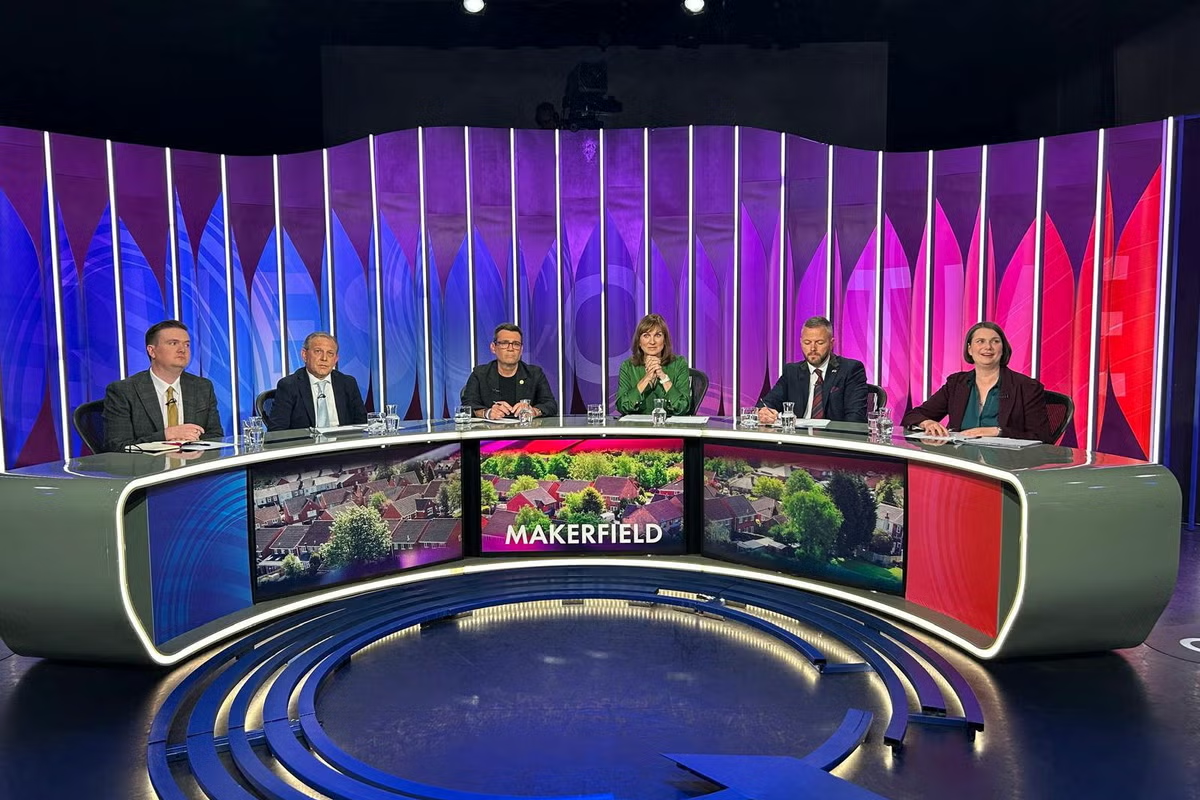
Who won the Makerfield by-election tv debate, Burnham or Kenyon? Plus, have your say

Published

on

Who won the Makerfield by-election tv debate, Burnham or Kenyon? Plus, have your say

John Rentoul, chief political commentator – “The cat’s out the bag … Andy is finally making this about No 10”

However hard the BBC and some of the panellists pretended, it was all about Andy Burnham. Some of it was about Burnham versus Robert Kenyon, the Reform candidate, as they competed to present themselves as Westminster outsiders – “normal people” in Kenyon’s phrase – wanting to go “down to London” to give Makerfield a fair deal.

Even that head-to-head was lop-sided, though, because of what Jake Austin, the Liberal Democratic candidate, said was the reason for the by-election, which is “about electing a prime minister by the back door”. Austin said this was “not the right way to be doing politics”, but what was interesting was that this divided the audience – some of them agreed, but most seemed to be quite happy to have their constituency used as a launch pad for the highest office.

Advertisement

Burnham himself dodged the question twice with his usual formula of wanting to take it to the “highest possible” level – if he is lucky enough to be elected – but then he cracked and said that Wes Streeting seems to have started a leadership contest already and “I would seek to join it”. His supporters in the audience cheered even as he tried to qualify it by saying he would have to persuade MPs to nominate him.

With that cat out of the bag, the two main candidates – the would-be prime minister and the plumber, the true outsider – could get on with discussing the main issue of the day, namely alleged two-tier policing. Kenyon went with public opinion, which thinks that the police are biased in favour of ethnic minorities, while Burnham went for the big tent, praising Michael Winstanley, the Conservative candidate, and Kemi Badenoch, his leader, for “speaking really well” on the subject.

In the end, Burnham came across as a regular guy, admitted he was ambitious and didn’t make any mistakes. That made him the winner.

‘ style=”border:0″>

Advertisement

Kate Devlin, Whitehall editor – “Both men appeared to be speaking to two different audiences”

The headlines from this encounter will be that Andy Burnham finally confirmed he will challenge Keir Starmer for the keys to No 10. He could hardly deny it, as the people of Makerfield weigh up whether to vote for the man who will potentially be the country’s next prime minister. He managed to walk a difficult line between focusing on local issues and a wider vision for Britain. He also managed to neatly answer some difficult questions.

In the wake of 18-year-old Henry Nowak’s death – the student was ignored by police officers when he told them he had been stabbed, and died while being arrested and handcuffed after his killer, Vickrum Digwa, 23, falsely claimed he had been the victim of a racist attack – he pointed to his relationship with the local police chief, who, he said, wanted to “make sure the police were seen as neutral, serving all communities, and therefore I backed him”. He also said there was a case to “look again” at the carrying of knives for religious reasons.

But he added “it needs a very careful debate”. Reform’s Robert Kenyon looked relaxed in his first outing on the national stage, but faced a difficult time from some members of the audience, including one who told him: “I’d rather have a career politician than a plumber who is a sexist”. While both men are battling for the same votes, in the same seat, they appeared to be speaking to two different audiences. Andy Burnham was the clear winner tonight, but it will count for nothing if he fails to win this by-election.

Advertisement

Sean O’Grady, associate editor – “Andy Burnham was unconvincing on ever level … poor old Makerfield”

For me the “Great Makerfield Debate” was all over when a plainly exasperated woman in the audience declared: “I’d rather have a career politician than a sexist plumber” for her next MP. Me too. And, to avoid the ultimate catastrophe of Reform UK and Nigel Farage regaining lost momentum, I’d vote for Andy Burnham. Reluctantly. He was unconvincing on every level, notably when he said he’d left Westminster in 2017 so he could work for the people as mayor of Greater Manchester. In reality it was because he saw no future for himself under Jeremy Corbyn. He was, is, and always will be a careerist – and should admit it.

As for Kenyon, he did at least disagree with Farage and condemned the violence in Southampton; but he couldn’t escape the wrath of Carol Vorderman. The nice Green candidate, Sarah Wakefield, told him Carol was watching at home and expecting an apology, and Kenyon looked like he’d dropped his best spanner down a U-bend. In the normal democracy we used to be, Micheal Winstanley (Tory) or Jake Austin (Lib Dem), both obviously decent folk, would walk this contest. But they’ll lose their deposits. Poor old Makerfield.

Source link

Advertisement
Continue Reading
Click to comment

You must be logged in to post a comment Login

Leave a Reply

NewsBeat

Conflict over identity politics could lead to civil war in the long term, Kemi Badenoch says

Published

on

Conflict over identity politics could lead to civil war in the long term, Kemi Badenoch says

Speaking to the BBC for the documentary before the sentencing of Nowak’s killer Vickrum Digwa, Badenoch said: “This is not a racist country. But now we are seeing more and more hostility to people of every ethnicity, whether they’re English or not English, because people are bringing political conflict into an area where we didn’t have political conflict.

Source link

Continue Reading

NewsBeat

Where peace talks between the US and Iran currently stand

Published

on

Where peace talks between the US and Iran currently stand

To understand where talks on ending the war between the US and Iran currently stand, all we can confidently assume is that Donald Trump’s pronouncements offer no guide. The US president said an agreement had been “largely negotiated” on May 23.

That proposal would have reopened the Strait of Hormuz in exchange for sanctions relief and the unfreezing of Iranian assets. But it would not have immediately extracted concessions on Iran’s nuclear activities and ballistic missile capabilities. In response to backlash from Republican hawks, Trump subsequently toughened the US position.

The following week, Trump again claimed he was “on the verge” of approving a peace deal and US officials started briefing that Iran had made critical concessions. Iranian officials denied reports they had accepted major concessions on uranium enrichment or the future of their nuclear programme.

Talks were then suspended on June 1 after Iran protested Israel’s offensive in Lebanon, and the US and Iran exchanged military strikes. Trump declared he “couldn’t care less” if the talks were over, but by the evening, was once again insisting negotiations were continuing “at a rapid pace”.

Advertisement

According to Iranian media, the current situation is that Iran is studying the latest US proposal but communications between the two countries are paused. The US and Iran have also traded military strikes in recent days. So why are the two sides seemingly unable to close the gap between their respective positions?

One obvious obstacle is the dysfunctional conditions under which negotiations are taking place. The simple act of communicating through intermediaries creates delays and complications. The fact that messages must then be considered by a reordered and fractured political system that is reluctant to use even basic communications technology for fear of revealing officials’ whereabouts adds another layer of complexity.

But even a more unified Iranian regime operating in peacetime would still have to contend with the message incoherence, unpredictability and unprofessionalism that masquerades as statesmanship in Washington. Iranian officials do not believe Trump has the attention span to negotiate a complex agreement, nor do they believe he can be relied upon to honour any agreement he signs.

In June 2025 and then again in February 2026, Iranian diplomats believed they were engaged in serious negotiations and were already working through the technical details of a potential agreement, only for US and Israeli military strikes to follow shortly afterwards.

Advertisement

This has important implications for the choreography of any deal to end the current hostilities. Iran wants Washington to make concessions – on sanctions relief, ending the US maritime blockade and unfreezing Iranian assets – first before it reciprocates. It also wants any agreement to be legally binding on future US administrations. The former is politically very difficult for Trump and the latter is constitutionally impossible.

Iranian fishermen steering a boat past ships stuck in the Strait of Hormuz off the coast of southern Iran on June 1.
Amirhossein Khorgooei / ISNA News Agency / EPA

Trump himself has made a very unconvincing case that he can force Iran to accept his maximalist demands. These include strict limits on Iran’s ballistic missile programme, an end to its support for proxy groups such as Hezbollah and Hamas and the dismantling of Tehran’s nuclear activities.

And yet he appears desperate to avoid signing a deal that could be compared to Barack Obama’s 2015 nuclear agreement with Iran (known as the Joint Comprehensive Plan of Action or JCPOA). Trump recklessly vandalised the JCPOA by withdrawing the US from the deal in 2018.

The JCPOA contained 159 pages of commitments and technical annexes. It took 20 months for a small army of diplomats and nuclear experts to negotiate. Currently, American diplomacy is being spearheaded by Trump’s son-in-law, Jared Kuschner, and a billionaire real estate magnate, Steve Witkoff. And Trump himself seems unsure on what would qualify as reasonable safeguards for preventing Iran from building a nuclear weapon.

Advertisement

At the same time, Iran’s enriched uranium is thought to be lying in highly hazardous gas form mostly buried under collapsed facilities bombed in the 12-day war of 2025. So the initial process of verifying how much enriched uranium Iran has poses a far greater technical challenge than it did in the lead up to the JCPOA. This in turn affects the negotiations because sanctions relief would be based on how much enriched uranium Iran ships out.

Iran’s strengthened hand

The US is also engaging in talks with greatly diminished leverage. By using military force against Iran, it has already played its ultimate coercive card. Both domestic and international opinion largely views the outcome as a failure.

Iran, by contrast, believes it has survived the conflict. It is now ruled by a generation of leaders shaped by the experiences of this war and by a renewed confidence that hard power and the strategic use of Iran’s geography can be used to reshape the regional order.

This has emboldened Iran to introduce demands that lay well beyond the scope of the JCPOA, most notably its insistence that any wider settlement addresses Israeli military operations against its ally Hezbollah in Lebanon.

Advertisement

It seems highly doubtful that a comprehensive deal can be reached that adheres to Trump’s proclaimed red lines. More realistically, though by no means assuredly, a deal may emerge that sees Iran reopen the Strait of Hormuz in return for financial incentives, with the other issues kicked into the long grass and postponed to an uncertain second phase of negotiations.

The lesson of this war is that the Gulf states will surely have much diminished faith in Washington’s ability to achieve a stable regional order. Its inability to contain Iran, prevent escalation or protect its allies from the consequences of its own failed military intervention is likely to accelerate efforts to build alternative security arrangements within the region.

Source link

Advertisement
Continue Reading

NewsBeat

Banned e-bike rider left boy injured in Thornaby street after crash

Published

on

Banned e-bike rider left boy injured in Thornaby street after crash

Christopher Taylor was banned from the roads when he smashed into the nine-year-old and made off, claiming to have panicked, Teesside Crown Court heard.

He then commented on a Facebook post showing CCTV of the incident in Thornaby saying he was “truly sorry” and would hand himself in, but failed to and two days later police found him hiding in a kitchen cupboard, trying to conceal himself behind a black bag.

Cainan Lonsdale, prosecuting, said, “thankfully” the boy “only” suffered scratches and abrasions to his back and a cut to the head which required three stitches. He underwent an X-ray but the scan revealed no further injury.

Although his family did not wish to provide a victim impact statement for the court, they did tell police their son had recovered well from treatment.

Advertisement

Mr Lonsdale said CCTV from the scene was shared on social media and the defendant was identified, so he posted a response on Facebook apologising, claiming to be “truly sorry”, pledging he would hand himself in to police.

Teesside Crown Court heard that as he fled Taylor shouted to the boy to get up, but other road users and passers-by in the street did go to his aid. Taylor was said to “to feel sick with shame.”

Despite his pledge to hand himself in, following the incident in Imperial Avenue on March 26, it was only two days later that he was arrested after officers went to his home address in Middlesbrough.

He claimed he had tried to swerve to avoid the boy, who it was accepted had not looked before starting to cross the road.

Advertisement

Mr Lonsdale said Taylor told police he “panicked” and rode off, stopping around the corner in a neighbouring street.

ChristopherTaylor, 34, starting an 18-month prison sentence after colliding into a boy on a pedal cycle and riding off on an illegal e-bike without going to his aid (Image: Cleveland Police)

He said he had intended to hand himself in but accepted the e-bike he was riding was not “road legal” and, therefore, he was uninsured.

Mr Lonsdale said it was estimated Taylor was travelling at between 15 to 20-mph at the time and did attempt to swerve to avoid the boy on the bike but he could not avoid the collision.

Taylor, 34, of Maple Avenue, Grove Hill, admitted careless driving, failing to stop after an accident and having no insurance.

Advertisement

The court heard his 17 previous offences included drink and drug driving, for which he received a 14-month prison sentence, suspended for 18 months, with a three-year driving ban, in November.

Jonathan Gittins, for Taylor, said, “he knows things could have been much worse”, regarding the boy’s injuries, for which he has expressed his shame and remorse, offering an apology to the victim and his family.

Mr Gittins said the defendant did intend to hand himself in, but, again, “panicked”, knowing he was in breach of a suspended prison sentence.

He said since being admitted to custody, at Holme House Prison, Stockton, awaiting sentence, it has been the defendant’s first taste of life behind bars.

Advertisement

Mr Gittins added that it was, “time he hasn’t wasted”, as he has remained “substance free”, with the help of the prison drug and alcohol service, and has been working in the wood mill, making furniture.

Judge Nathan Adams said that viewing the brief CCTV footage of the incident was among the most “distressing” clips he had seen, watching the boy being dragged along the road for several metres before, “being left in a heap”.

The judge told Taylor: “He was quite clearly in pain and distressed, yet you reacted as you did, riding off.”

Judge Adams said just the use of the bike was illegal and noted that Taylor had never held a driving licence.

Advertisement

He activated the 14-month suspended sentence, imposing a total term of 18 months.

Banning him from the roads for a further 42 months, the judge told Taylor: “You have got to realise you must stay off a mechanical vehicle of any kind.

“Otherwise, you will only find yourself serving longer and longer periods in prison.”

Advertisement

Source link

Continue Reading

NewsBeat

Why the electric SUV boom is a problem for climate, health and equity

Published

on

Why the electric SUV boom is a problem for climate, health and equity

Governments and car manufacturers sell electric cars as the future of green transport. But a less visible trend is challenging this story: many electric cars are getting bigger.

The International Energy Agency recently reported that larger models, including sports utility vehicles (SUVs), are taking up a major share of electric car markets.

In China, electric SUVs accounted for more than 60% of electric car sales in 2025. In Europe, SUVs accounted for almost 75% of electric models in 2025. In the US, the figure was even higher, at more than 85%.

SUV emissions are now so large that, if all SUVs were a country, they would be one of the world’s five biggest CO₂ emitters. The problem with SUVs is not only their tailpipe emissions. It is also their size, weight, cost and the way they reinforce car-dependent lifestyles.

Advertisement


À lire aussi :
Why surging sales of large electric vehicles raises environmental red flags


Electric SUVs may reduce tailpipe emissions compared with petrol and diesel SUVs, but they still need larger batteries, more raw materials, more energy and more road space than smaller electric cars. Their greater weight can also contribute to pollution from tyre, brake and road wear, including fine particulate matter linked to respiratory and cardiovascular diseases.

Larger vehicles can also make streets more dangerous, especially for children. A study using Great Britain crash data found that children aged 0-18 hit by SUVs, rather than passenger cars, had 77% higher odds of fatal injury. For children under nine, the odds were more than three times higher.

Advertisement

Switching diesel or petrol SUVs for electric SUVs isn’t the solution.
PV productions/Shutterstock

When roads are dominated by heavy privately owned cars, walking and cycling become less attractive, even for short everyday journeys. This matters because active travel (such as walking and cycling) is one of the easiest ways to build physical activity into daily life while producing little or no direct carbon emissions.

Car-dominated streets affect people unequally. Lower-income households are less likely to own new electric cars, but they still experience the traffic, danger, noise and pollution created by them. This is why the green transport transition needs to be judged by more than the number of electric cars sold. It should also be judged by whether it reduces car dependency and creates healthier, fairer streets.

Avoid, shift, improve

Our new research in the journal Energy Economics uses the avoid-shift-improve framework to assess transport decarbonisation. Avoid means reducing the need for unnecessary car journeys through measures such as teleworking, compact development, and better access to local services. Shift means moving remaining trips to lower-carbon, healthier modes such as walking, cycling, public transport, and bike and car sharing. Improve means making the vehicles that are still needed cleaner, lighter and more energy efficient, including through electrification.

This order matters. If policy jumps straight to improve, it can reduce emissions per mile while leaving the wider system unchanged. A city full of electric SUVs may have no exhaust emissions, but it can still suffer from congestion, road danger, inactive travel, unequal access, non-exhaust pollution and streets dominated by large private vehicles.

Advertisement

Too big to be green?

In our study, the proposed model uses registrations of SUVs as an undesirable indicator of transport decarbonisation. Their growth works against the move towards smaller, lighter and more energy-efficient cars. Larger, more expensive vehicles can deepen car dependence: once people have invested in a costly car, switching to non-car modes of transport can feel like a loss.

The SUV boom illustrates this. Larger vehicles are marketed as safer, more comfortable and more desirable. Advertising presents them as symbols of freedom, family protection and status, helping to make large cars appear normal and necessary even when smaller cars and better transport options could meet many everyday needs.

This conflicts with UK and EU climate goals, which prioritise reducing emissions, improving public health and making sustainable transport more accessible.

There are practical alternatives. Policy can support smaller, lighter and more affordable electric cars where cars are still needed. It can also make walking, cycling and public transport the easiest choices for everyday journeys. This means protected cycle lanes, safe pavements, reliable buses, lower traffic neighbourhoods, and road pricing that reflects the space, weight and pollution costs of larger vehicles.

Advertisement

These measures are not about blaming drivers. They are pro-health, pro-equity and pro-climate. Many people require cars, especially in rural and poorly connected areas. But the goal should be to reduce unnecessary car dependence, not to replace every petrol SUV with an electric SUV.

The future of transport should not only be electric. It should be lighter, healthier, more affordable and less car dependent.

Source link

Advertisement
Continue Reading

NewsBeat

‘I’m going’: Trump joining likes of Spike Lee and Timothee Chalamet at MSG for Knicks-Spurs Monday night and hints at Game 4

Published

on

‘I’m going’: Trump joining likes of Spike Lee and Timothee Chalamet at MSG for Knicks-Spurs Monday night and hints at Game 4

President Donald Trump has announced that he plans to attend the New York Knicks and San Antonio Spurs NBA finals game Monday night and may go to Game 4 as well.

The New York native will be at Madison Square Garden in Manhattan alongside a host of Knicks superfans, including the likes of filmmaker Spike Lee and actor Timothee Chalamet. Lee and Chalamet were among the celebrities who attended Game 1 in San Antonio Wednesday night, along with comedian Tracy Morgan and actor Ben Stiller.

When a reporter asked whether Trump would attend a finals game at MSG, he boasted about the Knicks and said he would be at the stadium to watch them.

“I’ve been a Knicks fan for a long time, and I’m also a Jim Dolan fan. He’s a nice guy,” Trump said from the Oval Office Thursday, referring to the owner of the Knicks.

Advertisement

“He’s been a long time wanting to win, and he’s a competitive guy, and he’s got a team that’s amazing.”

President Donald Trump has announced that he plans to attend the New York Knicks and San Antonio Spurs NBA finals game Monday night and may go to Game 4 as well
President Donald Trump has announced that he plans to attend the New York Knicks and San Antonio Spurs NBA finals game Monday night and may go to Game 4 as well (AFP via Getty Images)

Trump said Dolan invited him to the finals, adding, “I’m going.”

When asked which game he’d attend, the president said he might go Monday for Game 3 and maybe to Game 4 next Wednesday.

The president commended both NBA teams for their performances at a nail-biting Game 1. The Knicks won the game 105 to 95 after coming back from a 14-point deficit in the third quarter.

“I saw the beginning of the game, and it wasn’t looking good [for the Knicks],” Trump said. “I missed the middle because I talk to generals all night long now. But I watched that end of the game, and they were dominant.”

Advertisement
The New York native will be joined at Madison Square Garden in Manhattan by Knicks superfans, filmmaker Spike Lee and actor Timothee Chalamet
The New York native will be joined at Madison Square Garden in Manhattan by Knicks superfans, filmmaker Spike Lee and actor Timothee Chalamet (Getty Images)

Trump called Spurs Forward Victor Wembanyama “a great player.”

“How do you guard this guy? Seven-foot-five, and he’s got a great shot, right? But they find a way to do it,” Trump added.

Wembanyama towered over his competitors on Wednesday, but it didn’t stop the Knicks from squeaking out a victory.

Trump has a penchant for attending live sports, even with the beefed-up security needed to attend such games.

NBA finals games 3 and 4 will be played on the New York Knicks' home court at Madison Square Garden in Manhattan
NBA finals games 3 and 4 will be played on the New York Knicks’ home court at Madison Square Garden in Manhattan (Getty Images)

He became the first sitting president to attend the Super Bowl in February and went to a New York Yankees versus Detroit Tigers game last year while marking the 24th anniversary of the 9/11 terrorist attacks.

It’s unclear what type of welcome Trump will get at MSG.

Advertisement

He has a net approval rating of -25 percent, a new low for the president, according to a new The Economist/YouGov poll. New York is also a Democratic stronghold, which does not do any favors for the Republican president.

Game 2 will take place in San Antonio again on Friday before the teams head to New York.

Manhattan has been surging with energy this playoff season as the Knicks won their way to the finals for the first time in 27 years. This year will be a rematch between the Knicks and the Spurs, who went head-to-head in 1999, when San Antonio won the championship.

Source link

Advertisement
Continue Reading

NewsBeat

Brit missing in the Netherlands after gaming convention found drowned in river

Published

on

Daily Record

Bradley Passey was missing for over a week, after attending the TwitchCon event in Rotterdam

A British man missing in the Netherlands has now been found dead.

Advertisement

Bradley Passey, 21, had not been seen since May 30, when he was seen by friends outside a nightclub at around 2am.

He had attended the TwitchCon gaming convention and was reported to have been staying at a hostel in the Overblaak Cube Houses area but never returned after the night out.

Bradley’s family became worried when he didn’t board his flight home last Monday and there was no contact with him.

Members of his family travelled to Rotterdam as a major search was launched by local authorities. They are understood to have helped put up posters of him and made enquiries if anyone had footage, reports The Mirror.

Advertisement

READ MORE: Peter Murrell has £600,000 worth of pensions as he faces proceeds of crime pay back

READ MORE: Mob boss Steven Lyons’ lawyer claims deportation was ‘like a kidnapping’

His sister Amy has now said on social media that the family were told he had drowned in a river.

Amy wrote on Facebook: “This isn’t a post we ever thought we would be sharing, but we have sadly had confirmation this morning that Bradley Passey unfortunately drown in River Maas.

Advertisement

“We hoped that we would have time as a family to process this, but unfortunately news has already spread in the media in Netherlands.

“We appreciate all the love sent over the last few days, the shares & any donations made so far on the go fund me.

“Please continue to do so because we don’t know how long my family will remain in Rotterdam. Thank you x x x.”

Many people have sent their condolences on social media, with one person writing: “Oh Amy I’m so sorry to read this. Sending condolences to you and your family. Xx.”

Advertisement

Another said: “I am absolutely heartbroken for you all, I’m so so sorry sending you all so much love and strength.”

A further comment read: “Can’t believe this! i went to school with brad.. so sorry for you and your family.”

During the search, a Rotterdam Police spokesperson, reported AD, said: “We are working hard to gather all the information. Unfortunately, no leads have been found at this moment.”

A Foreign Office spokesperson said: “We are supporting the family of a British man who died in the Netherlands, and we are liaising with local authorities.”

Advertisement

Source link

Continue Reading

NewsBeat

Search for missing man Bradley with links to Bridlington

Published

on

Search for missing man Bradley with links to Bridlington

Bradley, 30, was last seen in the Bentley area of Doncaster on Wednesday (June 3).

He has links to Bridlington and officers are becoming increasingly “concerned” for his wellbeing.


Recommended reading:

Advertisement

Bradley is described as white, 5ft 9 inches tall, of a slim build with short brown hair and a beard.

It is reported that he is possibly wearing dark jeans, light coloured trainers, a grey t-shirt or jumper and possibly a baseball cap, South Yorkshire Police said.

A force spokesperson said: “If you believe you can help officers find Bradley, please get in touch online via live chat or by calling 101, quoting incident number 155 of 3 June 2026.”

Advertisement

Source link

Continue Reading

NewsBeat

England vs New Zealand: Ollie Robinson’s road to redemption has perfect start at Lord’s

Published

on

BBC Sport microphone and phone

Robinson was exiled for 24 Tests. In that time, 13 other men bowled seam in Test cricket for England. Fourteen, if you count Harry Brook’s wrong-footed part-time filth.

Robinson spent part of the Ashes winter playing club cricket in Sydney, mainly to work on his game, but also to be in the right place if England needed him. One wonders how many bowlers would have had to go down for Robinson to get the call, especially given a reserve Lions squad was also in Australia. Maybe 15, even 20?

But necessity is the mother of invention or, in this case, reinvention.

Humbled in Australia, England were badly in need of an attack-leader, a reliable tone-setter.

Advertisement

This summer is the first since 2007 that none of James Anderson, Stuart Broad or Chris Woakes will play a Test for England. Throw in the likelihood that Mark Wood will never play another Test and it means the four cornerstones of England’s pace attack have gone in the space of three years, taking 1,609 wickets with them.

So England reached out to Robinson, telling him at the start of the summer he was back on the radar. Already maturing with the captaincy, Robinson lasered-in on the goal of an international recall.

Those at Hove speak of an intense focus on a chance Robinson once thought had gone. Extra training sessions, leading on and off the field amid the turmoil of a points deduction for financial issues. The bowling was in good order, and there was even a vital century with the bat against Surrey.

When the England recall came, director of cricket Rob Key called Robinson “one of the best bowlers in the world”. McCullum said he had “banged the door down”, while Stokes challenged Robinson to “stay here as long as he can”.

Advertisement

On a murky and moody Thursday at Lord’s, Robinson rose to the challenge.

England had been rolled over for 140 by the excellent New Zealanders and all of Key, McCullum and Stokes must have been wondering if the Ashes rebuild was going to be reduced to rubble. Salvation came from the man they had shunned.

With the clouds hovering, rain threatening and pitch nibbling, Robinson was the perfect horse for this course.

Rumbling in from the Nursery End, nipping the ball down the slope to left-hander Devon Conway.

Advertisement

Third ball. Front pad. Finger up. Robinson’s eyes wide with delight, Conway aghast at a review that showed enough of leg stump was being clipped.

Source link

Continue Reading

NewsBeat

Donald Trump administration echoes Farage’s ‘two-tier policing’ claims after Henry Nowak’s death

Published

on

Manchester Evening News

The Trump administration has waded into UK domestic affairs, condemning alleged ‘two-tier policing’ following the death of Henry Nowak

The Trump administration has criticised what it calls “two-tiered policing” in Britain following the death of teenager Henry Nowak, echoing a claim made by Nigel Farage that has provoked widespread anger.

Advertisement

Henry Nowak, 18, was fatally stabbed in Southampton last December by Vickrum Digwa, 23, before being restrained in handcuffs by officers while he lay bleeding to death in the street.

Following the emergence of the footage, Hampshire Constabulary issued an apology to Mr Nowak’s relatives for the distress caused by the officers’ actions, acknowledging that mistakes were made in how the incident was handled.

In a statement posted on social media, the US State Department said: “Ideological conditioning and two-tiered policing are glaring symptoms of civilisational decline,” the statement read. “They must be rejected across the West.

“The United States sends our condolences to the family of Henry Nowak and the people of the United Kingdom at this troubling time.”

Advertisement

The language mirrors that of Mr Farage, who claimed in the Commons on Wednesday that the UK has “two-tier policing” and that officers are instructed to treat different ethnic groups differently.

He said: “Following the horrendous circumstances of Henry Nowak’s death, can I urge the Prime Minister to consider this: it is now clear to growing millions in this country that we are living under two-tier policing.

“The instructions that are given to police officers from police bosses are clear and written down in ink. It says you must treat different ethnic groups in different ways.

Advertisement

“Apart from the upset and the anger at the circumstances of his death, the anger that you saw spilling out in Southampton last night, which is in danger of getting considerably worse…

“If the public lose trust in being treated fairly by the police, can he (Sir Keir) take some action, end this divisive practice of two-tier policing, and make sure that all British citizens are treated the same?”

Sir Keir Starmer described Nigel Farage’s “appeal for rage” in the wake of Mr Nowak’s death as “unforgivable”.

Advertisement

Sir Keir replied: “I don’t believe there’s two-tier policing in this country. I’m really shocked that he pretends to have respect for Henry’s family and then acts in this way.

“The grieving family have asked us not to respond in the way that the leader of Reform has responded. They’ve asked us not to. They have lost their son in the most appalling circumstance. They make a simple plea of us as human beings to please not exploit that. That is their plea to us.

“We all need to reflect on those words of Henry’s father. My response, and the response of others to be fair, has been focused on the lessons to be learned, so we can deliver justice.” His (Mr Farage’s) response has been to appeal for rage, rage.

Advertisement

That’s his response to a father who has lost his son and asked for that not to happen. “Exploiting this tragedy to create grievance and division would be wrong in any circumstances, but to do it when the family are expressly saying ‘please don’t’ is unforgivable. It shows exactly who he is.”

Digwa, who inflicted the fatal blow using a ceremonial Sikh dagger known as a kirpan, received a life sentence for the killing on Monday.

The murder has ignited widespread protests across Britain, with crowds of demonstrators taking to the streets demanding justice for Nowak.

Hampshire’s Chief Constable Alexis Boon has apologised to Mr Nowak’s family but branded the scenes on the streets of Southampton as “disgraceful”, after eleven police officers were injured and two people were arrested as the protests intensified.

Advertisement

The National Police Chiefs’ Council (NPCC) says it will review the document and is “listening to legitimate concerns” about it — while No 10 says the body is “rightly” seeking to remove “ambiguity”.

Source link

Continue Reading

NewsBeat

Pictures as crowds arrive for Appleby Horse Fair 2026

Published

on

Pictures as crowds arrive for Appleby Horse Fair 2026

The annual gathering, held in and around the town of Appleby from June 4 to 10 this year, is celebrating its 250th year where it attracts thousands of visitors travelling through parts of County Durham, and elsewhere, on their way to the fair.

First held in the 18th century, Appleby Horse Fair has grown from a meeting for sheep and cattle drovers and horse dealers into a major Gypsy and Traveller fair that is unique in Europe.

Today, it draws around 10,000 Gypsies and Travellers and more than 30,000 other visitors, who come to see horses washed in the River Eden.

People in horse drawn carriages during the Appleby Horse Fair, the annual gathering of the travelling community in Appleby, Cumbria. Picture date: Thursday June 4, 2026. PA Photo. Photo credit should read: Owen Humphreys/PA Wire. (Image: Owen Humphreys/PA Wire)

The fair is famous for its brightly decorated bowtop caravans, traditional wagons and modern vehicles, as well as its rows of stalls selling harnesses, hardware, clothing and china.

Advertisement

It also gives communities the chance to meet up, celebrate their culture and conduct business, with horse dealing, riding, storytelling, music and dance all forming part of the week-long event.

People in horse drawn carriages during the Appleby Horse Fair, the annual gathering of the travelling community in Appleby, Cumbria. Picture date: Thursday June 4, 2026. PA Photo. Photo credit should read: Owen Humphreys/PA Wire. (Image: Owen Humphreys/PA Wire)

This year, as travellers make their way through County Durham, the council has set up eight temporary stopover areas (TSOAs) to offer safe places to rest.

People attending the Appleby Horse Fair, the annual gathering of the travelling community in Appleby, Cumbria. Picture date: Thursday June 4, 2026. PA Photo. Photo credit should read: Owen Humphreys/PA Wire. (Image: Owen Humphreys/PA Wire)

Councillor Dawn Bellingham, the council’s cabinet member for communities and civic resilience, said: “These TSOAs are provided every year, and we would encourage people attending Appleby Horse Fair to use them, as they provide a safe and convenient place to stop.

People in horse drawn carriages pass a police ANPR van during the Appleby Horse Fair, the annual gathering of the travelling community in Appleby, Cumbria. Picture date: Thursday June 4, 2026. PA Photo. Photo credit should read: Owen Humphreys/PA Wire. (Image: Owen Humphreys/PA Wire)

“We work closely with our partners to ensure that these areas bring benefit to both users and residents living along the routes.”

Advertisement

There are eight TSOAs in place until June 25.

The locations are:

  • Westerton Lay by, DL14 8AL
  • Gurney Valley, DL14 8RP
  • Broomielaw Picnic Area, DL12 8TT
  • Guide Post Corner, Bowes, DL12 9HU
  • Land at Stainton Bank, DL12 8RQ
  • Shaw Bank Field, DL12 8TD
  • Wackerfield Lay by, DL2 3AP
  • Winston Corner, DL2 3RW

Source link

Advertisement
Continue Reading

Trending

Copyright © 2025