

Business
A Comprehensive Guide to Corporate Restructuring and Local Tax Compliance


Most discussions about restructuring focus on the federal tax code. This is where buzzwords like IRC Section 368 and tax-free reorganization come into play.
What is often overlooked are the state and local tax bills that wouldn’t care if they were a Type A merger or Type C reorganization and send you a bill anyway.
How reorganization type shapes your local tax exposure
Under Internal Revenue Code (IRC) Section 368, the major reorganization structures are defined, and each one of them has different local tax implications which are entirely untouched by federal deferral.
A Type A reorganization is a statutory merger or consolidation. While the federal requirements to obtain tax-free treatment are the most permissive of any structure – you can have boot with the shareholders and still qualify – a consolidation or merger of two legal entities will trigger real property transfer taxes. This may be based on the fair market value of the real estate or on the mortgage that encumbers it, but either way, it’s a potentially large hit. Most of the taxes of this type are based on equitable ownership of the property changing. That would trigger the tax and I don’t know of any way to get out of it, even if the transfer is tax-free for federal income tax purposes.
Type B reorganizations – stock-for-stock purchases – leave the target entity in place as a subsidiary, so there is no immediate transfer of assets. As a result, they cause the fewest local tax surprises, although one must always be careful of successor liability and nexus.
Type C reorganizations occur when the acquiring corporation obtains substantially all of the target’s assets. Here, thinking through local tax consequences is especially important because most asset transfers trigger sales tax on the tangible personal property involved. In many instances, intangibles that are transferred in connection with a sales transaction are also subject to sales tax, although the states may not advertise in advance that they will be looking for these.
Nexus follows people and property – even after a restructure
An unexpected restructuring surprise that is both relatively common and often underestimated is unwelcome nexus expansion.
Like with a competitor acquisition, the realization of new payroll tax filing obligations in multiple states and municipalities with no prior presence can easily cause panic. A remote team in three new states means three potential new nexus positions, plus the new city payroll and property taxes we’ll touch on shortly. A hotel room of a W-2 employee from the acquired company working in a new city will require local registration. Opening payroll tax accounts is a given. Had the target company established payroll/withholding nexus in multiple jurisdictions the acquirer did not know about? That doesn’t go away.
An unsung hero of state and local tax liabilities is property taxes or the gross receipts taxes often paid by businesses that lease property. Special care is needed to ensure potential exposures from the target’s operations are fully evaluated and considered. For example, filing dominion and control forms to report particular kinds of business personal property tax liabilities can be a particularly revealing methodology. Dozens of states still impose these taxes, many jurisdictions have ‘silent’ filings that expose operations you might have otherwise flown under the radar, and questions from tax authorities could generate queries that open audit pathways for years to come.
Entity conversions carry their own local tax penalties
Converting a business entity – an LLC to a C-Corporation, an S-Corporation to a C-Corporation – is often viewed as a non-event. From a local tax perspective, it’s anything but.
When a pass-through entity converts to a C-Corporation, deferred tax liabilities can accelerate immediately. Net operating loss carryforwards built up under the prior entity structure may not survive the conversion, depending on state rules. At the federal level, IRC Section 382 limits how NOLs can be used after an ownership change; a number of states apply comparable restrictions disqualifying local NOL carryforwards in their entirety.
The transition from pass-through to double taxation is also one deserving of special attention. Under a C-Corporation structure, income is first taxed at the entity level and again upon distribution to shareholders. For businesses operating in high-tax jurisdictions, this secondary tax multiplies fast.
The Pass-Through Entity Tax election available in most states does provide a partial solution – it lets eligible entities pay state income tax at the entity level, indirectly preserving the deduction at the federal level and bypassing the SALT cap. However, entities converting mid-year need to decide if they can still make this election and determine the timing implications.
How restructuring reshapes the apportionment formula
For companies operating in multiple jurisdictions, local corporate income taxes are determined by an apportionment formula – a mix of sales, property, and payroll. All three of these components can be impacted by a merger or acquisition. Post-deal, the acquiring company’s business may have more employees in a high-tax city, thus resulting in more income being apportioned to that jurisdiction. If the acquisition added real estate in another municipality, local taxable income is likely to increase there, too. A change in the sales factor – including all-important single-sales-factor jurisdictions – can have a major impact on the state in which the greatest part of taxable income is apportioned.
A higher overall local corporate tax bill may be in order, just because the apportionment factors have tilted a bit more in the taxing authority’s favor. A flat revenue company post purchase may still have millions of new tax exposure. The only way to effectively manage this risk is to complete accurate apportionment factor projections prior to completing the transaction.
The capitalization trap: what you can and cannot deduct
Legal fees, accounting fees, and advisory costs are often treated as current deductions in a corporate restructuring, but in many cases that’s incorrect. Under the more general Section 263(a) of the Internal Revenue Code, costs that facilitate a capital transaction have to be capitalized. The regulations say that the deductibility of costs that facilitate a capital transaction is governed by a facts-and-circumstances test and that the treatment of these fees is based on the nature of the underlying transaction.
For example, the regulations distinguish between costs incurred in investigating or otherwise pursuing the acquisition, creation, or organization of an entity and costs incurred while facilitating the acquisition. Investigative costs are sometimes currently deductible rather than capitalized, but costs facilitating a capital transaction are generally capitalizable once a transaction has been identified as a specific entity and negotiation and or decision to acquire that entity begin.
At the local level, the treatment gets more complicated. Some jurisdictions follow the federal rules on capitalization; others have their own standards. Deductions that are allowable federally may not flow through to the local return without adjustment. Businesses navigating this kind of cross-jurisdictional complexity are often best served by consulting the best CPA in Queens, NY, since the capitalization question has to be answered separately for each return.
Successor liability: the hidden debt that comes with the deal
When you acquire a company you also acquire exposure to the mistakes the target made in the past. For the most part, a buyer that purchases business assets without obtaining a proper series of clearance certificates becomes legally responsible for the seller’s unpaid taxes – sales taxes, payroll taxes, franchise taxes, local business taxes.
This is known as successor liability and it’s not just a concept. Acquiring entities for predecessor tax debts are aggressively pursued by tax officials. The series of clearance certificates where the state or municipality certifies that there are no unpaid taxes is the protection, but it takes time and must be requested and received prior to closing the transaction. If the timeline doesn’t permit this request or response, then there is an escrow holdback covering the estimated tax exposure.
The majority of acquiring companies first request tax returns and then request the backup documentation to the return to support the filed numbers. In some cases, acquisitions happen before the first tax returns are filed. For those acquisitions, a charge or return for informative research with the major tax jurisdictions for the preceding five years is part of due diligence. The clearance certificate is specific that all applicable returns have been filed, which is why there are frequently late-stage filings post-transaction close.
NYC’s dual tax system requires parallel planning tracks
Businesses operating in New York City face a tax environment that runs on two tracks simultaneously. The New York City General Corporation Tax applies to corporations doing business, owning property, or employing capital within the five boroughs. The Unincorporated Business Tax applies to partnerships and sole proprietors. These are separate tax systems with separate rates, separate filing requirements, and separate administrative rules.
During a corporate restructuring, both can be implicated at once. If the transaction involves entities taxed under the GCT and others subject to the UBT, the combined entity may have obligations under both regimes in the transition year. Local tax auditors are particularly focused on the final returns of dissolved or merged entities – those returns attract scrutiny for constructive dividends, improper expense allocations, and deductions that don’t hold up under local rules.
Localized compliance burdens in environments like New York City can create effective tax rate differences of 5% to 8% compared to neighboring jurisdictions in the same metropolitan area. That kind of variance means that where exactly a business is registered and operating matters as much as how it’s structured. Working with advisors who know the GCT and UBT mechanics is essential during a complex corporate transition, because generalists will miss things that show up later as penalties and back taxes.
Post-restructure audits are more targeted than most people expect
Local tax collectors don’t tend to go easier on restructured entities than they go on operating concerns. When a business terminates, joins itself to another, or changes its legal form, those final tax filings are apt to be subjected to more audit rather than less.
Auditors review transfer pricing to see if deductions or income were inappropriately pushed into the returning entity’s final return. Deductions of costs or losses taken in the liquidation year that should have been capital or spread over a longer period into ongoing businesses. Income deferred beyond the point when the entity’s founders lost the power to declare it. Particularly in closely held firms associated with retirement of the owners, constructive dividends.
The best protection is documentation. Keep meticulous records for costs, categories of business expenses, and the like. During a restructuring event, add solid evidence of what each expense item brought to the company – whether it was an ordinary and necessary business expense for the year in question, or had a direct effect on income, whether for laying foundations for future profit and loss, and so on. Build that paper trail sooner than later.
Corporate restructuring creates real value when it’s executed well. The federal mechanics get the most planning attention, but the local and municipal layer is where the unexpected costs live – and where thorough, jurisdiction-specific advice pays for itself several times over.

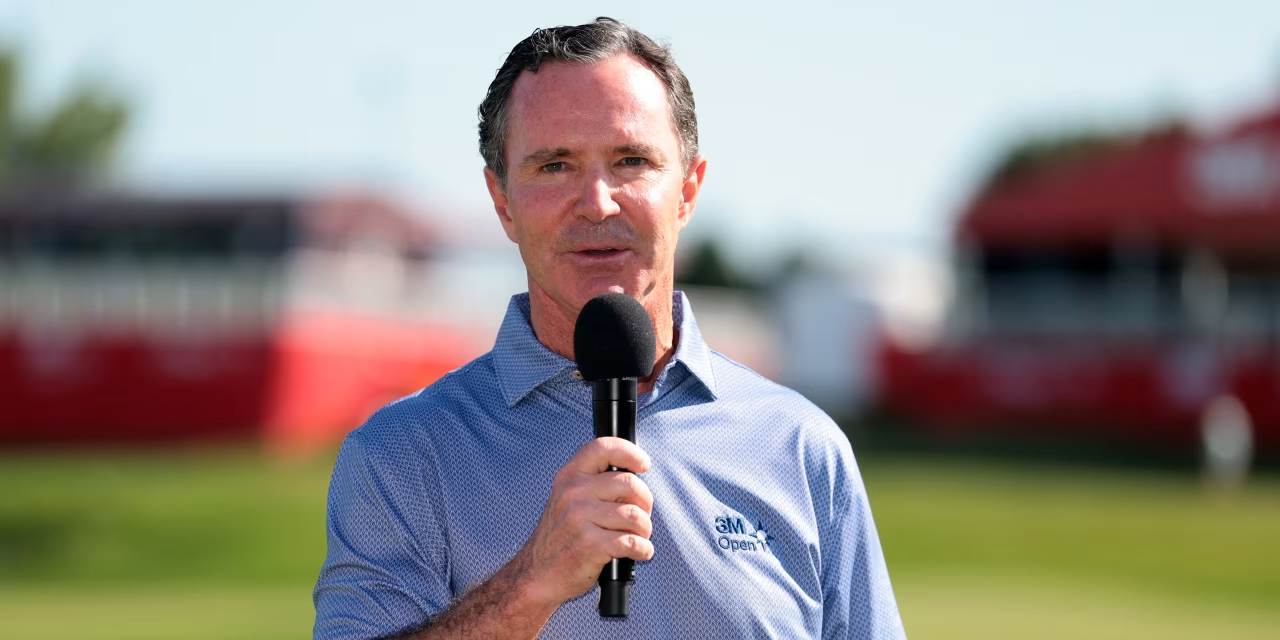
Shares in materials maker 3M rose 7.3% after the company raised its full-year adjusted earnings guidance.
The company’s second-quarter adjusted earnings increased 11% year-over-year thanks in part to strong performance in its industrial and safety businesses. Chief Executive Bill Brown said 3M is reshaping its portfolio to focus on high-growth, high-margin businesses such as data centers and fire and rescue equipment.
3M is continuing to boost the number of new products it offers, which is helping to drive sales. Brown said the company has improved its research-and-development process so it can commercialize ideas faster, and is on track to launch more than 350 new products this year.
Business
Japan Patent Office Rejects Another Nintendo Filing Tied to Palworld Lawsuit, Citing Lack of Originality

Japan’s patent office has rejected another Nintendo patent application connected to the company’s ongoing legal battle with Palworld developer Pocketpair, marking the latest in a series of setbacks for Nintendo’s intellectual property campaign against the hit survival game.
The rejected filing, application number 2024-031879, sits structurally between two Nintendo patents already granted and actively being asserted against Pocketpair in the Tokyo District Court. The Japan Patent Office found the application lacked the inventive step required for approval, citing prior art from a range of earlier titles, including ARK: Survival Evolved, Monster Hunter 4, Craftopia, Kantai Collection and Pokémon GO.
A lawsuit built on gameplay mechanics, not character designs
When Nintendo and The Pokémon Company filed their patent infringement lawsuit against Pocketpair in September 2024, many in the industry expected the case to center on copyright or trademark claims tied to the visual similarities between Palworld’s creatures and Pokémon designs. Instead, the companies pursued a narrower legal strategy, targeting specific gameplay mechanics: the act of capturing creatures by throwing an object at them, and the ability to transition between riding different creatures or items within an open-world setting.
That approach has proven contentious from the outset, given how widely those particular mechanics have appeared across the video game industry over multiple decades, spanning genres from survival games to massive multiplayer titles.
Why this rejection matters beyond a single filing
The application rejected this week is not a standalone or peripheral filing. According to reporting from legal industry outlet Games Fray and technology site Techdirt, the application descends directly from JP7505852, one of the two patents Nintendo has already been granted and is actively using in its court case against Pocketpair, while a related filing, JP7545191, branches off in a separate direction and is also being asserted in the ongoing litigation.
Because the rejected application sits within that same patent family, positioned between the two already-granted patents, the Japan Patent Office’s reasoning carries implications beyond the specific filing itself. If patent examiners determined that a structurally related application lacked sufficient originality when compared with existing games, that same logic could potentially be applied to challenge the validity of the two granted patents currently powering Nintendo’s lawsuit.
Pocketpair’s parallel defense strategy
Throughout the litigation, Pocketpair has pursued a dual approach to defending itself. The company has both patched several of the disputed gameplay mechanics out of Palworld directly, including removing the ability to throw Pal Spheres to summon creatures in a November 2024 update, while simultaneously building a broader legal case aimed at invalidating Nintendo’s patents by submitting evidence of prior art from other commercial games as well as fan-made mods, including titles like Pixelmon, a Minecraft-based mod, and Pocket Souls, a mod for Dark Souls 3.
Nintendo has pushed back on some of that evidence, arguing in filings to the Tokyo District Court that mods should not be considered valid prior art because they cannot function independently without the original game they modify. That argument remains a live point of contention in the case.
Part of a broader pattern
This is not the first time Nintendo’s patent filings tied to the Palworld dispute have run into trouble with Japanese examiners. A separate application covering touchscreen-based monster-capturing mechanics, filed by Nintendo in spring 2026 and seen by some industry observers as a potential preemptive move against a mobile version of Palworld, was also rejected by the Japan Patent Office, with an examiner citing footage from a 2013 unofficial Pokémon fan project as part of the prior art record. That rejection, like the one involving application 2024-031879, leaves Nintendo with the option to appeal before a panel of JPO administrative judges or submit a revised, narrower divisional application within a set window following the decision.
Nintendo has also faced related setbacks with patent filings in the United States tied to the same broader family of gameplay mechanics, according to industry reporting, adding to a pattern that has drawn increasing attention from legal and gaming industry observers watching how the case may shape the broader question of whether specific gameplay mechanics can be meaningfully patented at all.
What’s next in the case
Nintendo has not publicly indicated whether it intends to appeal the latest rejection or file a revised application narrowing its claims. The broader lawsuit against Pocketpair remains active in the Tokyo District Court, with additional court dates reportedly scheduled for later this year.
Legal observers following the case have noted that the pattern of rejections does not automatically invalidate the two already-granted patents Nintendo is using in its active lawsuit, since a rejection of a related application is a separate legal determination from a formal invalidation proceeding against a granted patent. However, the reasoning behind these rejections is expected to factor into Pocketpair’s ongoing efforts to challenge the validity of those granted patents directly within the litigation itself.
A closely watched case for the industry
Beyond its direct impact on Nintendo and Pocketpair, the case has become something of an industry benchmark for how far patent protections can reasonably extend over broad categories of gameplay mechanics, rather than specific implementations, visual designs or code. A ruling that meaningfully narrows or invalidates Nintendo’s patents could influence how other studios approach similar intellectual property strategies going forward, particularly for mechanics with long, well-documented histories across multiple genres and developers.
For now, the litigation remains ongoing, with no clear resolution in sight, and each new patent office ruling, whether favorable to Nintendo or Pocketpair, continues to shape the broader legal and industry conversation surrounding the case as it moves through Japan’s court system.

Capital One per-share earnings handily surpassed analysts’ expectations, in large part because it released more than $700 million in loan-loss reserves from its credit-card business. The company’s net charge-off rates and delinquency rates both fell from a year earlier and sequentially, continuing a trend for the company of improving credit metrics.

Gary Lineker has joined more than 100 British-based millionaires in calling on Andy Burnham to tax their wealth more, telling the new prime minister: “We can afford it.” For the country’s business owners, the detail behind the plea matters as much as the gesture.
On Thursday, a group of over 100 UK-based millionaires, including Lineker, screenwriter Richard Curtis, novelist Val McDermid and ex-City trader Gary Stevenson, signed a letter urging Mr Burnham to tax their wealth. It was organised by campaign group Patriotic Millionaires UK.
“We want you to tax us. We can afford it,” the letter says. “We’re not talking about higher taxes on those who get up and go to work for their income every day, but on the very richest whose income is derived from the wealth they hold.”
The signatories describe themselves as a “patriotic bunch” who “love this country and we want it to succeed”. Lineker added: “Paying your fair share is a basic British value, but so many ordinary people are already paying more than they can afford. Our richest people can do more and most want to. To live up to our national values our new government must raise taxes on extreme levels of wealth for a fairer, better, more hopeful Britain.”
The numbers are where owners of ambitious firms should pay attention. Patriotic Millionaires UK has called on the government to place a 2 per cent tax on wealth over £10m, which it says could raise £24bn a year. It also argues that reforms to capital gains tax, including equalising the rate with income tax, could raise a further £12bn.
That combination would land squarely on founders and family business owners, many of whom are already navigating pared-back reliefs on the sale of a company. A levy pegged to assets rather than income also raises the perennial question of illiquid wealth: a stake in a private business is not a bank balance you can dip into to settle a tax bill.
The campaign draws on fresh academic work. Economists Gabriel Zucman and Ben Tippet estimate that a 2 per cent charge on households with more than £100m in assets would raise £10bn a year and affect fewer than 1,000 of the wealthiest households in the UK. The tax would “raise meaningful revenues and dampen runaway inequality”, they said.
Mr Burnham has declined to rule out a wealth tax, telling Lineker earlier this month that his government may “ask for a little more”. In a separate interview he suggested there is “some room” in the Labour manifesto for “movement on tax”.
The plea lands amid a row over how the new prime minister will fund his cost-of-living blitz. Since taking office on Monday, Mr Burnham has capped most bus fares in England at £2 and promised an £850m tax cut on electricity bills. Darren Jones, an ally of Sir Keir Starmer who lost his cabinet post this week, claimed the energy bills cut was unfunded. The government says it will be paid for in part by scrapping Sir Keir’s national digital ID scheme, though the estimated £600m a year in savings falls short of the annual cost.
For the SME community, already wary of what a Burnham premiership means, that funding gap is the nub of the matter. Conservative shadow chancellor Sir Mel Stride told BBC Breakfast: “And in the context of a very constrained economy at the moment, in terms of debt, debt servicing costs, and so on, and a very fragile fiscal situation, you cannot be a government that goes out there and makes lots of spending commitments without being able to explain exactly how those commitments are going to be funded.”
The signatories insist the answer sits with the very rich, not the high street. Julia Davies, a member of Patriotic Millionaires UK, said the moment could “reduce the shocking levels of wealth inequality which intensifies the cost of living crisis, and raise much-needed revenue for our public services”. The idea that wealth taxes could generate meaningful sums has gained traction. Whether that revenue helps small businesses or simply reshapes the incentives for the people who back them is the question owners will be watching.
Signatories in full
Alexander Alanine · Antonio Amaral · Susan Angoy · Cal Bailey · David Barker · Mike Barnes · Brian Basham · Sasha Bates · Gareth Bayliss · Robin Beal · Derek Bennett · Michael Berners-Lee · Andy Bilson · Jonathan Bloch · Nacim Bougheda · Andrew Bowles · Chris Brown · David Burall · Fiona Campbell · Mark Campbell · Tim Carey · William Carman · John Cossins · Richard Curtis (screenwriter and film director) · Julia Davies (investor, Patriotic Millionaires UK) · Juan Jose del Rio · Nicholas Easter · Stephen Einhorn · Nicola Elliott · Brian Eno (musician and producer) · David Farrell · Chris Frith · Dawn Gerhold · Edward Gildea · James Golding · Stephen Gosling CBE · Ian Gregg (former chairman of Greggs) · Lauren Gupta · Richard Hagan · Vivien Hallebard · Dominic Hamon · David Hands · William Hartree · Carolyn Hayman · Tom Hearn · David Heffernan · Peter Hill · Graham Hobson · Becky Holmes · Patrick Hort · Diane Isenberg · Kristina Johansson · Patricia Johnstone · Susie Jolly · Jenny Kagan · Sunil Kapur · Hussayn Kassai · Colleen Keck · Stephen Kinsella · Ramana Kumar · Jean Latenser · Barry Lea · Nick Levey · Gary Lineker (broadcaster and former England striker) · Bruce Lloyd · Harry Longman · Sam Lupton · Fred Macmillan · Louisa Mann · Doro Marden · Nick Marple · Sophie Marple · Madelyn Martinez · Samantha Mayaveram · Val McDermid (novelist) · Gemma McGough-Colin · Ben Medlock · Tim Nottidge · Lesley Omara · Charlie Orton · Roy Phillips · Nick Powell · David Pugh · Nick Razey · David Richards · Andrew Richards · Mark Robinson · Sarah Rossi · Georgios Samaras · David Seaward · Mark Seow · Susan Seymour · Anika Sharma · Lawrence Shaw · Alan Sherwell · Paul Sherwood · Akshay Singal · Adam Singer · Geetie Singh-Watson · Guy Singh-Watson · Alastair Singleton · Alan Smith · Nathan Spencer · Heather Stevens · Gary Stevenson (economist and former City trader) · John Stickley · Tim Stumpff · Peter Sundgren · Ben Tibbits · Rebecca Tinsley · Jennifer Tomkins · Willem van Hoorn · Matthew Varnham · Edward Vickery · Suzanne Wise · Phil White · Leticia White · Vicki Wilkinson

Paul Jones
Harvard alumni and former New York Times journalist. Editor of Business Matters for over 15 years, the UKs largest business magazine. I am also head of Capital Business Media’s automotive division working for clients such as Red Bull Racing, Honda, Aston Martin and Infiniti.

Alaska Air shares fell after it reported a second-quarter loss and forecast third-quarter earnings below investors’ expectations. Blame fuel prices, which have been on the rise again this month as the conflict in Iran has intensified.
Airlines have been boosting fares to cover higher costs, and even with higher fares, planes are as full as ever, Alaska President and Chief Financial Officer Shane Tackett said in an interview. “I think people are really choosing experiences when they can with whatever discretionary income they may have, and it doesn’t feel to us like that’s likely to change.”
Alaska expects adjusted earnings to range between break-even and $1 a share for the third quarter, compared with the $1.47 forecast by investors. Shares fell 1.9% in after-hours trading.

Pubs, clubs and live music venues in England will get a 20% cut in business rates from April.

Pubs, clubs and live music venues in England will be given a 20% cut to business rates from April, which the government estimates will save firms around £1,100 next year.
In his third policy announcement since becoming prime minister, Andy Burnham said: “For too long, governments have stood by while cherished venues have disappeared from our local high streets.”
The cut will cost £100m and will be funded by a review of tax relief on firms such as vape shops which “do not make a positive contribution to local communities”, the government said.
Hospitality bosses welcomed the support, but some pub owners said the package would not go far enough to offset the impact of cost increases elsewhere.
The 20% business rates discount will not apply to the “very largest” live music venues. Details about which businesses are eligible will be announced at Chancellor John Healey’s first Budget in the autumn.
The cut is expected to benefit almost 32,000 venues, the government said.
Iain Hoskins, who owns Ma Pub Group in Liverpool, told the BBC the relief would help “chip away” at rising costs but questioned how many venues would benefit.
It could be “very meaningful”, he said, but “as always, the devil is in the detail”.
His pubs have previously missed out on government business rates support, and “the increases were so huge last year that now we’re sort of chipping away at some of those increases”.
Under previous chancellor Rachel Reeves, the government said last year it would scale back business rate discounts that had been in force since the pandemic and announced that there would be no discount at all from April this year.
That, combined with big upward adjustments to rateable values of pub premises, left landlords with the prospect of much higher rates bills.
Following criticism from the hospitality industry, the government cut business rates for pubs and music venues by 15% earlier in 2026.
The 20% discount will apply on top of the existing support.
Commenting on the cut which comes into effect next year, Steve Perez, founder of soft drinks company Global Brands and an owner of two hotels, said the announcement is “welcome… but this won’t make any material difference to any pub”.
UK Hospitality’s chief executive, Allen Simpson, said Burham’s plans are “a good start” which he said “suggests that his affection for hospitality has survived the trip down the M1”.
But he added that it is “not for everybody in hospitality”.
The change to business rates for some hospitality firms is the latest move in what Burnham hopes will provide “breathing space” for people and businesses.
On Tuesday, the government announced a cut of 5% VAT on electricity bills followed by capping bus fares at £2 in England outside London.
As well as reviewing tax relief on firms such as vape shops in order to fund the rate cut, the government also said it will “crack down” on businesses selling through online marketplaces which “do not comply with their tax obligations”.
The Night Time Industries Association’s chief executive, Michael Kill, said the tax break could provide “meaningful relief to businesses facing sustained cost pressures”.
But he said the sector is waiting for more details while questions remain about the exclusion of the largest live music venues.
The Federation of Small Businesses (FSB) said Thursday’s announcement must be “a downpayment on action that reaches across the small business community”.
FSB policy chief Tina McKenzie, said the plans were encouraging and fix the damage caused by past business rates decisions which are “holding back small business growth and jobs in every postcode”.

MSCI Q2 2026: Investors' Fears Are Justified
Business
Earnings call transcript: STMicroelectronics beats Q2 2026 estimates, shares fall premarket

Earnings call transcript: STMicroelectronics beats Q2 2026 estimates, shares fall premarket

A charity distributing food to the most needy said it had been “devastated” after thieves smashed their way into its warehouse, leaving tonnes of supplies ruined.
They broke into the Teesside base of FareShare North East on Tuesday and cut the power to the charity’s walk-in freezer and chiller units, meaning perishables like milk and meat had to be thrown out.
The charity said it lost 16 tonnes of food – the equivalent of 7,000 meals.
Middlesbrough hub manager Natasha Flanagan said it was “heartbreaking”, adding: “We’ve got a really great team of volunteers and staff and we try our best every day to get food out to people that need it.”
FareShare North East redistributes food donated by supermarkets from its warehouses in Newcastle and Middlesbrough to more than 200 community groups, including food banks.
The charity has been in Middlesbrough since 2023 and moved to its new base on Skippers Lane about four months ago.
Flanagan uncovered the damage when she arrived for work.
She said: “Lockers were ransacked, the staff drawers in the main warehouse were ransacked, and then I’ve seen the chiller doors were left open and the freezer door which has caused significant damage to food.
“Honestly it’s heartbreaking and we do really good things here.”

Zou Sensation to remain in Victoria for Group 3 Bletchingly Stakes in 2026

money subliminal calm – the audio that will make you rich // new formula (works instantly!)
3M Stock Jumps on Improved Earnings Guidance

Renter of Home in Anne Heche Crash Denies Settlement With Son

No Jackpot Winner as $257 Million Prize Rolls Over to $269 Million Monday Draw

Weekend Open Thread: Staud – Corporette.com
money subliminal calm – the audio that will make you rich // new formula (works instantly!)

XRP CAN RUN ON IT’S OWN & FLIP BTC! – BRAD EXPLAINS WHY SWIFT IS FINISHED!

Capital Budgeting | Financial Management | CS Executive Dec 2026 / June 2027 | CS Debashish Sir
-
 NewsBeat7 days ago
London Mayor Sadiq Khan handed a peerage by Keir Starmer alongside 15 other Labour figures… just days before the PM leaves No10
-

 Fashion6 days ago
Weekend Open Thread – Corporette.com
-

 Politics5 days ago
The House | The City of London can help the new chancellor deliver growth in every postcode
-

 Crypto World5 days ago
Ripple Payments Joins MiCA With 14 Firms, Does It Mean Anything For XRP?
-
 Crypto World6 days ago
Two July Windows Left: The CLARITY Act’s Senate Fight and What Failure Means
-

 Politics4 days ago
Democrats look to World Cup watch parties to register thousands of voters
-

 Crypto World5 days ago
Ripple wins EU-wide access as ESMA adds it to MiCA register
-

 Crypto World2 days ago
Grayscale Files For Worldcoin ETF, WLD Registers Sharp Rise
-

 NewsBeat3 days ago
Unregistered fitter used Gas Safe logo on business flyers
-

 Tech2 days ago
Sail Virtually Aboard The “Itanic” With IA-64 Emulator
-

 Crypto World7 days ago
Injective Submits SEC Transfer-Agent Registration to Onchain Ownership Records
-
 Tech2 days ago
Turtle Beach Command Series KB7 review: a nifty screen-equipped gaming keyboard
-

 NewsBeat6 days ago
Registration is now open for March for Men with Kev 2026
-
 Business1 day ago
New Jersey voter registration controversy explained: How 6,600 noncitizens got on the rolls, and what happens next
-
 Crypto World6 days ago
Claude Fable 5 Slips to Second in AI Coding Leaderboard
-

 News Videos6 days ago
Money | Class 12 Economics | CBSE Board Exam 2026-27
-

 Business6 days ago
Banco Bilbao Vizcaya Argentaria, S.A. (BBVA) Discusses Global Macro Environment and Economic Outlook for Core Markets Transcript
-

 Crypto World5 days ago
Kaspersky exposes OkoBot’s 20-module crypto wallet attack
-

 News Videos4 days ago
Big Money Is Entering XRP
-

 NewsBeat5 days ago
Durham County Council to send out electoral registration emails
You must be logged in to post a comment Login