

Crypto World
Can Elon Musk Grok AI Be Right About This Scary 2026 XRP Price Prediction?

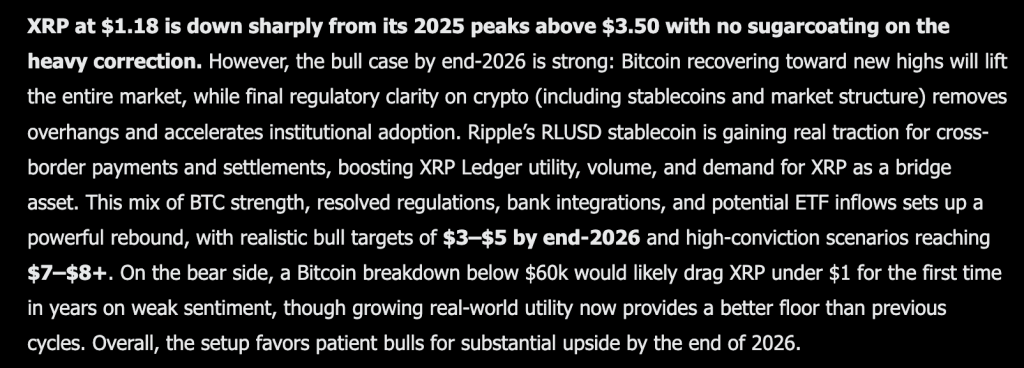
Grok AI is not sugarcoating its XRP price prediction, calling the correction from $3.50 exactly what it is: brutal and steep. But Elon Musk’s AI is equally direct about where the end-of-2026 prediction points.
$3 to $5 as the realistic bull target, with high-conviction scenarios reaching $7 to $8 and above from a current price of $1.18.
The foundation of that call is not wishful thinking; it is a convergence of 4 forces that have been building simultaneously while price has been grinding lower.
Bitcoin recovering toward new highs lifts the entire market, and XRP has historically been one of the biggest beta plays when that happens.
Final regulatory clarity on crypto, including stablecoins and market structure, removes the overhangs that have kept institutional capital cautious about deploying at scale.
Ripple’s RLUSD stablecoin, gaining real traction for cross-border payments and settlements, is the utility story becoming a revenue story, directly boosting XRP Ledger transaction volume and demand for XRP as the bridge asset in those flows.
And ETF inflows returning would add the structural institutional demand that turns a narrative into a sustained trend.
What Grok is describing is a market that has been pricing in the worst-case outcomes for months, where every positive development has been ignored, and every macro headwind has been amplified.
When that sentiment cycle turns, assets with the strongest fundamental cases tend to move the furthest the fastest, and XRP’s combination of regulatory clarity, real-world utility, and institutional access infrastructure makes it one of the most complete setups in the altcoin space for that reversal.

The bear case is the one the chart is threatening to test right now. A Bitcoin breakdown below $60,000 would likely drag XRP under $1.00 for the first time in years.
Grok AI acknowledges that RLUSD’s growing real-world utility provides a better prediction floor than previous cycles, but it is not dismissing the sub-$1.00 scenario as impossible, given where Bitcoin is sitting today.
Grok AI Price Prediction: The Chart Is Testing the Most Important Support in Its Entire Post-Settlement History
XRP is closing the current week at $1.191 with a weekly low of $1.140, and this weekly chart, going back to 2023, is showing something that has not happened since before the entire institutional repricing began.
The pre-breakout base from 2023 through October 2024 held XRP between $0.40 and $0.70 for over a year. The November 2024 vertical move to $3.40 launched from a base of $0.55, and the dotted support line on this chart sits at approximately $1.20, which is the level XRP has been defending since February 2026.
This week’s candle broke that line intraweek, with the low of $1.140 testing into the gap between $1.00 and $1.20 that has almost no structural support built into it.
The recovery back to $1.191 on the current close is keeping the weekly close marginally above $1.20, but the margin is thin enough that a single bad macro day next week could close this candle well below the floor.
The $1.00 level is the last psychological and structural barrier before XRP is priced out of the entire post-settlement premium.
Getting there on a weekly close would represent a complete unwinding of the regulatory clarity narrative that the market spent most of late 2024 pricing in, and would validate the bear case Grok identified around a Bitcoin breakdown below $60,000.
On the upside, the first meaningful resistance is now $1.40, which was support for months before breaking down this week.
Above that $1.60 is the zone where the market spent most of March and April consolidating, and clearing $1.60 on a weekly close is the minimum requirement before any conversation about the $3 to $5 target becomes technically credible.
Whether that extreme reading marks the capitulation bottom that Grok’s $3 to $5 call needs as its starting point, or whether it continues lower toward 25 as Bitcoin tests $60,000, is the question that defines the next 3 months for XRP holders.
LiquidChain Is Catching the Attention of XRP holders
Smart money does not wait at resistance. It moves before the next thing becomes obvious.
Bitcoin, Ethereum, and XRP are all capped at the same bands they have been testing for weeks. The macro relief keeps getting delayed. The institutional inflows keep getting pushed back. Waiting on catalysts outside your control is a strategy with a known ceiling.
Early-stage infrastructure plays do not have that ceiling. A small market cap means a modest rotation produces dramatic movement. The gap between what something is actually worth and what the market currently thinks it is worth is where asymmetric returns come from. That gap only exists while the project is still undiscovered.
Multi-chain fragmentation is bleeding DeFi every single day. Bitcoin, Ethereum, and Solana run completely isolated liquidity systems. Every user moving value between them pays for that disconnection in fees, slippage, and failed transactions.
LiquidChain collapses all 3 into a single execution layer. One deployment. Full ecosystem access. No cross-chain tax.
The presale is at $0.01454 with just over $700,000 raised. That is ground floor, not a marketing phrase.
Execution is unproven. Adoption is unknown. Established assets offer a smoother ride toward a ceiling that is already visible. LiquidChain offers an earlier seat at a table that has not been set yet.
Explore the LiquidChain Presale
The post Can Elon Musk Grok AI Be Right About This Scary 2026 XRP Price Prediction? appeared first on Cryptonews.


The U.S. Comptroller of the Currency faced sharp questions this week about potential political influence in the agency’s handling of crypto banking charters. Jonathan Gould, the OCC’s head, was pressed during a House Financial Services Committee hearing on oversight of prudential regulators over World Liberty Financial, a crypto venture tied to Donald Trump and two of his sons that has sought an OCC national bank charter.
New York Democratic Rep. Gregory Meeks demanded clarity about World Liberty’s connections to foreign governments and the Binance exchange, arguing the company’s January charter application warranted careful scrutiny given the Trump family links. Meeks contended that the firm “actively lines the pockets of the president’s family,” urging Gould to apply the same standards to World Liberty as to any other applicant and to demonstrate that consideration isn’t affected by political influence.
During the exchange, Meeks and Gould frequently spoke over one another. Meeks stenciled a stark question: whether Gould was still operating to serve the American people or acting as a “fixer for the Trump family.” In response, Gould rejected the premise of political pressure and defended the integrity of the OCC’s process, saying that attempts to pressure him were “the only political pressure I’ve felt from anyone other than your Senate colleagues,” and that such pressure was “unfortunate and unprecedented.”
The hearing unfolded against a backdrop of ongoing regulatory developments in the crypto space. The OCC has already approved or conditionally approved several national trust charter applications from other crypto firms, including Coinbase, Ripple, BitGo, Circle, Fidelity Digital Assets and Paxos. Gould took office in July 2025 after confirmation by the Republican-controlled Senate along party lines, a context that lawmakers said colored the conversation about independence and accountability in the regulator’s work.
The debate also touched on broader questions about the legitimacy of the charter process. Massachusetts Senator Elizabeth Warren had called for a pause on World Liberty’s application, arguing that the approvals at the time favored “seemingly ineligible companies” and could contravene federal banking laws. The exchange highlighted ongoing tensions between political scrutiny and the regulatory decision-making that shapes the crypto industry’s access to traditional banking rails.
World Liberty’s co-founders include Donald Trump and two of his sons, according to the firm’s disclosures. The company submitted its national bank trust charter application in January, a move that has drawn intense scrutiny from lawmakers who want to ensure the process remains insulated from political considerations. Separately, the crypto exchange Kraken’s parent company, Payward, also filed for an OCC charter in May, signaling a broader push by industry players to obtain regulated access to national banking services. Kraken’s OCC charter filing has added to the sense that the regulator’s charter pathway is a focal point for the sector’s U.S. regulatory strategy.
Key takeaways
- The congressional hearing underscored heightened scrutiny of World Liberty Financial’s OCC national bank charter bid and the broader issue of political considerations in regulatory reviews.
- The OCC has already granted or conditionally approved several crypto firms’ charter applications, signaling a developing framework for crypto-tied institutions to access national banking services.
- Regulatory momentum for digital assets extends beyond charters to legislation, with the CLARITY Act advancing in Senate committees and a summer timeline eyed by administration officials.
- The debate exposes a fundamental tension between political accountability and the technical, standards-driven processes that govern charter approvals—an uncertainty that could affect investor confidence and corporate planning in the sector.
World Liberty and the regulatory ledger for crypto banks
The World Liberty case sits at the intersection of political optics and regulatory mechanics. The company—co-founded by Donald Trump and two of his sons—submitted its national bank charter application in January, prompting a wave of questions from lawmakers about potential conflicts of interest and the standards applied to crypto-focused entrants seeking bank-like trust powers. In the same spirit of regulatory expansion, the OCC has already moved to approve other charter bids, signaling a recognition that crypto firms seek formalized access to the traditional financial system, albeit under tailored oversight.
World Liberty’s bid is not an isolated incident. The OCC has repeatedly signaled an openness to national trust charters for crypto firms as part of a broader move to clarify the rules of the road for digital assets. The agency’s approach contrasts with the more cautious, sometimes contradictory signals from other branches of government, illustrating the tug-of-war between enabling innovation and maintaining robust guardrails. The public discussion also features calls from lawmakers for greater transparency and consistently applied standards, regardless of a firm’s political connections.
Regulatory momentum and looming legislation
Beyond individual charter cases, the crypto regulatory landscape in the United States is moving toward a comprehensive framework. A sweeping market structure bill, known as the CLARITY Act, has been a central focal point for lawmakers seeking to standardize how digital assets are treated in terms of custody, investor protections, and market integrity. This week, Treasury Secretary Scott Bessent signaled that the administration aims to push the measure through the Senate in the near term, with some senators anticipating a vote before August following movement in two key committees. The timing injects a sense of urgency into debates about how to balance innovation with consumer safeguards and systemic stability.
The CLARITY Act discussion comes amid a broader political context. Senator Warren has used public remarks to question the integrity of crypto-related approvals, framing the debate as an ongoing contest between regulatory fairness and political influence. As the CHOICE of whether to grant or deny charters continues to unfold, investors and builders alike will be watching how the administration and Congress align on practical rules that can govern a rapidly evolving technology stack.
What this means for the market and the path forward
For market participants, the unfolding charter process and the CLARITY Act timeline offer both risk and clarity. On one hand, a transparent, consistently applied charter framework could reduce regulatory ambiguity and unlock institutional-grade services for a broader set of crypto firms. On the other hand, heightened political scrutiny raises the potential for delayed decisions or additional conditions attached to charter approvals, which could complicate strategic planning for exchanges, custodians, and other service providers seeking regulated access to the U.S. banking system.
Investors may also weigh the implications of ongoing congressional inquiries into potential conflicts of interest among regulators. The tension between ensuring independence and addressing legitimate concerns about corporate influence is likely to persist, potentially shaping how market participants assess political risk in regulatory decisions.
Looking ahead, the next couple of months will be telling. Courtship between crypto firms and the OCC will continue to unfold under the glare of congressional oversight, with World Liberty’s fate and Kraken’s charter filing serving as real-world tests of the agency’s thresholds. Simultaneously, the Senate’s handling of the CLARITY Act will offer a broader signal about the United States’ approach to crypto regulation, with implications for issuers, custodians, and users who rely on clear, enforceable rules.
Readers should watch how the OCC applies its standards in practice, whether World Liberty’s bid proceeds in line with other approvals, and how the CLARITY Act’s provisions—particularly around custody, compliance, and reporting—translate into actual regulatory requirements once the bill reaches a final vote. The evolving framework will shape the pace at which crypto firms can scale in the U.S. and influence how institutional capital views the country as a viable base for digital-asset infrastructure.


Nigel Farage’s Reform UK party has raised $9.4 million from two cryptocurrency billionaires in the first quarter of 2026, helping it collect more donations than either Labour or the Conservative Party.
Summary
- Reform UK raised $9.4 million from crypto billionaires Christopher Harborne and Ben Delo in Q1, surpassing Labour and Conservative fundraising totals.
- Harborne and Delo accounted for 28% of all political donations reported by UK parties during the quarter.
- Harborne’s financial ties to Nigel Farage remain under scrutiny amid questions over a separate $6.7 million personal gift.
According to newly released UK political donation records, crypto investors Christopher Harborne and Ben Delo provided the bulk of Reform UK’s fundraising haul during the quarter. Their combined $9.4 million contribution accounted for roughly 28% of the $32.2 million in donations accepted by all UK-registered political parties during the period.
Harborne, who holds a 12% stake in stablecoin issuer Tether and is estimated to be worth $24.4 billion, donated $4 million to Reform UK on Jan. 23. The contribution followed a separate $12.1 million donation he made in 2025, which was widely reported as the largest political donation ever made by a living individual in Britain.
BitMEX co-founder Ben Delo contributed another $5.4 million through two separate payments made in January and March. Delo returned to the UK from Hong Kong earlier this year.
In 2022, he pleaded guilty to violating the U.S. Bank Secrecy Act over failures to implement anti-money laundering controls at BitMEX and later received a presidential pardon from Donald Trump.
As a result of those contributions, Reform UK reported $12.5 million in donations during the first quarter, ahead of the Conservative Party’s $8.1 million and Labour’s $5.5 million.
Crypto backers strengthen Reform UK’s fundraising position
Political support from crypto-linked donors has grown alongside Reform UK’s increasingly favorable stance toward digital assets.
Among major British political parties, Reform UK had been the only one willing to accept cryptocurrency donations before the UK government introduced restrictions following the government-commissioned Rycroft review. The measures included a moratorium on political donations made in crypto and limits on overseas political contributions from British expatriates.
Speaking about the new rules, Harborne said he believed he was “the reason” behind the cap on overseas donors. He also suggested the restrictions could face legal challenges and said he had not ruled out returning to the UK.
Meanwhile, Reform UK has continued promoting policies aimed at the crypto industry. Farage said in October 2025 that he would be a “champion” for digital assets. The party has since backed proposals including a national crypto strategic reserve and lower capital gains taxes on cryptocurrency investments.
Campaign finance reform groups have criticized the concentration of political funding among wealthy donors. Olly Buston, chief executive of Clean Up Westminster, argued that large donations from a small number of individuals contribute to public concerns about fairness in the political system.
Harborne’s relationship with Farage draws attention
Separate scrutiny has also emerged around Harborne’s financial ties to Farage personally.
According to reports, Farage purchased a $1.9 million property in May 2024 after receiving what was described as a $6.7 million personal gift from Harborne. Critics have argued the payment should have been declared after Farage entered Parliament, prompting calls for an investigation.
Farage and Reform UK have rejected those claims. Farage said the payment was made before he became a member of Parliament and therefore fell outside parliamentary disclosure requirements.
Earlier last month, he said legal advice obtained by his team concluded there was “no obligation” to declare the transfer because it qualified as an “unconditional, non-political, personal gift.”
The issue has already been referred to Parliamentary Standards Commissioner Daniel Greenberg by Conservative officials. Labour chair Anna Turley has also questioned the arrangement, while Reform UK maintains that the payment was exempt from disclosure rules because it was received before Farage became the party’s candidate for Clacton.
Crypto World
Worldcoin (WLD) Explodes 60% Weekly Despite the Crypto Massacre: Further Gains on the Way?
The bears have taken total control of the crypto market lately, suppressing the prices of multiple leading digital assets, including Bitcoin (BTC), Ethereum (ETH), Ripple (XRP), Solana (SOL), Cardano (ADA), and many more.
Nonetheless, a handful of tokens have managed to remain in green territory, with Worldcoin (WLD) among them.
What’s Coming Next?
A few hours ago, the token’s price briefly exceeded $0.55, climbing to its highest point since January. Later on, it retraced to the current $0.48 (according to CoinGecko), representing a 60% increase on a weekly basis. Its market capitalization surpassed $1.6 billion, making WLD the 51st-largest cryptocurrency.
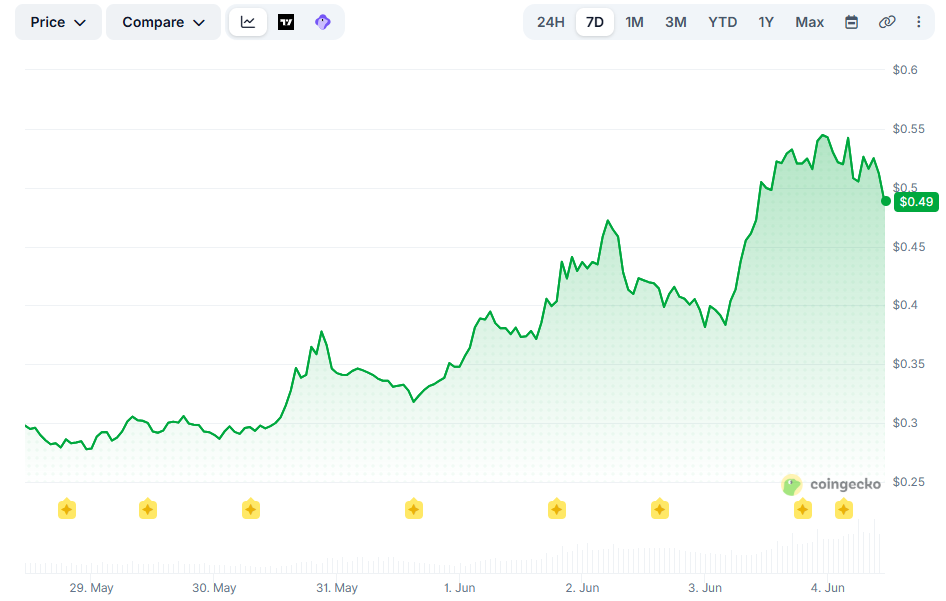
Perhaps the main catalyst driving the rally is the recent whale activity. The X account BSCN revealed that WLD transactions above $100,000 have reached their highest level this year, adding that growing accumulation, rising network activity, and an upcoming reduction in token emissions have also played a positive role.
X user Crypto Tony labeled WLD as one of “the strongest” altcoins, expecting a pump to $0.63 if the price holds the key level at $0.45. Other popular analysts who chipped in include Altcoin Sherpa and Crypto Catalysts.
The former envisioned a pump to $0.65 if “BTC stays stable,” while the latter noted the asset’s impressive performance amid the recent crypto massacre and predicted a potential ascent to $2.
For his part, Arthur Hayes – co-founder of BitMEX and CIO of Maelstrom – set a future price target of $10. He later described the token as a “shitcoin” that is “going to moon” only because of its connection to the emerging Artificial Intelligence (AI) technology.
Going South?
It is important to note that WLD’s solid price increase can also be followed by a pullback, given how quickly the upward move occurred. Its Relative Strength Index (RSI) is the exact technical analysis tool that highlights this risk.
Recently, it soared past 70, meaning that the asset has entered overbought territory and could be on the verge of a correction. The index runs from 0 to 100, and conversely, anything under 30 is considered a bullish sign.

Meanwhile, some analysts have not been so kind to Worldcoin. X user Ryker described it as a “dead project” that only follows NEAR because of the AI trend. They don’t expect much from WLD, claiming that the team behind it “doesn’t do anything.”
The post Worldcoin (WLD) Explodes 60% Weekly Despite the Crypto Massacre: Further Gains on the Way? appeared first on CryptoPotato.


Largest U.S. banks have moved toward a shared tokenized deposit network as stablecoin firms push deeper into payments and corporate finance.
Summary
- Major U.S. banks plan a tokenized deposit network through the Clearing House, with launch targeted for early 2027.
- The network will let banks move tokenized deposits instantly across blockchain infrastructure with round-the-clock settlement support.
- Banks see tokenized deposits as a regulated alternative to stablecoins that keep customer deposits inside the banking system.
The Wall Street Journal reported that the Clearing House will run the system, a real-time payment network owned by JPMorgan Chase, Bank of America, Citigroup, Wells Fargo, and other major commercial banks. The network is expected to launch in the first half of 2027 and will be available to banks across the United States.
Banks prepare a blockchain payment network
The planned system will connect existing bank payment rails with blockchain infrastructure used in digital assets. According to the Journal, tokenized deposits on the network could move instantly and settle around the clock, giving banks a way to offer blockchain-based payments without pushing deposits outside the regulated banking system.
Clearing House CEO David Watson told the Journal that the project is “a big move for the banks,” adding that the industry faces a “radically different” future around on-chain payments and finance.
The banks have not selected the blockchain vendor for the network, according to the report. Some participating banks have called the project “the bridge,” while others have referred to it as “the chain.”
Tokenized deposits gain ground amid stablecoin clash
The plan comes as banks watch crypto firms compete more directly in payments. The Journal reported that large banks have grown concerned that stablecoins could pull deposits away from lenders if crypto companies win more business from consumers and corporations.
Banks and crypto firms have also clashed over stablecoin legislation that advanced recently in Washington. According to the Journal, banks remain unhappy that the rules leave room for interest-like structures on stablecoins, while crypto companies have described the proposal as a compromise.
Banks prefer tokenized deposits because they represent regular bank deposits on a blockchain. The Journal reported that this structure keeps the same credit risk profile, regulatory treatment, and accounting approach as traditional deposits, making it easier for banks to adopt digital payment systems under existing rules.
Corporate treasury demand comes first
The Clearing House expects large multinational companies to be among the first users of the network, according to the Journal. Potential uses include programmable treasury operations, real-time liquidity management, and cross-border payments.
Shahmir Khaliq, Citi’s head of services, told the Journal that the network is another step that strengthens banks’ role in financing, money management, and capital markets.
At Bank of America, Mark Monaco, head of global payments solutions, said clients are not “beating down the door” for tokenized deposits. Still, he told the Journal that some interest exists and that the network would help banks stay ready as adoption develops.
JPMorgan has already used JPM Coin for internal institutional payments on its private blockchain, according to the Journal. The bank has also launched a deposit token called JPM Coin on Base, a public blockchain linked to Coinbase Global, with access limited to institutional clients. Last year, major banks explored a joint stablecoin effort through the Clearing House and Early Warning Services, the operator of Zelle, the Journal previously reported.


Western Union has made its USDPT stablecoin available on Bybit's fiat channels in Latin America, the two companies announced Thursday. Bybit, which describes itself as the world's second-largest crypto exchange by trading volume with over 80 million users, is the first major crypto exchange to… Read the full story at The Defiant


CME Group Chief Executive Terry Duffy has warned that the recent approval of cryptocurrency perpetual futures in the U.S. has created significant risks for investors and the financial system, calling the products “a disaster waiting to happen.”
Summary
- CME CEO Terry Duffy called U.S. crypto perpetual futures a “disaster waiting to happen.”
- Duffy warned that high leverage and automatic liquidations could expose retail traders to heavy losses.
- The criticism comes as Kalshi, Coinbase, and Kraken expand into the newly approved U.S. crypto perps market.
According to remarks delivered at Piper Sandler’s Global Exchange & Fintech conference on June 4, Duffy criticized the Commodity Futures Trading Commission’s decision to permit regulated crypto perpetual futures, arguing that the highly leveraged instruments introduce dangers that many market participants may underestimate.
Speaking shortly after several firms received regulatory clearance to enter the market, Duffy said speculation was increasingly replacing traditional market functions and questioned whether the new products serve the long-term interests of investors.
Perpetual futures, commonly known as perps, differ from standard futures contracts because they have no expiration date. The products allow traders to maintain positions indefinitely and often provide leverage of up to 50 times the deposited capital.
Duffy said the combination of high leverage and automatic liquidation mechanisms could expose retail traders to substantial losses, particularly if they do not fully understand funding rate costs and other risks associated with holding positions over extended periods.
Why is CME concerned about crypto perpetual futures?
Concerns from CME come as the U.S. crypto derivatives market undergoes one of its biggest regulatory changes in years.
On May 29, the CFTC approved the first regulated crypto perpetual futures products for U.S. participants, opening a market that had previously been dominated by offshore exchanges.
Days later, prediction market operator Kalshi launched Bitcoin perpetual futures, followed shortly by Ethereum perpetual futures on June 4, 2026. A broader suite of 11 additional cryptocurrency contracts, including Solana and Dogecoin, has been submitted for regulatory review but remains pending case-by-case approval before they can go live for trading
At roughly the same time, Coinbase Financial Markets received regulatory guidance allowing eligible U.S. institutional clients to access perpetual futures and options listed on Deribit, the derivatives exchange Coinbase acquired in 2025.
Separately, Kraken announced plans to launch regulated Bitcoin perpetual futures through Bitnomial Exchange, a regulated platform acquired by Kraken parent company Payward earlier this year.
The rapid expansion has prompted investors to reassess the competitive landscape for exchange operators. Shares of CME Group, Cboe Global Markets, and Intercontinental Exchange have come under pressure this week as some investors worry that regulated crypto perps could draw trading activity away from traditional futures markets.
Despite those concerns, Duffy argued that institutional demand for the products remains limited. He said between 85% and 90% of CME’s trading activity comes from institutional participants and noted that analysts covering the company do not view perpetual futures as a meaningful replacement for futures products typically used by professional investors.
What concerns does Duffy have about the approval process?
Beyond the products themselves, Duffy questioned how regulators handled the approval process.
During his conference appearance, the CME executive said the CFTC moved too quickly when reviewing what he described as a novel and complex financial instrument.
According to Duffy, regulators bypassed the type of comprehensive review process that would normally accompany the introduction of a new derivatives product carrying substantial leverage.
His comments arrive as firms across the crypto industry race to establish a foothold in the newly opened U.S. perpetual futures market.
While exchanges such as Kalshi, Coinbase, and Kraken are moving rapidly to expand offerings, Duffy said the risks associated with leverage-heavy products warrant greater scrutiny before they become widely adopted by retail traders.


The cryptocurrency-funded peptide market has surpassed a $100 million annual run rate after first-quarter sales jumped 159% quarter-over-quarter to $32 million, according to a new report from Chainalysis.
Summary
- Chainalysis says the crypto-funded peptide market has exceeded a $100 million annual run rate.
- Q1 2026 peptide sales jumped 159% quarter-over-quarter to $32 million.
- Average spending on independent purity testing fell 88% per buyer, raising safety concerns as demand for peptides continues to grow.
According to Chainalysis, demand for off-label peptides has expanded rapidly beyond niche biohacking communities, creating a growing gray-market industry that increasingly relies on cryptocurrency payments.
The blockchain analytics firm said peptide purchases reached $32 million during the first quarter of 2026, up from $12 million in the previous quarter.
Peptides, which are short chains of amino acids used in health, fitness, and wellness products, have gained attention following the success of GLP-1 drugs such as Ozempic and Wegovy. Chainalysis said growing consumer interest in weight loss, performance enhancement, and recovery products has pushed more buyers toward alternative peptide suppliers operating outside traditional pharmaceutical channels.
Many of those suppliers are based in China, where access to conventional banking services can be limited for businesses selling prescription-grade compounds and unregulated substances. As a result, Chainalysis said cryptocurrency has become a key payment rail connecting manufacturers with international buyers.
Stablecoins have become the preferred payment method
Examining on-chain activity linked to major peptide vendors, Chainalysis found that larger suppliers increasingly favor stablecoins over more volatile cryptocurrencies.
The firm said vendors receiving average deposits of at least $1,000 showed a payment mix dominated by stablecoins, suggesting an effort to reduce exposure to crypto price swings while handling larger supply-chain transactions.
What began as a small market catering to specialized buyers has evolved into a more organized ecosystem, according to Chainalysis.
The report noted that leading vendors are adopting increasingly sophisticated on-chain financial practices while continuing to process significant volumes through Bitcoin and stablecoins.
Chainalysis compared the peptide trade to other gray-market industries that have historically turned to cryptocurrency after encountering restrictions from banks and payment processors. The firm said suppliers can offer raw and unbranded products directly to consumers at prices well below those available through regulated channels.
The findings also fit into a wider trend previously identified by Chainalysis. Earlier this year, the company reported that cryptocurrency flows to suspected trafficking services rose 85% during 2025, with stablecoin-heavy networks operating through Telegram and other online platforms.
Chainalysis said blockchain transparency nevertheless provides investigators with permanent transaction records that can help track financial activity and identify key intermediaries.
Quality testing spending has fallen despite rising demand
Alongside rising sales, Chainalysis identified a decline in spending on independent product testing among peptide buyers.
The firm said many customers previously sent payments both to peptide suppliers and to Janoshik, a Czech-based laboratory that tests chemical purity. As the number of buyers surged, however, testing expenditures failed to keep pace with sales growth.
According to Chainalysis estimates, average testing spending per buyer fell 88% to roughly $8, even though Janoshik is conducting more tests than before. The decline occurred because new demand entered the market faster than testing activity expanded.
Safety concerns have also emerged around some suppliers participating in the industry. Chainalysis reported that Shanghai Sigma Audley, a company it linked to organizations previously involved in selling fentanyl precursors, generated at least $1 million in Bitcoin and $3.59 million in stablecoins before expanding into peptide sales.
Given the combination of unregulated products and cryptocurrency-based transactions, Chainalysis warned that many new customers entering the sector may have limited experience with either market, increasing potential risks as the industry continues to grow.
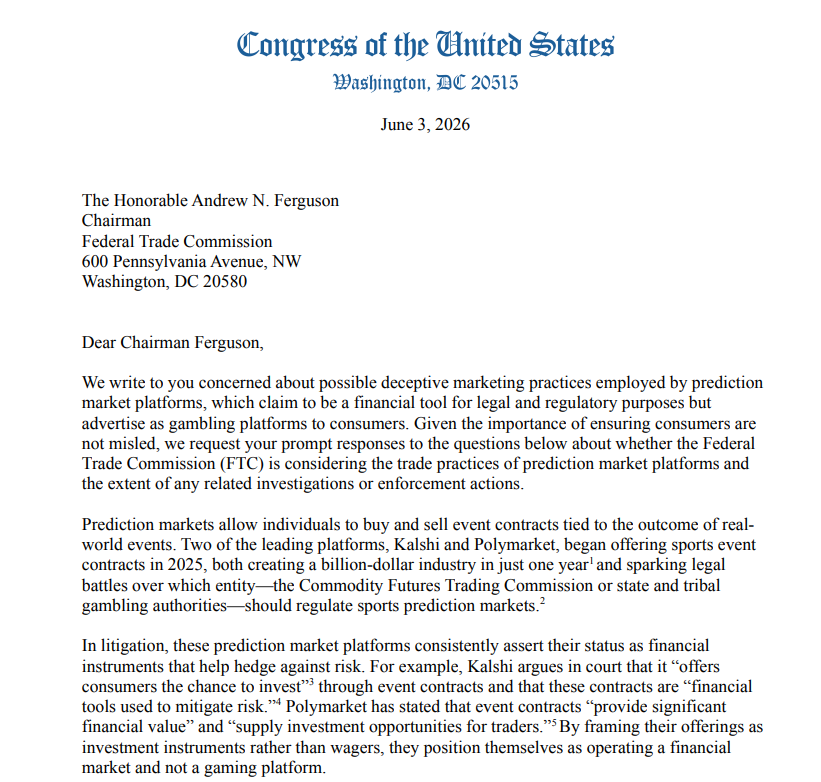
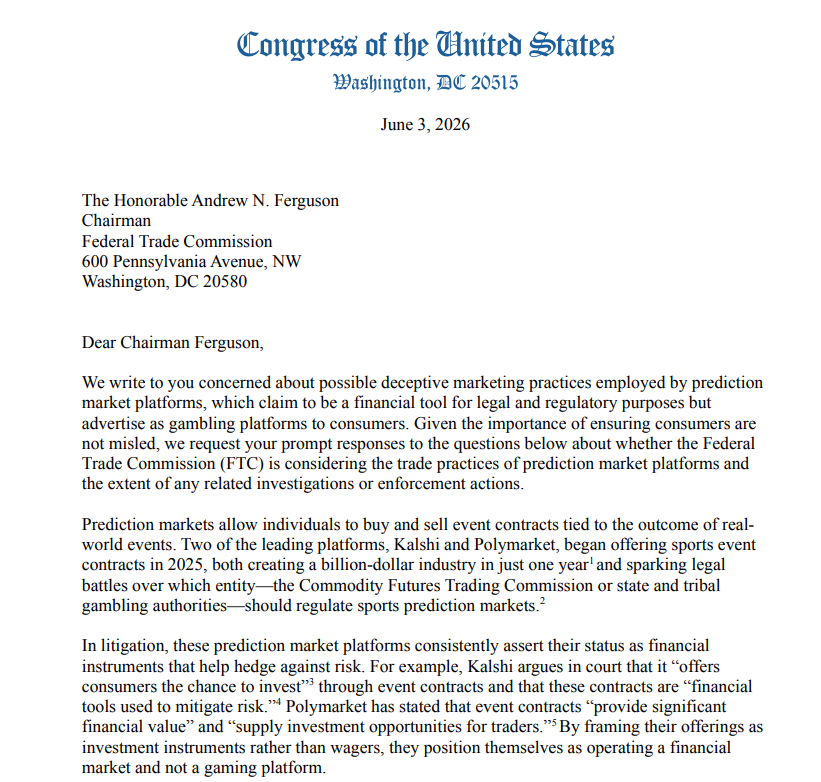
Nine Democratic lawmakers in the US House of Representatives have called on the Federal Trade Commission to launch a probe into how prediction markets are advertising to customers compared to how they present themselves to regulators.
In a statement on Wednesday, US Representatives Kevin Mullin and Gabe Vasquez said the FTC should investigate whether online prediction market platforms are misleading customers by advertising as gambling platforms while telling regulators they are financial tools offering investment products.
Prediction markets allow users to trade contracts on the outcome of future events. They have also been facing scrutiny over insider trading, with Congress launching a probe into Polymarket and Kalshi in May and questioning the companies’ responses to insider-trading incidents on their platforms.
The Democratic lawmakers allege that prediction market platforms use language associated with sports gambling, including legal betting and betting on sports without a sportsbook, while attempting to evade state gambling regulations.
A group of nine Democratic lawmakers is calling on the FTC to launch a probe into prediction markets. Source: Kevin Mullin
“These prediction market companies are presenting themselves differently to regulators than they are to the public, and that kind of contradictory messaging can mislead consumers about what rules and protections actually apply,” Mullin said.
“We are urging the FTC to investigate these practices and ensure consumers are protected from this potentially deceptive activity,” he added.
In their letter, the lawmakers are also asking the FTC for detailed information by June 29 on whether it has plans to take investigative or enforcement action against prediction market platforms for possible deceptive practices.
Related: Kalshi bans 3 US politicians for betting on their own election races
At the same time, the lawmakers have asked whether the FTC has received complaints about prediction markets and if the FTC considers public perception and legal filings when determining if a company has engaged in possible deceptive practices.
US Representatives Jared Huffman, Raul Ruiz, Salud Carbajal, Mike Levin, Dina Titus, Paul Tonko, and Valerie Foushee have also signed the letter.
Prediction markets have emerged as a significant real-world use case for blockchain, with some platforms relying on crypto rails and stablecoins for settlement and payments.
In March, transactions hit record highs amid growing interest in political and geopolitical event contracts, improved accessibility and positive regulatory developments for the industry.
Magazine: Big Questions: Do we really only need 2–5 cryptocurrencies?

Key Takeaways
- RBRK stock declines even as company delivers 39% revenue increase and improved cash generation.
- Shares fall in after-hours trading despite AI-focused cybersecurity platform expansion.
- Rubrik posts impressive ARR gains, but stock pressure continues following quarterly report.
- RBRK weakens as investors digest AI expansion, profitability metrics, and forward outlook.
- Company advances AI security offerings while facing post-earnings stock decline.
Shares of Rubrik (RBRK) experienced selling pressure following the company’s announcement of impressive first-quarter performance and increased emphasis on artificial intelligence-powered cybersecurity solutions. The stock closed regular trading at $77.00, declining 3.10%, then slipped further to $75.61 in extended hours. This downturn occurred even as the company demonstrated accelerating revenue, enhanced cash generation, and broader enterprise market penetration.
First Quarter Delivers Impressive Financial Performance
Rubrik unveiled its fiscal 2027 first-quarter financial results covering the three months concluded April 30, 2026. The data security specialist generated total revenues of $387.1 million, representing a 39% surge from the $278.5 million recorded in the comparable period last year. Subscription-based revenues climbed 41% to reach $374.2 million.
The organization disclosed that subscription-based annual recurring revenue hit $1.57 billion at the end of the reporting period. This metric demonstrated 32% annual expansion and underscored sustained market appetite for its security offerings. Revenues excluding material rights surged 43% compared to the year-ago quarter.
Rubrik simultaneously enhanced its profitability indicators throughout the period. GAAP-based gross margin expanded to 80.5%, while the non-GAAP gross margin improved to 82.9%. Furthermore, free cash flow generation climbed to $73.6 million, compared with $33.3 million in the prior-year period.
Company Advances AI-Driven Security Strategy
Rubrik has strategically repositioned itself as both a security and AI operations provider as businesses confront escalating cyber threats. The organization concentrates on data protection, identity restoration, cloud infrastructure resilience, and incident response capabilities. Consequently, the quarterly performance reflects growing enterprise demand for comprehensive cyber resilience solutions.
Throughout the quarter, Rubrik broadened multiple AI-integrated and cloud security capabilities. The company announced availability of Anthropic’s Mythos Research Preview via Project Glasswing. It simultaneously rolled out data protection functionality for Google Workspace, encompassing Gmail and Google Drive recovery capabilities.
Rubrik additionally introduced Rubrik Agent Cloud designed for Google Cloud’s Gemini Enterprise Agent Platform. This solution enables organizations to identify AI agents, implement protective parameters, and undo detrimental agent activities. The company also revealed SAGE, its artificial intelligence governance framework providing real-time agentic oversight.
Forward Guidance Signals Continued Expansion
Rubrik projected second-quarter fiscal 2027 revenues ranging from $395 million to $397 million. The company anticipates non-GAAP earnings per share between $0.03 and $0.05. It also forecasts subscription ARR contribution margin in the 11% to 12% range.
For the complete fiscal year, Rubrik anticipates revenues between $1.638 billion and $1.648 billion. The organization also projected subscription annual recurring revenue between $1.854 billion and $1.862 billion. Free cash flow projections range from $293 million to $303 million.
The company concluded the quarter holding $1.75 billion in cash, cash equivalents, and short-term investment securities. It also disclosed 2,946 customers generating subscription ARR exceeding $100,000. Nevertheless, the stock continued declining as market participants digested the comprehensive earnings announcement.



Arthur Hayes, co-founder of BitMEX and one of Hyperliquid's most vocal public supporters, has sold his entire positions in HYPE and NEAR Protocol. Hayes announced the exit on X on June 4, citing three macro headwinds he said altered his near-term risk calculus. "I just dumped my entire $HYPE and… Read the full story at The Defiant

Dan Clark Audio AEON Core Closed-back Headphones Debut at High End Vienna 2026

This crypto is the next Bitcoin

Nintendo Switch 2 is a year old today and we still don’t know what to make of it



-

 Tech7 days ago
Waymo dominates autonomous vehicle registrations as Tesla trails behind
-

 News Videos6 days ago
This is BROKEN! INSANE 5x MONEY CAR WASH WEEK! The NEW GTA Online UPDATE Today! (GTA5 New Update)
-
 Tech6 days ago
SpaceX just won a second Golden Dome contract. This one is $4.16 billion.
-

 Business3 days ago
Jade Biosciences, Inc. (JBIO) Discusses Positive Interim Results From JADE101 Phase I Healthy Volunteer Study and Development Plans Transcript
-
 News Videos6 days ago
SHE IS KILLING XRP!!! WATCH URGENT AND ACT FAST
-
 NewsBeat6 days ago
FIRST NIGHT REVIEW: Take That bring the Circus back to life in spectacular sun-soaked style
-

 Business5 days ago
Is the Spurs Phenom Already Better Than Prime Diesel?
-

 Sports2 days ago
French Open 2026 results: Alexander Zverev beats Rafael Jodar and will play Jakub Mensik in semi-finals
-
 Crypto World6 days ago
CFTC Has Approved the First Regulated Bitcoin Perpetual Contract in the U.S.
-

 Politics6 days ago
The House | Inside Andy Burnham’s Makerfield Campaign: “Nobody Thinks This Is In The Bag”
-
 NewsBeat6 days ago
Novak Djokovic v Joao Fonseca LIVE: French Open latest scores and results after Jannik Sinner’s shocking collapse
-
 Entertainment6 days ago
Weak ‘Supergirl’ Box Office Tracking Amid Milly Alcock Backlash
-

 Tech3 days ago
CryZENx Releases Fresh Playable Content Deep Inside Jabu-Jabu for His Ocarina of Time Remake
-
 Crypto World6 days ago
Snowflake (SNOW) Stock Rallies on Strong Q1 Results and AI Product Growth
-

 Entertainment6 days ago
Maddox Jolie-Pitt Legally Requests to Drop Brad’s Surname
-

 Business6 days ago
Demand Conditions Improve In Chemicals Sector In April 2026
-
 Crypto World6 days ago
MicroStrategy Moves $30 Million in BTC to Coinbase Prime: Is the Bitcoin Sell-Off Already Here?
-
 Entertainment6 days ago
One of the Greatest Sitcoms of All Time Shoots Up Apple TV’s Charts 11 Years Later
-

 Tech6 days ago
This Week In Security: Ubiquiti Fixes, And FreeBSD Joins The Club You Don’t Want To Join
-
 Entertainment6 days ago
Bruce Willis’ Generosity Resurfaces Amid His Dementia
You must be logged in to post a comment Login