Connect with us
DAPA Banner
DAPA Coin
DAPA
COIN PAYMENT ASSET
PRIVACY · BLOCKDAG · HOMOMORPHIC ENCRYPTION · RUST
ElGamal Encrypted MINE DAPA
🚫 GENESIS SOLD OUT
DAPAPAY COMING

NewsBeat

‘I’m going’: Trump joining likes of Spike Lee and Timothee Chalamet at MSG for Knicks-Spurs Monday night and hints at Game 4

Published

on

‘I’m going’: Trump joining likes of Spike Lee and Timothee Chalamet at MSG for Knicks-Spurs Monday night and hints at Game 4

President Donald Trump has announced that he plans to attend the New York Knicks and San Antonio Spurs NBA finals game Monday night and may go to Game 4 as well.

The New York native will be at Madison Square Garden in Manhattan alongside a host of Knicks superfans, including the likes of filmmaker Spike Lee and actor Timothee Chalamet. Lee and Chalamet were among the celebrities who attended Game 1 in San Antonio Wednesday night, along with comedian Tracy Morgan and actor Ben Stiller.

When a reporter asked whether Trump would attend a finals game at MSG, he boasted about the Knicks and said he would be at the stadium to watch them.

“I’ve been a Knicks fan for a long time, and I’m also a Jim Dolan fan. He’s a nice guy,” Trump said from the Oval Office Thursday, referring to the owner of the Knicks.

Advertisement

“He’s been a long time wanting to win, and he’s a competitive guy, and he’s got a team that’s amazing.”

President Donald Trump has announced that he plans to attend the New York Knicks and San Antonio Spurs NBA finals game Monday night and may go to Game 4 as well
President Donald Trump has announced that he plans to attend the New York Knicks and San Antonio Spurs NBA finals game Monday night and may go to Game 4 as well (AFP via Getty Images)

Trump said Dolan invited him to the finals, adding, “I’m going.”

When asked which game he’d attend, the president said he might go Monday for Game 3 and maybe to Game 4 next Wednesday.

The president commended both NBA teams for their performances at a nail-biting Game 1. The Knicks won the game 105 to 95 after coming back from a 14-point deficit in the third quarter.

“I saw the beginning of the game, and it wasn’t looking good [for the Knicks],” Trump said. “I missed the middle because I talk to generals all night long now. But I watched that end of the game, and they were dominant.”

Advertisement
The New York native will be joined at Madison Square Garden in Manhattan by Knicks superfans, filmmaker Spike Lee and actor Timothee Chalamet
The New York native will be joined at Madison Square Garden in Manhattan by Knicks superfans, filmmaker Spike Lee and actor Timothee Chalamet (Getty Images)

Trump called Spurs Forward Victor Wembanyama “a great player.”

“How do you guard this guy? Seven-foot-five, and he’s got a great shot, right? But they find a way to do it,” Trump added.

Wembanyama towered over his competitors on Wednesday, but it didn’t stop the Knicks from squeaking out a victory.

Trump has a penchant for attending live sports, even with the beefed-up security needed to attend such games.

NBA finals games 3 and 4 will be played on the New York Knicks' home court at Madison Square Garden in Manhattan
NBA finals games 3 and 4 will be played on the New York Knicks’ home court at Madison Square Garden in Manhattan (Getty Images)

He became the first sitting president to attend the Super Bowl in February and went to a New York Yankees versus Detroit Tigers game last year while marking the 24th anniversary of the 9/11 terrorist attacks.

It’s unclear what type of welcome Trump will get at MSG.

Advertisement

He has a net approval rating of -25 percent, a new low for the president, according to a new The Economist/YouGov poll. New York is also a Democratic stronghold, which does not do any favors for the Republican president.

Game 2 will take place in San Antonio again on Friday before the teams head to New York.

Manhattan has been surging with energy this playoff season as the Knicks won their way to the finals for the first time in 27 years. This year will be a rematch between the Knicks and the Spurs, who went head-to-head in 1999, when San Antonio won the championship.

Source link

Advertisement
Continue Reading
Click to comment

You must be logged in to post a comment Login

Leave a Reply

NewsBeat

Mother of trans woman who took own life addresses PM: ‘Act or more will die’

Published

on

Mother of trans woman who took own life addresses PM: ‘Act or more will die’

“I’m all too aware of the fact that as a trans man under this new guidance, I shouldn’t really be going to a women’s toilet, shouldn’t really be going to a men’s toilet, and that excludes people like me from public life and it’s affecting non-binary people, trans women, trans men,” Mr Bailey-Bearfield told PA.

Source link

Continue Reading

NewsBeat

The devastating train crash that ‘almost destroyed’ a Cambridgeshire town

Published

on

Cambridgeshire Live

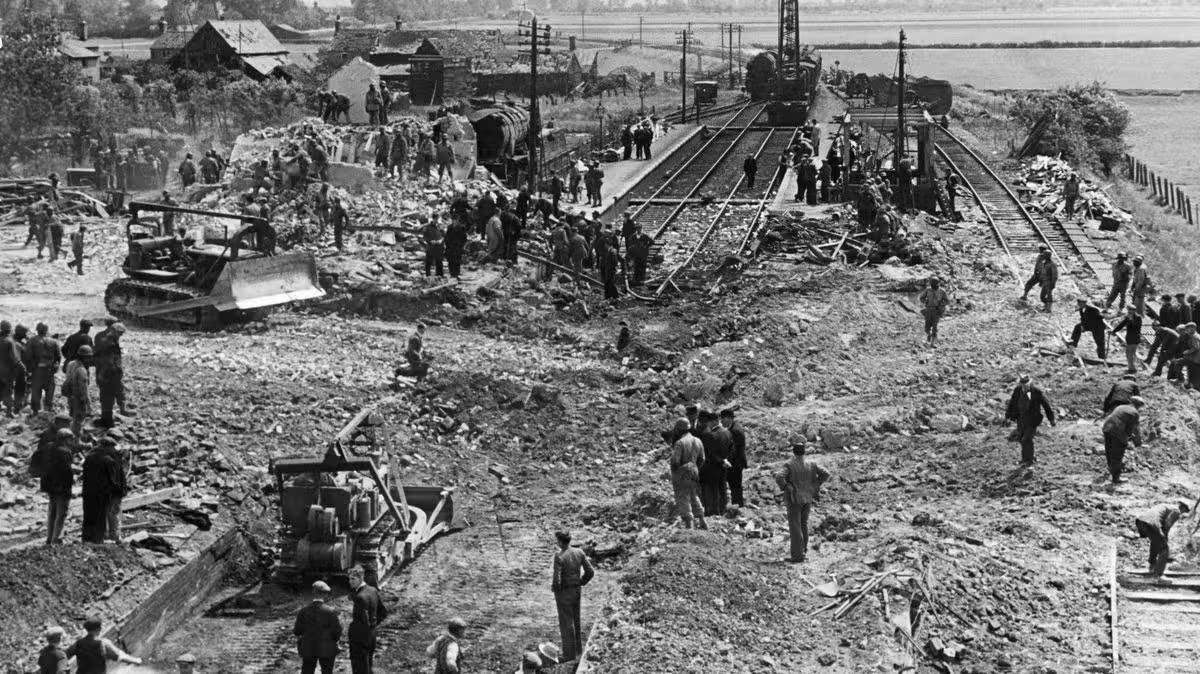
The explosion killed two people and damaged over 700 homes

History has seen some tragedies over its time, and Cambridgeshire has seen its fair few disasters, including major fires and crashes.

Advertisement

One disaster that “almost destroyed” a town was a railway fire that occurred in Soham in 1944. The day was June 2, when a heavy freight train left Whitemoor marshalling yard, near March, just after midnight.

The train was made up of a WD Austerity 2-8-0 engine, 51 wagons and a brake van, and it was headed for Ipswich. On board the train was driver Benjamin Gimbert, 41, fireman James Nightall, 22, and train guard Herbert Clarke.

Around 90 minutes into the journey the train approached Soham station. As it approached, the driver looked back and saw flames coming from the leading wagon.

This wagon contained 44 general purpose bombs, each weighing around 500 lbs. Gimbert stopped the train and instead of running to safety, he told Nightall to uncouple the first wagon from the rest of the train.

Advertisement

Nightall managed to sort this quickly, however the fire grew more serious. Gimbert started to get the wagon away and moved it around 140 yards away.

At this point, he was still alongside the platforms at Soham station and the bombs exploded. A more serious explosion was avoided as a result of the men’s actions.

The blast instantly killed Nightall. Signalman Frank Bridges, who was on the opposite platform, died the next day. Gilbert was badly injured, but didn’t die. Despite being in shock, Guard Clarke managed to walk to the next signal box to warn other signalmen of what happened. Five other people suffered severe injuries and 22 other people suffered minor injuries.

As well as human injury, the explosion created a massive crater, measuring 66ft in diameter and 15ft deep. The station buildings were almost demolished, and there was also severe damage to over 700 homes within a 900-yard radius of the explosion.

Advertisement

Despite the explosion being so severe, the line reopened to freight traffic within 18 hours. The cause of the fire was never fully explained, so it remains somewhat of a mystery.

Source link

Continue Reading

NewsBeat

Trainee barrister ‘caught driving car bomb across Northern Ireland border’ previously spent time in Syria, her lawyer says

Published

on

Isobella Perrie Sullivan, 25, was arrested after Irish police said they made an 'extremely significant seizure' of a device on Wednesday

A trainee barrister who was allegedly caught driving a car bomb towards Northern Ireland in a suspected New IRA operation spent time in Syria, her lawyer said. 

Isobella Perrie Sullivan, 25, was arrested after Irish police said they made an ‘extremely significant seizure’ of a device on Wednesday.

The force said the device, which was made from military-grade plastic, could have caused significant damage. 

It is understood to be the most sophisticated bomb seized by police since the Troubles. 

Advertisement

A man in his 40s was also arrested in the major investigation, with Irish news outlets reporting that the man was a suspected member of the New IRA’s Dublin branch. 

In an intelligence-led swoop, the Garda’s Special Detective Unit stopped the vehicle in transit near the Irish border on Wednesday afternoon on the N2 south of Carrickmacross, County Monaghan. 

Sullivan, from Clane in Co Kildare, was granted bail on Friday after appearing before a special sitting of Trim District Court in Co Meath charged with possession of explosives.

It has now emerged her solicitor Mr Gavin Booth told the court she was a previous member of a ‘political group’ and had spent some time in Syria.

Advertisement

Isobella Perrie Sullivan, 25, was arrested after Irish police said they made an ‘extremely significant seizure’ of a device on Wednesday

Sullivan leaves the after appearing before a special sitting of Trim District Court in Co Meath charged with possession of explosives

Sullivan leaves the after appearing before a special sitting of Trim District Court in Co Meath charged with possession of explosives

Mr Booth, however, said Sullivan had stepped away from politics as she focused on her studies as a barrister. Her notes were reportedly in the back of the car she was driving when arrested.

Advertisement

Sullivan, reportedly known as Perrie, was a student at ATU Donegal in Letterkenny and graduated last year with a law degree.

Mr Booth said his client had been asked to take a bag to the north and was not aware of its contents. He added Sullivan, who lives with her father, had been ‘manipulated’. 

He said her parents are ‘devastated’ and can’t comprehend this week’s events. He added, if she was granted bail, they would keep her on a ‘tight rein and ensure she abides by all conditions’.

Judge Raymond Finnegan granted Sullivan bail on Friday provided she obtained a €15,000 (£12,800) independent surety. 

Advertisement

She, who was wearing a pink White Fox Boutique hoodie at the time, was also ordered to surrender her passport and keep to a strict curfew. 

Her family had to leave medication at Dundalk gardai station, the court was told, because ‘if she doesn’t receive it, her body could go into shock and she could die’. 

The male suspect remained at a Garda station in the Dublin area on Friday night

Garda Commissioner Justin Kelly spoke to reporters on Friday in Templemore, Co Tipperary

Garda Commissioner Justin Kelly spoke to reporters on Friday in Templemore, Co Tipperary

Advertisement

Garda Commissioner Justin Kelly confirmed details of the operation as he spoke to media at a Garda graduation event in Co Tipperary on Friday.

Advertisement

‘To be clear, what we found was an extremely significant seizure,’ he said. ‘So this was an explosive device.’

Commissioner Kelly added: ‘Any seizure of this nature is really concerning.

‘However, we certainly know that there are a small minority of dissident republicans who did not agree with the Good Friday Agreement, they did not put weapons and explosives (out of use), they didn’t, you know, go through with the proper process in relation to decommissioning. So that is something that we continue to deal with.

‘There’s a small minority of these individuals, I would describe them as radicalised republicans, and this is a threat that we’re going to continue to face for some time in An Garda Síochána.

Advertisement

‘We work very closely with our colleagues in PSNI (Police Service of Northern Ireland) and the intelligence services in the UK to deal with this threat. But I want to commend the members of An Garda Síochána who are involved in this operation.’

Mr Kelly also indicated that the bomb was already constructed when it was seized.

‘Unfortunately for operational reasons, I can’t go into the exact detail of the device,’ he said. ‘But what I will say certainly it was a significant explosive device. So certainly not just the seizure of components or pieces.

‘This was an explosive device and it would have or could have potentially caused significant damage.’

Advertisement

The commissioner confirmed the operation relied on intelligence. ‘Obviously, this was not a random stop,’ he said.

‘This is an intelligence-led operation. But, naturally, I can’t go into a lot of that in public.’

Ireland’s Minister for Justice Jim O’Callaghan described the seizure as ‘very worrying’.

PSNI Assistant Chief Constable Davy Beck said police on both sides of the Irish border shared a ‘joint commitment’ to tackle the dissident republican terror threat. 

Advertisement

Carrickmacross is about six miles (10km) from the border between the Republic of Ireland and Northern Ireland.

Sporadic attacks by militant groups, often attempted car bombings, continue in Northern Ireland almost three decades since a peace deal largely ended sectarian violence.

Source link

Advertisement
Continue Reading

NewsBeat

Moment Ukraine backseat gunner shoots down Russian drone from open cockpit – as Putin’s Russia is hit by new wave of long-range strikes

Published

on

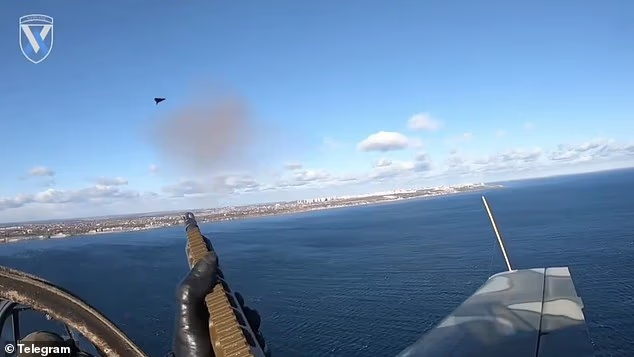
A Ukrainian Yak-52 backseat gunner has shot down a Shahed drone from the plane's open cockpit

The moment a Ukrainian backseat gunner shot down several Russian drones from an open cockpit has been caught on camera. 

Video footage showed a Yak-52 co-pilot sat in the backseat of the plane before aiming his assault rifle and shooting at the Shahed drones.

After firing his rifle in one clip, a thin trail of smoke began to rise from the drones right wing, before the pilot flew closer and it exploded above the sea.

The backseat gunner also recorded shooting down enemy drones which burst into flames, detonated after crashing into a field and fell through the clouds.

Advertisement

The Shahed drones are Iran‘s biggest contribution to Vladimir Putin‘s war which are adapted by Russian forces and used to strike Ukraine.

Footage was released after Russia was hit by a new wave of long-range strikes by the Ukrainian military, including a hit on a key nuclear missile base.

The ‘military barracks’ in the Saratov region was engulfed in flames following a missile and drone alert today.

Engels-2 base is home to Putin’s prized strategic nuclear bombers which have been repeatedly used in KH-101 missile strikes on Ukraine.

Advertisement

A Ukrainian Yak-52 backseat gunner has shot down a Shahed drone from the plane’s open cockpit

Footage captured the co-pilot aiming his assault rifle at the Russian drone before shooting it out of the sky

Footage captured the co-pilot aiming his assault rifle at the Russian drone before shooting it out of the sky

The video footage comes as Ukrainian forces are hitting Russia with a wave of long-range strikes

The video footage comes as Ukrainian forces are hitting Russia with a wave of long-range strikes

Advertisement

There were no reports of any casualties at the airbase located near the city of Engels.

The Ukrainian strike came after new intelligence suggests Putin is plotting a massive autumn offensive, having recruited more Russian men to fight, in an attempt to reverse setbacks.

Ukrainian leader Volodymyr Zelensky warned that his secret service agents assess Putin is poised for a huge new mobilisation draft in September or October.

‘We have clear information from intelligence that Russia is preparing a new wave of mobilisation for the autumn, a rather significant one,’ he said.

Advertisement

‘At the same time, the Russians are losing more of their soldiers on the front lines than they are recruiting, and Putin intends to increase attacks and expand this war. He needs more Russians to participate in the assaults.

‘We must proactively protect ourselves from this – at all levels: on the front lines, through our long-range sanctions, through our mid-range strikes, through our diplomacy, and, of course, through communication with everyone who is able to support life and bring peace closer.’

Ukraine has also been flexing its long-distance unmanned aerial power with strikes on oil refineries.

A refinery some 1,170 miles from the front line in the Siberian city of Tyumen exploded earlier today.

Advertisement
Ukrainian forces have drone striked a Russian oil refinery in the Tyumen region

Ukrainian forces have drone striked a Russian oil refinery in the Tyumen region

Black smoke erupts from an oil refinery in Ulyanovsk that was hit by Ukrainian drones

Black smoke erupts from an oil refinery in Ulyanovsk that was hit by Ukrainian drones

Russia's Amazon, Wildberries, has been attacked by drones ten times in the last week

Russia’s Amazon, Wildberries, has been attacked by drones ten times in the last week

Putin was visiting Omsk, 338 miles away, before a drone alert was issued ahead of his meeting with Kazakhstan’s President Kassym-Jomart Tokayev.

Advertisement

In the Ulyanovsk region, kamikaze drones hit another refinery which burst into flames more than 600 miles away from Ukraine.

The Ministry of Defense of Ukraine also shared drone footage in a post on X titled: ‘A massive Russian armoured assault on Dobropillia axis ended in failure’.

The post showed drones seconds before impact and said Ukrainian forces destroyed nine Russian tanks, two armoured vehicles, three Grad MLRS and dozens of soldiers.

Yesterday Ukraine suffered a major blow with a Russian attack on an arms exhibition which killed ten and left 70 wounded.

Advertisement

Among the dead was Valentyna Savitska, head of the Centre for International Co-operation and Strategic Communications at the State Security Service.

Her husband, Ihor Solovey, head of the Spravdi Centre for Strategic Communications, said: ‘My family is experiencing a terrible tragedy.’

In the last week, Russia’s Amazon, known as Wildberries, has been hit by drones ten times in a blitz of attacks.

The latest strike which took place today narrowly missed a warehouse in Yekaterinburg over 1,000 miles from the front line but it did destroy delivery trucks and force workers to flee.

Advertisement

It is said that the financial impact the war has had on the Russian economy may soon reach £3billion.

Source link

Continue Reading

NewsBeat

Man, 21, dies after horror crash between car and lorry in Moray as police launch probe

Published

on

Daily Record

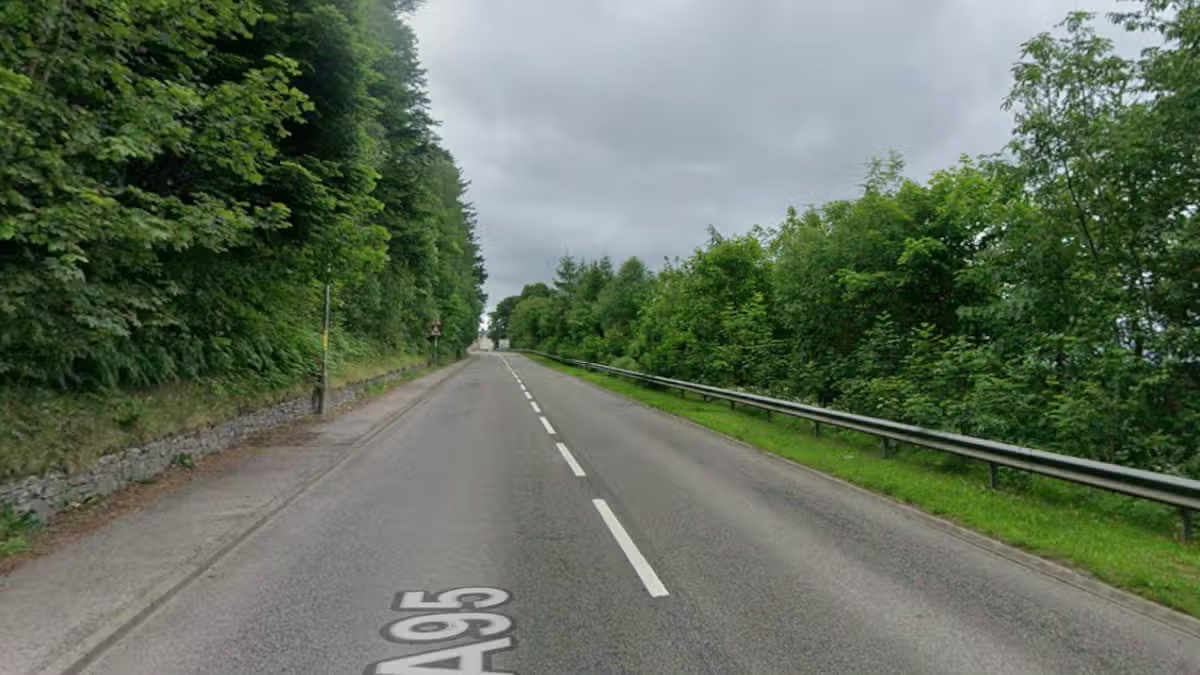
The driver of a Renault Clio was killed in the collision with a Scania lorry in Aberlour.

A young driver has died following a horror crash between his car and a lorry. Mercy crews were scrambled to Aberlour, in Moray, on last night after the smash.

A Renault Clio and Scania lorry collided at around 9.15pm on Friday, July 24, on the A95 between the town’s High Street and the B9138 at Marypark.

The 21-year-old Renault driver was tragically pronounced dead at the scene. The HGV driver was assessed by paramedics. No other injuries were reported.

Advertisement

The road was locked down to allow the police investigation to get underway. After around 15 hours, at 2.30pm on Saturday, July 25, the road was reopened.

Cops have urged anyone who saw the crash or either vehicle before the fatal incident to get in touch. Anyone with dash-cam footage from the area has also been asked to contact Police Scotland.

Sergeant Chris Bain said: “Our thoughts remain with the family and friends of the man who died at this extremely difficult time.

“Our enquiries into the crash are ongoing and I am appealing to anyone who witnessed the crash or saw either vehicle prior to get in touch with officers.

Advertisement

“I’d also ask that those driving in the area at the time with dash-cam footage review this to see if it has captured anything that could assist with our investigation.”

Anyone with information is asked to contact Police Scotland on 101, quoting incident number 3617 of July 24, 2026.

Source link

Continue Reading

NewsBeat

‘If you don’t run, it devours you’: Spain declares national emergency and France calls in army as 270,000 flee wildfires spreading across Europe

Published

on

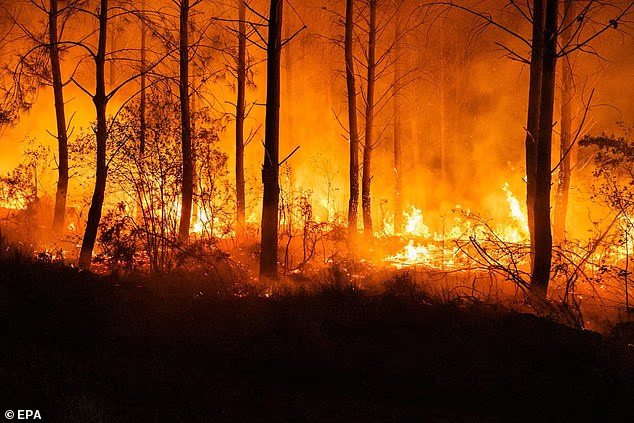
Dramatic pictures released by French authorities show an intense wildfire burning in Biscarrosse, southern France, on Saturday morning

Spain has declared a national emergency and France has called in the army as more than 270,000 people evacuate amid massive wildfires that continue to ravage Europe.

Huge forest blazes have become out of control and are threatening towns across the two countries, with Brits evacuated from hotels and high winds on Saturday are expected to spread the flames further.

Nasa has been forced to abandon a communications complex in Spain, impacting the agency’s ability to communicate with space probes, while an additional 500 troops have been sent in to south-west France to assist firefighters.

Some 197,000 people have been evacuated from the region, while in Spain, the figure has hit at least 70,000 with another 20,000 told to remain indoors.

Advertisement

As a blaze in France rages just 12 miles west of Bordeaux, a fire near Madrid is ‘at its peak’ and is at risk of merging with a second blaze today, something government official Nicanor Sen Velez said would be ‘very bad news’.

Residents have been left terrified as they flee their homes, with one Spanish resident describing how ‘if you don’t run from it [the fire], it devours you’.

A national wildfire emergency has now been declared in Spain and the European Union has been drafted in to help and is deploying seven planes to the two countries to help firefighting efforts.

Elsewhere, wildfires have also been reported in Sicily, Italy and Alijó, Portugal, as another record-breaking summer has left ‘tinderbox’ conditions across Europe, with the threat of yet more fires breaking out still severe.

Advertisement

And in Britain, a large fire in Cairngorms National Park in Scotland has seen some 500 firefighters tackling the blaze – with experts warning changing wind today could see it get worse. A major incident has been declared.

Dramatic pictures released by French authorities show an intense wildfire burning in Biscarrosse, southern France, on Saturday morning

Huge forest blazes have become out of control and are threatening towns across Europe (Pictured: Blaze in Biscarrosse)

Huge forest blazes have become out of control and are threatening towns across Europe (Pictured: Blaze in Biscarrosse)

Advertisement
A huge fire is also ongoing in the Cairngorms National Park in Scotland (pictured on Friday)

A huge fire is also ongoing in the Cairngorms National Park in Scotland (pictured on Friday)

Firefighters in France try to prevent the spread of a blaze in Lege-Cap-Ferret, south-west France

Firefighters in France try to prevent the spread of a blaze in Lege-Cap-Ferret, south-west France

A firefighter targets water onto a blaze in south-west France late on Friday

A firefighter targets water onto a blaze in south-west France late on Friday

Castilla-y-Leon district's firefighters battle a fire surrounding La Atalaya residential area in El Tiemblo on Saturday

Castilla-y-Leon district’s firefighters battle a fire surrounding La Atalaya residential area in El Tiemblo on Saturday

Advertisement
Spanish firefighters hoped to get control of wildfires raging near Madrid on Saturday but an official warned that erratic winds threatened to fan the blazes further

Spanish firefighters hoped to get control of wildfires raging near Madrid on Saturday but an official warned that erratic winds threatened to fan the blazes further

Firefighters wait on a road near Lacanau, south-west France, on Saturday

Firefighters wait on a road near Lacanau, south-west France, on Saturday

Bystanders look on as fire and smoke billow across Castres-Mazamet aerodrome, near Labruguiere in south-western France on Friday

Bystanders look on as fire and smoke billow across Castres-Mazamet aerodrome, near Labruguiere in south-western France on Friday

Firefighters battle a wildfire in Fresnedillas area, near El Escorial, north of Madrid, Spain on Saturday

Firefighters battle a wildfire in Fresnedillas area, near El Escorial, north of Madrid, Spain on Saturday

Advertisement
Aerial images show the devastation left behind in Spain by huge wildfiers - some 63,000 people have been evacuated in the country

Aerial images show the devastation left behind in Spain by huge wildfiers – some 63,000 people have been evacuated in the country

A burnt out car on Sicily Island in Italy on Friday, after a wildfire ravaged the area

A burnt out car on Sicily Island in Italy on Friday, after a wildfire ravaged the area

A fire map from Nasa shows the concentrated blazes to the west of Madrid and Bordeaux

A fire map from Nasa shows the concentrated blazes to the west of Madrid and Bordeaux

Dozens of firefighters have been injured, authorities have said, but no fatalities have been reported. 

Advertisement

In France, thousands of people were evacuated from suburbs near Bordeaux on Saturday as wildfires in areas around the city showed no signs of abating.

Local official Sophie Brocas said the areas of Le Haillan, Eysines and Merignac were being fully cleared of residents. 

Prime Minister Sebastien Lecornu said more than 141,000 people had so far been evacuated from the Gironde and Landes regions with motorists also advised to avoid the region. 

The fire has so far ravaged 40,000 hectares of land, and 500 soldiers are currently deployed to assist firefighting efforts, with that number set to rise to 1,000 over the weekend.

Advertisement

‘The fires that are hitting our country have reached a level that has never been seen before,’ Lecornu wrote on X on Saturday. 

So far this month, temperatures have averaged 32.2 degrees Celsius (90 Fahrenheit) across the broader Aquitaine region, which is 7.3C (13.1F) above the normal high for July between 1961 and 1990.

Mass evacuations have been taking place throughout the day – including by boat – from Cap Ferret in southwestern France, some 40 miles from Bordeaux, where wildfires have burnt through thousands of hectares of forest and destroyed luxury villas.

Many had been woken in the middle of the night and had bagged as many of their belongings as possible and scooped up their pets to head to Hall 3 of the Parc Des Expositions De Bordeaux.

Advertisement

Around 1,000 camp beds had been made available, all of which had been snapped up by 4am this morning. At least 5,000 people were crammed into the stuffy hall by 8am, some of whom had arrived seven hours earlier.

Trestle tables were set up filled with board games, toys and books for children. Bottles of water were handed out to those who were seeking shelter.

Valerie and Peter Horrilo left their home in Saint-Aubin-de-Médoc at 1am after getting the alert.

Sitting on a camp bed, 56-year-old Valerie said: ‘We’ve tried to sleep but it’s difficult, there’s a lot of news and the lights are on. I’ve used my earplugs, which have helped a little, but it’s not been the best night of my life.

Advertisement

‘As we got into the car to leave home, all our neighbours were doing the same.

‘Everyone was very calm. We’d been expecting to be evacuated at some point in the evening because the local authority had warned us that the smoke was drifting over towards our direction.

Thousands of people in southwest France have been evacuated to Hall 3 of the Parc Des Expositions De Bordeaux

Thousands of people in southwest France have been evacuated to Hall 3 of the Parc Des Expositions De Bordeaux

Evacuated residents Loic Dumont (centre) with his sister Sandrine (left), son Enzo, 18 wife Marie, 44 and daughter Zoe, 15

Evacuated residents Loic Dumont (centre) with his sister Sandrine (left), son Enzo, 18 wife Marie, 44 and daughter Zoe, 15

Advertisement
Valerie and Peter Horrilo left their home in Saint-Aubin-de-Médoc at 1am after getting the alert

Valerie and Peter Horrilo left their home in Saint-Aubin-de-Médoc at 1am after getting the alert

People sleep on carpet tiles in France after being evacuated from wildfire zones

People sleep on carpet tiles in France after being evacuated from wildfire zones

Evacuated residents queue for food after fleeing their homes in the dead of night at Bordeaux's exhibition hall

Evacuated residents queue for food after fleeing their homes in the dead of night at Bordeaux’s exhibition hall

Some 1,000 camp beds had been set up in the hall, with around 5,000 people having arrived by 8am on Saturday

Some 1,000 camp beds had been set up in the hall, with around 5,000 people having arrived by 8am on Saturday

Advertisement
Local residents evacuated to Bordeaux Expo Centre take a nap outside

Local residents evacuated to Bordeaux Expo Centre take a nap outside

A map shows the risk of wildfires breaking out across Europe for this week

A map shows the risk of wildfires breaking out across Europe for this week

‘We had a bag packed with clothes so when the phone alerts sounded, we were all ready to go.

‘From our home we can see and smell the smoke and ash falls from the sky like snow, but the fire is far away. We still have some Covid face masks left over and we’ve been using them when we’ve been outside.

Advertisement

‘We don’t know when we’ll be allowed back, I hope soon but it depends on the wind direction. We’re also due some rain, which is badly needed.’

Peter, 63, added: ‘We were on holiday in Greece two years ago when a typhoon forced us to sleep on the floor of a local airport so we have a little experience of this, but I’ve never been made to leave my home before.

‘We are trying to make the best out of a bad situation, we are safe at least and as comfortable as possible.’

Loic Dumont, 49, left home at 1am in Saint Aubin with wife Marie, 44, son Enzo, 18 and 15-year-old daughter Zoe as well as their three dogs and pet cat.

Advertisement

He met his sister Sandrine Dumont at the shelter after she too had been forced to evacuate.

He said: ‘We were expecting to have to leave home at some point so we already had the bags in the car.

‘When we got here in the middle of the night it was a little busy but thousands of people have arrived since and the hall is now nearly full.

‘We didn’t want to take up any of the camp beds because there were older people who needed them more but we asked volunteers who are helping at the shelter if they had anything we could sit or lie on.

Advertisement

‘They managed to find us half a dozen of what look like carpet tiles that make lying on the hard floor a bit more comfortable. I couldn’t sleep so ended up going to my car and trying to get a few hours rest instead.

‘We’ve got enough food and snacks and everyone is banding together. I hope we’ll be able to go home soon as we’re not near the fires at all, it’s just the smoke drifting over that may be harmful.’

Xavier Delort, 57, was sitting with friends at a table reading the local Sud Ouest newspaper with a dramatic front page picture of the forest fire accompanied by the headline ‘L’apocalypse’.

In broken English, he said: ‘Everything is ok. We’re here just as a precaution. We’re feeling good.’

Advertisement

Sitting across from Mr Delort was Cecilia Racheme, 47, who had jumped in a cab at 4am with her two sons, aged 16 and six, from their home in Mérignac, a suburb east of Bordeaux’s centre.

Some 140,000 people have been evacuated in France due to raging wildfires

Some 140,000 people have been evacuated in France due to raging wildfires

French firefighters tackle a blaze in Lege-Cap-Ferret in south-west France on Friday

French firefighters tackle a blaze in Lege-Cap-Ferret in south-west France on Friday

The blaze in Scotland (pictured) could get worse today as changing winds make it increasingly unpredictable

The blaze in Scotland (pictured) could get worse today as changing winds make it increasingly unpredictable

Advertisement
Flames in a forest in El Tiemblo, 80km west of Madrid, on Saturday

Flames in a forest in El Tiemblo, 80km west of Madrid, on Saturday

A wildfire burns near Lacanau, to the west of Bordeaux, on Saturday

A wildfire burns near Lacanau, to the west of Bordeaux, on Saturday

Dozens of firefighter trucks are parked in a support line between the villages of Lacanau and Saint-Helene in the Bordeaux region, south-west France, today

Dozens of firefighter trucks are parked in a support line between the villages of Lacanau and Saint-Helene in the Bordeaux region, south-west France, today

A burned house and vehicle in Lanton, in the Lege-Cap-Ferret region on Saturday

A burned house and vehicle in Lanton, in the Lege-Cap-Ferret region on Saturday

Advertisement
A view of the damage in the Casaboli Forest following a wildfire, near Palermo on Sicily island

A view of the damage in the Casaboli Forest following a wildfire, near Palermo on Sicily island

A firetruck moves to battle a wildfire affecting Castile y Leon province, in the village of El Tiemblo, Spain, on Friday

A firetruck moves to battle a wildfire affecting Castile y Leon province, in the village of El Tiemblo, Spain, on Friday

Firefighters assess the area outside the village of El Tiemblo during efforts to battle a wildfire affecting Castile y Leon province, Spain

Firefighters assess the area outside the village of El Tiemblo during efforts to battle a wildfire affecting Castile y Leon province, Spain

She said: ‘I was worried because the SMS alert came during the early hours when it was dark and I didn’t know how far the fires were.

Advertisement

‘We could smell the smoke and so that unnerved me a little.

‘As much as I want to go home, I’m concerned that we’ll be in danger from the smoke and possibly the flames if they spread this far.

‘We’ve bought some food and snacks from home. I hope this is all over soon.’

Most of those in the exhibition centre seeking shelter from the wildfire are local French families but one British father of two had been evacuated with his wife and young children from a hotel close to Bordeaux Airport.

Advertisement

He declined to give his name but said he was on holiday from Solihull in the West Midlands, adding: ‘We’d been in a campsite near Gastes but moved over to Bordeaux to get away from the fire.

‘We’d been in a hotel overnight when the alert came at 4am for us to vacate. Luckily, this has happened right at the end of our two week holiday and we’re hoping to fly back home later today… as long as the flight isn’t cancelled.’

In neighbouring Spain, firefighters hoped to get control of wildfires raging near Madrid on Saturday but an official warned that erratic winds threatened to fan the blazes further.

The fires in the parched countryside have forced 63,000 people to flee their homes or remain indoors, the interior ministry said, in what officials have called the region’s worst fire on record.

Advertisement

Thick grey smoke filled the sky west of the capital and the smell of burning reached the streets of central Madrid.

With temperatures dipping, ‘there is a real opportunity now to tackle this fire with some guarantee of success’, the central government’s delegate in Madrid, Francisco Martin, told reporters late Friday.

On Friday, ‘the temperature has dropped, the wind has eased and the relative humidity has risen,’ he said.

But he warned that Saturday would be ‘difficult’ as ‘the wind is expected to rise in the morning, with rather erratic gusts’.

Advertisement

The Madrid regional government’s emergency management chief Carlos Novillo had told reporters earlier Friday that the fire was ‘at its peak and… currently beyond the capacity of firefighters to contain’.

Two separate wildfires combined on Friday to become one huge blaze, which was close to merging with yet another near Avila in the neighbouring Castilla y Leon region.

The fires have burned 25,000 hectares, the Spanish interior ministry said today, ravaging nearly 10,000 hectares in the Madrid region and ‘between 13,000 and 15,000’ in the neighbouring province of Avila.

The total is more than twice the surface area of the city of Paris.

Advertisement

The Madrid regional government said on X that more than 2,000 people were being looked after in 14 emergency evacuation centres.

Interior Minister Fernando Grande-Marlaska told reporters Friday there were nine other fires at various locations in Spain.

In Scotland, the Cairngorms fire is at risk of flaring up again on Saturday after a change in wind direction.

Some 500 firefighters have been tackling it over the last nine days, alongside specialist wildfire appliances, all-terrain vehicles, helicopter water-bombing operations and partner agencies. 

Advertisement

People in the Nethy Bridge area were evacuated overnight as a precaution after Police Scotland declared the blaze a major incident.

Residents are being directed to a dedicated respite centre at the Macdonald Aviemore Hotel, and access roads into Nethy Bridge have been closed. 

Police Scotland Superintendent Judy Hill said: ‘The weather conditions experienced within the Cairngorms over the last 24 hours have added further complexities to this situation.

‘With evidence suggesting the fire is spreading towards Nethy Bridge, the decision has been taken to declare a major incident and evacuate residents as a precaution.

Advertisement

‘Additional police resources are being deployed to assist in contacting those who need to leave their properties and to maintain cordons around restricted areas while our fire service colleagues continue to tackle the wildfire.

‘We understand this is a very concerning time for residents, businesses and visitors to the Cairngorms region.

‘Please be assured that the multi-agency response remains fully committed to bringing this incident to a safe conclusion as quickly as possible.’

The Scottish Fire and Rescue Service said it has maintained a ‘significant operational response’ since the wildfire was first reported on July 15.

Advertisement

The smoke from the fire can now be seen as far away as Aberdeen. 

Source link

Continue Reading

NewsBeat

NHS waiting lists are finally getting shorter, but not fairer everywhere

Published

on

NHS waiting lists are finally getting shorter, but not fairer everywhere

After years of grim records, the NHS in England finally has some good news to report. The waiting list for planned hospital care has begun to edge down, and the share of patients treated within the 18-week target has climbed, from 59.8% in March 2025 to around 63% a year later. Ministers, who have promised to restore the 92% standard by 2029, are keen to claim momentum.

Until recently, it was difficult to say whether that recovery was reaching everyone equally. That changed in July last year when NHS England began publishing waiting-time data broken down by deprivation, age, sex and ethnicity for the first time. New analysis of this data by the Health Foundation, an independent health policy charity, gives us some answers.

The charity found that, nationally, the differences are narrow. In April 2026, 62.5% of people living in the most deprived areas had waited less than 18 weeks, compared with 63.6% in the least deprived. That 1.1 percentage point gap is the smallest since the NHS began publishing this breakdown, down from around 1.8 points in June 2025.

It would be easy to file that under “problem largely solved”. But a percentage point stops looking small when you work out what it means for real patients.

Advertisement

That 1.1 percentage point gap may sound small, but it amounted to around 7,400 people in the most deprived areas waiting more than 18 weeks for treatment in a single month. Repeat that month after month and that “trivial” gap becomes a great many people waiting in pain and anxiety.

Where are the gaps biggest?

Inequalities between rich and poor areas exist across almost every speciality. They are largest in plastic surgery, where patients in the richest areas are seven percentage points more likely to be treated on time than those in the poorest areas. Dermatology and urology also have large gaps, at five percentage points each.

The national figure also hides big local differences. Nearly two-thirds of the NHS bodies responsible for planning health services (integrated care boards) in their local area have bigger gaps than the national average. In other words, averaging the whole country together makes the problem look smaller than it is in many places.

The ethnic differences follow a similar pattern. People from Indian, Pakistani and Bangladeshi backgrounds consistently wait longer, at 60-61% seen within 18 weeks.

Advertisement

Again, the aggregate understates it: in dermatology, just 54% of south Asian patients were seen within 18 weeks, compared with 63% of white British, Irish and other white patients – a nine-point gap. For Black African, Caribbean and other Black patients, the difference is around six percentage points.

However, people living in poorer areas and some minority ethnic groups are younger on average, and the NHS quite properly prioritises patients who are older, more seriously ill, or at greater risk if they wait.

Dermatology illustrates this challenge. Patients suspected of having skin cancer are often moved up the queue, and skin cancer is more common in older people and those with lighter skin. So some differences in waiting time may reflect legitimate clinical priorities rather than discrimination.

Patients suspected of skin cancer are moved up the queue.
Evgeniy Kalinovskiy/Shutterstock.com

But that explanation only stretches so far. Earlier analysis found that inequalities in waiting times persisted even after taking age into account. Combined with the fact that gaps appear across almost every speciality and much of the country, this suggests they cannot simply be explained by differences in patient populations or geography.

Advertisement

Research suggests that practical barriers may also play a role – from struggling to get to appointments and finding transport to problems accessing interpreters, taking time off work and navigating a complicated NHS system.

Reasons to be optimistic

Despite this, the findings are genuinely encouraging.

Inequalities in the longest waits (over 52 weeks) have narrowed substantially, driven largely by five areas with high levels of deprivation: Birmingham, Solihull, Greater Manchester, Lancashire and South Cumbria. Meanwhile, some of the best-performing systems, such as Gloucestershire, record among the smallest differences. Places are managing to be fast and fair at the same time.

That matters, because it lays to rest a stubborn assumption. Speed and fairness have long been treated as a trade-off, as though narrowing gaps must inevitably mean missing targets. The past year offers real-world evidence that this is a false choice: several of the systems that cut their longest waits fastest were those serving the most deprived populations.

Advertisement

None of this happened by accident. It took a decision to start publishing the data, and sustained work in places like Lancashire and South Cumbria to act on what they showed. How many people are waiting and who is waiting longest remain different questions – but for the first time we can answer both, and both answers are moving in the right direction.

This is a genuine opportunity, and now is the time to act on it, while the recovery is still gaining ground. It means sharing what the best-performing systems have learned, continuing to track progress as waiting times fall, and treating fairness as an ongoing part of the job – not something to deal with once targets are hit. The task now is to keep that going.

Source link

Advertisement
Continue Reading

NewsBeat

The sex position both men and women secretly think is ‘one of the worst ever’

Published

on

The sex position both men and women secretly think is 'one of the worst ever'
Sex positions are purely preferential but there’s one that both sexes aren’t a fan of (Picture: Getty Images)

While men aren’t a fan of the classic cowgirl, and women hate it in reverse, how we like it in bed will always be a hot topic.

Of course, everyone has their own personal preferences, but there’s one position that both men and women agree is ‘one of the worst ever’.

What is it, you ask? It’s the 69, and both sexes have the exact same complaint… they don’t like multi-tasking.

It’s an understandable gripe, with countless men and women taking to Reddit to decry the oral act.

Advertisement

Here’s what the guys had to say…

One 28-year-old guy wrote: ‘Not a fan. I love giving. I love receiving. 69 makes it hard for me to enjoy either part. I don’t like someone’s crotch in my face when I’m receiving… and the BJ is really overwhelming for me when I’m trying to give pleasure.’

Ask Metro


Use AI to go deeper into the stories you care about – powered by Metro and trusted publications.

Advertisement

The off-putting nature of this multi-tasking was summed up perfectly by a fellow male Redditor, who said: ‘It’s like two people giving each other a massage. Feels like for the relaxation to be fully enjoyed, one person should go at a time.’

Cuddling
Men aren’t a fan because they either want to give during oral sex, or receive (Picture: Getty Images)

Sign up to The Hook-Up, Metro’s sex and dating newsletter

Love reading juicy stories like this? Need some tips for how to spice things up in the bedroom?

Sign up to The Hook-Up and we’ll slide into your inbox every week with all the latest sex and dating stories from Metro. We can’t wait for you to join us!

Advertisement

Others shared how they’d never climaxed or made their partner climax while 69-ing, while others admitted they’d get more pleasure taking turns.

‘The main problem with this position is that you are both givers and takers at the same time,’ added another. ‘As a giver it’s hard to focus, and as a taker you can’t relax. It’s one of the worst positions ever.’

Here’s what the women thought, too…

In the case of the 69, it’s clear men and women are singing from the same hymn sheet.

‘I don’t enjoy oral unless I can really concentrate on every subtle thing that he does and how good it feels,’ explained one woman. ‘Otherwise it just feels like someone tickling me in an uncomfortable way.

Advertisement

‘And when I have a d**k in my face, I am pretty unaware of anything going on with the rest of my body. It’s just so demanding and there in my face. So it end up being a blow job in an uncomfortable position with someone tickling me somewhere and an obligation to enjoy it.’

In fact, a study of more than 2,000 women found that, for 29%, the 69 was the most disliked sex position. Site Seduce AI, which conducted the study, found women cited the division of attention between giving and receiving pleasure to be a turn off.

They also felt they couldn’t focus on their own sexual feelings, which caused frustration and a lack of sexual satisfaction. Honestly, getting to the finish line can be hard enough as it is.

One woman added: ‘I don’t like it. It’s supposed to be double fun, but I can’t focus on any of the two and as a result neither of the two is fun.’

Advertisement

Others shared they were ‘surprised anyone actually likes it’.

Couple in the bedroom
Some women also feel self-conscious with their behinds on display (Picture: Getty Images/iStockphoto)

For some women, it’s too close for comfort

But unlike men, women shared another pitfall they felt stopped them from being able to enjoy the position.

‘There’s nothing appealing about it, and I’d feel self-conscious in that position,’ one lady admitted.

It’s not hard to see how having your naked behind on full display less than two inches from someone’s face might make you a bit nervous – it’s pretty exposing.

Another woman agreed, adding: ‘It’s a really awkward blowjob angle and his nose ends up too close to my butthole for comfort.’

Advertisement

The 69 is the marmite of sex

‘No sex position is for everyone but people have a lot of divisive opinions about 69-ing – they either love it, or they hate it,’ sexologist and author of Kink Curious, Gigi Engle, tells Metro.

‘In my experience, most people don’t like it.’

For Gigi, she agrees it can be a lot of work and can result in a loss of focus.

‘Giving a blowjob to a penis can be a lot of work, and takes a lot of focus, it can also be pretty exhausting on the jaw for some people,’ she explains.

Advertisement

‘The part women tend not to like about it is it can be difficult to enjoy the oral they’re giving you, because you can’t focus on your own pleasure and experience.’

Our bed is short
No sex position is for everyone (Picture: Getty Images)

She also adds that the 69 won’t be a favourite for people who like lots of eye-contact during sex, but she does think it’s a great position in its own right.

‘No sex position is for everyone, but 69-ing can be really fun, the focus just needs to be less about climaxing and more about experiencing the pleasure you’re giving each other,’ she says.

‘It doesn’t need to be about putting on a performance, just enjoy the intimacy of pleasuring your partner, while they’re pleasuring you.’

Proving there’s no one fits all when it comes to sex, though, once writer who recently took part in Metro’s How I Do It sex diary revealed how it had become her favourite way to end a night.

Advertisement

‘These days, 69 is definitely our ‘go to’ position for passion. We always finish together and my orgasms are so much more intense (and frequent),’ she said.

‘We may not have as much penis in vagina sex as we used to back in the day and pre-kids, but all our sexual encounters are so much more satisfying.’

Ultimately though, if the 69 is a turn off for you, that’s totally fine. As Gigi says, it’s ‘different strokes for different folks’.

Do you have a story you’d like to share? Get in touch by emailing MetroLifestyleTeam@metro.co.uk

Advertisement

Source link

Advertisement
Continue Reading

NewsBeat

Twenty firefighters hospitalised after explosion sparked massive blaze that destroyed three fire engines at Essex industrial unit

Published

on

An aerial image of the site showed the extent of the blaze yesterday which involved more than 100 firefighters

Advertisement

Twenty firefighters were hospitalised after a fire which followed an explosion at an industrial unit housing fertiliser in Essex yesterday.

More than 100 fire crew had responded to the fire, which came after an explosion heard across the county thought to have come from the industrial unit which housed fertiliser.

Three fire engines and two fire officer cars were also wrecked, according to Rick Hylton, chief fire officer at Essex County Fire and Rescue Service.

Four of the hospitalised firefighters were treated for minor injuries, while the rest were checked for hearing loss.

Advertisement

All have now been discharged, Mr Hylton said, adding crews would remain at the scene but that the fire had been put out.

He said it was one of the ‘most challenging and complex incidents’ his force had responded to in years.

Firefighters worked ‘tirelessly in extremely challenging and hazardous conditions’ from yesterday to this morning to stop the ‘large and rapidly developing’ fire from spreading further, he added.

Residents described hearing loud booms from a farm estate just before 6pm yesterday and were warned by emergency services to keep doors and windows closed. 

Advertisement

An aerial image of the site showed the extent of the blaze yesterday which involved more than 100 firefighters

Aerial footage showed buildings and vehicles on fire by Southend Road, between East Hanningfield and Rettendon, as dozens of fire engines and ambulances lined the roads nearby. 

According to reports, the explosion was heard up to nearly 15 miles away from the scene of the fire. Some said they heard the blast in Southend, around a 30-minute drive away.

Advertisement

Another resident reported on social media that a relative’s house had been damaged by the sheer force of the shockwave.

The first emergency call about the fire was made at around 4.50pm yesterday before a major incident was declared just under an hour later following the fertiliser unit explosion. 

It is understood a field and industrial units caught fire before fertiliser inside one of the units exploded while fire crews were on the scene. 

At a press conference today, Mr Hylton said an investigation into the fire’s cause was underway and urged the public not to speculate.

Advertisement

He said: ‘The fire and explosion has also destroyed three fire engines and two officer cars that were being used to respond to the incident. This underlines the scale and intensity of the conditions our crews faced.

‘I also want to provide an update on the welfare of our firefighters. I can confirm that 20 firefighters attended hospital following the incident.

‘Of that 20, four suffered minor injuries, and the remainder were precautionary assessments, including checks for issues such as hearing loss following the explosion.

‘I am pleased to confirm all of those firefighters have now been discharged from hospital.’ 

Advertisement
An explosion rocked homes across Essex as the fire erupted at an industrial unit in Southend Road, between East Hanningfield and Rettendon

An explosion rocked homes across Essex as the fire erupted at an industrial unit in Southend Road, between East Hanningfield and Rettendon

The chief fire officer added: ‘The incident is now under control, although firefighters will remain at the scene, dealing with the remaining hotspots and supporting the transition into the recovery phase.’

‘Firefighters arrived quickly and were faced with a large and rapidly developing fire involving several units and surrounding farmland.

‘At 5.46pm, following an explosion involving fertiliser within one of the industrial units, Essex County Fire and Rescue Service declared a major incident.

Advertisement

‘We took that decision because of the scale and complexity of the incident, the significant resources required to bring the fire under safe control, and the need to co-ordinate a multi-agency response.’

Advertisement

Source link

Advertisement
Continue Reading

NewsBeat

The Grossest Things People Do At Coffee Shops

Published

on

The Grossest Things People Do At Coffee Shops

I work from cafes most days. My regular place is good, but sometimes on my travels, I see things that make me question my caffeine addiction.

More than once, I’ve watched someone finish a glass of water and put their empty cup back in with the clean ones. So, now when I pick up a glass and it’s damp, I can’t tell if it’s wet from use or wet because it’s been washed, and I go without. It’s one of many unhygienic behaviours that seem rife in coffee shops.

Daniel Day via Getty Images

You may want to think twice before pouring from that shared milk carafe into your coffee.

Matt Woodburn-Simmons worked as a barista for years and now runs the Home Coffee Expert website. His first rule is: do not touch the milk.

Advertisement

In the hotter months, especially, people drink straight from the communal carafe, he said. “Full lips wrapped around it and chugging the milk while waiting for their coffee. I imagine people would rather their milk was not French kissed by a stranger before use.”

The honey is nearly as bad. Woodburn-Simmons watched people squeeze it onto a finger and lick it or wipe the drip from the nozzle and lick that, too. “Hundreds of fingers a day going onto the end of the honey nozzle is a superspreader event waiting to happen,” he said.

Shanina Knighton, an infection preventionist and nursing professor at Case Western Reserve University, can explain why the milk is so bad.

“Milk is about the friendliest thing you can hand a bacterium,” she said. “It is full of protein and sugar, it sits warm or lukewarm in the line, and it leaves a thin film on everything it touches. That film is where the trouble starts.

Advertisement

“Once a little milk dries onto a spout, a gasket or the inside of a dispensing tube, it gives bacteria a place to settle, and what grows there is a biofilm, a sticky layer of microbes that anchors to the surface and laughs off a quick rinse.”

I would never touch the milk, ever.

Topping up a half-empty jug only makes it worse. “When someone adds new milk on top of the old without emptying and washing the container first,” Knighton said, “whatever was living in that residue gets a fresh meal and a running start.”

Woodburn-Simmons saw that happen often. “Milk jugs with a crust around the spout,” he said, refilled multiple times and never cleaned. “I would never touch the milk, ever.”

Advertisement

Lids are also a concern. Elliot Sterling once watched a man find the communal milk almost empty, shake it vigorously over his cup, and then place his whole hand flat on the lid stack and drag it smoothly down the entire row. “Three people used those lids after him,” Sterling said, “and I used them as well before I realised what was happening.” He takes his from the middle of the stack now.

“People separate a stack by pawing through several lids before they commit to one,” Knighton said, “and the part they are handling is the same part that ends up against someone’s mouth. Most of what we touch in a day never reaches our lips, so it forgives a lot. A lid rim does not.”

“Lids themselves were never cleaned, just left on the assumption they were fine,” Woodburn-Simmons said. When the morning rush hit, the wipe-downs lapsed too. “Wiping down the area became an only-when-absolutely-necessary job,” he said, which on a bad morning meant “three to four hours.” He still remembers the puddles of spilled milky coffee left to spoil and people setting their lids down in them.

The horror stories continue. At a Toronto coffee shop, Philip Stoelman saw a customer lick the communal stir spoon and drop it straight back in the jar. “That person didn’t even think twice,” he said. Stoelman has carried his own stir stick ever since. JoAnne Loftus switched to a water bottle after watching someone in an Austin cafe rinse a used mug in the self-serve water-glass bin and refill it. “They didn’t even use the sink,” she said.

Advertisement
At a Toronto coffee shop, Philip Stoelman saw a customer lick the communal stir spoon and drop it straight back in the jar.

Tatiana Terekhina via Getty Images

At a Toronto coffee shop, Philip Stoelman saw a customer lick the communal stir spoon and drop it straight back in the jar.

Knighton has her own story. She once ordered an iced latte and watched the worker handle a credit card, then reach in and “grab the tip of my straw with their bare hand.” She asked for a fresh one. The worker held up the box kept under the counter. “Every straw in it had a visible coating of dirt,” she said. “They were clear straws, so there was no missing it.”

Woodburn-Simmons has a longer list. Customers clipped their nails while they waited, “nail clippings going everywhere.” Parents handed sugar packets to children who sucked on them and put them back – “kids being germ factories.” One person even fished an unused sugar packet out of the bin and put it back.

By now you might want to swear off self-serve stations entirely, but you don’t have to. “Bacteria live on practically everything we touch,” Knighton said, “so the real question is never whether something is there, but whether enough of the wrong kind is there to matter.”

Dr. Shilpi Agarwal, a board-certified family physician, has two rules at the station. The first is about the lid. “Customers often put their lid face down on the counter,” she said, after a mouth or dirty hands have already been on it. “Place down a napkin, then place your lid on there rather than resting it on the bare counter.”

Advertisement

The second rule skips the station altogether. “Ask for a top-off of warm milk,” she said, so the barista handles the dairy, and you never touch the jug. “Only touch what you need.”

Knighton’s test for a bad station needs no equipment. “Learn to read a station by its moisture rather than its shine,” she said. “Standing liquid, crusted residue, overflowing trays and a sticky dispensing area tell you far more about how a place is run than a spotless countertop ever will.”

I’m still a coffee addict, though after speaking to Woodburn-Simmons, I’m beginning to consider quitting. “The general public are way more disgusting than you think they should be,” he told me.

Advertisement

Source link

Continue Reading

Trending

Copyright © 2025