

Crypto World
Wall Street’s newest short desk is a blockchain



When SpaceX went public, the only place most of the world could short it was Hyperliquid, where a perpetual future tracked the IPO of the decade tick for tick, and a whale ran a $14 million leveraged short no brokerage would have offered. Equity perps are the first crypto product Wall Street cannot ignore, and regulators cannot place, and this is the audit of what they actually are.
Summary
- Hyperliquid, the dominant on-chain derivatives venue with roughly 70% of decentralized perpetuals volume and around $1.3 billion in annualized fees, now lists perpetual futures on stocks, with its SpaceX contract as the breakout case.
- The SPCX perp traded the IPO of the decade before, during, and after the listing, ran to a $228.74 high alongside the stock’s $225.64 peak, tracked its 48% collapse, and hosted positions like a 10x-leveraged $14 million short paired with a 40x $60 million Bitcoin short, structures no retail brokerage offers.
- Equity perps deliver what the equity market rations: 24/7 trading, high leverage, short exposure without locates or borrow fees, and access for the global majority locked out of US brokerage accounts, all against an oracle price and a funding rate instead of shares.
- The product’s honesty requires its limits: holders own no equity, no dividend, no claim, only a synthetic exposure whose integrity depends on oracle quality and venue solvency, on platforms mostly outside US jurisdiction.
- The regulatory placement is unresolved by design: synthetic equity exposure with no share changing hands sits between the SEC’s securities world and the CFTC’s derivatives world, on infrastructure neither reaches, and the CLARITY-era jurisdiction map does not cover it.
The most interesting trade of June was not in a stock. When SpaceX completed the largest IPO in history and its shares began their 48% descent, an anonymous trader on Hyperliquid, the blockchain derivatives venue, was running a combined position no prime broker would have blessed and no retail app could have executed: a $60 million Bitcoin short at 40x leverage paired with a $14 million short on SPCX at 10x, a pure bet on the deflation of the year’s twin euphorias, placed on rails that never close, require no borrow, and asked no questions.
The instrument making it possible, the equity perpetual future, is the crypto industry’s quiet invasion of the stock market: a synthetic contract that tracks a share price via oracle, settles in stablecoins, charges longs or shorts a funding rate to keep the peg, and trades around the clock at leverage American brokerages reserve for institutions, on venues most of the world can reach with a wallet.
Hyperliquid’s SPCX contract, born before the IPO priced and still trading through the stock’s every convulsion, is the product’s proof of concept and its perfect case study, and this piece uses it as one: what equity perps actually are, what they genuinely fix, what they quietly are not, and why the regulatory map, freshly redrawn for crypto by the CLARITY era, has no square for them at all.
The machine: how a stock trades without shares
An equity perpetual is three mechanisms in a trench coat, and each deserves one honest paragraph.
The first is the oracle. No share of SpaceX exists anywhere in the system; the contract’s reference is a price feed, assembled from the listed market’s data during exchange hours and from the perp’s own supply and demand when Nasdaq sleeps. This is the design’s power and its softest point in one: the feed makes the synthetic possible, and every question about the product’s integrity is ultimately a question about the feed, its sources, its manipulation resistance, its behavior when the underlying halts, gaps, or, as with SPCX in its lockup-shadowed churn, moves violently on thin news.
Perp venues have run oracle machinery for crypto assets for years at scale; equities add wrinkles crypto never had, official closes, halts, corporate actions, and the young history of equity perps includes the learning curve those wrinkles imply.
The second is the funding rate, the elegant trick that replaces ownership. Because nothing forces a perp’s price toward the stock’s, the contract pays a periodic transfer between longs and shorts; whichever side is heavier pays the other, so deviation from the reference price becomes expensive and arbitrage pulls the peg tight.
The funding rate is also the product’s honest price tag: holding a leveraged equity view costs whatever the crowd on your side must pay, which in euphoric stretches, SPCX’s first week, say, made long exposure meaningfully expensive, a cost structure entirely unlike owning shares and closer to a rolling options position. Traders who read funding as information, crowding, sentiment, squeeze risk, get a signal equity markets deliver only obliquely.
The third is the venue itself. On Hyperliquid, order book, matching, and liquidations run on-chain, collateral is stablecoin, and the exchange’s economics, roughly $1.3 billion in annualized fees at about 70% of the on-chain perps market, fund the token model this publication has covered as crypto’s clearest value-accrual machine. Equity perps arrived through the venue’s expansion of builder-deployed markets, the mechanism opening listings beyond crypto pairs, and the roster now reaches into stocks, indices, and commodities.
The plumbing matters because it defines the counterparty question: an equity perp holder’s real exposures are the oracle, the liquidation engine, and the venue’s solvency, not any transfer agent or clearinghouse, and those exposures live, for most such venues, offshore and on-chain, exactly where the traditional system’s guarantees do not.
What it fixes, honestly
The bull case for equity perps is not hype; it is a list of the equity market’s genuine rationing decisions, each of which the perp un-rations.
Time: stocks trade 32.5 hours a week; the news that moves them does not. The SPCX perp priced Starship’s failed test, the Cursor-acquisition backlash, and every lockup rumor in real time, weekends included, while shareholders waited for Monday.
For an asset class whose defining events, launches, in this case, literally happen at all hours, continuous price discovery is not a gimmick, and the perp’s around-the-clock tape has already become, for SpaceX watchers, the leading indicator the listed market opens to.
Access: a US brokerage account requires US residency, documentation, and, for anything beyond cash equities, suitability gates; the global majority is structurally excluded from the market that prices the world’s most important companies. A perp venue asks for a wallet.
Whatever one thinks of the compliance implications, and they are the final section’s subject, the distributional fact is real: equity perps are the first instrument through which a trader in Lagos or Karachi shorts an American IPO on the same terms as a fund in Connecticut.
Shorting: the equity market’s short path, locate the borrow, pay the fee, face the recall, buy-in risk, and, for a fresh IPO like SPCX with its 911.5 million share lockup, borrow scarcity that makes shorting practically institutional-only, is friction by design. The perp deletes all of it: shorting is symmetric with longing, no locate, no borrow, no recall, which is why the instrument’s clearest use case so far is exactly the whale trade this piece opened with, and why fresh IPOs, where the listed short is hardest, and opinion is hottest, are where equity perps found product-market fit first.
Our own coverage of SPCX’s descent noted the perp and the tokenized versions tracking the collapse in lockstep with the stock, a three-venue price war in which the crypto rails, not the exchange, offered the only practical retail short.
Leverage and capital efficiency complete the list; 10x on a stock position with stablecoin collateral is a different capital regime than Reg-T margin, and together the four fixes explain the product’s trajectory better than any narrative: equity perps grow wherever the traditional market’s rationing binds hardest.
What it is not, and where it cannot be placed
The audit’s other half is shorter and sharper, because the perp’s limits are as structural as its fixes.
It is not equity. No dividend, no vote, no claim in bankruptcy, no share: the holder owns a cash-settled bet on a number, and the number’s connection to the company runs entirely through the oracle.
In calm markets the distinction is pedantic; in the scenarios that define instruments, a halt, a delisting, a corporate action, an oracle failure, a venue insolvency, it is everything, and the young product’s stress record is thin precisely where equities generate their worst stresses.
The tokenized-equity reckoning this publication audited after the SpaceX IPO, products scrapped, buyers refunded, late vintages underwater, is the adjacent cautionary tale: synthetic exposure to private and newly public equity is exactly where the gap between marketing and mechanism has already cost real money.
And it is not placeable, yet, on any regulatory map. A perpetual future on a security, offered without the security, settles into a jurisdictional void the American system has spent two years mapping everything except: the SEC governs securities and the platforms that touch them; the CFTC governs derivatives on commodities; the CLARITY framework, whose implementation this publication has covered in detail, allocates digital assets between them, and a synthetic stock position on an offshore chain answers to neither cleanly.
US platforms do not offer equity perps for precisely this reason; offshore and on-chain venues offer them to everyone else, and the enforcement perimeter, as with every offshore derivatives wave before, reaches the marketing, the fiat ramps, and the US-person access, not the protocol.
The honest forecast is the one the product’s own growth writes: volumes concentrating offshore, a widening data gap between the priced world and the regulated one, and eventually, once the instrument prices something systemic, a jurisdictional fight that will make the prediction-market war look tidy, because at least an event contract admits what it is. An equity perp is a security’s price without the security, the purest regulatory-arbitrage instrument crypto has produced, and the system it arbitrages has not yet noticed the size of the hole.
The venue underneath: why this happened on Hyperliquid
The product’s story is inseparable from its venue, because equity perps did not emerge on a neutral substrate; they emerged on the one platform whose economics and architecture made them almost inevitable, and the causation teaches something about where crypto’s product frontier actually lives.
Hyperliquid’s qualifications are three. Liquidity first: at roughly 70% of on-chain perpetuals volume, with open interest and depth that dwarf its decentralized rivals, it is the only venue where a $14 million single-position equity short meets a book that can absorb it, and derivatives listings live or die on day-one depth.
Machinery second: a fully on-chain order book, matching engine, and liquidation system, hardened by years of crypto perps at scale, generalizes to any oracle-priced underlying, which is precisely what the builder-deployed markets mechanism formalized, opening the listing function beyond the core team and letting the equity roster grow at ecosystem speed rather than committee speed.
And incentives third: the venue’s fee engine, the roughly $1.3 billion annualized flow whose token mechanics this publication has covered as crypto’s most direct value-accrual machine, means every new asset class listed compounds the platform’s core loop, giving the ecosystem a structural hunger for exactly the kind of frontier products that traditional venues must clear through legal departments first. Where a regulated exchange asks whether it may list synthetic SpaceX, a permissionless listing mechanism asks only whether anyone will trade it, and the answer, June showed, was emphatic.
The concentration cuts both ways, and the audit owes the caveat. A product category living overwhelmingly on one venue inherits that venue’s specific risks: its oracle choices become the category’s oracle standard, its solvency becomes the category’s systemic question, and its governance, including the validator-set concentration questions that have followed the platform since launch, becomes the category’s political exposure.
Traditional equity infrastructure disperses these risks across exchanges, clearinghouses, and transfer agents by regulatory design; the equity-perp stack concentrates them by architectural choice, trading resilience for velocity. That trade has run in crypto’s favor for two years of calm-to-volatile markets. The scenario that would reprice it, a venue-level failure during an equity stress event, with synthetic positions on halted underlyings and no clearinghouse behind the book, is the category’s true tail, unpriced precisely because it is unprecedented, and anyone sizing positions in these instruments should price the venue before pricing the view.
What to watch
The roster’s growth. Which equities get perps next, and how fast listings follow retail heat. The pattern so far, fresh IPOs and locked-up names where shorting is hardest, is the tell for where the product’s edge actually lies, and the first perp on a halted or delisted name will write the stress-test chapter early.
Funding rates as the new sentiment tape. SPCX perp funding, and its successors’, is becoming the cleanest continuous read on positioning in names the options market covers only during business hours. Expect equity desks to start quoting it, quietly, the way they came to watch crypto funding.
The basis triangle. Perp versus listed stock versus tokenized versions: three prices for one exposure, on three legal architectures. Divergences in stress are where the instruments’ true differences surface, and the first sustained break will teach the market which venue leads and which merely follows.
The first US regulatory contact. An enforcement action, a no-action letter, or a CLARITY-era rulemaking that names synthetic equity exposure would end the placement void. Until then, the product grows in the gap, and the gap is the story.
One historical rhyme completes the audit, because the market has seen this movie’s structure before. Contracts for difference, CFDs, ran the same play against the equity market two decades ago: synthetic exposure, high leverage, no ownership, offered offshore to retail the regulated market rationed out, and they grew into a permanent, regulated, and repeatedly scandal-scarred fixture of European and Asian trading, banned outright for US retail to this day.
Equity perps are CFDs rebuilt on crypto rails, with three genuine upgrades: transparent on-chain positioning instead of dealer books, funding rates set by market balance instead of broker discretion, and self-custodied collateral instead of client-money accounts, and one genuine downgrade: the absence of any regulatory perimeter at all, even the imperfect one CFDs eventually accepted.
https://x.com/cryptodotnews/status/2066521860502683882
The CFD precedent predicts the arc: rapid offshore growth, a defining blowup that forces structure, then bifurcation into regulated products where allowed and gray markets where not. It also predicts the endgame nobody in crypto says aloud: the traditional exchanges, watching a parallel equity market price their listings around the clock, will eventually either extend their own hours, list their own perpetual-style products, or buy the venues, because that is what incumbents do to successful arbitrage.
The instrument’s deepest significance may be exactly that pressure: equity perps are the market’s demonstration that the 32.5-hour trading week is a policy choice, not a law of nature, and demonstrations of that kind have a way of ending with the incumbents adopting what they could not suppress.
Frequently Asked Questions
What is an equity perpetual future?
A derivative that tracks a stock’s price without any share existing in the system: an oracle feeds the reference price, traders post stablecoin collateral for leveraged long or short exposure, and a periodic funding-rate payment between longs and shorts keeps the contract’s price pegged to the stock’s. It trades continuously, including when the underlying market is closed, and settles in cash, never in shares.
Why did SpaceX’s perp become the breakout example?
Because it offered what the listed market could not. The SPCX contract traded through the IPO of the decade around the clock, tracked the stock from its $225.64 peak through its 48% collapse, and enabled short exposure, including a documented 10x, $14 million short paired with a 40x Bitcoin short, at a moment when the fresh IPO’s lockup made traditional borrowing scarce and practical shorting nearly impossible for retail.
What do equity perps genuinely improve on?
Four rationing decisions of the equity market: hours, with 24/7 trading against a 32.5-hour week; access, with a wallet replacing residency-gated brokerage accounts for the global majority; shorting, with no locates, borrow fees, or recall risk; and capital efficiency, with high leverage on stablecoin collateral. The product grows wherever these constraints bind hardest, which is why new IPOs led adoption.
What does a holder of an equity perp actually own?
A cash-settled position on a number, nothing more: no dividend, no vote, no bankruptcy claim, no share. The exposure’s integrity depends on the oracle’s accuracy, the venue’s liquidation engine, and the platform’s solvency, typically on offshore, on-chain infrastructure outside traditional investor protections. In halts, delistings, corporate actions, or oracle failures, the differences from equity ownership become decisive.
Who offers these products, and can US users trade them?
On-chain derivatives venues, with Hyperliquid, at roughly 70% of decentralized perpetuals volume and about $1.3 billion in annualized fees, as the category leader through its builder-deployed markets. US platforms do not list equity perps because of their unresolved legal status, and offshore venues restrict US persons formally; practical access, as with every offshore derivatives generation, varies with enforcement of the perimeter.
How do funding rates work, and why do traders watch them?
Whichever side of the contract is more crowded pays a periodic fee to the other, making deviation from the reference price costly and pulling the peg tight. The rate doubles as a sentiment gauge: expensive long funding signals crowded bullishness and squeeze risk, and because it prints continuously, it offers positioning information about a stock even while the listed market sleeps.
Where do equity perps sit legally?
In a void. They are synthetic exposure to securities offered without securities, on infrastructure the SEC does not reach, in a derivative form the CFTC’s commodity jurisdiction does not clearly cover, and the CLARITY-era framework allocating digital assets between the agencies does not address them. That placement question, unresolved and growing with the product’s volumes, is the category’s defining regulatory story.
Should traders use them?
That is an individual decision this article does not make. The honest framing: equity perps are powerful instruments whose advantages, hours, access, symmetric shorting, and leverage are real, and whose risks, oracle dependence, venue solvency, funding costs, legal ambiguity, and the absence of every traditional investor protection, are equally real and mostly unpriced until stress arrives. Position sizes that assume the venue is a brokerage misunderstand the instrument. This is educational analysis, not investment advice.
Disclaimer: This article is for information and educational purposes only and does not constitute financial or investment advice. Derivatives trading with leverage carries substantial risk of loss; products described may be unavailable or restricted in your jurisdiction, and figures reflect data available at the time of writing. Nothing here is a recommendation to trade any instrument. Always do your own research. Information is accurate as of July 24, 2026.



The OCC denied the UK company’s application this week citing AML/CFT risks, despite approving similar charters for digital asset companies in the last year.


North Korean authorities arrested former military hackers accused of stealing state funds from two banks and laundering the proceeds through cryptocurrency.
The group, according to a Daily NK report citing an anonymous source in Pyongyang, allegedly breached the internal systems of the Central Bank of the DPRK and Foreign Trade Bank, diverted foreign currency and state trade funds, and moved the money into overseas crypto wallets.
The report could not be independently verified.
Chinese brokers then converted the assets into U.S. dollars and yuan, Daily NK said. Contacts in the border cities of Sinuiju and Hyesan allegedly exchanged the crypto for cash in real time, with the group splitting transfers into small amounts to avoid detection and using encrypted messaging apps, unregistered phones and Chinese wireless equipment.
North Korea’s National Intelligence Agency arrested the suspects at a Pyongyang safe house on July 12 after officials detected discrepancies in foreign-currency payment approvals and suspicious overseas IP activity, according to the report.
The laundering route mirrors methods used by North Korean hacking groups to cash out stolen crypto.
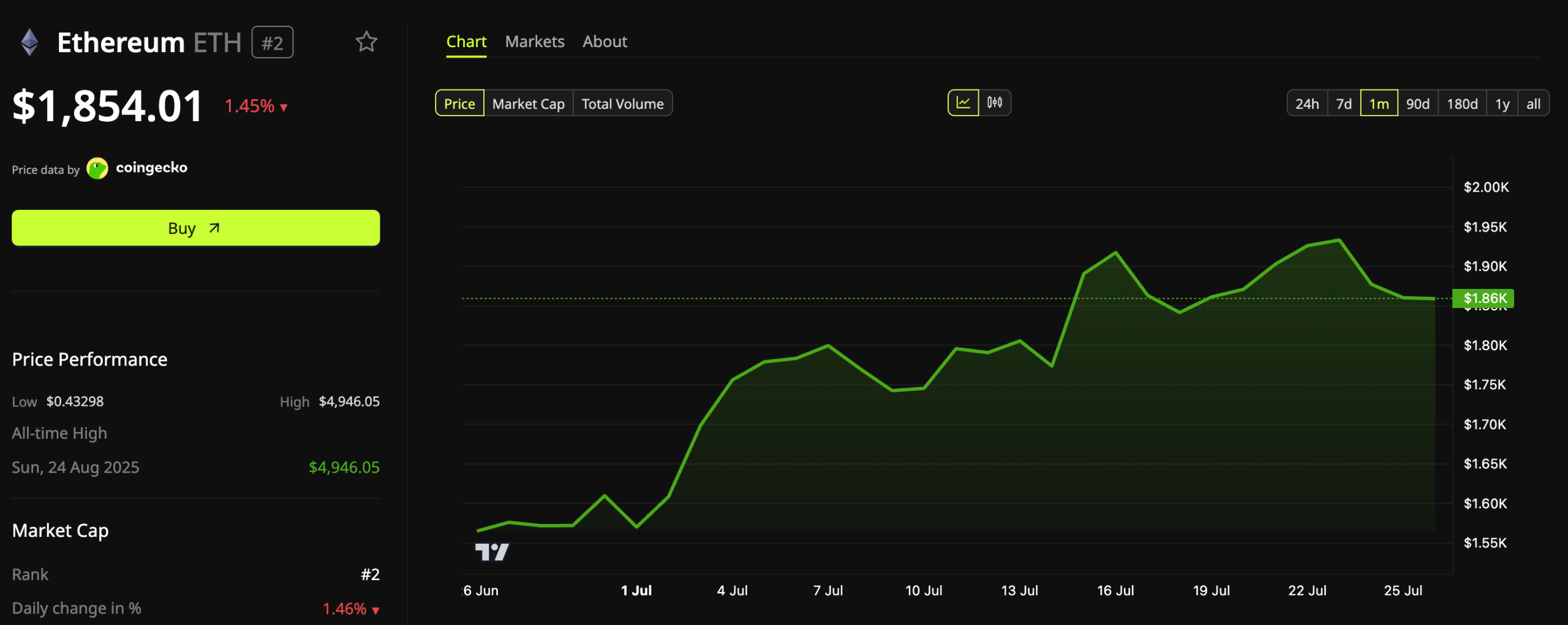
Ethereum (ETH) social commentary has turned very bearish for the third time in a month, according to Santiment. Two previous low readings preceded price rebounds.
The reading comes as ETH trades near $1,854 and spot exchange-traded fund (ETF) demand strengthens. Santiment treats crowd pessimism as a contrarian marker.

Why Ethereum’s Bearish Sentiment Matters
Santiment tracked the ratio of positive to negative Ethereum commentary across X, Reddit, Telegram, and other crypto channels. The reading fell to 1.089 on July 24, its third bearish extreme in a month.
The two earlier troughs arrived on June 27 and July 11. ETH gained 14% over the following 7 days and 7% over the next 4 days.
Follow us on X to get the latest news as it happens

Nonetheless, Santiment stopped short of calling a reversal.
“The bullish takeaway isn’t that negative sentiment guarantees an instant reversal. It’s that when traders are loudly giving up on Ethereum while ETF flows, L2 activity, and protocol upgrades remain active, the #2 market cap in crypto often gets a cleaner setup for a turn-around…” the firm said.
Ethereum ETF Inflows and On-Chain Data Flash Bullish Signals in July
Notably, the crowd turned bearish, but institutional buyers did not follow. Ethereum ETFs pulled in $103.9 million in the week ending July 24, more than any other spot crypto product. That marked a third straight positive week after inflows of $84 million and $105 million.
Demand is not the only metric improving. CryptoQuant said ETH is “undervalued relative to its cost basis.”
“It trades near $1,900 — roughly 17% below its realized price of $2,304 — and in the lower half of its realized price band, a zone historically associated with market bottoms and asymmetric upside,” the firm explained.
At the same time, the ETH/BTC exchange inflow ratio now sits near 0.8, down from above 1.5 in August 2025. Earlier bottoms formed nearer 0.4.
XWIN Research also flagged Binance reserves as a key signal. Holdings there have fallen from nearly 5 million ETH in mid-2025 to around 3.8 million. That leaves fewer coins ready to sell.
“While this does not confirm that Ethereum has reached its final bottom, the combination of declining Binance reserves, improving on-chain metrics, and recovering institutional interest suggests that downside risk is gradually diminishing,” the analyst said.
The post added that a continuation could set up relative strength against Bitcoin.
Subscribe to our YouTube channel to watch leaders and journalists provide expert insights
The post Ethereum Traders are Giving Up Again. The Last Two Times ETH Rallied appeared first on BeInCrypto.

After a major rally toward a monthly peak, bitcoin’s price has lost momentum and is down to $64,000, which is very close to a level that could provide more insight into which way the asset is going next.
Popular analyst Ali Martinez outlined the two most likely charts depending on whether BTC breaks out or down.
$67K Again or $60K?
The analyst told his over 165,000 followers on X that the primary cryptocurrency has returned to the key support level at $63,800 after failing at $67,000 earlier this week. He believes this critical line will determine the next leg, whether it will head back toward that aforementioned monthly high or crumble down to $60,000 as it did on a few occasions in June and in early July.
Keep an eye on Bitcoin $BTC at $63,800.
If this level holds as support, I’m watching for a rebound toward $67,000. But if it breaks, the next downside target sits around $60,000. pic.twitter.com/kAn0hDIEmc
— Ali Charts (@alicharts) July 25, 2026
Given his recent assessment of the upcoming month, though, the odds are leaning bearish. As reported earlier, Martinez outlined historical data showing that August has been anything but a positive month for the largest cryptocurrency. The last four editions have all been in the red, and only three out of the past 12 have posted gains. The last significant August rally came nine years ago when it pumped by 65% during the 2017 bull run.
On the positive side, CW reported that small whales holding between 100 and 1,000 BTC have seen their positions turn green. The analyst claimed that such developments in the past preceded short-term upticks or more profound rallies.
BTC Still Capped
Rekt Capital noted that all of BTC’s recent breakout attempts have been halted at approximately $65,500 on the weekly scale, which is where the 50-Month EMA is positioned. He warned that BTC may be “developing a new multi-week lower high” after the latest rejection.
In addition, he noted that the declining buy-side volume hints at another bearish shift, as sellers have stepped up lately.
“The more seller-dominant the volume becomes while Bitcoin is at resistance, the greater the chances for a rejection from here,” he concluded.
The post Bitcoin Is Testing a Crucial Level: Breakout or Breakdown Next? appeared first on CryptoPotato.


Dango will shut down its trading platform and its own blockchain after concluding the project has no path to lasting commercial success. The team told users to close positions and withdraw funds.
The wind-down arrives only months after Dango opened perpetual futures trading in April. Similar closures have hit the sector repeatedly through 2026.
Dango Sets 2 Deadlines for Users to Exit
Dango operates a Layer 1 (L1) blockchain and a decentralized exchange (DEX). Both are now on a countdown.
Trading stops on Wednesday, July 29, at 12 pm UTC. Remaining positions will close at the oracle price, and deposits in its liquidity provider vaults will unlock. The team said that all balances will be returned in USDC to spot accounts.
The L1 then stops running on Wednesday, August 13, at 12 pm UTC. Deposits left behind at that point go back to their original Ethereum (ETH) addresses.
“Funds are safe. Limits to withdrawals will be lifted shortly. We encourage you to close positions and withdraw funds. Be careful of slippage, as liquidity is expected to be thin,” Dango wrote.
Follow us on X to get the latest news as it happens
Founder Larry pointed to a stack of pressures rather than a single failure.
“Since the launch in April, our team has faced strong headwind: cash running out, legal/compliance challenges that led to large delays in our ability to ship new features, the resulting lose of growth momentum, lose of talents from the team, and the overall highly adverse market conditions,” he explained.
Dango is far from alone. CryptoRank counted 17 major crypto shutdowns and bankruptcies through July 23, including Loopring DEX, Movement Labs, and Bitcoin Depot.
Subscribe to our YouTube channel to watch leaders and journalists provide expert insights
The post Another Crypto Project Goes Dark as Dango Winds Down appeared first on BeInCrypto.
The spot Bitcoin exchange-traded funds ended their third consecutive week in the green, but momentum faded at the end of it.
In the meantime, the funds tracking Ethereum continue to outperform, gaining over $100 million as the underlying asset challenged the $1,950 level.
BTC ETFs Still in the Green but…
The funds tracking the market leader were in a tough spot for weeks. Eight, to be precise. In this streak that began in mid-May and felt it went on for eternity, they saw over $8 billion withdrawn from investors, with the total net inflows going down from over $59.34 billion to $51.08 billion on July 2.
However, investors finally changed their tune at this point and broke this negative trend during the first full week of July, inserting nearly $200 million. Another $75.67 million followed during the subsequent week, and the one that just ended began on a high note. In fact, the actual net inflows stood at approximately $1 billion during the seven consecutive green days – from July 14 until July 22.
This coincided (or propelled) with bitcoin’s price rally that drove the asset to $67,000 on Wednesday for the first time in over a month. However, the asset was rejected there, driven south to $64,000 on Friday, while the ETF outflows returned. On Thursday and Friday, investors pulled out $225.18 million and $240 million, respectively.
As such, even though the week ended slightly in the green, it was a relatively modest $33.79 million.

ETH ETFs Still Do Better
A rather interesting trend that began two weeks ago was replicated once again. The spot Ethereum ETFs turned out to be more attractive to investors, with almost $104 million in net inflows. Only one day was in the red, with investors pulling out $70.62 million on Friday. Before that, they had poured in $38.09 million on Monday, $37.47 million on Tuesday, $72.64 million on Wednesday, and $26.32 million on Thursday.
Perhaps due to these rather impressive numbers, the underlying asset surged past $1,900 mid-week and peaked at just over $1,950. However, it couldn’t keep the momentum going and slipped by about $100 on Friday and Saturday.
The total net inflows of the ETH ETFs have recovered over $200 million in the past three weeks, but are still well below the $12.09 billion seen in May.

The post Crypto ETF Recap: Ethereum Still Outpaces Bitcoin, but Cracks Are Emerging appeared first on CryptoPotato.

The New York Stock Exchange’s parent just completed a $2 billion bet on Polymarket. Kalshi raised a billion at $22 billion while generating fee revenue most exchanges would envy. Seven bills in Congress want the whole category banned. Wall Street is not gambling on prediction markets; it is buying the probability layer of the financial system, and the difference explains everything.
Summary
- Intercontinental Exchange, parent of the NYSE, completed a $2 billion commitment to Polymarket in March, $1 billion in October plus a fresh $600 million, with the platform now discussing new funding near a $15 billion valuation.
- Kalshi raised more than $1 billion this spring at a $22 billion valuation, roughly doubling in months, on volumes that reached $31.5 billion in June against Polymarket’s $10.8 billion, with fee revenue estimates running from $850 million to $1.5 billion annualized.
- The tell is the deal structure: ICE bought global distribution rights to Polymarket’s event data and launched institutional probability feeds within months, chairman Jeffrey Sprecher framing the stake as a new layer of financial intelligence, not a venture flyer.
- The consolidation is visible everywhere: the rival CEOs jointly backed a $35 million VC fund for the sector, Kalshi struck institutional distribution through Tradeweb, Robinhood’s event contracts out-earned its crypto business, and banks project the industry toward $10 billion in annual revenue by 2030.
- All of it is happening against maximal legal hostility: at least seven bills targeting the category in 2026, a bipartisan act to ban sports contracts outright, and the 50-state jurisdictional war this publication has mapped, a contradiction the valuations are pricing as temporary.
Wall Street has a reliable tell: watch what the exchanges buy. Exchanges are the market’s landlords; they monetize activity without taking its risks, and when an exchange operator writes a ten-figure check, it has concluded that a new kind of activity is durable enough to tax.
In March, Intercontinental Exchange, the $80-billion-class operator of the New York Stock Exchange and twelve other regulated venues, completed exactly that judgment: a $600 million investment closing out a $2 billion total commitment to Polymarket, the crypto-native prediction market, at valuations that climbed from $9 billion toward the $15 billion its next round now targets.
Weeks earlier, Kalshi, Polymarket’s regulated arch-rival, raised more than a billion dollars at a $22 billion valuation, double its winter mark, on revenue that estimates place between $850 million and $1.5 billion a year.
The two firms’ founders then jointly seeded a venture fund for their own sector, the corporate equivalent of rival generals founding a military academy, while Robinhood’s earnings quietly revealed that event contracts already out-earn its crypto business. And Congress, watching all of it, introduced at least seven bills to restrict or ban the category.
This piece is the cluster-opener the moment deserves: what the exchanges actually bought, why the valuations disagree with the volumes, and why the industry’s legal peril and its institutional embrace are, strangely, the same story.
What ICE actually bought
The most analyzed deal in the sector is also the most misread, because the commentary priced it as a bet on betting, and the structure says something else.
ICE’s $2 billion did not primarily buy a share of trading fees. It bought, alongside equity, global distribution rights to Polymarket’s event-driven data, and the follow-through arrived within months: Polymarket Signals and Sentiment, launched in February, packages real-time prediction-market pricing into structured feeds for institutional clients, sold through the same ICE data machine that distributes bond pricing and commodity curves to every terminal on earth.
https://x.com/cryptodotnews/status/2046178311332925655
Chairman Jeffrey Sprecher’s framing was explicit and deserves to be taken literally, not as deal-announcement poetry: the investment adds a new layer of financial intelligence. Translated from exchange-operator: markets on events generate a product exchanges have never had, continuously priced probabilities of the world’s discrete outcomes, elections, rate decisions, wars, product launches, and the firm that owns the distribution of those probabilities owns something adjacent to what Bloomberg owns in reference data.
The trading is the factory; the data is the product; and ICE, whose entire modern history is converting exchanges into data companies, ran its signature play on the newest exchange category in existence. The tokenization collaboration attached to the deal, and Polymarket’s acquisition of DeFi infrastructure startup Brahma to harden its on-chain stack, complete the picture of a platform being fitted for institutional plumbing, not fattened for retail.
Read that way, the sector’s other moves stop looking like a bubble and start looking like a supply chain assembling. Kalshi’s deal with Tradeweb points the same direction: prediction pricing distributed into institutional macro workflows, where a Fed-decision market is not a casino but a hedging instrument with cleaner event definition than any rates option.
The $35 million venture fund jointly backed by both CEOs is the infrastructure tell, seeding the tooling layer, the Bloomberg-style terminals, the risk systems that a maturing asset class requires. And Citizens Bank’s projection, a $3 billion industry revenue run rate with a credible path toward $10 billion by 2030, is the sell-side arriving to cover a category it can finally model, because fee-on-volume businesses are the one thing Wall Street knows how to value.
The scoreboard, and why it disagrees with the valuations
Now the numbers, because they contain a genuine puzzle: the market leader by volume is not the platform the world’s biggest exchange bought, and the valuations invert the operating data.
Kalshi leads operationally, and not narrowly. June volume near $31.5 billion against Polymarket’s $10.8 billion, roughly three-to-one; revenue estimates, whether the conservative $850 million fee figure or the $1.5 billion annualized estimates, that would flatter mid-tier traditional exchanges; 994% year-over-year growth into 2025’s $260 million; a CFTC-regulated perch that makes it the only fully domestic, fully legal venue for American event trading; distribution through Robinhood’s hundred-million-account retail machine; and an international expansion running through Brazil.
Its $22 billion valuation, double in months, prices continued category leadership. Polymarket’s operating story is choppier: bigger brand, deeper crypto-native liquidity, the QCEX acquisition purchasing a CFTC-licensed re-entry to the US market it was exiled from, February volume that touched $23 billion in the World Cup’s glow, but June at a third of Kalshi’s tape, revenue still being switched on, taker fees arriving only this spring, and a valuation, $9-10 billion post-ICE, now reaching for $15 billion, that trails its rival’s by a third despite the grander patron.
The resolution of the puzzle is the thesis of this piece. Kalshi is valued as an exchange: volumes, fees, growth, multiply. Polymarket is valued as infrastructure: the ICE relationship prices not its current fee take but its position as the probability layer ICE intends to distribute, the way index providers are valued not on their own revenue but on their irreplaceability in other people’s products.
Two different theories of what a prediction market is, held by two different kinds of capital, produce valuations that disagree with the volume table, and the disagreement is the sector’s live experiment: whether the money is in operating the casino or in owning the odds. The honest answer, visible in ICE’s own history, is that the second usually wins over decades, and the first pays for the war in the meantime.
The paradox: embraced and indicted at once
Everything above happened while the American legal system escalated its hostility, and the contradiction is not a footnote; it is the sector’s defining condition.
The docket, which this publication’s fifty-state-war coverage maps in detail, has only thickened: at least seven bills introduced in 2026 targeting prediction markets, headlined by the bipartisan Prediction Markets Are Gambling Act from Senators Schiff and Curtis, which would ban CFTC-regulated exchanges from listing sports contracts outright; Nevada’s temporary restraining order against Kalshi in March; state gaming regulators across a dozen jurisdictions pressing the position that event contracts on sports are wagers wearing derivative costumes; and a parallel insider-trading discourse, sharpened by suspicious trades around geopolitical events on Polymarket’s offshore book, that has drawn congressional letters.
The CFTC has intervened repeatedly on the federal-preemption side, backing the position that its regulated exchanges answer to it exclusively, the exact architecture, federal license against state police power, whose constitutional endgame our earlier coverage called the sector’s real stakes. Sports is the war’s center of gravity because sports is the revenue’s center of gravity, and a Schiff-Curtis world would amputate the category’s largest limb.
So why do the checks keep clearing? Because institutional capital has concluded the contradiction resolves in one direction, and the reasoning deserves to be stated plainly rather than dismissed as bravado.
First, the federal question is being litigated on ground the industry mostly wins: preemption doctrine has historically favored federally licensed markets, and every court that lets a CFTC venue keep operating strengthens the ratchet.
Second, the political economy shifts with every acquisition: when the NYSE’s parent owns the odds layer, when Robinhood’s earnings depend on event contracts, when Tradeweb distributes the pricing, a ban stops being a consumer-protection bill and becomes an attack on exchange infrastructure, and exchange infrastructure has the best lobbyists money retains.
Third, the data thesis is jurisdiction-proof in a way the trading thesis is not: even a sports-banned, state-harried American prediction market generates probability data on everything else, elections, rates, geopolitics, and the data product ICE bought travels globally regardless of where the trading is licensed.
The valuations, read correctly, are not ignoring the legal war; they are pricing its outcome, a federally consolidated, institutionally owned category whose bumpy state-level litigation is the cost of the moat being built, because the same legal complexity that harasses the incumbents forecloses new entrants. Whether that pricing is right is the decade’s question. That it is the pricing is no longer in doubt, and the November midterms, the category’s largest-ever volume event arriving in the middle of its largest-ever legal fight, will be the first full-scale test of both theses at once.
The third front: retail distribution and the Robinhood wedge
Between Kalshi’s regulated exchange and Polymarket’s crypto-native book runs a third front this publication has tracked from its earnings angle, and the cluster map is incomplete without it: the brokerages, who own the customers everyone else is paying to reach.
Robinhood’s numbers made the case before any thesis did: event-contract revenue of $147 million in a single quarter, up 320%, out-earning the firm’s entire crypto trading business, on 8.8 billion contracts, distribution economics that no standalone platform matches because the marginal customer already has the app, the account, and the balance. The firm’s response to its own data was vertical integration, the Rothera exchange venture, converting Robinhood from Kalshi’s largest distributor into its future competitor, a sequence every platform economist recognizes: distribute, learn the margins, then own the venue.
The World Cup quarter’s industry-wide records, Kalshi clearing $31 billion in a month with retail brokerage flow as a major tributary, previewed the steady state: prediction volume as a standard feature of every retail trading app, the way options became one, with the venues competing for the pipes as much as the punters.
The retail front reframes the legal war’s stakes too. The seven bills and the state actions target venues, but the wedge that actually carried event contracts into American living rooms is the brokerage integration: regulated firms with licenses to protect, distributing CFTC-listed contracts to mass-market accounts, and any legislative ban must therefore run through the brokerage lobby as well as the exchange lobby, a coalition that has historically been the most effective in financial politics.
It also sharpens the insider-trading and consumer-protection critiques, because the retail customer buying an election contract in a stock-trading app is precisely the participant the gambling framing worries about, and the industry’s response, self-surveillance regimes, contract-design standards, position limits, will be written under that spotlight. The cluster’s honest frame holds all three fronts at once: an exchange war for volume, a data war for institutional relevance, and a distribution war for the retail default, with the same November stress test scheduled for all three.
What to watch
The Schiff-Curtis whip count. The sports-ban bill is the one legislative vehicle that changes the revenue math rather than the compliance math. Its committee progress, and whether the exchange lobby’s fingerprints appear in the amendments, will reveal how far the political economy has already shifted.
Polymarket’s US re-entry mechanics. The QCEX license converting into live, fee-charging American operations is the event that would collapse the two rivals into one regulatory arena, and one comparable revenue table, for the first time. The valuation gap gets its verdict there.
The data products’ uptake. Signals feeds on terminals, Tradeweb integration metrics, the first hedge-fund letters citing prediction-market pricing as an input: the ICE thesis is falsifiable, and its evidence will be subscription revenue, not trading volume.
Midterm November. Record volumes are certain; the tests are operational integrity under peak load, insider-trading headlines under maximum scrutiny, and whether the state-law war produces an injunction that actually interrupts trading during the event. The category’s institutional era either survives its first American election as infrastructure, or it does not.
A final calibration for the cluster this piece opens: the honest bear case, stated without the valuations’ optimism. The category’s revenue concentrates in sports, the exact segment one live bipartisan bill would ban; its growth statistics are inflated by a World Cup and will meet a quieter 2027; its two leaders are burning venture capital on customer acquisition in a fee war that has already produced zero-fee promotional pairs; its insider-trading surface, markets on events their participants can influence or foreknow, is structurally worse than equities and has already generated congressional attention; and its institutional data thesis, however elegant, currently books a fraction of the revenue the trading does, meaning the valuations rest on the segment most exposed to the law and least proven under stress.
If the Schiff-Curtis framework passes, if a state supreme court cracks the preemption shield, or if November produces a manipulation scandal at scale, the $22 billion and $15 billion marks will be repriced as artifacts of the same exuberance that priced every previous financial-innovation wave at its legislative peak.
The bull case, argued above, is that the exchanges have already made the category too systemic to kill. The bear case is that Congress has killed systemic things before, and that betting on gambling’s legal normalization has broken sophisticated investors for a century. The cluster’s coverage will hold both, which is the only honest way to cover an industry whose defining trade is, fittingly, a binary contract on its own survival.
Frequently Asked Questions
What exactly did ICE invest in Polymarket?
A total commitment of $2 billion: $1 billion in October 2025, a further $600 million closing the agreement in March 2026, plus up to $40 million in secondary purchases from existing holders. The structure centers on global distribution rights to Polymarket’s event data alongside equity, and ICE launched institutional probability feeds, Polymarket Signals and Sentiment, in February, with a tokenization collaboration attached to the partnership.
How do Kalshi and Polymarket compare today?
Kalshi leads operationally: roughly $31.5 billion in June volume versus Polymarket’s $10.8 billion, fee revenue estimated between $850 million and $1.5 billion annualized, CFTC regulation, Robinhood distribution, and a Brazil expansion, at a $22 billion valuation after this spring’s billion-dollar raise. Polymarket holds the larger brand, crypto-native liquidity, the ICE partnership, and a CFTC-licensed US re-entry path via its QCEX acquisition, at a $9-10 billion valuation reaching toward $15 billion.
Why would the NYSE’s parent want a prediction market?
For the data, on the reading the deal structure supports. Prediction markets continuously price probabilities of discrete events, elections, rate decisions, geopolitical outcomes, a data product traditional exchanges have never generated, and ICE’s modern business is data distribution as much as trading. Chairman Jeffrey Sprecher framed the stake as a new layer of financial intelligence, and the February launch of institutional feeds executed exactly that thesis.
Are prediction markets actually profitable?
The leaders’ figures suggest strongly yes, with caveats. Kalshi’s revenue estimates range from $850 million in fees to $1.5 billion annualized against 994% growth into 2025; Polymarket only began charging taker fees this spring, with early annualized projections around $300 million; and Robinhood’s event-contract line reached $147 million in a quarter, exceeding its crypto revenue. Citizens Bank models the industry at a $3 billion run rate with a path toward $10 billion by 2030.
What is the legal threat, concretely?
Layered. At least seven 2026 bills target the category, led by the bipartisan Schiff-Curtis Prediction Markets Are Gambling Act, which would ban sports contracts on CFTC-regulated exchanges, the sector’s largest revenue source. State gaming regulators in a dozen-plus jurisdictions are litigating that event contracts are unlicensed wagers, with Nevada winning a temporary restraining order against Kalshi in March, while the CFTC backs federal preemption, the constitutional collision this publication’s earlier coverage maps.
Why does institutional money keep flowing despite the bills?
Because it is pricing a resolved endgame: preemption doctrine historically favors federal licenses, each acquisition shifts the political economy, banning bookies is easier than banning the NYSE’s data layer, and the probability-data thesis survives even adverse trading rulings, since data distributes globally regardless of where trading is licensed. The valuations treat the legal war as the moat’s construction cost, deterring entrants while incumbents entrench.
What is the joint VC fund the rivals backed?
A $35 million venture fund targeting the prediction-market sector, backed by the chief executives of both Kalshi and Polymarket, seeding infrastructure like analytics tooling and Bloomberg-style terminals for event markets. Rival operators jointly funding their category’s supply chain is the clearest signal that both view the sector’s growth, and its institutional legitimacy, as a shared asset that precedes their competition.
What should observers watch next?
Four things: the Schiff-Curtis bill’s committee progress, the one vehicle that changes revenue rather than compliance; Polymarket’s QCEX-licensed US operations going live, which puts both rivals in one arena; adoption evidence for the institutional data feeds, where the ICE thesis is falsifiable; and November’s midterms, the category’s biggest volume event colliding with its biggest legal fight, the first full-scale stress test of the institutional era. This is educational analysis, not investment advice.
Disclaimer: This article is for information and educational purposes only and does not constitute financial or investment advice. Valuations, volumes, and revenue figures are drawn from reporting and estimates that vary by source and change rapidly, and pending legislation and litigation described here are unresolved. Nothing here is a recommendation regarding any company, token, or contract. Always do your own research. Information is accurate as of July 24, 2026.


Daily NK reported that North Korea arrested former state cyber operators accused of hacking two state banks and laundering funds through crypto.
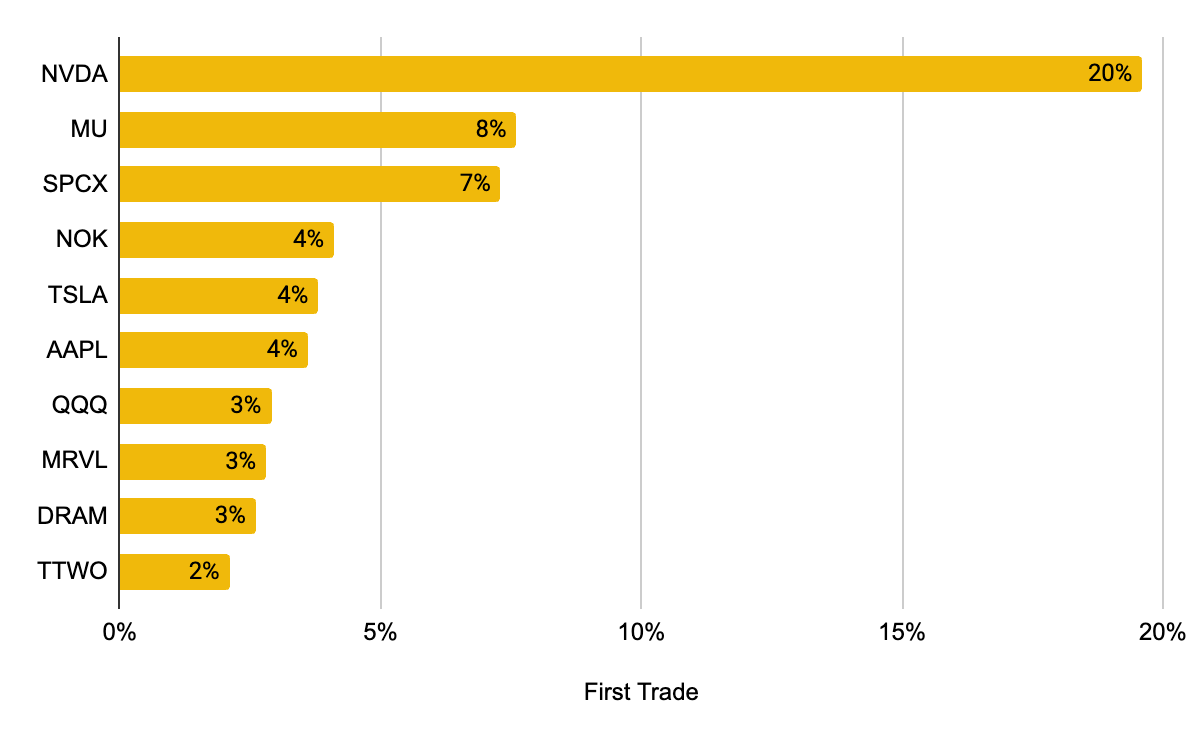
Nvidia (NVDA) is the most common first stock trade among the youngest and smallest equity accounts on Binance. The stock took 20% of first trades, according to a Binance Research report.
The finding covers a segment that Binance labels Next Gen Users. These are Gen Z customers in emerging markets holding under $2,000 in equity assets under management.
Semiconductor Stocks Dominate the First Trade List
Micron Technology (MU) ranks second at 8%, according to the report. Tesla (TSLA), Apple (AAPL), and the Nasdaq-100 exchange-traded fund (ETF) appear further down the list.
“Across the wider equity base, the same discipline is visible at portfolio level: users allocate roughly 60% of equity holdings to Information Technology and Communication Services, with around 26% concentrated in semiconductors, a thematically coherent tilt toward the artificial-intelligence complex rather than scattered speculation,” Binance Research noted.

The report noted that Next Gen Users make up 13% of Binance Direct Stocks customers. Gen Z as a whole accounts for 44%, the largest single cohort on the product.
Geography narrows the picture further. Binance Research highlighted that 95% of Gen Z traditional finance (TradFi) users are in emerging markets. Every other generation on the platform clears 90%.
Follow us on X to get the latest news as it happens
Trading Frequency Runs Below Other Cohorts
Binance Research presents the trading pattern as a discipline rather than speculation. Two further measures support that reading.
“The prevailing assumption about young, first-time investors, particularly those reached through a crypto-native platform, is that they trade aggressively and speculatively. The data does not support that characterization. It points, consistently, in the opposite direction,” the report read.
Next Gen Users average 2.6 trades per day, compared with 3.0 for other cohorts, according to platform data. Leverage use points the same way, with leveraged ETFs at 5.9% of Gen Z volume. Baby Boomers recorded 8.1%.
Scale has followed regardless. Gen Z has contributed approximately $80 billion in TradFi volume so far in 2026, compounding at nearly 24% per month.
Subscribe to our YouTube channel to watch leaders and journalists provide expert insights
The post Binance Data Shows How Crypto is Using AI Stocks to Attract Gen Z Investors appeared first on BeInCrypto.


Cathie Wood’s ARK Invest has added about $251,500 in BitMine Immersion Technologies shares and the 3iQ Solana Staking ETF across three of its exchange-traded funds.
Summary
- ARKK bought 5,264 BitMine shares worth about $83,100 at Friday’s $15.79 close.
- ARKW and ARKF added 28,018 SOLQ.U shares valued at roughly $168,400 combined.
- The 3iQ Solana Staking ETF fell 2.12% to $6.01 during Friday’s session.
ARK Invest adds BitMine exposure
ARK Invest’s Friday trade disclosures show its flagship ARK Innovation ETF, or ARKK, purchased 5,264 shares of BitMine Immersion Technologies (BMNR).
Based on BMNR’s $15.79 closing price, the purchase was worth approximately $83,100. The position represented roughly 0.0014% of ARKK’s portfolio, making it a small allocation within the fund but another addition to ARK’s crypto-linked investment exposure.
BitMine has positioned itself as an Ethereum treasury company, placing ARK’s purchase alongside its wider investments in publicly traded firms connected to digital assets.
The transaction was part of a broader ARKK rebalance that also included additional purchases of X-Energy shares and sales of Figma stock. ARK also sold shares of Strata Critical Medical, ATAI Life Sciences and Elbit Systems across its funds, according to the disclosures.
3iQ Solana Staking ETF receives $168K allocation
ARK’s ARK Next Generation Internet ETF (ARKW) and ARK Fintech Innovation ETF (ARKF) also increased their holdings in the 3iQ Solana Staking ETF, which trades under the ticker SOLQ.U.
ARKW purchased 16,917 shares, worth about $101,700 at Friday’s close. ARKF added 11,101 shares, valued at approximately $66,700.
Together, the two funds acquired 28,018 SOLQ.U shares worth around $168,400. The purchases came as the Solana-based investment product declined $0.13, or 2.12%, to close at $6.01 on Friday.
The move gives ARK further exposure to Solana through an exchange-traded product that includes staking-related exposure, rather than a direct purchase of SOL tokens.
ARK’s crypto and AI buying spree continues
Friday’s trades followed a more active week for ARK Invest, which bought nearly $60 million in Tesla, Circle Internet Group and Securitize shares on Thursday amid a broader U.S. equity market sell-off.
Tesla accounted for more than $51 million of that total, according to the firm’s daily trade reports. ARK also added roughly $14 million in SpaceX stock earlier in the week.
Outside crypto-related holdings, Friday’s filings showed new purchases of Pony AI, Kodiak AI, Scribe Therapeutics and Compass Pathways. The transactions point to continued portfolio adjustments across artificial intelligence, healthcare and digital-asset-linked companies.
What it means for U.S. investors
ARK Invest’s latest activity offers U.S. investors another snapshot of how one of the country’s best-known thematic ETF managers is approaching crypto exposure.
The purchases were modest relative to ARK’s overall assets, but they spread exposure across two distinct parts of the market: BitMine’s Ethereum treasury strategy and a Solana staking-focused ETF product.
U.S. investors considering similar exposure should note that ARK’s purchases do not amount to a forecast on either asset. They instead show the firm’s continued use of public equities and exchange-traded products to gain exposure to crypto-related themes while it also rotates positions in technology and AI stocks.

Meet Strictly Come Dancing’s new professional dancers

Blue-Chip 12% Yields: Why I Give Hercules Capital The Edge Over Trinity Capital

Wise expected to resubmit US charter application under GENIUS


-

 Fashion23 hours ago
Weekend Open Thread: Brooks Brothers
-

 Politics6 days ago
Democrats look to World Cup watch parties to register thousands of voters
-

 News Videos6 days ago
Big Money Is Entering XRP
-

 Crypto World4 days ago
Grayscale Files For Worldcoin ETF, WLD Registers Sharp Rise
-

 Tech5 days ago
Sail Virtually Aboard The “Itanic” With IA-64 Emulator
-
 Tech5 days ago
Turtle Beach Command Series KB7 review: a nifty screen-equipped gaming keyboard
-

 NewsBeat5 days ago
Unregistered fitter used Gas Safe logo on business flyers
-
 Business4 days ago
New Jersey voter registration controversy explained: How 6,600 noncitizens got on the rolls, and what happens next
-
 Entertainment4 days ago
Johnny Depp’s R-Rated Gothic Cult Classic Gets New Release Ahead of Sydney Sweeney Remake
-

 Crypto World3 days ago
Ethics, other provisions in crypto Clarity Act to be further discussed
-

 Tech5 days ago
Watch Flock Safety CEO Garrett Langley discuss the future of surveillance at TechCrunch Disrupt 2026
-
 NewsBeat5 days ago
Shanghai science forum photos show China’s AI and robotics advances in rivalry with US
-

 Crypto World5 days ago
Circle’s President Sold Over 360,000 Shares, The Filings Explain Why
-

 Tech5 days ago
Subway Sandwich Computers Get a Second Life as Gaming Machines
-

 Sports2 days ago
2026 3M Open leaderboard: Scottie Scheffler finds putter in Round 1, sits three back
-

 News Videos2 days ago
The Peugeot Family: How 200 Years of an “Old Money” Dynasty Died in A Boardroom
-

 Tech5 days ago
The 35 Best Board Games for Family Game Night
-

 Fashion2 days ago
16 Dresses for the High Summer Event
-

 Tech6 days ago
How To Use Claude’s Reflect Dashboard And Learn When It’s Time To Touch Grass
-

 Entertainment6 days ago
Stephen Colbert Returns to Social Media After Late Show End
You must be logged in to post a comment Login