

Crypto World
Arthur Hayes Exits Entire HYPE and NEAR Positions, Cites Iran War and AI IPO Pipeline



Arthur Hayes, co-founder of BitMEX and one of Hyperliquid's most vocal public supporters, has sold his entire positions in HYPE and NEAR Protocol. Hayes announced the exit on X on June 4, citing three macro headwinds he said altered his near-term risk calculus. "I just dumped my entire $HYPE and… Read the full story at The Defiant


US Securities and Exchange Commission (SEC) Commissioner Hester Peirce argued that publishing open-source blockchain and DeFi code should not automatically subject software developers to federal securities regulations, addressing a long-standing question about liability in decentralized finance. Speaking at the IC3 Blockchain Camp at Princeton University, Peirce emphasized that open-source software publication is often a First Amendment-protected activity and should not automatically render developers as securities intermediaries simply because others use their code.
“Many blockchain projects involve publishing open-source software, which is generally a protected activity under the First Amendment,” Peirce said, underscoring a view that decentralized protocols can operate without traditional intermediaries. She added that responsibility for securities law violations should generally rest with the individuals who engage in unlawful conduct, not the developers who publish code that others may utilize.
Peirce’s remarks reflect a broader stance within the SEC that questions the applicability of centralized regulatory constructs to decentralized networks. She warned against extending rules designed for traditional intermediaries—such as brokers, dealers, exchanges, clearinghouses, transfer agents, investment advisers, and investment companies—to blockchain infrastructure that can function independently of those entities.
“The SEC’s rulebook is full of intermediaries: brokers, dealers, exchanges, clearinghouses, transfer agents, investment advisers and investment companies,” she said. “As a result, we see the crypto world teaming with brokers, dealers, exchanges, clearinghouses, transfer agents, investment advisers, and investment companies.”
However, Peirce cautioned that these questions are not a blanket rejection of regulation but a call to calibrate the scope of securities laws to the realities of decentralized systems that serve purposes beyond securities transactions. She emphasized the need to distinguish between publication of open-source code and active participation in unlawful conduct within securities markets.
Source: Cointelegraph
Key takeaways
- The publication of open-source blockchain and DeFi code should not automatically trigger securities intermediary status for developers, according to Commissioner Hester Peirce.
- Open-source software publication is argued to be a First Amendment-protected activity in the context of decentralized networks.
- Regulatory considerations should avoid blanket application of centralized intermediary rules to distributed protocols with non-traditional models of operation.
- The SEC is moving away from “regulation by enforcement,” signaling a more nuanced approach to how existing securities laws apply to digital assets and decentralized systems.
- Recent SEC signals—broker-dealer interface guidance and strategic planning through 2030—underline continued regulatory focus on digital assets, while recognizing the unique structure of decentralized networks.
Open-source governance, liability, and the regulatory lens
Peirce’s remarks center on a practical tension: developers who publish open-source code can enable widely used protocols without participating in traditional market intermediation. In her view, liability for securities-law violations should trace to unlawful acts by individuals or entities rather than to the mere distribution of software. This stance aims to reduce unnecessary regulatory friction for developers who contribute to open ecosystems, while preserving accountability for bad actors who misuse technology.
The discussion highlights a broader policy question: how to balance innovation and investor protection in an environment where code and networks operate without conventional gatekeepers. For institutional researchers and compliance teams, the core implication is a potential narrowing of the risk surface for open-source contributors, coupled with a continued emphasis on identifying and addressing actual illicit activity within the system.
Regulatory alignment and the broader shift in oversight
Peirce’s comments align with a broader SEC recalibration away from what some officials have described as “regulation by enforcement.” Since its inception, the Crypto Task Force has explored how existing securities laws should apply to digital assets and decentralized infrastructure, seeking clearer boundaries between what constitutes a security and what falls outside traditional regulatory purview.
In parallel, SEC staff recently issued guidance addressing broker-dealer registration questions for certain user interfaces. The guidance suggested that some front-end websites and software interfaces that merely provide access to decentralized protocols may not fall within the traditional definition of a broker. That development signals a more nuanced approach to how compliance obligations are mapped onto user experiences that connect investors with crypto networks.
At the same time, the SEC has signaled that digital assets and blockchain technology will remain a central focus in the coming years. In its draft Strategic Plan through fiscal 2030, the agency highlighted blockchain and crypto assets as technologies with the potential to reshape financial markets—an articulation that reinforces ongoing regulatory attention and investment in regulatory clarity for firms operating in the space. As noted by Cointelegraph coverage of related developments, the plan framed these technologies as capable of transforming America’s financial infrastructure.
Related: Paxos becomes first crypto firm to win SEC clearing agency registration — highlighted in coverage that underscores how the SEC is leaning into specialized, regulated infrastructure providers within the crypto ecosystem.
According to Cointelegraph, these signals reflect a pattern: regulators are seeking to craft precise guardrails that protect investors without stifling innovation, particularly in areas where decentralized protocols operate without traditional intermediaries. The evolving regulatory toolkit includes clearer criteria for what constitutes a broker or intermediary, while recognizing that front-end interfaces may not always bear the same regulatory heft as the underlying protocol.
Implications for firms, banks, and compliance programs
The evolving stance has practical implications for crypto firms, exchanges, banks, and institutional investors. Compliance teams must monitor the regulatory boundary lines between open-source development and active market intermediation, ensuring procedures focus on identifying unlawful activity rather than penalizing legitimate software publication. This stance could affect licensing approaches, oversight frameworks, and cross-border regulatory strategies as firms navigate divergent national standards in a multi-jurisdictional environment.
In practice, this means: developers may benefit from clearer protections when contributing to open-source code, while businesses must remain vigilant against actual securities violations and ensure robust KYC/AML controls, appropriate disclosures, and risk monitoring for user interactions with decentralized protocols. The SEC’s ongoing dialogue with industry participants is likely to yield additional clarifications on where to draw the line between software publication and regulated activity.
What to watch next
Observers should monitor how the SEC translates these high-level considerations into concrete policy guidance for developers, platforms, and infrastructure providers. Key questions include how future enforcement actions would delineate permissible open-source contributions from activities that cross into regulated territory, what constitutes sufficient governance for decentralized networks, and how cross-border differences will be harmonized with U.S. policy aims. As the SEC advances its strategic priorities through 2030, the balance between safeguarding investors and fostering innovation remains a central point of focus for regulators, market participants, and compliance professionals alike.
Closing perspective: the evolving dialogue around open-source development and regulatory coverage will shape how crypto ecosystems grow, how firms structure their governance and licensing, and how supervisors enforce rules in a technology-neutral, risk-based manner.


Anthropic says its own AI is now accelerating AI development, an early signal of recursive self-improvement. Internal data shows Claude authored more than 80% of the code merged into the company’s production systems as of May 2026.
The disclosure came from the Anthropic Institute, which paired previously unreported internal data with public benchmarks. The findings point toward a future where AI systems could design and build their own successors.
Anthropic Data Points to Recursive Self-Improvement as Claude Writes 80% of Its Code
Before its in-house coding agent rolled out in February 2025, Claude wrote only low single-digit percentages of merged code, the report states. That share now exceeds 80%.
The output gain is steep. Anthropic’s typical engineer merged eight times as much code per day in the second quarter of 2026 as in 2024. The human now directs and reviews while Claude does the writing.
Follow us on X to get the latest news as it happens
The Judgment Gap is Closing
Anthropic runs the same test on every model. It hands the AI code that trains a small model and asks it to run faster. Claude Opus 4 averaged a 3x speedup in May 2025.
By April 2026, its Mythos Preview model reached 52x. A skilled human needs four to eight hours to hit 4x.
Research judgment is harder to automate. Shown a session before a researcher took a wrong turn, Mythos Preview picked a better next step 64% of the time, up from 51% for Opus 4.5 in November 2025.
“Claude-written code was somewhat worse than human-written code at Anthropic in late 2025, is roughly at parity today, and we expect it to be strictly better within the year,” read an excerpt in the report.
Why it Matters Beyond Anthropic
The company frames the trend as a possible path to recursive self-improvement, where AI builds its own successor.
It cautions that Claude has not yet shown the research taste to choose which problems matter most.
The stakes are commercial too. Anthropic recently submitted a confidential IPO registration and has built its brand around safety.
Faster development also feeds the broader crypto industry AI pivot, where autonomous AI agents in crypto execute trades and on-chain tasks.
The curve continuing to bend or flattening into an S-curve will decide how soon, if ever, AI starts building its own successor.
Elsewhere, reports also indicate that Anthropic’s sector rival, OpenAI, is seeing remarkable progress with its own AI, ChatGPT, said to be registering growth of its own.
Subscribe to our YouTube channel to watch leaders and journalists provide expert insights
The post Anthropic Admits AI Is Learning to Build Better AI Faster Than Expected appeared first on BeInCrypto.
More than two-thirds of accounts banned by Anthropic for policy violations over the last year used AI to help them prepare for cyberattacks, such as writing malware, according to the AI firm.
Anthropic said on Wednesday that between March 2025 and March 2026, out of 832 accounts that it examined for violating its policies, 560 accounts were used in this way.
The data reflects an alarming global trend — that AI is increasingly being used to carry out mass cyberattacks. In April, the value of crypto stolen in hacks surged to $629.7 million, the highest since February 2025, which some analysts linked to the widespread use of AI.
Source: Anthropic
Manuel Aráoz, the founder of the crypto security platform OpenZeppelin, said on May 27 that he considered “all of DeFi unsafe” due to AI models’ ability to identify smart contract vulnerabilities.
While the data shows that most of the AI use is in the preparation phase of an attack, Anthropic said it has also started to be deployed “deeper in the attack life cycle,” with 6.5% of the banned accounts using AI to assist with “lateral movement” — referring to techniques a cyberattacker uses after gaining initial access.
“These sorts of ‘post-compromise’ techniques used to be restricted to actors with the technical knowledge to carry them out,” Anthropic said. “Our investigation shows that AI can now be made to perform these activities on behalf of less sophisticated actors.”
AI also increased the threat level of attackers. Anthropic classified a third of accounts, or 33%, as “medium risk or higher” in the first six months of its analysis, but that figure nearly doubled to 56% in the second six-month period of its study.
The type of threat posed by AI-powered hackers was detailed by Google researchers last month. The researchers found what they believed was the first-ever case of AI being used to develop a zero-day exploit, which allowed hackers to bypass the two-factor authentication of an unnamed “popular open-source, web-based system administration tool.”
Related: AI guardrail removals raise questions over limits of open-source model regulation
It added that AI can now undertake highly technical tasks for attackers, and there is “little correlation between the skill of a threat actor and how many techniques they use,” a metric that traditionally measured an attacker’s risk level.
Anthropic said in some cases, such as one in November, a Chinese state-sponsored group carried out an attack where an AI model worked autonomously, where it conducted an exploit, stole credentials and made decisions with a human making an input at “key moments.”
“These are precisely the behaviors we expect to see much more of as AI agents become more capable,” it said.
Anthropic is set to roll out its AI model Mythos in the coming weeks, the company’s large language model that has concerned analysts due to its powerful cybersecurity capabilities that found over 10,000 major vulnerabilities in widely-used software.
Magazine: AI-driven hacks could kill DeFi — unless projects act now

Strategy, the largest corporate holder of Bitcoin, recorded the largest unrealized loss on its BTC holdings of over $10 billion in paper value. This reflects a 17% decline in the value of its position after years of steady accumulation.
The loss comes amid a broader market downturn as Bitcoin crashed to around $61,000 today. The apex coin is now down about 28% year-to-date, marking its weakest level since February.
Strategy Logs $10.47B Paper Loss
The company’s latest portfolio snapshot shows total invested capital at about $63.87 billion against a current valuation of $53.4 billion. This leaves a gap of about $10.47 billion in unrealized losses, alongside a smaller realized loss linked to recent portfolio activity. The figures highlight the continued pressure on its Bitcoin-heavy balance sheet after years of accumulation.
That pressure has also coincided with a notable change in its long-standing approach to Bitcoin holdings. The firm sold 32 BTC at an average price of $77,135 per coin, marking its first departure from a previously consistent no-sell stance.
According to a filing with the Securities and Exchange Commission, the sale took place between May 26 and May 31 and generated about $2.5 million. The proceeds are expected to support preferred stock distributions, including cash dividend obligations.
Broader market impact is also visible in the company’s equity performance. Strategy stock (MSTR) has declined about 77% from its peak, reflecting sensitivity to Bitcoin’s price movements and balance sheet exposure.
Over the same six-year period of sustained Bitcoin accumulation, the S&P 500 gained roughly 116%. This contrast underscores a widening performance gap between traditional equity benchmarks and firms with concentrated Bitcoin exposure.
Holding Through the Downturn
Executive Chairman Michael Saylor built the company’s Bitcoin strategy in 2020 by converting corporate reserves into digital assets as an inflation hedge. The firm maintains that it will continue holding BTC despite losses, with its strategy focused on long-term exposure rather than short-term stability.
Market observers say the unrealized loss highlights how Bitcoin price swings directly affect corporate balance sheets tied to digital asset exposure. They remain divided on whether the strategy amplifies volatility compared with diversified portfolios during extended downturns.
The post Strategy Sees Its Largest Ever Unrealized Loss at Over $10 Billion appeared first on CryptoPotato.
Crypto World
Michael Saylor Calls Bitcoin Selloff an AI Rotation as MicroStrategy Sits $10 Billion Underwater
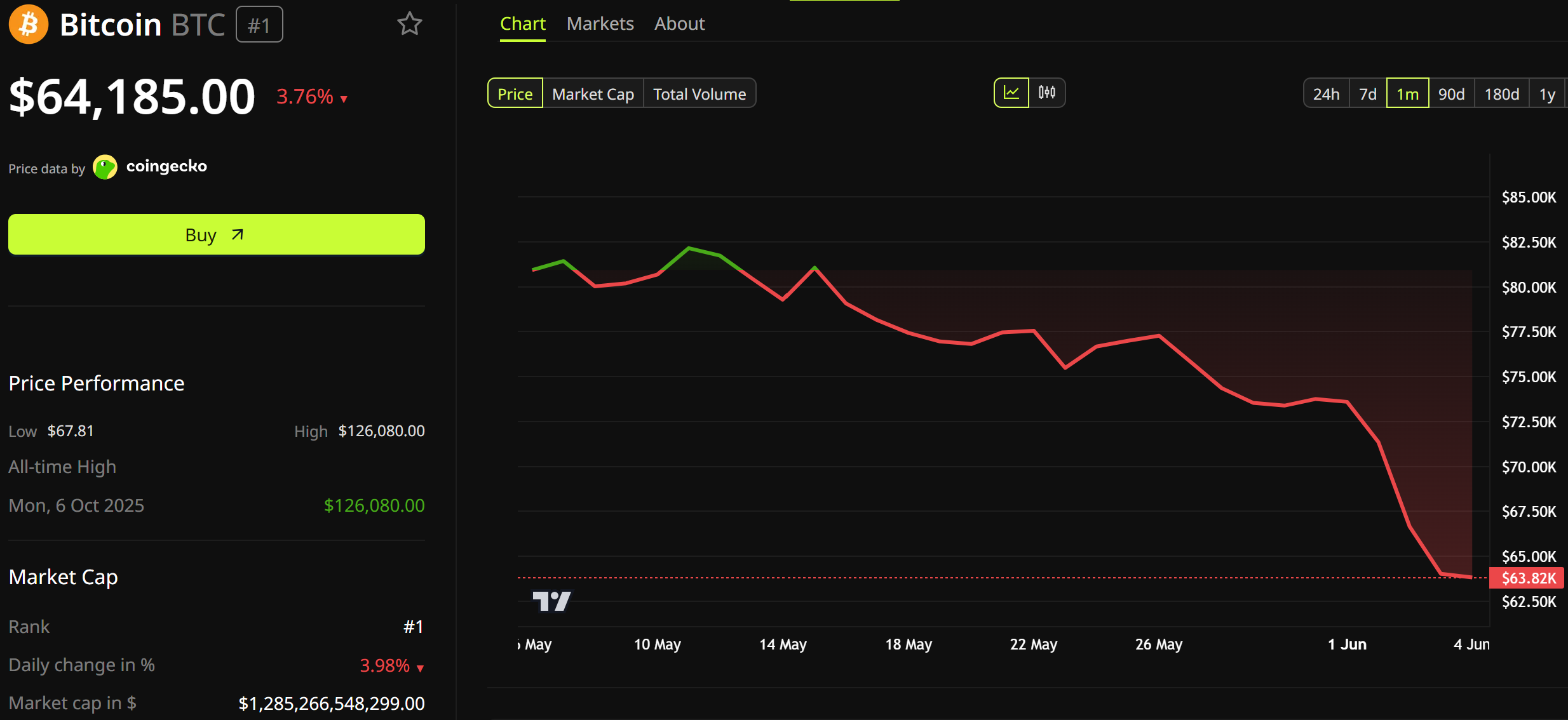
Michael Saylor conceded that the recent Bitcoin selloff reflects a rotation of capital toward AI rather than weakness in the pioneer crypto itself.
He pointed to roughly $4 billion in Bitcoin ETF outflows since May 14, with the king of crypto trading near $64,000 at the time, down about 4% on the day and nearly 49% below its October 2025 record.

Michael Saylor Reframes the Bitcoin Selloff
Saylor argued that capital markets are absorbing enormous sums to fund AI infrastructure. He put the figure at about $400 billion over six months across data centers and chips.
Analysts peg 2026 capital budgets at the largest US tech firms above $600 billion. That scale gives his rotation argument some footing.
He cast the ETF redemptions as temporary repositioning, not a structural problem. MicroStrategy holds 843,706 Bitcoin at an average cost near $75,702, per Strategy’s record Bitcoin holdings.
That average now sits well above the market price. With Bitcoin near $64,000, the 843,706 coins are worth about $54 billion against a cost basis near $63.9 billion.
That leaves MicroStrategy about $10 billion underwater on the largest corporate Bitcoin treasury. The loss is unrealized, yet it pressures a stock that trades as a leveraged proxy for the token.
The strain is already visible. A June 1 filing shows Strategy sold 32 BTC to fund preferred-stock dividends, its first sale since 2022. The move was small, yet it showed those obligations now drawing on the same balance sheet.
“Capital markets are funding the AI buildout at historic scale: ~$400B over 6 months. Bitcoin ETFs have seen ~$4B of outflows since May 14, pressuring $BTC. This is a capital rotation, not a Bitcoin impairment. Volatility creates opportunity,” Michael Saylor indicated.
Follow us on X to get the latest news as it happens
The Dot-Com Echo
The framing carries an irony, give Michael Saylor rode the same dot-com wave that once broke his company.
MicroStrategy peaked at $333 on March 10, 2000, the day the Nasdaq Composite also topped out. The stock then fell from $260 to $86 on March 20, a one-day drop above 60%.

That restatement erased about $66 million in revenue and turned reported profits into losses. Saylor and two executives later paid roughly $11 million to settle fraud charges, without admitting wrongdoing.
Analysts at PFR Capital now explore a possibility where Saylor could rattle markets again.
“In March 2000, MicroStrategy…changed its revenue recognition method…investors started doubting the revenue, profits, accounting quality, and so on of other companies. What happened after that, everyone knows. So you could say MicroStrategy single-handedly crashed the entire market. 26 years have passed. Will MicroStrategy be able to replay its market-crashing magic? Let’s wait and see,” PFR Capital’s Jayson Hu posed.
The parallel is imperfect, however, since the 2000 collapse stemmed from accounting. The current bet rests on transparent, on-chain purchases.
Still, leverage and concentration leave MSTR shareholders exposed to sharp swings.
Competing Reads on the Outflows
However, not everyone shares Saylor’s calm. CNBC’s Mad Money host Jim Cramer weighed in as the selling spread. He had touted doomed “new economy” stocks days before the 2000 top.
“Saylor suboptimal move roiling Crypto. Some wags pondering it was only up in the 90s because of Saylor… Seems extreme but it is all i hear,” he noted.
Bloomberg analyst Eric Balchunas described the stretch bluntly, while noting lifetime ETF inflows still top $55 billion. May marked the heaviest Bitcoin ETF outflows of 2026.
The split reflects a broader trend, with hedge funds rotating away from Bitcoin as AI narratives draw liquidity.
The post Michael Saylor Calls Bitcoin Selloff an AI Rotation as MicroStrategy Sits $10 Billion Underwater appeared first on BeInCrypto.


Visa and stablecoin infrastructure company Brale are piloting settlement using SBC, a U.S. dollar-backed stablecoin issued by Brale, on the Canton Network — the permissioned-but-privacy-preserving blockchain built by Digital Asset for regulated financial institutions. The two companies announced… Read the full story at The Defiant
The first week of June has split DeFi in two. Whale flows, total value locked, and sharp price moves point to three DeFi tokens and their respective projects to watch, where one is running hot, and two are bleeding.
This time, the smart-money signal and the price action mostly agree.
Hyperliquid (HYPE)
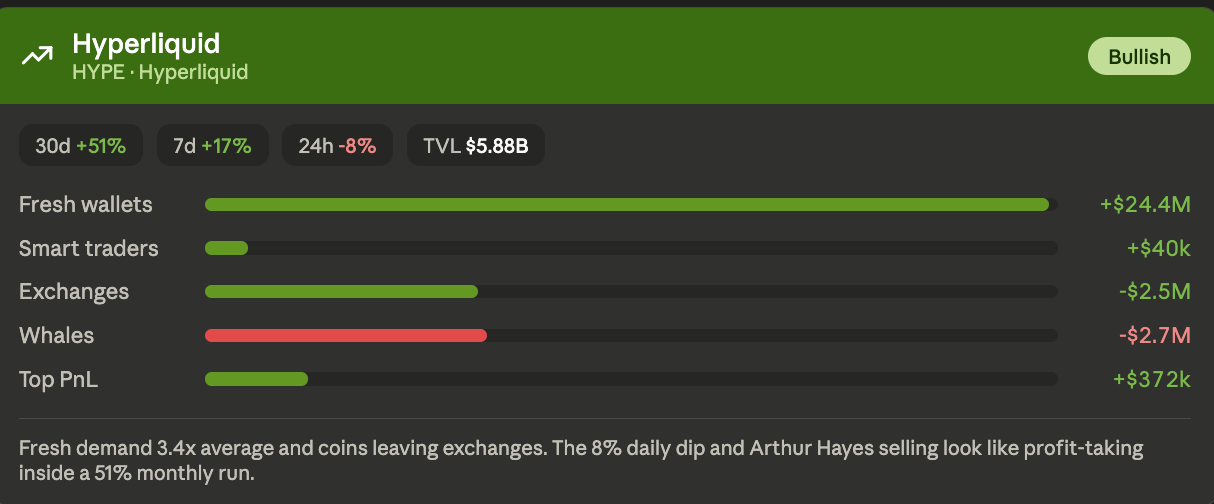
Hyperliquid is the week’s clear winner. HYPE is up about 17% over seven days and roughly 51% over the past month, even after an 8% pullback in the last 24 hours.
Want more token insights like this? Sign up for Editor Harsh Notariya’s Daily Crypto Newsletter here.
The whale flows explain the strength. Fresh wallets added $24.4 million, running 3.4 times their normal pace, and about $2.5 million in HYPE left exchanges. Coins leaving exchanges usually point to holders settling in rather than preparing to sell.

The fundamentals match. Hyperliquid total value locked (TVL), the dollar value of assets deposited in a protocol, climbed from about $5.52 billion in late May to about $5.88 billion now.

Whales did trim about $2.7 million, and Arthur Hayes was among the sellers. With TVL still rising, that reads as profit-taking inside a strong run rather than a top.
Aerodrome (AERO)
Aerodrome, the largest decentralized exchange on Base, is the mirror image. AERO, its DeFi token, fell 6.85% on the day and about 22% over the past month.
The whale flows are mixed rather than clean. Fresh wallets added about $17.3 million, but that ran below their usual pace, while top profit-takers trimmed roughly $222,000. The bigger tell is exchange deposits stacking up, which often points to sell pressure ahead.

The trend shows up in the fundamentals too. Aerodrome TVL has drained from about $501 million in January to about $312 million now.

Annualized incentives near $165 million also outrun revenue around $52 million, so the protocol pays out more than it earns.
Jupiter (JUP)
Jupiter is the most interesting case, because the project and one of its core tokens are pulling in different directions. JUP, the governance token, dropped about 15% in 24 hours. Yet the protocol itself is growing. TVL is up from about $2.34 billion in April to $2.51 billion, with zero incentive spending.

The selling concentrates in JLP, a separate DeFi token that represents a share of the Jupiter Perps liquidity pool. JLP holders deposit a basket of assets and act as the house against perpetual traders.
They earn most of the perp fees but absorb the pool’s market risk. Whales exited JLP at 14.7 times their normal pace, sending a part of $24.9 million to exchanges.

Here is the link between the two. JLP and JUP are both Jupiter tokens, but they do different jobs. JLP funds the perps exchange, and JUP lives off the fees the exchange generates. So, money fleeing JLP and the JUP price are connected at the source.
When whales pull $24.9 million out of JLP, they are backing away from Jupiter’s biggest fee engine.
Fewer backers means a weaker engine, and a weaker engine means thinner fees for JUP. So the JLP exit and the 15% JUP drop point the same way. They are one story about Jupiter, not two.
The fee and TVL numbers still look healthy for now. But if the JLP exit keeps running this hot, the fees behind JUP will be next to weaken.
The post 3 DeFi Tokens to Watch as One Jumps 50% and Two Bleed in June appeared first on BeInCrypto.
Crypto World
MicroStrategy’s STRC Slips Below $95, Adding New Pressure on Bitcoin Amid the Market Sell-Off
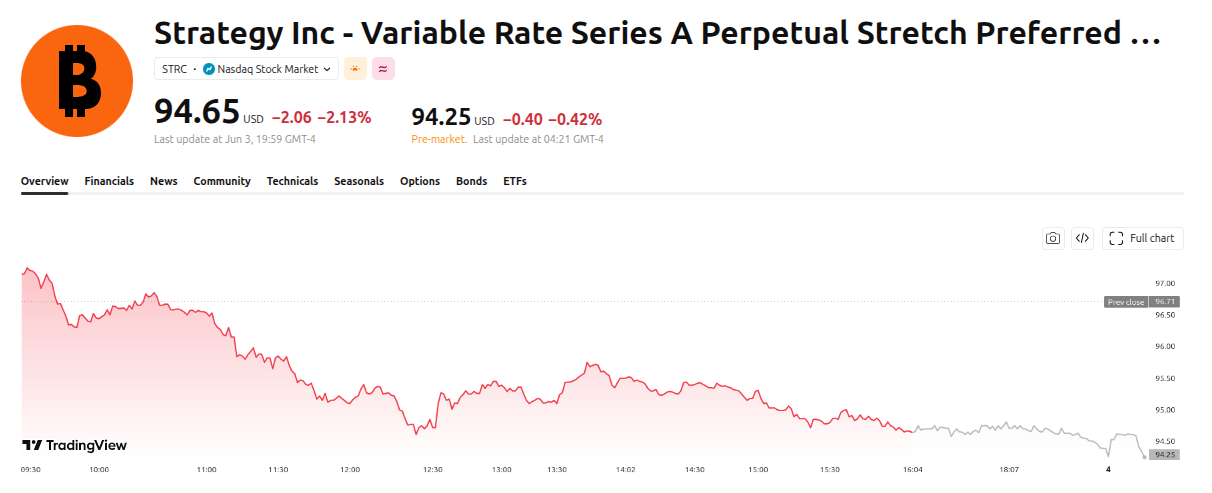
MicroStrategy’s preferred stock STRC fell below $95 for the first time in three months on June 3, 2026, closing at $94.65 as Bitcoin tumbled to $62,000 amid over $1.66 billion in liquidations.
We break down what STRC is, why it dropped, and what the move signals for Bitcoin investors right now.

Why STRC Slipped Below Its Target Range
STRC is Strategy’s Variable Rate Series A Perpetual Stretch Preferred Stock, designed with a $100 par value to deliver a high variable yield around 11.5% annually. It targets income-focused investors seeking indirect Bitcoin exposure with less volatility than MSTR.
The instrument uses dynamic dividend adjustments to keep its price trading near par. When demand weakens and the price falls, the company can raise the yield to pull the price back up over time, restoring the original capital structure logic.
That mechanism is now being stress-tested. STRC dropped more than 2% to close at $94.65, breaking a key psychological zone investors had grown used to during the past several months of relative stability.
Follow us on X to get the latest news as it happens
Trader Scott Melker known as “The Wolf of all Streets” provided important context on social media. “STRC’s $100 par value is not a price floor,” he wrote.
“A 5% discount to par is not evidence that something is broken. It’s evidence that investors are demanding a higher yield, pricing risk, or reacting to market conditions – exactly what preferred stocks do”, added.
The drop coincided with broader market turmoil. Bitcoin slid all the way to $62,000 in the last 24 hours, triggering more than $1.66 billion in crypto liquidations, mostly from long positions across major derivative platforms.
Strategy also added pressure by selling Bitcoin for the first time since 2022 to help fund preferred dividends. The amount was modest, but it dented the “never sell” narrative long championed by Executive Chairman Michael Saylor across global markets.
Why STRC Below Par Pressures Bitcoin Sentiment
The STRC discount matters because it directly affects Strategy’s ability to keep buying Bitcoin. With shares below $95, issuing new preferred stock becomes far less attractive, narrowing one of its main capital-raising channels.
Analyst Juan Rodríguez put it bluntly on social media. “STRC is adding bearish pressure to the Bitcoin price,” he wrote. “It signals danger and not future purchases of BTC. Investors are recovering capital at 95 with losses.”
The anti-Bitcoin and gold bug economist Peter Schiff highlighted the mechanical risks embedded in the structure. As STRC’s price falls lower, Strategy will be forced to raise the dividend rate even higher to pull the share price back toward par.
According to Schiff, this would accelerate the company’s cash burn and bring forward Bitcoin sales to fund the elevated payouts.
The math is straightforward. When STRC trades at or above par, new issuance funds further BTC purchases efficiently. Below par, the company needs higher yields to lure buyers, which increases cash outflows precisely when Bitcoin prices are already under pressure.
Strategy’s capital structure was designed for rising Bitcoin environments. Current conditions, including BTC at $63,500, a recent small sale to cover dividends, and STRC trading below target, present a notably less favorable backdrop than during the recent rally.
The company still holds over 843,706 BTC and maintains substantial cash reserves. MSTR common shares have also faced selling pressure, reflecting the interconnected nature of MicroStrategy’s layered capital stack and Bitcoin-centric corporate identity.
For income investors, the current discount offers a higher effective yield approaching 12%. However, that yield comes with mark-to-market losses and heightened uncertainty about dividend sustainability if Bitcoin weakness continues across the coming months.
Struggling STRC Faces Make-or-Break Shareholder Vote
This latest bout of weakness in STRC is unfolding with just days remaining before a critical shareholder vote on the proposed amendment to its dividend schedule.
With the June 7 deadline fast approaching, holders of both STRC and MSTR shares are being urged to approve a shift from monthly to semi-monthly dividend payments—keeping the 11.5% annualized rate unchanged but delivering payouts roughly every two weeks. The timing is far from ideal.
As STRC trades at a multi-month low and Bitcoin remains under pressure, the amendment aims to reduce reinvestment lag, tighten price action around par, and improve cash-flow consistency for income-focused investors.
However, the drop in the preferred shares has amplified concerns about the broader capital structure, with critics arguing it could accelerate cash burn and force earlier Bitcoin sales if the stock fails to recover.
MicroStrategy maintains the change will strengthen its “capital turbine” model, yet the current market stress has turned the upcoming vote into a key test of investor confidence at a particularly vulnerable moment.
The post MicroStrategy’s STRC Slips Below $95, Adding New Pressure on Bitcoin Amid the Market Sell-Off appeared first on BeInCrypto.
Crypto World
Jim Cramer Hints Michael Saylor “Murdered Bitcoin” as MicroStrategy Navigates a Sea of FUD


Jim Cramer fired a pointed jab on social media, hinting that Michael Saylor “murdered Bitcoin” as Strategy navigates a sea of FUD across its stock, preferred shares, and treasury position all at once.
We break down what Cramer said, the small Bitcoin sale behind the noise, and why MSTR and STRC are now flashing real stress signals.
Why Cramer Just Targeted Michael Saylor and MicroStrategy
Strategy is the Bitcoin treasury company formerly known as MicroStrategy. It holds more than 843,000 BTC, making it the largest corporate Bitcoin holder. The CNBC host’s “who murdered Bitcoin?” remark is widely seen as targeting Saylor’s accumulation approach.
The timing amplified the FUD. This week, Strategy disclosed that it sold 32 BTC for the first time since 2022, generating roughly $2.5 million to help fund dividends on its preferred shares.
While the sale represents a tiny fraction of total holdings, it broke from the firm’s long-held never-sell posture. The symbolic shift triggered a wave of scrutiny across crypto media and traditional Wall Street commentary almost overnight.
BeInCrypto reported that Saylor conceded the recent Bitcoin sell-off stems from capital rotating into AI rather than fundamental weakness of BTC, and highlighted roughly $4 billion in Bitcoin ETF outflows since May 14.
Cramer’s jab struck a nerve in crypto circles. Saylor commands a devoted following for his maximalist Bitcoin advocacy, and the veteran market commentator has a long history of contrarian calls challenging the broader crypto investment thesis.
Supporters counter that the recent sale was negligible and liquidity-driven. Critics, however, point out that Strategy’s Bitcoin bet has actually underperformed the S&P500 across the same multi-year horizon, fueling fresh debate.
How MSTR and STRC Are Flashing Real Stress
Investor sentiment has soured quickly across the entire Strategy capital stack. Shares of MSTR have pulled back sharply from prior highs, reflecting the company’s tight linkage to Bitcoin’s daily price performance across global markets.
The variable-rate perpetual preferred stock STRC has also slipped below $95. Yield-seeking investors are reassessing exposure as volatility in the underlying crypto holdings tests the stability mechanism designed to anchor STRC near par.
The structural model is being stress-tested in real time. Strategy uses share issuances and structured preferreds like STRC to amass Bitcoin, a model that delivered explosive upside in bull markets but now magnifies downside in risk-off environments.
The preferred stock framework targets high yields with mechanisms intended to stabilize the price around the $100. That balance becomes harder to maintain as Bitcoin trades well below Strategy’s average cost basis.
Saylor and the company have signaled continued commitment to the treasury strategy. They view drawdowns as temporary, but the mix of unrealized losses, the symbolic first sale, Cramer’s skepticism, and STRC weakness has created a potent FUD cocktail.
All eyes now remain on whether Strategy’s high-conviction approach can endure prolonged volatility. In the evolving world of corporate Bitcoin balance sheets, even small moves now invite outsized scrutiny from every angle of the market.
The post Jim Cramer Hints Michael Saylor “Murdered Bitcoin” as MicroStrategy Navigates a Sea of FUD appeared first on BeInCrypto.

The U.S. Comptroller of the Currency faced sharp questions this week about potential political influence in the agency’s handling of crypto banking charters. Jonathan Gould, the OCC’s head, was pressed during a House Financial Services Committee hearing on oversight of prudential regulators over World Liberty Financial, a crypto venture tied to Donald Trump and two of his sons that has sought an OCC national bank charter.
New York Democratic Rep. Gregory Meeks demanded clarity about World Liberty’s connections to foreign governments and the Binance exchange, arguing the company’s January charter application warranted careful scrutiny given the Trump family links. Meeks contended that the firm “actively lines the pockets of the president’s family,” urging Gould to apply the same standards to World Liberty as to any other applicant and to demonstrate that consideration isn’t affected by political influence.
During the exchange, Meeks and Gould frequently spoke over one another. Meeks stenciled a stark question: whether Gould was still operating to serve the American people or acting as a “fixer for the Trump family.” In response, Gould rejected the premise of political pressure and defended the integrity of the OCC’s process, saying that attempts to pressure him were “the only political pressure I’ve felt from anyone other than your Senate colleagues,” and that such pressure was “unfortunate and unprecedented.”
The hearing unfolded against a backdrop of ongoing regulatory developments in the crypto space. The OCC has already approved or conditionally approved several national trust charter applications from other crypto firms, including Coinbase, Ripple, BitGo, Circle, Fidelity Digital Assets and Paxos. Gould took office in July 2025 after confirmation by the Republican-controlled Senate along party lines, a context that lawmakers said colored the conversation about independence and accountability in the regulator’s work.
The debate also touched on broader questions about the legitimacy of the charter process. Massachusetts Senator Elizabeth Warren had called for a pause on World Liberty’s application, arguing that the approvals at the time favored “seemingly ineligible companies” and could contravene federal banking laws. The exchange highlighted ongoing tensions between political scrutiny and the regulatory decision-making that shapes the crypto industry’s access to traditional banking rails.
World Liberty’s co-founders include Donald Trump and two of his sons, according to the firm’s disclosures. The company submitted its national bank trust charter application in January, a move that has drawn intense scrutiny from lawmakers who want to ensure the process remains insulated from political considerations. Separately, the crypto exchange Kraken’s parent company, Payward, also filed for an OCC charter in May, signaling a broader push by industry players to obtain regulated access to national banking services. Kraken’s OCC charter filing has added to the sense that the regulator’s charter pathway is a focal point for the sector’s U.S. regulatory strategy.
Key takeaways
- The congressional hearing underscored heightened scrutiny of World Liberty Financial’s OCC national bank charter bid and the broader issue of political considerations in regulatory reviews.
- The OCC has already granted or conditionally approved several crypto firms’ charter applications, signaling a developing framework for crypto-tied institutions to access national banking services.
- Regulatory momentum for digital assets extends beyond charters to legislation, with the CLARITY Act advancing in Senate committees and a summer timeline eyed by administration officials.
- The debate exposes a fundamental tension between political accountability and the technical, standards-driven processes that govern charter approvals—an uncertainty that could affect investor confidence and corporate planning in the sector.
World Liberty and the regulatory ledger for crypto banks
The World Liberty case sits at the intersection of political optics and regulatory mechanics. The company—co-founded by Donald Trump and two of his sons—submitted its national bank charter application in January, prompting a wave of questions from lawmakers about potential conflicts of interest and the standards applied to crypto-focused entrants seeking bank-like trust powers. In the same spirit of regulatory expansion, the OCC has already moved to approve other charter bids, signaling a recognition that crypto firms seek formalized access to the traditional financial system, albeit under tailored oversight.
World Liberty’s bid is not an isolated incident. The OCC has repeatedly signaled an openness to national trust charters for crypto firms as part of a broader move to clarify the rules of the road for digital assets. The agency’s approach contrasts with the more cautious, sometimes contradictory signals from other branches of government, illustrating the tug-of-war between enabling innovation and maintaining robust guardrails. The public discussion also features calls from lawmakers for greater transparency and consistently applied standards, regardless of a firm’s political connections.
Regulatory momentum and looming legislation
Beyond individual charter cases, the crypto regulatory landscape in the United States is moving toward a comprehensive framework. A sweeping market structure bill, known as the CLARITY Act, has been a central focal point for lawmakers seeking to standardize how digital assets are treated in terms of custody, investor protections, and market integrity. This week, Treasury Secretary Scott Bessent signaled that the administration aims to push the measure through the Senate in the near term, with some senators anticipating a vote before August following movement in two key committees. The timing injects a sense of urgency into debates about how to balance innovation with consumer safeguards and systemic stability.
The CLARITY Act discussion comes amid a broader political context. Senator Warren has used public remarks to question the integrity of crypto-related approvals, framing the debate as an ongoing contest between regulatory fairness and political influence. As the CHOICE of whether to grant or deny charters continues to unfold, investors and builders alike will be watching how the administration and Congress align on practical rules that can govern a rapidly evolving technology stack.
What this means for the market and the path forward
For market participants, the unfolding charter process and the CLARITY Act timeline offer both risk and clarity. On one hand, a transparent, consistently applied charter framework could reduce regulatory ambiguity and unlock institutional-grade services for a broader set of crypto firms. On the other hand, heightened political scrutiny raises the potential for delayed decisions or additional conditions attached to charter approvals, which could complicate strategic planning for exchanges, custodians, and other service providers seeking regulated access to the U.S. banking system.
Investors may also weigh the implications of ongoing congressional inquiries into potential conflicts of interest among regulators. The tension between ensuring independence and addressing legitimate concerns about corporate influence is likely to persist, potentially shaping how market participants assess political risk in regulatory decisions.
Looking ahead, the next couple of months will be telling. Courtship between crypto firms and the OCC will continue to unfold under the glare of congressional oversight, with World Liberty’s fate and Kraken’s charter filing serving as real-world tests of the agency’s thresholds. Simultaneously, the Senate’s handling of the CLARITY Act will offer a broader signal about the United States’ approach to crypto regulation, with implications for issuers, custodians, and users who rely on clear, enforceable rules.
Readers should watch how the OCC applies its standards in practice, whether World Liberty’s bid proceeds in line with other approvals, and how the CLARITY Act’s provisions—particularly around custody, compliance, and reporting—translate into actual regulatory requirements once the bill reaches a final vote. The evolving framework will shape the pace at which crypto firms can scale in the U.S. and influence how institutional capital views the country as a viable base for digital-asset infrastructure.

Open-Source Blockchain Devs Outside SEC Rule Scope

Golden Knights’ McNabb exits Game 2 with injury

Spammers are flooding Reddit with fake posts designed to show up in AI search results



-

 Tech7 days ago
Waymo dominates autonomous vehicle registrations as Tesla trails behind
-

 News Videos7 days ago
This is BROKEN! INSANE 5x MONEY CAR WASH WEEK! The NEW GTA Online UPDATE Today! (GTA5 New Update)
-
 Tech6 days ago
SpaceX just won a second Golden Dome contract. This one is $4.16 billion.
-

 Business3 days ago
Jade Biosciences, Inc. (JBIO) Discusses Positive Interim Results From JADE101 Phase I Healthy Volunteer Study and Development Plans Transcript
-

 News Videos6 days ago
SHE IS KILLING XRP!!! WATCH URGENT AND ACT FAST
-
 NewsBeat6 days ago
FIRST NIGHT REVIEW: Take That bring the Circus back to life in spectacular sun-soaked style
-

 Business6 days ago
Is the Spurs Phenom Already Better Than Prime Diesel?
-
 Crypto World6 days ago
CFTC Has Approved the First Regulated Bitcoin Perpetual Contract in the U.S.
-

 Sports2 days ago
French Open 2026 results: Alexander Zverev beats Rafael Jodar and will play Jakub Mensik in semi-finals
-

 Politics6 days ago
The House | Inside Andy Burnham’s Makerfield Campaign: “Nobody Thinks This Is In The Bag”
-
 NewsBeat6 days ago
Novak Djokovic v Joao Fonseca LIVE: French Open latest scores and results after Jannik Sinner’s shocking collapse
-
 Entertainment6 days ago
Weak ‘Supergirl’ Box Office Tracking Amid Milly Alcock Backlash
-

 Tech3 days ago
CryZENx Releases Fresh Playable Content Deep Inside Jabu-Jabu for His Ocarina of Time Remake
-

 Entertainment6 days ago
Maddox Jolie-Pitt Legally Requests to Drop Brad’s Surname
-
 Crypto World6 days ago
Snowflake (SNOW) Stock Rallies on Strong Q1 Results and AI Product Growth
-

 Business6 days ago
Demand Conditions Improve In Chemicals Sector In April 2026
-
 Entertainment6 days ago
One of the Greatest Sitcoms of All Time Shoots Up Apple TV’s Charts 11 Years Later
-
 Crypto World6 days ago
MicroStrategy Moves $30 Million in BTC to Coinbase Prime: Is the Bitcoin Sell-Off Already Here?
-

 Tech6 days ago
This Week In Security: Ubiquiti Fixes, And FreeBSD Joins The Club You Don’t Want To Join
-
 Entertainment6 days ago
Bruce Willis’ Generosity Resurfaces Amid His Dementia
You must be logged in to post a comment Login