

Crypto World
Visa and Brale Test Privacy-Enabled SBC Stablecoin Settlement on Canton Network



Visa and stablecoin infrastructure company Brale are piloting settlement using SBC, a U.S. dollar-backed stablecoin issued by Brale, on the Canton Network — the permissioned-but-privacy-preserving blockchain built by Digital Asset for regulated financial institutions. The two companies announced… Read the full story at The Defiant



Bybit has added support for Western Union’s USDPT stablecoin, becoming the first major cryptocurrency exchange to list the dollar-pegged token for trading, transfers, and custody.
Summary
- Bybit has listed Western Union’s USDPT stablecoin for trading, transfers, and custody.
- USDPT launched in May on Solana and is backed by reserves held at Anchorage Digital Bank.
- The listing comes as stablecoin adoption grows across payments and financial services.
According to an announcement released on Thursday, users can now hold, transfer, and trade USDPT on Bybit. The integration gives Western Union’s newly launched stablecoin access to one of the crypto industry’s largest trading venues while adding another dollar-backed asset to Bybit’s stablecoin offering.
Malcolm Clarke, Head of Digital Assets at Western Union, said the Bybit listing extends the company’s network into the digital asset ecosystem and strengthens connections between its global payout infrastructure and crypto markets.
Clarke added that the development aligns with the company’s long-term view of digital payments, stating:
“This is where we see the future of settlement heading: always-on, programmable, and integrated across both traditional and digital financial systems, with USDPT at the center as a trusted, regulated settlement asset.”
Western Union introduced USDPT in May through its digital asset division, Western Union Digital. The token is backed by reserves held at Anchorage Digital Bank and was initially launched on the Solana blockchain per an earlier report by crypto.news.
The company said USDPT was designed to comply with the framework established under the U.S. GENIUS Act, which set regulatory standards for payment-focused stablecoins.
Coming only weeks after Bybit launched a perpetual contract linked to SpaceX, the exchange continues to expand the range of products available on its platform.
Earlier in May, Bybit introduced the SPCXUSDT perpetual contract, which offers traders exposure to SpaceX ahead of the aerospace company’s expected public listing. According to Bybit, the contract supports leverage of up to 10x and remains available for trading around the clock without an expiry date.
Stablecoin adoption expands among payment firms
Activity in the stablecoin sector has continued to increase even as cryptocurrency prices remain under pressure. Data from DeFiLlama shows that the combined value of dollar-pegged stablecoins has risen to nearly $320 billion.
Western Union is one of several payment companies that have recently entered the market. Earlier this month, MoneyGram launched its own dollar-backed stablecoin, MGUSD, on the Stellar network. The company said the token forms part of its efforts to support blockchain-based payments and cross-border money transfers.
At the same time, traditional card networks have been increasing their involvement in regulated stablecoin settlement. Mastercard announced on Wednesday that it was expanding support for stablecoins, including USD Coin, PayPal USD, and Ripple USD.
According to Mastercard, the initiative will allow certain issuers and acquirers to settle card transactions using regulated stablecoins.
Meanwhile, rival payments company Visa Inc. reported in April that its stablecoin settlement pilot had reached a $7 billion annualized transaction run rate, highlighting growing use of blockchain-based payment infrastructure.
Policymakers continue evaluating stablecoin payments
Interest in stablecoins has also attracted attention from regulators and international institutions assessing new payment technologies.
The World Bank has previously noted that conventional remittance systems can be expensive and may limit financial access in developing markets. According to the institution, digital payment solutions, including stablecoin-based transfers, could help reduce costs and improve efficiency in cross-border transactions.
As payment providers continue introducing their own digital dollars, the listing of USDPT on Bybit brings Western Union’s stablecoin into crypto trading markets only weeks after its launch, giving users another regulated dollar-backed option on the exchange.
Crypto World
PRED Opens Public Access for Unique FIFA World Cup Prediction Markets, After Private Beta Hits 86% Retention

[PRESS RELEASE – Panama City, Panama, June 4th, 2026]
After nearly $5 million in beta trading volume, Pred opens public access for the 2026 FIFA World Cup, with unique markets and fastest market resolution benchmarks.
Pred, a peer-to-peer sports trading exchange built on Base, opened public access today after a private beta that kept 86% of traders active week over week and pushed $5 million in notional volume through 300+ invited users.
Across 8 weeks, traders executed more than 100k trades on soccer markets, and 83% of them made repeat deposits.
Pred is a sports native exchange, designed for the speed of live sports. Traders match positions against one another through an on-chain order book. Trading settlement happens in 200 milliseconds, and markets resolve in 3 minutes, not hours. Positions are denominated in USDC, settled on-chain, and deposits and positions always earn native yield.
The release lands just in time for the opening match of the 2026 FIFA World Cup. Pred is building market depth around in-game events that general prediction platforms don’t carry: 15-minute markets that settle inside the run of play, 1UP and 2UP markets that close the moment a goal difference is reached, and live moneyline markets with the best prices. A typical Premier League match during beta ran several of these in parallel, where most prediction platforms list a few sub-markets per match.
“I spent 22 years trading sports, watching exploitative pricing of sportsbooks and limits of sharp traders cut to nothing the moment they started winning,” said Amit Mahensaria, CEO and co-founder of Pred. “Pred is the exchange I wanted as a trader. The UX and speed of a sportsbook, the pricing and transparency of an on-chain exchange.”
General-purpose prediction markets are today benefiting from the broken market structure and exploitative pricing of sportsbooks. But they are not designed for live sports – neither in UX, nor in speed, nor in market variety. Sports trading will be a verticalised play, and being such a large asset class, it needs its own exchange.
The product going live today is Pred V2, rebuilt after more than 300 calls with beta users. Pred is backed by Accel and Coinbase Ventures.
About Pred
Pred is a peer-to-peer sports native prediction market built on Base. Positions are denominated in USDC, matched through an open order book, and settled at high speed on-chain.
Disclaimer: Pred does not operate in India, Singapore, the United States, or OFAC-sanctioned countries.
The post PRED Opens Public Access for Unique FIFA World Cup Prediction Markets, After Private Beta Hits 86% Retention appeared first on CryptoPotato.
Crypto World
USD Private Introduces a Structured Digital Asset Model with a Programmed Price Path From $1 to $1 Million

[PRESS RELEASE – Portland, OR, June 4th, 2026]
USD Private is launching a structured digital asset platform built around a programmed price path, closed-platform access, and future utility.
The platform is designed to offer a more rules-based approach to digital assets, with pricing determined by a scheduled model rather than open-market trading. The $USDP token is launching soon, with an initial price of $1 providing an easy entry point for early participants. From there, the pre-programmed price path is designed to increase to $1,000,000 over a four-year period.
A Programmed Price Path
One of USD Private’s key features is its programmed price path. The $USDP token will start at $1 and is designed to increase to $1,000,000 over four years, giving early adopters an exciting opportunity.
Unlike many digital assets that are driven by open-market volatility, $USDP’s pricing will be determined by the platform’s programmed model. This means the token price is not set by speculative trading across external exchanges. Instead, the platform separates price progression from liquidity: the programmed schedule determines the price path, while user participation determines how easily buy and sell orders are fulfilled. USD Private is investing heavily in demand creation activities and expects an always rising price will result in more buyers than sellers in the market over time.
This structure gives USD Private a more rules-based model than typical token markets. The pricing model is straightforward, easy to understand, and central to how the platform is designed to operate.
A Closed Platform with Structured Rules
USD Private operates within a closed trading environment. This structure allows the platform to support its algorithmic pricing model and maintain a consistent set of rules for all participants.
All buying and selling activity takes place within the USD Private platform. This avoids reliance on scattered external markets and allows users to interact through a single structured system. The platform also supports fractional purchases, enabling users to participate with smaller amounts rather than needing to purchase a full token. This can be helpful for those who want to try the platform first.
The closed-platform model is designed to make the user experience more consistent and easier to follow. Instead of navigating multiple exchanges or market venues, participants use one environment, one programmed price schedule and one queuing system for platform activity.
Long-Term Utility Through USDM
USD Private is not designed only for its first four years. While $USDP is designed to reach $1,000,000 within that period, the platform’s roadmap provides long-term utility and value. After the four-year early adopter phase, $USDP’s price will become fixed and convert into USDM. USDM will be the only fully private and anonymous USD-linked blockchain. A highly demanded private USD blockchain is expected to generate high demand for the platform beyond its initial four-year cycle, while introducing a pathway for longer-term utility within the broader model. For early adopters, this creates the potential to move into an exciting new phase designed around expanded utility after the first cycle is complete.
Platform Activity and Liquidity
USD Private separates the programmed price path from market liquidity. The platform sets the price path in advance, but completed sell orders still require buyer participation within the system.
This means the programmed schedule determines the price, while platform activity helps determine liquidity and how easily users can buy or sell over time. Stronger buyer activity may support smoother transaction flow, while lower activity may lead to longer waiting times for sellers.
This is why the platform is making heavy investments in demand creation and makes clear that liquidity depends on participation and is not guaranteed.
About USD Private
Expected to launch soon, USD Private will mark the first entry point into a more structured digital asset model. $USDP will begin at its initial $1 price point before continuing along its programmed price path to $1,000,000 per token.
To access USD Private from launch, users may register their interest by emailing register@usdprivate.com. Registered users will be notified directly once the launch date is confirmed.
To learn more about the platform and follow launch updates, visit USD Private’s official website and social channels:
Website: https://usdprivate.com/
Telegram: https://t.me/USDPrivate
Disclaimer: This article is for informational purposes only. It is not financial, investment, legal, or tax advice.
The post USD Private Introduces a Structured Digital Asset Model with a Programmed Price Path From $1 to $1 Million appeared first on CryptoPotato.
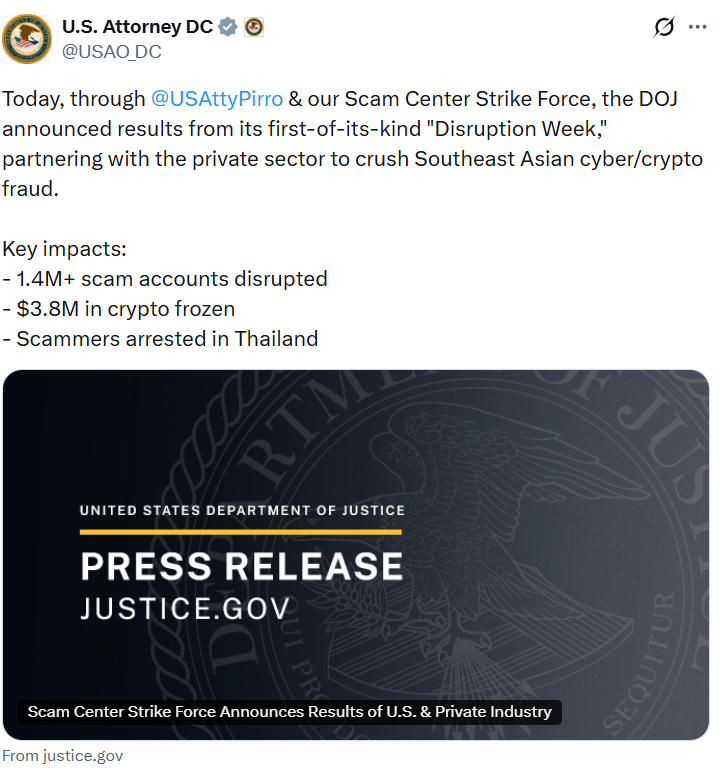
Crypto exchange Coinbase said it froze more than $3 million in cryptocurrency tied to a global operation targeting cyber-enabled crypto scam networks in Southeast Asia.
The operation was part of Disruption Week led by the US Department of Justice’s Scam Center Strike Force, which brought together government entities and private industries to tackle crypto fraud targeting Americans.
“This operation is proof that scammers can’t be stopped by any single company or agency acting alone,” said Coinbase.
“It took social platforms, financial institutions, connectivity providers, and law enforcement working in lockstep to hit these networks at nearly every point in the fraud chain, online accounts, financial flows, and physical infrastructure all at once.”
The operation also involved Meta, Microsoft and Starlink, which worked together to take down servers and other hosting infrastructure linked to scam networks and disrupt criminal activity across more than 1.4 million social media and email accounts, leading to several arrests by the Royal Thai Police Anti-Cyber Scam Center.
Investment fraud and pig butchering are among the fastest-growing and most financially devastating forms of fraud targeting Americans, the DOJ said. The FBI reported earlier this month that Americans’ losses from crypto- and AI-related scams in 2025 exceeded $11 billion, with investment scams the most damaging.
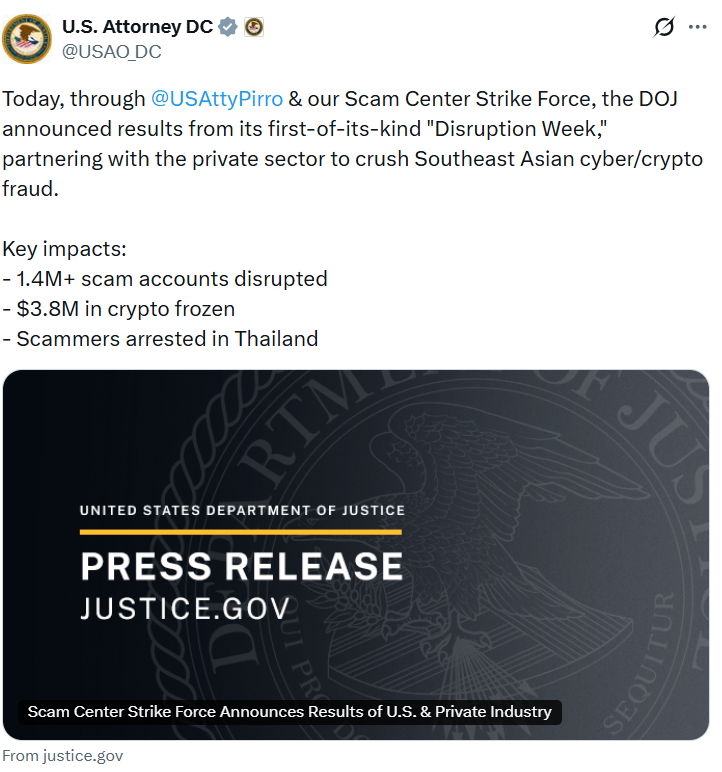
Source: US Attorney DC
“We know crypto sometimes gets an unfair reputation when it comes to illicit finance. The reality is the opposite. Blockchain technology gives law enforcement something traditional financial systems often can’t: a transparent, immutable and permanent record of every transaction,” Coinbase added.
Other members of the coalition included the FBI, the US Secret Service and law enforcement partners in the UK, Australia, Canada, New Zealand and Thailand.
Related: OFAC sanctions Cambodian politician linked to pig butchering scam centers
Meta said it shared “actionable insights” from all those involved, which helped “connect the dots between disparate pieces of information across platforms. The collective effort of these tech companies enabled the operation to target and disrupt criminals at nearly every point in the fraud chain.”
Authorities around the world have been heavily targeting scam infrastructure this year. In April, the US Scam Center Strike Force and its law enforcement partners targeted scam centers and froze more than $701 million in crypto linked to investment scams.
Meanwhile, a Dubai police-led international crackdown on scam rings resulted in the arrest of 276 individuals and the shutdown of at least nine crypto scam centers.
In another police action involving Austrian and Albanian authorities, with support from Europol and Eurojust, 10 people were arrested in connection with three scam centers in Tirana, Albania.
Magazine: Big Questions: Do we really only need 2–5 cryptocurrencies?


Bitcoin has fallen below $64,000 after Strategy’s small BTC sale intensified pressure on a market already facing ETF outflows and renewed criticism from high-profile skeptics.
Summary
- Bitcoin fell below $64,000 after Strategy disclosed a 32 BTC sale, raising fresh concerns across the crypto market.
- Jim Cramer said Strategy’s move shook confidence because investors viewed Saylor’s company as a major Bitcoin supporter.
- SoSoValue data showed U.S. spot Bitcoin ETFs recorded $1.40 billion in outflows during early June.
According to Strategy’s latest disclosure, the Michael Saylor-led Bitcoin treasury firm sold 32 BTC after trading opened on Monday, days after BTC traded just under $74,000 on June 1. The sale was small compared with the company’s total holdings, but traders quickly focused on the timing because Strategy has long been viewed as one of Bitcoin’s most visible corporate backers.
Bitcoin dropped sharply after the announcement, while Strategy shares also came under pressure. Market data cited in the report showed MSTR down about 15% since the disclosure, with the company sitting on an unrealized Bitcoin loss of roughly $10.8 billion.
Cramer Says Strategy Sale Shook Bitcoin Confidence
CNBC host and former hedge fund manager Jim Cramer said Saylor’s decision has unsettled crypto traders because many investors believed Strategy helped support Bitcoin’s previous highs.
In his remarks after the disclosure, Cramer said he may need to rethink his pro-Bitcoin view because Strategy had “propped it up” for years. He described Strategy as a “key trampoline” for Bitcoin, although he said calling the move market manipulation would be “too strong.”
Cramer later argued that the sale changed how investors viewed Bitcoin’s recent rise. He said many traders now believe crypto reached earlier peaks largely because of Saylor’s continued buying. Responding to Strategy’s unrealized loss, Cramer referred to Bitcoin’s “murder” and criticized the company’s position.
ETF Outflows Add Pressure to Bitcoin
SoSoValue data showed that U.S. spot Bitcoin ETFs posted $2.43 billion in net outflows in May. The same data showed another $1.40 billion leaving the funds during the first three days of June.
Those withdrawals added pressure after Bitcoin had already struggled for months following the Oct. 10 flash crash last year. The ETF data suggests institutional demand has weakened at the same time Strategy’s sale has raised questions about corporate support for BTC.
Bitwise advisor Jeffrey Park offered another explanation for the withdrawals. Park said some investors may be moving money out of Bitcoin to prepare for expected IPO opportunities, including SpaceX and Anthropic.
Schiff Renews Attack on Saylor’s Bitcoin Strategy
Economist and longtime Bitcoin critic Peter Schiff said the latest price action represents more than normal volatility. Schiff argued that investors are selling Bitcoin to avoid larger losses or to move toward other investment opportunities.
Schiff also claimed Saylor is caught in a difficult cycle because Strategy needs to keep buying Bitcoin as other investors sell. According to Schiff, the company’s ability to support Bitcoin depends on whether it can continue issuing stock.
He further argued that Strategy could face problems if MSTR shares trade at a discount. In Schiff’s view, weaker access to share issuance would hurt the company’s ability to buy more Bitcoin and maintain confidence in its treasury plan.
Although Strategy’s 32 BTC sale was small, the market reaction showed how closely investors track Saylor’s moves. Cramer, Schiff, and ETF flow data each placed Strategy back at the center of the Bitcoin debate.

Bitcoin slipped about 21% over a 10-day stretch, briefly retesting the $61,000 area as MicroStrategy’s debt strategy unfolded and the broader market faced ongoing ETF and liquidity dynamics. The move came as Strategy announced it had tapped into cash raised from recent equity issuances to repurchase portions of its convertible debt, a step that paused fresh Bitcoin accumulation for the moment and fanned questions about potential future liquidations.
MicroStrategy has long been the most visible large-scale Bitcoin holder, with its treasure chest growing to 126,016 BTC, accumulated for roughly $9.31 billion since March. The company funded a portion of its strategy by raising capital via equity issuances and used about $1.38 billion of that cash to repurchase convertible debt, a decision announced in mid-May. At the same time, the Stretch preferred stock (STRC US) price has drifted away from the $100 mark, complicating the near-term risk calculus for holders of both the company’s stock and the associated preferred instrument.
With its Bitcoin reserve now backed by a smaller cash cushion, Strategy’s balance sheet remains under close scrutiny. The company has also disclosed that its cash position sits around $900 million, a level that can cover roughly six months of preferred-dividend payments, assuming current rates continue. The STRC preferred stock pays a monthly dividend at an annual rate of about 11.5%, with a mechanism that allows new share issuance if the price climbs back to $100, and a lower price could trigger adjustments in the dividend or share issuance dynamics. The interplay between STRC’s price, potential new issuances, and the flow of Bitcoin buys and sells is central to how investors gauge Strategy’s risk in a volatile macro backdrop. For context, Strategy has raised about $7.5 billion through STRC issuances in the first five months of 2026, a move that has been supportive of Bitcoin’s price trajectory to date. Further detail on the debt-repurchase move is noted in contemporaneous coverage from Cointelegraph.
Momentum in the market has also been influenced by the STRC’s price trajectory and the broader ETF environment. As STRC trades below $100 and spot ETFs remain net sellers, the odds of a sustained breakout for Bitcoin toward the $70,000 level have been read as limited for now. This framing is consistent with the observed liquidity dynamics around MicroStrategy’s equity and debt instruments and with market participants’ evolving view on the company’s ability to finance ongoing Bitcoin accumulation through equity-drawn cash and preferred-stock capital raises.
The balance sheet remains anchored by a key metric: 11% net leverage. Even at subdued Bitcoin prices, the value of Strategy’s Bitcoin holdings provides a significant cushion, though the company’s cash runway has thinned. A scenario analysis widely discussed among market participants suggests that the coverage provided by the Bitcoin reserve could be conservative even if the Bitcoin price were to dip meaningfully, such as toward $30,000. In other words, the reserve buffer has historically offered a margin of safety, even as cash and liquidity come under pressure from debt-service obligations and new capital-raising activities.
Key takeaways
- Conservative leverage with a Bitcoin cushion: Strategy reports an 11% net leverage, a key metric that is mitigated by the value of its Bitcoin holdings, which provides a conservative buffer even under stressed prices.
- Near-term upside tempered by STRC and ETF dynamics: A sustained rally above $70,000 is unlikely while STRC trades under $100 and spot ETFs remain net sellers.
- Cash runway narrowed by debt maneuvers: About $1.38 billion of cash was used to repurchase convertible debt, contributing to a cash balance around $900 million and roughly six months of dividend coverage at current rates; STRC issuances totaling $7.5 billion in early 2026 underpinned prior liquidity.
- No hard liquidation floor, but dilution as a risk tailwind: There is no contractual floor forcing Bitcoin sales, but if debt markets tighten, dilution of existing holders could become a lever, potentially influencing leverage perception and stock dynamics.
Debt moves, liquidity, and what comes next
The mid-May debt-repurchase decision — financed with cash raised from recent equity issuances — underscores MicroStrategy’s attempt to manage its capital structure in a period of tighter liquidity. By pulling cash from equity proceeds to repurchase portions of its convertible debt, the company sought to reduce the near-term debt burden and stabilize the balance sheet while continuing to pursue strategic Bitcoin accumulation under a changed liquidity backdrop. In turn, the STRC preferred stock’s price sensitivity to the $100 threshold complicates the financing calculus, because crossing that line can alter the timing and scale of new share issuance and the associated dividend dynamics. The dividend itself is currently set at an annual rate of 11.5% and is paid monthly, a feature that remains attractive to some investors but adds another layer of sensitivity to market price movements for STRC.
MicroStrategy’s Bitcoin position remains a central part of its narrative and risk/return profile. Holding 126,016 BTC with a reported value of about $9.31 billion as of March, the reserves continue to anchor the company’s asset base even as cash and liquidity face pressure from ongoing financing activity. The company’s strategy to deploy equity-derived cash toward debt repayments aligns with a broader aim to reduce financial fragility while sustaining Bitcoin accumulation over time. Related commentary from market observers notes that any eventual sale of Bitcoin from Strategy would not be automatic or guaranteed; rather, it would hinge on a mix of debt markets, equity financing options, and strategic risk assessments.
Market chatter around a potential “doom loop” — the idea that a large sale could push BTC price lower, prompting buyers to wait for lower prices — has been attributed to commentary circulating on social platforms. One widely cited thread suggested that a large, credible seller could depress prices more quickly, discouraging new accumulation and deepening liquidity challenges. While such a scenario remains speculative, it highlights how closely the price action of Strategy’s holdings is watched by traders and the broader market, particularly given the interplay between the STRC price, STRC’s dividend mechanics, and the path of Bitcoin prices.
Looking ahead, the main narrative remains: with STRC trading below $100 and ETF flows continuing to shape the immediate supply/demand balance for Bitcoin, the probability of a rapid move back toward $70,000 in the near term hinges on how Market participants interpret Strategy’s liquidity trajectory, potential debt-market reopening, and any policy shifts that affect crypto-backed balance sheets. As cash reserves erode and the debt-repurchase narrative unfolds, investors will be watching whether Strategy can sustain its Bitcoin accumulation without triggering forced liquidations or triggering dilution events that would alter the risk/return calculus for both equity and preferred-share holders.
For readers seeking context, Cointelegraph’s related coverage details Strategy’s debt-repurchase activity and the broader implications of favored instruments like STRC in the company’s funding mix. Additionally, market chatter around Strategy’s strategy and Bitcoin exposure continues to be analyzed across social channels, including commentary that points to the dynamic tension between price levels, dividend terms, and liquidity constraints.
What comes next will hinge on liquidity recovery, debt-market conditions, and the evolving price relationship between STRC, Bitcoin, and the broader crypto ecosystem. Stay attentive to updates around STRC’s price, the company’s cash runway, and any new debt or equity issuances that could recalibrate Strategy’s balance sheet and Bitcoin accumulation trajectory.
Sources and further reading: Cointelegraph coverage of Strategy’s debt repurchases and STRC dynamics; TradingView data on STRC price behavior; public disclosures on Strategy’s Bitcoin holdings and cash position; market commentary on the potential implications of a “doom loop” for Bitcoin and large corporate holders.
[PRESS RELEASE – Stockholm, Sweden, June 4th, 2026]
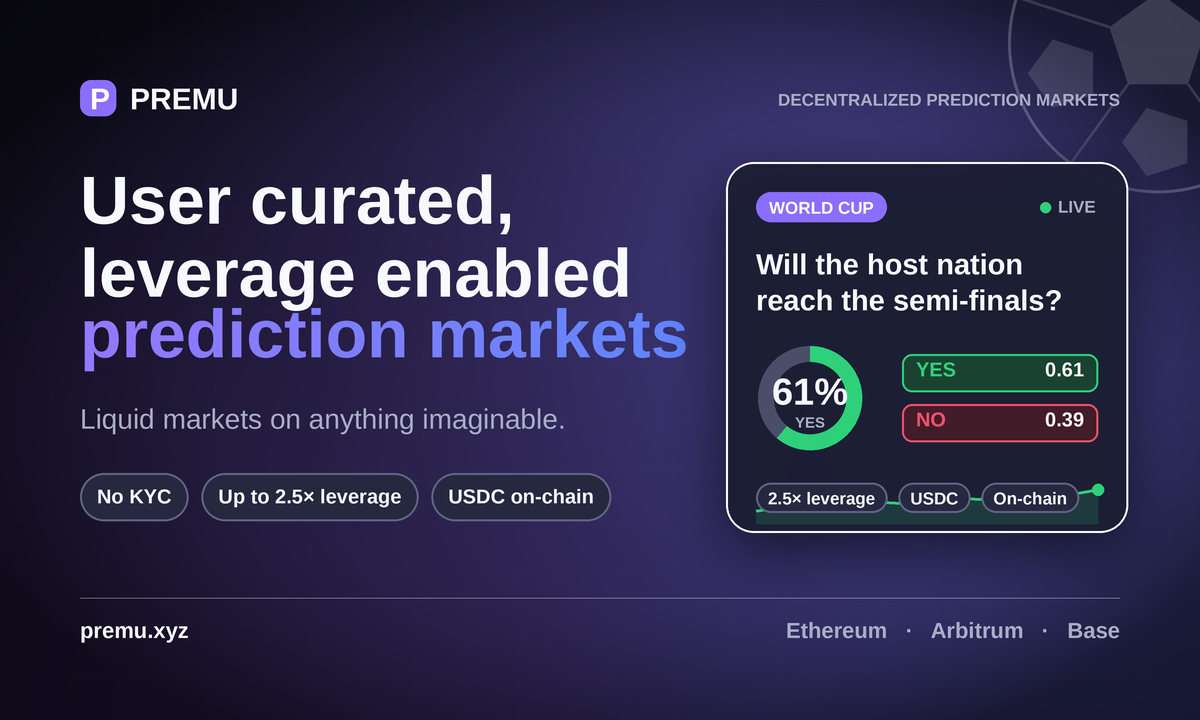
Decentralized prediction market platform lets participants launch their own World Cup markets, trade with leverage of up to 2.5x, and earn fees on the markets they create.
With the 2026 FIFA World Cup set to begin on June 11, Premu, a decentralized prediction market platform, is highlighting the feature that distinguishes it from centrally operated venues: any participant can create a market on a World Cup outcome, set it live, and earn a share of the fees generated by trading in that market.
Rather than waiting for a platform to list a contract, participants on Premu can launch a yes-or-no market on questions such as which team advances from a group, who reaches the final, or the result of a single fixture. Markets are created permissionlessly by posting a bond in USDC, and the creator earns a fee on every trade placed in the market. Positions can be traded with leverage of up to 2.5 times using isolated or cross margin, with activity settled on-chain in USDC across the Ethereum, Arbitrum, and Base networks.
The timing coincides with rising interest in prediction markets, which have moved from a niche tool into wider public view over the past year as participants turn to event-based markets for forecasting and information. Major sporting events have historically drawn some of the highest trading activity to these platforms, and the World Cup, a 104-match tournament running through July 19, ranks among the largest such events on the 2026 calendar.
“Sporting events like the World Cup tend to generate questions faster than any central team can list them,” said Chadi Farhat, Chief Technology Officer at Premu. “Allowing participants to create their own markets, and to earn from the activity they bring, means the platform can keep pace with each stage of a tournament as it unfolds.”
Comparisons such as Polymarket vs Kalshi have featured prominently in industry discussion, drawing attention to differences in market structure, regulatory approach, and how markets are listed across centralized and decentralized models. Premu positions itself as a decentralized prediction market in which the market list is defined by participants themselves rather than a central operator, an approach the company says suits fast-moving events where demand can shift between fixtures.
Beyond sports, the platform supports markets across cryptocurrency, politics, culture, technology, economics, and global events, including rapid five-minute markets on the price direction of assets such as Bitcoin, Ethereum, and Solana. Balances are held in on-chain vault contracts that can be independently verified, and deposits and withdrawals are recorded as on-chain events rather than processed through a custodial intermediary.
The Premu platform is available globally through its web application at https://premu.xyz.
About Premu
Premu is a decentralized prediction market platform that enables participants to create and trade markets based on real-world events. The platform combines permissionless, user-created markets with leveraged event trading and on-chain settlement in USDC across the Ethereum, Arbitrum, and Base networks, supporting a range of event categories.
The post Premu Opens User-Created, Leveraged Prediction Markets Ahead of the 2026 World Cup appeared first on CryptoPotato.


Michael Saylor’s Strategy has faced growing pressure to sell additional Bitcoin after a recent share price decline raised concerns about the sustainability of its financing structure, according to a new report from Grayscale Research.
Summary
- Grayscale warned that Strategy may be forced to sell more Bitcoin if weakness in STRC increases cash flow obligations.
- The firm said lower STRC and MSTR share prices could restrict Strategy’s ability to raise capital for additional BTC purchases.
- While Grayscale expects Bitcoin to recover, Standard Chartered believes Strategy will resume aggressive Bitcoin accumulation.
Grayscale Research said the company’s ability to keep expanding its Bitcoin holdings has become more constrained as prices of both MSTR and STRC shares have fallen. The warning follows Strategy’s sale of 32 BTC, a move that drew attention because Saylor had spent years publicly arguing against selling Bitcoin.
The report linked the recent strain to weakness in Strategy’s preferred stock offering, STRC, which was designed to trade near $100 per share while paying an 11.5% dividend. With STRC changing hands at about $95.42, Grayscale head of research Zach Pandl said the structure creates additional pressure on the company.
Falling STRC shares increase cash flow demands
According to Grayscale, a decline below STRC’s intended trading level can force Strategy to raise the dividend offered to investors.
Higher dividend payments would increase the company’s cash obligations, potentially making future Bitcoin sales more likely if additional funds are needed.
Recent market turbulence has already weighed on Strategy-linked securities. Earlier reporting from crypto.news attributed the pressure on STRC to two developments. Strategy’s decision to sell Bitcoin was followed by a decline in BTC prices, a combination that raised questions among investors about risks tied to the company’s heavily leveraged Bitcoin accumulation model.
Adding to those concerns, STRC does not carry FDIC or SIPC protection. Strategy also provides no guarantee regarding the stock’s future market price or dividend payments.
Despite those risks, investor demand helped STRC grow rapidly. Grayscale noted that the preferred stock has reached a market capitalization of roughly $10 billion, more than three times its size at the beginning of the year. The report attributed that growth to investors seeking high yields alongside exposure to Strategy’s Bitcoin-backed business model.
The current bearish market conditions could also limit Strategy’s capacity to issue new shares and raise fresh capital for additional Bitcoin purchases. Grayscale said lower prices for both STRC and MSTR reduce the attractiveness of the company’s primary funding channels.
Bitcoin treasury accumulation remains uneven
While Grayscale sees short-term challenges for Strategy, the firm argued that the long-term impact on Bitcoin could prove constructive. The report said a reduction in Bitcoin held on highly leveraged balance sheets, combined with ownership spread across multiple corporate treasuries, may support a healthier market structure over time.
Grayscale also expects Bitcoin prices to recover in the coming months, although the firm said some crypto assets benefiting from regulatory developments could outperform during that period.
Not every corporate Bitcoin holder has responded to market stress by reducing exposure. While Strategy sold part of its holdings, Strive Inc. increased its position. The company disclosed that it purchased another 2,500 BTC between May 23 and June 1, lifting its total holdings to 19,000 BTC.
At the same time, views on Strategy’s outlook remain divided. Standard Chartered recently said Bitcoin’s bottom is likely approaching and maintained its year-end target of $100,000. Unlike Grayscale, the bank expects Strategy to resume aggressive Bitcoin accumulation, drawing comparisons with the company’s purchasing activity after a Bitcoin sale in 2022.
Bitcoin (BTC) changed hands at $63,560 at the time of writing, representing a 2.5% decline over the previous 24 hours.


SEC Commissioner Hester Peirce has said that software developers who publish open-source blockchain code should not face federal securities registration rules simply because others use their work.
Summary
- Hester Peirce said open-source DeFi code should not automatically expose developers to federal securities registration requirements or intermediary rules.
- Peirce argued that securities violations should rest with unlawful actors, not developers whose public software is later used by others.
- Her remarks followed SEC staff guidance suggesting some DeFi interfaces may not qualify as brokers under existing rules.
SEC Commissioner Hester Peirce, speaking Tuesday at the IC3 Blockchain Camp at Princeton University, said the SEC should not treat code writers as brokers, dealers, exchanges, or other market middlemen when they only release software for public use.
Peirce said many blockchain projects involve open-source software, which she described as activity generally protected by the First Amendment. In her remarks, she argued that responsibility for securities law violations should fall on people who commit unlawful acts, not on developers whose code later appears in financial activity.
Peirce draws Lline between code and conduct
Peirce said decentralized protocols can operate without the same central parties found in traditional finance. In her view, securities laws should focus on conduct by market participants rather than neutral software tools.
The commissioner said the SEC rulebook was built around intermediaries such as brokers, dealers, exchanges, clearinghouses, transfer agents, investment advisers, and investment companies. She warned that applying those categories too broadly could pull blockchain developers and infrastructure providers into rules designed for centralized institutions.
Peirce also questioned whether distributed networks should face securities regulation just because users may access them for token-related transactions. She said blockchain systems support many uses beyond securities activity, which makes automatic classification under market rules difficult.
DeFi front ends face fresh SEC scrutiny
Her comments followed an April staff statement from the SEC’s Division of Trading and Markets on certain crypto user interfaces. According to the SEC staff statement, some interfaces that prepare code for users to interact with blockchain protocols through self-custodial wallets may avoid broker-dealer registration if they meet stated conditions.
The staff statement said such interfaces may convert user-selected transaction details into blockchain-legible commands, provide market data, and show educational material. The staff also said the interface provider’s role matters when assessing whether broker-dealer rules apply.
Peirce’s remarks fit that debate because many DeFi users rely on front-end websites, browser extensions, wallets, and other tools to reach decentralized protocols.
Crypto Task Force reviews existing rules
The SEC’s Crypto Task Force has been reviewing how federal securities laws apply to digital assets, decentralized systems, and market infrastructure. The task force was created as the agency moved away from former Chair Gary Gensler’s enforcement-heavy crypto approach.
SEC Chair Paul Atkins has criticized “regulation by enforcement” and has called for clearer rules for digital assets. Peirce, who leads the task force, has long argued that crypto firms and developers need clearer legal boundaries.
Even as Peirce pushed back against automatic registration duties for code writers, the SEC has kept crypto on its policy agenda. In its draft Strategic Plan through fiscal 2030, the agency said blockchain and crypto asset technologies could reshape America’s financial infrastructure.
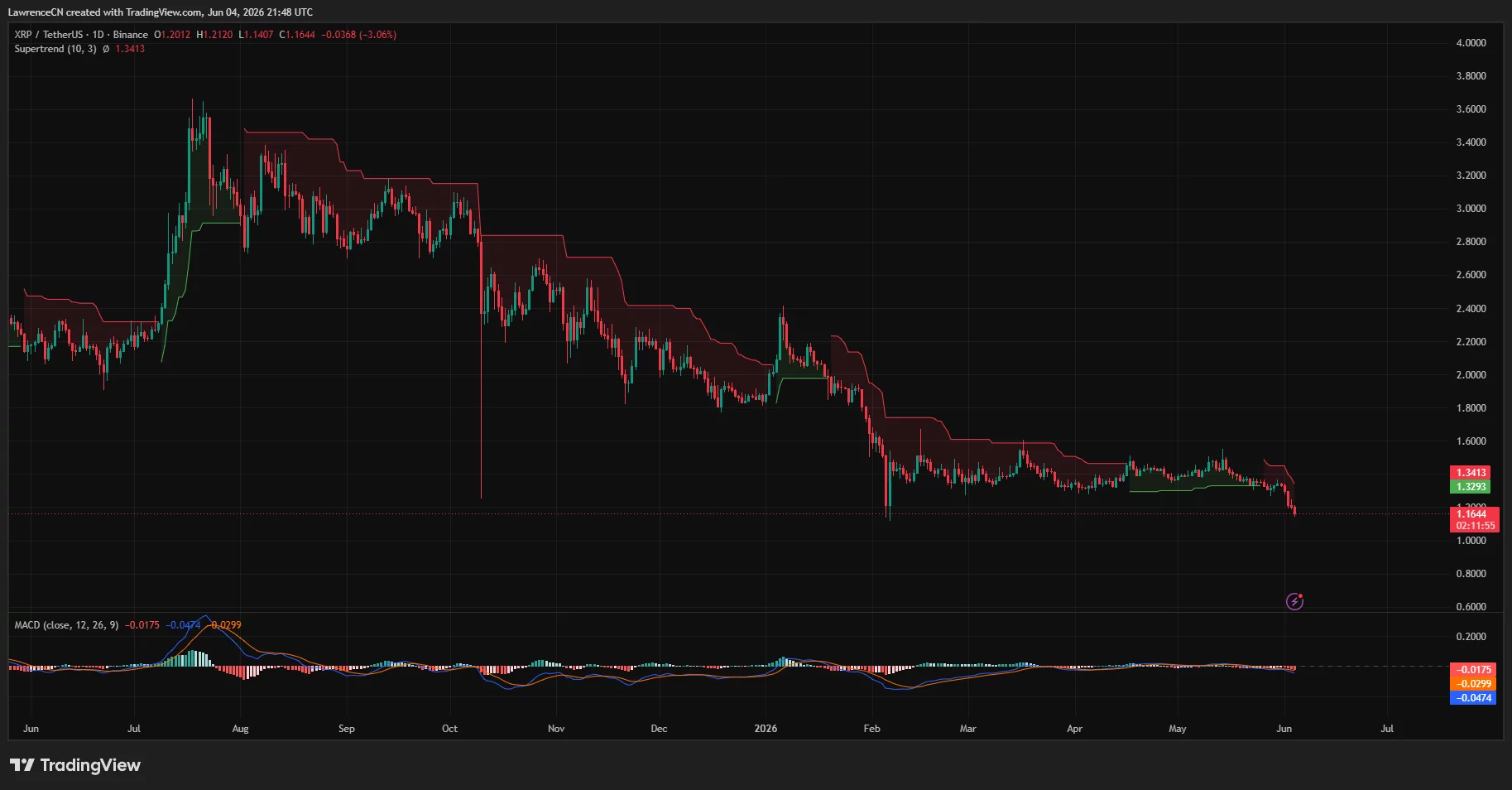
XRP has fallen to around $1.16 after losing more than 3% in a day, while an analyst argues that a retreat toward the $1.03 area could form part of a longer consolidation rather than the start of a deeper downtrend.
Summary
- XRP price may revisit $1.03 support without breaking its long-term market structure, according to analyst The Great Mattsby.
- XRP remains below key resistance at $1.34, while daily momentum indicators continue to favor sellers.
- XRP Ledger is preparing for its 3.2.0 upgrade, which includes the transition from “rippled” to “xrpld.”
According to data from crypto.news, XRP (XRP) price traded near $1.16 on June 4, extending a pullback that has accompanied renewed weakness across the cryptocurrency market.
Bitcoin (BTC) briefly slipped below $62,000 during the session as risk appetite deteriorated amid concerns over global growth, elevated oil prices, and uncertainty surrounding the Federal Reserve’s rate-cut path.
The decline comes even as the XRP Ledger ecosystem prepares for another network upgrade. Earlier this week, XRP Ledger Operations announced that version 3.2.0 will soon be deployed, introducing a transition from the long-running “rippled” software name to “xrpld.”
Infrastructure providers, validators, and node operators will be required to update their systems ahead of the migration.
Commenting on the latest price structure, crypto analyst The Great Mattsby argued that XRP may be approaching a key technical test on higher timeframes.
“At this point it would make sense for $XRP to backtest the monthly cloud around 1.03.”
The analyst added that traders familiar with market structure and Ichimoku analysis should not view the setup as bearish from a macro perspective, describing the current chart as a prolonged consolidation phase.
Monthly Ichimoku cloud highlights $1.03 as key support
The monthly Ichimoku chart shared by The Great Mattsby shows XRP trading above a major support zone created by the cloud structure that has developed over several years.
A move toward $1.03 would place the token near the upper region of that support area and could serve as a backtest of a level that previously acted as resistance before the latest rally.
On the daily timeframe, XRP remains below the Supertrend indicator, which currently sits near $1.34. The indicator has remained in bearish territory since late May and continues to cap recovery attempts. Any sustained rebound would likely require buyers to reclaim that level before attention shifts toward the $1.45-$1.50 region.
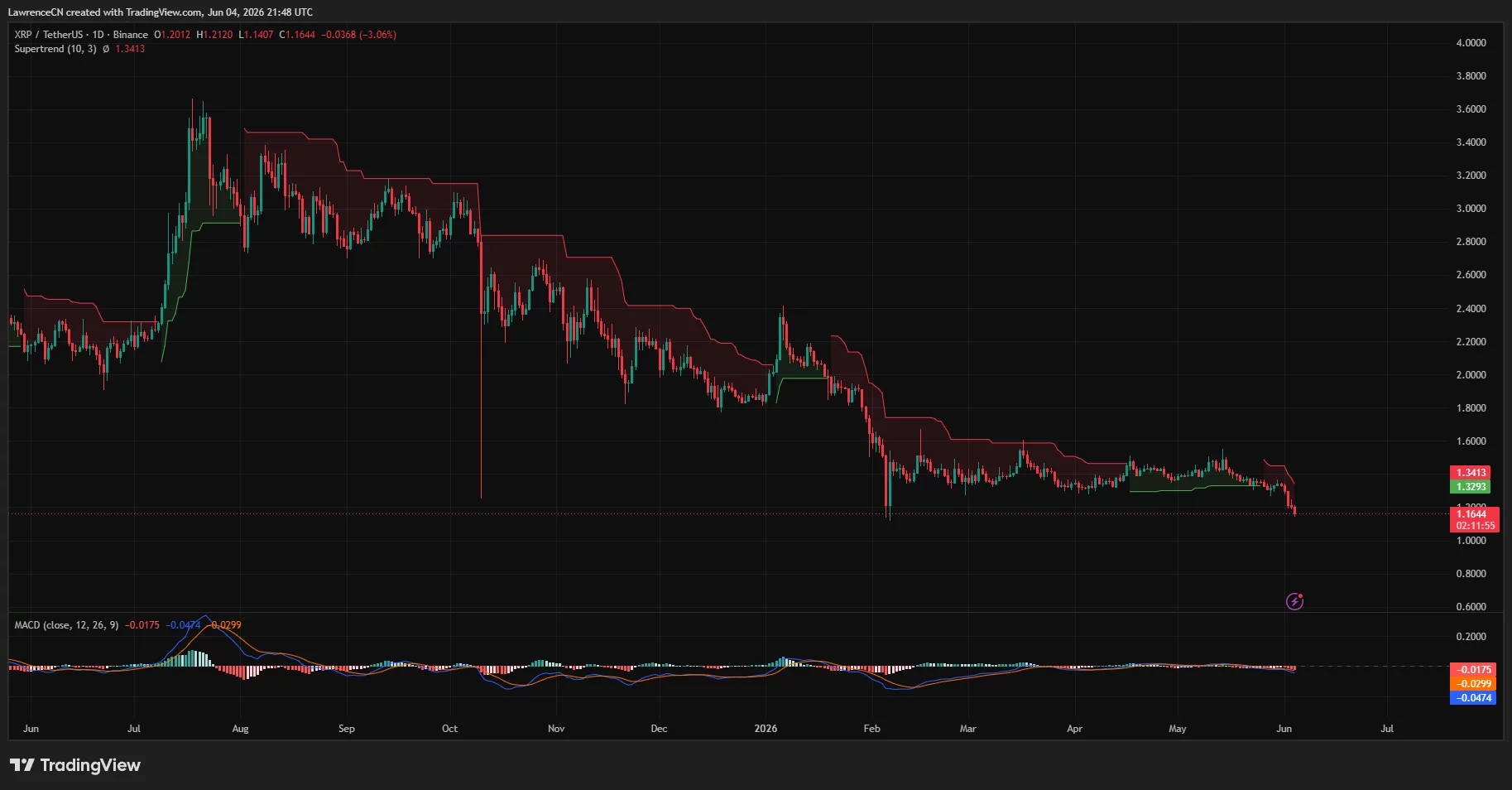
Momentum indicators have also weakened. The daily MACD remains below the zero line, while the signal line continues to trade above the MACD line. Histogram bars have expanded into negative territory, showing that selling pressure has yet to fully subside.
Recent derivatives activity has reinforced the cautious outlook. Leveraged long positions across the market faced another round of liquidations during the latest crypto sell-off, reducing speculative exposure and contributing to weaker price action across major altcoins, including XRP.
Recovery above $1.34 would improve the technical outlook
Despite the recent decline, several developments continue to support the long-term XRP narrative. The upcoming XRP Ledger 3.2.0 upgrade follows the successful activation of version 3.1.3 in May, which introduced the fixCleanup3_1_3 amendment and improved network reliability after receiving full validator consensus.
Institutional adoption of Ripple’s ecosystem has also expanded in recent months through the growth of RLUSD and additional infrastructure partnerships. While those developments have not translated into immediate price strength, they have helped maintain attention on the XRP ecosystem during a period of heightened market volatility.
Downside risks remain tied to both technical and macroeconomic factors. A decisive break below the $1.03 support area would weaken the consolidation thesis presented by Ichimoku analysts and expose XRP to a deeper retracement toward psychological support near $1.00.
External risks could also add pressure. Higher energy prices, escalating geopolitical tensions, and any indication that the Federal Reserve may keep interest rates elevated for longer could weigh on risk assets and limit demand for cryptocurrencies.
For now, traders appear focused on whether XRP can stabilize above the monthly cloud support region. While a drop toward $1.03 would represent another leg lower from current levels, proponents of the bullish long-term view argue that such a move would remain consistent with XRP’s existing macro structure unless that support ultimately fails.
Disclosure: This article does not represent investment advice. The content and materials featured on this page are for educational purposes only.

UnitedHealth Group: Why Berkshire Hathaway Sold In FQ1 2026 (Rating Downgrade)

Bybit launches support for Western Union’s USDPT stablecoin

‘Everyone is apoplectic’: Inside Democrats’ blame game over Graham Platner

HarrisX Poll Found 52% of Registered Voters Support the CLARITY Act

BloFin War of Whales 2026 Grand Prix opens registration for $5M trading championship

Blockchain.com files with SEC for U.S. IPO

Wannabe E-Girl Made $0.52 Last Month | Financial Audit

Rep. Judy Chu questions whether TRUMP ADMIN. understands household financial pressures

#prank #viralvideo #Shorts #YouTubeShorts #Viral #Trending #FYP #Explore #AI #ChatGPT #Money #funny
-

 Tech7 days ago
Waymo dominates autonomous vehicle registrations as Tesla trails behind
-

 News Videos7 days ago
This is BROKEN! INSANE 5x MONEY CAR WASH WEEK! The NEW GTA Online UPDATE Today! (GTA5 New Update)
-
 Tech6 days ago
SpaceX just won a second Golden Dome contract. This one is $4.16 billion.
-

 Business3 days ago
Jade Biosciences, Inc. (JBIO) Discusses Positive Interim Results From JADE101 Phase I Healthy Volunteer Study and Development Plans Transcript
-

 News Videos6 days ago
SHE IS KILLING XRP!!! WATCH URGENT AND ACT FAST
-
 NewsBeat6 days ago
FIRST NIGHT REVIEW: Take That bring the Circus back to life in spectacular sun-soaked style
-

 Business6 days ago
Is the Spurs Phenom Already Better Than Prime Diesel?
-
 Crypto World6 days ago
CFTC Has Approved the First Regulated Bitcoin Perpetual Contract in the U.S.
-

 Politics6 days ago
The House | Inside Andy Burnham’s Makerfield Campaign: “Nobody Thinks This Is In The Bag”
-

 Sports2 days ago
French Open 2026 results: Alexander Zverev beats Rafael Jodar and will play Jakub Mensik in semi-finals
-
 NewsBeat6 days ago
Novak Djokovic v Joao Fonseca LIVE: French Open latest scores and results after Jannik Sinner’s shocking collapse
-
 Entertainment6 days ago
Weak ‘Supergirl’ Box Office Tracking Amid Milly Alcock Backlash
-

 Tech3 days ago
CryZENx Releases Fresh Playable Content Deep Inside Jabu-Jabu for His Ocarina of Time Remake
-
 Crypto World6 days ago
Snowflake (SNOW) Stock Rallies on Strong Q1 Results and AI Product Growth
-

 Entertainment7 days ago
Maddox Jolie-Pitt Legally Requests to Drop Brad’s Surname
-

 Business6 days ago
Demand Conditions Improve In Chemicals Sector In April 2026
-
 Entertainment6 days ago
One of the Greatest Sitcoms of All Time Shoots Up Apple TV’s Charts 11 Years Later
-

 Crypto World6 days ago
MicroStrategy Moves $30 Million in BTC to Coinbase Prime: Is the Bitcoin Sell-Off Already Here?
-

 Tech7 days ago
This Week In Security: Ubiquiti Fixes, And FreeBSD Joins The Club You Don’t Want To Join
-
 Crypto World3 days ago
Seagate (STX) Stock Surges to Record High on AI Boom and Legal Settlement
You must be logged in to post a comment Login