

Crypto World
Is a16z-linked HYPE buying the next big whale signal?



A group of wallets described by on-chain analyst Ai 姨 as linked to a16z has reportedly withdrawn another 224,118 HYPE from exchanges over 24 hours, adding to a large 2026 accumulation streak.
Summary
- a16z-linked wallets reportedly withdrew 224,118 HYPE as analysts track fresh accumulation across several addresses.
- The HYPE position now shows about $131 million in unrealized gains, according to on-chain tracking.
- HYPE pulled back from records after Arthur Hayes sold, but linked wallets kept adding tokens.
Ai 姨 said the wallets pulled 224,118 HYPE from several exchanges, with the tokens valued at about $15.16 million. The analyst said total 2026 accumulation has reached 6.906 million HYPE, worth about $322 million.
The reported average cost stands near $46.7. Based on the analyst’s figures, the position now carries about $131 million in unrealized gains. The wallets cited in the post include several Arkham-tracked addresses.
Attribution remains unconfirmed
The wallet cluster has not been confirmed by a16z. That matters because on-chain labels can connect wallets to entities through transaction patterns, exchange flows, or prior tags, but they do not replace a public filing or direct statement.
Ai 姨 also used a cautious frame in the post, asking, “Is this MicroStrategy’s move to buy into HYPE?” The question suggests market curiosity, not verified corporate activity. The article treats the wallets as analyst-attributed addresses.
Meanwhile, the latest post follows two earlier updates from the same analyst. One said an a16z-associated entity withdrew 174,917.41 HYPE in 12 hours, worth about $11.16 million. The analyst said the wallet had accumulated 5.9 million HYPE since 2026.
Another post said the same entity resumed buying after a five-day pause. It reportedly received 253,947.43 HYPE from exchanges and market makers in seven hours, worth about $15.03 million. The average withdrawal price in that batch stood near $59.2.
Hayes exit adds market tension
The buying claims come during a volatile week for Hyperliquid. HYPE recently hit record highs before pulling back sharply. Crypto.news price data showed HYPE trading near $61.37 on June 5, down 15.49% in 24 hours but still up 39.51% over 30 days.
The pullback also followed Arthur Hayes’ decision to sell his full HYPE and NEAR positions. Earlier reports said Hayes sold 247,334 HYPE worth about $18 million, days after a $100,000 wager and a prior $150 HYPE target.
Hyperliquid still has strong market drivers. Earlier reports said its Assistance Fund directs 97% of protocol fees into open-market HYPE purchases. That mechanism has supported demand while ETF products and trading volume bring more attention to the asset.
For now, the story remains a whale-tracking update rather than proof of an official a16z trade. The key facts are clear: large wallets linked by analysts to a16z kept withdrawing HYPE, the token remains volatile, and traders continue to watch whether heavy accumulation can balance profit-taking near recent highs.



Forward Industries deposited 455,784 Solana (SOL) worth $31.87 million into Coinbase Prime, breaking a month of treasury inactivity and reviving speculation that the largest corporate SOL holder may finally trim a position deep in the red.
The transfer landed while Solana prices left Forward roughly $1.13 billion below its purchase cost. Exchange deposits often precede sales, though the company has not confirmed any intent to sell.
A $1.59 Billion Solana Bet Underwater
Forward launched its Solana treasury strategy in September 2025. Since then, it has spent roughly $1.59 billion buying 6.83 million SOL at an average entry near $232.08.
Solana now trades far below that level. BeInCrypto Markets data showed that the cryptocurrency has fallen nearly 19% over the past week, trading at $66.
The holdings are now worth about $451 million, a drop of more than $1.1 billion from the original outlay.
Follow us on X to get the latest news as it happens
The paper damage has already hit the reported results. Forward posted a $283.1 million net loss for the quarter ended March 31, 2026, driven by fair value declines on its SOL stack. The company stressed the loss “does not represent an outflow of cash or impact Forward’s liquidity.”
Treasury Firms Head for the Exits
Since the October market crash, many corporate holders have trimmed or dumped their digital asset holdings. In November 2025, Sequans Communications sold 970 Bitcoin worth roughly $100 million.
Bitcoin miners also participated in the retreat. Public miners sold about 32,000 BTC in the first quarter, more than in all of 2025.
Even MicroStrategy broke ranks. The largest corporate holder of Bitcoin (BTC) has sold 32 BTC since 2022.
Forward’s Coinbase deposit may reflect routine staking or custody moves. Yet with the position so far in the red, the coming days will show whether the largest Solana treasury joins the wave of sellers.
Subscribe to our YouTube channel to watch leaders and journalists provide expert insights
The post Solana Treasury Firm Forward Industries Deposits $32 Million of SOL to Coinbase appeared first on BeInCrypto.
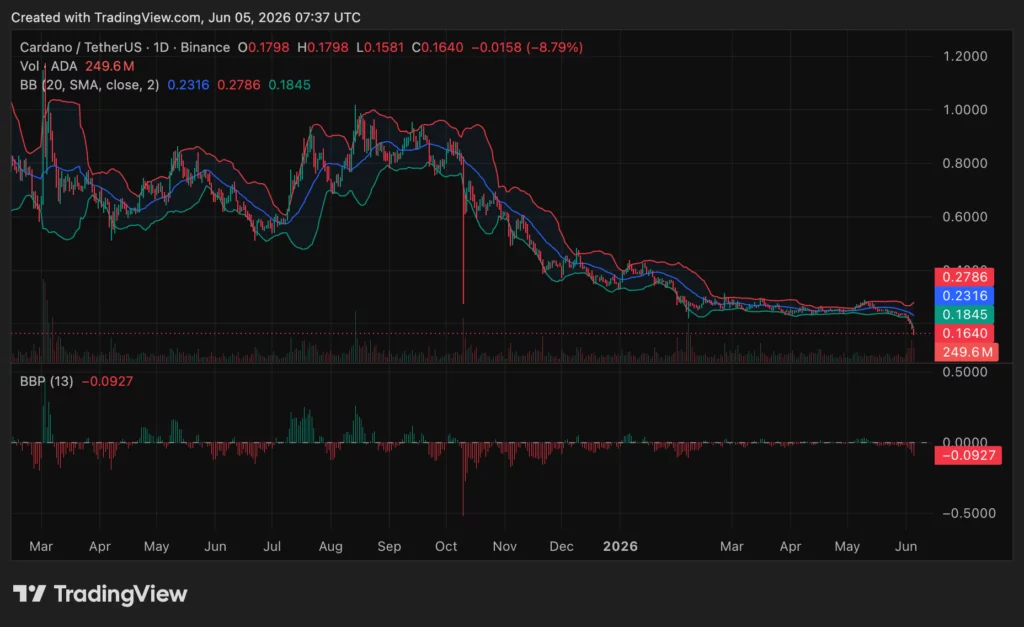
Cardano price fell near $0.16 on June 5 as ADA extended its selloff and reached levels last seen around late 2020, while social activity and on-chain usage rose during the market stress.
Summary
- Cardano price fell near $0.16 as ADA reached levels last seen around late 2020.
- Santiment data shows Cardano social dominance and active addresses jumped during the sharp selloff.
- Ali Martinez sees $0.11 and $0.051 targets unless ADA reclaims key Bollinger levels.
Cardano price falls below $0.16
Cardano traded near $0.162 on June 5, according to crypto.news price data. ADA fell 17.9% over 24 hours and lost 30.7% over seven days, while the monthly decline reached 38.29%.
The token moved between a 24-hour low of $0.158433 and a high of $0.198698. Trading volume stood above $1.1 billion as sellers pushed the market toward the lower end of the daily range.
Cardano now holds a market rank of #16, with a market value of about $6.03 billion. Its fully diluted valuation stands near $7.31 billion, based on a maximum supply of 45 billion ADA.
The fall pushed ADA far below its 2021 all-time high of $3.09. The token has also dropped 76.26% over the past year and 67.46% over the past 200 days, showing a long-running downtrend.
Santiment shows social spike during selloff
Santiment said Cardano became one of the most discussed crypto assets after ADA dropped below $0.16. The firm linked the jump in attention to price weakness and rising concern around founder Charles Hoskinson.
According to Santiment, Cardano reached a 2026 high of about 0.52% social dominance. That means more than one in every 190 crypto-related social discussions focused on ADA during the spike.
The same update said daily active addresses rose to 28,459, the highest level in four months. This shows users continued to interact with the network as the selloff increased debate among traders.
Santiment described much of the reaction as bearish. However, the firm also said Cardano still has one of crypto’s most vocal communities, with many holders staying active through past market cycles.
Hoskinson concerns add pressure
Recent Cardano weakness also followed renewed attention on Charles Hoskinson. Santiment said discussion increased after Hoskinson said he was “taking a break” following warnings about project shutdowns and funding stress.
As crypto.news reported, Hoskinson warned more Cardano businesses could fail after TapTools announced it would shut down. TapTools had operated as a Cardano analytics platform for about four years.
The wider ecosystem has faced governance pressure as well. The Cardano Foundation canceled the 2026 Cardano Summit after a proposal seeking 7.8 million ADA failed to secure enough approval from DReps.
Moreover, crypto.news also reported debate around a separate 32.9 million ADA treasury request linked to Input Output Global research and development work. DRep opposition had climbed above 80% before the vote deadline.
These events place funding, governance, and project survival at the center of the current ADA story. Price weakness has now turned those ecosystem debates into market-moving issues.
ADA technical levels point lower
Ali Martinez said he would target $0.11 and $0.051 for ADA after the latest breakdown. He also said, “I’d be taking a break too if I were him,” while referring to the pressure around Hoskinson.
The technical setup remains weak. ADA broke below the lower Bollinger Band at $0.1845, showing strong downside pressure and an extended bearish move.
The Bollinger Band midline sits near $0.2316, while the upper band stands around $0.2786. ADA remains far below the midline, which shows buyers have not regained control.
A recovery would need ADA to reclaim the lower band near $0.1845. A stronger rebound would then need a move toward $0.2316 before traders can argue that the trend has improved.
The BBP reading stands at -0.0927, placing price below the lower Bollinger Band. That signals oversold conditions, but it does not confirm a reversal.
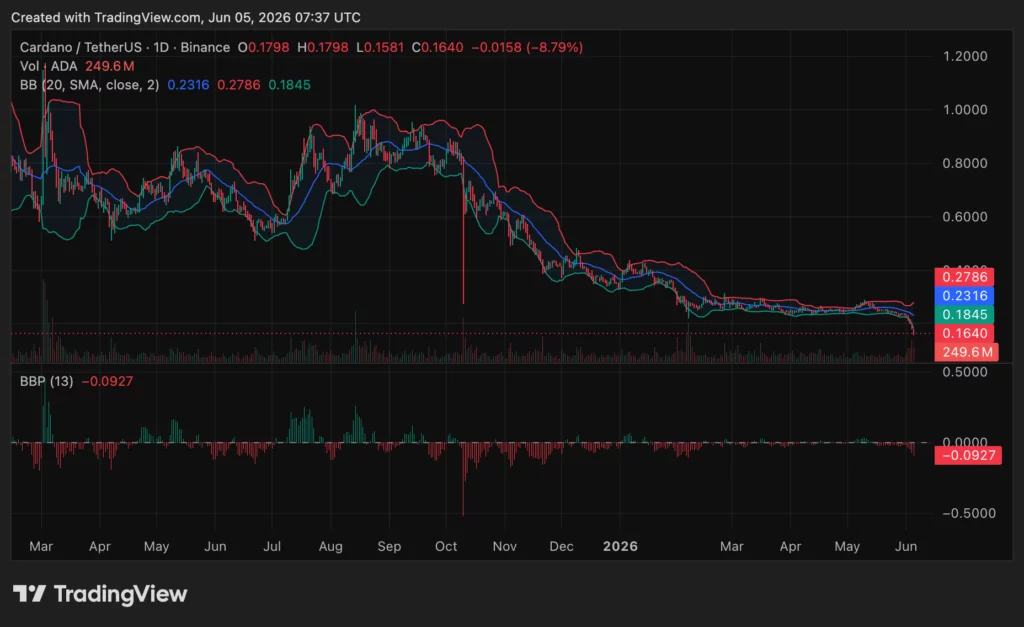
For now, sellers still control the chart while ADA remains outside the bands. If $0.158 support fails, traders may focus on Ali’s $0.11 target as the next downside level.
A deeper fall toward $0.051 would require another major breakdown and sustained weak demand. That level remains a lower target, not a confirmed path.
Cardano’s next move now depends on whether buyers defend the $0.15 to $0.16 zone. Bulls need ADA back above $0.1845 to ease immediate pressure. Bears need another close below the recent low to keep the breakdown active.
Disclosure: This article does not represent investment advice. The content and materials featured on this page are for educational purposes only.
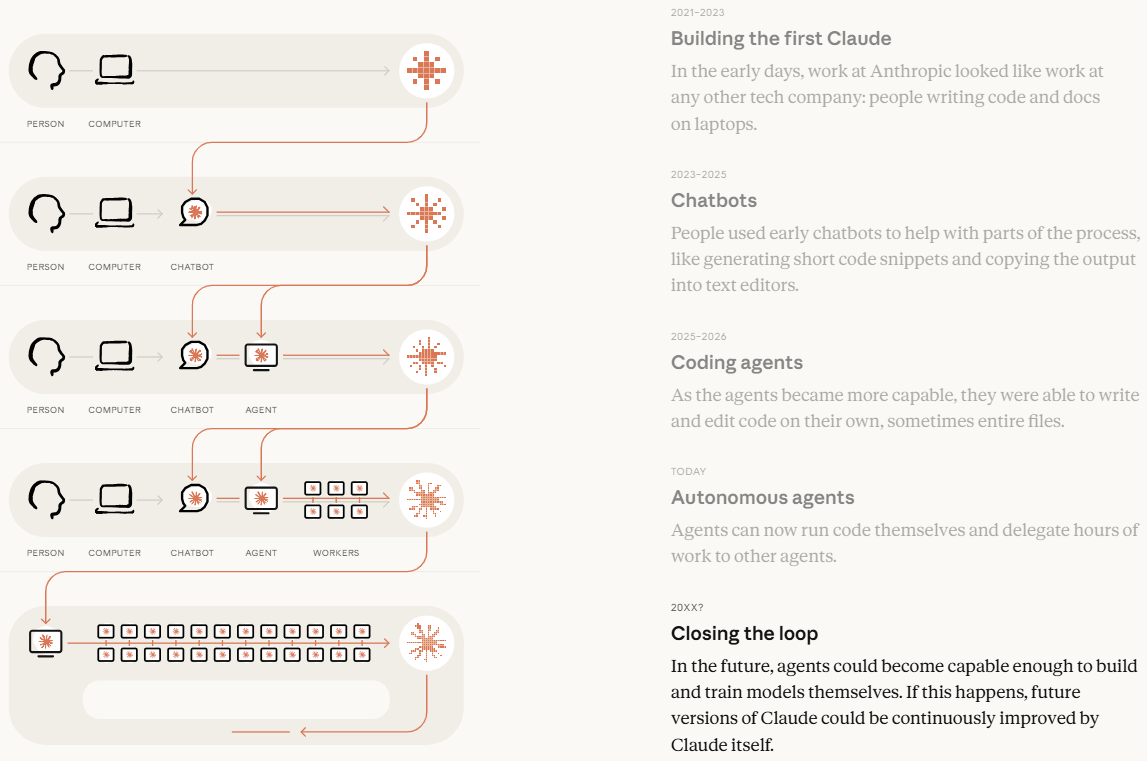
US-based AI firm Anthropic warns AI development is advancing at a pace that could soon see agents building, training and improving themselves without human input, and recommends a slowdown in development.
In a blog post published Thursday, Marina Favaro, lead at the Anthropic Institute, and Anthropic co-founder Jack Clark said agents can already run code themselves, delegate hours of work to other agents and could be on the cusp of taking over completely.
“For most of AI’s history, humans drove every step in its development cycle. But at Anthropic, we are delegating a growing share of AI development to AI systems themselves, which is speeding up our work,” they said.
“Taken far enough, and given enough compute, that trend points to an AI system capable of fully autonomously designing and developing its own successor,” Favaro and Clark added.
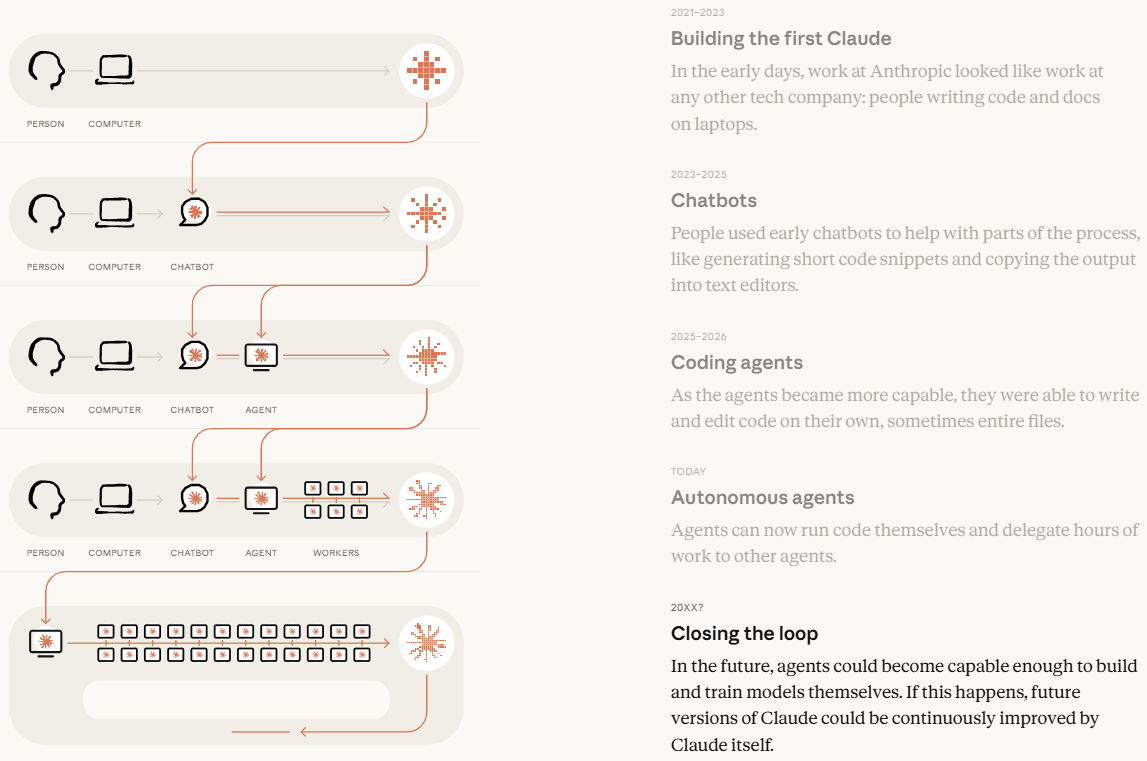
AI development is advancing at a pace that could lead to agents improving without human input. Source: Anthropic
There are concerns over what could happen if AI is able to become smarter on its own. In December, OpenAI said it is researching how to safely develop and deploy increasingly capable AI, including AI capable of recursive self-improvement.
“We want these systems to consistently follow human intent in complex, real-world scenarios and adversarial conditions, avoid catastrophic behavior, and remain controllable, auditable, and aligned with human values,” it said.
The company is also hiring a researcher for recursive self-improvement preparedness, which forms part of its Safety Research team.
AI model improvement has been roughly doubling every four months, rather than every seven months, according to Favaro and Clark. The role of humans is narrowing at each step, with Anthropic’s Claude model authoring around 80% of the code merged into Anthropic’s codebase.
“We are not there yet, and recursive self-improvement is not inevitable. But it could come sooner than most institutions are prepared for,” they said.
“Once human- and AI-authored code quality reach parity, humans will stop writing code entirely and shift to only reviewing it. But if they can’t review code as quickly as Claude can generate it, human review will become the bottleneck to AI development,” they added.
Favaro and Clark also said that slowing development to allow more time to address its “immense” implications would be ideal.
Related: Modern robots impress, but are years away from replacing humans
In April, Anthropic ruled out releasing its AI model, Claude Mythos, to the public over concerns about the threat to global cybersecurity.
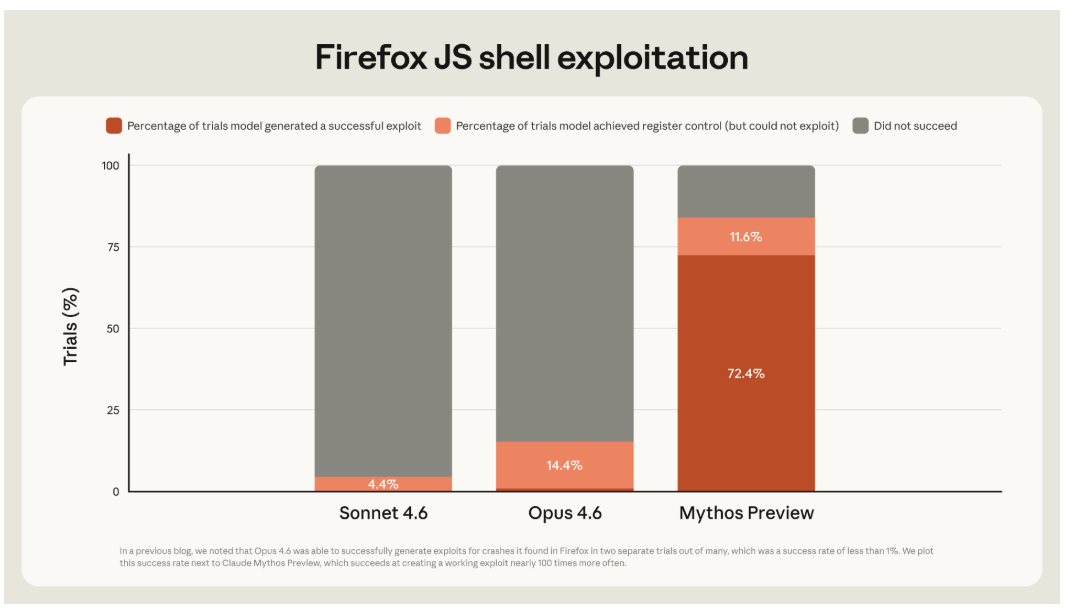
Claude Mythos was able to easily create software exploits, leading Anthropic to rule out a public release for now. Source: Anthropic
At the same time, a group of tech leaders, including some from Anthropic and OpenAI, released an open letter on Thursday, urging lawmakers to enact stronger guardrails around the technology over concerns it could be used to overcome “knowledge barriers” that have historically prevented bad actors from creating biological weapons.
“We believe it would be good for the world to have the option to slow or temporarily pause frontier AI development to enable societal structures and alignment research to keep up with the advance of the technology,” Favaro and Clark said.
“But if a slowdown simply lets the least cautious actors catch up technologically, it could leave everyone less safe. Without a global coordination mechanism, companies and governments will have to make difficult decisions about safety while under competitive and geopolitical pressures.”
AI agents are becoming increasingly popular, including among crypto users. Some crypto executives have speculated that AI agents settling transactions could drive adoption and transaction volumes. Circle CEO Jeremy Allaire predicted in January that billions of AI agents would operate on users’ behalf within five years.
Crypto investment firm Keyrock reported last month that AI agents settling payments went from concept to reality in the past 12 months, with $73 million settled across 176 million transactions.
Magazine: Korea’s first memecoin rug-pull case, China’s crypto rules review: Asia Express
Binance Research projects that crypto exchanges could channel $2 trillion in incremental capital and nearly 300 million new investors into global equity markets by 2031, positioning trading platforms as the next gateway to stock ownership.
The forecast frames this as a base case for how crypto platforms move beyond digital assets into equities.
Why Crypto Exchanges Are Chasing Equities
Binance Research laid out the projection in a new report. The bull scenario points to $5 trillion in annual equity inflows from crypto users within five years.
“This estimate is derived from a top-down model: beginning with the total global crypto user base, then applying exchange coverage, user eligibility, and adoption rates to estimate the number of active equity traders, before multiplying by average position size to estimate total capital deployment,” Binance said.
Follow us on X to get the latest news as it happens

The research points to a significant participation gap between the United States and the rest of the world. While about 62% of Americans own stocks either directly, through investment funds, or via retirement accounts. Meanwhile, equity ownership outside the US remains below 20% of the population.
According to Binance Research, this disparity represents one of the most pronounced structural imbalances in global finance. Despite being the world’s largest and most liquid equity market, US stocks remain largely inaccessible to many international investors, leaving substantial pools of capital underexposed to American equities.
Early data from Binance’s stock-trading offering appears to support that view. Nearly 93% of the platform’s initial stock-trading users came from emerging markets, where geographic constraints and limited access to brokerage services have historically restricted participation in global equity markets.
However, the projected growth remains far from guaranteed. Whether stock tokenization can unlock as much as $2 trillion in new capital will ultimately depend on regulatory developments, user adoption, and the broader expansion of tokenized equity markets.
Subscribe to our YouTube channel to watch leaders and journalists provide expert insights
The post Crypto Exchanges Could Funnel $2 Trillion Into Stocks by 2031, Binance Research Says appeared first on BeInCrypto.
Strategy’s leveraged Bitcoin model is stressed, which could limit the firm’s ability to keep buying BTC and potentially force further sales, according to Grayscale.
“The shift in approach from one of the world’s largest BTC holders has weighed on market sentiment,” said Zach Pandl, Grayscale’s head of research, on Thursday.
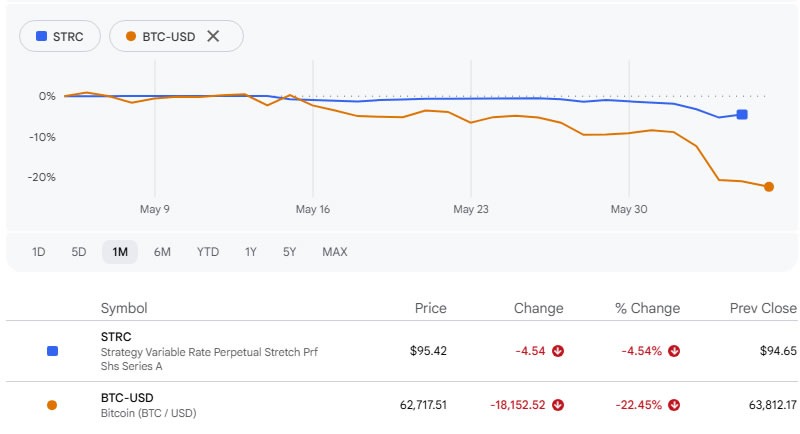
Michael Saylor’s Strategy sold 32 BTC on Monday, a tiny fraction of its total holdings of 843,706 BTC, but enough to rattle market sentiment as the asset has tanked by 16% since the sale.
Strategy also sold $128 million worth of shares, and its stock value has declined by 12.8% since the sale to a two-month low of $126 on Thursday.
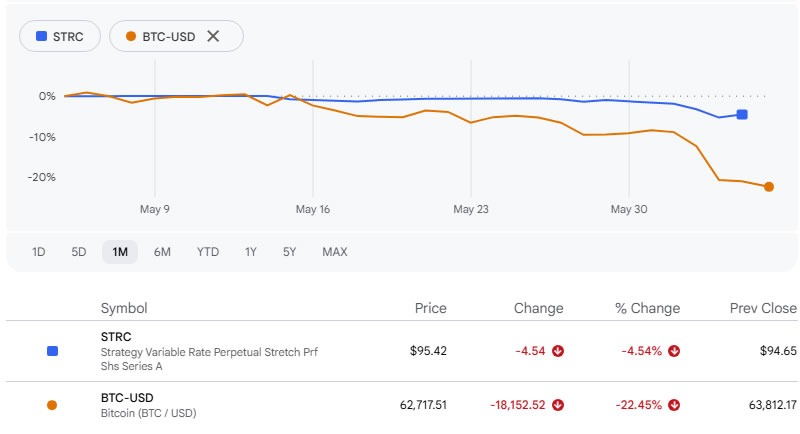
BTC losses accelerated after Strategy sold and STRC declined. Source: Google Finance
Pandl warned this could have a greater impact on Stretch (STRC), the firm’s variable rate preferred equity instrument.
Stretch is designed to trade at a share price of around $100 and pay a dividend of 11.5%, but it is currently trading below that at around $95, meaning investors require a higher rate of return.
If Strategy raises its dividend to compensate investors, it increases cash obligations, potentially forcing more BTC sales and further price pressure in a negative feedback loop.
“Strategy’s levered business model is under pressure, and this has increased the volatility for the BTC market as a whole,” said Pandl.
He added that Grayscale thinks that Strategy will have a “limited ability to accumulate more tokens at current share prices for both STRC and MSTR.”
Related: Saylor downplays Bitcoin slide as Strategy faces $11B paper loss
Goldbug Peter Schiff said something similar on X on Thursday. If Strategy is forced to increase the dividend to return STRC to $100, the company “will run out of cash much sooner, pulling forward Bitcoin sales to fund payments.”
Pandl concluded, stating that less Bitcoin in leveraged corporate holdings would be healthier for the broader market and ecosystem.
“For the health of the Bitcoin ecosystem over the long run, less BTC on levered DAT [digital asset treasury] balance sheets and more on diversified corporate balance sheets will be a positive, in our view.”
It’s not all bearish for Saylor’s Strategy
Augustine Fan, partner at crypto software firm SignalPlus, told Cointelegraph on Friday that markets are blaming Strategy’s recent sales and STRC’s discount to par for driving the latest sell-off, “but the reality is that even the most ardent supporters are running out of reason to be structurally bullish.”
“All focus will be on the MSTR situation to see how Saylor manages to handle his liquidity strains by balancing dividend payments against STRC and the DAT holdings.”
Jeff Ko, chief analyst at CoinEx, told Cointelegraph that Strategy’s first Bitcoin sale was an “important psychological trigger” for this week’s selloff.
However, he said the move was more constructive than the market reaction implied, as it gives the company more flexibility.
“Greater flexibility around selling Bitcoin can help Strategy manage balance sheet risk more prudently, rather than forcing itself into a one-way accumulation strategy under all market conditions.”
Magazine: Korea’s first memecoin rug-pull case, China’s crypto rules review: Asia Express
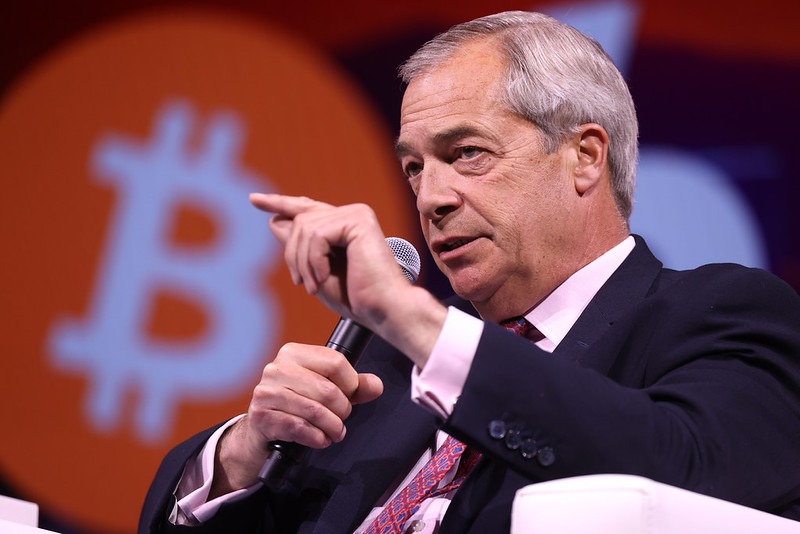
Nigel Farage’s Reform UK received 7 million British pounds ($9.4 million) from two crypto billionaires this year, with total funds raised outstripping all other political parties.
The party received a $4 million donation from Christopher Harborne, who has a stake in the stablecoin issuer Tether, and a $5.4 million donation from Ben Delo, the co-founder of the crypto exchange BitMEX, according to Electoral Commission data released on Thursday.
The Labour and Conservative parties each received around $5.4 million in the first quarter of the year.
Reform UK has pitched itself as a pro-crypto party. It was the first UK political party to accept donations in Bitcoin (BTC), and Farage has proposed cutting capital gains taxes on crypto from 24% to 10%. He has also called for the Bank of England to create a Bitcoin reserve.
The crypto industry has been spending heavily on politics as it seeks to influence policy. In the US, crypto-backed political action committees (PACs) have recently spent millions to successfully back candidates who won primary elections ahead of the country’s midterm elections in November.
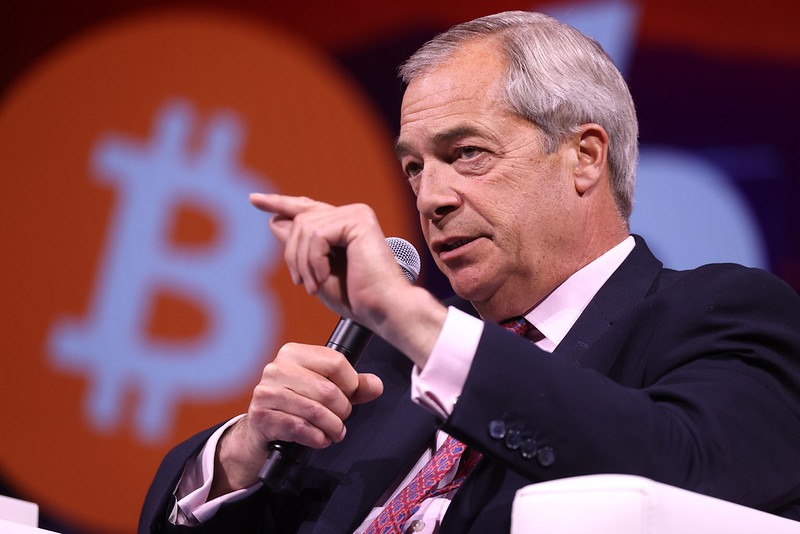
Nigel Farage speaking at the Bitcoin 2025 conference in Las Vegas. Source: Gage Skidmore
Delo is a first-time donor to the right-wing populist party, while the latest donations bring Harborne’s total to $20 million in the past year.
Harborne had separately given Farage a $6.7 million personal gift, which is facing a probe by a parliamentary standards inquiry as to whether it should have been registered.
Related: UK politician Nigel Farage bought $1.8M house after $6.7M crypto gift
Farage has said he didn’t need to declare the money as it was given before he was a member of parliament and was used to pay for personal security. He later claimed the gift was for successfully campaigning for the UK to leave the EU.
Reform’s fundraising in the first quarter has increased sixfold compared to the same time last year, when it received $2 million.
The total funding across all parties for the quarter had also more than doubled compared with a year ago.
Magazine: Guide to the top and emerging global crypto hubs: Mid-2026
Crypto World
ZEC Price Crashes 48.4% as Orchard Pool Bug and Arthur Hayes Exit Trigger Mass Liquidations

TLDR:
- ZEC dropped 48.4% to $272.79 on Binance following the Orchard pool soundness bug discovery.
- Total ZEC liquidations hit $81.91M in 24 hours, with $70.55M from long positions alone.
- Arthur Hayes sold his entire ZEC position after the Orchard exploit news broke publicly.
- A ZEC whale holding $174M saw holdings lose over $70M in value within a single trading day.
Zcash’s native token, ZEC, has dropped 48.4% in 24 hours, trading at $272.79 on Binance. The selloff follows a series of technical emergencies in Zcash’s Orchard shielded pool, including a critical soundness bug and an emergency soft fork.
Liquidations hit $81.91 million, with long positions bearing the bulk of losses at $70.55 million. The crash erased billions in market value and shook confidence in ZEC’s recent bull run.
From Record Highs to Emergency Forks: The ZEC Timeline
Six days ago, ZEC appeared immune to broader market weakness. The token had surged more than 750% and was trading around $540–$560 when a critical soundness bug was discovered in the Orchard pool on May 29.
Shielded Labs uncovered the flaw during a routine audit before any exploit occurred. The find, however, set off a chain of emergency responses that ultimately unwound the rally.
On June 2, developers deployed an emergency soft fork at block 3,363,426. The fork disabled the Orchard pool entirely to prevent a potential double-spend attack.
At that point, ZEC was trading near $587, still holding most of its gains despite the severity of the protocol-level intervention.
By June 3, the NU6.2 hard fork went live, re-enabling Orchard with a patched circuit. Block explorers went dark for roughly four hours during the transition.
Social media was flooded with claims that Zcash was down, though the underlying chain never stopped producing blocks. ZEC pushed higher still, briefly touching $629.
The narrative then shifted sharply on June 4 and 5. Reports spread that Claude Opus 4.8 had in some capacity “broken” Zcash, fueling panic across trading desks.
The crowded long trade began reversing, and ZEC shed more than 30% as leveraged positions unwound rapidly across major exchanges.
The timeline illustrates how quickly sentiment can reverse in crypto markets. A token riding a multi-month rally on privacy narrative strength can lose nearly half its value in under 24 hours once confidence in the underlying protocol wavers.
Arthur Hayes Exits, Whale Absorbs $70M Loss
BitMEX co-founder Arthur Hayes disclosed on X that he had sold his entire ZEC position following the Orchard pool exploit news.
Hayes had previously been one of ZEC’s most vocal proponents, publicly calling for a $10,000 price target. His rapid exit drew wide attention, with traders treating it as a directional signal to cut exposure.
On-chain analytics platform Arkham flagged a notable whale address that held approximately $174 million in ZEC before the crash.
Within 24 hours, the value of those holdings fell to less than half. The whale’s unrealized losses stood at roughly $70 million, with no ZEC sold over the prior six months.
The liquidation data adds further context to the scale of the unwind. CoinGlass recorded $81.91 million in total ZEC liquidations, with $70.55 million coming from long positions.
Short liquidations accounted for the remaining $11.36 million, reflecting a market that was heavily positioned to the upside heading into the collapse.
Hayes’s exit, combined with his prior sales of HYPE and NEAR, drew commentary on X. One account noted that his so-called “holy trinity” of positions had unwound in under six days, raising questions about broader positioning shifts among prominent crypto traders.
The ZEC crash serves as a reminder that protocol-level vulnerabilities, however quickly patched, can permanently alter market structure around an asset.



Bitcoin continues to lose ground and the price is fast closing on $60,000 amid record ETF outflows.
The $60,000 level has been widely cited by analysts as a major support, below which the selloff could get even uglier.
Jean-David Péquignot, the chief commercial officer at leading crypto options exchange Deribit said that price is critical not just because it’s a round-number psychological level. More importantly, it’s a structural threshold with real consequences for institutions and derivatives market participants.
The cost basis problem
According to Péquignot, a significant chunk of institutional money — comprising ETF buyers, large holders and short-term speculators — bought bitcoin at prices between $60,000 and $67,000 over the past year.
With the largest cryptocurrency now trading within that range, these buyers are sitting at or near their cost basis, essentially at break-even. If prices drop further, unrealized or paper losses will mount and holding becomes expensive, especially when AI stocks and other parts of the traditional market are rallying like there is no tomorrow.
“As price undercuts their cost basis, the resulting unrealized losses may incentivize rushed selling, especially as the opportunity cost of holding BTC rises against a surging AI equity sector,” he said.
Michael Saylor, the high-profile executive chairman of Strategy (MSTR), the largest publicly traded bitcoin holder, also blamed capital rotation for recent BTC losses.
The derivatives problem
Things become mechanical after that.
On Deribit, there is over $1.2 billion in notional open interest sitting at the $60,000 strike put options, which pay out if prices fall below that level. Investors have bought these as a hedge against a protracted selloff.
The problem, however, is that market makers, who are on the opposite side of the investors, are now short puts, or more precisely, “short gamma.”
So, as BTC nears $60,000, market makers and dealers will be forced to sell spot BTC or futures to balance their books. Other things being equal, this hedging can accelerate the selloff, turning an orderly decline into a chaotic one, Péquignot said.
He also pointed out that there are too many leveraged longs in the system, and a break below $60,000 could lead to more liquidations, adding to downside momentum.
“With leverage still not fully flushed from the system, a break of $60K could rapidly worsen collateral metrics, triggering a cascading wave of automated long liquidations,” he said.
Note that billions of dollars of leveraged longs, or bullish plays tied to BTC and other tokens, have already been liquidated this week.
Crypto World
Forward Industries (FORD) Transfers $32M in Solana to Coinbase Amid Massive Unrealized Losses

Key Takeaways
- Forward Industries transferred 455,784 SOL (approximately $31.87M) to Coinbase Prime following 30 days of wallet dormancy
- The transaction has sparked widespread speculation about a possible liquidation event
- Since September 2025, Forward Industries accumulated 6.83 million SOL for approximately $1.59 billion
- With an average entry price of $232.08 per token, the portfolio is currently valued at roughly $458.6 million
- Forward Industries faces an unrealized deficit approaching $1.13 billion on its Solana investment
Forward Industries has transferred 455,784 SOL tokens to Coinbase Prime, representing approximately $31.87 million in current market value. Blockchain analytics platform Lookonchain identified the transaction, which occurred after 30 consecutive days without any on-chain activity from the company’s wallet.
Forward Industries, Inc., FWDI
When institutional holders move substantial cryptocurrency amounts to centralized trading platforms, market observers typically interpret this as preparation for liquidation. Forward Industries has remained silent on the reasoning behind this transfer.
The firm initiated its Solana accumulation program in September 2025, deploying approximately $1.59 billion to acquire 6.83 million SOL tokens at a mean cost of $232.08 each.
SOL currently trades significantly beneath that acquisition average. The aggregate portfolio value stands at approximately $458.6 million, resulting in an unrealized deficit nearing $1.13 billion.
This represents a substantial paper loss for an investment approach centered on strategic accumulation and long-term positioning.
An Aggressive Strategy Meets Harsh Reality
Forward Industries positioned itself among the most bullish institutional Solana accumulators in the public markets. The company’s approach closely resembled MicroStrategy’s Bitcoin playbook — systematic purchasing with conviction through market cycles.
However, SOL’s price action has remained unfavorable. The cryptocurrency hasn’t reached the price levels necessary to restore the position to profitability.
While the Coinbase Prime deposit doesn’t definitively indicate liquidation, it establishes the operational framework to execute such a transaction with minimal delay.
Blockchain Analytics Reveal the Details
Lookonchain’s blockchain surveillance confirmed the 455,784 SOL moved in one transaction following a complete month without meaningful wallet activity.
Such abrupt movements from recognized institutional wallets frequently influence market dynamics. Solana market participants and technical analysts have maintained close surveillance on this wallet since the transfer was detected.
Wu Blockchain reported on X that this positions Forward Industries as the largest corporate SOL holder to have potentially liquidated — or prepared to liquidate — a portion of its holdings.
It’s important to understand that Coinbase Prime serves as both a custody solution and trading infrastructure for institutional clients. While asset transfers to the platform don’t guarantee immediate sales, such moves typically serve specific strategic purposes.
Forward Industries deployed roughly $1.59 billion constructing this position. Today, its complete 6.83 million Solana holdings carry a market value of approximately $458.6 million.
The differential between acquisition cost and present valuation represents the central narrative.
The company has issued no official statement clarifying whether this deposit signals the beginning of portfolio liquidation or constitutes standard treasury operations.
As of June 5, the 455,784 SOL transfer to Coinbase Prime represents the latest verified on-chain transaction from Forward Industries.
Crypto World
Planet Labs (PL) Stock Tumbles Despite 42% Revenue Surge and Expanding AI Satellite Network

Key Takeaways
- PL shares decline despite achieving 42% quarterly revenue expansion and AI advancement
- Stock retreats overnight as expanding losses overshadow impressive revenue performance
- Company achieves best-ever quarterly sales but shares slip following earnings announcement
- PL experiences downward pressure as AI satellite deployment accelerates amid growing deficit
- Backlog soars 72% year-over-year while shares face post-earnings selloff
Shares of Planet Labs (PL) experienced overnight declines despite the company delivering exceptional quarterly sales figures and robust backlog expansion. Trading closed at $43.53, gaining 0.93%, before retreating to $41.77, declining 4.04%, following the earnings release. The downturn reflected investor concerns despite the company’s advancing revenue metrics and expanding AI-powered satellite operations.
Company Delivers Best-Ever Quarterly Sales Alongside Expanded Deficit
Planet Labs disclosed fiscal 2027 first-quarter revenue totaling $94.2 million for the three-month period concluding April 30, 2026. Sales climbed 42% compared to the corresponding period last year, driven by improved performance from both sales teams and delivery operations. Additionally, the organization maintained 99% recurring annual contract value by quarter’s end.
The satellite imaging provider recorded an expanded net deficit of $138.9 million throughout the reporting period. This compares unfavorably to the $12.6 million loss registered during the matching quarter in fiscal 2026. The company attributed a substantial portion of the increase to a $106.5 million non-cash loss stemming from warrant liability revaluation.
Additionally, Planet disclosed an adjusted EBITDA deficit of $1.0 million for the three-month period. Free cash outflow measured negative $2.5 million, whereas operational cash generation reached $15.4 million. The organization concluded the quarter holding $730.8 million across cash accounts, equivalents, and short-dated investment instruments.
Defense and Government Agreements Drive Future Revenue Visibility
The company announced backlog expansion of 72% on a year-over-year basis, surpassing $906 million. This metric provides enhanced predictability for upcoming revenue recognition periods. Furthermore, contract additions and renewals demonstrated sustained appetite from governmental and defense sector clients.
Throughout the reporting period, Planet executed an eight-figure annual agreement with an overseas defense and intelligence organization. This arrangement provides the client with extensive high-resolution tasking capabilities and analytical platform access. The firm additionally obtained National Geospatial-Intelligence Agency contracts supporting maritime monitoring and emergency response operations.
The organization secured a six-month extension valued at $7.5 million from the U.S. Navy. This contract facilitates vessel identification and tracking throughout critical Pacific regions. Additional partnerships were established with governmental entities including Greece, the Czech Paying Agency, Scotland, and various other international partners.
Artificial Intelligence Satellite Deployment Strengthens Technology Portfolio
Planet Labs advanced both its orbital constellation and artificial intelligence product initiatives throughout the quarter. During May, three supplementary AI-capable Pelican satellites launched via SpaceX transportation. This deployment elevated the company’s operational high-resolution Pelican satellite count to nine.
The launch mission incorporated Sweden’s inaugural sovereign reconnaissance satellite. The company noted this satellite reached orbit merely four months following contract execution. This achievement underscored the organization’s accelerated production timeline for defense-oriented satellite programs.
The firm additionally introduced a private beta artificial intelligence application enabling natural language-based satellite imagery queries. This technology empowers users to explore Planet’s extensive archive, conduct temporal analysis, and produce automated reports. Concurrently, SuperRes and Pelican-11 capabilities provided additional enhancement to the company’s high-resolution imaging development pipeline.

Solana Treasury Firm Forward Industries Deposits $32 Million of SOL to Coinbase

Chris Hemsworth and Family Were Denied Boarding on Flight

Cryptocurrency Halal or Haram? #muftitariqmasood #tariqmasood #crypto #cryptocurrency

HarrisX Poll Found 52% of Registered Voters Support the CLARITY Act

BloFin War of Whales 2026 Grand Prix opens registration for $5M trading championship

Blockchain.com files with SEC for U.S. IPO
Cryptocurrency Halal or Haram? #muftitariqmasood #tariqmasood #crypto #cryptocurrency

Once Your Money Moves to Crypto, Tracking Becomes Almost Impossible | Rajkumar IFS | Gobinath

Skill Financial Planning yang Harus Kamu Kuasai Biar Gaji Gak Cuma Numpang Lewat
-

 News Videos7 days ago
This is BROKEN! INSANE 5x MONEY CAR WASH WEEK! The NEW GTA Online UPDATE Today! (GTA5 New Update)
-

 Business4 days ago
Jade Biosciences, Inc. (JBIO) Discusses Positive Interim Results From JADE101 Phase I Healthy Volunteer Study and Development Plans Transcript
-
 Tech6 days ago
SpaceX just won a second Golden Dome contract. This one is $4.16 billion.
-

 News Videos7 days ago
SHE IS KILLING XRP!!! WATCH URGENT AND ACT FAST
-

 Sports2 days ago
French Open 2026 results: Alexander Zverev beats Rafael Jodar and will play Jakub Mensik in semi-finals
-
 NewsBeat6 days ago
FIRST NIGHT REVIEW: Take That bring the Circus back to life in spectacular sun-soaked style
-

 Business6 days ago
Is the Spurs Phenom Already Better Than Prime Diesel?
-

 Tech3 days ago
CryZENx Releases Fresh Playable Content Deep Inside Jabu-Jabu for His Ocarina of Time Remake
-
 NewsBeat7 days ago
Novak Djokovic v Joao Fonseca LIVE: French Open latest scores and results after Jannik Sinner’s shocking collapse
-

 Politics6 days ago
The House | Inside Andy Burnham’s Makerfield Campaign: “Nobody Thinks This Is In The Bag”
-
Crypto World7 days ago
CFTC Has Approved the First Regulated Bitcoin Perpetual Contract in the U.S.
-

 Entertainment7 days ago
Maddox Jolie-Pitt Legally Requests to Drop Brad’s Surname
-
 Entertainment6 days ago
Weak ‘Supergirl’ Box Office Tracking Amid Milly Alcock Backlash
-
 Entertainment6 days ago
Bruce Willis’ Generosity Resurfaces Amid His Dementia
-
 Crypto World7 days ago
Snowflake (SNOW) Stock Rallies on Strong Q1 Results and AI Product Growth
-
 Entertainment6 days ago
One of the Greatest Sitcoms of All Time Shoots Up Apple TV’s Charts 11 Years Later
-

 Business6 days ago
Demand Conditions Improve In Chemicals Sector In April 2026
-

 Tech7 days ago
This Week In Security: Ubiquiti Fixes, And FreeBSD Joins The Club You Don’t Want To Join
-
 Crypto World7 days ago
MicroStrategy Moves $30 Million in BTC to Coinbase Prime: Is the Bitcoin Sell-Off Already Here?
-
 Crypto World3 days ago
Seagate (STX) Stock Surges to Record High on AI Boom and Legal Settlement
You must be logged in to post a comment Login