
Crypto World
XRP at a Crossroads: ‘Wick or Brick’ Could Decide the Next Macro Move


Crypto markets are in shambles again, with bitcoin dipping to $61,000 earlier this morning for the first time in four months. Although some alts managed to withstand the calamity at first, they have joined the ride with even more profound losses.
Ripple’s XRP is no exception. The asset stood above $1.55 just a few weeks ago, but the subsequent rejection drove it south hard. It plunged to just under $1.10 today, which marked its lowest price position since before the US presidential elections in late 2024.
Despite the short-term pain, popular analyst EGRAG CRYPTO outlined a more macro perspective, suggesting that the real story may just be beginning.
What’s Next for XRP?
The analyst noted that the cross-border token has approached a pivotal moment that could define its next major cycle move. By drawing parallels to early 2017, EGRAG highlighted a historical pattern where XRP briefly slumped below key structural support, which they referred to as the “Bifrost Bridge,” before it initiated a powerful expansion move.
That bull phase began with a sharp downside wick, designed to flush out weak hands and reset market positioning, EGRAG added.
“The big question: Will we get another massive liquidity wick… or will price build a solid brick structure above support?” – The analyst asked now.
They predicted that another deep wick could “shake out weak hands, create maximum fear, sweep liquidity fast, and form the final macro reset.” This would be the so-called “wick” scenario, in which a sudden yet aggressive move lower challenges the broader market’s positioning.
The Brick Structure
The alternative in EGRAG’s analysis is the “brick” structure, where Ripple’s native token consolidates above key support levels such as $1.00 and $1.10 and gradually builds a reliable base. This scenario would signal stronger accumulation and market confidence, potentially allowing for an earlier upside continuation without the need for the aforementioned dramatic flush.
Despite the uncertainty, the analyst leans toward the first outcome:
“Personally…I still think the market wants one final emotional move before the real expansion,” they concluded.
The post XRP at a Crossroads: ‘Wick or Brick’ Could Decide the Next Macro Move appeared first on CryptoPotato.


“BTC’s Yardstick is hovering near historic lows, while several sentiment indicators are approaching capitulation territory,” stated Fidelity in its Q3 Signals Report on Tuesday.
However, bitcoin is currently trading around 50% below its all-time high, which is still shallow compared to previous bear market bottoms.
October Eyed as Key Cycle Timeframe
The Yardstick metric compares bitcoin’s market capitalization to network hashrate via a normalized Z-score, with values below -1 standard deviation indicating undervaluation.
It essentially measures whether the asset is trading at a fair price relative to the “energy cost” of its security. Low or negative readings signal undervaluation or cheap bitcoin, while high readings signal overvaluation and expensive BTC. The metric has been firmly in the “undervalued” zone for 83% of the past 92 days.
Bitcoin miners have faced increasing pressure as prices have fallen, yet the total hash rate has only fallen around 22% from its peak, “highlighting miner resilience.”
“As a result, the Yardstick is currently hovering near historic lows. This suggests BTC may be trading at a substantial discount relative to the energy securing the network.”
Two signals we’re watching are approaching significant levels.
BTC’s Yardstick is hovering near historic lows, while several sentiment indicators are approaching capitulation territory.
Could the market be nearing a bottom?
Explore the data in our Q3 2026 Signals Report… pic.twitter.com/XsliCQG9Lx
— Fidelity Digital Assets (@DigitalAssets) July 28, 2026
This has likely happened because this cycle has lower price volatility than previous ones, and the mining industry has matured, with miners now managing energy costs more efficiently, said Fidelity.
Historically, this undervalued zone has aligned with accumulation phases and relative bottoms, which lasted almost 300 days in previous cycles.
“This bear market has experienced 203 days to date, suggesting October 2026 may represent a key timeframe for investors focused on cycle dynamics.”
Joao Wedson, founder of Alphractal, said, “Bitcoin is approaching a historically important zone.” BTC’s long-term holder to short-term holder realized cap ratio has reached 3.9, approaching the level above 4 that preceded major price bottoms in previous cycles.
The metric shows realized capital increasingly concentrated among long-term holders with strong conviction, while short-term speculative participation remains weak, indicating an advanced accumulation phase.
“This does not guarantee that the exact bottom is already in, but it shows that the market is approaching a zone previously associated with major cycle bottoms.”
BTC Price Outlook
Bitcoin has retreated by 5.5% from its five-week high of $67,000 on July 21, falling to just under $63,000 on Tuesday. However, the asset has made a minor recovery to tap $64,000 three times over the past 12 hours, failing to break resistance there.
Swissblock reported on Wednesday that Bitcoin’s “reconstruction phase” has hit another obstacle as momentum has escaped its most extreme negative readings but has now stalled.
“The structure continues to stabilize, but buying participation has not expanded enough to carry price forward,” they said.
The post Fidelity Flags October and Bitcoin Bottom as ‘Yardstick’ Hits Historic Lows appeared first on CryptoPotato.
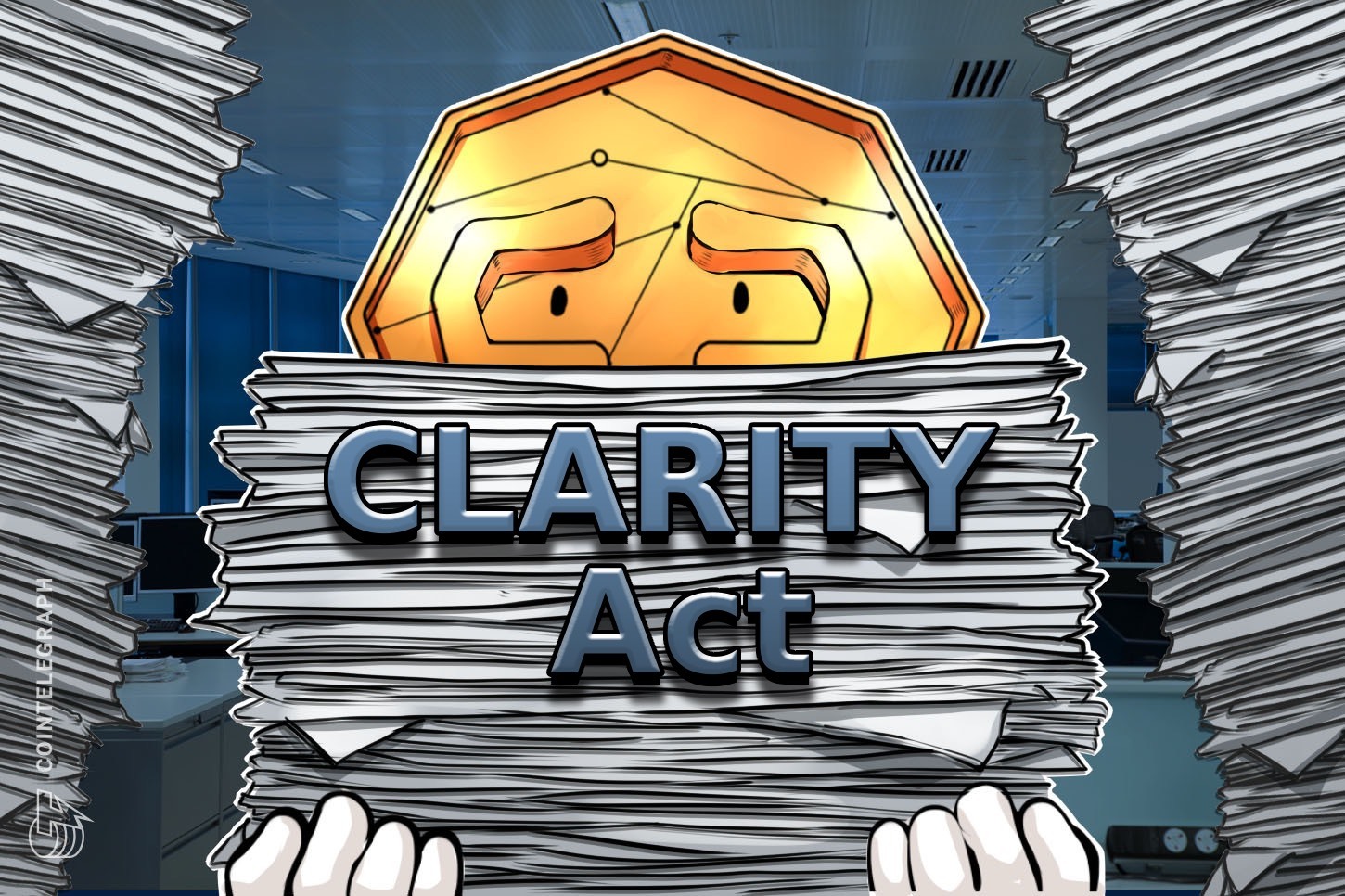
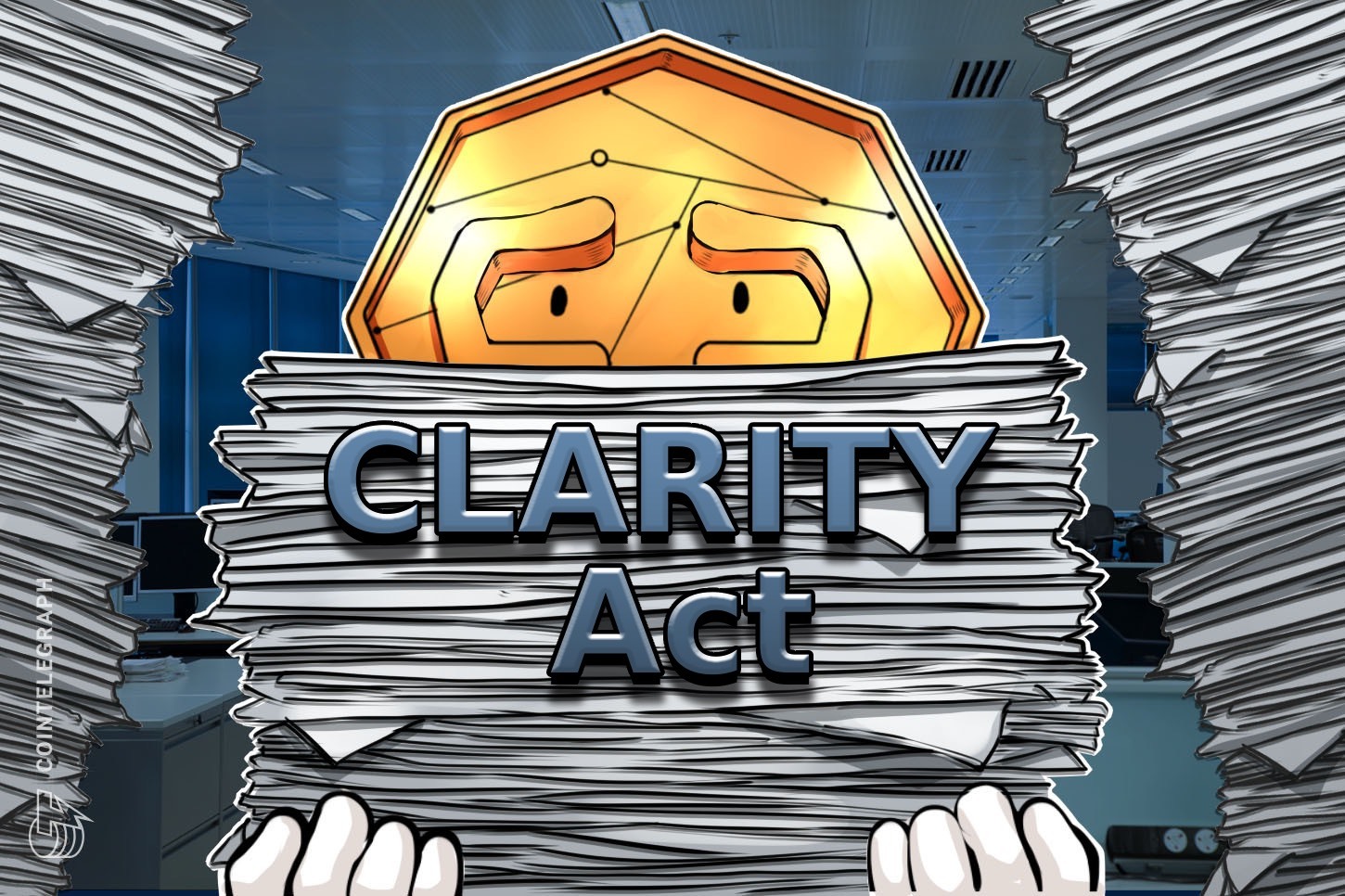
Organizations representing law enforcement officials in the US have reportedly proposed changes to a comprehensive cryptocurrency market structure bill under consideration in the Senate, with only days left until the chamber breaks for a month-long recess.
According to a Tuesday Politico report, the National Association of Assistant US Attorneys and the National District Attorneys Association sent a letter to the White House asking for changes on provisions regarding developers in the Digital Asset Market Clarity (CLARITY) Act. The changes proposed to the Blockchain Regulatory Certainty Act (BRCA) within the CLARITY Act included that guidelines on developers not “create, expand, or modify criminal liability under Federal law.”
In response to reports on the proposed changes, White House crypto adviser Patrick Witt said that the provisions were “not even close” to the Trump administration’s position, and implied that it was not the result of “productive negotiations.” Senator Catherine Cortez Masto has reportedly been pushing the White House to address the BRCA before any potential vote.
The provisions came as the CLARITY Act faces pushback from many Democrats over ethics rules in the bill regarding US President Donald Trump’s crypto investments, which netted him $1.4 billion in 2025. As of Wednesday, Senate Majority Leader John Thune had not scheduled a vote on the legislation before the chamber breaks for state work periods.
Related: Wyden urges Senate leaders to keep dev protections in crypto bill
The US Senate is scheduled to start state work periods from Aug. 7 to Sept. 14, giving lawmakers a limited window to pass crypto market structure before the recess and potential complications from the 2026 midterm elections in November. Thune told reporters last week that the Senate was unlikely to vote on the bill before the August recess.
”Even if CLARITY were brought up today, the procedural steps — cloture → amendment process → second cloture → up to 30 hours of debate — make finishing before recess extremely difficult without [unanimous consent] agreement to waive process, which is rare on contested bills,” said Anne Kelley, a partner at consulting firm Mercury Strategies, in a Monday X post.
CLARITY could shift crypto authority to US commodities regulator
One of the key points of the crypto market structure bill would be to change the regulatory purview over digital asset largely from the US Securities and Exchange Commission (SEC) to the Commodity Futures Trading Commission (CFTC), which currently has fewer tools and resources to address enforcement and oversight issues. Both agencies are also currently understaffed at the leadership level, with only one CFTC chair and three SEC commissioners.
Magazine: Here’s why the CLARITY Act’s ethics deal may be so hard to reach
Cointelegraph is committed to providing independent, high-quality journalism across the crypto, blockchain, AI, and fintech industries.
All news, reviews, and analyses are produced with full journalistic independence and integrity. For more details on our standards and processes, please read our Editorial Policy.
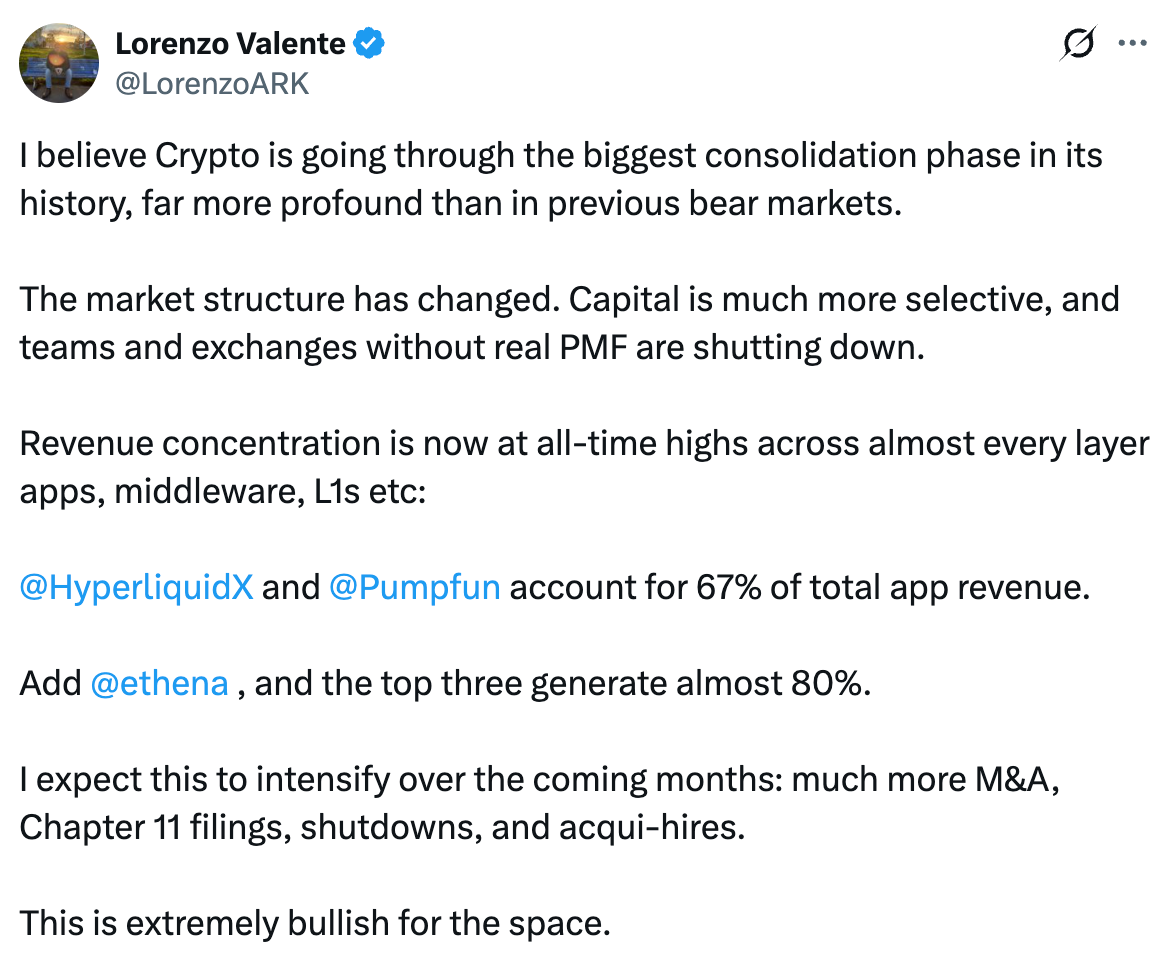
An ARK Invest analyst says the cryptocurrency industry is entering what he describes as its biggest consolidation phase yet, with revenue increasingly concentrated among a handful of dominant protocols.
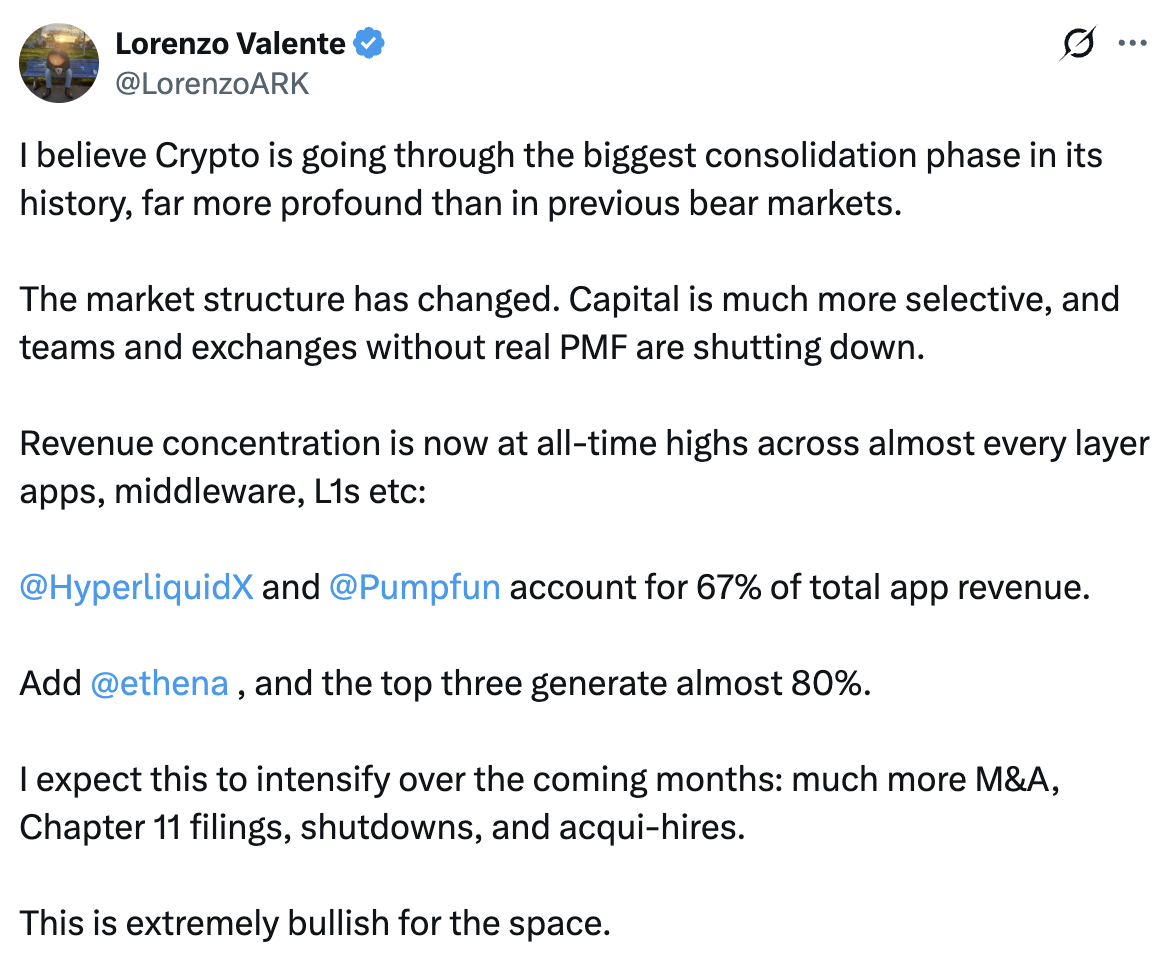
In a Wednesday post on X, Lorenzo Valente, a research associate at ARK Invest, said investors have become increasingly selective, making it harder for crypto projects and exchanges without strong product-market fit to attract capital. As weaker projects struggle or shut down, revenue is becoming concentrated among a small number of dominant protocols, he said.
As evidence, Valente said perpetual futures exchange Hyperliquid and memecoin launchpad Pump.fun account for roughly 67% of total crypto application revenue. Including synthetic dollar protocol Ethena raises the top three’s combined share to nearly 80%, highlighting what he described as record-high revenue concentration across the sector.
Source: Lorenzo Valente
Valente added that he expects the trend to accelerate in the coming months, leading to more mergers and acquisitions, Chapter 11 bankruptcies, project shutdowns and acqui-hires. Despite the shakeout, he described the consolidation as “extremely bullish” for the crypto industry.
Related: ARK pushes back against a16z’s ‘TradFi wants blockchain, not DeFi’ claim
Exchange closures add to consolidation narrative
The comments come as several crypto exchanges have announced plans to wind down operations in recent days, underscoring mounting pressures across parts of the industry.
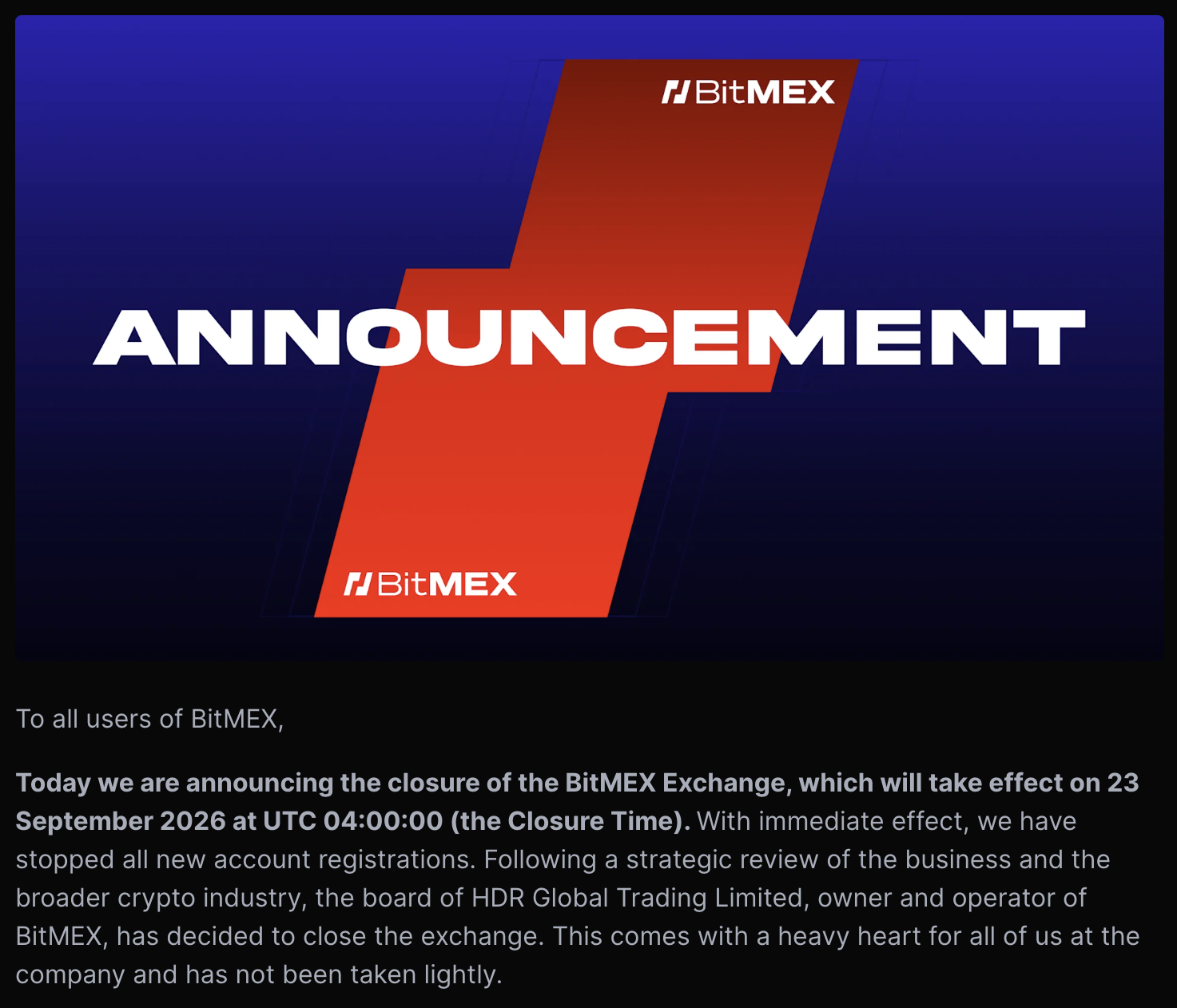
Last week, BitMEX announced it would shut down its exchange in September after a strategic review by owner HDR Global Trading. The exchange had recently accelerated the delisting of trading pairs and derivative contracts, citing insufficient trading interest.
Days later, BitMart announced it would end trading services on Aug. 26 before winding down operations entirely in January 2027. The exchange said the decision followed a review of its operating conditions, market environment and future strategic direction.
Consolidation has also come through acquisitions. Earlier this month, Bybit launched a locally operated exchange in Indonesia after acquiring a majority stake in local digital asset firm NOBI, expanding its presence in one of Asia’s largest crypto markets.
Source: BitMEX
Magazine: The 100x obsession: Fundamentals grow in importance as crypto matures


President Donald Trump threatened a forceful response after Iran fired missiles at U.S. forces in Jordan, ending a brief pause in fighting and sending oil prices sharply higher.
Summary
- Trump vowed to hit Iran “very hard” after missiles targeted American forces in Jordan.
- Brent crude jumped nearly 8% as traders priced in renewed risks to Middle East supplies.
- The Dow fell 2.14%, while the S&P 500 and Nasdaq also closed sharply lower.
- Bitcoin briefly recovered to $64,435 after the Federal Reserve left interest rates unchanged.
Trump vows retaliation after Iran missile attack
Iran’s Revolutionary Guards fired several ballistic missiles at a U.S. air base and military center in Jordan. U.S. officials said American forces intercepted the missiles, with no immediate reports of casualties.
Trump promised retaliation during comments at the White House.
“So it’s our turn,” Trump said. “We’re going to hit them very hard.”
Trump left open the possibility of a future agreement with Tehran but gave no details about the timing or scale of a U.S. response. He also said he had been briefed about a drone strike on a U.S.-owned gas storage tanker at Egypt’s Damietta port.
American and Saudi forces separately carried out joint strikes against Iran-backed groups in Iraq. The attacks killed at least 20 members of the Popular Mobilization Forces, according to the group.
Saudi Arabia’s direct involvement marks a further expansion of the conflict. Riyadh had previously tried to limit its military role while defending oil facilities and shipping routes from attacks linked to Tehran-backed groups.
Oil jumps as shipping risks return
Oil prices surged as traders reassessed the chances of prolonged disruption across the Strait of Hormuz and Bab el-Mandeb Strait.
Brent crude futures settled $6.65, or 7.91%, higher at $90.74 per barrel. U.S. West Texas Intermediate crude gained 6.56% to $84.46. The rally accelerated after Trump promised further action against Iran.
Traffic through the Strait of Hormuz remained limited, while Houthi militants continued to threaten vessels near the Bab el-Mandeb Strait. Only five commodity ships passed through Bab el-Mandeb on Wednesday, down from 39 on Tuesday.
Falling U.S. inventories added to the price pressure. Government data showed crude stockpiles declined by 7.2 million barrels to 404.5 million, their lowest level since 2018.
US Treasury targets Iran-linked crypto payments
Washington also expanded its financial campaign against Tehran. The U.S. Treasury sanctioned two companies accused of operating an Islamic Revolutionary Guard Corps-backed maritime insurance scheme.
Treasury officials said the firms forced commercial vessels to buy mandatory insurance before passing through the Strait of Hormuz. One of the sanctioned companies, HormuzSafe Marine Services Authority, allegedly accepted Bitcoin and other digital assets to bypass Western sanctions.
“The United States will not allow Iran to hold global commerce hostage or use international shipping to finance the IRGC’s terrorism, aggression, and repression,” Treasury Secretary Scott Bessent said.
The action also covered vessels accused of transporting Iranian crude and petrochemical products. Treasury has sanctioned more than 100 vessels linked to Iran’s shadow fleet since the start of 2026.
For U.S. crypto businesses, the action raises sanctions-compliance risks around wallets or payments tied to Iranian shipping operations.
Bitcoin recovers as US stocks close lower
Wall Street ended the session sharply lower as rising oil prices, renewed fighting and concerns about artificial intelligence spending weighed on risk appetite.
The Dow Jones Industrial Average fell 2.14%, while the S&P 500 lost 1.50%. The Nasdaq Composite dropped 1.68%, extending its decline from its June record.
Bitcoin initially fell below $64,000 following reports of the Iranian attack. It later recovered to about $64,435 after the Federal Reserve maintained its benchmark rate at 3.50%–3.75%. Three of the 12 policymakers voted for a quarter-point increase.
Markets will now focus on Trump’s response, access through the Strait of Hormuz, and whether higher energy prices push the Fed toward a September rate increase. Further military action could restore selling pressure across stocks and crypto while keeping oil prices elevated.
Federal Reserve Chair Kevin Warsh told markets on Wednesday to stop trading his intentions and start trading the data. Participants are learning to play the ball, not the referee, he said.
The remark landed hours after the Federal Open Market Committee (FOMC) held rates steady in a 9 to 3 vote. Warsh refused to call the outcome a pause.
Why Warsh Told Markets to Play the Ball
Warsh built his press conference around one message. Inflation sits above target, and the committee intends to bring it down.
The FOMC statement kept the federal funds range at 3.50% to 3.75%. It carried no forward guidance, a clear break from the Jerome Powell era.
Warsh also rejected the idea of a flexible goal. Five years of elevated prices, he argued, left an impression that the Fed quietly tolerated inflation above 2%.
He played down the June core Consumer Price Index (CPI) print as well. The trend matters more than any single month, he said, and inflation cannot be cured in nine weeks.
“We will deliver price stability,” Warsh assured.
Subscribe to our YouTube channel to watch leaders and journalists provide expert insights
That pledge arrived with a condition. Where necessary and appropriate, Warsh said, the committee will not hesitate to act. His tone marked a shift from his first FOMC presser in June, which pushed risk assets lower.
How Bonds, SPY, and Bitcoin Responded
Warsh flagged that nominal and real yields now sit materially higher across the Treasury curve. The Fed is trying to stay out of that repricing, he added, and let the market signal come through unfiltered.
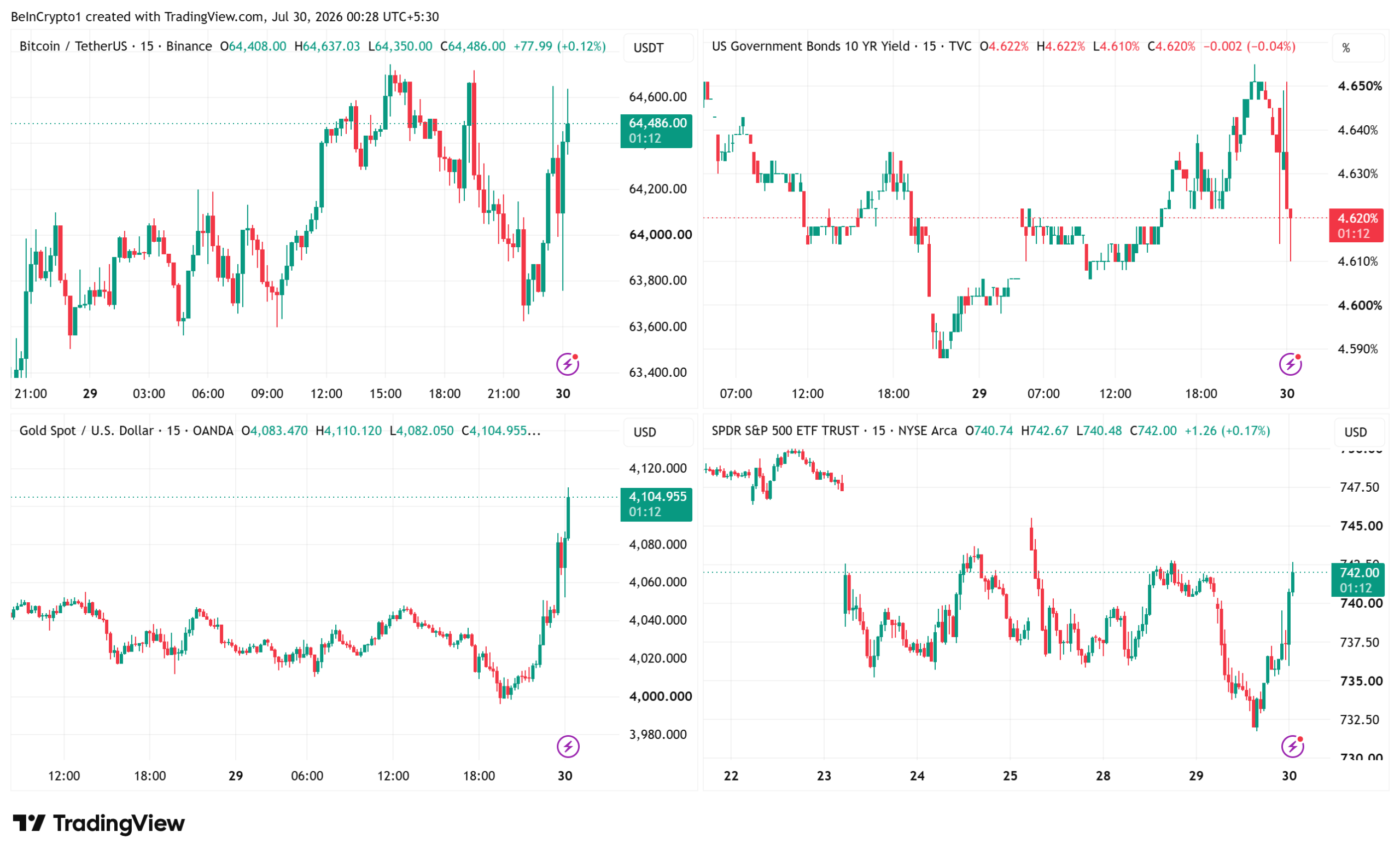
The 10-year Treasury yield eased to 4.620% after touching roughly 4.650% earlier in the session. Traders had spent the week weighing Fed rate hike odds before three dissenting Fed officials backed a quarter point increase.
The SPDR S&P 500 ETF Trust (SPY) turned positive at $742.00, up 0.17%. Gold spot pushed above $4,100, its strongest level of the session.
Bitcoin (BTC) followed the rebound. Bitcoin’s latest price action put it near $64,237, up 0.84% over 24 hours, with a market capitalization of $1.29 trillion.

Even so, the long end stays under pressure after global bond yields climbed to their highest levels since 2008.
Why Peter Schiff Says Warsh Cannot Deliver
Not everyone accepted the framing. Peter Schiff, chief economist and chief executive at Euro Pacific Asset Management, argued that only the language has changed.
“For all of Warsh’s tough talk about the Fed’s newfound commitment to achieving the 2% inflation target it failed to hit under Powell, so far the Fed has done nothing differently with respect to interest rates or its balance sheet. It’s business as usual,” said Schiff.
Schiff pointed to the long end of the curve as his evidence. Investors are selling Treasuries and buying gold, he said, rather than taking the pledge at face value.
Warsh described the weeks ahead as a period of watchful thinking rather than watchful waiting. September will show whether the data, and not the referee, agrees with him. Meanwhile, US President Trump thinks the Fed chair is brilliant.
Follow us on X to get the latest news as it happens
The post Play the Ball, Says Warsh as Fed Keeps Inflation Front and Center; SPY, Bonds React appeared first on BeInCrypto.


Tether’s US-focused USAT stablecoin has launched on Celo, marking its second mainnet deployment after Ethereum and extending the token to a network widely used for digital-dollar payments.
Summary
- USAT now supports native minting and burning on Celo rather than relying solely on bridged tokens.
- Celo users can pay network gas fees with USAT through the blockchain’s CIP-64 fee abstraction.
- USAT has reached a market capitalization of about $185 million since launching in January.
- Tether recently led a $7 million Pact Labs round to expand USAT into US payroll payments.
USAT adds native issuance and gas payments on Celo
Tether announced the USAT deployment on Wednesday, several months after the two companies disclosed plans for the launch in March. Celo becomes the stablecoin’s second supported mainnet following its initial rollout on Ethereum.
USAT holders will be able to use native mint-and-burn functions on Celo. Native issuance reduces the need to move tokens through third-party bridges, which can introduce additional technical and custody risks.
The token can also be used to pay transaction fees on the network. Celo introduced this function through its CIP-64 upgrade, which allows approved ERC-20 tokens to serve as gas currencies instead of requiring users to hold a separate network token.
“Expanding USA₮ to Celo was a deliberate decision,” Tether US CEO Bo Hines said in a statement.
“USA₮ is designed to operate in environments where digital dollars are already being used at scale, and that is what Celo has built, with hundreds of thousands of people transacting on the network every day.”
Celo already handles 28% of cross-chain USDT transfers
Celo has become Tether’s largest USDT distribution network by weekly active users since the flagship stablecoin launched on the blockchain in 2024, according to the announcement.
The network accounts for 28% of cross-blockchain USDT transfers. It also holds more than 90% of the market for XAUt0, the omnichain version of Tether Gold.
Tether’s transparency data lists about $470 million in authorized USDT on Celo, making it the token’s eighth-largest supported blockchain by that measure. Authorized tokens include inventory available for future issuance and do not necessarily represent the amount currently circulating.
Separate market estimates place Celo’s total circulating stablecoin supply near $136 million. USDT accounts for about $78.8 million, giving Tether a 57.6% share of that market.
Opera has also launched a self-custodial stablecoin wallet on Celo with Tether’s support. The product has reportedly reached more than 18 million users worldwide.
USAT targets regulated dollar payments in the US
USAT launched in January and has grown to a market capitalization of about $185 million. That remains a small fraction of USDT’s roughly $180 billion supply, but the two tokens serve different markets.
Tether designed USAT around the requirements of the US GENIUS Act. The stablecoin maintains reserves in cash or liquid cash equivalents, including US Treasury securities, to support one-to-one redemptions.
Anchorage Digital Bank, a federally chartered crypto bank supervised by the Office of the Comptroller of the Currency, issues the token. Hines joined Tether US after serving as executive director of the President’s Council of Advisers on Digital Assets from January through August 2025.
The regulated structure places USAT at the center of Tether’s effort to expand beyond crypto trading and into everyday US payments.
Tether extends USAT into the $11 trillion payroll market
As crypto.news reported in mid-July, Tether led Pact Labs’ $7 million Series A funding round alongside Blockchange Ventures and Lasagna. The deal aims to integrate USAT into payroll and payment systems used by American employers.
Pact Labs plans to let businesses process wages through blockchain payment rails while adding embedded digital wallets and related financial services. Tether is targeting a US payroll market that processes more than $11 trillion annually.
Celo’s low fees, mobile-focused design and existing stablecoin activity could provide another settlement network for those applications. The blockchain began as a Layer 1 in 2020 before moving to an Ethereum Layer 2 built on the OP Stack in March 2025.


Binance.US plans to apply for a U.S. Commodity Futures Trading Commission (CFTC) Designated Contract Market (DCM) license next month, marking a major step in its expansion beyond spot crypto trading.
CEO Stephen Gregory reportedly announced the move at RareEvo, saying the exchange aims to launch regulated prediction markets as part of its broader comeback strategy centered on lower fees, perpetuals, and new trading products.
Binance.US Targets CFTC Approval for Prediction Markets
Binance.US is preparing to apply for Designated Contract Market (DCM) status with the CFTC next month, a move that would pave the way for the exchange to offer regulated prediction markets in the United States.
CEO Stephen Gregory, known online as Stevie_Satoshi, revealed the plan during an on-stage conversation with journalist Eleanor Terrett at the RareEvo conference.
The announcement represents another milestone in Binance.US’s efforts to rebuild its U.S. business following years of regulatory challenges and reduced product offerings.
A Bigger Comeback Strategy Takes Shape
Prediction markets are only one part of Binance.US’s broader strategy.
According to Gregory, the exchange is also focused on reducing trading fees and expanding beyond traditional spot markets into products such as perpetual contracts. The goal is to attract more traders while competing more directly with U.S. crypto exchanges offering a wider range of regulated products.
A DCM designation is the regulatory framework that allows exchanges to list futures, options, and certain event contracts under CFTC oversight. Obtaining the license would place Binance.US among platforms pursuing regulated prediction markets as demand for event-based trading continues to grow.
Why Investors Are Watching
The announcement comes as prediction markets gain increasing attention across financial markets, with traders using event contracts to hedge risk and express views on elections, economic data, sports, and other outcomes.
For Binance.US, securing a DCM license could significantly expand its product lineup while reinforcing its regulatory credentials in the United States.
However, the company has not yet submitted its application, and any approval process could take months. CFTC review timelines vary, and there is no guarantee the application will be approved.
What’s Next?
Investors will now watch for Binance.US’s formal CFTC filing, expected next month. Any updates on the application process, regulatory feedback, or future product launches could shape the exchange’s next phase of growth and influence competition in the rapidly evolving U.S. prediction markets sector.
Binance.US did not immediately respond to BeInCrypto’s request for comment.
The post Binance.US Reportedly Eyes CFTC License in Bold Prediction Markets Push appeared first on BeInCrypto.
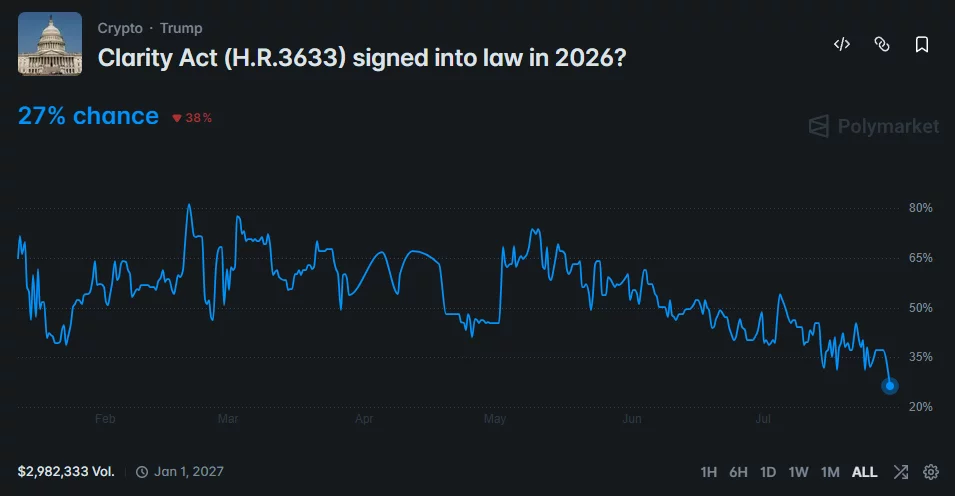
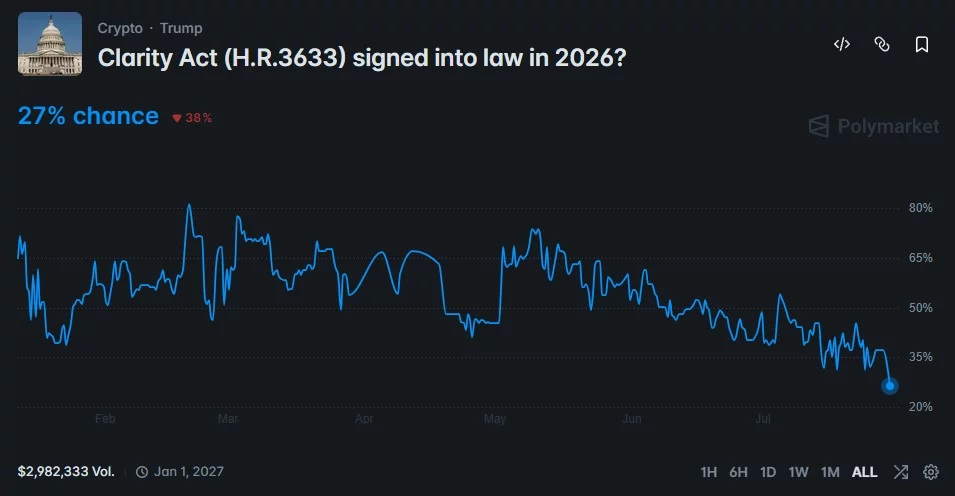
Polymarket traders cut the CLARITY Act’s chances of becoming law in 2026 to a record-low 27% after the Senate postponed action on the crypto market structure bill.
Summary
- CLARITY Act passage odds fell to 27%, their lowest level since the Polymarket market opened.
- Senate leaders prioritized Russia sanctions and federal nominations before the scheduled Aug. 8 recess.
- Senators Ruben Gallego and Thom Tillis are preparing a bipartisan ethics counteroffer for the White House.
- SEC Chair Paul Atkins said the agency could write crypto rules without Congress if negotiations fail.
CLARITY Act odds fall as Senate changes priorities
The Polymarket contract asking whether crypto market structure legislation will become law in 2026 fell to 27% on July 29. The price represents traders’ assessment rather than an independent forecast, but it shows growing doubts about the bill’s shrinking legislative window.
Galaxy Digital has also lowered its estimated probability of passage to 30% as negotiations extend further into the Senate calendar.
As crypto.news reported, Senate Majority Leader John Thune postponed action on the CLARITY Act while lawmakers considered a Russia sanctions package and a group of federal nominees. The Senate voted on July 28 to advance the sanctions legislation, leaving fewer working days for the crypto bill before the Aug. 8 recess.
Industry participants have urged Thune to begin the cloture process before the break, even if the Senate cannot complete a final vote. A procedural vote could establish whether the measure has enough bipartisan support to advance later in the year.
Senators prepare a new ethics counteroffer
Democratic Sen. Ruben Gallego and Republican Sen. Thom Tillis are finalizing a bipartisan counteroffer covering ethics restrictions in the bill. The lawmakers expect to submit the language to the White House within days.
Tillis indicated that the proposal could allow state attorneys general to enforce its ethics provisions instead of giving that authority only to the Department of Justice. Ethics rules covering elected officials and their financial interests in digital assets have become a central point in negotiations.
A separate dispute over stablecoin rewards could create another delay. Banking groups have pushed lawmakers to restrict yield-bearing products that may compete with traditional deposits, while crypto companies argue that broad limits could reduce consumer choice.
Even if senators reach an ethics agreement, the bill must still clear procedural thresholds, pass the Senate and resolve any differences with the House version. Those steps make passage before the recess increasingly unlikely.
US crypto firms seek federal market rules
The CLARITY Act would divide digital asset oversight between the Securities and Exchange Commission and the Commodity Futures Trading Commission. Its supporters say the framework would give exchanges, token issuers and blockchain developers clearer rules for operating in the United States.
Florida Rep. Mike Haridopolos renewed his support for the measure during a July 28 appearance on Fox Business. As crypto.news previously reported, the House Financial Services Committee member warned that continued delays could send investment and jobs to countries with clearer regulations.
“This is about making sure that American markets are the premier markets in the world,” Haridopolos said.
BlackRock, Goldman Sachs, Franklin Templeton, Fidelity, Charles Schwab and SoFi have also supported passage, challenging claims that Wall Street broadly opposes the legislation.
“The Big Bank Lobby is trying to say that all of Wall Street is opposed to the Clarity Act. That’s completely false,” Sen. Cynthia Lummis said.
The Consumer Technology Association has made a similar economic argument, warning that regulatory uncertainty could push capital and employment outside the country.
SEC could move ahead without Congress
SEC Chair Paul Atkins said the regulator remains prepared to address parts of the crypto market structure debate through agency rulemaking if Congress fails to act.
Atkins described the SEC as “ready, willing and able” to write rules under its existing authority. However, he said legislation remains preferable because a statute would provide a more durable framework than regulations that a future administration could revise.
Independent SEC action may clarify how the agency treats certain tokens, trading platforms and tokenized securities. It would not fully replace legislation establishing statutory jurisdiction between the SEC and CFTC.
The bipartisan ethics counteroffer is now the bill’s most immediate test. White House acceptance could help negotiations continue after the recess, but the Senate calendar and unresolved stablecoin dispute leave the CLARITY Act facing its weakest outlook so far.
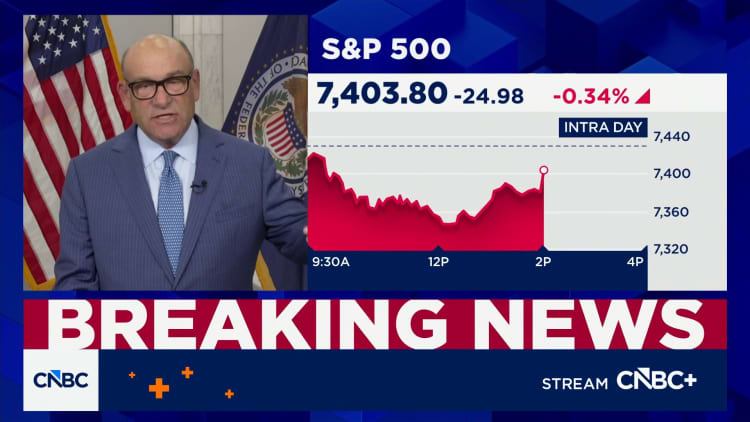

WASHINGTON – The Federal Reserve on Wednesday voted to hold its key interest rate steady but not without opposition from three officials who have expressed concern over inflation and wanted to hike.
Despite increasing support among some officials for a rate increase, the Federal Open Market Committee voted 9-3 to leave the federal funds rate in a range between 3.5% and 3.75%.
All of the “no” votes came from regional presidents – Beth Hammack of Cleveland, Neel Kashkari of Minneapolis and Lorie Logan of Dallas – who had been the most explicit about the need for higher rates to address inflation that has been above the Fed’s 2% target for more than five years.
The post-meeting statement noted that the three dissenters “preferred to raise the target range for the federal funds rate by ¼ percentage point at this meeting.”
An early challenge for Warsh
This is the first time since September 2016 that three policymakers dissented with a unified view of which direction rates should head.
“We’re reading this as a Committee with vocal hawks,” said Ian Lyngen, head of U.S. rates at BMO Capital Markets.
The no votes presented an early challenge for Chairman Kevin Warsh, whose refusal to provide clear road signs on where monetary policy is headed led to an unusually high level of uncertainty heading into the meeting.
Markets largely had expected the central bank policymakers to approve another hold on rates, though there had been some inclination – about a 1-in-3 chance, according to the CME Group’s FedWatch tool – that a surprise rate hike was in the cards. Prediction markets had a higher level of certainty that the Fed would hold.
Warsh has argued that the Fed should spend less time trying to tell markets what it will do and instead emphasizing the conditions under which action would be taken. However, Wednesday’s statement provided neither, even with markets largely expecting the Fed to hike in September.
The post-meeting statement was almost identical to the one following the June 17 decision and was in keeping with the Fed’s actions all year, following three rate cuts in the latter part of 2025.
Officials again noted that “Economic activity is expanding at a solid pace despite elevated uncertainty that owes, in part, to the conflict in the Middle East.” The statement further said that job growth has “kept pace with the workforce and the unemployment rate has changed little” even as the U.S. labor force has contracted.
As in June, the statement concluded with the simple declaratory, “The Committee will deliver price stability.”
“The Fed appears to be running out of patience with above-target inflation, despite recent data coming in cold,” said Kay Haigh, global head and chief investment officer of fixed income and liquidity solutions at Goldman Sachs Asset Management. “The committee’s growing hawkish sentiment, shown by the three dissents against today’s hold, has also likely been exacerbated by the recent flare up in hostilities in the Middle East.”
Officials favoring tighter policy argued inflation has been a burden on households and is not showing clear signs of abating. Recent price pressures have reflected both tariffs imposed by President Donald Trump and higher energy costs tied to the Iran conflict.
The full committee in June penciled in one quarter-percentage-point increase by the end of 2026.
Disparate policy views
Governor Christopher Waller also voiced worries recently over inflation, saying higher rates could be necessary if more progress isn’t made. However, he voted in favor of a hold at this meeting.
For his part, Warsh has called inflation “a choice,” and he repeatedly stressed the importance of getting prices in check during recent hearings on Capitol Hill.
But from a policy perspective, Warsh has expressed disdain for the Fed’s past practice of providing forward guidance on its expectations for rates.
Keeping with Warsh’s first meeting, the statement was much shorter than what had become the norm. Warsh has stressed changing the way the Fed communicates, even dedicating one of five task forces he has created to address the issue.
In the weeks leading up to the meeting, his FOMC colleagues had expressed disparate policy views.
New York Fed Chair John Williams has said he sees current policy well positioned to bring inflation back to target. However, Logan countered that “modestly” higher rates would be needed. Hammack also has been an inflation hawk, citing the pressure households are facing from persistently higher prices across the board.
Earlier this week, Trump showed support for Warsh, calling him “fantastic” while noting other Fed officials had “bad intentions” and perhaps had political motivations.

US stocks: US market closes down sharply after Fed holds rates unchanged
Fidelity Flags October and Bitcoin Bottom as ‘Yardstick’ Hits Historic Lows

Family Reportedly Seeks Social Media Account Data


-

 Fashion5 days ago
Weekend Open Thread: Brooks Brothers
-
 Sports3 days ago
Commonwealth Games boxing: Jadumani Singh seals dominant 5-0 win over Pakistan’s Sumama Rehman to enter quarter-finals | Commonwealth Games News
-

 Tech3 days ago
Intel is reversing course and bringing hyper-threading back to its server chips
-

 Crypto World7 days ago
Ethics, other provisions in crypto Clarity Act to be further discussed
-

 Politics2 days ago
Luke Littler dismantles Gerwyn Price to retain title in Blackpool
-

 Crypto World4 days ago
Ripple bought a bank in pieces. The $4 billion audit
-
 Entertainment5 days ago
A New Post-Apocalyptic Gundam Anime Series Blasts Into SDCC
-

 News Videos3 days ago
BITCOIN JUST ENTERED THIS CRITICAL ZONE…
-

 Politics2 days ago
The Part of the Electric Transition Nobody Wants to Discuss
-

 Sports6 days ago
2026 3M Open leaderboard: Scottie Scheffler finds putter in Round 1, sits three back
-

 Fashion6 days ago
16 Dresses for the High Summer Event
-

 News Videos6 days ago
The Peugeot Family: How 200 Years of an “Old Money” Dynasty Died in A Boardroom
-

 Business16 hours ago
Major shareholder moves on Canyon
-

 Crypto World4 days ago
XRP Ledger adds $2.6B as RWA inflows rank second
-

 Politics3 days ago
Spain sweeps the board at 2026 World Cup with individual awards
-

 Crypto World6 days ago
Uniswap (UNI) pushes deeper into tokenized RWAs with permissioned trading pools
-
 Entertainment1 day ago
‘Stargate’ Creator’s New Sci-Fi Series Returns for Season 3 Tomorrow
-
Crypto World7 days ago
SEC Agrees to Overhaul Recordkeeping After Settling Coinbase Lawsuit Over Gensler’s Lost Texts
-

 Tech5 days ago
Anthropic launches Claude Opus 5, a cheaper AI model for coding, agents and enterprise workflows
-
 Entertainment4 days ago
Sara Gilson Killed By Husband After Viral “Pedophile” TikTok Video
You must be logged in to post a comment Login