

Crypto World
Bitcoin reclaims $61,000 after dipping below $60,000 in an AI-led rout



Bitcoin reclaimed the $61,000 level in Asian morning hours Saturday after briefly dipping below $60,000 overnight, steadying after a strong U.S. jobs report on Friday triggered a sharp selloff across stocks, bonds and crypto.
The token fell as low as $59,227 before buyers stepped back in, and was trading around $61,000, down about 1.3% on the day.
The bounce came off a level traders had been watching closely. Bitcoin had been sliding toward $60,000 all week as a record run of ETF outflows and Strategy’s first bitcoin sale since 2022 removed buyers that had supported the price. The break below the round number overnight did not turn into a deeper breakdown, with the token recovering more than $1,500 off the low.
The selloff that drove the dip started outside crypto. Friday’s nonfarm payrolls report came in solid, and rather than cheering the strength, markets repriced the Federal Reserve outlook hard. Swaps now fully price a rate increase by the end of 2026, a reversal from the cuts expected under newly confirmed chair Kevin Warsh. Two-year Treasury yields jumped 12 basis points to 4.16%, the dollar rose, and risk assets fell.
The damage was worst in the AI trade. The Nasdaq 100 sank about 5%, its steepest drop since April 2025, and a gauge of chipmakers tumbled 10%. The S&P 500 fell 2.6% and failed to complete a tenth straight weekly gain.
Other tokens remain deep in the red on the week. Ether is down 21.6% over seven days to around $1,575, solana down 23.7% to $63, and XRP, dogecoin and BNB all between 13% and 20% lower. Hyperliquid’s HYPE, which outperformed through most of the recent bleed, is down 9.9% over the same stretch.
The leverage washout was heavy. Around $1.60 billion in positions were liquidated over 24 hours across roughly 308,000 traders, according to CoinGlass, with longs accounting for $1.21 billion. Bitcoin saw $534 million in liquidations and ether $423 million, while Zcash, in the middle of its own 44% collapse tied to a disclosed bug in its Orchard privacy pool, logged another $115 million.
With $60,000 pierced overnight but quickly reclaimed, the question is whether bitcoin can build on the bounce or whether the level gives way on a retest. A clean break below it would put the token back into territory it last traded during the February drawdown.

After plunging by several grand in the span of less than 12 hours, bitcoin finally rebounded from its multi-year low and now sits at around $61,000.
Although most altcoins are still in the red on a daily scale, they have managed to recover some of the losses. This is particularly true for ZEC, which bled out heavily yesterday, and PI, which marked consecutive all-time lows.
Bitcoin Recovers $2K
What a week it has been for bitcoin, and mostly for the bears. In fact, what a painful three-week period. The asset stood above $82,000 in mid-May before its calamity began, and it dumped to $74,000 at the end of the month. But that was just the start, as June, in just five days, brought a lot more pain.
Bitcoin quickly lost the $70,000 support, and then the bears were really in control. They started pushing it below one key support level after another. Thus, $68,000, $65,000, and $62,000 gave in before the asset came inches away from the $60,000 bottom that managed to hold it during the February crash.
Although the buyers successfully defended it at first, that level finally gave in yesterday, and bitcoin plunged to just over $59,000. This became its lowest price since before the November 2024 US presidential elections. After losing about $23,000 in weeks, BTC finally showed signs of a minor recovery and has bounced to $61,000 as of now.
Its market cap is up to $1.225 trillion on CG, while its dominance over the alts has reclaimed the 56% level.

ZEC, PI Rebound
Although most crypto assets plunged yesterday, Zcash became the worst performer after a vulnerability in its code was uncovered and Arthur Hayes dumped his entire stash. At one point, ZEC had dropped by over 50%, going from $630 to under $300. However, it has reacted swiftly and now trades above $370.
Pi Network’s native token marked several consecutive all-time lows after it dumped below $0.15 earlier this week. The latest, according to CoinGecko data, sits at under $0.12. However, it has managed to reclaim that level since then and now trades about 7% above the ATL.
ETH dumped to $1,500 yesterday but stands close to $1,600 now. BNB is back to $580, while XRP has returned to $1.10. XLM and CC are among the few alts in the green today.
The total crypto market cap dipped to $2.1 trillion yesterday, and although it has recovered some of its losses, it still sits below $2.2 trillion on CG.

The post Pi Network’s PI Token Rebounds After New ATL, BTC Quickly Reclaims $60K: Weekend Watch appeared first on CryptoPotato.


Arthur Hayes has closed his entire Worldcoin position after turning cautious on WLD and other high-beta altcoins within days of publicly defending the trade.
Summary
- Arthur Hayes sold his entire WLD position on June 6 after recently backing the AI-linked token.
- Hayes had earlier exited HYPE, NEAR, and ZEC within two days.
- Stacy Muur said WLD had gained about 68% while the market dropped nearly 10%.
Hayes said in posts on X that he sold the full WLD position on June 6 after earlier arguing that the token could benefit from renewed interest in artificial intelligence-linked assets. The BitMEX co-founder had outlined a bullish case for WLD on June 3, then reiterated the view on June 4, linking the token to expected AI IPO activity and shifting liquidity conditions.
Hayes Cuts WLD After Rapid Rally
Worldcoin had gained strongly during the previous three weeks, even as several altcoins struggled to hold momentum. Crypto analyst Stacy Muur said on June 5 that WLD had advanced about 68% while the crypto market fell roughly 10%. She attributed part of that gap to Hayes and his fund, Maelstrom.
By June 6, Hayes had reversed course and shared a chart to explain why he had sold the full position. His exit turned WLD from one of his preferred AI-related trades into another token removed from his book during a sharp round of risk reduction.
The sale came after WLD became more volatile in early June. Hayes did not describe the move as a slow portfolio adjustment. Instead, his public posts showed a quick move from conviction to a complete exit.
HYPE, NEAR, ZEC Sales Came First
Worldcoin was not the first token Hayes dropped during the week. On June 4, he said he had sold his full HYPE and NEAR holdings and told followers that he would explain the decision in an essay titled “Reality Test,” expected the following Tuesday.
In the same macro note, Hayes cited higher energy prices tied to the Iran conflict, three expected AI IPOs before early Q3, and his view that President Trump could adopt an anti-AI stance before the midterms. Hayes presented those issues as reasons to reassess positions linked to AI and speculative liquidity.
A day later, Hayes also exited Zcash after the Orchard shielded-pool vulnerability became public. He wrote that the trade no longer worked for him because the bug could not be formally proved to prevent unauthorized minting. Hayes added that the “privacy from AI, govt, big tech narrative demands perfection.”
As previously covered on crypto.news ZEC sale ended what Hayes had called his “Holy Trinity” of HYPE, NEAR, and ZEC. WLD then became the final major position he removed.
Hayes remains a closely followed crypto investor, and his trades often shape debate even when they do not directly move prices. His decision to sell WLD, HYPE, NEAR, and ZEC within two days gave traders a clearer view of his current caution toward altcoins outside Bitcoin and Ether.
The key question for WLD holders is whether the token’s earlier premium can hold without Hayes as a public backer. Stacy Muur’s June 5 comments showed how far WLD had moved ahead of the market before the exit.
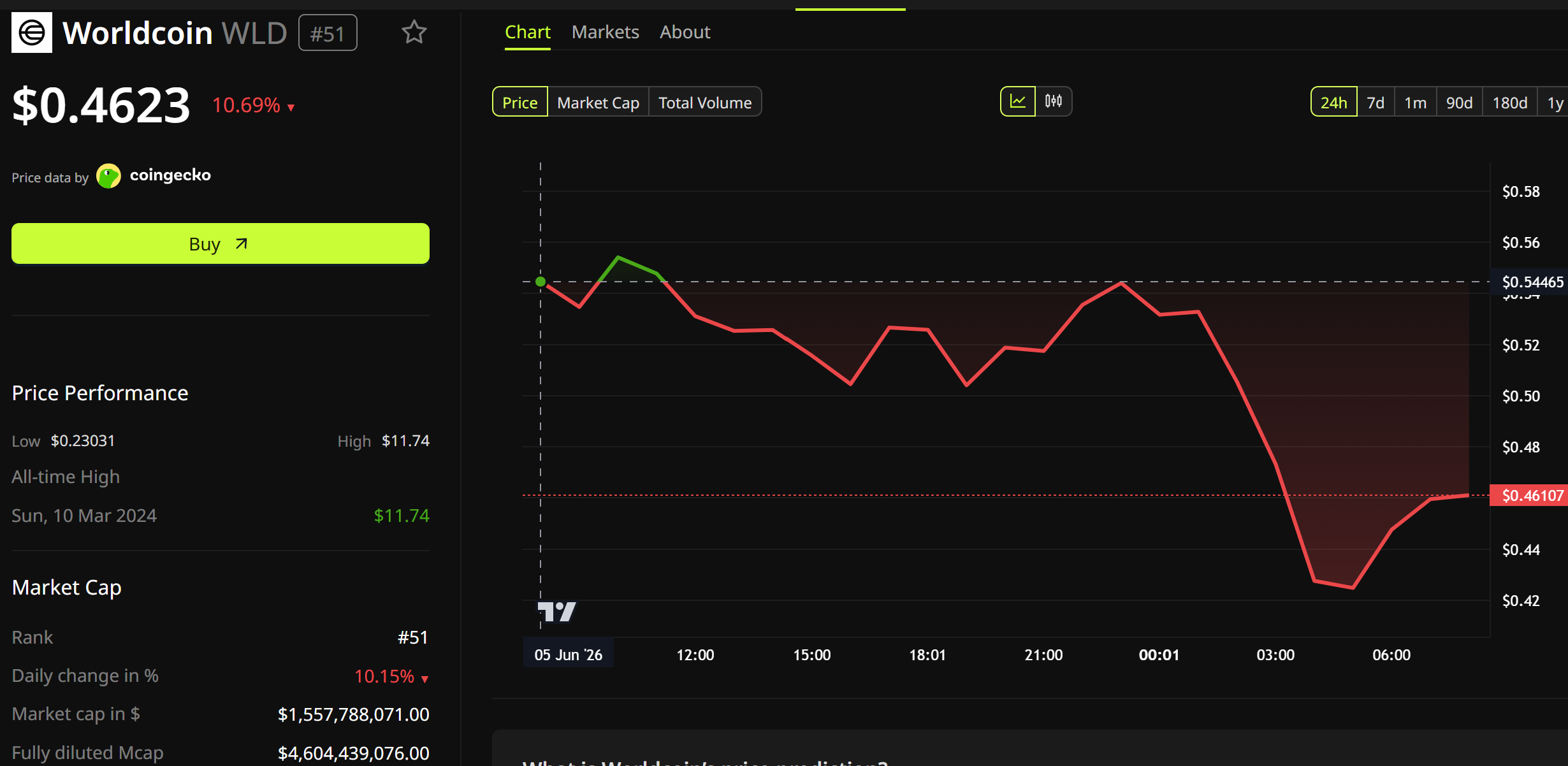
Arthur Hayes said he sold his Worldcoin (WLD) position on June 6, only days after publicly promoting the token, drawing accusations that he built exit liquidity for his own followers.
The reversal capped a week in which the BitMEX co-founder unwound four high-conviction altcoin bets. WLD traded near $0.46, down about 11% over 24 hours after a sharp weekly run.

Arthur Hayes Moves From Bullish Thread to Sudden Exit
Hayes announced the sale on X (Twitter) early Saturday, alongside a falling price chart.
“This chart is going in the wrong direction. Dumped $WLD. I’m out. See y’all at the clerb,” he said.
The timing fueled the anger. Days earlier, Hayes had urged followers to hold WLD through an expected SpaceX listing and framed it as a high-beta bet on artificial intelligence.
WLD had climbed roughly 55% over the prior week before the pullback.
Worldcoin, since rebranded World, is the iris-scanning identity project co-founded by OpenAI chief Sam Altman. Its token has drawn heavy retail interest, which critics say magnifies the impact of influential traders.
WLD still ranks near 51st by market value at roughly $1.55 billion. The single-day drop trimmed about $190 million from that figure, even after the token gained around 55% over the prior seven days.
Critics Allege a Repeated Pattern
The backlash widened after crypto sleuth ZachXBT tied the WLD exit to earlier reversals.
“How much exit liquidity was created from your followers over the past couple days? First NEAR HYPE ZEC Now WLD,” wrote ZachXBT.
Follow us on X to get the latest news as it happens
Indeed, Hayes dumped his Hyperliquid stack and NEAR Protocol (NEAR) on June 4, days after a $150 HYPE price target and a public charity wager.
He exited Zcash (ZEC) next, then WLD, despite having kept holding Worldcoin as his last AI proxy.
“…no redemption for you [Arthur Hayes] ever… Just leave to some remote island and beg for forgiveness for 50 years and never show your face in this crypto-space ever again,” another user lashed.
Hayes carries a contested history. He pleaded guilty in 2022 to a Bank Secrecy Act violation tied to BitMEX and paid a $10 million fine. This history deepens the distrust behind the Worldcoin price manipulation claims now circulating.
In his defense, Arthur Hayes says he “sold to a willing buyer at a price, highlighting that he would have suffered the loss had prices moved higher.
“I just happened to call it right this time as it regards to my trading goals,” wrote Hayes.
Whether the episode reshapes how followers treat his calls, or simply fades like prior cycles, may become clear in the coming weeks.
“ZEC, NEAR, and WLD are back to where they were before his calls,” Lookonchain indicated.
The post Arthur Hayes Sparks Fury After Abrupt Worldcoin Exit, WLD Price Falls 10% appeared first on BeInCrypto.

Solana-based memecoin launchpad Pump.fun has unveiled an open bounty platform that pays crypto rewards for promotional tasks—ranging from jaw-dropping stunts to deeply controversial acts. The system operates with funds escrowed and submitted tasks reviewed by Pump.fun, with payouts released only if a submission passes review and is accepted.
Among the most eye-catching bounties are a $57,000 offer to skydive into a World Cup match as a memecoin mascot, and a $25,000 bounty to interview the family of Henry Nowak’s killer. There’s also a $3,000 incentive to quit one’s job live on camera. The platform’s ledger at the time of reporting showed an unclaimed pool of about $115,000 across 225 live bounties and 509 total submissions, indicating both high interest and a crowded field of proposals.
Open bounties on Pump.fun are listed with expiration dates, detailed deliverables, and the ability for participants to submit attempts. Users can sort by reward, remaining time, or the number of submissions to gauge popularity and urgency. When a task is accepted, the payout is disbursed to the submitting participant, with funds held in escrow during review.
However, the platform’s ambitious scope has raised questions about moderation, safety, and potential legal exposure. Critics have pointed to the risk that some tasks could be exploitative or harmful, underscoring the need for robust safeguards and clear boundaries around acceptable conduct. In its Terms and Conditions, Pump.fun notes that bounties deemed spam by the platform’s hosting environment may be disallowed, signaling an attempt to curb reckless or abusive use of the system.
“This is a horrible market. It’s like playing with poor people’s lives and paying them to entertain you.”
That sentiment was echoed by observers on social media, who warned that the platform could resemble a modern, crypto-flavored variant of contestants’ stunts from reality shows. Another commentator drew a parallel to dystopian tropes, noting the stark power imbalance between high-stakes promotions and participants willing to take on risky or degrading tasks for a payout.
As Pump.fun frames it, the platform exists to channel human energy and financial rewards across a global network, enabling participants to pursue bounties for virtually any deliverable. Open listings include tasks with captions and explicit deliverables, requiring video proof or other verifiable evidence to qualify for payment. The open-bounty model relies on a blend of creator trust, platform oversight, and escrowed funding to mitigate risk and ensure accountability.
Platform listings show the breadth of creative possibilities—and risks. One task offers a $3,572 bounty to spray-paint the ticker symbol “$memecoin” on a car and ignite it, provided the participant dons a memecoin mascot and documents the entire process. Another listing proposes a $2,630 bounty for tattooing the ticker symbol “$boutywork” on a participant’s forehead, with a video proof requirement. Each bounty is structured with a deadline, deliverables, and a payout condition if approved by Pump.fun’s review process.
At present, Pump.fun’s bounty pool is far from empty, but a sizable portion remains unclaimed. The platform’s public view shows $115,000 in unclaimed rewards while listing 225 live bounties and 509 submissions from participants. The sheer scale of interest illustrates how quickly meme economies can incubate incentive campaigns when combined with crypto funding and a streamlined escrow workflow.
Key takeaways
- Pump.fun has launched an open bounty marketplace on Solana that pays crypto rewards for promotional tasks, with funds held in escrow and reviewed by the platform.
- High-profile bounties include a $57,000 skydiving stunt into a World Cup match and a $25,000 interview with the family of a killer—highlighting the platform’s willingness to fund extreme promotional acts.
- As of reporting, there is about $115,000 unclaimed across 225 active bounties and 509 total submissions, signaling strong participant interest but ongoing liquidity concerns for some tasks.
- Moderation and safety concerns persist, with Terms indicating that bounties deemed spam by social platforms may be disallowed and critics warning about potential exploitation or legal exposure.
- The marketplace illustrates a broader dynamic: meme-driven incentives can rapidly mobilize large-scale marketing stunts, but the ethical and regulatory implications remain unsettled.
A new marketplace for memecoin stunts
Pump.fun positions the platform as an open marketplace to “complete bounties for ANY task and leverage the power of humans & money across the globe.” Submissions are reviewed by Pump.fun, and funds stay in escrow until a bounty is accepted and paid out. This model aims to provide a structured pathway for creative marketing while preserving a check on submissions through defined deliverables and expiration windows. In its Terms, the company makes clear that tasks that may constitute spam on other networks are not allowed, signaling an intent to set some boundaries around the kinds of stunts allowed on the platform.
Notable listings and what they reveal about incentive design
Several listed bounties underscore the carnival-like quality of crypto marketing, but also the potential for harm. A task offering $3,572 encourages painting a car with the ticker symbol for a memecoin and then setting it on fire, with the participant required to wear a memecoin mascot and film the process. A separate offer of $2,630 seeks participants willing to tattoo the ticker “$boutywork” on their foreheads, accompanied by video proof. Each task has a defined deadline and deliverables, and all are subject to Pump.fun’s review and escrow-based payout model.
Beyond these spectacle-driven promotions, other high-value listings reveal a more provocative edge. The $25,000 bounty to interview the family of Henry Nowak’s killer is a stark example of how meme-driven campaigns can intersect with real-world narratives, raising questions about consent, privacy, and the line between marketing and sensationalism. These listings illustrate how the platform acts as a rapid-launchpad for creative, if controversial, promotional campaigns that leverage crypto as a payoff mechanism.
Community responses have been mixed. Some users criticize the platform for wagering with vulnerable participants—calling it an extreme form of entertainment economics—while others see it as a new front in the evolution of meme-driven marketing and incentive design. For now, Pump.fun’s escrow-backed framework and explicit deliverables provide a level of guardrails that could help distinguish legitimate campaigns from reckless stunts, but the long-term viability will hinge on how well safety, consent, and legal risk are managed as the catalog of tasks grows.
“This is a horrible market. It’s like playing with poor people’s lives and paying them to entertain you.”
Meanwhile, other comments captured the surreal nature of the platform’s offerings. “Yep, reminds me of Squid Game,” one observer remarked, underscoring the sensational vibe that such bounty listings have cultivated within crypto communities. Whether these reactions signal skepticism or curiosity, they reflect a broader tension between provocative marketing and responsible promotion in a space where incentives are amplified by cryptocurrency rewards.
As with any new incentive system, the key questions will revolve around moderation, safety, and the legal environment. Pump.fun’s Terms explicitly aim to filter out spam and ensure that tasks meet acceptable standards, but observers will be watching to see how these rules are enforced as the bounty pool scales and as more users participate with diverse risk appetites.
For investors and builders, the platform’s emergence signals a broader trend: meme-powered incentive models can accelerate marketing reach far beyond traditional channels, often at a rapid pace. Yet the authenticity and sustainability of such campaigns will ultimately depend on governance, participant protection, and clear boundaries around what constitutes acceptable promotional activity in different jurisdictions.
Source: Pump.fun
Related coverage: South Korea police probes Polymarket users over illegal gambling claims, illustrating how regulatory scrutiny looms over crypto-backed promotional activities and prediction markets.
Crypto World
Shilling Before Dumping? Why Crypto X Is Furious With Arthur Hayes After His Latest Sale

Despite outlining bullish predictions for several popular altcoins in the past few months, such as WLD, ZEC, HYPE, and NEAR, Arthur Hayes has publicly declared that he has sold almost all of his positions long before his targets were reached.
This has caused a significant backlash from the cryptocurrency community, as some believe his hype is only to drag people into those assets before he dumps them at higher prices.
Hayes Continues Selling, This Time WLD
It was just several days ago that Hayes said he would be holding WLD for at least the first week of SpaceX’s IPO, as both have Elon Musk as a key person. He predicted that the IPO would “melt people’s faces off.”
Hours ago, though, he changed his tune after showing the chart of SpaceX’s stock getting wrecked on Friday during the market-wide calamity. He argued that the newly listed shares are heading in the wrong direction, which is why he decided to dump his WLD stash.
Popular on-chain sleuth ZachXBT was among the first to call out Hayes on his controversial moves, asking how much “exit liquidity was created” from his followers over the past few days. He also brought up other major sales from Hayes.
As reported yesterday, the BitMEX co-founder disposed of his ZEC stash after developers revealed a Zcash code vulnerability that was already fixed at the time of his sale. Previously, he had also dumped HYPE and NEAR holdings after making some quite optimistic price predictions.
How much exit liquidity was created from your followers over the past couple days?
First NEAR HYPE ZEC
Now WLD pic.twitter.com/vyDXwCHRwO— ZachXBT (@zachxbt) June 6, 2026
Community Lashes Out
The analysts at Lookonchain also flagged his exits, especially since they arrived close to the assets’ price tops. Interestingly, all of them plunged in the hours after he disclosed his exodus and have returned to essentially the same levels where they were before his big price predictions.
Arthur Hayes(@CryptoHayes) called $ZEC, $NEAR, and $WLD.
He sold near the top, then disclosed his exit and turned bearish.$ZEC, $NEAR, and $WLD are now back to where they were before his calls. pic.twitter.com/IlvCqTHe3r
— Lookonchain (@lookonchain) June 6, 2026
Some of the comments below the posts on X were quite brutal, calling it a “douchebag” move for shilling an altcoin just hours before dumping it. Others noted that if any traders followed his moves, they were “small scammers” that were “scammed” by the “big scammer.”
The post Shilling Before Dumping? Why Crypto X Is Furious With Arthur Hayes After His Latest Sale appeared first on CryptoPotato.

TLDR:
- 83% of altcoins on Binance are trading below their 200-DMA, one of the lowest readings this cycle.
- TOTAL3 has dropped to roughly $670B, shedding around $520B from its peak during the current cycle.
- Altcoin weakness has persisted since October 2025, with 60–90% of assets below their 200-DMA consistently.
- Bitcoin fell nearly 4% while Nasdaq dropped 4.7%, dragged lower by AI and semiconductor stock weakness.
The altcoin market is facing severe pressure as $520 billion in capitalization has evaporated since October 2025. Bitcoin dropped nearly 4% in a single session, while the S&P 500 fell 2.6% and the Nasdaq lost 4.7%.
Technology stocks, particularly AI and semiconductor names, led the broader selloff. Against this backdrop, altcoins have continued to lag behind the wider market recovery.
83% of Altcoins Trade Below Key Technical Level
Data from Binance shows that 83% of listed altcoins are now trading below their 200-day moving average. This reading ranks among the lowest levels recorded during the current market cycle. The 200-DMA is widely regarded as a reliable gauge of long-term trend direction.
The weakness is not a recent development. Since October 2025, the share of altcoins below their 200-DMA has ranged between 60% and 90% consistently.
That persistent range reflects a structural breakdown rather than a short-term dip. Few assets in this segment have managed to hold above the key threshold.
Analyst Darkfost noted the severity of the situation in a post on X, stating: “83% of Altcoins below 200-DMA as $520B vanishes from the Altcoin market.”
The observation draws attention to how broadly the damage has spread across the altcoin market. It is not isolated to a handful of smaller tokens.
Moreover, the current weakness extends across assets of varying market capitalizations. Both mid-cap and smaller altcoins have struggled to gain traction.
Trading volumes have also remained subdued, offering little indication of buyer conviction in the near term.
TOTAL3 Drops to November 2024 Valuation Levels
TOTAL3, which measures the combined market cap of altcoins excluding Ethereum, has fallen to roughly $670 billion.
That figure represents a loss of approximately $520 billion from its peak during this cycle. The index now sits at valuations last seen in November 2024.
The decline brings the altcoin market back to a period before many anticipated a broad rally. Much of the capital that entered during late 2024 and early 2025 has since rotated out or been lost. Recovery to previous highs would require a substantial shift in market sentiment.
Historically, conditions of extreme pessimism have preceded meaningful turning points in the altcoin market. In March and December 2024, nearly 90% of altcoins traded above their 200-DMA, a breadth level not seen since 2017. That level of expansion often signals an overheated market rather than a foundation for continued gains.
Opportunities in past cycles have tended to emerge when pessimism is at its deepest. Whether the current environment represents that kind of floor remains to be seen. For now, the data paints a picture of continued structural weakness across the altcoin space.


Bitcoin’s price crash that began at the start of the business week culminated yesterday evening, at least for now, with a painful decline to a multi-year low of $59,100 on most exchanges.
This violent drop of roughly $23,000 in the span of just a few weeks might be regarded as a proper buy-the-dip opportunity, but popular analyst Ali Martinez believes the most lucrative levels are yet to come.
In a recent post on X following the Friday night massacre, Martinez said the “best risk-reward opportunities typically emerge” when the asset drops into the 1.0 or 0.8 MVRV Pricing Bands.
Despite the correction, BTC is still far from these levels, he added. In order to reach them, the cryptocurrency’s correction needs to extend further, as they currently sit just under $54,000 and over $43,000. Bitcoin hasn’t traded at such low levels in over two years.
I believe the best risk-reward opportunities typically emerge when Bitcoin $BTC drops into the 1.0 and 0.8 MVRV Pricing Bands.
Those levels currently sit at $53,900 and $43,130, respectively. pic.twitter.com/crHwe4NNwH
— Ali Charts (@alicharts) June 6, 2026
In contrast, fellow analyst Crypto Rover believes the bottom might be in, according to a signal that has successfully determined all previous ones. His advice was that investors turn into a full-on accumulation mode, as they will be called “lucky” in 2-3 years when the next bull cycle peaks.
However, on-chain metrics and key technical tools still do not indicate that BTC has bottomed out during this phase. In fact, some analysts envision a more profound decline to $50,000, while Peter Schiff, staying true to his nature, predicted a crash to $20,000 if that support level is lost.
The post Should You Buy BTC Now? Analyst Reveals the Best Bitcoin Entry Levels After the Crash appeared first on CryptoPotato.


Crypto investment opinions are changing in less than 24 hours these days.
Arthur Hayes, co-founder of crypto exchange BitMEX and chief investment officer of family office Maelstrom, said on Friday the firm had sold its entire stake in Worldcoin, the digital token tied to Sam Altman’s eye-scanning identity project, a day after he said it would keep holding the token.
“Dumped $WLD. I’m out. See y’all at the clerb,” he wrote, alongside a chart of SpaceX stock sliding. WLD dropped 10% in the past 24 hours, with a chunk of the move coming after Hayes’ tweet.
A day earlier Hayes had said Maelstrom was keeping Worldcoin. The firm had just sold all of its Zcash, a privacy coin, blaming a flaw in its Orchard privacy pool that he said undercut the reason to own it, and Hayes said the firm would rebuy it higher if he turned out to be wrong. Worldcoin it would keep, he said then, while waiting for ‘Lord Elon’ – referring to Elon Musk – to lift the price.
The connection ran through artificial intelligence. SpaceX has increasingly pitched its listing as an AI and connectivity play rather than just a rocket company, so a strong debut promised to lift the broader AI and tech trade.
Worldcoin, an AI-themed token that trades around the clock, was the fund’s fast way to ride that, a liquid stand-in for SpaceX shares that retail cannot easily buy and that are not yet trading.
SpaceX trades under the ticker SPCX but does not list on the Nasdaq until June 12, so the price Hayes reacted to is a pre-listing quote from private markets for a company that is not yet public. Worldcoin is also Altman’s project, not Musk’s, and the two men run rival artificial intelligence firms.
Pre-listings for SpaceX stock are down more than 50% in the past few days on Hyperliquid, data shows, giving less of a reason for AI bettors to be holding the proxy.
Hayes is a frequent, market-moving voice in crypto. Worldcoin was bucking a market-wide downturn with a 70% rise over the past month, a gain that has trimmed down to 45% over the past week on Saturday’s price drop.
AVAX price crashed to levels last seen in early 2021 after a market-wide liquidation wave erased support near $8 and left traders heavily bearish.
Summary
- AVAX price has fallen to levels last seen in early 2021 after a crypto-wide liquidation event wiped out key support zones.
- Open interest dropped to $159 million while more than 70% of derivatives positions remained short, highlighting bearish market sentiment.
- Traders are watching the $6.25 “Ultimate Support” level, with a break below potentially exposing AVAX to further downside toward $5.46 and $4.68.
According to data from crypto.news, Avalanche (AVAX) fell 14% to an intraday low of $6.26 on Saturday, June 6, its lowest level since January 2021, before stabilizing at $6.64 at press time.
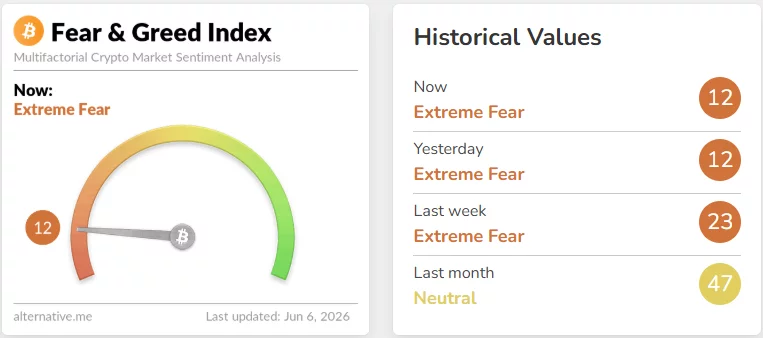
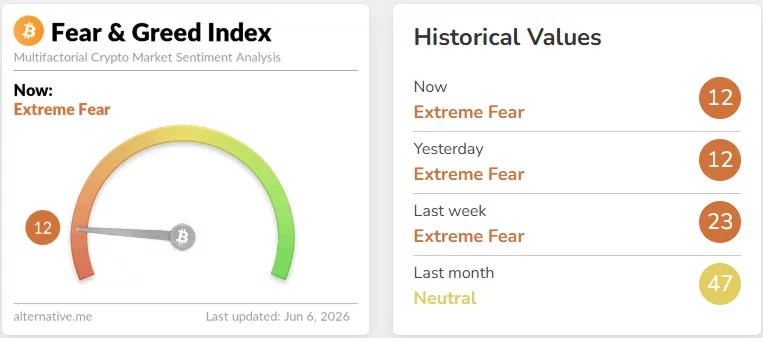
The sharp decline came after Bitcoin (BTC) briefly fell below the key $60,000 support level and touched nearly $59,000, prompting traders to reduce risk as leveraged long positions were liquidated, and the Crypto Fear & Greed Index fell to 12 and remained in Extreme Fear territory, underscoring the deteriorating sentiment across the digital asset market.
Leverage flush leaves AVAX near early 2021 range
The move was not driven by a clear Avalanche-specific network failure. Before the selloff, Avalanche had seen stronger institutional and on-chain activity, including more than $1.16 billion in on-chain real-world assets and the launch of regulated AVAX futures by CME Group.
Those developments offered little protection once the market entered a forced deleveraging cycle. The additional context showed more than $1.86 billion in long liquidations across crypto derivatives, with high-beta layer-1 tokens such as AVAX absorbing sharper losses than Bitcoin.
Derivatives positioning also weakened. Open interest in AVAX fell to about $159 million, showing fewer traders were willing to keep capital in active positions during the decline. At the same time, more than 70% of positions were shorts, leaving the market tilted toward further downside rather than a fast recovery.
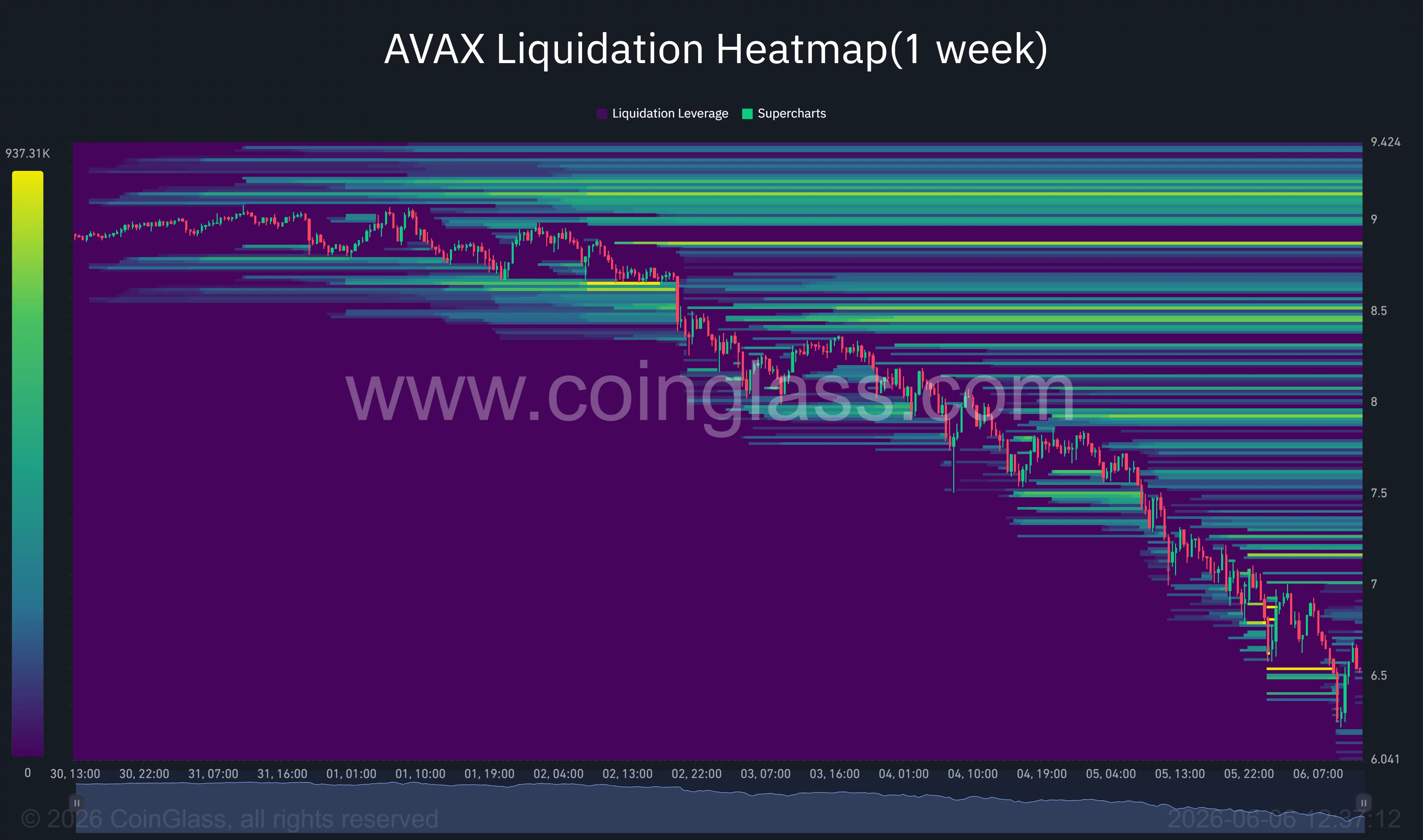
CoinGlass liquidation heatmap data shows heavy leverage above the current price, especially around $7.00, $7.50, $8.00, $8.50, and the $8.80–$9.20 zone. A rebound into those levels could trigger short liquidations, but current price action has not yet shown enough spot demand to force that squeeze.
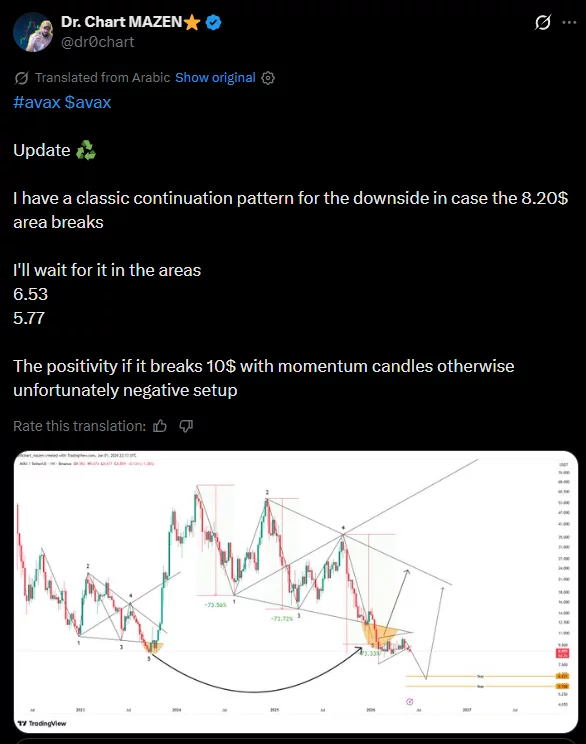
According to an earlier X post by analyst Dr. Chart MAZEN, AVAX still carries downside continuation risk unless buyers reclaim higher levels. “I have a classic continuation pattern for the downside in case the 8.20$ area breaks,” the analyst wrote, adding that he was watching “6.53” and “5.77” as lower areas.
Technical setup keeps the bottom case fragile
AVAX fell close to its final major Murrey Math support zone near $6.25 earlier today, a level labeled ‘Ultimate Support’ on the daily chart. The token previously lost the $7.81 and $7.03 support bands during the liquidation-driven selloff, leaving the $6.25 area as the key line bulls must defend to prevent a deeper decline toward the oversold region near $5.46.
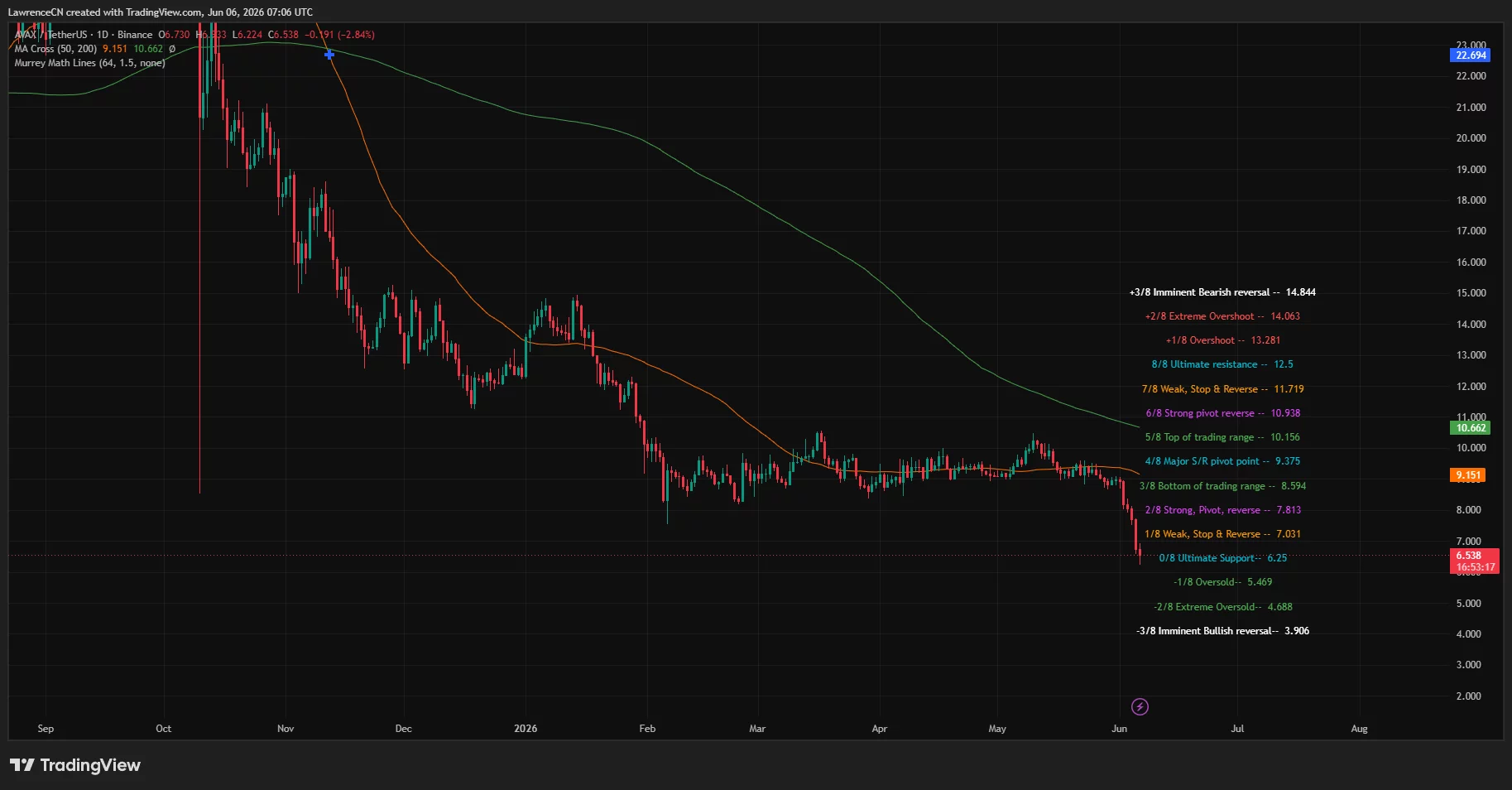
At press time, AVAX was trading below both the 50-day moving average at $9.15 and the 200-day moving average at $10.66.
Reclaiming those levels would be necessary to restore a bullish market structure, although the token’s defense of the $6.25 support zone has begun attracting attention from traders looking for signs of a longer-term bottom.
Resistance now sits near $7.03, followed by $7.81 and $8.59. A close above $8.20 would weaken the downside continuation setup described by Dr. Chart MAZEN, while a stronger move above $10 would bring the 200-day average and major trend resistance back into focus.
Downside risk remains clear. A daily close below $6.25 would keep sellers in control and expose AVAX to the -1/8 Murrey level near $5.46. Below that, the next major downside area sits near $4.68, while Dr. Chart MAZEN’s $5.77 level may act as the first test before deeper capitulation.
AVAX can still form a bottom if buyers defend the $6.25–$6.50 range and force shorts to unwind above $7.50. Until price reclaims $8.20 with strong volume, the chart favors a damaged recovery attempt rather than a confirmed reversal.
Disclosure: This article does not represent investment advice. The content and materials featured on this page are for educational purposes only.

In such times of distress where all crypto assets head south, including the largest altcoin, the retail public generally turns to more experienced and prominent names to look for support.
In an interesting development, though, one of the key crypto figures with a long connection to Ethereum, ConsenSys co-founder Joseph Lubin, has made a large ETH transfer after years of inactivity, which stirred the pot rather than calming the public.
Is Lubin Dumping ETH?
Lookonchain shared data showing that the transfer occurred just hours ago, in which Lubin sent out 80,001 ETH (valued at over $121 million). This wallet linked to him has been inactive for over three years, and the timing now is what raised so many questions.
Some asked why he didn’t sell at the very top last year when the asset neared $5,000 for the first time ever. Others believed retail investors might follow the example in what appears to be a capitulation event.
However, there were those who noted that Lubin simply needs to cover his leveraged trades on other platforms, such as MakerDAO. When an asset dumps as hard as ETH did in the past few days, the risk for forced closures (liquidations) skyrockets unless the trader provides more liquidity or collateral.
Is #Ethereum co-founder Joseph Lubin(@ethereumJoseph) preparing to dump $ETH?
A wallet linked to Joseph Lubin, which holds 243,300 $ETH($370M), transferred out 80,001 $ETH($121.6M) after more than 3 years of inactivity.https://t.co/s6lzxlNpRy pic.twitter.com/f0hyWvQBAm
— Lookonchain (@lookonchain) June 6, 2026
Lubin’s intentions remain unclear at the moment, but the general consensus (no pun intended) in the comments below Lookonchain’s post is that the transfer increased the overall FUD. However, there’s no confirmation that he indeed sold or plans to do so.
Will ETH Dump Toward $1K?
Speaking on the asset’s disastrous price action over the past week or so, Ali Martinez noted that ETH has hit its first bearish target at $1,560. It went even below that, and the popular analyst outlined his second, significantly more painful one, situated at just over $1,000, which would be another 50% drop from the current levels.
Rekt Capital, another popular analyst with over 550,000 followers on X, supported Martinez’s target. They noted that ETH has broken below the multi-year uptrend line and there’s a solid chance it slumps toward $1,000 in the not-so-distant future. It’s worth noting that the world’s largest altcoin hasn’t traded at such low levels since the 2022 bear market.
Ethereum has finally broken down from the multi-year uptrend line
The multi-year technical uptrend is over
Price has revisited the orange area for the first time since early 2025
If price Monthly Closes beneath orange and turns it into new resistance, there’s a good… https://t.co/0OCG5J6xGd pic.twitter.com/ek8SrG7qzk
— Rekt Capital (@rektcapital) June 5, 2026
The post Is Joseph Lubin Abandoning Ethereum as Analysts Warn of a $1K Crash? appeared first on CryptoPotato.

3 Finance Experts Reveal India’s Biggest Money Mistakes | Kushal Lodha #339

Arista Networks: Best Demand In Company History, Still A Hold (NYSE:ANET)
Pi Network’s PI Token Rebounds After New ATL, BTC Quickly Reclaims $60K: Weekend Watch



-

 Business5 days ago
Jade Biosciences, Inc. (JBIO) Discusses Positive Interim Results From JADE101 Phase I Healthy Volunteer Study and Development Plans Transcript
-
 Tech7 days ago
SpaceX just won a second Golden Dome contract. This one is $4.16 billion.
-

 Sports3 days ago
French Open 2026 results: Alexander Zverev beats Rafael Jodar and will play Jakub Mensik in semi-finals
-

 Fashion15 hours ago
Weekend Open Thread: Evereve – Corporette.com
-

 Tech4 days ago
CryZENx Releases Fresh Playable Content Deep Inside Jabu-Jabu for His Ocarina of Time Remake
-

 Business7 days ago
Is the Spurs Phenom Already Better Than Prime Diesel?
-
 Crypto World20 hours ago
Jensen Huang Approves Samsung, SK Hynix, and Micron for NVIDIA (NVDA) HBM4 Memory Supply
-

 Business3 days ago
Trump Taps Housing Chief Bill Pulte as Acting Intelligence Director After Gabbard Exit
-
Crypto World24 hours ago
LBank Surpasses 25 Million Users Worldwide as AFA Partnership Continues to Drive Global Growth
-
 Entertainment7 days ago
One of the Greatest Sitcoms of All Time Shoots Up Apple TV’s Charts 11 Years Later
-
 NewsBeat7 days ago
Everything you need to know as Cambridge’s Strawberry Fair returns after cancelled year
-
 Crypto World4 days ago
Seagate (STX) Stock Surges to Record High on AI Boom and Legal Settlement
-
 NewsBeat3 days ago
Republicans balk at Trump’s attempt to appoint a MAGA enforcer to lead National Intelligence
-
Crypto World3 days ago
EU AI Data Center Project Faces Delays as Funding Gaps Grow
-

 Entertainment3 days ago
Did The Mandalorian And Grogu Already Ruin The Next Star Wars Movie?
-

 Tech7 days ago
Acer’s Swift Air 14 is a peppy MacBook Neo rival with some cool upgrades and a $699 ask
-

 Business3 days ago
Aehr Test Systems Stock Soars 17% Amid Surging AI Demand and Conference Spotlight
-
Business7 days ago
Algoma Steel gains 63% as Fair Value models spot opportunity
-
 Business4 days ago
Claude AI Down Today Reason: Why Anthropic’s AI is not working today? What’s the latest quota update
-

 Business3 days ago
Relay Therapeutics Shares Surge 20% on ASCO Momentum for Zovegalisib Breast Cancer Program
You must be logged in to post a comment Login