

Crypto World
Justin Sun’s HTX drops USD1 as WLFI freeze fight grows



HTX has delisted USD1, the stablecoin issued by Trump-linked World Liberty Financial, after the exchange said WLFI froze certain on-chain addresses linked to the platform.
Summary
- HTX removed USD1 after wallet addresses linked to the exchange were frozen.
- World Liberty Financial cited sanctions compliance controls.
- HTX said user USD1 balances will convert to USDT at a 1:1 rate.
- The move adds to Justin Sun’s dispute with the Trump-linked crypto project.
The exchange, associated with crypto entrepreneur Justin Sun, said the freeze limited the movement of assets tied to those addresses. HTX said it removed USD1 to protect user assets and reduce trading risk.
HTX removes USD1 after wallet freeze
HTX said World Liberty Financial “unilaterally imposed a freeze” on specific HTX on-chain addresses following sanctions compliance checks.
The exchange said the action restricted circulation of some WLFI-linked assets. It also said the freeze came without enough prior communication, clear legal basis, or due process.
HTX has suspended USD1 deposits and conversion services. It also halted trading for WLFI/USDT, USD1/USDT, BTC/USD1, and ETH/USD1 pairs.
The exchange said eligible USD1 balances will be converted into Tether’s USDT at a 1:1 rate. HTX said more details on timing will be shared separately.
World Liberty cites sanctions controls
World Liberty Financial has not publicly confirmed whether it froze HTX-linked addresses.
The project posted on X that “in light of recent sanctions updates, World Liberty Financial maintains risk-based sanctions compliance controls.”
The dispute follows UK sanctions announced on May 26 against Huobi Global S.A., formerly linked to the HTX brand. UK authorities said they had grounds to suspect the entity supported Russia through financial services.
HTX rejected the link to its current online exchange. It said Huobi Global S.A. is separate from the operating HTX platform and should not affect users.
Justin Sun dispute adds pressure
The USD1 delisting adds another layer to the public fight between Justin Sun and World Liberty Financial.
As previously reported by crypto.news, Sun and World Liberty have been locked in a legal dispute after WLFI froze Sun’s tokens. Sun sued the project in April, claiming his assets were frozen and threatened without proper reason.
World Liberty later sued Sun for defamation. The project claimed he made false statements and broke WLFI token sale rules through alleged transfers, short-selling, and straw purchases.
Sun has been linked to HTX and has served on its global advisory board. The exchange has said it may seek legal remedies to protect user rights.
USD1 faces fresh trust test
USD1’s removal from HTX comes at a difficult time for stablecoin issuers and crypto exchanges. The case shows how compliance actions can quickly affect token access, trading pairs, and user balances.
The stablecoin had gained attention because of its link to World Liberty Financial, a project tied to U.S. President Donald Trump and his family. Donald Trump, Donald Trump Jr., Eric Trump, and Barron Trump are listed as advisers.
HTX said its main goal is to protect users while asking WLFI to reverse the freeze. For now, USD1 trading on HTX remains suspended, and users must wait for the exchange’s conversion update.

Crypto World
Securitize (SECZ) Eyes NYSE Debut: SEC Clears Path for Tokenization Giant’s Public Listing

Key Takeaways
- Securitize received SEC clearance on its Form S-4 filing, advancing its special purpose acquisition company transaction with Cantor Equity Partners II
- A shareholder vote scheduled for June 29 will determine whether the merged entity trades on the NYSE under ticker symbol “SECZ”
- The platform oversees $4 billion in tokenized assets and generated $19.5 million in Q1 revenue, marking a 39% year-over-year increase
- On-chain tokenized real-world assets reached an all-time high of $32 billion in May, representing 220% growth over the past year
- More than 60% of tokenized assets reside on Ethereum and its layer-2 scaling solutions
A leading platform specializing in real-world asset tokenization has cleared a critical regulatory hurdle with the US Securities and Exchange Commission, bringing it one step closer to debuting on the New York Stock Exchange.
The securities regulator declared effective the Form S-4 registration document submitted by Securitize in conjunction with Cantor Equity Partners II, a blank-check company backed by a Cantor Fitzgerald affiliate.
This regulatory green light paves the way for shareholders to cast their votes on June 29. Should the proposal pass, the newly formed entity will begin trading on the NYSE with the ticker symbol SECZ.
According to Carlos Domingo, who co-founded Securitize and serves as its CEO, this represents “another important milestone for Securitize and for the broader institutional adoption of tokenization.”
Understanding Securitize’s Business Model
Securitize holds the position as the dominant tokenization platform measured by market share. With $4 billion in assets under management, the company provides tokenized investment products in partnership with prominent asset managers such as Apollo, BlackRock, BNY, and VanEck.
During the first quarter, Securitize posted revenue totaling $19.5 million, representing a 39% jump compared to the corresponding period in the prior year.
This past March saw the NYSE enter into a memorandum of understanding with Securitize. This partnership forms part of a broader initiative to develop blockchain infrastructure for securities trading on Wall Street.
Real-World Asset Tokenization Hits All-Time Peak
The announcement of this SPAC combination arrives amid unprecedented growth in tokenized real-world assets.
According to data from RWA.xyz, the total value of on-chain RWA reached $32 billion in May. This calculation excludes stablecoins and reflects a 220% surge compared to twelve months earlier.
US Treasury securities comprise nearly half of all tokenized assets on blockchain networks. Commodities represent approximately 16% of the total.
Equities remain a relatively modest segment, constituting just 4.8% of the market, equivalent to roughly $1.5 billion in total on-chain valuation.
Ethereum alongside its layer-2 scaling networks dominates the tokenization landscape, commanding a collective market share exceeding 60%.
The SEC has additionally designated digital assets as a strategic focus area extending through 2030, a policy shift that could prove advantageous for tokenization platforms such as Securitize in the years ahead.
The upcoming shareholder vote on June 29 represents the next critical juncture for the company. Approval would provide retail and institutional investors with direct exposure to one of the world’s largest tokenization platforms.
Should Securitize complete its public listing, it would represent one of the earliest instances of a prominent tokenization company achieving a listing on a conventional stock exchange.

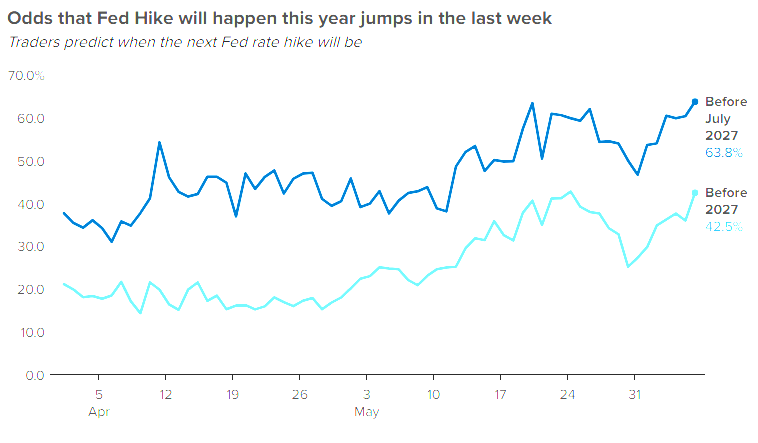
America’s newest Federal Reserve Chair did not get a quiet start. Kevin Warsh was sworn in on May 22, three weeks ago, as the 17th Fed Chair. The youngest Fed governor ever appointed when he first joined the board in 2006 at age 35, he walked in promising “regime change”: tighter inflation discipline and a rethink of the Fed’s balance sheet.
Then the May jobs report landed. The US economy added 172,000 jobs, nearly double expectations, against a forecast of 85,000. Bond markets pushed the odds of a December rate hike to 68%.
Kevin Warsh’s First Real Test
His Senate confirmation, 54-45, the most divisive Fed vote in history, signaled a contested tenure from day one.
Wall Street largely read his appointment as a sign of rate continuity: while Warsh was a hawk during the 2008 financial crisis alongside Ben Bernanke, analysts expected his second stint to run closer to Powell’s playbook.
His “regime change” language, most argued, pointed to internal Fed reform rather than a shift in rate policy.
Recently, Cleveland Fed President Beth Hammack stepped forward to say the central bank may need to act soon to bring inflation back to 2%, warning that “if we wait for definitive evidence that high inflation has become embedded in the economy, it may require larger policy adjustments, at greater cost.”
That lands Warsh in a direct position: hold rates at the June 17-18 FOMC meeting and signal that regime change means structure, not stance, or back a hike and prove his inflation discipline is real.

When Bitcoin ETF outflows hit a record streak amid rate-hike fears, markets have been repricing the Fed outlook for weeks.
The Kevin Warsh Paradox for Bitcoin
Warsh enters the role as the most crypto-familiar Fed chair in history: past ties to Bitcoin and stablecoin ventures, opposition to a central bank digital currency, and support for private-sector stablecoins.
Yet crypto-friendly or not, the rate math dominates. Bitcoin has fallen from $82,000 in mid-May to the low $60,000s, tracking almost exactly with the collapse in rate-cut expectations over the same period.
As BeInCrypto previously reported, when Goldman Sachs and others were still forecasting rate cuts, Bitcoin was pricing in a very different policy path.
Warsh’s crypto fluency means he understands how the rate decision affects digital assets in a way no previous Fed chair has.
Bitcoin price analysis for June 2026 showed that the next directional move is entirely contingent on whether the Fed signals hold or hike at its June 17-18 meeting.
Whether that means tighter rates or just tighter communication, June 17-18 is the date Bitcoin investors are watching.
The post Fed Rate Hike Odds Just Hit 68%, Is Kevin Warsh Now Bitcoin’s Biggest Problem? appeared first on BeInCrypto.
Maelstrom co-founder Arthur Hayes said he sold his Worldcoin (WLD) holdings just days after his venture capital firm described it as one of the cleanest proxies for the AI investment play.
“This chart is going in the wrong direction,” said Hayes on X on Saturday, showing a chart for the SpaceX pre-IPO perpetual futures contract, which had fallen sharply.
“Dumped WLD. I’m out. See y’all at the clerb,” he added.
It was only on Wednesday that Maelstrom researcher Lukas Ruppert described Worldcoin as an “overlooked” bet on “AI mega IPOs,” predicting WLD would hit $5 by August.
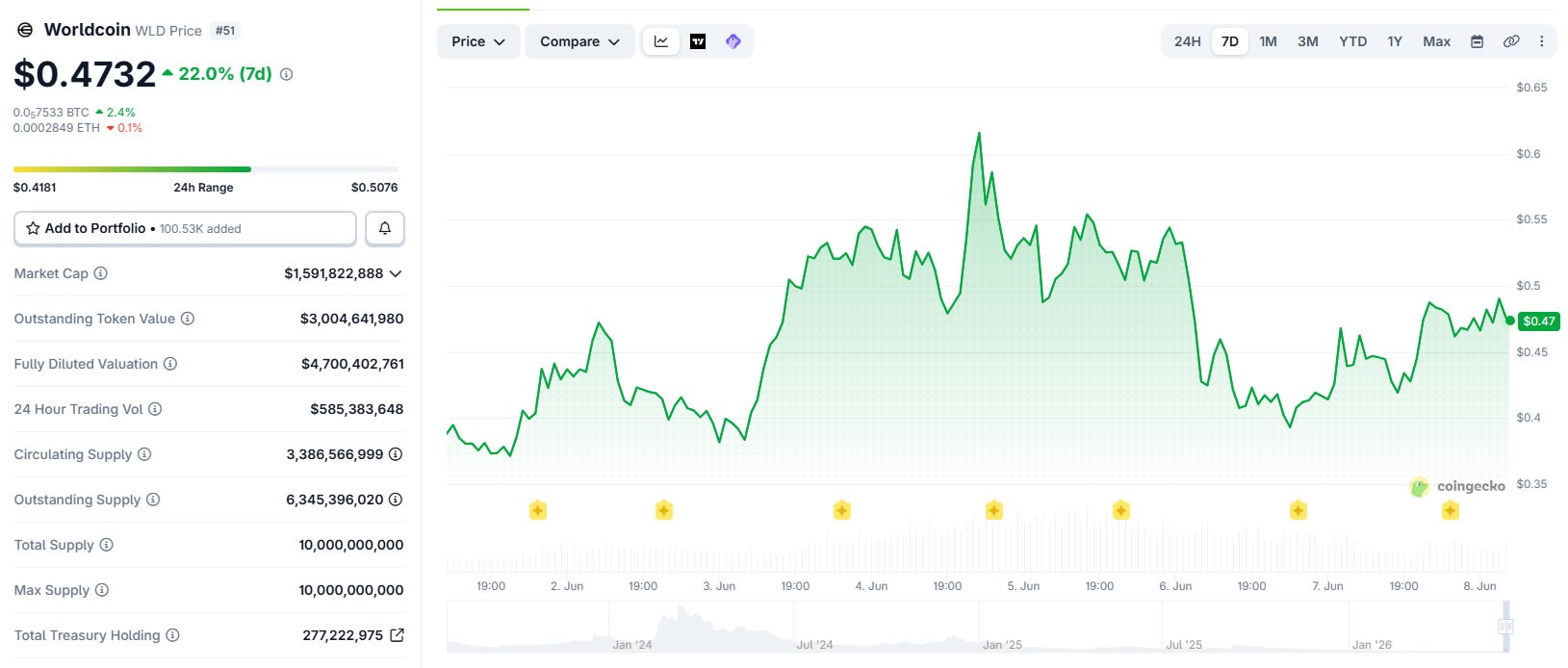
The investor note led to a short rally for WLD, which topped $0.60 on June 5, but has since fallen back to $0.40 on June 7 as Hayes told his 800,000 X followers that he had exited his position.
Hayes previously said on X that he would hold WLD through the SpaceX IPO on Nasdaq, which is expected on June 12, prompting some to criticize the timing of the sale.
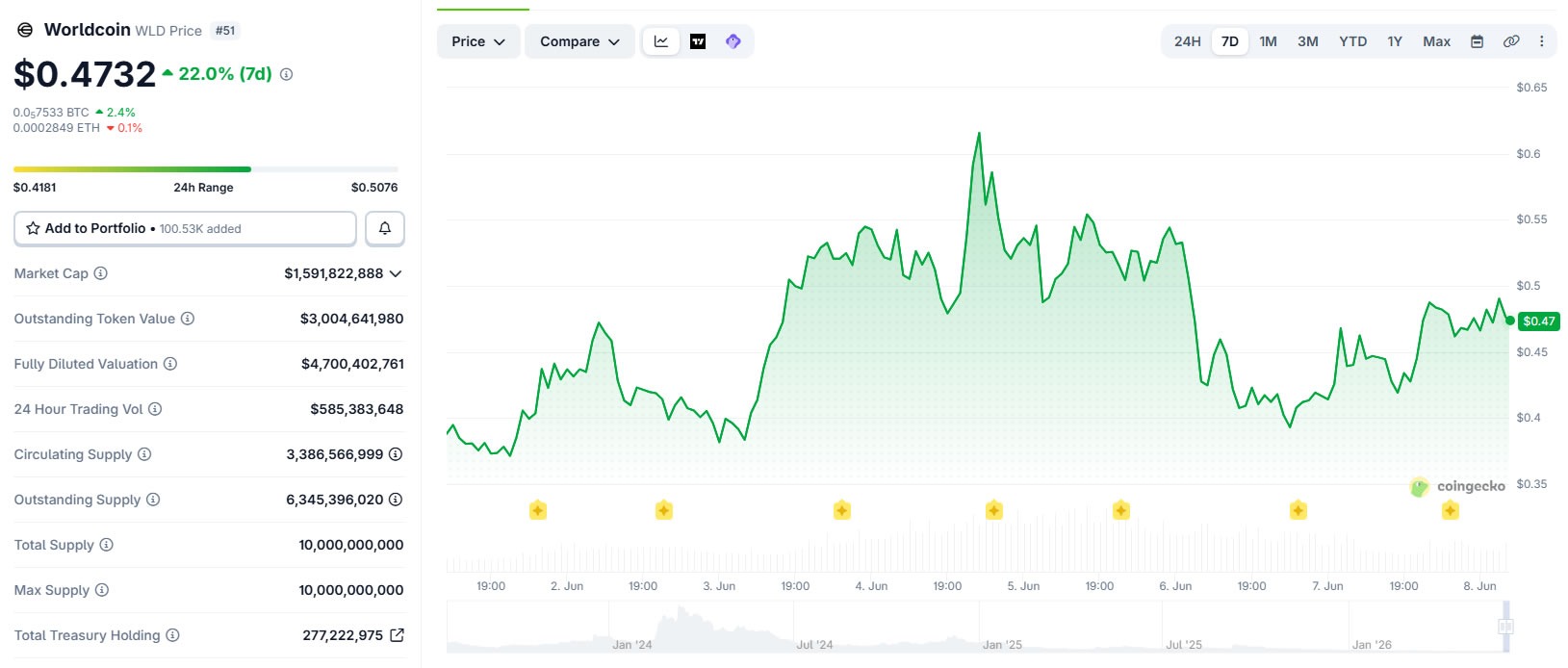
WLD prices have been extremely volatile over the past week. Source: CoinGecko
The ‘Holy Trinity is dead’ — or is it?
WLD adds to the list of crypto assets Hayes has pivoted on despite earlier bullish comments.
In March, Hayes predicted that Hyperliquid (HYPE) would reach $150 by August and on June 1 said it would “outperform any other current top ten crypto in USD terms from now until year-end,” but sold his entire position in the asset three days later, citing higher energy prices due to the Iran war, “inventory restocking,” and imminent “mega AI IPOs.”
Related: Hyperliquid bear turns bullish after losing over $46M shorting HYPE
On May 6, Hayes said Zcash would reach 10% of Bitcoin’s price. On June 5, he offloaded his ZEC stash following the discovery of a critical vulnerability in its privacy protocol, claiming that the “Holy Trinity” of HYPE, ZEC, and NEAR was “dead.”
However, Hayes appears to have reversed his position partially. A wallet linked to Hayes bought back around 33,978 HYPE worth around $2 million on Monday, after it had fallen 26% in the wake of his June 4 sale, according to Arkham Intelligence.
Cointelegraph reached out to Maelstrom for comments but did not receive an immediate response.
Magazine: Korea probes Polymarket users, crypto PACs sweep primaries: Hodler’s Digest
Key Takeaways
- On June 7, Bybit rolled out tokenized SpaceX IPO participation for VIP and Pro members at $135 per token with a 5% underwriting charge
- Bybit and Kraken both utilize the xStocks infrastructure, managed by Payward Services (Kraken’s parent entity), to deliver this offering
- SpaceX seeks a $1.75 trillion market cap through a $75 billion capital raise — potentially setting a record as the largest IPO ever
- These tokens function as tracker certificates rather than actual equity — holders receive neither voting privileges nor dividend payments
- According to Bybit’s documentation, the assets backing these tokens “may not always consist of the underlying shares”
Major cryptocurrency platforms Bybit and Kraken have introduced tokenized participation in the SpaceX initial public offering, though the product includes significant restrictions and conditions investors should understand.
Bybit’s IPO Express Program Explained
Bybit activated subscription access on June 7 through its IPO Express platform. Eligibility requires VIP or Pro status plus completion of Level 1 identity verification. The subscription period extends through June 11, with token allocation occurring on June 11 and distribution planned for June 12 — coinciding with SpaceX‘s anticipated Nasdaq debut.
Participants pledge USDC at an estimated $135 per token, accompanied by a 5% underwriting charge. The entry threshold sits at 100 USDC, while individual users face a ceiling of 50 subscription requests. Committed capital remains frozen until allocation completion.
Should the actual IPO price fall within 20% of the $135 estimate, Bybit executes automatic subscriptions. When the price exceeds the estimate by more than 20%, participants must provide reconfirmation during a designated timeframe. Final allocations may be fractional or completely unfilled based on overall demand levels.
As of Sunday morning, approximately 550 participants had completed pre-registration, representing roughly $9.1 million in total USDC commitments.
Understanding the xStocks Token Structure
Bybit and Kraken both employ the xStocks infrastructure, operated through Payward Services — the business-to-business division of Kraken’s parent organization. This framework originated from Backed Finance prior to Kraken’s acquisition of the company.
Backed Assets (JE) Limited, a Jersey-domiciled entity, issues these tokens. They operate as tracker certificates — bearer debt instruments designed to mirror SpaceX share price movements. Token holders do not acquire voting authority or dividend entitlements.
While Bybit’s promotional content characterizes the tokens as “backed 1:1 by real equity,” the official product documentation clarifies that underlying collateral “may not always consist of the underlying shares” and permits substitution with cash or alternative assets. Bybit further acknowledges it performs no independent collateral verification.
Kraken introduced its offering on June 5 under the SPCXx ticker symbol, accessible across more than 110 jurisdictions. While Bybit excludes the European Economic Area from its program, Kraken provides access to these regions through a Cyprus-regulated subsidiary.
SpaceX IPO Context and Scale
A consortium of 23 financial institutions is orchestrating SpaceX’s public offering. Goldman Sachs serves as lead underwriter, with Morgan Stanley, Bank of America, Citigroup, and JPMorgan Chase following in the syndicate hierarchy. The aerospace company pursues a $1.75 trillion market capitalization with shares priced at $135, aiming to secure approximately $75 billion in capital.
Investor appetite has climbed to roughly $150 billion — approximately twice the company’s fundraising target.
The xStocks tokenization methodology diverges from approaches adopted by competing crypto platforms. Coinbase, Binance, OKX, Bitget, and additional exchanges have instead launched pre-IPO perpetual futures contracts tied to SpaceX. These alternative products carry distinct hazards — Ventuals, one platform provider, recently issued trader compensation following a data malfunction that triggered a 45% decline in its SpaceX perpetual contract within 30 minutes.
SpaceX’s public offering follows its consolidation with Elon Musk’s xAI, which had previously acquired social media platform X.
Crypto World
MapleStory Universe Opens MSU Space and Launches Global Game Jam Competition as Part of MSU 2.0 Expansion

[PRESS RELEASE – Abu Dhabi, UAE, June 8th, 2026]
Global game jam MapleStory Vibe Camp offers US$60,000 in NXPC prizes as builders gain access to official MapleStory Universe resources in conjunction with Verse8
MapleStory Universe (MSU), the blockchain-powered expansion of Nexon’s iconic MapleStory franchise, today announced the launch of MapleStory Vibe Camp, a global builder competition inviting users to create original games and experiences using official MapleStory Universe resources. The campaign coincides with the opening of MSU Space, a dedicated builder hub developed in collaboration with AI-powered game creation platform Verse8.
Running from June 8 to June 29, MapleStory Vibe Camp offers a total prize pool of US$60,000 in NXPC and is open to builders worldwide. Through MSU Space, participants will be able to build and publish MapleStory-inspired experiences, with selected projects receiving recognition, rewards, and potential opportunities for future ecosystem participation.
The launch is the first major public activation of MSU 2.0, MapleStory Universe’s next phase of growth following its first year of live operations. The milestone celebrated surpassing 150 million cumulative on-chain transactions and generating approximately 49.1 million NXPC, equivalent to US$31 million, in ecosystem revenue. This heralds MapleStory Universe’s expansion from a single game environment into a broader platform designed to support creation, distribution, and monetization opportunities with MapleStory IP.
Sun Young Hwang, Chief Executive Officer at Nexpace said, “Over the past year, MapleStory Universe has demonstrated that a large-scale game economy can successfully operate on-chain. The next chapter is about expanding who participates in building it. As AI continues to lower the barrier to game creation, the distinction between player and builder becomes less fixed, and MapleStory IP becomes the foundation that both groups create from and around. Both MapleStory Vibe Camp and MSU Space represent important first steps toward realizing that vision, by lowering barriers to creation and unveiling new ways for communities to build with our legacy IP.”
Opening MapleStory IP to a New Generation of Builders
At the center of the initiative is MSU Space, a dedicated environment within Verse8 that provides users access to official MapleStory Universe assets, resources, and development tools. Through the platform, builders can leverage MapleStory-themed characters, monsters, items, environments, and lore while utilizing Verse8’s AI-assisted game creation capabilities. Participants can develop projects through natural language prompts, iterate on gameplay concepts, and publish completed experiences directly through the platform.
The launch reflects the broader objectives of MSU 2.0, which aims to transform MapleStory from a traditionally closed-game IP into a programmable ecosystem where communities can create new experiences, applications, and services using MapleStory IP.
MSU 2.0 seeks to reduce the barriers traditionally associated with IP-based creation by combining on-chain infrastructure, AI-assisted creation tools, and community-driven participation into one unified framework.
Why MSU Space on Verse8
As MapleStory Universe expands beyond a single game experience, creating accessible entry points becomes increasingly important. The collaboration with Verse8 provides an environment where builders can discover ecosystem opportunities, experiment with fresh concepts, and participate in the broader vision of MSU 2.0. The initiative also introduces MapleStory Universe to a wider audience of developers and AI-native builders who may be encountering the ecosystem for the first time.
Kevin Lee, CEO of Verse8, said: “For decades, building with major gaming IPs has largely been limited to professional studios and approved partners. Through MSU Space and AI, however, creators can now experiment with MapleStory IP in a more accessible way and bring their ideas to life faster than ever before. We’re excited to help power the next wave of MapleStory builders.”
Taken together, MSU Space serves as an accessible gateway into the emerging builder economy underpinning MSU 2.0, connecting users with the tools, resources, and infrastructure needed to create with MapleStory IP.
MapleStory Vibe Camp will run from June 8 to June 29, 2026, with winning entries selected from projects submitted through MSU Space. For more information or to participate in MapleStory Vibe Camp, users can visit: https://vibecamp.msu.io.
About Nexpace
Nexpace, an innovative blockchain company based in Abu Dhabi, pioneers an IP-expansion initiative powered by blockchain technology and NFTs to build a community-driven ecosystem. With a mission to redefine interactive entertainment, Nexpace creates a vibrant space for exploring, sharing, and engaging with diverse content and gameplay crafted by community members.
At the heart of Nexpace’s ecosystem are principles of transparency, security, and trust, empowering builders to freely share their ideas and enabling users to enjoy immersive experiences. By fostering a culture of creative expression, Nexpace envisions a secure, collaborative environment that unites ecosystem participants in a thriving digital community.
About Verse8
Verse8 is an AI-native creation and publishing platform that allows anyone to turn ideas into interactive games and stories. By combining generative AI, an integrated game engine, and on-chain ownership, Verse8 lowers the barrier to interactive creation and supports a new generation of creator-led digital worlds. Developed by Planetarium Labs in collaboration with Jake Song, the platform leverages deep gaming expertise and strategic partnerships to deliver high-fidelity interactive experiences at scale.
The post MapleStory Universe Opens MSU Space and Launches Global Game Jam Competition as Part of MSU 2.0 Expansion appeared first on CryptoPotato.


Syscoin has paused its bridge after a security incident created about 5 billion unauthorized SYS outputs through its UTXO bridge path.
Summary
- Syscoin paused its bridge after a validation issue created about 5B unauthorized SYS outputs.
- The team traced major tainted balances to two UTXO addresses holding about 4B and 1B SYS.
- Syscoin said exchanges and partners were asked to freeze, blacklist, or monitor linked deposits.
The project said an attacker exploited a validation issue in the bridge flow. The flaw caused the system to incorrectly accept or read a transaction proof and create SYS output that should not have been produced.
Meanwhile, SYS traded near $0.00165 after the update, with a market cap of about $9.7 million, according to CoinGecko. The token was down sharply from its all-time high of $1.30, showing weak market confidence around the project. The token has fallen nearly 10% in the last 24 hours.
Syscoin bridge paused during investigation
Syscoin said the bridge remains paused while the team investigates the incident, completes a fix, and decides how to address the unauthorized SYS output.
“The Syscoin bridge is currently paused while the team investigates,” the project said in its preliminary postmortem.
The team said users should not interact with the bridge while it remains offline. It also said the incident is being treated as a top priority.
Syscoin said it has already identified the affected validation path. The team said it has a fix in place, but review and implementation are still ongoing.
5B SYS output traced on UTXO chain
According to Syscoin, the attacker created an unauthorized output of about 5B SYS through the UTXO bridge path.
The funds were first sent to one address before being spent and split into other outputs. Syscoin said the largest tainted balances appear linked to two addresses holding about 4B SYS and 1B SYS.
The team published the initial UTXO transaction, the later spend, and the split transaction. It said it is tracing the funds across the UTXO trail.
Syscoin also said it is working with exchanges and ecosystem partners. The goal is to stop tainted SYS from being deposited, traded, or spread further.
Exchanges asked to monitor tainted SYS
Syscoin said it contacted exchanges and relevant partners after the incident. The project asked them to blacklist, freeze, or closely monitor SYS deposits tied to the tainted outputs.
The team also asked partners to watch descendant spends from the affected UTXO trail. This step aims to reduce the chance that the unauthorized SYS reaches open markets.
The incident comes as cross-chain bridge security remains under close watch across crypto. Bridges often handle funds across different chains, making validation errors costly when attackers find a weak path.
Related reports show that bridge attacks have remained active in 2026, with several cross-chain systems hit in recent months.
Related crypto.news coverage previously described Syscoin as a dual-layer blockchain that combines Bitcoin-style security with Ethereum-like smart contract support.
That background matters because the latest incident involved Syscoin’s bridge system, which connects activity across its native UTXO side and related blockchain infrastructure.
Separate market reports have also tracked rising bridge risks across the wider crypto sector. Recent cases include attacks on cross-chain systems where flaws or key failures allowed attackers to move large amounts of assets.
For Syscoin, the next update will likely focus on the final remediation plan. The team said it will share more information after it completes the fix and decides how to neutralize the unauthorized output.

Crypto markets are back in the green on Monday morning following a weekend of losses that sent them to their lowest point in this bear market cycle.
The week ahead could accelerate those losses as inflationary pressures are expected to continue with no deal in sight between the US and Iran.
“We expect another volatile week ahead after Friday’s sharp drop in AI stocks,” said the Kobeissi Letter.
Economic Events June 8 to 12
The latest from the war situation is President Trump saying that Israeli Prime Minister Netanyahu will have “no choice” but to accept a US deal with Iran, because he “calls the shots.”
The missile strikes from the US, Israel, and Iran continued over the weekend, and oil prices are climbing higher again.
May’s existing home sales data is due on Tuesday, but all eyes will be on Wednesday’s CPI inflation report.
This report could be key ahead of the Federal Reserve’s rate decision on June 17 as investors look for clues on whether the central bank is considering raising interest rates.
“May’s consumer prices report will be a key gauge on the impact of rising prices on consumer spending,” analysts at AJ Bell said in a note, according to the WSJ.
“With inflation running persistently ahead of the Fed’s 2% target, a hotter-than-expected print will make it difficult for policy makers to argue for further rate cuts.”
However, there is currently a 97% probability that rates will remain unchanged, according to the CME futures Fed Watch tool
Thursday will see May’s PPI inflation report, adding more fuel to the fire should it come in hot.
Michigan Inflation Expectations and Consumer Sentiment data are due on Friday.
Key Events This Week:
1. May Existing Home Sales data – Tuesday
2. May CPI Inflation data – Wednesday
3. May PPI Inflation data – Thursday
4. OPEC Monthly Report – Thursday
5. MI Inflation Expectations data – Friday
6. MI Consumer Sentiment data – Friday
All eyes are on…
— The Kobeissi Letter (@KobeissiLetter) June 7, 2026
Crypto Market Outlook
Crypto markets fell to their lowest levels since October 2024, with total cap dipping to $2.17 trillion over the weekend.
Bitcoin fell below $60,000 to a new cycle low on Saturday but had clawed its way back to $63,000 at the time of writing on Monday morning in Asia. The asset has lost 14% over the past week, driven primarily by the ongoing war and Strategy selling a few BTC.
Ether prices have been hit harder, with the asset falling to just above $1,500, its lowest level for 14 months. There was a minor recovery to $1,700 on Monday morning, but ETH is in the depths of crypto winter.
The post 3 Things That May Move Bitcoin and Crypto Markets This Week appeared first on CryptoPotato.


The White House’s most influential AI and crypto policy voice just called AI safety the ‘new Climate Change’, referring to the amount of ‘Hollywood storytelling’ involved. This comes six days after his administration signed an AI safety order.
On Monday, David Sacks, who served as the White House Special Advisor for AI and Crypto and now advises the administration through the President’s Council of Advisors on Science and Technology, reposted this on X:
Contradiction Inside the White House?
Six days before Sacks posted his tweet, President Trump signed an executive order asking AI companies to voluntarily submit their most powerful models to federal safety testing up to 30 days before public release.
The order directed federal agencies to develop safety benchmarks, assess AI models for cyber capabilities, and shore up critical infrastructure defenses.
Sacks helped build the policy environment that produced that order. However, he is now publicly raising the heightened safety concerns of some, similar to climate change scaremongering.
This appears to be a deliberate signal about the administration’s true stance on AI safety, regardless of the document issued a week ago.
This is not new. Sacks has framed regulatory interference in emerging technology as a power grab rather than a legitimate function before.
Sacks has also called AI safety advocates a “Doomer Industrial Complex“, a coordinated effort by former Biden staffers and effective altruists to inflate AI threat narratives for political purposes.
What the David Sacks Framing Means for Crypto and AI Tokens
Sacks also drove the CLARITY Act through its early legislative stages, and the crypto market structure bill is now working through the Senate.
His framing of AI regulation as a “takeover of the economy and information space” directly mirrors the argument his office used against aggressive crypto oversight: safety narratives are a cover for regulatory expansion, not genuine consumer protection.
Sacks seems to be building a single political argument against both AI and crypto regulation: safety concerns are political weapons, not technical realities. For AI-linked crypto tokens and the likes, the White House’s posture on AI regulation sets the tone for the next four years.
The administration that backed crypto helped move the CLARITY Act and, in 2025, the US stablecoin framework, the GENIUS Act, became law. The same administration is now framing heavy-handed AI safety as leftist pseudoscience.
The fight Sacks is previewing will determine whether AI safety regulation looks like climate policy: sweeping, expensive, and politically defining for a generation. He is betting it does not.
The post Former White House AI Adviser Calls Safety Fears ‘Hollywood Storytelling’ appeared first on BeInCrypto.
BTCTOP CEO Jiang Zhuoer has pushed back against fears that Strategy could become a major Bitcoin seller if the market falls further.
Summary
- Jiang Zhuoer said Strategy has little reason to damage its “never selling Bitcoin” image.
- He argued a Bitcoin drop to $30,000 would keep Strategy’s leverage near manageable levels.
- The comments follow fresh concerns over STRC dividends, funding pressure, and Strategy’s Bitcoin sale.
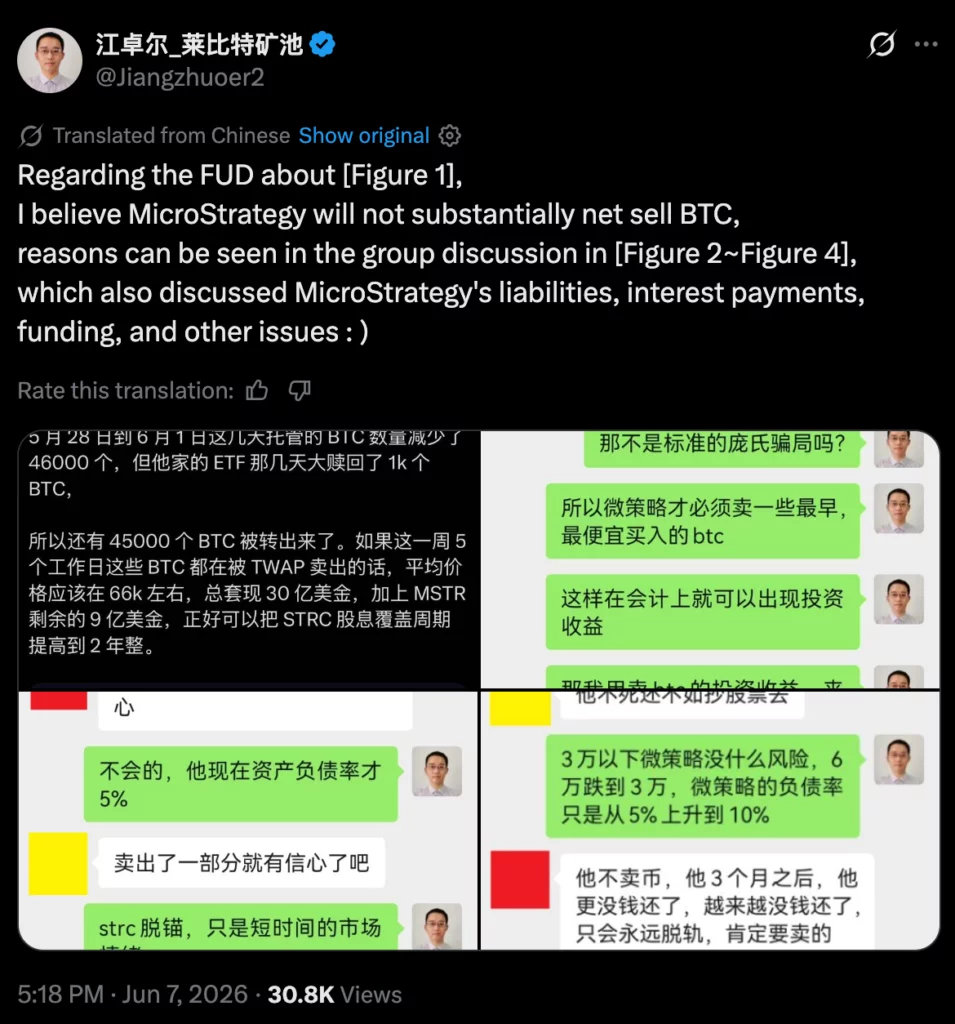
In a post on X, Jiang said he does not believe Strategy will “substantially net sell BTC.” He argued that the company still has a strong reason to protect its public image as a long-term Bitcoin holder.
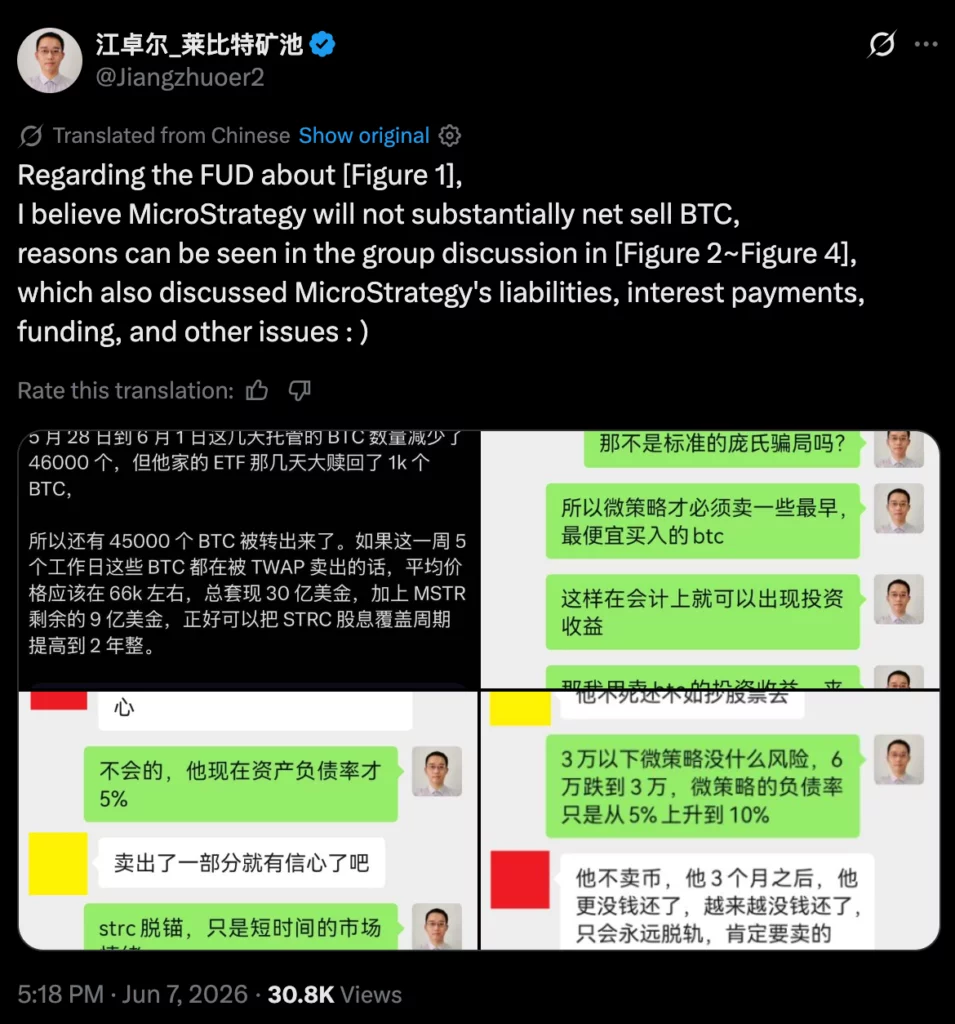
BTCTOP CEO questions Strategy selloff fears
Jiang said Strategy’s brand is closely tied to the idea that it does not sell Bitcoin in size. In his view, breaking that image could cost the company more than it gains from reducing exposure.
He said even a fall in Bitcoin to $30,000 would not make Strategy’s debt profile unmanageable. According to Jiang, its leverage ratio would rise from about 5% to around 10% under that scenario.
That view differs from recent market concerns. Some investors have warned that Strategy may face more pressure if Bitcoin, MSTR shares, and STRC preferred stock all weaken at the same time.
STRC interest logic stays in focus
Jiang also discussed Strategy’s STRC interest coverage model. He said the company can sell older, low-cost Bitcoin and book accounting gains to cover STRC interest.
He added that new STRC proceeds can still support further Bitcoin purchases. Under that structure, Strategy may keep the wider message that it remains a net buyer over time.
Crypto.news recently reported that Strategy sold 32 BTC between May 26 and May 31 at an average price of $77,135. The sale raised about $2.5 million and was linked to preferred stock dividend funding.
The sale was small compared with Strategy’s total Bitcoin holdings, but it drew attention because Michael Saylor had long promoted a no-sell Bitcoin stance.
Grayscale warns on funding pressure
As previously reported by crypto.news, Grayscale warned that weaker STRC and MSTR prices could limit Strategy’s ability to raise new capital for more Bitcoin purchases.
Grayscale said falling STRC prices may require Strategy to raise dividend rates, increasing cash obligations. That could make future Bitcoin sales more likely if other funding channels stay weak.
Strategy’s latest large buy came in May, when it bought 24,869 BTC for about $2.01 billion. That lifted its holdings to 843,738 BTC, more than 4% of Bitcoin’s fixed supply.
The company funded that purchase through MSTR common stock and STRC preferred stock sales, showing how central capital markets remain to its Bitcoin strategy.
For now, Jiang’s view is that Strategy still has room to manage a deeper Bitcoin drawdown. His argument rests on low leverage, accounting flexibility, and the company’s need to protect its long-term Bitcoin narrative.


A New York judge has halted proceedings in a lawsuit seeking ownership of 39,069 dormant Bitcoin wallets, delaying any attempt to secure a default judgment before a July 14 court hearing.
Summary
- A New York judge has paused a lawsuit seeking ownership of 39,069 dormant Bitcoin wallets and blocked any move toward a default judgment before a July hearing.
- The complaint argues that abandoned property laws could apply to self-custodial Bitcoin wallets, including addresses linked to Satoshi-era holdings and the Mt. Gox hack.
- An attorney seeking to appear as amicus curiae has challenged the plaintiffs’ legal theory, setting up a debate over whether dormant blockchain assets can be claimed under existing New York law.
According to court filings made public on June 5, New York Supreme Court Justice Kathy J. King signed an order to show cause on June 4 that stays all further proceedings related to the plaintiffs’ request for a declaratory judgment.
The order specifically blocks any application for an inquest or default judgment until oral arguments are heard on July 14 at the New York County courthouse.
Court records show King removed the phrase “and determination” from the standard stay language, leaving the case paused until the scheduled hearing rather than until a later ruling is issued.
A separate order filed the same day found an earlier request for injunctive relief to be moot, with the court citing the plaintiffs’ First Amended Complaint filed on May 1.
Challenge to dormant wallet ownership claim gains time
The lawsuit, filed under the caption ABC Company, XYZ Company, and Noah Doe v. John Does 1-39,069, seeks a court declaration that the plaintiffs legally own thousands of dormant Bitcoin addresses under New York Personal Property Law Article 7-B, the state’s lost-and-found property statute.
Filed on May 1 through Brooklyn law firm Lewis & Lin LLC, the complaint argues that plaintiff Noah Doe discovered a security vulnerability in October 2024 that allegedly left certain wallet owners permanently unable to access their Bitcoin.
According to the complaint, Doe developed a proprietary algorithm to identify wallets that he believes meet the legal standard for abandonment, reported the findings to the NYPD, and spent more than a year attempting to locate the owners.
The filing further states that Doe assigned ownership rights in all but 18 wallets to ABC Company in December 2025, after which ABC Company transferred a 17.7% interest to XYZ Company.
Public attention around the case increased after Sani, founder of blockchain analytics platform Timechain Index, highlighted the lawsuit on X in May. Sani estimated that the listed wallets held roughly 3.7 million BTC, worth about $285 billion at the time.
Separately, Galaxy Research estimated that 39,069 addresses named in the lawsuit contained approximately 3.8 million BTC. Using Bitcoin prices available when its analysis was published in May, Galaxy valued those holdings at roughly $293.5 billion.
Amicus filing challenges legal theory
Among the addresses identified in the complaint are the “1Feex” wallet, which public reporting has long linked to the 2011 Mt. Gox hack, and wallets that Galaxy Research said display Satoshi-era “Patoshi” mining patterns commonly associated with Bitcoin’s creator. The complaint also references the “12c6D” address, another wallet widely associated with Satoshi Nakamoto.
The plaintiffs’ valuation approach differs significantly from those estimates. According to the complaint, an unnamed expert assessed each wallet at less than $10 because of the uncertainty involved in recovering any value from the assets.
Meanwhile, opposition to the lawsuit has begun to emerge in court filings. Ian R. Cohen, an M&A attorney at IRC Legal Advisors LLC who states that he holds Bitcoin in self-custody, filed a motion on May 29 seeking permission to appear as amicus curiae.
In his filing, Cohen said he does not represent any party in the case and has no financial interest in the outcome. He submitted a 26-page proposed brief challenging the plaintiffs’ interpretation of New York’s lost-property law and its application to self-custodied Bitcoin wallets.
The case is expected to test whether dormant blockchain addresses can be treated as abandoned property under existing state law, a question that has not yet been formally resolved by New York courts.
Timechain Index founder Sani has also pointed to a potential procedural issue, noting that legal notices were reportedly sent to Pay-to-Public-Key-Hash addresses, while some older Satoshi-era holdings remain stored in Pay-to-Public-Key scripts that may not have received notice.

Betty Gilpin Opens Up About Prosthetics In Office Romance Birth Scene

Keely Hodgkinson pipped to 800m crown despite personal best at Stockholm Diamond League

$388,000 Of Debt To Storm The Capitol | Financial Audit



-

 Fashion3 days ago
Weekend Open Thread: Evereve – Corporette.com
-

 Business6 days ago
Jade Biosciences, Inc. (JBIO) Discusses Positive Interim Results From JADE101 Phase I Healthy Volunteer Study and Development Plans Transcript
-
 Crypto World3 days ago
Jensen Huang Approves Samsung, SK Hynix, and Micron for NVIDIA (NVDA) HBM4 Memory Supply
-

 Sports5 days ago
French Open 2026 results: Alexander Zverev beats Rafael Jodar and will play Jakub Mensik in semi-finals
-

 Tech6 days ago
CryZENx Releases Fresh Playable Content Deep Inside Jabu-Jabu for His Ocarina of Time Remake
-

 Business5 days ago
Trump Taps Housing Chief Bill Pulte as Acting Intelligence Director After Gabbard Exit
-
 Business1 day ago
The Pain Points Taking a Fragile Tech Rally Down a Notch
-
Crypto World3 days ago
LBank Surpasses 25 Million Users Worldwide as AFA Partnership Continues to Drive Global Growth
-
 NewsBeat5 days ago
Republicans balk at Trump’s attempt to appoint a MAGA enforcer to lead National Intelligence
-

 Tech3 days ago
RCS Messages Between iPhone and Android Get End-to-End Encryption With iOS 26.5
-
 Crypto World6 days ago
Seagate (STX) Stock Surges to Record High on AI Boom and Legal Settlement
-

 Tech3 days ago
Microsoft launches MXC, an OS-level sandbox for AI agents, with OpenAI and Nvidia already on board
-

 Tech3 days ago
Meta steals a tactic from Tesla and builds data centers in tents
-
Crypto World5 days ago
EU AI Data Center Project Faces Delays as Funding Gaps Grow
-

 Entertainment5 days ago
Did The Mandalorian And Grogu Already Ruin The Next Star Wars Movie?
-

 Business5 days ago
Aehr Test Systems Stock Soars 17% Amid Surging AI Demand and Conference Spotlight
-
 Crypto World3 days ago
Merlin (MRLN) Stock Soars 32% on Major USSOCOM Autonomy Milestone
-
 Business6 days ago
Claude AI Down Today Reason: Why Anthropic’s AI is not working today? What’s the latest quota update
-

 Tech3 days ago
Credit card theft campaign abuses Stripe to host stolen payment info
-
 Business1 day ago
Cryptos Could Be Casualties of SpaceX IPO as Bitcoin Hits Lowest Price Since 2024
You must be logged in to post a comment Login