Connect with us
DAPA Banner
DAPA Coin
DAPA
COIN PAYMENT ASSET
PRIVACY · BLOCKDAG · HOMOMORPHIC ENCRYPTION · RUST
ElGamal Encrypted MINE DAPA
🚫 GENESIS SOLD OUT
DAPAPAY COMING

Business

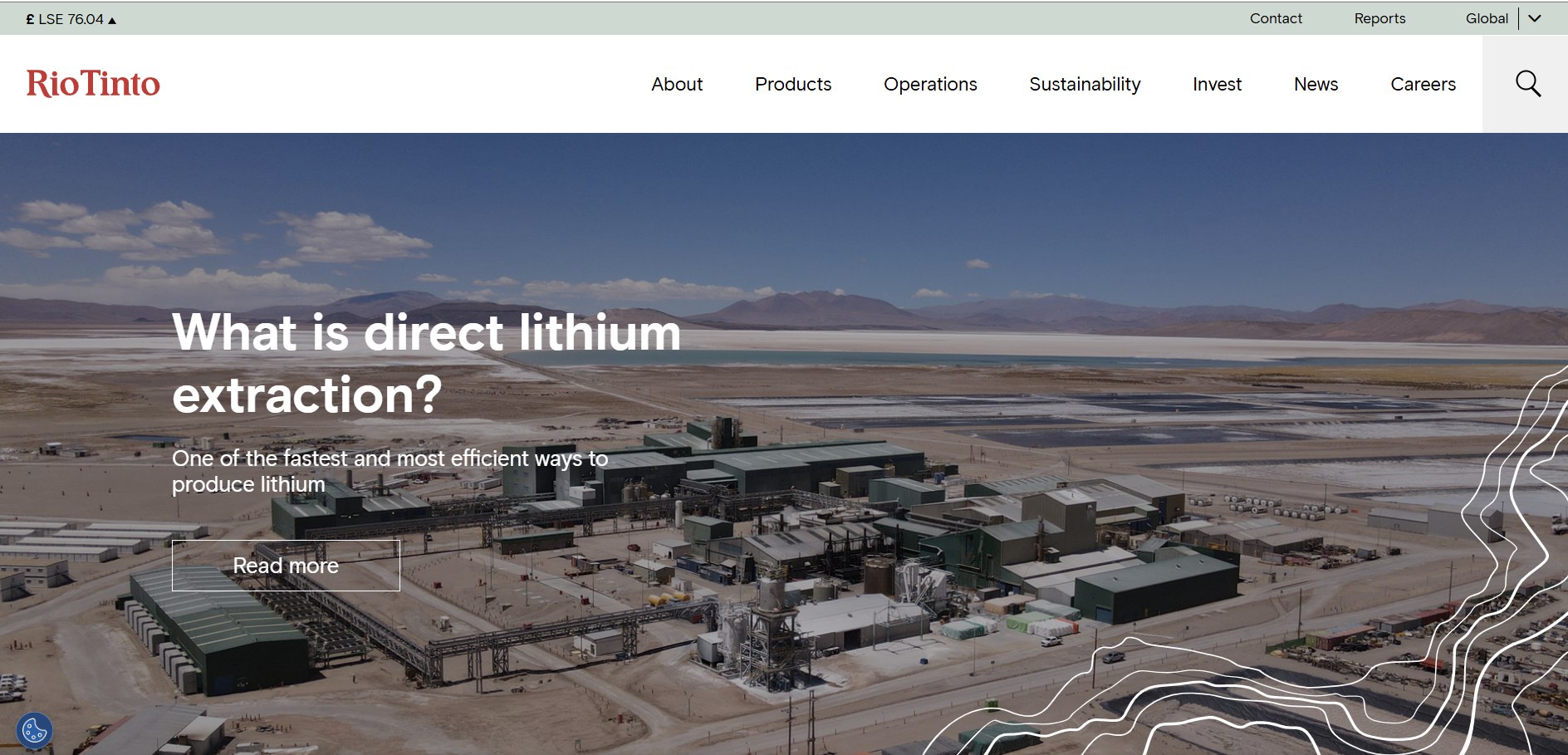
Rio Tinto Shares Fall Nearly 2% as Iron Ore Prices Pressure Mining Stocks

Published

on

Rio Tinto Shares Fall Nearly 2% as Iron Ore Prices

SYDNEY — Rio Tinto Ltd. shares declined on Friday, closing at A$184.58 after losing 3.50 or 1.86%, as softer iron ore prices and cautious sentiment across the resources sector weighed on Australia’s second-largest mining company.

The move extended recent weakness for the diversified miner, which has faced headwinds from fluctuating commodity markets despite solid operational performance. Rio Tinto, a major global producer of iron ore, copper, aluminum and other critical minerals, remains highly sensitive to developments in China and broader industrial demand.

Trading volume was elevated as the stock underperformed the broader S&P/ASX 200 index. The decline reflects ongoing investor rotation away from resource stocks amid concerns over near-term demand signals from major economies. Iron ore, Rio Tinto’s flagship commodity, has experienced volatility in recent weeks, pressuring valuations across the sector.

Analysts noted that while Rio Tinto maintains strong fundamentals, near-term commodity softness has dominated market narratives. The company’s low-cost operations and diversified portfolio have historically provided resilience, but current pricing dynamics have led to profit-taking and cautious positioning by investors.

Advertisement

Rio Tinto has reported robust production figures in 2026, with iron ore output meeting or exceeding guidance at key Pilbara operations in Western Australia. Copper production has also shown growth, supported by assets in Mongolia and elsewhere. The company continues advancing projects in lithium and other future-facing minerals, aligning with global energy transition trends.

Despite these operational strengths, share price performance has been influenced by external factors. Chinese steel production and property sector activity remain key variables for iron ore demand. Recent data showing moderation in some industrial indicators has contributed to the recent pullback in mining stocks.

Rio Tinto maintains a disciplined approach to capital allocation, with strong free cash flow supporting dividends and selective growth investments. The company’s interim dividend has been well-received by income-focused investors, providing a reliable yield even during periods of commodity volatility.

For longer-term investors, Rio Tinto offers exposure to structural demand drivers in copper and other metals essential for electrification and renewable energy technologies. Its Pilbara iron ore operations remain among the world’s most efficient, providing competitive advantages through the cycle.

Advertisement

Valuation metrics suggest the shares trade at reasonable levels relative to historical averages when considering long-term commodity outlooks. However, near-term uncertainty around China’s economic trajectory and global growth prospects has introduced volatility.

Broader Australian resources sector context shows similar pressure on major players. The sector, a significant contributor to the national economy and ASX performance, has been a key driver of gains earlier in the year but now faces consolidation amid mixed signals.

Looking ahead, Rio Tinto’s upcoming operational updates and production guidance will be closely monitored. The company continues investing in automation, sustainability initiatives and low-carbon technologies across its portfolio. Projects such as the expansion of copper operations and exploration in critical minerals position it for potential growth as global demand evolves.

Global factors, including U.S.-China trade dynamics, energy prices and geopolitical developments, continue to influence commodity markets. Rio Tinto’s diversified asset base across multiple continents provides some natural hedges against regional disruptions.

Advertisement

Analysts generally maintain constructive longer-term views on Rio Tinto, citing its operational excellence, strong balance sheet and exposure to future-facing commodities. While near-term headwinds exist, the company’s scale and low-cost production should support margins through market cycles.

For investors, the current share price level may represent an opportunity to accumulate a high-quality mining stock with diversified exposure. Those with shorter time horizons might prefer waiting for clearer signals on commodity prices and Chinese demand indicators.

The modest decline on Friday fits within normal daily movements for a company of Rio Tinto’s size. It reflects broader sector sentiment rather than company-specific news. Rio Tinto has not released material updates that would explain the session’s trading.

As one of Australia’s largest listed companies, Rio Tinto plays a vital role in the national economy through employment, exports and tax contributions. Its performance influences broader market confidence and reflects conditions in global commodity markets.

Advertisement

Rio Tinto continues emphasizing safety, sustainability and community engagement across its operations. Its commitment to reducing carbon emissions and investing in renewable energy projects aligns with evolving stakeholder expectations and regulatory requirements.

Investors evaluating Rio Tinto should consider individual risk tolerance, portfolio allocation and time horizon. The company offers exposure to global commodity cycles with a high-quality operator, but volatility remains inherent to the mining sector. Diversification across industries can help manage company-specific and cyclical risks.

Friday’s trading session served as a reminder of the resources sector’s sensitivity to sentiment shifts. While near-term pressures exist, structural drivers supporting demand for Rio Tinto’s key commodities suggest potential for recovery as markets digest current uncertainties.

Market participants will now assess next week’s economic calendar, including any further data from China and other major economies. The balance between global growth expectations, supply responses and energy transition trends will remain central to mining sector performance.

Advertisement

Overall, Rio Tinto maintains a position of strength in the global mining industry. Its diversified asset base, operational excellence and strategic focus on critical minerals position it favorably to navigate current challenges while capitalizing on longer-term opportunities in the evolving resource landscape.

Continue Reading
Click to comment

You must be logged in to post a comment Login

Leave a Reply

Business

Kuwait Airport Open Today as Terminal 1 Resumes Flights, Though Full Operations Remain Phased

Published

on

Kuwait International Airport

KUWAIT CITY — Kuwait International Airport is open today, with flights operating again through a phased resumption plan after months of disruption, but it is not yet described as fully back to standard capacity across all services. Recent reporting says Terminal 1 reopened on June 1, allowing Arab and international airlines to resume passenger operations as repair and upgrade work was completed.

The Civil Aviation Authority said the airport’s restart would come gradually, with the first phase allowing one flight per airline so officials could monitor flow, safety and readiness before expanding service. That approach marked a careful return to operations after the airport was closed in late February amid regional conflict, then reopened in April under a phased plan.

The airport’s official website remains active and includes flight-status and timetable information, reinforcing that the facility is functioning today. A live conditions page also shows Kuwait International Airport in service, with current airport status information available for travelers. While that does not by itself prove every route is operating normally, it supports the broader picture that the airport is open and handling traffic.

Reporting from early June said the first phase of the Terminal 1 relaunch included Arab and foreign airlines, with the airport using operational measures intended to streamline passenger movement and maintain safety. Earlier coverage also noted that Kuwait Airways and Jazeera Airways had already been serving from other terminals as part of the recovery process, while new international services returned in stages. That makes today’s status clear: open, active and rebuilding, but not yet fully restored in the sense of unrestricted, all-airline normal operations.

Advertisement

The reopening matters for one of the Gulf’s most important aviation hubs, where even a partial shutdown can affect regional connections, business travel and expatriate traffic. Kuwait’s phased strategy appears aimed at restoring capacity without overwhelming airport systems that were only recently repaired and inspected. Authorities have said the staged approach is intended to protect passenger safety and preserve orderly service as more airlines return.

For travelers, the practical guidance is simple: Kuwait International Airport is open today, but flight schedules may still reflect the phased rollout. Passengers should verify their airline’s status before leaving for the airport and allow extra time for any updated procedures. The airport timetable page and airline updates remain the most relevant operational references for same-day travel.


The broader recovery also reflects how quickly aviation can shift from closure to gradual return once authorities complete repairs and safety checks. Recent reporting said Terminal 1’s reopening followed the completion of repair and upgrade work, and the first flights back were meant to test the system before the network expands further. That means the airport is open today, but the final step of returning to full, routine operations is still unfolding.

In simple terms, the answer is yes — Kuwait International Airport is open today. But the airport is still operating in phases, so “open” does not yet mean every service has fully normalized.

Advertisement

Flight operations

The latest coverage says the reopening began with Terminal 1 and a limited number of flights per airline, then expanded as conditions allowed. That phased model is consistent with earlier official comments that full operations would resume only after a careful evaluation of air traffic, facility readiness and safety standards. Kuwait’s flagship carriers and several international airlines have already returned in some form, but the schedule remains in transition.

The airport’s timetable page shows active listings for June dates, including airline entries for the current operating window. That is a strong indicator of normalizing activity, though not a guarantee that every destination or terminal function has returned to pre-closure levels. Travelers planning same-day departures or arrivals should therefore treat the airport as open but still in recovery mode.

What officials said

Officials framed the reopening as a measured step forward, not an instant return to full capacity. The Civil Aviation Authority said the first phase was designed to ensure smooth operations and assess performance before further expansion. Arab News also quoted the authority as saying the phased plan was meant to prepare the airport for “full operation in the coming period”.

Advertisement
Continue Reading

Business

Broadcom: The Market Overreacted To The AI Guidance Optics (NASDAQ:AVGO)

Published

on

Broadcom: The Most Important Non-GPU AI Compounder Is Becoming Indispensable

This article was written by

Daniel Sereda is chief investment analyst at a family office whose investments span continents and diverse asset classes. This requires him to navigate through a plethora of information on a daily basis. His expertise is in filtering this wealth of data to extract the most critical ideas.
He runs the investing group Beyond the Wall Investing in which he provides access to the same information that institutional market participants prioritize in their analysis. Learn more.

Analyst’s Disclosure: I/we have a beneficial long position in the shares of AVGO either through stock ownership, options, or other derivatives. I wrote this article myself, and it expresses my own opinions. I am not receiving compensation for it (other than from Seeking Alpha). I have no business relationship with any company whose stock is mentioned in this article.

Seeking Alpha’s Disclosure: Past performance is no guarantee of future results. No recommendation or advice is being given as to whether any investment is suitable for a particular investor. Any views or opinions expressed above may not reflect those of Seeking Alpha as a whole. Seeking Alpha is not a licensed securities dealer, broker or US investment adviser or investment bank. Our analysts are third party authors that include both professional investors and individual investors who may not be licensed or certified by any institute or regulatory body.

Advertisement
Continue Reading

Business

Trading platform IG Markets fails in $5.5m bid against Perth investor

Published

on

Trading platform IG Markets fails in $5.5m bid against Perth investor

The state’s highest court has dismissed IG Markets’ bid against a Perth stock trader who reaped $5.5 million in 30 minutes on its trading platform.

Continue Reading

Business

Fostering a fitness gamechanger

Published

on

Fostering a fitness gamechanger

Western Australian fitness industry stalwarts Cal and Shelby Foster began the latest chapter of their business career on Monday in Dunsborough.

Continue Reading

Business

Sensex down over 10K points from Dec peak. Should MF investors buy the dip, hold positions, or wait on sidelines?

Published

on

Sensex down over 10K points from Dec peak. Should MF investors buy the dip, hold positions, or wait on sidelines?
With the benchmark index – BSE Sensex down by over 10,000 basis points to a level of 74,243 as of June 6, 2026, has left many investors wondering whether to continue SIPs and lump-sum investments during the current market decline, hold current positions or wait for greater clarity on market direction?

Market experts believe that investors should see this 10,000 point correction as a buying opportunity rather than a reason to panic.

Vishal Dhawan, Founder & CEO, Plan Ahead Wealth Advisors told ETMutualFunds that investors should view this 10,000-point Sensex correction as a long-term buying opportunity as market drawdowns are natural processes that shake out speculative premiums, resetting valuations to fundamentally healthier levels.

Also Read | Multicap or flexicap mutual fund for a 20-year SIP? Expert explains what investors should choose

“Long-term investors can continue their Systematic Investment Plans (SIPs) and hold current positions firmly. Pausing allocations to “wait for clarity” is a psychological trap that historically locks investors out of the sharpest days of a market rebound.”

Advertisement


Dhawan further said that while regular SIPs are key to an investment journey, panic selling must be completely avoided; use this market decline to methodically build an equity baseline designed to reward your patience when economic sentiment inevitably swings back to optimism at some point in the future and it is critical to have a minimum 5-7 year investment horizon whilst investing.
Echoing a similar opinion of considering this as a buying opportunity rather than a reason to panic, Amitabh Lara, Executive Director, Anand Rathi Wealth Limited shared with ETMutualFunds that for long-term investors, this is not the time to stop investing.Amitabh further said that continuing SIPs during a fall can actually work in your favour because the same investment amount buys more units at lower prices and one of the biggest mistakes investors make is stopping SIPs during a correction and returning only after the recovery has already happened.

The benchmark index which touched a peak of 84,391 on December 10, 2025, is now down by nearly 10,148 points to a level of 74,243 as of June 6, 2026.

As the market becomes volatile, investors as well as the fund managers keep cash in hand and wait for the opportunity to deploy it in the market but with a dilemma whether to deploy cash immediately or stagger investments over time.

Amitabh said that if investors have idle cash available then they can go ahead and invest as a lumpsum and funds can be deployed in a staggered manner through tranches, over 6 to 8 weeks. “It also removes the stress of trying to time the exact bottom. If they have SIPs, they can continue it without worrying about the market level and take advantage of rupee cost averaging.”

Dhawan said that for investors sitting on cash, a staggered deployment strategy via a 6-month to 12 month Systematic Transfer Plan (STP) is highly recommended as this approach could hedge your principal against intermediate downside volatility.

Advertisement

He further said that investors should avoid deploying an absolute lumpsum at current levels, as picking the exact market bottom is a statistical myth and tranche-based buying ensures you average out your entry costs across multiple lower price bands smoothly.

“Park your liquid capital in low-duration instruments and systematically route it into equity. This automated execution effectively replaces portfolio anxiety with disciplined benefits. In case you wish to deploy a lumpsum, and not do a STP, an investment in the Balanced Advantage category is suggested.” Dhawan said.

How equity categories performed

ETMutualFunds checked the performance of equity mutual funds since December 10, 2025. Small cap funds have delivered an average return of 6.06% since the date BSE Sensex touched the new peak, followed by mid cap funds which gave an average return of 2.58%.

Also Read | Nippon India Mutual Fund limits subscription in Gold BeES and gold savings fund

Advertisement

In contrast, the counterparts, large cap funds gave a negative average return of 6.26% since December 10, 2025. Multi cap funds gave an average return of 0.06% whereas flexi cap funds fell 2.95% on an average in the said time period.

Out of 10 equity categories, only three gave positive average returns which were small caps, mid caps and multi caps whereas the other categories such as large caps, contra funds, ELSS, flexi, focused, value and large & mid caps gave negative average returns.

Which market-cap segment could lead the recovery?

Dhawan said that large-cap stocks are typically best positioned to lead the initial recovery wave when domestic and foreign institutional flows return and their robust cash flows, operational scale, and institutional backing provide an essential fundamental moat.

He further said that mid-caps may require stock-specific elements to perform, as many names went up significantly during the previous bull cycle; small caps should be approached with high caution and patience, as they remain prone to sharp liquidity outflows during market corrections. “Limit small-cap exposure if you can handle the volatility and have a longer time horizon of 7-10 years for mid and small caps.”

Advertisement

Lara said that small caps appear to have the most room for upside when markets recover. Currently, Nifty Smallcap 250 is trading about 17.4% below its fair value, compared with 9.6% for the Nifty Midcap 150 and around 5-9% for large-cap indices. Hence, small caps have corrected more than large caps and mid caps relative to their earnings potential.

He further said that investors can have a balanced exposure across market caps, with 55% in large caps and the rest in mid and small caps to be a part of the eventual recovery that will follow in the markets.

BSE Sensex: In the last six months, the index was down 13.38% and in the nine months, it was down 8.01%. In the last one year, Sensex was down 8.83% whereas in the last three years and five years it was up 5.74% and 7.33% respectively.

Sector allocation becomes particularly important during market corrections as valuation gaps emerge across industries. The question is whether investors should actively target beaten-down sectors or focus on broader diversification.

Advertisement

In response to this, Lara said investors should avoid investing in single sectors or making sectoral bets as performance in sectors/themes is highly cyclical. For example, in 2024, the pharma & IT sectors were part of the best-performing sectors, however, they both turned into worst-performing sectors in 2025, which suggest that entry and exit at the right time play a crucial role in making investments in the sectorial/thematic funds.

Also Read |HDFC Mutual Fund limits subscription in its gold ETF and FoF. What this means for investors?

During such corrections, it would be more beneficial for investors to invest in diversified categories of equity mutual funds to get exposure to all sectors and benefit from their performance, rather than focusing solely on any single sector, Lara further said.

Dhawan said to prioritize accumulating high-quality banking and financial services funds as these segments offer good earnings visibility, corrected price multiples, and fundamentally strong underlying balance sheets.

Advertisement

He further said systematic accumulation of Information Technology (IT) funds could be attributed to these deep valuation resets as they are cash-rich franchises with low debt. However, they do face business model risk. Conversely, stay away from Utilities and capital goods as valuations look well above their long term averages.

(Disclaimer: Recommendations, suggestions, views and opinions given by the experts are their own. These do not represent the views of The Economic Times)

If you have any mutual fund queries, message on ET Mutual Funds on Facebook/Twitter. We will get it answered by our panel of experts. Do share your questions on ETMFqueries@timesinternet.in along with your age, risk profile, and Twitter handle.

Advertisement
Add ET Logo as a Reliable and Trusted News Source

Continue Reading

Business

Nasdaq Rises on AI Resurgence After Tech Selloff. Dow Futures Drop as Israel, Iran Strikes Drive Up Oil Prices.

Published

on

Barron's

Blue-chip stocks looked set to fall on Monday as the cease-fire in the Middle East appeared to fray, with the market still reeling from Friday’s brutal artificial intelligence selloff.

Futures tracking the Dow Jones Industrial Average slipped 169 points, or 0.3%. S&P 500 futures climbed 0.3%, while contracts tied to the tech-heavy Nasdaq 100 added 0.7%.

The three blue-chip indexes all plummeted on Friday after the May nonfarm payrolls report topped economists’ expectations, strengthening fears that the Federal Reserve will hike interest rates.

Continue Reading

Business

Analysis-Prabowo’s populist policies propel a ’doom-loop’ in Indonesian markets

Published

on

Analysis-Prabowo’s populist policies propel a ’doom-loop’ in Indonesian markets


Analysis-Prabowo’s populist policies propel a ’doom-loop’ in Indonesian markets

Continue Reading

Business

Iran blames US for latest exchanges of fire with Israel

Published

on

Iran blames US for latest exchanges of fire with Israel


Iran blames US for latest exchanges of fire with Israel

Continue Reading

Business

Nestle among Nuvama's top consumer picks after Q4 earnings

Published

on

Nestle among Nuvama's top consumer picks after Q4 earnings

Nestle is among Nuvama’s top consumer picks following strong Q4 earnings, driven by resilient rural and urban demand. Despite challenges like unseasonal weather impacting seasonal products, the brokerage highlighted Nestle, Asian Paints, Pidilite Industries, Berger Paints, and Marico as key investment opportunities in the sector.

Continue Reading

Business

TCS shares slip 2%, down 12% in 4 straight sessions. What’s triggering the decline?

Published

on

TCS shares slip 2%, down 12% in 4 straight sessions. What’s triggering the decline?
Shares of TCS, India’s largest IT services company, plunged 2% to an intraday low of Rs 2,144 on the BSE on Monday as a surge in U.S. bond yields reignited concerns that the Federal Reserve may be forced to raise interest rates later this year. With today’s decline, the stock has lost 12% over the last four trading sessions.

Higher U.S. bond yields and expectations of tighter monetary policy are generally seen as negative for Indian IT stocks. They tend to compress valuations of growth-oriented companies, raise concerns about slower technology spending by U.S. clients, encourage businesses to focus on cost optimization rather than expansionary IT investments, and can trigger foreign investor outflows from emerging markets.

The weakness in TCS also follows a sharp relief rally in IT stocks last week. The sector has remained under pressure through much of 2026 amid growing concerns that rapid advances in artificial intelligence could disrupt the traditional software services business model.

Should you buy TCS shares?

“We recommend avoiding TCS for now as the major trend is bearish,” Sudeep Shah, Vice President and Head of Technical & Derivatives Research at SBI Securities told ETMarkets. According to Shah, momentum indicators have weakened considerably, with the RSI turning lower after nearing the 60 level, suggesting fading bullish strength. He also pointed out that the stock has slipped below the Bollinger Band midline, an important support level often tracked by technical analysts. With the latest decline, TCS has fallen below several key short- and long-term moving averages, indicating a weakening trend.

Advertisement

Harshal Dasani, Business Head at INVasset PMS, said the stock’s technical setup has shifted from weakness to a test of a potential breakdown. According to him, the 9% decline following a 6.53% rebound in the last week suggests the earlier recovery was merely a dead-cat bounce rather than evidence of fresh buying interest. “When a large-cap stock gives up a relief rally this quickly, the market is not reacting to a single negative headline. It is repricing the entire low-growth IT model,” Dasani said.
On the upside, he sees the Rs 2,400-2,450 range as a significant supply zone, since the recent recovery attempt stalled in that region. Dasani added that until TCS manages to reclaim this band with strong participation, any rallies are likely to face selling pressure.

TCS share price performance

TCS shares have fallen over 32% since the start of the year and about 37% in the last 1 year.
TCS reported a 12% year-on-year rise in consolidated net profit at Rs 13,718 crore for the fourth quarter, while revenue from operations increased 10% YoY to Rs 70,698 crore. The company also announced a final dividend of Rs 31 per share.
During the quarter, TCS secured three large deals, taking the total contract value to $12 billion for the period. On a quarter-on-quarter basis, revenue grew 5.4%, while constant currency growth came in at 1.2%, broadly in line with expectations. Operating margin for the January to March quarter stood at 25.3%, up 10 basis points from the previous quarter.

(Disclaimer: Recommendations, suggestions, views and opinions given by the experts are their own. These do not represent the views of The Economic Times)

Continue Reading

Trending

Copyright © 2025