

Crypto World
Bitcoin’s $60K Support in Doubt Amid Mounting Macro Risks


Bitcoin (BTC) showed tentative resilience as Monday’s Wall Street session loomed, with the $60,000 level continuing to serve as a key anchor. After aweek of mixed signals, traders watched for signs of a breakout beyond a broad, low-volatility range, while macro headwinds kept the mood cautious across timeframes.
Analysts highlighted that a move toward $64,000 remains in view for traders seeking evidence of the next leg, but a sustained push higher hinges on broader risk-appetite and macro stability. Meanwhile, the market’s attention drifted to the interaction between price action and moving averages, which have started to act as near-term hurdles in an otherwise choppy backdrop that also features renewed focus on yen dynamics and global risk sentiment.
Key points:
- Bitcoin rebounded modestly but avoided a fresh retest of $60,000 as markets looked ahead to the Wall Street open.
- Analysts describe a potential, prolonged range between roughly $60,000 and $80,000 unless a decisive breakout occurs.
- The 200-day moving average on lower timeframes is acting as a nearby ceiling for near-term moves.
- Some experts warn that a failure to reclaim upside momentum could invite renewed downside pressure toward the range low.
- Macro headwinds—ranging from rate expectations to FX and geopolitical tensions—continue to shadow bitcoin’s risk-on narrative.
Bitcoin price decisions hover around the $60k floor
TradingView data showed selling pressure easing after the weekly close, with BTC tracing a path that critics say signals the potential for range-trading rather than an imminent breakout. The price action has kept the market oriented toward the $60,000 level as a psychological and technical pivot in the near term.
“Holding the $60K low and I will just assume this is a range for now,” noted Daan Crypto Trades in a recent analysis on X, underscoring a broader market mood that favors caution over chasing aggressive moves. The trader added that a prolonged phase within the $60,000 to $80,000 corridor would be plausible if buyers refrain at the range low and sellers remain contained at the range high.
On the chart side, a visible pattern is the recent interaction with the 200-day simple moving average, which is functioning as a form of resistance on shorter timeframes. Traders are watching whether price can clear that level to signal a more conclusive shift in momentum or if selling pressure reasserts control near the line.
Bearish overheads and long-term bear-market signals
As technicians parse the setup, attention also turns to more structural indicators. Rekt Capital highlighted a key milestone last week: Bitcoin briefly touched the 200-week moving average for the first time in this bear cycle. Deviations below that level have historically preceded the formation of bear-market bottoms, according to the analyst’s observations shared with followers on social media.
“Bitcoin has now tagged the 200-week SMA for the first time in this Bear Cycle,” Rekt Capital noted, adding that a failure to sustain a rebound could erode the fragile support around $60,000 and widen downside risks. The discussion underscores how closely traders are watching long-term anchors as the market tests the resilience of recent price action.
Macro winds complicate the crypto narrative
Beyond technicals, macro headwinds continue to knit a complicated backdrop for bitcoin and other risk assets. Market color from QCP Capital captured the tension succinctly: “BTC is effectively being asked to perform while oil, rates, FX and geopolitics are all tapping it on the shoulder.” In other words, crypto must contend with a broad spectrum of competing forces that can sap momentum even as it tries to chart its own course.
The bulletin also pointed to crosswinds from Asia equities, noting a backdrop of weakness that could test bitcoin’s ability to detach from broader stock-price dynamics. If crypto can hold steady as equities digest the AI-led correction, there remains a chance for a cleaner, standalone narrative. Conversely, a further downturn in stocks could make the decoupling seem less independent and more a delayed reaction to macro shocks.
On the yen side, the currency has again traded in volatile territory, with a move toward 160 per dollar cited as another obstacle to risk-on appetite. These factors—along with US Federal Reserve rate expectations and geopolitical developments—form a kaleidoscope of risks that crypto markets must navigate as they attempt to solidify a durable trend.
In the near term, observers will be looking for how price behaves around the critical $60,000 support and whether any break above the 200-day resistance gains credibility. The dynamic between spot prices and correlated assets—stocks, currencies, and commodities—will help determine whether bitcoin can escape a risk-off mood or remain tethered to a cautious, range-bound regime.
What happens next could hinge on how the macro environment evolves in the coming weeks. If markets manage to absorb the AI-driven recalibration in equities without a fresh wave of selling, BTC might extend a gradual recovery within the established range. If, however, macro pressures intensify or geopolitical tensions flare, the probability of a deeper retest of support could rise, challenging the notion of a stable, stand-alone crypto narrative in the near term.
As always, readers should monitor coming data points—from rate path guidance to policy signals and currency moves—alongside price action in the BTC market to gauge where this evolving saga might head next.

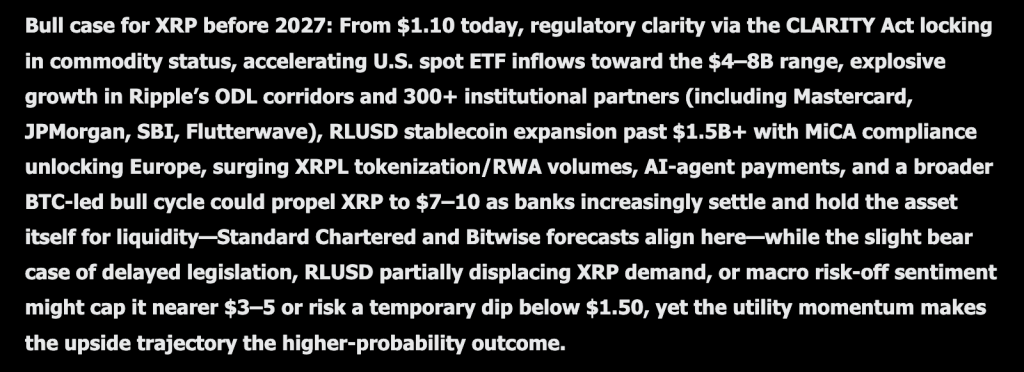
Elon Musk Grok AI is not thinking in quarters for this one either. From $1.10 today, the prediction is a run toward $7 to $10 sometime before 2027, based on the idea that XRP will finally become a bank-held asset rather than just a bank-used rail.
The foundation is regulatory. Grok points to the CLARITY Act, which would lock in XRP’s commodity status and remove the single biggest legal cloud that has hung over this coin for years.
US spot ETF inflows are expected to accelerate toward the $4B to $8B range on the back of that clarity. That kind of institutional plumbing tends to arrive quietly and then show up all at once in the price.
Ripple’s own network numbers back up the utility argument. Explosive growth in ODL corridors, plus more than 300 institutional partners now including names like Mastercard, JPMorgan, SBI, and Flutterwave.
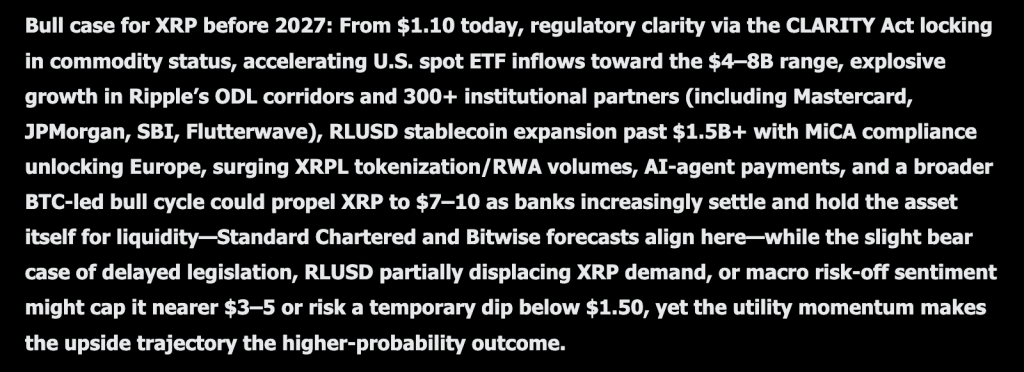
RLUSD stablecoin expansion has pushed past $1.5B, with MiCA compliance opening the door to Europe in a real way. Layer on surging XRPL tokenization and RWA volumes, plus early AI agent payment activity, and Grok sees a network doing meaningfully more than it was two years ago.
The final piece is simply riding the wave. A broader BTC-led bull cycle could pull XRP along with it, and Grok notes that Standard Chartered and Bitwise forecasts land in a similar zone, which is nothing when two independent shops agree on direction.
The bear case is specific rather than dismissive. Delayed legislation, RLUSD partially cannibalizing XRP demand rather than complementing it, or a broader macro risk-off turn could cap the price near $3 to $5, or even force a temporary dip below $1.50.
Grok still calls the upside path the higher-probability outcome, but it does not pretend that the downside scenario is small. A dip below $1.50 from here would erase a meaningful chunk of the current price before any bullish thesis has a chance to play out.

XRP Price Prediction: Five Years Of XRP In One Chart, And It Is Still Fighting The Same Ceiling
Zoom out to the weekly and XRP’s history is really just two enormous spikes separated by long, grinding silence. The 2021 run topped near $1.96, then spent almost three full years drifting between $0.30 and $0.60 with barely any life in it.
Late 2024 changed that completely. Price exploded from under $0.60 to above $3.30 in a matter of weeks, one of the sharpest moves this asset has ever produced, before spending 2025 chopping between $1.80 and $3.65 in a wide, volatile range.
The current pullback has brought XRP back down to $1.10086, up 0.36% for the week, with a range between $1.08229 and $1.16411. That puts the price roughly in the middle of where it sat right before the late 2024 breakout even started.
Support on this weekly chart sits at $1.00, a level that has acted as both a floor and a ceiling multiple times over the last five years. Below that, $0.80 is the next real shelf from the 2025 consolidation.
Resistance is heavier and further away. First at $1.60, then the thick supply zone between $2.20 and $2.60, where the price spent most of 2025 fighting for direction.
Momentum on the weekly is neutral, sitting in the same kind of digestion phase Bitcoin’s own chart is showing right now, which makes sense given how correlated these two assets have become.
For Grok AI $7 to $10 predicts to have any weekly chart support, XRP needs to first reclaim that $2.20 to $2.60 zone that rejected it twice in 2025. Everything above that stays a story about regulation and adoption until the price actually confirms it.
Discover: The best crypto to diversify your portfolio with
Here is what Grok AI Predicts For LiquidChain’s Near Future
Every cycle has a moment where waiting becomes the most expensive decision you can make. That moment is now.
Bitcoin, Ethereum, and XRP are all pinned under the same resistance they have been testing for weeks. The macro unlock is perpetually one data point away. The institutional money keeps arriving next quarter. Large-cap traders waiting for a breakout are queuing for a decision that belongs to someone else entirely.
Grok AI has identified what experienced cycle traders already act on. Capital that registers as statistical background noise at Bitcoin’s market cap can completely reprice a small, undiscovered project.
The asymmetry is not complicated. It lives in the distance between what something is genuinely worth and what the market has currently assigned it. The moment that distance gets noticed, it collapses. Before that moment, it is fully open.
Cross-chain fragmentation has been quietly taxing every DeFi participant since the first bridge went live. Bitcoin, Ethereum, and Solana were engineered independently with zero shared infrastructure and no design intent to communicate.
Every transaction crossing those ecosystem boundaries absorbs the cost of that decision in fees, failed execution, and slippage that hits before settlement even begins. The bridge industry did not fix this problem. It built a business model on top of it.
LiquidChain removes the business model entirely. Three networks unified inside a single execution layer. One deployment reaches all of them simultaneously. No cross-chain tax is extracted from any interaction anywhere.
Grok AI predicts it as a coin worth watching. The presale sits at $0.01454 with just over $860,000 raised.
Execution is unproven. Adoption is an open question. Established assets offer a smoother path toward a ceiling that the entire market can already see. LiquidChain is the entry point that stops existing once the market finds it.
Don’t Miss Out on Our $1,000 USDT Airdrop on ByBit
The post Elon Musk Grok AI Predicts XRP Price Prediction That Has Ripple Investors Excited appeared first on Cryptonews.
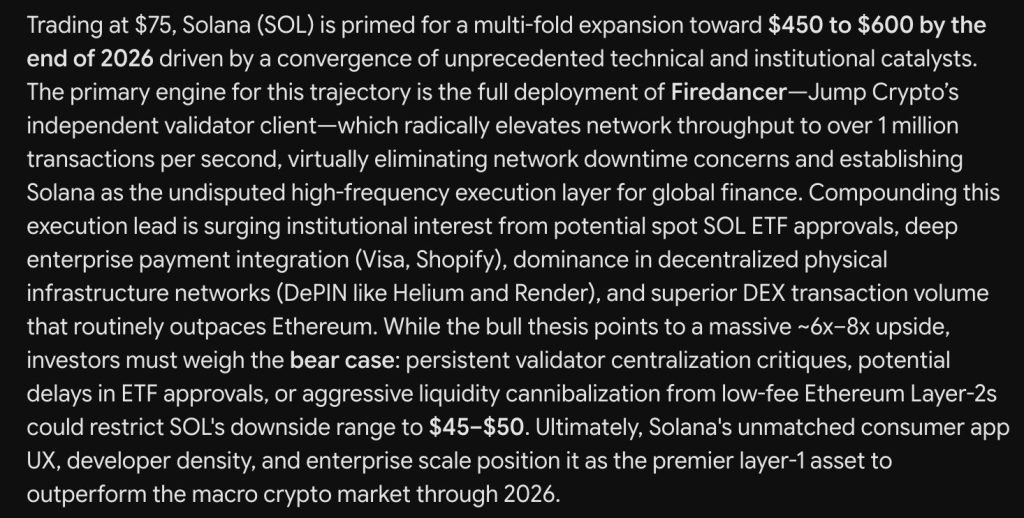
Google Gemini AI is not being subtle about this prediction. From $75 today, the price prediction is $450 to $600 by the end of 2026, a move that would multiply Solana price six to eight times over.
The engine behind it is a single piece of infrastructure. Full deployment of Firedancer, Jump Crypto’s independent validator client, is expected to push network throughput past 1 million transactions per second.
That kind of capacity does more than speed things up. Gemini argues it virtually eliminates the outage risk that has dogged Solana’s reputation for years, positioning the network as the default high frequency execution layer for global finance.
Institutional interest is stacking on top of that technical shift. Potential spot SOL ETF approvals, deep payment integration with names like Visa and Shopify, and dominance in decentralized physical infrastructure networks like Helium and Render all point the same direction.
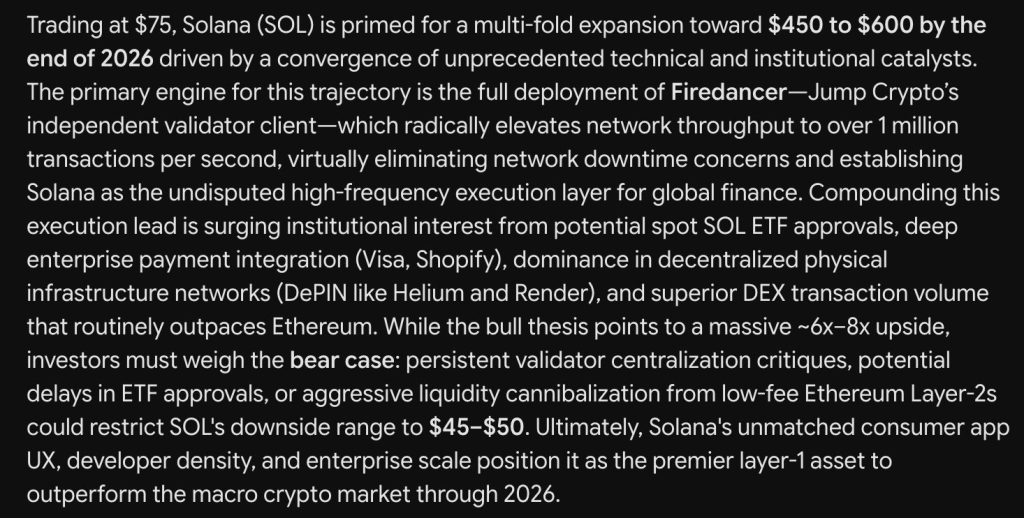
Gemini also flags something worth sitting with. Solana’s DEX transaction volume routinely outpaces Ethereum’s, which is a real usage metric rather than a speculative one.
The bear case is not vague either. Persistent validator centralization critiques, potential delays in ETF approvals, or aggressive liquidity cannibalization from low fee Ethereum Layer 2s could all cap Solana’s downside near $45 to $50.
Gemini still frames the unmatched consumer app experience, developer density, and enterprise scale as the deciding factors, positioning Solana as the layer 1 asset built to outperform the broader market through 2026.

Solana Price Prediction: SOL Needs A Number It Has Not Touched Since Winter
The daily chart tells a rougher story than the prediction does. SOL topped near $257 in September 2025, and what followed was a mostly uninterrupted decline into a low near $60 by February 2026.
Since that crash, price has spent five months building a wide, choppy range. Two separate rallies, one in December and one in May, both stalled almost exactly at $100, and both rolled over hard afterward.
Today closed at $75.29, up 1.11%, with the session ranging between $74.40 and $75.91. That is a modest green day sitting in the lower half of a range that has trapped this coin since winter.
Support sits at $70, then the June low near $60 that has now held twice. Resistance stacks at $85, then $95, then the persistent $100 ceiling that has rejected every real breakout attempt this year.
Momentum here is neither compressed nor extended, sitting in a neutral zone that reflects a market still deciding whether the June low was the actual bottom. For Gemini’s $450 target to have any grounding, Solana first needs to do something it has failed to do twice in 2026, close above $100 and actually hold there.
That single level is the entire gap between where this prediction lives and where the chart currently sits.
Discover: The Best Crypto to Diversify Your Portfolio
You Might Like What Gemini AI Predicts About This New Layer 3 Called LiquidChain
The money that wins cycles never waits at resistance.
Large caps are stuck. Bitcoin, Ethereum, and XRP keep testing the same ceilings with nothing breaking through. Every macro catalyst has a new arrival date. Every institutional wave has a new quarter attached. Waiting on someone else’s decision is not a trade.
Small market cap infrastructure plays operate on completely different physics. A rotation that vanishes as noise at Bitcoin’s scale reprices an undiscovered project by multiples. The opportunity lies in the gap between what something is genuinely worth and what the market has assigned it. That gap closes permanently the moment discovery happens.
Multi-chain fragmentation is one of the most expensive unsolved problems in DeFi. Bitcoin, Ethereum, and Solana run as completely isolated systems. No shared architecture. No native interoperability. Every time value crosses those boundaries it pays in fees, slippage, and failed transactions.
LiquidChain makes the crossing free. Gemini AI predicts and agrees. All 3 networks within a single execution environment. Single deployment. Complete ecosystem access. No tax on any interaction.
The presale is at $0.01454 with just over $890,000 raised. Early and undiscovered. That combination does not last long.
Explore the LiquidChain Presale
The post Google Gemini AI Predicts Solana Price Could 8x Before End of 2026 appeared first on Cryptonews.
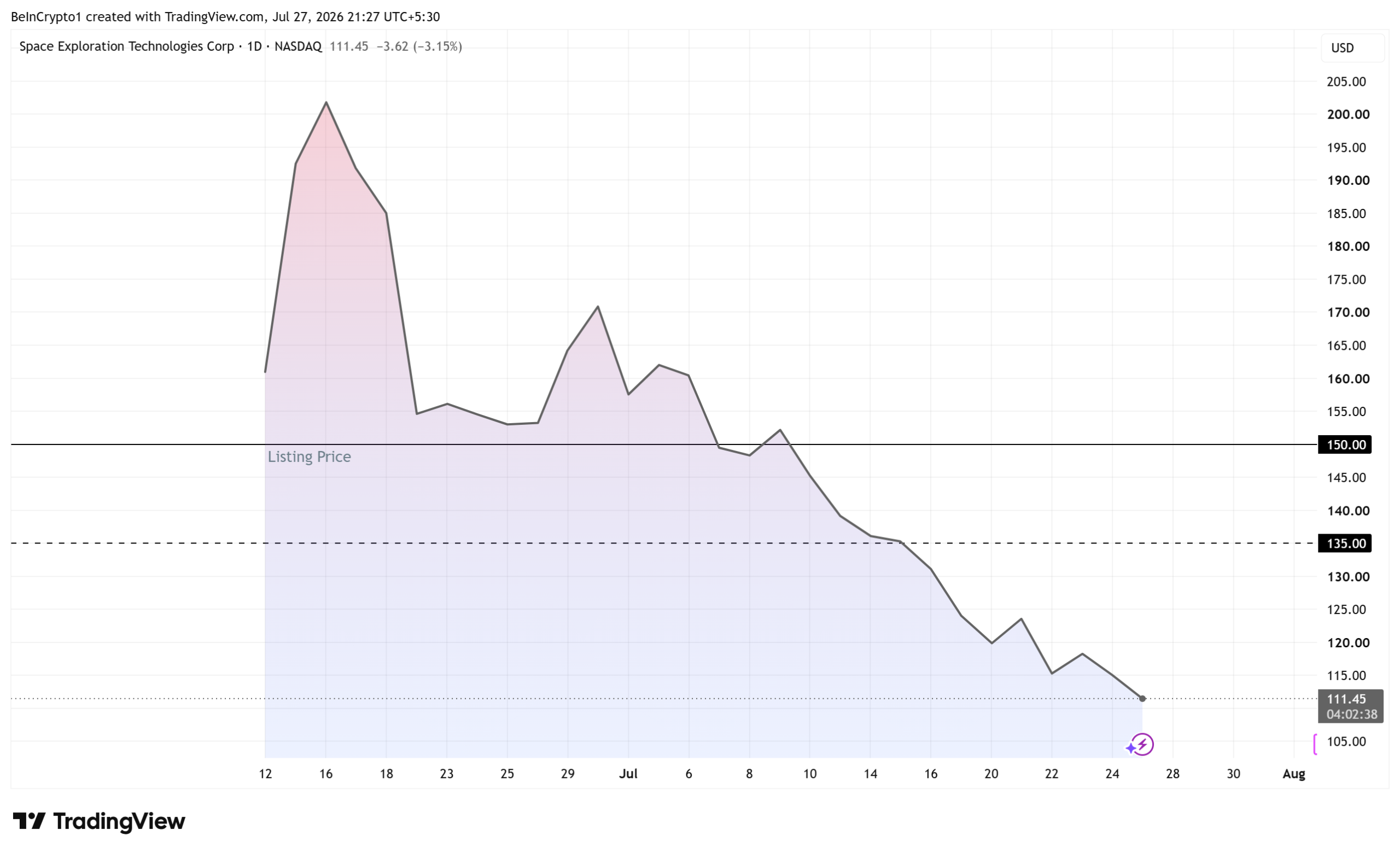
SpaceX stock (SPCX) is now worth less than it was on day one. Shares closed near $115 last week. That is about 15% below the $135 price the company set for its June 12 debut.
Anyone buying at the listing is underwater. The obvious question is whether it comes back, and there is one good place to look for the answer.

What Just Happened to SpaceX Stock
SpaceX sold 555.6 million shares at $135 each. That raised almost $75 billion and valued the company near $1.77 trillion, according to its prospectus.
The start was strong. Shares opened at $150 and closed the first day around $161. By June 16 they hit $225.64.
Then the mood turned. The stock fell 6.7% on July 22 to $115.26. That is roughly 49% below the June high.
The company is now worth about $1.52 trillion. An earlier part of the slide had already wiped $500 billion from Musk’s fortune.
Three things went wrong at once:
- Starship slipped
- Rival Blue Origin raised new money, and
- China caught a rocket booster.
That last one stung. On July 10, China landed a Long March 10B booster in a net on a sea platform. It became only the second country to bring an orbital booster home. SpaceX did it first in December 2015, so China is about a decade behind.
Peter Schiff called the drop a broader market crash warning. Now, IPO investors are sitting on nearly 20% loss.
Why Two Dates in August Matter So Much
SpaceX reports earnings for the first time on August 4. Two trading days later, on August 6, a lot of shares become sellable.
Here is why that matters. When a company lists, insiders sign a lock-up. It stops them selling for a set period.
SpaceX built its lock-up around earnings instead of the calendar. Once results are out, up to 911.5 million shares are free to trade.
Elon Musk is not one of the sellers. His shares are locked for 366 days, with no early exit, so he cannot sell until June 2027.
Follow us on X to get the latest news as it happens
The Huge Batch of Shares That Will Not Be Sold
A second batch of 455.8 million shares was also lined up for August. Almost nobody has noticed that it will not arrive.
Those shares only unlock if the stock trades 30% above the IPO price. In cash terms, that means $175.50.
It has to close there on five of the 10 days ending on the earnings date. The stock is near $115, so it cannot happen.
The fall has therefore cut the amount of stock hitting the market. Roughly half the expected August supply is already gone.
Why Meta Fits Better Than Tesla
Most people compare SpaceX to Tesla. That comparison does not work.

Tesla listed in June 2010. It sold 13.3 million shares at $17 and raised $226 million. SpaceX raised about 330 times more.
Facebook, now Meta, is the better match. It priced at $38 in May 2012 and raised $16 billion.
Both put the founder firmly in charge. Musk holds 82.4% of the voting power at SpaceX while owning less than half the shares.
He does it with a second class of stock worth 10 votes each. Ordinary shares get one vote.
Small investors piled into both deals. Early reports said SpaceX would give retail buyers 30% of the offering. CNBC later reported the real figure came in at just over 20%.
SpaceX, 2026
Meta, 2012
Tesla, 2010
IPO price
$135.00
$38.00
$17.00
Money raised
$75.0B
$16.0B
$226M
Value at listing
$1.77T
$104B
About $2B
First-day close
$161, up 19%
$38.23, up 0.6%
$23.89, up 41%
Founder voting power
82.4%
Majority
None special
Worst fall below IPO price
15% so far
53.3%
Recovered fast
Time to get back to IPO price
Pending
14.5 months
Weeks
What Meta’s Lock-Up Actually Did to the Stock
This is the part worth remembering. Meta went through the same fear in 2012, twice.

The first unlock came on August 16, 2012, covering 271 million shares. The stock fell 6.3% that day.
The second was far bigger. On November 14, 2012, some 1.19 billion shares came free.
The stock went up 12.6%. The biggest wave of selling turned into the best day.
The damage had already been done in advance. Meta bottomed on September 4, 2012, closing at $17.73. That was 53.3% below its IPO price, more than three times the fall SpaceX holders have seen.
“This is an example of why it’s so dangerous to rush into buying a heavily hyped IPO during its first few days of trading,” Peter Schiff noted.
What Would Turn SpaceX Stock Around
Meta did not recover on hope. It recovered on one number.
On July 24, 2013, it reported that mobile made up about 41% of its ad sales. Three quarters earlier the figure was near 14%.
Revenue grew 53% in a year. The stock jumped almost 30% the next day.
It finally closed back above $38 on August 2, 2013. That took 14.5 months.
SpaceX needs a number of its own. Starlink profits, launch numbers, and Starship progress are the candidates.
Analysts cannot agree on what any of it is worth. Their price targets run from $156 all the way to $239.
Morgan Stanley says a drop to $100 would price the company’s AI work at almost nothing. Chart watchers point to a falling wedge pattern that often breaks upward.

Cathie Wood still calls SpaceX her favorite long-term holding. Meanwhile Google’s SpaceX stake stays locked up for longer.
Meta took 14.5 months and one very good earnings report. SpaceX gets its first shot at that on August 4, two days before the selling can start.
The post The Closest IPO Parallel to SpaceX Is Not Tesla But This Stock appeared first on BeInCrypto.


Cointelegraph is committed to providing independent, high-quality journalism across the crypto, blockchain, AI, and fintech industries.
All news, reviews, and analyses are produced with full journalistic independence and integrity. For more details on our standards and processes, please read our Editorial Policy.
Bitcoin (BTC) heads into the end of July juggling volatility catalysts as the Federal Reserve reacts to US inflation.
Key points:
- The Fed will deliver its latest decision on interest rates as US bond yields spike, with markets seeing a September hike as likely.
- June PCE inflation is due on Thursday after hitting a three-year high of 4.1% last month
- Signs of a shift in the equities uptrend places the focus on Bitcoin’s macro correlation.
- Whales exchange inflows cool by 44% since June
Markets remain split on rate outlook
Attention turns once more to the US Federal Reserve this week, with the Federal Open Market Committee (FOMC), chaired by Kevin Warsh, set to announce its latest interest rate decision on Wednesday, July 29.
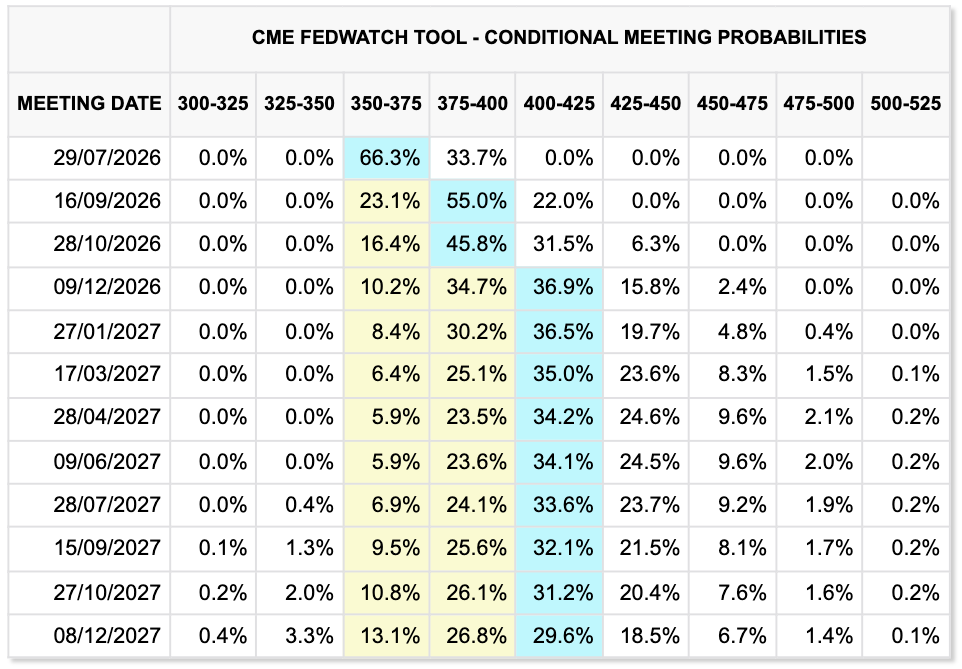
A combination of geopolitical tensions and persistent inflation pressures has reshaped expectations for Fed policy and put the possibility of further rate hikes back on the table as the US 2-year Treasury yield climbed to 4.3% last week. The latest data from the CME Group’s FedWatch Tool currently sees a 31% chance of a hike this week, with a hike at the September meeting having odds as high as 50%.
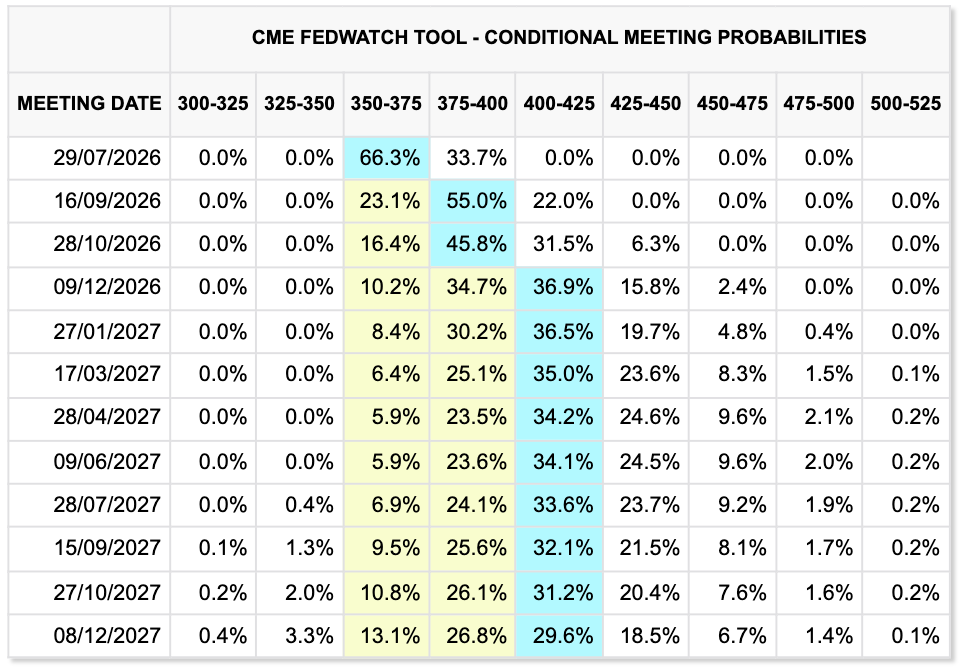
Fed target rate probabilities (screenshot). Source: CME Group
These rate hike expectations were tempered slightly as oil prices dropped 8% in the early hours of Monday as the US and Iran paused strikes. Rate hike odds therefore shifted from 37.4% to 33.7%. Ongoing developments in the Middle East thus continue to introduce volatility into the macroeconomic outlook, even as PPI inflation data released earlier in the month came in below expectations.
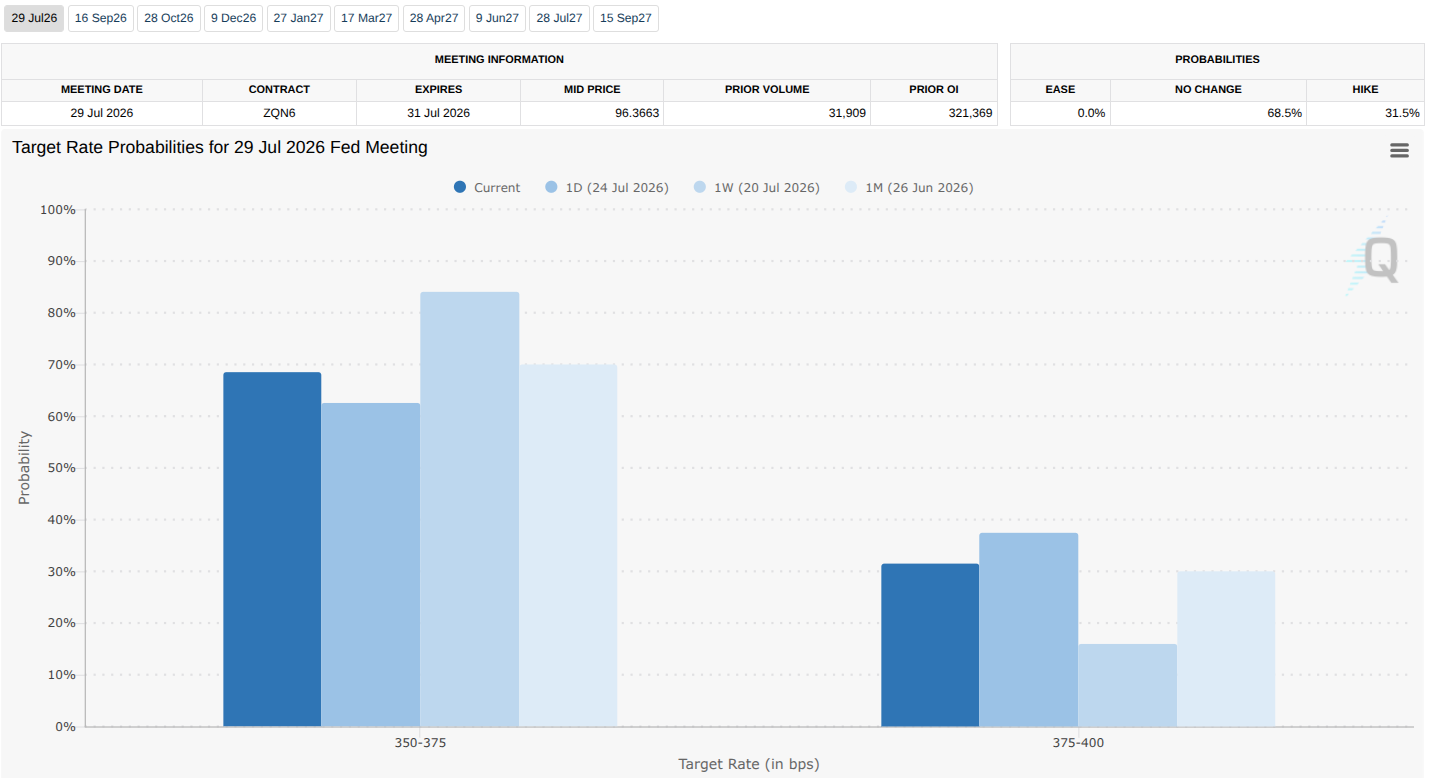
Fed target rate probability comparison for July FOMC meeting (screenshot). Source: CME Group
Commenting, trading resource Mosaic Asset Company also noted a pending upward breakout in 30-year bonds. Although the long end of the bond curve now plays a diminished role in funding the US government, this could notionally add to pressure on Warsh as he shapes his language at the post-FOMC press conference.
“The 30-year Treasury yield is also testing a key breakout level once again. In May, the 30-year yield saw a false break above the 5% level which has served as resistance since late 2023,” it summarized in the latest edition of its regular newsletter, The Market Mosaic.
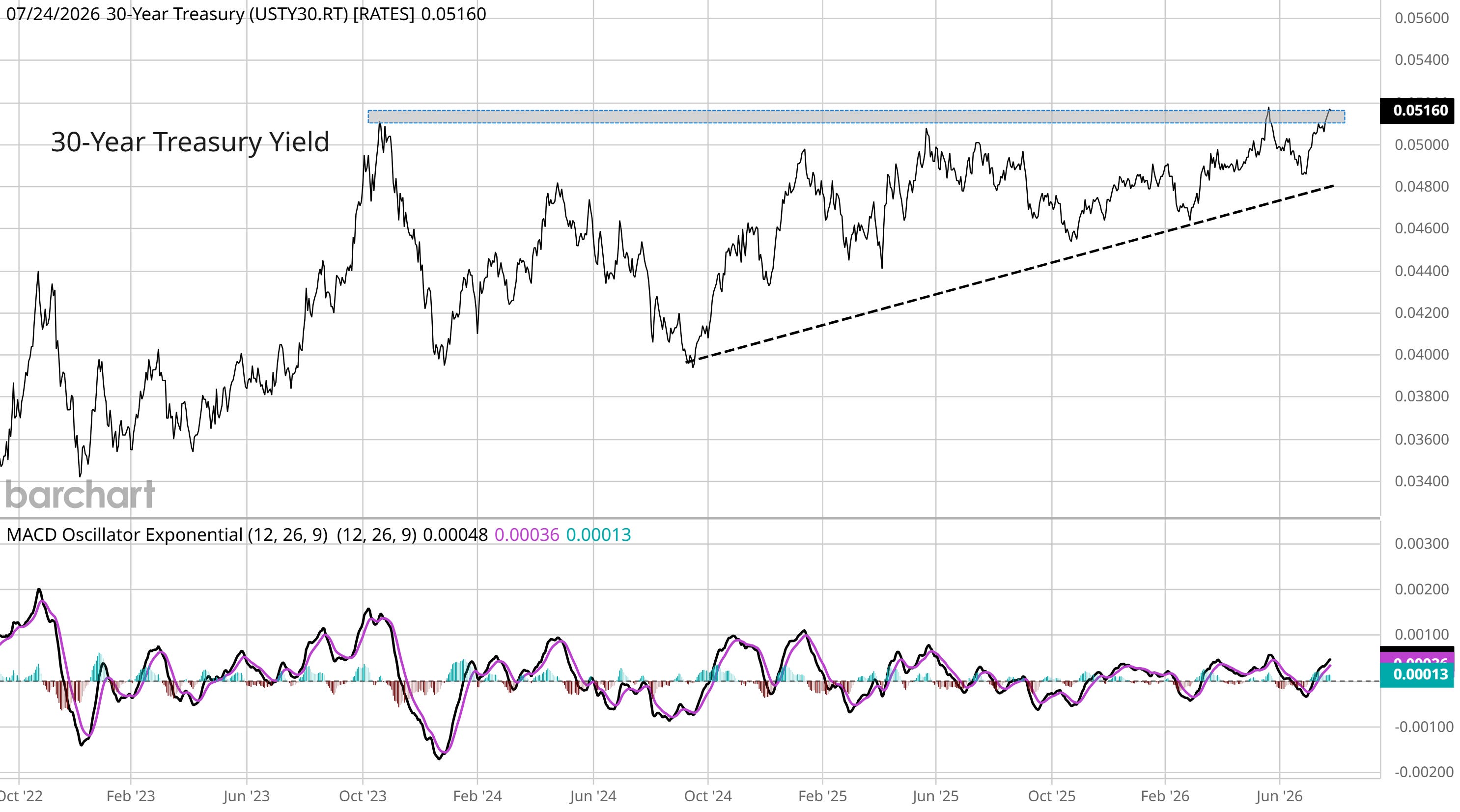
US 30-year bond-yield data. Source: Mosaic Asset Company
Even before the latest turmoil, new Fed chair Warsh had steered clear of dovish language on the economy and kept his post-FOMC statement and press conference notably brief.
“Inflation remains elevated relative to the Committee’s 2 percent goal, in part reflecting supply shocks that have driven price increases in certain sectors, including energy,” he said at the time.
PCE inflation seen falling from three-year high
Beyond the FOMC, markets will be watching the Personal Consumption Expenditures (PCE) index on Thursday for fresh signals over the impact of the US-Iran war on inflation trends. The June print of the index, currently sits at three-year highs.
PCE volatility can have a snap impact on risk-asset performance as traders reprice potential Fed reactions. June’s release coincided with Bitcoin dropping to macro lows around $58,000.
Prefacing its latest analysis, the International Monetary Economics Network (IMEN) predicted that PCE would be moderately lower compared to May’s 4.1% year-on-year tally. “U.S. inflation: We currently expect June PCE inflation to be 3.7% year‑over‑year,” it wrote on X.
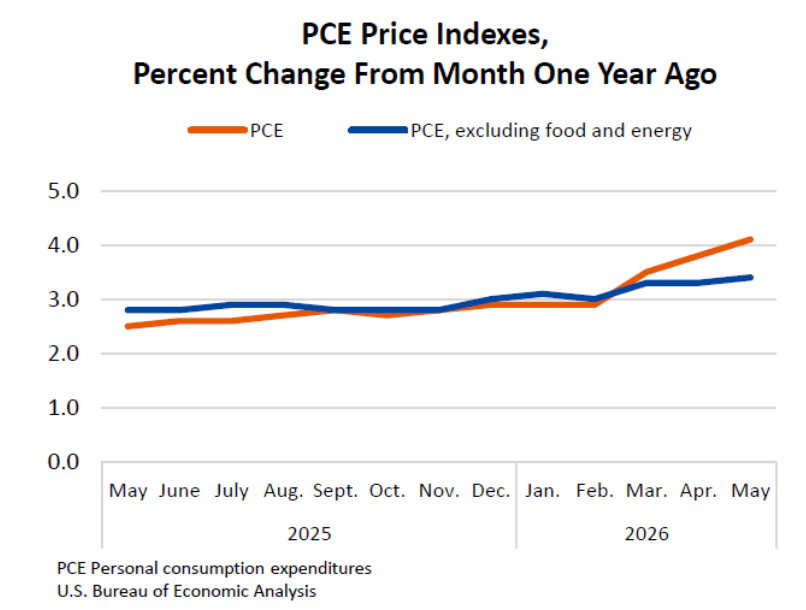
US PCE inflation data (screenshot). Source: Bureau of Economic Analysis
Correlation between Bitcoin and equities remains absent
On higher timeframes, correlations between Bitcoin and major equity indices have largely disappeared. Data from TradingView currently puts the daily correlation between BTC/USD and the S&P 500 with a 20-week loopback window as practically absent, at its lowest levels since March. Against the tech-heavy Nasdaq Composite Index, meanwhile, its current correlation coefficient of 0.11 was last observed in mid-February. While correlations on the weekly timeframe move slowly, bearish geopolitical and macro events have the potential to make the two asset classes move in lockstep again.
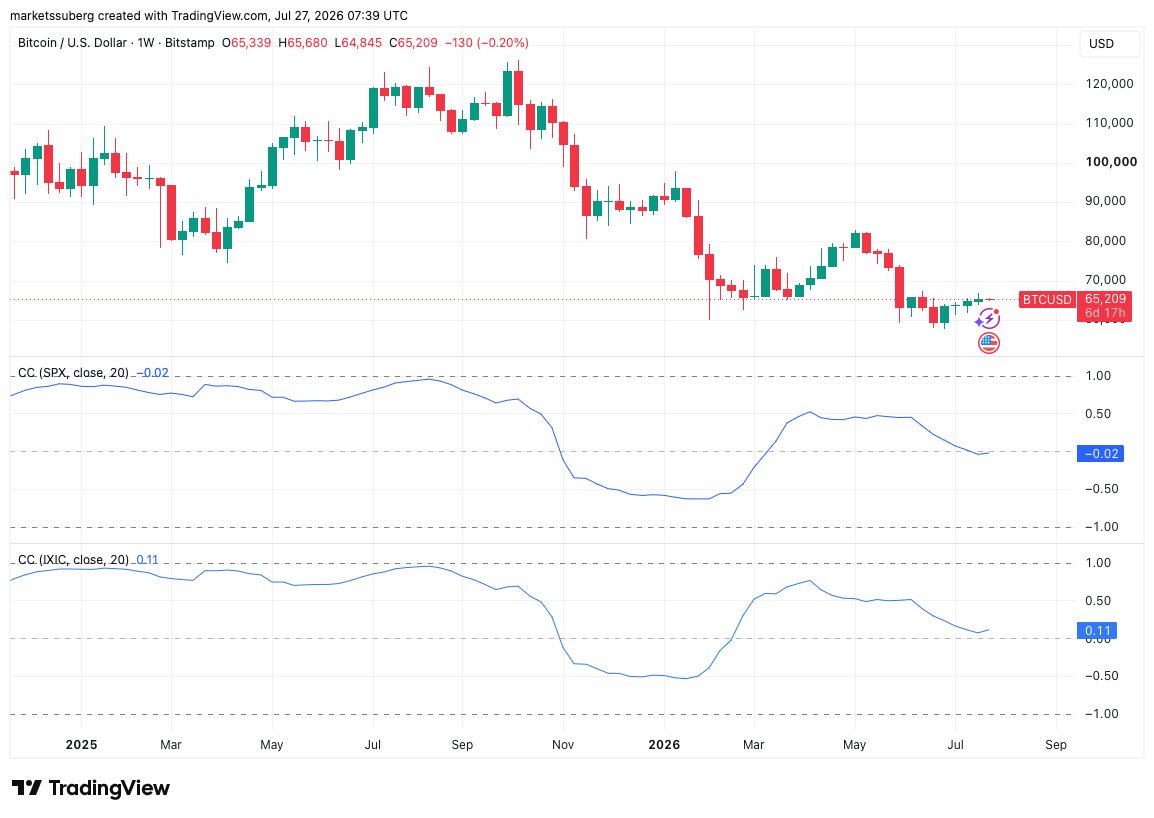
BTC/USD one-week chart with rolling 20-week stocks correlation. Source: Cointelegraph/TradingView
For now, corporate earnings in the US have continued to surpass expectations. However, given the historically high valuations, this is unlikely to shield the market from potential pullbacks. Several major US tech stocks saw significant drawdowns last week. The Magnificent 7 falling by an aggregate 5.3% through Friday after $GOOGL and $TSLA had already suffered sell-offs earlier in the week.
In spite of this, “Alphabet, $GOOGL , is the single largest margin contributor after significantly beating earnings estimates,” the Kobeissi Letter commented on the topic at the weekend.
“Meanwhile, 86% of reporting S&P 500 firms have so far beaten EPS estimates, while 80% have exceeded revenue expectations. AI is driving historic earnings growth.”
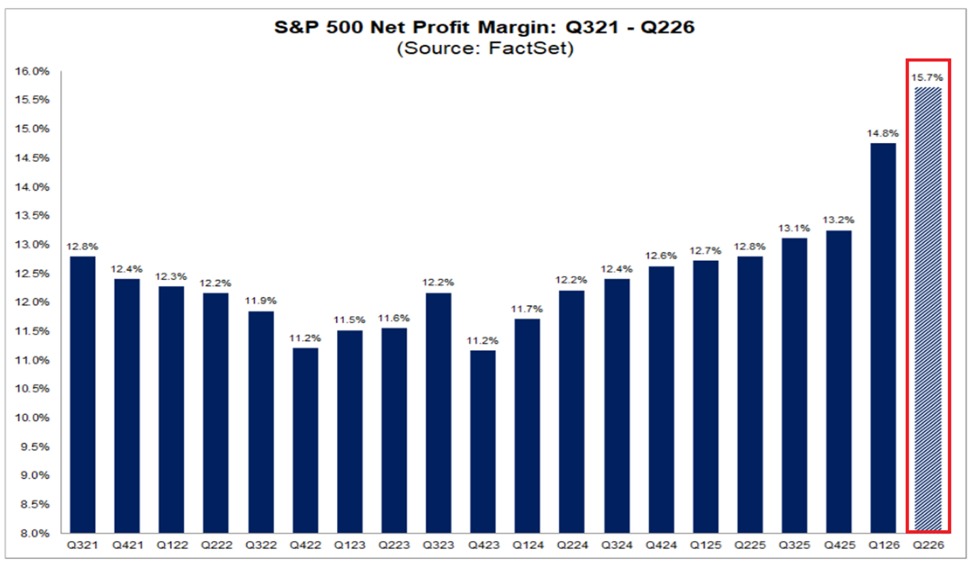
S&P 500 net profit-margin data. Source: The Kobeissi Letter on X.com
Mosaic Asset Company highlighted the risks that the rate environment may exert on US equities.
“Rising rates across the yield curve could keep pressuring stock prices, where indexes like the S&P 500 and Nasdaq peaked in early June and are now losing key support levels. At the same time, market breadth is deteriorating while the backdrop for seasonality is transitioning from a bullish tailwind to bearish headwind. Seasonality during mid-term election years also tends to produce lower average returns and larger drawdowns.”
With these emerging hurdles, the S&P 500 is at risk of losing its bullish setup altogether, Mosaic warns.
“The S&P already lost one key support level with the 50-day moving average (MA – black line). If trendline support in the triangle gives way, that could set up a test of the 200-day MA (green line) that’s currently near the 7,000 level (or 5% downside from current levels),” it added alongside an explanatory chart.
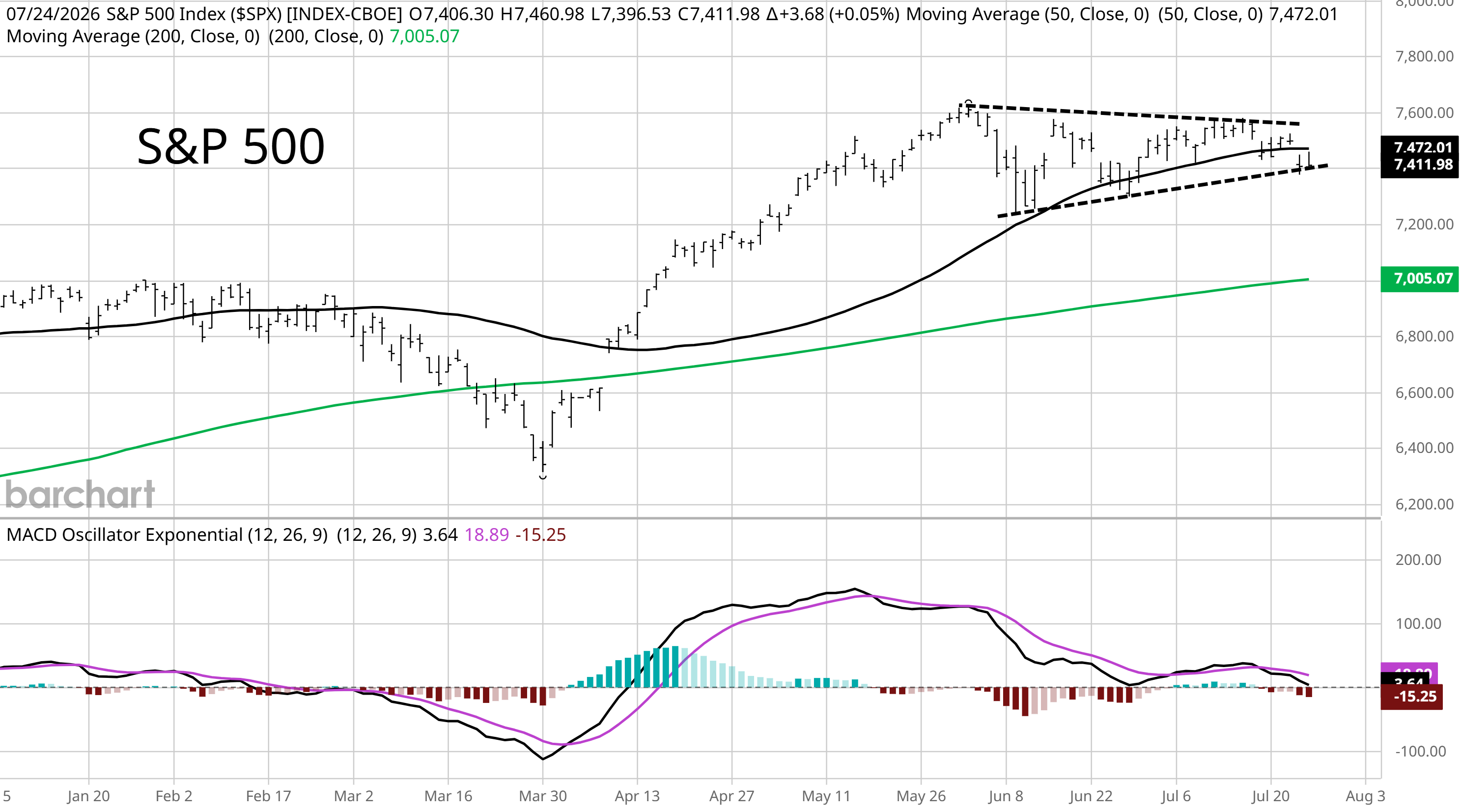
S&P 500 data. Source: Mosaic Asset Company
On shorter time frames, the picture remains fluid, with a pause in hostilities between the US and Iran providing a bullish impulse across risk assets. US WTI crude oil dropped as low as $83 per barrel to start the week, having previously eyed $95.
“The market is beginning to price-in a peace deal again,” Kobeissi responded.
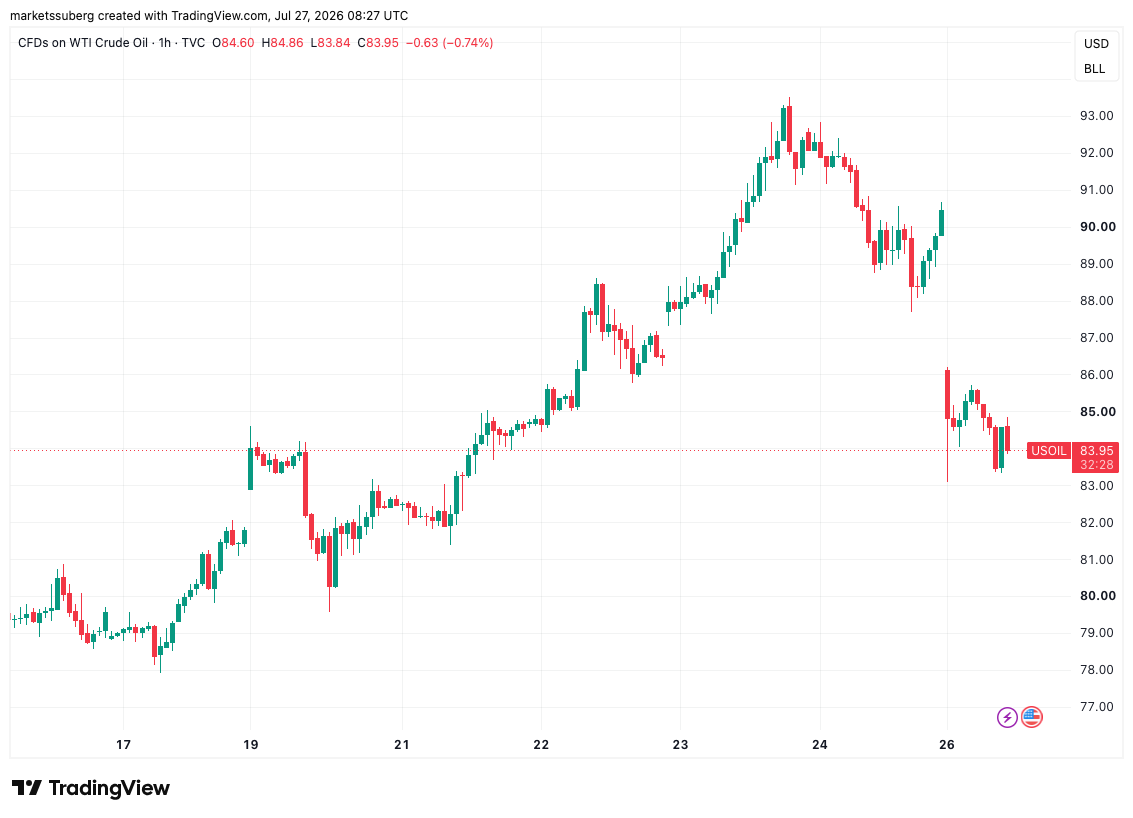
CFDs on US WTI crude oil one-hour chart. Source: Cointelegraph/TradingView
“Boring” BTC price range tests 50-month trend line
Bitcoin went on to seal new local highs after Sunday’s weekly close, reaching $65,680 on Bitstamp. Still in a familiar range, BTC/USD battled its 50-month exponential moving average (EMA) trend line, having previously flipped it to resistance in a copycat move from the 2022 bear market.
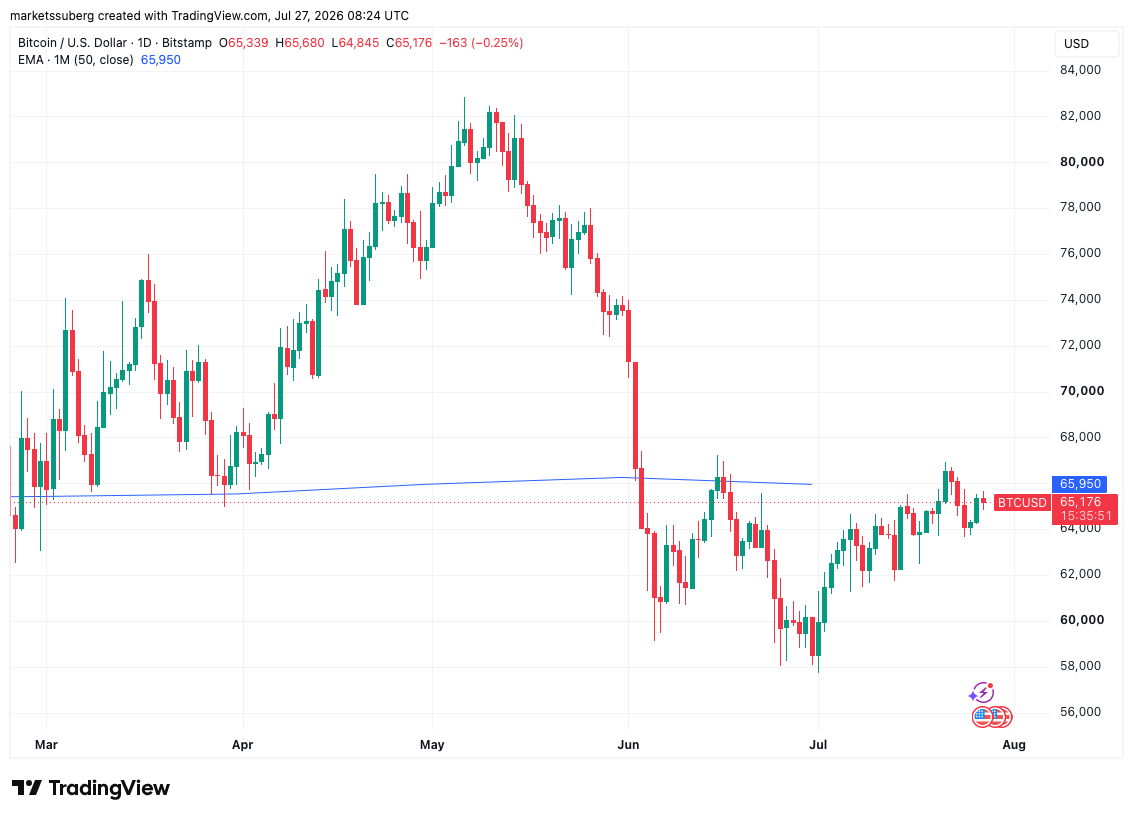
BTC/USD one-day chart with 50-month EMA. Source: Cointelegraph/TradingView
Commenting on the current market setup, trader and analyst Rekt Capital flagged resurgent sell-side pressure.
“The more seller-dominant the volume becomes while Bitcoin is at resistance, the greater the chances for a rejection from here,” he warned X followers on Sunday.
Rekt Capital brought the 200-week simple moving average (SMA) into the equation, describing price as “sandwiched” between it and its 50-month counterpart.
“Continued price compression here is unsustainable and will eventually force major volatility,” he forecast.
“And if the seller volume keeps coming in at this rate, then there’ll likely be a breakout on seller volume to precede a rejection from this local resistance area.”
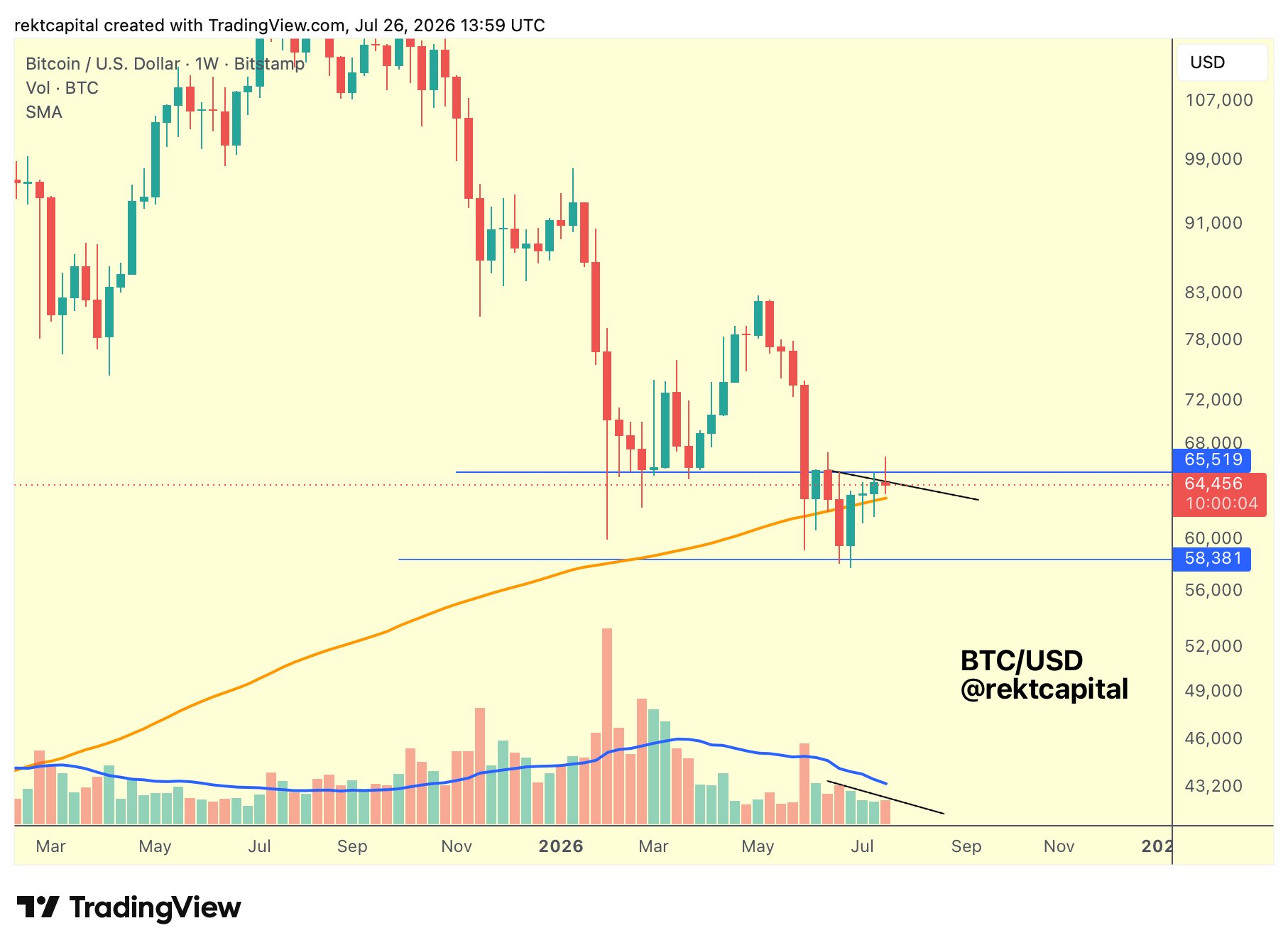
BTC/USD one-week chart. Source: Rekt Capital on X.com
Binance whale inflows nearly halve since mid-June
Commenting on the FOMC meeting and its impact on crypto markets, onchain analytics platform CryptoQuant sees a potential knock-on effect for sell-side pressure on major exchanges.
Related: BTC supply in profit eyes 60%, but analysis hints recovery may ‘roll back over’
According to their data, BTC inflows from whales to Binance, have dropped by up to 44% since June 12, while retail inflows fell 22%.
“This leaves retail inflows at roughly twice the level of whale inflows, with a gap of $3.9 billion,” contributor Amr Taha wrote in a blog post on Monday.
“The divergence suggests that the composition of BTC transfers into Binance has shifted: retail participants are currently significantly more active than whales in sending BTC to the exchange.”
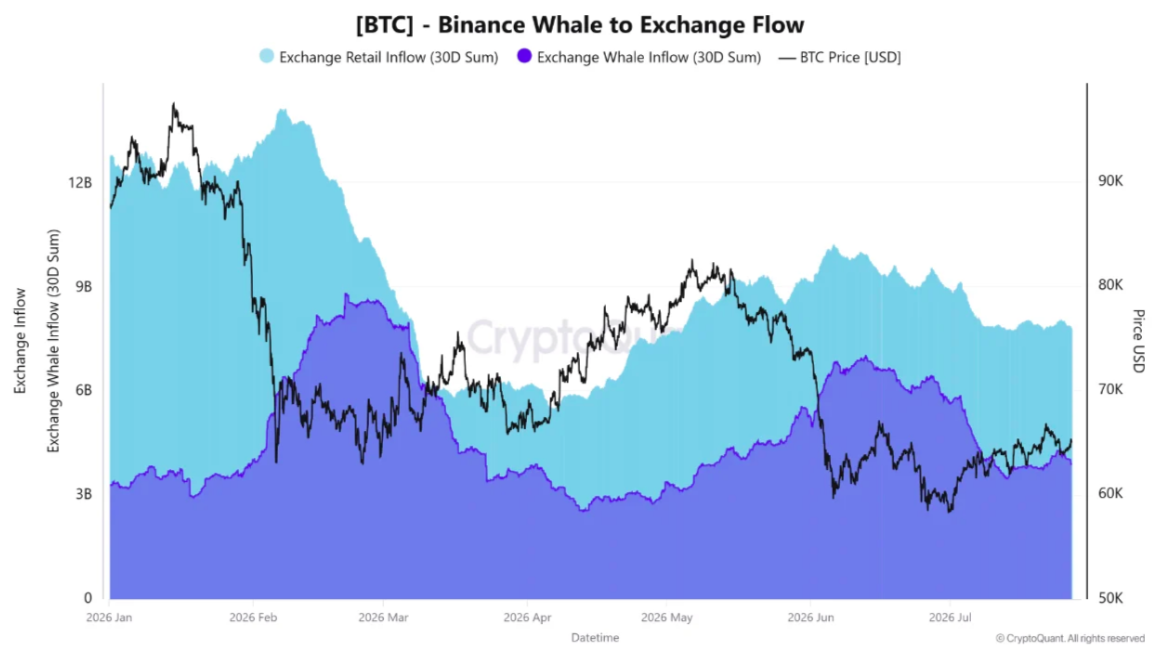
Bitcoin whale inflows to Binance (screenshot). Source: CryptoQuant
Taha described the FOMC meeting as a “major macro catalyst” that could reshape the approach of all investor cohorts to the market.
“With retail inflows now running at 2x whale inflows, Wednesday’s Fed decision could provide an important test of whether the current divergence between the two BTC cohorts persists or begins to converge,” he concluded.
As Cointelegraph reported, Binance saw single-day withdrawals of over 9,000 BTC last week.


The deal brings wallet technology to Payward’s enterprise platform, potentially reducing the number of infrastructure providers businesses need to integrate with.
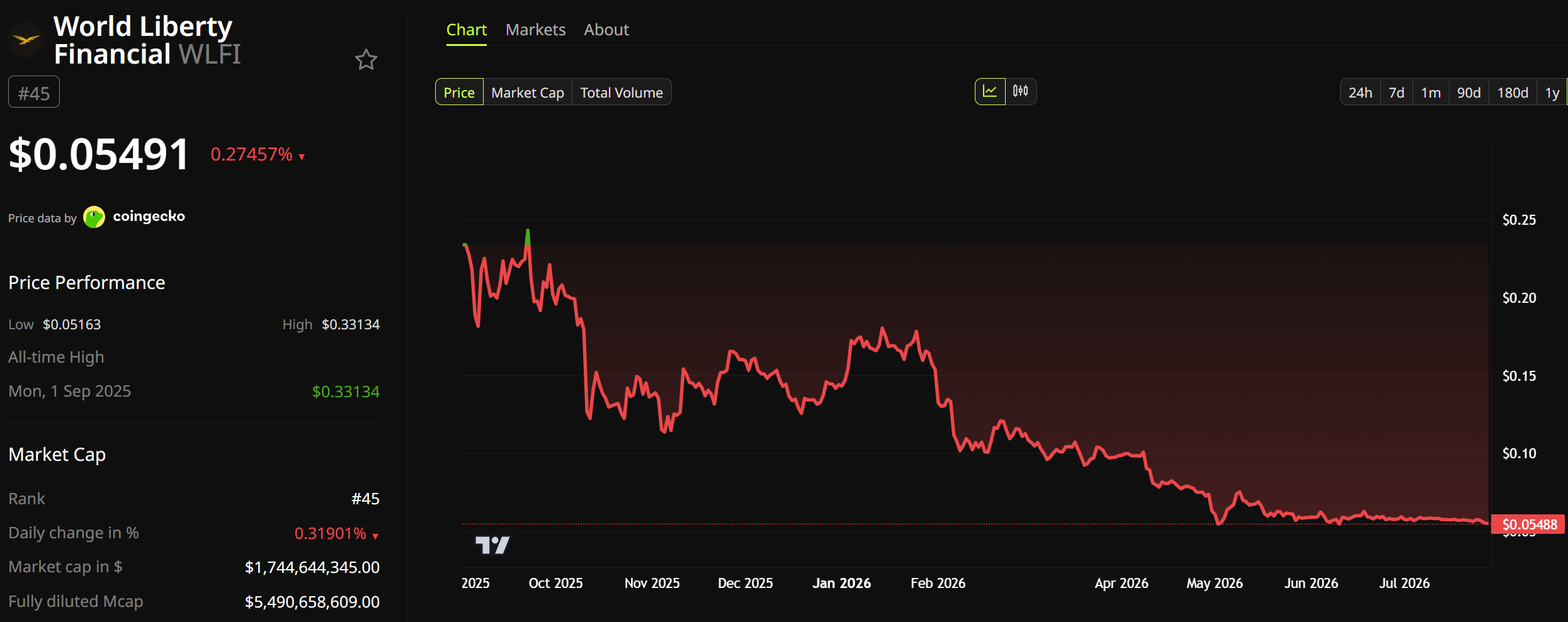
Nic Carter reportedly almost joined World Liberty Financial (WLFI), the Trump family crypto venture. He allegedly walked away when cofounder Steve Witkoff said “memecoin” as “me-me” coins.
Carter described the 2024 Miami meeting to New York magazine. World Liberty says his account is wrong, and that it never offered him the job.
Witkoff Could not Explain the Product
Carter invests for Castle Island Ventures. He also voted for Trump in 2024. Witkoff wanted him as an advisor. But Witkoff could not describe the decentralized finance (DeFi) business.
“He didn’t know what crypto or DeFi was. He didn’t know what the pitch was,” the New York feature reported, citing Nic Carter.
Witkoff had one clear goal, Carter says. The launch had to happen before the election. That way Trump was still a private citizen.
Carter turned the role down. He warned the project could cost Trump votes. That is when Witkoff’s tone hardened.
World Liberty’s own Gold Paper supports part of that read. It says the sole utility of WLFI is governance. Holders get no right to any return or dividend.
WLFI Holders are Still Locked In
WLFI trades near $0.055, against a record of $0.3313 on Sept. 1, 2025. That was the first day of open trading. The price fell 40% before it ended.

World Liberty released only 20% of each investor’s tokens that day. Just 31.8% of the supply trades now. An April plan unlocks the rest from 2028. Holders who vote against it stay locked.
The company also added a contract function letting it freeze any wallet. That change landed eight days before trading opened.
Justin Sun was the largest early backer. He sued World Liberty Financial in California for fraud. The company countersued for defamation in Miami. Both cases remain at an early stage.
The venture has been lucrative for the family even as the token sank. Reporting on the Trump family crypto windfall tracks how little of it reached ordinary holders.
Carter saw a token with no business behind it. Two years on, most of the supply is still frozen. The unlock schedule runs past the end of Trump’s term.
The post VC Reportedly Rejected Trump Crypto Venture After Steve Witkoff’s Memecoin Blunder appeared first on BeInCrypto.

New York City just published a list of 31,000 homes. It names the streets, the buildings, and the apartment numbers. Crypto founders say it is a map to rich people’s front doors.
The city released the file on July 24. It exists to find second homes that owe a new tax. Officials expected about 10,000 properties. They got three times that.
What New York City Actually Published
The tax started July 1. It targets homes that are not where the owner actually lives.
A condo or co-op lands on the list at $1 million. A house has to be worth $5 million.
That $1 million line matters. It is why the roll holds 24,700 apartments but only 6,800 houses.
State law told the city to name every property that “may be subject” to the tax. It also told the city to identify co-op apartments by street address and unit number.
So the file does not just flag a building. It flags the apartment.
Ben Williams is a property tax lawyer at Rosenberg & Estis. He testified at the city’s hearing on the rules. He told Bloomberg the list is far too broad, and that many homes will come off it on appeal.
Spectrum News NY1 reporter Bernadette Hogan flagged the file, noting that owner names sit in the spreadsheet as well.
Bills go out by August 30. Owners then get 30 days to object. The final list is due December 31.
Crypto Founders Call It a Mass Doxxing
Uniswap founder Hayden Adams searched a few luxury buildings. He found the homes of people he knows. He also found nearly every other unit in those towers.
“Not only were their units listed, but nearly every unit in the entire building was listed. They clearly took an incredibly expansive view of ‘could be’ and just doxxed a huge percentage of all expensive apartments in new york city,” wrote Adams.
That is the law working as written. The city has to list every unit that might owe the tax. At a $1 million threshold, that pulls in whole buildings.
Helius CEO Mert Mumtaz made a narrower point. The data was already public, he said. It was just messy. Now it is clean, sorted, and easy to download.
Castle Island Ventures partner Nic Carter went further. He pointed to the France crypto kidnapping toll, which has climbed all year.
“So this is a list of wealthy people and their addresses. As we’ve seen in France and Sweden this leads to crypto kidnappings torturings and murders. Yes real estate records are semi public but this is an easily searchable database and target list,” Carter stated.
Attack Data Gives the Warning Weight
CertiK counted 52 wrench attacks in the first half of 2026. A wrench attack is simple. Criminals use force or threats to make someone hand over their crypto.
The count was 39 a year earlier. It follows the most violent year recorded for crypto crime.
The sums got much bigger too. Victims faced $124.2 million in the first half of 2026, up from $10.5 million. The average case jumped from $270,000 to $2.39 million.
One number stands out. Home invasions rose from a single case to 20.
But the map does not point at New York. France had 33 of the 52 attacks. Europe had 39. The United States had four. Sweden, which Carter named, had two.
The risk is about method, not place. CertiK calls it “data-driven targeting.” Attackers stitch together leaked databases, property records, and tax files. They build a full profile before they ever knock on a door.
That is not theory. French investigators say a tax office employee sold crypto investor data to criminal networks. The same fear followed new UK tax rules that make exchanges hand over user data.
CertiK now urges regulators to lock down government databases that tie people to crypto and addresses.
New York’s list holds no crypto data at all. What it adds is the address. That only helps someone who already knows you own crypto.
The final roll arrives December 31. How far it falls below 31,000 will show how seriously the city took the warning.
The post Finding Crypto Millionaires in New York Just Got Easier appeared first on BeInCrypto.

“Crypto + AI” is the new “blockchain + [anything].” A desperate rebrand for failing business models, and investors aren’t buying it.
The Pattern We’ve Seen Before
2017: Every company added “blockchain” to their name and watched their stock price triple.
Kodak became KodakCoin. Long Island Iced Tea became Long Blockchain Corp. A company that made fruit juice rebranded to blockchain and saw its shares surge 200% overnight.
None of it was real. All of it eventually collapsed.
2026: The same thing is happening with AI. Except this time, it’s crypto companies doing the rebranding—and it’s failing faster.
What’s Actually Happening Right Now
Bloomberg reported it today: the once-hot market for cryptocurrency treasury stocks has imploded. Companies that bet their entire identity on Bitcoin accumulation are now pivoting to artificial intelligence to win back investors.
The numbers are brutal:
K Wave Media, a former Bitcoin accumulator that shifted to data center development, has seen its shares fall 71% since rebooting in May.
Satsuma Technology approved the full liquidation of its 668 BTC. The move was so drastic it triggered the company’s delisting from the London Stock Exchange. A company deleted itself from a major exchange to exit crypto.
Sequans Communications sold 1,025 BTC, along with almost 80% of its remaining holdings, just to repay convertible debt.
MARA Holdings and Bitdeer have been selling Bitcoin to repay debts while simultaneously redirecting resources toward AI data centers.
Even Strategy, formerly MicroStrategy, the loudest evangelist for the corporate Bitcoin treasury model, sold approximately 3,620 BTC and authorized further sales. They still hold over 840,000 BTC, making them the largest corporate holder. But even the true believer is selling.
The corporate Bitcoin treasury model isn’t just struggling. It’s unwinding in real time.
Why The AI Pivot Isn’t Working
Here’s what these companies are betting on: if we say “AI” enough times, investors will forget we said “Bitcoin” and give us another chance.
It’s not working. K Wave Media’s 71% decline happened after the pivot, not before.
Why? Because investors aren’t stupid. They’ve seen this movie before.
When a company pivots its entire identity to chase a hot trend, it signals one thing: the original strategy failed, and management has no real conviction about what comes next.
A Bitcoin treasury company that suddenly loves AI data centers isn’t a tech innovator. It’s a company trying to survive by attaching itself to whatever narrative is currently attracting capital.
The market can tell the difference between a genuine AI company and a crypto company that bought a few Nvidia chips and updated its press release.
Turns out, so can Bloomberg.
Brian Armstrong Saw This Coming
Coinbase CEO Brian Armstrong said it this week, publicly:
Crypto startups that rebrand to AI are missing the point. Blockchain technology isn’t competing with AI; it’s the infrastructure that will underpin future automation.
Armstrong’s argument is precise: these aren’t two separate things you can choose between. AI needs infrastructure. Blockchain provides trustless, verifiable infrastructure for AI agents, AI transactions, AI governance.
Companies pivoting from “crypto” to “AI” as if they’re alternatives are making a category error. And they’re making it because they’re panicking, not because they have a strategy.
The companies that will survive aren’t the ones that abandoned crypto for AI. They’re the ones that understood crypto is the infrastructure for AI and built accordingly.
The Real Problem: Business Models Built On Hype
Let’s be honest about what the corporate Bitcoin treasury model actually was.
Companies like MicroStrategy (now Strategy) made a bet: buy Bitcoin, hold it, watch the price go up, use the appreciation to justify your existence as a company.
That’s not a business. That’s a leveraged Bitcoin position dressed up as corporate strategy.
When Bitcoin price goes up, you look like a genius. When it stagnates, as it has for much of 2026, hovering around $64–65K, you look like a company with no real business model, sitting on an asset that isn’t moving, with investors asking uncomfortable questions about your actual operations.
The crypto treasury model required perpetual Bitcoin appreciation to work. The moment appreciation slowed, the model broke.
And now those same companies are trying to claim they were always AI companies really.
The Difference Between Real AI And AI Panic
There’s a meaningful difference between companies building genuine AI infrastructure and companies slapping “AI” on a failing crypto strategy.
Real AI infrastructure companies:
- Have actual compute resources being used by actual customers
- Generate revenue from AI services, not just from asset appreciation
- Have technical teams building real AI products
- Can explain what their AI actually does
Crypto companies pivoting to AI:
- Announce plans to build AI data centers
- Haven’t yet generated meaningful AI revenue
- Are selling Bitcoin to fund the pivot
- Can’t clearly explain how AI fits their original thesis
K Wave Media’s 71% decline after its pivot tells you which category investors think it falls into.
The Deeper Pattern: What Happens When A Narrative Breaks
Every market cycle has a dominant narrative. The narrative attracts capital. Capital inflates valuations. Valuations attract more capital. Until the narrative breaks.
2021–2022 crypto narrative: Bitcoin is digital gold, crypto is the future of finance, every company should have a Bitcoin treasury.
Companies built entire identities around that narrative. Stock prices reflected narrative premium, not business fundamentals.
2023–2025: Narrative weakens. Institutional adoption happens but stabilizes rather than explodes. Bitcoin sits at $60–65K instead of going to $200K as predicted. The narrative premium evaporates.
2026 desperation move: Attach to the new dominant narrative (AI) before investors fully price in that the old narrative failed.
The problem: AI investors are sophisticated. They know what real AI companies look like. A Bitcoin accumulator with an Nvidia press release isn’t one of them.
Who’s Actually Winning
While crypto treasury stocks implode, two categories of companies are doing well:
1. Companies that built genuine products on blockchain infrastructure
Coinbase, whatever its challenges, built an actual exchange with actual users generating actual revenue. It has a real business that doesn’t depend on Bitcoin price appreciation alone.
2. Companies building AI infrastructure that happens to use blockchain
The companies Armstrong is describing: building the trustless infrastructure layer that AI agents will need to transact, verify, and operate at scale. This is real. It has genuine demand. It’s not a rebrand.
The companies failing are the ones that were never really building anything, just accumulating an asset and hoping appreciation would substitute for operations.
The Uncomfortable Question For Every Crypto Company
If your business model requires the price of Bitcoin to keep going up forever to justify your existence, what do you actually do?
That’s the question the imploding treasury stocks can’t answer.
And “we’re pivoting to AI” isn’t an answer. It’s a postponement.
The companies that survive the current shakeout will be the ones that had actual operations, actual users, actual revenue— that happened to use blockchain or crypto as infrastructure.
The ones that don’t survive will be the ones that confused “holding Bitcoin” with “building a company.”
The AI rebrand just delays the reckoning by a quarter or two.
What Comes Next
Expect more of this: crypto companies announcing AI pivots, investors not being fooled, stock prices continuing to decline, companies eventually running out of runway.
Expect fewer of this: genuine companies built on blockchain infrastructure, serving real users, generating real revenue—that will be fine.
The shakeout was always coming. The Bitcoin treasury model worked during appreciation. It was never a real business. Now that appreciation has slowed, the reality is visible.
The AI pivot is the last gasp. Not a new beginning.
The Lesson That Never Gets Learned
Every market cycle produces the same story:
Narrative attracts capital. Capital inflates valuations beyond fundamentals. Smart money exits. Companies desperately rebrand to the next narrative. Doesn’t work. Collapse.
2017: Blockchain everything. 2021: NFT everything, metaverse everything. 2024–2025: Bitcoin treasury everything. 2026: AI everything.
The companies that survive every cycle are the ones that were never chasing the narrative in the first place. They were building something real that happened to use the technology everyone else was hyping.
Those companies exist in crypto. They’re just not the ones making headlines this week.
If your crypto strategy requires Bitcoin to go up forever, you don’t have a strategy. You have a bet. And bets eventually lose.


Cantor Fitzgerald is advising Swiss digital asset lender AMINA Bank on a possible public listing as the Wall Street firm expands its role in crypto capital markets.
Summary
- AMINA Bank is considering a public listing, although its valuation and preferred exchange remain undisclosed.
- Cantor’s mandate follows its onchain IPO partnership with Securitize, announced earlier in July.
- AMINA recorded 69% revenue growth in 2024 and holds regulatory approvals in Switzerland and Europe.
- Cantor is also reportedly pursuing a separate deal involving up to 30,000 Bitcoin from Blockstream.
AMINA Bank considers a public listing
According to reports, Cantor Fitzgerald is advising AMINA Bank, formerly known as SEBA Bank, as the Swiss crypto lender assesses a potential entry into public markets.
Discussions remain at an early stage, and neither company has disclosed a target valuation, timetable or possible listing venue. A completed transaction would make AMINA one of the few publicly traded banks focused primarily on digital asset services.
The bank operates under a licence from the Swiss Financial Market Supervisory Authority, or FINMA. Its services include cryptocurrency custody, trading, lending and staking for institutional and private clients.
AMINA reported a 69% increase in revenue during 2024. That performance positioned it as Switzerland’s fastest-growing crypto bank at the time, although updated financial figures for 2025 and 2026 were not provided.
A listing would expose the bank to greater financial disclosure and corporate governance requirements. It could also give public-market investors direct exposure to a regulated crypto banking business rather than a cryptocurrency exchange, miner or treasury company.
Cantor expands its crypto capital markets business
The advisory role builds on Cantor’s wider attempt to connect traditional capital markets with blockchain-based financial infrastructure.
As previously reported by crypto.news, Cantor partnered with tokenization company Securitize on July 15 to support blockchain-based initial public offerings and follow-on share sales.
Cantor will provide equity capital markets and trading services under that agreement. Securitize will supply the technology needed to issue, distribute and service securities onchain, while its SEC-registered broker-dealer, Securitize Markets, will participate in offerings and settlements.
That structure differs from platforms that create blockchain-based versions of shares already trading on public exchanges. The partnership aims to use blockchain infrastructure during the original issuance process while keeping offerings within existing securities rules.
Advising AMINA fits that strategy, although no indication has emerged that the bank would use Securitize’s infrastructure for its potential listing.
AMINA builds its European regulatory reach
AMINA’s regulatory position could form an important part of its case to public investors.
Alongside its Swiss banking licence, the group secured authorization under the European Union’s Markets in Crypto-Assets framework through its Austrian subsidiary. AMINA described itself as the first international crypto banking group to obtain a MiCA licence.
The approval allows the subsidiary to offer regulated crypto services across European Economic Area markets through MiCA’s passporting system, subject to applicable local requirements.
AMINA expanded its asset support in May 2026 by becoming the first regulated bank to provide custody and trading services for Canton Coin. Canton Network focuses on blockchain infrastructure for regulated financial institutions.
For US investors, access to AMINA shares would depend on where the bank lists and whether American brokerages support the security. A US listing would also bring additional Securities and Exchange Commission registration and disclosure requirements, but the parties have not identified the United States as a venue.
Cantor pursues a separate $3 billion Bitcoin deal
Cantor is also reportedly negotiating with Blockstream co-founder Adam Back over a transaction that could place more than $3 billion in Bitcoin into a publicly traded vehicle.
Under the proposed deal, Blockstream would contribute as many as 30,000 BTC to Cantor Equity Partners 1, a special purpose acquisition company that raised $200 million in January. Blockstream would receive shares in return, while the vehicle would be renamed BSTR Holdings.
The agreement could reportedly be signed as early as this week, although its terms remain subject to change.
Cantor has not disclosed when AMINA might decide whether to proceed with its listing. The bank’s chosen exchange, valuation and offering structure will determine whether the plan develops into a conventional IPO, another public-market transaction or an onchain issuance tied to Cantor’s tokenization strategy.

Bryan Kohberger seeks to withdraw guilty plea in Idaho student murders

New technical education routes to be offered at 14 in England

Elon Musk Grok AI Predicts XRP Price Prediction That Has Ripple Investors Excited


-

 Fashion3 days ago
Weekend Open Thread: Brooks Brothers
-

 Crypto World7 days ago
Grayscale Files For Worldcoin ETF, WLD Registers Sharp Rise
-

 NewsBeat6 days ago
How a former Blue Peter presenter stunned America’s Got Talent judges
-

 Tech23 hours ago
Intel is reversing course and bringing hyper-threading back to its server chips
-

 Tech7 days ago
Sail Virtually Aboard The “Itanic” With IA-64 Emulator
-
 Tech7 days ago
Turtle Beach Command Series KB7 review: a nifty screen-equipped gaming keyboard
-
 Business6 days ago
New Jersey voter registration controversy explained: How 6,600 noncitizens got on the rolls, and what happens next
-
 Entertainment6 days ago
Johnny Depp’s R-Rated Gothic Cult Classic Gets New Release Ahead of Sydney Sweeney Remake
-

 Crypto World5 days ago
Ethics, other provisions in crypto Clarity Act to be further discussed
-

 Politics12 hours ago
Luke Littler dismantles Gerwyn Price to retain title in Blackpool
-
 NewsBeat7 days ago
Shanghai science forum photos show China’s AI and robotics advances in rivalry with US
-
 Sports1 day ago
Commonwealth Games boxing: Jadumani Singh seals dominant 5-0 win over Pakistan’s Sumama Rehman to enter quarter-finals | Commonwealth Games News
-

 Sports4 days ago
2026 3M Open leaderboard: Scottie Scheffler finds putter in Round 1, sits three back
-

 News Videos4 days ago
The Peugeot Family: How 200 Years of an “Old Money” Dynasty Died in A Boardroom
-

 Fashion4 days ago
16 Dresses for the High Summer Event
-

 Politics1 day ago
Spain sweeps the board at 2026 World Cup with individual awards
-

 Crypto World7 days ago
Andrew Cuomo joins OKX board as crypto exchange expands in U.S.
-
 Entertainment3 days ago
A New Post-Apocalyptic Gundam Anime Series Blasts Into SDCC
-

 News Videos1 day ago
BITCOIN JUST ENTERED THIS CRITICAL ZONE…
-

 Crypto World2 days ago
XRP Ledger adds $2.6B as RWA inflows rank second
You must be logged in to post a comment Login