

Crypto World
Strategy’s (MSTR) bitcoin purchase fails to stir BTC price: Crypto Markets Today



The recovery in bitcoin stalled Tuesday even after Strategy (MSTR) bought more of the largest cryptocurrency following its end-May sale.
Bitcoin was recently trading near $62,600, little changed from Monday. This follows Sunday’s 4% bounce, which briefly took prices above $64,000 on some exchanges, including Coinbase.
Strategy, the largest publicly listed bitcoin holder, said Monday it had bought 1,550 BTC for $101 million, bringing its total stockpile to 845,256 coins. While that’s about 48 times the 32 BTC it sold in the final days of May, the purchase failed to stir the token’s price.
BTC’s immobility isn’t doing any good to the broader market either. The CoinDesk DeFi Select Index has dropped 1.8% in 24 hours and the CoinDesk 80 Index is down 1.3%.
The mood clearly remains risk-averse, with investors lacking conviction to chase upside.
“Bitcoin’s recent rebound shows there is still demand when prices pull back, but investors are not committing capital with the same level of confidence we saw earlier in the year,” Daniel Reis-Faria, CEO of ZeroStack, said in an email.
“While a lot of attention has been placed on Strategy’s buying activity, the bigger factor remains the broader economic environment. Investors are paying close attention to inflation and interest rate expectations ahead of next week’s FOMC meeting, as these factors influence how much risk they’re willing to take across all asset classes, including crypto,” Reis-Faria said.
Derivatives positioning
- Total crypto futures volume slipped 1.3% to $190.7 billion in 24 hours while open interest held largely flat around $103 billion. Liquidations crashed 48% to $301 million, a sign that the most aggressive leverage has already been flushed from the system.
- ZEC is the standout in futures markets. Open interest has climbed roughly 5% to 2.47 million tokens, the highest since May 26, as the token trades at $472, sharply recovering from lows under $300 last week.
- Its 24-hour cumulative volume delta (CVD) is positive, meaning buyers are driving price action with market orders rather than passive limit orders. The catch is that annualized perpetual funding rates remain deeply negative at around -45%, meaning shorts are still firmly in control of positioning. That sets up a potential short squeeze should prices continue rising, as bears face mounting costs to hold their positions.
- Open interest in WLD remains just shy of last week’s record 963.6 million tokens, signaling elevated positioning and heightened potential for price volatility. Bitcoin and ether open interest are steady near Monday levels.
- The 24-hour CVD for most major coins, including bitcoin and ether, is negative, meaning bears are leading price action across the broader market.
- BVIV and EVIV — bitcoin and ether’s 30-day implied volatility indexes — continue their retreats from Friday’s highs, suggesting panic is ebbing. But front-week implied volatility in both is sharply elevated, pointing to heightened expectations around Wednesday’s U.S. CPI release.
- On Deribit, the $60,000 put remains a focal point and is among the most actively traded strikes across multiple expiries in the past 24 hours. The one-week risk reversal is heavily skewed toward puts, with BTC puts trading at an 8 vol point premium to calls, a persistent signal that fears of a deeper price selloff have not gone away.
Token talk
- Humanity Protocol’s H token crashed more than 80% after attackers stole the private keys — the secret codes that control crypto wallets — of a Humanity Foundation member and drained more than $32 million from about 17 wallets, with losses still climbing.
- The token fell from about $0.67 to near $0.13 and briefly touched $0.05, a 24-hour drop of roughly 90%.
- The theft is still in progress. The attacker has been selling the stolen H for ether and minted another 100 million H, worth about $11 million, on BNB Chain, pointing to more selling pressure ahead.
- Humanity, a palm-scan identity project that pitches itself as a rival to , told users to stop touching its bridge and liquidity pools while it works with security firms and exchanges.
- The attack fits the dominant 2026 pattern of thieves going after keys rather than code. Solana’s Drift lost about $285 million in April after attackers seized an administrative key, and Kelp DAO lost roughly $292 million the same month through a single-validator bridge.
- Sahara AI’s SAHARA fell about 60% to roughly $0.016, near its all-time low of $0.01355. About $215 million changed hands against a market cap near $49 million, turnover more than four times the token’s size and the mark of a capitulation event.
- Unlike Humanity, Sahara said there were no security issues with its contracts or products, the same line it posted verbatim on Nov. 29, 2025, when the token fell from about 7 cents to 4 cents. It blamed a pre-scheduled 600 million token transfer to its Chainlink cross-chain bridge and said team and investor allocations are untouched on-chain.
- SAHARA is now down roughly 75% since its June 2025 debut.


Bitcoin can survive another price crash as it has done so many times in the past, reassured the CEO of CryptoQuant, Ki Young Ju.
However, he envisions another major threat for the asset – boredom, and he linked it to Strategy’s STRC shares, which have raised some eyebrows in the past few weeks.
Boredom, Not a Crash
If you have followed the cryptocurrency industry for a few (or more) years, you are probably aware of its intense volatility at times. Bitcoin has been the object of some mind-blowing fluctuations, up or down. Of course, the skyrocketing liquidations on the way down are usually the ones people read about, and don’t get me wrong, there have been plenty of instances in which the asset has tumbled by double digits daily. However, it has also risen in the opposite direction violently before.
Naturally, the current market state and the past several months, starting with the early October massacre, the February calamity, and the June crash, are examples of bear-dominated trends. Nevertheless, BTC has managed to withstand all of those and has (for now) returned stronger than before.
Consequently, CryptoQuant’s chief exec didn’t seem too bothered about the potential of another crash. However, he believes boredom could pose a more profound threat, especially if Strategy’s controversial Stretch (STRC) fails to operate as intended.
“Strategy’s STRC structure becomes truly dangerous not when Bitcoin simply crashes, but when Bitcoin spends years moving sideways, and the bear market drags on.”
He added that “long stagnation kills the story,” as BTC can survive another crash if the market still believes in the next leg up. However, weak demand due to stagnation leads to compressed MSTR premium and makes “Saylor’s capital-raising machine much harder to sustain.”
A Reason to Believe
Young Ju further explained that the real challenge for Saylor and his company is not just to keep buying bitcoin, but to give the market “a new reason to believe.”
“After nearly a decade in this industry, I’ve realized Bitcoin’s core has not really changed. What changes every cycle is the story around why BTC price should keep going up. But, most of those stories now feel exhausted.”
He warned that BTC failed to serve as digital gold when it was needed, as it traded like a tech stock. It was supposed to be freedom money built by cypherpunks, but many OGs are now shilling other coins. It also faces the rising threat of advanced quantum computing.
Although he remains a firm believer that “the pool of capital that could flow into Bitcoin is massive,” he noted that the “sense of an inevitable catalyst feels much weaker” now compared to 10 years ago.
“It makes me a little sad to see the ideas that originally pulled me in gradually get consumed and diluted: freedom money, energy money, and institutional adoption.”
The post Bitcoin’s Biggest Risk Is Boredom, Not Another Price Crash: CryptoQuant CEO appeared first on CryptoPotato.

TLDR
- The XRP Ledger’s core server software xrpld v3.2.0 launched June 15, targeting 30–40% memory optimization
- Node operators and developers identified several technical issues via GitHub shortly after deployment
- A node operator experienced complete sync failure post-upgrade despite previous version stability
- Reported issues encompass configuration parsing problems, transaction relay defects, and validator data distribution gaps
- Adoption remains at 26% network-wide; no critical network failures documented
Following the June 15 deployment of xrpld version 3.2.0, the XRP Ledger development community has documented numerous technical issues with the network’s updated core server infrastructure.
The software update promised notable enhancements including performance optimization and a projected 30% to 40% decrease in memory consumption. The release also transitioned the server nomenclature from “rippled” to “xrpld” while incorporating enhanced security protocols.
Yet, shortly following the launch, node administrators and software engineers started documenting problems through the official GitHub issue tracker.
Synchronization Problems and Configuration Glitches
A node administrator documented that their infrastructure running v3.2.0 completely failed to retrieve ledger information following the update. The system maintained connection status but synchronization ceased entirely. Notably, identical hardware performed flawlessly under version 3.1.3. This issue, submitted June 18, awaits resolution.
Another documented problem reveals that configuration files containing inline comments trigger server crashes during initialization. The legacy parsing system fails to properly handle comments in specific parameters, generating a “BadLexicalCast” exception.
Project maintainers have validated multiple reports as legitimate defects requiring technical assessment.
Relay and Validator Network Concerns
Engineers identified a defect affecting transaction propagation mechanisms to network peers. A computational error restricts the number of peers receiving transaction broadcasts, potentially causing insufficient network distribution.
The resource fee tracking mechanism also drew scrutiny. The current implementation only preserves the maximum fee value while discarding previous entries, behavior developers classify as erroneous.
Validator list propagation presented another challenge. Currently, validator metadata transmits exclusively to inbound peer connections while excluding outbound links. This asymmetry affects validator information distribution throughout the network infrastructure.
Developers identified potential unsigned integer overflow vulnerabilities during ledger sequence validation processes. Additional reports highlighted inconsistent transaction routing parameters and compromised node identification when utilizing ephemeral cryptographic keys.
A further report outlined a logical deficiency in ledger state tracking that can strand nodes in undefined states without established recovery procedures.
Current Status Assessment
Presently, none of the documented defects have triggered network-wide service disruptions. The XRP Ledger Foundation alongside open-source development contributors continue examining all submitted reports via the project’s GitHub platform.
Network adoption of version 3.2.0 currently stands at 26%. The substantial majority of nodes continue operating on previous software releases.
The XRP Ledger Foundation has not released official communications or remediation patches at publication time. All identified issues remain under ongoing technical evaluation.

Key Takeaways
- Scaramucci anticipates Bitcoin will begin its upward momentum in Q4 2026 through early 2027
- He dismisses concerns about Michael Saylor and Strategy, calling them financially secure
- Strategy maintains approximately $52 billion in Bitcoin holdings plus $1 billion cash reserves
- Declining retail interest and reduced Google search activity represent bullish indicators in his view
- ETF capital flows and institutional accumulation have created a less volatile cycle compared to previous periods
Anthony Scaramucci, founder of SkyBridge Capital, told CNBC that Bitcoin remains aligned with its traditional four-year market cycle. He anticipates an upward price movement commencing in late 2026 and extending into the first quarter of 2027.
According to Scaramucci, the current market cycle has exhibited less volatility than previous iterations. Bitcoin experienced approximately 50% retracement from peak levels, significantly less than the 60–70% corrections observed in earlier cycles. He attributes this moderation to sustained ETF capital inflows and growing institutional participation.
“I think Bitcoin starts to rally late in the fourth quarter of 2026 into early 2027,” he said.
Scaramucci identified diminishing market attention as an encouraging development. Search volume for Bitcoin on Google has declined substantially, and retail investor enthusiasm has waned. He characterized this apathy as a pattern that typically emerges near cycle lows rather than market peaks.
He emphasized that Bitcoin’s market remains comparatively modest in size. Consequently, even limited fresh capital entering the market can generate substantial price appreciation. Scaramucci disclosed that he maintains significant personal Bitcoin exposure.
“I still like it. I own a lot of it,” he said.
Strategy’s Position Draws Support From Scaramucci
Scaramucci dismissed criticisms surrounding Strategy’s substantial Bitcoin position. He highlighted Michael Saylor’s access to robust capital markets and a solid financial foundation.
“You have to really understand the mechanisms of the balance sheet to understand that Bitcoin can go a lot lower, and he’s virtually not in trouble,” he said.
Strategy’s Bitcoin treasury stands at approximately $52 billion in current value. This reserve provides coverage for 31 months of dividend payments and interest commitments. The firm additionally maintains $1 billion in liquid cash reserves.
No significant debt obligations come due before 2028. Saylor has stated publicly that Strategy can continue servicing its preferred stock dividends and enhancing shareholder returns as long as Bitcoin appreciates by a minimum of 1.25% annually.
Scaramucci observed that Strategy’s equity continues trading at a premium relative to its underlying Bitcoin reserves. He suggested this premium provides investors with “necessary arbitrage” opportunities that justify the investment thesis.
“I like him. I think he’s going to be right,” Scaramucci said of Saylor.
He further mentioned that recent geopolitical developments and declining energy costs could suppress inflationary pressures. Should this scenario materialize, the Federal Reserve might implement interest rate reductions, potentially benefiting Bitcoin and broader risk assets.
Drawing on nearly four decades of investment experience, Scaramucci characterized the present market conditions as a late-cycle deceleration rather than the conclusion of Bitcoin’s long-term appreciation trajectory.

Quick Summary
- Total net revenue for 2025 reached $4.5B at Robinhood, representing a 52% annual increase
- First quarter 2026 brought $1.07B in revenue (up 15%), while Gold membership reached 4.3 million users
- Wall Street’s consensus 12-month target averages approximately $112, marginally exceeding today’s ~$108 trading level
- Projections for 2031 suggest a baseline target near $148, with optimistic scenarios approaching ~$293
- Probability-weighted analysis indicates a 2031 price around $156, representing potential gains of ~44% from present values
Robinhood (HOOD) stock currently hovers around the $108 mark, prompting investors to question its trajectory over the coming half-decade.
The trading platform delivered $4.5 billion in consolidated net revenue throughout 2025, marking a substantial 52% year-over-year expansion. Profitability metrics showed strength as well, with net income totaling $1.9 billion while adjusted EBITDA surged 76% to reach $2.5 billion.
Momentum carried into the first quarter of 2026. Robinhood generated $1.07 billion in quarterly revenue, reflecting 15% growth compared to the same period a year earlier. Earnings per share on a diluted basis landed at $0.38, representing a 3% improvement. The premium Gold subscription service expanded its user base by 36%, hitting an all-time high of 4.3 million subscribers.
Operational metrics from May painted an even stronger picture. The platform’s funded customer count climbed to 27.7 million, while aggregate platform assets swelled to $377 billion—a 48% year-over-year jump. During Q1 alone, net deposits totaled $17.7 billion.
The company has evolved significantly beyond its original retail equity trading roots. Today, Robinhood encompasses options trading, cryptocurrency transactions, retirement planning tools, banking services, credit card offerings, prediction market participation, and access to private market opportunities.
Exploring Three Distinct Price Scenarios
Three potential pathways illustrate where HOOD shares might trade by 2031.
Under a bearish scenario, annual revenue reaches approximately $6.5 billion, but compressed margins and subdued trading activity constrain profitability. Applying a 22x price-to-earnings ratio yields a potential stock price around $35.
The baseline projection estimates annual revenue of roughly $10 billion by 2031. Assuming net profit margins stabilize around 35% and earnings per share hit $3.90, a 38x valuation multiple suggests a price target near $148.
An optimistic scenario envisions Robinhood successfully constructing a comprehensive financial ecosystem. Should revenue climb to $14 billion with EPS reaching $6.50, a 45x earnings multiple would support a stock price approaching $293.
Balancing these scenarios through probability weighting produces a 2031 target price around $156—translating to approximately 44% appreciation from current levels, or roughly 7.5% compound annual growth.
Wall Street’s Current Perspective
Analyst sentiment toward Robinhood remains constructive, though enthusiasm appears measured.
MarketBeat data reveals HOOD holds 18 Buy recommendations, 5 Hold ratings, and no Sell opinions. The overall consensus stands at Moderate Buy. However, the mean 12-month price objective sits around $112—only marginally higher than current trading levels.
This modest near-term target despite positive ratings suggests analysts recognize the long-term opportunity while acknowledging limited immediate upside following the stock’s recent appreciation.
Several headwinds warrant consideration. Current valuation multiples appear elevated. Transaction-based revenue streams face cyclical pressures. Cryptocurrency markets exhibit high volatility. The regulatory environment remains uncertain. Established financial institutions pose formidable competitive challenges.
Conversely, Robinhood possesses meaningful competitive strengths—including a substantial, demographically young customer base, expanding subscription-driven revenue from Gold memberships, growing assets under administration, and continuous product portfolio diversification.
Realistic modeling places the 2031 price range between $150 and $160. Achieving the $293 bull case target would require Robinhood to successfully transform into a comprehensive financial super app serving next-generation consumers.


Blockstream CEO Adam Back said concerns over Strategy’s small Bitcoin sale are overblown, framing the move as normal treasury management rather than a warning sign for the company’s Bitcoin plan.
Summary
- Adam Back said Strategy’s small Bitcoin sale showed balance sheet flexibility, not bearish treasury change.
- Strategy sold 32 BTC for about $2.5 million to fund preferred stock dividend payments due.
- Crypto.news later reported Strategy bought 1,550 BTC, keeping its accumulation story active for now again.
Speaking in a Bloomberg interview shared on YouTube, Back addressed questions about Strategy selling 32 BTC to help pay preferred stock dividends. He said the sale showed the firm could meet obligations while keeping Bitcoin at the center of its balance sheet.
Back frames sale as balance sheet use
Back argued that the market should not treat the 32 BTC sale as a bearish signal. In his view, Strategy used a small part of its Bitcoin position to support investor payments and reduce pressure on the capital structure.
He also said the move showed how Bitcoin can function inside a corporate treasury. Rather than showing weak conviction, it showed that a company can hold Bitcoin, raise capital against it and use a limited amount when cash needs arise.
Back’s argument also places the sale inside a larger shift in corporate Bitcoin finance, where companies use BTC alongside preferred shares, debt, common equity, and market tools today.
Strategy’s first sale drew attention
As previously reported by crypto.news, Strategy disclosed on June 1 that it sold 32 Bitcoin between May 26 and May 31 at an average price of $77,135. The sale raised about $2.5 million.
The filing said proceeds were expected to fund distributions on the company’s preferred stock. The sale represented about 0.0038% of Strategy’s Bitcoin holdings at the time, but it drew attention because Michael Saylor had long promoted a “never sell” message around Bitcoin.
Crypto.news later reported that Saylor separated personal investor advice from corporate treasury actions. “I said to YOU never sell your bitcoin,” Saylor said at BTC Prague.
Preferred dividends remain in focus
The debate centers on Strategy’s preferred stock model. Preferred shares can give investors yield, but they also create recurring cash needs that the company must meet through cash reserves, equity issuance or limited Bitcoin sales.
Strategy’s STRC preferred stock has faced pressure after falling below its $100 par value. As crypto.news reported, Saylor defended the company’s Bitcoin-backed strategy and said its Bitcoin and cash reserves still exceeded outstanding debt by about $48 billion.
Some critics argue that dividend obligations could become harder to manage if market conditions weaken. Supporters say the 32 BTC sale showed Strategy has several funding tools and does not need to abandon its long-term accumulation plan.
Strategy remains a net accumulator
The sale did not stop Strategy from buying more Bitcoin. Crypto.news reported that the company later bought 1,550 BTC for $101.3 million, lifting its holdings to 845,256 BTC after the sale disclosure.
That purchase was nearly 50 times larger than the 32 BTC sale. It helped support Back’s view that the transaction was not a broad retreat from Bitcoin.
Saylor has also argued that Bitcoin does not need staking or protocol-based yield. In a separate post covered by crypto.news, he framed Bitcoin as the base layer for credit, money, yield and equity products.
For now, the issue is not whether Strategy still wants Bitcoin. The question is how it funds preferred dividends while keeping investor trust and managing balance sheet risk.

TLDR
- STRC, Strategy’s preferred stock instrument, plunged to an all-time intraday low of $83 on June 18, trading approximately 17% beneath its $100 par value — marking the worst performance since launching in July 2025.
- The company’s $1.5 billion convertible bond repurchase depleted Strategy’s cash reserves, slashing projected dividend coverage from an intended 24-month buffer down to approximately 6 months.
- With bitcoin declining from highs above $80,000 in May to approximately $62,500, Strategy’s BTC portfolio now carries an unrealized deficit of roughly $11.14 billion.
- CEO Michael Saylor maintained the company’s financial strength, noting that combined BTC and USD reserves surpass total debt obligations by approximately $48 billion.
- While skeptics like Peter Schiff have questioned the legality of Strategy’s approach, advocates contend STRC’s framework remains viable provided Bitcoin experiences long-term appreciation.
On June 18, Strategy’s STRC preferred shares collapsed to an unprecedented intraday bottom of $83, ultimately settling at $88.59 — approximately 17% under the $100 par value benchmark. Since its July 2025 introduction, the instrument was engineered to maintain trading levels at or close to par while delivering an 11.5% annualized return.
This sharp decline wasn’t an abrupt event. Rather, it emerged from a sequence of corporate actions and bitcoin’s persistent price deterioration spanning several weeks.
Heading into its monthly ex-dividend date on May 14, STRC maintained its $100 level while bitcoin commanded prices exceeding $80,000. Superficially, the situation appeared stable. However, BTC had already retreated significantly from its October 2024 peak of $126,000.
That identical day, competitor Strive Asset Management unveiled SATA, its own preferred instrument featuring daily distributions at a 13% yield — immediately creating competitive pressure for Strategy.
Convertible Note Repurchase Drains Cash Cushion
The following day, May 15, Strategy disclosed plans to repurchase $1.5 billion worth of its 2029 convertible bonds at an 8% discount. The company financed a portion of this transaction by tapping into cash reserves initially designated for dividend distributions and debt service obligations.
This crucial information wasn’t immediately transparent. When details surfaced on May 26, the reserve balance had contracted to $871 million — dramatically reducing STRC dividend coverage from the advertised 24-month projection to merely 6 months.
STRC slipped to $99.33 that session. Bitcoin was changing hands around $77,000.
Despite this, Strategy persisted with bitcoin accumulation. On May 18, the firm acquired 24,869 BTC while prices descended toward $76,000.
June 1 delivered another unexpected development. Strategy disposed of 32 BTC — representing its first bitcoin divestment since 2022. Though minuscule at just 0.0038% of total holdings, the transaction alarmed market participants. MSTR shares declined 5.9% that day. Bitcoin tumbled to lows near $70,500. STRC settled at $98.07.
Accelerating Bitcoin Weakness Compounds Challenges
By June 5, bitcoin had penetrated below $60,000 for the first time since October 2024. STRC touched lows of $90 before recovering to close at $93.40.
Strategy shareholders authorized a transition to semi-monthly STRC dividend distributions on June 8, an adjustment intended to minimize volatility surrounding ex-dividend periods. The company simultaneously disclosed its dollar reserve had rebounded to $1 billion following the purchase of 1,550 BTC.
On June 15, Strategy added another 1,587 BTC to its portfolio. Reserve balances reached $1.1 billion.
Then June 18 arrived. STRC plummeted to $83 during trading hours before finishing at $88.59 as bitcoin declined 2.4% to $62,880. Strive CEO Matt Coles, whose SATA instrument also suffered losses, attributed the downturn to forced liquidations from leveraged positions rather than fundamental credit deterioration.
Strategy currently maintains 846,842 BTC, accumulated at an average acquisition cost of $75,656 per unit. With bitcoin hovering around $62,500, the corporation faces an unrealized portfolio loss approaching $11.14 billion.
MSTR common equity trades near $112, representing roughly an 80% decline from its November 2024 record high.
Michael Saylor countered critics this week, declaring via X that combined BTC and USD reserves now surpass the company’s total debt burden by approximately $48 billion. He drew comparisons to 2022, when debt temporarily exceeded reserves by $300 million while BTC traded near $20,000.
Peter Schiff has advocated for shareholder litigation and suggested Saylor potentially breached SEC promotional regulations while marketing STRC. Conversely, Bitcoin proponent Samson Mow characterized STRC as a “brilliant instrument,” maintaining there are no inherent structural deficiencies unless one assumes bitcoin won’t appreciate over extended timeframes.

Key Takeaways
- Q1 2026 marked Coinbase’s second consecutive quarterly loss, posting $1.43 billion in revenue against a $394 million net deficit.
- Strategic diversification includes stablecoins, derivatives trading, payment solutions, and prediction market platforms.
- The newly launched prediction markets division achieved more than $100 million in annualized revenue within months.
- Deribit acquisition strengthens Coinbase’s competitive stance in cryptocurrency derivatives trading.
- Wall Street consensus targets approximately $250 for 12 months, with 2031 base-case projections between $300–$400.
Since going public through a direct listing in 2021, Coinbase (COIN) stock has experienced significant volatility — climbing to impressive peaks before retreating sharply. While near-term movements capture headlines, the more compelling analysis focuses on where this cryptocurrency platform could stand by 2031.
Current analyst consensus places COIN at approximately $250, derived from 33 Wall Street analysts monitored by MarketBeat. The overall rating stands at Hold, comprising 18 Buy recommendations, 12 Hold positions, and 3 Sell ratings.
Recent performance has been challenging. The stock has retreated from previous highs, and first-quarter 2026 earnings reflected this pressure. The company reported roughly $1.43 billion in revenue while recording a $394 million net loss — marking back-to-back quarters in the red. Declining cryptocurrency trading volumes directly impacted transaction-based income.
This represents the immediate reality. The extended-term narrative, however, tells a different story.
Coinbase has systematically constructed a diversified portfolio of services extending beyond its primary exchange operations. The company now operates across stablecoins, derivatives markets, institutional infrastructure, payment processing, and Base — its proprietary Ethereum Layer 2 blockchain solution.
The Deribit purchase represents a strategic milestone. As among the world’s leading platforms for cryptocurrency options and futures, Deribit’s integration significantly enhances Coinbase’s capabilities in derivatives — a rapidly expanding market segment.
Rapid Growth in Prediction Markets
One recent initiative has generated particular interest: Coinbase’s entrance into prediction markets. Company leadership revealed the segment surpassed $100 million in annualized revenue shortly after deployment. This rapid scaling demonstrates the viability of new product categories.
This development illustrates Coinbase‘s capacity to execute swiftly when identifying market opportunities, with several initiatives already delivering meaningful returns.
Constructing a 2031 Valuation Framework
Valuing Coinbase through current earnings metrics presents challenges — cryptocurrency markets operate cyclically, and the company remains in transformation mode. A more practical approach examines potential revenue generation five years forward.
In a base-case projection — assuming continued institutional cryptocurrency adoption, expanding stablecoin utilization, and growing derivatives activity — Coinbase could achieve approximately $12 billion in annual revenue by 2031. Applying roughly $9 in earnings per share with a 32x earnings multiple suggests a stock price approaching $300.
This represents the moderate scenario. A pessimistic outlook, where adoption stagnates and fee compression intensifies, could drive shares toward $20–$50. Conversely, an optimistic scenario featuring mainstream digital asset integration and Base establishing itself as a major blockchain network could propel valuations beyond $800.
Rosenblatt recently confirmed its Buy rating with a $240 target. Multiple analysts continue positioning COIN as a long-term investment thesis on cryptocurrency adoption.
Probability-weighted modeling currently suggests a base estimate near $370 by 2031, according to current analytical frameworks.


SEC Commissioner Hester Peirce, widely known in the digital asset industry as “Crypto Mom,” said she will leave the agency in November and join Regent University School of Law as an associate professor.
Summary
- Peirce said she will leave the SEC in November and join Regent Law as professor.
- Her exit comes as the SEC weighs crypto rules, tokenization and a narrow innovation exemption.
- The SEC will have only Paul Atkins and Mark Uyeda as active commissioners after departure.
Peirce confirmed the plan during an appearance on The Rollup podcast, saying she will be “moving to the beach” after nearly three decades in Washington, D.C. As previously reported by crypto.news, Regent announced in May that she will teach securities regulation, financial markets, digital assets and public policy.
Peirce confirms move to Regent Law
Peirce has served as an SEC commissioner since January 2018. The Senate confirmed her for a second term in 2020, and that term expired on June 5, 2025.
SEC rules allow commissioners to remain for up to 18 months after a term expires if no successor has been confirmed, according to the SEC commissioners page. Peirce could have stayed until December 2026, but her November move means she will leave slightly earlier.
On the podcast, Peirce said she looks forward to working with students. “I’m going to be teaching law school. So, I’m excited about working with the next generation,” she said.
Crypto task force faces transition
Peirce has led the SEC’s Crypto Task Force since January 2025. The task force seeks to draw clearer lines around digital assets, token status, disclosure rules, registration paths and enforcement priorities. It also gives market participants a channel to send written input and request meetings during the current rule review.
Her departure will leave the commission with Chairman Paul Atkins and Commissioner Mark Uyeda as the two active sitting members, unless new nominees are confirmed before then. The SEC is designed to have five commissioners, with no more than three from the same political party.
Peirce’s final priorities include helping shape a crypto framework, changing rules so more companies can go public earlier and removing the trade-through rule. These items remain part of a wider market-structure debate at the agency.
Innovation exemption remains pending
The SEC’s possible “innovation exemption” for digital assets has drawn strong attention from crypto firms and tokenization platforms. Peirce used the podcast appearance to lower expectations around what the proposal may include.
“First, the innovation exemption has not yet been released. So that’s one myth that should be dispelled,” Peirce said. She also said synthetic securities were not part of what officials had in mind.
Her comments followed reports that the SEC could give firms limited room to test blockchain-based products while broader rules remain under review. Peirce said the exemption should not be treated as a blanket approval for every tokenized product.
Exit comes during crypto policy reset
Peirce gained the “Crypto Mom” nickname after years of criticizing enforcement-led crypto oversight and calling for clearer rules. Her public dissents made her one of the industry’s most followed SEC officials.
The agency has shifted under Atkins toward new crypto policy work, including tokenization, custody and market access. The question now is whether that work continues at the same pace after Peirce leaves.
For crypto firms, the timing matters because several rulemaking paths remain open. Peirce’s exit does not stop the SEC’s crypto agenda, but it removes one of its most visible advocates inside the commission.


A Japanese corporate pension fund serving about 1,200 small and medium-sized businesses plans to allocate roughly 1% of its assets to cryptocurrency during fiscal 2026.
According to Nikkei, the Nationwide Business Corporate Pension Fund, based in Okayama, will invest in a passive fund managed by a major hedge fund that holds multiple crypto assets. The pension fund reportedly manages about 21.3 billion yen in assets, or about $130 million.
Japanese crypto news site CoinPost reported that the fund is adding crypto as part of an effort to diversify its exposure. The fund reportedly allocates 80% of its assets to yen, 15% to US dollars and 5% to other currencies.
The move suggests crypto is beginning to gain acceptance among Japan’s more conservative institutional investors as the country prepares to integrate digital assets more closely with traditional finance.
Japan brings crypto closer to traditional finance
The planned pension allocation comes as Japanese lawmakers and financial institutions prepare for digital assets to play a larger role in the country’s traditional financial system.
On June 11, Japan’s House of Representatives passed legislation that would bring crypto assets under the Financial Instruments and Exchange Act, subjecting them to rules more closely aligned with those governing conventional financial products.
The legislation is expected to proceed to the House of Councilors and could create a path for crypto exchange-traded funds and a shift to a 20% flat tax on digital-asset gains.
Related: Polymarket seeks Japan entry despite gambling law hurdles: Report
Japanese financial groups are also developing new ways for retail and institutional investors to access crypto. SBI Shinsei Bank has begun testing a deposit-linked rewards program offering vouchers redeemable for Bitcoin, Ether or XRP, ahead of a planned permanent launch this autumn.
On June 12, Metaplanet, Japan’s largest publicly listed Bitcoin holder, also agreed to acquire Siiibo Securities for 2.1 billion yen. The company said the acquisition would support the development and distribution of Bitcoin-linked yield products through a newly formed securities arm.
Magazine: China’s 107 Bitcoin memory thief, Bithumb CEO booked: Asia Express
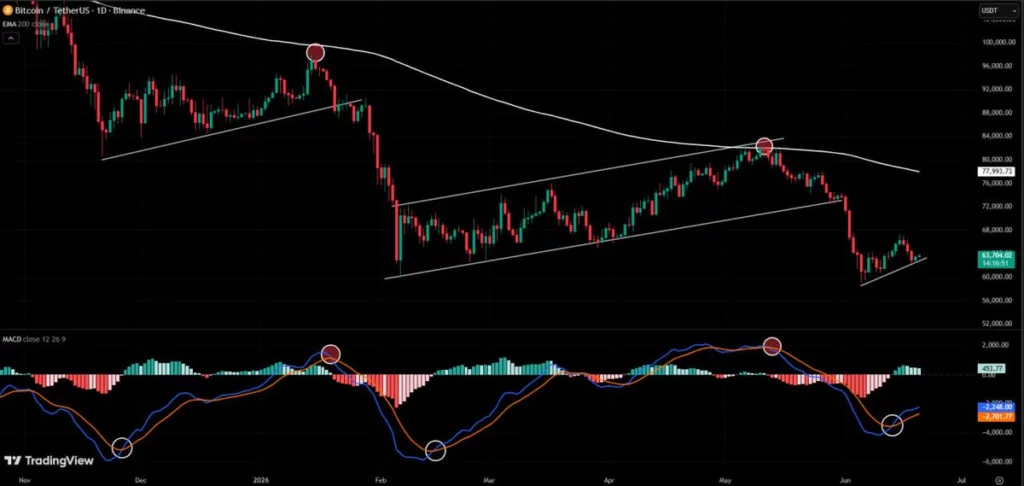
Bitcoin traded near $64,000 on Sunday after recovering part of Friday’s sell-off, but the rebound has not yet changed the wider range.
Summary
- Bitcoin traded near $64,008, up 0.87% daily, while staying almost flat on the week overall.
- Galaxy Research said Bitcoin ETFs posted a record $6.35B outflow across the latest 30-day window.
- Analysts are watching $62K support and $67K resistance as macro risks steer near-term Bitcoin direction.
According to crypto.news market data, Bitcoin traded around $64,008, up 0.87% over 24 hours.
The page showed a 24-hour range between $63,188 and $64,462, with daily volume above $16.6 billion. Bitcoin’s seven-day move stayed slightly negative, showing that the weekend bounce only repaired part of the damage.
The move kept traders focused on the $62,000 support area. A clear break below that zone could weaken short-term sentiment, while a move above $67,000 would give bulls a stronger relief setup.
Bitcoin holds range after Friday’s drop
Bitcoin fell below $63,000 on Friday as risk appetite weakened across crypto markets. It later bounced from the weekly 200-period moving average area and the 0.618 Fibonacci retracement, according to crypto trader Daan Crypto Trades.
Daan said the $62,000 area remains the level bulls “must hold” into the weekly close. In his view, a move below that level would look bearish in the short term, while a break above the local high near $67,000 could open a move toward $73,000.
Ether, Solana and Tron also firmed over the weekend, while HYPE remained one of the stronger weekly performers despite a daily pullback. Dogecoin stayed weaker than most large tokens on a seven-day basis.
The broader market move looked more like stabilization than a strong trend change. Bitcoin still needs a higher close above nearby resistance to show that buyers control the next leg.
Hormuz threat keeps macro risk alive
Bitcoin’s weekend move came as traders watched planned U.S.-Iran ceasefire talks in Switzerland. The talks follow last week’s memorandum of understanding, which gave both sides a 60-day window to work toward a longer deal.
The market backdrop remains unsettled because Iran again ordered the closure of the Strait of Hormuz. The waterway is one of the world’s key oil routes. A real closure could lift oil prices and pressure risk assets, including Bitcoin.
crypto.news previously reported that lower oil from a reopened Hormuz can ease inflation pressure and help liquidity expectations. The reverse also matters. Higher oil could revive inflation worries and keep the Federal Reserve cautious, which would limit support for crypto.
That keeps Bitcoin tied to events outside crypto markets. A durable ceasefire would reduce one source of risk, while a renewed oil shock could bring back defensive trading across digital assets.
Bitcoin ETF outflows weigh on demand
ETF flows remain another key issue for Bitcoin price analysis. Galaxy Research said U.S. spot Bitcoin ETFs recorded $6.35 billion in net outflows over the latest 30-day window, the largest such outflow in its tracked data.
The same data showed six straight weeks of outflows. Cumulative net flows reportedly fell to $53.4 billion from a $63 billion peak in October 2025. That suggests institutional demand has cooled while price tries to hold support.
ETF outflows do not always force an immediate price break. Still, they remove a source of steady demand that helped Bitcoin during earlier parts of the cycle. When fund flows weaken at the same time as macro risk rises, buyers often wait for clearer levels before adding exposure.
The pressure also matters because Bitcoin has traded below several earlier cycle reference levels. If funds keep losing capital, spot buyers may need to absorb more supply before price can reclaim the $67,000 area.
Analysts split on momentum signals
Some technical traders see early signs of relief. Crypto analyst BATMAN said Bitcoin printed a daily MACD momentum flip from deeply negative territory. He argued that similar signals in this cycle appeared near local bottoms before relief rallies.
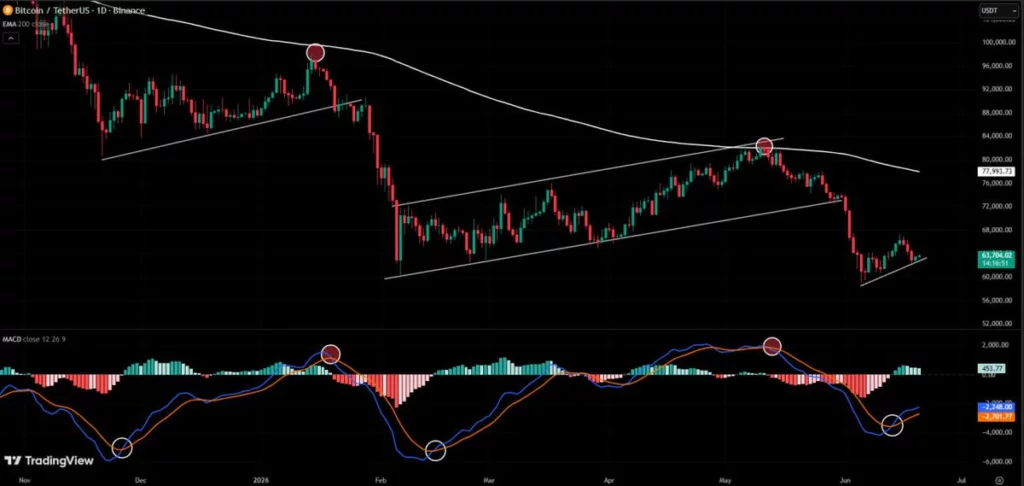
Rekt Capital gave a more cautious historical view. He said that if June ends red, July has often moved in the opposite direction. He also noted that a weak June close could confirm a loss of the 50-month EMA as support, turning any July bounce into a retest rather than a confirmed recovery.
For now, Bitcoin remains caught between support near $62,000 and resistance near $67,000. A close below $62,000 would put the $60,000 to $59,000 zone back in focus. A move above $67,000 could shift attention toward $73,000, especially if oil risk eases and ETF outflows slow.
The near-term setup therefore stays balanced. Bitcoin has stabilized, but traders still need stronger volume, better fund flows and calmer geopolitical news before calling the rebound durable over the near term.
Disclosure: This article does not represent investment advice. The content and materials featured on this page are for educational purposes only.

Colombia votes in runoff pitting leftist reformer against law-and-order newcomer
Bitcoin’s Biggest Risk Is Boredom, Not Another Price Crash: CryptoQuant CEO

6 Brilliant War Movies No One Remembers Today


-

 Business7 days ago
No Jackpot Winner as $257 Million Prize Rolls Over to $269 Million Monday Draw
-

 Fashion2 days ago
Weekend Open Thread: Miami – Corporette.com
-
Crypto World6 days ago
Zimbabwe Requires Crypto Businesses to Register Annually Under New FIU Regulations
-
 Business1 day ago
Wall Street Week Ahead: Investors see Micron earnings as pulse check of AI rally momentum
-
 Entertainment7 days ago
Matt Damon’s Viral Sci-Fi Thriller Has Taken Over HBO Max
-

 Tech7 days ago
As AI companies race to go public, who else is along for the ride?
-

 Business7 days ago
Anthropic staff to meet White House officials next week, Axios reports
-

 Crypto World1 day ago
HIVE shares jump as $220M AI deal speeds Bitcoin mining pivot
-
 Crypto World7 days ago
Bitcoin could crash to $48,000, if this historical pattern is triggered
-
 NewsBeat7 days ago
what doctors are seeing in ebike crashes
-
 NewsBeat7 days ago
Warning of disruption as Cardiff Crossrail works to start
-
 NewsBeat7 days ago
Tributes to former deputy head teacher at Cambridge school among death and funeral notices
-
 Entertainment7 days ago
Kate Middleton Glare Goes Viral After Kids Booed At Royal Event
-

 Politics7 days ago
“Israel’s” ban on ICRC visits ruled illegal, but Knesset moves to stop them permanently
-

 News Videos7 days ago
Financial Accounting | Last Day Revision Strategy and Booster | CMA Inter – June 2026
-

 Crypto World7 days ago
XRP ETFs Outperform As Bitcoin And Ethereum Funds Extend Outflow Trend
-

 Tech6 days ago
Over 400 Arch Linux packages compromised to push rootkit, infostealer
-

 Business7 days ago
Invesco Quality Income Fund Q1 2026 Commentary
-

 NewsBeat7 days ago
Singer Oliver Tree dies aged 32 in helicopter crash in Brazil
-
 Crypto World7 days ago
Market Preview: SpaceX (SPCX) IPO Record, Federal Reserve Meeting, and Iran Nuclear Agreement
You must be logged in to post a comment Login