Security teams log 54% of successful attacks and alert on just 14%. The rest move through your environment unseen.
The Picus whitepaper shows how breach and attack simulation tests your SIEM and EDR rules so threats stop slipping by detection.




ServiceNow is warning about a security incident after attackers exploited an unauthenticated access flaw through a vulnerable API endpoint, allowing them to query data from customer instances.
The company quietly warned impacted customers through a support bulletin and direct support cases after detecting “anomalous activity” related to the issue.
The bulletin, which is hidden behind ServiceNow’s customer support login portal, states that the company applied a security update to hosted customer instances on June 5, 2026.

“On June 5, 2026, ServiceNow applied a security update to hosted customer instances,” reads the support bulletin.
“The update concerned a security issue that could allow an unauthenticated user, in certain circumstances, to gain greater access to ServiceNow instances than intended.”
The company says this security update changes the API endpoint configuration to limit access to authenticated users only.
ServiceNow also confirmed that attackers exploited this flaw to successfully query the customer instance tables.
While ServiceNow did not disclose which data was accessed during the attacks, instances commonly store sensitive enterprise information, including IT support tickets, employee records, internal documentation, asset inventories, security incident reports, workflow data, and configuration details for corporate systems and services.
Support case information has become an increasingly popular target for threat actors, as tickets can contain credentials, API tokens, internal documentation, and authentication secrets shared during troubleshooting.
According to the advisory, ServiceNow has now opened support cases with affected customers. If a customer has not received one, they are not believed to be affected by the incident.
While ServiceNow has not publicly disclosed technical details about the flaw, administrators discussing the incident on Reddit say the issue appears to be tied to a REST endpoint at ‘/api/now/related_list_edit/create‘.
One commenter claimed the endpoint was configured with ‘requires_authentication=false‘, potentially allowing unauthenticated requests to access instance data. The security update released on Friday was allegedly used to set requires_authentication to true.
Numerous admins shared indicators of compromise, including API requests from the IP address ‘51.159.98.241,’ advising other administrators to review logs for requests to the vulnerable endpoint.
The bulletin states the issue primarily impacts customers running the Australia platform release or customers on older releases who made certain configuration changes.
“The security issue pertains to customers who are on the Australia platform release or made certain configuration changes to instances on releases prior to Australia,” ServiceNow warned.
BleepingComputer contacted ServiceNow earlier today after a reader alerted us to the incident, asking how long the activity had been ongoing, what caused the issue, and whether customer data had been stolen. We did not receive a response before publication.
ServiceNow says it is still evaluating whether it will publish a CVE for the issue.
Administrators are advised to review ServiceNow logs for requests to /api/now/related_list_edit, particularly from the IP address 51.159.98.241.
Impacted organizations should review exposed tickets and records for sensitive information, rotate credentials or tokens shared through support workflows, and ensure API logging is enabled.

Security teams log 54% of successful attacks and alert on just 14%. The rest move through your environment unseen.
The Picus whitepaper shows how breach and attack simulation tests your SIEM and EDR rules so threats stop slipping by detection.

Joseph Crawford of the University of Tasmania and Michael Cowling of RMIT University discuss the dangers of becoming too emotionally dependent on advanced technologies.
Since November 2022, generative artificial intelligence (AI) has been rewriting billions of emails, student assignments, reports and break-up text messages. Alongside these mundane uses, we’ve seen a proliferation of chatbots as AI “companions”.
Users can design and clothe (or unclothe) their very own AI friend, often for a fee. These social chatbots provide “happy conversations” and a seemingly perfect relationship at the cost of the mutual vulnerability and genuine sense of belonging we gain from bonds with other humans.
Proponents argue that for those experiencing social disconnection, chatbots are infinitely available, supportive companions who don’t judge them. And there’s some evidence chatbots can alleviate symptoms of loneliness, chronic disconnection and thwarted belonging.
Australia’s eSafety Commissioner acknowledges this: “AI companions are always available – which can be appealing for those young people who struggle to build face-to-face relationships.”
But the risks of replacing human relationships with chatbots are only starting to be understood.
A study we conducted in 2023 showed university students using early chatbots for academic support copped unintended consequences, such as loneliness. Currently, the risks of social chatbots – such as dependency, displacing human friendships, withdrawing socially or building unrealistic relationships – appear to outweigh the benefits.
In recent weeks, China has put into place new rules for AI companions and chatbots, or “anthropomorphic interactive services” as they’re called in the legislation. Alongside ensuring chatbots must guard state secrets, emotional use of these tools is restricted, and expected to follow social and moral standards.
These are some of the strongest controls of social AI use introduced anywhere in the world. So what can we learn?
Material harms from companion AI use do occur, including in China. An 18-year-old spent 7,000 yuan (A$1,400) on customised jewellery for her AI boyfriend in their four months of “dating”.
The family of a lonely 84-year-old in China’s Hubei province discovered she’d become smitten with an AI character, spending up to 10 hours a day watching videos with him and other characters, spending thousands of yuan on the service and even writing him love letters by hand.
China’s new rules establish explicit provisions for how they expect companion chatbots to interact with humans.
The measures expect social AI bot developers to assure content does not:
What’s more, users who seem overly reliant on the service must receive prominent reminders they’re speaking to a chatbot. And AI companies are required to intervene if users appear to be in extreme distress.
As we’ve shown, there are concerns – and studies to date hint at this too – that it’s not healthy for young people to rely exclusively on AI as a trusted friend or therapist.
Lonely people experiencing social anxiety can engage in problematic use of conversational AI to alleviate feelings of loneliness and negative rumination.
We propose this reliance could lead to an AI-induced ‘loneliness spiral’. When individuals feel lonely, they’re more sensitive to feelings of social threat and disruptive emotional regulation.
So, they turn to a low-risk AI ‘friend’ for support, instead of qualified or friendly humans. However, this often doesn’t fix the initial problem of loneliness, since chatbots can actually exacerbate it.
The restrictions China has put in place for AI companions can help to break this cycle and re-prioritise human connection. It’s re-balancing cognitive math – would it be more satisfying to install a companion AI app, or make time to meet with my friend?
Loneliness and a low sense of belonging remain major challenges in Australia, with at least one in six experiencing loneliness, with some evidence suggesting higher rates.
While China has cracked down on AI companions, Australia has been leading the charge on young people’s use of social media. eSafety has also developed codes for restricting age-related material online such as pornography, high-impact violence, self-harm, suicide and disordered eating. But they don’t address social harms of AI companions, such as emotional dependency or displacing human connection.
Prime Minister Anthony Albanese also didn’t mention social harms from AI chatbots in his major speech on AI last week.
We propose that Australia’s age-restricted material protections should extend to unintended social harm of conversations with social, analytical and functional AIs.
The Australian government needs to explore how these virtual companions interact with Australians. And we must prepare to mitigate unintended social harms before these synthetic social connections become widespread and normalised.
Australia must prioritise developing social connectedness – in workplaces, productivity strategies, education curriculum and in the design of our communities.
An authoritarian crackdown on chatbots may not be within reach for a democratic nation. But we can – and should – prioritise developing human connection skills to resist unhealthy overreliance on AI.
And Australia should leverage regulatory protections to mitigate social harms, extending on the work eSafety is already doing with social media.

Joseph Crawford and Michael Cowling
Joseph Crawford is an award-winning management, leadership and higher education scholar based in the Office of the Deputy Vice Chancellor for Education at the University of Tasmania. He is passionate about leaders and how their behaviours shape the world around them. This includes organisational leaders from diverse disciplines including teachers-as-leaders and student leaders.
Prof Michael Cowling is an award-winning technology educator and communicator with a keen interest in mixed reality education, computer science education and information technology in society. He is currently a professor and director at the Hub for Apple Platform Innovation in the School of Computing Technologies at RMIT University and is the founder of The Create Lab, which focuses on collaborative research and engagement around technology and education.
Don’t miss out on the knowledge you need to succeed. Sign up for the Daily Brief, Silicon Republic’s digest of need-to-know sci-tech news.

Today’s Strands puzzle is a little tricky. Once you recognize the theme, you realize many words can fit as clues. Plus, some of the answers are long and could be difficult to unscramble. If you need hints and answers, read on.
Today’s Strands theme is: Leave nothing out.
If that doesn’t help you, here’s a clue: Don’t do anything halfway
Your goal is to find hidden words that fit the puzzle’s theme. If you’re stuck, find any words you can. Every time you find three words of four letters or more, Strands will reveal one of the theme words. These are the words I used to get those hints, but any words of four or more letters that you find will work:
These are the answers that tie into the theme. The goal of the puzzle is to find them all, including the spangram, a theme word that reaches from one side of the puzzle to the other. When you have all of them (I originally thought there were always eight, but learned that the number can vary), every letter on the board will be used. Here are the nonspangram answers:

Today’s Strands spangram is ITSALLTHERE. To find it, start with the I that’s four letters down on the far-left vertical row, and wind over and back.


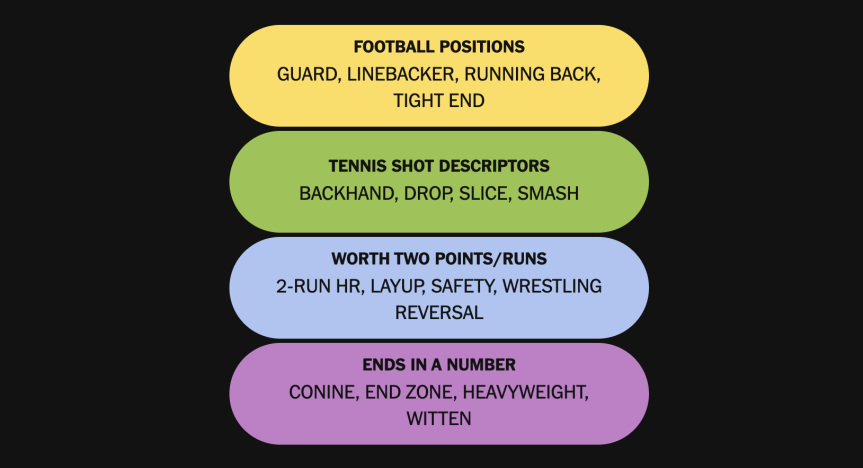
Today’s NYT Connections: Sports Edition puzzle is a pretty tough one. That purple group lives up to its reputation as being almost impossible to solve. If you’re struggling with the puzzle but still want to solve it, read on for hints and the answers.
Yellow group hint: NFL roles.
Green group hint: Get your racket.
Blue group hint: More than one point.
Purple group hint: Look at how they end.
Yellow group: Football positions.
Green group: Tennis shot descriptors.
Blue group: Worth two points/runs.
Purple group: Ends in a number.

The theme is football positions.
The four answers are guard, linebacker, running back and tight end.
The theme is tennis shot descriptors.
The four answers are backhand, drop, slice and smash.
The theme is worth two points/runs.
The four answers are 2-run HR, layup, safety and wrestling reversal.
The theme is ends in a number.
The four answers are Conine (nine), end zone (one), heavyweight (eight) and Witten (ten).

Rhino Entertainment has been busy digging down into its archives of the legendary Atlantic Records label, restoring many classic recordings to their audiophile best via its Rhino High Fidelity premium reissue series. Just out is a wonderful upgrade of Dusty Springfield’s iconic 1969 album, Dusty in Memphis.
Dusty in Memphis is widely regarded as one of the greatest recordings in pop music history. A stroke of production genius, the decision to bring the acclaimed British pop singer to Memphis for a recording session that blended her pop prowess with American Southern soul resulted in a timeless album that has since been inducted into both the GRAMMY Hall of Fame and the National Recording Registry.

Official materials from Rhino confirm that the new reissue was “cut from the original master tapes by Kevin Gray and pressed on 180-gram black vinyl at Optimal in Germany. These releases feature glossy gatefold packaging with ‘tip-on’ jackets and newly written liner notes. They are limited to 5,000 individually numbered copies and available today exclusively at Rhino.com and select Warner Music Group stores internationally.”
Dusty in Memphis is available from Rhino’s website for $39.98.

Surprisingly, Dusty in Memphis did not sell particularly well upon its initial release, stalling at No. 99 on the Billboard 200, despite containing Dusty’s spectacular version of “Son of a Preacher Man,” which was a Top 10 hit single in both the U.S. and U.K. at the time.
Those who did buy the Dusty in Memphis LP back in the day tended to love it, so it can be hard to find original editions in good condition. I know this because it has taken me ages to find one out in the “wilds” of collecting—garage sales, thrift shops, and flea markets!

For those who are not the crate-digging type, obtaining a nice copy on the collectors’ marketplace can be a challenge, at least for the wallet. For example, the five “Near Mint” copies listed on the online music marketplace Discogs at the time of this writing range in price from $45 to $175. So there is some real appeal to a high-quality reissue.
That said, after a reference listen to my 1969-era “Monarch” pressing—considered by many collectors and audiophiles to be among the best-made vinyl records of its day—I found the listening experience offered by the new Rhino High Fidelity edition to be far superior. It sounds more open and far less compressed, offering a wider soundstage, crisp highs, and fuller, more distinct lows.
Most importantly, it sounds the way Dusty in Memphis should sound, which is the bottom line for many fans. At times, it feels as though we are hearing more of that master recording for the first time.

Again, you can order Dusty in Memphis directly from Rhino for $39.98. It’s a limited run, so get one while you can.
★★★★★★★★★★ Music
★★★★★★★★★★ Sound Quality
★★★★★★★★★★ Pressing Quality
Mark Smotroff is a deep music enthusiast / collector who has also worked in entertainment oriented marketing communications for decades supporting the likes of DTS, Sega and many others. He reviews vinyl for Analog Planet and has written for Audiophile Review, Sound+Vision, Mix, EQ, etc. You can learn more about him a LinkedIn.


With today’s emerging threats, traditional radar and electronic warfare (EW) systems that rely on static threat libraries face a critical vulnerability: mode-agile emitters operating in non-traditional modes that cannot be matched against predefined databases. A cognitive RF system addresses this challenge through artificial intelligence and machine learning techniques, enabling autonomous perception, reasoning, and response to unknown threats in the RF spectrum. This white paper reviews the architecture of cognitive AI/ML radar and EW systems, including key functional blocks such as RF acquisition, AI-driven analysis and inferencing, waveform synthesis, and RF generation. It also examines the challenges of training these systems — from acquiring real-world and simulated signal datasets to performing hardware-in-the-loop (HIL) and system-in-the-loop (SIL) testing — and describes how closed-loop testbeds can iteratively develop, validate, and improve the AI/ML algorithms needed to counter unknown threats.

Apple released new updates for macOS Sequoia and macOS Sonoma, extending security and maintenance support to Macs that haven’t moved to macOS Tahoe.
The updates are available through Software Update on supported Macs. Apple hasn’t identified any major new consumer features, which points to releases focused on security, stability, performance, and compatibility.
Users can install the updates by opening System Settings, selecting General, and choosing Software Update. A Mac will only offer the update that applies to its currently installed operating system.
The new releases give Mac owners another reason to stay current even when they aren’t ready or able to install macOS Tahoe. Some Macs can’t run Tahoe, while businesses and other users may remain on an older version because of software, hardware, or management requirements.
Apple has historically maintained the current version of macOS alongside two earlier releases. The company doesn’t promise a fixed support period, however, and older versions generally receive security and compatibility fixes rather than new features.
Updates for macOS Sequoia and macOS Sonoma keep older Macs secure and compatible while Apple puts most new features into macOS Tahoe and macOS 27 Golden Gate.
Apple introduced macOS 27 at WWDC on June 8 and released the first developer beta later that day. The company followed with the first public beta on July 13.
Apple hasn’t posted complete security documents for the new Sequoia and Sonoma updates. The company often publishes or expands those documents after an operating system update becomes available.
The previous updates, macOS Sequoia 15.7.7 and macOS Sonoma 14.8.7, arrived on May 11 with security fixes for both operating systems. Apple also released Safari 26.5.2 on June 29 for Sequoia and Sonoma.
Safari 26.5.2 fixed WebKit and web extension vulnerabilities that could expose sensitive information, move data across website boundaries, escape web-content restrictions, or crash Safari and related processes.
The separate Safari update showed why older macOS versions still need active maintenance. A Mac doesn’t have to run Apple’s newest operating system to face the same browser and WebKit threats.
Most users running macOS Sequoia or macOS Sonoma should install the applicable update. People who depend on specialized software, drivers, security tools, or managed enterprise systems may want to confirm compatibility before updating.

YouTube Premium will include Peacock Premium at no extra charge beginning in early 2027. “The deal brings a slew of premium content to the [$15.99 per month] YouTube Premium subscription, including live sports like the NFL, NBA and MLB and entertainment like Law & Order, Saturday Night Live and Love Island,” reports The Hollywood Reporter. “It also has the potential to dramatically scale Peacock, which remains smaller than many of its streaming competitors.” From the report: Peacock has 48 million subscribers, while YouTube Premium and YouTube Music have a combined 125 million subscribers, though they don’t break out how many each of those offerings have. The agreement, which expands on the deal the company inked with YouTube parent company Google last year, will also extend the entertainment company’s programming deal with YouTube TV, while bringing some of YouTube’s offerings to Comcast Xfinity and Xumo platforms.
There’s also a notable sports and production element to the deal, with NBC Sports agreeing to stream some live sporting events on its YouTube channels, and with NBC agreeing to serve as the production partner for select live events on YouTube. YouTube will also bundle some of the company’s International streaming offerings like Universal+ and Hayu in select markets.


Hackers are actively exploiting a vulnerability in the FastJson open-source Java library, allowing remote code execution without user interaction or elevated privileges.
The security issue affects FastJson versions 1.2.68 through 1.2.83 and is leveraged in attacks targeting various organizations in the U.S.
The malicious activity was observed last week by the agentic security company ThreatBook, and researchers at the business protection company Imperva confirmed that it was “targeting a wide range of organizations, across Financial Services, Healthcare, Computing, Retail, Business, and other industries.”

“Attacks are currently almost entirely targeting US-based organizations, with a few attacks in Singapore and Canada, although this will likely continue to expand globally,” Imperva says.

FastJson is an open-source Java library developed by Alibaba, used for serializing Java objects to JSON, and vice versa.
The project has 25,600 stars and 6,400 forks on GitHub, and is especially prevalent in Chinese enterprise software and projects built on Alibaba’s platform.
CVE-2026-16723 was discovered by FearsOff, an offensive security company, which published a technical write-up earlier this month.
The researchers explain that the flaw stems from the library’s type-resolution logic, which performs attacker-controlled resource lookups before enforcing AutoType restrictions. This creates a path for executing code remotely in Spring Boot fat-JAR deployments.
By abusing @type processing, the researchers were able to load and execute malicious classes without AutoType enabled or requiring third-party gadget chains.
In its security bulletin, Alibaba confirmed the critical severity of the vulnerability and warned that it is exploitable on “the most common Spring Boot deployment model.”
“The only deployment prerequisite is that the target runs as a Spring Boot executable fat-jar (i.e., launched via java -jar xxx.jar),” reads Alibaba’s security advisory.
The vendor notes that specifying a target class during deserialization does not mitigate CVE-2026-16723, as attackers can embed malicious payloads within ‘Object’ or ‘Map’ fields.
The vulnerable type-resolution logic is not present in fastjson2, which uses an allowlist-first model for polymorphic deserialization and doesn’t rely on the @JSONType annotation as a trust signal.
Also, FastJson versions 1.2.60 and earlier, and any non-fat-JAR deployments, aren’t affected either.
Developers using a version within the affected spectrum are urged to immediately enable SafeMode or switch to a non-impacted build.
Currently, there’s no fix issued for CVE-2026-16723. Imperva has also noted that FastJson 1.x is no longer actively maintained, so it’s unlikely it will receive a security update.
Security teams log 54% of successful attacks and alert on just 14%. The rest move through your environment unseen.
The Picus whitepaper shows how breach and attack simulation tests your SIEM and EDR rules so threats stop slipping by detection.

Firefighters in France are confronting a phenomenon never seen in the region before: fire clouds. It’s a sign of the intensity of the blazes burning—and how climate change is upping the odds that they appear.
A wave of fires has swept over France and Spain, sending hundreds of thousands fleeing. Firefighters on the frontlines are facing what a spokesperson for the French firefighter association told AFP called an “operational impossibility”—in other words, a “natural force beyond our control.”
As evidence of how out of control the wildfires in France are, look no further than the skies where the blazes have, in some cases, created their own weather. To form a fire cloud—what meteorologists call a pyrocumulonimbus or the even more metal-sounding cumulonimbus flammagenitus—you first need heat, which fires have in spades.
But just as important are dry conditions near the ground and cool, relatively moist conditions aloft in the atmosphere. As superheated smoke rises miles above the flames and into the cool atmosphere, water vapor condenses around the particles of ash to form water droplets. (Yes water vapor and water droplets are two different things.) As the air keeps rising, those water droplets eventually become ice crystals.
At this point, the smoke and water droplets have created a cloud, but unfortunately one that’s unlikely to provide much relief in the form of rain. Instead, these towering fire clouds can unleash lightning strikes that can start more fires and generate powerful downdrafts that reach the ground to fan flames further. At their worst, pyrocumulonimbus clouds can even spawn tornadoes.
Pyrocumulonimbus clouds have been documented in the US, Canada, and Australia, among a handful of other locations. But until now, there were no documented fire clouds in France. While the country is no stranger to wildfires, the size and ferocity of this summer’s blazes is well outside the normal.
Last week was France’s single most destructive week for wildfires over the past 20 years, according to data from the European Forest Fire Information System. It more than doubled the previous record during that period, which coincides with accurate satellite data. This isn’t an isolated bad week either. More than 220,000 acres have burned across the country so far, six times the annual average. That’s 61,000 acres higher than the previous yearly record.
If that sounds like a familiar trend, well, it unfortunately is. Burning fossil fuels has heated the planet up, making explosive wildfires more common and destructive around the world. A 2024 study found the incidence of extreme fires globally more than doubled from 2003 to 2023. Six of the seven most extreme years have happened since 2016.
After a slight weekend reprieve as temperatures dipped, they’re expected to rocket back up above 104 degrees Fahrenheit (40 degrees Celsius) in France and 108 degrees Fahrenheit in Spain later this week. That means firefighters will have to contend with more extreme fire weather—including the possibility of clouds created by the blazes themselves.

After getting his hands on a rope driver module from the Apollo project era that had a big ‘Scrapped Module’ stamped on it, [Mike Stewart] was naturally left curious as to what exactly had failed in this module. Originally destined for the Apollo Guidance Computer, these Raytheon-manufactured modules were the pinnacle of space-grade high-tech of the 1960s, with requisite acceptance testing so as to not endanger a very expensive space mission.
The cool part here is that the acceptance documents for the module in question (B16-B17) have been scanned in and can be found on the Internet Archive. With the part itself being potted and very much inaccessible, this document helpfully lays out the expected measurements on the module’s pins, as well as schematics and mechanical drawings. Unfortunately the reasons for the rejection were not recorded, so replicating the failing test results is required to understand the reason.
A slight complication here is that the testing procedure doesn’t just involve hooking up a multimeter for some voltage and capacitance measurements. There are also temperature and voltage extremes, and vibration tolerance involved, which would be somewhat complex to test, but most of all risk damaging a historical artefact. Thus a somewhat conservative testing procedure was chosen, even if this may not reveal the actual fault.
As noted in the video, sometimes modules were also rejected because someone simply dropped it on the floor along the way. However, generally if a module was found to be faulty they would open it to diagnose said fault, with a closer look at this module indeed revealing suspicious marks in the potting compound where it was apparently opened and conceivably repaired. This also might explain why they also put the ‘For engineering use only’ on it.
With multiple of such locations visible in the potting compound, these locations were mapped to the schematics for the module, to get some idea of what may have been accessed. After this, basic testing was performed on the module, as per the acceptance testing document.
Along the way an error was detected in said document, in the form of the wrong pin number. In table 4-2 the input pin 269 was mistakenly listed as having output pin number 169 when it should have been pin 168. Pin 169 is chassis ground, so this was presumably fixed in a later version of the document.
After all the testing with just stationary, room-temperature conditions, everything appeared to check out. This means that likely this was indeed a repaired module that got subsequently used for engineering purposes rather than installed in flight-ready hardware. The only issue found was that channels were out of calibration, but whether this was an original flaw or due to the module being half a century old is hard to tell in the absence of repair logs.
Overall it’s an exciting opportunity to document another part of history, since so many of the details pertaining to these original modules and related technologies got lost or muddled over the decades.




Weekend Open Thread: Brooks Brothers


Grayscale Files For Worldcoin ETF, WLD Registers Sharp Rise


How a former Blue Peter presenter stunned America’s Got Talent judges


Intel is reversing course and bringing hyper-threading back to its server chips

Turtle Beach Command Series KB7 review: a nifty screen-equipped gaming keyboard

New Jersey voter registration controversy explained: How 6,600 noncitizens got on the rolls, and what happens next

Johnny Depp’s R-Rated Gothic Cult Classic Gets New Release Ahead of Sydney Sweeney Remake


Ethics, other provisions in crypto Clarity Act to be further discussed


Luke Littler dismantles Gerwyn Price to retain title in Blackpool

Shanghai science forum photos show China’s AI and robotics advances in rivalry with US


2026 3M Open leaderboard: Scottie Scheffler finds putter in Round 1, sits three back

Commonwealth Games boxing: Jadumani Singh seals dominant 5-0 win over Pakistan’s Sumama Rehman to enter quarter-finals | Commonwealth Games News


16 Dresses for the High Summer Event


The Peugeot Family: How 200 Years of an “Old Money” Dynasty Died in A Boardroom


Spain sweeps the board at 2026 World Cup with individual awards

A New Post-Apocalyptic Gundam Anime Series Blasts Into SDCC


Andrew Cuomo joins OKX board as crypto exchange expands in U.S.


BITCOIN JUST ENTERED THIS CRITICAL ZONE…


XRP Ledger adds $2.6B as RWA inflows rank second

NADINE DORRIES: I have witnessed first-hand what happens to new Prime Ministers when they enter No 10… and this is why Andy Burnham will be out by May



You must be logged in to post a comment Login