





-and-Peter-Johnstone-in-1987.png)





It is 32C (90F) at Clapham Junction in south London, and sweating criminals are dropping like flies.
Every few minutes, this one wanted for robbery, or that one for stalking or theft, is surrounded by cops and cuffed.
They are carted off to face extra jailtime or a day in court they thought they’d dodged. One even tries to run away, but he doesn’t get far.
‘This is a brilliantly efficient way to apprehend wanted people,’ says Sergeant Kevin Brown, a supervisor in a small Metropolitan Police team using cutting edge ‘Live Facial Recognition’ technology (LFR) to round up hundreds of miscreants across the capital.
LFR utilises mobile van-based CCTV cameras and artificial intelligence to compare the biometrics of passers-by – in this case their unique facial properties – with a watchlist of people wanted for committing crimes, for failing to turn up to court hearings, or for breaching orders to deter stalking, sexual offences and violence against women and girls.
‘When we first began using the technology in 2024, it enabled us to arrest 574 wanted people,’ says Sergeant Brown.
‘Last year, that number was 1,135, and already this year it is around 900. LFR is a very useful tool to help us keep the public safe.’
LFR was first trialled by police in the UK in 2015 before being used formally by South Wales Police at the Uefa Champions League final in Cardiff in 2017, primarily to spot wanted football hooligans.
Since then, it has been rolled out by more than a dozen forces in what is being seen as a policing revolution.
Among those are Greater Manchester, Cambridgeshire, Hampshire, Norfolk, South Wales and Thames Valley.
Metropolitan Police have been using cutting edge ‘Live Facial Recognition’ technology (LFR) to round up hundreds of criminals across the capital

LFR utilises mobile van-based CCTV cameras and artificial intelligence to compare the biometrics of passers-by with a watchlist of people wanted for committing crimes

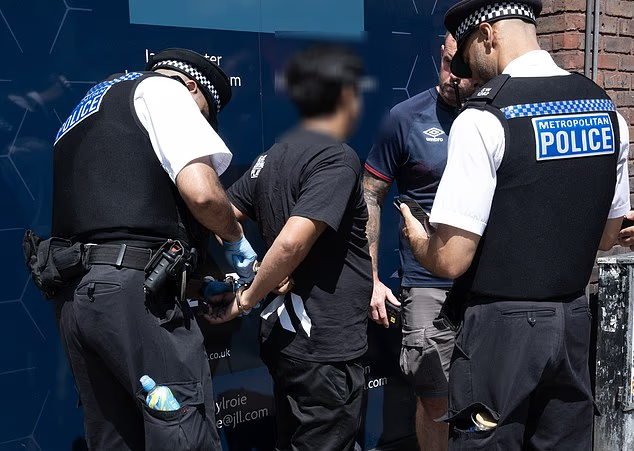
LFR was first trialled by police in the UK in 2015 – and today it has been rolled out to more than a dozen forces across the country. Pictured: Met Police swoop on a suspected criminal
Earlier this year, Home Secretary Shabana Mahmood, a firm proponent of the technology, unveiled plans to increase the number of LFR mobile vans across the country to 50.
But while law enforcement promotes LFR as a spectacularly good way of finding people they describe as ‘sought after’, civil liberties campaigners fear it could erode our rights to privacy and anonymity, not least because its introduction has happened so quickly that no specific legislation is yet in place governing how it should be used.
‘Privacy is an important and hard-won right,’ says Charlie Whelton, policy and campaigns officer at Liberty.
‘Walking past a facial recognition camera is like showing your ID at a checkpoint – something most of us wouldn’t want to do just to go to the shops, watch our football team, or attend a concert.’
Six or seven times a week, the Met’s LFR van is set up at busy locations in the capital. Today, it is deployed near the Shopstop shopping centre on St John’s Hill in Clapham.
Signs are posted on and near the van alerting the public to the technology being used, though how many will understand just what it is, is a moot point.
Inside, operators view two screens divided into four sections on which the faces of people being filmed as they walk down the street are framed inside red boxes.
They are unaware they are being filmed and checked against a watchlist containing the names and images of 18,000 people wanted for crimes ranging from shoplifting to mugging and sexual offending, for failing to turn up to court hearings, or being in breach of a court order or summons.
If the people in these boxes are not on the list, their details are deleted immediately.
If they are on it, and the AI system matches their biometrics with a level of certainty above 64 per cent, an alert will be sent to special handsets held by Sergeant Brown and local officers positioned on the street. Today, there are ten of them.
The suspects are approached and questioned while the operators check why they are wanted.
If it is for a crime that would attract a jail sentence of more than a year, they are arrested on the spot.
Similarly, if they are in breach of a court order relating to stalking, sexual offences or violence they will be taken into custody.
While photographer Murray Sanders and I are here, most submit meekly with shocked resignation on their faces. Several are handcuffed. One young man tries to run away but is quickly captured by the officers.
By the end of the day, ten people have been stopped and questioned, and seven have been arrested for offences ranging from robbery and theft to stalking.
I give permission for an image of me to be put on the watchlist and walk down the street wearing sunglasses that I think might bamboozle the system.
They don’t, and I am spotted immediately, with a certainty rate of more than 80 per cent.
‘We’re operating with an algorithm that’s been independently tested by experts at the National Physical Laboratory (the official UK institute that checks the reliability of measurements and technology),’ says Sergeant Brown.
‘We know when the system performs well, and we have engineers who are experts in this area who make sure that everything we do is in line with policy and done properly.’
This is true. However, Home Office research published last December, and also citing the National Physical Laboratory, called into question the accuracy of ‘retrospective’ AI facial recognition systems – where images from crimes that have already taken place are checked against criminal databases (rather than live checks in the street).
It found that AI facial recognition could create high numbers of false positives against black and brown people.
Among black women, 9.9 per cent of results were incorrect – a failure rate of 100 times more than for white women.
This is just one of the concerns raised by privacy activists. The Met, and other forces, say they have stringent policies in place to ensure the technology is used proportionately and that data collected on innocent passers-by is deleted immediately.
But what about future regimes, campaigners ask? How powerful could such a tool be in the hands of a despot? Their political enemies would have nowhere to hide. Everything you did, and everywhere you went, could be seen and judged by the regime.

Home Secretary Shabana Mahmood has unveiled plans to increase LFR mobile vans across the country. Pictured: Officers arrested a person identified by the technology
This was something that concerned even the late Pope Francis. In 2020, he issued a joint statement with Microsoft president Brad Smith and IBM executive vice president John Kelly which warned about the dangers of AI biometric technology being used to extract data for political ends.
On the ground, however, it is easy to see why ordinary officers, and law enforcement top brass, are so keen to roll out the technology – quite simply, it works.
Sergeant Brown and the team were on deployment in Denmark Hill, south-east London, on January 10 last year when the system flagged up a man walking down the street, holding the hand of a six-year-old girl.
‘We got an alert on our handsets with a match for a David Cheneler, [74], a registered sex offender who has a sexual offence prevention order that doesn’t allow him to be unaccompanied with somebody under the age of 14,’ says Sergeant Brown.
Cheneler had befriended the little girl’s mother and gained her trust to the extent that she allowed him to pick up the girl from school.
Police bodycam footage of Cheneler’s arrest shows him also admitting he is carrying a knife. He was subsequently jailed for two years for being in breach of a sexual offence prevention order.
‘He had got to know mum, and for several months had been buying presents for the mother and daughter – he was basically grooming them both,’ says Sergeant Brown.
‘We did a lot of safeguarding of the mother and child after that, with specially trained officers and social services.
‘Had we not intervened, I dread to think what could have happened to that little girl. But that’s why we come to work every day, to try to make a difference.
‘If doing a successful job like that – potentially saving that little girl – doesn’t give you some form of satisfaction or reward, then I’d say policing isn’t for you. This equipment helps us to do our jobs better.’
The Met is able to point to a host of other successes.
Since the start of 2024, there have been more than 2,100 arrests because of LFR, with 24 per cent of those being related in some way to violence against women and girls.
This resulted in more than 1,400 being either charged or cautioned. Of these, more than 100 were sex offenders.
One of the system’s biggest successes was at last year’s Notting Hill Carnival, where LFR cameras resulted in 61 wanted people being arrested.
It also enabled checks on 30 registered sex offenders – three of whom were found to be in breach of orders imposed to prevent them from reoffending.
A glimpse into where the police would like to take LFR came during a project on the main shopping thoroughfare in Croydon, south London, from October 2025 to March 2026, when static cameras – rather than mobile vans – were positioned on lampposts and other structures.
During 24 operations, officers arrested 173 alleged criminals or ‘sought’ people – including some wanted for rape, kidnapping and sexual assault, and a woman who had failed to appear in court on assault charges 20 years ago.
The Met says this equated to the apprehension of one wanted person every 35 minutes.
It claims that, locally, the operation resulted in a reduction in overall crime of 10.5 per cent, and of 21 per cent when it came to violence against women and girls.
The Met and several other forces have also trialled a system called Operator-Initiated Facial Recognition (OIFR), which doesn’t even need CCTV cameras – just a smart phone held by an officer whose camera can be linked to a watchlist, something privacy campaigners see as unjustifiably intrusive without relevant legislation.
However, that legislation, expected to be incorporated into a new Police Reform Bill, has been slow in coming.
A consultation period for interested parties to register observations opened last December and closed on February 12, but nothing has happened since.
This month, Ms Mahmood was asked by the House of Lords justice and home affairs committee why the legislation was taking so long.
She said her office was ‘still nailing down the policy details’, adding: ‘The technology is moving very quickly, and a lot of the consultation responses focused on making sure that we have robust rules that can hold and stand the test of time.
‘There definitely will be a need for a body to provide independent oversight.’
The person who most closely fits that bill at the moment is Professor William Webster, the UK’s independent biometrics and surveillance camera commissioner.
In an interview I conducted with him in March, he explained that in the absence of legislation, police forces were taking their lead from the results of two court cases where the use of LFR was challenged – one against South Wales police in 2020, which the force lost, and the other against the Met earlier this year, which it won.
‘At the moment, the police can use any technology, unless it’s challenged in the courts and proven to be illegal,’ he said.
‘So there isn’t a specific piece of legislation that allows them to use it, but neither are they barred.’
He added: ‘This technology is always going to butt against human rights and we need legislation to ensure that the technology is used in such a way as to safeguard those rights.
‘So I think the position of the Government is to be applauded. The sooner they have the legislation in place, the better.’
The Home Office confirmed that ‘the Government intends to bring forward a new bespoke legal framework to ensure all police forces across the country can use facial recognition with greater confidence, and that their uses and limits are clear to the public’, but it did not say when.
For now, we are left with a barely regulated technology that is breathtaking in its ability to take criminals off the streets, but terrifying in its potential – to quote Pope Francis – to pose ‘grave risks for democratic societies’.
Campaign groups such as Big Brother Watch do not argue the technology should never be used, but they would like safeguards in place to ensure our privacy is guaranteed and the technology cannot be misused in the future.
‘Having nothing to hide does not mean you want to be watched,’ says Jasleen Chaggar, Big Brother Watch’s senior legal and policy officer.
‘Mass surveillance infrastructure, once built, is rarely dismantled, meaning any future government with authoritarian instincts inherits it ready-made.’
It is an argument MPs will have to take seriously when they frame the long-awaited laws which will govern the use of facial recognition technology – just as they will have to remember the day when it saved a six-year-old girl from the clutches of a sexual deviant.










![Bitcoin Is Getting Ready For A Sizeable Move! [Time To Pay Attention]](https://wordupnews.com/wp-content/uploads/2026/07/1785221163_maxresdefault-80x80.jpg)





































You must be logged in to post a comment Login