
Security teams log 54% of successful attacks and alert on just 14%. The rest move through your environment unseen.
The Picus whitepaper shows how breach and attack simulation tests your SIEM and EDR rules so threats stop slipping by detection.




Persuasion plays a key role in society. Whether it is political or financial decisions, workplace or family choices, or simply reading a book or article (like this one), often someone is trying to persuade someone else to agree with them, possibly by changing their mind. This raises an interesting question: if persuasion is such an important part of life, how good are the latest AI systems in this domain? Are they, for example, better than humans? That is what a research project has just investigated, and on an impressively large scale:
in a series of four preregistered experiments (n = 18,978 conversations from 6,923 people), we pitted AI systems against a range of human persuaders, including laypeople, winners of a separately preregistered four-round online persuasion tournament, professional canvassers, and world championship debaters.
The results were unequivocal:
We found that AI systems were reliably more persuasive than expert humans, even when expert humans chose their issues, researched in advance, underwent hours of live, structured practice, and were incentivized with £1,000 cash bonuses. In a follow-up study, AI’s advantage persisted after experts received a coaching tool that let them practice against the AI that beat them, review their performance history, and see what AI would have said at key moments.
An arguably more demanding test found that AI systems were not just persuasive when it came to opinions, but also in terms of real-world actions: they managed to elicit substantially more real-money donations to charity than well-paid professional canvassers. The researchers were able to pin down the two key factors that helped AI to out-perform the best human persuaders in all these tests:
We found converging evidence that AI’s advantage stemmed from rapidly deploying larger quantities of information: after coaching, expert humans could tie an AI constrained to respond at human speeds and with human-length messages.
That is, AI systems were more persuasive largely thanks to the range of knowledge they could demonstrate, and the speed with which they could present it — precisely those aspects of AI that are improving all the time. Which means that frontier AI systems are likely to become even more persuasive in the future. That sounds a rather bleak prospect, but a commentary from Tom Stafford, professor of psychology at the University of Sheffield, and co-author of the book Mind Hacks, points out that things may not be as bad as they seem:
fact-based persuasion may indeed be effective, but that is good news for human reasonableness, not bad. The way the AI works isn’t some sinister magic; if it produces more facts, it is more persuasive. The constraint that persuasion requires evidence means that what anyone can be persuaded of will ultimately ground out on what can reasonably be claimed about reality. If AI is a tool which produces better-informed citizens and more respect for facts, that can be a positive thing.
That may be true in general, but the original researchers note that there are other factors at play here. For example, access to resources is clearly important:
power could flow to whoever can most readily access and deploy the most capable systems. In practice, that could mean the actors who already command the most resources, such as large private corporations, political campaigns, or nation states. These actors spend heavily to influence public opinion and consumer behaviour, and although the per-message effects of such efforts can be modest, such AI could raise their effectiveness, deepening existing imbalances in who can sway the public.
Another issue is that the persuasive power that comes with the deployment of leading AI systems could increase the clout of top AI companies:
in persuasion contests where both sides can secure access to the most capable systems, such AI could consolidate power by giving significant leverage to the actors that build and control those systems. These actors could tilt the outcome of such contests by, for example, deciding which positions their models will, and will not, argue for. In this case, power would flow not to the users of persuasive AI but to its suppliers, and consolidation of their influence would occur even when access among users is perfectly equal.
More positively, the researchers point out that as constant improvements in technology push down the cost of using persuasive AI
it could help under-resourced actors (e.g., pro se litigants and public defenders, small charities, grassroots activists) compete against more established and better-funded rivals, narrowing long-standing gaps in access to justice and assisting civic advocacy more broadly.
In his blog post, Stafford mentions another factor to consider:
In a world where every surface becomes filled with persuasive text, I don’t think it is inevitable that people will open themselves to being pulled in every direction. Not only do people have a significant degree of native scepticism, tending to resist persuasive efforts as they seek to maintain stability in their existing views, but they also have agency to open themselves, or not, to persuasive effects. The studies reported in this paper asked for an average of 14 minutes of conversation from participants. 14 minutes of sincere engagement might be a lot more than most of us give to alternative points of view in our daily lives.
In other words, we don’t really know yet what impact these highly-persuasive AI systems will have on politics, business, and everyday life. But given their superior ability to convince it seems likely that we will be encountering them more frequently in their role of indefatigable persuader, whether we want that or not.
Follow me @glynmoody on Mastodon and on Bluesky.
Filed Under: ai, canvassing, charities, coaching, donations, facts, grassroots, investment, persuasion, politics, pro se, public defender, tom stafford, university of sheffield

Need some help with today’s Mini Crossword? The first two clues require you to know a little bit about different alphabets. Read on for all the answers.

1A clue: Letter after alpha, in the Greek alphabet
Answer: BETA
5A clue: Letter after Alfa, in the NATO phonetic alphabet
Answer: BRAVO
6A clue: Barrier reef organism
Answer: CORAL
7A clue: Bout of sniffling and sneezing, say
Answer: COLD
8A clue: Blue expanse
Answer: SKY
1D clue: “Babbling” body of water
Answer: BROOK
2D clue: Before expected
Answer: EARLY
3D clue: Broadcast commercial, for short
Answer: TVAD
4D clue: Big name in early email
Answer: AOL
5D clue: Brings into an email thread discreetly
Answer: BCCS




A proof-of-concept exploit for “Certighost,” a Windows Active Directory Certificate Services vulnerability, has been released that can allow authenticated attackers to potentially compromise a Windows domain.
Tracked as CVE-2026-54121, the vulnerability was fixed by Microsoft as part of the July 2026 Patch Tuesday security updates.
“An authenticated attacker could manipulate attributes associated with a machine account and obtain a certificate from Active Directory Certificate Services that allows authentication as that machine via PKINIT,” Microsoft explained.

If the attacker can target a domain controller account, Microsoft says they could authenticate as the domain controller and perform privileged Active Directory operations.
Security researchers H0j3n and Aniq Fakhrul reported the vulnerability to Microsoft on May 14, 2026, with Microsoft fixing the flaw in the July security updates.
Last week, the researchers publicly disclosed the technical details regarding the vulnerability, including the release of an exploit that can be used to gain domain-level administrative capabilities.
“Certighost is an Active Directory Certificate Services (AD CS) vulnerability that allowed a low-privileged domain user to impersonate a Domain Controller and achieve domain compromise in the tested AD CS configuration,” reads the researchers’ technical writeup.
Active Directory Certificate Services (AD CS) is Microsoft’s public key infrastructure for Windows domains and is used to issue certificates for authentication and secure communications.
During certificate-based authentication, the domain controller verifies which Active Directory account the certificate belongs to and then issues Kerberos credentials.
Certighost affects a fallback mechanism used by AD CS during certificate enrollment requests, which the researchers refer to as a “chase,” that uses two certificate request values:
cdc, or Client DC, identifies the server the Certification Authority should contact.
rmd, or Remote Domain, identifies the account the CA should search for.
When both attributes are supplied, the CA connects to the server specified in the cdc value and searches for the specified rmd.
However, systems previously did not verify that the server supplied through the attacker-controlled cdc value was a legitimate domain controller.
This allowed an attacker to run rogue SMB, LSA, and LDAP services, direct the CA to the attacker-controlled system, and return false directory information for a targeted machine account.
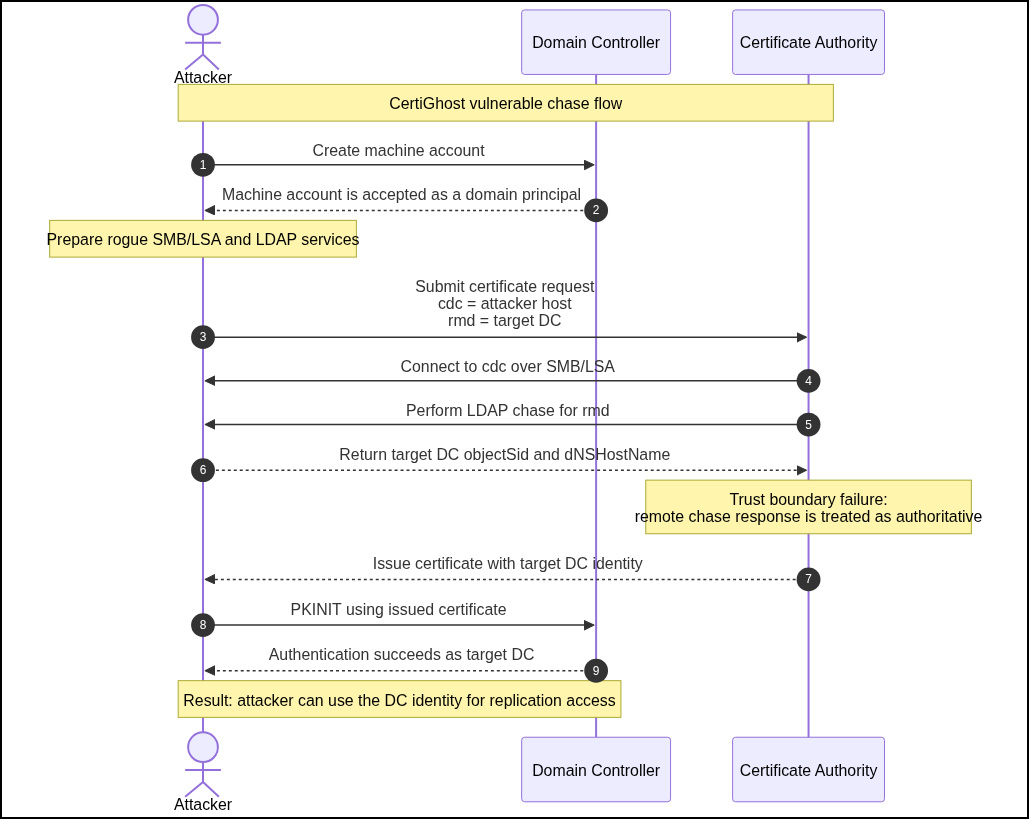
In the attack demonstrated by the researchers, a low-privileged user first creates a machine account, which is permitted under the default ms-DS-MachineAccountQuota configuration.
“A machine account created through the default ms-DS-MachineAccountQuota setting is a valid domain principal,” reads the report.
“This allowed the attacker-controlled chase endpoint to satisfy the authentication checks needed for the CA to continue, even though it was not the Domain Controller being impersonated.”
The attacker then submits a certificate request that directs the CA to the rogue services and targets a domain controller account. Because the CA trusts the identity information returned by the attacker-controlled services, it issues a certificate that can be used to authenticate as that domain controller and perform Active Directory operations.
The released certighost.py proof-of-concept automates this process by using the certificate to authenticate through PKINIT as the targeted domain controller, saving the resulting Kerberos credentials to a .ccache file and extracting the account’s NT hash.
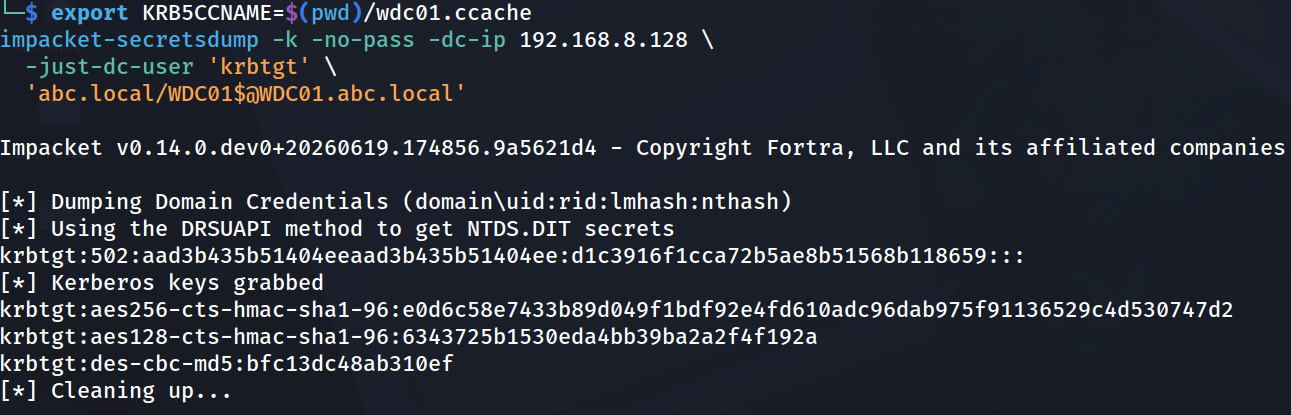
The researchers then demonstrated using the saved Kerberos credentials with Impacket’s secretsdump tool to perform a DCSync attack and retrieve the krbtgt account’s credentials.
“A Domain Controller account has directory replication rights. With the resulting Kerberos credential, the attacker can request account secrets, including the krbtgt secret,” explained the researchers.
Microsoft fixed the vulnerability as part of the July Patch Tuesday updates by adding validation to this chase process.
The CA now verifies that the server specified in the cdc attribute maps to a legitimate domain controller in Active Directory and confirms that the returned identity matches the expected account.
For admins who cannot install the July security updates, the researchers say that you can disable the optional chase fallback using the following commands:
certutil -setreg policy\EditFlags -EDITF_ENABLECHASECLIENTDC
Restart-Service CertSvc -Force
However, the researchers stress that this workaround is only a temporary mitigation and has not been fully tested in production environments. Therefore, admins should prioritize installing the latest security updates as soon as possible.

Security teams log 54% of successful attacks and alert on just 14%. The rest move through your environment unseen.
The Picus whitepaper shows how breach and attack simulation tests your SIEM and EDR rules so threats stop slipping by detection.
Weeks before its expected acquisition by SpaceX closes, AI coding startup Cursor is making its biggest push into India yet, launching its first country-specific subscription as the company bets on one of the world’s largest developer markets to drive its next stage of growth.
On Monday, the startup introduced Cursor Start, a ₹649-a-month (about $7) subscription built specifically for India — and priced well below Cursor’s standard $20-a-month Pro subscription.
The move reflects India’s growing importance to Cursor’s business. The startup says India is already its third-largest market globally and home to its highest concentration of power users, with its user base in the country more than tripling over the past year.
That scale, coupled with India’s deep pool of software engineering talent, made it the first market where Cursor chose to localize pricing, Simon Green, Cursor’s head of Asia-Pacific and Japan, told TechCrunch. “We felt that we had an opportunity there to right-size the commercial model and drive scale,” Green said. “The technical competency of the country and the engineering talent that already exists make it a very natural fit.”
India has emerged as one of the world’s largest software developer hubs. Earlier this year, GitHub said that the country has more than 27 million developers on its platform, second only to the U.S., with more than two million joining in 2026 alone.
Cursor Start includes access to Cursor’s Composer 2.5 model and Grok 4.5, with higher usage limits than the free tier, alongside cloud agents, its iOS app, plugins, Model Context Protocol support, hooks, and skills. The startup said the plan is aimed at developers who need more AI-assisted coding capacity than the free tier offers without upgrading to its full Pro subscription.
The lower-priced plan is intended to broaden access rather than replace Cursor’s flagship offering, Green said. Unlike the $20-a-month Pro subscription, Start does not include access to frontier AI models from providers such as OpenAI and Anthropic, or advanced features including Bugbot, Auto Mode, Automations, and the Cursor SDK.
The plan is billed in Indian rupees and supports payments through credit and debit cards as well as India’s Unified Payments Interface (UPI).
Green told TechCrunch that Cursor would use multiple checks to ensure the India-only subscription is available only to individual users in the country, including measures to deter people from accessing the plan through virtual private networks (VPNs).
Cursor is not alone in tailoring its pricing for India. OpenAI and Anthropic have also rolled out India-specific plans over the past year as global AI companies compete for users in one of the world’s fastest-growing AI markets.
While Cursor Start is initially limited to India, Green told TechCrunch that the startup could expand localized pricing to other markets if the model proves successful.
“We will continue to do everything we can to fuel the demand and serve those clients that are using us,” Green said. “Now, if this model proves that we could take it to other markets, perhaps we will. But I think it’d be crazy to say we would never do it elsewhere.”
OpenAI provides one precedent for this strategy, having launched its sub-$5 ChatGPT Go in India before expanding the lower-priced subscription to other markets.
In addition to the localized pricing strategy, Cursor is also expanding its presence in India through new hires. Green told TechCrunch that the startup recently hired its first salesperson in India and expects another leader to join in Delhi. The company is also building out its a government affairs office, alongside three technical customer support hires, as it expands its presence in Bengaluru, Chennai, Hyderabad, and Mumbai.
Cursor’s enterprise push is still in its early stages in India, Green said, where adoption has so far been driven largely by individual developers, startups, and universities. He said Cursor sees significant opportunities in sectors including banking and large enterprises as it expands its local sales efforts.
Green said, the India-specific pricing was designed to be commercially sustainable rather than a loss leader. He said the lower-priced plan is viable because it is built around Cursor’s own AI models, which carry lower operating costs than relying primarily on third-party frontier models.
Cursor’s India expansion comes a little over a month after Elon Musk’s SpaceX agreed to acquire the AI coding startup in a $60 billion all-stock deal, following SpaceX’s blockbuster initial public offering. The acquisition is expected to close in Q3. However, SpaceX has been partnered with Cursor since April to develop a next-generation “coding and knowledge work AI.”
Green said Cursor will continue to operate independently until the transaction closes and that the company’s India expansion plans were already in motion before the deal. Once the acquisition closes, however, Green said SpaceX’s existing presence in India through Starlink could help Cursor expand faster by lowering commercial and operational barriers.
When you purchase through links in our articles, we may earn a small commission. This doesn’t affect our editorial independence.
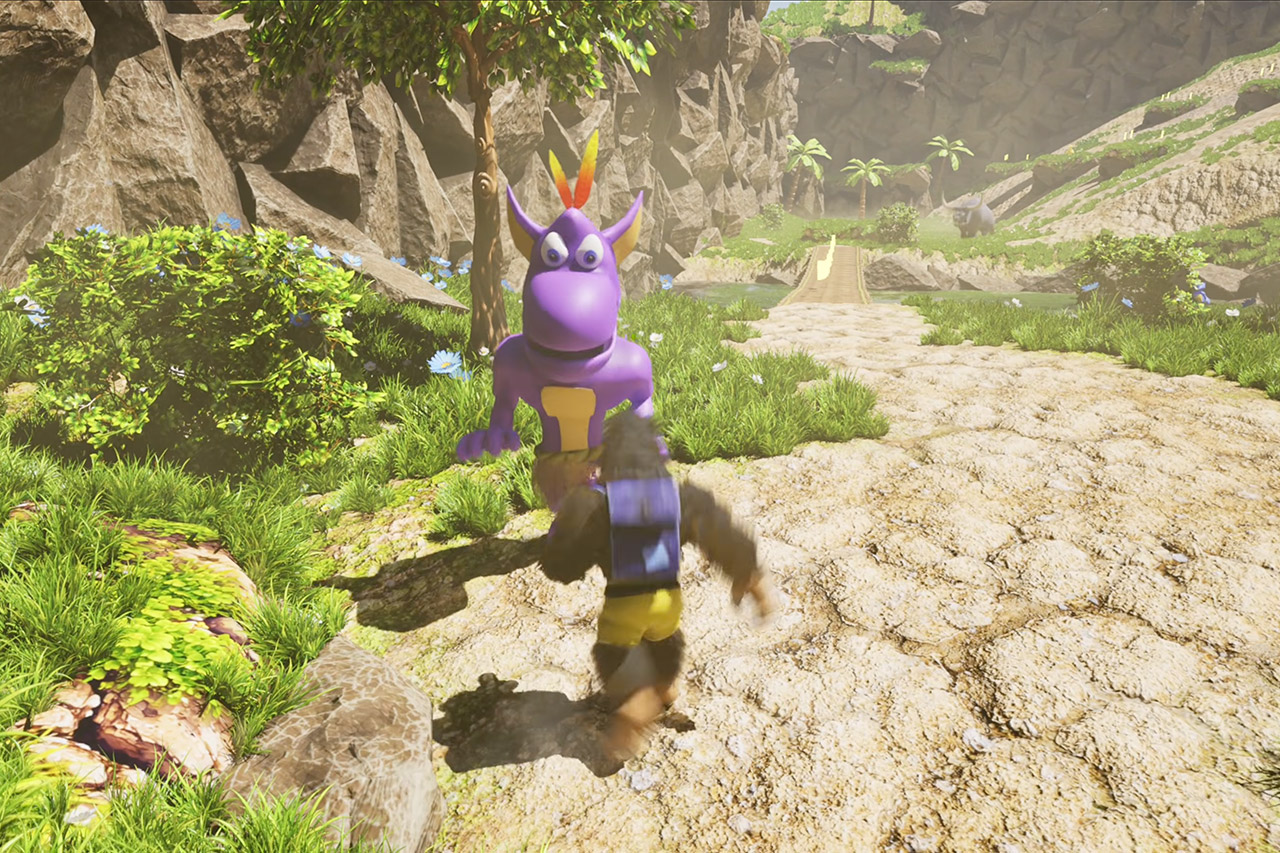
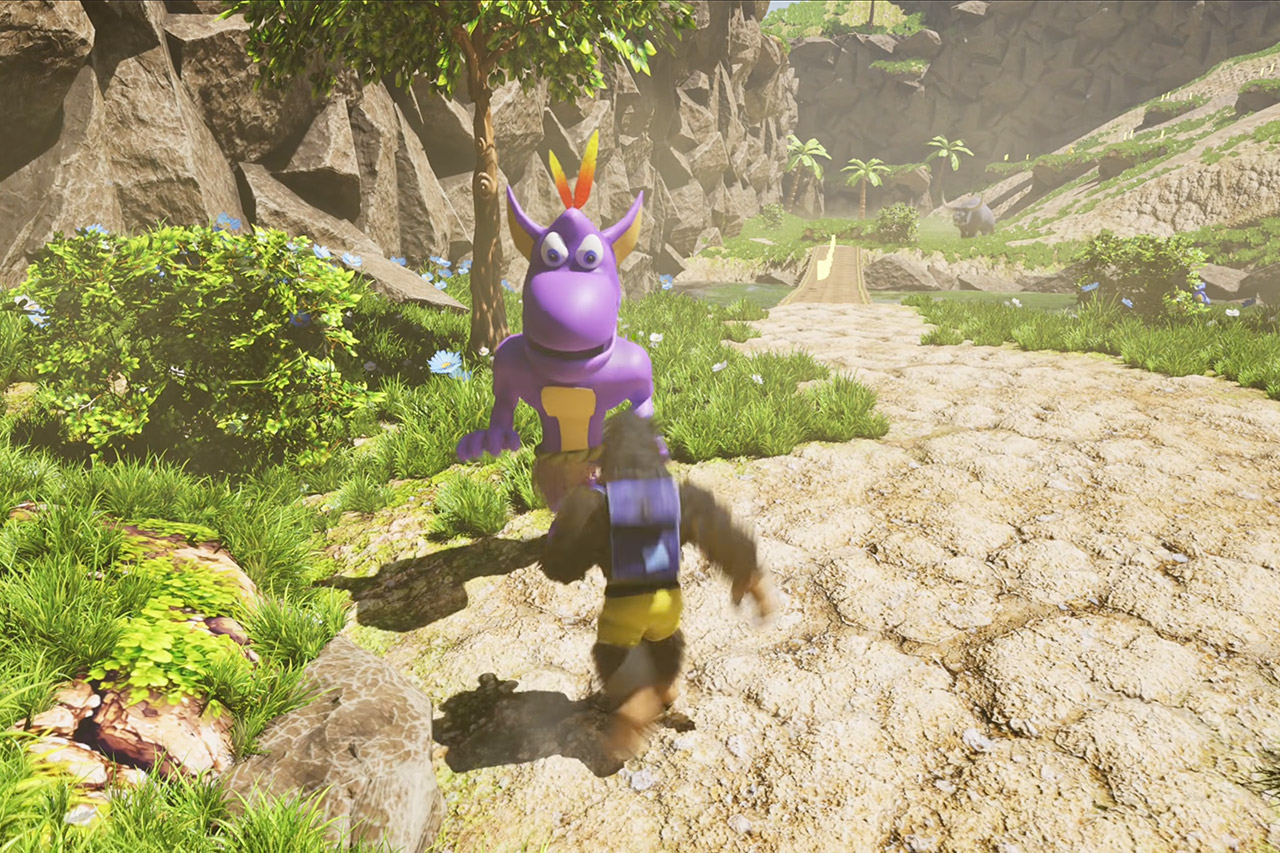
Twenty-eight years after a honey bear and a red-crested bird first scrambled across Spiral Mountain, a fresh batch of Unreal Engine 5 footage has arrived that makes the wait for an official return feel almost unbearable. François Montagud, the same creator who previously rebuilt Doom 3 in the engine for his portfolio, has posted seven uninterrupted minutes of his Banjo-Kazooie fan remake. It will never ship. You cannot download it. Yet the short video already does more to answer the quiet question hanging over the series than any corporate teaser has managed in years.
Montagud’s idea with this one was to bring back the original game’s charm while also incorporating all of the improvements that modern hardware would provide. The end result is that the grass swings in the breeze, the leaves catch the light in a realistic way, and the rock faces suddenly have a degree of detail that the old N64 games couldn’t match. The lighting is stunning, casting shadows that stretch and shrink as Banjo moves around, and you can see how clean the water is, whereas the old cartridge merely hinted at how good it could appear. The environments feel lived-in rather than thrown together.


The camera follows the duo through some big open areas as well as some tighter spots, and you can still see Banjo trudging along in that typical manner, while Kazooie, of course, bursts out of the backpack at the appropriate times, and leaping around still produces all of those cheery little “woohoo”s and “wheeee”s that you have always enjoyed. When they go underwater, the soundtrack turns to bubbles and muted sounds, which is actually very convincing.

Vegetation is arguably the most improved, because plants and trees no longer sit there like flat billboards; they have volume. Light passes through the leaves, creating all these gorgeous soft patterns on the ground. The far hills have a lot more texture, yet it doesn’t take away from the game’s gentle, storybook appeal. The color scheme is still warm and inviting, and the balance is perfect. None of it has been pushed too far into photorealism, which would clash with Banjo’s nicely rounded design or Gruntilda’s appropriate cartoon menace. That’s significant because it helps the game feel like it belongs in this universe.
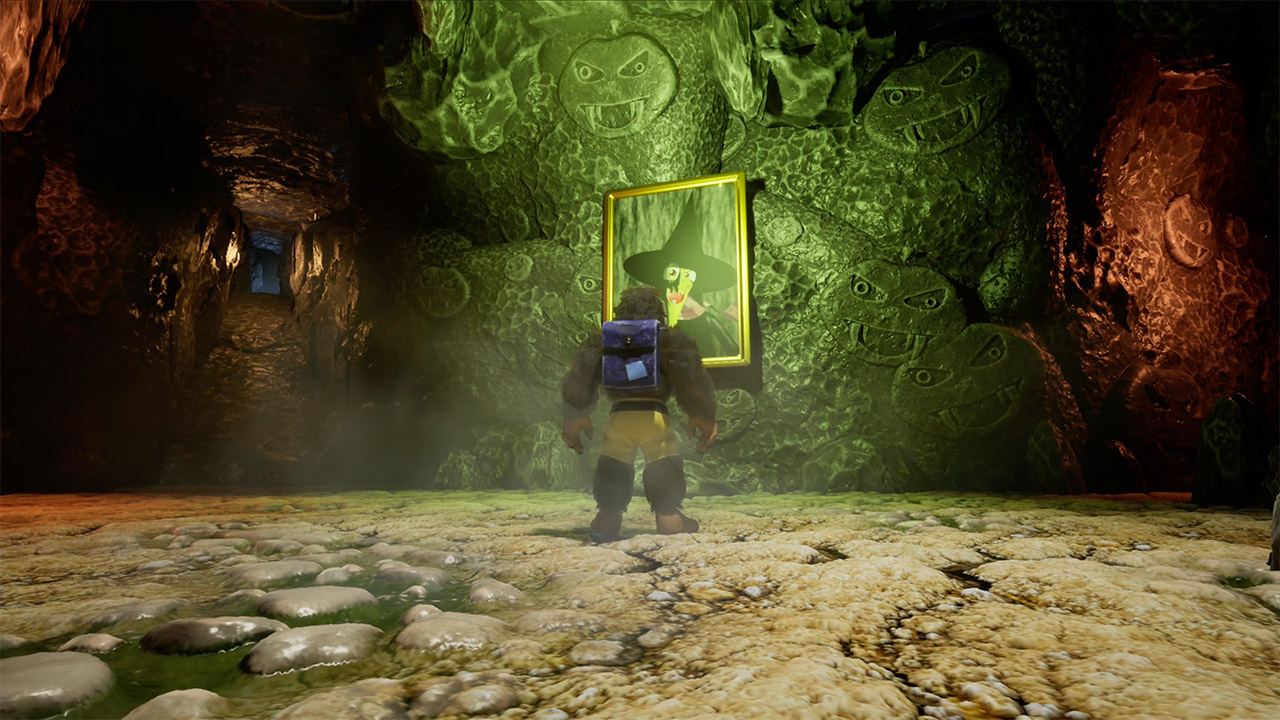
Montagud has been open about this, stating that he did it for his portfolio and that it would most likely remain offline, similar to his Doom 3 work. There are no plans for a public build, but this does not diminish the footage’s effect. Fans who have been waiting since Nuts & Bolts, through the Smash Bros. debut, and through the numerous speculations finally have a tangible visual reference for what a properly done remake could look like.
[Source]
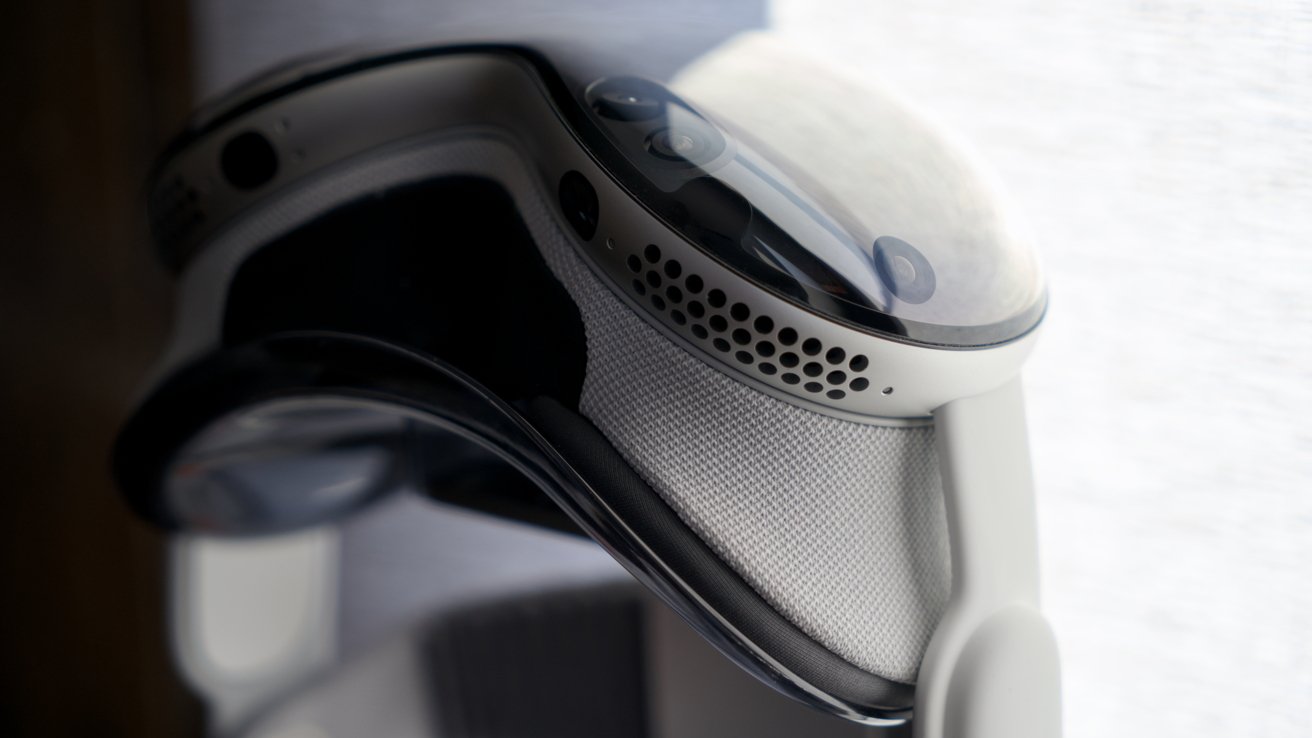
The end-of-cycle updates are often devoid of anything user-facing, but that doesn’t mean you should delay updating to visionOS 26.6. Security patches and preparation for Siri AI are worth the update.
Not every operating system update is going to have some flashy headlining feature. As we await the OS 27 releases in the fall, the OS 26 cycle is still getting needed updates.
Apple has released visionOS 26.6 today alongside the other operating systems with minor changes. The release notes don’t mention anything beyond the usual bug fixes and performance enhancements.
The release build for visionOS 26.6 is number 23O770.
Even though users won’t get any new user-facing features, there has been some evidence that Apple will begin indexing users’ devices before releasing Siri AI in September. The index would occur in the background and not be accessible to the user in visionOS 26, but would be ready for visionOS 27.
Indexing every piece of data available across all of a user’s devices is time-consuming and can affect performance. It is also not an ideal situation given that users hoping to try the new Siri AI might be disappointed to find errors when their data isn’t indexed.
Outside of that, there isn’t anything of note in visionOS 27. Since the update offers the usual bug fixes and performance enhancements, it is best to install the update as soon as is reasonable.

It is rather refreshing that, in an era of artificial intelligence and faceless machine made music, there is not only interest in, but genuine demand for, a multidisc, 118 track boxed set dedicated to recordings by Gertrude “Ma” Rainey, the “Mother of the Blues,” including four previously unreleased alternate takes.
Ma Rainey: Mother of the Blues, The Complete Paramount Recordings 1923 to 1928 promises improved sound while offering a compelling portrait of this underappreciated artist. The set also includes a 100 page book featuring unpublished photographs, detailed biographies, notes for each track, news clippings, period advertisements, and a complete discography.

A pioneer on many levels, Rainey was a successful Black female musician who maintained control over her work in an industry that continues to exploit and mislead artists. The official materials accompanying the set explain:
“By the time Paramount signed her in 1923, she had the standing to negotiate on her own terms. She managed her own career for nearly thirty years and, according to registered copyrights, wrote or co wrote at least a third of what she recorded, at a time when almost no performer, and few women anywhere in the business, held that kind of control.”
While collectors understandably prize original 78 RPM recordings such as these, the reality is that discs produced before tape and digital technology, during the nascent and effectively direct to disc era of recorded music, are exceptionally rare. It is therefore especially encouraging to see this music preserved and improved through the latest technology and restoration expertise. Although the original discs have survived for more than a century, no doubt because of careful collectors, they will eventually deteriorate.

Featuring audio restoration by engineer Doug Benson, the set compiles the best surviving version of each 78 RPM side, as the individual recordings were known. Modern demixing software apparently does not work particularly well with early acoustic recordings, which account for roughly half of this collection, so the producers instead chose to remaster the material while remaining faithful to the sound of the original releases. Some surface noise is inevitable, but preserving it ultimately helps retain the music’s overall fidelity.
So how does it sound, you ask? While the label could not send me the entire boxed set for review, I did receive a very useful 22 song advance sampler CD that provides a strong overview. In short, it is highly enjoyable and, considering that these recordings are now roughly 100 years old, the sound quality is remarkably good. Do not expect Abbey Road by The Beatles or the latest Billie Eilish album, but this remains a vivid and authentic listening experience.
The recordings appear to be in remarkably good condition, given their age and scarcity. The music itself is often astonishing, particularly in its explicit, honest, and direct treatment of sexuality and independence on songs such as the groundbreaking “Prove It on Me,” “Shave ’Em Dry,” and “Dead Drunk Blues.”

Available now from Black Swan Records, named in tribute to the pioneering Black owned label founded in the 1920s, the set also reflects an important historical connection. J. Mayo Williams, who distributed the original Black Swan label, became Paramount’s recording director during the year Rainey signed with the company. Ma Rainey: Mother of the Blues, The Complete Paramount Recordings 1923 to 1928 can be ordered through the official website or Jazzology for $125.
★★★★★★★★★★ Music
★★★★★★★★★★ Sound Quality
Mark Smotroff is a deep music enthusiast / collector who has also worked in entertainment oriented marketing communications for decades supporting the likes of DTS, Sega and many others. He reviews vinyl for Analog Planet and has written for Audiophile Review, Sound+Vision, Mix, EQ, etc. You can learn more about him at LinkedIn.
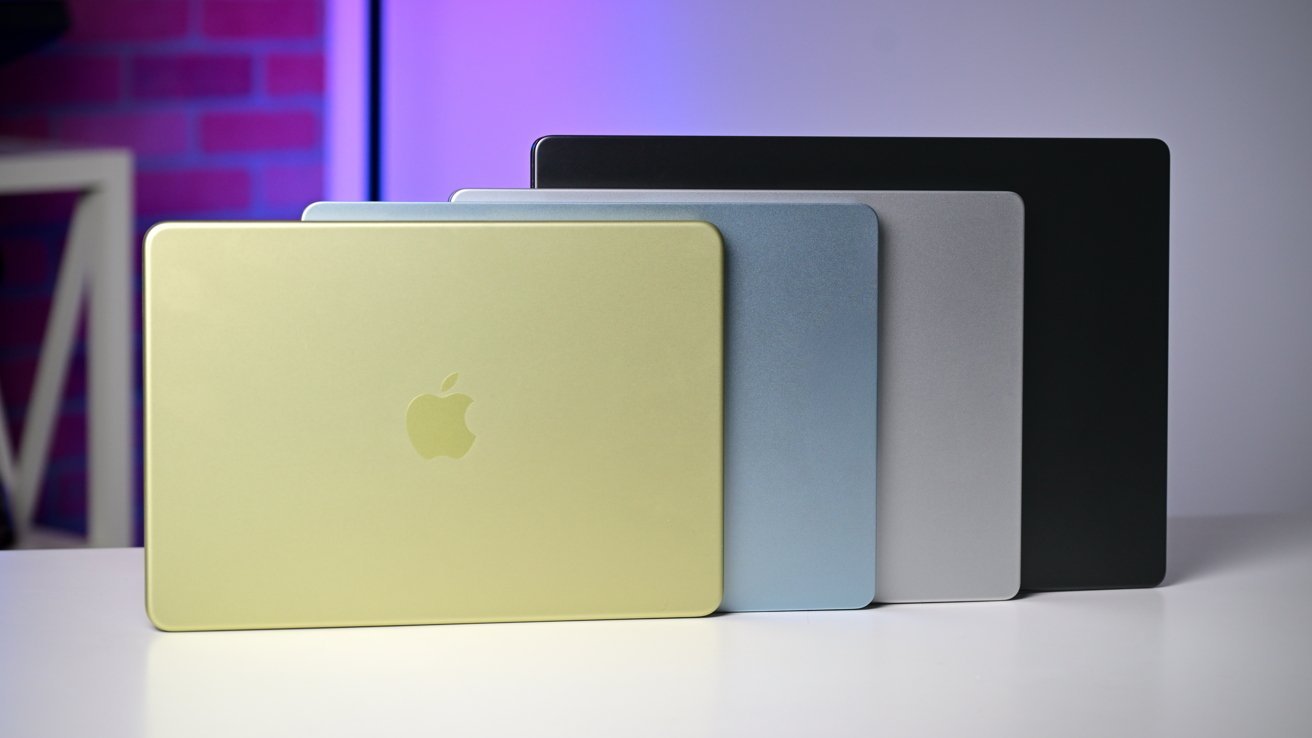
Apple has released macOS 26.6 to the public, but don’t expect much in the way of big changes to features this time around.
Apple has concluded its beta testing program for updates to its current-gen operating systems. After five developer betas and a release candidate, it has now shipped macOS Tahoe 26.6.
At the same time, Apple has also brought out updates for earlier macOS versions. There are updates available for macOS Sequoia 15.7.8 and macOS Sonoma 14.7.7.
As usual for any system update, it is advisable to install the update, due to Apple including various bug fixes, performance improvements, and security refinements. However, unlike the macOS 27 Golden Gate beta program, you’re not going to see any real feature-based additions.
Instead, users may be forgiven for not seeing any real updates to macOS 26.6 at all. However, release notes for the betas and the RC edition show that there are some changes.
The release notes for the RC build mention some small improvements, including the deprecation of encrypted HFS+, which won’t be supported in macOS 28.
It also resolves a problem with deprecation notifications where it incorrectly identifies an app as Intel-only. This occurred when a system plugin loader like the Color Picker loads x86 code into the host process.
HealthKit also adjusted temporally-weighted average statistics queries for discrete quantity types, such as resting heart rate. It was occasionally returning high values in cases when sample times overlapped.
For Messages, the build fixes HDR screenshots that can appear garbled when sent to other users.
To update, open System Preferences, then General, followed by Software Update. If there is a software update available, select to install it.
Google has been in the business of making smartphones ever since the early days of Android. However, Google’s early phones, the Nexus lineup, were actually manufactured by other companies like HTC, Samsung, LG, and Huawei, resulting in different hardware designs and feature sets every time. The company finally found its footing with the Pixel lineup that debuted in 2016 and, in more recent years, has established a stronger identity with a consistent design language.
If you’re buying a Pixel smartphone today, you’re doing it primarily for the software experience. Google offers up to seven years of Android updates across its Pixel lineup. Since it also happens to develop the Android operating system, Pixel users enjoy these updates on day one. Pixels have also garnered a reputation for offering some of the best camera systems in a smartphone. Despite these benefits, Pixels aren’t always as easy to recommend as other Android phones.
There are a few reasons behind this, ranging from performance compromises to slow-paced hardware improvements. It also doesn’t help that a flagship from Google costs more than the Samsung Galaxy S26, which has a similar screen size, a great camera system, a powerful system-on-a-chip (SoC), and more starting storage. Here’s a closer look at some of the corners the Google Pixel series cuts and why they might be dealbreakers to some people.
Your smartphone doesn’t have to be the most powerful portable computer you own, but when you’re paying close to $1,000 for a flagship, you’d expect it to at least keep up with the competition. All current-generation Google devices, except for the Pixel 10a, ship with the in-house Tensor G5 chip, which, on paper, is significantly slower than the latest from Qualcomm. The budget Pixel 10a doesn’t even get that, running the older Tensor G4 that debuted in the Pixel 9 series in 2024. According to NanoReview, the Snapdragon 8 Elite Gen 5 scores up to 2.7x higher than the Tensor G5 in AnTuTu benchmarks.
Of course, real-world use is more than just stress testing your phone’s CPU and GPU using synthetic benchmarks. In our review of the Pixel 10 Pro XL, we didn’t report any performance issues, but for people who are hoping to enjoy the most graphically demanding games out there, the Pixel’s weaker GPU performance may be a dealbreaker.
Google is a software-first company, which is why many praise its Pixel devices, not because of their hardware, but because of the exclusive software features these phones offer. Unfortunately, a few of these headlining features are region-locked and might not be available to everyone. For instance, the enhanced call screening functionality is only available in select countries, including Germany, France, Australia, and India. In fact, for the feature to screen your calls automatically, you will have to be located in the United States.
Call Notes is another useful addition that lets you transcribe, summarize, and generate important points discussed during a conversation. Not only does this feature not work on Google’s budget A-series devices, but its availability is also restricted to a limited number of countries and languages. Other features like Hold for Me and Take a Message are also limited to certain regions. Even something as basic as Scam Detection isn’t as widely available as you might think.
Google is not the only brand that’s guilty of advertising region-locked features, as other companies like Apple and Samsung limit functionality based on where you live, too. However, if you’re planning to buy a Pixel primarily because one of these nice-to-have features caught your eye, it’s worth checking if it actually works on your device, in your location, and in your language.
Modern Pixel smartphones are well built, typically pairing a glass sandwich construction with an aluminum frame. You also get a bright display with thin, uniform bezels and a flagship camera system. Yet, next to the rest of the Android field, it’s easy to realize just how safe the Pixel plays.
For instance, Oppo’s flagships are known for pushing the boundaries of camera hardware by including large sensors and periscope cameras like the Find X9 Ultra’s, which hits 10x optical zoom without an add-on lens. OnePlus, on the other hand, sells some of the most powerful smartphones that undercut other options in price. Many Chinese phone makers have also made the switch to using silicon-carbon batteries. These batteries are high-density and known to last long. Gaming phones, like ones from Red Magic, come with active cooling solutions and capacitive shoulder triggers, delivering an experience closer to an actual controller.
Some users even feel the software experience on Pixel phones is a bit bland. Compared to feature-rich Android skins like One UI and OxygenOS, the Pixel interface is more on the minimalistic side. In our review of the Pixel 10a, we noted how it was basically the same phone as last year’s. There’s nothing inherently wrong with recycling a formula that works, but it does come at the cost of seeming uninspired.
How long your phone lasts on a single charge depends on various factors, including the kind of workload you put it through, how bright your screen is on average, and if you’re relying more on 5G than a stable Wi-Fi connection. To combat the growing requirements of modern smartphones, manufacturers have been fitting their phones with increasingly larger batteries every year. In fact, the market now has many Android phones with silicon-carbon batteries that offer capacities of 7,000mAh or higher.
Even the mainstream manufacturers that are playing it safe are either doing great with optimization or simply packing in larger lithium-ion cells. Samsung’s most premium flagship, for instance, has shipped with the same 5,000mAh battery capacity since the Galaxy S20 Ultra in 2020, but has managed to deliver all-day battery life thanks to improvements in display and chipset efficiency. Phones from Chinese manufacturers like OnePlus and Xiaomi not only pack in larger batteries but also feature significantly faster charging speeds of up to 120W in certain regions.
The Google Pixel, on the other hand, doesn’t stand out for its battery life claims. In a comprehensive battery test carried out by YouTuber MrWhoseTheBoss, the Pixel 10 Pro XL came in last place with nine hours and 53 minutes, followed by the Samsung S25 Ultra with 10 hours and 43 minutes.


Chinese AI startup Moonshot AI, creators of the increasingly famous “Kimi K” family of powerful, open AI models, today released the full weights for its largest and most performant version yet — Kimi K3. But enterprises evaluating the model should read the attached custom Kimi K3 usage license as carefully as the benchmark charts.
VentureBeat previously covered Kimi K3 when it debuted through Moonshot’s hosted API earlier this month, including its 2.8 trillion-parameter architecture, one million-token context window and frontier benchmark performance. Today’s announcement completes that rollout with the release of the full model weights, a 47-page technical report documenting its training innovations and obstacles, and much of the infrastructure required to run the model independently.
That includes the complete 2.8 trillion-parameter Mixture-of-Experts model, inference infrastructure, optimized attention kernels, MoE communication libraries and deployment components aimed at researchers and enterprise developers who want to self-host the system rather than consume it exclusively through an API.
Moonshot is also releasing implementation support for ecosystems including vLLM and SGLang, alongside a technical report detailing the architectural innovations behind the model, including Kimi Delta Attention, Attention Residuals and Stable LatentMoE. Together, those techniques underpin what the company describes as the world’s first open 3T-class model, activating 104 billion parameters from a pool of 896 experts while supporting native multimodal reasoning and a one million-token context window.
While Kimi K3’s license grants broad rights to developers and even enterprises to download, modify and deploy the model for commercial purposes — a win for those seeking low-cost, frontier-level AI they can control and run offline — it also imposes some added obligations on larger companies and AI service providers not found in traditional open-source licenses like Apache 2.0 or MIT.
Here’s the text of the new Kimi K3 License in full:
Permission is hereby granted, free of charge, to any person (the “Licensee”) obtaining a copy of this software — including the model weights, parameters, configuration files, inference and training code, and associated documentation (collectively, the “Software”) — to deal in the Software without restriction. This includes, without limitation, the rights to use, copy, modify, merge, publish, distribute, sublicense, and/or sell copies of the Software; to run, deploy, fine-tune, or otherwise modify the Software and create derivative works from it; and to permit persons to whom the Software is furnished to do so, in each case subject to the following conditions:
1. The above copyright notice and this permission notice shall be included in all copies or substantial portions of the Software. Licensee’s use of the Software must comply with applicable laws and regulations.
2. “Model as a Service” means giving a third party access to language model inference or fine-tuning (e.g., via API) in a manner that allows such third party to exercise meaningful control over the inputs, parameters, or training data. This does not include (a) end-user products with model capabilities solely embedded within specific features or harnesses, or (b) mere relaying of requests to models hosted by others.
If the Licensee or any of its affiliates operates a Model as a Service business, and the aggregate revenue of the Licensee and its affiliates exceeds 20 million US dollars (or the equivalent in other currencies) in total over any consecutive 12 months, the Licensee must enter into a separate agreement with Moonshot AI before using the Software or its derivative works for any commercial purpose.
3. If the Software (or any derivative works thereof) is used for any of the Licensee’s commercial products or services that have more than 100 million monthly active users, or more than 20 million US dollars (or equivalent in other currencies) in monthly revenue, “Kimi K3” must be prominently displayed on the user interface of such product or service.
4. The requirements set forth in Sections 2 and 3 do not apply to: (a) internal use of the Software, defined as any use that does not make the Software, its outputs, or its underlying capabilities available to third parties; or (b) any use of the Software accessed through Moonshot AI’s official products or certified inference partners.
The most significant clause is 2., as it requires a separate commercial license from companies earning $20 million in annual revenue and operating what Moonshot calls a “Model as a Service,” which it defines as “giving a third party access to language model inference or fine-tuning (e.g., via API) in a manner that allows such third party to exercise meaningful control over the inputs, parameters, or training data” but not ” end-user products with model capabilities solely embedded within specific features or harnesses” or “mere relaying of requests to models hosted by others.”
That would seem to allow for free use of the model for most non-tech focused enterprises: banks and consumer brands seeking to use it as a front-end chatbot or customer service agent should be fine, since they’re not using Kimi K3 as a “Model as a Service.” But firms like they hyperscalers or startups offering model training tools might fall under the commercial license terms.
The wording is further notable because it does not limit the revenue calculation to products built on Kimi K3.
Instead, it references the aggregate revenue of the licensee and its affiliates, potentially bringing even smaller companies that are part of larger parents into the requirement that they must commercially license the model from Moonshot, pending the parent firm generates revenue of $20 million or more per year as is using it somewhere, in some capacity, as a “Model as a Service.”
Regardless of this requirement, in clause 3, the license also requires attribution once a commercial deployment reaches significant scale:
“If the Software… is used for any of the Licensee’s commercial products or services that have more than 100 million monthly active users, or more than 20 million US dollars in monthly revenue, ‘Kimi K3’ must be prominently displayed on the user interface.”
For enterprise software vendors, AI copilots and consumer applications, that branding requirement may prove just as significant as the revenue threshold. Companies that typically abstract away the underlying model may instead need to disclose it directly within their products.
But, if your enterprise is sticking to using Kimi K3 internally as an employee tool for information retrieval, creating spreadsheets and documents, or answering employee questions, Moonshot offers a significant carve out, stating that clauses 2 and 3 “do not apply to: (a) internal use of the Software, defined as any use that does not make the Software, its outputs, or its underlying capabilities available to third parties.”
The licensing provisions quickly became one of the dominant topics of discussion following the release of the model weights.
AI researcher Nathan Lambert, previously the co-leader of the Olmo family of open models at AI startup Ai2, summarized the issue in a post on X:
“Kimi K3 license. It’s inspired by MIT but distinctly non-commercial, where any company making over $20M/yr must get a specific commercial deal (and display Kimi K3 if over 100M users or $20M/mo revenue).”
Lambert’s assessment reflected what many developers noticed as they dug into the newly published license: while Kimi K3 offers unrestricted access to the model weights for researchers, startups and many enterprises, commercial obligations become significantly more complex for larger organizations.
The broader community reaction was largely positive toward the release itself. Developers praised Moonshot for publishing not only the weights but also supporting infrastructure, including attention kernels, MoE communication libraries and agent tooling, viewing the release as a significant contribution to the open-weight AI ecosystem.
Others highlighted the rapid pace of ecosystem support, with inference projects such as vLLM and SGLang, along with cloud providers and infrastructure partners, moving quickly to support Kimi K3 deployments.
At the same time, discussion centered on two practical caveats. One was licensing: many developers argued the model is more accurately described as open weight than fully open source, given the commercial conditions attached to larger deployments. The other was operational.
At roughly 1.5 TB of model weights, Kimi K3 remains a system aimed primarily at well-resourced organizations capable of operating large-scale inference infrastructure, even as reports emerged of successful deployments on clusters of consumer RTX 5090 GPUs.
Moonshot is far from the first frontier AI developer to embrace an “open, but not completely open” licensing strategy.
Meta’s Llama family, for example, has long been distributed under its own community license requiring a commercial agreement for those building with the model and exceeding 700 million monthly users, rather than a traditional open-source software license. Other frontier model developers have likewise adopted bespoke licensing terms governing redistribution, commercial use or attribution.
Kimi K3 follows that broader trend, albeit with a different mechanism. Rather than broadly restricting redistribution, Moonshot ties certain commercial rights to company scale.
Organizations operating a Model-as-a-Service business above specified revenue thresholds must negotiate a separate commercial agreement, while the largest commercial deployments must visibly attribute Kimi K3 within their products.
For enterprises, the practical implication is that “open weights” and “open source” are becoming increasingly distinct concepts. Downloading and modifying frontier models may be straightforward; understanding the legal conditions attached to commercial deployment increasingly is not.
For CIOs, chief AI officers and engineering leaders, the first step is to determine how the organization intends to use Kimi K3 before evaluating its technical performance.
If the model will remain entirely inside the organization—for example, supporting developers, researchers, legal teams or internal productivity workflows—the published license appears substantially more permissive. Those deployments may qualify as internal use under Moonshot’s terms, avoiding the commercial licensing provisions that apply to customer-facing AI services.
Organizations planning to build products on top of Kimi K3 should take a different approach.
Legal, engineering and product leaders should determine whether the planned deployment constitutes “Model as a Service” under the license, whether the company or its affiliates exceed the $20 million revenue threshold, and whether future growth could trigger the requirement to negotiate a commercial agreement with Moonshot.
Companies expecting products to reach more than 100 million monthly active users—or more than $20 million in monthly revenue—should also evaluate the license’s attribution requirement and how it fits with existing branding, contractual commitments and white-label offerings.
More broadly, Kimi K3 illustrates a transition taking shape across frontier AI. As the industry’s most capable models increasingly become available as downloadable weights instead of exclusively through hosted APIs, enterprises will need to evaluate licensing terms with the same rigor they apply to benchmarks, security reviews and infrastructure planning.
The next competitive battleground may not simply be whether AI models are open or closed, but the increasingly nuanced legal frameworks that determine who can commercialize them, under what conditions and at what scale.
T-Mobile’s Monday outage is officially over. After thousands of customers spent hours dealing with dropped signals and iPhones stuck in SOS mode, the carrier confirmed that service has been fully restored.
Reports started flooding into Downdetector around 4 PM ET, and within an hour, more than 140,000 users had flagged an issue. Most people reported they are receiving no signal or a dead mobile connection.
The trouble didn’t stop at T-Mobile’s own network either. StatusGator confirmed that MVNOs like Mint Mobile and Boost Mobile, which run on T-Mobile’s towers, also felt the impact.
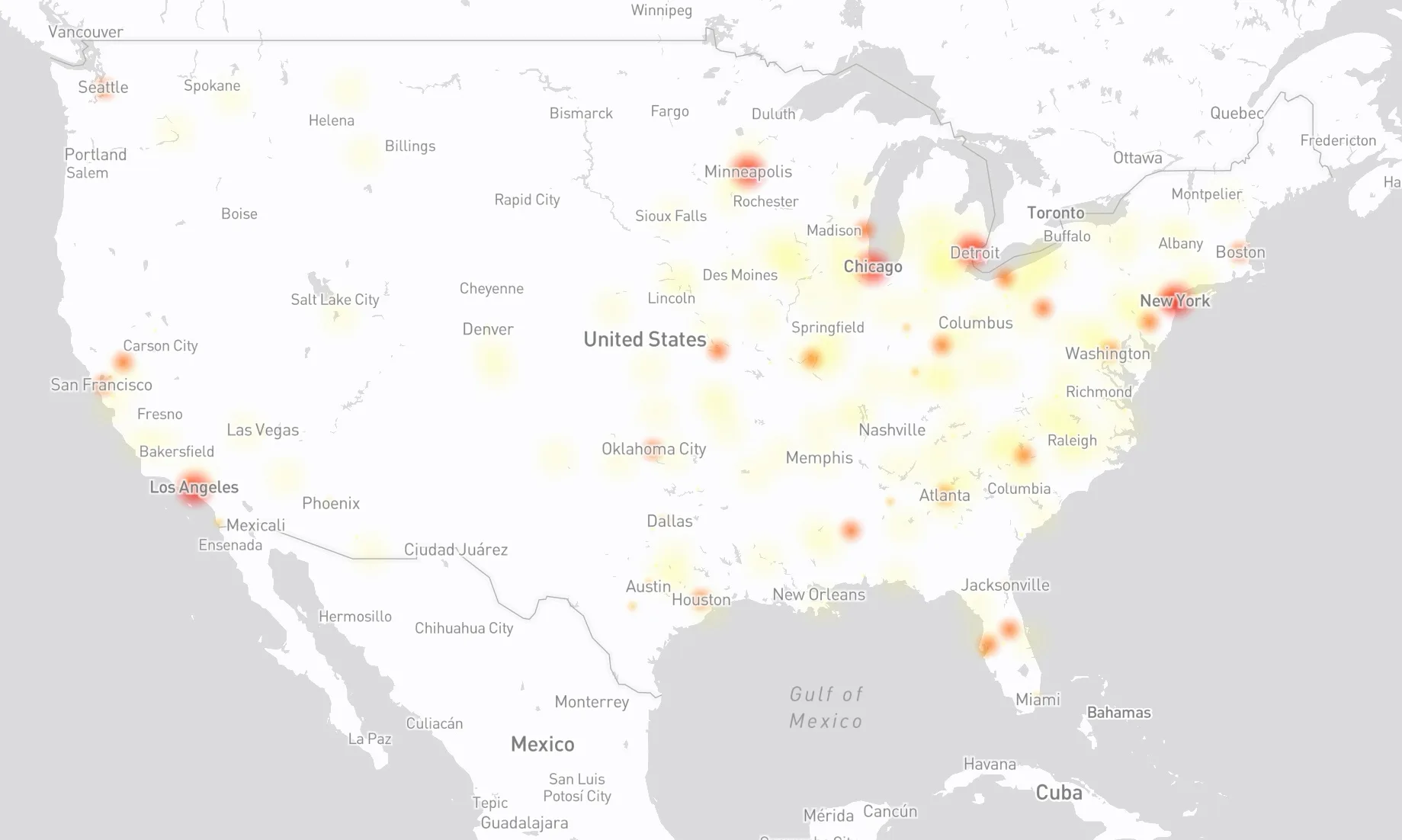
Things got bad enough that plenty of iPhone owners watched their devices switch to Emergency SOS mode, and Google searches for “SOS mode” spiked as people tried to figure out what was happening. New York, Washington D.C., Chicago, Detroit, Minneapolis, and Los Angeles saw the heaviest concentration of complaints, according to Downdetector’s outage map.
Over on Reddit and X, posts about the outage blew up, racking up thousands of comments as users traded theories and potential fixes.
After first saying its teams were “actively working” on the issue, T-Mobile followed up with a full resolution update on X. “We have fully restored service for all customers and sincerely apologize for the difficulties to those who experienced network impacts today,” the company said. “At T-Mobile, we know that customers rely on us to stay connected to what matters most, and we appreciate their understanding as we prioritized resolution.”
T-Mobile still hasn’t shared what actually caused the outage in the first place, so we don’t know if this was a one-time hiccup or something worth keeping an eye on. For now, if your phone was stuck on SOS earlier today, a quick restart should get you back to full bars.




Weekend Open Thread: Brooks Brothers


Grayscale Files For Worldcoin ETF, WLD Registers Sharp Rise


How a former Blue Peter presenter stunned America’s Got Talent judges


Intel is reversing course and bringing hyper-threading back to its server chips

New Jersey voter registration controversy explained: How 6,600 noncitizens got on the rolls, and what happens next

Johnny Depp’s R-Rated Gothic Cult Classic Gets New Release Ahead of Sydney Sweeney Remake


Ethics, other provisions in crypto Clarity Act to be further discussed


Luke Littler dismantles Gerwyn Price to retain title in Blackpool

Commonwealth Games boxing: Jadumani Singh seals dominant 5-0 win over Pakistan’s Sumama Rehman to enter quarter-finals | Commonwealth Games News


2026 3M Open leaderboard: Scottie Scheffler finds putter in Round 1, sits three back


16 Dresses for the High Summer Event


The Peugeot Family: How 200 Years of an “Old Money” Dynasty Died in A Boardroom


Spain sweeps the board at 2026 World Cup with individual awards

A New Post-Apocalyptic Gundam Anime Series Blasts Into SDCC


BITCOIN JUST ENTERED THIS CRITICAL ZONE…


XRP Ledger adds $2.6B as RWA inflows rank second


Uniswap (UNI) pushes deeper into tokenized RWAs with permissioned trading pools


Sablier Labs Enters Maintenance Mode, Halts Development


Anthropic launches Claude Opus 5, a cheaper AI model for coding, agents and enterprise workflows


Ripple bought a bank in pieces. The $4 billion audit


You must be logged in to post a comment Login