Welcome to Fully Fit 2026, GOLF’s new platform for providing you with real-golfer insights into what 2026 gear might be best suited for your game. To this end, we assembled six GOLF content creators of varying abilities and ran them through the gauntlet of six full-bag fittings (driver to putter!) at six major club manufacturers in Phoenix and Carlsbad, Calif. Our hope: that you might see shades of your own game in one of our panelists’ and take some learnings and inspiration from their fitting experiences. In this installment (below), Jack Hirsh details his low-torque putter journey around Fully Fit 2026. You may browse each of our panelists’ full 2026 dream bags here:
The biggest surprise for me during our six-day club-fitting bonanza back in December was during a putter fitting at TaylorMade’s Kingdom.
Advertisement
No, I wasn’t knocked off my feet by how good the Spider Tour and Spider Tour X putters are — although they are tremendous putters.
Instead, my “Aha” moment came with the newer of TaylorMade’s Spider models, the Spider ZT, TaylorMade’s take on the low-torque, or “zero-torque,” putting phenomenon that has captivated the marketplace over the past two years.
Editor’s note: Given that even “zero-torque” putters still have torque to get them to balance toe-up, GOLF refers to these types of putters as “low-torque.”
During a putter fitting, I came with two “gamers.” A face-balanced blade and a low-torque mid-mallet that I had committed to using for several months to see what it would do to my putting stroke.
Advertisement
After a couple of strokes with a comparable TaylorMade blade, we jumped into the Spider ZT, where the result left me in a rare speechless moment.
On the first attempt, I recorded a face angle of 0.01 ° at impact on the GEARS system. That meant I returned the putter face nearly perfectly square. Good putters typically have up to a degree of face angle variance. A professional golfer typically records anywhere within a half degree. After a few more attempts, I kept getting within that half-degree threshold.
Am I the ideal candidate for low-torque putters? As I have found out, it’s not that simple.
My low-torque putting experiment
For some background, until I had this job as GOLF’s associate equipment editor, I had used either a Scotty Cameron Newport 2 or Newport 2.5+ with Teryllium inserts for 15 years. I never knew a mallet, and I liked a soft feel.
Advertisement
A putter fitting — realistically, my first ever — with Bettinardi last spring showed me that the short slant on my Newport 2.5+ had too much toe hang and I’d be better off using something more face-balanced. My stroke was more like a pendulum, with very little face rotation, rather than an arc like I thought it was.
I was using blades like that and seeing improvements, especially from short and mid-range, until Scotty Cameron released their Onset Center Fastback and Phantom 11R, the company’s first low-torque putters. Immediately, I was intrigued, especially by the Fastback OC, as it was a shape that I already knew I liked — a mid-mallet that was far off spaceship territory — had little shaft lean and had Scotty Cameron’s new and very soft Studio Carbon Steel insert.
Advertisement
Scotty Cameron Studio Style Fastback OC Putter
As an extension of the popular Studio Style Fastback design, the Studio Style Fastback OC is a low-torque model featuring the same ring-weighted, high-alignment, multi-material design of the other Fastback models, but with Scotty’s tour-validated OC technology package. Featuring onset center shaft placement behind the putter face’s leading edge, the straight shaft is precisely positioned in line with the putter head’s CG location and leans 1° forward. This allows for low-torque performance and face alignment that stays square to the path.
STUDIO CARBON STEEL (SCS) FACE INSERT
The Studio Style Fastback OC includes a chain-link milled Studio Carbon Steel (SCS) insert for soft sound and feel, treated with an electroless nickel plating for enhanced durability with aerospace-inspired vibration damping for tuned sound, feel and performance.
CUSTOM BLACK SHAFT
Advertisement
Custom made for the new OC putters, each model includes a special black KBS x Scotty Cameron shaft with optimal flex, unimpeded alignment and precise feel.
CUSTOM MATADOR GRIP
With a debossed chain-link texture built-in, each new OC putter includes a custom 11-inch mid-size Matador grip in black with racy red and cool gray accents.
In my first tests, I didn’t have a left miss, which to that point, I’d experienced with almost every low-torque putter I’d tried except the Spider ZT. I put some impact tape on the face just out of curiosity and saw my strike was dead center.
My first rolls with the Scotty Cameron Fastback OC.
Jack Hirsh/GOLF
That was when I came up with this experiment, and my experience at the Kingdom only further proved to me that I was on the right track.
Advertisement
For the next few months, I planned to putt exclusively with low-torque putters as a means of resetting my putting stroke.
Until my putter fitting with Bettinardi, I felt like my putting was holding me back. I struggled big time with pulls, especially from short range and couldn’t convert enough 10-20 foot mid-range putts. I started putting better after the putter changes, but I figured, why not try to reset everything and potentially start fresh in 2026?
After TaylorMade, I wondered if the experiment would ever end. But by April, it was, and I had learned a ton.
My results with low-torque putters
The primary putters I used for the experiment were the Scotty Cameron Fastback OC and the Spider ZT, both at 35″ and standard lie angles of 70 degrees. I also dabbled with a L.A.B. Golf OZ.1i and had some good initial success, but the milled steel insert was too firm for me, and I struggled with pace.
Advertisement
The blade putters I used in 2025 were slightly longer at 35.5″ and flatter at 67 degrees, but with both putters, my stroke was consistent and my eyes were in similar positions in the stock length and lie.
Both putters I gripped with the Golf Pride Reverse Taper Pistol Medium, slightly larger than the small version I’d been using on all my other putters. I did this because, to be most effective with a low-torque putter, I needed to remove my hands from the stroke, and a bigger grip helps that.
At first, the results were good. I trended toward the Cameron a little more because of its more compact shape and the softer insert, which I felt helped with distance control.
The Spider ZT had plenty of advantages, though, thanks to its larger, high-MOI shape. With that putter, I knew I could make a bad stroke and still have it go in.
Advertisement
TaylorMade Spider 5K-ZT Black Putter
LOW TORQUE DESIGN
The KBS putter shaft is bored directly toe-ward near the CG at a 1° shaft lean with 25mm onset behind the face allowing golfers to realize the benefits of a new stable, toe up design.
UNIQUE SOLE SHAPING
New and improved sole shaping to work specifically with this unique hosel configuration, engineers worked tirelessly to find new ways to improve accuracy from the moment the putter is placed behind the ball. The new sole curvature accommodates different player types and ball positions, giving golfers the ability to find a consistent and repeatable stroke.
SPIDER STABILITY
Combining high density stainless steel and low-density aerospace quality aluminum provides the perfect foundation for a design that is high MOI and allows for a shaft orientation that sits closer to the face.
MILLED TRUE PATH™ ALIGNMENT
Based on tour player feedback, we were tasked to find a new premium alignment system. Building on the classic TaylorMade True Path™ technology, milled lines the width of the golf ball were added helping golfers properly index to center face.
For the most part, my pulls on short putts, especially right-to-left breakers, were eliminated, but I didn’t realize at what cost for a few months.
Advertisement
Eventually, my left miss came back because I became fearful of a right miss. The thing with low-torque putters is that they resist the urge to twist either direction. I’ve putted for years with the feeling of the blade opening and then closing. Whether it matched my stroke or not, I needed to feel like the blade closes through the stroke.
This is when I got into a phase of battle golf on the green, either pushing the putt because I was actively trying to avoid feeling my natural release through the putt, or pulling it because I forced myself to close the blade, even though the putter was already square.
I had grown up on a feel and now that feel was dulled.
What I’m using now
Ironically, the putter I’m using now was presented to me during Fully Fit, and I passed because I didn’t understand what it was.
Advertisement
The Ping Scottsdale TEC Ally Blue Onset looks like a low-torque putter, but it’s actually something entirely different. For starters, the Ally Blue Onset has toe hang. It’s minimal, just five degrees, but the toe does not point up when balanced.
That’s because instead of aligning the Ally Blue Onset’s shaft through the center of gravity of the putter, Ping placed it in front of the CG, meaning the stroke pulls the CG, like a truck towing a trailer. The configuration does lower the putter’s torque profile, but it’s not far off from Ping’s Anser either.
The shaft is still back off the face, but it gives a completely unobstructed view of the face to aid alignment. The Scottsdale TEC EyeQ technology also has a number of alignment aids built in that GOLF’s Jake Morrow just dove deep into.
With that unique CG placement relative to shaft axis, what I got is a super stable putter that gave me just the right feeling of release through the ball. Finally, I had a putter that I could stroke freely and trust the ball would come off on my intended line.
The Scottsdale TEC insert is made of super-soft PEBAX material. It’s the first non-milled putter I’ve ever used, but the soft feel is very similar to what I’ve liked my whole life.
When at Ping’s PLD Putting Lab for my fitting last December, the fitter asked if I wanted to try the then-unreleased Ally Blue Onset. I thought it was another low-torque option and I wasn’t ready to commit to either a traditional-sized mallet or a putter without a milled insert. My tune changed after my Kingdom experience.
Advertisement
Would I like to go back to the PLD Lab and see if we could get this Ally Blue Onset further dialed in? It will probably happen at some point, but until then, I’m not worried that I’m leaving anything on the table.
What I learned
Let me be clear: If anyone asked to make an eight-foot, dead straight putt for a million dollars, I’d be comfortable using any one of these putters. In an indoor fitting environment where I know the target is a straight putt with no break, a low-torque putter is simply point-and-shoot.
But for a golfer like me, who has thousands upon thousands, maybe even millions(?) of reps of releasing the toe of a putter, breaking putts becomes challenging.
So I learned that an indoor putter fitting is great, but I need to validate that experience on the golf course and hit breaking putts.
Advertisement
The second thing is that using a low-torque putter did have a pretty significant impact on my stroke.
While I did fight the concept for a while, my stroke was refined through months of trying to reduce the manipulations of my hands. Now I can still feel the release of the putter while also keeping my hands quiet through the stroke.
The Ping is the best putter for me. But I find that whenever I pick up my old Scotty Cameron blades, I have a much easier time hitting the center than before.
“Going to the Jailbird, kind of that longer length, a lot heavier, helped kind of quiet and take the hands out of it a bit,” Fowler, who moved from a L.A.B. putter to a center-shafted Scotty Cameron GoLo this year, said. “And then from there went into messing with the L.A.B.s, still helping take the hands out of it a bit, but at a lighter, kind of shorter setup to help try and bring some feel back into it.”
Like Fowler, I also got over any aversion to center-shafted putters.
Not really a low-torque putter, but it still fits in the category if we define it by onset putters. This has been my gamer, somewhat surprisingly, in my first two competitive rounds of the year, and I’ve yet to have a competitive three-putt.
Advertisement
Despite the onset shaft, there’s no shaft lean, which makes this feel just like a traditional putter to me; I just place the ball a little more forward in my stance.
The insert also really surprised me for how responsive it is. The original Scottsdale line from 2025 had a similar PEBAX insert, which even I found was too soft. The Scottsdale TEC — probably because the rest of the putter is a milled aluminum and steel construction — feels much more like the soft milled putters I’ve used before.
Scotty Cameron Fastback OC
Advertisement
Scotty Cameron Studio Style Fastback OC Putter
As an extension of the popular Studio Style Fastback design, the Studio Style Fastback OC is a low-torque model featuring the same ring-weighted, high-alignment, multi-material design of the other Fastback models, but with Scotty’s tour-validated OC technology package. Featuring onset center shaft placement behind the putter face’s leading edge, the straight shaft is precisely positioned in line with the putter head’s CG location and leans 1° forward. This allows for low-torque performance and face alignment that stays square to the path.
STUDIO CARBON STEEL (SCS) FACE INSERT
The Studio Style Fastback OC includes a chain-link milled Studio Carbon Steel (SCS) insert for soft sound and feel, treated with an electroless nickel plating for enhanced durability with aerospace-inspired vibration damping for tuned sound, feel and performance.
CUSTOM BLACK SHAFT
Advertisement
Custom made for the new OC putters, each model includes a special black KBS x Scotty Cameron shaft with optimal flex, unimpeded alignment and precise feel.
CUSTOM MATADOR GRIP
With a debossed chain-link texture built-in, each new OC putter includes a custom 11-inch mid-size Matador grip in black with racy red and cool gray accents.
I like the feel and look of this low-torque putter the best.
Unlike most low-torque designs, this isn’t a high-MOI shape, so it’s easier for someone who has played a blade to transition to it.
What did me in here was the heavier-designed weight, which didn’t totally mesh with my quicker stroke tempo. I also found that I was launching this putter with backspin, again potentially having something to do with the heavier headweight. This could potentially be solved with the adjustable weights, but I haven’t tried that yet.
For someone with a more deliberate pace who likes the soft feel, this could work out really well.
Advertisement
TaylorMade Spider ZT Black
TaylorMade Spider 5K-ZT Black Putter
LOW TORQUE DESIGN
The KBS putter shaft is bored directly toe-ward near the CG at a 1° shaft lean with 25mm onset behind the face allowing golfers to realize the benefits of a new stable, toe up design.
UNIQUE SOLE SHAPING
New and improved sole shaping to work specifically with this unique hosel configuration, engineers worked tirelessly to find new ways to improve accuracy from the moment the putter is placed behind the ball. The new sole curvature accommodates different player types and ball positions, giving golfers the ability to find a consistent and repeatable stroke.
SPIDER STABILITY
Combining high density stainless steel and low-density aerospace quality aluminum provides the perfect foundation for a design that is high MOI and allows for a shaft orientation that sits closer to the face.
MILLED TRUE PATH™ ALIGNMENT
Based on tour player feedback, we were tasked to find a new premium alignment system. Building on the classic TaylorMade True Path™ technology, milled lines the width of the golf ball were added helping golfers properly index to center face.
This is one of the most popular low-torque putters on the market for good reason.
Due to the Pure Roll insert’s great forward roll, I tried to give this putter as much of a chance as possible after the fitting. But it just didn’t translate to the course, and I found myself trying to steer it.
Advertisement
If you’re someone who wants a point-and-shoot putter with tons of forgiveness, look no further.
L.A.B. Golf OZ.1i HS
Advertisement
L.A.B. Golf OZ.1i HS Custom Putter
It’s heel-shafted. It’s still L.A.B. Heel-shafted putters have been around forever. No reason they shouldn’t be balanced. OZ.1i HS is the first heel-shafted putter with Lie Angle Balance, giving golfers the traditional look so many love with the ease of use that defines L.A.B.
This isn’t just an OZ.1 i with a different neck. Lie Angle Balance demands precision, so we re-engineered the OZ.1 i chassis for a no-compromise heel-shafted design. Our proprietary aluminum riser connects the shaft to the head in a way that maintains Lie Angle Balance and delivers the same forgiveness as the OZ.1i.
Golfers who prefer a heel-shafted look no longer have to compromise on performance. And because it’s a L.A.B., you can count on every putter being individually built and balanced. With OZ.1i HS, it’s not where the shaft goes. It’s where the ball goes.
This is my favorite L.A.B. putter so far, but I just didn’t vibe with the super firm feel off the face, despite pairing it with the softer Accra shaft.
Advertisement
I also used a 0 ° shaft-lean option, which really helped me avoid a left start line.
Honorable mention: Spider Tour Torched Small Slant
Advertisement
TaylorMade 2026 Spider Tour Small Slant Custom Putter
TORCHED PVD FINISH
The durable PVD coating creates a beautiful high-quality finish.
THIN WALL UNDERCUT CONSTRUCTION
We’ve engineered a super stable structure by removing excess weight to create high MOI and legendary Spider performance.
CG LOCATION PROGRESSION
Each Spider Torched model features different CG locations for optimal putter fitting.
HYBRAR ECHO® DAMPENER
HYBRAR is behind the face to dampen unwanted vibrations, delivering premium sound and feel on every putt with the best possible sensation.
I just received the Spider Tour during the run-up to the release of the 2026 line, and I’ve never had the chance to try out the small slant necks on the Spider before.
Advertisement
Turns out they work really well with my stroke, and I look forward to more testing. However, I’m not looking to change anything with my gamer at the moment.
Honorable mention: Bettinardi BB28 2026 and Scotty Cameron Catalina
Advertisement
Scotty Cameron Studio Style Catalina Custom Putter
STUDIO CARBON STEEL (SCS) FACE INSERT
Designed to deliver the unmistakably soft sound and feel of carbon, the new precision milled Studio Carbon Steel (SCS) insert is treated with an electroless nickel plating for enhanced durability in a re-engineered concept that includes the line’s new chain-link face milling technology and aerospace-inspired vibration damping for tuned sound, feel and performance.
CHAIN-LINK FACE MILLING TECHNOLOGY
New chain-link face milling technology reduces the putter face insert’s touch points at impact with the ball using a texture that softens the sound and provides improved roll characteristics while preserving feel and feedback off the putter face.
FULL CONTACT SLIM GRIP
With a comfortable chain-link texture to match the new putter face milling pattern, the custom crafted Full Contact Slim paddle-style grip was designed to complement stroke and performance of blade and mid-mallet putters. Its uniquely contoured profile and flat top provide superior comfort and contact between the hands and the putter, and enhanced body alignment.
MID-BEND SHAFT
The Studio Style Catalina is designed with a stepless steel shaft engineered to minimize face rotation—or arc—in the putting stroke by incorporating a single “mid” bend aimed directly down the target line.
Manchester United and Mauricio Pochettino have been linked with each other for a decade now, every time that there has been a change in the dugout at Old Trafford
Reports linking Mauricio Pochettino with becoming the next Manchester United head coach should soon be a thing of the past.
Negotiations with the United States Soccer Federation (USSF) over a new contract are reportedly going well. It is said that the proposed deal is for four years through to the 2030 World Cup in Morocco, Portugal, and Spain.
Advertisement
Pochettino became the first U.S. men’s national team coach to win a knockout round match in 24 years this summer. However, because of the tournament’s expansion, they still only reached the round of 16, as they did in 2010, 2014 and 2022.
Nevertheless, as Telemundo broadcaster Andres Cantor first reported, U.S. Soccer intends to announce his renewal soon. The Athletic have clarified that a deal is “close” but not quite done, with talks ongoing.
Assuming that extension does become official and Pochettino sees it out, he will have spent six years Stateside. That would make it the longest tenure of his coaching career.
He was sacked by Tottenham Hotspur five-and-a-half years into his time there in 2019. The only period of his professional life longer than that is the amount of time he has been linked with becoming the United manager this century.
Pochettino was a candidate to replace Louis van Gaal a decade ago, before Jose Mourinho ultimately got the job. United had previously overlooked the Portuguese when appointing David Moyes as their successor for Sir Alex Ferguson.
However, unlike Mourinho, Pochettino has never ended up in the home dugout at Old Trafford. In a cruel twist of fate, the now Real Madrid head coach – another job the Argentine has regularly been talked up for – replaced him at Spurs three years after United snubbed him.
Pochettino acknowledged to FourFourTwo earlier this year: “United have always shown interest. But the ideal scenario to manage there has never quite materialised.”
Advertisement
Thousands of Man United fans upgraded their matchday last season. This is how they did it.
This article contains affiliate links, we will receive a commission on any sales we generate from it. Learn more
Official premium experiences at Old Trafford are available now for the 26/27 Premier League season. Make it easier than ever to turn a regular fixture into something genuinely unforgettable.
Speaking about when United were looking to replace Ole Gunnar Solskjaer in 2022 permanently, he said: “I was under contract at PSG. After our Champions League elimination against Real Madrid, we had no option but to make sure we secured the Ligue 1 title at least.
Advertisement
“United were in a hurry to announce their new manager before the end of that season because the situation had become unsustainable. I couldn’t negotiate, whereas Ajax gave Ten Hag the flexibility to do so.”
Four years on, months after United handed Michael Carrick a two-year contract, when Pochettino was again under contract. However, he now appears to be about to commit his long-term future away from Old Trafford, ending a decade of rumours.
Jun 7, 2022; Minneapolis, Minnesota, USA; Minnesota Vikings head coach Kevin O’Connell looks on during mandatory mini camp at TCO Performance Center. Mandatory Credit: Matt Krohn-USA TODAY Sports.
GM Nolan Teasley proclaimed his desire to constantly search for talent at yesterday’s press conference. Maybe a small glimpse of that approach can be seen in the news of the Vikings bringing a pile of players in for a chance to prove their mettle.
Aaron Wilson of KPRC2 offered the update online: “#Vikings worked out Jamal Adams (signed), Kendrick Blackshire, Romello Brinson, Victor Dimukeke, Brandon Jayes, Curtis Jacobs, Anfernee Orji, Derek Robertson, Roc Taylor.” Most already know that veteran safety/linebacker Jamal Adams got snagged. What of the other players?
The Vikings Brought Players in for Workout
By a Minnesota mile, Adams is the best-known talent in that cluster of players. There is, nevertheless, reason to note who else was brought to town.
Advertisement
Check out which player plays which position. Doing so offers some of the most basic criteria for where Minnesota may feel the roster needs help:
Jamal Adams, Safety/Linebacker
Kendrick Blackshire, Linebacker
Romello Brinson, Wide Receiver
Victor Dimukeje, Edge Rusher
Brandon Hayes, Guard
Curtis Jacobs, Linebacker
Anfernee Orji, Linebacker
Derek Robertson, Quarterback
Roc Taylor, Wide Receiver
Cincinnati Bengals wide receiver Tyler Boyd (83) turns downfield after completing a catch as Seattle Seahawks safety Jamal Adams (33) defends in the first quarter during an NFL football game between the Seattle Seahawks and the Cincinnati Bengals Sunday, Oct. 15, 2023, at Paycor Stadium in Cincinnati. – Credit: USA TODAY Network via Reuters Connect
Note, as many already have, that Adams is viewed as a versatile piece of the puzzle. The accomplished veteran is going to be tasked with ample responsibility as somebody who can play like a normal safety but who can also be a linebacker and slot.
Based on position, bringing a quarterback to town is somewhat odd, but perhaps the inclusion of Robertson was about facilitating the workout rather than trying to find a fifth arm.
Taking a look at linebackers, edge rushers, and wide receivers makes sense. In fact, many believe that the edge rusher spot is aching for more depth, former Vikings GM Jeff Diamond them.
Advertisement
Teasley took on a direct question about needing more help at edge rusher yesterday, deflecting the specific inquiry by saying his front office is always searching for talent. At the very least, somebody has been brought to town for a workout.
Does Minnesota circle around to Dimukeje at some point in the future? The Vikings do need help here and the pass rusher is only 26. He was a 6th-Round selection of the Falcons in 2021 and has played in roughly 2,000 career snaps across defense and specials since that time.
At guard, there are questions about who is going to function as the main backup. LG1 Donovan Jackson is entering his sophomore NFL season; RG1 Will Fries is entering his second season with the Vikings. Both are being tasked with elevating their game. Even if they do, what happens if one guy goes down?
Right now, the top backup looks like Michael Jurgens, but that’s written in pencil. Before too long, the Vikings would like to arrive at a spot where they can write somebody’s name in ink.
Advertisement
Minnesota Vikings offensive guard Will Fries celebrates in the end zone after a touchdown during second-quarter action on Jan. 4, 2026, at U.S. Bank Stadium in Minneapolis, Minnesota. The scoring play highlighted Minnesota’s offensive execution against the Green Bay Packers and gave the Vikings another memorable moment in a rivalry matchup late in the regular season. Mandatory Credit: Matt Blewett-Imagn Images.
The Vikings had roughly $13 million in cap space moving into the recent flurry of moves. The major factor to watch is how much cap space gets created due to the Brian O’Neill extension. As a rough guide, look for the Vikings to be sitting on about $25 million.
Minnesota Vikings players huddle before a snap during a road matchup against the Green Bay Packers at Lambeau Field. Christian Darrisaw stands at left as the offense organized assignments and communication before the play. On Nov. 23, 2025, Minnesota navigated another crucial NFC North battle while attempting to strengthen its postseason position. Mandatory Credit: Jeff Hanisch-Imagn Images.
Minnesota’s o-line is considerably better when Christian Darrisaw is out there. Accordingly, the update from Kevin O’Connell should be seen as cause for cartwheels.
Coach O’Connell chatted alongside GM Nolan Teasley yesterday. Occasionally, the conversation demonstrated some knowledge of football being a sport that goes beyond the quarterback position. Per O’Connell, the Vikings’ star left tackle isn’t going to be hindered by injury: “No, there’s not [any limitations].” The skipper then said that Darrisaw has “had a healthy offseason” while saying that there’s an individualized plan to work toward keeping the LT1 healthy.
The Vikings’ Star Left Tackle is Healthy
Sometimes, football lingo can obfuscate rather than clarify. The proclamation that football is a matchup sport can sometimes lose its luster since it’s said so often.
Advertisement
There is, nevertheless, plenty of truth in the overused saying.
Boasting an elite left tackle means being able to counteract the other side’s best effort. Traditionally, a defense would put its best pass rusher on the left tackle’s side — the blind side — since most quarterbacks throw with their right hand, making it harder to see a pass rusher coming. The idea, then, is to insert one’s foremost blocker at that left tackle spot to neutralize the most potent threat against the passer.
Sep 29, 2024; Green Bay, Wisconsin, USA; Minnesota Vikings safety Josh Metellus (44) celebrates with offensive tackle Christian Darrisaw (71) after catching a touchdown pass against the Green Bay Packers at Lambeau Field. Mandatory Credit: Tork Mason/USA TODAY Network via Imagn Images.
Even better, of course, is if a team can toss the left tackle out there without there being any help.
Picture a Packers game. Micah Parsons is a monster of a pass rusher who threatens to wreck games. Seeing Darrisaw fulfill his potential could involve letting the left tackle wrestle with Parsons in a true one-on-one fashion. Not only would Parsons be neutralized — itself an ambitious, laudable goal — but Minnesota could use an extra blocker to double-team the next most dangerous pass rusher.
Christian Darrisaw boasts a perfect build to be an NFL left tackle. He’s a 6’5″ and 315 pound athlete with elegant, explosive feet and efficient, electric mitts. Part of what makes him so formidable is that he can stun edge rushers with his punch without looking like he’s breaking much of a sweat. Being able to snag him at No. 23 overall in 2021 — ironically, a draft slot that has some connections to GM Nolan Teasley and Jamal Adams — was an instance of highway robbery.
Combined with LG1 Donovan Jackson, Darrisaw is at such a level that he should be capable of winning the line of scrimmage on a weekly basis. A lofty goal, no doubt, but that’s the sort of expectation that accompanies sending out a pair of 1st-Round selections on the same side of the o-line.
Advertisement
On Sep 8, 2024, at MetLife Stadium in East Rutherford, Minnesota Vikings cornerback Byron Murphy Jr. (7) celebrated alongside Christian Darrisaw and other teammates after a defensive stop against the New York Giants. The energetic scene captured how the defense tilted the momentum during a tense second-half stretch, showing the unity and impact of Minnesota’s group effort in a pivotal sequence. Mandatory Credit: Vincent Carchietta-Imagn Images.
Lately, much praise has been kicked over to new o-line coach Keith Carter. Likewise, Frank Smith — the former OC with the Dolphins who is the Asst. HC in Minnesota — is thought of as being a key component of unlocking the running game. Boasting a terrific tackle can only help in these ambitions.
Oh, and the QB1 — whoever it ends up being — will benefit from a fantastic blind side protector.
Christian Darrisaw is 27. Health permitting, Darrisaw could be an excellent player for another five (or more) years. The Vikings’ ambition is to work toward that future by seeing the left tackle start the full 2026 season, doing excellently along the way.
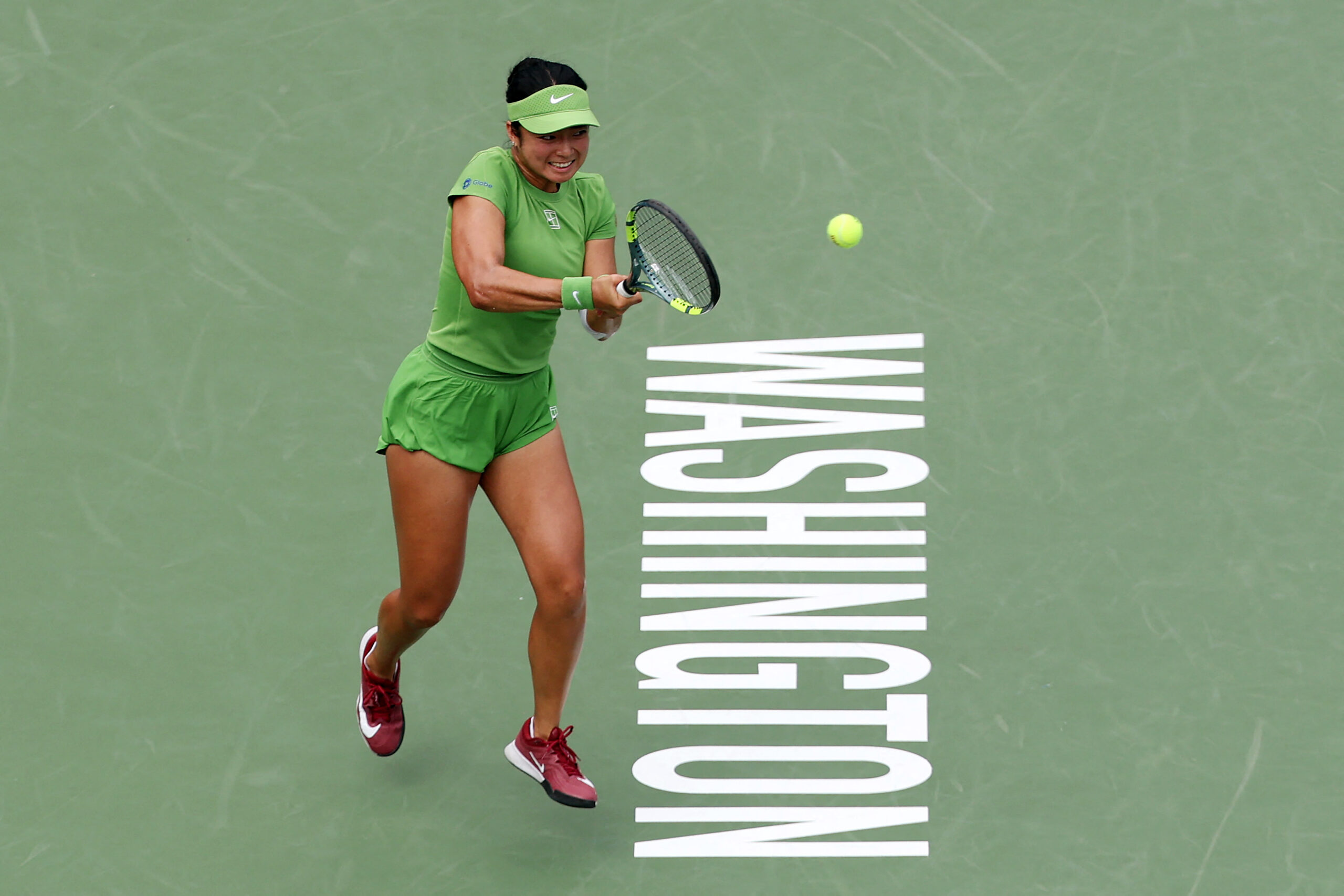
Alexandra Eala of the Philippines returns a shot during a women’s singles match against Leylah Fernandez of Canada during day three of the Mubadala Citi DC Open 2026 at William H.G. FitzGerald Tennis Center on July 29, 2026 in Washington, DC. Emilee Chinn/Getty Images/AFP
MANILA, Philippines — Alex Eala ousted defending champion Leylah Fernandez with an impressive 6-2, 7-6 (1) victory to secure a spot in the quarterfinals of the Mubadala DC Open in Washington, D.C.
Showcasing grit once again, Eala rallied from a 5-1 deficit in the second set before overwhelming Fernandez in the tiebreak to level their head-to-head series at one win apiece.
“I think I definitely had some tough moments in that match, and credit to Leylah, she put me in some really tough positions,” Eala, who previously lost to Fernandez in the Stuttgart Open in April, said. “So, I think I’m super proud of how I fought and how I stayed in there.”
On the verge of playing another three-setter, Eala responded by winning five straight games to take a 6-5 lead, but Fernandez held serve to force a tiebreak.
Advertisement
The Filipino tennis star wasted no time in the tiebreak, building a 3-0 advantage before Fernandez got on the board. Eala then won four straight points to close out the match in one hour and 53 minutes.
Article continues after this advertisement
Eala will face the winner between Polina Kudermetova and Elina Svitolina in the quarterfinals.
The world No. 28 came out firing in the first set with a 3-0 lead, opening the match with a love hold to set the tone. She traded holds with Fernandez before sealing the set with her second break.
Advertisement
Alexandra Eala of the Philippines returns a shot during a women’s singles match against Leylah Fernandez of Canada during day three of the Mubadala Citi DC Open 2026 at William H.G. FitzGerald Tennis Center on July 29, 2026 in Washington, DC. Emilee Chinn/Getty Images/AFP
But Eala admittedly struggled in the second after Fernandez, currently ranked No. 34 with a career-high No. 13, found her rhythm and reeled off five straight games to move within a game of forcing a decider.
Article continues after this advertisement
That was when Eala regained her composure—reminiscent of her Round of 32 win over Zheng Qinwen, when she rallied from a set down—and retook control of the match.
“I know that she was playing a little better, and maybe my level dropped a little bit. I think those are very tricky moments when you know your level has dropped, and you want to do better, but things just, for one reason or another, aren’t coming out,” Eala, who beat Zheng 4-6, 6-4, 6-1, said.
Advertisement
Your subscription could not be saved. Please try again.
Your subscription has been successful.
“I think patience was key there, and just trying to work it out, and have a strong mentality in terms of trying to find solutions.”
Advertisement
Eala eyes another semifinal appearance this year in her first tournament of the North American swing as part of her buildup to the US Open.
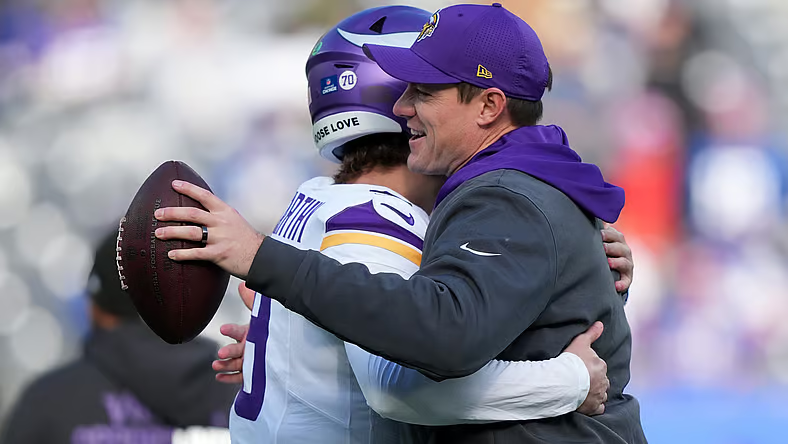
Dec 21, 2025; East Rutherford, New Jersey, USA; Minnesota Vikings quarterback J.J. McCarthy (9) and head coach Kevin O’Connell hug before the game at MetLife Stadium. Mandatory Credit: Robert Deutsch-Imagn Images
Back in rookie minicamp, the Vikings welcomed a veteran passer to town in an effort to keep the pigskin spinnin’. Cooper Rush has been a pro for a long time, leading to some attention about him going out for a cluster of practices meant for the NFL’s newest employees.
Kevin O’Connell demonstrated some good self awareness on the matter. In fact, he made jokes about hoping that Rush didn’t hang up the phone due to being asked about coming to the Twin Cities for an unusual arrangement.
Part of O’Connell’s hope was to build a communication avenue should there be a need for an emergency passer. Pursuing that initial plan may now need to occur at the front office level since Rush is no longer unemployed.
Advertisement
Look at what ESPN’s Adam Schefter said in the update: “With Atlanta QB Tua Tagovailoa dealing with a tight back and Michael Penix still not practicing due to a knee injury, the Falcons are signing veteran quarterback Cooper Rush, per sources.”
The Vikings’ Emergency QB Plan
The Falcons are being led by Kevin Stefanski. If that name sounds familiar, then that’s for good reason. Coach Stefanski got his start in the NFL with the Vikings, rising up to being the offensive coordinator before getting stolen away to be the head coach of the Browns.
Stefanski is now in Atlanta to work alongside a pair of southpaw passers. Most notably, there’s Michael Penix Jr.. He’s the quarterback who got chosen at No. 8 in the same draft where J.J. McCarthy went at No. 10. Part of what made that decision wild (other than the move being a huge reach) was that Kirk Cousins had just been signed to a monstrous contract. Atlanta created a mess and is still digesting the consequences.
Sep 10, 2023; Cleveland, Ohio, USA; Cleveland Browns head coach Kevin Stefanski congratulates quarterback Deshaun Watson (4) for his touchdown run against the Cincinnati Bengals during the second quarter at Cleveland Browns Stadium. Mandatory Credit: Scott Galvin-USA TODAY Sports
Otherwise, there’s Tua Tavogailoa in town to battle for the starting spot.
Upon first glance, employing these two quarterbacks would appear to leave little room for a third passer. The issue is that both are working through injury, albeit of a different severity.
Marc Raimondi (ESPN) with an update on Penix: “Penix said it might be another four weeks to get cleared or maybe earlier, depending on how his body feels during camp.” Meanwhile, Tagovailoa is inching closer. Schefter sent a quick word on the matter: “Falcons HC Kevin Stefanski said QB Tua Tagovailoa ‘will be out there sooner rather than later.’”
So, the pivot is toward Cooper Rush. He’ll quickly learn his assignment while allowing for Atlanta to function in training camp practices.
Advertisement
Dec 7, 2025; East Rutherford, New Jersey, USA; Miami Dolphins quarterback Tua Tagovailoa (1) walks on the field after the game against the New York Jets at MetLife Stadium. Mandatory Credit: Ed Mulholland-Imagn Images
Minnesota’s passer depth chart is pretty stuffed. Check out how most view things:
QB1 Kyler Murray
QB2 J.J. McCarthy
QB3 Carson Wentz
QB4 Max Brosmer
Of those options, Max Brosmer is the most insecure in his roster spot. What’s somewhat ironic is that the firmest assignment belongs to Carson Wentz. He’s close to assured of being the emergency quarterback. Where there’s room for some debate is who secures the top spot.
What threatens things is the ever-present danger of injury. The 2023 season was undermined largely by shuffling through four quarterbacks. Something similar could be said of the 2025 season due to the three different quarterbacks who were needed last year. Minnesota’s approach has been to hope for the best while planning for the worst.
In Cooper Rush, the Vikings felt as though they had a break-glass-in-case-of-emergency option sitting in free agency. Leaving him there, in free agency, meant allowing for some risk of losing him. Minnesota will need to look elsewhere for a veteran shepherd for their complex scheme if injury runs amok on the QB room yet again.
Vikings quarterback J.J. McCarthy drops back and delivers a first-quarter throw at U.S. Bank Stadium, Jan 4, 2026, in Minneapolis against the Green Bay Packers. The snapshot captured McCarthy operating within the structure of the offense early, as Minnesota looked to establish rhythm and tempo during a high-stakes divisional matchup. Mandatory Credit: Jeffrey Becker-Imagn Images.
Cooper Rush, 32, has played in 42 NFL games dating back to 2017.
I’ve had a Motocaddy Electric Caddy for three years now, dating back to the 2024 model of the M7 Remote GPS. For me, the Motocaddy unlocked a whole new world. I have some sports injuries from the past that are quite troublesome when walking 18 holes while carrying a bag or even pushing a cart, but the Motocaddy freed up the stress on my joints to enjoy my rounds with friends who also enjoy the walk. Last year I upgraded to the 2025 model of the M7 Remote, and for the past two months I have been using the 2026 model of the M7 Remote.
So how does Motocaddy continue to make the product better every year? Let’s dive in.
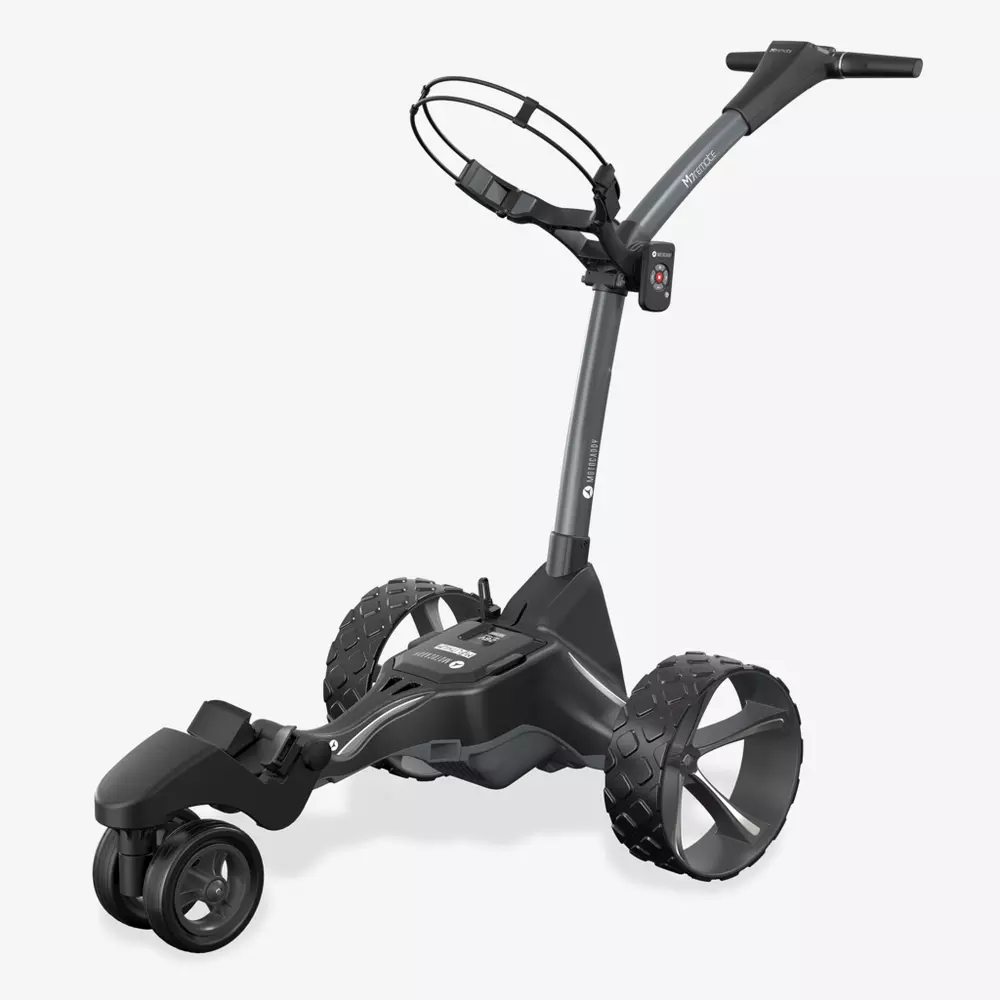
The Motocaddy M7 Remote (2026) is a three-wheeled electric caddy that you can steer around the golf course with a remote. They also have a cheaper M5 model without the remote as well as a more expensive M7 Remote GPS which unlocks the ability for the on-board screen to act as a course GPS; you can plot out distance to hazards and yardages to the front, middle and back of greens. You can also pair their caddies with one of their golf bags, which feature their unique locking system. That saves you from having to strap in the bottom of the bag and makes getting the clubs on the trolley faster and more secure. I like the EliteFlex Hybrid Golf Bag.
All of our market picks are independently selected and curated by the editorial team.
If you buy a linked product, GOLF.COM may earn a fee. Pricing may vary.
Winner of the My Golf Spy ‘Most Wanted’ award, the compact-folding M7 REMOTE features a rechargeable handset, removable anti-tip wheel, and automatic Downhill Control technology for the ultimate in responsive control. Responsive Remote Following extensive development and testing, the M7 REMOTE’s powerful drive system offers unrivalled reliability, optimized battery efficiency, and instinctive caddy control from your first time behind the wheel. Take Control The rechargeable remote control handset conveniently clips to the caddy frame for easy access and storage. The latest handset provides golfers with ergonomic controls, improving usability and precision when controlling the caddy. Compact Folding, Simplified The sophisticated remote control model integrates all the cutting-edge M-Series functionality including the world’s simplest folding mechanism, innovative trunk friendly design, high-power 28.8V system, easily-adjustable handle height and over-sized tubing for ultimate caddy stability. It also features a removable rear anti-tip wheel and automatic Downhill Control to traverse undulations with ease. Downhill Control Technology Established over a decade ago, Downhill Control (DHC) has undergone extensive development and refinement since its creation. The game-changing technology is now considered an essential feature for thousands of golfers across the globe. DHC ensures the caddy maintains a constant speed while moving down a gradient, helping golfers stay in complete control around even the most undulating golf courses. The award-winning feature is now bolstered by the integration of all-terrain wheels. IDEAL FOR : Golfers looking for a small folding remote model with exceptional control Features: Rechargeable remote-control handset Ergonomic design that can be conveniently attached to the caddy frame Forward, left, right & reverse controls Ultra-responsive handset buttons make caddy handling instinctive Automatic Downhill Control Allows the caddy to maintain a constant speed when moving down a gradient NEW Slimline all terrain rear wheels With anti-skid tread to tackle all types of ground with ease Pause & resume, plus emergency stop Helps golfers stay in control and safely navigate around the course Remote handset lock function Ensures the handset does not get engaged accidentally Easy manual control mode Instantly switch to handle control when preferred Removable rear anti-tip wheel Keeps the caddy stable through rough terrain and course undulations 50m range cut-out Control the M7 REMOTE from distance with complete peace of mind 120 second hibernation Stops the caddy if no buttons are pressed for 2 minutes Simple, compact-folding system Award-winning M-Series folding technology fits into the smallest car boots Next generation, High Power 28V system More powerful, efficient, & reliable than ever before Nine-speed settings, Speed indicator & Battery meter Stay in complete control with a quick glance at the handle display NEW Anti-glare LCD widescreen display Redesigned interface for improved performance On screen remote handset battery meter Helps ensure the wireless remote remains charged & ready for action USB charging port Ideal for charging any USB powered device while you play High-capacity, waterproof Lithium battery IP66 water & dust rating for complete protection against the elements On board battery charging No need to remove the battery for storage, transportation & charging Oversize tubing for ultimate handle stability Thicker frame profile combines with top quality materials for unrivalled performance Innovative inverting wheels Revolutionary space-saving technology – flip the wheels to fit into the tightest spaces Convenient auto-open stand Allows the caddy to stand upright for minimised folded footprint Simple, fully-adjustable handle height Ensures the caddy is optimised for golfers of every height Two powerful, whisper‑quiet 230W DHC motors Quiet, exceptional performance with power when you need it EASILOCK™ compatible Securely attach your Motocaddy golf bag without a lower bag strap
Thanks to the 28V battery (which can remain on the trolley while charging at home) the Motocaddy M7 Remote is very responsive to the remote control. In an older YouTube video about the 2024 model I steered my 2024 M7 from the tee box of a 380-yard Par 4 all the way to the green without losing control of the device. If you do happen to lose sight of the trolley or control of it from the remote, it has a fail-safe to stop the caddy once the connection is lost. The 2026 version has been no different. It’s actually become a running joke when playing with new people that they think I’m going to lose control of the trolley. The battery also has a long life. I’ve played 54 holes in a single day with mine, although I’d safely say that 36 holes would be a better limit to set for yourself, just in case.
The remote is very responsive. It’s easy to use with left and right directional controls, up and down for speed control, and a central pause button to stop the caddy’s movement. It does take a few holes to get used to the responsiveness of the remote to the unit, but it’s a quick learning curve. You can also adjust the trim of the caddy to make sure that it stays in a straight line as it’s moving. This is something I’ll usually do on the first hole. Changing up your bag setup or the things you carry in your bag can shift the weight placement and affect the trim.
Advertisement
Do NOT use your Motocaddy without installing the anti-tip wheel. I don’t want to tell you how I know.
Jake Morrow / GOLF
There’s also a remote power button to make sure you’re not inputting any unnecessary commands when you don’t want to. Typically I’ll park the caddy off the green once I’ve got my putter in hand and then press the power button on the remote to make sure nothing happens while I am going through my putting routine or watching members of the group finish out.
One huge upgrade for the M7 Remote this year is that they have finally switched the charging cable for the remote itself over to USB-C. No more having to keep track of the outdated USB-A cable. Thank the heavens.
The new Motocaddy remote finally charged via a USB-C cable!
Jake Morrow / GOLF
Advertisement
If for any reason you have issues with the remote, you forget the remote at home, or you end up putting the remote in the washing machine (don’t ask) you can still use the caddy. At that point it just becomes a self-powered push cart. As long as you stay behind it and within arms reach to push the large stop/go button on the handlebars you won’t have any issues. The stop/go button is also a dial for speed control which you can track on the large screen. The 2026 version of the M7 Remote can also track distance travelled for the round and an individual shot as well as keep time for the round.
The 2026 model has a nice big screen above the two on-board buttons and the stop/go wheel that also functions as manual speed control
Jake Morrow / GOLF
In the box you’ll also get a few accessories including a scorecard holder, umbrella holder, bottle holder and an anti-tip wheel for the back. You’re going to want to install that anti-tip wheel immediately because it will absolutely be the reason you don’t break your new Motocaddy. It also gives you the chance to turn your Motocaddy into an R2-D2 like character every time you start it moving. That’s just a nice bonus. Motocaddy also has plenty of accessories available to build the perfect caddy system for you. Heated gloves for the handles, an accessory pouch to load down the caddy with more gear, a seat for taking breaks, a rangefinder pouch, and more are all available from their site or major retailers.
When you’re done with your round the M7 Remote folds down into a very managable size and it automatically shuts off and disconnects the battery once you fold it down. It just takes two levers to fold the M7 Remote into itself and it can fit in whatever car you’re driving to the course.
Advertisement
The caddy alongside my Motocaddy Protekta bag in the bag of my 4Runner.
Jake Morrow / GOLF
At the end of the day, the Motocaddy really is a big help. I can’t make it through 18 holes carrying my bag on my shoulders or pushing a push cart. My knees give out and it’s rather uncomfortable to finish the round. I also don’t play many places that have caddies available. When I’m home, I try to walk as much as I can and the Motocaddy allows me to do that. I even bring my old Motocaddy with me for friends to use, and they love the relief just as much as I do.
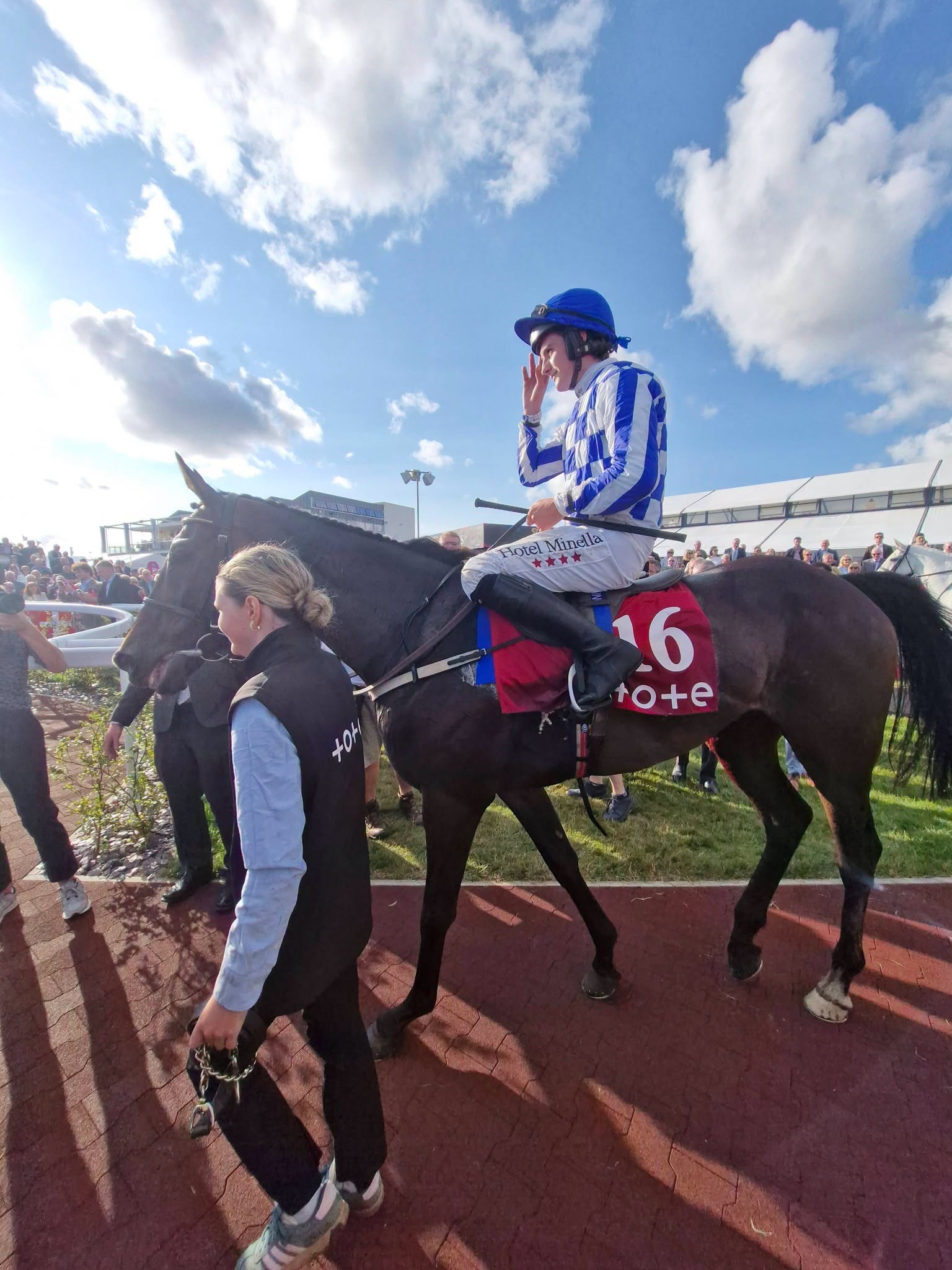
King Alexander (20/1) won the Tote Galway Plate at Ballybrit on Wednesday afternoon,
Trained by Willie Mullins, the Daniel King-ridden eight-year-old gave the Closutton trainer his third victory in the Grade 3 feature.
In a race where big-priced horses filled the first three spots, Paul Nolan’s Conyers Hill (25/1), the mount of Aldan O’Sullivan, was second, with Gorgeous Tom (25/1), from the Waterford stable of Henry de Bromhead, third at 25/1.
Advertisement
There was only a half-length and three-quarters-of-a-length respectively between the first three finishers in the €270,000 Wednesday feature.
Rising star Daniel King gives us his reaction to winning the Galway Plate for Willie Mullins 🗣️ pic.twitter.com/9rqMzkGHdi
The win completed a treble for Mullins this evening, having earlier won the maiden hurdle and the mares’ handicap hurdle.
The champion trainer began the day with the victory of Mr Hollywood (2/1 favourite) in the opening Tote Guaranteed 50k Placepot Maiden Hurdle.
Advertisement
The gelded bay son of Iquitos, last seen when finishing third in the Queen Alexandra at Royal Ascot last month, came late on the stands’ side under Brian Hayes as the six-year-old beat Emmet Mullins’ Jeroboam Machin (10/1) and Donagh Meyler by half-a-length. Another Willie Mullins-prepared runner, Al Arrivee (3/1), the mount of Patrick Mullins, was two-and-a-half lengths further back to complete a Mullins family trifecta.
Mullins had brought up a double on the evening when the impressive French-bred Venusienne took the Tote Guarantee, Never Beaten by SP Irish EBF Mares Handicap Hurdle for rider Harry Cobden. The daughter of Capital Stud’s Authorized had a two-and-a-half length advantage over the Joseph O’Brien-trained Fratas (2/1f) at the winning line, with Emesteraye (16/1) third.
Mighty Berkshire (15/2) was a popular victor in the Tote.ie Money-Back 2nd Every Race Handicap Hurdle for owner/jockey Declan Queally. The Waterford handler’s runner was only contesting his second handicap, and the addition of new headgear seemed to help the six-year-old bay gelding. Owned by the Man About Dog Syndicate, comprising members from counties in Munster, Mighty Berkshire won by a length-and-a-quarter from Noel Meade’s Golden Temple (5/1), with Macshadow Des Crai third at 14/1 under Jack Kennedy.
Abbotsford (7/4 favourite), owned and bred by Juddmonte Farms, gave Dermot Weld a birthday present when winning the Visit Tote26 On Course (Q.R.) Maiden over one mile four furlongs and 43 yards.
Advertisement
The three-year-old son of Frankel, who was gelded since finishing runner-up at Cork last May, was an easy seven-and-a-half length winner for amateur jockey Finny Maguire, son of former top National Hunt rider, Adrian.
Joey Sheridan and Minella Rockett (10/1) came late in the Tote Every Day Is A Money-Back Day Handicap to get a neck advantage over Johnny Soda (11/2) at the line, to deny Ado McGuinness another winner at Galway this week. Krasimir (15/2) was a head back in a tight finish to the 1 mile 123 yards race.
The final race of Galway Plate Day, the Bet With Tote.ie On Racing & Sports Handicap went the way of Cock And Bull (7/2jf) for Sam Coen and Emmet Mullins.
India’s teenage batting sensation Vaibhav Sooryavanshi has added another milestone to his rapidly rising career after being appointed vice-captain of the East Zone squad for the Duleep Trophy 2026. Fresh from winning the Player of the Series award during India’s tour of Zimbabwe, Sooryavanshi will serve as deputy to Ishan Kishan, who has been named captain of the East Zone side for the prestigious red-ball tournament beginning on August 23 in Bengaluru.
The vice-captaincy marks another major achievement for the youngster, who made his international debut during India’s tour of England earlier this month. Following a string of impressive performances for India and in domestic cricket, Sooryavanshi has now been entrusted with a leadership role in one of India’s premier domestic tournaments.
He is expected to open the batting alongside experienced Bengal opener Abhimanyu Easwaran, who returns as the most seasoned player in the squad with more than 100 first-class appearances.
Ishan Kishan to lead experienced East Zone squad
Wicketkeeper-batter Ishan Kishan will captain an East Zone side that blends experienced international cricketers with emerging talent. Veteran India pacer Mohammed Shami returns to the domestic circuit after missing international action since the 2025 Champions Trophy final. The 35-year-old featured for Bengal in the 2025-26 domestic season and also played 13 matches for the Lucknow Super Giants in IPL 2026.
Advertisement
The squad also includes India fast bowler Mukesh Kumar, all-rounder Shahbaz Ahmed, Jharkhand batter Virat Singh, wicketkeeper Kumar Kushagra, and spin all-rounder Anukul Roy, who impressed during India A’s successful tri-series campaign in Sri Lanka earlier this year.
Advertisement
Riyan Parag, Akash Deep miss out
East Zone will be without two prominent names, Riyan Parag and Akash Deep, both of whom continue their rehabilitation after undergoing surgeries. Parag is recovering from right shoulder surgery, while Akash Deep remains sidelined following back surgery. Neither player was considered for selection as they continue their recovery programmes.
East Zone Squad for Duleep Trophy 2026
Full Squad: Abhimanyu Easwaran, Sudip Gharami, Mohammed Shami, Mukesh Kumar, Shahbaz Ahmed, Suraj Jaiswal, Ishan Kishan (captain), Vaibhav Sooryavanshi (vice-captain), Virat Singh, Kumar Kushagra, Shikhar Mohan, Subranshu Senapati, Abhijit Sarkar, Anukul Roy and Denish Das.
Advertisement
Standbyes: Ayush Loharuka, Sridam Paul, Sambit S Baral, Sharandeep Singh and Swastik Samal.
The Duleep Trophy, one of India’s premier first-class competitions, gets underway in Bengaluru on August 23.
The Philadelphia 76ers figure to be at or near the top of the Eastern Conference after a busy offseason that brought in Jaylen Brown, LeBron James, and a slew of others to join Joel Embiid, Tyrese Maxey, and VJ Edgecombe on a talented roster. The Sixers now have one of the best rosters in the league and should be contending for a title in the upcoming season.
With that being said, the Sixers should still be at the top of the East. However, when asking former champion Jason Williams, he isn’t buying the Sixers:
Advertisement
The Knicks are going to be better. Miami is going to be better. Orlando Magic will finish higher than the Sixers…Atlanta will finish higher.
Please be advised that the clip below contains language that some might consider offensive.
One has to wonder if Williams is just trolling, but he does have a point about a team like the Knicks, for example. That’s a team that has been together through all of the playoff wars and just won a championship. The Sixers will have to eventually match up with them in terms of chemistry and such.
However, the Magic is a big stretch. Orlando has a ton of talent led by Paolo Banchero and Franz Wagner, and have a new coach in Sean Sweeney, but that duo has yet to really figure it out. They probably have more chemistry, but the Sixers are the supremely talented team. It’s hard to really envision the Magic finishing ahead of the Sixers in the 2026-27 season.
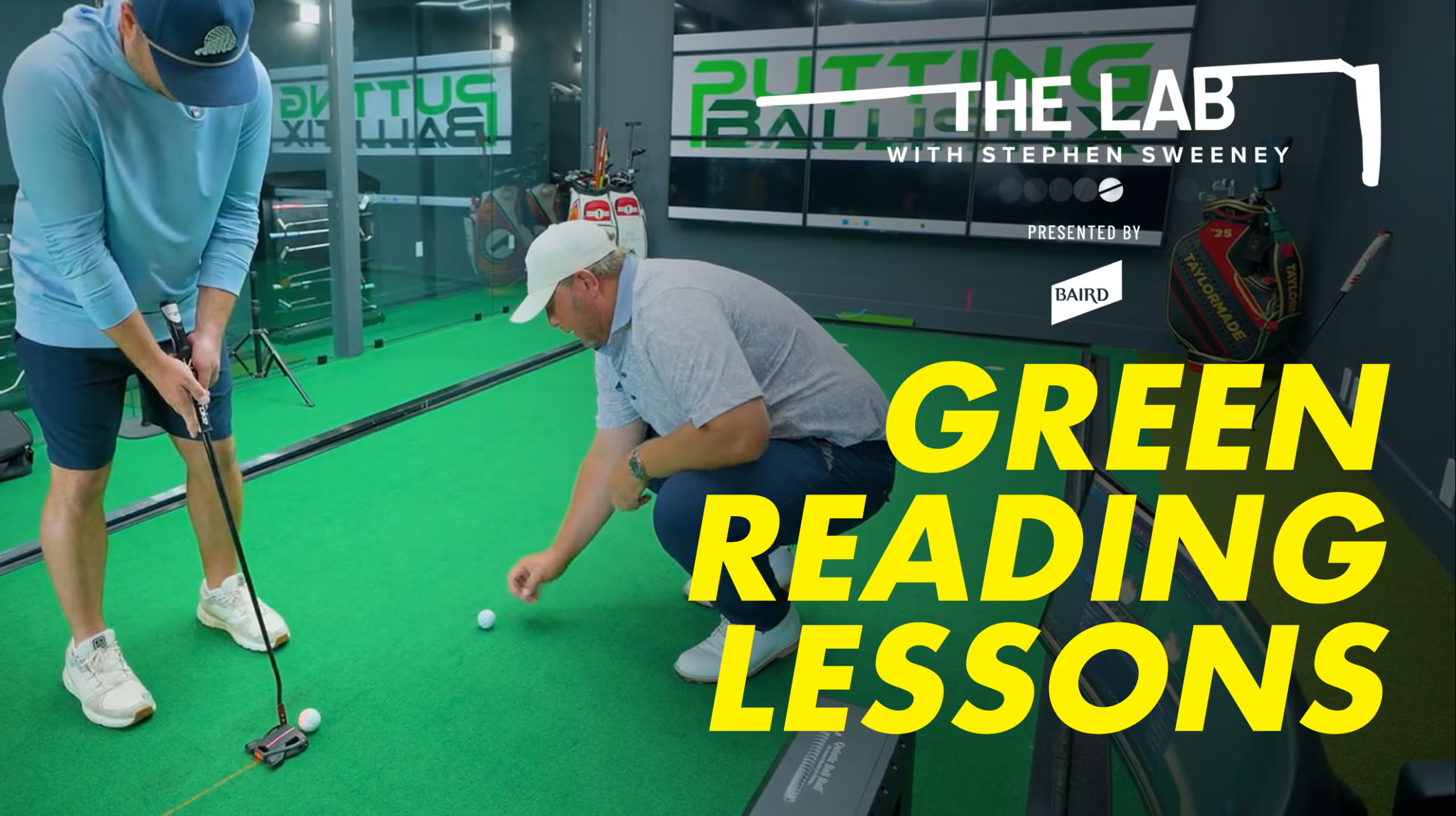
We’re now on Episode 3 of The Lab with PGA Tour Putting Performance Advisor Stephen Sweeney, and I’ve not been shy about how this experience changed my game. In Episode 1 we talked all about setup, and Sweeney basically changed every single part of how my body sets up to the ball. In Episode 2 he walked me through the idea of capture speed, and how staying consistent with your intended speed can help make more putts, and now for Episode 3 we’re tackling green reading. I wasn’t shy about green reading being the worst part of my putting performance, but one simple sentence ended up turning it all around.
As we know from previous episodes there’s basically three reasons a player will miss a putt. There are technical reasons, which include a small portion of the actual equipment in your hands, there’s speed control, and there’s the read you decided on in the first place. As Sweeney explains in the video, the majority of the time the problem starts with the read the player thought they had in their head.
“Any putt within 1º of the intended start line is not a technical reason for missing a putt,” Sweeney says.
To get started working on my green reading skills he had me mark a point on the Platform Golf putting green in his Jupiter, Florida studio. This point was meant to be where I thought the putt was going to break. I accidentally failed to follow directions and I ended up signaling the spot where I was trying to start my putt.
Advertisement
Sweeny fired up his Quintic Overhead technology and marked that spot on the green so we could keep track of where I thought the line was, as well as the several putts I would end up hitting before we figured it out. (Spoiler: I was very, very far off.) I just couldn’t seem to match the speed and line that was needed for this seemingly simple indoor putt. By the fourth try I was hitting the ball way too hard for my own comfort level, so clearly something was wrong in the intention for the line that I created.
While I continued to miss putts, Sweeney expressed his frustration with how frequently amateurs under-read their putts.
“I go out and play and I’ll hear caddies from this distance say something is a ball right or a ball left. It’s never a ball outside left. Not from this distance.”
After several missed putts, Sweeney dropped a stat on me that completely changed the way I think about reading a green:
Advertisement
When you miss a putt on the high side, the miss will only be affected by about 50% of the read. If you read a putt one foot out to the right of a hole and you miss on the high side, the miss is only going to be about 6″ assuming you got the speed even remotely correct. When you miss on the low side though, the miss is multiplied by a factor of three. If you read a putt one foot out to the right and you end up missing low, you could end up three feet gone on the low side.
Read that again! That statement changed everything for me.
Essentially when you miss on the high side, you’re able to be more aggressive with the putt itself. Mostly because you’re hitting the putt uphill for a longer duration of time, the effect of gravity towards the end of the putt is decreased. If you miss on the low side, you’re letting gravity impact the ball much sooner in the duration of the putt and it will only continue to pull on the ball worse.
Sweeney finished off with a funny story mentioning that he does teach Aim Point but he knows it’s not for everyone.
Advertisement
“When it comes to the amateur game one of the best tips I got was actually from an 8-handicap dentist. He said that whatever he thinks the read is, he just plays double. Now it’s probably the easiest piece of advice I can give to an amateur golfer.”


;)
















;)
;)
;)
;)









































You must be logged in to post a comment Login