Connect with us
DAPA Banner
DAPA Coin
DAPA
COIN PAYMENT ASSET
PRIVACY · BLOCKDAG · HOMOMORPHIC ENCRYPTION · RUST
ElGamal Encrypted MINE DAPA
🚫 GENESIS SOLD OUT
DAPAPAY COMING

NewsBeat

Is ten too young to be criminally responsible? Here’s what the evidence says

Published

on

Is ten too young to be criminally responsible? Here’s what the evidence says

At ten years old, some children may still struggle to tie their shoelaces or use a knife and fork properly. Yet under the law of England and Wales, a child of this age is old enough to be held criminally responsible for their actions. This is the age at which, in the eyes of the justice system, childhood effectively ends. But there could soon be a chance to bring this law into line with that of other comparable nations.

The current age of criminal responsibility sits in stark contrast with other legal protections we afford to children. Prime minister Keir Starmer’s announcement of a planned social media ban for under-16s from spring 2027 is a potent example of this.


À lire aussi :
UK under-16 social media ban: what parents need to know


Under-18s in England and Wales cannot purchase vape products or alcohol. They cannot marry or vote, and they must be 17 to drive. Society has constructed these protections on sound developmental logic: children are not yet adults and the law should reflect that.

Advertisement

The recently published youth justice white paper, which sets out the government’s strategy on young people in the criminal justice system, stated that the government will assess the age of criminal responsibility in England and Wales. But it has made no firm commitment to raise it.

England and Wales have the lowest age of criminal responsibility in Europe, alongside Switzerland. In the Republic of Ireland children can be held criminally liable from 12, while in Croatia it is 14, along with Germany, Italy and Spain. In Denmark, Norway and Sweden it is 15, and it is 16 in Portugal.

The United Nations Committee on the Rights of the Child has long called for an absolute minimum age of 14, and Scotland raised its age of criminal responsibility from eight to 12 in 2021. Northern Ireland is facing renewed calls to raise the age to 16 following a previous consultation on raising the age from ten in in 2022.

Politicians have dismissed calls for reform by claiming there is no public appetite for change. But leading justice figures have since come out in support of the proposed amendment to the crime and policing bill, due to come into force on June 29 2026. This would raise the criminal age of responsibility to 14.

Advertisement

Raising it to at least 14 appears to have widespread support among the UK public. Crucially, this was consistent across the political spectrum – suggesting it is seen as a question of basic child protection.

What neuroscience tells us

Knowledge of adolescent brain development has advanced considerably in recent decades. A substantial body of research demonstrates that children have developmentally immature brains. Experts can also say with confidence that the brain does not reach full maturation until after the age of 30.

The adolescent brain is characterised by heightened impulsivity, reduced capacity to consider consequences, and heightened emotional reactivity. These traits are neurologically normal, not moral failings. But the intersection of childhood, responsibility and serious violence exposes the deep complexities within youth justice.

Taking victims’ experiences seriously and questioning a system that criminalises children at a younger age than most comparable democracies are not competing goals. A mature justice system can – and must – do both.

Advertisement

But by and large, children who end up in England and Wales’s youth justice system are not budding criminals. Around 66% of children in custody have experience of the care system, and 80% have special educational needs or disabilities.

Around half come from racial minority backgrounds, and research shows that racial disparities begin early – with school exclusions and at the point where decisions are made about whether to divert children away from the justice system. The vast majority of children who have come into contact with the justice system have been excluded from school.

Most children who enter the justice system have been excluded from school.
Ground Picture/Shutterstock

These are children who have been let down by services such as education, healthcare and social care. And any racial disparities they might face compound every stage of this process.

Advertisement


À lire aussi :
Black detainees twice as likely as white detainees to be strip-searched in police custody – new study


Young offender institutions have been condemned as sites of institutionalised abuse. Children can be held in isolation for 22 hours a day, while educational provision is inadequate and rehabilitative support is minimal.

As researchers focused on children and young people at the Institute for Children’s Futures at Manchester Metropolitan University, we bring together legal expertise and criminological insight in the study of children, society and the law. We argue that England and Wales must raise the age of criminal responsibility to 12 as a minimum, with a serious ambition to reach 14 in line with the UN Committee on the Rights of the Child recommendations from 2023.

This means diverting children away from criminal justice processes and towards the health, education and social support they need. Raising the age of criminal responsibility is not only better for children – it produces better outcomes for victims and society too, with evidence showing that diversion from the formal justice system reduces reoffending far more effectively than early criminalisation.

Advertisement

This is not because children should face no consequences for harmful behaviour – they should. But the system as it currently exists does not rehabilitate, it harms. And no child, whatever they have done, deserves to be processed through a machine that was never designed with their wellbeing in mind.


Source link

Advertisement
Continue Reading
Click to comment

You must be logged in to post a comment Login

Leave a Reply

NewsBeat

Image released after alleged rape in Micklegate, York

Published

on

Image released after alleged rape in Micklegate, York

North Yorkshire Police says the force is still appealing for witnesses, information and video footage after an incident which took place in Micklegate on Tuesday evening (June 16).

They added that a man who was initially arrested in connection with the incident has now been released without charge.


RECOMMENDED READING:

Advertisement

As reported by The Press, officers were stationed between the junction of Micklegate and Bar Lane and the boundary of George Stephenson House, a Network Rail building, on Wednesday (June 17) whilst an investigation took place.

A new image has been released today (June 18) which shows a man who police would like to speak to in connection with the investigation.

It is believed he was at the Harry Hotspur pub in Micklegate on Tuesday evening.

He is described as white, mid-30s, slim build, and had a brown stubble beard. He ws wearing a white t-shirt with a Guinness lobster logo, black adidas shorts, black and white Vans trainers, and black socks.

Advertisement

“If you have not yet come forward, please do so as soon as possible. Even the smallest piece of information could be crucial to help piece together the full circumstances of this incident,” said a spokesperson for the force.

Officers added that the victim is continuing to receive specialist support and care.

If you recognise him from the description and CCTV image or know where police can find him, please call North Yorkshire Police on 101 or if you prefer to remain anonymous, contact Crimestoppers on 0800 555 111 or make an online report.

Please quote reference number 12260111552 when providing details.

Advertisement

Source link

Continue Reading

NewsBeat

Farmfoods to close and relocate in Byron Place, Seaham

Published

on

Farmfoods to close and relocate in Byron Place, Seaham

Farmfoods will move into the former B&M store at Byron Place on July 2.

The move is expected to create seven new jobs, while a new entrance is also being created.

A spokesperson for Farmfoods said: “Our new shop in Seaham at the Byron Place Shopping Centre will open Thursday, July 2 at 8am. 

Advertisement

“Our current shop will close on Sunday, June 28 following a 50 per cent off all stock sale that day. 

 “The new shop – a relocation and upsize from our existing unit opposite – will offer our full range of branded and own-brand products including frozen food, groceries, chilled foods, bread, milk, fresh fruit and vegetables along with a range of household and other items.  

The new store will be open at 8am Monday to Saturday, closing at 9pm on weekdays and 8pm on Saturday. It will be open from 11am til 5pm on Sunday.

Advertisement

Source link

Continue Reading

NewsBeat

How a Swedish king went on strike in 1768

Published

on

How a Swedish king went on strike in 1768

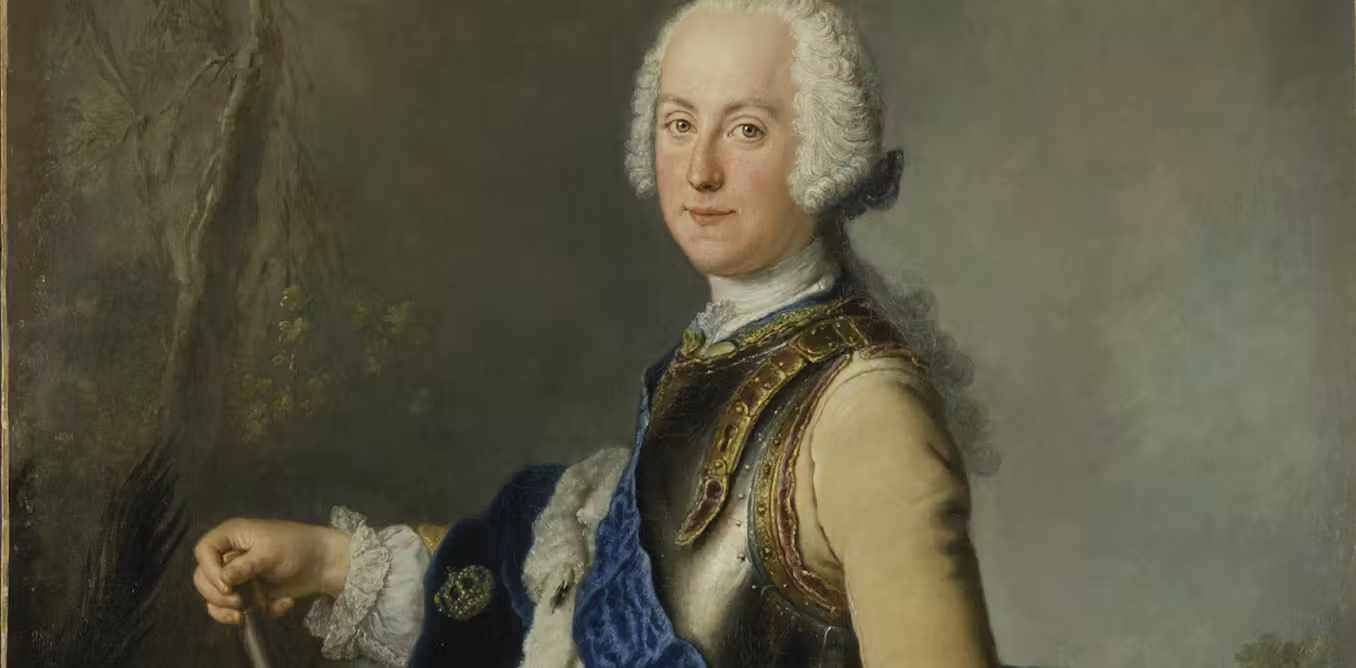
In 1768, towards the end of the period of Swedish history known as Frihetstiden, the Age of Liberty, King Adolf Frederick threatened to abdicate unless an extraordinary session of the Riksdag, the Swedish parliament, was immediately convened. The immediate issue concerned a new financial plan, but the king hoped that the parliamentary session would also lead to constitutional changes to strengthen his power.

The 16-member strong Council of the Realm, over which the king presided, was given three days to summon the Riksdag. Meanwhile, the king would not partake in any decision-making. In other words, he went on strike.

As I show in my new book, Monarchy in the Age of Liberty: Royal power and public life in eighteenth-century Sweden, this moment in Swedish political history poses an interesting question: does a monarchy need a monarch? The country at the time was a kingdom, yet it effectively had a republican form of government. In the events that followed the king’s ultimatum, his councillors even attempted to replace him with a signature stamp. It is one of the many paradoxes of this era that such a measure be taken not in opposition to the monarchy but in order to preserve its very essence.

A political revolution

Sweden’s Age of Liberty was ushered in by the death of King Charles XII during the siege of Fredrikshald, in Norway, in 1718. From 1680, Sweden had been ruled as an absolute monarchy. Now, fatigued by 18 years of continuous warfare, the four estates of the Swedish Riksdag decided to curtail the king’s executive powers. As formulated in the Instruments of Government, the Accession Charters and the Royal Elections Acts of 1719 and 1720, the Council of the Realm was now to oversee the monarch’s decision-making, and, in turn, answer to the Riksdag.

Advertisement

In Protestant Sweden, social theory was grounded in equal measure in ancient political thinking and Lutheran ideas. Central to this was Martin Luther’s so-called doctrine of the three estates, which held that society was composed of the teaching estate (the clergy), the defending estate (the nobility) and the nourishing estate (the commoners) and that all three were needed for societal balance and harmony to be achieved.

A 17th-century illustration of the balance between the estates and the crown by Schering Rosenhane.
Kungliga biblioteket/The National Library of Sweden.

The monarch stood above all laws — it was the essence of his majesty. As such, he was the only figure considered to be free from self-interest and therefore able to maintain this social balance. Thus, despite his practical duties having been made redundant, his symbolic importance was incontrovertible.

Upon the death of Charles XII in 1718, his sister, Ulrika Eleonora, briefly succeeded to the throne before abdicating after just over a year in favour of her husband, Frederick I, who ruled until 1751.

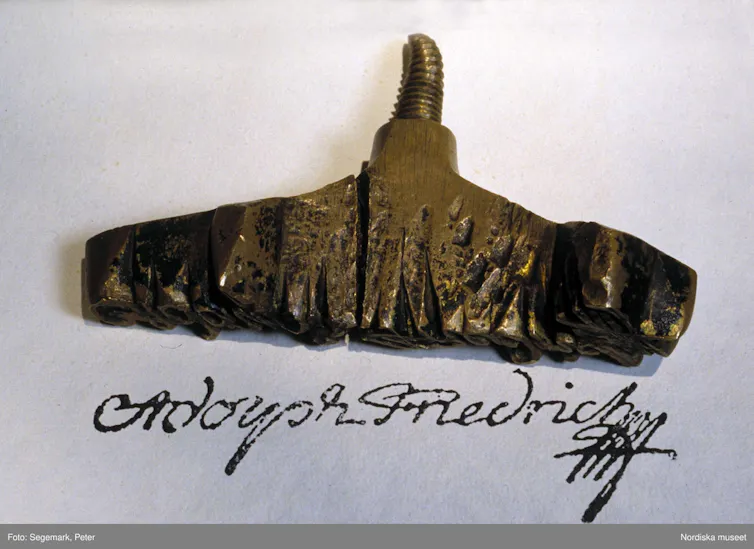
As king, Frederick I soon lost interest in his rather insignificant duties and, drawing inspiration from absolutist France, had a name stamp made. This was ostensibly to save himself the trouble of signing a large number of circulars. But the stamp also came to serve as a political instrument.

Advertisement

In certain circumstances, the council could even issue government decrees without the king’s signature. But the councillors considered this inappropriate as it revealed to the outside world when they were in disagreement with the king. On such occasions, the signature stamp became a practical alternative.

The signature stamp also meant the councillors could no longer delay decisions by citing the king’s refusal to sign a document. Unlike the king, the council had to answer to the Riksdag for its actions and be held to parliamentary accountability.

In the Swedish public’s imagination, this replacement of the king’s personal signature with a stamp is the ultimate symbol of the monarch’s powerlessness. But how it was actually used demonstrates that the king’s signature was considered indispensable for lending dignity and authority to government decisions.

A metal signature stamp with a print of the signature on paper
King Adolf Frederick’s signature stamp.
Nordiska museet, CC BY-NC-ND

Constitutional crisis

The crown’s symbolic importance was most clearly demonstrated by Frederick I’s successor, Adolf Frederick, when he went on strike in 1768. This constitutional crisis was partly a conflict between the two opposing parties, the Caps and the Hats, concerning issues in which the king played only a peripheral role. The parties’ views differed on foreign alliances, economic policy and, increasingly, civil and political rights, but they agreed on the king’s constitutionally restricted position. However, none of them hesitated to use the king as a tool when it suited their own purposes.

The council was controlled by the Caps. In response to the king’s threat, the councillors attempted to govern by means of the signature stamp.

Advertisement

In return, the central government agencies, which were dominated by Hat sympathisers, refused to comply with any decisions bearing only the king’s duplicated signature. They insisted that the form of government rested on the majesty of the king, the authority of the council and the liberty of the people, that is, their civil and political rights. If any of these elements were missing, the balance was disrupted and the impartiality of government decisions could be called into question.

The civil servants’ refusal to comply with decisions bearing a stamped signature brought the state apparatus to a standstill. The Riksdag was convened, just as the king had demanded.

The outcome was decided by the strong position of the Hats in the government agencies. However, once the extraordinary session of the Riksdag was convened, the king gained no support whatsoever for his constitutional proposals. Even though the signature stamp was taken out of use and the king’s symbolic authority reaffirmed, his actual political influence diminished even further.

In my research I show that this episode highlights a typical pattern of the Age of Liberty. The court was supported by the opposition party for only as long as it remained in opposition. As an ally against the government, the monarch was important in shaping opinion and providing influence. For the government, conversely, he was an unpredictable asset.

Advertisement

This observation can also be generalised. In early modern times, power was based on authority from above. By tradition, the monarchy represented a divine order that demanded unconditional submission.

As countries such as Sweden and the United Kingdom began to shift away from absolutism and towards a more representative form of government, the monarch continued to symbolise governmental impartiality in spite of sharp partisan divisions. The notion that the people, with their passions and their self-interest, were too unpredictable to rule a state, endured. During this transitional phase, a monarch was needed who symbolically stood above all special interests and treated all his subjects with the same paternal care.

Source link

Advertisement
Continue Reading

NewsBeat

Johnsons shares statement after boy ‘seriously injured’ in crocodile enclosure

Published

on

Cambridgeshire Live

A man has been arrested on suspicion of attempted murder

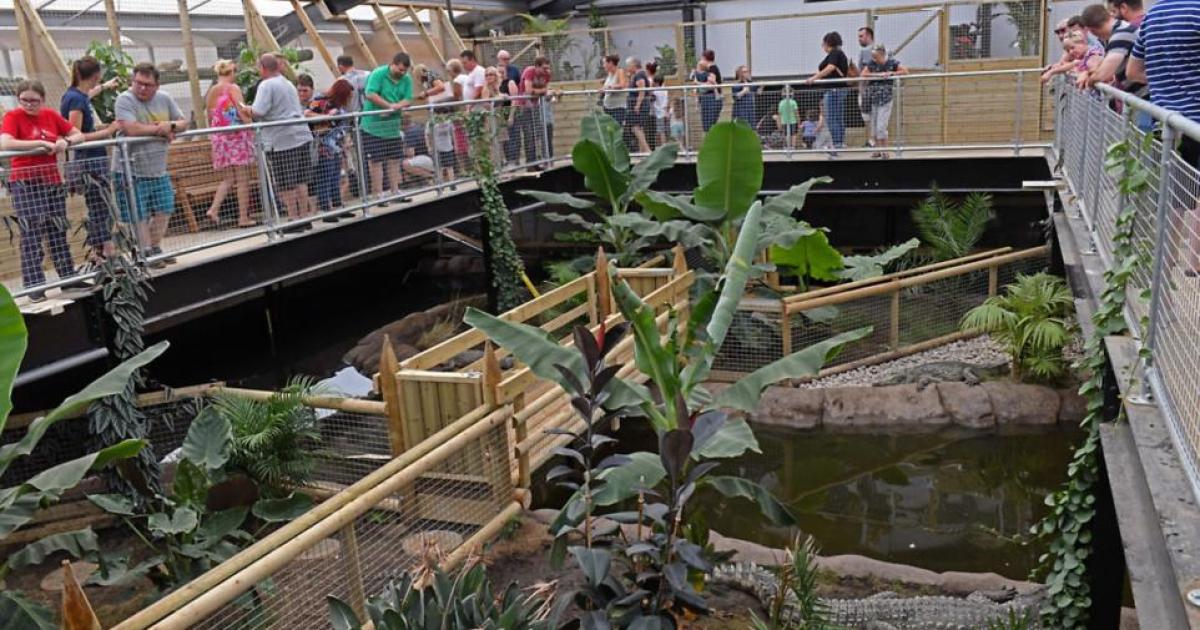
Johnsons of Old Hurst has shared a statement after a 3 year old boy was ‘seriously injured’ on the afternoon of June 18.

Officers were called to the zoo at 1.24pm on June 18 to reports of an incident involving a three-year-old boy, during which he ended up in the crocodile enclosure.

The boy has been taken to Addenbrooke’s Hospital with serious injuries and is critical but stable. Specially trained officers are at the hospital supporting the boy’s family.

Advertisement

A 30-year-old man from Norfolk has been arrested on suspicion of attempted murder. Johnsons has now confirmed that the Tropical House part of the site will be closed until further notice.

It has added that the team’s “thoughts and prayers” are with the boy and his family. Johnsons shared: “Our thoughts and prayers are with the boy and his family following the incident that occurred today.

“Out of respect to the family, our Tropical House will remain closed until further notice. If you have any questions about the incident, please direct enquiries to Cambridgeshire Police Constabulary. The rest of the site will remain open as normal.”

Source link

Advertisement
Continue Reading

NewsBeat

North Lanarkshire’s overall claimant count down two per cent over year as employment shows ‘encouraging progress’

Published

on

Daily Record

This reflects the continued work of Jobcentre teams to “support people into employment and help employers access local talent”.

This month’s employment statistics show “encouraging progress” across North Lanarkshire, with the overall claimant count down two per cent over the year.

Advertisement

This reflects the continued work of Jobcentre teams to “support people into employment and help employers access local talent”.

The latest figures also show positive progress in a number of communities across North Lanarkshire.

In Coatbridge and Bellshill, the overall claimant count is down eight per cent year-on-year, including a seven per cent reduction among young people aged 18 to 24.

In Motherwell, Wishaw and Carluke, the overall claimant count is down one per cent, while the number of claimants aged 50 and over has fallen by three per cent.

Advertisement

Alongside this progress, Jobcentre Plus continues to focus on providing tailored support for young people, older jobseekers, and people with disabilities and health conditions, helping them build confidence, develop skills and move closer to work.

A key part of that support in North Lanarkshire is the continued focus on work experience and volunteering opportunities, helping jobseekers gain practical skills, build confidence and strengthen their CVs.

Over the summer, customers are being encouraged to take part in a range of local opportunities, including Barista Taster Sessions in June, construction work experience placements, and retail-based roles and placements with organisations including Barnardo’s, Salvation Army, and the British Heart Foundation.

These opportunities are designed to help people gain meaningful workplace experience and take positive steps towards employment.

Advertisement

Shaun Cowie, Jobcentre Plus external relations leader for North Lanarkshire, said: “We know that when young jobseekers receive personalised support, they build the confidence to develop their skills, take their first steps into work, and start progressing in their careers.

“That’s why work coaches are working hard to ensure young people know about the wide range of opportunities and support available to them.

“Specialist support also continues to be available for those aged 50-plus and people with disabilities and health conditions, ensuring everyone can stay connected to opportunities.

“During the busy summer season, jobcentres are focused on helping young people take advantage of seasonal roles by working closely with employers to boost the supply of new workers.

Advertisement

“This includes opportunities linked to local festivals, tourism, hospitality and retail, alongside job fairs, Sector-based Work Academy Programmes and other initiatives designed to match young people with the right roles at the right time.”

Shaun added: “There is also a continued focus in North Lanarkshire on work experience and volunteering, giving people the chance to build their confidence, gain practical skills and develop experience that can help them move into lasting employment.

“From barista tasters to construction placements and retail-based opportunities with well-known local organisations, these activities are helping people prepare for the workplace and see what is possible.

“Jobseekers are also encouraged to check out the range of vacancies available on Find a Job. With over 180 live vacancies currently advertised across North Lanarkshire, there are opportunities available in sectors including retail, hospitality, construction, logistics, engineering and manufacturing.”

Advertisement

*Don’t miss the latest headlines from around Lanarkshire. Sign up to our newsletters here.

And did you know Lanarkshire Live had its own app? Download yours for free here.

Source link

Advertisement
Continue Reading

NewsBeat

Knicks victory parade rocks New York as fans fill the streets

Published

on

Knicks victory parade rocks New York as fans fill the streets

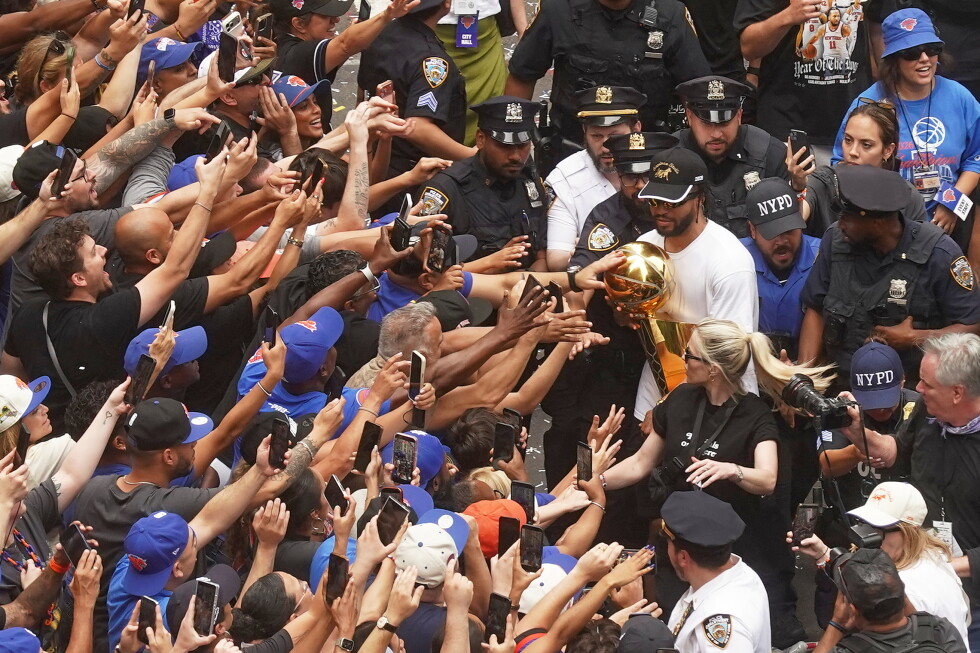
NEW YORK (AP) — Jalen Brunson held up the golden NBA championship trophy for a forest of outstretched hands to touch as fans celebrated the New York Knicks’ first title in 53 years with a booming parade through Manhattan’s skyscraper-flanked “Canyon of Heroes.”

“Damn, New York, we really did it,” Brunson, the finals MVP, said at a celebration at City Hall. “Somehow, someway I knew we were going to find a way to get this done.”

Moments later, Mayor Zohran Mamdani presented keys to the city to the Knicks’ players, coaches, owners and staff. Wearing a team jersey under his suit jacket, Mamdani said he and other fans “waited because we knew deep down in our sick, suffering hearts” the Knicks would someday win.

Confetti in Knicks blue and orange swirled through the air during the parade. Massive cheers of “Let’s go, Knicks!” and “Knicks in five!” kept erupting.

Advertisement

And OG Anunoby, who scored the go-ahead basket in Game 4 of the finals on a tip-in with 1.2 seconds left, left his parade float to interact with fans, holding the NBA Cup in-season championship trophy in one hand and a bottle of Patron tequila in the other.

Film director Spike Lee, perhaps the team’s most iconic fan, was on a float with Brunson, savoring the moment. “I’ve never been to a parade — ever — and I’m glad it’s this one,” Lee said.

The MVP’s mom, Sandra Brunson, wore a shirt with photos of Jalen and husband Rick, who played for the Knicks. She echoed her son’s words, saying: “It was all worth it.”

Karl-Anthony Towns hoisted the Eastern Conference championship trophy and a cigar on top of a parade bus while Mamdani danced. On a nearby float with other alumni, Carmelo Anthony had a victory cigar of his own.

Advertisement

“The whole city won,” Anthony said. “New Yorkers are, as they say, ‘lit’ right now.”

Knicks fans turn out in force

People streamed into lower Manhattan on crammed subways. Even several blocks from the parade route, fans stood shoulder to shoulder — sometimes on each other’s shoulders — or climbed traffic lights and sanitation trucks. Far away on the Brooklyn Bridge, people gathered just to hear the loudspeakers.

Advertisement

“I had to be here today,” said Shareefa Wallace, 34, who got up at 3 a.m. to make her way from suburban Long Island. She grew up in the city going to Knicks games, and she sported the souvenir jersey of one of the legends from that era, Patrick Ewing.

Owner James Dolan thanked fans for waiting more than a half-century.

“Let’s keep this energy going, baby,” coach Mike Brown said, “because this championship is about you guys.”

‘The New York vibe’

Nearby bars and delis filled with fans, some wishing they’d arrived at dawn. But many seemed at peace with the fact that they would only experience the parade from a distance.

Advertisement

“We’re fine with the fray, we just want to be with the New York energy and the New York vibe,” said Jean Strong, who came to the parade from Harlem with his nephew and sister.

Terrell Emerson, a chef who grew up in Queens, said he drove from Maryland with his daughter Madison – named in honor of the Knicks’ home arena, Madison Square Garden.

Beaming, Madison held a handwritten sign announcing she’d skipped her fifth-grade graduation to be there.

Advertisement

Stars and Knicks legends

Knicks great Walt “Clyde” Frazier — a member of the ’70s champion teams — led the parade in a stylish convertible and wearing his NBA title rings. Frazier had late teammates and coaches on his mind.

“They would be amazed at what has happened to the Knicks and how they’ve really captivated the city this year,” Frazier said. “This has exceeded any expectations I ever thought that we’d have.”

Timothee Chalamet, Jon Stewart, Ben Stiller, Mariska Hargitay and other celebrities joined the party. Knicks play-by-play announcer Mike Breen emceed the City Hall ceremony.

Alicia Keys, the singer who collaborated with Jay-Z on the New York-loving 2009 hit “Empire State of Mind,” performed a montage with that song, mixing it with the classic “New York, New York.”

Advertisement

A parade decades in the making

The mere fact that the parade is happening is historic in itself. Although the Knicks won the championship twice in the 1970s, the city didn’t host a parade for them either time. Then-Mayor John Lindsay had cut down on ticker-tape extravaganzas for financial and other reasons, and he instead honored the Knicks at a 1970 reception at the mayoral mansion and a jam-packed 1973 ceremony outside City Hall.

This time, the city went all out. A police officer could be seen holding a sign reading, “This is really happening.”

And a massive security operation

Police plan to deploy 10,000 officers to secure the event, which follows ebullient but sometimes chaotic street celebrations and some violence during the Knicks’ title run, including a five-game final against San Antonio.

The Fire Department said at least nine people were taken to hospitals but didn’t immediately respond to a request for more details.

Advertisement

At one point before the parade, a small group of people were crushed against a barrier near Fulton Street, a key subway hub, pinned between a swelling crowd and a group of police officers shoving the barrier.

Some 650 sanitation workers were assigned to clean up what could be tens of thousands of pounds (kilograms) of debris, if recent history is any guide.

Why does New York throw ticker-tape parades?

Ticker-tape parades derive their name from the narrow strips of paper used by telegraph-era “stock ticker” machines. New York brokerage firm workers tossed the paper from office windows during parades in the late 19th century, adding a swirling spectacle.

Over the years, especially up to the mid-1960s, the city rolled out ticker-tape parades for visiting foreign leaders, historic anniversaries and feats in aviation, war, sports, music, space travel and more.

Advertisement

The Knicks’ parade is the 210th, coming after a ticker-tape bash for the WNBA’s New York Liberty in 2024.

___

Associated Press writers Jennifer Peltz and Julie Walker in New York and AP Basketball Writer Brian Mahoney in Southampton, New York, contributed.

Advertisement

Source link

Continue Reading

NewsBeat

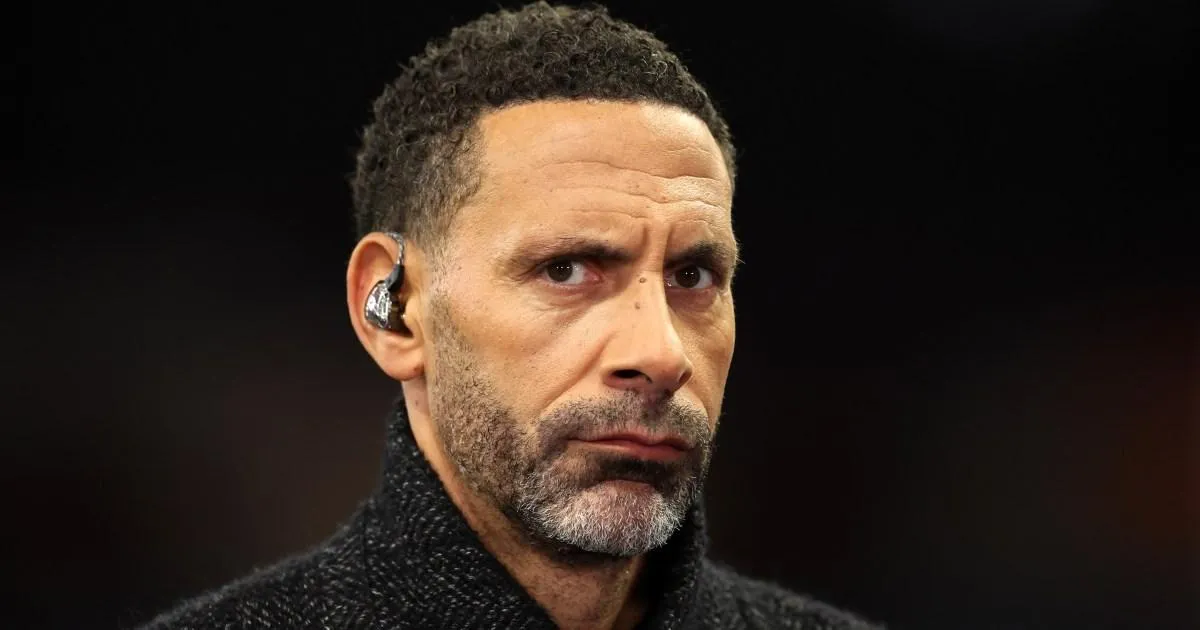
Rio Ferdinand says England only have one ‘world-class player’ at the World Cup | Football

Published

on

Rio Ferdinand says England only have one 'world-class player' at the World Cup | Football

Close Overlay

In The Mixer’s World Cup special

Everything you need to know about the World Cup – England updates, the games to watch and stories you missed – in five minutes, at 1pm, every day.

Source link

Advertisement
Continue Reading

NewsBeat

Should social media be banned for adults, too? Readers discuss

Published

on

Should social media be banned for adults, too? Readers discuss
Readers discuss if social media is good for adults, the treatment of homeless people in London and John Healey’s reasons for resigning (Picture: Getty Images)

Do you agree with our readers? Have your say on these MetroTalk topics and more in the comments

‘I don’t think social media does a lot of adults much good, either, mind you’

Regarding the forthcoming ban on under-16s accessing social media (MetroTalk, Tue) – as obscure pop act
Halo James sang in 1990, Could Have Told You So…

I don’t think social media does a lot of adults much good, either, mind you.

You recently asked how the year 1996 compared with 2026. I could write you out a list of unpleasant things that we now have to contend with that we didn’t back then but MetroTalk wouldn’t be big enough to accommodate it all.Dec, Essex

Advertisement

When I see young people glued to their smartphones I often think, ‘Why don’t they do something more interesting… 
like trainspotting!?’

In years gone by, trainspotters were sometimes regarded as people with sad, uninteresting lives, but it was actually a good excuse for travelling around by train (much cheaper then) and seeing other parts of the country. It was also a chance to make real friends.

Going on to social media appears to be the modern equivalent of trainspotting but, instead of travelling around, you are stuck in one place, alone, with cyber ‘friends’ – many of whom turn out to be scammers, perverts, AI and the like.

Are young people’s lives so unfulfilled that they need ‘influencers’, nearly all of whom are even less significant than the ‘celebrities’ on telly that nobody has ever heard of?

Advertisement

Perhaps if young people on social media platforms are derided by their peers in the same way trainspotters used to be, then there would be less need for intervention from the government. Martin J Phillips, Leeds

Cross words

The ‘point of origin of an earthquake’ is not its ‘epicentre’ as your crossword had it (Metro, Mon). That is the point on the surface vertically above the quake’s subterranean origin. Epicentre is probably the most incorrectly used word in the English language, along with ‘massive’ –which does not mean ‘big’, it means ‘heavy’. How heavy is a hole? Martin, South Gloucestershire

Advertisement

‘”You are loved and wanted in London” doesn’t apply if you’re homeless’

Transport for London has been putting up another set of signs with the message, ‘You are loved and wanted in London’.

Of course, that doesn’t apply if you’re homeless, in which case the government will criminalise your very existence, harass you wherever you go and turn your life into a dystopian nightmare by telling everyone to ignore you.

When I first saw one of those signs, it was right next to a rough sleeper who was being ordered to move by the British Transport Police, for the sole reason that he was a homeless person sitting in a Tube station. It made the sign’s message feel rather hollow. Ryan Cooper, London

Russia invading a sovreign state should mean UK increases millitary spending

Bernard (MetroTalk, Tue) questions whether it really is necessary to increase military spending to the degree demanded by defence secretary John Healey before he resigned over not getting it.

Advertisement

I’d have thought that Vladimir Putin’s Russia invading an independent sovereign state, something Russia hadn’t done for years beforehand, was reason enough. John Daniels, Redhill

John Healey’s reasons for resigning are ‘fundamentally wrong’

I think of John Healey (whom I have met) as a decent and sincere man. However, I believe his reasons for resigning to be fundamentally wrong.

We all understand that the current international climate is hostile, particularly with Putin at the helm in Russia and Donald Trump in the US.

I can also understand John feeling a bit peeved at being told the defence budget would increase by less than one per cent.

Advertisement

However, we need to look at this from a wider perspective rather than listen to the warnings of former generals.

We are members of Nato. Any Nato member can rely on other members to support them if they are attacked. Russia is well outgunned by Nato.

This means that it is highly unlikely Russia will attack us or any Nato country. Why should they? Putin may harbour imperialist intentions but he is not stupid.

We need to make sure that we meet the Nato requirements of spending at least two per cent of our GDP on defence.

Advertisement

Spending more seems unnecessary when we have other pressing domestic issues, such as the NHS.

We are a small island off the coast of Europe, whose Empire disappeared more than 60 years ago. It about time we stopped perpetrating the myth we are somehow up there with the big hitters

I also cannot see the point of nuclear weapons, where the sole use is to blow the world to pieces. We could save tens of billions by not upgrading our existing nuclear arsenal. Neville Jones, Widnes

Do you agree with our readers? Have your say on these MetroTalk topics and more in the comments

Advertisement

Source link

Advertisement
Continue Reading

NewsBeat

Green leader Zack Polanski cleared in GLA probe over London houseboat council tax

Published

on

Green leader Zack Polanski cleared in GLA probe over London houseboat council tax

“The situation might have been different had Mr Polanski owed arrears of council tax at the time of participating in those decisions. However, as I have previously advised the GLA, Mr Polanski was not subject to the exclusion from voting on council tax matters because he did not owe any arrears of council tax at the time of casting his votes.

Source link

Continue Reading

NewsBeat

Boy ended up in Johnsons of Old Hurst crocodile enclosure

Published

on

Boy ended up in Johnsons of Old Hurst crocodile enclosure

Police were called to Johnsons of Old Hurst at 1.24pm to reports of an incident involving a three-year-old boy, during which he ended up in the enclosure. 

The boy has been taken to Addenbrooke’s Hospital with serious injuries and is critical but stable.

Specially trained officers are at the hospital supporting the boy’s family.

Advertisement

Follow our live blog for more

Cambridgeshire Police have confirmed a 30-year-old man, from Norfolk, has been arrested on suspicion of attempted murder. 

Detectives from the Major Crime Unit are investigating.

Det Insp Verity McCann said: “At this stage we are speaking to people who were at the zoo at the time of this distressing incident to understand more about the circumstances.

Advertisement

“We do not believe the man arrested and the child are known to each other.

“Officers are supporting the boy’s family at hospital, and our thoughts remain with them.”

Have you got a story you want to share? Get in touch at oliver.murphy@newsquest.co.uk

Advertisement

Source link

Continue Reading

Trending

Copyright © 2025