
TL;DR
UPS detailed AI plans including a digital twin of its full network, agentic control towers, RFID tracking, and AI customs clearance hitting 97% first-day rates.



As India cut off access to messaging app Telegram for a week over concerns about exam-related fraud, users turned to virtual private networks (VPNs) and alternative messaging apps in unusually large numbers.
App intelligence firm Appfigures told TechCrunch that Tuesday, the day India announced the Telegram restriction, marked the biggest day for VPN app downloads in the country since at least the start of 2025. Downloads of major VPN apps rose 49% from a recent daily average of 139,000 to 208,000, the firm said.
Proton VPN and Turbo VPN recorded some of the largest increases. Downloads of Proton VPN on Apple’s App Store in India jumped 113%, while Turbo VPN downloads rose 85%. On Google Play, downloads of Proton VPN climbed 64% and Turbo VPN downloads increased 35%. NordVPN’s App Store downloads increased 41%, while ExpressVPN downloads on Google Play rose 31%.
The surge also pushed several VPN services up India’s app-store charts. Proton VPN climbed from 18th to 5th in Apple’s Utilities rankings between June 16 and June 18, while its Google Play ranking rose from 8th to 2nd in the Tools category, according to Appfigures.
The spike in VPN demand followed India’s decision to temporarily restrict Telegram until June 22 over concerns that fraudsters were using the platform to target candidates ahead of a re-test for the National Eligibility cum Entrance Test (Undergraduate), the country’s largest entrance examination by applicant volume. The Indian government said the measure was needed to prevent the spread of fake exam papers and related scams. Telegram has challenged the order in the Delhi High Court, arguing that authorities should target specific content rather than block the entire platform.
The response extended beyond app-store download data. Proton said daily registrations from India rose 120% above baseline levels on Wednesday, after hourly registrations had already spiked 150% on Tuesday evening following the Telegram restriction. The company described the increase as “extremely noteworthy” given its existing scale in the country.
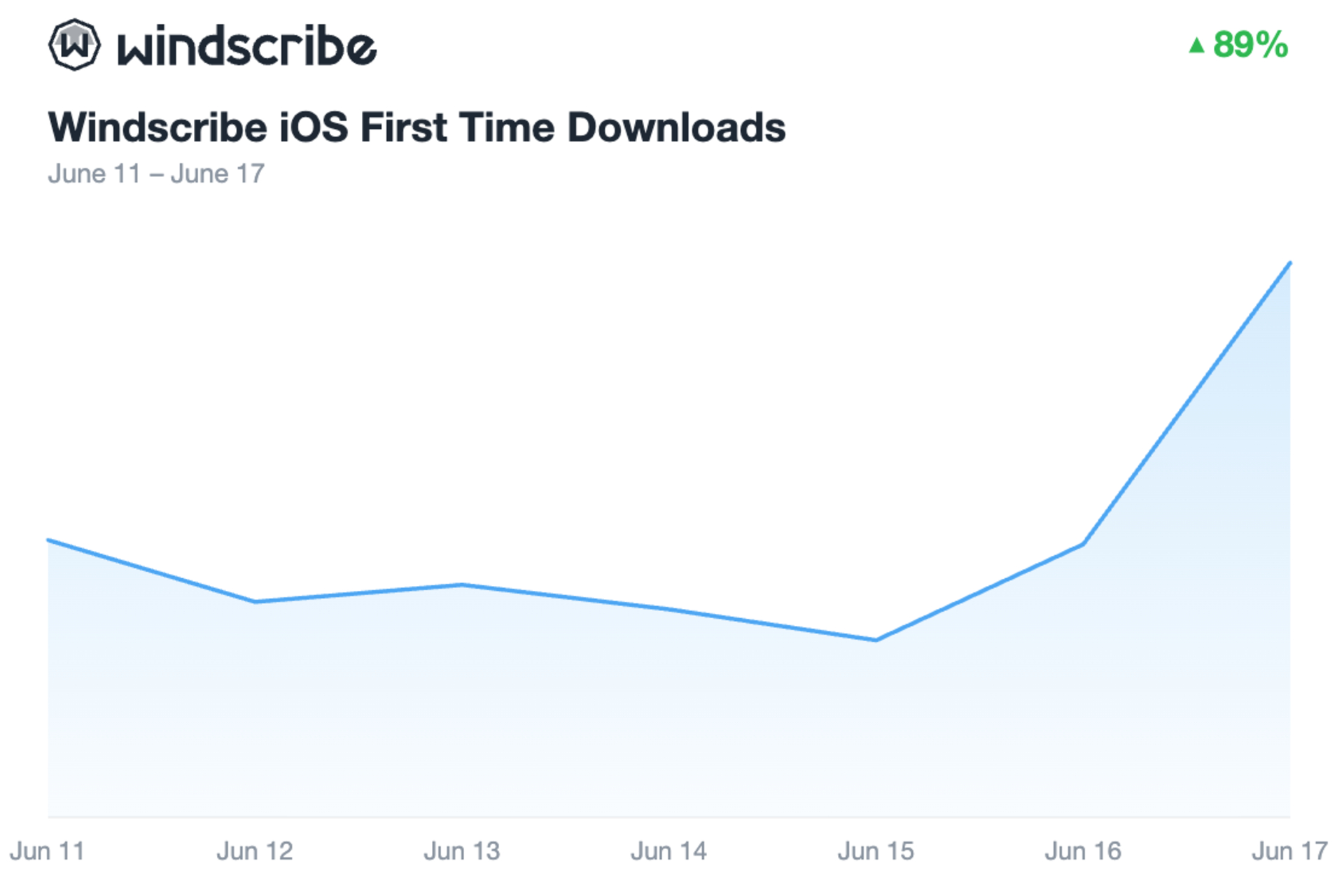
Canadian VPN service provider Windscribe reported a similar trend. The company told TechCrunch that signups from India peaked roughly 100% above baseline levels, while first-time downloads of its iOS app in the country rose about 89%.
“The spike in India follows the same general trend we see in areas that ban specific apps, introduce age bans or verification requirements, or otherwise restrict internet access,” Rebecca Rosenberg, growth operations manager at Windscribe, said.

The trend was not limited to a handful of VPN providers. Sensor Tower told TechCrunch that downloads across the VPN app category in India rose 10% day-over-day on June 17, reversing a decline seen over the previous two weeks.
Users also appeared to be exploring alternatives to Telegram. Appfigures said downloads of Signal in India rose 72% on Apple’s App Store and 322% on Google Play following the restriction, while Viber’s App Store downloads increased 216%.
Telegram-linked messaging app iMe recorded one of the sharpest jumps. Its Google Play downloads rose from a recent daily average of about 827 to 50,900 on June 16, Appfigures said.
Yet the restriction did not immediately translate into lower Telegram usage. Sensor Tower said Telegram’s daily active users in India rose 17% on the day the measure was announced — the app’s largest day-over-day increase in the country since a widespread outage of Meta’s services in 2021.
Other data points also suggest heightened efforts to access Telegram following the restriction.
Cloudflare Radar Lead Lai Yi Ohlsen told TechCrunch that DNS requests for Telegram domains in India increased sharply over the two days after the measure was announced. The company cautioned that higher DNS traffic does not necessarily indicate successful access to the platform, and could reflect users repeatedly attempting to reach Telegram after it was blocked.

Telegram pointed to its efforts to cooperate with authorities during hearings in the Delhi High Court this week. Its lawyers said the company had removed channels identified by authorities and questioned the need for a platform-wide restriction affecting what Telegram says are over 150 million users in India.
Government lawyers defended the measure as a temporary, event-linked response tied to the NEET re-test. Solicitor General Tushar Mehta told the court that a permanent ban could raise proportionality concerns but argued the current restriction had a “logical nexus” to the objective being pursued.
After hearing arguments from Telegram and the government on Thursday, the Delhi High Court reserved its order and is expected to deliver its verdict on Friday.
The debate echoes questions raised elsewhere when governments restrict access to major online platforms. Sensor Tower said VPN downloads in the U.S. rose more than 40% week-over-week when TikTok was briefly removed from U.S. app stores in 2025, while Windscribe said it has observed similar patterns following restrictions in countries including Iran and Russia.
When you purchase through links in our articles, we may earn a small commission. This doesn’t affect our editorial independence.

I can’t say I know for sure that Stephen Colbert is a Techdirt reader, but I very much believe he is. His interests align somewhat with ours, he often comments on some of the same topics we do, and, it turns out, he decided to troll his previous employer during his last show in a very Techdirt-ian manner.
After CBS decided to sacrifice Colbert at the altar of American fascism, the wind down of The Late Show culminated in a final broadcast weeks ago. During that broadcast, Colbert was covering a story about Lee Mendelson Film Productions, which owns the music catalogue for the Charlie Brown franchise, suing several targets for use of its copyrighted music. As he did so, the show band began playing the Charlie Brown theme song. Colbert mused afterwards sarcastically that he hoped that wouldn’t cost CBS any money.
Well played, if only to highlight the absurdity that such a short performance of an iconic song like that could actually result in threats, lawsuits, or demands for payment. But many speculated that the show had already gotten the rights to play the music before it aired, or that Lee Mendelson Film Productions wouldn’t actually do anything about it all to avoid inserting itself into the public spat between Colbert, CBS, and our current government.
Wrong. The company did apparently reach out to CBS, which eventually had to enter into a licensing agreement to avoid any legal issues.
The agreement will see CBS take a license for “Linus and Lucy,” the unofficial Peanuts theme that Colbert’s band played on the air during the show. The proceeds from the deal will be donated to the charity World Central Kitchen, run by Chef José Andrés.
“LMFP found the music’s use on The Late Show funny and entertaining, and is proud to support World Central Kitchen’s mission,” the group’s chairman Jason Mendelson said. A spokeswoman for CBS confirmed the agreement but declined to comment.
On the one hand, I guess it’s nice to see some of CBS’ money go to a good organization like World Central Kitchen. But I do indeed wonder if similar arrangements were struck with the other four entities against which LMFP filed lawsuits. I somehow doubt it. I would guess instead that such treatment was reserved for CBS, in order to make this story more lighthearted and warming.
It’s not, this is stupid, and none of this is as it should be. Colbert shouldn’t have been forced out of his job by a combination of a thin-skinned gibbon and a compliant CBS. It’s insanity that copyright law is in a place where such a diminutive use of a famous song could result in the requirement of a licensing arrangement, never mind actual potential lawsuits. And if it’s so necessary to protect copyright in this instance that lawsuits need to be filed against multiple parties, it should be important enough that any licensing fees and/or damages obtained shouldn’t just be given away to charities.
But as a final poke in CBS’ eye, this was a good one.
Filed Under: charlie brown, copyright, licensing, stephen colbert
Companies: cbs, lmfp, paramount, world central kitchen

In context: Unpatchable, hardware-level vulnerabilities caused a stir some years ago when they repeatedly turned up in AMD and Intel processors, but they’ve been far rarer on Apple chips. This latest discovery only affects older iPhone processors, but it still shows that even relatively recent SecureROM implementations aren’t foolproof.
Security researchers at Paradigm Shift have published the first iPhone bootROM exploit in years. The process, called usbliter8, targets a hardware-level flaw, which means upgrading to newer hardware is the only real fix.
The exploit affects the iPhone XS’s A12 chip, the Apple Watch Series 4’s S4 chip, and the iPhone 11’s A13 SoC. The S5, found in the Apple Watch Series 5, first-generation SE, and HomePod mini, is vulnerable too. Pulling it off requires physical access and a Raspberry Pi, since the flaw sits in a part of the USB controller that standard Mac and PC USB stacks can’t reach.

A12 and A13 are exposed because of how their USB controllers mishandle data packets, leaving SRAM data insecure. Earlier SoCs avoid the issue because they reset the DMA address after each packet comes through the USB controller, and A14 and newer are also safe, having corrected the underlying configuration.
Using the exploit to jailbreak devices is fairly simple on A12, S4, and S5 chips. A13 is trickier, since SecureROM’s PAC protections add extra steps, but it’s ultimately just as vulnerable as its predecessor. The flaw can’t be patched via software, and altered firmware survives reboots.
While most devices built on these chips have been considered obsolete for years, the iPhone 11 which still runs on the A13 chip happens to be the oldest iPhone that supports iOS 26. Apple isn’t dropping it for iOS 27 this fall, either, so it’s guaranteed at least another year of software updates.

The last unpatchable iPhone jailbreak, checkm8, surfaced in 2019 and covered the A5 (iPhone 4S) through A11 (iPhone X). It later resurfaced as a way to bypass the security chips on some Macs. Together, the two exploits leave every iPhone from the 4S through the 11 open to an unpatchable jailbreak.
A fundamentally similar bootROM exploit recently surfaced for Microsoft’s Xbox One, a console long considered unhackable. But getting it to work proved far harder than on iPhones, requiring a voltage-based hijack to pull off.

Google’s next-generation smart speaker is finally available to pre-order. The new Google Home Speaker launches with Gemini built in, costs $99.99/£99.99, and comes with a six-month subscription to Google Home Premium for a limited time.
The speaker was first teased last year, with Google recently hinting that more details were just around the corner. Now, pre-orders are officially live ahead of general availability from June 25.
Gemini is the headline feature here, bringing Google’s AI assistant directly to the speaker. Buyers will also get six months of Google Home Premium, which unlocks additional features including access to Gemini Live.
Google is promising a noticeable audio upgrade over the Nest Mini. The Home Speaker features a centrally positioned 58mm driver. It claims to deliver 2.5 times stronger bass than its smaller smart speaker. While it lacks the dedicated tweeter found in the larger Nest Audio, Google is clearly positioning it as a more capable option for music playback. It is more capable than the Nest Mini.
One feature that could help it stand out is its integration with the Google TV Streamer. Unlike Google’s existing smart speakers, which rely on standard Bluetooth connections, the Home Speaker can pair directly with the streaming device. As a result, it allows it to output TV audio more seamlessly.
The speaker will be available in four colours and is priced at $99.99/£99.99. Customers who place an order before the end of September will receive six months of Google Home Premium at no extra cost.
Pre-orders are now open on the Google Store, while general availability begins on June 25 through Google and other retailers.
After months of teasers, Google’s Gemini-powered smart speaker is finally ready to land. Given its focus on Gemini and the broader role it will play within Google’s smart home ecosystem, the speaker is arguably the company’s biggest smart home launch since the Nest Audio.

Long before we had Amazon or Facebook marketplace, or thousands of other online retailers, we had eBay. And now, we have an eBay coupon to help you save on basics like vacuums and phones, to even your most niche need—because eBay has everything from haunted objects to ironic landline phones to retro gaming consoles. One of the first and most enduring online shopping platforms, eBay has stood the test of time, providing us with the old-school feel of estate sales, complete with bidding wars and gently used items of quite literally every type.
eBay has rotating deals, like 20% off up-and-coming brands, so be sure to check their page often to know which deals are next. They have huge savings on essentials, like Dyson vacuums—an enduring titan in the home cleaning realm. There’s also discounts on like-new refurbished Apple MacBooks and iPads so you can work or study for so much less. It’s not only office tech they have deals on, but even kitchen essentials, like the forever-popular KitchenAid Stand Mixer. eBay has deals on everything from clothing and jewelry to power tools, so check eBay’s deals page often.
Once you’ve perused the nearly endless options of items on eBay, here’s how you can redeem the eBay discount code or offer at checkout: first, make sure your code isn’t expired (I know it sounds like a no-brainer, but you don’t want to be disappointed when that dreaded ‘invalid’ pop-up comes on the screen). Enter the code in the ‘Add coupons’ section, or check the box if the coupon is displayed. When you select ‘apply,’ you should see the discounted total, and then you’ll be prompted to pay.
Once you find the special item of your dreams, go to the “shipping and pickup” search filter and check the “free shipping” box to get free shipping. Make sure you choose eBay free shipping on a multitude of items like motor parts, books, golf clubs, Pokemon cards, haunted objects, tech, and virtually anything else you can imagine.
eBay has rotating deals, like 20% off up-and-coming brands, so be sure to check their page often to know which deals are next. They also have spotlighted, trending, and featured deals for huge savings on a myriad of products like auto parts, golf clubs, shoes, and more. eBay has a money-back guarantee to ensure you get the item you ordered or you get your money back.
Have you heard of an eBay Mastercard? I hadn’t either, but if you’re a collector or frequent eBay shopper, an eBay Mastercard is a smart way to save on purchases you were already planning to make. You’ll earn five times the amount of points for the rest of the year after you spend $1,000 on eBay in a calendar year. Until then, you’ll earn three times the points per $1 spent, up to $1,000, on eBay in a calendar year. You can also earn twice as many points per $1 spent on gas, restaurant, and groceries, and 1 times as many points per $1 spent on all other Mastercard purchases.
If you’re someone who shops or sells on eBay often, I’d suggest downloading the eBay app for even more perks. The eBay mobile app makes it easy to find the best rotating deals on various items and access to the hottest deals and discounts of the day before they leave. Through the app, you can browse everything from trendy items, to power tools, to tech gadgets, and then choose whatever price looks best. There’s also app-only discounts and special offers exclusively for eBay app users. Plus, eBay will help you figure out when’s the best time to buy, with price notifications to let you know when the price has dropped.
If you don’t know what to get the quirky fashionista or vintage collector in your life? Rather than a run-of-the-mill present, get them an eBay gift card so that they can use it to expand their rare baseball collection or get a discounted Nintendo Switch. eBay gift cards can be used to pay for almost any item online. You can get a digital gift card on eBay, or you can buy a physical eBay gift card at CVS, Walgreens, and other retailers.
eBay has expanded considerably, but it first gained popularity by being the first online auctioneer, expanding the world of trading and rarities globally. Today, it’s even more streamlined, with the eBay auction hub, where folks can catch the rarest weekly collectible drops from top vendors. Some of the most popular auction items include Pokemon, baseball cards, basketball, and football cards. If you’re looking to upgrade your collectibles collection, this is where you want to start.
You probably don’t think of eBay when you think of car parts and accessories, but eBay has a wide range of everything you need for car additions and maintenance for way less than if you bought new at a chain retailer. On eBay, you can shop by popular car and truck parts categories, like racks, cargo carriers, towing parts, exhaust and emission systems, brakes, starters, alternators, and more.
Summer is the time to get out in the wide open and get exploring while the sun is out later and temperatures rise. eBay is a great place to shop for powersport parts like wheels and tires for ATVs, UTVs, and motorcycles. And right now, you can get 10% off powersport parts with eBay coupon code Adventure10 (until June 30). There’s no minimum on this eBay coupon code, and the discount applies to the purchase price and excludes shipping, handling, and taxes.

UPS detailed AI plans including a digital twin of its full network, agentic control towers, RFID tracking, and AI customs clearance hitting 97% first-day rates.
UPS detailed a slate of AI-powered logistics initiatives on Wednesday, including a real-time digital twin of its entire global network that updates every 10 minutes. The system creates a digital replica of facilities, air and ground networks, and end-to-end package flows. It continuously tracks performance so the network can adjust and, in UPS’s words, “self-heal in real time.”
The company says its AI-driven network planning tools now complete analyses in one afternoon that previously took engineering teams several months. Forecast accuracy has improved by up to 40%, according to Supply Chain Dive, shrinking costly buffer capacity and enabling a 9.9% reduction in US labour hours during recent volume declines.
“After 118 years of reinventing logistics, we have entered a defining moment, using AI to simplify how we work across the enterprise,” said Carol B. Tomé, UPS chief executive officer. “We are pairing the deep expertise of our people with the power of AI to drive faster decisions and a better experience for our customers around the globe.”

The 💜 of EU tech
The latest rumblings from the EU tech scene, a story from our wise ol’ founder Boris, and some questionable AI art. It’s free, every week, in your inbox. Sign up now!
UPS is also deploying what it calls agentic “control tower” capabilities on-site with customers. These combine data, predictive models, and connected services to go beyond shipment tracking. They flag, prioritise, and help resolve disruptions across complex, multi-carrier networks. Agentic AI is increasingly moving from theory to production across enterprises, and UPS’s deployment is one of the largest logistics implementations announced so far.
On the tracking side, UPS has embedded RFID sensors in all US package delivery vehicles, in delivery facilities across the country, and on every package shipped through over 5,500 The UPS Store locations. The company says misloads have dropped by nearly 70% since the rollout began three years ago. Combined with AI, the RFID data delivers near real-time, package-level visibility.
UPS’s AI customs brokerage is clearing 97% of shipments on the first day of entry, according to the company. The system uses AI and cross-border data to interpret customs requirements worldwide, and the company says it is outpacing competitors on clearance speed. A separate product, UPS Export Assure, uses AI for more accurate product classifications, reducing errors and accelerating processing.
Happy Returns, the reverse logistics company UPS acquired, is using AI to combat returns fraud. The system photographs return contents and compares them against expected product images using its “Return Vision” AI tool. Happy Returns piloted the system with Everlane, Revolve, and Under Armour. Returns fraud is a $76.5 billion problem for US retailers, according to the company.
UPS reported $88.7 billion in revenue for 2025 and has approximately 460,000 employees globally. The company’s “Network of the Future” initiative is backed by a planned $9 billion investment over five years, expected to generate $3 billion in recurring annual savings. Digital twins and AI-driven operational planning are spreading across industries from motorsport to shipping, but UPS’s implementation, covering every mode of transport across more than 200 countries, is among the most ambitious in scale.

Interscope Capitol Records’ Definitive Sound Series is adding one of Marvin Gaye’s most beloved albums to its growing audiophile vinyl catalog. Let’s Get It On is the next DSS release, arriving July 17 as a limited-edition AAA 180g high-definition vinyl One Step pressing.
The release is available now for pre-order and is limited to 3,000 individually numbered copies. It is priced at $110, which puts it right in line with the rest of the DSS series and squarely in premium audiophile vinyl territory. Nobody is confusing this with a casual $29.99 reissue you grab while pretending you only came into the record store for sleeves, or that ninth copy of Disintegration you hid in the classical bins between well-worn copies of Khachaturian’s Symphony No. 3 that nobody has touched since the Carter administration.
Related Reviews:
The Definitive Sound Series edition of Let’s Get It On has been mastered by Chris Bellman at Bernie Grundman Mastering from the original analog master tapes. The record is pressed on Neotech VR900-D2 180g high-definition vinyl at Record Technology, Inc., with the One Step process handled by Dorin Sauerbier.
That AAA chain matters. In an era when “audiophile” can mean everything, nothing, or merely thicker cardboard, this release is being positioned around source, mastering, plating, pressing, and packaging. The One Step process eliminates multiple plating stages used in conventional vinyl manufacturing, with the goal of preserving more detail, depth, and immediacy from the lacquer to the finished record.
The package includes a heavyweight tip-on gatefold jacket, a custom-designed slipcase using the original album artwork, and a certificate of authenticity detailing the mastering, plating, and pressing chain.
At $110, Let’s Get It On lands in the same range as other Definitive Sound Series titles, which generally sell between $100 and $125 per copy. Existing DSS releases have included The Beach Boys’ Pet Sounds, Beck’s Morning Phase, Lionel Richie’s Can’t Slow Down, Nat King Cole’s The Christmas Song, blink-182’s Enema of the State, Dr. Dre’s The Chronic, and A Perfect Circle’s Mer de Noms.
That pricing is not inexpensive, but it is also not unusual for the current premium One Step market. Mobile Fidelity’s UltraDisc One-Step releases, which helped define this category for many collectors, commonly sell for around $100 to $125 depending on the title and format. The comparison is useful because both approaches are aimed at listeners who care about mastering chain, pressing quality, packaging, and limited availability as much as the album itself.
In other words, this is not a reissue for everyone. It is for Marvin Gaye collectors, serious soul and R&B listeners, and vinyl buyers who want a premium pressing of a foundational album and are willing to pay for it.
Originally released in August 1973 on Motown’s Tamla label, Let’s Get It On marked a major shift in Marvin Gaye’s career. Coming after What’s Going On and Trouble Man, the album moved away from overt social commentary and into something more intimate, sensual, spiritual, and emotionally exposed.
The title track became one of Gaye’s defining recordings, reaching No. 1 on the Billboard Hot 100. The album climbed to No. 2 on the Billboard 200 and became the best-selling soul album of 1973. Alongside the title track, the album includes “Please Don’t Stay (Once You Go Away),” “If I Should Die Tonight,” “Come Get to This,” “Distant Lover,” “You Sure Love to Ball,” and “Just to Keep You Satisfied.”
The estate of Marvin Gaye framed the release around that same idea, noting that Gaye “created music that was deeply personal, yet universally understood,” and that Let’s Get It On remains one of his most celebrated works.
Marvin Gaye’s Let’s Get It On is exactly the kind of title that makes sense for the Definitive Sound Series: culturally important, vocally rich, beautifully arranged, and capable of rewarding a better mastering and pressing chain.
At $110, this DSS One Step edition is not an impulse buy. But compared with MoFi’s UltraDisc One-Step releases and other premium audiophile vinyl offerings, the price sits where the market already lives. The real question is whether the mastering, pressing quality, and all analog chain deliver enough to justify the premium.
For collectors who love Marvin Gaye, classic Motown, and properly executed AAA vinyl, this one is going to be hard to ignore.
Where to pre-order: $110 at Motown Records (ships July 24, 2026)


International law enforcement agencies cleaned nearly 15,000 malware-infected WordPress websites and took down more than 100 servers linked to the SocGholish botnet and the Evil Corp Russian cybercrime group.
This joint action (supported by Europol and Eurojust) was part of Operation Endgame, a major law enforcement operation targeting cybercrime now aimed at disrupting a key infection chain linked to Evil Corp.
Authorities from the Netherlands (NHCTU), Canada (RCMP), the United States (FBI), and Germany (BKA) cleaned SocGholish malware infections from 14,971 compromised WordPress websites and took 106 servers and domains offline.

While the Dutch police removed the malware and backdoors from the infected sites, it also advised the website owners to change their credentials, enable multi‑factor authentication, delete any unknown WordPress accounts, and keep their WordPress site up‑to‑date.
“With these actions we deprive cybercriminals of access to infected computer systems. This prevents further damage to the digital systems of citizens, businesses and organizations worldwide and limits the spread of malware,” said Maikel Rollman, of the Netherlands’ National High Tech Crime Unit.
“It also reduces the risk that these systems are used for cyber‑attacks on critical infrastructure and other essential societal processes. This marks the beginning of further action against SocGholish.”
The SocGholish JavaScript-based malware downloader (also tracked as FakeUpdates and GhoLoader) has been used in attacks since at least 2017, and it works by hijacking legitimate websites (primarily WordPress sites) and tricking visitors into downloading malicious payloads, commonly disguised as fake browser updates.
When a user installs the malicious update, the malware opens a connection to the attackers, giving them access to the infected system. SocGholish has also been used to deploy other malware families, including Dridex, Doppelpaymer, Empire, Koadic, Chtonic, and Azorult.
The malware has been previously linked to Evil Corp, a Russian cybercrime gang active since 2007 that has been associated with the Zeus and Dridex malware families and was behind the WastedLocker, Hades, Macaw Locker, and Phoenix CryptoLocker ransomware operations.
“This marks the beginning of further action against SocGholish,” Rollman added in a press release published today.
In November, as part of Operation Endgame, law enforcement agencies also took down over 1,000 servers used by the Rhadamanthys, VenomRAT, and Elysium botnet malware operations.
Previously, Operation Endgame has also targeted ransomware infrastructure, Smokeloader botnet customers and servers, the AVCheck site, and various other major malware operations, including DanaBot, IcedID, Pikabot, Trickbot, Smokeloader, Bumblebee, and SystemBC.

Security teams log 54% of successful attacks and alert on just 14%. The rest move through your environment unseen.
The Picus whitepaper shows how breach and attack simulation tests your SIEM and EDR rules so threats stop slipping by detection.
Disclaimer: Unless otherwise stated, any opinions expressed below belong solely to the author.
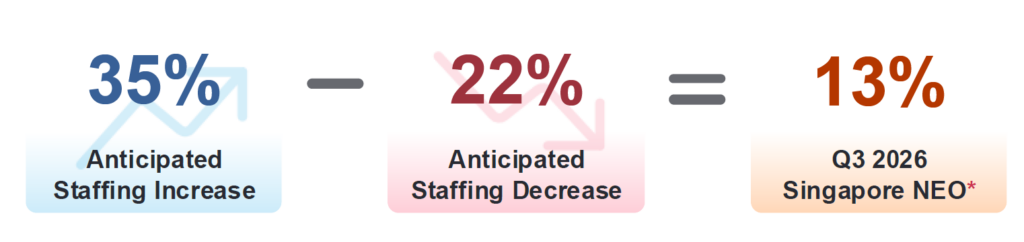
Employment situation in Singapore remains positive, although the job market is showing signs of cooling in yet another report. According to the latest Q3 release by ManpowerGroup Singapore, the Net Employment Outlook index fell to just 13%, which is the lowest reading since 2022.
NEO is measured as a simple difference between the share of companies anticipating an increase in hiring and those which are expecting cuts.


Of course, as ever, these are only averages, and your situation is going to depend not only on specific industry but also the type and size of company you’re either working for or are interested in.
Manufacturing leads the ranking, which is not a surprise given the impact that AI has had on demand for locally made electronics and semiconductors.
Almost all other industries have suffered precipitous drops, however.

While the IT sector is stable and quite strongly positive, it is not immune to layoffs—like the recent round just announced at Shopee.
Meanwhile, Finance & Insurance dipped into negative territory after losing 13 points. It would appear that some of the most lucrative jobs in Singapore might be harder to find this quarter.
It may be compounded by the fact that many of the companies in the sector employ thousands of people.

Yes, you read that right: the NEO score for companies of 5000+ employees and over is negative 26%, after dropping 29 points. Put simply, more large employers are planning workforce reductions than new hires.
This is an alarmingly low reading, especially compared to the global average of a positive 24%.
In fact, all companies employing 50 pax or more are reporting a significant drop in hiring sentiments, although no other group sank into negative territory.
Meanwhile, hiring appears to be booming at the bottom end, with a net positive of 42% for businesses under 10 employees and 34% for those over 10 but under 50. Both have also recorded strong positive swings ahead of Q3, defying the negative sentiments of larger businesses.
This is unlikely to bring comfort to those wary of potential layoffs at the biggest employers, since smaller businesses are rarely able to match the pay and benefits, unless, perhaps, for the lowest-paid roles.

Compared to 2025, Singapore’s employer sentiments have worsened moderately, at -11 points. The worst performer globally is UAE, which shouldn’t be a surprise given the fallout from the war with Iran which has disrupted local business and led to flight of thousands of people, with currently no established date of return to normalcy.
But not all is bad in the world, as UK, US or Sweden are reporting decently positive attitudes (among the developed nations) despite the geopolitical turmoil.
That said, all of them are grappling with much higher unemployment rates than Singapore (currently around 3% for residents), with the US at 4.3%, UK at around 5% and Sweden at a whopping 8.7%. Perhaps this explains why more companies are expecting their headcounts to increase soon, whereas Singapore is quite known for suffering quite persistent shortage of talent.
Featured Image Credit: jovannig/ depositphotos

In a system serving nearly 1 million students across more than 1,800 schools, the distance between a central office cubicle and a second grade classroom in New York City Public Schools can feel immense — yet they are inextricably linked. When the central office works, schools get the resources and support they need. When it does not, the friction and challenges can ripple directly into classrooms.
Supporting that system requires thousands of central office staff whose work rarely makes headlines but directly shapes how schools function, from budgets to policies to resource allocation. Recently, the district tried something unusual: offering executive coaching — including human- and AI-powered options — to those behind-the-scenes employees.
Tracie Benjamin-Van Lierop
Executive Director, Organizational Development, Talent and Culture, NYC Department of Education

The move came as staff navigated shifting priorities and persistent uncertainty in the years after the pandemic, raising questions about how best to provide a stable foundation for schools. Through a partnership with the digital coaching and workforce development company BetterUp, central office staff are developing skills such as agency, agility and clarity — capabilities district leaders see as essential to sustaining and stabilizing the nation’s largest school system.
EdSurge spoke with Tracie Benjamin-Van Lierop, New York City Public Schools’ executive director of organizational development, talent and culture, about what this coaching looks like in practice and why investing in the people outside the classroom supports the success of the people inside it.
EdSurge: What was the climate like for central staff before coaching began?
Benjamin-Van Lierop: Coming out of the pandemic, there was a lot of uncertainty. I would say the biggest challenge was feeling seen.
A lot of focus is rightfully on supporting school-based staff, but the people behind the scenes — the ones making sure schools run smoothly — also need development and support.
How did you view coaching at first?
At first, my schedule was just crazy, and I thought, “This is just one more thing I have to do.” One colleague attended the orientation, came back excited and said, “I think this is something we should really look into.” I tried one session, then a second, and three years later, I’m with the same coach.
A lot of focus is rightfully on supporting school-based staff, but the people behind the scenes — the ones making sure schools run smoothly — also need development and support.— Tracie Benjamin-Van Lierop
Sometimes coaching can be seen as punitive — maybe that isn’t the right word — but it’s like it’s there to fix something, and that’s not what I wanted. I wanted us to see coaching as a lever to improve the culture in the organization. We want people who want to work here, and if the environment has room for improvement, we want to hear that.
What shifts have you seen in how people approach coaching?
One person’s story was very similar to mine. They kept hearing colleagues talk about their positive experiences with coaching and said, “Let me try it out.”
They tried it and ended up getting a promotion because they learned to speak up in a respectful way. A lot of that newfound confidence and professionalism came from role-playing with their coach. Role-playing felt like a safe way to prepare for difficult conversations. That person said, “I don’t know that my supervisor would have seen me in the light that they see me in now had I not been able to do those role-play activities with my coach.”
Other signs of success are easy to see: People vote with their feet. If they did not want to continue, they wouldn’t. We’ve gone from “This is something that I have to do,” to “This is something I want to do.”
This affects the work itself. We’re seeing stronger work products and stronger connections between offices and schools as we develop a clearer understanding of why we do this work.
Employee Resource Group (ERG) leaders were among the first central-office staff invited into the coaching pilot. Several describe it as an important source of support as they work to amplify employee voice and strengthen culture across the system. Because ERG leadership is layered on top of full-time roles, coaching has offered space for reflection and skill-building in a complex and demanding environment. The benefits carry into the teams and schools they serve.
How does AI coaching fit in alongside human coaching?
It depends on comfort level and sometimes generation. I’ve tried my AI coach and thought, “No, thanks. I need a human.” But some of our [younger] leaders choose AI because that’s their comfort level. One colleague will only do role-plays with their AI coach because they feel it’s a safe, nonjudgmental space.
I wanted us to see coaching as a lever to improve the culture in the organization. We want people who want to work here, and if the environment has room for improvement, we want to hear that.— Benjamin-Van Lierop
At the end of the day, if that tool is supporting what is happening in schools, then it’s helpful. I see that as an area that will continue to grow.
How has coaching shaped your own leadership?
It has changed me — or I would say transformed me — in a holistic way. It’s not just at work; it has transformed my whole approach to decision-making, my sense of impact and my intentionality.
It has also made me a more curious leader. Sometimes I make judgments based on a story I’ve created in my head, and that story may not be true. I’ve learned to recognize that tendency and ask, “How am I getting to the heart of the matter?” Nine times out of ten, when I take that curious stance, it elevates the work in ways I wasn’t able to three and a half years ago.
What advice would you give to districts thinking about coaching?
First, make it voluntary. Coaching can be seen as, “You’re getting a coach because you’re not doing your job well,” but that’s not what it is. People who opt in often become the biggest supporters later.
Second, coaching requires effort. It’s not just about meeting for 45 minutes. It’s a partnership — a two-way street — and you have to put in the work. It won’t work if you don’t.
Third, really use the data from your coaching partner to track progress and refine your approach.
Coaching is often seen as a nice-to-have, and I understand that, especially with all the demands right now. But this is an investment in your people. If your people are going to do the job well, they need to feel invested in, and this is one of the best investments I’ve experienced in my career.
This article was sponsored by BetterUp and produced by the Solutions Studio team.


Once you’re done with your smartphone, it either ends up in a drawer, on the growing second-hand market, or perhaps in a recycle bin. However, it’s a computer and, when combined with others like it, can offer real processing power.
Computer scientists at the University of California, San Diego, working in collaboration with Google, plan to deploy a rather unusual compute cluster built not from conventional servers, but using 2,000 retired phones.
The goal is to demonstrate how these devices might continue to serve as a low-cost, low-carbon computing platform after their original owners have abandoned them for a shiny new widget to doomscroll TikTok on.
“The project was the brainchild of Jennifer Switzer, a former PhD student at UCSD who is now working on a post-doc at Google,” Ryan Kastner, an associate professor of computer science at UCSD, told El Reg.
In particular, UCSD will be using 2,000 Pixel Fold smartphones courtesy of Google.
Google estimates that the average person upgrades their phone every four years or so. While the physical device and battery may show some wear and tear from their years of service, their core computing functionalities remain intact.
“It’s just a vast amount of sort of thrown away compute and recycling is a terrible option for most of these smartphones,” Kastner said, adding that Switzer started by building a couple of small clusters using smartphones to prove the concept. Since then, the project’s scale has grown considerably.
According to the Chocolate Factory, the motherboard represents about 50 percent of the smartphone’s embodied carbon.
A lot of early testing used unmodified smartphones, Kastner noted, but as the team quickly learned, this wasn’t practical or safe. “In some early meetings with Google, their engineers said that, if you’re going to put these in the datacenter, those batteries are no-go — a lot of things are a no-go — because they’re just fire hazards,” he said.
Some of this work was done by researchers, including Switzer and another UCSD computer science prof Patrick Pannuto, but for the full deployment this fall, Kastner said, Google is working with a third party to extract the phones’ motherboards from their cases.
Once the phone’s motherboards have been extracted from their shells, the researchers say that the chips hiding within remain more than potent enough to be useful for a variety of tasks.
In many cases, the single-threaded performance of these chips is as good as, if not better than, what you’d find from a many-cored datacenter chip.
The Pixel Fold smartphones, which will form the basis of the cluster, are powered by a Google Tensor G2 processor with two 2.85 GHz Cortex-X1, two 2.35 GHz Cortex-A78 and four 1.80 GHz Cortex-A55 Arm cores, a Mali-G710 MP7 GPU, and 12 GB of system memory.
Early benchmarking using the SPEC suite suggests that 25-50 phones should deliver performance similar to that of a conventional server.
The major challenge, instead, is distributing workloads across multiple devices, each of which has a handful of cores of one or more varieties, and most have 8-12 GB of memory.
UCSD researchers are approaching this challenge from a couple of different angles. The first is by targeting applications that can easily fit within a single device. The second is using Kubernetes to orchestrate container deployments across clusters of 25-50 phones.
For this to work, the devices first need to be flashed with a Linux operating system suitable for the job. While Android makes for a great handheld experience, it is not intended for server duty. In the blog post, researchers note that Android includes functionality intended to stop rogue applications from chewing up excessive amounts of memory and draining your battery. In server context, these safety mechanisms are no longer necessary.
Kastner told us this was by no means an easy task, but the team has made steady progress toward getting Linux running smoothly on these devices, including support for the phone’s onboard GPUs. Access to some functionality, like the chip’s integrated tensor processing unit, remains elusive.
Clustering these devices will require networking the phones together. Normally these devices would connect over cellular or Wi-Fi, but at this scale, this not only isn’t practical, but also has implications for security, he explained. Instead, the team will employ PCBs that both supply power and break out wired Ethernet networking.
The researchers suggest that many EdTech, grading, and research workloads commonly run by universities in the cloud are small enough to run on the cluster without issue.
“The vast majority of these applications are within the capabilities of a single smartphone to host, with the standard grading backend running on small cloud instances,” a blog post detailing the planned deployment reads. “Early experiments show that even a moderately-sized cluster of 20 phones is capable of supporting peak submission rates for a 75+ student class.”
“A lot of the sort of function as a service workloads seem to make a whole lot of sense, because they’re sort of sporadic, and don’t need a whole lot of high-performance compute,” Kastner said.
Alongside traditional IT applications, the cluster will also support exploration into parallel computing and systems programming, which sounds an awful lot like the smartphone equivalent of the Beowulf clusters of the ‘90s, which saw researchers cobble together supercomputers from consumer PCs.
UCSD is also home to the San Diego Supercomputing Center. Kastner told us the plan is to make the cluster available to teams working at the center, which suggests we could see a High-Performance Linpack run before long.
The full smartphone cluster is expected to launch this fall. Depending on how well the initial phase goes, we’re told the cluster could grow even larger.
This is far from the only unorthodox cluster we’ve seen in recent memory. Just up the Pacific coast from San Diego, UC Santa Barbara deployed what at the time was the largest Raspberry Pi cluster ever.
The system, built in collaboration with Oracle, featured 1,050 Raspberry Pi 3B+ single board computers.
More recently, we came across a tiny cluster developed by Gigabyte that packed 40 Intel Lunar Lake notebook processors, each with eight cores and 32 GB of memory, into a system the size of a pizza box. ®




No Jackpot Winner as $257 Million Prize Rolls Over to $269 Million Monday Draw


Weekend Open Thread: Tuckernuck – Corporette.com

Zimbabwe Requires Crypto Businesses to Register Annually Under New FIU Regulations


Bitget enters Argentina’s regulated crypto market through PSAV registration


NanoClaw integrates JFrog registries to secure AI agent downloads


This Week In Security: Microsoft On Microsoft, Register Your Domains, Linux On ARM, And FreeBSD Joins The File Cache Club


FBI searches office of Ohio voter registration group

Matt Damon’s Viral Sci-Fi Thriller Has Taken Over HBO Max


Anthropic staff to meet White House officials next week, Axios reports


As AI companies race to go public, who else is along for the ride?

Bitcoin could crash to $48,000, if this historical pattern is triggered


“Israel’s” ban on ICRC visits ruled illegal, but Knesset moves to stop them permanently
Ana Navarro unleashes explosive tirade on ex-Trump aide, Disney Channel star in epic on-air fight: 'Have you no shame?'

Warning of disruption as Cardiff Crossrail works to start


Financial Accounting | Last Day Revision Strategy and Booster | CMA Inter – June 2026

Tributes to former deputy head teacher at Cambridge school among death and funeral notices

Market Preview: SpaceX (SPCX) IPO Record, Federal Reserve Meeting, and Iran Nuclear Agreement

what doctors are seeing in ebike crashes


Deion Sanders Shares Powerful Post After Viral Advice To Deiondra

Kate Middleton Glare Goes Viral After Kids Booed At Royal Event


You must be logged in to post a comment Login