

Crypto World
Kevin Warsh just killed crypto’s rate-cut trade

The new Fed chair held rates steady in his debut, then quietly inverted the entire outlook. The dot plot that projected cuts in March now projects hikes. For a crypto market that spent all year waiting on cheaper money, the ground just shifted.
Summary
- Warsh held rates steady, but the dot plot changed the entire market outlook.
- Crypto fell because the expected path of rates moved higher, not because current rates changed.
- A hawkish Fed raises the bar for every crypto bull case.
- Inflation is now the key number for crypto investors to watch.
On June 17, 2026, Kevin Warsh chaired his first meeting of the Federal Reserve and left interest rates exactly where they were, at 3.50% to 3.75%, the fourth consecutive hold and an outcome markets had fully expected. That decision changed nothing.
What Warsh did to the projections changed everything. Its updated dot plot, the chart showing where officials expect rates to go, flipped from projecting cuts to projecting hikes, and the forward guidance that markets had leaned on for a year was stripped out entirely.
Most major cryptocurrencies fell between 1% and 3% on the news, with Bitcoin sliding toward $64,000. The reason was not the rate decision, which was priced in, but the realization that the cheap-money future crypto had been pricing for the second half of 2026 had just evaporated.
For most of this year, a large part of the crypto bull case rested on a single assumption: that the Fed would cut rates in 2026, easing financial conditions, increasing liquidity, and lifting risk assets including crypto. That assumption is now in serious doubt, and the man who put it in doubt is, ironically, the crypto-friendly chair the industry welcomed.
This piece works through what Warsh actually did at his first meeting, why the dot-plot reversal matters more than the rate hold, why a hawkish Fed is a headwind for crypto, the inflation backdrop forcing the Fed’s hand, and what changes for a market that has to rebuild its thesis without the rate cuts it was counting on.
The rate-cut trade is dead, and understanding why is essential to understanding where crypto goes from here.
What Warsh actually did
The meeting held rates steady, so the story is entirely in the projections and the language, and both pointed firmly in one direction.
The Federal Open Market Committee voted twelve to zero to keep the federal funds rate at 3.50% to 3.75%, a decision so widely expected that on its own it would have passed without much market reaction. The market-moving content sat in the Summary of Economic Projections, the quarterly document that includes the dot plot.
In March, before Warsh took over, that dot plot showed zero officials projecting a rate hike for 2026 and the committee as a whole forecasting a cut. At this meeting, the picture inverted: nine of eighteen officials now project at least one rate hike in 2026, and six of those project two hikes, while only one official still pencils in a cut.
The median projection for the end-of-2026 rate rose to 3.8% from 3.4% in March. In the space of one quarter, the Fed went from expecting to cut to expecting, on balance, to hold or hike, which is a sharp and consequential reversal.
Its language shifted just as hard. The policy statement dropped its easing bias, removing the references to future rate adjustments that had signaled cuts were coming, and became shorter and blunter, declaring that the committee “will deliver price stability.”
Warsh explicitly abandoned the practice of telegraphing future moves, the forward guidance that markets had relied on under the previous chair. He signaled a Fed that would be data-dependent and unwilling to promise the easing that traders wanted.
He also announced a broad review of the central bank’s work, naming five task forces covering inflation, communications, economic data, productivity, and the labor market, a sign that he intends to reshape how the Fed operates, not merely to chair its meetings. The combination, a hawkish dot plot, stripped-out guidance, and a price-stability-first message, told markets that this Fed is focused on inflation and is not preparing to cut.
Why the dot-plot reversal matters more than the hold
The rate hold was a non-event because it was expected; the projection reversal was the event because it rewrote what markets expect next, and expectations are what move asset prices.
Markets do not price the current interest rate so much as the expected path of future rates, because asset values reflect what investors believe will happen, not only what is true today. For a year, the crypto market and the broader risk-asset complex had priced in a path of falling rates in 2026, an easing cycle that would loosen financial conditions and support higher valuations.
The dot-plot reversal demolished that priced-in path in a single afternoon, replacing an expected easing with an expected hold-to-tightening. When the expected path of rates shifts upward, the assets that were priced for falling rates have to reprice downward to reflect the new reality.
That repricing is what the 1% to 3% crypto decline represented. It was not a reaction to a rate that did not change, but an adjustment to a future that did.
Removing forward guidance compounds the effect by injecting uncertainty. Under the prior regime, markets received signals about where rates were heading, which let them price the future with some confidence.
Warsh’s refusal to telegraph moves means markets must now navigate without that guidance, pricing a wider range of outcomes and demanding more compensation for the uncertainty. That tends to pressure risk assets that depend on confident expectations of easier conditions.
A Fed that will not promise cuts, that projects hikes, and that anchors everything to delivering price stability is a Fed that has taken the rate-cut assumption off the table. Every asset that was leaning on that assumption, crypto prominently among them, has to find its footing without it.
The hold kept rates still; the projections moved the market, because the market trades the future the projections describe.
Why a hawkish Fed is a headwind for crypto
The connection between Fed policy and crypto prices is direct and well-known, and a hawkish turn works against crypto through several reinforcing channels.
The clearest channel runs through liquidity and risk appetite. When the Fed holds or raises rates, it keeps money relatively expensive and scarce, which reduces the flow of capital into speculative, risk-sensitive assets, and crypto sits at the far end of the risk spectrum.
Higher rates make safe assets like Treasury bills more attractive by paying a solid yield for no risk. That raises the bar for holding a volatile, yield-less asset like Bitcoin, since the opportunity cost of choosing crypto over a safe 4% return goes up.
Crypto has shown a persistent correlation with risk assets during periods of monetary tightening, and the precedent is recent and painful. When the Fed hiked aggressively in 2022 and 2023, crypto fell hard alongside equities, and the same dynamic can reassert itself when policy tightens or simply refuses to loosen.
A hawkish Fed drains the cheap liquidity that fuels crypto rallies. It is one of the macro forces pressuring crypto, and it now sits at the center of the market’s 2026 problem.
A second channel runs through the dollar and real yields. A more hawkish Fed tends to strengthen the dollar, and a stronger dollar is generally a headwind for crypto, which is priced in dollars and competes with the dollar as a store of value.
Rising real yields, interest rates adjusted for inflation, make holding non-yielding assets like Bitcoin and gold less attractive by raising the return available elsewhere. That is part of why both have struggled in this environment.
A third channel is sentiment and the narrative. The crypto market had built a meaningful part of its 2026 optimism on the expectation of rate cuts, and removing that expectation removes a pillar of the bullish story, leaving the market to lean on other catalysts.
None of this means crypto cannot rise in a hawkish environment, since asset-specific catalysts can override the macro. But it means the macro tide is now running against crypto instead of with it, and swimming against a tide is harder than swimming with one.
The inflation backdrop forcing the Fed’s hand
Warsh’s hawkishness is not arbitrary; it is a response to an inflation problem that has worsened, and understanding the backdrop explains why the rate-cut trade was always vulnerable.
This meeting unfolded against the worst inflation reading in three years. Consumer prices rose 4.2% in May from a year earlier, the largest annual increase since April 2023, driven substantially by higher energy costs tied to the conflict in the Middle East that began earlier in the year.
Inflation running well above the Fed’s 2% target, and rising instead of falling, leaves the Fed little room to cut even if it wanted to. Cutting rates into rising inflation risks letting that inflation accelerate, the cardinal error a central bank focused on price stability must avoid.
The Fed’s statement explicitly tied the inflation backdrop to supply shocks including energy, and Warsh’s price-stability-first framing is the natural response of a central bank confronting inflation that has not been tamed. The hawkish turn is the Fed reacting to the data in front of it.
This is why the rate-cut trade was built on a shaky foundation from the start. The market wanted cuts, and priced them, but the inflation data never supported them, and a Fed serious about its 2% mandate was always going to struggle to deliver easing while prices climbed at 4.2%.
The irony of the Middle East situation is sharp here. The same geopolitical conflict that briefly lifted crypto on risk-on relief when a peace deal approached is also the source of the energy-driven inflation that is keeping the Fed hawkish.
That is the geopolitical side of the same backdrop. The story cuts both ways, offering a sentiment tailwind while feeding the inflation that produces a monetary headwind.
It is also the oil-inflation-Fed chain in action: energy prices feed inflation, inflation shapes Fed policy, and Fed policy shapes the crypto liquidity environment.
Warsh inherited an inflation problem, and his first meeting signaled that he intends to treat it as the priority. That means the easy money the crypto market wanted is not coming while inflation runs this hot.
The data killed the rate-cut trade; Warsh merely confirmed the death.
What changes for crypto
With the rate-cut assumption gone, several things change for how the crypto market should be understood and how its thesis has to be rebuilt.
One change is that the macro tailwind many were counting on for the second half of 2026 is now a headwind, or at best a neutral. That means the crypto bull case can no longer lean on easing financial conditions and has to rest on other foundations.
Asset-specific catalysts become more important precisely because the macro is no longer doing the work. Adoption, institutional flows, regulatory clarity, and project-level developments now have to carry more of the burden of driving prices, since they cannot count on a rising liquidity tide to lift everything.
That is how a softer Fed shaped the XRP case: without easier money, even strong asset-specific theses need a clearer mechanism and real inflows to matter.
Regulatory catalysts still matter, especially when they change who can buy, hold, or finance digital assets. That is why letters to federal banking regulators on digital-asset risk weights still sit inside the broader crypto thesis, even as the Fed turns hawkish on rates.
This raises the bar for any bullish thesis, which now has to identify a specific reason an asset will rise despite a hawkish Fed, instead of assuming the macro will provide the lift. The market that spent 2026 waiting for the Fed has to start finding reasons that do not depend on it.
Another change is in how to read the data going forward. The single most important number for crypto is now the inflation print, because the path of rates, and therefore the macro environment for crypto, depends on whether inflation continues climbing or begins to ease.
If the 4.2% figure keeps rising, the probability of actual rate hikes increases, and the headwind for crypto intensifies. If inflation cools, the Fed could soften and the rate-cut hope could revive.
Crypto investors who were watching for dovish signals from the Fed should now be watching the inflation data that drives the Fed, because that data is upstream of everything.
A third change is psychological: the market has to absorb that the crypto-friendly chair it welcomed is, on monetary policy, a hawk, and that personal comfort with Bitcoin does not translate into the easy money that lifts its price. Warsh can like crypto and still run a policy that pressures it, and the market is learning that distinction the hard way.
That distinction matters even as Congress advances crypto-related limits on the Fed, including a CBDC pause in a major housing bill. A crypto-friendly policy environment can exist alongside a hostile liquidity environment.
What it means for investors
For anyone navigating crypto in this environment, the Warsh pivot reframes the landscape, and a few principles follow from it.
Realistically, crypto now faces a less supportive macro backdrop than the market assumed for most of 2026. The expected rate cuts have been replaced by an expected hold-to-tightening, and that is a genuine headwind that has to be weighed against whatever asset-specific catalysts an investor is following.
It does not mean crypto cannot rise, because strong enough catalysts can overcome a hawkish macro. A major adoption event, a regulatory breakthrough, a powerful project development, or sustained institutional flows can still move individual assets even in tight environments.
But it means the broad, rising-tide bull case that depended on easing is off the table for now. An investor should be skeptical of any thesis that quietly assumes the Fed will ride to the rescue with cuts, because the Fed has just signaled it will not.
The macro wind is in crypto’s face, and a position should be sized with that in mind. That is the broader question this raises: whether crypto can keep advancing when the liquidity story no longer does the lifting.
Discipline means separating the macro from the micro and watching the inflation data as the key variable. An investor can still find compelling asset-specific opportunities in a hawkish environment, but should hold them understanding that they are fighting the macro instead of riding it, and should adjust expectations and risk accordingly.
Watching the inflation prints, the dollar, and real yields gives a clearer read on the crypto environment now than watching for Fed dovishness that is not coming. Those are the forces actually driving the policy.
None of this is investment advice; it is a frame for a market whose central macro assumption just changed, and which has to be understood in light of that change rather than in the comfortable terms it used for most of the year.
The easy money is not coming
Kevin Warsh’s first meeting as Fed chair will be remembered not for the rate hold, which surprised no one, but for the projection reversal that killed the rate-cut trade.
The dot plot that showed cuts in March now shows hikes, the forward guidance is gone, the message is price stability above all, and a crypto market that spent the year pricing in easier money has had to reprice for a Fed that is not going to provide it.
The 1% to 3% decline on the news was the market beginning to absorb a future without the cuts it was counting on, and that absorption is not finished.
The deeper lesson: the macro foundation of the 2026 crypto bull case has shifted, and the market has to rebuild its thesis on something other than Fed easing. The rate cuts that were supposed to lift crypto in the second half of the year are not coming while inflation runs at 4.2%, and the crypto-friendly chair the industry welcomed has turned out to be, on the policy that matters most for prices, a hawk.
What carries crypto from here will have to be asset-specific: adoption, flows, regulatory clarity, and real catalysts. The macro is no longer offering a free lift and may be pushing the other way.
The rate-cut trade is dead, the inflation print is now the number that matters most, and the comfortable assumption that cheap money would return in 2026 just ran out of road. Crypto can still rise, but it will have to earn it without the Fed’s help, and that is the change that matters.
Frequently asked questions
What did Kevin Warsh do at his first Fed meeting?
At his June 17, 2026 debut, Warsh held the federal funds rate steady at 3.50% to 3.75% on a 12-0 vote, an expected decision. The market-moving change lived in the projections: the dot plot flipped from projecting rate cuts in March to projecting hikes. Nine of eighteen officials now see at least one 2026 hike and six see two, while the median end-2026 rate rose to 3.8% from 3.4%. The statement also dropped its easing bias and emphasized delivering price stability.
Why did crypto fall after the Fed held rates steady?
Because markets price the expected path of future rates, not just the current rate. For a year, crypto had priced in rate cuts in 2026. The hawkish dot-plot reversal replaced that expected easing with an expected hold-to-tightening, forcing assets that were priced for falling rates to reprice downward. Most major cryptocurrencies fell 1% to 3%, with Bitcoin sliding toward $64,000, reacting not to the unchanged rate but to the changed outlook.
Why is a hawkish Fed bad for crypto?
A hawkish Fed keeps money expensive and scarce, reducing the flow of capital into speculative assets like crypto. Higher rates make safe assets like Treasury bills more attractive, raising the opportunity cost of holding yield-less crypto. A hawkish stance also tends to strengthen the dollar and raise real yields, both headwinds for Bitcoin. Crypto has shown persistent correlation with risk assets during tightening, falling alongside equities when the Fed hiked in 2022 and 2023.
Why is the Fed turning hawkish now?
Inflation has worsened. Consumer prices rose 4.2% in May from a year earlier, the largest annual increase since April 2023, driven substantially by higher energy costs tied to the Middle East conflict. With inflation well above the Fed’s 2% target and rising, the Fed has little room to cut without risking accelerating inflation. Warsh’s price-stability-first stance is a response to this data, which is why the rate-cut trade was built on a shaky foundation.
Does this mean crypto cannot go up in 2026?
No, but it means the macro is now a headwind rather than a tailwind. Crypto can still rise on strong asset-specific catalysts, adoption, institutional flows, regulatory clarity, or major project developments, which can override a hawkish macro. But the broad, rising-tide bull case that depended on rate cuts is off the table for now. Any bullish thesis has to identify a specific reason an asset will rise despite the Fed, not assume easing will lift everything.
What should crypto investors watch now?
The inflation print is now the most important number, because the path of rates depends on whether inflation keeps climbing or eases. If inflation rises, rate hikes become more likely and the crypto headwind intensifies; if it cools, the Fed could soften. Investors should also watch the dollar and real yields, which drive the crypto environment. Watching the inflation data that drives the Fed gives a clearer read than waiting for Fed dovishness that the June meeting signaled is not coming.
As of June 19, 2026. Monetary policy and markets change quickly; verify current data before relying on this analysis. This article is information, not investment advice.

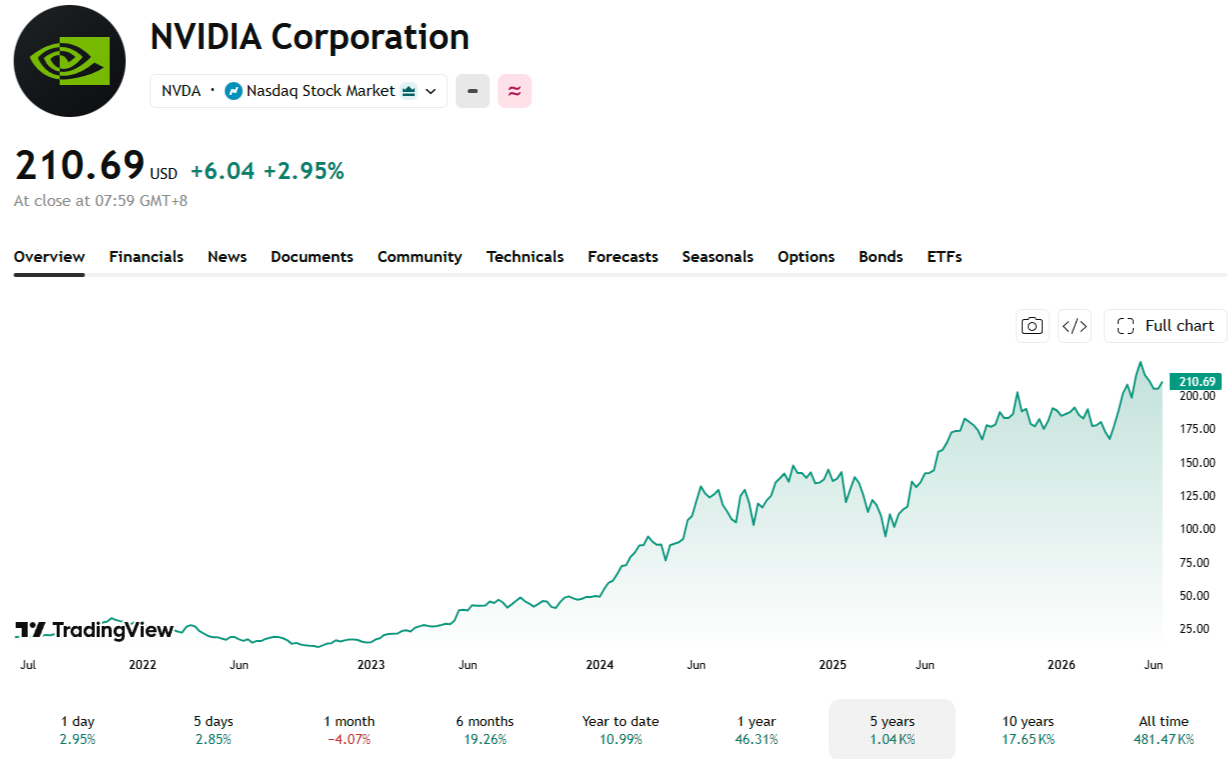
Wall Street is drawing a clear line between two of AI’s biggest stock winners. Analysts broadly back Nvidia at current prices and flag Micron Technology as overvalued heading into its June 24 earnings report.
Wall Street’s price targets lay it bare. Nvidia trades near $210. The 69 analysts covering it see $300, about 43% higher.
Meanwhile, Micron is the mirror image. It sits around $1,133, but the 49 analysts on it call fair value just $949, roughly 16% under today’s price.
Why Analysts Back Nvidia
NVIDIA powers nearly 90%+ of AI training compute globally. Its reported fiscal first-quarter revenue of $81.6 billion is up 85% year over year. The next-generation Vera Rubin GPU platform is set to ship later this year, with CEO Jensen Huang telling analysts that every major frontier model company will adopt it immediately.

Despite that momentum, Nvidia trades at 32 times earnings, essentially its cheapest valuation in seven years. Wall Street forecasts adjusted earnings growth of 43% annually through fiscal 2029.
Why Analysts Are Cautious on Micron
The skepticism on Micron comes down to one structural problem: memory chips are commodities. Products from different manufacturers are largely interchangeable, leaving Micron without a durable competitive advantage.
Industry leaders Samsung and SK Hynix both gained DRAM and NAND market share at Micron’s expense in the most recent quarter. Their larger production capacity gives them a structural edge. The HBM memory boom is expected to peak around 2028, after which sales are projected to drop sharply.
According to The Motley Fool, Micron’s adjusted earnings are forecast to grow at 13% annually through fiscal 2029. At 48 times earnings, that trajectory makes the current valuation look stretched against Nvidia’s cheaper multiple and faster growth outlook.
Micron’s June 24 report may shift some of those targets. But the structural divide Wall Street sees between the two stocks is unlikely to close on one quarter alone.
The post Wall Street Analysts Picks Nvidia Over Micron: Here’s Why appeared first on BeInCrypto.


- Real Finance launches REAL Competition for the $ASSET ecosystem.
- Users can earn points by trading, staking and holding $ASSET.
- A $3400 raffle pool gives more community members a chance to win.
Real Finance has launched the REAL Competition, a community rewards campaign aimed at increasing participation across the $ASSET ecosystem.
The Sofia-based company said the campaign will allow users to earn points through trading, staking and holding $ASSET, with top participants eligible for up to $20,000 in USDC rewards.
The competition also includes an additional raffle prize pool, broadening the reward structure beyond the highest-ranked users.
Real Finance said the campaign is designed to recognise sustained on-chain engagement rather than simply rewarding short-term trading volume.
Points system targets wider ecosystem activity
The REAL Competition introduces a points-based model that tracks qualifying activity involving $ASSET.
Participants can earn points by trading, staking and holding the token, with all activity monitored on-chain through the competition dashboard.
The structure is designed to give users multiple ways to participate.
Active traders can build points through qualifying transactions, while long-term holders and stakers can also improve their standing through sustained participation.
Real Finance said participants will move through a 13-level rewards structure during the campaign.
This approach marks a shift from conventional trading competitions, which often focus mainly on volume.
By including staking and holding activity, the REAL Competition is intended to reward broader involvement across the $ASSET ecosystem.
Leaderboard rewards backed by raffle prizes
The campaign’s main prize structure includes fixed rewards for the top-ranked participants, with total rewards of up to $20,000 in USDC available through the competition.
Real Finance will also distribute rewards through a broader pool based on final point totals.
This means participants outside the highest leaderboard positions may still be eligible for rewards, depending on their accumulated score.
In addition, the company said it will offer a separate raffle reward pool worth $3,400.
The raffle is designed to give more community members a chance to win prizes, even if they do not finish among the top-ranked participants.
“The REAL Competition is designed to reward meaningful participation across our ecosystem,” said Ivo Georgiev, CEO of Real Finance.
Whether users are actively trading, staking for the long term, or steadily building their position in $ASSET, we want to recognize the community members helping drive the growth of the network. By combining leaderboard rewards with raffle prizes, we’re creating opportunities for a broader range of participants to benefit from the campaign.
Campaign to run over coming months
Participants can join the REAL Competition by connecting a supported wallet and completing qualifying $ASSET transactions or staking activities.
Real Finance said users will be able to track their points, leaderboard ranking and unlocked multipliers through the campaign dashboard.
The company said the competition is now live and will run through the coming months, with rewards to be distributed after the campaign concludes.
The REAL Competition is scheduled to go live at 11 AM UTC.
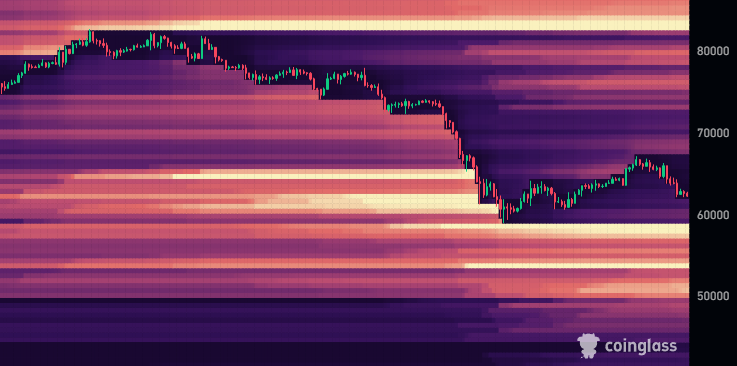
Bitcoin (BTC) could reach its new “macro bottom” by September, as price action continues to surprise traders.
Key points:
- Bitcoin may “front run” exchange order-book liquidity to produce a bear-market low between $50,000 and $60,000.
- A trader sees “complete disbelief” if price reverses with only a partial liquidity grab.
- “Aggressive” shorting from Binance traders returns on low time frames.
BTC price bottom could spark “complete disbelief”
New analysis from pseudonymous trader Killa on Friday focuses on a sub-$60,000 liquidity grab next quarter.
Crypto exchange order-book liquidity is key to short-term price moves, as large-volume traders coerce the market into wiping nearby positions, causing volatility.
Killa, however, is looking at the longer-term picture — many expect BTC/USD to drop as low as $50,000 to take liquidity before bouncing, data shows.
“At some point, $BTC is going to front run major HTF liquidity,” he told followers in a post on X.
“Just like the market front ran the 140K liquidity above, it can do the exact same thing on the downside, leaving many in complete disbelief.”
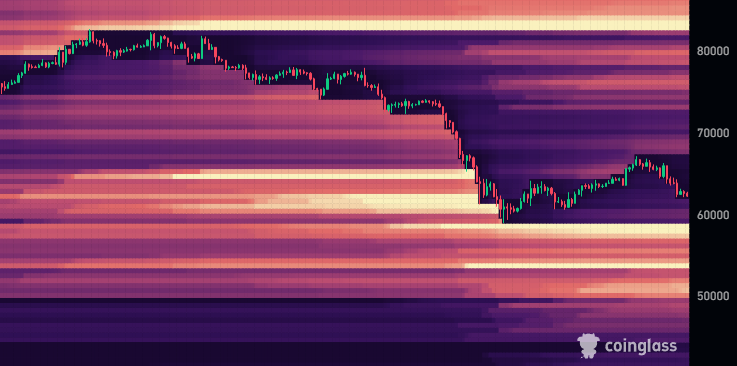
Bitcoin order-book liquidity data. Source: Killa/X
An accompanying chart from CoinGlass shows the main area of interest between $50,000 and $60,000. If it gets taken, Killa argues, it would lay the foundation for the end of the bear market.
“I’m not saying we won’t sweep below 60K, but it’s something worth considering. Markets have a habit of front running the levels everyone is focused on,” they continued.
“Because if this particular liquidity below 60K gets grabbed, there’s a very good chance the next major pool that forms between July and September never gets filled, marking the macro bottom.”
Binance BTC shorts become “aggressive”
As Cointelegraph reported, others have questioned the staying power of current support around the $60,000 mark.
Related: Bitcoin market cap rebound to take ‘5-10 years’ after dropping 10 places since mid-2025
Traders are poised for a snap collapse, with Daan Crypto Trades warning that the situation could “get ugly” if nearby trend lines fail to hold.
“Bulls need to hold that $61K-$62K region otherwise things get ugly real quick I think. But for now, still at support,” he summarized on X.
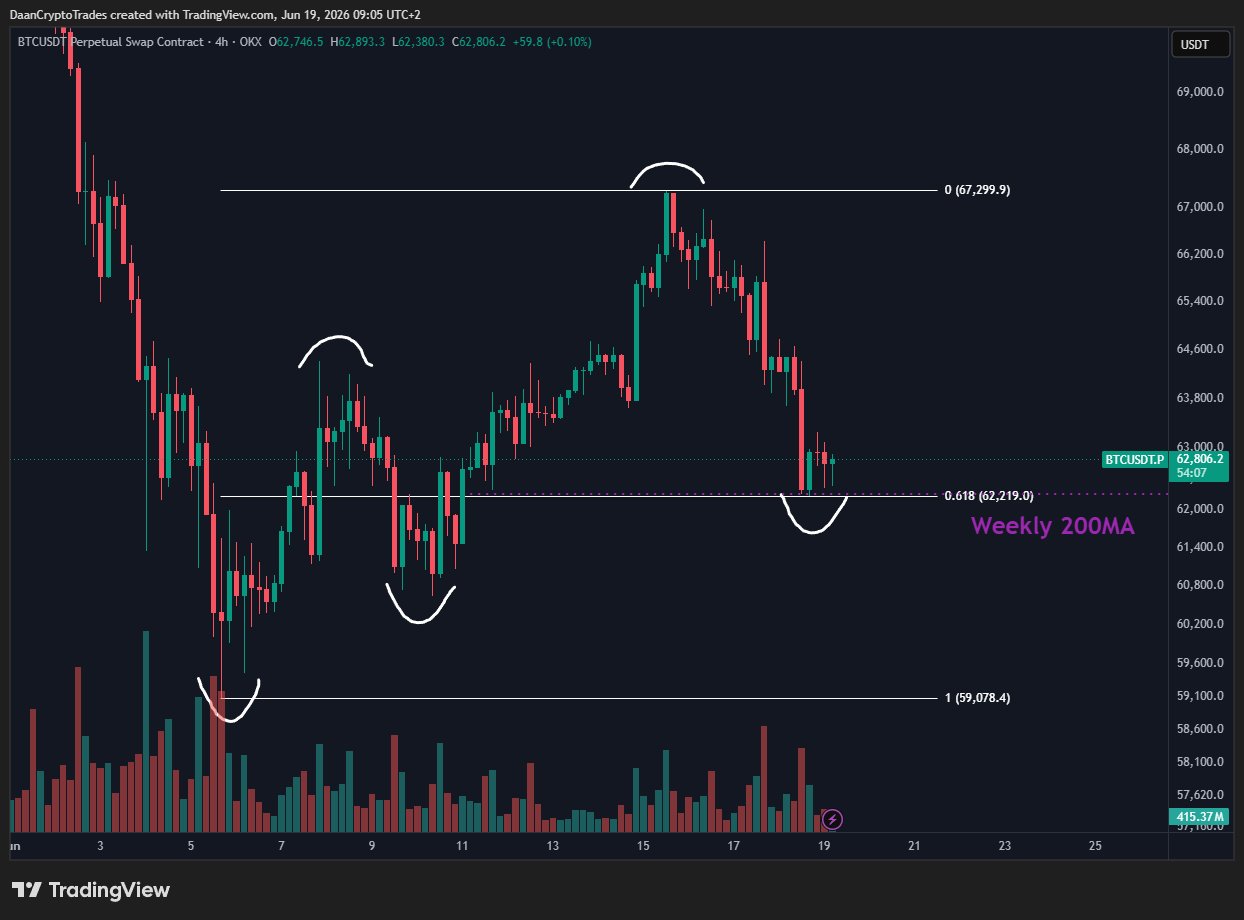
BTC/USD perpetual swap contract four-hour chart. Source: Daan Crypto Trades/X
On Thursday, commentator Exitpump flagged “aggressive” short positioning by traders on Binance, saying that the short-term price outlooks “looks bearish” as a result.
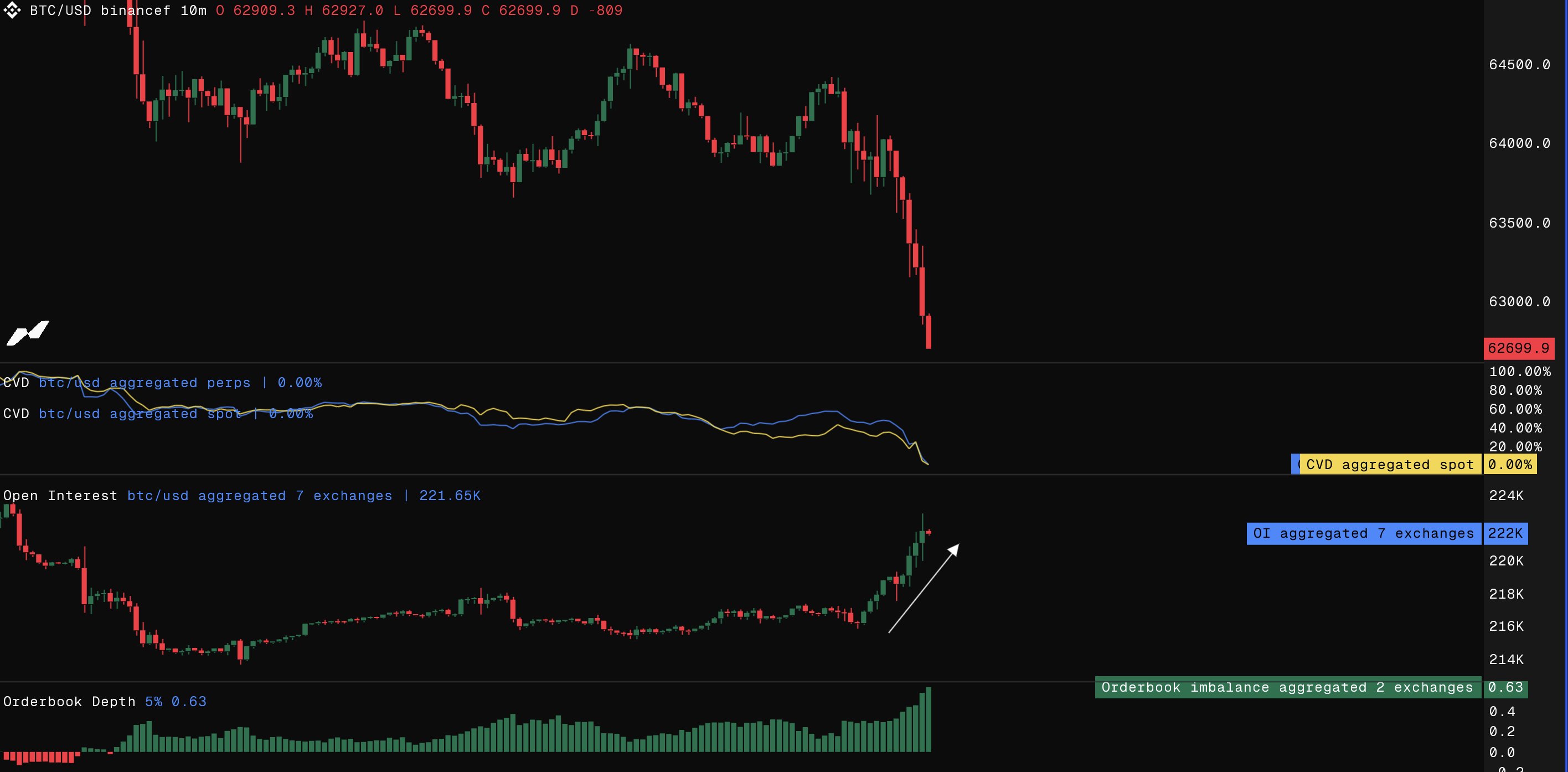
BTC/USD 10-minute chart with order-book data (Binance). Source: Exitpump/X


The largest cryptocurrencies remained under pressure for a fourth straight day, with bitcoin falling 2.5% in 24 hours to just below $62,400.
It’s not alone. The CoinDesk 20 Index (CD20) has dropped 3.3%, with ether (ETH), XRP (XRP) and solana (SOL) all weaker. The CoinDesk Smart Contract Platform Select Capped Index fell 4%, and the CoinDesk 80 and CoinDesk DeFi Select Index are following close behind.
Concerns about Strategy (MSTR), the Michael Saylor-led bitcoin treasury company, continue to dominate market sentiment, with particular focus on its dividend-paying preferred stock, STRC.
“Strategy, the largest listed BTC holder, has watched its STRC preferred collapse below par, and the market is now openly pricing the tail that it has to sell coins to defend the structure,” analysts at Marex said.
“Add five straight months of BTC trading under its estimated $78k production cost, quietly forcing the weakest miners to capitulate, and you have two real sellers that were not in the frame a week ago,” they added.
Derivatives Positioning
- Bulls continue to bleed as the market wilts in the wake of Wednesday’s hawkish Fed meeting. In the past 24 hours, more than $450 million in leveraged bets has been liquidated. As has been the case since the meeting, most are longs.
- Open interest (OI) in bitcoin and ether futures is largely unchanged over the past 24 hours. SOL futures OI increased to over 70 million tokens, just shy of the June 5 record 71.57 million. In other words, demand for leverage remains near all-time highs, pointing to potential for outsized volatility.
- The same is true of XRP, where futures OI is hovering at its highest since October last year.
- As for cumulative volume delta, most of the biggest 25 tokens, except TRX and LAB, show negative OI-adjusted CVD for the past 24 hours. That’s a sign sellers are trading at market orders, leading the price action, as opposed to passive limit orders. It’s been the same playbook since at least Wednesday.
- Funding rates for most tokens remain flat to negative, pointing to bearish sentiment. ADA, XLM, and BCH funding rates are down to between minus 20% and minus 30%.
- In the bitcoin options market, traders are lifting put options in size, prepping for a potential slide down to $52,000 or lower in the coming weeks.
- The bearish sentiment is also evident from 25-delta skews, which show one-week puts trading at a volatility premium of 10% or more.
Token Talk
- Need evidence of how frenzied sentiment about AI is? Check out the LAB token, the cryptocurrency native to the LAB Terminal, which is a browser-based and extension-accessible platform for high-performance trade execution. Its key feature: AI-powered research and trade routing to minimize slippage.
- LAB has gained 57% in seven days, a staggering rise compared with the malaise in the broader market.
- The outperformance doesn’t end there: The token has surged 92% this month, following gains of 900% in May, 250% in April and 78% in March. Talk about a bull market.
- Over the same period, bitcoin has ricocheted from $68,000 to $82,000 and back to $63,000.
- While LAB’s performance is impressive, their’s not apparent reason for it. And it’s not without controversy.
- Blockchain investigation expert ZachXBT recently highlighted that insiders supposedly own 95% of the token’s supply. He said they have used four methods concurrently to attract retailer investors. These include high-interest over-the-counter loans with promotional conditions, unilateral vesting period extensions, delayed or withheld market rewards and undisclosed market-making deals.
- As the old saying goes: All that glitters is not gold.

Hsiao-Wei Wang resigned as co-executive director and board member of the Ethereum Foundation on June 18, effective immediately, the second co-ED departure in roughly four months and the latest news signal that EF leadership is structurally unsettled heading into a critical upgrade cycle.
The exit lands the same day former EF contributor Trent Van Epps published a detailed warning that Ethereum’s core development ecosystem faces a slow-burning funding crisis within three to nine months, with an estimated $30 million annual gap that has no replacement mechanism in place.
Wang thanked Bastian Aue for guiding the transition during her prior sabbatical. Aue, who served as interim co-ED after Tomasz Stańczak stepped down in February, is now effectively the sole executive director of the Foundation. No successor structure has been announced.
ETH was trading near $1,690 at the time of publication, down roughly 3.3% on the day, broadly in line with market-wide pressure rather than any Wang-specific repricing. The structural story here is not the price tick. It is whether the EF can stabilize its leadership and funding architecture before both gaps compound.

Discover: The Best Crypto to Diversify Your Portfolio
Ethereum Core Dev Funding: What the $30M Gap Actually Means
Van Epps, who spent five years at the Ethereum Foundation from May 2021 to April 2026, focusing on core development coordination and Protocol Guild funding, is not an outside commentator raising theoretical concerns.
He was embedded in the mechanism he is now warning about, which makes the three-to-nine-month window he names worth taking seriously.
The $30 million annual figure Van Epps cites covers client teams, researchers, and coordination groups responsible for shipping protocol upgrades and maintaining network reliability. That baseline is currently under pressure from two converging sources.
First, the Client Incentive Program expired in April 2026 with no replacement announced. The CIP launched in 2021 to provide validator-based rewards to teams maintaining key Ethereum execution and consensus clients, Geth, Erigon, Lighthouse, and others, with payouts that unlocked over time contingent on continued network contribution.
Its expiration removes one of the few recurring, structured funding streams outside direct EF grants.
ETHEREUM FOUNDATION IS RUNNING OUT OF MONEY! CRISIS COMING IN 3-9 MONTHS
A former Ethereum Foundation core developer just dropped a serious warning.
Trent Van Epps, who worked at EF for 5 years coordinating core development, says the foundation’s funding is drying up fast.… pic.twitter.com/PLv3d5IvWA— Andrew Leverage (@Mr_LeverageX) June 19, 2026
Second, the EF leadership is running a deliberate treasury drawdown policy, targeting a reduction in annual spending from 15% of its treasury to a 5% baseline by 2030.
That is a defensible long-term posture for an institution managing billions in ETH, but the transition creates a near-term gap that no alternative mechanism has yet filled.
EF Q1 2026 grants covered Geth, Erigon, Lighthouse, validator security tooling, cryptography research, and core infrastructure. Funding continues, but Van Epps’s argument is that episodic grants do not substitute for the structural continuity the CIP provided.
If a replacement for the Client Incentive Program is not announced within the next few months, the most exposed teams are those maintaining execution and consensus clients on a thinner runway, precisely the engineers whose continued output is required for the Glamsterdam upgrade roadmap to stay on schedule.
Van Epps also flags quantum-security research and Layer 1 scaling work as long-horizon projects that erode first when funding visibility shortens.
Discover: The Best Token Presales
Two Co-EDs Out in Four Months: What the Ethereum Leadership Exits News Signal
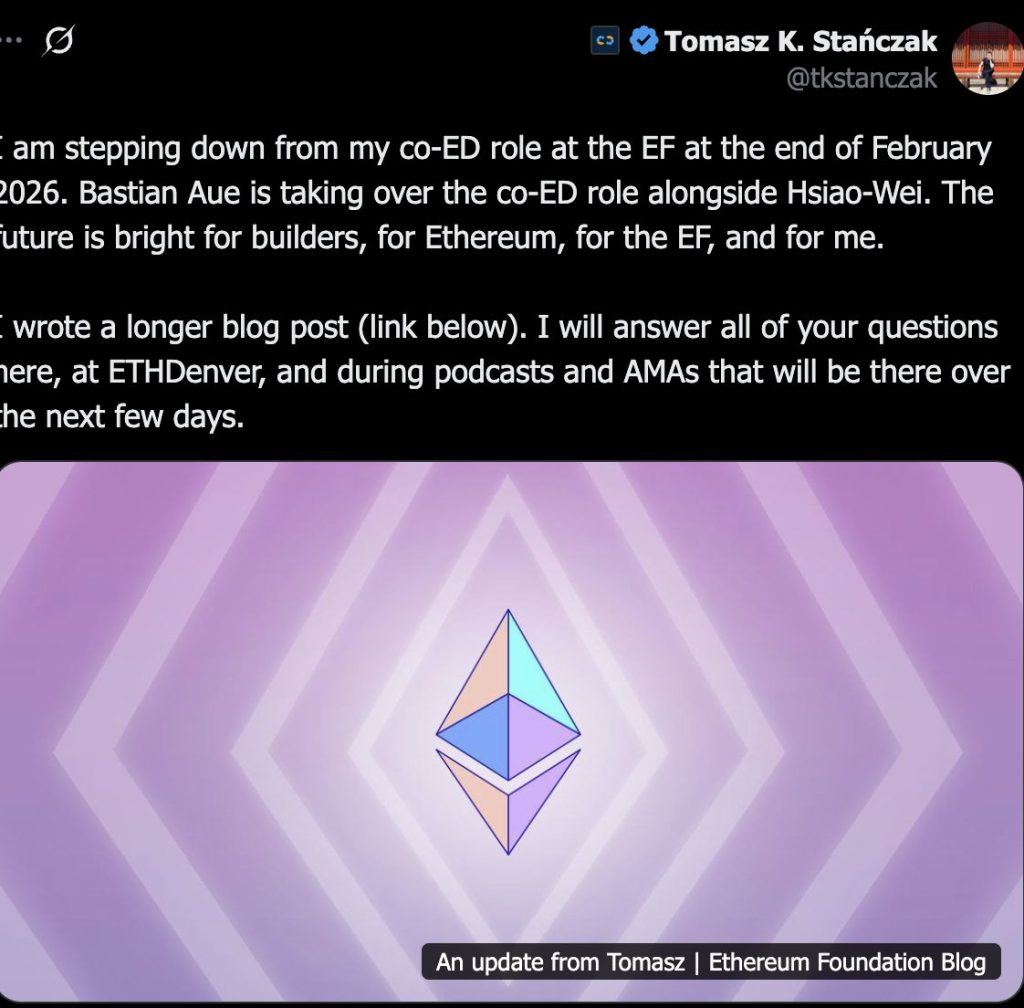
Wang and Stańczak were named co-executive directors in March 2025 as part of a governance reset following Aya Miyaguchi’s move to a president role.
Both are now gone within fifteen months. Broader reporting places the total number of EF departures in 2026 at approximately 19, with at least eight senior figures exiting in the past five months, including figures tied to the Protocol Cluster transition, such as Barnabé Monnot, Tim Beiko, and Alex Stokes.
Treating each exit as an individual decision misses the pattern. A foundation managing a multi-billion-dollar ETH treasury, overseeing core developer funding for the world’s largest smart contract platform, and navigating a major upgrade cycle does not shed two co-EDs in four months without structural tension of some kind, whether over mandate, resource allocation, or governance direction.
Vitalik Buterin publicly responded to Wang’s departure, calling her a steadfast contributor for a decade and crediting her with organizing Ethereum research, consensus work, and community building in Taipei. That is a genuine acknowledgment.
It does not resolve the question of what the EF’s executive structure looks like going forward, particularly as Bastian Aue holds the ED role without a co-lead, and no succession timeline has been made public.
The post Ethereum Foundation Lost 2nd Co-Director in 4 Months As $30M Funding Crisis Looms appeared first on Cryptonews.

Key Highlights
- Bernstein SocGen launched coverage of GEV with an Outperform rating and set a $1,206 price objective
- Analyst Sunaina Ocalan highlighted three major tailwinds: decarbonization efforts, energy security needs, and surging AI power requirements
- First quarter orders surged to $18.3 billion, representing a 71% year-over-year increase, while backlog climbed to $163 billion
- Q1 free cash flow reached $4.8 billion — exceeding the entire fiscal 2025 total
- Shares have climbed 62.3% year-to-date, currently trading at $1,103, approaching the 52-week peak of $1,150
GE Vernova (GEV) saw its shares climb 5.2% Wednesday following Bernstein SocGen analyst Sunaina Ocalan’s initiation of coverage with an Outperform rating alongside a $1,206 price objective. At the time of the upgrade, shares were changing hands at $1,103, hovering near the 52-week high of $1,150 reached in April 2026.
Ocalan characterized GEV as the “right time, right business” — positioning the company at the convergence point of three significant structural trends currently fueling electricity demand.
These three catalysts include the push toward decarbonization, heightened energy security concerns, and the explosive growth in AI infrastructure. Each trend is amplifying demand for gas turbines and grid infrastructure. GEV’s order pipeline is experiencing unprecedented growth.
First quarter bookings totaled $18.3 billion, reflecting 71% organic growth compared to the prior year period. The total backlog now stands at $163 billion. Gas turbine capacity reservations reached 100 gigawatts during the quarter, with company leadership aiming for 110 GW by the close of the year.
First quarter free cash flow hit $4.8 billion. This figure surpasses what GEV produced throughout the entirety of fiscal 2025. The magnitude of this performance is noteworthy.
Small Modular Reactor Initiative Strengthens Growth Thesis
GE Vernova Hitachi Nuclear Energy revealed plans for a partnership focused on constructing a new production facility designed to support small modular reactor (SMR) rollouts throughout Europe. Additionally, the company continues advancing its SMR initiative in Ontario, Canada.
The recent Iran peace agreement contributed favorably to market sentiment. Reduced oil prices lower operational expenses for data centers and industrial operations that represent GEV’s primary customer base, supporting the financial viability of the AI expansion fueling its order growth.
GEV shares have appreciated 62.3% from the beginning of the year. Early investors who allocated $1,000 to GEV at its March 2024 initial public offering now hold positions valued at $8,401.
Market Context: Price Swings Are Common
GEV has experienced 19 single-day movements exceeding 5% throughout the past year, indicating today’s advance aligns with the stock’s established volatility pattern.
Just eight trading sessions ago, shares declined 6.6% following CPI data revealing 4.2% annualized inflation — the steepest level in three years — prompting markets to anticipate a December Federal Reserve rate increase. Elevated interest rates create challenges for capital-intensive industrial companies like GEV.
Previously, the Iran conflict weighed on investor sentiment, as Tehran directed attacks toward Bahrain, Kuwait, and Jordan, introducing supply chain disruptions and complications to international logistics operations.
Gas turbine capacity reservations totaled 100 gigawatts at first quarter end, with leadership establishing a 110 GW target for year-end.

Franklin Templeton has filed to launch two exchange-traded funds that would automatically direct stock dividend income into Bitcoin exposure.
Summary
- Franklin Templeton has filed for two ETFs that would reinvest stock dividends into Bitcoin exposure through a rules based allocation strategy.
- The proposed funds would start with a 95% allocation to U.S. large cap equities and a 5% allocation to Bitcoin linked investments.
- The filing extends Franklin Templeton’s digital asset expansion after recent tokenization partnerships with Kraken, MoonPay, and Ondo Finance.
A registration filing submitted on Thursday shows the asset manager has proposed the Franklin US Equity Bitcoin DRIP Index ETF and the Franklin US Innovation Bitcoin DRIP Index ETF, with an anticipated effective date of Sept. 1, 2026.
The products would track the VettaFi US Large-Cap 500 Bitcoin DRIP Index and a related innovation-focused version. Under the index methodology, dividends generated by the underlying stock portfolios would be reinvested into Bitcoin-linked investments rather than remaining in cash or being distributed to investors.
The filing states that Bitcoin exposure could come through spot Bitcoin exchange-traded products, futures contracts, options, or other investment instruments. The strategy is scheduled to begin with a portfolio allocation of 95% U.S. large-cap equities and 5% Bitcoin exposure.
Quarterly rebalancing rules would reduce Bitcoin allocations above 5% back to 4.5%, while a separate cap would limit Bitcoin exposure to 20% between rebalancing periods, the filing states.
As of April 30, the equity index included approximately 498 securities. The filing states that constituent companies ranged in market capitalization from roughly $7.5 billion to $4.9 trillion.
Franklin expands crypto-linked investment offerings
The proposed ETFs add another product category to Franklin Templeton’s digital asset business, which already includes spot cryptocurrency ETFs, tokenized funds, and blockchain-based investment products.
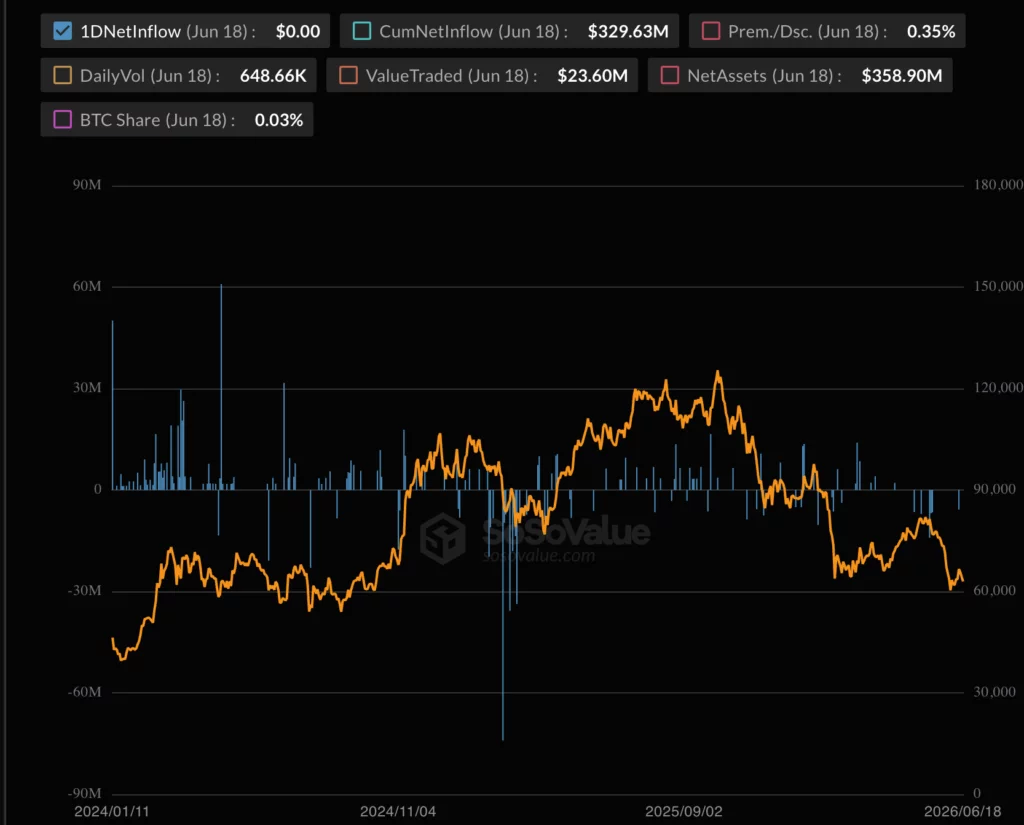
Data from SoSoValue showed Franklin Templeton’s spot Bitcoin ETF, EZBC, held $358.9 million in net assets and had attracted $329.6 million in cumulative net inflows as of Thursday.
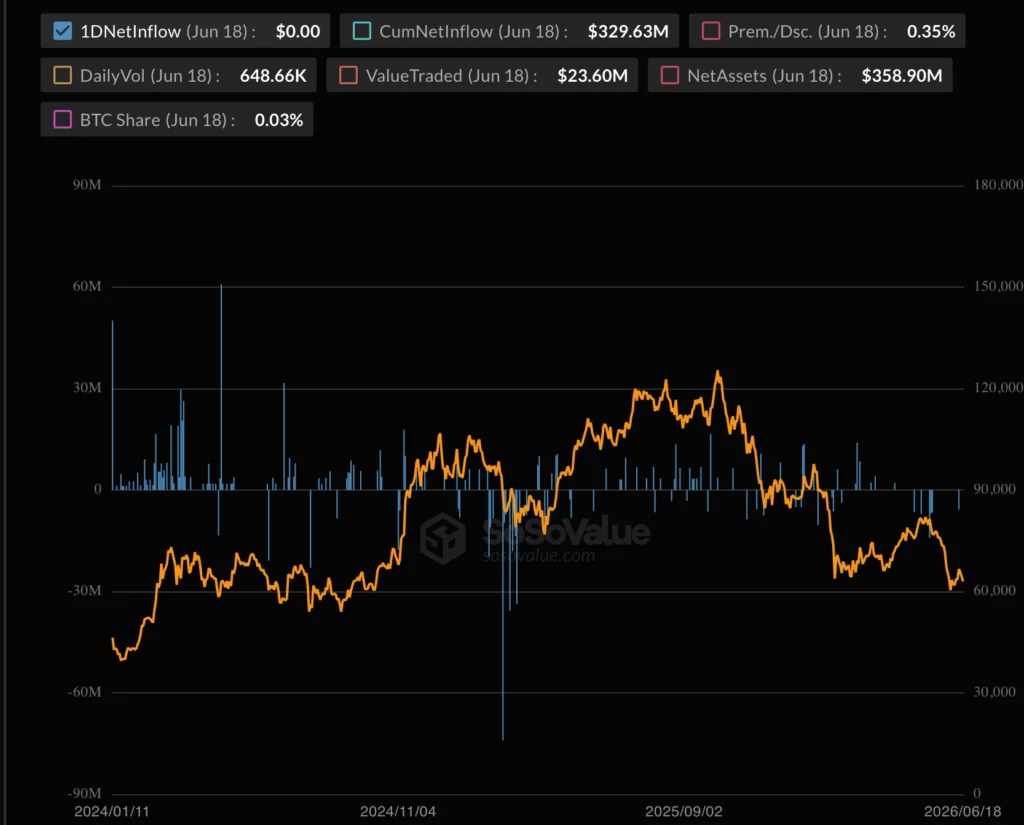
Source: SoSoValue.
The filing follows several digital asset initiatives announced by the firm in recent months. On June 15, Franklin Templeton said it would work with Ondo Finance to offer tokenized versions of its ETFs that can trade directly from crypto wallets on a 24/7 basis. The products target investors outside the United States and include exposure to U.S. equities, fixed income assets, and gold.
Earlier in June, Franklin Templeton integrated its BENJI tokenized money market fund into MoonPay Trade. The partnership allows institutional clients to exchange stablecoins such as USDC and USDT for BENJI through MoonPay’s on-chain trading infrastructure.
In May, Franklin Templeton announced a separate partnership with Payward, the parent company of crypto exchange Kraken. The companies said BENJI would be available on Kraken’s platform as a collateral and cash management product for institutional users. They also disclosed plans to develop additional tokenized investment products through Payward’s xStocks infrastructure.
Crypto World
Crypto News, June 19: Bitcoin at Risk as Strategy STRC Cracks its Peg, Microsoft Warns Windows Crypto Users, Iran Suspends Peace Talks

Bitcoin is not having a good time as Strategy STRC peg finally snapped, Iran peace talks stalled before they even started, and Microsoft just told every Windows user touching crypto to wake up.
Strategy chairman, Saylor, dropped a tweet this morning that felt way too calm for him. There is fire, no shill energy in his tweet, it’s worrying to some degree. At the same time, an old video of him saying he built parts of the Bitcoin Strategy mechanism with ChatGPT is getting another round of attention.
In reality, the STRC peg has been broken since May, and it’s getting ugly because of the Bitcoin current chart. STRC was aggressively buying Bitcoin when it was above par, but now it’s below $100, and the buying pressure is somehow gone. If STRC stops acting like an accumulator, Bitcoin could lose one of its more aggressive buyers. Some analysts even think that we could see forced selling next.
It could be just temporary, and the peg may be back when Bitcoin starts going back up again. But either way, Saylor with his STRC Strategy and Bitcoin is not in a good position. Critics say this is the same movie as the dot-com days. We can feel that STRC fud isn’t going away anytime soon, not before Bitcoin goes up.

Discover: The Best Crypto to Diversify Your Portfolio
Iran Peace Talks Postponed Just 24 Hours After Memorandum Signed: Bitcoin, STRC, and Saylor Are in Danger
Switzerland said today that Friday’s US-Iran meeting will be postponed. Iran reportedly suspended the whole 60-day process less than a day after the initial deal, blaming strikes on Lebanon. JD Vance’s trip has also been quietly canceled. Iran peace deal looks dead in the water right now.
Simultaneously, the Pentagon is now asking for $80 billion to cover Iran war costs after already spending way more than the $29 billion they admitted back in May. But this is also on top of their trillion-dollar budget.
JUST IN: — Watcher.Guru (@WatcherGuru) June 19, 2026

 US Department of War requests $80,000,000,000 to cover Iran war and other costs.
More geopolitical tension means more short-term pain for risk assets and anyone running a leveraged Bitcoin-like strategy.
Discover: The Best Token Presales
Microsoft Warns Windows Users of Crypto Attack
Microsoft Threat Intelligence posted about a crypto clipper that’s been running since February. It swaps wallet addresses in your clipboard, spreads through malicious .lnk files on USB drives, and even runs Tor in the background.
How does it work? Once your computer is infected, there are some backdoors to it, and this is actually bad for Windows users. When you copy an address, the malware changes it and tricks you into transferring funds to the wrong address.
As of now, Microsoft tags it as Trojan:Win32/CryptoBandits.A. If you’re trading crypto, or even just doing stablecoin transactions on Windows, it might be the right time to take precautionary measures. Double-check every address, use a hardware wallet, and stop clicking random shortcuts. It could be an expensive lesson.
Discover: The Best Crypto to Diversify Your Portfolio
Bitcoin and Other Market Updates
Morgan Stanley updated their spot Ethereum and Solana ETF filings with a 0.14% fee, making their offer the cheapest on the table so far. At the same time, Franklin Templeton filed two new products that convert stock dividends and automatically turn them into Bitcoin up to 20% exposure, targeting a September launch.
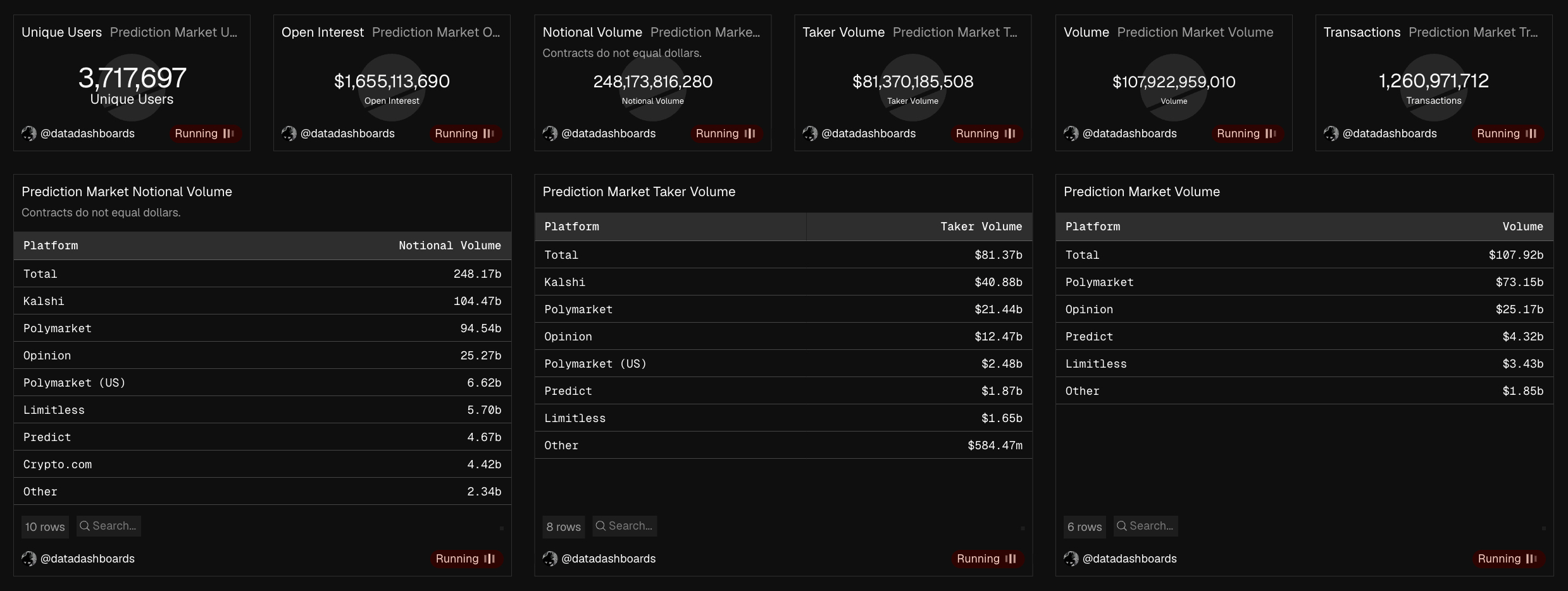
On the prediction market, Polymarket’s rival, Kalshi, is now preparing to go public at a $22 billion valuation with over $2 billion in yearly revenue. The prediction markets platform raised $1B in a Series F round in May, bringing its valuation to $22B. The round was led by Coatue, with participation from Sequoia Capital, Andreessen Horowitz, IVP, Paradigm, Morgan Stanley (MS), and ARK Invest.
For now, it’s true that Bitcoin is not helping STRC, and Iran peace looks like it’s falling apart. Microsoft warnings questions the safety of crypto, too. But the big money isn’t waiting around for perfect conditions. They’re still filing ETFs, raising capital, and building infrastructure. Bitcoin cycle survivors already know how this works.
Discover: The Best Token Presales
The post Crypto News, June 19: Bitcoin at Risk as Strategy STRC Cracks its Peg, Microsoft Warns Windows Crypto Users, Iran Suspends Peace Talks appeared first on Cryptonews.
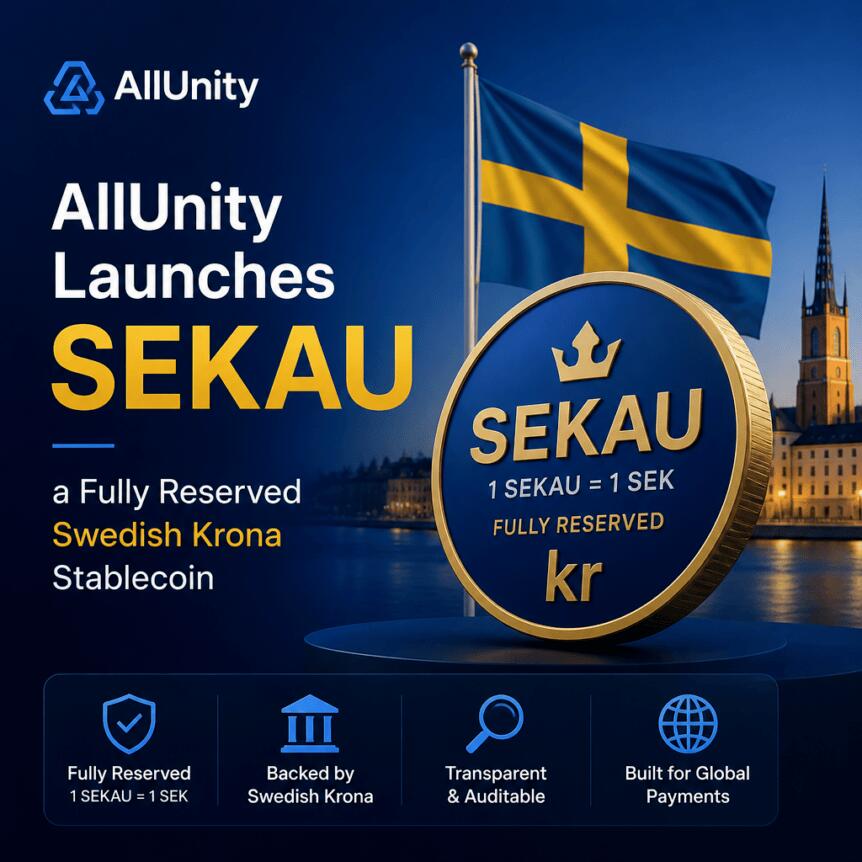
AllUnity is extending its MiCA-regulated stablecoin lineup with SEKAU, a Swedish krona-backed token designed for institutional settlement and cross-border payments. The company said the new stablecoin is issued under the EU’s Markets in Crypto-Assets Regulation (MiCA) as an e-money token, with reserves held in segregated Swedish krona accounts.
The release also highlights how issuers are adapting to MiCA’s framework by moving beyond “early-stage” token concepts and toward bank- and infrastructure-style custody and settlement. AllUnity’s SEKAU follows its earlier Swiss franc stablecoin rollout, reinforcing a multi-currency strategy built for different blockchain ecosystems.
Key takeaways
- SEKAU is a Swedish krona stablecoin issued under MiCA as an e-money token, backed 1:1 by segregated SEK reserves.
- Banking Circle will hold and manage the reserves, with Marginalen Bank supporting the rollout as a banking partner.
- SEKAU launches on five networks—Ethereum, Solana, Base, Tempo, and Polygon—with plans to add more chains later in 2026.
- AllUnity frames SEKAU as the first fully reserved Swedish krona-denominated MiCA-aligned stablecoin, contrasting it with non-public tokenized experiments.
MiCA compliance becomes the product, not just the legal wrapper
In a statement shared with Cointelegraph, AllUnity described SEKAU as the first fully reserved Swedish krona stablecoin aligned with MiCA, issued as a regulated e-money token (“EMT”). The token’s backing is described as 1:1 by Swedish krona reserves held in segregated accounts, an approach intended to distinguish it from fiat-referenced crypto concepts that may not be designed for regulated redemption and governance.
AllUnity also emphasized that “SEK exposure has previously existed mainly through early-stage concepts,” which it said were not confirmed as MiCA-authorized, fully regulated EMTs. That distinction matters for market participants who care less about token branding and more about how fiat reserves are managed, what oversight applies, and whether the stablecoin is designed to operate as regulated private money under EU rules.
Who will hold the reserves and connect the infrastructure
SEKAU’s structure leans heavily on regulated financial infrastructure and integration partners. Banking Circle, a Luxembourg-based business-to-business bank and financial infrastructure firm, will hold and manage the reserves backing the token. Swedish Marginalen Bank is listed as a banking partner supporting the rollout.
For broader ecosystem access, Trust Anchor Group is named as the infrastructure integration provider for SEKAU. Together, these relationships suggest AllUnity is treating stablecoin deployment as a coordinated effort across custody, banking relationships, and technical connectivity—rather than a standalone token launch.
A multi-chain rollout aimed at liquidity across ecosystems
SEKAU is launching on five blockchain networks: Ethereum, Solana, Base, Tempo, and Polygon. AllUnity said the multi-chain approach is intended to improve access, interoperability, and liquidity across major ecosystems.
The company also signaled it does not intend to stop at the initial set of networks, stating it plans to expand SEKAU to additional blockchain networks later in 2026. The contrast with AllUnity’s previous stablecoin deployment is notable: its Swiss franc stablecoin CHFAU initially launched exclusively on Ethereum in February before expanding to Tempo, implying a more staggered chain rollout for the earlier product.
AllUnity also operates EURAU, a euro-backed stablecoin launched in 2025. According to CoinGecko data cited by Cointelegraph, EURAU has reached a market capitalization of $1.4 million and ranks as the 16th largest euro stablecoin among 23 tracked tokens. CoinGecko also shows the euro stablecoin market totals about $883 million in combined value at the time of writing.
SEK stablecoins in Sweden: public tokens vs closed pilots
AllUnity’s messaging around SEKAU also speaks to the broader question of whether Sweden has stablecoin activity beyond regulated, publicly redeemable products. The company pointed to Sweden’s e-krona project run by the Riksbank as a relevant initiative for tokenized payments infrastructure—but stressed it is fundamentally different from a stablecoin.
AllUnity noted that Swedish banking and fintech pilots have explored tokenized deposit money and settlement systems. However, the company characterized these as “closed, experimental infrastructures” rather than publicly redeemable stablecoins.
The company further referenced communication from the Riksbank earlier in 2026 indicating there were no stablecoins in Swedish kronor. While that does not preclude tokenized pilots or related experiments, it frames SEKAU as a distinct category: a regulated, publicly available krona token built under MiCA’s e-money rules.
What investors and users should watch next
With SEKAU now live across multiple chains, the immediate question is how liquidity and usage develop across Ethereum, Solana, Base, Tempo, and Polygon—especially as AllUnity plans additional network expansion later in 2026. Market participants will also want to monitor how reserve management and EMT compliance are handled in practice over time, and whether the SEK stablecoin narrative gains traction alongside other MiCA-regulated fiat tokens.


Representative Bryan Steil introduced the Stop Lawmakers from Predicting Act on June 18. The bill bars members of Congress, their spouses, and dependent children from wagering on government policy and political outcomes through prediction markets.
The Wisconsin Republican chairs the House Administration Committee. His bill responds to mounting concerns surrounding reported insider trading on these platforms.
Steil Seeks to Bar Lawmakers From Betting on US Policy Outcomes
The legislation builds on the Stop Insider Trading Act, which the committee advanced on January 14. Steil framed the new measure as a way to rebuild confidence in elected officials.
“The American people deserve to know their Member of Congress is not profiting off insider information,” Steil said. “Lawmakers should be writing policy, not wagering on its outcome.”
Follow us on X to get the latest news as it happens
The bill bans members, spouses, and dependent children from betting on specific government policies, actions, or political results. Violators must pay $2,000 or 10% of the transaction value, whichever is greater. They also forfeit any net gain.
In addition, the bill proposes that members cannot use their official allowances, Senate expense accounts, or political donations to pay the fine. Those who resign or retire without paying can be referred to the Department of Justice for civil enforcement.
The proposal joins a wider push. In March, Senators Todd Young, Elissa Slotkin, John Curtis, and Adam Schiff introduced the Public Integrity in Financial Prediction Markets Act, targeting nonpublic information trades across any platform. A House companion, the PREDICT Act, extends similar limits to officials’ families.
Whether the measure advances may hinge on bipartisan appetite, given parallel Senate and House efforts already in motion. Meanwhile, prediction market platforms have responded too.
In June, Kalshi rolled out risk scoring, employment checks, and whistleblower channels to deter insiders from acting on privileged information. Polymarket brought in Chainalysis to build an on-chain surveillance system.
Subscribe to our YouTube channel to watch leaders and journalists provide expert insights
The post US Lawmakers May Be Banned From Betting on Kalshi and Polymarket appeared first on BeInCrypto.

AO World chief blames Labour as record profits mask shift of 200 jobs to South Africa

Wall Street Analysts Picks Nvidia Over Micron: Here’s Why

Politics Home | Burnham Vows To “End Trickle Down Economics” In By-Election Victory Speech


-

 Business5 days ago
No Jackpot Winner as $257 Million Prize Rolls Over to $269 Million Monday Draw
-

 Fashion7 days ago
Weekend Open Thread: Tuckernuck – Corporette.com
-
 Crypto World4 days ago
Zimbabwe Requires Crypto Businesses to Register Annually Under New FIU Regulations
-

 Crypto World6 days ago
Bitget enters Argentina’s regulated crypto market through PSAV registration
-

 Tech6 days ago
NanoClaw integrates JFrog registries to secure AI agent downloads
-

 Tech7 days ago
This Week In Security: Microsoft On Microsoft, Register Your Domains, Linux On ARM, And FreeBSD Joins The File Cache Club
-

 NewsBeat7 days ago
FBI searches office of Ohio voter registration group
-
 Entertainment5 days ago
Matt Damon’s Viral Sci-Fi Thriller Has Taken Over HBO Max
-

 Business5 days ago
Anthropic staff to meet White House officials next week, Axios reports
-

 Tech5 days ago
As AI companies race to go public, who else is along for the ride?
-
 Crypto World5 days ago
Bitcoin could crash to $48,000, if this historical pattern is triggered
-

 Politics5 days ago
“Israel’s” ban on ICRC visits ruled illegal, but Knesset moves to stop them permanently
-
 NewsBeat5 days ago
Warning of disruption as Cardiff Crossrail works to start
-

 News Videos5 days ago
Financial Accounting | Last Day Revision Strategy and Booster | CMA Inter – June 2026
-
 NewsBeat5 days ago
Tributes to former deputy head teacher at Cambridge school among death and funeral notices
-

 Entertainment5 days ago
Deion Sanders Shares Powerful Post After Viral Advice To Deiondra
-
 Crypto World5 days ago
Market Preview: SpaceX (SPCX) IPO Record, Federal Reserve Meeting, and Iran Nuclear Agreement
-
 NewsBeat5 days ago
what doctors are seeing in ebike crashes
-

 Crypto World5 days ago
XRP ETFs Outperform As Bitcoin And Ethereum Funds Extend Outflow Trend
-
 Entertainment5 days ago
Kate Middleton Glare Goes Viral After Kids Booed At Royal Event
You must be logged in to post a comment Login