
Crypto World
AllUnity Launches SEKAU, a Fully Reserved Swedish Krona Stablecoin

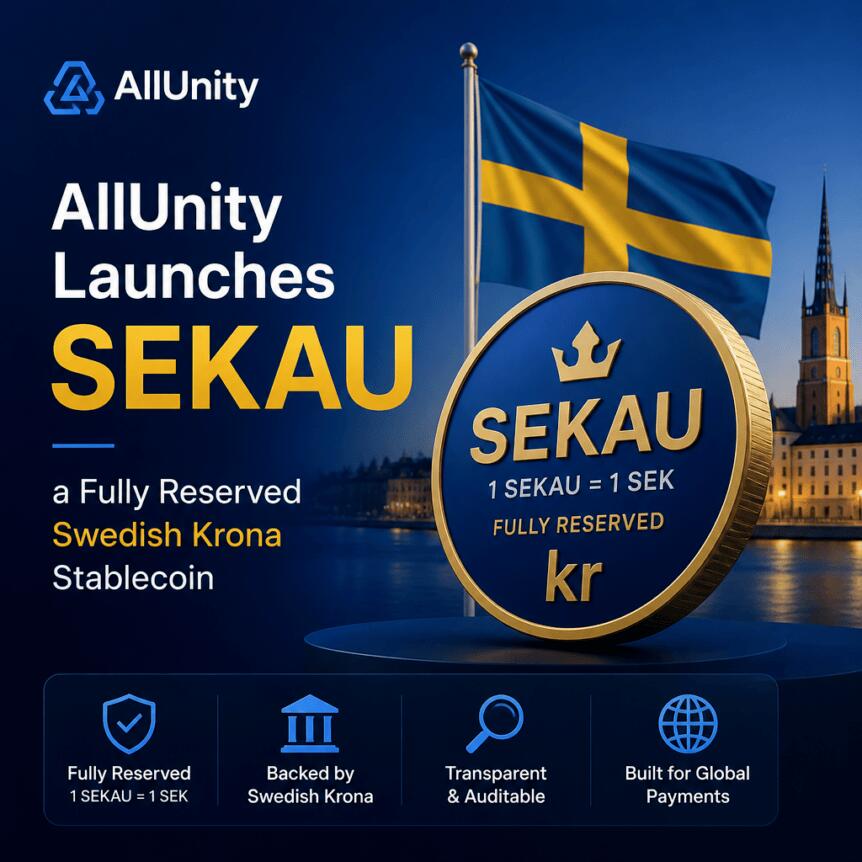
AllUnity is extending its MiCA-regulated stablecoin lineup with SEKAU, a Swedish krona-backed token designed for institutional settlement and cross-border payments. The company said the new stablecoin is issued under the EU’s Markets in Crypto-Assets Regulation (MiCA) as an e-money token, with reserves held in segregated Swedish krona accounts.
The release also highlights how issuers are adapting to MiCA’s framework by moving beyond “early-stage” token concepts and toward bank- and infrastructure-style custody and settlement. AllUnity’s SEKAU follows its earlier Swiss franc stablecoin rollout, reinforcing a multi-currency strategy built for different blockchain ecosystems.
Key takeaways
- SEKAU is a Swedish krona stablecoin issued under MiCA as an e-money token, backed 1:1 by segregated SEK reserves.
- Banking Circle will hold and manage the reserves, with Marginalen Bank supporting the rollout as a banking partner.
- SEKAU launches on five networks—Ethereum, Solana, Base, Tempo, and Polygon—with plans to add more chains later in 2026.
- AllUnity frames SEKAU as the first fully reserved Swedish krona-denominated MiCA-aligned stablecoin, contrasting it with non-public tokenized experiments.
MiCA compliance becomes the product, not just the legal wrapper
In a statement shared with Cointelegraph, AllUnity described SEKAU as the first fully reserved Swedish krona stablecoin aligned with MiCA, issued as a regulated e-money token (“EMT”). The token’s backing is described as 1:1 by Swedish krona reserves held in segregated accounts, an approach intended to distinguish it from fiat-referenced crypto concepts that may not be designed for regulated redemption and governance.
AllUnity also emphasized that “SEK exposure has previously existed mainly through early-stage concepts,” which it said were not confirmed as MiCA-authorized, fully regulated EMTs. That distinction matters for market participants who care less about token branding and more about how fiat reserves are managed, what oversight applies, and whether the stablecoin is designed to operate as regulated private money under EU rules.
Who will hold the reserves and connect the infrastructure
SEKAU’s structure leans heavily on regulated financial infrastructure and integration partners. Banking Circle, a Luxembourg-based business-to-business bank and financial infrastructure firm, will hold and manage the reserves backing the token. Swedish Marginalen Bank is listed as a banking partner supporting the rollout.
For broader ecosystem access, Trust Anchor Group is named as the infrastructure integration provider for SEKAU. Together, these relationships suggest AllUnity is treating stablecoin deployment as a coordinated effort across custody, banking relationships, and technical connectivity—rather than a standalone token launch.
A multi-chain rollout aimed at liquidity across ecosystems
SEKAU is launching on five blockchain networks: Ethereum, Solana, Base, Tempo, and Polygon. AllUnity said the multi-chain approach is intended to improve access, interoperability, and liquidity across major ecosystems.
The company also signaled it does not intend to stop at the initial set of networks, stating it plans to expand SEKAU to additional blockchain networks later in 2026. The contrast with AllUnity’s previous stablecoin deployment is notable: its Swiss franc stablecoin CHFAU initially launched exclusively on Ethereum in February before expanding to Tempo, implying a more staggered chain rollout for the earlier product.
AllUnity also operates EURAU, a euro-backed stablecoin launched in 2025. According to CoinGecko data cited by Cointelegraph, EURAU has reached a market capitalization of $1.4 million and ranks as the 16th largest euro stablecoin among 23 tracked tokens. CoinGecko also shows the euro stablecoin market totals about $883 million in combined value at the time of writing.
SEK stablecoins in Sweden: public tokens vs closed pilots
AllUnity’s messaging around SEKAU also speaks to the broader question of whether Sweden has stablecoin activity beyond regulated, publicly redeemable products. The company pointed to Sweden’s e-krona project run by the Riksbank as a relevant initiative for tokenized payments infrastructure—but stressed it is fundamentally different from a stablecoin.
AllUnity noted that Swedish banking and fintech pilots have explored tokenized deposit money and settlement systems. However, the company characterized these as “closed, experimental infrastructures” rather than publicly redeemable stablecoins.
The company further referenced communication from the Riksbank earlier in 2026 indicating there were no stablecoins in Swedish kronor. While that does not preclude tokenized pilots or related experiments, it frames SEKAU as a distinct category: a regulated, publicly available krona token built under MiCA’s e-money rules.
What investors and users should watch next
With SEKAU now live across multiple chains, the immediate question is how liquidity and usage develop across Ethereum, Solana, Base, Tempo, and Polygon—especially as AllUnity plans additional network expansion later in 2026. Market participants will also want to monitor how reserve management and EMT compliance are handled in practice over time, and whether the SEK stablecoin narrative gains traction alongside other MiCA-regulated fiat tokens.



That didn’t happen, and probably catalyzed the closure of those bets during Friday’s 08:00 UTC expiry, which settled BTC and ether (ETH) options worth $10 billion. Notional open interest on the $70,000 call has fallen to $943 million, and on the $72,000 call to $888 million. While still significant, those levels are well below the $60,000 put.
Another interesting data point comes from seasonality. Since 2013, July has produced a median return of 8.61%. The price has risen by 8.9% this month, according to CoinDesk data. So far, so unexciting. But a positive July is usually followed by a negative August, producing a median return of -7.51%.
Median is useful here because it shows the typical outcome without being skewed by unusually large gains or losses that can distort the average. In markets like bitcoin, where a few extreme months can pull the mean up or down, the median often gives a cleaner read on what has happened most often.
That means the mood is bearish for BTC as we head into August. Stay alert!
Read more: For analysis of today’s activity in altcoins and derivatives, see Crypto Markets Today . For a comprehensive list of events this week, see CoinDesk’s “Crypto Week Ahead.”
New York has sued prediction market platform Kalshi, alleging it operates an illegal, unlicensed gambling business by offering event contracts on sports, elections and other outcomes.
The lawsuit seeks to stop Kalshi’s alleged illegal gambling operation in the state, require the company to forfeit illegal gains, pay restitution to users and pay civil penalties equal to three times those gains.
“No matter what they call themselves, prediction markets like Kalshi are gambling platforms, plain and simple,” Attorney General Letitia James said in Friday’s statement. “We are taking them to court to uphold our laws and protect New Yorkers.”
The lawsuit comes after the New York State Gaming Commission issued Kalshi a cease-and-desist order in October 2025, prompting the company to sue the regulator in federal court.
A judge denied Kalshi’s request for a preliminary injunction in July, and an appeals court later rejected its bid to block enforcement while the appeal proceeds.
Kalshi did not immediately respond to Cointelegraph’s request for comment.
CFTC defends federal oversight of prediction markets
The lawsuit adds to an escalating jurisdictional dispute over whether event contracts offered by federally regulated prediction markets are subject to state gambling laws.
Just before New York filed its case, the Commodity Futures Trading Commission (CFTC) filed an emergency motion seeking to block New York’s enforcement efforts, arguing that the state’s actions interfere with the agency’s exclusive authority under the Commodity Exchange Act to regulate designated contract markets like Kalshi.
Related: CFTC issues second warning to prediction markets on cookie-cutter self-certifications
The CFTC has taken similar positions in disputes involving at least nine states, arguing that allowing states to prohibit event contracts listed by federally regulated exchanges would create conflicting state rules and undermine federal commodities regulation.
Prediction markets continue to gain mainstream traction
Prediction markets allow users to buy and sell contracts tied to the outcome of future events, with prices reflecting the market’s estimate of the probability that an event will occur.
Kalshi’s rival, Polymarket, has also faced regulatory scrutiny, with several countries restricting or investigating its operations over gambling and licensing concerns.
Kalshi began expanding into blockchain-based infrastructure in December 2025, launching tokenized prediction markets on Solana and later adding support for multiple blockchain networks.
The broader prediction market sector has also grown alongside major sporting events.
According to analytics firm Chainalysis, blockchain-based prediction markets processed about $20 billion in trading tied to the 2026 FIFA World Cup, with more than 400,000 wallets participating.
Magazine: The 100x obsession: Fundamentals grow in importance as crypto matures
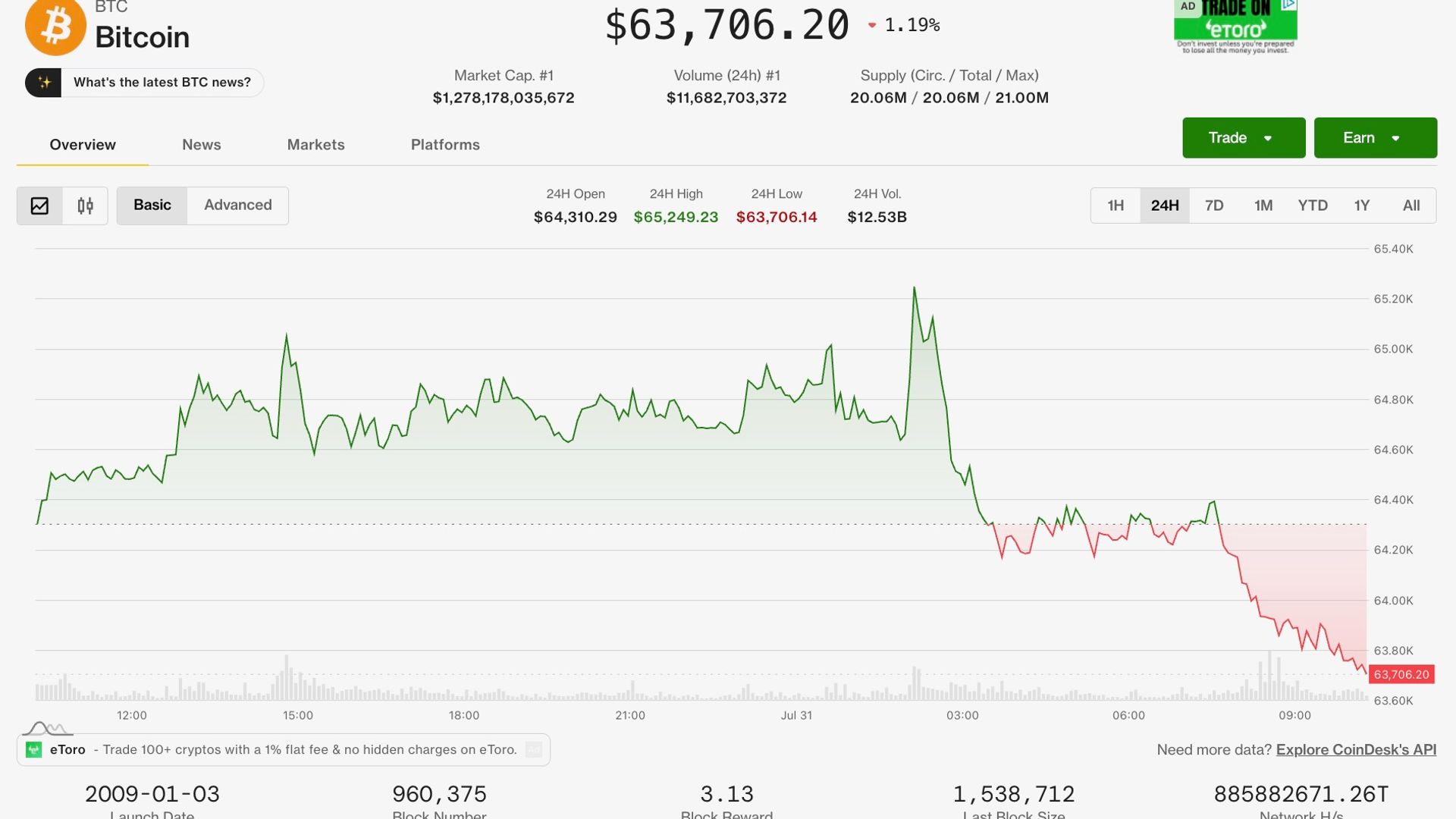
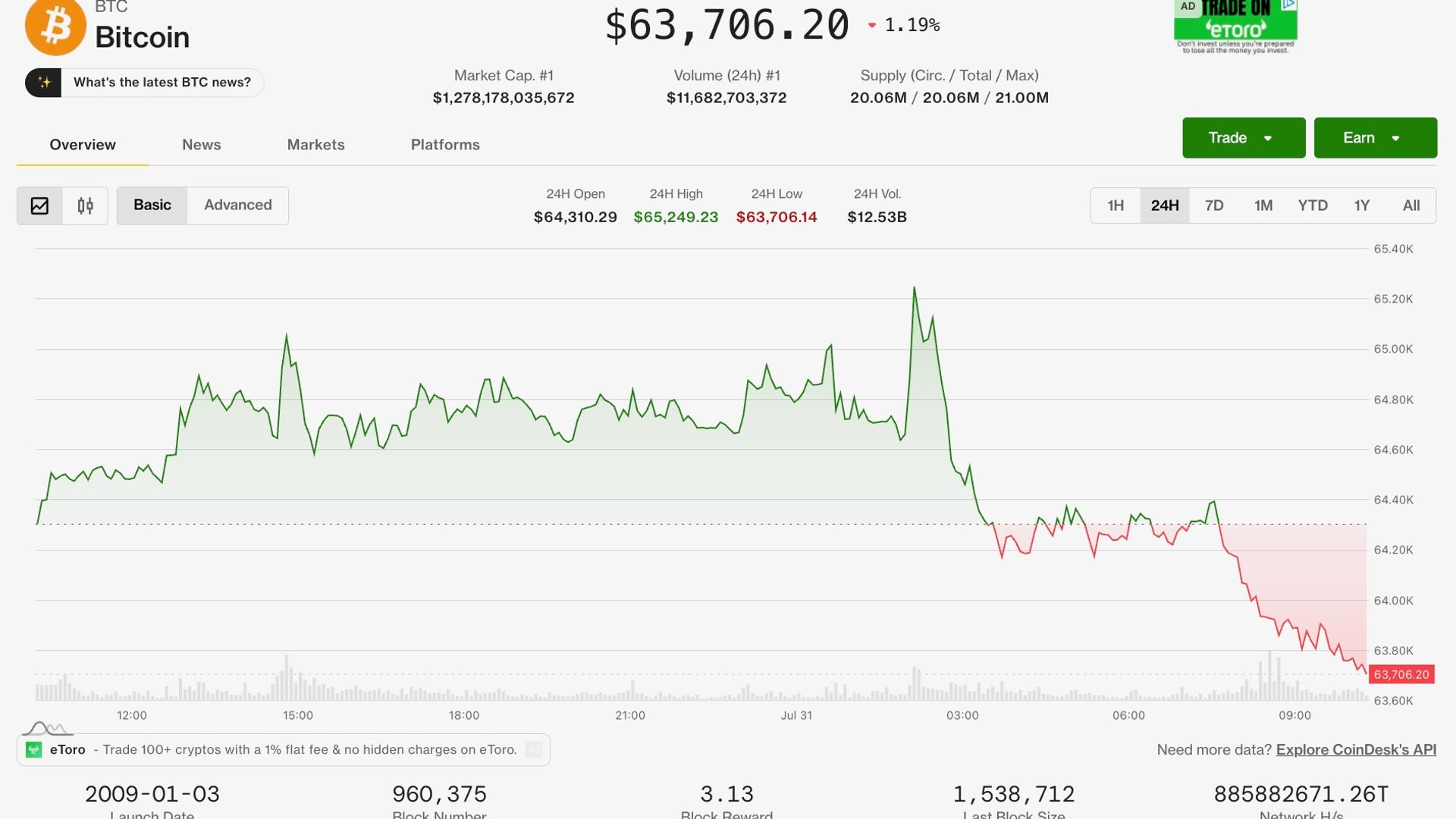
The crypto market is closing out July on the back foot, with bitcoin falling 1.31% since midnight UTC to $63,870 and ether (ETH) dropping 1.40% to $1,890 after struggling to regain the $2,000 level it touched earlier this month.
The performance is diverging from equities, with South Korea’s Kospi surging by more than 15%. Nasdaq 100 and S&P 500 index futures are also in the green.
The conflict in the Middle East and hawkish comments from the Federal Reserve committee have dented crypto’s recovery hopes this week. The CoinDesk 20 Index has dropped 2.34% since midnight Monday, though with a gain of 8.7% since June, it’s still positive for the first month in three and by the most in a year.
Derivatives positioning
- Taker long-short futures volume ratio: As the market wilts, the taker long-short futures market volume ratio continues to lean bearish, suggesting a downside bias. A taker is a market participant who executes an order immediately against an existing order in the book.
- XRP futures open interest rises: XRP’s futures open interest (OI) rose further, extending the three-week upswing to 2.27 billion tokens, the most since late June. The token’s price has declined to $1.07 from $1.13 during the period. A combination of a drop in price alongside a rise in OI is said to confirm the downtrend, a sign traders are shorting the market in anticipation of a deeper price drop.
- BTC in stasis: BTC’s OI remains static at around 750K, as it has all month. That’s a sign traders are unwilling to deploy capital in leveraged products despite signs of stability in the market. It’s no surprise that BTC’s early month bounce from under $58K has stalled in the $62K to $65K range. It’s the same story for ether and Solana.
- UNI’s OI growth: Uniswap’s UNI token is the OI growth leader for the third straight day, rising to 75.80 million UNI, a level last seen Feb. 14. This is a clear sign of investors willing to take on risk in tokens backed by positive newsflow. Recently, BlackRock decided to debut its tokenized Treasury fund on Uniswap.
- Negative cumulative volume delta: Most major tokens, including UNI, have negative 24-hour OI-adjusted cumulative volume delta, a feature consistently observed during sharp downtrends over the past year. A negative CVD means traders are shorting more at market orders than passive limit orders. In other words, bears are being more aggressive.
- Bitcoin implied volatility: Bitcoin’s BVIV, the 30-day implied volatility index, fell to 37%, the lowest since May. These levels have served as floors in recent years, bringing about a bounce in the so-called fear index. Since ETFs debuted in 2024, the BTC price correlation with the BVIV has been negative, meaning any bounce in the BVIV could be accompanied by a fresh decline in the spot price.
- Options open interest: On Deribit, bitcoin and ether options worth $10 billion expired early today. Now the distribution of open interest in remaining expiries that extend all the way to June 2027 shows a $60,000 put as the most popular bet. A put represents a bearish bet on the market.
Token talk
- Uniswap (UNI) was Friday’s standout performing altcoin, rising by 9.30% over 24 hours to $4.41 as it sustains momentum from its Robinhood layer-2 integration announced earlier this month.
- Ethena (ENA) extended its recovery, rising 1.23% since midnight UTC and 4.31% over 24 hours to $0.082, with the token now up significantly from its July lows. Keep in mind it’s still more than 90% below its all-time high.
- Lighter (LIT) fell a further 2.28% as the correction from its July peak deepened, with the token now 20% below the highs it set earlier this month after its 200% rally between May and early July.
- Zcash (ZEC) gave back 2.15% to $459 after a strong run earlier in the week, with the privacy coin sector losing ground on Friday.
- added 0.94% since midnight and 4.09% over 24 hours, quietly extending a recovery that has seen it claw back after June’s 45% plunge.

New York Governor Kathy Hochul and Attorney General Leticia James have filed a lawsuit against one of the most popular prediction market platforms, Kalshi.
The move marks the latest escalation in the growing battle over whether event contracts fall under federal commodities law or state gambling regulations.
Lawsuit Launched
The press release from the New York office informs that James and Hochul have alleged that Kalshi is operating illegal gambling products in the state without the necessary license. Filed in Manhattan state court, the complaint seeks to stop the platform from offering its event contracts to New York residents and requests financial penalties, forfeiture of profits, and restitution for affected customers.
Event contracts, as the lawsuit describes them, allow users to trade on outcomes of sports matches, elections, economic data, and other real-world events. However, they amount to unlicensed gambling under New York law, stated the PR.
Officials also argued that Kalshi permits users between the ages of 18 and 20 to participate, despite the state requiring bettors to be at least 21 years old. The platform, though, still claims that its products are federally regulated derivatives overseen by the US CFTC, not gambling products subject to state gaming laws.
The lawsuit launched by the state of New York comes just weeks after a federal judge denied Kalshi’s request to block officials from enforcing its gambling laws while the broader case proceeds.
The Bigger Fight
The explosive growth of the two major prediction market platforms, Kalshi and Polymarket, has quickly caught the attention of regulators, and this is the latest chapter in an increasingly complex jurisdictional dispute over their capabilities.
The CFTC has repeatedly defended its authority over federally registered prediction markets, but New York officials argue that event contracts resemble traditional betting. The regulator even sued New York, claiming that federal law preempts state attempts to oversee these products.
New York also sued prediction market businesses operated by Coinbase and Gemini recently, arguing that they offered the same illegal gambling services without proper authorization.
Meanwhile, Kalshi and Polymarket continue to face severe backlash outside the US as well, including some bans in jurisdictions like Argentina, Spain, Brazil, and Indonesia.
The post New York Sues Kalshi as Legal Pressure on Prediction Markets Intensifies appeared first on CryptoPotato.

Tom and Max fight. Anna drives a kitchen knife into Max’s back. He staggers outside, and Tom knocks him into the pool, which glows an unnatural aquamarine beneath the storm. “It’s a kill-or-be-killed sort of moment,” Adams says.
In the churning pool, Max grapples with Tom, who locks him in a stranglehold. Anna leaps in, and together they hold him under until his limbs finally go limp.
Moving the climax from the open waters of the Cape Fear River to the family’s backyard pool marks a decisive break from previous film adaptations. “We felt for this version of the story that it should end in their home,” Antosca explains. “Bring the storm to them.”
The scene also pays off a detail from Episode 7, when Max told Natalie he’d been baptized in the Cape Fear River as a boy but never learned to swim. “[The pool] is also the place where he’s more vulnerable,” Bardem says.
The pool fight took days to shoot, with rain pouring down and cameras rolling underwater. Staging a brawl in water demands precision from everyone in it. “You’ve got to be so in tune with your dance partner,” Wilson says. It was also a release after months of playing Tom measured. “We all had been so measured for so long … it was nice to let it rip,” he says. For all the scale, the sequence plays as a test the Bowdens narrowly pass. “There’s a killer inside of everybody,” Wilson says, but killing Max at that point would be vengeance, not self-defense. “Tom, at his core, is not someone that would kill out of revenge.”
Crypto World
Zoomex Launches “August Summer Airdrop”: New Users Can Unlock Up to $1,500 in Combined Rewards and Exclusive Benefits


Global cryptocurrency trading platform Zoomex today announced the official launch of its global onboarding initiative, the “August Summer Airdrop.” Running from July 31 to August 31, the campaign is designed to streamline the onboarding journey for new crypto traders through simplified participation steps and transparent reward structures, offering eligible new users a comprehensive reward package worth up to $1,500.
As a platform dedicated to optimizing the contract trading experience, Zoomex has structured this summer campaign to lower entry friction, dividing the initiative into three clear modules:
- Zero-Barrier Trading Experience: During the campaign period, new users can claim a $100 BTC position voucher simply by registering and completing an initial deposit of $\ge 1$ USDT. This allows them to experience live-market contract trading without risking personal capital.
- Clear Tiered Incentives: To assist users as they navigate the platform, the campaign establishes a transparent growth path. By completing tasks such as an initial deposit, KYC verification, and futures trading, users can progressively unlock corresponding cash bonuses and trading support, accumulating up to $1,500 in total rewards.
- Exclusive New-User Earn Specials: The campaign introduces a dedicated Earn channel for new registrants, featuring yield options with APYs reaching up to 666%, providing traders with flexible asset growth choices.
The design of the “August Summer Airdrop” aligns directly with Zoomex’s Q3 brand commitment: “Easy to Use. Transparent balance. Fair access to your earnings.” By featuring clear rules and transparent execution, Zoomex empowers traders at all skill levels to engage in a clear, controllable environment with tangible benefits.
Zoomex Marketing Director stated:
“Through the ‘August Summer Airdrop,’ we aim to offer global traders a sincere and user-friendly entry point into crypto trading. From the $100 BTC position voucher to our clear, condition-free tiered rewards, we are dedicated to eliminating complexity in the crypto derivatives space. At Zoomex, we firmly believe that transparent rules and clear product experiences form the cornerstone of long-term user trust.”
The event is now live on the Zoomex website and official mobile app. Users can view complete terms and join the campaign here.
About Zoomex
Founded in 2021, Zoomex is a global cryptocurrency trading platform focused on the contract trading experience, serving over 3 million users across 35+ countries and regions. Tailored for traders who value speed, clarity, and control, Zoomex delivers a high-performance trading experience with clear asset and order displays, transparent fees and rules, and a continuously evolving trust framework—including Hacken security audits, Proof of Reserves (PoR), and compliance information—to provide users with a clearer and more efficient trading environment.
Beyond trading, Zoomex creates a premium brand experience through partnerships with the Haas F1 Team, World Cup-winning goalkeeper Emiliano Martínez, and initiatives in tennis. Zoomex extends the values of elite sports—speed, precision, discipline, fair play, and rule execution—into its contract trading product, ensuring brand expression remains fully consistent with user experience.
At Zoomex: Easy to Use. Transparent balance. Fair access to your earnings.
The post Zoomex Launches “August Summer Airdrop”: New Users Can Unlock Up to $1,500 in Combined Rewards and Exclusive Benefits appeared first on BeInCrypto.


James’ office described Kalshi’s event contracts as bets and said the platform takes wagers on professional and college sports, elections and culture. The lawsuit alleges Kalshi allows users aged 18 to 20 to wager and lists markets involving New York college teams, both prohibited for licensed sportsbooks in the state.
“New York’s gambling laws protect children from underage betting and help combat gambling addiction,” James said in the statement. “No matter what they call themselves, prediction markets like Kalshi are gambling platforms, plain and simple.”
The World Cup helped boost Kalshi’s numbers, adding 3 million during the course of the tournament, according to CNBC. That’s more than double the 2 million the firm said it had at the start of May.
According to the attorney general’s statement, the lawsuit follows an October cease-and-desist order from the New York State Gaming Commission.
A federal judge denied Kalshi’s bid to block state regulators on July 7 and rejected an injunction pending appeal on July 27.
CoinDesk approached Kalshi for comment outside of regular U.S. office hours, and had not heard back by publication time.


- Bybit’s new simulator previews both Dual Asset settlement outcomes clearly.
- Redesigned interface reduces steps needed to compare terms and place orders.
- VIP-tier products with enhanced APR rates open to all users every Friday.
Bybit said on Friday that it had upgraded its Dual Asset product with a new investment simulator, a simplified interface and broader access to products carrying VIP-tier annual percentage rates.
The Dubai-based company, which describes itself as the world’s second-largest cryptocurrency exchange by trading volume, said the changes are intended to make the short-term structured investment product easier to understand and use.
Bybit Dual Asset is a non-principal-protected product that allows users to set a target price for buying or selling cryptocurrency.
Investors earn APR rewards on their principal at settlement, regardless of whether the selected target price is reached.
A simulator for settlement outcomes
The main addition is a simulator that lets users preview potential outcomes before placing an order. Traders can choose a token from a searchable list, enter their investment amount and select from the available durations.
The tool displays the two possible settlement scenarios side by side in a single illustration, giving users a clearer view of the product’s possible outcomes.
A “Match My Assets” filter also highlights coins based on a user’s existing holdings.
Bybit said this feature is designed to make product selection more efficient. Users can reach the simulator by switching on “Beginner Mode” under “Choose Product Plan”.
The company has also redesigned the wider Dual Asset interface. The updated layout reduces the number of steps needed to compare product terms and place an order.
VIP products open to all on Fridays
Bybit is also expanding access to Dual Asset products previously limited to VIP customers. Every Friday, all users will be able to access selected VIP-exclusive products with enhanced APR rates without holding a VIP membership.
The weekly access window extends the higher-rate offering to a broader section of the exchange’s user base while retaining the existing product structure.
Bybit said users can earn a competitive yield when a target trade is executed, settling at the preset price while also receiving APR rewards.
The product may also allow users to buy at a lower price or sell at a higher price than through a direct trade when the target price is reached.
When the target is not triggered, users receive their principal back together with the APR rewards accrued during the investment period.
The company noted, however, that the product remains non-principal-protected and that terms, eligibility requirements and potential restrictions apply.


The political heat around Donald Trump’s crypto holdings is translating into pressure across politically linked digital assets. The official TRUMP crypto token trades at $1.45, down 0.3% over the past 24 hours and 9.4% during the last seven days.
Sen. Elizabeth Warren cited a fresh Echelon Insights survey showing 55% of voters disapprove of Trump’s cryptocurrency earnings. Meanwhile, 44% said they strongly disapprove. Another Progressive Policy Institute and GBAO survey found 71% to 75% support banning federal officials and their families from profiting from crypto, even after respondents were reminded that Trump is a successful businessman.
Federal disclosures indicate Trump earned roughly $1.2 billion to $1.4 billion from crypto ventures over the past year. Warren argues those gains came while many Americans still struggle to cover everyday expenses. As a result, the issue has become a growing political flashpoint instead of a niche crypto debate.
What this polling momentum means for regulatory risk is the real market story. If public disapproval turns into legislative action, politically branded tokens could face added pressure. That would make political sentiment a direct pricing factor instead of simple market noise.
Discover: The Best Crypto to Diversify Your Portfolio
Can TRUMP Crypto Token Hold Key Levels as Political Headwinds Mount?
TRUMP trades at $1.45, hovering near the lower end of its $1.44 to $1.47 daily range. The $1.44 area is acting as immediate support. A decisive break below that level could send the token toward the psychological $1.40 mark. Meanwhile, light trading volume leaves room for sharp moves in either direction.
The approval data continues to weigh on sentiment. Emerson College polling puts Trump’s crypto-specific approval at 25%, while 39% disapprove. Those readings have stayed largely unchanged across multiple survey cycles. In addition, 62% of Americans distrust the Trump administration on crypto regulation. Another 89% of Democrats said they would oppose candidates supporting Trump’s crypto profits.
The bull case remains intact if regulatory gridlock keeps enforcement limited. In that scenario, TRUMP could rebound toward $1.47 and pressure short sellers. The base case points to continued trading between $1.44 and $1.47 as markets wait for a legislative catalyst.
The bear case changes if Congress advances a bill targeting presidential crypto conflicts. That could quickly push TRUMP toward $1.35 as political risk increases.
Trade Memecoins on Bybit and Get a Chance to Win Our $1,000 USDT Airdrop
Maxi Doge Targets Early Mover Upside as Trump Tests Key Levels
Trump grinding sideways with no clear breakout catalyst is, frankly, the argument for looking earlier on the risk curve. Established meme tokens at this market cap require macro tailwinds and viral momentum simultaneously — a rare combo. Early-stage presales offer asymmetric entry before either ingredient is needed.
Maxi Doge ($MAXI) is positioning itself as the trading community’s meme token, built around a 240-lb canine juggernaut persona and a culture of 1000x leverage trading energy. The tagline is “Never skip leg-day, never skip a pump,” which is either peak meme or quietly brilliant marketing.
The presale has raised $4.8 million at a current price of $0.0002831 on Ethereum. Features include holder-only trading competitions with leaderboard rewards, a Maxi Fund treasury for liquidity and partnerships, and dynamic staking APY for early participants.
The meme-first, gym-bro aesthetic is deliberate, with viral humor having driven more meme token breakouts than any whitepaper.
Traders with a meme allocation looking for early-stage exposure can research Maxi Doge here.
Discover: The Best Token Presales
The post Trump Crypto Empire Under Fire After Poll Shows Majority Disapprove appeared first on Cryptonews.
This Friday, we examine Ethereum, Ripple, Cardano, Binance Coin, and Hyperliquid in greater detail.
Ethereum (ETH)
Ethereum’s price remained flat compared to last week because sellers stopped the rally at the $2,000 resistance and pushed it into a pullback. At the time of this post, ETH was found around $1,890, and it may retest the support at $1,800 next.
Despite the recent gains from $1,500, this cryptocurrency remains in a macro downtrend with clear lower lows and lower highs. If buyers want to put a stop to this, they need to turn $2,000 into support.
Looking ahead, Ethereum may be consolidating between $2,000 and $1,800 until a clear breakout takes place. Bulls will also have to do their best to stop any price below $1,800 to avoid new lows.

Ripple (XRP)
XRP fell by 3% this week and is back just above the $1 support level. This price action has also formed a pennant. That could highlight a continuation of the prevailing trend once the asset escapes it. In this case, that’s bearish.
The volume also continues to fall and is making clear lower lows. That’s not encouraging if buyers hope to reverse the ongoing downtrend. A break below $1 would settle the matter and see XRP make new lows, with $0.80 as a key target.
Looking ahead, best to wait for the pennant to break and then reassess. Until that happens, the price will compress at the apex of this formation before it escapes.

Cardano (ADA)
ADA managed to close this week in the green, albeit with only a 2% gain. Still, the support at $0.15 has been reconfirmed, and this cryptocurrency has a good shot at moving towards $0.20. Eventually, the resistance at $0.23 must be reclaimed to turn bullish.
Because the most recent push higher has been on low volume, this shows buyers remain weary and will need to see more gains before they gather sufficient confidence to step up their presence on the orderbook.
Looking ahead, Cardano may be about to exit a very difficult period between 2025 and 2026 when the price went from $1.2 to $0.14. To do that, ADA will have to hold above $0.15 and aim for $0.23 next.

Binance Coin (BNB)
Binance Coin is up 4% this week after buyers managed to take it above the support at $580. As long as this key level holds, bulls have the upper hand, and they may be aiming for $690 next, which is the key resistance.
At the time of this post, the ongoing uptrend is still early, and sellers could at any time reverse it. Therefore, best to wait for a confirmation of this breakout to avoid a bull trap scenario.
Looking ahead, BNB could continue to consolidate between $580 and $690. If so, the drop under $580 could be interpreted as a short-term deviation in the price action.

Hyperliquid (HYPE)
Similar to last week, HYPE disappointed again with a price that closed in red and lost 7% of its valuation. More concerning, however, is the fact that this cryptocurrency appears to have lost its uptrend.
The support at $60 has now turned into a resistance and HYPE is well on its way to test the next support at $52. If both these levels are lost in quick succession that’s an extremely bearish signal that hints at a major correction.
Looking ahead, it is becoming clearer that Hyperliquid’s best days may be behind it after the price topped around $76. Since then, it’s been down only. Should $52 not stop sellers, then the next key support will be found at $45.

The post Crypto Price Analysis July-31: ETH, XRP, ADA, BNB, and HYPE appeared first on CryptoPotato.

Group’s mission to appreciate every piece of food in South West

Bitcoin $60,000 put leads the pack as mood swings bearish for August: Crypto Daily

Politics Home | MPs And Peers Urge Burnham To Launch National Commission On Lords Reform


-

 Fashion7 days ago
Weekend Open Thread: Brooks Brothers
-
 Sports5 days ago
Commonwealth Games boxing: Jadumani Singh seals dominant 5-0 win over Pakistan’s Sumama Rehman to enter quarter-finals | Commonwealth Games News
-

 Business2 days ago
Why Trees Belong on the Risk Register
-

 Tech4 days ago
Intel is reversing course and bringing hyper-threading back to its server chips
-

 Crypto World6 days ago
Ripple bought a bank in pieces. The $4 billion audit
-

 Politics4 days ago
Luke Littler dismantles Gerwyn Price to retain title in Blackpool
-
 Entertainment7 days ago
A New Post-Apocalyptic Gundam Anime Series Blasts Into SDCC
-

 Politics3 days ago
The Part of the Electric Transition Nobody Wants to Discuss
-

 News Videos5 days ago
BITCOIN JUST ENTERED THIS CRITICAL ZONE…
-

 Business2 days ago
Major shareholder moves on Canyon
-

 Crypto World5 days ago
XRP Ledger adds $2.6B as RWA inflows rank second
-

 News Videos24 hours ago
Bitcoin Enters the 3rd Stage of the Bear Market
-

 Politics5 days ago
Spain sweeps the board at 2026 World Cup with individual awards
-
 Entertainment3 days ago
‘Stargate’ Creator’s New Sci-Fi Series Returns for Season 3 Tomorrow
-

 Entertainment5 days ago
Sara Gilson Killed By Husband After Viral “Pedophile” TikTok Video
-

 Crypto World3 days ago
Kraken Enables Retail Access to Jersey Mike’s IPO via Tokenized Shares
-

 Tech6 days ago
Anthropic launches Claude Opus 5, a cheaper AI model for coding, agents and enterprise workflows
-

 News Videos3 days ago
Claude: Build Financial Dashboards in Minutes (2026)
-

 Tech3 days ago
New macOS Sequoia & Sonoma security updates for older Macs
-

 Politics19 hours ago
Luke Littler’s dominance sparks GOAT debate
You must be logged in to post a comment Login