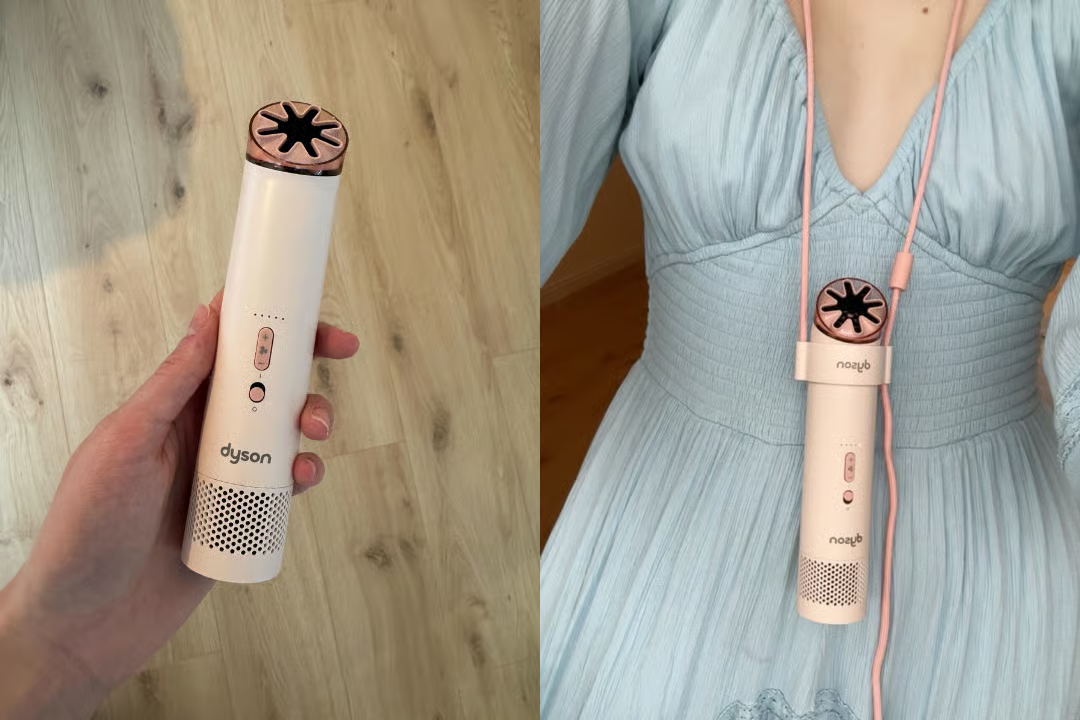
Dyson continues to focus on refining products that are compact yet powerful, like the pencilvac and the supersonic hair dryer. This fan follows suit, weighing just 212g, so you can stay cool on the move without feeling weighed down.
Don’t let the size of this fan fool you, because this thing moves fast, hitting speeds of up to 25m/s thanks to a motor that revs at 65,000rpm. You can customise the cooling output with five levels depending on how much relief you need, while an upgraded airflow system focuses the stream exactly where it’s needed, rather than just blowing it around.
Noise has been thoughtfully refined, too. Dyson’s hushjet nozzle creates a more balanced, easy on the ear sound by softening lower frequencies and removing any high-pitched whir or motor noise, so that the cooling feels just as smooth as it sounds.
Advertisement
You can charge the Dyson hushjet mini cool handheld fan the same way you would other small tech, like your phone, with a USB-C charging point that gets it back up to full power (six hours worth) in just three hours. You can choose from three classic Dyson finishes, including ink/cobalt, carnelian/sky and stone/blush. Inside each box you’ll find a charging stand, travel pouch, neck dock and USB-C cable. Plus, you can buy a universal mount to attach to a pram or other items of clothing.
The fan features a built-in rechargeable lithium-ion battery, which is generally permitted in carry-on luggage and not checked baggage, so if you’re lucky enough to be jetting off somewhere this half term (although we’re not sure you’ll need to given the forecast) then you can take your handy new tool with you.
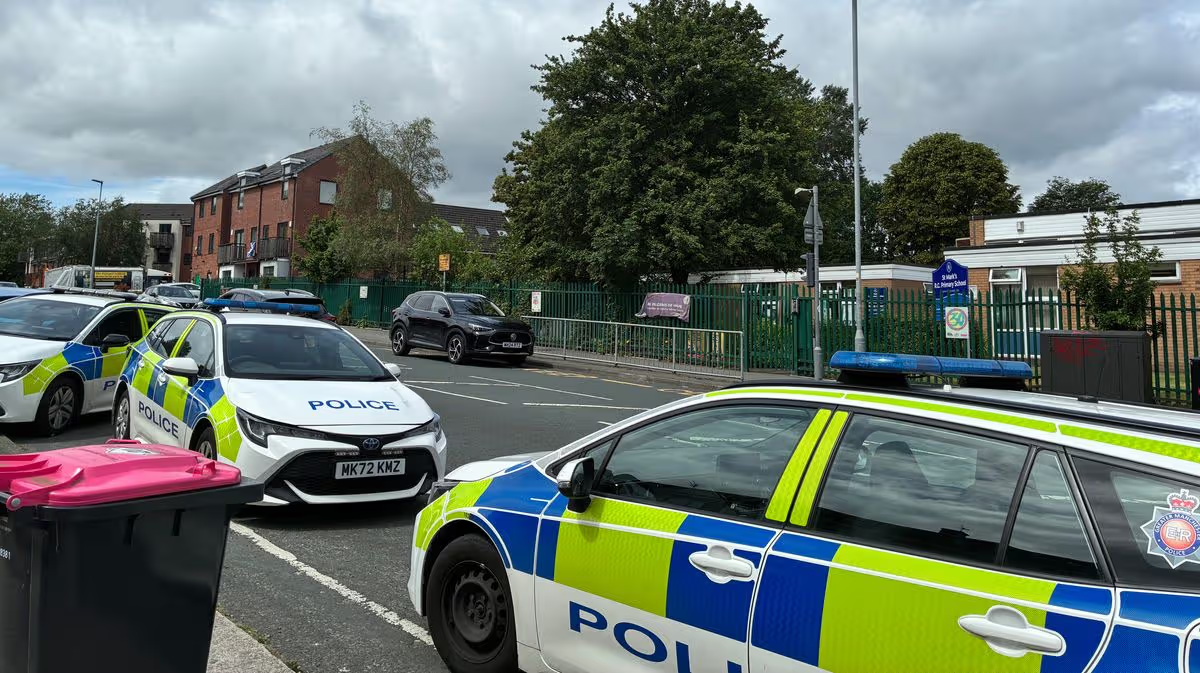
A number of police cars are stationed on Queensway, Salford, outside the school
Police outside St Marks R C Primary School in Salford(Image: MEN)
Police are responding to an incident in Salford this afternoon with a primary school reportedly ‘in lockdown’ after a man entered the grounds with a brick.
A number of police vehicles are responding to the incident on Queensway in the Clifton area. According to our reporter on the scene, children can be seen leaving St Marks R C Primary School as parents wait outside to collect them.
A Greater Manchester Police spokesperson has said a man entered the school grounds with a brick. He has been taken to hospital, police say.
Advertisement
Click here to get the biggest stories straight to your inbox in our Daily Newsletter
They said: “Emergency services were called to reports of a concern for welfare on Queensway in Swinton at around 10am this morning (Friday 19 June).
“A man – who was potentially suffering a medical episode – entered the school grounds with a brick, causing alarm to school staff and pupils and damaging a window. Officers arrived on scene quickly and gained control of the man, who was taken by ambulance staff to hospital.
“No harm was caused to any of the school staff or the pupils, and the school has made the decision to close for the day and send children home.”
Advertisement
Follow our live blog below for the latest updates on this incident.
Parents ‘really worried’ amid incident
Advertisement
Parents have been speaking to Tara outside St Marks R C Primary School.
Content cannot be displayed without consent
Primary school window damaged
Police confirmed a window at St Marks R C Primary School was left damaged.
Advertisement
The man entered the school grounds with a brick.
Man has been taken to hospital
Police said the man, who ‘was potentially suffering a medical episode’, was taken to hospital.
Advertisement
Officers ‘gained control of him’ and he was taken to hospital by ambulance staff.
CSI van arrives on the scene at St Marks R C Primary School
Forensic officers are on the scene.
Advertisement
Content cannot be displayed without consent
No children or staff were hurt in the incident
Police confirmed no children or staff were hurt in the incident.
The school has shut today and sent children home.
Advertisement
GMP statement: Man entered school grounds with a brick and damaged window
In a statement, a GMP spokesperson said:
“Emergency services were called to reports of a concern for welfare on Queensway in Swinton at around 10am this morning (Friday 19 June). A man – who was potentially suffering a medical episode – entered the school grounds with a brick, causing alarm to school staff and pupils and damaging a window. Officers arrived on scene quickly and gained control of the man, who was taken by ambulance staff to hospital. No harm was caused to any of the school staff or the pupils, and the school has made the decision to close for the day and send children home.”
Advertisement
Our reporter Tara is on the scene
Tara says there is a heavy police presence outside St Marks R C Primary School.
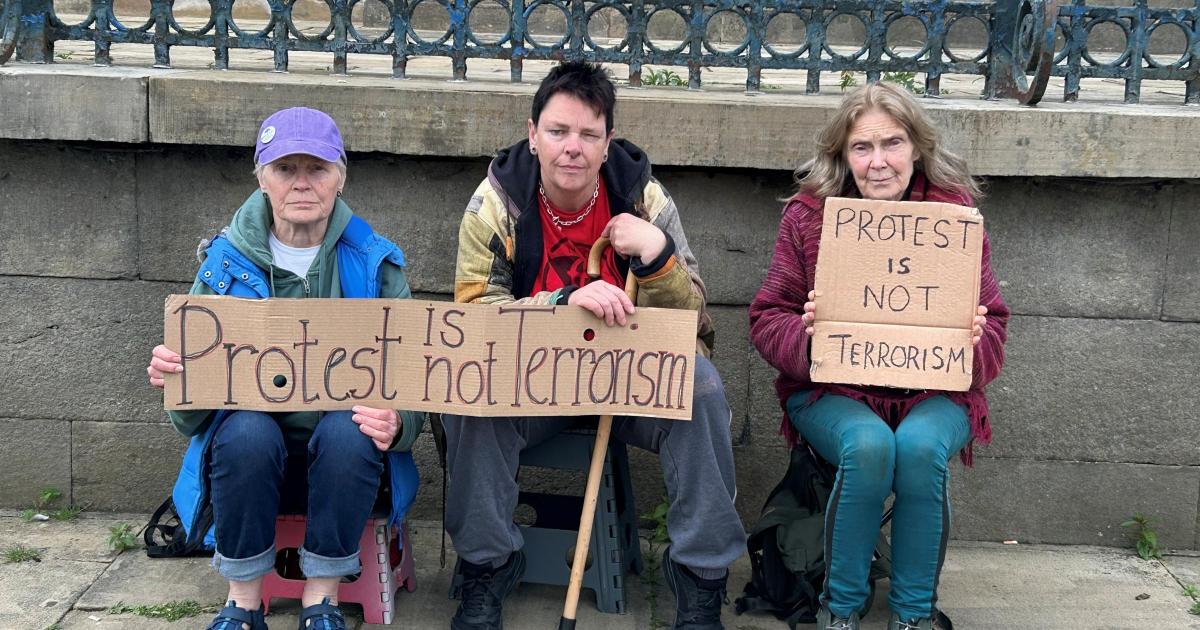
On Friday they held banners about four members of the pro-Palestine group being sentenced in London for causing criminal damage at the UK site of an Israel-based defence firm.
The York group said one of its members was among an estimated 500 supporters demonstrating at Woolwich Crown Court in London on Friday, but the others had chosen to demonstrate outside the York court because it was expensive to travel to London.
According to the prosecution against the Palestine Action four, their actions had caused £1.2m of damage, The four had denied the charges but been convicted at a retrial.
Advertisement
On Monday June 15, members of the York group were back outside the York courthouse as Court of Appeal judges prepared to decide whether the Home Secretary had been right to declare Palestine Action a terrorist organisation.
The York demonstrators held banners saying “Protest is not terrorism”, the same argument used by Palestine Action against the Home Secretary’s decision.
They vowed to continue their support of the organisation’s campaign against its proscription. A High Court judge had declared the Home Secretary’s decision unlawful, but the Court of Appeal overturned that on Monday.
Following the latest court decision, Palestine Action immediately announced it would appeal to the Supreme Court and if that ruled against it to the European Court of Human Rights. The organisation maintains that it has the right to protest.
Morocco is odds on to win against Scotland today, according to Betway, which has the North African team 4/6 for victory later on.
Morocco – 4/6
Draw – 5/2
Advertisement
Scotland – 9/2
Lewis Knowles, Betway’s spokesperson, said:”Scotland undoubtedly go into this game on a high following their victory over Haiti last weekend, but the odds are very much suggesting a tough task awaits against Morocco this evening.
WScotland were as short as 3/1 for this game only a few days ago, but it’s been one-way traffic in the market over the last 48 hours, and Scotland are now 9/2 to get the win, with the Moroccans very solid favourites at 4/6.”
Parts of England are set to swelter in a fresh heatwave this weekend, with temperatures forecast to reach 32C by the beginning of next week.
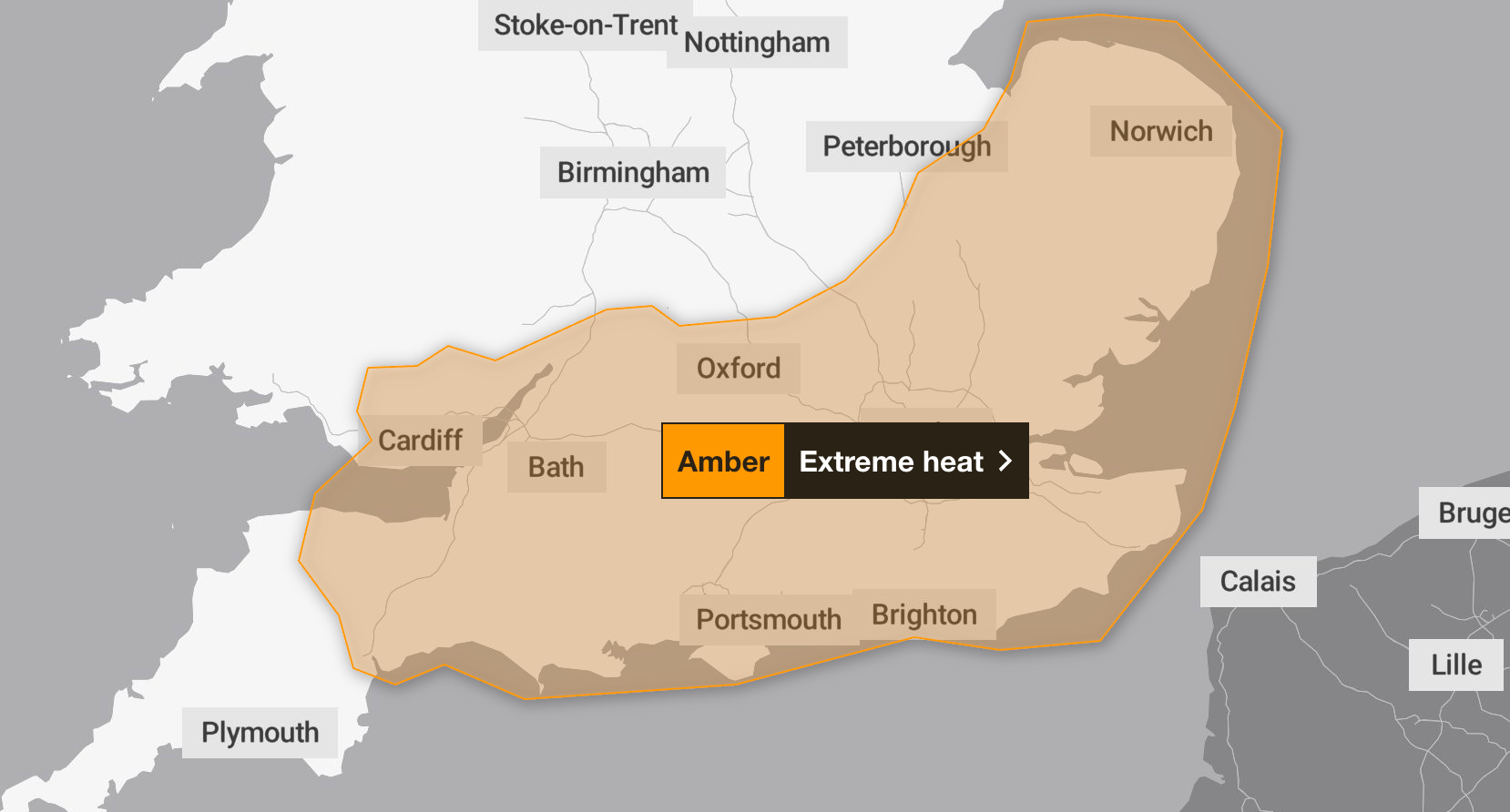
The Met Office has issued an amber weather warning for extreme heat in the East of England, London and South East England, South West England, and Wales on Monday and Tuesday.
UKHSA also issued yellow alerts for East Midlands and West Midlands, which means a greater risk to the lives of vulnerable people and higher demand for health and care services.
Advertisement
Dr Agostinho Sousa, head of extreme events and health protection at UKHSA, said: “Sustained periods of warm weather can result in serious health outcomes, especially for older adults, and it is therefore important that everyone takes sensible precautions while enjoying the sun.
“We are urging health and social care services in affected regions to ensure they are prepared, and reminding people to look out for elderly relatives, neighbours, and those with underlying health conditions, making sure they are aware of the forecast and following the necessary advice.”
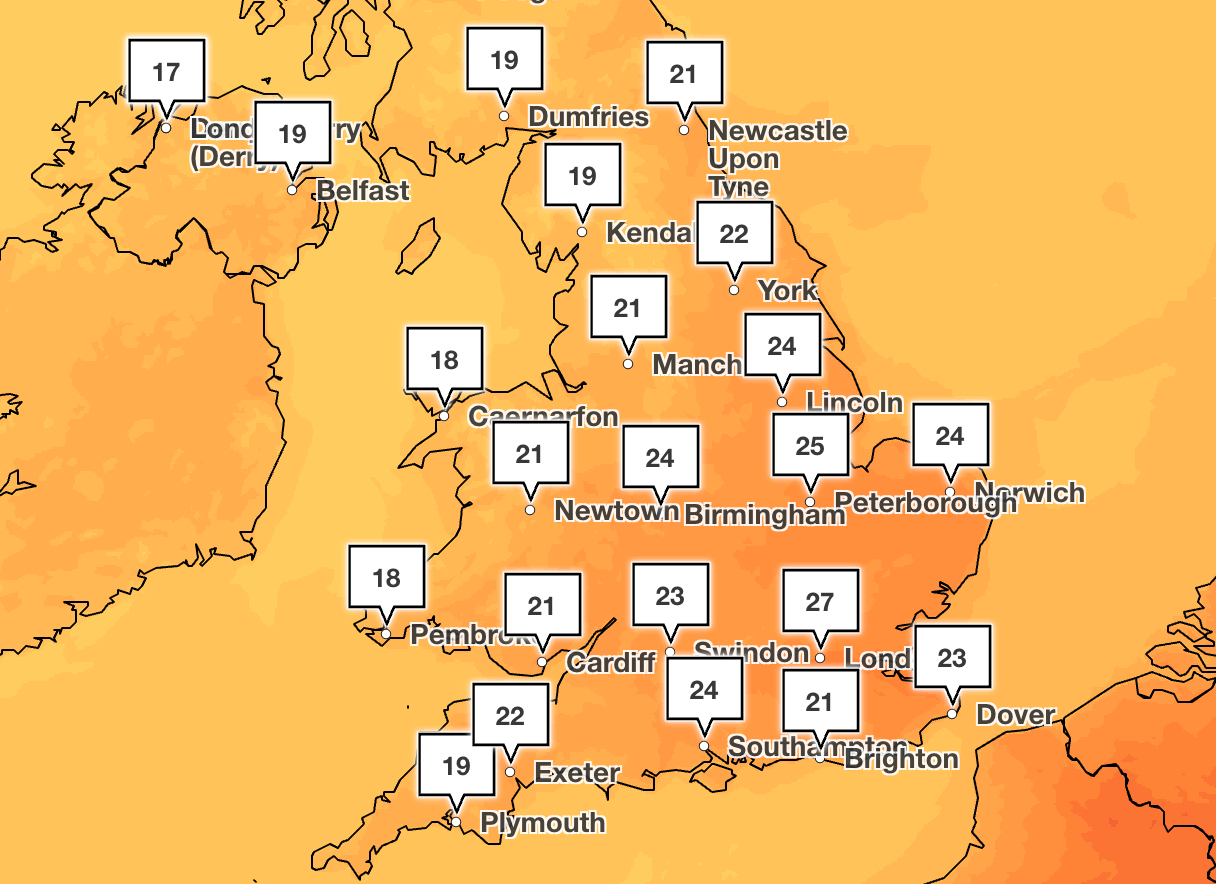
Areas in the southeast of England are expected to approach 30C on Friday, while temperatures climb to the mid-twenties elsewhere.
Advertisement
Scotland and Wales will see cooler weather throughout the day, where it is not expected to rise above 20C.
Some areas are likely to meet heatwave criteria by Saturday and more widely on Sunday.
A UK heatwave threshold is met when a location records at least three consecutive days on which daily maximum temperatures meet or exceed the heatwave temperature threshold. The threshold varies by UK county. In London and the South East, that threshold is 28C or 27C.
Saturday weather
Advertisement
Temperatures could hit 28C in London on Saturday (Met Office)
On Saturday, temperatures are forecast to fall slightly, but could still hit 28C in the southern parts of England.
Across the rest of England and parts of Wales, temperatures will stay in the low to mid-twenties. The weather will be cooler in Scotland, staying below 20C throughout the day.
Met Office deputy chief forecaster, Gregory Wolverson, said: “As we move towards the weekend, we’ll see conditions become more widely settled and temperatures rise all round. Many parts of southern and eastern England are likely to see temperatures high enough to meet heatwave thresholds.
“While temperatures may be high, we might not all see the wall-to-wall sunshine and blue skies we experienced back in May because there is more cloud around. There is also a chance of thunderstorms developing in places, particularly later each day, which could bring heavy showers and localised impacts.”
Sunday weather
Advertisement
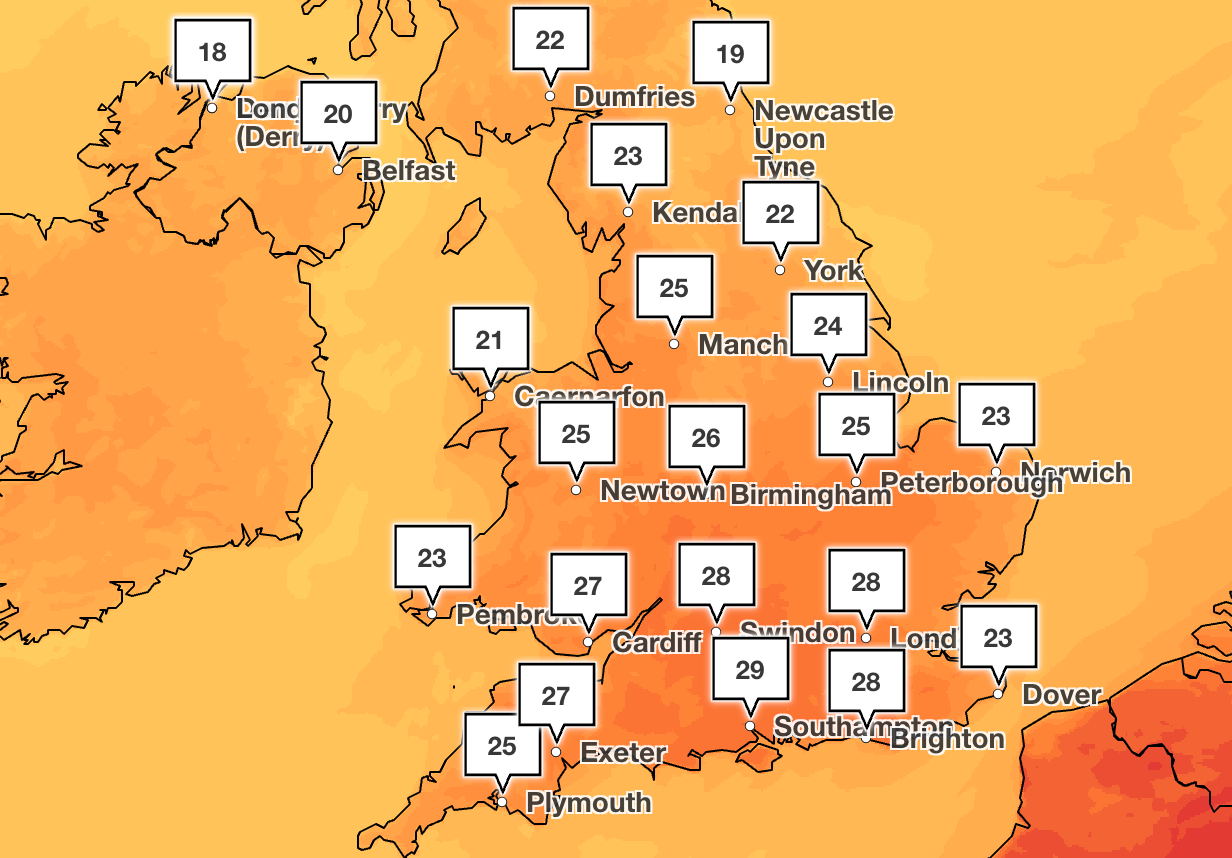
Temperatures could reach 30C in some parts of England on Sunday (Met Office)
On Sunday, London and southeastern areas are due to see a return to 30C, while other areas of England and Wales will experience temperatures reaching around 25C.
Temperatures will stay in the mid-teens for the northern parts of Scotland, but could climb above 20C in the southern areas.
Much of Northern Ireland will approach 20C on Sunday afternoon.
An extreme heat amber warning has been issued by the Met Office (Met Office)
The weather is set to get hotter for most of the country on Monday, with 32C forecast in the southeast. Another scorching day is expected on Tuesday, when temperatures will again climb to 32C.
A Met Office amber warning for extreme heat will come into force at 1am on Monday, as the forecaster warns very high temperatures will likely bring widespread impacts to people and infrastructure. It will be lifted at the end of the day on Tuesday.
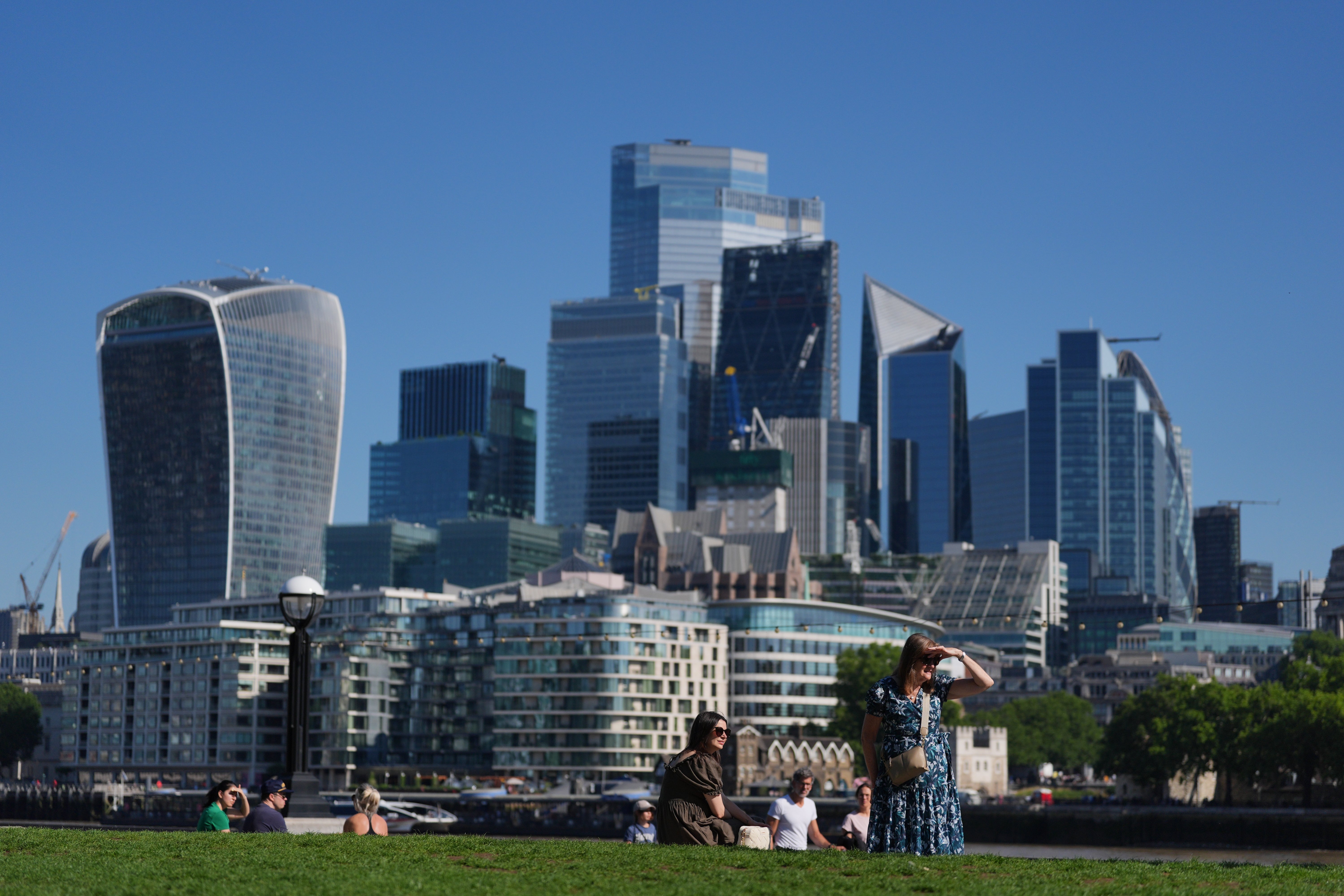
People enjoy the warm weather on The Queen´s Walk in London (PA)
What is a heat dome and why is it influencing the UK’s weather?
A heatwave developing in the UK and across Europe has been influenced by a strong area of high pressure that is currently on the continent.
Advertisement
The high-pressure system sits over a region and traps hot air underneath it, acting like a lid on a pot and creating a “heat dome”.
Parts of Spain, France and Italy are expected to see temperatures rise into the high 30s, and possibly exceed 40C over the coming days.
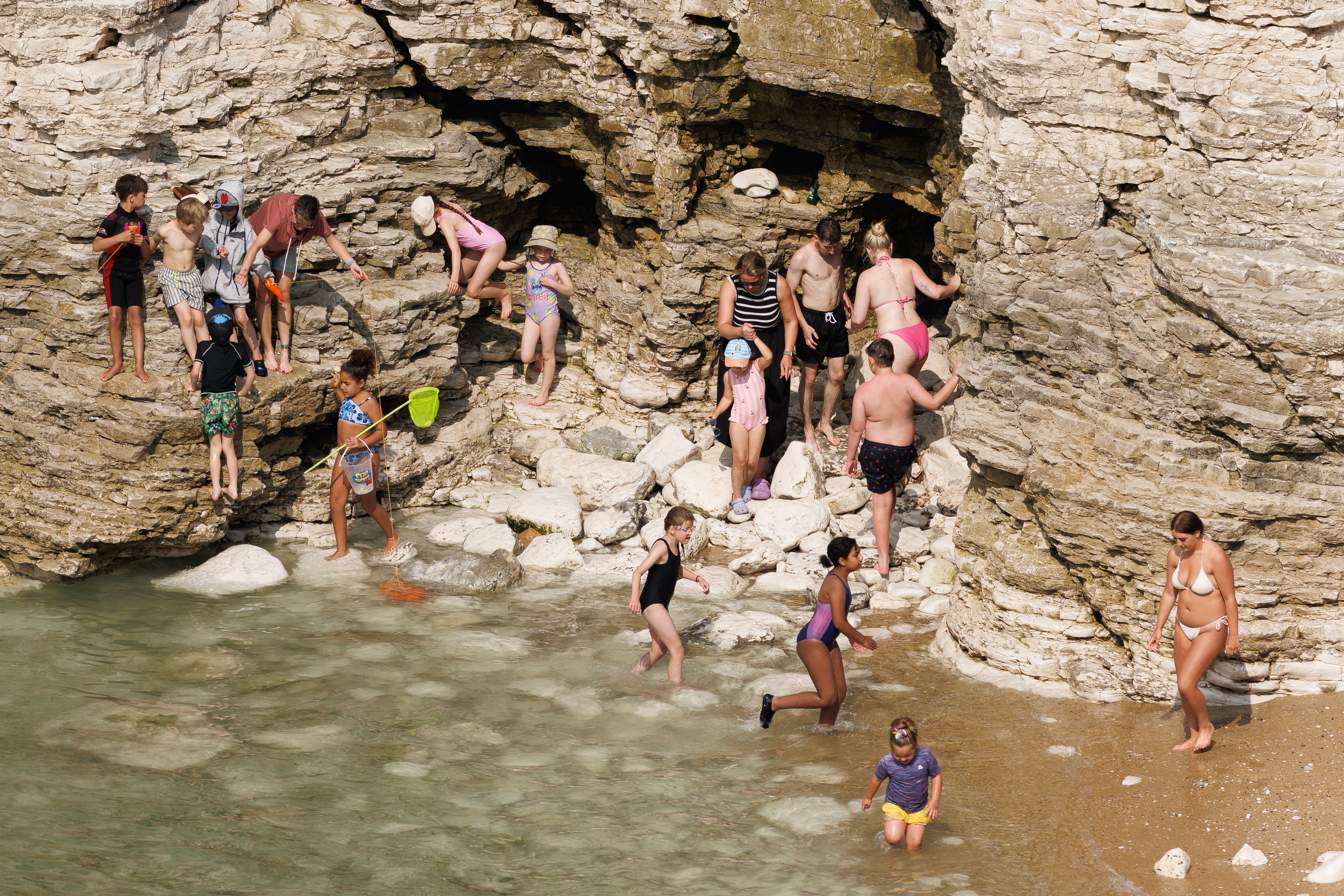
Beachgoers at Flamborough in last month’s heatwave (Getty)
Mr Wolverson said: “This week’s weather reflects a contrast we often see in summer, with more unsettled conditions passing to the northwest of the UK while heat builds in the South and East.”
Meteorologist Jonathan Vautrey warned rising temperatures and humidity would be likely to come with overcast skies for many.
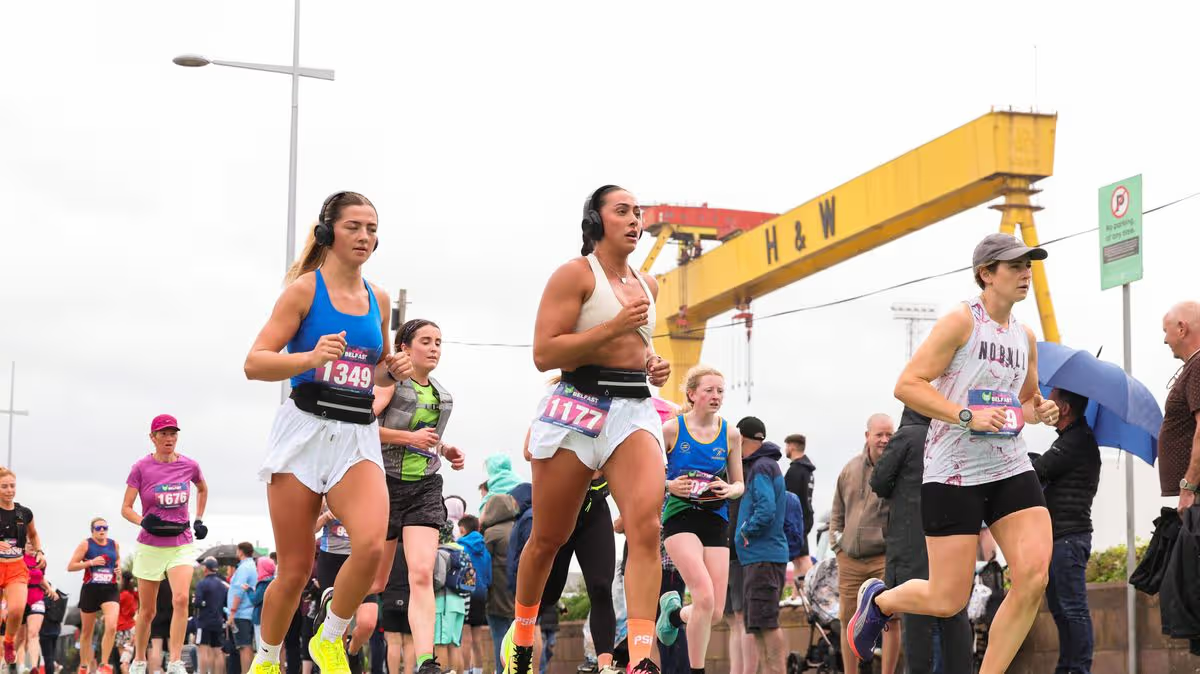
Excitement is building as thousands of women prepare to take to the streets of Belfast this Sunday for the highly anticipated Phoenix Energy Belfast City Women’s 10K, one of Northern Ireland’s largest female-only participation events.
The event will welcome runners, joggers and walkers of all abilities for a memorable day of fitness, fun and community spirit in the heart of the city.
All participants are reminded that race packs must be collected in advance from IKEA Belfast. Race packs will not be available for collection on race day; packs can be collected on Friday, June 19, from 5pm-7pm, or on Saturday, 20th June, from 9.30am-4pm.
Due to ongoing roadworks in the Hamilton Road area, parking close to the start line will be significantly restricted.
Participants are therefore advised to use parking facilities in the SSE Arena area or in the City Centre, which will provide the most convenient access to the event. Runners are encouraged to allow additional travel time on race morning.
The event starts at 10 am and finishes on Hamilton Road. The route leads the runners around the iconic Titanic Quarter and then makes their way out to Sydenham Road, onto the Airport Road and loops back to the finish to grab their well-earned medal.
The finish area promises to be a vibrant celebration of achievement, featuring a range of food and beverage vendors alongside event partners and supporters, Phoenix Energy, Belfast Live, Q Radio, Glow NI and Cancer Focus Northern Ireland. Participants will also have the opportunity to celebrate their Personal Bests by ringing the Phoenix Energy PB bell.
The Phoenix Energy Belfast City Women’s 10K continues to inspire women of all ages and abilities to challenge themselves, improve their health and wellbeing, and enjoy the unique camaraderie that makes the event so special.
Event organisers are looking forward to welcoming participants from across NI and beyond for another fantastic celebration of women’s running and community spirit.
For the latest event information, participants should visit the Belfast City Marathon website and follow official event social media channels and additionally check their email for Participant Instructions.
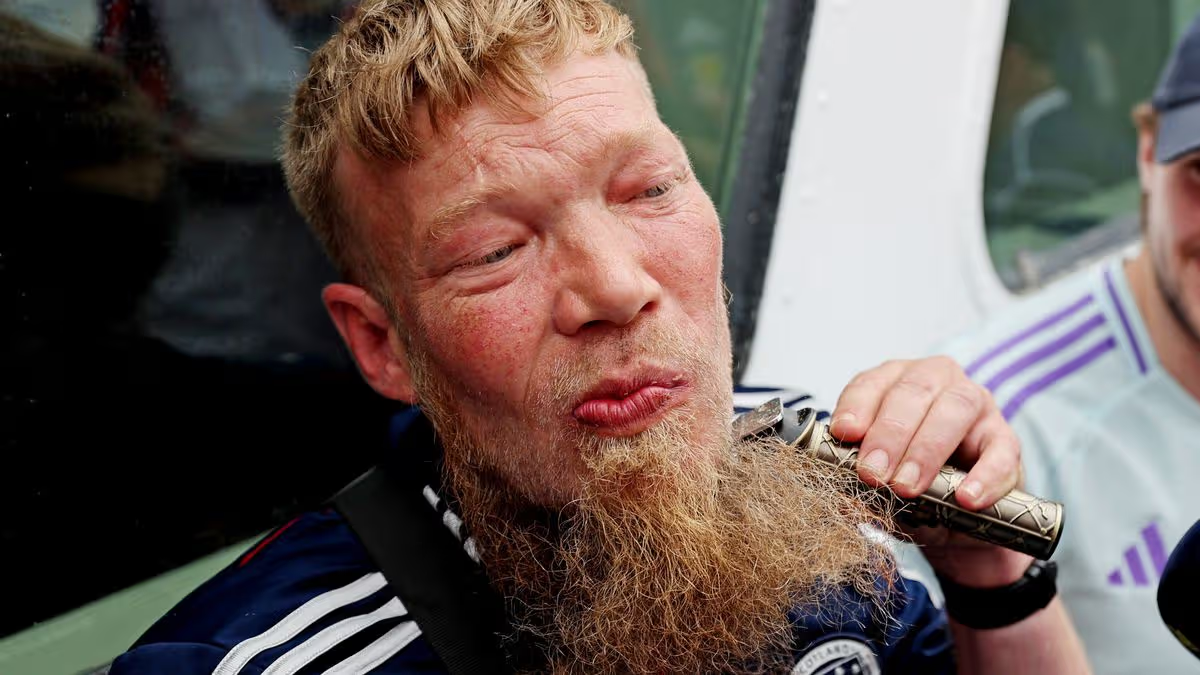
David Carsey, 42, braved the shave as delighted fans chanted ‘No Scotland, No Party’.
Tartan Army footsoldier shaves off beard for charity on Boston party boat trip
A Tartan Army foot soldier has shaved his beard on a Scotland boat party in aid of charity.
David Carsey, 42, braved the shave aboard the three-hour booze cruise on Thursday afternoon. Hundreds of bleary-eyed Scotland fans piled onto the huge cruiser in gloomy conditions on Thursday afternoon before the celebration got into full swing.
And there was a huge cheer of ‘No Scotland, No Party’ as David shaved his long facial hair in front of delighted fans. David, from Aberdeen, said: “I did the same thing for the Euros and I though I might as well do it again.
“If I can raise a bit of money for charity – too right. I’m doing it for the STV Children’s Appeal and also a Boston hospital. Now my beard is gone, it feels very weird! I always have a beard – I’ve had one for 10 years.
Advertisement
“But this is a special occasion so I’m so pleased to be able to raise a bit of cash for charity.”
Speaking more widely about his World Cup adventure, David, who works as a groundsman for Aberdeen City Council, added: “We’ve been here for eight days so far and it’s just been phenomenal.
Advertisement
“The people of Boston have been looking after us so well. We are staying through in Providence and it’s absolutely amazing through there as well.”
The three-hour party boat cruise included an open bar and an extensive spread – including sandwiches, wraps and salad – our foot soldiers quickly got the party going with chants of ‘Scotland’s on Fire’.
As the clouds cleared, delighted fans were seen embracing each other in hugs as they danced to all the usual songs.
As fans arrived back at Rowes Wharf after the three-hour cruise, they burst back into song and one punter said: “Can we stay on here all night?”
Advertisement
North East Tartan Army chief Chris Gibson, 50, has organised around a dozen party cruises for our supporters but said this was the best one yet.
He said: “What a day. We’ve all been partying here. This one has blown the rest out of the water. It was fantastic to have Craig Ferguson on here too. It’s been such a brilliant day.”
He added: “If they thought this was good, Boston is about to see the biggest party ever tomorrow night when we get the result and get through that group.
“They have no idea what qualifying through the group means to us – but they’re about to find out!”
Charity hero Craig Ferguson, who walked the length of America to Boston, was enjoying some downtime after raising £1million for men’s mental health with his trek.
After posing for pictures with dozens of delighted fans, the 22-year-old told the Record: “That was just unbelievable. This is what it’s all about. Look at everyone hugging and kissing.
“I only heard that I was able to get on the boat yesterday. I missed the last one, and I thought I’m not missing this again! So I’m very, very glad that I got on it, because that was just amazing.
Advertisement
“Do you know what I love, it’s when you’re going out on the boat. And everyone on the harbour is just waving and taking pictures.
“It just makes you so proud, because everyone looks so enamoured – like who are these kilted men just going for it?! It’s just the best thing ever.”
He added: “I’ll be at the game tomorrow. I’m falling into the same trap as I always do and I’m feeling too confident – but I’m going for a 2-2.”
Get more Daily Record exclusives by signing up for free to Google’s preferred sources. Click HERE.
WASHINGTON (AP) — Most Americans continue to disapprove of how President Donald Trump is handling Iran, while his overall presidential approval holds steady, according to a new AP-NORC poll that was conducted as Trump suggested a deal with Iran had been reached.
The poll points to just how unpopular the three-month war with Iran has been with Americans, even as Trump turned abruptly from threatening Iran to reopening negotiations. Support for the president’s handling of the war remains lopsidedly partisan. About two-thirds, 65%, of U.S. adults disapprove of how Trump is handling issues with Iran. But while the vast majority of Democrats and independents view Trump’s actions negatively, only 28% of Republicans are unhappy.
Americans’ views on how the president is handling Iran are roughly in line with his overall job approval, which stands at 37%, unchanged from an AP-NORC poll conducted in May.
The survey was conducted June 11-17, just after Trump called off threats to escalate the war with Iran. The poll was fielded as Trump announced a deal with Iran and authorized an end to the U.S. naval blockade in the Strait of Hormuz, concluding just before the deal was signed Wednesday.
Advertisement
Approval of Trump’s actions on Iran has been low over the last few months. But in interviews, some Republicans also weren’t pleased with the outcome of this week’s agreement, which gives Iran an immediate benefit, allowing it to sell its oil freely again.
The deal also reopens the strait without tolls for two months, restarts talks between the U.S. and Iran over Tehran’s nuclear program and calls for Tehran to dilute its stockpile of highly enriched uranium.
David Farrington, a 79-year-old Republican-leaning independent in Fort Worth, Texas, “doesn’t have any love lost” for Iran, but he’s frustrated the agreement focused on the strait and didn’t deliver more on the country’s nuclear weapons program.
“Any agreement regarding the strait is hardly what I would consider a recognizable concession on the part of Iran,” Farrington said. “So, I consider that some fluff that attempts to make this agreement look better when it’s not.”
Advertisement
Trump’s approval on Iran remains flat
Only about one-third of U.S. adults approve of how Trump is handling Iran in the new poll, in line with May.
Donald McBride, a 28-year-old independent in Plano, Texas, is frustrated that Trump has not maintained his campaign promise to keep America out of foreign wars. McBride voted for Trump but he opposed going to war with Iran.
“I would like the war to end,” he said. “The original objective of the war was to end the Iranian regime, and that’s just not possible. I don’t really know why we’d continue fighting.”
The poll suggests most Americans want action in Iran to wrap up. Even with an agreement on the horizon, 53% of U.S. adults said American military action against Iran had “gone too far,” only a slight decline from 59% in March.
Advertisement
About 4 in 10 Republicans, though, said in the latest poll that action has been “about right,” and 37% said it had not gone far enough.
Joan Jones, a 64-year-old independent in northwest Florida, believes the United States’ actions in Iran have been necessary to address the threat Iran posed.
“Those attacks are ultimately to protect us from nuclear attacks,” Jones said. “I think we have to go through that … and eliminate that worry so we don’t have that hovering over us.”
Few approve of Trump’s approach on Israel
About one-third, 34%, of U.S. adults approve of how Trump is handling Israel.
Advertisement
Tensions have been rising between Israeli Prime Minister Benjamin Netanyahu and Trump as the president criticizes recent Israeli attacks in Lebanon, which jeopardized negotiations between Washington and Tehran.
James Huffman, a 69-year-old Republican in Medway, Ohio, thinks Trump is taking the wrong strategy when it comes to Netanyahu.
“Netanyahu is not going to do everything Trump wants. He’s going to do what he wants,” Huffman said. “I just don’t think it’s effective.”
Only about one-third approve on the economy
About one-third of U.S. adults approve of Trump’s approach to the economy. That’s in line with last month, and continues a challenging stretch for Trump on the issue.
Advertisement
Jones, the Florida independent, is more optimistic than most. She said she can hardly leave the house some hours without getting stuck in the traffic of tourists headed to the beach on vacation. She also spots lines around the block for Starbucks, McDonalds and Chick-fil-A in her community — all signs to her that the economy is doing well overall.
“I think President Trump’s policies are contributing to a better economy,” Jones said.
Other Republicans are more skeptical, a troubling sign for a president who prides himself on his business acumen. Only 69% of Republicans approve of how he’s handling the economy, slightly lower than the 78% who approve of how he’s handling the presidency overall.
Patricia Bailey, a 42-year-old Republican in Parkersburg, West Virginia, sees an economy where prices have gotten out of control. “I just said the other night, ordering pizza is for rich people,” she said. Bailey voted for Trump but added, “He’s kind of let me down a little bit.”
Advertisement
Even if high prices preceded Trump, Bailey doesn’t think he’s lived up to his pledge to improve the economy.
“I think he got so distracted with the war that he forgot some old promises,” she said.
___
The AP-NORC poll of 3,040 adults was conducted June 11-17 using a sample drawn from NORC’s probability-based AmeriSpeak Panel, which is designed to be representative of the U.S. population. The margin of sampling error for adults overall is plus or minus 2.8 percentage points.
Police were involved in the investigation of two drug lines, which were later attributed to Malaki McQuade.
Warrants were executed at McQuade’s girlfriend’s home in Heol y Berllan, Ely, and his grandmother’s home in Penygarn Road, Ely.
He was found at his girlfriend’s home and told officers: “Listen, everything that has been found in this flat is mine, it’s got f*** all to do with her, she doesn’t know anything about it. I have got no choice to do what I do bro, I owe money out, big money owed out. You have caught me red handed.”
Advertisement
A search of the house resulted in the discovery of the phone linked to the drugs line, three further phones, a machete, 14g of heroin, 18 wraps of 0.6g deals of heroin, a grip seal bag of cannabis, £525 in cash, and scales with white powder residue.
A search of the defendant’s grandmother’s home resulted in the discovery of 10.94g of cocaine, a bag of white powder, scales, £2,900 in cash, two further phones, a bag containing cannabis and a machete.
Mr Orndal said the combined value of the class A drugs seized is between £830 and £1,030.
The defendant sent bulk messages to up to 85 customers.
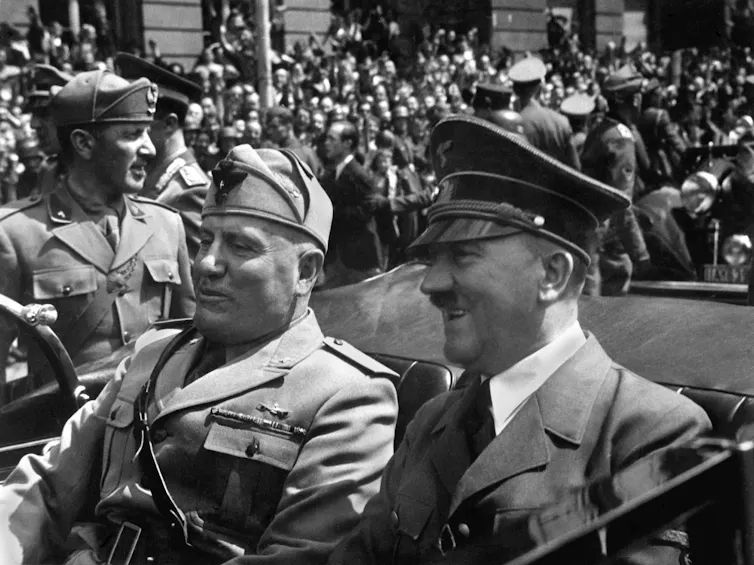
Benito Mussolini stepped out onto the Piazza del Campidoglio at 10:58 in the morning of April 7, 1926. He had just delivered a speech prepared for him by his lover, the Jewish writer Margherita Sarfatti.
The speech had been a success, and Mussolini left satisfied, making his way through the cheering crowd.
Suddenly, a woman approached within a few meters of the Duce. She was holding a Lebel, a deadly revolver issued to the French army during the first world war. She pointed it at the dictator and fired.
Mussolini shortly after the assassination attempt which grazed his nose. wikimedia
Mussolini was grazed on the nose by the bullet. The next day’s newspapers reported that he was saved by a sudden shift of his head while giving the Roman salute. The woman attempted a second shot, but the gun failed to fire.
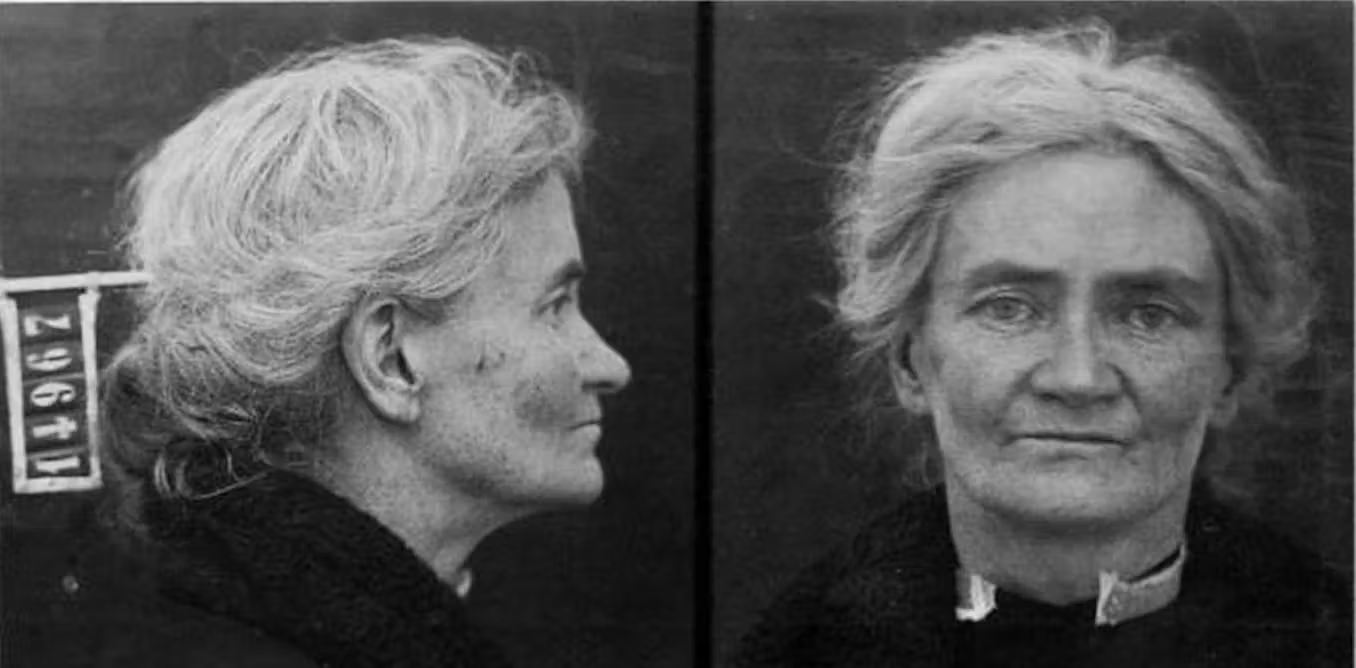
Blocked and beaten by the crowd, the woman was immediately arrested and taken to the Mantellate prison (a Roman female prison), where she gave her personal details. She claimed not to remember the attack and appeared surprisingly calm and indifferent.
The woman in question was Violet Albina Gibson, the daughter of the 1st Baron Ashbourne Edward Gibson. The Baron was the Lord Chancellor of Ireland for almost 20 years (1885-1905), before its independence from Great Britain. Gibson was born in Dublin on August 31, 1876, into a pro-British Anglican family.
After the assassination attempt, Gibson was branded insane. The political motive behind the attack was hushed up to reduce the embarrassment of both British and Italian governments.
Advertisement
Only by downgrading the attack to the senseless behaviour of a madwoman – judicially certified by a court – could it have been possible, as indeed happened, to proceed with Gibson’s repatriation, as all parties hoped.
The Insights section is committed to high-quality longform journalism. Our editors work with academics from many different backgrounds who are tackling a wide range of societal and scientific challenges.
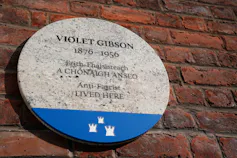
This version of history was believed for decades. It was only in 2014 that Gibson’s story was brought to a wider audience by the documentary, Violet Gibson, The Irish Woman Who Shot Mussolini, based on the work of historian Frances Stonor Saunders. Finally, in 2021, Dublin Council honoured her stand against tyranny with a plaque outside her childhood home.
Now, new evidence buried in a number of Italian archives, uncovered by one of us (Giovanni), further substantiates Gibson’s clear anti-fascist political motives and reveals how the attack was carefully planned. It shows how:
Advertisement
When Gibson moved to Rome, she lived next door to the Duke of Cesarò, an opposition leader, prominent anti-fascist and a man she would later claim was her lover.
Gibson’s acquaintance with the Duke was further corroborated by a new analysis of her psychiatric report.
Gibson moved to Italy after the murder of Giacomo Matteotti, the socialist leader kidnapped and killed by a fascist squad.
Gibson travelled to the small town where the trial of Matteotti’s murderers took place.
Evidence from several key witnesses was ignored or twisted.
Who was Violet Gibson?
At the age of 18, Gibson was a debutante in the court of Queen Victoria. Debutantes were young, upper-class women who were presented to the monarch to mark their official entry into high society and the marriage market.
Gibson was photographed standing next to the future King George V in 1897 during a visit to the Ashbourne family in Howth Castle, when he was Duke of York.
In conflict with her family, Gibson converted to Catholicism at the outbreak of the first world war and Scotland Yard registered her “anti-British pacifism”. Over the years, she would develop a Christian-socialist attitude that saw her sympathise with the poor.
She also had strong ties to Italy, a country she had visited frequently and for long periods as a young woman. Partly because of her father’s interest in Italian reunification, on which he had written extensively, she had always followed Italian politics with passion and apprehension as the country was falling towards right-wing extremism.
Advertisement
She was extremely worried about the rise of fascism, starting at least from the 1923 assassination by a fascist squad of the priest Don Giovanni Minzoni.
Then, according to her family, in August 1924 she reacted furiously to one of the first BBC news broadcasts reporting the discovery of the body of socialist leader Matteotti.
The suspicions of Mussolini’s involvement in plotting his murder ushered in a long period of crisis that the Duce only managed to overcome in January 1925. It accelerated his authoritarian drift toward dictatorial power, with support he had won from King Victor Emmanuel III.
British reaction to Gibson’s arrest
There were violent reactions from the fascist movement following Gibson’s attempt. The fascists were by then a powerful force in the country and were calling for revenge against those who had dared to plot against the head of government.
George V’s embassy in Italy issued a statement the day after the assassination attempt. It said the embassy was unaware of Gibson’s presence in Rome, believing that she was interned in a nursing home in England. King George V himself, perhaps embarrassed by that old photo of himself, immediately condemned “the ignoble attack”.
Advertisement
British Foreign Secretary Sir Austen Chamberlain also expressed “horror” at the act committed by a woman belonging to the British aristocracy in a telegram to Mussolini.
We have also reviewed correspondence, stored in the UK’s National Archives, sent from Chamberlain in the aftermath of the attempt. In these messages he instructed Ambassador to Italy Sir Ronald Graham to help Italian investigators. The ambassador told Chamberlain he had “little doubt” that Gibson was “a tool of outside influence”. Nevertheless, Chamberlain instructed him to suggest she was mad and she should be in a mental institution in England. He said this would minimise repercussions on the hitherto good international relations between the two countries, reporting also that Churchill was “charmed by Mussolini”.
Almost in unison, Gibson’s family members also denied that there could be any political significance to her actions. They promised, if released, she would be properly cared for in a health facility in England.
Investigations
During the initial interrogations with the magistrate (which took place under the liberal penal code of Zanardelli) in four separate interviews in April, May and June 1926, Gibson continued to state, somewhat vaguely and confusingly, that she did not remember trying to shoot Mussolini.
Advertisement
Then, in mid-June, the defendant’s attitude suddenly changed.
On June 12 and 16, under the guidance of lawyer Enrico Ferri and assisted by Bruno Cassinelli, she confessed to being responsible for the attack and claimed she had an accomplice – the prominent anti-fascist politician, Duke Antonio Colonna, Duke of Cesarò (1878-1940).
She also claimed she was insane. This seemed to be enough to quell rumours of a conspiracy. It was all the work of a mad woman, acting alone.
But a question loomed: what was Gibson doing in Italy in the first place?
Advertisement
New evidence
Our fresh critical analysis of the trial documents shows that Gibson arrived in Italy with her lady-in-waiting Mary McGrath in October 1924 and lived in Rome at Via Gregoriana. This was just a few steps away from the Duke of Cesarò’s house in Via Gregoriana. But when she talked about her movements across Rome in subsequent interviews, she never mentioned this address.
This, together with the Duke’s admission of having met Gibson in 1912 in Munich at a conference of the Theosophical Society, suggests that – despite the Duke’s denials – he and Gibson had met in Rome prior to the attempted murder.
Furthermore, it is important to stress that Gibson’s companion in Italy, Mary McGrath, distanced herself from the prevailing family attitude that attributed Gibson’s mental infirmity as the cause of the attack.
Our archival research clearly shows that, when summoned by the Italian Consul in Dublin on May 19, McGrath maintained that she did not believe her mistress was insane, and even added that she suspected she used to meet many people every day during her stay in Rome.
However, from the defendant’s somewhat extravagant and in our view quite intentional judicial behaviour (claiming to be both mad and responsible for the crime), an altered mental state emerged during interrogations that was used to suggest the existence of a cognitive bias.
By declaring herself insane, she denied full responsibility for the criminal act. Further doubts also arose from the fact that she told the experts she loved the Duke of Cesarò, yet continued to denounce him as an accomplice.
Under the liberal penal code in force at the time, admitting responsibility for the attack while simultaneously declaring herself insane (and therefore irresponsible for the act) forced the magistrate to order a psychiatric evaluation.
Advertisement
From the testimonies gathered during the police investigations and checks conducted by the experienced police commissioner, Epifanio Pennetta, other important aspects emerged.
Although they were willingly denied by Gibson, these findings confirmed instead the defendant’s clear premeditation of the attack, carried out with anti-fascist motivations.
Contrary to this perspective, erasures and misrepresentations would instead emerge, which can only be explained, historically, as prejudicially influenced by the Mussolini regime.
These aspects were not accepted as significant evidence in the Special Military Tribunal – which took over the case – and were not subsequently examined by historians, with the exception of some references in the book by American historian Richard O. Collin, who was the first to shed some light into the Gibson affair in 1986.
Advertisement
Attending Matteotti’s trial
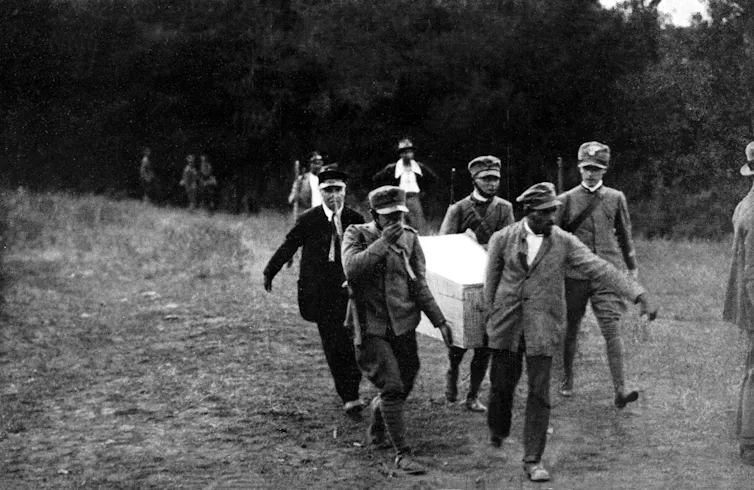
A critical piece of evidence which was ignored by investigators at the time was the fact that several witnesses testified to having seen Gibson attend the trial against Giacomo Matteotti’s assassins in Chieti between March 16 and 24, 1926.
These testimonies are highly significant: only devout anti-fascists travelled to the small mountain town where the regime had moved the highly sensitive trial.
Travelling to Chieti was neither easy nor straightforward at the time – even now it takes three hours by coaches which didn’t exist at the time. It required a very serious commitment.
In contrast to these witness testimonies, Gibson would categorically deny having attended the trial.
Advertisement
The body of socialist leader Giacomo Matteotti is discovered on the outskirts of Rome on August 16 1924, two months after his disappearance. Archivio GBB/Alamy
Surprisingly, she was believed by the military magistrates despite their own affirmation in the ruling that her past, present and future statements should be prejudicially deemed false and unreliable.
Upon her return to Rome from Chieti, likely disappointed by the outcome of the legal proceedings, which had resulted in only light convictions for Matteotti’s assassins, Gibson would demonstrate her desire to implement a plan she had perhaps already conceived for some time. A plan that was kept secret.
Then, on March 28, 1926, witnesses interviewed during the preliminary investigation reported her presence at Villa Glori – at the anniversary of the founding of the Fascist Party, attended by Mussolini.
Gibson also denied being at this event and was, again, believed by the magistrates.
It’s important to highlight that this episode occurred a few days after the end of the Matteotti’s murderer trial and shortly before the events of April 7.
Advertisement
These testimonies, which the military judges did not credit, lead us to suspect that Gibson may have already been contemplating an attack on Mussolini on this occasion – suggesting clear premeditation and consistent anti-fascist motivation.
The psychiatric report and a lover
On July 8, 1926, psychiatrists were appointed. Sante De Sanctis and Augusto Giannelli were the family’s expert witness and the court-appointed expert witness, respectively. The experts were asked whether, “Miss Gibson was rationally aware and free of will at the time of the accused act”; if the accused was suffering from mental insanity, and “how the statements recently made to the investigating magistrate should be considered”.
This came as a surprise to the experts who tried unsuccessfully to highlight the paradox she was falling into by declaring that she loved a man who she ended up damaging by her accusations.
In August, the mental health experts’ unanimous verdict was that the defendant was partially insane and therefore could not be responsible for her crime.
The spy and the Special Military Tribunal
Meanwhile, Mussolini was pushing forward his authoritarian agenda. In Autumn 1926 there had been two more attempts on his life from the young anarchists Gino Lucetti and Anteo Zamboni (both of whom missed their target).
The government took advantage of the situation by pressing on with its “hyper-fascist laws” which dissolved all political parties, ended Parliamentary democracy and introduced a Special Military Tribunal for crimes against the regime. Crucially, the new tribunal could inflict the death penalty, which was reintroduced 37 years after its abolition.
It is worth noting at this stage that, according to Italian historian Mauro Canali, one of Gibson’s lawyers, Bruno Cassinelli, was also an informant for Mussolini’s government, with the codename Brucassi.
He had already defended Giovanni Corvi, a communist that had killed the fascist MP Armando Casalini in September 1924 (shouting “Vendetta per Matteotti”), and who was also judged mentally insane.
It is easy to imagine that Gibson’s judicial strategy (defended by the same lawyer) was also aimed at obtaining the same declaration of insanity from the military judges. And unlike the original judges, the military judges were influenced by Mussolini who at that point was keen on maintaining good relations with the British government.
The first ruling of the newly operational Special Military Tribunal, was with the Gibson case.
The case was dealt with in a private hearing and a verdict was reached on May 6, 1927. The first point reiterated extensively by the military judges was that nothing but lies could be expected from Gibson.
It was therefore essential to prevent these scandalous lies from being uttered in a public hearing. The ruling therefore established that both her past and present statements and those that could have been made in a public hearing were to be prejudicially deemed false and unreliable.
The final decision on Gibson’s mental infirmity was taken, uniquely, by military judges, who based it on “legal-ethical” reasons.
The verdict
On this basis, the Special Military Tribunal, having ignored all politically relevant aspects of the previous investigation, on May 6, 1927, independently ruled that there was “no case to answer against Violetta Albina Gibson, regarding the crimes she was charged with, because she is not punishable by reason of mental illness”.
Advertisement
The verdict, which explicitly mentioned “the intervention of his excellency Benito Mussolini”, ordered her release in order for Gibson to be admitted to a mental asylum for treatment.
Yet, the police authorities, rather than delivering her to a Roman psychiatric hospital, as had happened in similar cases, released her, once again, on Mussolini’s orders.
Return to England
The regime handed Gibson over to her sister, Constance, On May 9, 1927, in a breach of the usual procedure. Three days later, the sister accompanied Gibson back to England on a long train journey. With them, undercover Italian police, one Italian nurse, three English nurses and a travel agency attendant. None of them were dressed in their usual uniforms and Gibson did not know what was about to happen to her.
Some family members and political figures expressed gratitude to Mussolini for freeing one of their compatriots who had “senselessly” attempted to kill him. In compliance with the ruling of the Special Military Tribunal in Italy, which had erased the political motivation and judicially certified the defendant’s insanity, a further psychiatric diagnosis was ordered to confirm her mental illness.
Advertisement
The “senseless” motivation for the attack was quickly confirmed with a certification of insanity rushed through by Maurice Craig and Bernard Hart, two doctors in Harley Street. Gibson was admitted to St Andrew’s Hospital in Northampton (a town around 60 miles north of London) where she would remain segregated for almost 30 years.
In April 1930, on the fourth anniversary of her assassination attempt, she tried to take her own life, but a nurse found her before she could. Only her sister Constance kept visiting in the hospital, while the rest of the family kept their distance.
Throughout her time at St Andrew’s Hospital, she repeatedly pleaded for her liberation in letters to her family, to the Queen and to members of the government, including Winston Churchill.
When the young Princess Elizabeth married Prince Philip, in 1947, Gibson wrote her a clear, kind and simple letter which read:
Advertisement
In the happiest period of your life, I make this request that you write to the Home Secretary saying that you would be glad if he would release me from this mental hospital so that I can go into a convent…In 1926, I shot at Mussolini and was shut up in this hospital for the course of His Majesty’s pleasure. I am feel quite sure that your kind-hearted grandfather would not take any pleasure in keeping me here any longer, twenty weary years and six months. I am now old, bed-ridden with very bad heart disease and other illnesses…You will not need to fear that I will ever shoot anyone again as I am old and ill and occupied in very quiet matters, especially prayers. So if you get me my freedom, I am sure that such a kind act will bring a blessing on your marriage…
As with most of the other letters, it was never sent and they lie in St Andrew’s Hospital archive.
Epilogue
Antonio Colonna, the Duke of Cesarò – the man Gibson professed to love – was forced to retire from politics after her arrest and the investigation over his role. He died in Rome, aged 62, in 1940 just a few months after fascist Italy had declared war on Great Britain.
Italian partisans eventually killed Mussolini on April 28, 1945. It is not known how Gibson received either piece of news.
A commemorative plaque was unveiled for Violet Gibson at her childhood home on Merrion Square, Dublin, in 2022. PA/Alamy
The collective memory of Gibson was for a long time shaped by the narrow conception of mental health in the early 20th century, the diagnostic conclusions of Italian and British psychiatrists and the international agreement between governments that had her confined in a mental institution.
Gibson died in St Andrew’s Hospital, on May 2, 1956, a few months before her 80th birthday. No friends or family attended her funeral.
Advertisement
In her will, she requested a requiem mass and to be buried in a Catholic cemetery – this final wish was ignored by her family.
Gibson came closer than anyone to killing Mussolini. Her attempt was well planned and executed. Had she succeeded, the history of the 20th century would have been very different.
To hear about new Insights articles, join the hundreds of thousands of people who value The Conversation’s evidence-based news. Subscribe to our newsletter.
Europe’s premier club competition gets underway earlier than usual in the 2026-27 campaign, starting the week commencing September 8 as fixtures from the league phase will be played across three days.
Gabriel missed the decisive penalty against PSG
Getty
The Gunners are in pot one ahead of the new campaign, but do not discover their opponents for the league phase until the end of August when the draw takes place.
Though, the 2026-27 Champions League schedule has already been revealed.
Advertisement
With Arsenal discovering their Premier League fixture list on Friday morning, it has allowed for the Gunners to learn their fate with regards to who they will face after all eight European fixtures next season.
It works out to be relatively kind to Mikel Arteta’s side with five home games directly after a Champions League fixture. However, the big story is two games against likely title rivals Manchester City following matchday five and eight.
Who Arsenal will face after Champions League games






































You must be logged in to post a comment Login