The Wansbeck Business Park firm has issued new accounts showing its performance
Inside the Raytec factory(Image: Raytec)
Industrial lighting maker Raytec says the outlook looks “extremely positive” amid an increase in turnover.
The Ashington-based manufacturer, which employs close to 100 people in the town, says there is increasing global demand of its low-energy and low-maintenance LED lighting systems. New accounts for the Japanese-owned business, which specialises in lighting for hazardous areas, lighting for video surveillance, lighting for the transport sector and heavy industrial lighting, show sales grew 8.3% to £18.7m, from £17.3m in 2025.
Operating profits fell slightly from £2.8m to £2.6m as pre-tax profits grew from £3.05m to £3.2m. Ordinary dividends of £1.89m were paid during the year.
Raytec describes itself as a world leader in LED lighting for security and safety, with a focus on smart and connected lighting products fed by ongoing research and development efforts. It supplies products to international markets through a network of distributors, a US subsidiary and directly to other manufacturers with exports accounting for about 67% of sales.
Advertisement
Its main markets are Europe (52%), the Middle East (6%), America (19%) Oceania (11%) and the Far East (12%). The firm said it had grown its product portfolio during 2025 through investment, which is expected to benefit 2026 sales.
In November last year, it was announced Raytec had acquired Finnish portable lighting specialist Atexor. The Espoo-based business brought 21 staff to Raytec’s operation and strengthened its position, with Raytec bosses saying at the time that the move brought enhanced research and development capabilities and a wider support network.
Atexor, which was founded in the early 1980s, provides products used across the oil and gas, petrochemical and manufacturing sectors. It continues to operate as an independent company and brand following the acquisition.
Writing in the 2025 Raytec Limited accounts, managing director David Lambert said: “The company’s sales increased by 8.3% year-on-year and the long-term business outlook remaining extremely positive, with increasing global demand for high performance, low energy, low maintenance LED illuminators across the specialist niche markets in which the business operates.
Advertisement
“Year-on-year, sales have increased to £18.7m (2024: £17.3m) generating profit before tax of £3.2m (2024: £3m). The company has continued to strengthen its product portfolio through 2025 through investment in research and development and expects new products to contribute significantly to sales in 2026.”
Manchester has been named the leading UK city outside London to start a business, according to new research from National Women’s Enterprise Week, in findings that point to the growing pull of regional “hidden hubs” for women building companies away from the capital.
The survey of 1,000 female entrepreneurs found that 41 per cent named Manchester as either the best or second-best UK city outside London to launch a venture, with one in four (27 per cent) putting it in top spot. Birmingham followed on 14 per cent, with Liverpool on 5 per cent.
The picture that emerges is of women-led enterprise increasingly being built beyond the M25, with founders citing lower costs, greater flexibility and stronger regional opportunity as reasons to stay put. It is a trend already visible elsewhere in the country, with female entrepreneurship booming in the North East as well as across the North West.
National Women’s Enterprise Week was founded by Alison Cork MBE as a UK-wide campaign to help close the gender gap in business ownership. Around one in five UK businesses is currently woman-led, a figure that has climbed from 16 per cent in 2018 but still lags well behind the ambition set out in the government-backed Rose Review of Female Entrepreneurship, which set a target of nearly 600,000 more women founders by 2030.
The research, carried out by Sapio Research, set out to test whether funding, visibility and networks are keeping pace with where women-led businesses are actually being built. While London remains a critical centre for finance and dealmaking, the findings suggest that London-centric assumptions about growth risk disadvantaging founders who are choosing, deliberately, to build viable businesses elsewhere.
Advertisement
More than half (52 per cent) of women entrepreneurs agree that building a business outside London offers greater opportunity, while the same proportion say lower costs are among the top benefits of basing a company beyond the capital.
Yet the old hierarchy has not gone away. Nearly six in ten (58 per cent) agree that businesses based in London are taken more seriously than those outside it, and 61 per cent believe a London address signals that a business is well-established or successful. Perception, in other words, has not caught up with practice.
If anything, that bias runs deeper among those writing the cheques. A separate survey of 200 business investors who have backed UK firms found that 78 per cent agree London-based businesses are taken more seriously, while 80 per cent say a London address signals success. More than half (52 per cent) have at some point required or encouraged a company they invest in to relocate to the capital.
Among women founders based outside London, more than a third (37 per cent) say they have felt pressure to move in order to grow. The majority, though, have no wish to leave: 76 per cent say that, if funding, visibility and opportunity were equal across the UK, they would still choose to base their business exactly where it is today.
Advertisement
That tension, between where capital expects success to happen and where founders are choosing to build it, sits at the heart of the funding debate. It is a theme that runs through wider concerns about the gender finance gap, including evidence that women founders secure 25 per cent less than men at exit.
Alison Cork, founder of National Women’s Enterprise Week, said Manchester topping the list was significant, but that the bigger story lay in what it revealed about the changing geography of British enterprise.
“Women are building ambitious businesses in cities, towns and communities across the country, not just in London,” she said. “The opportunity is already there, but visibility, networks and investment have not always kept pace.
“What this research reveals is a tension between where founders see opportunity and where many people still believe success is supposed to happen. We need to stop thinking of regional growth as an alternative to London and start recognising it as a major driver of the UK’s entrepreneurial economy.”
Advertisement
That argument aligns with the direction of national policy. The government’s Women-Led High-Growth Enterprise Taskforce has likewise pressed for investment and support to reach female founders wherever they are based, rather than concentrating opportunity in the South East.
The research also underlines how much support remains out of reach. Only 35 per cent of women entrepreneurs say they have all the access and backing they need, while 42 per cent say they have some but could do with more. A lack of funding and low visibility are the joint top challenges founders face in growing a business from their current location, each cited by 27 per cent, echoing the squeeze that has seen some female entrepreneurs take on second jobs as 2025 pressures grow.
The findings are being released to coincide with National Women’s Enterprise Week’s Own It: Speed Mentoring for Female Founders event on 19 June 2026, which is built around improving access to practical support, mentoring, networks and visibility for women founders across the UK.
Amy Ingham
Amy is a newly qualified journalist specialising in business journalism at Business Matters with responsibility for news content for what is now the UK’s largest print and online source of current business news.
SlateStone Wealth chief market strategist Kenny Polcari discusses whether investors are too dependent on AI, Space X’s IPO and his outlook for the markets on ‘Varney & Co.’
Americans’ contributions to their 401(k) savings accounts hit record highs in 2025, according to a new report from Vanguard.
Among employees with active 401(k) accounts in both December 2024 and December 2025, median account balances increased by 27%, according to the report, titled How America Saves 2026.
Advertisement
Of those same participants, 94% saw an increase in their account balances, reflecting both a rise in contributions and strong returns from markets, according to the report.
People review tax forms on a laptop computer. (iStock)
The average account balance for a Vanguard 401(k) was $167,970 in 2025, a near $20,000 increase from the 2024 average of $148,153. The median account balance, meanwhile, also increased year over year, rising from $38,176 in 2024 to $44,115 in 2025.
One factor the report cites as a potential impact on the higher contributions is a shift in automatic employee enrollment.
Some employers have shifted to automatically enrolling employees in 401k plans, with the share of Vanguard-defined contribution plans using automatic enrollment sitting at 61% in 2025 compared with just 10% in 2006.
By reframing an employee’s decision into opting out, rather than voluntarily opting in, employers encourage significantly stronger participation in retirement plans, according to the report.
“With an autopilot design, individuals are automatically enrolled into the plan, their deferral rates are automatically increased each year, and their contributions are automatically invested in a balanced investment strategy. In such a plan, the decision to save is framed negatively: ‘Quit the plan if you’d like.’ And ’doing nothing; leads to participation in the plan and investment of assets in a long-term retirement portfolio,” the report states.
Advertisement
American flags on the floor at the New York Stock Exchange in New York, on Aug. 18, 2025. (Michael Nagle/Bloomberg via Getty Images)
Employees deferred a similar percentage of their total incomes into plans in 2025 when compared with 2024, though deferral rates have broadly trended up in the last decade.
The average deferral was 7.6% of an employee’s income in 2025, the same as it was in 2024, per the report. The median rate was 6.6% in 2025 compared with 6.7% in 2024.
A quarter of all participants had a deferral rate of over 10% of their incomes. That compared with just 20% of participants deferring more than a tenth of their income in 2016, the report noted.
Advertisement
A younger person reviews bills on their desk and inputs them into a computer. (Getty Images)
The report wasn’t all positive. Hardship withdrawals increased for the fourth straight year, rising to 6% in 2025 from 5% the previous year. While the report cited potential pressures from inflation and other economic challenges, it also noted that a recent streamlining in the process to apply for hardship withdrawals has “made retirement assets more accessible in times of need.”
Northern Trust Asset Management is a global investment manager that helps investors navigate changing market environments in efforts to realize their long-term objectives.
Entrusted with $1.2 trillion in assets under management as of March 31, 2024, we understand that investing ultimately serves a greater purpose and believe investors should be compensated for the risks they take — in all market environments and any investment strategy. That’s why we combine robust capital markets research, expert portfolio construction and comprehensive risk management in an effort to craft innovative and efficient solutions that seek to deliver targeted investment outcomes.
As engaged contributors to our communities, we consider it a great privilege to serve our investors and our communities with integrity, respect and transparency.
Northern Trust Asset Management is composed of Northern Trust Investments, Inc., Northern Trust Global Investments Limited, Northern Trust Fund Managers (Ireland) Limited, Northern Trust Global Investments Japan, K.K., NT Global Advisors, Inc., 50 South Capital Advisors, LLC, Northern Trust Asset Management Australia Pty Ltd, and investment personnel of The Northern Trust Company of Hong Kong Limited and The Northern Trust Company. Note: This account is not managed or monitored by Northern Trust Asset Management, and any messages sent via Seeking Alpha will not receive a response. For inquiries or communication, please use Northern Trust Asset Management’s official channels.
FOXBOROUGH, Mass. — Scotland will bid to make World Cup history Friday night when they face Morocco at Gillette Stadium. Never before has Scotland reached the knockout stages of a major tournament, but Steve Clarke’s side will progress to the last 32 with a victory over a Moroccan team many consider among the tournament’s most dangerous dark horses.
The Stakes for Scotland
Scotland’s first game was certainly their easiest on paper, against the 83rd-ranked Haiti. John McGinn scored the only goal of the game, taking Scotland to the top of the group. That result has set up arguably the most significant 90 minutes in the modern history of Scottish football, with a win Friday capable of securing a knockout-stage berth the nation has never previously achieved at a major tournament.
A Dangerous Opponent
Advertisement
Morocco enters this match as one of the most respected sides in the tournament, having reached the semifinals of the previous World Cup. Morocco, now eighth in the world, are dark horses for the tournament after reaching the semifinals four years ago. Even a point from this game would be a bonus for Clarke and his squad.
That assessment reflects the scale of the challenge facing Scotland, even with the considerable confidence the team carries after its opening win. Steve Clarke has been candid about embracing Scotland’s position as the underdog against a side widely regarded as one of the tournament’s most complete teams.
A Test Against a Familiar Foe From the Past
While Friday’s meeting represents new territory in terms of the stakes involved, it is not the first time these nations have crossed paths on the world stage, with both having figured in the same group during Scotland’s previous World Cup appearance. Scotland’s run through this group stage continues a pattern of facing storied opposition; their final group match will pit them against Brazil, another side they faced in their last World Cup group stage, back in 1998. Back then, Brazil won 2-1 to kick off their tournament.
Advertisement
Broadcast Details
Scotland’s World Cup opener against Haiti and blockbuster final group-stage clash against Brazil will be broadcast on the BBC, while their game against Morocco in Boston will be shown on ITV. The match kicks off at Gillette Stadium at 11 p.m. GMT on Friday.
Should Scotland progress from the group stage, the BBC will have three of the top four picks in the round of 16 and three of the top five picks in the round of 32, reflecting the broadcaster’s significant rights investment in following the team’s potential knockout-stage journey.
Betting Markets Lean Toward Morocco
Advertisement
Oddsmakers have installed Morocco as the favorite heading into the match, reflecting both the side’s pedigree and its run to the semifinals in the previous tournament. A bet of $100 would win $522 total if Scotland wins, while a bet of $138 would win $238 total if Morocco wins, underlining the gap in perceived favoritism between the two sides despite Scotland’s perfect start to the tournament.
Group C Standings Entering the Match
Scotland entered the match with a record of one win, no draws, no losses, and three points, while Morocco sat with no wins, one draw, no losses, and one point. The betting line for the match had Morocco as a 1.5-goal favorite, with the over/under set at 2.5 total goals.
A Squad Built Around Continuity
Advertisement
Scotland heads into the match with a roster constructed around continuity from their World Cup qualifying campaign and a clear identity established under Clarke’s management. The squad includes Scott McTominay, Ross Stewart, and Craig Gordon among the 26 players selected, giving the team a blend of Premier League and continental experience to call upon against a technically gifted Moroccan side.
Concerns Beyond the Pitch
Off the field, Scottish supporters have faced their own set of challenges navigating the logistics of following the team across the United States during this expanded, 48-team tournament. Reports have highlighted growing concerns among traveling fans over the cost of domestic transport between World Cup host cities, prompting Clarke himself to publicly caution supporters against taking on excessive debt simply to attend matches in person.
In a lighter footnote tied to the team’s presence in New England, Massachusetts officials moved to formally “legalize” haggis ahead of the tournament, a symbolic nod to the thousands of Scottish supporters expected to descend on the region for the match.
Advertisement
The Broader Context for Group C
Friday’s meeting in Boston represents the clash between the top two sides currently positioned in Group C, following each team’s opening result earlier in the tournament. With Brazil having played to a draw against Morocco in their own opener, and Haiti having pushed Scotland closer than many expected before ultimately falling 1-0, the group has already demonstrated a level of competitiveness that makes Friday’s result difficult to project with full confidence.
A victory for Scotland would not only deliver the country’s first-ever appearance in a major tournament knockout stage, but would also place significant pressure on both Morocco and Brazil heading into the final round of group matches. For Morocco, even a draw would keep the team’s own knockout-stage path firmly intact, given the side’s status as one of the pre-tournament dark horses to watch.
Regardless of Friday’s outcome, Scotland’s campaign will be decided in its final group match against Brazil in Miami on June 24 — a fixture that, depending on how Friday’s result unfolds, could end up determining not just Scotland’s fate, but the final composition of the entire group heading into the round of 32.
The United States and Australia meet Friday in a pivotal Group D matchup at the 2026 FIFA World Cup, with both teams entering off convincing opening-round victories and a place atop the group on the line at Seattle’s Lumen Field.
Folarin Balogun
Kickoff Time and Venue
USA and Australia meet in the 2026 FIFA World Cup on Friday, June 19, 2026, at 12:00 p.m. Pacific Time, or 3 p.m. Eastern Time, from Seattle Stadium. The match is set for Friday, June 19, 2026, at 3 p.m. ET.
In the U.S., Fox Sports lists FOX and FS1, which are available on fubo for English-language coverage, while Telemundo will stream every match live on Peacock and the Telemundo App for Spanish-language coverage.
Streaming Options
For viewers without traditional cable access, several streaming platforms carry FOX’s World Cup coverage. Streaming options include watching three days free on FOX One, or watching for free on Tubi and FOX Sports.
FOX One gives fans access to live games, pregame coverage, highlights, expert analysis, and unforgettable moments directly to their screen. Fans who are late to the game can set their DVR to catch up with highlights they missed, then jump into the action live, with options to bypass spoilers and hide the live score until fully caught up.
Advertisement
YouTube TV gets viewers all the channels needed to watch the 2026 World Cup, including FOX, FS1, Universo, and Telemundo. Subscribers can currently get a deal on YouTube TV for $67.99 per month for the first five months, then $82.99 per month thereafter, with a 10-day free trial. One thing to note is that YouTube TV livestreams tend to run a slight delay, which isn’t ideal for viewers trying to keep up with the live game down to the exact second.
FOX One is a relatively new streaming service from FOX that launched last summer. With a subscription, viewers can tune in to FOX News, FOX Sports, FOX Weather, FS1, FS2, FOX Business, FOX Deportes, the Big Ten Network, and local FOX stations all in one place, with both live programming and on-demand shows and movies. At launch, the base price for FOX One costs $19.99 a month, or subscribers can save with an annual subscription for $199.99.
The best place to catch the match is on the streaming service fubo, with new customers able to sign up for a free trial. Fubo offers a free trial for new subscribers, allowing them to stream ESPN, ABC, CBS, FOX, and more than 100 top channels of live TV and sports without cable.
How Both Teams Got Here
Advertisement
Both nations enter Friday’s match with significant momentum following dominant performances in their tournament openers. The USMNT arrives red-hot after Folarin Balogun’s two-goal performance in a 4-1 opening win over Paraguay, while Australia also rolled in its opener, knocking off Türkiye 2-0.
The United States men’s national team made a statement to open its 2026 FIFA World Cup campaign, routing Paraguay 4-1 last week behind two goals from Folarin Balogun. The U.S. struck less than seven minutes in, taking a 1-0 lead when Paraguay’s Damian Bobadilla redirected the ball into his own net. Fans inside the packed stadium in Inglewood, California, roared as the USMNT seized an early advantage.
An Injury Concern to Watch
One lingering question heading into kickoff involves the availability of one of the USMNT’s most important attacking players. Team USA’s star midfielder Christian Pulisic’s availability remains a question after he was substituted out of last week’s win. Former USMNT head coach Bob Bradley discussed Pulisic’s calf injury and whether he’ll be ready to face Australia, alongside the broader discussion of the USMNT’s 4-1 win over Paraguay.
Advertisement
Where the Match Fits Into the Day’s Slate
Friday’s USA-Australia match is part of a packed slate of World Cup action across the United States. Day 9 of the 2026 FIFA World Cup delivers four compelling group stage matches, led by the heavyweight Group D showdown between the United States and Australia in Seattle. Later, five-time world champion Brazil looks to right the ship against Haiti in Philadelphia after a disappointing 1-1 draw with Morocco to open the tournament. Scotland and Morocco also face off in Group C in Boston, and Türkiye and Paraguay close the night on the West Coast in a Group D must-win for both teams. All four matches air on FOX or FS1 and stream live on FOX One.
All times Eastern: USA vs. Australia at 3 p.m., Scotland vs. Morocco at 6 p.m., Brazil vs. Haiti at 9 p.m., and Türkiye vs. Paraguay at midnight.
Looking Ahead in Group D
Advertisement
Beyond Friday’s match, both nations have their final group-stage fixtures already mapped out. The United States will face Türkiye on June 25 at Los Angeles Stadium at 10 p.m. ET, while Australia will face Paraguay on June 25 at the San Francisco Bay Area Stadium, also at 10 p.m. ET.
The Bigger Picture for U.S. World Cup Coverage
Friday’s match is part of a much larger broadcast commitment FOX has made to covering the entire tournament across its network properties. All 104 tournament matches will air live across FOX and FS1, with every match streaming live and on-demand within FOX One’s new, innovative World Cup viewing experience and the FOX Sports App. Every match is available in 4K on FOX One and most major pay-TV providers.
What’s at Stake on the Field
Advertisement
Beyond the broadcast logistics, Friday’s match carries genuine tactical and strategic significance for both nations as they look to build on their strong starts to the tournament. The U.S. team is at its best attacking from wide positions, with manager Mauricio Pochettino placing Dest, normally a fullback, further up the field to take advantage of his dribbling and shooting abilities.
With both the United States and Australia sitting level on points after their respective opening wins, Friday’s result in Seattle is likely to go a long way toward determining which nation finishes atop Group D heading into the final round of group matches later this month.
Jeff Bezos has thrown his weight behind one of Cambridge’s most closely watched artificial intelligence ventures, joining a $400 million fundraising that values materials-discovery specialist CuspAI at $2.6 billion.
The Amazon founder is backing the company through Bezos Expeditions, the private investment vehicle he created in 2005 to manage his fortune and which has previously taken stakes in Twitter, Uber and Airbnb. According to the Financial Times, which first reported the deal, Bezos is investing alongside Kleiner Perkins, the Silicon Valley venture capital firm. The round more than quadruples the valuation CuspAI carried last September, when it was worth $520 million.
CuspAI was founded in 2024 by Chad Edwards, who had previously built a quantum computing unicorn, and Max Welling, a professor of machine learning at the University of Amsterdam. Its advisory bench is formidable: it counts among its counsel Yann LeCun and Geoffrey Hinton, the 2024 Nobel laureate often described as a godfather of modern AI, two of the most influential researchers in the field.
The company’s pitch is, in essence, a search engine for matter. Rather than relying on the slow, costly trial and error that has long defined materials science, CuspAI lets customers specify the properties they need, then uses its models to assemble candidate molecular and atomic structures and test them inside a digital simulation. The promise is a development cycle measured in months rather than decades.
That ambition is already drawing serious customers. ASML and Meta are among the businesses using the platform to hunt for new materials, and last month CuspAI said it had worked with Kemira, a Finnish chemicals group, on materials capable of stripping so-called “forever chemicals” from water. Kemira is now pressing ahead with 20 candidates, having sifted through 300 trillion possible structures over six months, a scale of exploration that would be unthinkable by conventional laboratory methods.
Advertisement
The raise lands amid a striking run of form for British AI. It follows substantial rounds for PhysicsX and for Ineffable Intelligence, the London venture that recently secured Europe’s largest-ever seed round. In the first quarter of this year, UK AI start-ups raised $5.8 billion between them, more than France, Germany and the Netherlands combined, a figure that lends fresh credibility to ministers’ claims that Britain can compete at the frontier.
Bezos himself has been making the case for the technology in unusually bullish terms. Speaking at a conference in Paris, he dismissed fears that AI would render workers obsolete. “I know there’s a lot of concern that many people have, including many smart people, that AI is going to make humans redundant and so on,” he said. “I totally disagree with this point of view. I think, in fact, AI is going to create a labour shortage.” It is a theme that runs through his wider portfolio of bets on applied AI, from scientific research to the engineering-focused venture Project Prometheus he has been quietly assembling.
For Cambridge, the deal is further evidence that the cluster’s reputation for deep science is translating into the kind of capital that keeps fast-growing companies on British soil, a concern that has shadowed the sector even as investment in homegrown AI infrastructure accelerates. For the broader economy, it is a reminder that the next generation of AI value may lie not in chatbots but in the unglamorous, high-stakes business of inventing the materials on which physical industries depend.
CuspAI declined to comment. Kleiner Perkins and Bezos Expeditions did not respond to a request for comment.
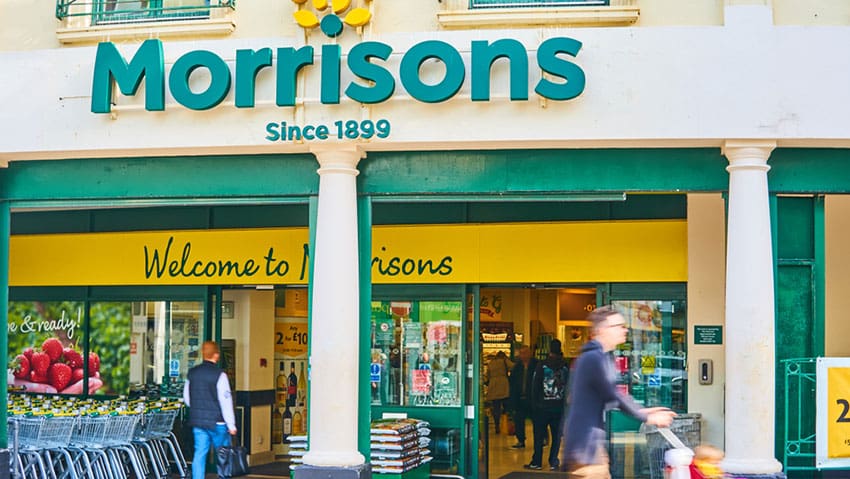
There are few sharper symbols of how brutally the British grocery market has reshaped itself over the past decade than this: Morrisons, once one of the proud “big four”, has been overtaken by Lidl in the league table of the nation’s largest supermarkets.
The Bradford-based grocer reported that group like-for-like sales rose 2.2 per cent in the three months to the end of April, a slowdown from the 2.8 per cent growth it posted in the opening quarter of the year. Total sales edged up 1.7 per cent to £4 billion over the period, lifted, the company said, by fresh food promotions tied to Valentine’s Day, Mother’s Day and Easter. Underlying earnings (Ebitda) for the first half climbed 5.7 per cent to £323 million.
Steady enough numbers in isolation. The problem for Morrisons is what was happening elsewhere on the shelf.
According to Worldpanel by Numerator, Lidl held 8.6 per cent of the UK grocery market in the 12 weeks to 17 May, nudging ahead of Morrisons on 8.3 per cent and claiming the title of Britain’s fifth-largest grocer. For a chain that controlled barely more than 1 per cent of the market at the turn of the millennium, it is a remarkable ascent, and one we have tracked closely as Lidl crossed the threshold.
Morrisons, predictably, is not minded to concede the point. The grocer argued that the Worldpanel figures “underestimate” its true position because they exclude convenience stores. A spokesman added that the chain had “maintained our share while not opening new supermarkets, unlike the discounters who continue to add significant new space”. There is data to support the pushback: separate figures from NIQ put Morrisons on 8.5 per cent for the same window, just ahead of Lidl’s 8.3 per cent. The trade bible The Grocer noted that the two are now running neck and neck, the precise ranking depending on whose tape measure you trust.
Advertisement
Either way, the direction of travel is unmistakable, and it lands at an awkward moment.
Rami Baitiéh, who has led the recovery effort since the end of 2023, struck a measured note. The grocer was operating in a “highly competitive market”, he said, and remained focused on delivering “the best value for customers”.
The competitive backdrop is only half the story. Morrisons has been labouring under a heavy debt load since the American private equity group Clayton Dubilier & Rice acquired it in 2021, a deal that piled £6.6 billion of borrowings onto its balance sheet. The strain still shows in the statutory accounts: the group booked a pre-tax loss of £381 million in its latest financial year, a modest improvement on the £414 million loss the year before.
There has been genuine progress on the debt itself. Net debt has fallen 46 per cent to £3.17 billion since 2022, helped along by redundancies and the sale of stores and petrol forecourts. The company now operates around 500 supermarkets alongside a clutch of convenience outlets. Baitiéh, who has described the recovery as a “marathon”, says he is seeing “green shoots every single day”.
Advertisement
One asset Morrisons appears determined to hold onto is its food production arm. It remains the only major UK supermarket group to own its entire food manufacturing supply chain, processing roughly a quarter of the fresh food sold in its aisles. The division, Myton Food Group, runs about 10 sites across the country turning out eggs, meat, chilled food, flowers, seafood, produce and baked goods.
Speculation over its future has rumbled on. The Telegraph reported earlier this year that Morrisons was weighing a sale of the unit as the conflict in Iran stoked inflation fears among British businesses. The Grocer countered that the company was “not in serious negotiations” to sell Myton. Baitiéh himself was unequivocal in January, calling the manufacturing operation the “DNA of Morrisons”, adding that “it’s going to stay”. Rather than offload it, the grocer has been courting rival supermarkets to take supply from Myton, turning a cost centre into a potential revenue stream.
Like much of the sector, Morrisons has been vocal about the burden of government-imposed costs, singling out a £75 million annual hit from the rise in employer national insurance contributions. It is a complaint echoed across the high street, with Tesco among those urging ministers to ease the pressure as input inflation and geopolitical uncertainty cloud the outlook.
Baitiéh said the supermarket continued to “monitor the impact of input inflation very closely and we remain committed to doing whatever we can to help keep prices down for customers”. He has previously argued that rising prices “particularly affect pensioners and other less affluent groups, which comprise a significant proportion of our Morrisons customer base”.
Advertisement
For all the pressure, the tone from the top was upbeat on prospects. The grocer had made an “encouraging start” to the third quarter, Baitiéh said, with “strong plans in place to make the most of the World Cup and Father’s Day”. Whether that is enough to halt the discounters’ march, or simply to slow it, will define the next chapter of a turnaround that is far from finished.
Amy Ingham
Amy is a newly qualified journalist specialising in business journalism at Business Matters with responsibility for news content for what is now the UK’s largest print and online source of current business news.
Rise follows a 1 per cent fall in April as fears over the Iran war caused Brits to curb their spending
13:05, 19 Jun 2026Updated 13:06, 19 Jun 2026
Shoppers on Buchanan Street in Glasgow(Image: PA)
UK retail sales rose in May, as shoppers returned to the high street during the heatwave and demonstrated a continued appetite for new electronic goods.
Retail sales volumes are estimated to have risen by 1.2 per cent in May, following a 1 per cent decline in April as concerns over the Iran war prompted Britons to rein in their spending, according to the latest figures from the Office for National Statistics.
Advertisement
The rebound in May was supported by the third-warmest May on record, with non-food stores driving the upturn as shoppers sought products to cope with the heat.
Non-store retailers recorded a 6.1 per cent increase, the largest monthly gain since February 2025, as shoppers sought products to cope with the heat.
Retailers, in particular, attributed warm-weather promotions and sales of items such as outdoor furniture, paddling pools and fans to the upturn, as reported by City AM.
Department store volumes also grew 2.7 per cent in the three months to May, the largest three-monthly increase since September 2024, with analysts anticipating summer events, including Wimbledon and the World Cup, to keep shoppers coming back to the high street.
Advertisement
Erin Brookes, European retail and consumer lead at Alvarez & Marsal: “May’s retail sales figures offer hope that consumers are willing to spend again, with the warm weather and bank holiday weekends helping to drive demand across department stores, online retail and consumer electronics.
“Retailers will be willing this positive momentum to carry through the summer.”
Sales volumes amongst computer and telecoms retailers also climbed, as customers demonstrated continued demand for products launched in March, with some choosing to delay new purchases amid the uncertainty surrounding the Iran war.
Online sales volumes also leapt 3.3 per cent in the three months to May, while sales values rose 12.2 per cent compared to the previous year.
Advertisement
However, food stores experienced a 0.4 per cent drop in sales as grocery volumes “remain under pressure” from stretched households having to juggle soaring bills, housing costs and unpredictable fuel prices, with Ms Brookes observing many “are still prioritising saving”.
She said: “Beneath the headline growth, this remains a market shaped by selective demand rather than renewed confidence.
“Grocery volumes remain under pressure, and in non-food the strongest gains came where weather, timing and clear purpose aligned. Consumers are still value-conscious, deliberate and willing to shift, channel or delay spend in search of the right proposition and promotion.”
Despite the increase in non-food purchases, analysts highlighted that the market remains “shaped by selective demand rather than renewed confidence”, with the heatwave chiefly responsible for the uptick. Found said: “Consumers are still value-conscious, deliberate and willing to shift channel or delay spend in search of the right proposition and promotion.
Advertisement
“That leaves retailers trapped between political pressure and commercial reality. The government is pushing the sector to do more to support stretched households, but retailers are facing rising wages, energy, and operating costs of their own.
“Retailers know these moments tend to create pockets of demand rather than a broad uplift. The challenge remains in supporting affordability for customers, while protecting profitability.”
Nevertheless, some analysts pointed out that a potential resolution to the Middle East conflict, coupled with high-profile summer sporting events, could sustain elevated sales into June.
Oliver Vernon-Harcourt, head of retail at Deloitte, said: “Brighter times may lie ahead. With some resilience in households’ personal finances, the end of geopolitical tensions and World Cup fever kicking in, we could see spending continuing to improve. Consumers may start enjoying more seasonal splurges, including in the more discretionary categories.”















































You must be logged in to post a comment Login