
Crypto World
Most Litecoin nodes ignore patch for double-spending bug



Earlier this year, a hacker tried to double-spend litecoin (LTC) before an emergency, 13-block reorganization thwarted the attack.
Even though developers have released a flurry of code patches to prevent a repeat, most of the Litecoin network’s nodes have still not installed the fix.
The patch has been available for free download for nearly two months. Nonetheless, of the nodes tracked by a major monitoring service, less than 30% are running up-to-date software that would reject the type of transactions behind April’s double-spending attempt.
Sadly, the largest cohort of node operators on the Litecoin network by software version run v0.21.4. This vulnerable version is live on roughly 39% of reachable nodes, most of which are non-mining.
Fortunately, most mining Litecoin nodes have updated their software, despite most validating nodes, which comprise the majority of the network, still operating with old, buggy code.
Read more: Bitcoin thieves got away with ATM double-spending spree across Canada
A post-incident review admitted that adoption of the patched software was a meager 23% after nearly two weeks of public release.
As weeks roll on, malformed transactions that triggered April’s reorg would still find a temporarily receptive majority today on the internet, even though miners wouldn’t be fooled and continue building on the correct chaintip.
The original vulnerability sat in Litecoin Core’s handling of MimbleWimble Extension Block (MWEB) transactions. MWEB is a Litecoin privacy layer the project activated in 2022.
Earlier this year, a malformed MWEB peg-out transaction allowed a tiny input to back a far larger withdrawal of LTC, effectively creating coins that should never have existed.
Nodes ignore the patch for Litecoin’s double-spending bug
It would be far more secure if most — or ideally all — nodes patched their software to reject invalid peg-out transactions containing unfairly minted LTC, but despite the fix being public for weeks, the network has declined or simply been too lazy to install it.
The major incident involving the exploit occurred on April 25. Non-upgraded mining nodes accepted an invalid MWEB transaction, and an attacker pegged out coins to third-party venues in an attempt to convert the fake LTC for other assets.
A 13-block reorganization beginning at block 3,095,931, documented in the post-mortem, fortunately reversed those transactions and wiped out roughly half an hour of blockchain activities.
The official Litecoin account admitted on social media, “A zero-day bug caused a DoS attack that disrupted major mining pools.” Litecoin creator Charlie Lee also posted about the double-spending attempt.
Litecoin node software developers shipped v0.21.5.4 the day after the reorg to stop the immediate threat of mining denial-of-service.
They soon followed with another patch in early May, v0.21.5.5, to add consensus-level MWEB validation hardening. Many node operators have simply ignored it.
Litecoin has a market cap of $3.4 billion. Its long-term security depends on software updates that most node operators have ignored for almost two months.
Got a tip? Send us an email securely via Protos Leaks. For more informed news and investigations, follow us on X, Bluesky, and Google News, or subscribe to our YouTube channel.


European support for Ukraine remains strong, and governments suffering from higher prices are more likely to blame Moscow than Kyiv. But Putin is now so anxious for battlefield wins that he will stay the course even without a clear-cut victory. Nor should we expect a revival of the agreement brokered by the United Nations in July 2022 that restored safe maritime traffic to and from Ukrainian ports.
Just as the standoff in the Strait of Hormuz has sent neighboring countries scrambling for new ways to move oil out of the Persian Gulf, Ukraine may be able to move grain through the Danube, via Romanian ports, and by rail, as it did in the war’s early days. But as before, diversions are costly and logistically complicated.
For all these reasons, the shape of Russia’s war on Ukraine will continue to shift as each side searches for new ways to break the battlefield stalemate in its favor. And the economic damage, felt well beyond Ukraine and Russia, will continue.


Traders have no way to react to events after markets close on TradFi venues. Perps on the other hand run 24/7. The Iran conflict was reflected in oil perps on Hyperliquid before CME reopened. Perps offer a continuously running, efficient market in a simple interface. Futures and options come with expiry dates, complicated greeks and interfaces. Perps remove all of that while keeping the speculative upside potential intact.
Martin Lee is Market Insights Lead of DWF Labs, one of the most active market makers and investors in digital assets.
Derivatives always outgrow spot
Derivatives volumes always outgrow their underlying spot market. It’s what we see in equities, commodities and crypto. RWAs are following the same trend. Equity perp volume on Hyperliquid ran 13-20x tokenized equity spot volume between March and May 2026.
You could argue that the number of traders matter more, a metric that spot usually wins out across most markets (except commodities). Looking into the numbers, tokenized equities have the bigger base: 180,845 wallets against 24,378 for equity perps. But perp holders are compounding at roughly 33% a month against spot’s 17%. Even in the domain where spot dominates, perps are rapidly closing the gap.
Perps innovate faster
The biggest factor driving the acceleration is the rapid rate of experimentation that RWA perps are able to have. Launching tokenized assets takes much longer and is more legally complex than launching a new perp market. The ease of launching perp markets creates opportunities for novel synthetic markets to be spun up. Markets that unlock fresh opportunities that didn’t exist before. A true 0 to 1 moment.
The team behind Pi Network set a deadline for its next big upgrade, while Solana’s native token risks plunging to as low as $50.
Bitcoin (BTC) may also head south, but interestingly, some analysts believe such a move could actually benefit the bulls.
Pi Network’s Announcement
The Core Team has been on a tear since the start of 2026, unveiling several major ecosystem improvements. The latest was the migration to protocol version 25, which was supposed to be deployed earlier this month.
Pi Network’s team did not disclose the move on X or on its website, yet multiple users claimed that it was in effect. The project has now shifted its attention to the next protocol update (version 26), setting August 11 as the deadline.
“All Mainnet note operators must complete the upgrade before the deadline to remain connected to the network,” the post reads.
The team also shared additional details about its Pi Launchpad model. It explained that in this ecosystem, projects issue tokens as tools to acquire users for their applications and integrate those coins directly into product functionality, such as rewards, payments, access, and governance.
“Instead of being taken by the issuing project, the proceeds of Pi from their token launch go to a liquidity pool with the ecosystem token, which bootstraps a healthy liquidity foundation from the start,” the team added.
PI, which was bleeding heavily prior to the aforementioned announcements, managed to rebound and now trades at around $0.08. Still, it remains down roughly 97% from its all-time high of $3 registered last year.
SOL at Risk
Solana’s native cryptocurrency has slipped by 3% over the past week, currently trading at around $73.50. This means that it has plunged below the $73.75 mark, which the popular analyst Ali Martinez recently described as a “make-or-break” level.
He believes that a sustained close under this key zone might trigger further selling pressure and result in a collapse to $60 and even $50 in the near future.
However, not all are pessimists. X user Crypto Zenkai argued that buying SOL below $80 is like investing in Bitcoin (BTC) in 2010, while Lucky told his nearly 2 million followers that the asset’s plunge under $75 might represent a “juicy dip.”
BTC Needs to Fall?
As of press time, the primary cryptocurrency is worth approximately $63,800, a 2.5% decline on a weekly basis. And while bulls eagerly await a resurgence, Martinez claimed they should actually welcome a potential drop to $60K.
He believes that a plunge to that level would validate the formation of a classic inverse head-and-shoulders pattern that is typically seen as a precursor to a rally. The analyst opined that completing the setup, combined with a confirmed breakout above $66,500, could set the stage for a rally to a two-month high of $74K.
Not long ago, Martinez predicted that BTC’s bear market (assuming the 4-year cycle holds) may conclude between October 6 and October 16. Until then, many industry participants expect the asset’s price to plunge below $50,000 and even $40,000. The most bearish forecast came from X user BATMAN, who claimed that BTC’s recent performance mirrors that of the autumn of 2022, which was followed by a giant collapse to roughly $16,000.
The post Recent Pi Network (PI) Updates, Solana (SOL) Warning, and More: Bits Recap July 31 appeared first on CryptoPotato.


Someone likely used AI to drain almost 600 BTC, worth $38 million, from roughly 500 dormant wallets yesterday as part of a seed phrase exploit targeting Coldcard hardware wallets.
The attack took just 25 minutes to move the BTC from 500 single-signature addresses into a single address, and reports suggest the exploit will likely continue.
Coindesk reports that the affected BTC was dated between 2021 and 2026, and much had remained dormant for years. Of the 594 coins stolen, 562 remain in the same address at the time of writing.
Coldcard maker, Coinkite, confirmed hours after the exploit that seed generation within its Mk3 wallet, and its subsequently updated versions beyond March 2021 (version 4.0.1), may not have been random at all.
Coldcard initially claimed that its Mk3 devices were at risk, and that the Mk4, Q, and Mk5 are “not affected based on our early analysis.”
Read more: Credit default swaps forecast AI bankruptcies
Block, formerly known as Square, found different results in its published analysis while one of its team members, Max Guise, found flaws between Mk2 and Mk5 Coldcard models.
The payments company traced the bug to a mis-written compile-time check. The newer devices, Block found, carry a smaller, but real, version of the same flaw.
Coinkite believes AI was used to discover exploit
Coinkite’s recent analysis deduced that, because Coldcard’s source code is open and public, someone likely used AI to exploit it.
It said that a few weeks before the attack, it couldn’t spot the bug even with Coinkite’s use of “the best available AI models.”
It added, “Both attackers and defenders have the same AI tools, but today it did not help us, and only helped the bad guys.”
Pseudonymous owners of Bitcoin.org website, Cobra, also expressed that they have “very bad feeling AI was involved,” and noted, “For whatever reason some addresses are only being partially drained despite the private key being compromised. Strange.”
Read more: Apple threatens Sparrow bitcoin wallet dev with App Store termination
Crypto developer Stephen DeLorme claims he was able to use AI model Claude Opus 5 to sniff out the Coldcard vulnerability after cloning the firmware’s repository.
“All our software is insecure, and we’re painfully figuring that out in realtime with AI agents,” DeLorme said.
The technicalities behind the Coldcard BTC theft
BTC wallets need genuinely random numbers to generate an unguessable private key. Coldcard’s firmware was supposed to pull that randomness from a hardware generator built into its STM32 chip.
According to Block, a codebase check tested only whether a macro called MICROPY_HW_ENABLE_RNG was defined, not what value it held.
Coinkite’s software build set that macro to zero on purpose. Because the character was set to zero, and not a variable symbol, the check was flawed.
Despite this, the flawed check passed anyway during software operations. Firmware fell back to Yasmarang, a MicroPython pseudo-random number generator never meant for real-world cryptographic protection.
Read more: The number of BTC wallets holding more than 0.1 BTC hasn’t grown in two years
Bitcoin Core developer Gregory Sanders reproduced the attack using setup button-press counts, and confirmed its impact on Mk3 and Mk2 models. His own response to his findings was, “Sorry, this is the time to panic.”
Sanders first wrote, “confirmed. Mk2/3 vuln, I don’t think mk4 is but can’t be certain,” before following up an hour later with “mk4 is probably not much better.”
Got a tip? Send us an email securely via Protos Leaks. For more informed news and investigations, follow us on X, Bluesky, and Google News, or subscribe to our YouTube channel.
The post Coldcard attack: 25 minutes, 500 wallets, $38M in BTC gone appeared first on Protos.
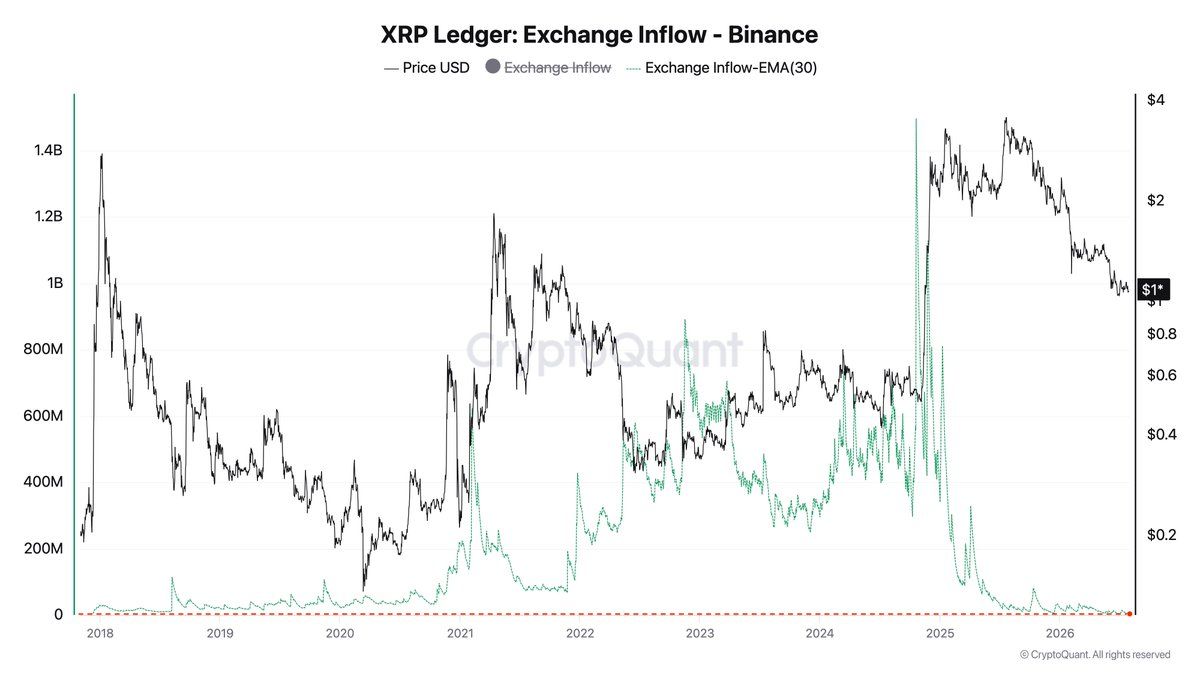
XRP (XRP) gained over 3.8% in July, snapping a two-month losing streak. The token still trailed other large caps, with Bitcoin (BTC) adding about 9% and Ethereum (ETH) around 20%.
As August begins, two on-chain signals point to fading sell pressure. However, the month has historically offered XRP little support, and institutional demand through ETFs remains thin.
XRP Exchange Data Shows Sellers Stepping Back
In a post on X, analyst Darkfost noted that XRP inflows to Binance have fallen to a record low. According to the analyst, average monthly inflows to the exchange have dropped to roughly 3.6 million XRP.
While the figure remains significant in absolute terms, it marks the lowest monthly inflow ever recorded. Darkfost said the trend suggests that XRP holders are showing little willingness to move tokens onto exchanges for sale, pointing to an exhaustion of selling pressure.
He added that the reduced pressure could help XRP establish stronger price support above $1.
“What remains to be seen is whether a genuine rebound in demand will follow this lull on the sell side, a condition that appears necessary to spark a sustainable bullish trend,” the analyst added.

Follow us on X to get the latest news as it happens
Meanwhile, another on-chain analyst reported a sharp increase in XRP withdrawals from exchanges. Withdrawal transactions accounted for 55.6% of XRP activity on Binance over the past seven days as of July 31, the highest share since February 2021.
Across all centralized exchanges, the figure reached 54%, confirming the shift extends beyond a single venue.
Deposit transactions moved the opposite way. Binance’s deposit share slipped to 44.3%, while the market-wide figure fell to 45.95%. Both readings mark multi-year lows.
The metric tracks transaction counts rather than XRP volume or net flows. It signals a structural change in exchange behavior but does not, on its own, confirm accumulation.
August Seasonality and ETF Flows Cloud the Setup
Yet, history gives buyers less comfort. August is XRP’s flattest month on record, averaging returns of just 0.43%, and it has closed red for four straight years. That seasonality contrasts with July, which XRP has closed green every year since 2020.

Institutional appetite offers little counterweight. Spot XRP ETFs attracted only about $19.6 million in net inflows across July’s 21 trading days, according to SoSoValue data. Flows registered zero on 11 of those days, while July 1 and July 8 saw outright outflows.
The on-chain picture suggests sellers have largely stepped aside above $1. Whether dormant ETF desks and a historically quiet month allow demand to return will define XRP’s August.
Subscribe to our YouTube channel to watch leaders and journalists provide expert insights
The post XRP Flashes 2 Bullish On-Chain Signals Heading Into August appeared first on BeInCrypto.


Quantum Solutions more than doubled its authorized Ethereum (ETH) sale cap to 4,375 ETH on July 30, as subsidiary GPT Pals Studio sold another 1,000 ETH at $1,903 per token.
The sale generated $1.9 million in proceeds and is expected to result in an accounting loss of approximately JPY 17 million ($100,970). The proceeds will fund the group’s AI Infrastructure Data Center (AIDC) business.
Why Quantum Solutions Is Selling Its ETH Holdings
The Tokyo Stock Exchange-listed firm first approved sales of up to 1,875 ETH on June 4. It cited funding needs for data center usage agreements, GPU equipment, and business launch preparations.
GPT Pals Studio sold 904 ETH on June 16, leaving just 971 ETH available under the original policy. The board therefore added 2,500 ETH to the cap through a written resolution on July 30.
The group has now sold 1,904 ETH since June, cutting its holdings to 4,764.80 ETH. However, 3,050 of those tokens have remained pledged to a Singapore-based lender as collateral since April. That leaves only 1,714.80 ETH in GPT’s trading account.
The July sale resulted in an expected accounting loss because the sale price of $1,903 per ETH was below the carrying value of $2,003.97,
“As a result of the sale, the Company expects to recognize a loss on sale of approximately JPY 17 million during the second quarter of the fiscal year ending February 2027, calculated based on the carrying value following the mark-to-market valuation conducted at the end of the first quarter of the fiscal year ending February 2027,” the firm said.
Follow us on X to get the latest news as it happens
Crypto Treasuries Feed the AI Trade
Quantum Solutions joins a widening group of public companies chasing the AI trade. Bitcoin (BTC) miners show the trend most clearly.
IREN, TeraWulf, and Core Scientific have redirected their energy-heavy facilities from mining rigs to high-performance computing (HPC) and AI workloads.
In fact, public miners offloaded 32,000 BTC in the first quarter of 2026, exceeding their disposals for all of 2025. Squeezed margins, heavy debt loads, and AI infrastructure shift drive the exodus.
Subscribe to our YouTube channel to watch leaders and journalists provide expert insights
The post Tokyo Firm Liquidates Part of Ethereum Treasury to Fund AI Data Centers appeared first on BeInCrypto.

Ken Griffin’s Citadel has reportedly stepped in to buy a large portion of the publicly traded stock portfolio of Situational Awareness, the hedge fund run by former OpenAI researcher Leopold Aschenbrenner. The deal comes after steep losses tied to last month’s broad selloff in AI-linked equities.
According to the Financial Times, Citadel purchased the discounted portfolio after Situational’s performance deteriorated in July’s AI stock rout. Earlier reporting from The Wall Street Journal indicated Situational fell about 67% during July, even as it was still up roughly 80% for the year at the time of a letter sent to investors.
Key takeaways
- Citadel reportedly bought much of Situational Awareness’s publicly traded equity portfolio after major July losses in AI-linked stocks.
- Reports cite liquidity pressure, including the need to handle lender margin calls, though Reuters could not confirm whether formal margin calls were issued before certain share sales.
- SEC filings show Situational held public stakes in AI-adjacent names such as Sandisk, CoreWeave-related exposure, and Bloom Energy as of March 31, alongside a sizable Bitcoin mining share portfolio.
- It remains unclear which exact holdings were included in the Citadel transaction and whether any of the miner positions were retained.
From AI selloff to portfolio sale
The reported acquisition follows a sharp equity drawdown that hit hedge funds concentrated in AI infrastructure and related trades. The Financial Times said Citadel bought the portfolio at a discount after Situational Awareness suffered heavy losses during July’s AI stock market rout.
The sequence of events described by major outlets suggests liquidity became the limiting factor. The Wall Street Journal reported that Situational needed cash to meet margin calls from its lenders. In that account, the fund agreed late Wednesday to sell $3.5 billion of Anthropic shares to a group led by Greenoaks and Sequoia Capital, but then withdrew from the deal after agreeing terms for a Citadel-led portfolio transaction.
Reuters separately reported that Citadel bought most of Situational’s stock holdings after the AI share rout and described details of the leveraged portfolio and share sales. Reuters also stated it could not determine whether formal margin calls had been issued before the Anthropic-related sale discussions. Reuters added that Situational retained about $10 billion in stocks and private investments, including exposure to Anthropic.
What July losses looked like in holdings
Several stocks connected to Situational Awareness’s portfolio reportedly dropped sharply during July. Yahoo Finance data cited in the coverage shows Sandisk down about 44% for the month even after closing Thursday up 26%. CoreWeave was down nearly 26% in July, while Bloom Energy fell around 32%, according to the same dataset.
While those monthly declines underline how concentrated positions can magnify market stress, they also illustrate why a portfolio sale at “discounted” terms can become attractive to a counterparty—particularly when pricing dislocations occur across an entire thematic trade rather than a single company-specific issue.
SEC filings point to AI infrastructure and Bitcoin mining exposure
Situational Awareness’s U.S. Securities and Exchange Commission filing reportedly shows direct share positions in at least three companies—Sandisk, CoreWeave, and Bloom Energy—as of March 31. The SEC document is used to ground the public-equity portion of the story, including what was held before July’s drawdown.
The same filing also showed approximately $1.11 billion in shares of seven Bitcoin (BTC) mining companies, including Iren, Core Scientific, Riot Platforms, and CleanSpark. Cointelegraph previously reported that the strategy involved miner exposure that could benefit from demand for AI and high-performance computing by repurposing power supplies and data center sites.
In this round of reporting, however, the critical open question for investors is scope: it is not clear which specific stocks were included in the Citadel transaction, and it remains uncertain whether Situational retained any of its Bitcoin miner positions after the sale of the public stock portfolio.
Why the trade may signal shifting leverage risk
Across hedge fund industry coverage, the theme in situations like this is rarely the long-term thesis of an investor—it’s how leverage and collateral requirements interact with fast-moving equity markets. The reporting around margin calls and the need for cash suggests the fund’s ability to keep positions through volatility was constrained.
At the same time, the asymmetry between what is publicly visible and what is financially decisive remains. Reuters’ note that it could not confirm whether formal margin calls had been issued before certain transactions highlights the limits of what outsiders can verify in real time—especially when term sheets, lender discussions, and collateral mechanics are involved.
For readers tracking crypto-adjacent strategies, the story also underscores that “AI” and “crypto infrastructure” exposures are increasingly intertwined. Situational’s reported combination of AI-linked equity holdings and Bitcoin miner stock exposure reflects a broader market reality: demand for power, computing, and deployment of infrastructure can connect traditional equity investing, AI narratives, and crypto mining businesses.
Watch items after the reported deal
Investors should watch for further clarity on which holdings Citadel acquired, whether Situational retained any miner positions, and how the fund’s remaining $10 billion of reported stocks and private investments evolve after July’s volatility. Until additional filings or confirmations arrive, the practical takeaway remains straightforward: when leverage meets thematic drawdowns, portfolio exits can happen quickly—even for funds that may still look strong over a longer time horizon.

The state is seeking at least $36 billion in damages from the prediction market platform it calls an unlicensed gambling operation, and has filed for a temporary restraining order to halt its contracts immediately.
Summary
- New York Attorney General Letitia James and Governor Kathy Hochul sued KalshiEX on July 31, 2026, in New York Supreme Court, Manhattan, seeking at least $36 billion in compensatory damages, triple-gains penalties, and $100,000 per unauthorized sports wagering offer.
- The state simultaneously filed a motion for a temporary restraining order to halt Kalshi’s event contracts in New York immediately, citing ongoing harm to consumers including users under the legal gambling age of 21.
- Kalshi users bet over $1 billion monthly on the platform in 2025, with 90% of that volume on sports, according to figures cited in the AG’s own release, a concentration that makes the bipartisan Senate proposal to ban sports event contracts existential for the business.
- Kalshi, valued at roughly $22 billion with annualized volume of approximately $178 billion, calls the suit “political theater” and argues its CFTC registration as a designated contract market means exclusive federal oversight.
- A bipartisan coalition of 38 state attorneys general has already filed an amicus brief supporting Massachusetts in a parallel case, signaling that the enforcement wave extends far beyond the 13 states with active litigation.
The lawsuit that prediction markets knew was coming
Two days after the Second Circuit denied Kalshi emergency relief on July 29, New York filed the most aggressive state action yet against the prediction market industry. The suit arrived with a coordinated announcement from AG James and Governor Hochul, counts spanning multiple bodies of state law, a $36 billion damages demand, and a motion for an immediate restraining order.
The $36 billion figure, reported by The Block based on the court filings, is roughly 1.6 times Kalshi’s reported valuation. It is the number every major outlet is leading with, and it signals that New York is treating this as a revenue-extraction case, not merely a cease-and-desist.
This piece examines the filing, the legal arguments on both sides, the federal regulator caught between them, and what the case means for an industry now fighting a war on two fronts: in courtrooms and in Congress.
What the complaint actually alleges
The core claim is straightforward: Kalshi is running an unlicensed gambling business in New York.
The AG’s office says the platform lets users place wagers on uncertain future events, from Super Bowl outcomes to reality TV winners to election results, without a Gaming Commission license and without paying state gaming taxes. New York treats these as bets, not derivatives, regardless of Kalshi’s CFTC registration.
The complaint goes further. It alleges Kalshi allows users aged 18 to 20 to place bets, violating New York’s 21-and-older minimum for mobile sports betting. It alleges the platform offered wagers on games involving New York college teams, a separate violation under state law.
The AG’s investigators placed test wagers from New York accounts as evidence: four “Yes” contracts on a UConn-Michigan basketball game at $1.14 in April 2026, and ten contracts on the winner of “Big Brother” in July 2026. Both transactions completed without obstruction.
The filing also introduces a count under the federal Interstate Wire Act, alleging Kalshi used wire communications to transmit bets across state lines. This is significant because it widens the legal exposure beyond state gambling statutes into federal criminal law, giving the state an argument that operates independently of the preemption question. Even if Kalshi’s CFTC registration were found to preempt state gambling law, the Wire Act is a federal statute, and the state is arguing that Kalshi violates it.
The complaint details the investigative methods in unusual specificity. Rather than relying on industry reports or third-party data, the OAG built its case from the inside. Investigators created accounts, placed real wagers, and documented each step. This matters for the TRO motion: the state can present firsthand evidence that illegal gambling is actively occurring in New York, not merely that it could occur.
“Prediction markets like Kalshi are gambling platforms, plain and simple,” James said in a statement accompanying the filing.
Governor Hochul framed the action around consumer protection, saying Kalshi “has chosen to ignore New York’s gaming laws, which exist to protect consumers, prevent problematic gambling, deliver funding for critical public services, and ensure that every company plays by the same rules.” The coordinated announcement from both the AG and the Governor signals that this is not a routine regulatory action. It is a political priority.
The $36 billion in damages and the TRO
New York is not seeking a slap on the wrist. The headline number is at least $36 billion in compensatory damages, pending a full accounting of Kalshi’s operations. The remedies demand:
- A permanent injunction barring Kalshi from operating unlicensed gambling in the state
- A temporary restraining order halting Kalshi’s event contracts in New York immediately
- A full accounting of every customer bet and loss processed through the platform
- Forfeiture and disgorgement of all gains the state deems illegal
- Restitution to affected consumers
- Penalties of three times Kalshi’s gains under Penal Law Section 80.10
- A fine of $100,000 per unauthorized sports wagering offer under the Racing Law
The TRO is the near-term threat. If granted, Kalshi would need to suspend operations in New York while the case proceeds, potentially for years. The triple-damages provision is the long-term one. At $36 billion, New York is claiming a figure that exceeds the platform’s reported valuation of $22 billion by more than 60%.
The per-offer fine structure adds another layer. The AG’s release notes that Kalshi users bet over $1 billion monthly in 2025, with 90% of that volume on sports. Each unauthorized sports offering carries a $100,000 fine under the Racing Law. At that volume, the per-offer penalties alone could produce a figure in the hundreds of millions.
The damages calculation itself reveals the state’s theory of the case. New York is not treating Kalshi as a minor regulatory violator that failed to file paperwork. It is treating Kalshi as a gambling operation that processed billions in unlicensed wagers over multiple years, and it wants the full economic benefit of that activity returned. The $36 billion figure presumably reflects the total volume of wagers placed by New York users, or a substantial fraction of it, multiplied by the treble-damages provision. The final number will depend on the full accounting the state is requesting, but the opening demand is meant to establish the scale of the alleged violation.
The TRO motion deserves separate attention because it operates on a different timeline from the main case. A TRO hearing can happen within days or weeks, while the underlying lawsuit could take years. If New York secures the restraining order, Kalshi faces an immediate operational decision: comply and lose the New York market, or challenge the order and risk contempt proceedings. Either outcome sets a precedent that other states can follow. Michigan and Nevada secured their own TROs through similar procedural mechanisms, and each one reduced Kalshi’s geographic footprint.
The $1 billion monthly number and why it matters
The AG’s release includes a figure that has received less attention than the $36 billion headline: Kalshi users bet over $1 billion every month on the platform in 2025, and 90% of that money went to sports betting.
This is the number that makes the bipartisan Senate proposal to ban CFTC-licensed platforms from offering sports event contracts existential. Sports are not a side product for Kalshi. They are the product. If sports contracts are removed, whether by state enforcement or federal legislation, the platform loses nine-tenths of its recorded consumer activity.
The figure also undercuts Kalshi’s framing of its offerings as sophisticated financial derivatives. A billion dollars a month on the Super Bowl, the NBA, and college basketball looks like a sportsbook by any name. New York is making exactly that argument, and the AG’s investigators have the receipts.
The concentration matters for investors and market participants as well. Kalshi’s $22 billion valuation implies a diversified event-contract platform serving a range of use cases: elections, weather, economics, entertainment. The AG’s data shows something closer to a sports gambling platform with a derivatives label. If the valuation was underwritten on the assumption of product diversity, the 90% sports concentration represents a disclosure risk independent of the legal outcome.
Kalshi’s federal preemption defense
Kalshi’s position rests on a single legal premise: that its 2020 registration with the CFTC as a designated contract market means its event contracts are regulated derivatives under the Commodity Exchange Act, subject to exclusive federal oversight.
The company calls the suit “political theater” and argues states cannot simply shut down a federally licensed exchange. The framing is deliberate. Kalshi wants this treated as a jurisdictional question, not a gambling question.
It is the strongest version of their argument, and it carries legal weight. The CFTC itself has backed the position, filing lawsuits against multiple states and claiming exclusive regulatory authority over prediction markets. On the same day New York filed its suit, the CFTC filed an emergency counter-motion in Manhattan federal court less than one hour before the state complaint dropped, attempting to reassert federal jurisdiction preemptively.
The federal regulator has now challenged state enforcement in at least nine states, including filing suit against Arizona, Connecticut, and Illinois in April 2026. The CFTC is not a passive bystander in this dispute. It is an active combatant on Kalshi’s side.
Why the federal shield is cracking
On July 7, U.S. District Judge Analisa Torres denied Kalshi’s preliminary injunction against New York’s Gaming Commission enforcement. Her reasoning cut directly at the preemption argument.
Torres cited Section 2 of the Commodity Exchange Act, which states the law “shall not supersede or limit the jurisdiction conferred on other regulatory authorities under the laws of the United States or of any state.” She wrote that “Congress did not intend to regulate so broadly as to exclude all state gambling laws from regulating transactions involving swaps.”
Her conclusion was blunt: “There is nothing preventing Kalshi from obtaining a license pursuant to New York law.”
The Second Circuit denied Kalshi emergency relief on July 29. With the appellate safety net gone, the state had a clear path to file.
The Torres ruling matters beyond New York because it provides a template. Other states facing Kalshi’s preemption argument can cite it directly. The decision rejects the premise that CFTC registration creates a blanket exemption from state gambling law, and it does so by citing the Commodity Exchange Act’s own text. Before Torres, Kalshi could argue that no court had squarely addressed the question. That argument is gone.
The legal logic is worth following in detail. Kalshi’s preemption claim rests on the idea that CFTC registration means its products are regulated derivatives, full stop. Torres responded that the Commodity Exchange Act explicitly preserves state jurisdiction, that the products in question resemble gambling under New York law, and that nothing in federal statute prevents Kalshi from obtaining a state gaming license if it wants to operate in New York. The decision does not say Kalshi cannot exist. It says Kalshi cannot avoid state gambling law by pointing to a federal license that, by its own statute’s terms, was never meant to override it.
The Second Circuit’s refusal to grant emergency relief on July 29 reinforced this reasoning. It did not issue a full opinion, but the denial means Kalshi failed to show a likelihood of success on the merits, which is the standard for emergency relief. Two levels of federal courts have now declined to protect the company from state enforcement.
The result is a genuine constitutional question about the boundary between federal commodity regulation and state gambling law. Kalshi needs either a circuit court reversal or Congressional action to restore the shield it thought it had.
The 38-state coalition
The count that matters is not 13 states with active litigation. It is 38.
In April 2026, James joined a bipartisan coalition of 38 state attorneys general filing an amicus brief supporting Massachusetts in its parallel case against Kalshi. The coalition spans from Alabama to Wisconsin, including red states, blue states, and the District of Columbia. The full list: Alabama, Alaska, Arizona, Arkansas, California, Colorado, Connecticut, Delaware, Hawaii, Idaho, Illinois, Iowa, Kansas, Louisiana, Maine, Maryland, Michigan, Minnesota, Mississippi, Nebraska, Nevada, New Jersey, New Mexico, New York, North Carolina, Ohio, Oklahoma, Oregon, Pennsylvania, Rhode Island, South Carolina, South Dakota, Tennessee, Utah, Vermont, Virginia, Wisconsin, and DC.
On the same day the AGs filed, the CFTC filed its own amicus brief at the Massachusetts Supreme Judicial Court asserting exclusive federal jurisdiction, creating a direct confrontation between the federal regulator and a supermajority of state enforcement agencies.
New York is not operating in isolation. The suit fits into a pattern of escalating state enforcement that has accelerated through 2026:
Massachusetts has a court order restricting Kalshi. Polymarket has countersued the state, opening a second front.
Michigan secured a temporary restraining order against the platform under AG Dana Nessel, making it the third state to obtain a court order.
Nevada issued a TRO covering sports, election, and entertainment contracts. Kalshi responded by removing those categories for Nevada users, effectively conceding the state’s authority in practice while contesting it in court.
Washington holds its own court order restricting the platform. The state’s Gambling Commission issued a cease-and-desist, and Kalshi did not challenge it in court.
Wisconsin handed down an adverse ruling the week of July 28, adding another state to the enforcement column in a decision that received less coverage than the New York and Massachusetts actions but follows the same legal reasoning.
New York itself previously sued Coinbase and Gemini in April 2026 on similar prediction-market allegations. That suit broadened the target set beyond pure-play prediction platforms, signaling that New York views any company offering prediction-style products to state residents as subject to gaming law, regardless of whether the company’s primary business is elsewhere.
In Congress, a bipartisan Senate proposal has emerged that would ban CFTC-licensed prediction market platforms from offering sports event contracts, which would remove the category that accounts for 90% of Kalshi’s recorded volume.
The arithmetic that matters
Kalshi’s reported valuation of $22 billion rests on the assumption that its CFTC registration provides a durable regulatory moat. The annualized transaction volume of $178 billion flows through that assumption. If the federal preemption argument fails at the circuit level, the business model does not downgrade gracefully.
The platform cannot operate as a state-licensed gambling business without fundamental changes to its product, its economics, and its user base. State gaming licenses come with specific requirements: age floors (21 in New York for mobile betting), tax obligations, product restrictions, and compliance infrastructure that a CFTC-registered exchange was never built to support.
Nevada’s example is instructive. When the state issued its TRO, Kalshi did not fight to keep sports, election, and entertainment contracts available to Nevada users. It removed them. If that pattern repeats across additional states, the platform’s addressable market contracts with each new enforcement action.
The numbers tell the story in three layers. First, $36 billion in damages sought in New York alone, exceeding the company’s valuation by 60%. Second, 38 state attorneys general aligned against the federal preemption argument, representing a supermajority of American enforcement capacity. Third, 90% of Kalshi’s monthly volume concentrated in sports, the single category most vulnerable to both state enforcement and the pending Senate ban.
The counter-argument deserves its strongest form. Kalshi’s $178 billion in annualized volume proves genuine consumer demand for event contracts. The CFTC registration is not a legal fiction, and federal regulators are actively fighting to preserve federal jurisdiction. The Commodity Exchange Act does grant the CFTC authority over designated contract markets, and a reasonable reading of federal preemption could conclude that state gambling law should not apply to products traded on a federally licensed exchange. If the CFTC prevails at the appellate level, or if Congress acts to clarify federal preemption, the state cases collapse. Kalshi’s appeal of the Torres ruling remains live, and the Second Circuit has not yet ruled on the merits.
There is also a policy argument that Kalshi rarely makes explicitly but that supports its position. Prediction markets have informational value. Research from academic institutions and the CFTC’s own prior statements have recognized that event contracts can produce useful price signals about future events. A state-by-state licensing regime could effectively kill a market structure that regulators, academics, and the public have found valuable for forecasting elections, economic indicators, and policy outcomes.
But the burden has shifted. Two federal courts have declined to protect Kalshi from state enforcement. Thirty-eight attorneys general have aligned against the federal preemption argument. And 90% of Kalshi’s volume is concentrated in sports, the single category most politically vulnerable. The question is no longer whether states can regulate prediction markets. The question is whether Kalshi can find a court that says they cannot.
What to watch
- The TRO hearing in New York Supreme Court. If granted, Kalshi must suspend operations in the state while the case proceeds. The timeline and conditions of this hearing will set the pace for the entire case.
- The Second Circuit appeal of Judge Torres’s July 7 ruling. If the court reverses on federal preemption, the state enforcement wave stalls. If it affirms, expect additional state filings within weeks.
- The CFTC’s emergency motion filed hours before New York’s suit. The federal court’s handling of this motion will signal whether the judiciary treats CFTC registration as a meaningful shield or a regulatory label.
- Congressional action on the bipartisan Senate proposal to ban sports event contracts. At 90% of Kalshi’s volume, this would be a structural blow regardless of court outcomes.
- Kalshi’s operational response in states with active enforcement. Nevada’s pattern, removal of categories rather than legal confrontation, is the leading indicator of how the business adapts under pressure.
What did New York sue Kalshi for?
New York filed a lawsuit alleging Kalshi operates an unlicensed gambling business by offering wagers on sports, entertainment, and election outcomes without a Gaming Commission license and without paying state gaming taxes. The suit includes counts under the state constitution, Penal Law gambling provisions, the Racing Law, and the federal Interstate Wire Act.
How much is New York seeking in damages?
The state is seeking at least $36 billion in compensatory damages, pending a full accounting of Kalshi’s operations. Additional penalties include three times the company’s gains under Penal Law and $100,000 per unauthorized sports wagering offer under the Racing Law.
What is the temporary restraining order?
Alongside the lawsuit, New York filed a motion for a TRO to halt Kalshi’s event contracts in the state immediately while the case proceeds. If granted, Kalshi would need to suspend operations in New York, potentially for years.
What is Kalshi’s defense?
Kalshi argues that its registration with the CFTC as a designated contract market since 2020 means its event contracts fall under exclusive federal oversight and that states cannot regulate them as gambling. The company calls the suit “political theater.”
How did the court rule on federal preemption?
U.S. District Judge Analisa Torres denied Kalshi’s preliminary injunction on July 7, ruling that the Commodity Exchange Act does not prevent states from applying their gambling laws to event contracts. The Second Circuit denied emergency relief on July 29.
How many states are aligned against Kalshi?
A bipartisan coalition of 38 state attorneys general filed an amicus brief supporting Massachusetts in a parallel case. At least five states, Massachusetts, Michigan, Nevada, Washington, and Wisconsin, have active court orders or adverse rulings restricting Kalshi’s operations.
What role is the CFTC playing?
The CFTC has positioned itself as the exclusive federal regulator of prediction markets, filing lawsuits against multiple states and an emergency motion less than one hour before New York’s suit. The agency has challenged state enforcement in at least nine states and filed an amicus brief directly opposing the 38-state attorney general coalition.
Could this lawsuit shut down prediction markets entirely?
The New York case alone would not end the industry, but it tests whether CFTC registration shields platforms from state gambling laws. With 38 attorneys general aligned against the federal preemption argument and 90% of Kalshi’s volume concentrated in sports betting, the combination of state enforcement and the pending Senate ban on sports event contracts could force a fundamental restructuring of the business model. This is educational analysis, not investment advice.
This article is for informational purposes only and does not constitute legal, financial, or investment advice. The information presented reflects the state of events as of July 31, 2026, and may change as legal proceedings develop. Readers should consult qualified professionals before making decisions based on this material.

Japan’s Ministry of Finance confirmed yen buying, dollar selling intervention on July 30, sending USD/JPY sharply lower before the pair recovered later. However, the rebound highlighted how intervention alone struggles to reverse a long-term trend without monetary policy support.
Meanwhile, the Bank of Japan kept its policy rate at 1.0% after its July meeting while maintaining a tightening bias. For crypto, narrowing US-Japan rate differentials and a softer dollar could pressure the yen carry trade, a major funding source for leveraged risk assets, including Bitcoin.
Discover: The Best Token Presales
Yen Intervention Alone Cannot Reverse the Trend
Japan has intervened several times to support the yen over the past two years, including large-scale operations in 2024 and another confirmed move on July 30. Each intervention briefly strengthened the currency before market forces regained control. That pattern reflects the wide interest rate gap between Japan and the United States, which still favors holding dollars over yen.

Reports also suggested Japanese officials remained in close contact with US counterparts during the intervention period. However, there was no confirmation of coordinated intervention with the Federal Reserve or the US Treasury. While comments from US officials acknowledged yen weakness, the operation remained Japan-led rather than a joint currency action.
The quick recovery in USD/JPY after intervention reinforces the structural challenge. With the BoJ holding rates at 1.0%, markets focused instead on Governor Kazuo Ueda’s guidance for future hikes. That outlook, rather than intervention itself, is likely to determine whether the yen can sustain further gains.
Trade Crypto on Bybit and Get a Chance to Win Our $1,000 USDT Airdrop
Why the Yen Carry Trade Matters for Bitcoin
The yen carry trade relies on borrowing low-cost yen and investing in higher-yielding assets. As Japanese rates gradually rise while the Federal Reserve pauses, that advantage becomes smaller. Even so, the US-Japan rate gap remains wide enough to keep the strategy attractive for many investors.
Economists broadly expect the BoJ to continue raising rates cautiously over the coming quarters, although the timing remains uncertain. Some forecasts point to another increase before the year’s end, while others expect policymakers to wait until inflation and wage growth strengthen further. A gradual path would likely produce an orderly carry trade unwind instead of a sudden market shock.

The most relevant comparison remains August 2024, when an unexpected BoJ rate hike contributed to a sharp yen rally and forced investors to unwind leveraged positions. Bitcoin fell alongside equities as funding conditions tightened. Although today’s backdrop shares some similarities, current conditions are less extreme because markets already expect additional tightening.
For Bitcoin, the base case remains a gradual normalization in Japan that creates modest headwinds rather than a major selloff. However, a faster pace of BoJ tightening or another surge in the yen could accelerate deleveraging across crypto markets. That makes Japanese monetary policy an increasingly important macro factor for traders, even if intervention alone is unlikely to change the trend.
Discover: The Best Crypto to Diversify Your Portfolio
The post BoJ Holds at 1% as Yen Intervention Fades: Bitcoin’s Carry Trade Risk Grows appeared first on Cryptonews.


Ken Griffin’s Citadel has bought most of Situational Awareness’ AI stock portfolio at a discount, a move that represents another victory for the billionaire villain of the crypto industry.
Indeed, despite years of criticism about Griffin’s traditional finance tactics, the crypto industry keeps giving him more assets.
From a copy of the US Constitution, payment for order flow, equity in a $40 billion crypto holding company, and a new distressed portfolio of cheap AI stocks, crypto traders are far too willing to further enrich the billionaire CEO.
Margin calls gutted former FTX Future Fund member Leopold Aschenbrenner’s AI hedge fund earlier this week, turning the 25-year-old into a forced seller liquidated under a stack of self-imposed leverage to Griffin’s standing bid.
Griffin, unlike most crypto investors, had plenty of cash amid Aschenbrenner’s distress.
The New York Times reported that Citadel won the overnight auction for Situational Awareness’ AI stocks at a “considerable reduction” to market value.
Crypto has watched this movie before.
Cheap share certificates alongside a cheap US Constitution
When the crypto industry’s people, tokens, or trophies land across the negotiating table from Griffin, more often than not, traders often accept his lowball offer. At the eleventh hour, a little cash is better than nothing at all.
Consider what happened in November 2021 when ConstitutionDAO raised over $40 million of ETH to bid on a physical print of the US Constitution. Over 17,000 donors chipped in at a median of $206 apiece.
Their crowdfunded bid carried a fatal flaw, as Protos noted. Its balance sat on-chain in public view, so rival bidders like Griffin knew precisely where their money to bid would run out.
The DAO also reserved millions for fees and costs that it couldn’t spend on bids.
Griffin won the document at $43.2 million. Sotheby’s irrevocable-bid mechanics trimmed roughly $4.2 million off his final bill. This spring, he bought the only other privately owned first print, cornering the market for the immensely valuable collectible, despite crypto’s attempt to decentralize it.
Thanks for the payment for order flow
Payment for order flow is a predictable profit generator for sophisticated market-makers and quantitative trading companies like Citadel.
Whenever a stock brokerage or similar platform offers commission-free or “$0 fee” trades, they often engage in payment for order flow on the backend.
Citadel Securities has accounted for over 40% of all US payment for order flow in some years, and it’s happy to accept order flow from crypto traders who inefficiently smash buy or sell with “market” orders.
Of course, retail crypto traders also buy stocks and options — the same folks who route even more payment for order flow through Citadel.
On crypto trades, for example, Robinhood discloses that market makers pay it $0.95 per $100 of orders routed. Its SEC filings identify B2C2, Wintermute, and Citadel Securities among the companies paying for order flow.
Read more: Ken Griffin wants the SEC to follow Citadel’s advice about DeFi
Ripple equity, cheaper than its own tokens
Consider another example of Griffin’s one-sided crypto dealings.
In November 2025, Ripple raised $500 million at a $40 billion valuation. Affiliates of Citadel Securities co-led the round.
Although the valuation seemed impressive, Griffin wasn’t taking much risk. In fact, XRP was trading near $2.35 the day of the announcement.
That day, Ripple held roughly 37 billion XRP, a pile worth about $87 billion that day.
In other words, Citadel bought shares in a company valued at less than half its crypto holdings.
In addition to his incredibly discounted valuation, Griffin also received protections from the price risk of XRP itself.
Bloomberg reported the fine print that benefitted Citadel. Absent an IPO or sale within a few years, those Ripple investors would have the right to put their shares back to the company at a positive annual rate of return.
Citadel’s rights also stand ahead of existing shareholders in the event of any liquidation.
In summary, crypto has gifted Ken Griffin and Citadel a cheap portfolio of AI stocks, a cheap Sotheby’s art piece, cheap payments for order flow, and cheap equity at less than half its balance sheet.
Despite describing crypto in October 2021 as a “jihadist call” against the US dollar, it’s been paying him ever since.
Got a tip? Send us an email securely via Protos Leaks. For more informed news and investigations, follow us on X, Bluesky, and Google News, or subscribe to our YouTube channel.

Why Russia Is Choking Ukraine’s Black Sea Ports

Hackney votes to end 58-year Haifa twinning, citing “anti-racist values”

Infantino’s senior advisor resigns amid outrage over FIFA’s private investment plan


-

 Fashion7 days ago
Weekend Open Thread: Brooks Brothers
-
 Sports5 days ago
Commonwealth Games boxing: Jadumani Singh seals dominant 5-0 win over Pakistan’s Sumama Rehman to enter quarter-finals | Commonwealth Games News
-

 Business2 days ago
Why Trees Belong on the Risk Register
-

 Tech5 days ago
Intel is reversing course and bringing hyper-threading back to its server chips
-

 Crypto World6 days ago
Ripple bought a bank in pieces. The $4 billion audit
-

 Politics4 days ago
Luke Littler dismantles Gerwyn Price to retain title in Blackpool
-
 Entertainment7 days ago
A New Post-Apocalyptic Gundam Anime Series Blasts Into SDCC
-

 Politics3 days ago
The Part of the Electric Transition Nobody Wants to Discuss
-

 News Videos5 days ago
BITCOIN JUST ENTERED THIS CRITICAL ZONE…
-

 Business2 days ago
Major shareholder moves on Canyon
-

 Crypto World5 days ago
XRP Ledger adds $2.6B as RWA inflows rank second
-

 News Videos1 day ago
Bitcoin Enters the 3rd Stage of the Bear Market
-

 Politics5 days ago
Spain sweeps the board at 2026 World Cup with individual awards
-
 Entertainment3 days ago
‘Stargate’ Creator’s New Sci-Fi Series Returns for Season 3 Tomorrow
-

 Entertainment5 days ago
Sara Gilson Killed By Husband After Viral “Pedophile” TikTok Video
-

 Crypto World3 days ago
Kraken Enables Retail Access to Jersey Mike’s IPO via Tokenized Shares
-

 Tech6 days ago
Anthropic launches Claude Opus 5, a cheaper AI model for coding, agents and enterprise workflows
-

 News Videos3 days ago
Claude: Build Financial Dashboards in Minutes (2026)
-

 Tech4 days ago
New macOS Sequoia & Sonoma security updates for older Macs
-

 Politics21 hours ago
Luke Littler’s dominance sparks GOAT debate
You must be logged in to post a comment Login