Delinquencies in commercial mortgage-backed securities rose again in January, up 17 basis points from December to 7.47%, according to Trepp.
The increase was driven by the beleaguered office sector, which has a lot of distressed properties to work through but is seeing improvements in fundamentals.

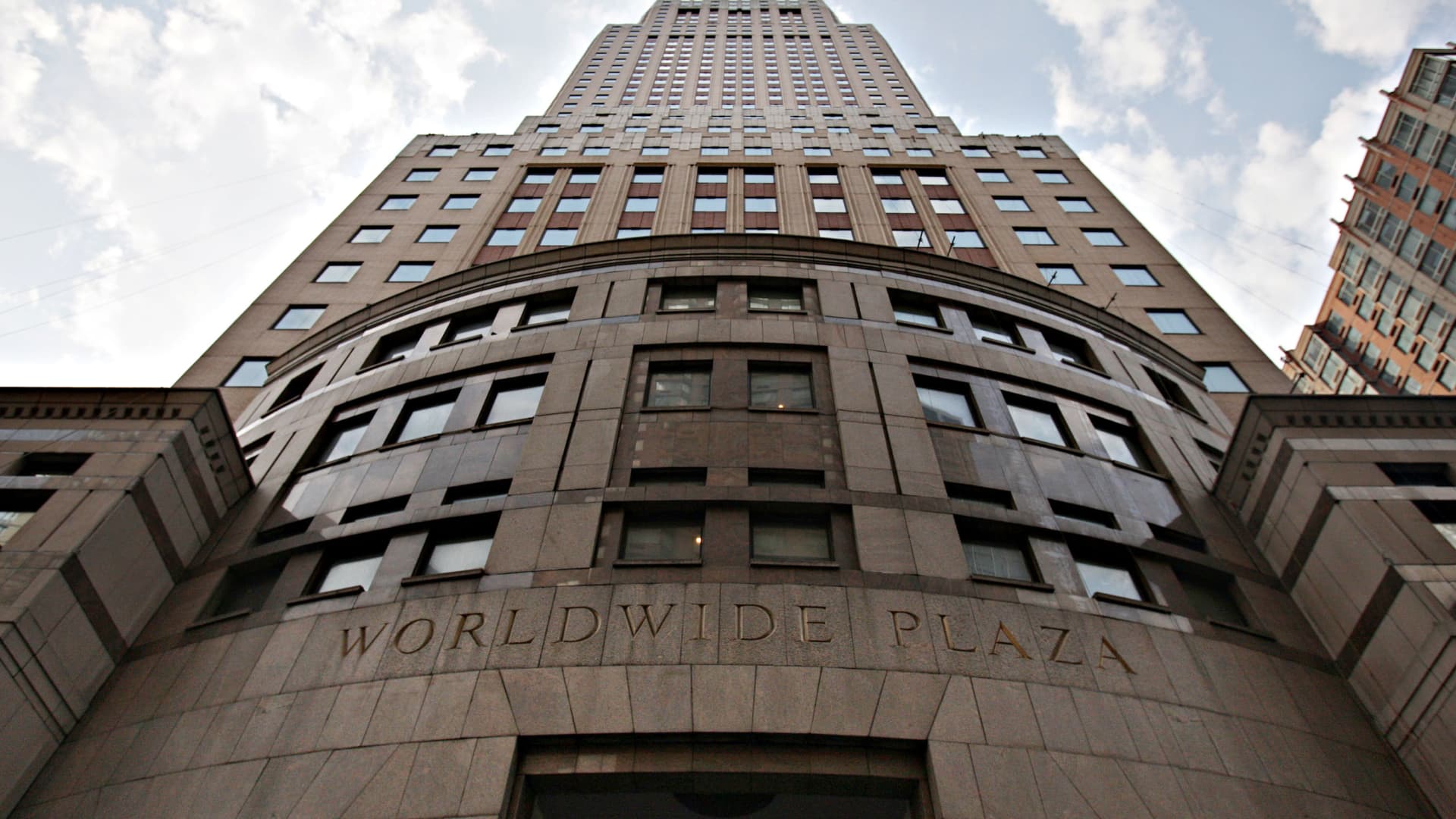
The rate increase was driven by two exceptionally large New York City properties: Worldwide Plaza and One New York Plaza.
A version of this article first appeared in the CNBC Property Play newsletter with Diana Olick. Property Play covers new and evolving opportunities for the real estate investor, from individuals to venture capitalists, private equity funds, family offices, institutional investors and large public companies. Sign up to receive future editions, straight to your inbox. Delinquencies in commercial mortgage-backed securities rose again in January, up 17 basis points from December to 7.47%, according to Trepp. In January 2025, the rate was 6.56%. Last month’s balance of newly delinquent loans totaled just under $5.4 billion, but during the same period, $2.6 billion worth of delinquent loans cured and $1.1 billion paid off. That left a net increase of $1.6 billion in delinquent loans. The increase was driven by the beleaguered office sector, which has a lot of distressed properties to work through but is seeing improvements in fundamentals. Vacancies are finally falling for the first time since 2019. Office CMBS delinquencies rose 103 basis points from December to 12.34%, an all-time high on Trepp’s index dating back to 2000. The previous high was 11.6%, set in October. The rate increase, however, was driven by two exceptionally large New York City properties: Worldwide Plaza ($940 million) and One New York Plaza ($835 million). And while the headline rate is certainly concerning, what’s actually happening with the loans seems less so. “A lot of these loans face cash flow pressure, but they’re still close enough to cash flow positive, or they are cash flow positive, so the borrower has incentive to try and salvage the deal and keep some optionality going for the long run,” said Stephen Buschbom, Trepp’s head of applied research and analytics. “So you end up seeing the borrowers contribute a marginal amount of equity to kick the can down the road and kind of lean into and hope for the return to office, salvaging their equity position.” Buschbom said he believes this will be the year office hits peak delinquency, somewhere between 12% to 13%. Class A, the newer or trophy office buildings, are already seeing much higher occupancy rates, especially in cities where AI is driving new employment. Office conversions to residential, especially in New York City, are also helping mitigate some of the distress. “There’s no, ‘Oh my gosh, the sky’s falling, or this is going to completely change my view on the sector.’ It’s a record high, but same old story. Where do we go from here? Will we continue going higher, or are going to start seeing some positivity?” said Buschbom. He pointed to the fact that the vast majority of the delinquent office loans have been maturity defaults, so they are loans that are being paid but simply can’t be refinanced when they finish their term due to the higher interest rate environment. The lender doesn’t want to foreclose, so in some cases the borrower may inject fresh equity into the loan, not enough to refinance but enough to buy an extension. “We’re seeing a lot of that. It’s not a one-size-fits-all. It’s very much case-dependent,” he added, pointing out that today’s loans are nothing like those from the 2008 financial crisis. “The underwriting and the securitization design are much more disciplined, much lower risk. And, importantly, the servicing aspect has become increasingly efficient. So servicers have gotten much, much quicker at working something out,” Buschbom said.
A basketball finds nothing but net during practice before a 2024 NCAA Tournament game at PPG Paints Arena in Pittsburgh.
Charles LeClaire | Reuters
Prediction markets saw strong results from the Super Bowl, but it was just an appetizer for a banquet of sporting events in 2026 that are expected to drive surging volumes in event contracts.
Advertisement
Kalshi saw record downloads during Super Bowl week, up 1,544% from the same time period last year, according to a report from market intelligence firm Sensor Tower. Daily active users jumped more than 1,100% to nearly 2 million on the day of the big game, the firm said.
That was almost three times the daily active users on sportsbook BetMGM, co-owned by MGM and Entain, which had 81% growth to 680,000 daily active users. Polymarket reported 59,000 daily active users and 264% growth over the previous year.
More than $1 billion was traded on Kalshi for the Super Bowl, up 2,700% according to the company. Founder and CEO Tarek Mansour told CNBC Tuesday that consumers are drawn by having lots of trading options for the game in one place.
“Our culture markets were huge this weekend. You know, ‘What [Bad] Bunny was going to perform’ was over $100 million in trading,” he said.
Advertisement
Though prediction markets enable users to buy event contracts for a wide swath of financial, weather, pop culture and other events, sports have been driving the action and the profits.
Robinhood CEO Vlad Tenev is pushing back against any investor concerns the Super Bowl was as good as it gets for trading on sports prediction markets.
“What we’re actually seeing is surprising us,” Tenev said on his company’s fourth-quarter earnings call on Tuesday. “In January, for instance, NBA contracts surpassed NFL in trading activity on our platform.”
Major sports events keep rolling, with the Winter Olympics offering a variety of betting options through Feb. 22. This weekend, fans will also get an eyeful during the NBA All-Star Weekend.
Advertisement
March brings college basketball madness, with the NCAA Tournament taking off with Selection Sunday on March 15. The entire tournament typically brings in more gambling dollars than Super Bowl.
And then there’s the World Cup, kicking off 104 games in mid-June.
Kalshi has been aggressive in marketing, outspending Polymarket in the United States by about 19 times and outspending DraftKings by about 35%, according to Sensor Tower estimates.
Still, the American giants in sports betting remain dominant. DraftKings saw 5 million daily active users for the Super Bowl and FanDuel had 4.2 million, according to the Sensor Tower data.
Advertisement
The CEOs of sportsbook market leaders FanDuel and DraftKings both told CNBC just before the game that they don’t see any cannibalization of their traditional sports betting business. They instead see real opportunity with sports and event contracts in states that haven’t legalized sports wagering.
Tenev said events contracts are the “fastest growing business in the company’s history.” Robinhood reported a 300% rise in “other revenue,” which is largely comprised of event contracts.
And the growth is accelerating. Robinhood reported 12 billion event contracts in 2025, and it’s already seen 4 billion contracts so far in 2026.
Disclosure: CNBC and Kalshi have a commercial relationship that includes a minority investment.
Payne Capital Management President Ryan Payne explains why tech earnings remain strong despite a recent dip and how AI hiring could help offset a wave of baby boomer retirements on ‘Mornings with Maria’.
Amazon is expanding its same-day prescription delivery service to nearly 4,500 U.S. cities and towns by the end of 2026, adding about 2,000 new communities, including statewide coverage in Idaho and Massachusetts.
The move deepens Amazon’s push into the prescription drug market, which it entered in 2018 through its acquisition of PillPack. The company is positioning faster delivery and subscription pricing as competitive advantages against traditional pharmacy chains.
Advertisement
Amazon said the expansion comes as pharmacy closures, staffing shortages and transportation barriers make it harder for some patients – particularly in rural and remote areas – to access medications.
“Patients shouldn’t have to choose between speed, cost, and convenience when it comes to their medication, regardless of where they live,” said John Love, vice president of Amazon Pharmacy. “By combining our pharmacy expertise with our logistics network, we’re removing critical barriers and helping patients start treatment faster—setting a new standard for accessible, digital-forward pharmacy care.”
Boxes lie on a conveyor belt during Cyber Monday at Amazon’s fulfillment center in Robbinsville, New Jersey, U.S., Dec. 2, 2024. (Eduardo Munoz/Reuters)
The company said it improved delivery speeds across all 50 states and Washington, D.C., in 2025. Faster shipping is expanding into rural areas, including remote Alaska towns and parts of the Navajo Nation, where the nearest pharmacy can be nearly an hour away.
Close-up of an Amazon Pharmacy shipping label on a cardboard box, Reliez Valley, California, Feb. 9, 2025. (Smith Collection/Gado/Getty Images)
Amazon is also integrating pharmacy services with One Medical, the primary care provider it acquired in 2023. Some One Medical patients can pick up prescriptions at in-clinic kiosks, and the company began filling select prescriptions at those electronic kiosks in December. One Medical operates on a $199 annual membership model.
In October, Amazon partnered with WeightWatchers to supply medications, including injectable GLP-1 obesity treatments, to its members. Amazon Pharmacy also offers the oral GLP-1 Wegovy pill.
Amazon packages seen on a conveyor belt at a warehouse facility. (Luke Sharrett/Bloomberg via Getty Images / Getty Images)
The company continues to promote cost-saving programs, including Prime Rx discounts of up to 80% on generics and 40% on brand-name drugs for uninsured members, as well as RxPass, a $5-per-month subscription available in 48 states for more than 50 common medications.
Novo Nordisk President and CEO Mike Doustdar joins ‘Mornings with Maria’ to discuss the launch of the first GLP-1 weight-loss pill in the U.S., the lawsuit against Hims & Hers and talks with the Trump administration on drug pricing.
GLP-1 weight-loss drugs are now the focus of a heated legal battle, with a leading drugmaker warning that copycat versions pose a risk to patient safety.
“When you go and try to source raw materials from China or unknown sources, put it in an injection, and sell knockoff medication, there is something wrong with this,” Mike Doustdar, president and CEO of Novo Nordisk, told FOX Business’ Maria Bartiromo.
Advertisement
Novo, best known for its blockbuster diabetes drug Ozempic and weight-loss treatment Wegovy, has filed a lawsuit against Hims & Hers Health, accusing the telehealth company of selling compounded, unapproved versions of its semaglutide-based medications, including a copycat version of its newly launched daily pill.
Doustdar said the introduction of the oral option broadens access for patients who are reluctant to use injections, but he sharply criticized what he described as widespread “mass compounding” of GLP-1 drugs by telehealth firms.
A woman injects a GLP-1 injection into her stomach in this undated photo taken at an undisclosed location. (iStock / iStock)
“Compounding is supposed to be for a few individuals that have, let’s say, allergic reactions to the real medicine,” he said. “But this mass compounding — it’s quite unbelievable that it has gotten to this point.”
Advertisement
He added that Novo has filed multiple lawsuits against compounders, arguing that the launch of a compounded pill version crossed a line.
“I think the nail in the coffin, as they say, was when they completely made a new drug — the pill — a compounded version of it and basically tried to introduce that to the market,” he said. “That’s where we felt enough is enough.”
A pharmacist displays a box of Wegovy pills at a pharmacy in Provo, Utah on Thursday, Jan. 15. (George Frey/Bloomberg via Getty Images / Getty Images)
Hims & Hers fired back against Novo Nordisk in a statement issued to multiple outlets this week, blasting the legal move as “a blatant attack by a Danish company on millions of Americans who rely on compounded medications for access to personalized care” and accusing “Big Pharma” of “weaponizing the U.S. judicial system to limit consumer choice.”
Advertisement
“This lawsuit attacks more than just one medication or company – it directly assaults a well-established, vital component of U.S. pharmacy practice that has improved patient care for everything from obesity to infertility to cancer,” a representative for the company said, per the New Jersey business publication NJBIZ.
The company also cited its history of providing “safe access to personalized healthcare to millions of Americans,” adding that it will “continue to fight to provide choice, affordability and access.”
The New York Stock Exchange with a Hims & Hers Health, Inc. banner is pictured as a person runs past in the Manhattan borough of New York City, New York on Jan. 21, 2021 (Reuters/Carlo Allegri / Reuters)
For some time, patients seeking GLP-1 therapy for conditions such as obesity, type 2 diabetes, fatty liver disease and metabolic syndrome have sought compounded alternatives after facing insurance roadblocks that created cost challenges for brand-name medications.
Advertisement
Doustdar said Novo’s recent cost reductions have eliminated the need for copycat drugs due to what he described as pricing similarities between branded and compounded versions.
Fox News senior medical analyst Dr. Marc Siegel joins ‘Mornings with Maria’ to break down the new FDA-approved weight loss pill, concerns over cost and safety and how GLP-1 drugs could transform obesity care.
However, when Hims & Hers briefly launched its compounded oral semaglutide, it was marketed at about $49 per month as an introductory price and around $99 per month thereafter, lower than Novo’s FDA-approved oral Wegovy, which launched at roughly $149 per month and can cost up to $299 at higher doses under self-pay pricing.
Advertisement
Hims & Hers later pulled the oral compounded medication from its platform following legal threats from Novo and scrutiny from federal regulators.
Novo Nordisk CEO Mike Doustdar on Wednesday said the company is aiming to capture around 15 million new patients, at least initially, when Medicare starts covering obesity treatments for the first time later this year.
Around 67 million Americans are covered by Medicare, but “when you take a look at specifically our products and the target group, I think around 15 million people would be a good number to target,” he told CNBC in an interview.
Medicare is slated to start covering obesity medicines for the first time later this year under the landmark “most favored nation” drug pricing deals that Novo and its chief rival Eli Lilly struck with President Donald Trump in November.
Health experts say the long-awaited coverage could broaden the market for the medicines and spur more private insurers to cover them. Some experts estimate that 20 million to 30 million Medicare patients are suffering from obesity and related conditions.
Advertisement
Doustdar said Medicare coverage, along with the launch of Novo’s new obesity pill and other factors, should help the company gradually boost prescription volumes and offset lower prices in the U.S. following that agreement with Trump.
But he said he doesn’t expect Medicare access to obesity treatments to open up overnight.
“Now, it would be great if we could find a way to get access very, very fast. But I think that would be a bit naive,” Doustdar said, pointing to the slow adoption seen among eligible patients with commercial insurance.
It’s a slightly more conservative tone on the initial impact of Medicare coverage compared to Lilly, which has cited that coverage as a key tailwind to its guidance this year. Last week, Lilly said it expects Medicare coverage to come online by July.
Advertisement
Meanwhile, Doustdar said Novo is in the midst of negotiations with the government on “exactly which month, which week that is going to be opening.”
Closing the market share gap
Novo is under pressure to claw back market share in the booming GLP-1 space from Lilly and cheaper, compounded copycats. Last week, Lilly said its share of the U.S. obesity and diabetes drug market increased to 60.5% in the fourth quarter, while Novo’s was 39.1%.
Novo has also highlighted a gap in the “preference share” for its weight loss treatment Wegovy versus Lilly’s rival injections. In the U.S., Novo estimates that between 7 and 8 patients out of 10 go to Lilly.
When asked how Novo plans to close that gap, Doustdar said one way to do so is “to do better on the pill.” The company’s Wegovy obesity pill has a head start compared to Lilly’s upcoming oral drug, orforglipron, which is expected to win approval from the Food and Drug Administration during the second quarter.
Advertisement
Mike Doustdar, left, CEO of Novo Nordisk, and David Ricks, CEO of Eli Lilly, listen as President Donald Trump speaks in the Oval Office during an event about weight-loss drugs on Nov. 6, 2025.
Andrew Caballero-Reynolds | Afp | Getty Images
Doustdar said Novo’s pill is slightly more effective than Lilly’s based on separate clinical trials, showing 16.6% weight loss compared to 12.4% with Lilly’s oral drug.
“If you use these two numbers, basically you have a 40% difference between the efficacy of these pills,” he said. “I think this is going to be a very main, main selling point of the pill.”
Advertisement
But Doustdar also pointed to the upcoming approval and launch of a higher dose – 7.2 milligram – of Wegovy that could help win market share from Lilly’s obesity treatment Zepbound.
That higher dose helps patients lose around 21% of their weight, which is “very much on par” with the highest dose of Zepbound, he said. Zepbound’s higher efficacy has been a key factor in driving more patients and prescribers away from choosing Wegovy, which has shown around 15% weight loss on average in clinical trials.
“When that comes to the market, my thought, my wish, my hope is that people will realize, OK, now we have two products with similar efficacy,” he said.
GXO Logistics, Inc. (GXO) Q4 2025 Earnings Call February 11, 2026 8:30 AM EST
Company Participants
Patrick Kelleher – Chief Executive Officer Baris Oran Kristine Kubacki – Chief Strategy Officer
Advertisement
Conference Call Participants
Stephanie Benjamin Moore – Jefferies LLC, Research Division Ryan Deveikis – Wells Fargo Securities, LLC, Research Division Madison Pasterchick – Morgan Stanley, Research Division Scott Schneeberger – Oppenheimer & Co. Inc., Research Division Richa Talwar – Deutsche Bank AG, Research Division Patrick Creuset – Goldman Sachs Group, Inc., Research Division Uday Khanapurkar – TD Cowen, Research Division Jeffrey Kauffman – Vertical Research Partners, LLC David Zazula – Barclays Bank PLC, Research Division Kevin Gainey – Thompson, Davis & Company, Inc., Research Division
Advertisement
Presentation
Operator
Welcome to the GXO Fourth Quarter and Full Year 2025 Earnings Conference Call and Webcast. My name is Darryl, and I’ll be your operator for today’s call. [Operator Instructions]. Please note that this conference is being recorded.
Before the call begins, let me read a brief statement on behalf of the company regarding forward-looking statements, the use of non-GAAP financial measures and the company’s guidance. During this call, the company will be making certain forward-looking statements within the meaning of applicable securities laws, which, by their nature, involve a number of risks, uncertainties and other factors that can cause actual results to differ materially from those projected in the forward-looking statements. A discussion of factors that can cause actual results to differ materially is contained in the company’s SEC filings. The forward-looking statements in the company’s earnings release or made on this call are made only as of today, and the company has no obligation to update any of these forward-looking statements, except to the extent required by law.
Advertisement
The company also may refer to certain non-GAAP financial measures as defined under applicable SEC rules during this call. Reconciliations of such non-GAAP financial
FOX Business’ Jeff Flock has the details from New Jersey on ‘Mornings with Maria.’
California’s fuel market is entering another period of strain as refinery capacity continues to shrink in the nation’s largest gasoline market. The planned closure of Valero’s Benicia refinery, one of the state’s remaining major facilities, is expected to tighten supply in a system that already operates with little margin for disruption.
FOX Business’ Jeff Flock joined Maria Bartiromo on “Mornings with Maria” to report on how the pending refinery shutdown is fueling concerns about higher gas prices, job losses and increased volatility across California’s fuel market.
Advertisement
Rep. Jason Smith, R-Mo., joins ‘Mornings with Maria’ to discuss President Donald Trump’s economic agenda, falling gas prices, tax refunds and the upcoming midterm elections.
That tightening supply has already translated into higher prices and growing uncertainty for drivers, according to California lawmakers, who warn the situation is no longer theoretical.
“California is truly at a breaking point. Refineries are closing, supply is diminishing, and my constituents are paying more at the pump every single day,” Republican state Sen. Suzette Martinez Valladares said.
Valero’s Benicia Refinery in California in operation. (Paul Morris/Bloomberg / Getty Images)
The Benicia facility, located in Northern California, has played a significant role in supplying gasoline to a state that consumes more fuel than any other except Texas. Its closure follows a wave of refinery exits that has steadily reduced California’s ability to produce its own gasoline, leaving the state increasingly dependent on a small number of remaining plants and imported fuel that must meet its unique regulatory standards.
With fewer refineries operating, even routine maintenance or unexpected outages can quickly ripple through prices at the pump.
FOX Business’ Stuart Varney analyzes a scathing New York Times op-ed of Gov. Gavin Newsom, examining the exodus of over one million residents, the state’s dead-last affordability ranking and the strategic liability he poses to his party.
State lawmakers have increasingly pointed to energy policy as a central factor behind the tightening market. Critics argue that years of regulations and penalties have discouraged long-term investment in refining infrastructure, accelerating closures and amplifying price swings for consumers. Supporters of the policies counter that refinery shutdowns align with the state’s broader environmental and climate goals.
“This is happening right now, and the longer we wait to address this issue, the more instability and volatility we’ll see here in California,” Valladares said.
Justin Verlander, the three-time Cy Young Award winner and future Hall of Famer, is returning to the Detroit Tigers on a one-year, $13 million contract for the 2026 season, the team announced Wednesday, Feb. 11, 2026. The deal includes a $2 million signing bonus and performance incentives that could push the total value above $15 million, reuniting the 43-year-old right-hander with the franchise where he spent 13 dominant seasons and won his first Cy Young Award.
The move marks a sentimental homecoming for Verlander, who began his career with the Tigers in 2005, became the face of the franchise during their 2011–2014 playoff runs, and pitched the team’s most recent no-hitter (2011) before being traded to the Houston Astros in August 2017. After winning two World Series titles with Houston (2017, 2022) and earning his third Cy Young in 2019, Verlander expressed a desire to finish his career where it started.
“I always said if I had the chance to come back to Detroit, I’d jump at it,” Verlander said in a statement released by the Tigers. “This city, this organization, these fans — they mean everything to me. I’m not here just to collect a paycheck. I’m here to compete, to mentor the young pitchers, and to help this team win again. Detroit gave me everything; now I want to give something back.”
The Tigers, coming off a surprising 88-74 season in 2025 that saw them reach the American League Wild Card round, view Verlander as both a veteran ace and a cultural force. Manager A.J. Hinch, who managed Verlander in Houston, called the signing “a full-circle moment.”
“Justin’s work ethic, his preparation, his competitiveness — those are the standards we want in our clubhouse,” Hinch said. “Beyond the innings he’ll eat and the games he’ll win, he’s going to make everyone around him better. This is a huge get for us.”
Advertisement
Verlander, who turns 44 in February 2026, is coming off a strong 2025 campaign with the Astros, where he went 11-6 with a 3.41 ERA in 26 starts despite missing time with a shoulder strain. He struck out 148 batters in 152⅓ innings and showed his fastball still touched 95 mph late in the season. The move to Detroit allows him to pitch closer to his Michigan home, where he and wife Kate Upton maintain a residence.
Financially, the one-year deal represents a significant pay cut from his previous $43.3 million average annual value with Houston, but it includes escalators tied to innings pitched (up to $1 million for 160+ innings) and playoff appearances. The Tigers also hold a $15 million mutual option for 2027, with a $3 million buyout.
A Storied Detroit Legacy
Verlander debuted with the Tigers in 2005 and quickly became the ace of a rotation that included Jeremy Bonderman and Nate Robertson. He won the AL Rookie of the Year in 2006 (shared with Daisuke Matsuzaka) and anchored Detroit’s 2006 and 2011 American League pennant winners. His 2011 season — 24-5, 2.40 ERA, 250 strikeouts — earned him the AL MVP and Cy Young, one of only two pitchers since 1986 to win both in the same year (the other being Roger Clemens in 1986).
In 13 seasons with Detroit, Verlander compiled a 203-141 record, 3.44 ERA, 2,373 strikeouts, and three no-hitters (2007, 2011, 2011 postseason). He remains the Tigers’ all-time leader in strikeouts and is second in wins and innings pitched. The 2011 no-hitter against Toronto remains one of the most electrifying moments in Comerica Park history.
Advertisement
After the 2017 trade to Houston, Verlander won World Series titles in 2017 and 2022, earned his third Cy Young in 2019, and surpassed 3,000 career strikeouts in 2022. He has 262 career wins and 3,342 strikeouts as of the end of 2025, ranking him 24th and 14th all-time, respectively. He is virtually assured of first-ballot Hall of Fame induction once eligible.
Impact on the Tigers’ 2026 Outlook
The signing bolsters a rotation that already includes Tarik Skubal (2024 AL Cy Young winner), Reese Olson, Jack Flaherty, and rookie Jackson Jobe. Verlander is expected to slot in as the No. 2 starter behind Skubal, providing veteran stability and postseason experience.
General manager Scott Harris called the move “transformative on and off the field.”
“Justin is one of the greatest pitchers of his generation,” Harris said. “He’s going to mentor our young arms, stabilize our rotation, and give us a chance to win every fifth day. But beyond the numbers, he’s going to bring a winning culture and a championship mentality back to this clubhouse.”
Advertisement
The Tigers, who have not won a playoff series since 2013, are viewed as a rising contender in the AL Central. Adding Verlander gives them a proven October arm and a symbolic boost for a fan base hungry for sustained success.
Emotional Homecoming
Verlander’s return has already sparked a wave of nostalgia in Detroit. Social media flooded with throwback photos of his 2011 no-hitter, his 2006 ALCS Game 5 gem, and his emotional 2017 trade press conference. Comerica Park plans to honor him with a pregame ceremony on Opening Day (March 27, 2026, vs. Chicago White Sox) and is expected to retire his No. 35 jersey after retirement.
For a player who once said “I bleed Old English D,” the chance to finish where he started is deeply meaningful.
“I never got to say goodbye the way I wanted,” Verlander said. “This is my chance to do it right — to pitch in front of the fans who supported me from day one, to compete for a city that’s always had my back. Detroit is home. Always has been.”
Advertisement
As spring training approaches, the Tigers’ rotation suddenly looks formidable, and the city of Detroit has one of its own back — this time, perhaps for one final, unforgettable run.