

Business
Abu Dhabi Investment Portfolio: 10 stocks rally up to 106% in CY26, 2 new picks added in Q4 – Portfolio check


The equity portfolio of the Abu Dhabi Investment Authority (ADIA), managed through its global funds, has recorded a 30% gain so far in CY26, rising from Rs 3,720 crore in December 2025 to Rs 4,817 crore as of June 19, 2026. As of the March 2026 quarter, the portfolio comprised holdings in 26 publicly listed Indian companies.


The company said the transition marks a significant milestone in strengthening alignment with parent entity BSE Ltd and reinforces its role within the broader BSE ecosystem.
BSECL will continue to provide clearing, settlement and risk management services across the equity, equity derivatives, currency derivatives, debt, commodity, mutual fund, electronic gold receipt (EGR) and securities lending and borrowing (SLB) segments, among others.
The company said it remains committed to ensuring financial market stability, efficient collateral management and the highest standards of regulatory compliance as mandated by the Securities and Exchange Board of India (SEBI).
“The transition from ICCL to BSE Clearing Limited reflects our strong alignment with the BSE brand and our role as a trusted pillar of India’s financial market infrastructure. Over the years, we have built robust clearing, settlement, and risk management capabilities that support market integrity and investor confidence,” said Vaisshali Babu, Managing Director and Chief Executive Officer of BSE Clearing Limited.

“As we embark on this new chapter, we remain steadfast in our commitment to operational excellence and regulatory compliance while supporting the long-term resilience of India’s capital markets,” she added.
According to the release, the rebranding will have no impact on the corporation’s operations, legal obligations, contracts or service commitments towards members, participants and stakeholders.All existing agreements, memberships and regulatory registrations will continue without interruption, the company said.
BSE, Asia’s oldest stock exchange, is also the world’s largest exchange by number of listed companies. Over the years, it has played a key role in the development of India’s capital markets and serves as a major platform for companies raising capital. Its benchmark index, the Sensex, is widely tracked by domestic and global investors as a gauge of Indian equity market performance.
(Disclaimer: Recommendations, suggestions, views and opinions given by the experts are their own. These do not represent the views of The Economic Times)

The growing push to restrict Americans from using federal food aid to buy certain processed or sugary products is creating a new challenge for some of the biggest U.S. food and beverage companies.
The U.S. Department of Agriculture as of May had approved food restriction waivers for Supplemental Nutrition Assistance Program benefits in 23 states, affecting roughly one-third of all SNAP participants, according to Numerator. The research firm estimates the restrictions could reduce food and beverage sales by as much as $830 million this year as consumers either shift spending to approved products or cut back overall.
Kroger CEO Greg Foran said on the company’s first-quarter earnings call on Thursday that customers remain under pressure in part due to reduced SNAP benefits, as well as higher gas prices, “squeezing budgets.”
“Customers are managing spend carefully and shopping with real intent,” Foran said.
Most waivers focus on limiting consumption of sugar-sweetened beverages and confectionery products, signaling a targeted approach rather than broad food restrictions. As the movement spreads, it’s forcing major packaged food companies to monitor shopper behavior and assess whether they need to remake product lines — though many of them have already been changing what they offer after consumer habits shifted in recent years.
Iowa recently became the first state to codify elements of the “Make America Healthy Again,” or MAHA, movement into law, approving legislation that targets artificial food dyes, ultra-processed foods in school and purchases made through SNAP.
“Altogether, this bill advances the health and wellness for every Iowan today and for generations to come,” said Iowa Gov. Kim Reynolds when she signed the measure last month.
She added the law helps “refocus federal food assistance programs on the actual purpose for which they were created: helping low-income families afford nutritious food.”
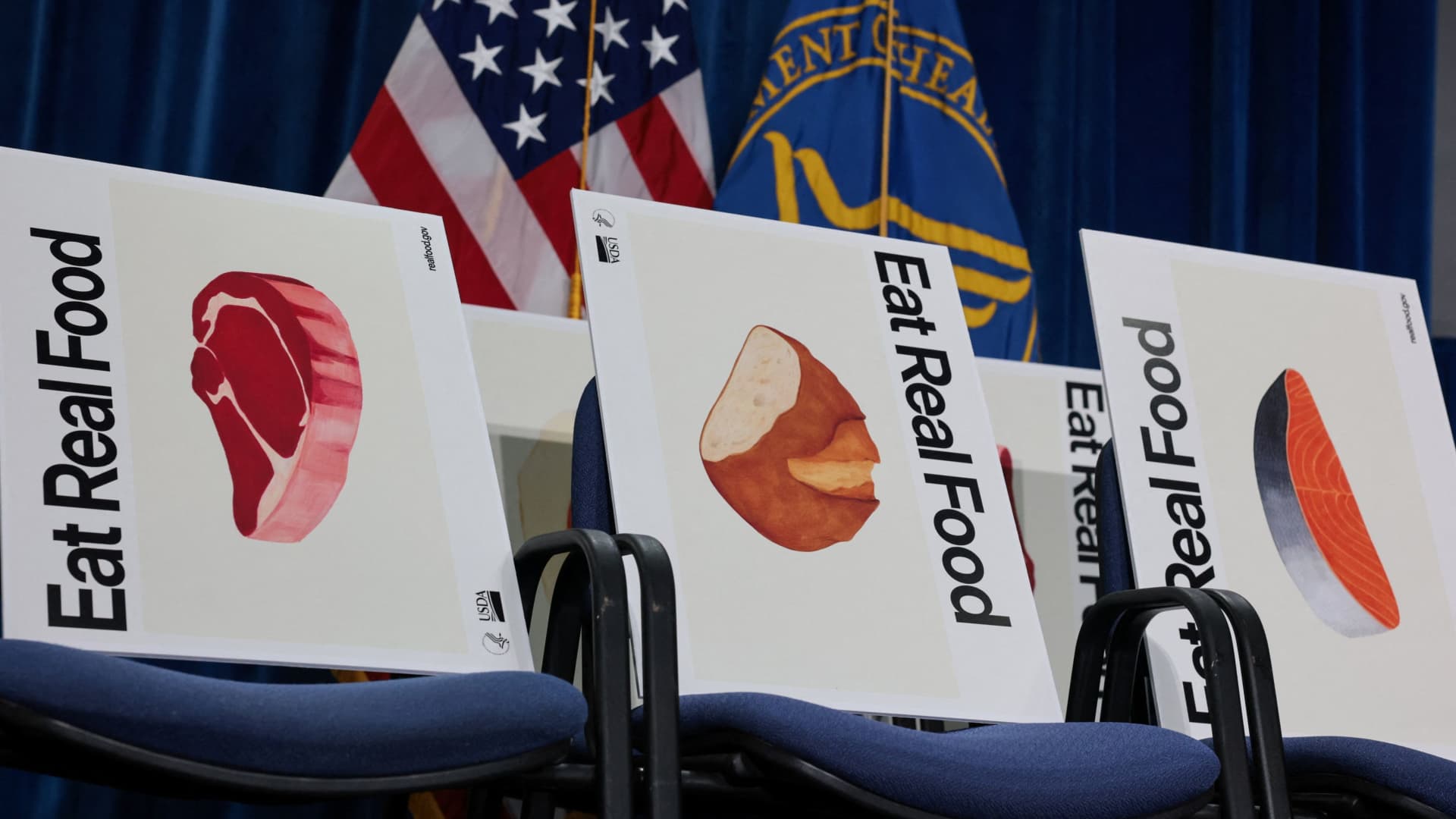
Attendees are greeted with”Eat Real Food” placards as they gather for U.S. Health and Human Services (HHS) Secretary Robert F. Kennedy, Jr. and Agriculture Secretary Brooke Rollins to announce new nutrition policies at the Department of Health and Human Services in Washington, D.C., U.S., January 8, 2026.
Jonathan Ernst | Reuters
The law bans several synthetic dyes, including Red 40 and Yellow 5, from most K-12 school meals and vending machines, while also restricting SNAP recipients from using benefits to buy products such as soda and candy.
Navigating the MAHA era
Many food companies aren’t waiting to see how policies evolve.
At a Goldman Sachs conference in May, Hershey said it has researchers in Texas conducting in-store interviews with shoppers who receive SNAP benefits to understand how purchasing behavior is shifting under new restrictions in the state.
“We’ve observed some consumer uncertainty at the register as new restrictions take effect,” a Hershey spokesperson told CNBC. “We anticipate this will improve as store execution improves, rules become clearer, and SNAP users can plan and budget with more certainty.”
The company is studying everything from product substitutions to budget tradeoffs, offering an early glimpse into how major food manufacturers are preparing for a potentially significant shift in consumer demand.
Many of the products most exposed to the changes are produced by some of the largest companies in the industry like Kraft Heinz, PepsiCo, Coca-Cola, General Mills, Nestle and others.
J.M. Smucker CEO Mark Smucker, however, told CNBC he expects the SNAP policy changes to have a more muted impact.
“I would say the current environment isn’t really that different than what we’ve seen over time, and thus far some of the modifications have really had no meaningful impact to our business,” he said.
Still, the company’s Hostess products like Twinkies and Donettes — the latter of which saw net sales grow 13% in the latest quarter, according to the company — may be impacted under broader state restrictions on “highly processed snacks.”
Current SNAP waivers in states like Texas focus primarily on candy and sugary drinks, not snack cakes. However, some states have proposed broader definitions that could eventually encompass packaged desserts and sweet baked goods.
At the same time, fewer Americans are even receiving the benefits. One analysis estimates 3.5 million people have lost their SNAP aid since President Donald Trump last year signed a sweeping bill that restricts eligibility for SNAP, among other changes.
Many U.S. households have found it harder to pay for groceries following the changes. The restrictions have also meant fewer dollars flowing to major businesses.
Walmart is particularly exposed to SNAP spending, capturing roughly a quarter of all SNAP grocery dollars nationwide, according to Numerator. Kroger, Costco and Amazon follow at about 8%, 6% and 5%, respectively.
The curbs on what consumers can buy with federal assistance are only one shift food companies are watching.
At a hearing of the Senate Committee on Health, Education, Labor and Pensions in April, Health and Human Services Secretary Robert F. Kennedy Jr. went as far as to say he “would support” a ban on junk-food television advertising. The department has not yet taken steps to introduce such a ban.
Responding both to Kennedy’s MAHA initiative and shifting consumer tastes, food manufacturers have also accelerated efforts to reformulate products and reduce synthetic ingredients in products like Kool-Aid, Fanta, Doritos and Flamin’ Hot Cheetos, which contain dyes like Red 40 and Yellow 5.
General Mills, Kraft Heinz and Target have all pledged to phase out certain artificial colors and additives by 2027 or sooner.
Nestle announced Monday it achieved its commitment on time to fully eliminate Food, Drug & Cosmetic colors from its U.S. food and beverage portfolio.

Roku: Fox Deal Changes The Narrative (Rating Downgrade)

Joby Aviation: The Race To The Skies Is Narrowing, And Joby Is In Front

Cushman & Wakefield surges 63% after InvestingPro fair value alert

Alibaba's 45% Collapse Created A Buying Opportunity

A total of 16 stock market holidays have been scheduled for 2026, out of which nine have already passed.
Following next week’s closure, the next market holiday will fall on Monday, September 14, for Ganesh Chaturthi. In the second half of the year, markets will also remain closed on October 2 for Gandhi Jayanti, October 20 for Dussehra, November 10 for Diwali Balipratipada, November 24 for Guru Nanak Jayanti and December 25 for Christmas, which will be the final market holiday of 2026.
Will MCX be closed?
Meanwhile, Multi Commodity Exchange of India will remain closed during the morning session on June 26 but will resume trading in the evening session. According to MCX’s annual trading calendar, the exchange has 16 trading holidays in 2026, with either partial or full-day closures.
The National Commodity & Derivatives Exchange Limited will remain shut for both trading sessions on the same day.
Stock Market Holidays 2026
In 2026, four key holidays fall on weekends and therefore will not lead to additional market closures. These include Mahashivratri on February 15 and Eid-Ul-Fitr on March 21, both of which have already passed, along with Independence Day on August 15 and Diwali Laxmi Pujan on November 8.
Diwali Laxmi Pujan will fall on a Sunday this year, though exchanges will conduct the customary Muhurat Trading session on November 8. The timings for the special one-hour session will be announced closer to the date. Independence Day, meanwhile, falls on a Saturday.
(Disclaimer: Recommendations, suggestions, views and opinions given by the experts are their own. These do not represent the views of The Economic Times)

Capita chiefs promised MPs on the Public Accounts Committee it would fix long-running problems with its administration of one of the biggest pension schemes in the country by the end of this month.
Tens of thousands of retired and serving civil servants have been reporting long delays to payments, leading to serious financial hardship to pensioners and their families.
But Money Box has learned the deadline isn’t likely to be met. We speak to the chairman of the Public Accounts Committee about what happens next.
And cases of reported are still increasing. We explain how AI has become the latest weapon in the fraudsters’ armoury.
Also, holiday season is upon us. What can we do to minimise the hit from those annoying non-sterling transaction fees levied every time we use our plastic. A consumer expert shares his advice.
Business
Nancy Guthrie Case Reframed by Crypto Firm’s “Wrench Attack” Label as Police Confirm Motive Pending

More than four months after 84-year-old Nancy Guthrie vanished from her Tucson, Arizona, home, a retired FBI agent says a leading cybersecurity company has publicly classified the case as a cryptocurrency-motivated kidnapping — what the industry calls a “wrench attack by proxy.” If the designation holds up, it would reframe the disappearance of Today co-anchor Savannah Guthrie’s mother as part of a documented and growing pattern of violent crimes targeting people connected to digital-currency wealth.
What CertiK Said
Jennifer Coffindaffer, a retired FBI agent and NewsNation contributor, posted on X on Saturday, June 13, sharing a screenshot from cybersecurity firm CertiK. In it, CertiK described Nancy Guthrie’s kidnapping as part of a “$6 million bitcoin ransom demand” and tied it to what the company called “the documented trend of proxy target selection already identified in our 2025 report.”
CertiK published a broader report documenting 34 verified wrench attacks between January and April 2026, a 41% increase from the 24 incidents recorded during the same period in 2025. Total losses from these attacks exceeded $101 million in just four months. Among the cases flagged in the report was the suspected abduction of Nancy Guthrie, which CertiK categorized as a potential “wrench attack by proxy.” Ransom notes demanding $6 million in Bitcoin were reportedly sent to multiple media outlets, including KGUN9 and TMZ.
What a “Wrench Attack” Means
The term “wrench attack” comes from the cryptocurrency world. It refers to a physical assault or threat, sometimes literally with a wrench or other weapon, aimed at forcing someone to hand over digital assets. A “proxy” variation targets not the crypto holder directly but a family member or associate, using the threat against that person as leverage. The term traces back to a satirical XKCD webcomic first published in 2009, built on the joke that it’s easier to beat someone with a wrench until they give up their password than it is to hack a cryptocurrency wallet.
Coffindaffer characterized the development in stark terms in her post. “Nancy Guthrie: It’s the biggest public break in Nancy’s Case as CertiK, arguably the Leading Crypto Security company in the World, has designated Nancy’s abduction as a Wrench attack by Proxy,” she wrote. “Does CertiK have knowledge as to (whether) Savannah has a Bitcoin account? This is a huge breakthrough. Times have changed. And how these networks operate is new to LE. Unless LE knows who took Nancy, then a Wrench by Proxy Is on the Table.”
An Important Caveat
Despite the attention generated by Coffindaffer’s post, the designation remains, at this stage, an outside assessment rather than a confirmed law enforcement finding. Nothing in the public domain confirms CertiK’s internal knowledge beyond the screenshot Coffindaffer shared, and the assessment remains speculative rather than established fact. The Pima County Sheriff’s Department, which is leading the inquiry, says detectives are still examining DNA and pursuing leads, but no suspect has been identified. The FBI is assisting, yet there has been no confirmation that agents accept the “wrench attack” label or see the case as part of a wider crypto-crime pattern.
Authorities have not officially confirmed any motive in the case, despite the various theories that have circulated publicly in recent weeks.
A Pattern Beyond This Single Case
CertiK’s broader research frames the Guthrie case as one example of an accelerating trend rather than an isolated incident. The blockchain security firm’s data shows wrench attacks are not slowing down. As the report notes, hardware wallets, multisig setups, and time-locked transactions were designed to protect against digital threats, but they do very little when someone threatens a person’s family. The Guthrie case illustrates that wealth proximity, not just wealth ownership, creates risk — meaning a person doesn’t need to hold Bitcoin to become a target, only to be connected to someone who does, or who is perceived to.
The Broader Investigation
The case has remained under intense investigation since Guthrie’s disappearance from her home in the Catalina Foothills area near Tucson. She was last seen at her home on January 31, according to reports, and was reported missing by family the following day. Since then, the Pima County Sheriff’s Department and the FBI have been processing DNA evidence, following up tips, and reviewing ransom letters connected to the case.
The investigation was formally upgraded from a missing persons case to a homicide investigation earlier this year, even as no official suspect has been named. A masked individual captured on Guthrie’s doorbell camera around the time of her disappearance remains a central, unidentified focus of the inquiry.
Savannah Guthrie’s Continued Absence
Savannah Guthrie has continued to navigate her role at Today amid the ongoing search for her mother, periodically stepping away from her anchor duties. She returned to the broadcast earlier this year following an extended leave of absence after her mother’s disappearance, though she has continued to take intermittent breaks from the show as the investigation has stretched on.
What Comes Next
With CertiK’s assessment now circulating widely but still unconfirmed by the FBI or Pima County investigators, the central question facing the case remains the same one that has persisted for months: whether law enforcement can convert the various competing theories — cryptocurrency ransom, the unidentified masked suspect, or other leads — into an actual identified perpetrator. Coffindaffer’s post suggests the crypto angle may open investigative doors that traditional law enforcement has been slow to walk through, but until the FBI or Pima County Sheriff’s Department issues an official statement addressing CertiK’s designation directly, the “wrench attack” theory remains one competing explanation among several in a case that has now stretched well past the four-month mark without a confirmed suspect or a resolution for the Guthrie family.
Anyone with information related to Nancy Guthrie’s disappearance is urged to contact the FBI at 1-800-CALL-FBI. The family’s $1 million reward and the FBI’s $100,000 reward for information remain active.

Buy The Dip: 8%+ Yields Getting Way Too Cheap

THEY ARE SELLING EVERYTHING FOR THIS – CRYPTO BITCOIN MARKET DUMP JUST STARTING

Becky Hill booed and crowd leaves after ‘worst idea ever at a festival’
BSE subsidiary ICCL adopts new brand identity as BSE Clearing


-

 Business6 days ago
No Jackpot Winner as $257 Million Prize Rolls Over to $269 Million Monday Draw
-
 Crypto World6 days ago
Zimbabwe Requires Crypto Businesses to Register Annually Under New FIU Regulations
-

 Fashion18 hours ago
Weekend Open Thread: Miami – Corporette.com
-
 Entertainment6 days ago
Matt Damon’s Viral Sci-Fi Thriller Has Taken Over HBO Max
-

 Tech6 days ago
As AI companies race to go public, who else is along for the ride?
-

 Business6 days ago
Anthropic staff to meet White House officials next week, Axios reports
-
 Crypto World6 days ago
Bitcoin could crash to $48,000, if this historical pattern is triggered
-
 NewsBeat6 days ago
what doctors are seeing in ebike crashes
-
 NewsBeat6 days ago
Warning of disruption as Cardiff Crossrail works to start
-
 NewsBeat6 days ago
Tributes to former deputy head teacher at Cambridge school among death and funeral notices
-

 Entertainment6 days ago
Deion Sanders Shares Powerful Post After Viral Advice To Deiondra
-

 Politics6 days ago
“Israel’s” ban on ICRC visits ruled illegal, but Knesset moves to stop them permanently
-

 News Videos6 days ago
Financial Accounting | Last Day Revision Strategy and Booster | CMA Inter – June 2026
-
 Entertainment6 days ago
Kate Middleton Glare Goes Viral After Kids Booed At Royal Event
-

 Tech6 days ago
Over 400 Arch Linux packages compromised to push rootkit, infostealer
-

 Crypto World6 days ago
XRP ETFs Outperform As Bitcoin And Ethereum Funds Extend Outflow Trend
-

 Business6 days ago
Invesco Quality Income Fund Q1 2026 Commentary
-
 Crypto World6 days ago
Market Preview: SpaceX (SPCX) IPO Record, Federal Reserve Meeting, and Iran Nuclear Agreement
-

 NewsBeat6 days ago
Singer Oliver Tree dies aged 32 in helicopter crash in Brazil
-

 Sports6 days ago
Dick Advocaat’s Curacao scores first-ever World Cup goal against Germany
You must be logged in to post a comment Login