
TL;DR
Wordfence blocked 17M+ attempts to exploit a Gravity SMTP bug that leaks API keys and system data from WordPress sites without authentication.





AI2 Incubator has spent the past 12 years building AI companies in Seattle. Now it’s taking the name of the community it built around that work, rebranding today as AI House and dropping the AI2 name it had kept as a vestige of its former ties to the Allen Institute for AI.
The incubator was founded in 2014 inside Ai2 — the Seattle research institute created by Microsoft co-founder Paul Allen — long before artificial intelligence became a household term. Its mission has been to help founders with the early work of company building: idea formation, customer discovery, recruiting, technical strategy and more.
In 2022, the incubator spun off from Ai2, and last year launched AI House as a physical hub for Seattle’s AI ecosystem — a gathering space for founders, engineers, researchers and investors at Pier 70 on the Seattle waterfront. In its first year, more than 20,000 people came through its events and programming.
“We’ve grown a lot, we’ve become our own organization in so many ways,” said Jacob Colker, the co-founder and managing director of AI2 Incubator and now AI House. “Community has become a deeply intertwined company-building platform for how we do what we do — and that was a big catalyst for the evolution of our brand.”
Along with the rebrand, AI House is bringing on Sri Chandrasekar as a new managing director. Chandrasekar spent nearly a decade at Point72 Ventures, where he helped build the firm’s ventures and private equity businesses, and previously led investments at In-Q-Tel, the strategic investment arm of the U.S. intelligence community.
While considering what to do next and possibly starting his own fund, Chandrasekar said he realized it was already being built.
“I think the core of what I would have wanted to do was build a community of founders all learning from each other and going as fast as they can,” Chandrasekar said. “And it already existed at AI House.”

Chandrasekar was already deeply connected to AI House before joining full-time — he had invested in several of its portfolio companies and wrote the first check into the organization’s $80 million Fund III last fall. He moved to Seattle from the Bay Area in 2021, betting the city would become a major force in AI.
Five years later, that conviction has only grown.
“As I think about my portfolio from Point72, some of our best performing companies are Seattle-based,” Chandrasekar said. “We had never made a Seattle investment before I moved up here, and something like 25% of our investments, maybe even more, were Seattle-based by the time I left.”
@media (max-width: 600px) {
aside.callout { float:none !important; max-width:100% !important; margin-left:0 !important; margin-right:0 !important; }
aside.callout .callout-img { display:none !important; }
}
Chandrasekar joins Colker and fellow AI House managing director Yifan Zhang, who have led the organization through its evolution from research institute spinout to independent venture firm and community hub.
Colker credited Zhang with creating the basis for a community and building a public-private partnership with the City of Seattle, the State of Washington and Ada Developers Academy, with early support from Google and JPMorgan.
“It’s through her hard work over the last year that we have so much energy coming through the space,” he said.
Oren Etzioni, the longtime AI researcher and former CEO of the Allen Institute for AI, continues in a part-time role as technical director, and AI House also recently hired former GeekWire editor Taylor Soper as director of community and programming.
Under the AI House name, the organization is formalizing itself around three pillars: Community, which brings together founders, engineers, researchers and investors across the Pacific Northwest; Incubator, where the team works side by side with founders from the earliest stages; and Capital, where it writes pre-seed checks from its Fund III into applied AI companies.
Colker said the company-building playbook that worked in 2018 no longer applies in 2026.
“The new playbook is being written in real time,” he said. “One team’s breakthroughs that week become another team’s unfair advantages next week.”

Over its 12-year history, AI2 Incubator spun out more than 40 companies — including computer vision startup Xnor.ai, acquired by Apple; legal tech firm Lexion, acquired by Docusign for $165 million; and applied AI startups Yoodli, Ozette, Roboto and Casium — with 90% of graduates going on to raise venture funding.
AI House will continue to recruit founders from across North America — the organization has portfolio companies in Montreal, New York, San Diego and elsewhere — but Seattle remains the home base. Going forward, every founder in the incubator will be required to spend at least one month working from AI House daily.
Colker said the requirement isn’t a hard sell.
@media (max-width: 600px) {
aside.callout { float:none !important; max-width:100% !important; margin-left:0 !important; margin-right:0 !important; }
aside.callout .callout-img { display:none !important; }
}
“Community is not something you can fully access from a distance,” Colker said. “The value comes from being in the room: the conversation after an event, the founder at the next desk, the operator who helps with a pricing question.”
Colker has been vocal on LinkedIn about what he sees as Seattle’s underappreciated stature, and he had no shortage of examples. Forty percent of world air travel flies on planes built in the Pacific Northwest, he noted. The cloud was invented here. When OpenAI needed compute, Sam Altman flew to Seattle to talk to Microsoft CEO Satya Nadella. When Anthropic needed compute, Dario Amodei flew to Seattle to talk to Amazon CEO Andy Jassy.
“How are we not just walking around with our heads held high?” Colker said. “I think we are as a region bad at telling our story — but that doesn’t mean we don’t have ambition and world-changing impact. It just shows up a little differently.”
Chandrasekar, who made his own bet on Seattle, put it simply.
“I can’t imagine a more exciting opportunity than investing in AI companies in an area that has a plethora of AI talent like Seattle,” he said. “If you want to use AI to disrupt an industry, this is the place where we teach you how to do that.”


Wordfence blocked 17M+ attempts to exploit a Gravity SMTP bug that leaks API keys and system data from WordPress sites without authentication.
Attackers are actively exploiting a vulnerability in the Gravity SMTP WordPress plugin that exposes API keys, OAuth tokens, and detailed system configuration data to anyone who sends a single unauthenticated HTTP request. Wordfence, the WordPress security firm owned by Defiant, says it has blocked more than 17 million exploit attempts targeting the flaw since activity began in early May 2026. The plugin is installed on approximately 100,000 WordPress sites.
The vulnerability, tracked as CVE-2026-4020 and rated 5.3 on the CVSS scale by Wordfence, affects all versions of Gravity SMTP through 2.1.4. A patch was released in version 2.1.5 on 17 March 2026, but exploitation did not begin until roughly two months later, suggesting attackers reverse-engineered the fix or discovered the flaw independently after the patch drew attention to it.
The root cause is a REST API endpoint registered at /wp-json/gravitysmtp/v1/tests/mock-data with a permission_callback function that unconditionally returns true. That means no authentication check runs before the server processes the request. When an attacker appends the query parameter ?page=gravitysmtp-settings, the plugin’s register_connector_data() method populates internal connector data, and the endpoint returns approximately 365 KB of JSON containing the site’s full system report.
The exposed data includes API keys, secrets, and OAuth tokens for every email integration configured in the plugin. Gravity SMTP supports Amazon SES, Google, Mailjet, Resend, and Zoho, and credentials for any of these services appear in the response if they have been configured. An attacker who obtains those credentials can send email on behalf of the compromised site, a capability that is useful for phishing campaigns and business email compromise.
The system report also contains the WordPress version, PHP version and loaded extensions, the web server version, the document root path, the database server type and version, all active plugins with their version numbers, the active theme, and database table names. That information gives attackers a detailed map of the site’s software stack, significantly reducing the reconnaissance effort required to plan follow-on attacks against known vulnerabilities in specific plugin or server versions.
“The exposure of live third-party API credentials means an attacker could abuse the site’s connected email services, while the detailed system report significantly lowers the effort required to plan further attacks against the site,” Wordfence researchers wrote in their advisory.
Exploitation volume spiked sharply around 6 June 2026, with Wordfence blocking more than 4 million requests in a single day on 7 June. The attack traffic has originated primarily from a cluster of IP addresses that Wordfence published for administrators to add to blocklists. The key indicator of compromise is requests to /wp-json/gravitysmtp/v1/tests/mock-data in web server access logs, particularly those containing the ?page=gravitysmtp-settings query parameter.
CrowdSec, the open-source threat intelligence platform, independently corroborated the timeline. It deployed detection for CVE-2026-4020 on 22 May and observed the first real-world exploitation on 27 May. By 1 June, the activity had been classified as background noise, indicating it had been integrated into automated scanning routines that sweep WordPress sites at scale.
The speed at which exploitation was industrialised reflects a broader pattern in WordPress plugin security. The flaw requires no authentication, targets a widely installed plugin, and returns high-value data in a single GET request, making it trivial to automate. WordPress’s plugin ecosystem has faced repeated supply chain compromises in 2026, including an attack in which 30 plugins purchased on Flippa were backdoored and lay dormant for eight months before activation.
The Gravity SMTP vulnerability is distinct from those supply chain attacks in that it does not involve malicious code injected by a compromised developer. It is a straightforward coding error, a permission callback that should have verified the requesting user’s credentials but instead returned true for every request. The simplicity of the flaw makes its survival through development, review, and release notable.
The exposure of API credentials is particularly dangerous because those credentials often persist even after the plugin is updated. Updating to version 2.1.5 closes the vulnerable endpoint, but it does not revoke or rotate the API keys that may have already been harvested. Credential theft through software flaws is an accelerating problem across the industry, with recent research showing that exposed API credentials are exploited within minutes of discovery.
Wordfence’s advisory urges site owners running a vulnerable version of Gravity SMTP who have configured third-party email integrations to assume compromise. The recommended remediation is to update the plugin to version 2.1.5 or later, then immediately rotate all API keys, secrets, and OAuth tokens configured in the plugin’s email connectors. Administrators should also review server log files for requests from the published attacker IP addresses.
The CVE was published on 31 March 2026, two weeks after the patch shipped. Despite the three-month window between patch availability and peak exploitation, many sites remain vulnerable. The gap between when patches become available and when organisations deploy them is one of the most persistent problems in software security, and WordPress plugins are especially prone to it because many site operators do not monitor plugin changelogs or enable automatic updates.
Wordfence also issued a separate advisory this week for CVE-2026-8713, a critical unauthenticated arbitrary file-deletion vulnerability in the Avada Builder plugin, which is installed on approximately one million WordPress sites. That flaw allows attackers to delete files on the server through a path traversal bug, and deleting wp-config.php can revert a site to its initial setup state, potentially enabling a full takeover.
A patch for the Avada Builder flaw is available in version 3.15.4, and no active exploitation of CVE-2026-8713 has been observed yet.
Wordfence did not attribute the Gravity SMTP exploitation to a specific threat actor or group. The pattern of mass scanning from a small cluster of IP addresses is consistent with opportunistic credential harvesting rather than targeted intrusion, though the stolen credentials could be sold or shared with more sophisticated operators for follow-on attacks.

Recorded from the show floor at AXPONA 2026, Lenny Coco of Mobile Fidelity Distribution discusses why vinyl still holds relevance in a digital first world, and how it fits alongside modern streaming habits. The conversation avoids framing the formats as competitors and instead looks at how each serves a different role for listeners, with Coco offering his perspective as both an industry insider and music fan. In the end, the focus stays on what matters most: the connection to the music, regardless of how it is delivered.
Sponsors: Thank you SVS for sponsoring this episode, along with Audeze for supplying all guests LCD-S20 Headphones, and Loewe and T10 Bespoke for sharing lounge space at AXPONA 2026.
This episode was recorded on April 12, 2026 (the third day of AXPONA 2026).

GPD has introduced its new Panther Lake Mini PC with Intel’s Core Ultra processors, combining compact dimensions with desktop-focused connectivity options.
The base configuration uses the Core Ultra 7 356H processor, while the step-up variant deploys the Core Ultra X7 358H CPU with a superior Arc B390 integrated graphics.
This graphics card delivers within 2% of the mobile RTX 3050M across several gaming benchmarks with a thermal envelope of just 25 watts, making it remarkably efficient for a compact chassis.
The GPD Box distinguishes itself through an MCIO 8i connection that supplies 512 Gbps of bidirectional bandwidth across its interface.
GPD claims this “effectively matches a native PCIe 5.0 x8 cable connection,” which would theoretically eliminate the bandwidth bottlenecks common to USB4 and Thunderbolt implementations.
The companion G2 eGPU dock ships with an 800 W ATX 3.1 PSU and two separate power cables for graphics cards, though buyers must still procure their own GPU separately.
This docking station provides some flexibility for existing graphics card owners seeking external expansion.
The Core Ultra X7 358H version inexplicably lacks this MCIO port entirely, leaving its owners dependent solely upon USB4 for any external GPU connectivity.
This decision effectively forces a compromise between the superior integrated graphics of the X7 and the expansion potential of the base model’s MCIO connection.
The cheaper Ultra 7 356H configuration retains the MCIO port while offering a weaker iGPU, creating an awkward trade-off that performance-focused buyers will not like.
Despite measuring only 175 × 134 × 39.5 mm, the system incorporates a substantial range of connectivity options across its compact chassis.
The rear panel provides a DisplayPort 2.1 UHBR20 output and one HDMI 2.1 FRL port alongside dual 2.5 GbE RJ45 sockets with link aggregation capability.
Two USB 3.2 Gen 2 Type-A ports complement the front panel’s offering of two USB4 V2 Type-C connections and another pair of USB 3.2 Gen 2 Type-A sockets.
Wireless connectivity includes both Wi-Fi 6E and Bluetooth 5.3, which should satisfy most modern networking and peripheral requirements without significant difficulty.
The X7 358H variant ships with 32 GB of LPDDR5-8533 memory and a 1 TB M.2 2280 NVMe SSD as standard equipment across both configurations.
The omission of dedicated GPIO pins seems particularly shortsighted, given the industrial applications where this mini PC might otherwise find a natural home.
The absence of this interface restricts the device’s utility for embedded systems, automation tasks, and custom hardware integration projects that rely upon such connections.
GPD appears to have created a product that excels in raw graphical performance on the 358H while simultaneously alienating the professional audience that might have valued the 356H’s expandability.
The GPD Box is available on Indiegogo, and it starts at HK$11,377 (~$1,452) for the base configuration featuring the Core Ultra 7 356H processor.
The standalone Core Ultra X7 358H model with the higher-performance Arc B390 integrated graphics solution costs HK$12,020 (~$1,534).
The Core Ultra 7 356H bundle with the G2 eGPU Dock costs HK$14,394 (~$1,837), including the external graphics expansion hardware.
While the Core Ultra X7 358H bundle with the G2 eGPU Dock reaches HK$15,036 (~$1,919), the dock sells separately for $385.

Follow TechRadar on Google News and add us as a preferred source to get our expert news, reviews, and opinion in your feeds.

Japan and Tunisia lock horns in a Group F-defining World Cup 2026 match at Estadio BBVA in Monterrey, Mexico. Tunisia find themselves staring down the barrel after a bitter opening round defeat that led to an emergency replacement in the dugout, while Japan seek to get on the front foot early.
A new coach in the middle of a high-stakes tournament is never good news, but the Tunisian FA had seen enough with a 5-1 loss to Sweden to replace Sabri Lamouchi with former Saudi Arabia boss Herve Renard. The Eagles of Carthage went undefeated in the CAF qualifiers, scoring 22 goals without conceding a single one, but now face an uphill task if they’re to make it out of the group for the first time.
Japan, on the other hand, lived up to their dark-horse status by showing immense discipline against the Netherlands. Hajime Moriyasu’s men secured a feisty 2-2 draw, after goals from Keito Nakamura and Daichi Kamada drew the Samurai Blue level after twice trailing.
Having beaten Brazil and England in the past 12 months, Japan will be confident of securing the full three points against Tunisia, but even a draw could further complicate matters in a relatively even group.
So, read on as we show you exactly how to watch Tunisia vs Japan for free from anywhere in the FIFA World Cup 2026.
Tunisia vs Japan is available to watch for free in multiple countries, including the UK, Australia, Brazil, Belgium, Ireland, Netherlands, Switzerland and Turkey.
Abroad? Can’t access your free stream? Unblock your free World Cup stream with Norton VPN — more on that below.
It’s the World Cup, and if you’re traveling, you might discover your usual Tunisia vs Japan stream is suddenly unavailable due to geo-restrictions.
Don’t worry, that’s exactly where a VPN can help. A virtual private network lets you connect to servers around the world so you can securely access your usual World Cup coverage as if you were back home.
We recommend Norton VPN. Here’s why:

US viewers can watch Tunisia vs Japan on FS1.
Cord-cutters can access FFS1 ox through live TV services like YouTube TV (free trial), Hulu+Live TV, Sling (select markets), Fubo or DirecTV.
Those looking for a streaming service instead can watch Tunisia vs Japan on Fox One (3-day free trial).
If you are looking for a stream in Spanish you can watch on Telemundo which is available via Peacock.
Visiting the US from the UK? You can still watch your World Cup stream for free thanks to Norton VPN (try for 60 days).

UK customers are in luck as they can stream Tunisia vs Japan for free on BBC iPlayer. Live coverage is also available on the BBC One TV channel.
You require a TV license and a valid UK postcode for an account (e.g. SE1 7PB).
Norton VPN can unlock your stream if you’re abroad today.

Tunisia vs Japan will be shown for free in Australia on SBS On Demand.
The streaming platform has every game of the tournament for free, making it the perfect place for your World Cup viewing.
Traveling for work or on holiday? A VPN like Norton VPN can help unlock your free stream.

In Canada, TSN will be broadcasting Tunisia vs Japan.
You can live stream via the TSN+ streaming platform, which costs CA$8 per month or CA$80 per year.
Outside of Canada? Use Norton VPN whilst you’re traveling away from home to unlock your stream.
Tunisia vs Japan kicks-off at 12am ET / 5am BST / 2pm AEST on Sunday, June 21.
Tunisia
Goalkeepers: Aymen Dahmen (CS Sfaxien), Sabri Ben Hassen (Etoile du Sahel), Mouhib Chamakh (Club Africain)
Defenders: Montassar Talbi (Lorient), Dylan Bronn (Servette), Ali Abdi (Nice), Yan Valery (Young Boys), Mohamed Amine Ben Hamida (Esperance de Tunis), Moutaz Neffati (IFK Norrkoping), Omar Rekik (Maribor), Adem Arous (Kasimpasa), Raed Chikhaoui (US Monastir)
Midfielders: Ellyes Skhiri (Eintracht Frankfurt), Hannibal Mejbri (Burnley), Anis Ben Slimane (Norwich City), Mortadha Ben Ouanes (Kasimpasa), Ismael Gharbi (FC Augsburg), Hadj Mahmoud (Lugano), Rani Khedira (Union Berlin)
Forwards: Elias Achouri (Copenhagen), Firas Chaouat (Club Africain), Hazem Mastouri (Dynamo Makhachkala), Elias Saad (Hannover 96), Sebastian Tounekti (Celtic), Khalil Ayari (Paris Saint-Germain), Rayan Elloumi (Vancouver Whitecaps)
Japan
Goalkeepers: Tomoki Hayakawa (Kashima Antlers), Keisuke Osako (Sanfrecce Hiroshima), Aya Suzuka (Parma Calcio)
Defenders: Yuto Nagatomo (FC Tokyo), Shogo Taniguchi (Sint-Truiden), Ko Itakura (Ajax), Tsuyoshi Watanabe (Feyenoord), Takehiro Tomiyasu (Ajax), Hiroki Ito (Bayern Munich), Ayumu Seko (Le Havre AC), Yukinari Sugawara (Werder Bremen), Junosuke Suzuki (FC Copenhagen)
Midfielders: Wataru Endo (Liverpool), Junya Ito (Genk), Daichi Kamada (Crystal Palace), Koki Ogawa (NEC Nijmegen), Daizen Maeda (Celtic), Ritsu Doan (Eintracht Frankfurt), Ao Tanaka (Leeds United), Kaishu Sano (Mainz 05), Takefusa Kubo (Real Sociedad)
Forwards: Ayase Ueda (Feyenoord), Keito Nakamura (Stade de Reims), Ito Suzuki (SC Freiburg), Kento Shiode (Wolfsburg), Keisuke Goto (Sint-Truiden)
|
Position |
Team |
GD |
Points |
|---|---|---|---|
|
1 |
Sweden |
4 |
3 |
|
2 |
Japan |
0 |
1 |
|
3 |
Netherlands |
0 |
1 |
|
4 |
Tunisia |
-4 |
0 |
Of course, most broadcasters have streaming services that you can access through mobile apps or via your phone’s browser.
You can also stay up-to-date with all of the key World Cup moments on the official social media channels on X/Twitter (@FIFAWorldCup), Instagram (@FIFAWorldCup), TikTok (@FIFAWorldCup) and YouTube (@FIFA).
We test and review VPN services in the context of legal recreational uses. For example: 1. Accessing a service from another country (subject to the terms and conditions of that service). 2. Protecting your online security and strengthening your online privacy when abroad. We do not support or condone the illegal or malicious use of VPN services. Consuming pirated content that is paid-for is neither endorsed nor approved by Future Publishing.
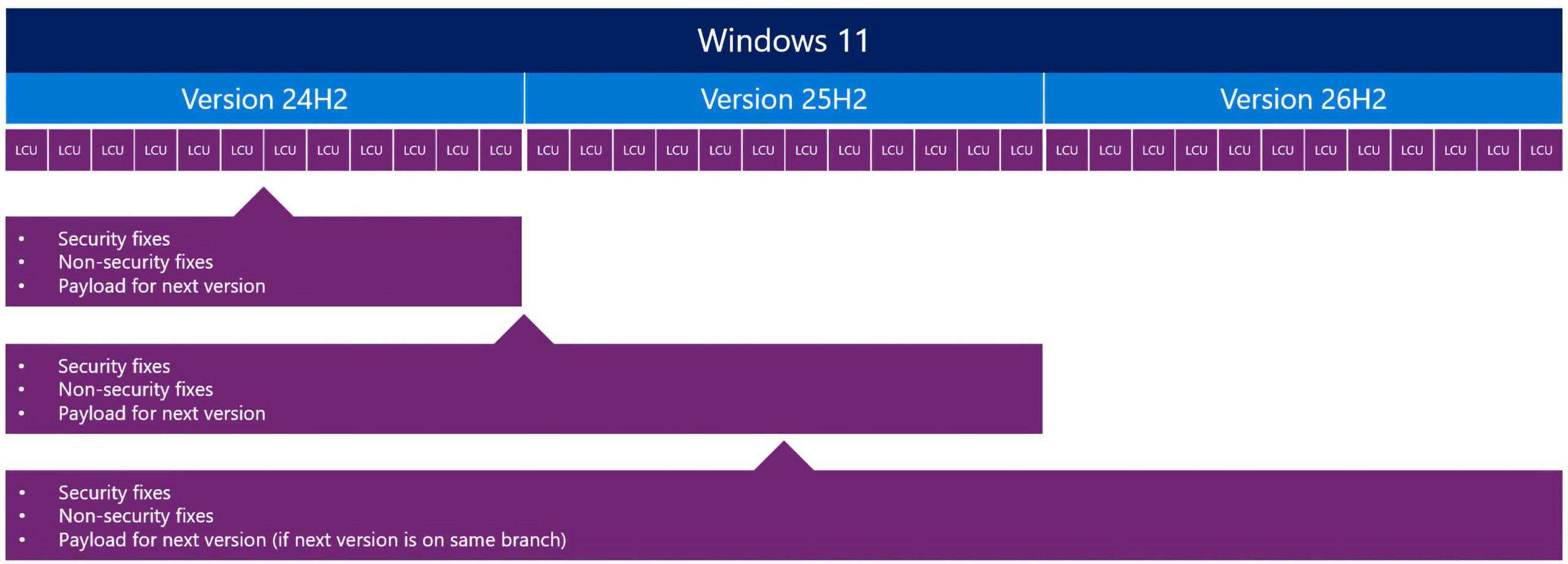
First look: Microsoft is sticking with smaller, incremental Windows 11 updates, and its next release will follow the same pattern. There’s no major feature rollout tied to Windows 11 26H2. Like version 25H2, it will arrive as an enablement package that toggles changes already present in the OS. On PCs already running Windows 11 24H2 or 25H2, the upgrade should be a quick enablement download, a single reboot, and a few minutes of install time, with no obvious changes on the desktop.
This approach dates back to Windows 11 24H2, released in October 2024, which marked the last traditional feature update. Since then, Microsoft has kept new versions on the same underlying platform. In practice, 25H2 and now 26H2 mostly exist to extend support timelines rather than add new capabilities.
New features are no longer tied to these annual releases. Instead, Microsoft is delivering them through monthly cumulative updates, allowing changes to roll out continuously. Recent updates have added a Low Latency Profile, with support for a movable taskbar expected in an upcoming Patch Tuesday release.
As a result, the annual “feature update” now acts more like a maintenance marker than the main way new features arrive.
Microsoft has positioned this update model as a way to reduce disruption, particularly for enterprise environments where stability is critical. “The next annual update for Windows 11 is coming soon… continues our focus on delivering a predictable, low-disruption update experience for organizations and IT professionals,” the company said in recent documentation.
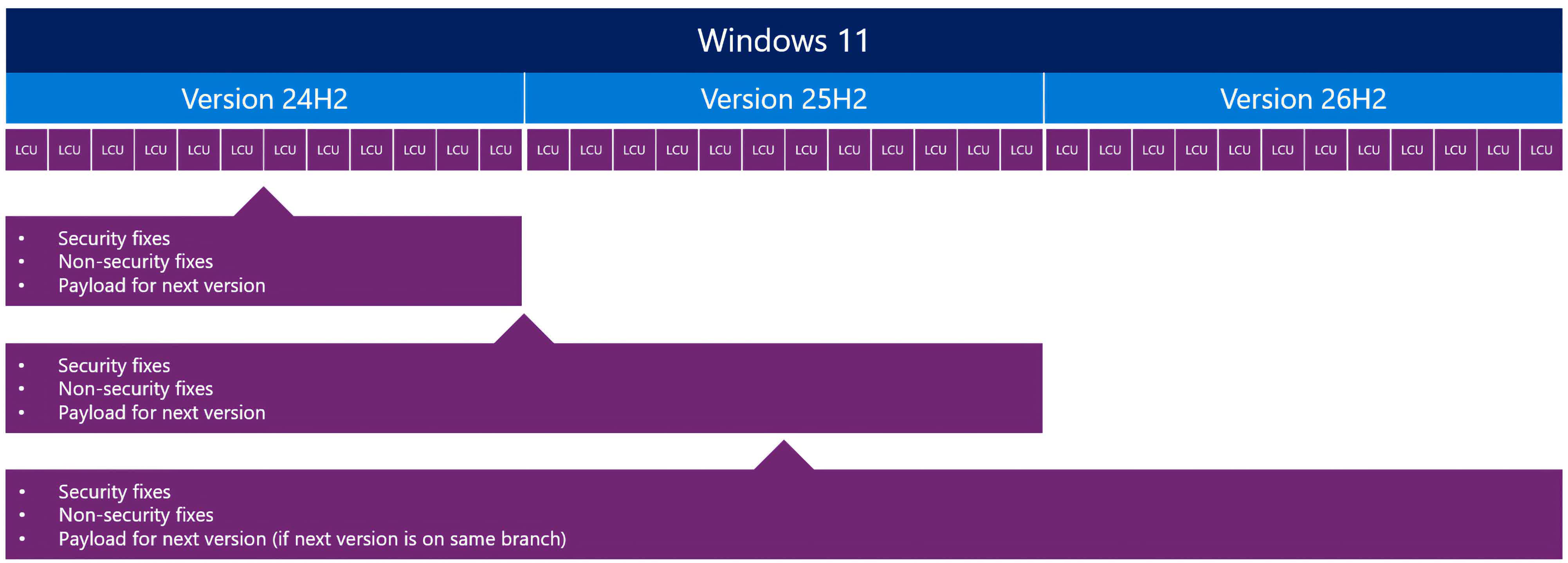
Enablement packages are small, often under 500KB, and work by activating dormant code already present in the OS. Because the platform itself doesn’t change, installation is faster and tends to be less disruptive than a full upgrade.
That shift also changes what a version number represents. Moving from 24H2 to 26H2 doesn’t bring a new feature set; it keeps the same codebase while advancing the support timeline for that installation.
For 26H2, support runs through October 2028 for Home, Pro, Pro EDU, and Pro for Workstations. Enterprise, Education, and IoT Enterprise versions will receive updates until October 2029, in line with Microsoft’s standard lifecycle model.
Hardware requirements remain unchanged. Any system capable of running Windows 11 24H2 or 25H2, which requires at least 4GB of RAM, 64GB of storage, and a 64-bit dual-core processor, will support the new version.
A separate release, Windows 11 26H1, is tied to newer silicon platforms such as Nvidia N1 and Snapdragon X2. It’s based on a different platform baseline and doesn’t introduce exclusive user-facing features, so for most users, it isn’t a meaningful upgrade.
The broader shift is that Windows is now evolving through steady, incremental updates rather than periodic overhauls. The most meaningful changes arrive through monthly patches, while annual releases serve primarily to maintain and extend the platform.
Microsoft hasn’t said whether this model will continue beyond 2026, and didn’t confirm if the same approach will apply to a future 27H2 release. For now, though, the company appears committed to a cadence built around smaller updates and more predictable deployment.
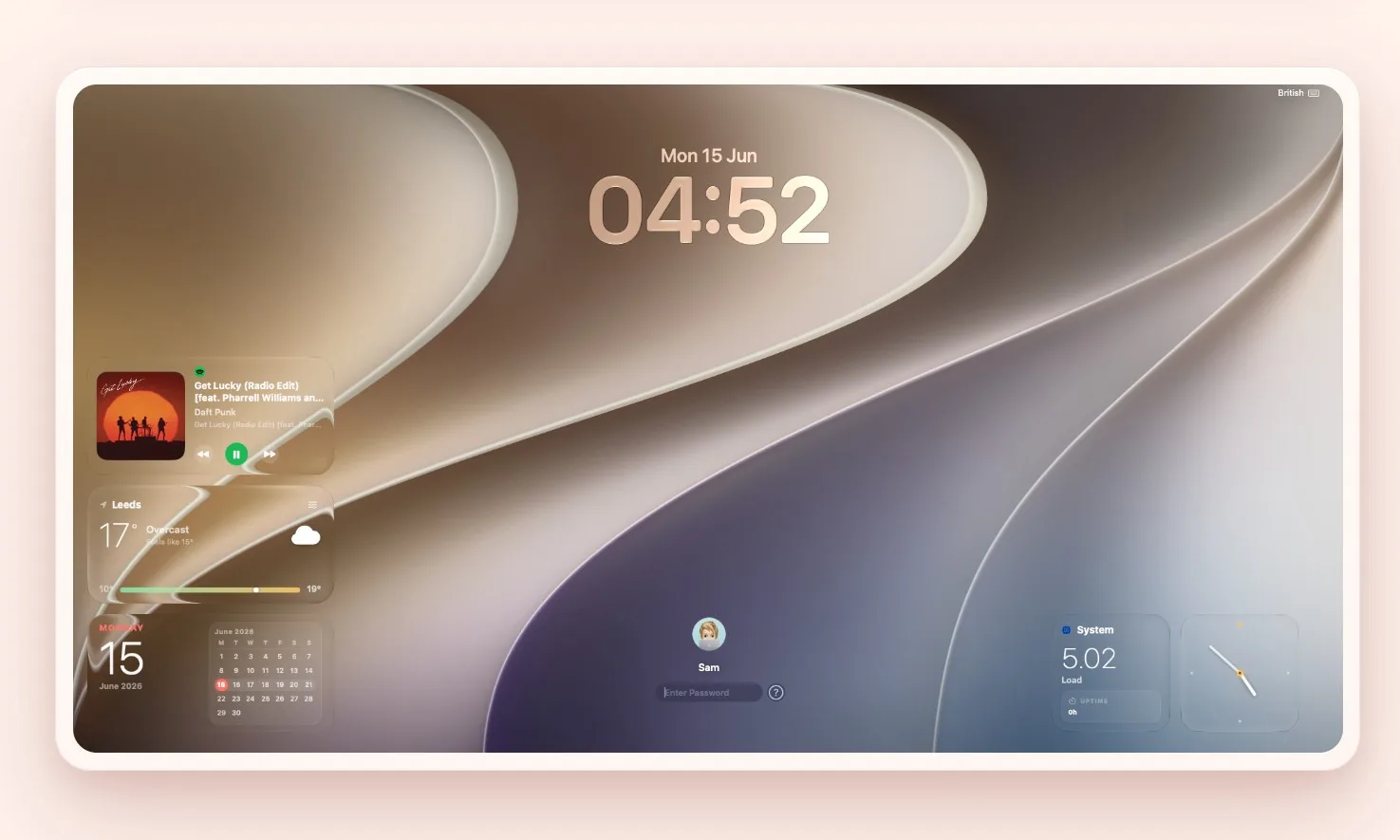
The Mac lock screen has always felt a little underused. You see the time, your wallpaper, and not much else. macOS already supports desktop widgets, but once your Mac is locked, that extra information disappears.
WidgetScreen is trying to fix that in a pretty simple way. The free Mac app, made by UK computer science student Sam Cook, adds glassy widgets to the lock screen so you can quickly check things like the weather, clock, calendar, battery, music playback, countdowns, and system information.

The app is intentionally limited to the lock screen. The widgets appear when the Mac is locked and disappear when the user signs in, so they do not compete with macOS desktop widgets.
WidgetScreen is built for quick glances. You can arrange widgets on a grid, resize them, choose frosted or clear glass styles, change units and time format, and decide which display they appear on.
The app also avoids one obvious concern. It does not ask for Screen Recording permission, and its website says it does not capture your screen or read your wallpaper. Instead, the widgets sit above the lock screen as native windows. Weather data comes from Open-Meteo, with a coarse IP-based location by default. You can also set a custom city manually.
WidgetScreen is completely free, does not require an account, and works on macOS 15 or later. It also lives in the menu bar, so it is easy to tweak without digging around.
Cook is already taking feedback from Reddit users. Automatic updates and improved frosted glass visuals have been added, while user-added widgets, desktop support, more opacity controls, extra calendar options, and more widget styles are among the ideas being worked on for future updates.


Claude Guillemot, who co-founded Ubisoft in 1986 and led gaming peripherals maker Guillemot Corp, has died at 69 in a plane crash in western France.
Claude Guillemot, one of five brothers who co-founded Ubisoft in 1986, has died in a plane crash near the coastal town of La Baule in western France. He was 69. Guillemot and a flight instructor from Rennes were both killed when their twin-engine Cessna 421 crashed in a field near La Baule aerodrome on the afternoon of 19 June.
French authorities confirmed that the aircraft was on fire when emergency crews reached the scene. Guillemot, a member of a local flying club, had departed Rennes and was travelling to an aviation gathering that was expected to draw more than 100 aircraft to the area. The cause of the crash has not been determined, and an investigation is underway.
Ubisoft confirmed the death in a statement, saying the company was “deeply saddened to learn of the death of Claude Guillemot.” The five Guillemot brothers, Claude, Yves, Michel, Christian, and Gérard, founded Ubisoft on 28 March 1986 in the Brittany village of Carentoir. What began as a software distribution business grew into one of the largest video game publishers in the world, behind franchises including Assassin’s Creed, Far Cry, Just Dance, and the Tom Clancy series.
Claude served as Executive Vice President in charge of operations at Ubisoft and sat on the company’s board of directors. His brother Yves remains chairman and chief executive of Ubisoft, which employs roughly 19,000 people across more than 40 studios worldwide.
Outside Ubisoft, Claude was chairman and CEO of Guillemot Corporation, the family’s publicly traded holding company that owns Thrustmaster, a major manufacturer of gaming peripherals including racing wheels, flight sticks, and controllers, and Hercules, which makes audio and DJ equipment. Guillemot Corp reported revenue of €197.7 million in its most recent fiscal year.
The Guillemot family’s grip on Ubisoft has been a recurring topic in the gaming industry. Despite holding roughly 11% of outstanding shares, the family maintains control through France’s Florange Act, which grants double voting rights to long-term shareholders. In 2022, Tencent, the Chinese conglomerate that has aggressively expanded its gaming portfolio, invested approximately €300 million in Guillemot Brothers Limited, the family’s private holding company, acquiring a 49.9% economic stake while receiving only 5% of voting rights.
That deal was widely interpreted as a defensive move, allowing the Guillemots to maintain control of Ubisoft while keeping Tencent’s influence capped. Tencent also holds a direct stake of approximately 9.46% in Ubisoft and invested €1.16 billion in Vantage Studios, a new Ubisoft subsidiary created in 2025 to manage the company’s biggest franchises. The question of whether Tencent and the Guillemot family would eventually pursue a full buyout has lingered for years, with no deal materialising as of June 2026.
Ubisoft has faced significant headwinds in recent years, including studio closures, layoffs affecting hundreds of employees, and a corporate restructuring that split the company into five creative divisions. The successful launch of Assassin’s Creed, a franchise that has expanded beyond games into film and television, helped stabilise the company after a difficult 2024, with Assassin’s Creed Shadows surpassing five million players within four months of its March 2025 release.
Claude Guillemot’s death comes at a particularly complex moment for the family business he helped build. Ubisoft is navigating activist investor pressure, an ongoing strategic partnership with Tencent, and a broader gaming industry contraction that has seen tens of thousands of jobs eliminated across the sector since 2023.
He is survived by his brothers and his family. French media reported that tributes from the gaming industry and the Brittany business community began arriving within hours of the announcement.

Asked about the privacy implications of chatbots like ChatGPT and Claude, Signal President Meredith Whittaker answered, “These are not your friends. These are not conscious beings. These are not sentient interlocutors.”
Whittaker made those comments in a broader interview with Bloomberg about policy, privacy, and Signal. She acknowledged that she uses AI tools “to format a document here and there,” but insisted, “I don’t ask them questions. I’m very serious about my thinking and writing, and I don’t want the process of working through an idea […] to be foreclosed or eclipsed by the response of a system that’s averaging what’s already out there.”
As for Microsoft AI CEO Mustafa Suleyman’s prediction that users could let Microsoft Copilot handle all their Christmas shopping this year, Whittaker argued this scenario — where Copilot is eavesdropping on the family group chat to determine who wants want — means giving it “access to my credit card, my browser, my Signal, the ability to message my siblings on my behalf, my home address [and] my calendar.”
“What you’ve just described is a system with very pervasive access across multiple applications and services,” Whittaker said. “In the context of Signal, it would constitute a kind of a backdoor.”


Movie studios keep hunting for ways to make a trip to the theater feel essential again. Sony Pictures landed on one clear path with its next Spider-Man film. The studio worked directly with CJ 4DPLEX to present Spider-Man: Brand New Day in SCREENX, a format built to spread the action beyond the front screen and across the side walls of specially equipped auditoriums.
Audiences who choose this version enter rooms where specific scenes continue to play out on the walls next to them. The primary story remains front and center on the enormous screen in front, but there are supplementary shots playing out to the left and right. The combination of the two produces a very broad, all-encompassing perspective that immerses you in the action rather than making you a distant spectator.
Sale

SCREENX is powered by a multi-projection system, with one projector handling the main screen and additional ones dealing with the side walls. The photos are all aligned using smart techniques like as warping correction and edge blending, resulting in a seamless image despite the fact that the walls are at an angle to the main surface. There are no special glasses required, which is a plus. The extra content is kept under control since it only appears at specified points in the film, rather than running throughout.
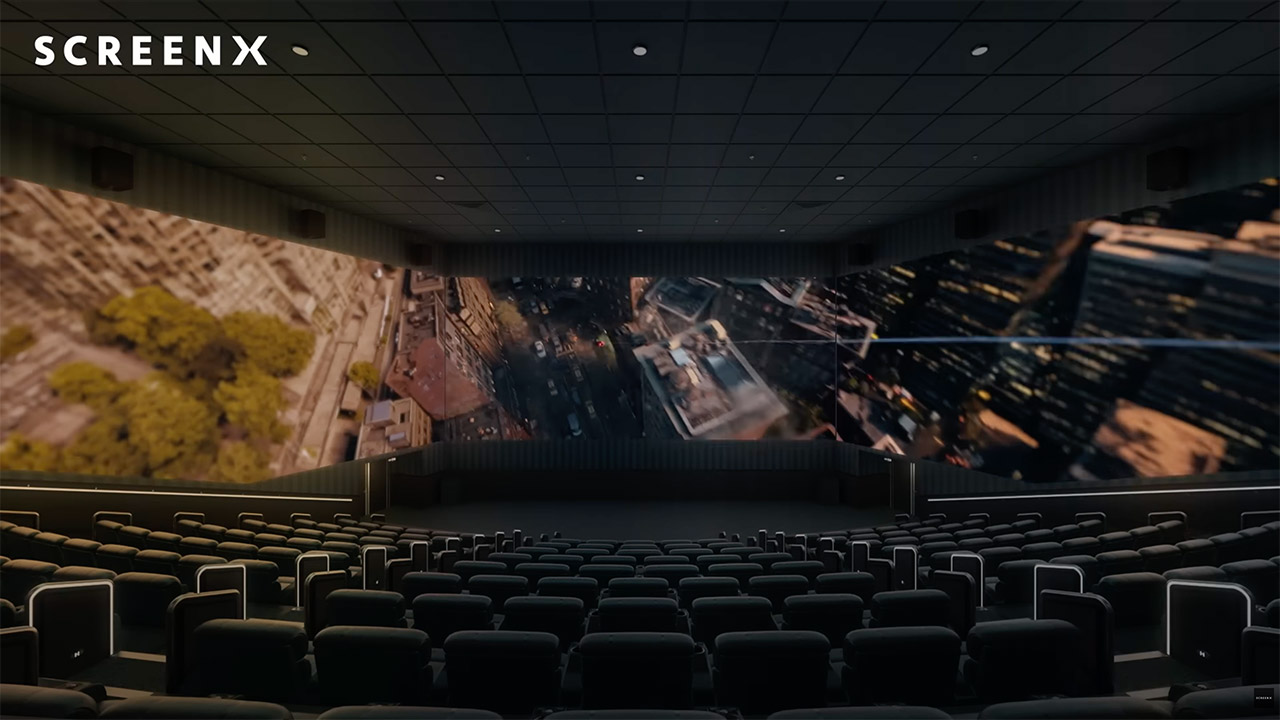
SCREENX has been widely used by filmmakers since it first appeared in films rather than only advertisements a few years ago. The amount of extra content on the side walls has been progressively expanding. Some films may only open the walls for a few twenty or thirty minute portions, but newer films can keep them open for an hour or more. Extra material is typically created from existing film or digital elements added later in the editing process.
However, Spider-Man: Brand New Day takes a different approach to the situation. CJ 4DPLEX despatched a crew to the set while the main crew was filming. That team took specialized photographs for the side walls, and this is the first time the format has had unique on-set photography generated particularly for it from the start of a major studio film until its release. Director Destin Daniel Cretton puts it simply: CJ 4DPLEX and their team came in to shoot content for the SCREENX auditoriums.
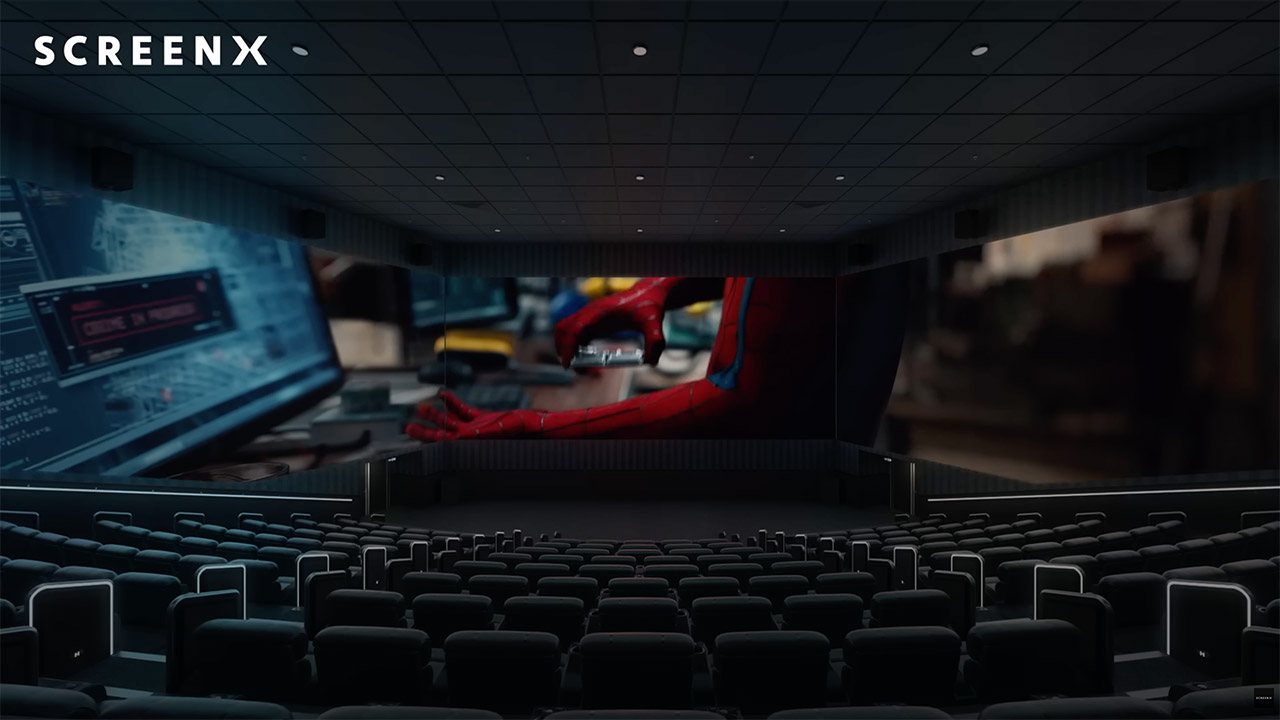
Jun Bang, the CEO of CJ 4DPLEX, described it as an advancement of the overall SCREENX concept. They collaborated closely with Sony Pictures and Cretton, utilizing their proprietary tools to greatly expand the visual possibilities. The goal was to ensure that they preserved the director’s vision while also immersing the audience in the story, action, and Spider-Man world.
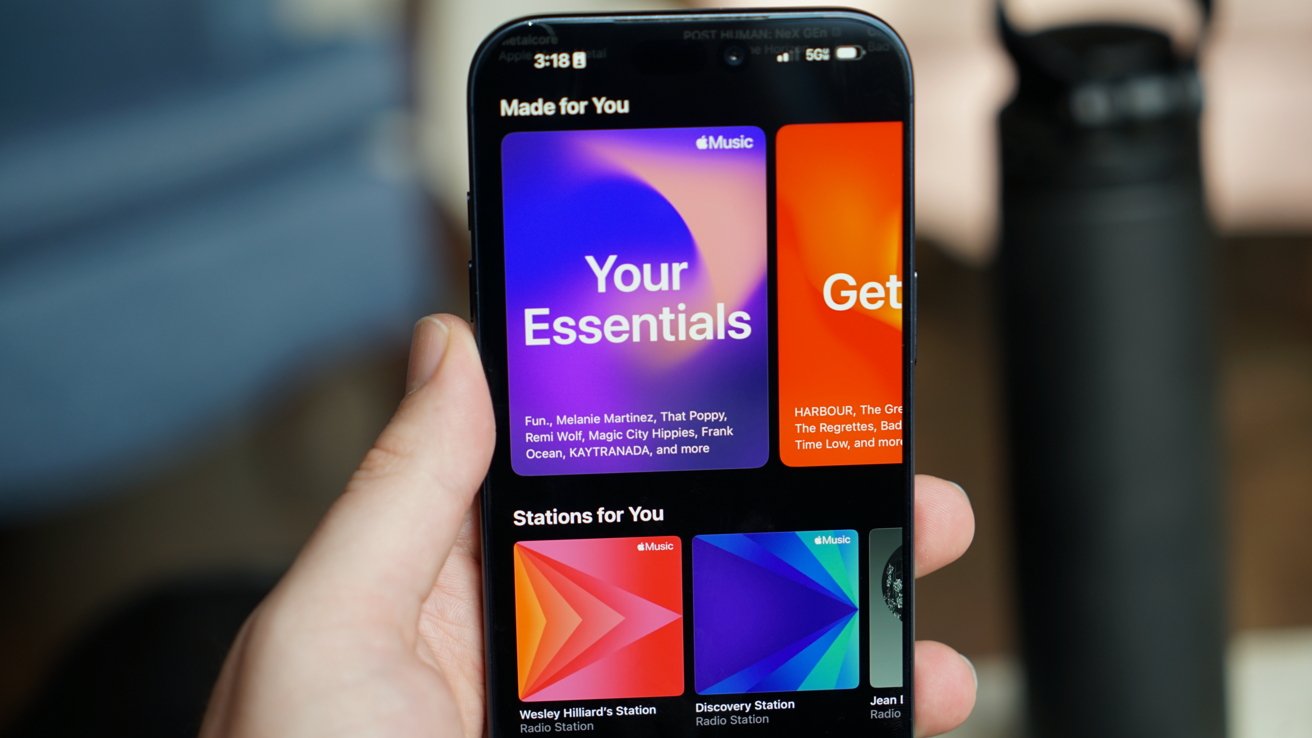
It should come as no surprise that Taylor Swift, Bad Bunny, Ariana Grande, and Kendrick Lamar are among the top 20 most streamed artists of all time on Apple Music. Check out the full list.
Apple Music launched on June 30, 2015, and it celebrated 10 years of streaming with a top 500 songs list. A year on, the streamer has shared a new metric.
The new chart is the top 20 artists of all time on Apple Music, shared by Chart Data on social media. It’s an official endorsement, as Apple Music’s account reposted it and replied with a heart and trophy emoji.
It isn’t clear what prompted the post, but we are in proximity to Apple Music’s birthday, so it may simply be that. If you don’t live under the proverbial rock, none of these artists should come at any surprise.
Apple isn’t promoting the list on Apple Music, at least not yet anyway. If you’re interested in the top 500 song playlist, it’s still available.
Out of the twenty artists present, I have six in my library. Unsurprisingly, the vast majority of music represented here is in the rap or pop genres.
If you’d like to see something a little more personalized, there’s your Apple Music Replay. Unlike Spotify Wrapped, it is updated monthly, so your 2026 Replay is already available.





No Jackpot Winner as $257 Million Prize Rolls Over to $269 Million Monday Draw


Weekend Open Thread: Miami – Corporette.com

Zimbabwe Requires Crypto Businesses to Register Annually Under New FIU Regulations

Wall Street Week Ahead: Investors see Micron earnings as pulse check of AI rally momentum

Matt Damon’s Viral Sci-Fi Thriller Has Taken Over HBO Max


As AI companies race to go public, who else is along for the ride?


Anthropic staff to meet White House officials next week, Axios reports

Bitcoin could crash to $48,000, if this historical pattern is triggered

what doctors are seeing in ebike crashes

Warning of disruption as Cardiff Crossrail works to start


HIVE shares jump as $220M AI deal speeds Bitcoin mining pivot

Tributes to former deputy head teacher at Cambridge school among death and funeral notices


“Israel’s” ban on ICRC visits ruled illegal, but Knesset moves to stop them permanently


Financial Accounting | Last Day Revision Strategy and Booster | CMA Inter – June 2026

Kate Middleton Glare Goes Viral After Kids Booed At Royal Event


Over 400 Arch Linux packages compromised to push rootkit, infostealer


XRP ETFs Outperform As Bitcoin And Ethereum Funds Extend Outflow Trend


Invesco Quality Income Fund Q1 2026 Commentary


Singer Oliver Tree dies aged 32 in helicopter crash in Brazil

Market Preview: SpaceX (SPCX) IPO Record, Federal Reserve Meeting, and Iran Nuclear Agreement



You must be logged in to post a comment Login