

Crypto World
Sam Altman ChatGPT AI Predicts Stunning Bitcoin Price By End Of 2026

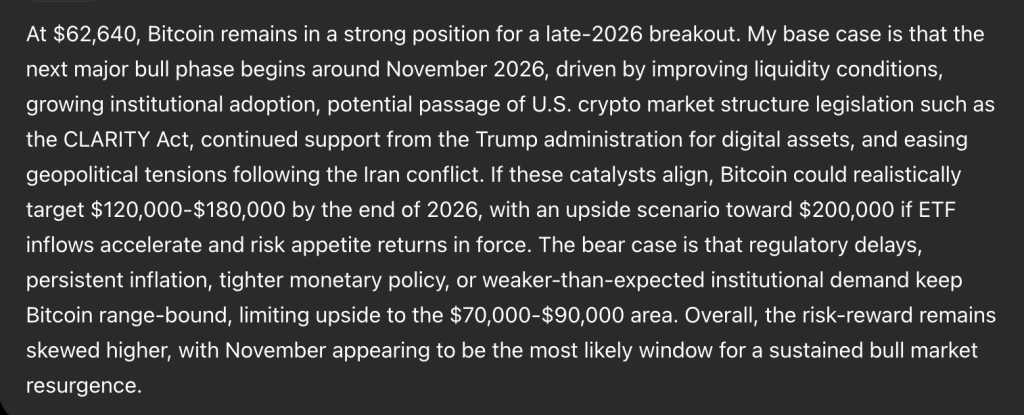
There is one word in this prediction that carries more weight than any of the Bitcoin price predictions for November. ChatGPT AI is not hedging on timing the way a lot of these predict do.
It names a specific month as the most likely window for a sustained bull market resurgence, and everything else in the prediction is built to support that single calendar bet.
When an AI commits to a date rather than just a price, the entire thesis becomes easier to grade later, which makes this one of the more accountable calls in the series.
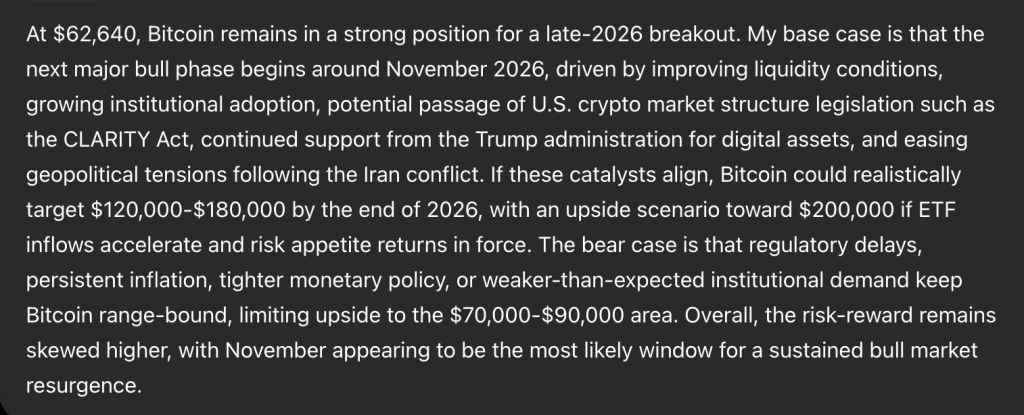
At $62,640, ChatGPT’s base case has the next major bull phase beginning around November 2026, driven by improving liquidity conditions, growing institutional adoption, potential passage of U.S. crypto market structure legislation such as the CLARITY Act, continued support from the Trump administration for digital assets, and easing geopolitical tensions following the Iran conflict.
That is five distinct tailwinds converging on roughly the same window, and if even most of them land together, the base target sits at $120,000 to $180,000 by year’s end, with an upside scenario stretching to $200,000 if ETF inflows accelerate and risk appetite returns in force.
From current levels, that base case alone represents nearly a 2x to almost 3x move.

The bear case is where this prediction earns some credibility by being specific rather than vague. Regulatory delays, persistent inflation, tighter monetary policy, or weaker-than-expected institutional demand could keep Bitcoin range-bound, limiting upside to the $70,000 to $90,000 area.
That is not a doomsday scenario; it is a stall scenario, and the distinction matters because it means even in the bear case, ChatGPT still expects the price to be above where it sits today. The overall framing leans firmly toward risk-reward skewed higher.
Bitcoin Price Prediction: The Calendar Bet The Chart Has To Earn
Bitcoin price is at $62,568 today, and the daily chart shows price sitting almost exactly where it has traded multiple times before across this entire cycle, a level that keeps getting revisited rather than decisively broken in either direction.
From the $128,000 peak last October, the decline has been steep, but what stands out on this chart is the repeating rhythm, sharp drops followed by multi-month recoveries that each stall out before reaching the previous high.
The June low near $60,000 is the third meaningful test of that general zone since the correction began, and each prior test has produced a bounce rather than a breakdown.
For ChatGPT’s November thesis to have any technical credibility, the chart needs months of quiet base-building between now and then, exactly the kind of consolidation pattern that has actually been forming since February.
The $60,000 to $70,000 range has effectively become the holding zone for this entire correction, and the longer price stays contained within it without making a new low, the more that range starts to look like accumulation rather than distribution.
The first real test above is $72,000, the level that has capped every recovery attempt since the May rejection, and reclaiming it would be the earliest technical signal that the chart is starting to lean into the bull phase the prediction is calling for.
The RSI sits at 34.11 with the signal line at 32.45, a gap of less than 2 points, among the flattest readings seen anywhere in this prediction series. Momentum is neither building decisively nor collapsing further, it is essentially asleep, hovering in the same depressed zone it has occupied through most of this multi-month range.
That flatness is oddly consistent with a November target. A genuine bull phase igniting months from now does not require momentum to already be screaming higher today, it requires exactly this kind of quiet, sideways grind first, the calm before whichever catalyst from ChatGPT’s list actually shows up to break the range.
LiquidChain Is Catching the Attention of Bitcoin holders: ChatGPT AI Predicts It’s the Next 100x
The rotation is already happening. Most people will only see it in hindsight.
Large-cap crypto is not failing. It is capped. Bitcoin, Ethereum, and XRP have been pressing against the same resistance bands for weeks. The macro tailwinds keep getting delayed.
The institutional inflows keep getting pushed to next quarter. Holding assets where the upside depends on catalysts you cannot control is not a strategy. It is waiting.
A capital that has navigated enough cycles does not wait at resistance. It moves before the destination becomes obvious.
Early-stage infrastructure plays operate on different math entirely. A small enough market cap means a modest rotation produces dramatic price movement. The asymmetry exists because the market has not priced in what is being built yet. That gap between current valuation and what the project is actually worth is where the returns come from.
Multi-chain fragmentation costs DeFi real money every single day. Bitcoin, Ethereum, and Solana run completely isolated liquidity systems with no native way to connect them. Every user moving value between ecosystems absorbs that cost directly in fees, slippage, and failed transactions.
LiquidChain collapses all 3 networks into a single execution layer. One deployment. Full ecosystem access. No cross-chain tax on every interaction.
The market has not found this yet. That is the entire point.
The presale is at $0.01454 with just over $820,000 raised. Ground floor is not a marketing phrase here. It is a description of where this actually sits in its lifecycle.
Execution is unproven. Adoption is unknown. Those risks are real and worth naming directly. Established assets offer a smoother ride toward a ceiling that is already visible. This offers an earlier seat at a table that has not been set yet.
Explore the LiquidChain Presale
The post Sam Altman ChatGPT AI Predicts Stunning Bitcoin Price By End Of 2026 appeared first on Cryptonews.

Crypto World
Bets against SpaceX grow to 32% of float as Elon Musk warns short sellers won’t survive

Samuel Boivin | Nurphoto | Getty Images
Elon Musk warned that investors betting against SpaceX have little chance of survival — even as short sellers boosted their wagers against the company to about one-third of its publicly tradable shares ahead of several key catalysts.
About 206 million SpaceX shares are now sold short, representing roughly 32% of the company’s publicly tradable float and about $25 billion in notional bearish bets, according to estimates from S3 Partners. That’s up from about 185 million shares, or 29% of the float, just last week, and marks a dramatic increase from an estimated 40 million shares, or roughly 5% to 7% of the float, about a month ago.
“We continue to see short sellers adding exposure ahead of several key upcoming catalysts, including the company’s first earnings report as a public company and subsequent lock-up expirations,” Matthew Unterman, head of research at S3, told CNBC.
Musk responded to the growing short interest in a post on X, predicting investors betting against the company would ultimately lose.
“The survival probability of firms who maintain a significant short position in SpaceX over time is very low,” Musk wrote. “I said SpaceX will be worth more than Earth if we achieve our goals. Obviously true.”

SpaceX one month
SpaceX confirmed Tuesday that it will release its first quarterly earnings report as a public company after U.S. markets close on Aug. 4. The results will give investors their first detailed look at SpaceX’s performance since its initial public offering and could provide a fresh test for both bulls and short sellers.
The growing bearish position comes as investors weigh SpaceX’s long-term prospects against its valuation and the possibility of additional shares becoming available after lock-up restrictions expire. Bulls point to the company’s leadership in launch services, Starlink’s expansion, and its artificial intelligence ambitions, while skeptics have questioned how much future growth is already reflected in the stock.
SpaceX shares rose about 3% on Tuesday, snapping a seven-session losing streak after analysts at Macquarie reiterated their outperform rating and urged investors to buy the recent weakness. The stock climbed to around $124, though it remains below its $135 IPO price following a sharp post-listing pullback.
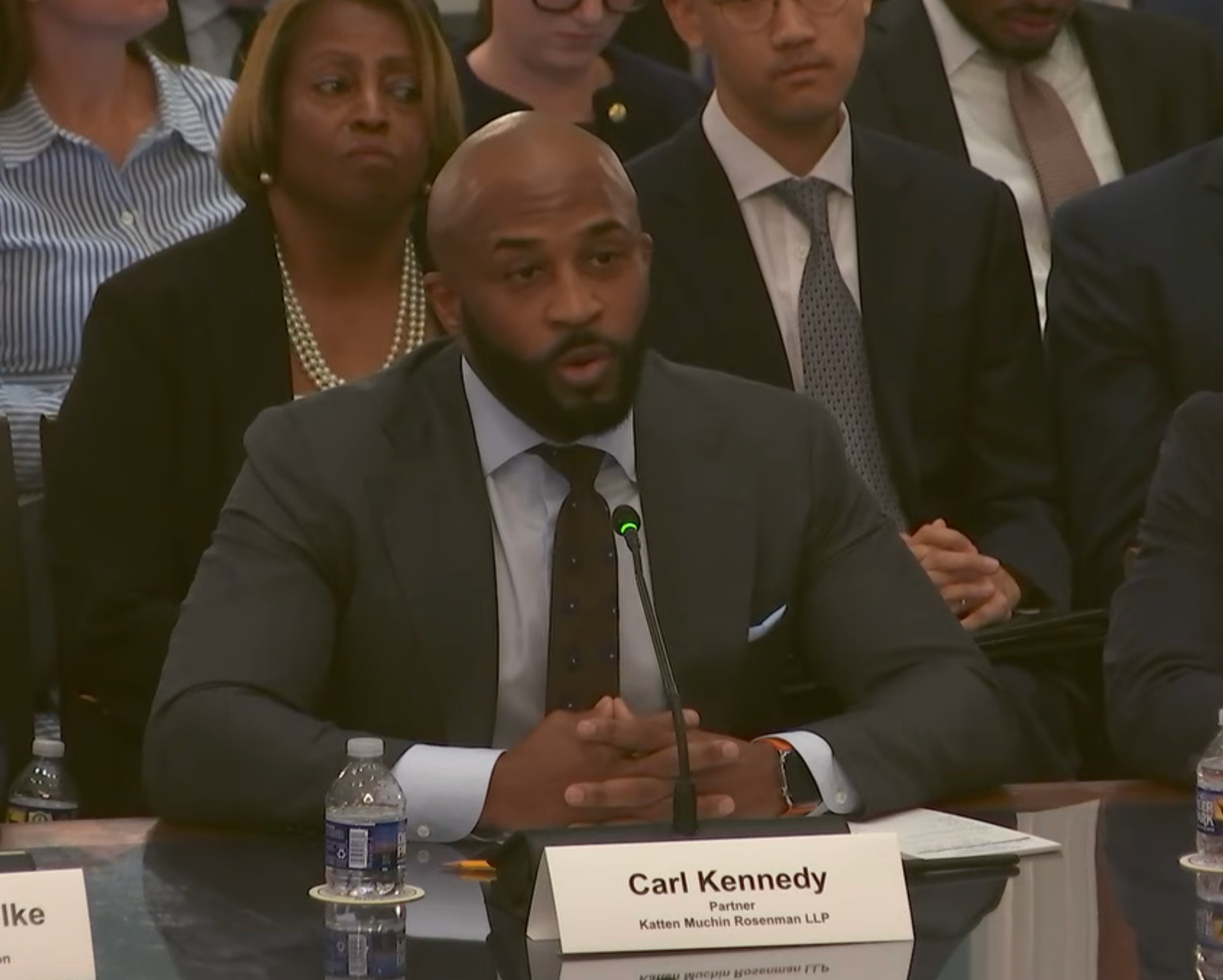
Lawmakers in the US House Committee on Agriculture’s Subcommittee on Commodity Markets, Digital Assets, and Rural Development held a hearing on how the Commodity Futures Trading Commission (CFTC) could address oversight of prediction market companies, including discussions of pending crypto market structure legislation.
In a Tuesday hearing on “Examining Customer Protections and Market Integrity in Sports Event Prediction Markets,” Carl Kennedy, a partner at New York law firm Katten Muchin Rosenman, said that the CFTC was likely too “short-staffed” to fully deal with the regulation and enforcement of prediction market platforms like Kalshi and Polymarket. According to the lawyer, the Digital Asset Market Clarity (CLARITY) Act under consideration in the US Senate could grant the commodities regulator additional authority not only to address digital assets but also the “explosive growth of prediction markets.”
“I do believe that with additional resources — they’re about to perhaps receive additional authorities under the CLARITY Act — with additional resources to address these new asset classes in the cash markets and crypto, as well as to deal with the explosive growth of prediction markets, I think that the CFTC certainly should receive additional resources,” said Kennedy.
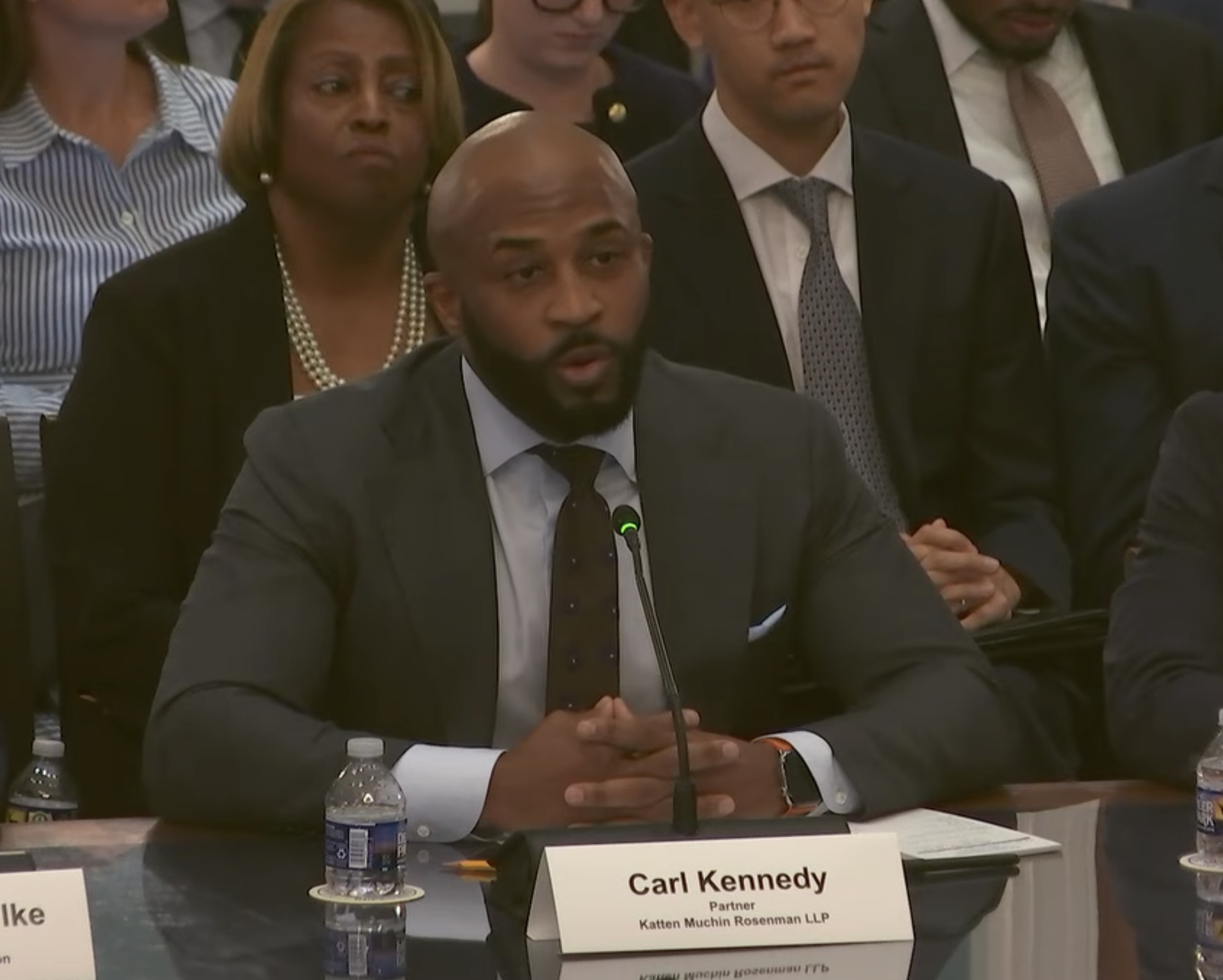
Carl Kennedy at Tuesday hearing. Source: House Committee on Agriculture
Kennedy’s remarks were just one example of legal and regulatory experts chiming in on the CFTC’s approach to handling prediction markets under Chair Michael Selig. Since being confirmed by the Senate in December, the chair has unilaterally taken the position that the agency has “exclusive jurisdiction” over the companies, arguing that event contracts on the platforms are classified as “swaps” under the CFTC’s purview. Selig is the only Senate-confirmed member heading the CFTC in a leadership panel normally consisting of five commissioners.
Related: Trump claims he can ‘future proof’ crypto regulation with CLARITY Act
The CFTC chair’s position has led to what many Democratic senators call an “assault” on state authorities trying to regulate prediction market platforms, with some US states filing lawsuits against Kalshi and Polymarket over sports betting. Last week, he ordered Kalshi to ignore a ruling from a Michigan court, which the company said “put [it] in an impossible position” between state and federal authorities.
Some legal experts expect that one or more of the prediction markets cases could eventually reach the US Supreme Court to address the clash between state and federal regulators.
Text of CLARITY Act expected to be released soon
Republican senators pushing for a vote on the CLARITY Act in Congress before the chamber breaks for August state work periods say they expect to release the bill’s text soon. Details on how the bill could address prediction markets, ethics and other concerns from lawyers were not made public as of Tuesday.
In June, gambling industry groups petitioned the US Senate to add language to CLARITY “that explicitly prohibits event contracts tied to sports and casino-style gaming.” The White House also confirmed reports that the Trump administration “agreed to the most comprehensive and wide-ranging ethics provision in history“ and it had “bent over backward to accommodate [Democrats’] concerns.“
Magazine: Peter Brandt predicts the exact day Bitcoin’s bear market will be over


Jack Mallers said he is stepping down as CEO of Twenty One Capital, the Tether-backed bitcoin treasury company he founded, to focus on his payments firm Strike. "I've decided to step down as CEO of Twenty One," Mallers wrote on X on Tuesday. "My life's work remains Bitcoin. My Bitcoin company is… Read the full story at The Defiant


Morpho, one of the largest onchain lending protocols, launched Midnight, a fixed-rate and fixed-term credit protocol, on the Base network. The team announced that "Morpho Midnight is live," describing it as "fixed rate, fixed term credit markets." Alongside the protocol, Morpho released a new… Read the full story at The Defiant


Paris Blockchain Week is entering its next chapter with a new name, broader focus and new owner. Hyve Group acquired Signal Week, formerly Paris Blockchain Week, alongside RAISE Summit and MACHINA Summit. The terms were not disclosed.
Hyve said the three events will form a new AI-focused division while adding crypto expertise to its fintech portfolio.
Blockchain Steps Into a Wider Room
Signal Week marks a clear shift in how the Paris event presents itself. Its agenda will cover institutional digital assets, traditional finance, and AI-driven financial infrastructure.
Hyve said the latest Paris Blockchain Week attracted more than 10,000 attendees from over 100 countries, with executives making up 70% of the audience. RAISE brings more than 9,000 AI attendees, while MACHINA focuses on robotics and “physical AI.”
Together, the acquisitions bring crypto, enterprise AI, and robotics under one roof. Signal Week and RAISE will remain separate brands, although their overlap could attract more banks, investors, and policymakers to the same Paris ecosystem.
Hyve Buys While Being Bought
Hyve plans to add hosted meetings, executive discussions, and stronger matchmaking across the events. It also wants to launch successful brands in new markets and develop year-round content and membership products.
Meanwhile, Hyve is going through an ownership change. Private equity firm Hellman & Friedman agreed in June to acquire it from Providence Equity Partners and Searchlight Capital Partners.
The deal should close before the end of 2026. The Financial Times valued it at about $1.8 billion, while Hyve said its annual EBITDA had risen above $100 million.
That backing gives Hyve more capital to acquire and scale conference brands. It also places Signal Week inside a group built around international expansion.
A New Identity for Crypto’s Paris Stage
Crypto remains central to Signal Week. Its remit now covers the wider infrastructure developing around digital assets, including institutional markets and AI-linked financial systems.
The acquisition changes the event’s ownership and strategic direction. One of Europe’s largest crypto gatherings is being rebuilt as a broader technology and finance platform.
The post Paris Blockchain Week Enters Its AI Era Under New Owner appeared first on BeInCrypto.


Pump.fun, the Solana-based token launchpad, introduced a launch mechanism it calls BOOST mode, describing it in a post on X as "the new standard launch mechanism for EVERY new pump fun coin." The company said BOOST reinjects future liquidity into every bonded coin, framing the change as a response… Read the full story at The Defiant
The blockchain developer will continue operating under court supervision as it restructures following a market-making scandal, a co-founder’s suspension, and exchange delistings that rocked the project.
Movement Labs, the developer behind the Movement Ethereum layer-2 blockchain, has filed for Chapter 11 bankruptcy protection in the US Bankruptcy Court for the District of Delaware, according to court records.
The petition was filed July 15 under Subchapter V, a streamlined reorganization process for qualifying small businesses. The filing allows the company to continue operating while it restructures under court supervision.
On Monday, the court approved interim requests allowing Movement Labs to maintain its bank accounts and cash management systems and obtain debtor-in-possession financing to fund operations during the bankruptcy process. Creditors have until Sept. 14 to file claims.
Following the filing, Move Industries CEO Torab Torabi wrote on X that the bankruptcy applies only to Movement Labs. Move Industries, which took over development and operations of the Movement ecosystem from Movement Labs in December 2025, continues to operate normally, according to Torabi.
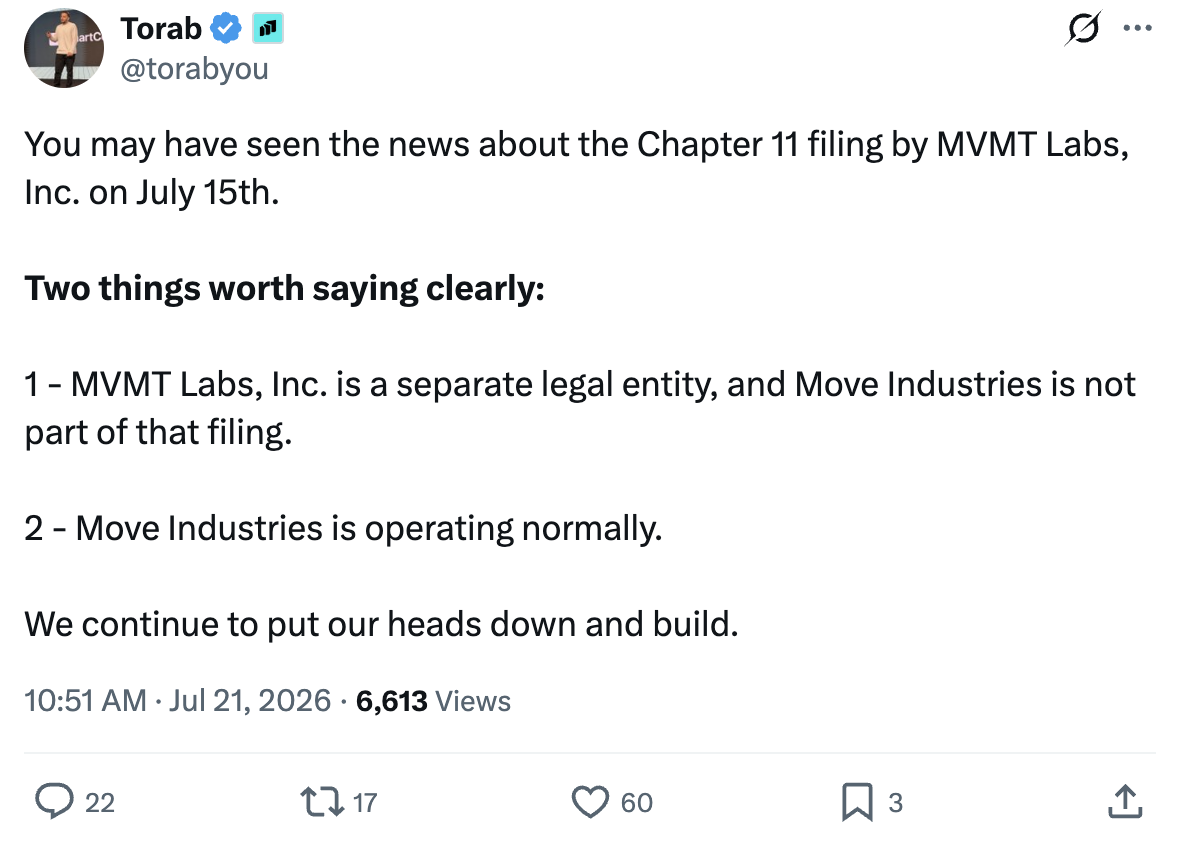
Source: Torab
Market-making scandal rocked Movement before bankruptcy
The filing follows months of turmoil tied to the launch of Movement’s MOVE token and a controversial market-making agreement.
Movement Labs suspended co-founder Rushi Manche in May 2025 over a deal he helped broker with Web3Port. The market maker received 66 million MOVE, about 5% of the token’s supply, and later sold the holdings, reportedly creating roughly $38 million in downward price pressure and prompting an independent investigation.
Coinbase suspended MOVE trading later that month after determining the token no longer met its listing standards, as the review into the market-making arrangement continued.
The bankruptcy follows a prolonged decline of the MOVE token, which has fallen more than 94% over the past year to roughly $0.01.
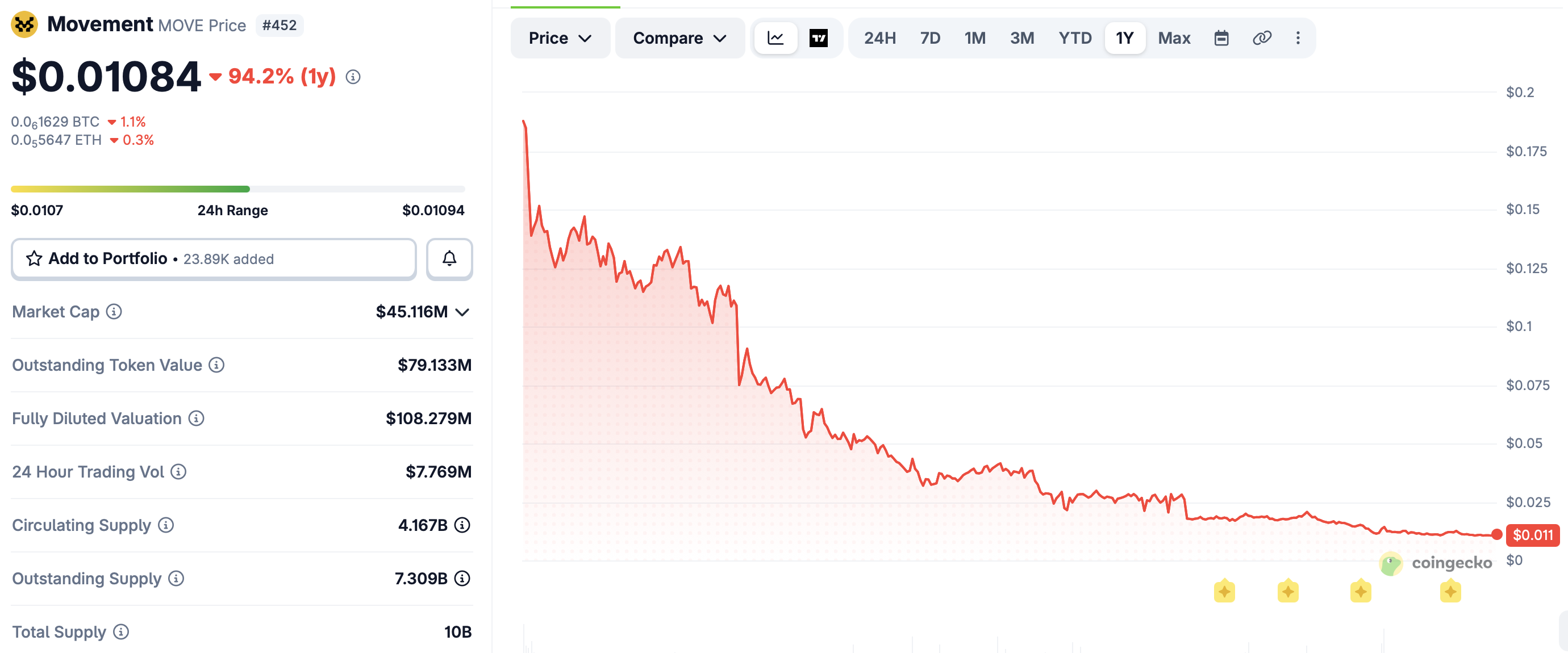
MOVE token price over the past year. Source: CoinGecko


Crypto prices climbed on Tuesday after reports that the White House had reached agreement on the ethics provision that had stalled the Digital Asset Market Clarity Act in the Senate, reviving the odds of a floor vote before Congress breaks for its August recess. The ethics language had been the… Read the full story at The Defiant
Crypto World
Fewer Than 300 Made the Cut: Ivan Nevzorov on MiCA, CASP Licensing, and What’s Next for Crypto Firms
Of the more than 3,000 companies that were legally serving crypto clients across the EU as recently as this June, fewer than 300 hold the right to do so today, according to CASP Tracker.
The reason is the Markets in Crypto-Assets Regulation (MiCA), which took full effect across the European Union on 1 July 2026: from that date, only a company holding Crypto-Asset Service Provider (CASP) authorisation — granted by a regulator in one EU member state and passported across the rest of the bloc — can serve EU clients. Companies that previously operated under national Virtual Asset Service Provider (VASP) registrations had exactly until that date to convert. Most didn’t.
We talked to Ivan Nevzorov, CEO at SBSB Fintech Lawyers, about what’s actually left for them now — and why the shortcuts most of them reach for first usually aren’t the ones that hold up.

Let’s start with the obvious one. A company still doesn’t have a CASP licence today — what happens to it now?
Ivan Nevzorov: Look, here’s the thing people don’t want to hear: the deadline’s already passed. From July 1st, every day you keep serving EU clients without authorisation is a day you’re in breach of MiCA — a minimum €5 million fine under Article 111, and in France it can mean criminal liability for whoever’s responsible. So the answer everyone expects to hear, “just go get licensed,” isn’t actually on the table anymore for a company operating today. You can’t file an application, keep the lights on for months while it gets reviewed, and call that compliance.
Which really leaves two paths. One, you wind down, because the business can’t meet the new standard. Two, you relocate — move your base to a friendlier jurisdiction. Though that one only keeps you legal if you stop marketing into the EU completely and let clients come to you on their own, what’s called reverse solicitation. Keep advertising to EU users from outside the bloc, and you’re breaking the exact same rule, just from a different address.
We’ll come back to relocating, because it’s genuinely its own conversation. Let’s start with winding down, since that’s where most of these companies actually are right now — and honestly, it’s painful to watch, because most of them didn’t do anything wrong. They just didn’t get there in time, and for a lot of them, the reasons had nothing to do with how good their compliance actually was.
Winding down sounds like the more straightforward path, at least. Is it actually?
Ivan Nevzorov: Not as straightforward as people think, and there’s a right way and a wrong way to do it. The wrong way is switching off the app and disappearing — the client assets sitting in those accounts don’t vanish, and holding them is a regulated activity in itself. To the regulator, that company hasn’t gone anywhere. It’s still operating without a licence, only now it’s also stopped answering its clients. The right way is one of two things: an orderly wind-down, or transferring your clients to a CASP that’s already authorised.
ESMA’s actually spelled out what an orderly wind-down has to look like: stop onboarding, stop any marketing into the EU, restrict yourself to settling what’s already open. And transferring clients sounds simpler on paper, but being on the CASP register only tells you a firm’s allowed to take clients — it doesn’t tell you they’re actually set up to onboard a few thousand new ones at once. A lot of the firms that got authorised fastest didn’t build a crypto compliance function from zero — they already held a MiFID or e-money licence and just converted it, lighter scrutiny attached. Good for them, but it also means some of these brand-new CASPs are banks running crypto as a side product, not specialists who can absorb a wave of migrating clients. Every single one of those clients still needs full AML and KYC re-verification before the new CASP can touch their money. That’s months of work for a team that does it every day. Longer for a team that doesn’t.
You’d think the bigger platforms would have this solved by now. Is that actually the case?
Ivan Nevzorov: Less than people think, and Binance is actually a fair example of why. A platform with years of European operating history and enormous legal and compliance resources still ran into real MiCA licensing problems — the same wall a lot of much smaller companies are hitting. That tells you something worth sitting with: this isn’t a gap you close just by throwing money or headcount at it. If a company at that scale couldn’t get it fully sorted before the deadline, a smaller operator shouldn’t assume they’ll just muscle through it either.
Let’s rewind for a second — only a couple hundred companies actually made it through while that was still possible. What was going wrong for the rest?
Ivan Nevzorov: Honestly, it’s rarely the paperwork. A technically correct application just gets you in the room — it doesn’t win you the decision. We saw one filing get rejected over how the share capital was deposited, and that requirement isn’t even written into MiCA, anywhere. The regulator just invented a formality that isn’t in the text. That’s the pattern I keep seeing: whatever reason they put on paper is almost never the real one. The real reason comes to you informally, if it comes at all, and it’s about how they read the company — do you actually understand your own risk model, who’s accountable for what, who your clients really are. A compliance policy copied from a template answers none of that. It’s the first thing I flag when someone walks into SBSB with one.
And the second thing people underestimate completely: where you filed mattered almost as much as what you filed. This wasn’t one process across the EU — it was twenty-seven versions of it, moving at completely different speeds, with completely different appetites for saying no. Germany’s BaFin wasn’t shy about it: its first-ever MiCA enforcement action was rejecting Ethena’s application and then forcing the company to wind down its German operation and redeem its tokens. Italy’s regulator went the other way — it spent most of the transition period without having authorised anyone at all, so filings there just sat. Same regulation, wildly different odds depending on the door you knocked on. A few countries never even built the door — Poland’s the loudest example, it went into the deadline with no authority issuing CASP licences at all — but that’s the extreme end of a spectrum the whole market was sitting on.
Let’s talk about the companies actually going through the licensing process, then — a first application in a market they haven’t touched yet, or a return down the line after an orderly exit. What does a strategy that actually works look like, in practice?
Ivan Nevzorov: Honestly, it starts before you’ve touched a single form. You go talk to the regulator first, find out exactly what they expect from a business like this one, and only then do you build the structure around that answer — the AML policy, the governance, the documentation. MiCA’s a directive, which means every country implements it a little differently, so a compliance package that worked in one member state gets rechecked before you dare reuse it somewhere else. People skip that step constantly, and it costs them.
At SBSB, a full mandate for us looks like this: company formation, the application itself, handling the regulator correspondence, and then the parts most founders genuinely can’t build alone — banking relationships, payment infrastructure, penetration testing through our partners, licensed compliance software. And staffing matters just as much. Regulators check AML certifications early, so get that sorted before the application goes in, not after you’ve already filed.
How should a company actually choose which EU market to apply in — Germany, Austria, the Netherlands, Estonia?
Ivan Nevzorov: I don’t give every client the same answer, honestly, and if anyone tells you there’s one magic jurisdiction, they’re oversimplifying it for you. But the differences between regulators are real, and by now they’re well documented. Germany’s BaFin gives you the heaviest signature in Europe — corporate clients respect it — but you pay for it: a German entity, at least two qualified directors actually present in the country, capital paid up at filing, and a documentation pack that runs to hundreds of pages, with the formal filing in German. France is the opposite story: the AMF had been licensing crypto firms under its own national regime for five years before MiCA existed, so firms already registered there got a genuinely streamlined path, and the regulator’s crypto unit knows what it’s looking at. Luxembourg, Ireland, and Malta became the hubs the big exchanges actually picked: Coinbase went through Luxembourg, Kraken through Ireland, OKX and Crypto.com through Malta. That’s not a coincidence; it’s where the process was mature enough to handle a file that size.
But here’s what I actually tell clients: the regulator’s speed shouldn’t decide it — your own capacity should. Every serious regulator now checks for the same thing: a real office, real staff on the ground, a credible plan for that specific market. Pick the jurisdiction where you can honestly show that, not whoever’s got the shortest queue — a fast process with no substance behind your application just gets you a fast rejection. And yes, Germany leads on raw licence numbers right now, but a good chunk of that is banks and brokers converting a licence they already had, not crypto-native firms getting freshly approved. “Germany has the most CASPs” and “Germany’s the easiest place for a crypto company” are two different claims, and people mix them up constantly. I don’t think any single country’s lead holds for long anyway — regulator capacity is finite everywhere. We’ve watched this movie before, it’s basically what happened with Curaçao’s gaming licence reform. Once the volume outpaces what the regulator can actually process, the process itself becomes the bottleneck.
Let’s come back to relocating, the third path you mentioned earlier. For companies thinking globally, how should they weigh an EU licence against licences elsewhere — Latin America, Asia, offshore?
Ivan Nevzorov: Look, the safest position is full compliance everywhere you operate — better banking terms, full market access, nothing sitting in a grey area. But that takes a budget most startups just don’t have. So in practice, most of them end up running from a business-friendly base — El Salvador, Panama, the UAE, Singapore, Mexico, these come up constantly — and serving EU clients only through reverse solicitation, sometimes with geo-blocks stacked on top for the riskier markets.
But notice what those two options really are: one’s too expensive for most, and the other cuts you off from actively winning EU clients at all. Which is why the question I hear constantly right now is: can’t I just operate under someone else’s licence? And here’s where MiCA catches people off guard. In payments, under the Second Payment Services Directive, PSD2, there’s a proper agent model — an unlicensed company can work the market on behalf of a licensed one, and the industry uses it everywhere. MiCA has nothing like that. Articles 59 and 60 draw a hard line around who’s allowed to provide crypto services at all, so the classic white-label — an unlicensed provider serving clients in its own name under someone else’s licence — formally doesn’t work.
What nobody forbids, though, is supplying a licensed CASP with technology or marketing. That’s fully legal, and the entire market has rushed into the gap between those two points — KvarnX, Bitpanda, Bit2Me are all running their own versions of it, and Spain’s regulator has even given the grey-label approach a cautiously positive read, with real limits attached. The catch is what role you’re actually playing: the licensed partner holds every wallet, every bank account, every client transaction. You’re the technology behind their offer, not the provider in front of the client. For a lot of companies that’s a perfectly good way back into the EU market. Just be honest with yourself about which side of that line your business model actually needs to be on.
Last one — once a company has the CASP licence, what does the ongoing workload actually look like?
Ivan Nevzorov: Getting the licence is honestly the easy part to talk about. Staying licensed is where companies actually get tested. I’ve watched a licence get pulled by an EU regulator within months of being granted, because the business just didn’t follow through on what it promised in the application. What actually matters, once you’re authorised, is exactly what you signed up for on paper — active risk assessment, ongoing AML monitoring, reporting to the regulator on time, every single time.
Has that gap between paperwork and practice actually cost one of your clients?
Ivan Nevzorov: This one’s a bit different — no regulator pulled anything here, and it’s actually from outside crypto. But it’s the same underlying lesson, so it’s worth telling. We had a client at SBSB who did everything right on paper: MSB registration, their API — Authorised Payment Institution — licence, connected to a banking-as-a-service partner, targeting the European market. Business plan solid, AML policy solid, source-of-funds checks all cleared. Where it fell apart was the economics nobody had stress-tested. The marketing spend needed to actually hit their projected client volume ran well above what they’d budgeted. The partner bank’s own compliance screening filtered out a chunk of the high-risk client segment their whole model was built around. And the tariffs the bank actually offered were thinner than what they’d planned for. Nothing illegal happened anywhere in that chain. The business just didn’t survive contact with the market it was built for. They made the call to sell, and we’ve already found a buyer — sold it, more or less, at this point.
One thing that’s genuinely changed the economics here is AI in compliance monitoring. Transaction monitoring that used to eat up a whole team can run with a fraction of the people now — cheaper for the company, and from what regulators have signalled, easier for them to work with too. None of that replaces the basic requirement, though. The licence is the easy part. Staying licensed — that’s the job.
If you had to give one piece of advice to a company still sitting on this decision — wind down or relocate, transfer or hold — what would it be?
Ivan Nevzorov: Pick your strategy and start moving — this week, not this quarter. The window between now and the first wave of regulatory checks is the only asset these companies have left, and it’s shrinking: we flagged back in May that the first checks would land around the third quarter of this year, and the Netherlands has already shown how this plays out — their central bank fined Kraken €4 million and Crypto.com €2.85 million under the old registration regime, and OKX €2.25 million just last year, for something that happened two years earlier.
A company that uses these months to actually execute — transfer the clients, close out the obligations, or get the relocation structure in place — walks into that first check with a story of action behind it. A company that’s still weighing its options in September walks in with an explanation for why it did nothing. Given the choice, I know which conversation I’d rather have with a regulator.
Disclaimer: The above article is sponsored content; it’s written by a third party. CryptoPotato doesn’t endorse or assume responsibility for the content, advertising, products, quality, accuracy, or other materials on this page. Nothing in it should be construed as financial advice. Readers are strongly advised to verify the information independently and carefully before engaging with any company or project mentioned and to do their own research. Investing in cryptocurrencies carries a risk of capital loss, and readers are also advised to consult a professional before making any decisions that may or may not be based on the above-sponsored content.
Readers are also advised to read CryptoPotato’s full disclaimer.
The post Fewer Than 300 Made the Cut: Ivan Nevzorov on MiCA, CASP Licensing, and What’s Next for Crypto Firms appeared first on CryptoPotato.
Movement Labs, the team behind the Movement Ethereum layer-2 network, has filed for Chapter 11 bankruptcy protection in the United States, according to court records. The filing places the company under court supervision as it restructures following a series of controversies around the launch of the MOVE token and subsequent corporate disruptions.
The petition was submitted on July 15 in the U.S. Bankruptcy Court for the District of Delaware under Subchapter V, a streamlined reorganization route available to qualifying small businesses. If approved, Subchapter V can allow a business to continue operating while it works toward a plan for creditors.
Key takeaways
- Movement Labs filed Chapter 11 under Subchapter V on July 15, with operations continuing during restructuring under court oversight.
- The court approved interim measures including retention of bank accounts/cash management and permission to pursue debtor-in-possession financing.
- Creditors have until Sept. 14 to submit claims related to the bankruptcy.
- Move Industries CEO Torab Torabi says the bankruptcy is limited to Movement Labs, while Move Industries continues operating normally.
- The move comes after months of fallout tied to MOVE’s launch, a market-making dispute, and exchange delistings that contributed to a major decline in token value.
Chapter 11 filing under Subchapter V
Court documents show that Movement Labs, Inc. sought Chapter 11 protection on July 15 using Subchapter V, which is designed to streamline reorganizations for certain small businesses. That status is significant for stakeholders because it can change the pace and structure of the restructuring process compared with a traditional Chapter 11 case.
Following the filing, the court granted interim requests that allow Movement Labs to maintain its bank accounts and cash management systems. The court also approved the company’s ability to obtain debtor-in-possession (DIP) financing, a common mechanism in Chapter 11 cases that helps fund operations while a debtor reorganizes.
For creditors and counterparties, timing matters. The court set a claims deadline of Sept. 14, giving parties a defined window to file claims tied to Movement Labs’ bankruptcy.
Move Industries says it is not covered
After the bankruptcy filing became public, Move Industries CEO Torab Torabi addressed the situation on X. According to Torabi’s statement, the Chapter 11 filing applies only to Movement Labs.
Torabi also said Move Industries—an entity that took over development and operations of the Movement ecosystem from Movement Labs in December 2025—continues to operate normally.
The distinction is important to users and developers because it suggests the broader ecosystem stewardship may not be directly suspended by Movement Labs’ restructuring. However, readers should still watch for how responsibilities, funding, and contractual relationships between the entities are handled during the bankruptcy process.
Earlier coverage from Movement’s community materials indicates the handoff occurred as part of a broader operational transition. Torabi’s post points to that separation as a reason investors should not automatically assume the entire Movement network is winding down.
Market-making controversy and exchange action preceded the filing
Movement Labs’ bankruptcy arrives after months of turmoil surrounding the MOVE token launch and a controversial market-making agreement. Cointelegraph previously reported that Movement Labs suspended co-founder Rushi Manche in May 2025 in connection with a deal he helped broker with Web3Port.
According to that earlier reporting, the market maker received 66 million MOVE—about 5% of the token’s supply—and later sold the holdings. The arrangement drew scrutiny after it reportedly exerted significant downward pressure on the token price, and an independent investigation was launched.
Cointelegraph also reported that Coinbase suspended MOVE trading later in May 2025 after determining the token no longer met its listing standards, with the market-making review ongoing at the time.
Those steps—suspension of a co-founder, ongoing investigation, and an exchange delisting—formed a damaging sequence that affected both market confidence and liquidity. A Chapter 11 filing typically signals that the financial and operational strain from such disruptions can no longer be contained internally.
Token collapse underscores the pressure on the project
The filing is occurring against a backdrop of a steep decline in MOVE’s market value. Cointelegraph’s source material notes that MOVE has fallen by more than 94% over the past year to roughly $0.01. While token price alone is not proof of bankruptcy, it often reflects a wider loss of trust, reduced trading activity, and potentially diminished revenue for token-linked business operations.
For market participants, the deeper implication is less about the immediate price reaction and more about what bankruptcy means for governance, funding, and stakeholder claims. In restructurings like this, creditors may seek repayment through settlement terms or equity arrangements depending on the company’s assets and liabilities—details that typically emerge gradually as the case proceeds.
What to watch next
Movement Labs’ restructuring plan and DIP financing terms will likely be the next decisive signals for investors and ecosystem participants. Readers should also monitor whether the separation from Move Industries remains operational in practice—especially around access to resources, continuity of development, and how any claims tied to past token-related controversies are handled.

Brit exposed to Ebola in DR Congo monitored at London hospital

IMAX CEO calls ‘The Odyssey’ debut a ‘frenzy’ after $124M box office debut
Bets against SpaceX grow to 32% of float as Elon Musk warns short sellers won’t survive


-
 NewsBeat5 days ago
London Mayor Sadiq Khan handed a peerage by Keir Starmer alongside 15 other Labour figures… just days before the PM leaves No10
-

 Fashion4 days ago
Weekend Open Thread – Corporette.com
-

 Politics3 days ago
The House | The City of London can help the new chancellor deliver growth in every postcode
-

 Politics6 days ago
Young campaigners urge incoming PM to act on outdoor junk food ads
-
 Crypto World4 days ago
Two July Windows Left: The CLARITY Act’s Senate Fight and What Failure Means
-

 Crypto World6 days ago
CFTC blocks Kalshi from unwinding Michigan trades after court order
-

 Crypto World3 days ago
Ripple Payments Joins MiCA With 14 Firms, Does It Mean Anything For XRP?
-

 Business6 days ago
Nvidia Stock Slips After Big Tuesday Rally as Huang Confirms Vera Rubin Chip Is Now in Production Today
-

 Politics2 days ago
Democrats look to World Cup watch parties to register thousands of voters
-
 Entertainment6 days ago
Disney’s Most Ambitious Failed Star Wars Attraction Is Coming to SDCC
-

 Crypto World4 days ago
Ripple wins EU-wide access as ESMA adds it to MiCA register
-

 Crypto World14 hours ago
Grayscale Files For Worldcoin ETF, WLD Registers Sharp Rise
-

 Crypto World5 days ago
Injective Submits SEC Transfer-Agent Registration to Onchain Ownership Records
-

 Business6 days ago
Palantir Shares Rise After Expanded Nvidia Partnership and Fresh Analyst Upgrades Ahead of Earnings Day
-

 Tech22 hours ago
Sail Virtually Aboard The “Itanic” With IA-64 Emulator
-
 Tech19 hours ago
Turtle Beach Command Series KB7 review: a nifty screen-equipped gaming keyboard
-

 NewsBeat4 days ago
Registration is now open for March for Men with Kev 2026
-

 NewsBeat1 day ago
Unregistered fitter used Gas Safe logo on business flyers
-
 Sports6 days ago
New Cornerback Enters Vikings Trade Rumor Mill
-

 News Videos5 days ago
Money | Class 12 Economics | CBSE Board Exam 2026-27
You must be logged in to post a comment Login