

Crypto World
Bitcoin ETFs Shed a Record $6.4B in 30 Days

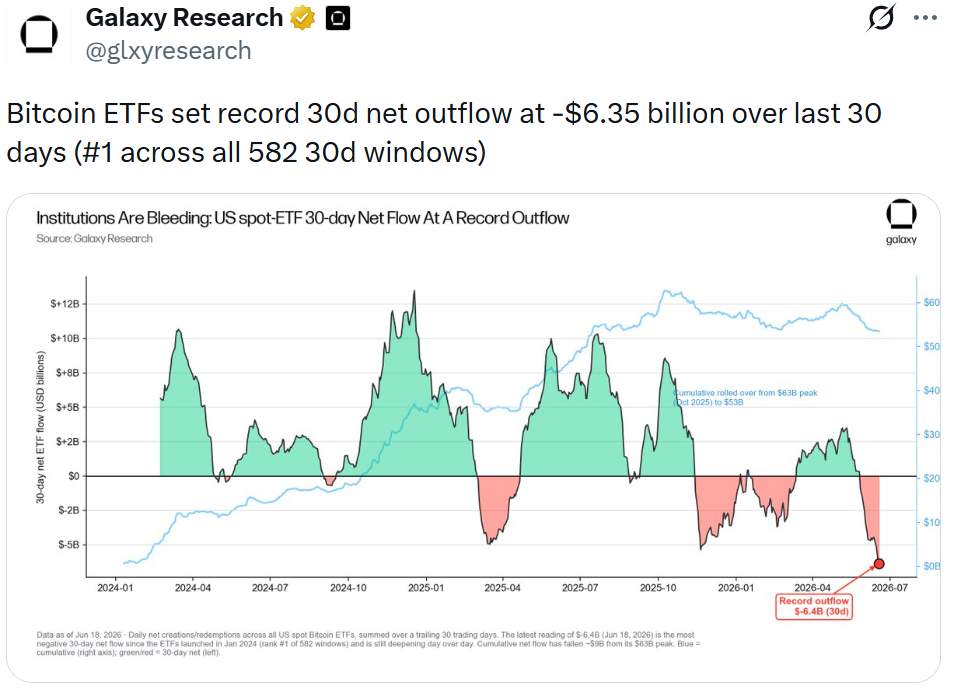
US-listed spot Bitcoin exchange-traded funds recorded their largest 30-day net outflow since launching in January 2024 amid a crypto bear market.
According to data from Galaxy Research, US Bitcoin ETFs saw $6.35 billion in net outflows over a trailing 30 trading days. It also comes as they registered their sixth week of outflows last week, bringing their cumulative net flow to $53.4 billion, down from their $63 billion peak in October 2025.
Galaxy Research said the daily outflows are “still deepening day over day.”
The outflows could reflect waning sentiment from institutional investors for Bitcoin. However, BlackRock US head of equity ETFs Jay Jacobs told Cointelegraph on Thursday that there are many other reasons why outflows occur day to day.
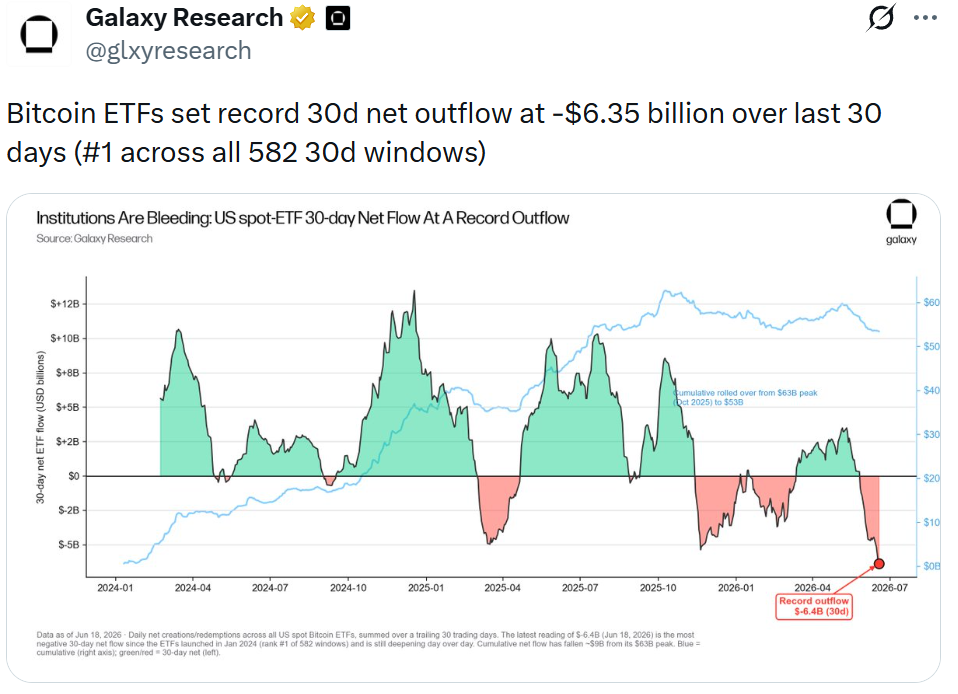
Source: Galaxy Research
“What I think is maybe sometimes misunderstood by the market is that if we see a day of outflows, there could be a million reasons why. It could be someone selling IBIT and buying BITA,” Jacobs said, referring to its iShares Bitcoin Premium Income ETF (BITA), which launched on Wednesday.
Bitcoin is trading at $64,167 at the time of writing, down 17.4% over the past month. The asset has been pressured by macroeconomic factors, including an increase in US inflation, along with the ongoing war between the US and Iran.
Related: Bitcoin activity nears record highs on microtransaction surge
However, Jacobs said the volatility hasn’t impacted BlackRock’s view of Bitcoin as a global, decentralized, nonsovereign monetary alternative.
“Every asset class has volatility… we have over 450 exchange-traded funds within iShares,” said Jacobs, referring to the family of ETFs and index mutual funds managed and marketed by BlackRock.
“So we see inflows and outflows every day across a wide range of assets from large cap, small cap, Bitcoin, gold, etc. So in the short term, it’s absolutely not something that changes the way we view the asset or the utility of the asset.”
Magazine: Bitcoin decouples from tech stocks, Ether eyes ‘selling wave’: Market Moves



Two Texas brothers pleaded guilty in a federal case tied to the armed robbery of a Minnesota family and the theft of more than $8 million in cryptocurrency.
Summary
- Two Texas brothers pleaded guilty to robbery after an armed $8 million crypto kidnapping case.
- Prosecutors said the victims were held for nine hours while crypto was transferred under threat.
- The case adds to rising global wrench attacks targeting crypto holders and their family members.
The U.S. Attorney’s Office for the District of Minnesota announced the pleas on June 18.
Isiah Angelo Garcia, 25, and Raymond Christian Garcia, 24, both of Waller, Texas, pleaded guilty to one count each of Interference with Commerce by Robbery. Prosecutors said each man faces up to 20 years in federal prison. Sentencing dates have not yet been set.
Guilty pleas follow armed crypto robbery
According to the Justice Department, the Garcia brothers traveled from Texas to Minnesota in September 2025 to carry out the robbery. Prosecutors said they held a family at gunpoint in their home in Grant, Minnesota, while demanding access to crypto accounts.
The defendants admitted in their guilty pleas that they used firearms to threaten the victims and help carry out the robbery. They also agreed to pay more than $8 million in restitution.
“The guilty pleas entered today reflect our commitment to holding the defendants accountable for the choices they made,” U.S. Attorney Daniel Rosen said.
Prosecutors describe hours-long ordeal
Court records said the robbery began on Sept. 19, 2025. Prosecutors said the brothers zip-tied the victim, his wife and his son, and held the family at gunpoint for more than eight hours.
Isiah Garcia then took the main victim to a family cabin in northern Minnesota, where prosecutors said he forced him to retrieve extra crypto storage devices. The brothers ultimately forced the transfer of more than $8 million in digital assets.
The victim’s son later called 911 when one of the suspects left the home. Deputies found the wife and son still zip-tied inside the house. Investigators also found a disassembled AR-15-style rifle, ammunition and other items near the property.
Evidence led police back to Texas
The Justice Department said investigators used items left near the home to identify the suspects. Earlier charging documents said a Wendy’s receipt, rental car records, motel records and video surveillance helped track the brothers after they fled Minnesota.
Police arrested the brothers in Texas on Sept. 22, 2025. Prosecutors said Isiah Garcia later admitted that he and his brother drove to Minnesota, held the family at gunpoint and forced the crypto transfer.
The case moved from state charges to a federal case. The brothers were originally charged in Washington County, Minnesota, with kidnapping, robbery and burglary counts before the federal prosecution moved forward.
Case adds to wrench attack concerns
The guilty pleas come as law enforcement and security firms track more physical attacks against crypto holders. These attacks are often called wrench attacks, a term used when criminals rely on force, threats or kidnapping to steal digital assets.
As previously reported by crypto.news, France has faced a wave of crypto-linked abductions and attempted kidnappings in 2026, including a failed attack involving the wife of The Sandbox co-founder Sébastien Borget. The same report said security experts urged crypto holders to reduce public exposure and improve personal safety.
CertiK reported 34 verified wrench attack cases worldwide between January and April 2026, with estimated losses of about $101 million. Its earlier 2025 report counted 72 verified physical coercion incidents, up 75% from 2024.
The Minnesota case forms part of a wider pattern of physical crypto crime tracked by law enforcement and security firms. Prosecutors will next seek sentencing in federal court. Until then, both brothers remain convicted by guilty plea and await punishment.
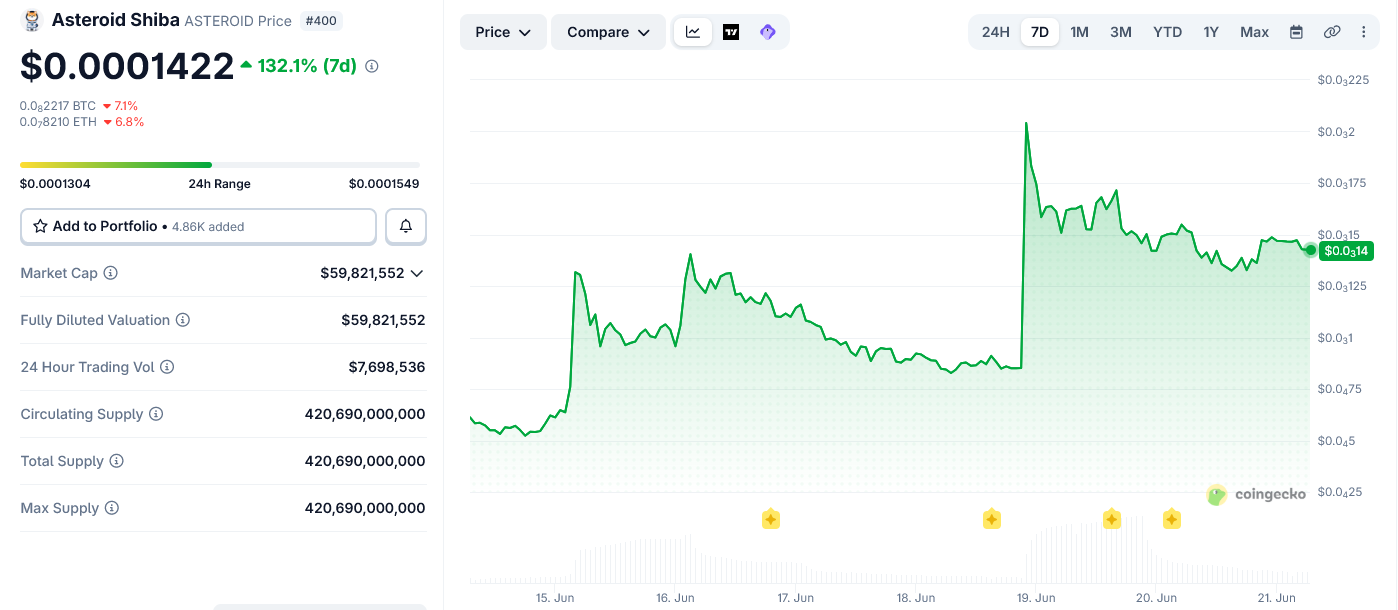
A Shiba Inu plush toy on SpaceX’s online store has sent a parody crypto token or meme coin into another sharp rally.
Asteroid Shiba, an Ethereum-based meme coin built around the “Asteroid” plush from SpaceX’s Polaris Dawn mission, jumped more than 137% over the past week, according to CoinGecko.
Its market value briefly climbed from roughly $22 million at its weekly low to about $86 million at the peak, before cooling to around $60 million.

That means the token briefly added more than $60 million in paper value during the move. Even after the pullback, it remains far above where it traded before the latest wave of SpaceX-linked attention.
A Plush Toy Becomes a Trade
The trigger was simple. SpaceX listed a $35 “SPACEX ASTEROID PLUSH” on its store, marked “coming soon,” with the company saying it expects Asteroid to “land” in September.
The store page describes Asteroid as a Shiba with “the fluffiest of ears” and says it was designed by “Liv P,” an honorary member of the Polaris Dawn team.
Crypto traders read that as fresh fuel for a story that had already gone viral once.

Asteroid was not created as a crypto mascot. It began as a real plush toy designed by Liv Perrotto, a young cancer patient and space fan who became connected to the Polaris Dawn crew through St. Jude-linked spaceflight efforts.
The plush flew on the Polaris Dawn mission in September 2024 as the crew’s zero-gravity indicator. That is the small object astronauts use to show when they have reached microgravity.
The Emotional Origin Story
Liv said Asteroid was inspired by Elon Musk’s Shiba Inu, Floki. She wanted the toy to help other children believe that space was not impossibly far away.
Before her death in January, Liv reportedly left Musk a list of questions. The last question asked whether Asteroid could become SpaceX’s official mascot. Musk later replied publicly, and that response helped turn the toy into a full crypto narrative.
In April, ASTEROID exploded after Musk’s reply. CoinDesk reported that one anonymous wallet turned a $575 trade into about $1.17 million in five days during that first run.
The latest rally is the sequel. This time, the catalyst was not just a social media reply. It was a SpaceX store listing.
The Line Traders Keep Blurring
The key detail is the distinction between the plush and the token. SpaceX is selling the Asteroid plush. It is not selling, endorsing, or backing the ASTEROID token.
The token has no formal ties to SpaceX, St. Jude, Musk, or Liv’s family, and no verified mechanism directing token proceeds to charity.
That has not stopped the market. ASTEROID now trades as a pure narrative asset: part SpaceX lore, part Shiba meme, part emotional internet story.
That combination has been enough to add tens of millions of dollars in market value within days. It also means the same attention that lifted it can disappear quickly.
The post SpaceX’s Mascot Shiba Dog Adds $50 Million to a Parody Token appeared first on BeInCrypto.
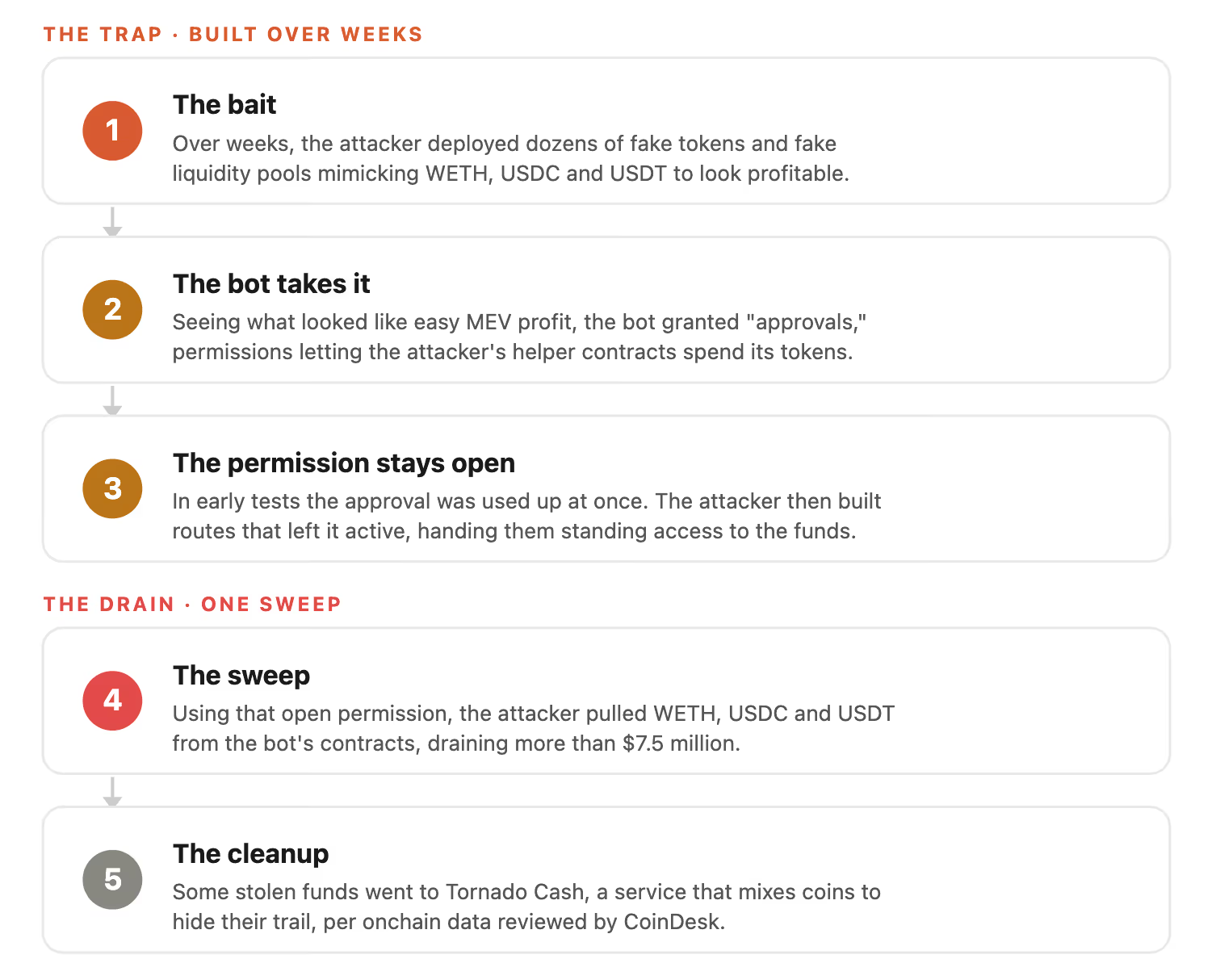
The setup was built over several weeks, where the attacker deployed dozens of fake token contracts and fake liquidity pools – a term for a pile of tokens locked on a decentralized exchange – that looked like profitable trades. Some mimicked familiar assets such as wrapped ether (WETH), and dollar-pegged stablecoins USDC and USDT.
That bait did what it was supposed to do. Jaredfromsubway.eth’s bot saw what looked like MEV opportunities and generated approvals for attacker-controlled helper contracts to spend tokens on its behalf. Those approvals were used immediately as part of the trade in earlier tests, but later, the attacker created routes where the approvals stayed open.
This left the attacker with standing permission to pull funds. And they used those open approvals to transfer WETH, USDC and USDT out of Jaredfromsubway.eth’s contracts, draining more than $7.5 million.
Some of the stolen funds were later sent to Tornado Cash, onchain data reveiwed by CoinDesk showed.

The irony was hard to miss, meanwhile.
Jaredfromsubway.eth has long been one of the most visible symbols of toxic MEV on Ethereum. Sandwich attacks cost Ethereum traders about $60 million a year, with 60,000 to 90,000 attacks per month between November 2024 and October 2025.


Pump.fun’s new GO bounty feature is facing fresh criticism after reports said users completed or posted tasks involving tattoos, public humiliation and high-risk stunts for crypto rewards.
Summary
- Pump.fun’s GO feature has paid over $370,000 while hundreds of bounties remain open online.
- Reported tasks range from charity actions to forehead tattoos, job quitting videos and risky stunts.
- Critics say crypto rewards can pressure vulnerable users into unsafe or humiliating public behavior online.
The Solana meme coin launchpad introduced GO in early June as a marketplace where users can create paid tasks and lock rewards in escrow.
According to the New York Post, the feature has paid out more than $370,000 since June 4. The report said about 270 open bounties still offered more than $200,000 in rewards, with some tasks ranging from charity actions to stunts that critics called unsafe or degrading.
How the GO bounty feature works
As previously reported by crypto.news, Pump.fun launched GO as a bounty marketplace with more than 320 active tasks and $144,000 in unclaimed rewards shortly after going live. Users could connect an X account and crypto wallet, then post or complete tasks for payouts starting at $5.
Pump.fun promoted the feature with the phrase “Pay ANYONE to do ANYTHING.” Bankless reported that rewards sit in escrow until Pump.fun reviews a submission, and that the platform has final authority over approval, rejection or cancellation.
Reports point to strange and risky tasks
The New York Post reported that one man in the Philippines received $15,000 in crypto after tattooing “bounty.fun” on his forehead. Other listings reportedly included putting a face in a toilet, quitting a job on camera and climbing Mount Everest for a large reward.
Some listed tasks were harmless, including feeding stray animals or donating clothes. Others raised safety and dignity concerns. Wired reported that several bounties pushed people toward embarrassment, harassment or possible legal risk, while some submissions appeared to use AI-generated images as proof. Wired also noted that payouts can be split among several entries.
Public criticism grows
New York Governor Kathy Hochul criticized the platform on X, calling it a “dystopian nightmare” and saying she would support the first bill introduced to ban it. X head of product Nikita Bier also criticized the feature, saying it showed people using money to push others into shameful acts.
The concern is not only about strange internet behavior. Critics argue that crypto rewards can put pressure on people with fewer resources to accept tasks they might otherwise avoid. Pump.fun warns users that participation is at their own risk, according to the New York Post. The company did not immediately comment to the outlet.
Earlier Pump.fun controversy adds context
The backlash follows earlier concerns around Pump.fun’s livestreaming tools. crypto.news reported that Pump.fun had shut down livestreaming after users became more extreme in how they tried to attract attention. The feature later returned with stricter moderation.
The Defiant reported that GO drew backlash within hours of launch after an extreme listing appeared on the platform. The report said GO gives Pump.fun sole authority to accept or reject tasks and submissions, while its public rules still leave many decisions to platform review.
Pump.fun remains one of the most watched meme coin platforms on Solana. Its GO feature now places the company in a wider debate over crypto incentives, user safety and online attention markets. The platform’s next steps may depend on how it handles moderation and public pressure. It may also face closer scrutiny from policymakers and consumer advocates.

Bitcoin’s crash to just under $60,000 meant that the asset had lost over 53% of its value since the all-time high marked in October last year. Although this correction is not as painful as previous cycles, some analysts seem convinced that BTC has either bottomed or is very close to it.
Michaël van de Poppe cited on-chain metrics signaling the bear market’s end could be around the corner, while Merlijn The Trader said, ‘Bitcoin looks dead,’ which could be the necessary catalyst for a major price revival.
One More Flush?
Merlijn compared this cycle to the ones from 2012, 2016, and 2020. In each, BTC’s price had remained calm and suppressed for months after a big correction that wiped out half or more of its value. Once the overall sentiment had dumped to new lows, the asset’s rally began, resulting in massive gains and a subsequent all-time high.
Consequently, he predicted that it’s ‘good’ that “Bitcoin looks dead right now,” as this is how every cycle bottom has felt in the past. However, he envisioned another flush before the eventual “moonshot.”
In a separate post, the analyst highlighted BTC’s electrical cost: the metric showing how much it costs, on average, to mine one unit. He noted that the cryptocurrency has fallen to that level now for just the fifth time in 11 years. All four previous occasions have “marked a historic bottom,” and “every single one launched a massive rally.”
Indeed Bottomed Out?
Michaël van de Poppe also speculated that BTC’s bottom during this cycle could already be here. He explained that many on-chain indicators are “signaling what we clearly want to see at these ranges: a bottoming formation on BTC.” One of those is the Puell Multiple, which has dropped to one of its lowest levels in the cryptocurrency’s history at 0.65.
Nevertheless, the analyst cautioned that the asset could still consolidate at these levels for months or dip slightly lower. However, BTC has already been sideways between $60,000 and $80,000 since the early February crash, which is a “pretty long period of consolidation, and if this current correction doesn’t go deeper, there’s no clear argument to say that the bottom isn’t here.”
Many onchain indicators are signalling what we clearly want to see at these ranges:
A bottoming formation on $BTC.
Yes, we can still consolidate here for months, or the markets can go deeper.
But don’t forget: the markets have already gone sideways from $60K for almost five… https://t.co/vZtruwaW7l
— Michaël van de Poppe (@CryptoMichNL) June 20, 2026
The post ‘Bitcoin Looks Dead Now:’ Analyst Reveals When the Next Moonshot Could Begin appeared first on CryptoPotato.

A Japanese corporate pension fund plans to start investing in crypto assets in fiscal 2026, in a rare move for the country’s retirement sector.
Summary
- Japan’s National Business Corporate Pension Fund plans a 1% crypto allocation through passive multi-asset funds.
- The fund reportedly framed crypto as currency-risk diversification, not a short-term return strategy for growth.
- Japan’s changing crypto rules could give institutions clearer paths to ETFs, futures, and tax relief.
The National Business Corporate Pension Fund, based in Okayama City, serves about 1,200 small and medium-sized companies and manages about 21.3 billion yen, or roughly $136 million, according to CoinPost, citing Nikkei.
The fund reportedly plans to allocate about 1% of total assets to crypto. The exposure would come through a passive fund managed by a major hedge fund and would hold multiple crypto assets. The fund has not disclosed the exact tokens or the manager.

Fund cites currency risk as main reason
The reported allocation is not being framed as a short-term bet on crypto prices. CoinPost said the main goal is currency risk diversification. The fund’s fiscal 2025 asset mix stood at 80% yen, 15% dollars and 5% other currencies.
For fiscal 2026, the fund plans to cut yen exposure to 70% and add a 10% allocation to developed-market currencies. Another 5% would include emerging-market currencies, gold and crypto. Aiyu Kiguchi, the fund’s investment executive director, reportedly said the dollar “may lose its status as a reserve currency,” explaining why the fund did not raise dollar holdings.
Six years of research led to decision
Kiguchi also reportedly said the fund reached its view after about six years of research. He said the market had “matured” as the investor base became deeper. The fund is also studying funds that use arbitrage strategies across several crypto assets.
The plan remains small by design. A 1% allocation would give the pension fund exposure while limiting direct pressure on its wider portfolio. That matters because defined benefit plans must protect retirement savings and manage losses with care. CoinPost said the fund has a funded ratio above 140% and an effective equity ratio above 30%.
Japan’s crypto rules are changing
The pension plan comes as Japan moves toward a wider rewrite of crypto rules. As previously reported by crypto.news, Japan’s lower house passed a bill on June 11 to move crypto assets from the Payment Services Act to the Financial Instruments and Exchange Act.
Crypto.news also reported that the linked 20% tax rate is a target for 2028, not an immediate change. The same legal shift could help open a path for regulated crypto exchange-traded funds in Japan, although further upper-house review and rulemaking are still needed.
Osaka Exchange also eyes Bitcoin futures
Separately, CoinPost noted that Osaka Exchange, part of Japan Exchange Group, aims to launch Bitcoin futures in 2028 if spot Bitcoin ETFs become legal in Japan. The exchange would use futures to meet hedging demand from institutional investors.
Reuters reported this month that a ruling party panel also urged Japan to build a legal framework for crypto ETFs and promote yen stablecoins in Asia. Together, these moves show how Japan is trying to place crypto inside regulated market channels rather than leave it only to direct exchange trading.
The pension fund’s plan marks a cautious step by a medium-sized Japanese asset owner. It does not change the risk profile of crypto assets. It does show that some domestic institutions now see limited crypto exposure as part of currency and portfolio planning.


Bitcoin steadied near $64,000 over the weekend, clawing back part of Friday’s drop, as traders weighed the start of US-Iran ceasefire talks against a renewed threat to close the Strait of Hormuz.
The token traded around $64,200 on Sunday, up 0.9% over 24 hours but roughly flat on the week, per CoinDesk data, after dropping below $63,000 on Friday. Most majors firmed alongside it.
Ether rose 0.5% on the day and 3.3% on the week to $1,734, solana gained 1.5% to $73 and tron added 1.2%. Hyperliquid’s HYPE slipped 2% on the day but remains the week’s standout, up 14.8%. Dogecoin was the weakest major, down 4.9% over seven days.
Bitcoin has gone nowhere on net this week, rallying early on the signed Iran deal, selling off Friday in a broad risk-off move, and stabilizing over the weekend.
The weekend’s focus is Switzerland, where US and Iranian officials, including Vice President JD Vance, are due to open talks on a permanent ceasefire, per Bloomberg.
The negotiations follow the memorandum of understanding President Donald Trump signed last week, which set a 60-day window that can be extended.


Ethereum’s well-known MEV bot JaredFromSubway was drained after an attacker used contracts that made its automated trading system grant token approvals, according to Blockaid.
Summary
- Blockaid says attacker-controlled contracts tricked JaredFromSubway’s automated system into granting approvals later used for draining.
- Jared publicly claimed a $15 million loss, while Blockaid’s public estimate stood near $7.5 million.
- Crypto.news previously tied JaredFromSubway to Vitalik Buterin’s swap and heavy Ethereum gas use in 2023.
The security firm said the incident was not a normal phishing case and not a direct bug in the victim contract.
“This is not a classic phishing attack and not a traditional smart-contract vulnerability in the victim contract,” Blockaid said.
The firm said the bot approved attacker-controlled contracts during routes that appeared to be profitable MEV trades.
Blockaid says approvals stayed open
Blockaid said the attacker first tested routes where approvals were used at once, leaving no open allowance. Later, the attacker changed the route design so the bot gave approvals that were not spent or revoked.
One example cited by Blockaid involved an approval of about 92.16 WETH to an attacker helper contract. Etherscan data for the transaction showed jaredfromsubway.eth interacting with its MEV Bot 2 contract before the later sweep. The transaction record also showed ERC-20 movements tied to the same automated route.
Final sweep hit WETH, USDC and USDT
The final transaction used the open approvals to pull WETH, USDC and USDT from the JaredFromSubway MEV bot contract through transferFrom. Etherscan showed transfers from “jaredfromsubway: MEV Bot 2” to the attacker wallet beginning with 0x3e37.
Blockaid put the drained amount at about $7.5 million. The JaredFromSubway account later claimed the loss was $15 million and offered a $1 million bounty for the full return of the funds. That difference has not been fully explained in the public posts reviewed.
How the attacker turned the bot’s logic against it
The attack appears to have targeted the bot’s own trading workflow. MEV bots watch Ethereum activity and act on transactions that look profitable. In this case, attacker-controlled contracts made the route look useful enough for the bot to approve spending rights.
The attacker used 66 fake token contracts that copied the look and function of WETH, USDC and USDT. These contracts were paired with fake liquidity pools. The setup pushed the bot toward approvals that later became the path for the drain.
JaredFromSubway’s record is back in focus
JaredFromSubway is one of Ethereum’s most watched sandwich bots. In a sandwich attack, a bot places trades before and after a user’s swap. This can give the user a worse price while the bot captures the spread.
As previously reported by crypto.news, JaredFromSubway targeted a small swap by Ethereum co-founder Vitalik Buterin in April, using about $1.14 million in WETH volume across SushiSwap and Uniswap V2. Crypto.news also reported in 2023 that the bot used 455 ETH in gas within 24 hours and accounted for about 7% of Ethereum gas use during that period.
The exploit now puts attention on token approvals used by automated systems. The case shows how a system built to act quickly on open market data can be steered into unsafe permissions when controls around approvals are weak. It also adds a new chapter to the wider debate over MEV, sandwich trades and user protection on Ethereum.
For now, the key public details remain split between Blockaid’s technical thread, the on-chain records and posts from the JaredFromSubway account. No recovery had been confirmed in the reviewed updates.
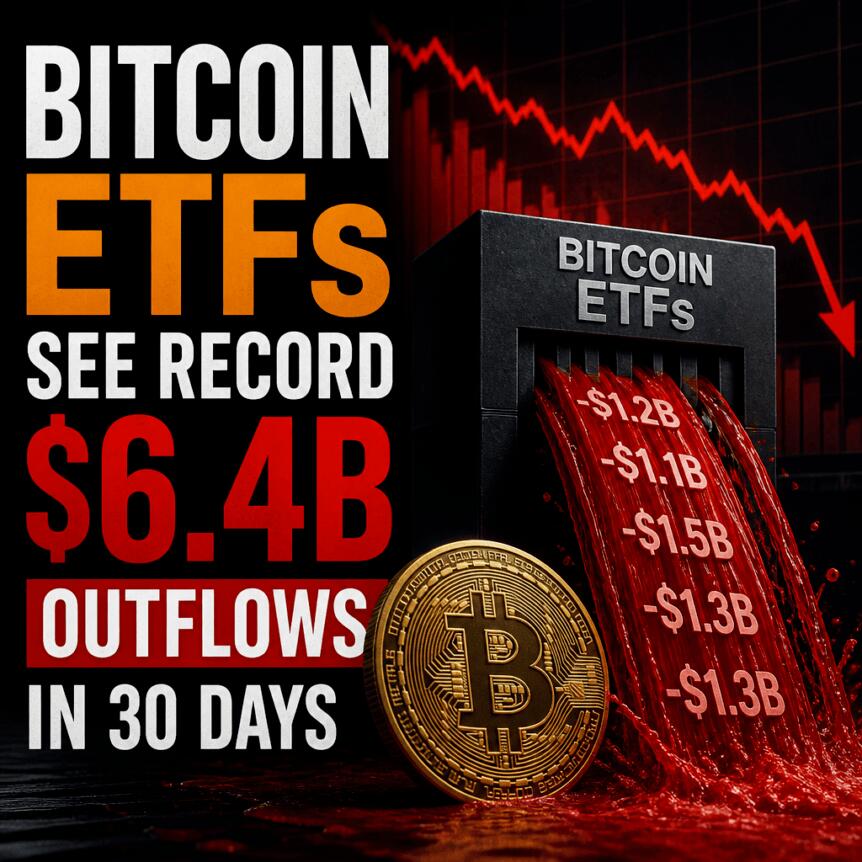
US-listed spot Bitcoin exchange-traded funds (ETFs) are experiencing another period of heavy selling pressure, with Galaxy Research data indicating the largest 30-day net outflow since the products began trading in January 2024. The renewed outflow streak comes amid a broader risk-off environment for crypto that has weighed on Bitcoin’s price and investor positioning.
According to Galaxy Research, US spot Bitcoin ETFs recorded $6.35 billion in net outflows across a trailing 30 trading-day window. The figures also align with a longer-running pattern: Galaxy Research said the ETFs logged their sixth consecutive week of net outflows last week, bringing cumulative net flows to $53.4 billion, down from a $63 billion peak reached in October 2025.
Key takeaways
- Galaxy Research reports US spot Bitcoin ETFs saw $6.35B in net outflows over the last 30 trading days.
- ETFs have now entered their sixth straight week of net outflows, with cumulative net flow down from a $63B peak in October 2025.
- BlackRock’s iShares US equity ETFs head Jay Jacobs said day-to-day ETF flows can have many causes beyond “bearish” sentiment.
- Bitcoin has been under pressure from macro factors, with trading at $64,167 at the time of writing, down 17.4% over the past month.
Biggest recent 30-day outflow highlights ongoing ETF stress
The latest ETF flow data points to a sustained rotation away from spot Bitcoin exposure rather than a one-off pullback. Galaxy Research’s assessment that daily outflows are “still deepening day over day” suggests pressure has not stabilized, even as the market continues to digest a relatively mature product lineup.
In earlier phases of the January 2024 rollout, inflow dynamics were closely watched as a signal that institutional demand was building. This time, however, Galaxy Research’s tracking shows the ETFs are moving further into negative territory relative to their earlier peak, implying that the market is currently in a different behavioral regime—one where outflows are not only recurring, but intensifying.
Why outflows happen: Jacobs points to internal ETF switching
While outflows can be interpreted as reduced institutional interest, BlackRock ETF executives caution against treating every day of selling as a single narrative. Speaking to Cointelegraph, Jay Jacobs, BlackRock US head of equity ETFs, argued that observers may be overreading short-term flow prints.
Jacobs said a day of outflows might reflect a portfolio reshuffle among ETF products rather than broad withdrawal from the asset class. He noted that transfers can occur within the ETF ecosystem—for example, an investor could sell one Bitcoin ETF and buy another.
“What I think is maybe sometimes misunderstood by the market is that if we see a day of outflows, there could be a million reasons why. It could be someone selling IBIT and buying BITA,” Jacobs said. His comments referenced BITA, an iShares Bitcoin Premium Income ETF launched on Wednesday.
This distinction matters for readers because it changes how flow data should be interpreted. If part of the outflow is simply switching between products, then net outflow numbers may understate underlying demand for Bitcoin exposure, at least in the very short run. That said, Galaxy Research’s broader multi-week pattern still indicates investors are leaving the spot Bitcoin sleeve overall, even if some flows may represent internal reallocations.
Macro pressure and geopolitical risk sit alongside ETF weakness
ETF outflow data is arriving as Bitcoin faces multiple headwinds outside the funds themselves. The article notes Bitcoin was trading at $64,167 at the time of writing, down 17.4% over the month, with the coin “pressured by macroeconomic factors,” including an increase in US inflation and the ongoing war involving the US and Iran.
Macro variables can influence Bitcoin’s attractiveness to both institutions and retail traders, especially during periods when liquidity conditions and risk appetite deteriorate. In such environments, investors often reduce exposures that are perceived as volatile, or they demand higher compensation for risk—both of which can show up as ETF outflows.
However, ETF flows also do not always move strictly in tandem with price. Even when Bitcoin declines, flow can sometimes remain steady as new investors enter or as existing holders rebalance. Here, though, Galaxy Research’s “deepening” language suggests that both price weakness and investor behavior are aligned toward reducing spot ETF exposure.
BlackRock maintains a longer-term view despite volatility
In response to the current outflow environment, Jacobs emphasized that volatility itself does not necessarily alter the long-term investment case for Bitcoin. He framed ETF flow variability as common across asset classes managed by large index and ETF providers.
Jacobs said BlackRock continues to view Bitcoin as a “global, decentralized” and “nonsovereign monetary alternative,” adding that short-term fluctuations are expected within a broad ETF lineup. He referenced the scale of iShares products, saying the firm manages “over 450 exchange-traded funds” within iShares.
“Every asset class has volatility… we have over 450 exchange-traded funds within iShares,” Jacobs said. He added that inflows and outflows occur across a wide range of assets—ranging from large cap and small cap equities to Bitcoin and gold—and that, in the short term, daily fund flow movement does not change how BlackRock views the asset’s utility.
For investors, the practical takeaway is that ETF flow cycles may not be a clean proxy for conviction. At the same time, persistent, multi-week outflows—as Galaxy Research describes—still deserve attention, because sustained selling reduces net demand for spot Bitcoin exposure and can compound downside if it drives additional hedging or portfolio adjustments.
Going forward, readers should watch whether outflows stabilize or continue to deepen week over week, and whether any of the newly launched or expanding ETF lineup leads to more visible switching patterns rather than pure reduction in Bitcoin exposure. With macro conditions and geopolitics still in the background, the key uncertainty remains whether current fund outflows represent temporary repositioning—or a longer retreat from spot Bitcoin demand.
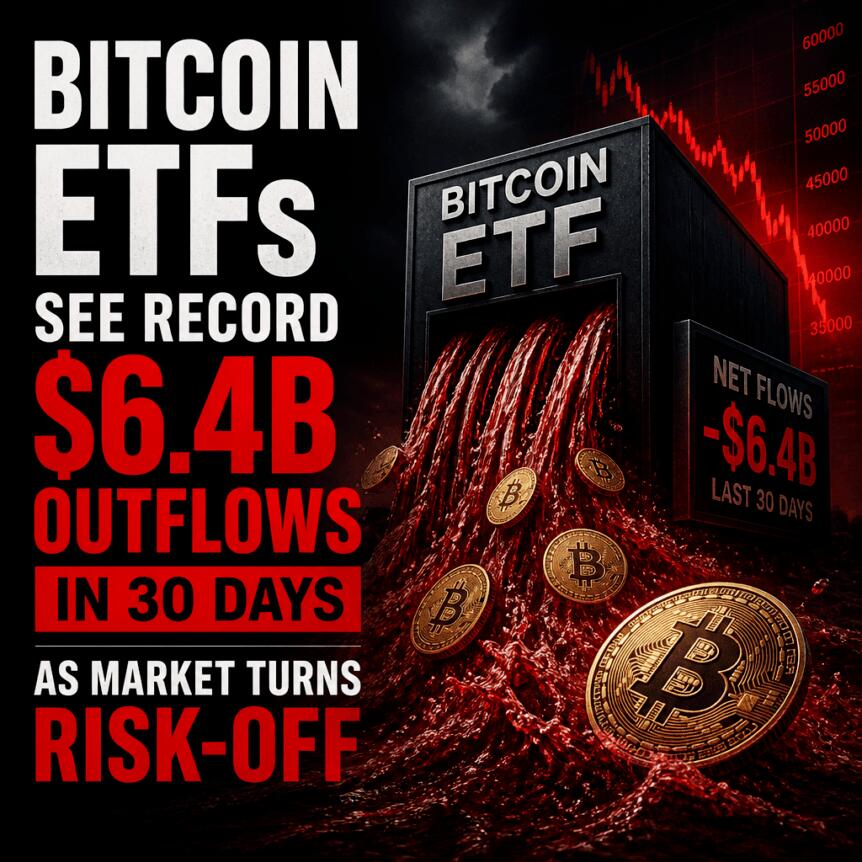
US-listed spot Bitcoin exchange-traded funds (ETFs) are enduring a prolonged stretch of withdrawals, registering their largest 30-day net outflow since trading began in January 2024. The move comes during a broader risk-off period for crypto markets and underscores how ETF flows can diverge from short-term price headlines.
According to Galaxy Research data shared on social media, US spot Bitcoin ETFs recorded $6.35 billion in net outflows over the trailing 30 trading days. This also marks a continuation of negative momentum, with the funds completing six straight weeks of outflows, bringing cumulative net flow to $53.4 billion—down from a $63 billion peak reached in October 2025.
Key takeaways
- Galaxy Research reports $6.35B in net outflows across US spot Bitcoin ETFs over the last 30 trading days, the worst since January 2024.
- Six consecutive weeks of withdrawals have reduced cumulative ETF net flows to $53.4B, below an $63B high in October 2025.
- BlackRock’s iShares ETFs chief for US equity ETFs, Jay Jacobs, said day-to-day outflows can have multiple drivers that don’t necessarily reflect a single bearish thesis.
- Bitcoin’s spot market remains pressured by macroeconomic factors and geopolitical risk, though Jacobs argued volatility alone doesn’t change ETF issuers’ long-term positioning.
The worst 30-day outflow since launch
While spot Bitcoin ETFs have not been uniformly positive since their launch, Galaxy Research’s latest tally highlights how quickly the flow picture can worsen when sentiment turns. The firm characterized ongoing daily withdrawals as “still deepening day over day,” suggesting the recent outflows are not merely a short-lived dip.
Galaxy’s figures also frame the withdrawals against the ETFs’ earlier accumulation phase. The current cumulative net flow of $53.4 billion remains positive overall since launch, but it is now well below the $63 billion peak registered in October 2025—indicating that inflows earlier in the cycle have been partially given back.
Why ETF outflows don’t always mean “institutional exit”
Some market participants may read persistent outflows as confirmation of weakening institutional demand. However, BlackRock’s Jay Jacobs pushed back against a simplistic interpretation of daily ETF flow prints.
Speaking to Cointelegraph, Jacobs argued that outflows can result from routine reallocations rather than a broad selloff. In his view, a single day of withdrawals may reflect internal fund switching—such as investors moving exposure from one ETF to another.
“What I think is maybe sometimes misunderstood by the market is that if we see a day of outflows, there could be a million reasons why. It could be someone selling IBIT and buying BITA,” Jacobs said, referring to BlackRock’s iShares Bitcoin Premium Income ETF (BITA), which launched on Wednesday.
This distinction matters for traders and allocators trying to interpret flows as a directional signal. Galaxy Research’s data points to a negative trend over weeks, but Jacobs’ comments suggest that even during such periods, component funds within the broader Bitcoin ETF complex can experience opposite movements as investors rebalance.
Bitcoin price pressure continues alongside flow weakness
At the time of writing, Bitcoin was trading around $64,167, down 17.4% over the past month. Cointelegraph previously reported that Bitcoin has been pressured by macroeconomic factors, including increased US inflation, as well as geopolitical risk tied to the ongoing conflict between the US and Iran. Those drivers can weigh on liquidity and investor risk appetite—conditions that often affect both spot crypto demand and ETF flow behavior.
Even so, Jacobs said BlackRock does not treat BTC volatility as a reason to reconsider the asset’s longer-term role. He characterized volatility as a feature of many markets and pointed to the breadth of assets held across iShares’ ETF lineup.
“Every asset class has volatility… we have over 450 exchange-traded funds within iShares,” Jacobs said, noting that daily inflows and outflows occur across different asset categories including large-cap, small-cap, Bitcoin, and gold.
In his framing, short-term flow reversals do not necessarily change the underlying investment utility. “So we see inflows and outflows every day across a wide range of assets from large cap, small cap, Bitcoin, gold, etc. So in the short term, it’s absolutely not something that changes the way we view the asset or the utility of the asset.”
What investors should watch next
The immediate takeaway is that the ETF complex is still bleeding, with Galaxy Research pointing to deepening daily outflows and the worst trailing 30-day result since launch. The longer question is whether this pattern continues to consolidate into sustained outflow pressure—or whether it stabilizes as investors rotate between funds and as macro and geopolitical conditions evolve.
For market participants, the next milestone will be whether ETF outflows remain concentrated over multiple weeks (supporting a bearish flow narrative) or start to narrow in magnitude as rebalancing activity and sentiment shifts take hold.

Etoro Bassey Stages Brilliant Comeback to Win First CBN National Open Tennis Title

This World Cup, Bigger Might Not Really Be Better

THE NEXT BITCOIN MOVE IS OBVIOUS…


-

 Business7 days ago
No Jackpot Winner as $257 Million Prize Rolls Over to $269 Million Monday Draw
-

 Fashion2 days ago
Weekend Open Thread: Miami – Corporette.com
-
 Crypto World6 days ago
Zimbabwe Requires Crypto Businesses to Register Annually Under New FIU Regulations
-
 Business1 day ago
Wall Street Week Ahead: Investors see Micron earnings as pulse check of AI rally momentum
-
 Entertainment7 days ago
Matt Damon’s Viral Sci-Fi Thriller Has Taken Over HBO Max
-

 Tech7 days ago
As AI companies race to go public, who else is along for the ride?
-

 Business7 days ago
Anthropic staff to meet White House officials next week, Axios reports
-
 Crypto World7 days ago
Bitcoin could crash to $48,000, if this historical pattern is triggered
-

 Crypto World1 day ago
HIVE shares jump as $220M AI deal speeds Bitcoin mining pivot
-
 NewsBeat7 days ago
what doctors are seeing in ebike crashes
-
 NewsBeat7 days ago
Warning of disruption as Cardiff Crossrail works to start
-
 NewsBeat7 days ago
Tributes to former deputy head teacher at Cambridge school among death and funeral notices
-
 Entertainment7 days ago
Kate Middleton Glare Goes Viral After Kids Booed At Royal Event
-

 Politics7 days ago
“Israel’s” ban on ICRC visits ruled illegal, but Knesset moves to stop them permanently
-

 News Videos7 days ago
Financial Accounting | Last Day Revision Strategy and Booster | CMA Inter – June 2026
-

 Crypto World7 days ago
XRP ETFs Outperform As Bitcoin And Ethereum Funds Extend Outflow Trend
-

 Tech6 days ago
Over 400 Arch Linux packages compromised to push rootkit, infostealer
-

 NewsBeat7 days ago
Singer Oliver Tree dies aged 32 in helicopter crash in Brazil
-

 Business7 days ago
Invesco Quality Income Fund Q1 2026 Commentary
-
 Crypto World7 days ago
Market Preview: SpaceX (SPCX) IPO Record, Federal Reserve Meeting, and Iran Nuclear Agreement
You must be logged in to post a comment Login