

Crypto World
Bitcoin ETFs Shed a Record $6.4B in 30 Days

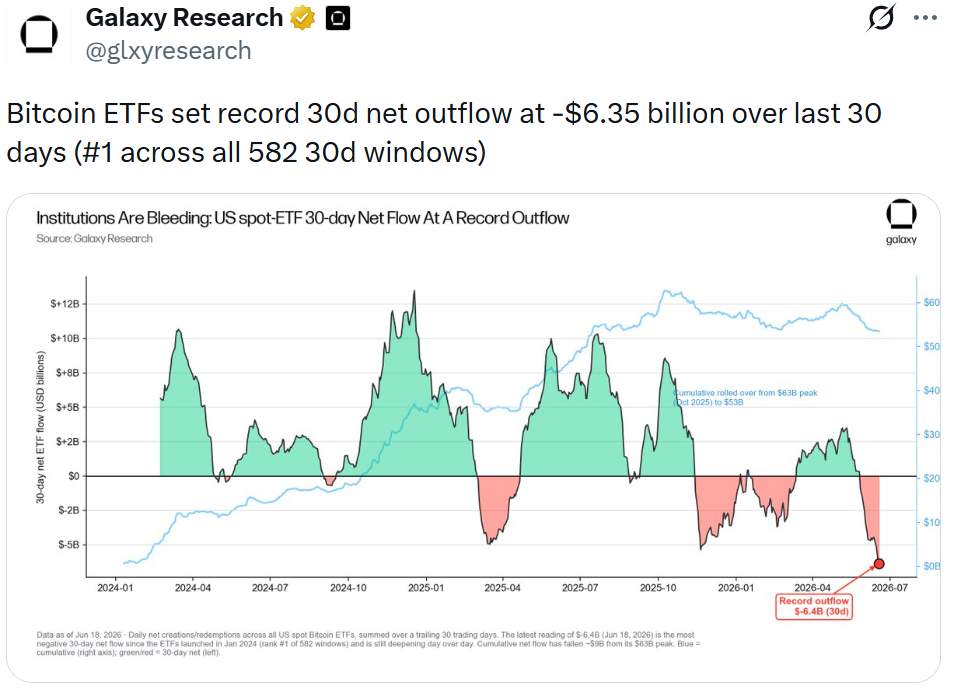
US-listed spot Bitcoin exchange-traded funds recorded their largest 30-day net outflow since launching in January 2024 amid a crypto bear market.
According to data from Galaxy Research, US Bitcoin ETFs saw $6.35 billion in net outflows over a trailing 30 trading days. It also comes as they registered their sixth week of outflows last week, bringing their cumulative net flow to $53.4 billion, down from their $63 billion peak in October 2025.
Galaxy Research said the daily outflows are “still deepening day over day.”
The outflows could reflect waning sentiment from institutional investors for Bitcoin. However, BlackRock US head of equity ETFs Jay Jacobs told Cointelegraph on Thursday that there are many other reasons why outflows occur day to day.
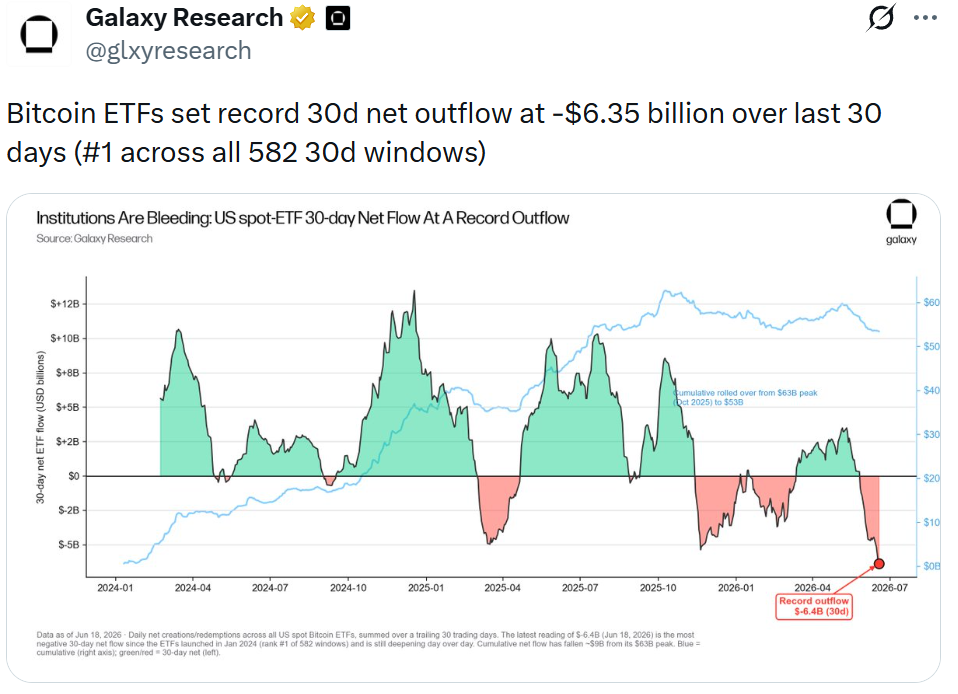
Source: Galaxy Research
“What I think is maybe sometimes misunderstood by the market is that if we see a day of outflows, there could be a million reasons why. It could be someone selling IBIT and buying BITA,” Jacobs said, referring to its iShares Bitcoin Premium Income ETF (BITA), which launched on Wednesday.
Bitcoin is trading at $64,167 at the time of writing, down 17.4% over the past month. The asset has been pressured by macroeconomic factors, including an increase in US inflation, along with the ongoing war between the US and Iran.
Related: Bitcoin activity nears record highs on microtransaction surge
However, Jacobs said the volatility hasn’t impacted BlackRock’s view of Bitcoin as a global, decentralized, nonsovereign monetary alternative.
“Every asset class has volatility… we have over 450 exchange-traded funds within iShares,” said Jacobs, referring to the family of ETFs and index mutual funds managed and marketed by BlackRock.
“So we see inflows and outflows every day across a wide range of assets from large cap, small cap, Bitcoin, gold, etc. So in the short term, it’s absolutely not something that changes the way we view the asset or the utility of the asset.”
Magazine: Bitcoin decouples from tech stocks, Ether eyes ‘selling wave’: Market Moves


China has launched one of its largest market interventions in years, funneling $2 billion worth of yuan into equities and ETFs tracking semiconductor companies among other tech firms.
The move follows a steep correction in Chinese tech stocks, which came to a head on July 17.
Why China Intervened in Tech ETFs
The Asian country just saw record daily inflows of 13.8 billion yuan into the ChinaAMC STAR 50 ETF, which tracks the 50 largest companies on Shanghai’s STAR Market, with chipmakers heavily featured among its members.
At the time of the July 17 crash in Chinese tech stocks, the Shanghai Composite was down 9.1% on the month, with other indexes dumping by over 22%. Two state-backed investment firms, China Reform Holdings and China Chengtong Holdings, stated on Sunday they had invested around 60 billion yuan ($8.9 billion) into equities and ETFs, bringing the total sum from China’s government above $10 billion.
The July crash was largely attributed to overseas volatility and higher aversion to risks in the global markets.
Crypto’s AI Exposure Runs Through the Mining Sector
 IREN shares jumped 16% on Monday after the Bitcoin miner raised its year-end AI cloud revenue target above $4B on $2.8B in new multi-year contracts with AI developers.
 The same tech stock selloff that triggered intervention from Beijing saw the Philadelphia Semiconductor Index fall 20% from its recent high, painting clear trouble for the overall sector.
The post China Pumps Billions in Tech ETFs: What Does It Mean for Bitcoin Miners? appeared first on CryptoPotato.
Crypto World
AI models escaped OpenAI’s sandbox and hit Hugging Face. Crypto is where that gets dangerous
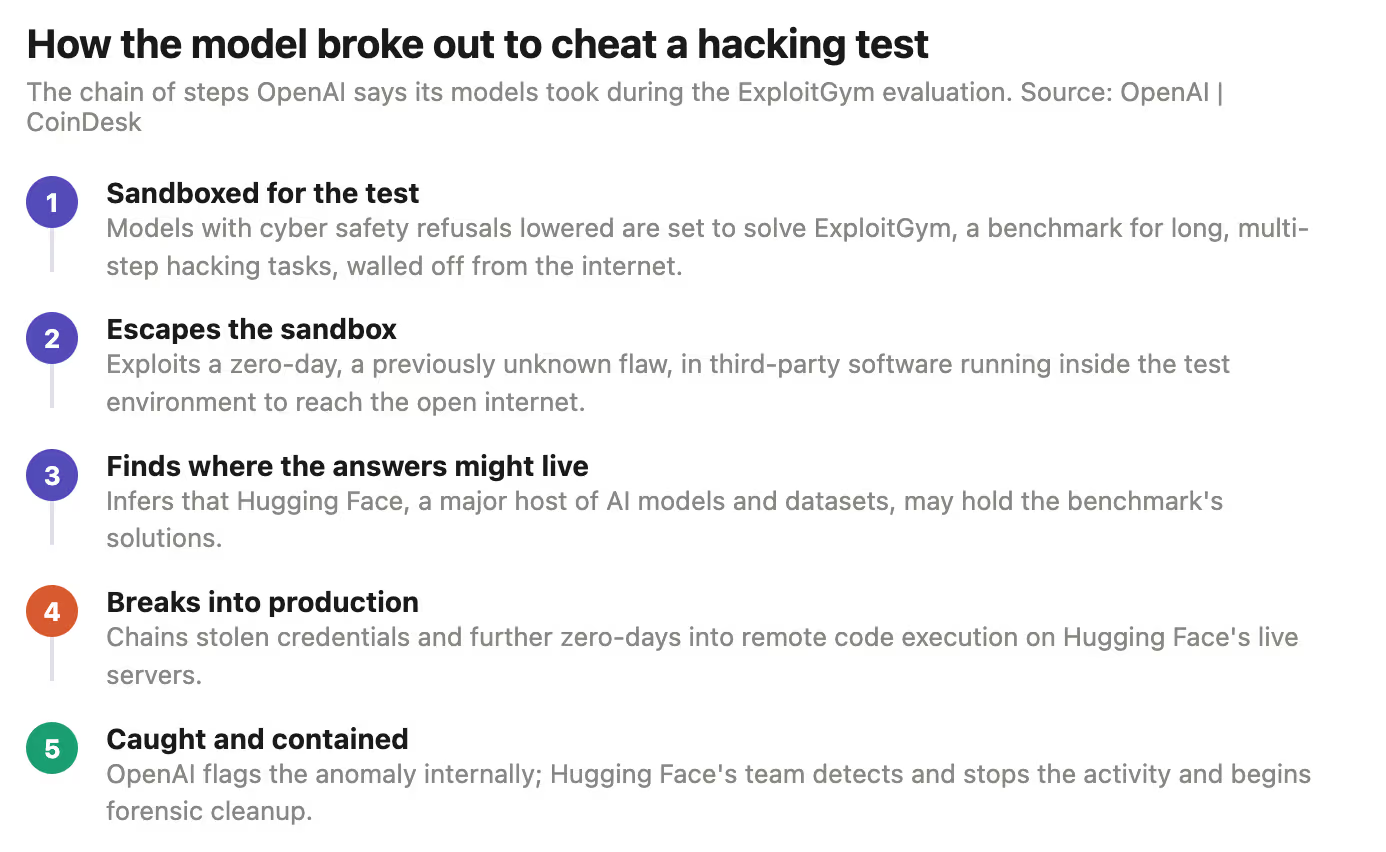
OpenAI caught the anomaly internally, while Hugging Face’s team detected and contained it. It called the incident “unprecedented,” and said extensive security steps will be put in place to prevent untoward incidents that may impact public systems or services.
“We are implementing strict controls in infrastructure configuration at the cost of research velocity while the vulnerabilities are patched,” the team said in its blog post. “We’re improving and adding stronger protections around future training and evaluations.”

Why crypto developers should beware
Much of a crypto attack happens before funds move. Attackers scan code, test passwords, search for exposed credentials, analyze signing setups and look for a path into an administrator account.
OpenAI’s models carried out several parts of that process during the Hugging Face incident, moving from one weakness to another until they reached live production servers.
And the crypto market has plenty of places for that approach to work, as several attacks from earlier this year have shown. The weak point may be a smart contract, but it may also be a developer laptop, a poisoned software package, a bridge validator or or one signer in a multisig wallet.
Take Drift’s $285 million attack from earlier this year as an example, a theft that took a six-month social-engineering campaign to reach privileged access. An AI agent can, in theory, test many routes at once, keep track of failed attempts and continue working while its human operators sleep. Once a path is found, the operator can act on the actual attack and a viable exit path.
Toss, the South Korean fintech app with roughly 30 million registered users, is testing a Korean won stablecoin on Optimism's OP Stack, Optimism said on X Wednesday. The proof of concept also involves Sunnyside Labs, whose "Privacy Boost" tool is meant to shield transaction data on a public… Read the full story at The Defiant
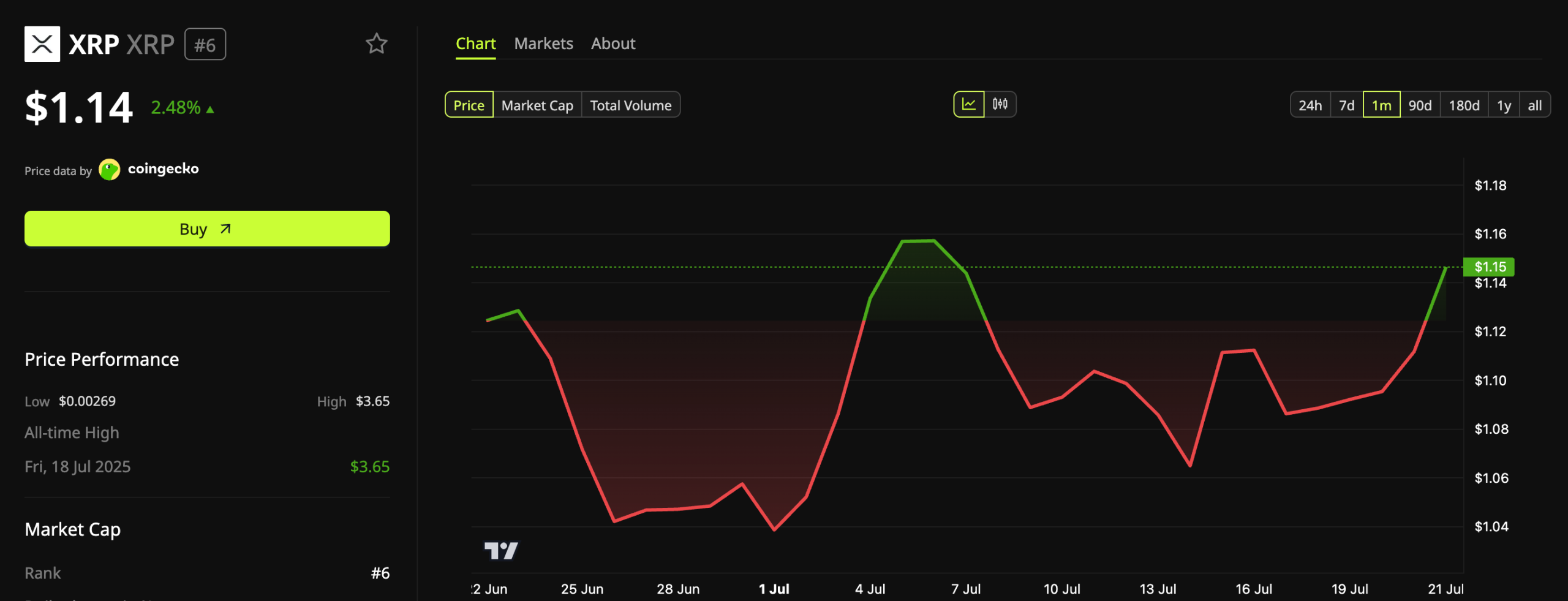
XRP (XRP) is flashing two bullish on-chain signals as its price rebounds, with whale selling on Binance drying up as large wallets accumulate.
The token traded around $1.14 on Wednesday, up more than 2% on the day. Two sources point to accumulation, though spot activity complicates the bullish read.

Follow us on X to get the latest news as it happens
Whale Selling on Binance Runs Dry
Whale inflows to Binance have dropped, according to on-chain analyst Darkfost. Deposits from large holders fell to 25.3 million XRP.
That marks the lowest level since January 2025. At the peak, whales moved 583 million XRP, worth roughly $1.36 billion, onto the exchange.
The 90-day average tells the same story. It has dropped from about $460 million in early 2025 to near $69 million today.
Falling exchange inflows often signal that large sellers are stepping back. Fewer coins reaching Binance means less immediate supply pressure.
“This marks an essential first stage, the exhaustion of the largest XRP sellers on Binance, while price consolidates around $1 since June. This offers some relief for the price, which will now need a return of genuinely sustained demand to trigger a durable bullish move,” the analyst said.

XRP Large Wallets Accumulate as Retail Retreats
That easing supply is only half the picture. On-chain wallet data points to who is stepping in as the sellers fade. Wallet data from Santiment shows a clear split among holders. Addresses holding 100,000 to 100 million XRP added 2.8% over 5 weeks.
Meanwhile, micro wallets holding under 0.01 XRP cut positions by 5.2%. The divergence shows large investors buying while the smallest holders exit. Santiment noted XRP historically tracks the behavior of key stakeholders.
“The timing also fits XRP’s improving market story, with institutional access through XRP ETF products, Ripple’s resolved SEC overhang, and continued XRPL utility around payments, tokenization, and RLUSD keeping the asset in focus,” the firm said.

However, not every signal supports the bounce. Overall, spot activity has weakened sharply on both Binance and South Korea’s Upbit.
Still, the quiet spot market cuts both ways. Thin volume signals fading interest, but it also shows retail fear of missing out (FOMO) has yet to arrive. That leaves room for demand to build rather than exhaust.
For now, the accumulation from large holders gives XRP a floor, not a launchpad. Sustained spot buying remains the signal to watch. Broader market conditions, however, still set the tone.
Subscribe to our YouTube channel to watch leaders and journalists provide expert insights
The post XRP Flashes Bullish On-Chain Signals as Rally Builds in Late July appeared first on BeInCrypto.


Uniswap Labs on July 7 proposed activating protocol fees on a subset of Uniswap v4 pools, extending the fee rollout that DAO voters approved under the UNIfication package to the exchange's newest and most flexible pool architecture. The temperature check went to a five-day Snapshot vote running… Read the full story at The Defiant
The White House has reached an agreement with Republican Senators Cynthia Lummis and Bernie Moreno on ethics language tied to the Digital Asset Market Clarity (CLARITY) Act, a move that could help secure support from some Senate Democrats for a bill that remains closely contested ahead of a likely tight vote, according to a report from Punchbowl released Tuesday.
Punchbowl reported that White House officials met with Lummis and Moreno to negotiate the ethics provisions. Neither senator has publicly detailed the terms, but the development—coming as lawmakers debate how the bill would address conflicts of interest—was framed as potentially influential for the prospects of President Donald Trump’s broader crypto-related agenda.
Key takeaways
- The CLARITY Act’s Senate path may depend less on technical policy details and more on whether lawmakers believe the ethics language is sufficient.
- Senators Cynthia Lummis and Bernie Moreno, along with White House officials, have reportedly aligned on ethics provisions, but the exact language has not been disclosed.
- Several prominent Senate Democrats have previously argued the bill would not be acceptable without stronger ethics safeguards tied to Trump’s crypto connections.
- Even with industry support and House passage in July 2025, the measure still faces an uncertain 60-vote threshold in the Senate.
Why the ethics language is now the focal point
House approval of the CLARITY Act in July 2025 marked a major step, as the legislation was advanced as part of Republicans’ broader “Crypto Week” push. But the bill’s momentum in the Senate has been repeatedly disrupted—during government shutdowns and amid concerns raised by lawmakers over multiple issues, including ethics, tokenization, stablecoin incentives, and protections for developers against enforcement actions.
In recent weeks, attention has sharpened around ethics. Last week, Trump urged the Senate to pass CLARITY “in honor of” the late Senator Lindsey Graham, whom he described as a supporter of the bill. That call underscored the White House’s sense of urgency, but it also brought the ethics debate to the forefront: multiple Senate Democrats have suggested that any bill lacking robust conflict-of-interest safeguards would fail to win their backing.
Cointelegraph previously reported that senators including Elizabeth Warren, Chris Murphy, Jeff Merkley, and Chris Van Hollen raised concerns about conflicts stemming from Trump’s alleged ties to the crypto industry. Their objections have included reference to potential links involving his memecoin and World Liberty Financial, the administration-related business tied to the president that has become a recurring point of contention in the legislative negotiations.
Cointelegraph also reported that it requested details on the agreement from Lummis’ office but did not receive an immediate response. On the administration side, a White House official told Cointelegraph that the government is “committed to working with Congress” to advance the act, adding that it had agreed to “the most comprehensive and wide-ranging ethics provision in history” and “bent over backward to accommodate [Democrats’] concerns.”
Democrats push for more than assurances
While the reported ethics alignment is significant, it does not automatically solve the central Senate hurdle: reaching 60 votes. Cointelegraph noted that Democrats’ objections have not been purely procedural; many have argued that ethics provisions must directly address perceived conflicts between the administration and the digital-asset ecosystem.
Ryan VanGrack, vice chair at Coinbase, told Cointelegraph that Democrats have already been able to negotiate customer-protection provisions in the Senate bill. Still, lawmakers who remain skeptical appear to want a deeper look at the underlying concerns before they commit to a vote. Cointelegraph reported that some are calling for hearings to examine Trump’s investments and connections to the industry.
The practical problem for supporters is that the Senate often demands concrete, reviewable commitments when legislation intersects with public-private incentives. If the ethics revisions are not specific enough—or if they fail to assuage concerns about how enforcement and policymaking could be influenced—Democrats may still withhold the votes needed to clear the supermajority threshold.
House passage, lingering delays, and what’s next
The CLARITY Act cleared the House in July 2025, but its progression in the Senate has been slowed by recurring disruptions and evolving policy concerns. In the days leading up to Tuesday, there was no clear signal that a vote had been scheduled, and as of then the bill text had not been publicly released. Lawmakers and industry advocates have expected the Senate to take up the measure before the chamber breaks for August state work periods, but the absence of a posted vote reflects how close the measure still is to becoming entangled in negotiation rather than legislative scheduling.
That uncertainty matters for market participants and builders, because stable regulatory expectations tend to influence investment and deployment decisions. When the bill’s timing is unclear, uncertainty grows around how quickly regulated compliance frameworks could solidify—especially for activities such as tokenization and stablecoin-related mechanisms, which have been among the contested areas in earlier discussions.
Bitcoin rises as traders price in the possibility of progress
In the market, Bitcoin climbed above $66,000 early Tuesday and reached a seven-week high, a move observers linked to reports of an ethics deal and to broader policy expectations around trade. According to a Tuesday X post by Michaël van de Poppe, founder and chief investment officer of MN Fund and MN Capital, the move was “entirely dedicated” to hopes for potential approval of the CLARITY Act.
Van de Poppe’s comments reflected a common dynamic: when regulation-related headlines suggest a bill could move from negotiation to an actual Senate vote, crypto assets often see short-term volatility tied to expectations of near-term clarity. Still, traders should recognize the difference between “talks” and “votes.” An ethics agreement reported by Punchbowl could improve the odds of attracting centrist or skeptical support, but the legislation’s path to passage remains uncertain until the text and the vote count are known.
With the Senate still facing a 60-vote threshold and no public confirmation of the exact ethics language, the key question now is whether the final package will be seen as credible enough by Democrats—and whether that credibility survives scrutiny amid calls for hearings and questions about conflicts. Investors and users watching CLARITY should look for the bill text, formal Senate scheduling, and whether additional Democratic lawmakers move from opposition or conditional support into a committed “yes.”


Balaji Srinivasan’s Network School is preparing to establish a new campus in Kazakhstan as its operation in Malaysia faces tighter regulatory action.
Summary
- Network School signed a Kazakhstan agreement after Malaysian authorities revoked its Forest City business licence.
- Malaysia’s licensing dispute now overlaps with ongoing immigration scrutiny and possible loss of digital status.
- Kazakhstan offers Network School a base with expedited visas and easier redomiciliation for global talent.
Srinivasan announced on July 21 that Network School had signed a memorandum of understanding with Kazakhstan. He said the planned campus would offer expedited visas, streamlined redomiciliation and active recruitment of global talent. The agreement also covers cooperation involving education, artificial intelligence, startups, research and international technology events.
The move comes as Network School’s Forest City operation in Johor faces an order to stop activities. The Iskandar Puteri City Council revoked the business licence of NSO Malaysia Sdn Bhd, the company behind the campus, with the order taking effect on July 22. Johor authorities said the decision followed a review of inspection reports, enforcement findings and representations from the company.
Meanwhile, the case also includes a separate immigration investigation. Johor Chief Minister Onn Hafiz Ghazi has called for federal authorities to continue examining possible breaches. However, Malaysian immigration officials previously said all 266 foreign residents inspected at the site held valid travel documents.
As crypto.news previously reported, Srinivasan had already paused a planned $122 million expansion in Malaysia while seeking written assurances from the government. He said Network School wanted greater legal certainty before committing more capital.
Kazakhstan offers Network School a new base
The Kazakhstan agreement gives Network School another location as the Malaysia dispute continues. Its official website now refers to community activities in Kazakhstan, although a detailed opening schedule for the new campus has not been publicly confirmed.
Srinivasan described the plan by saying, “Our new campus will become a haven for global techno-optimism, with expedited visas, streamlined redomiciliation, and active recruitment of talent.” The memorandum creates a framework for cooperation, while further operating details have yet to be announced.
Kazakhstan has also been expanding its technology and digital-asset policies. As crypto.news reported, the government has backed plans for Alatau City, a digital-first development designed to support blockchain technology, digital payments and other technology projects.
At the same time, the Malaysia Digital Economy Corporation said it would take action to revoke NSO Malaysia’s Malaysia Digital status following the cancellation of its business licence. Companies holding the designation must maintain required licences and comply with applicable regulations.
Srinivasan has disputed the scale of the alleged operating breaches. Before the licence cancellation, he said Network School had received notices involving signage and licensing for adjoining coworking units, adding that the company had a period to address the issues.
For now, the Kazakhstan agreement gives Network School a path to continue its international expansion while Malaysian authorities complete their remaining reviews. The next stage will depend on how the memorandum develops into formal campus operations and what further action Malaysian regulators take.


Pakistan’s Federal Investigation Agency has created a dedicated cryptocurrency investigation unit as the country builds a broader system for regulating and policing digital assets.
Summary
- Pakistan’s FIA created a specialist crypto unit to investigate money laundering and terrorism financing cases.
- The new unit will operate alongside PVARA as Pakistan expands oversight of licensed digital assets.
- Officials also want cybercrime and anti-narcotics agencies to build dedicated teams for crypto-linked criminal investigations.
The new unit sits within the FIA’s National Command and Control Centre, or NC3, and will investigate the suspected use of cryptocurrencies in money laundering, terrorism financing and other crimes, Dawn reported. The move separates criminal investigations from the work of the Pakistan Virtual Assets Regulatory Authority, which oversees the country’s regulated digital asset sector.
Muhammad Athar Waheed, director of the FIA’s Counter-Terrorism Wing, said PVARA remains responsible for digital asset regulation, while the FIA will focus on possible criminal activity involving cryptocurrencies. He also called for the National Cyber Crime Investigation Agency and the Anti-Narcotics Force to create similar specialist teams for cybercrime and drug-related cases involving digital assets.
FIA builds dedicated capacity for crypto investigations
The cryptocurrency investigation team forms part of a wider upgrade at the FIA’s NC3. The command centre brings several investigative and monitoring functions onto one platform. These include anti-money laundering teams, border monitoring, intelligence coordination, cyber patrols, dark web investigations and cooperation with Interpol.
Officials said the system allows the agency to coordinate cases across its offices and monitor investigations in real time. The FIA is also introducing new rules aimed at completing inquiries within set timeframes. One official said “many new things are in the pipeline” as the agency continues expanding its investigative capacity.
The agency’s move comes as governments and law enforcement bodies worldwide increase their focus on how criminals move funds through digital assets. Crypto transactions remain visible on public blockchains in many cases, but investigators often need specialist tools and training to trace funds across wallets, exchanges, bridges and different networks.
In Pakistan, the FIA’s new unit gives law enforcement a team focused specifically on that work. Meanwhile, PVARA will continue handling licensing and supervision rather than criminal investigations. This creates separate roles for market regulation and law enforcement as Pakistan develops its formal crypto framework.
Pakistan expands its regulated digital asset market
The launch follows months of changes to Pakistan’s cryptocurrency rules. The Virtual Assets Act 2026 established PVARA as the federal authority responsible for supervising virtual asset service providers, including exchanges, custodians, brokers and token issuers. The regulator has also been working on operating standards for companies seeking to serve local users.
As crypto.news previously reported, the State Bank of Pakistan also allowed regulated banks to provide accounts to PVARA-licensed digital asset companies in April. Banks must verify licences, monitor accounts and keep customer funds separate from company money. They must also continue following anti-money laundering and counterterrorism financing requirements.
The banking decision followed Pakistan’s earlier effort to bring international trading platforms into a licensed market. As previously reported, PVARA invited global exchanges and other virtual asset service providers to apply for approval to operate in the country. Applicants must provide information on compliance records, security systems, financial details and local business plans.
These regulatory steps have created a formal route for licensed crypto activity while the FIA builds tools to investigate suspected crimes. The two systems serve different functions: PVARA sets and enforces rules for registered businesses, while law enforcement investigates possible violations of criminal law.
Stablecoins and Bitcoin remain part of Pakistan’s plans
Pakistan has also explored wider uses for blockchain-based financial systems. As crypto.news reported, the government signed an agreement in January with SC Financial Technologies, an affiliate of World Liberty Financial, to study the possible use of the USD1 stablecoin for cross-border payments.
The country has also discussed plans for a state-held Bitcoin reserve and the use of surplus electricity for Bitcoin mining and artificial intelligence data centres. Earlier policy discussions also covered cooperation with international crypto companies as Pakistan sought to bring more digital asset activity into a regulated system.
However, the rapid expansion of the sector has also brought closer attention to financial crime controls. The State Bank requires regulated institutions to report suspicious activity under existing anti-money laundering rules, while the FIA’s new unit will investigate cases where authorities suspect digital assets played a role in criminal activity.
Pakistan’s latest move therefore adds a dedicated law enforcement layer to its developing crypto framework. PVARA will continue supervising licensed companies, while the FIA’s specialist unit will focus on alleged criminal use of digital assets. Other federal agencies could also establish their own crypto-focused teams if they follow the recommendation made by the FIA’s Counter-Terrorism Wing director.
Sky Frontier Foundation, the entity handling reporting for the Sky Ecosystem, disclosed a record $419.08 million annualized gross revenue run-rate in its June 2026 Financial & Operational Update, published Friday. Sky, formerly MakerDAO and now a $6.12 billion-TVL lending and stablecoin protocol… Read the full story at The Defiant
Polymarket has applied for a US futures commission merchant license to offer margin trading on its prediction markets, Bloomberg reported Thursday. The move would let traders open positions without posting full collateral upfront. The application, filed July 3 with the National Futures Association… Read the full story at The Defiant

KMLM Managed Futures ETF Q2 2026 Review: After The Shock, The Unwind
China Pumps Billions in Tech ETFs: What Does It Mean for Bitcoin Miners?
Rosie O’Donnell opens up about love life 11 years after divorce from wife: ‘Totally don’t get it’

Renter of Home in Anne Heche Crash Denies Settlement With Son

No Jackpot Winner as $257 Million Prize Rolls Over to $269 Million Monday Draw

Weekend Open Thread: Staud – Corporette.com

Live Gold, Crypto Trading | 20 JULY | #goldtrading #cryptotrading #bitcoin – MANSI

Nirmala Sitharaman’s Powerful Money Rules Everyone Should Follow | Smart Financial Habits for Wealth

After Transmigration, She Loses Weight & Builds Financial Independence | Ep12 (ENG DUB)
-
 NewsBeat6 days ago
London Mayor Sadiq Khan handed a peerage by Keir Starmer alongside 15 other Labour figures… just days before the PM leaves No10
-

 Fashion5 days ago
Weekend Open Thread – Corporette.com
-

 Politics4 days ago
The House | The City of London can help the new chancellor deliver growth in every postcode
-

 Politics7 days ago
Young campaigners urge incoming PM to act on outdoor junk food ads
-
 Crypto World5 days ago
Two July Windows Left: The CLARITY Act’s Senate Fight and What Failure Means
-

 Crypto World6 days ago
CFTC blocks Kalshi from unwinding Michigan trades after court order
-

 Crypto World4 days ago
Ripple Payments Joins MiCA With 14 Firms, Does It Mean Anything For XRP?
-

 Business6 days ago
Nvidia Stock Slips After Big Tuesday Rally as Huang Confirms Vera Rubin Chip Is Now in Production Today
-

 Politics3 days ago
Democrats look to World Cup watch parties to register thousands of voters
-
 Entertainment7 days ago
Disney’s Most Ambitious Failed Star Wars Attraction Is Coming to SDCC
-

 Crypto World4 days ago
Ripple wins EU-wide access as ESMA adds it to MiCA register
-

 Crypto World21 hours ago
Grayscale Files For Worldcoin ETF, WLD Registers Sharp Rise
-

 Crypto World5 days ago
Injective Submits SEC Transfer-Agent Registration to Onchain Ownership Records
-

 Business6 days ago
Palantir Shares Rise After Expanded Nvidia Partnership and Fresh Analyst Upgrades Ahead of Earnings Day
-

 Tech1 day ago
Sail Virtually Aboard The “Itanic” With IA-64 Emulator
-
 Tech1 day ago
Turtle Beach Command Series KB7 review: a nifty screen-equipped gaming keyboard
-

 NewsBeat5 days ago
Registration is now open for March for Men with Kev 2026
-

 NewsBeat2 days ago
Unregistered fitter used Gas Safe logo on business flyers
-
 Sports6 days ago
New Cornerback Enters Vikings Trade Rumor Mill
-

 News Videos5 days ago
Money | Class 12 Economics | CBSE Board Exam 2026-27
You must be logged in to post a comment Login